EP0251069B1 - Accéléromètre - Google Patents
Accéléromètre Download PDFInfo
- Publication number
- EP0251069B1 EP0251069B1 EP87108798A EP87108798A EP0251069B1 EP 0251069 B1 EP0251069 B1 EP 0251069B1 EP 87108798 A EP87108798 A EP 87108798A EP 87108798 A EP87108798 A EP 87108798A EP 0251069 B1 EP0251069 B1 EP 0251069B1
- Authority
- EP
- European Patent Office
- Prior art keywords
- magnet
- accelerometer
- casing
- sensors
- section
- Prior art date
- Legal status (The legal status is an assumption and is not a legal conclusion. Google has not performed a legal analysis and makes no representation as to the accuracy of the status listed.)
- Expired
Links
- 230000005355 Hall effect Effects 0.000 claims description 11
- 230000007423 decrease Effects 0.000 claims description 9
- 238000013016 damping Methods 0.000 claims description 7
- 239000012530 fluid Substances 0.000 claims description 6
- 230000000694 effects Effects 0.000 claims description 5
- 230000007935 neutral effect Effects 0.000 claims description 5
- 238000006073 displacement reaction Methods 0.000 claims description 3
- 239000007788 liquid Substances 0.000 claims 4
- 238000005286 illumination Methods 0.000 claims 2
- 238000007789 sealing Methods 0.000 claims 2
- 230000001419 dependent effect Effects 0.000 claims 1
- BGPVFRJUHWVFKM-UHFFFAOYSA-N N1=C2C=CC=CC2=[N+]([O-])C1(CC1)CCC21N=C1C=CC=CC1=[N+]2[O-] Chemical compound N1=C2C=CC=CC2=[N+]([O-])C1(CC1)CCC21N=C1C=CC=CC1=[N+]2[O-] BGPVFRJUHWVFKM-UHFFFAOYSA-N 0.000 description 10
- 230000001133 acceleration Effects 0.000 description 6
- 238000005192 partition Methods 0.000 description 3
- 239000003550 marker Substances 0.000 description 2
- 239000000725 suspension Substances 0.000 description 2
- 229910000906 Bronze Inorganic materials 0.000 description 1
- OAICVXFJPJFONN-UHFFFAOYSA-N Phosphorus Chemical compound [P] OAICVXFJPJFONN-UHFFFAOYSA-N 0.000 description 1
- 239000010974 bronze Substances 0.000 description 1
- KUNSUQLRTQLHQQ-UHFFFAOYSA-N copper tin Chemical compound [Cu].[Sn] KUNSUQLRTQLHQQ-UHFFFAOYSA-N 0.000 description 1
- 238000010586 diagram Methods 0.000 description 1
- 230000004907 flux Effects 0.000 description 1
- 238000007689 inspection Methods 0.000 description 1
- 239000000696 magnetic material Substances 0.000 description 1
- 238000004519 manufacturing process Methods 0.000 description 1
- 239000000463 material Substances 0.000 description 1
- 238000005259 measurement Methods 0.000 description 1
- 230000000704 physical effect Effects 0.000 description 1
- 238000011179 visual inspection Methods 0.000 description 1
Images

Classifications
-
- G—PHYSICS
- G01—MEASURING; TESTING
- G01P—MEASURING LINEAR OR ANGULAR SPEED, ACCELERATION, DECELERATION, OR SHOCK; INDICATING PRESENCE, ABSENCE, OR DIRECTION, OF MOVEMENT
- G01P15/00—Measuring acceleration; Measuring deceleration; Measuring shock, i.e. sudden change of acceleration
- G01P15/02—Measuring acceleration; Measuring deceleration; Measuring shock, i.e. sudden change of acceleration by making use of inertia forces using solid seismic masses
- G01P15/08—Measuring acceleration; Measuring deceleration; Measuring shock, i.e. sudden change of acceleration by making use of inertia forces using solid seismic masses with conversion into electric or magnetic values
- G01P15/105—Measuring acceleration; Measuring deceleration; Measuring shock, i.e. sudden change of acceleration by making use of inertia forces using solid seismic masses with conversion into electric or magnetic values by magnetically sensitive devices
-
- Y—GENERAL TAGGING OF NEW TECHNOLOGICAL DEVELOPMENTS; GENERAL TAGGING OF CROSS-SECTIONAL TECHNOLOGIES SPANNING OVER SEVERAL SECTIONS OF THE IPC; TECHNICAL SUBJECTS COVERED BY FORMER USPC CROSS-REFERENCE ART COLLECTIONS [XRACs] AND DIGESTS
- Y10—TECHNICAL SUBJECTS COVERED BY FORMER USPC
- Y10S—TECHNICAL SUBJECTS COVERED BY FORMER USPC CROSS-REFERENCE ART COLLECTIONS [XRACs] AND DIGESTS
- Y10S73/00—Measuring and testing
- Y10S73/01—Vibration
-
- Y—GENERAL TAGGING OF NEW TECHNOLOGICAL DEVELOPMENTS; GENERAL TAGGING OF CROSS-SECTIONAL TECHNOLOGIES SPANNING OVER SEVERAL SECTIONS OF THE IPC; TECHNICAL SUBJECTS COVERED BY FORMER USPC CROSS-REFERENCE ART COLLECTIONS [XRACs] AND DIGESTS
- Y10—TECHNICAL SUBJECTS COVERED BY FORMER USPC
- Y10S—TECHNICAL SUBJECTS COVERED BY FORMER USPC CROSS-REFERENCE ART COLLECTIONS [XRACs] AND DIGESTS
- Y10S73/00—Measuring and testing
- Y10S73/03—Hall effect
Definitions
- the present invention relates to an accelerometer and more specifically to an accelerometer for use in an automotive vehicle or the like and which exhibits an arrangement whereby temperature compensation can be effected without the need of a temperature sensor and associated complex circuitry.
- the device disclosed in this document includes a permanent magnet which is suspended in a manner that it can be displaced in one of the above mentioned vertical, lateral or for- aft directions of the vehicle; and a Hall-effect Hall IC which disposed proximate the magnet in a manner to be responsive to the movement thereof.
- the known device includes first and second proximity sensors. It also contains a magnet supported by a flexible member and moveable in first and second opposite directions.
- One feature of this known device is a temperature compensation by means of complementarily varying sensor outputs plus measurement of the difference of these outputs.
- An advantage of the present invention is the provision of an acceleration sensor arrangement which is arranged to exhibit temperature compensation without the need to resort to the provision of the temperature sensor and associated complex circuitry.
- first and second Hall-effect or the like type proximity sensors are arranged in combination with a magnet so that when the magnet is moved under the influence of an accelerative force or the like the output of one sensor increases while the other decreases.
- the magnitude of the difference between the two outputs is indicative of the force while the effects of temperature on the individual signals mutually offset one and other providing temperature compensation.
- the magnet is mounted in a pendulum-like arrangement wherein the magnet is supported in a balanced fashion by a single flexible member, causing the magnet to move in the first and second directions with a slightly arcuate path, the increase and decrease in the output of the first and second sensors being substantially proportional to their distance from the magnet.
- the present invention takes the form of an accelerometer which features a first proximity sensor disposed in a casing; a second proximity sensor disposed in a casing close to the first one; a magnet movably supported within the casing by a flexible member so as be movable from a neutral position in a first and second opposite directions, the first and second proximity sensors being arranged so that when the magnet is moved in the first direction the output of the first sensor increases and the second sensor decreases and when the magnet moves in the second direction the output of the second sensor increases and the output of the first one decreases.
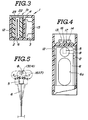
- Figs. 1 to 7 show an embodiment of the present invention.
- the interior of an elongate retangular cross- section non-magnetic casing 1 is partitioned into first and second sections 2, 3 by a partition wall 4.
- a permanent magnet 5 is disposed in the first of the two sections and supported on a flexible non-magnetic support member 6 which in this instance is made of a phosphor bronze of the like material.
- the member 6 in this embodiment takes the form of an essentially rectangular thin plate in which a large oval cut-out 6a is formed (see Fig. 4).
- the plate is arranged to be flexible in one direction (viz., in first and second opposite directions x and y - as shown schematically in Fig. 5).
- the poles (N,S) of the magnet 5 are alinged with the direction in which the member 6 is flexible.
- Weights 7 and 8 are attached to each face of the magnet 5 in a manner as shown in Fig. 2.
- the weights are formed of a non- magnetic material and are selected so that the combined mass of the weights and the magnet is of a value predetermined in view of the intended application of the device.
- the lower end (viz., the end distal from the magnet 5) of the flexible member 6 is embedded in a non-magnetic support 9 which can be sealingly inserted through an aperture formed in the lower end face of the casing 1 and project into the first section 2 of the casing 1.
- the support 9 is formed with two retangular cross-section finger-like extensions 10, 11 which flank the front and rear face of the support member 6.
- the first section 2 contains a damper oil 12. This fluid exhibits suitable viscosity and other physical properties suitable for damping excessively rapid motion of the pendulum like arrangement defined by the magnet 6, weights 7, 8, and flexible support member 6 and thus ensures stable operation of the device.
- First and second proximity sensors 13, 14 which in this embodiment take the form of linear type Hall-effect IC units are are disposed on the partition wall 4 in the second section 3 in a manner such as shown in Figs. 2 and 4.
- Each of these units has a respective Hall-effect element 16, 17 which are arranged in close proximity of the magnet in an essentially side-by-side manner.
- the elements 16 and 17 are arranged in a manner that when the magnet moves in the x direction for example the output of one element increases while the other decreases and vice versa.
- a differential amplifer circuit 15 is attached to an inner wall of the casing 1 in a manner to be spaced from the partition wall 4. This circuit provides an operative interconnection between the proximity sensors and a control circuit not shown such as that used to control an anti-skid control system, suspension or the like.
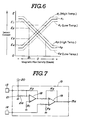
- Fig. 6 shows in graphical form the output characteristics of the two proximity sensors 13, 14 and the effect of temperature thereon.
- the sensors 13, 14 are arranged so that when the magnet 5 assumes a neutral position the outputs of the two sensors are equal. In Fig. 6 this situation is shown by the intersection of the traces al (sensor 13) and a2 (sensor 14) at a magnetic flux density denoted by "0".
- the instant device is constructed so that the maximum possible displacement of the magnet is limited in a manner, which as shown in Fig. 5, is such that the effective magnetic field (phi) generated by magnet 5 does not move to the point that the output of either sensor becomes constant. This ensures accurate metering even when the flexible member 6 is subject to maximum deflection.
- the difference between the two outputs for any change in magnetic field intensity is constant irrespective of the drift in output caused by changes in temperature while the magnitude of the difference indicative of the acceleration to which the mass (magnet and weights) are subject.
- the outputs of sensors 13 and 14 are E1 and E3 respectively, while under relatively low temperature conditions the corresponding outputs are E2 and E4.
- the magnitude of E1 - E3 and the magnitude of E2 - E4 are the same.
- Fig. 7 shows an example of a circuit arrangement which can be used to detect the difference between the outputs of the two Hall-effect units 13, 14 and generate a signal indicative of the acceleration to which the magnet 5 is subject.
- This circuit includes two differential amplifiers 18, 19. The first of these units is operatively connected with the Hall-effect IC 13 and a source of power 20.
- a variable resistor 21 is arranged between the current source 20 and connected with the inverting input (-) of differential amplifier 18 through a pickup 21a.
- the non- inverting input (+) of this device is connected to ground through a first pulldown resistor R1.
- the output of differential amplifier 18 is connected to its own inverting input (-) via resistor R2 and to the non-inverting input (+) of the second amplifer 19.
- the inverting input (-) of the second amplifier 19 is connected to the second sensor 14 and to ground through a pulldown resistor R3.
- the output of the second amplifer 19 is connected to its own non-inverting input (+) via
- a lamp 28 is disposed in an upper corner of the 1b face of the casing 1. This lamp 28 is operatively connected with the differential amplifier circuit 15 in a manner that it becomes illuminated when a balance between the outputs of the two proximity sensors 13, 14 is achieved. This of course facilitates adjustment of variable resistor 21 in that it is possible to visually detect the situation wherein a balance has been achieved between the outputs of the two proximity sensors and a zero output appears on terminal 15a.
- the casing 1 of the instant embodiment is formed with an inspection window 22 in side denoted by 1b in Fig. 1. This window is closed by a transparent or semi-transparent panel 23. Two level markers 24 and 25 are formed at the periphery of the window 22. By using these markers it is possible to determine by visual inspection if the appropriate amount of air is present.
- the air bubble 26 and the marker 24 act as a "spirit level" or level gauge which is used for setting the accelerometer in place when it is to be used for lateral and forward directional sensing while the marker 25 and the bubble are used when the device is to be disposed horizontally for sensing vertical acceleration.
Landscapes
- Physics & Mathematics (AREA)
- General Physics & Mathematics (AREA)
- Measurement Of Length, Angles, Or The Like Using Electric Or Magnetic Means (AREA)
- Transmission And Conversion Of Sensor Element Output (AREA)
Claims (11)
- Accéléromètre dans lequel un premier capteur de proximité (13) disposé dans un boîtier (1) et un deuxième capteur d'approche (14) est disposé près du premier capteur de proximité (13), l'accéléromètre possédant également un aimant (5) supporté mobile dans le boîtier (1) de façon à pouvoir être déplacé d'une position neutre dans des première (x) et deuxième (y) directions opposées, de sorte que lorsque l'aimant (5) se déplace dans la première direction (x), la sortie du premier capteur (13) augmente et celle du deuxième capteur (14) diminue, et lorsque l'aimant (5) se déplace dans la deuxième direction (y), la sortie du deuxième capteur (14) augmente et celle du premier capteur (13) diminue,
caractérisé en ce que
l'augmentation et la diminution de la sortie des premier et deuxième capteurs (13, 14) étant essentiellement proportionnelles au déplacement de l'aimant (5) depuis ladite position neutre, ledit boîtier comprend une portion de paroi (4) qui divise hermétiquement l'intérieur du boîtier en des première et deuxième sections (2, 3) dans lesquelles ledit aimant (5) et l'élément flexible (6) sur lequel l'aimant est supporté, est disposé dans la première section (2) et dans lesquelles les premier et deuxième capteurs (13, 14) sont disposés dans ladite deuxième section (3). - Accéléromètre selon la revendication 1, possédant en outre un circuit (15) répondant aux sorties des premier et deuxième capteurs (13, 14) d'une manière que la différence entre leurs sorties est déterminée et utilisée en tant que mesure de la force d'accélération à laquelle l'aimant (5) est soumise.
- Accéléromètre selon la revendication 1 ou 2, dans lequel ladite première section (2) de chambre contient un fluide d'amortissement qui exerce un effet d'amortissement sur le mouvement dudit aimant (5).
- Accéléromètre selon la revendication 1, dans lequel ledit élément flexible (6) est monté sur un élément (9) séparé dudit boîtier (1), ledit élément séparé (9) étant disposé de manière étanche dans une ouverture pratiquée dans ledit boîtier (1).
- Accéléromètre selon la revendication 2, comprenant en outre un dispositif d'illumination (28) disposé dans ledit boîtier (1), ledit dispositif d'illumination (28) étant relié pour son fonctionnement audit circuit (15) d'une manière à s'allumer lorsque les signaux desdits premier et deuxième capteurs de proximité (13, 14) sont équilibrés au point que la différence entre eux est zéro.
- Accéléromètre selon l'une des revendications précédentes, dans lequel lesdits premier et deuxième capteurs (13, 14) sont reliés en parallèle.
- Accéléromètre selon l'une des revendications précédentes, dans lequel lesdits capteurs (13, 14) possèdent une paire de transducteurs à effet de Hall (16, 17).
- Accéléromètre selon la revendication 7, comprenant en outre un moyen d'atténuation (21) pour atténuer la sortie de l'un (13) desdits transducteurs à effet de Hall de façon à rendre les sorties respectives de ladite paire des transducteurs à effet de Hall (16, 17) mutuellement égales.
- Accéléromètre selon l'une des revendications précédentes, dans lequel ledit aimant (5) est disposé à l'intérieur de la première section (2) et un fluide liquide d'amortissement (12) est prévu autour dudit aimant, une bulle (26) étant prévue dans ledit fluide liquide d'amortissement (12) pour permettre une fluctuation fonction de la température du volume dudit fluide liquide d'amortissement.
- Accéléromètre selon la revendication 9, dans lequel une portion conduisant la lumière (22, 24, 26) et formée à une portion de ladite première section (21) et à travers cette portion conduisant la lumière on peut discerner la position et la taille de ladite bulle pour déterminer l'orientation de ladite première section et le niveau dudit fluide d'amortissement.
- Accéléromètre selon la revendication 9, dans lequel ledit élément flexible (6) est prévu sur un élément étanche (9) séparé de ladite première section (2), ledit élément étanche (9) étant logé dans une ouverture dans ladite chambre pour former un joint liquide.
Applications Claiming Priority (2)
| Application Number | Priority Date | Filing Date | Title |
|---|---|---|---|
| JP61144472A JPS631975A (ja) | 1986-06-20 | 1986-06-20 | 加速度センサ |
| JP144472/86 | 1986-06-20 |
Publications (2)
| Publication Number | Publication Date |
|---|---|
| EP0251069A1 EP0251069A1 (fr) | 1988-01-07 |
| EP0251069B1 true EP0251069B1 (fr) | 1992-09-02 |
Family
ID=15363085
Family Applications (1)
| Application Number | Title | Priority Date | Filing Date |
|---|---|---|---|
| EP87108798A Expired EP0251069B1 (fr) | 1986-06-20 | 1987-06-19 | Accéléromètre |
Country Status (4)
| Country | Link |
|---|---|
| US (1) | US4870864A (fr) |
| EP (1) | EP0251069B1 (fr) |
| JP (1) | JPS631975A (fr) |
| DE (1) | DE3781472T2 (fr) |
Families Citing this family (21)
| Publication number | Priority date | Publication date | Assignee | Title |
|---|---|---|---|---|
| JPH0195667U (fr) * | 1987-12-18 | 1989-06-23 | ||
| DE3929082A1 (de) * | 1988-12-09 | 1990-06-13 | Teves Gmbh Alfred | Beschleunigungssensor mit einseitig eingespanntem biegebalken |
| JPH03253440A (ja) * | 1990-03-01 | 1991-11-12 | Zexel Corp | 車両安全装置のための制御システム |
| DE4033885A1 (de) * | 1990-10-25 | 1992-04-30 | Bosch Gmbh Robert | Beschleunigungssensor |
| DE4036224A1 (de) * | 1990-11-14 | 1992-05-21 | Bosch Gmbh Robert | Sensor |
| GB2284482A (en) * | 1993-12-02 | 1995-06-07 | Klippan Autoliv Snc | Improvements in or relating to an accelerometer |
| US5627315A (en) * | 1995-04-18 | 1997-05-06 | Honeywell Inc. | Accelerometer with a cantilever beam formed as part of the housing structure |
| US5670876A (en) * | 1995-11-14 | 1997-09-23 | Fisher Controls International, Inc. | Magnetic displacement sensor including first and second flux paths wherein the first path has a fixed reluctance and a sensor disposed therein |
| JP3719566B2 (ja) * | 1996-05-27 | 2005-11-24 | 株式会社デンソー | 電磁弁 |
| US6050160A (en) * | 1996-09-04 | 2000-04-18 | Joseph B. Willey | Apparatus and method for automatically compensating for lateral runout |
| US6101911A (en) * | 1996-09-04 | 2000-08-15 | Joseph B. Willey | Apparatus and method for automatically compensating for lateral runout |
| JPH10267685A (ja) * | 1997-03-21 | 1998-10-09 | Unisia Jecs Corp | 車両の横滑り角推定方法 |
| US6515474B1 (en) | 1997-08-06 | 2003-02-04 | Fisher-Rosemount Systems, Inc. | Linearized magnetic displacement sensor |
| US6060881A (en) * | 1997-08-06 | 2000-05-09 | Fisher Controls International, Inc. | Flux shaping pole pieces for a magnetic displacement sensor |
| US6536469B2 (en) | 1999-06-29 | 2003-03-25 | Fisher Controls International, Inc. | Self-centering magnet assembly for use in a linear travel measurement device |
| US6909281B2 (en) | 2002-07-03 | 2005-06-21 | Fisher Controls International Llc | Position sensor using a compound magnetic flux source |
| ATE472093T1 (de) * | 2003-02-21 | 2010-07-15 | Fisher Controls Int | Magnetischer positionssensor mit integriertem hall effekt schalter |
| KR100632458B1 (ko) | 2004-04-30 | 2006-10-11 | 아이치 세이코우 가부시키가이샤 | 가속도 센서 |
| US7536935B2 (en) * | 2005-04-07 | 2009-05-26 | Pro-Cut Licensing Company, Llc | Brake rotor resurfacing |
| JP4692605B2 (ja) * | 2008-10-27 | 2011-06-01 | ブラザー工業株式会社 | 携帯型装置 |
| CN111505338B (zh) * | 2020-05-03 | 2021-07-02 | 华中科技大学 | 一种磁反馈闭环加速度传感器及其温度补偿方法 |
Family Cites Families (9)
| Publication number | Priority date | Publication date | Assignee | Title |
|---|---|---|---|---|
| US2987669A (en) * | 1959-01-19 | 1961-06-06 | Gulton Ind Inc | Hall effect electromechanical sensing device |
| US3431417A (en) * | 1966-12-29 | 1969-03-04 | Industrial Nucleonics Corp | Energy reflection apparatus for measuring a physical variable |
| US3557628A (en) * | 1967-12-27 | 1971-01-26 | Toyoda Chuo Kenkyusho Kk | Accelerometer |
| JPS577389B2 (fr) * | 1972-06-30 | 1982-02-10 | ||
| US3961185A (en) * | 1974-11-11 | 1976-06-01 | The Detroit Edison Company | Fiber optic displacement transducer |
| JPS5249871A (en) * | 1975-10-18 | 1977-04-21 | Toyota Motor Corp | Device for detecting deceleration for vehicles |
| DE2644606A1 (de) * | 1976-10-02 | 1978-04-06 | Daimler Benz Ag | Magnetisch betaetigter elektrischer schalter |
| DE2709156A1 (de) * | 1977-03-03 | 1978-09-07 | Vdo Schindling | Einrichtung zur anzeige von beschleunigungswerten |
| DE2829425C3 (de) * | 1978-07-05 | 1981-08-06 | Deutsche Forschungs- und Versuchsanstalt für Luft- und Raumfahrt e.V., 5000 Köln | Vorrichtung zum Messen von Beschleunigungen an schwingenden Körpern |
-
1986
- 1986-06-20 JP JP61144472A patent/JPS631975A/ja active Pending
-
1987
- 1987-06-17 US US07/063,263 patent/US4870864A/en not_active Expired - Fee Related
- 1987-06-19 EP EP87108798A patent/EP0251069B1/fr not_active Expired
- 1987-06-19 DE DE8787108798T patent/DE3781472T2/de not_active Expired - Fee Related
Also Published As
| Publication number | Publication date |
|---|---|
| DE3781472D1 (de) | 1992-10-08 |
| DE3781472T2 (de) | 1993-02-04 |
| JPS631975A (ja) | 1988-01-06 |
| US4870864A (en) | 1989-10-03 |
| EP0251069A1 (fr) | 1988-01-07 |
Similar Documents
| Publication | Publication Date | Title |
|---|---|---|
| US4870864A (en) | Accelerometer | |
| US4821218A (en) | Method and apparatus for determining at least one characteristic value of movement of a body | |
| EP0323709B1 (fr) | Accéléromètre triaxial | |
| US5632093A (en) | Inductive sensor and method for detecting displacement of a body | |
| JPH09501498A (ja) | 傾斜計 | |
| JPS6326520A (ja) | 傾斜センサ | |
| US4192189A (en) | Rate sensor | |
| US4901571A (en) | Acceleration pickup | |
| US5524488A (en) | Flux control groove | |
| JPS59107205A (ja) | 傾斜角センサ | |
| GB2087082A (en) | Electrically testing for straightness and evenness | |
| US3978715A (en) | Low frequency, high sensitivity electromechanical transducer | |
| CN110308307B (zh) | 一种静电力平衡式石英挠性加速度计的电极参数设计方法 | |
| SU727992A1 (ru) | Устройство дл определени углов наклона подвижных объектов | |
| SU1700484A1 (ru) | Устройство дл измерени ускорений | |
| JPS63163209A (ja) | 加速度センサ− | |
| US2820303A (en) | Integrating turn indicator | |
| SU1067445A1 (ru) | Компенсационный акселерометр | |
| RU2046345C1 (ru) | Акселерометр | |
| RU2065572C1 (ru) | Устройство для определения угла наклона подвижного объекта | |
| SU1099302A1 (ru) | Гравиметр | |
| US2663088A (en) | Pendulum and acceleration compensation system | |
| SU390357A1 (ru) | Буссоль для определения девиации курсовых систем и компасов | |
| RU1812427C (ru) | Наклономер | |
| SU1040425A1 (ru) | Поплавковый ма тниковый акселерометр |
Legal Events
| Date | Code | Title | Description |
|---|---|---|---|
| PUAI | Public reference made under article 153(3) epc to a published international application that has entered the european phase |
Free format text: ORIGINAL CODE: 0009012 |
|
| AK | Designated contracting states |
Kind code of ref document: A1 Designated state(s): DE FR GB |
|
| 17P | Request for examination filed |
Effective date: 19880628 |
|
| 17Q | First examination report despatched |
Effective date: 19891201 |
|
| RAP1 | Party data changed (applicant data changed or rights of an application transferred) |
Owner name: ATSUGI UNISIA CORPORATION |
|
| GRAA | (expected) grant |
Free format text: ORIGINAL CODE: 0009210 |
|
| AK | Designated contracting states |
Kind code of ref document: B1 Designated state(s): DE FR GB |
|
| REF | Corresponds to: |
Ref document number: 3781472 Country of ref document: DE Date of ref document: 19921008 |
|
| ET | Fr: translation filed | ||
| PLBE | No opposition filed within time limit |
Free format text: ORIGINAL CODE: 0009261 |
|
| STAA | Information on the status of an ep patent application or granted ep patent |
Free format text: STATUS: NO OPPOSITION FILED WITHIN TIME LIMIT |
|
| 26N | No opposition filed | ||
| PGFP | Annual fee paid to national office [announced via postgrant information from national office to epo] |
Ref country code: GB Payment date: 19970605 Year of fee payment: 11 |
|
| PGFP | Annual fee paid to national office [announced via postgrant information from national office to epo] |
Ref country code: FR Payment date: 19970616 Year of fee payment: 11 |
|
| PGFP | Annual fee paid to national office [announced via postgrant information from national office to epo] |
Ref country code: DE Payment date: 19970829 Year of fee payment: 11 |
|
| PG25 | Lapsed in a contracting state [announced via postgrant information from national office to epo] |
Ref country code: GB Free format text: LAPSE BECAUSE OF NON-PAYMENT OF DUE FEES Effective date: 19980619 |
|
| GBPC | Gb: european patent ceased through non-payment of renewal fee |
Effective date: 19980619 |
|
| PG25 | Lapsed in a contracting state [announced via postgrant information from national office to epo] |
Ref country code: FR Free format text: LAPSE BECAUSE OF NON-PAYMENT OF DUE FEES Effective date: 19990226 |
|
| PG25 | Lapsed in a contracting state [announced via postgrant information from national office to epo] |
Ref country code: DE Free format text: LAPSE BECAUSE OF NON-PAYMENT OF DUE FEES Effective date: 19990401 |
|
| REG | Reference to a national code |
Ref country code: FR Ref legal event code: ST |