EP0250498B1 - Vorrichtung für die aufnahme und zum einbringen von geweben in den menschlichen körper sowie hierfür verwendbares instrument - Google Patents
Vorrichtung für die aufnahme und zum einbringen von geweben in den menschlichen körper sowie hierfür verwendbares instrument Download PDFInfo
- Publication number
- EP0250498B1 EP0250498B1 EP87900060A EP87900060A EP0250498B1 EP 0250498 B1 EP0250498 B1 EP 0250498B1 EP 87900060 A EP87900060 A EP 87900060A EP 87900060 A EP87900060 A EP 87900060A EP 0250498 B1 EP0250498 B1 EP 0250498B1
- Authority
- EP
- European Patent Office
- Prior art keywords
- tissue
- thread
- tube
- membrane
- instrument
- Prior art date
- Legal status (The legal status is an assumption and is not a legal conclusion. Google has not performed a legal analysis and makes no representation as to the accuracy of the status listed.)
- Expired - Lifetime
Links
- 239000012528 membrane Substances 0.000 claims abstract description 19
- 210000001124 body fluid Anatomy 0.000 claims abstract description 8
- 239000010839 body fluid Substances 0.000 claims abstract description 8
- 230000036770 blood supply Effects 0.000 claims abstract description 3
- NOESYZHRGYRDHS-UHFFFAOYSA-N insulin Chemical compound N1C(=O)C(NC(=O)C(CCC(N)=O)NC(=O)C(CCC(O)=O)NC(=O)C(C(C)C)NC(=O)C(NC(=O)CN)C(C)CC)CSSCC(C(NC(CO)C(=O)NC(CC(C)C)C(=O)NC(CC=2C=CC(O)=CC=2)C(=O)NC(CCC(N)=O)C(=O)NC(CC(C)C)C(=O)NC(CCC(O)=O)C(=O)NC(CC(N)=O)C(=O)NC(CC=2C=CC(O)=CC=2)C(=O)NC(CSSCC(NC(=O)C(C(C)C)NC(=O)C(CC(C)C)NC(=O)C(CC=2C=CC(O)=CC=2)NC(=O)C(CC(C)C)NC(=O)C(C)NC(=O)C(CCC(O)=O)NC(=O)C(C(C)C)NC(=O)C(CC(C)C)NC(=O)C(CC=2NC=NC=2)NC(=O)C(CO)NC(=O)CNC2=O)C(=O)NCC(=O)NC(CCC(O)=O)C(=O)NC(CCCNC(N)=N)C(=O)NCC(=O)NC(CC=3C=CC=CC=3)C(=O)NC(CC=3C=CC=CC=3)C(=O)NC(CC=3C=CC(O)=CC=3)C(=O)NC(C(C)O)C(=O)N3C(CCC3)C(=O)NC(CCCCN)C(=O)NC(C)C(O)=O)C(=O)NC(CC(N)=O)C(O)=O)=O)NC(=O)C(C(C)CC)NC(=O)C(CO)NC(=O)C(C(C)O)NC(=O)C1CSSCC2NC(=O)C(CC(C)C)NC(=O)C(NC(=O)C(CCC(N)=O)NC(=O)C(CC(N)=O)NC(=O)C(NC(=O)C(N)CC=1C=CC=CC=1)C(C)C)CC1=CN=CN1 NOESYZHRGYRDHS-UHFFFAOYSA-N 0.000 claims description 14
- 102000004877 Insulin Human genes 0.000 claims description 7
- 108090001061 Insulin Proteins 0.000 claims description 7
- 229940125396 insulin Drugs 0.000 claims description 7
- 238000000502 dialysis Methods 0.000 claims description 6
- 239000002184 metal Substances 0.000 claims description 6
- 238000003780 insertion Methods 0.000 claims description 3
- 230000037431 insertion Effects 0.000 claims description 3
- 241000251468 Actinopterygii Species 0.000 claims 1
- 241001454698 Teleostei Species 0.000 claims 1
- 239000000835 fiber Substances 0.000 claims 1
- 229940088597 hormone Drugs 0.000 abstract description 8
- 239000005556 hormone Substances 0.000 abstract description 8
- 230000007123 defense Effects 0.000 abstract description 5
- 210000001519 tissue Anatomy 0.000 description 31
- 238000002513 implantation Methods 0.000 description 4
- 239000008280 blood Substances 0.000 description 3
- 210000004369 blood Anatomy 0.000 description 3
- 206010012601 diabetes mellitus Diseases 0.000 description 3
- 239000007943 implant Substances 0.000 description 3
- 238000004519 manufacturing process Methods 0.000 description 3
- 230000035699 permeability Effects 0.000 description 3
- 230000000717 retained effect Effects 0.000 description 3
- 238000011477 surgical intervention Methods 0.000 description 3
- 241000534669 Albula vulpes Species 0.000 description 2
- 150000001413 amino acids Chemical class 0.000 description 2
- 230000015572 biosynthetic process Effects 0.000 description 2
- 238000006243 chemical reaction Methods 0.000 description 2
- 238000011161 development Methods 0.000 description 2
- 238000009792 diffusion process Methods 0.000 description 2
- 238000000034 method Methods 0.000 description 2
- 235000015097 nutrients Nutrition 0.000 description 2
- 210000000496 pancreas Anatomy 0.000 description 2
- 229920000642 polymer Polymers 0.000 description 2
- 230000001105 regulatory effect Effects 0.000 description 2
- 241000282412 Homo Species 0.000 description 1
- 210000003815 abdominal wall Anatomy 0.000 description 1
- 238000010521 absorption reaction Methods 0.000 description 1
- 239000000427 antigen Substances 0.000 description 1
- 102000036639 antigens Human genes 0.000 description 1
- 108091007433 antigens Proteins 0.000 description 1
- 239000002775 capsule Substances 0.000 description 1
- 230000001427 coherent effect Effects 0.000 description 1
- 229940079593 drug Drugs 0.000 description 1
- 239000003814 drug Substances 0.000 description 1
- 238000005538 encapsulation Methods 0.000 description 1
- 238000000605 extraction Methods 0.000 description 1
- 239000012530 fluid Substances 0.000 description 1
- 210000004907 gland Anatomy 0.000 description 1
- 239000012510 hollow fiber Substances 0.000 description 1
- 230000008105 immune reaction Effects 0.000 description 1
- 230000001771 impaired effect Effects 0.000 description 1
- 238000002347 injection Methods 0.000 description 1
- 239000007924 injection Substances 0.000 description 1
- 238000002955 isolation Methods 0.000 description 1
- 239000000463 material Substances 0.000 description 1
- 238000002483 medication Methods 0.000 description 1
- 238000012544 monitoring process Methods 0.000 description 1
- 239000011148 porous material Substances 0.000 description 1
- 230000005855 radiation Effects 0.000 description 1
- 230000001846 repelling effect Effects 0.000 description 1
- 239000000126 substance Substances 0.000 description 1
- 238000001356 surgical procedure Methods 0.000 description 1
- 238000012549 training Methods 0.000 description 1
Images
Classifications
-
- A—HUMAN NECESSITIES
- A61—MEDICAL OR VETERINARY SCIENCE; HYGIENE
- A61M—DEVICES FOR INTRODUCING MEDIA INTO, OR ONTO, THE BODY; DEVICES FOR TRANSDUCING BODY MEDIA OR FOR TAKING MEDIA FROM THE BODY; DEVICES FOR PRODUCING OR ENDING SLEEP OR STUPOR
- A61M31/00—Devices for introducing or retaining media, e.g. remedies, in cavities of the body
- A61M31/002—Devices for releasing a drug at a continuous and controlled rate for a prolonged period of time
-
- A—HUMAN NECESSITIES
- A61—MEDICAL OR VETERINARY SCIENCE; HYGIENE
- A61F—FILTERS IMPLANTABLE INTO BLOOD VESSELS; PROSTHESES; DEVICES PROVIDING PATENCY TO, OR PREVENTING COLLAPSING OF, TUBULAR STRUCTURES OF THE BODY, e.g. STENTS; ORTHOPAEDIC, NURSING OR CONTRACEPTIVE DEVICES; FOMENTATION; TREATMENT OR PROTECTION OF EYES OR EARS; BANDAGES, DRESSINGS OR ABSORBENT PADS; FIRST-AID KITS
- A61F2/00—Filters implantable into blood vessels; Prostheses, i.e. artificial substitutes or replacements for parts of the body; Appliances for connecting them with the body; Devices providing patency to, or preventing collapsing of, tubular structures of the body, e.g. stents
- A61F2/02—Prostheses implantable into the body
- A61F2/022—Artificial gland structures using bioreactors
-
- A—HUMAN NECESSITIES
- A61—MEDICAL OR VETERINARY SCIENCE; HYGIENE
- A61K—PREPARATIONS FOR MEDICAL, DENTAL OR TOILETRY PURPOSES
- A61K35/00—Medicinal preparations containing materials or reaction products thereof with undetermined constitution
- A61K35/56—Materials from animals other than mammals
- A61K35/60—Fish, e.g. seahorses; Fish eggs
Definitions
- the invention relates to a device for introducing tissues into the human body, the tissue forming insulin and being inside a closed tube which at least partially consists of a membrane through which the body fluids diffuse, but antibodies and defense cells are retained and a Instrument for introducing the same.
- Devices of the generic type are known from US Pat. No. 3,093,831, in the interior of which tissue from glands is arranged, which is implanted into the living human organism with the aid of the device.
- tissue from glands In order to prevent the immune reactions occurring which work towards rejecting the tissue recognized as foreign to the body, devices with a semipermeable membrane are proposed, the pore size of which is selected such that antigens and antibodies cannot pass through.
- the nutrients on the blood fluid surrounding the implant are let through and can reach the tissue.
- Such devices can in particular also absorb insulin-producing tissue of the pancreas, which is intended for implantation in diabetic patients.
- the usable cell tissue of the Langehans Islands is scattered over the entire pancreas, so that it is extremely cumbersome and costly to isolate and collect them.
- the invention has set itself the task of creating a device which is as inexpensive and easily obtainable as possible and which is suitable for implantation in diabetic patients.
- tissue is independent of the blood supply and consists of cell tissue from Brockmann bodies obtained from teleostia (bone fish).
- the decisive advantage is to be seen in the fact that in bone fish the insulin-producing cell tissue appears in a coherent and no longer scattered manner and that insulin hormone produced by this tissue can be used and used by humans without problems. The result is a significant simplification of the isolation and extraction and thus the production.
- the permeability and "mesh size" of the membrane should be chosen so that body fluids diffuse through, but antibodies and defense cells are retained.
- antibodies and defense cells mean all those cells that trigger rejection reactions and attempt to eliminate foreign body tissue.
- body fluid includes the nutrients, Hormones, especially regulatory hormones and all other substances that are necessary to maintain life in the tissue cells.
- the size of the tissue in the device according to the invention is to be interpreted broadly, because it is intended to encompass both individual tissue cells and larger tissue parts with a large number of cells.
- the shape of the tube is arbitrary and it can be shaped as a bag or chamber or even as a capsule. From a functional point of view, it is essentially a question of surrounding the tissue with a closed shell with appropriate permeability.
- the device is used in such a way that the device according to the invention is introduced into the body and remains there for example by a small surgical intervention and is nourished and kept alive by diffusion of the body fluid through the membrane.
- the tissue produces hormones that diffuse through the membrane in the opposite direction to the body fluid.
- the fact that other body fluids already contain regulatory hormones means that the hormones produced by the tissue can penetrate the membrane and enter the patient's body.
- the membrane prevents them from entering the patient due to the foreign body tissue Training defense cells and antibodies are retained, so that the functionality. of the implanted tissue is not impaired.
- the invention proposes in a further development to choose the tube of cylindrical shape and to arrange a thread approximately centrally, one end of which is attached to an end face designed as a cap or shield and the opposite end of which engages through the other end face and to a certain extent Distance before that ends.
- the approximately central thread allows the entire device to be easily exchanged and exchanged by gripping it at its free end and by pulling the entire device out of the patient's body.
- a button or an eyelet is attached to the free end of the thread, which considerably facilitates and simplifies gripping the thread end. This measure also makes a contribution to improving the exchangeability and exchangeability of the device according to the invention.
- the thread should be selected so that it is capable of absorbing high tensile loads and, on the other hand, no undesirable or harmful reactions can occur even if the patient remains in the body for a long time. For this reason, the invention recommends the material plastic or metal.
- the invention proposes in one embodiment the use of a hollow fiber, such as a dialysis tube, and the use of a dialysis membrane is recommended with regard to the formation of the membrane.
- a hollow fiber such as a dialysis tube
- a dialysis membrane is recommended with regard to the formation of the membrane.
- the invention proposes the production of the membrane by the encapsulation process known per se, in which the production takes place in three process steps: In the first step, the tissue is surrounded by a gel, in the second step it is applied to it Gel is a network made of amino acids or other polymers, so that the result is the tissue surrounded by a membrane, which is chemically cross-linked by polymers such as amino acids or the like. was generated.
- a major advantage of this preferred embodiment is that it is now possible to surround the smallest tissue parts down to individual cells with a membrane, which allows the smallest dimensions to be achieved, which allow injection into the patient's body, so that the surgical intervention no need for implantation.
- a significant simplification of the attachment of the device according to the invention or other implants, such as depot medications, radiation sources etc. in the patient's body can be achieved by an instrument also proposed by the invention, which consists of a needle, in particular of metal which is adjoined at the end by a cylindrical sleeve, in the interior of which the tube with the tissue, that is to say the device according to the invention, can be arranged. It enables the device according to the invention to be implanted without complex surgery by inserting it into the body, for example in the abdominal wall, and fixing it there when the desired position of the device located inside the sleeve is reached, whereas the metal needle is continued, preferably in another place, but then leaves the body with an empty shell.
- Fixing within the body is particularly easy if the thread is chosen with respect to the sheath so that it protrudes at the ends, because then the user is given the possibility of holding the thread of the device according to the invention even when the thread is continued Fix movement of the needle in a simple way.
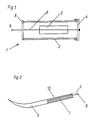
- the hose 1 shown in FIG. 1 is formed in its entirety by a cylinder 2 which is closed at its left end by an end face 3 and at its right end by a cap 4, so that the result is a structure which is closed on all sides.
- a tissue 5 which is only hinted at here, and a thread 6, which runs essentially centrally, and is fastened to the cap 4 with one end, and at the same time reaches through the left end face 3 of a sealed opening (not shown here) and in front of the same ends at a certain distance in an eyelet 8.
- This free projecting of the thread 6 and the attachment of the eyelet 8 facilitate grasping the thread 6, with the aid of which the entire device can be moved translationally in the thread direction when subjected to tensile stress. An easy removal and thus replacement of the already implanted device can be carried out with its help.
- FIG. 2 shows an instrument by means of which the device described for example in FIG. 1 can be inserted into the patient's body.
- This consists of a curved metal needle 9, at the outer end of which a cylindrical sheath 10 connects.
- the hose 1 which is assigned to the sheath 10 so that the protruding end of the thread 6 and in particular the eyelet 8 located there also protrude beyond the sheath 10. This makes it easier to grasp the thread 6 and in particular the eyelet 8, as a result of which the tube 1 can then be fixed in the position currently in place, in particular also when the metal needle 9 is moved further.
- this instrument is as follows: First, the device according to the invention and in particular the tube 1 is inserted into the sheath 10, then the needle 9 is inserted into the part of the body intended for receiving the implant until the tube 1 is in the desired position End position comes to rest. It is fixed there in that the thread 6 is held in place by means of the eyelet 8 and consequently the tube 1 also remains spatially fixed when the needle 9 moves further. The curvature of the needle ensures that the needle leaves the body at a short distance from the puncture site. A complex surgical intervention for implantation is then superfluous.
- the invention provides a device by means of which tissue can be implanted in an unproblematic manner without the body repelling it.
Landscapes
- Health & Medical Sciences (AREA)
- Life Sciences & Earth Sciences (AREA)
- Veterinary Medicine (AREA)
- Public Health (AREA)
- General Health & Medical Sciences (AREA)
- Engineering & Computer Science (AREA)
- Animal Behavior & Ethology (AREA)
- Biomedical Technology (AREA)
- Transplantation (AREA)
- Heart & Thoracic Surgery (AREA)
- Medicinal Chemistry (AREA)
- Chemical & Material Sciences (AREA)
- Bioinformatics & Cheminformatics (AREA)
- Cardiology (AREA)
- Vascular Medicine (AREA)
- Oral & Maxillofacial Surgery (AREA)
- Anesthesiology (AREA)
- Hematology (AREA)
- Marine Sciences & Fisheries (AREA)
- Pharmacology & Pharmacy (AREA)
- Epidemiology (AREA)
- Prostheses (AREA)
- External Artificial Organs (AREA)
Description
- Die Erfindung betrifft eine Vorrichtung zum Einbringen von Geweben in den menschlichen Körper, wobei das Gewebe Insulin bildet und sich im Innerem eines geschlossenen Schlauches befindet, der zumindest teilweise aus einer Membran besteht, durch die die Körperflüssigkeiten hindurchdiffundieren, Antikörper und Abwehrzellen jedoch zurückgehalten werden sowie ein Instrument zur Einbringung derselben.
- Aus der US-A-3,093,831 sind Vorrichtungen gattungsgemäßer Art bekannt, in deren Inneren Gewebe von Drüsen angeordnet ist, welches mit Hilfe der Vorrichtung in den lebenden menschlichen Organismus implantiert wird. Zur Unterbindung der dabei auftretenden Immunreaktionen, die auf ein Abstoßen des als körperfremd erkannten Gewebes hinarbeiten, werden Vorrichtungen mit semipermeabler Membran vorgeschlagen, deren Porenweite so gewählt ist, daß Antigene und Antikörper nicht hindurchtreten können. Jedoch werden die Nährstoffe auf der das Implantat umgebenden Blutflüssigkeit hindurchgelassen und können so zum Gewebe gelangen. Derartige Vorrichtungen können insbesondere auch insulinerzeugendes Gewebe der Bauspeicheldrüse aufnehmen, welches zur Implantation bei zuckerkranken Patienten bestimmt ist. Das nutzbare Zellgewebe der Langehansinseln ist über die gesamte Bauchspeicheldrüse verstreut, so daß es außerordentlich mühselig und kostenaufwendig ist, diese zu isolieren und einzusammeln.
- Hiervon ausgehend hat sich die Erfindung die Schaffung einer möglichst preisgünstig und einfach beschaffbaren Vorrichtung zur Aufgabe gemacht, die sich zur Implantation bei zuckerkranken Patienten eignet.
- Gelöst wird diese Aufgabe dadurch, daß Gewebe von der Blutversorgung unabhängig ist und aus Zellgewebe von Teleostien (Knochenfischen) gewonnenen Brockmann-Bodies besteht.
- Der entscheidende Vorteil ist darin zu sehen, daß bei Knochenfischen das insulinerzeugende Zellgewebe zusammenhängend und nicht mehr verstreut auftritt und daß durch dieses Gewebe erzeugte Insulinhormon problemlos für Menschen einsetz- und nutzbar ist. Es resultiert eine wesentliche Vereinfachung der Isolierung und Gewinnung und damit der Herstellung. Die Durchlässigkeit und "Maschenweite" der Membran ist so zu wählen, daß Körperflüssigkeiten hindurchdiffundieren, Antikörper und Abwehrzellen jedoch zurückgehalten werden. In Anlehnung an die übliche Terminologie sind hierbei unter "Antikörper und Abwehrzellen" all jene Zellen gemeint, die Abstoßungsreaktionen auslösen und Elimination des körperfremden Gewebes zu bewirken versuchen. Unter den Sammelbegriff "Körperflüssigkeit" fallen die Nährstoffe, Hormone, insbesondere auch Regulationshormone und alle anderen Stoffe, die zur Aufrechterhaltung des Lebens in den Gewebezellen erforderlich sind.
- Grundsätzlich ist im Sinne der Erfindung die Größe des in der erfindungsgemäßen Vorrichtung befindlichen Gewebes weit auszulegen, denn es sollen sowohl Gewebeeinzelzellen als auch größere Gewebeteile mit einer Vielzahl an Zellen umfaßt werden. Des weiteren ist die Form des Schlauches beliebig und sie kann als Beutel oder Kammer oder gar als Kapsel ausgeformt sein. In funktioneller Hinsicht geht es im wesentlichen darum, das Gewebe mit einer geschlossenen Hülle von entsprechender Durchlässigkeit zu umgeben.
- Die Benutzung geschieht in der Weise, daß die erfindungsgemäße Vorrichtung Beispielsweise durch einen kleinen operativen Eingriff in den Körper eingebracht wird und dort verbleibt und durch Diffusion der Körperflüssigkeit durch die Membran ernährt und am Leben gehalten wird. Dabei erzeugt das Gewebe Hormone, die durch die Membran jedoch in zur Körperflüssigkeit entgegengesetzter Richtung hindurchdiffundieren. Aus der Tatsache, daß Körperflüssigkeit umter anderem bereits Regulationshormone enthält, ergibt sich zwingend, daß auch die durch das Gewebe erzeugten Hormone die Membran durchdringen können und in den Körper des Patienten gelangen. Gleichzeitig verhindert die Membran, daß die sich in Patienten auf Grund des eingebrachten, körperfremden Gewebes ausbildenden Abwehrzellen und Antikörper zurückgehalten werden, so daß die Funktionsfähigkeit. des implantierten Gewebes nicht beeinträchtïgt wird.
- Bei Zuckerkranken besonders wichtig ist, daß durch Implantierung eines insulinerzeugenden Gewebes dem Körper des Patienten kontinuierlich Hormone zugeführt werden, so daß sich der Wert des Blutzuckerspiegels permanent im Normalbereich bewegt.
Ein Zuführen und Spritzen von Insulin erübrigt sich dann und der Patient kann ohne ständige Überwachung seines Blutzuckerspiegels leben. - Im implantierten Zustand wird sich die Oberfläche des Schlauches und insbesondere die der Membran nach gewisser Zeit mit Gewebe zusetzen und zuwachsen. Da hierdurch die Diffusion wesentlich erschwert oder völlig unterbunden wird, muß die erfindungsgemäße Vorrichtung von Zeit zu Zeit ausgetauscht werden. Aus diesem Grund schlägt die Erfindung in einer Weiterbildung vor, den Schlauch von zylindrischer Gestalt zu wählen und in etwa zentral einen Faden anzuordnen, dessen eines Ende an einer als Kappe oder Schild ausgebildeten Stirnseite befestigt und dessen gegenüberliegendes Ende die andere Stirnseite durchgreift und in einem gewissen Abstand davor endet. Der etwa zentral verlaufende Faden läßt eine problemlose Austausch- und Auswechselbarkeit der gesamten Vorrichtung dadurch zu, daß er an seinem freien Ende ergriffen und durch Zug die gesamte Vorrichtung aus dem Körper des Patienten entfernbar ist. Da das andere Ende des Fadens an der hinteren, gegenüberliegenden und als Kappe oder Schild ausgebildeten Stirnseite befestigt ist und damit dieser Vorrichtungsteil eine entsprechende Verstärkung erfährt, lassen sich die zum Auswechseln erforderlichen Kräfte auf die gesamte Vorrichtung übertragen. Durch die Tatsache, daß der Faden durch die gegenüberliegende Stirnseite verläuft und in einem gewissen Abstand davor endet, läßt er sich leicht erfassen und die gesamte Vorrichtung durch Zug bewegen und entfernen.
- In einer zweckmäßigen Weiterbildung ist hierzu am freien Ende des Fadens ein Knopf oder eine Öse angebracht, welche das Ergreifen des Fadenendes wesentlich erleichtert und vereinfacht. Auch diese Maßnahme stellt einen Beitrag zur Verbesserung der Auswechsel- und Austauschbarheit der erfindungsgemäßen Vorrichtung dar.
- Der Faden ist so zu wählen, daß er zur Aufnahme hoher Zugbelastungen in der Lage ist und zum anderen auch bei längerer Verweildauer im Körper des Patienten keine unerwünschten oder schädlichen Reaktionen auftreten können. Aus diesem Grunde empfiehlt die Erfindung das Material Kunststoff oder Metall.
- Im Hinblïck auf die Ausbildung des Schlauches wird durch die Erfindung in einer Ausführungsform die Verwendung einer Hohlfaser, wie z.B. eines Dialyse-Schlauches, vorgeschlagen und bezüglich der Ausbildung der Membran die Verwendung einer Dialyse-Membran empfohlen. Sowohl Dialyse-Schlauch als auch Dialyse-Membran erfüllen die im Hinblïck auf die Durchlässigkeit durch die Erfindung gestellten Anforderungen.
- Grundsätzlich besteht die Möglichkeit, daß der das Gewebe umgebende Schlauch in seiner Gesamtheit die Membran darstellt. Für derartige Fälle schlägt die Erfindung die Erzeugung der Membran durch das an sich bekannte Verfahren der Enkapsulierung vor, bei dem die Herstellung in drei Verfahrensschritten erfolgt:
Beim ersten wird das Gewebe von einem Gel umgeben, im zweiten Arbeitsschritt wird auf diesem Gel ein Netzwerk aus Aminosäuren oder anderen Polymeren hergestellt, so daß man im Ergebnis das Gewebe umgeben von einer Membran erhält, welche auf chemischen Wege durch Vernetzung von Polymeren, wie z.B. Aminosäuren odgl. erzeugt wurde. Ein wesentlicher Vorteil dieser bevorzugten Ausführungsform besteht darin, daß es nunmehr möglich ist kleinste Gewebeteile bis hin zu einzelnen Zellen mit einer Membran zu umgeben, wodurch sich kleinste Abmessungen erreichen lassen, die das Einspritzen in den Körper des Patienten erlauben, so daß sich der operative Eingriff zur Implantierung erübrigt. - Eine wesentliche Vereinfachung der Anbringung der erfindungsgemäßen Vorrichtung oder auch anderer Implantate, wie z.B. Depotmedikamente, Strahlenquellen usw. in dem Körper des Patienten läßt sich durch ein ebenfalls durch die Erfindung vorgeschlagenes Instrument erreichen, welches aus einer Nadel, insbes. aus Metall, besteht, an die sich eine zylindrische Hülle endseitig anschließt, in dessen Inneren der Schlauch mit dem Gewebe, also die erfindungsgemäße Vorrichtung, anordenbar ist. Sie ermöglicht ohne aufwendige Operation die Implantierung der erfindungemäßen Vorrichtung dadurch, daß sie in den Körper, beispielsweise in die Bauchdecke, eingeführt wird und mit Erreichen der gewünschten Position der innerhalb der Hülle befindlichen Vorrichtung diese dort fixiert wird, hingegen die Metallnadel weitergeführt wird, die vorzugsweise an einer anderen Stelle, dann jedoch mit leerer Hülle den Körper verläßt.
- Besonders einfach wird das Fixieren innerhalb des Körpers, wenn der Faden in Bezug auf die Hülle so gewählt ist, daß er endseitig übersteht, weil dann für den Benutzer die Möglichkeit gegeben ist, einzig und allein durch Festhalten des Fadens die erfindungsgemäße Vorrichtung auch bei Fortsetzung der Bewegung der Nadel auf einfache Weise zu fixieren.
- Durch die schließlich noch vorgeschlagene Verwendung einer gekrümmten Nadel erreicht man eine Erleichterung der Handhabung, dahingehend, daß die gekrümmte Nadel bereits in geringer Entfernung von der Einstichstelle wieder den Körper verlassen kann.
- Weitere Einzelheiten, Merkmale und Vorteile der Erfindung lassen sich dem nachfolgenden Beschreibungsteil entnehmen, in dem die in schematischer Darstellung in der Zeichnung wiedergegebenen Ausführungsbeispiele näher erläutert sind. Es zeigen:
- Figur 1
- eine erfindungsgemäße Vorrichtung für die Aufnahme und zum Einbringen von Gewebe in den menschlichen Körper in prinzipienhafter Querschnittsdarstellung,
- Figur 2
- ein zum Einbringen verwendbares Instrument ebenfalls in prinzipienhafter Darstellung.
- Der in Figur 1 gezeigte Schlauch 1 wird in seiner Gesamtheit gebildet durch einen Zylinder 2, der an seinem linken Ende durch eine Stirnseite 3 und an seinem rechten über eine Kappe 4 verschlossen ist, so daß man im Ergebnis ein nach allen Seiten geschlossenes Gebilde erhält. In dessen Inneren befindet sich ein hier nur andeutungsweise wiedergegebenes Gewebe 5 sowie ein Faden 6, der im wesentlichen zentral verläuft, und mit seinem einen Ende an der Kappe 4 befestigt ist, gleichzeitig die linke Stirnseite 3 einer hier nicht eingezeichneten abgedichteten Öffnung durchgreift und vor derselben in einem gewissen Abstand in einer Öse 8 endet. Dieses freie Überstehen des Fadens 6 sowie die Anbringung der Öse 8 erleichtern das Ergreifen des Fadens 6, mit dessen Hilfe sich auf Zugbeanspruchung die gesamte Vorrichtung translatorisch in Fadenrichtung bewegen läßt. Ein leichtes Entfernen und damit Austauschen der bereits implantierten Vorrichtung läßt sich mit dessen Hilfe durchführen.
- In Figur 2 ist ein Instrument dargestellt, mit dessen Hilfe die beispielsweise in Figur 1 beschriebene Vorrichtung in den Körper des Patienten eingebracht werden kann. Diese besteht aus einer gekrümmten Metallnadel 9, an deren äußeren Ende sich eine zylindrische Hülle 10 anschließt. In dieser befindet sich der Schlauch 1, der der Hülle 10 so zugeordnet ist, daß das überstehende Ende des Fadens 6 und insbesondere die daran befindliche Öse 8 ebenfalls über die Hülle 10 hinausragen. Dies erleichtert das Erfassen des Fadens 6 und insbesondere der Öse 8, wodurch dann der Schlauch 1 in der momentan befindlichen Postition fixiert werden kann, insbesondere auch dann, wenn die Metallnadel 9 weiterbewegt wird.
- Die Handhabung dieses Instrumentes ist wie folgt: Als erstes wird in die Hülle 10 die erfindungsgemäße Vorrichtung und insbesondere der Schlauch 1 eingeführt, dann wird die Nadel 9 in die zur Aufnahme des Implantats bestimmte Körperpartie eingestochen und zwar soweit, bis der Schlauch 1 in der gewünschten Endposition zu liegen kommt. Dort erfolgt seine Fixierung dadurch, daß der faden 6 vermittels der Öse 8 festgehalten wird und demzufolge auch der Schlauch 1 bei Weiterbewegung der Nadel 9 raumfest bleibt. Durch deren Krümmung wird erreicht, daß die Nadel bereits in geringer Entfernung von der Einstichstelle wieder den Körper verläßt. Ein aufwendiger, operativer Eingriff zur Implantation ist dann überflüssig.
- Im Ergebnis gibt die Erfindung eine Vorrichtung an die Hand, mit deren Hilfe auf unproblematische Weise Gewebe implantiert werden kann, ohne daß es der Körper abstößt.
Claims (9)
Priority Applications (1)
| Application Number | Priority Date | Filing Date | Title |
|---|---|---|---|
| AT87900060T ATE64848T1 (de) | 1985-12-20 | 1986-12-18 | Vorrichtung fuer die aufnahme und zum einbringen von geweben in den menschlichen koerper sowie hierfuer verwendbares instrument. |
Applications Claiming Priority (2)
| Application Number | Priority Date | Filing Date | Title |
|---|---|---|---|
| DE3545237 | 1985-12-20 | ||
| DE19853545237 DE3545237A1 (de) | 1985-12-20 | 1985-12-20 | Vorrichtung fuer die aufnahme und zum einbringen von geweben in den menschlichen koerper sowie hierfuer verwendbares instrument |
Publications (2)
| Publication Number | Publication Date |
|---|---|
| EP0250498A1 EP0250498A1 (de) | 1988-01-07 |
| EP0250498B1 true EP0250498B1 (de) | 1991-07-03 |
Family
ID=6289035
Family Applications (1)
| Application Number | Title | Priority Date | Filing Date |
|---|---|---|---|
| EP87900060A Expired - Lifetime EP0250498B1 (de) | 1985-12-20 | 1986-12-18 | Vorrichtung für die aufnahme und zum einbringen von geweben in den menschlichen körper sowie hierfür verwendbares instrument |
Country Status (4)
| Country | Link |
|---|---|
| EP (1) | EP0250498B1 (de) |
| AU (1) | AU6835387A (de) |
| DE (2) | DE3545237A1 (de) |
| WO (1) | WO1987003802A2 (de) |
Families Citing this family (11)
| Publication number | Priority date | Publication date | Assignee | Title |
|---|---|---|---|---|
| US5773286A (en) * | 1987-11-17 | 1998-06-30 | Cytotherapeutics, Inc. | Inner supported biocompatible cell capsules |
| US4892538A (en) * | 1987-11-17 | 1990-01-09 | Brown University Research Foundation | In vivo delivery of neurotransmitters by implanted, encapsulated cells |
| US5106627A (en) * | 1987-11-17 | 1992-04-21 | Brown University Research Foundation | Neurological therapy devices |
| US5786216A (en) * | 1987-11-17 | 1998-07-28 | Cytotherapeutics, Inc. | Inner-supported, biocompatible cell capsules |
| US5487739A (en) | 1987-11-17 | 1996-01-30 | Brown University Research Foundation | Implantable therapy systems and methods |
| US5800829A (en) * | 1991-04-25 | 1998-09-01 | Brown University Research Foundation | Methods for coextruding immunoisolatory implantable vehicles with a biocompatible jacket and a biocompatible matrix core |
| HK1001832A1 (en) * | 1991-04-25 | 1998-07-10 | Brown University Research Foundation | Implantable biocompatible immunoisolatory vehicle for delivery of selected therapeutic products |
| KR930701209A (ko) * | 1991-06-28 | 1993-06-11 | 윌리암 엠. 잭슨 | 신경 이식 시스템 |
| DE4229526B4 (de) * | 1992-09-07 | 2006-02-16 | Schrezenmeir, Jürgen, Dr. | Vorrichtung zur Aufnahme und zum Einbringen von biologisch aktiven Geweben oder Zellen in den menschlichen Körper |
| AU6243294A (en) * | 1993-02-18 | 1994-09-14 | New England Deaconess Hospital Corporation | Implantable artificial organ |
| JPH10504725A (ja) * | 1995-04-06 | 1998-05-12 | ダルフージー ユニバーシティ | 糠尿病の治療におけるトランスジェニック魚 |
Family Cites Families (12)
| Publication number | Priority date | Publication date | Assignee | Title |
|---|---|---|---|---|
| US3093831A (en) * | 1959-10-22 | 1963-06-18 | Jordan Gerhard Paul Wilhelm | Artificial gland |
| US3804088A (en) * | 1972-07-31 | 1974-04-16 | Lilly Co Eli | Removable implantate for administering physiological active agents to animals |
| US3946734A (en) * | 1975-02-19 | 1976-03-30 | The United States Of America As Represented By The Secretary Of State | Apparatus for controlling the release of a drug |
| CA1085104A (en) * | 1977-03-21 | 1980-09-09 | Anthony M. Sun | Artificial endocrine pancreas |
| DE2721752C2 (de) * | 1977-05-13 | 1983-12-29 | Siemens AG, 1000 Berlin und 8000 München | In einen menschlichen oder tierischen Körper implantierbares Gerät zur Infusion einer medizinischen Flüssigkeit |
| US4286067A (en) * | 1978-10-23 | 1981-08-25 | Alza Corporation | Article of manufacture comprising semipermeable polymer and dextran derivative |
| US4304232A (en) * | 1979-03-14 | 1981-12-08 | Alza Corporation | Unit system having multiplicity of means for dispensing useful agent |
| US4352883A (en) * | 1979-03-28 | 1982-10-05 | Damon Corporation | Encapsulation of biological material |
| US4300558A (en) * | 1980-07-18 | 1981-11-17 | Alza Corporation | Self-driven fluid dispenser |
| IE52122B1 (en) * | 1980-08-25 | 1987-06-24 | Univ California | Somatostatin or somatostatin precursors |
| US4449983A (en) * | 1982-03-22 | 1984-05-22 | Alza Corporation | Simultaneous delivery of two drugs from unit delivery device |
| US4479796A (en) * | 1982-11-15 | 1984-10-30 | Medtronic, Inc. | Self-regenerating drug administration device |
-
1985
- 1985-12-20 DE DE19853545237 patent/DE3545237A1/de not_active Withdrawn
-
1986
- 1986-12-18 DE DE8787900060T patent/DE3680107D1/de not_active Expired - Lifetime
- 1986-12-18 EP EP87900060A patent/EP0250498B1/de not_active Expired - Lifetime
- 1986-12-18 WO PCT/DE1986/000518 patent/WO1987003802A2/de not_active Ceased
- 1986-12-18 AU AU68353/87A patent/AU6835387A/en not_active Abandoned
Also Published As
| Publication number | Publication date |
|---|---|
| WO1987003802A2 (en) | 1987-07-02 |
| DE3545237A1 (de) | 1987-06-25 |
| WO1987003802A3 (fr) | 1987-07-30 |
| EP0250498A1 (de) | 1988-01-07 |
| AU6835387A (en) | 1987-07-15 |
| DE3680107D1 (de) | 1991-08-08 |
Similar Documents
| Publication | Publication Date | Title |
|---|---|---|
| EP0776230B1 (de) | Implantat und applikationsvorrichtung | |
| DE3855054T2 (de) | Vorrichtung zur Verabreichung von festen Präparaten | |
| DE69932612T2 (de) | Gerät zur erleichterten hemostase eines biopsietraktes | |
| DE3706077C1 (de) | Intravenoeses Filter sowie Vorrichtung und Verfahren fuer die Vorbereitung des Filters fuer die Operation | |
| DE69121917T2 (de) | Vorrichtung zum anbringen eines drains | |
| DE69116351T2 (de) | Vorrichtung zum zeitlichen Einsetzen eines Blutfilters in eine Vene des menschlichen Körpers | |
| DE3880676T2 (de) | Einspritzvorrichtung zum einpflanzen mehrerer arzneimittelkuegelchen. | |
| DE3704089C2 (de) | ||
| DE69013367T2 (de) | Biopsiespritze. | |
| EP0250498B1 (de) | Vorrichtung für die aufnahme und zum einbringen von geweben in den menschlichen körper sowie hierfür verwendbares instrument | |
| DE2853809A1 (de) | Verfahren und vorrichtung beim einfuehren einer elektrode | |
| DE2829773C2 (de) | Blutentnahmevorrichtung | |
| DE2007738A1 (de) | Medizinisch-chirurgische Röhren, insbesondere Katheter | |
| EP0659389A1 (de) | Endoprothese | |
| DE2159666B2 (de) | Vorrichtung zum Züchten eines schlauchförmigen Gewebeteils in einem lebenden Körper | |
| CH689892A5 (de) | Chirurgisches Instrument zum stossartigen Einführen einer intraossären Trokarnadel. | |
| EP0242711A1 (de) | Katheter zur künstlichen Befruchtung | |
| DE2405497B2 (de) | Vorrichtung zur Aufnahme von Blut im Inneren einer Körperhöhle eines Lebewesens | |
| DE2022576A1 (de) | In einen lebenden Koerper einpflanzbares Gewebestueck sowie Verfahren und Vorrichtung zu dessen Herstellung | |
| DE69102478T2 (de) | Endoprothese-Katheter. | |
| DE69521792T2 (de) | Blockiereinrichtung für einen eileiter | |
| DE69630879T2 (de) | Biologisch abbaubare vorrichtung | |
| EP3720387B1 (de) | Implantat mit reservoir | |
| DE60311319T2 (de) | Verfahren zur identifizierung und überwachung von tieren mittels verwendung von elektronischen identifizierungsvorrichtungen (transponder) | |
| EP2026868B1 (de) | Implantierbare vorrichtung |
Legal Events
| Date | Code | Title | Description |
|---|---|---|---|
| PUAI | Public reference made under article 153(3) epc to a published international application that has entered the european phase |
Free format text: ORIGINAL CODE: 0009012 |
|
| 17P | Request for examination filed |
Effective date: 19870917 |
|
| AK | Designated contracting states |
Kind code of ref document: A1 Designated state(s): AT CH DE FR GB IT LI NL SE |
|
| 17Q | First examination report despatched |
Effective date: 19890727 |
|
| GRAA | (expected) grant |
Free format text: ORIGINAL CODE: 0009210 |
|
| AK | Designated contracting states |
Kind code of ref document: B1 Designated state(s): AT CH DE FR GB IT LI NL SE |
|
| PG25 | Lapsed in a contracting state [announced via postgrant information from national office to epo] |
Ref country code: SE Effective date: 19910703 Ref country code: NL Effective date: 19910703 |
|
| REF | Corresponds to: |
Ref document number: 64848 Country of ref document: AT Date of ref document: 19910715 Kind code of ref document: T |
|
| REF | Corresponds to: |
Ref document number: 3680107 Country of ref document: DE Date of ref document: 19910808 |
|
| ITF | It: translation for a ep patent filed | ||
| GBT | Gb: translation of ep patent filed (gb section 77(6)(a)/1977) | ||
| ET | Fr: translation filed | ||
| NLV1 | Nl: lapsed or annulled due to failure to fulfill the requirements of art. 29p and 29m of the patents act | ||
| PLBE | No opposition filed within time limit |
Free format text: ORIGINAL CODE: 0009261 |
|
| STAA | Information on the status of an ep patent application or granted ep patent |
Free format text: STATUS: NO OPPOSITION FILED WITHIN TIME LIMIT |
|
| 26N | No opposition filed | ||
| REG | Reference to a national code |
Ref country code: FR Ref legal event code: ST |
|
| REG | Reference to a national code |
Ref country code: FR Ref legal event code: AR |
|
| REG | Reference to a national code |
Ref country code: FR Ref legal event code: DS |
|
| PGFP | Annual fee paid to national office [announced via postgrant information from national office to epo] |
Ref country code: GB Payment date: 19950602 Year of fee payment: 9 |
|
| PG25 | Lapsed in a contracting state [announced via postgrant information from national office to epo] |
Ref country code: GB Effective date: 19951218 |
|
| GBPC | Gb: european patent ceased through non-payment of renewal fee |
Effective date: 19951218 |
|
| PGFP | Annual fee paid to national office [announced via postgrant information from national office to epo] |
Ref country code: AT Payment date: 19970619 Year of fee payment: 11 |
|
| PGFP | Annual fee paid to national office [announced via postgrant information from national office to epo] |
Ref country code: CH Payment date: 19970623 Year of fee payment: 11 |
|
| PGFP | Annual fee paid to national office [announced via postgrant information from national office to epo] |
Ref country code: FR Payment date: 19971217 Year of fee payment: 12 |
|
| PG25 | Lapsed in a contracting state [announced via postgrant information from national office to epo] |
Ref country code: AT Free format text: LAPSE BECAUSE OF NON-PAYMENT OF DUE FEES Effective date: 19971218 |
|
| PG25 | Lapsed in a contracting state [announced via postgrant information from national office to epo] |
Ref country code: LI Free format text: LAPSE BECAUSE OF NON-PAYMENT OF DUE FEES Effective date: 19971231 Ref country code: CH Free format text: LAPSE BECAUSE OF NON-PAYMENT OF DUE FEES Effective date: 19971231 |
|
| REG | Reference to a national code |
Ref country code: CH Ref legal event code: PL |
|
| PG25 | Lapsed in a contracting state [announced via postgrant information from national office to epo] |
Ref country code: FR Free format text: LAPSE BECAUSE OF NON-PAYMENT OF DUE FEES Effective date: 19990831 |
|
| REG | Reference to a national code |
Ref country code: FR Ref legal event code: ST |
|
| PGFP | Annual fee paid to national office [announced via postgrant information from national office to epo] |
Ref country code: DE Payment date: 20041124 Year of fee payment: 19 |
|
| PG25 | Lapsed in a contracting state [announced via postgrant information from national office to epo] |
Ref country code: IT Free format text: LAPSE BECAUSE OF NON-PAYMENT OF DUE FEES;WARNING: LAPSES OF ITALIAN PATENTS WITH EFFECTIVE DATE BEFORE 2007 MAY HAVE OCCURRED AT ANY TIME BEFORE 2007. THE CORRECT EFFECTIVE DATE MAY BE DIFFERENT FROM THE ONE RECORDED. Effective date: 20051218 |
|
| PG25 | Lapsed in a contracting state [announced via postgrant information from national office to epo] |
Ref country code: DE Free format text: LAPSE BECAUSE OF NON-PAYMENT OF DUE FEES Effective date: 20060701 |