EP0248533B1 - Method, apparatus and system for recognising broadcast segments - Google Patents
Method, apparatus and system for recognising broadcast segments Download PDFInfo
- Publication number
- EP0248533B1 EP0248533B1 EP87303968A EP87303968A EP0248533B1 EP 0248533 B1 EP0248533 B1 EP 0248533B1 EP 87303968 A EP87303968 A EP 87303968A EP 87303968 A EP87303968 A EP 87303968A EP 0248533 B1 EP0248533 B1 EP 0248533B1
- Authority
- EP
- European Patent Office
- Prior art keywords
- signature
- frame
- segment
- parametized
- monitored signal
- Prior art date
- Legal status (The legal status is an assumption and is not a legal conclusion. Google has not performed a legal analysis and makes no representation as to the accuracy of the status listed.)
- Expired - Lifetime
Links
Images





Classifications
-
- G—PHYSICS
- G11—INFORMATION STORAGE
- G11B—INFORMATION STORAGE BASED ON RELATIVE MOVEMENT BETWEEN RECORD CARRIER AND TRANSDUCER
- G11B27/00—Editing; Indexing; Addressing; Timing or synchronising; Monitoring; Measuring tape travel
- G11B27/10—Indexing; Addressing; Timing or synchronising; Measuring tape travel
- G11B27/19—Indexing; Addressing; Timing or synchronising; Measuring tape travel by using information detectable on the record carrier
- G11B27/28—Indexing; Addressing; Timing or synchronising; Measuring tape travel by using information detectable on the record carrier by using information signals recorded by the same method as the main recording
-
- G—PHYSICS
- G06—COMPUTING OR CALCULATING; COUNTING
- G06V—IMAGE OR VIDEO RECOGNITION OR UNDERSTANDING
- G06V20/00—Scenes; Scene-specific elements
- G06V20/40—Scenes; Scene-specific elements in video content
-
- H—ELECTRICITY
- H04—ELECTRIC COMMUNICATION TECHNIQUE
- H04H—BROADCAST COMMUNICATION
- H04H60/00—Arrangements for broadcast applications with a direct linking to broadcast information or broadcast space-time; Broadcast-related systems
- H04H60/35—Arrangements for identifying or recognising characteristics with a direct linkage to broadcast information or to broadcast space-time, e.g. for identifying broadcast stations or for identifying users
- H04H60/37—Arrangements for identifying or recognising characteristics with a direct linkage to broadcast information or to broadcast space-time, e.g. for identifying broadcast stations or for identifying users for identifying segments of broadcast information, e.g. scenes or extracting programme ID
-
- H—ELECTRICITY
- H04—ELECTRIC COMMUNICATION TECHNIQUE
- H04H—BROADCAST COMMUNICATION
- H04H60/00—Arrangements for broadcast applications with a direct linking to broadcast information or broadcast space-time; Broadcast-related systems
- H04H60/56—Arrangements characterised by components specially adapted for monitoring, identification or recognition covered by groups H04H60/29-H04H60/54
- H04H60/58—Arrangements characterised by components specially adapted for monitoring, identification or recognition covered by groups H04H60/29-H04H60/54 of audio
-
- H—ELECTRICITY
- H04—ELECTRIC COMMUNICATION TECHNIQUE
- H04H—BROADCAST COMMUNICATION
- H04H60/00—Arrangements for broadcast applications with a direct linking to broadcast information or broadcast space-time; Broadcast-related systems
- H04H60/56—Arrangements characterised by components specially adapted for monitoring, identification or recognition covered by groups H04H60/29-H04H60/54
- H04H60/59—Arrangements characterised by components specially adapted for monitoring, identification or recognition covered by groups H04H60/29-H04H60/54 of video
Definitions
- This invention relates to the automatic recognition of broadcast segments, particularly commercial advertisements broadcast by television stations.
- US Patent 3,919,479 describes a technique for identifying broadcast segments in which the segments are digitised and correlated with a digitised reference. When the output of the correlation function exceeds a predetermined threshold, a match is found.
- French Patent 2,559,002 describes a technique for detecting the broadcasting of audiovisual information by a radio or television station.
- the document states that a received broadcast is recorded and a comparator compares the broadcast with recorded signatures contained in a memory.
- the signatures consist of at least a portion of the spectral analysis of the information to be detected, and the comparator comprises a plurality of processors each of which makes the comparison of the recording with at least one signature.
- the present invention provides a method and apparatus for real-time continuous pattern recognition of broadcast segments by constructing a digital signature from a known specimen of a segment which is to be recognized.
- the signature is constructed by digitally parametizing the segment, selecting portions from among random frame locations throughout the segment in accordance with a set of predefined rules (i.e. different frames are selected for each segment, but the selection is always based on the same criteria) to form the signature, and associating with the signature the frame locations of the portions.
- the signature and associated frame locations are stored in a library of signatures. Each signature in the library is identified with a particular segment to be recognized.
- a broadcast signal is monitored and digitally parametized. For each frame of the parametized monitored signal, the library is searched for any signature that may be associated with that frame. Using the frame information stored with the signature, each of the potentially associated stored signatures is compared to the appropriate frames of the parametized signal. If a stored signature compares with the monitored data, a match is declared and the broadcast segment is identified using identification data associated
- a digital keyword derived from a designated frame in the parametized segment is identified as associated with the segment signature, but the association of that keyword with a particular segment signature is non-exclusive -- i.e., the same keyword can be associated with more than one signature.
- a plurality of additional frames is selected from among random frame locations throughout the segment in accordance with a set of predefined rules and, in a library of signatures, the keyword representing the designated frame and the words representing the additional frames are stored together with the offsets of the additional frames relative to the designated frame.
- a broadcast signal is monitored and digitally parametized.
- the library For each monitored digital word of the parametized monitored signal, the library is searched for any signature associated with a keyword corresponding to that monitored word, and the additional words of any such signature are compared with those words of the parametized monitored signal which are separated from the monitored word by the stored offset amounts. If the stored signature compares with the monitored data, a match is declared and the broadcast segment is identified using identification data associated with the signature data.
- the present invention can identify a segment of a broadcast signal by pure continuous pattern recognition on a real-time basis. No codes need be inserted into the broadcast signal prior to transmission and no "cues" or “signalling events” (e.g., fades-to-black or scene changes) that occur in the broadcast need be used in the recognition process.
- the broadcast signal can be either a radio broadcast, for which audio information is obviously used for the recognition process, or a television broadcast, for which audio information, video information, or both, can be used, and can be an over-the-air signal, a cable television signal, or a videotape signal.
- the broadcast signal is parametized to yield a digital data stream composed, preferably, of one 16-bit digital word for every 1/30 of a second of signal.
- the audio data is synchronized with the video frame rate to form an "audio frame".
- the information is then processed in the same way whether it originated as audio or video.
- a digital signature is constructed for each segment to be recognized.
- the construction of the signature is discussed in more detail below. However, it preferably comprises 128 bits representing eight 16-bit words corresponding to eight frames of signal information selected from among random frame locations throughout the segment in accordance with a set of predefined rules.
- the incoming audio or video signal is digitized and parametized to yield, preferably, a 16-bit digital word for each frame of data. This also is discussed in more detail below.
- the incoming signal is received, it is read into a buffer which holds, e.g., two minutes of signal data. Each word of this data is assumed to be the first word of an eight-word signature.
- offset information indicating the spacing (i.e., the number of frames) between each such word and the first signature word.
- the library of signatures of known segments to be recognized is searched for signatures beginning with that word. Using the offset information stored with the signatures, subsequent received words, already in the buffer, are compared to the remaining signature words to determine whether or not they match those remaining words of the signature.
- the system of the invention be capable of comparing, in real time, incoming frame signature data to many tens of thousands of segment signatures representative of as many different commercials.
- the number of signatures that can be stored and searched within the real-time limitation of 1/30 second and, hence, the number of broadcast segments which can be monitored can be increased to several hundred thousand using a designated frame keyword lookup data reduction method.
- a signature is constructed for a known segment, one frame from the segment is chosen, using criteria to be discussed below, as the key frame, its digital parametized equivalent becoming the keyword.
- the signature is still, preferably, eight 16-bit words, but the stored offset information now represents spacing from the keyword rather than from the first signature word.
- the keyword can be one of the signature data words, in which case the offset for that word is zero, or it can be a ninth word.
- the keyword also need not temporally precede all of the other signature words and often will not.
- the present invention need not rely during the recognition process on any cues, signalling events or pre-established codes in the broadcast signal. It simply monitors the incoming signal and performs continuous pattern recognition.
- Video information is parametized and digitized as described below. Although, in the description which follows, parametization is based upon signal luminance, it is to be understood that other or additional attributes of a video signal could be used for this purpose.
- a number of areas, preferably 16 (although more or fewer areas may be used), of the video field or frame are selected.
- the size of each area is preferably eight-by-two pizels, although areas of other sizes could be used.
- the luminance of each area is averaged to produce an absolute gray scale value from, e.g., 0-255. This value is normalized to a bit value of 0 or 1 by cooparing the value to one of the following:
- FIG. 1 A sample partial distribution of areas within a frame is shown in FIG. 1.
- Frame 10 is actually a video field of sampled pixels.
- a bit value of 1 is returned if the luminance of the area in question exceeds the luminance of the comparison area. If the luminance of the area in question is less than or equal to the luminance of the comparison area, a bit value of 0 is returned.
- a 16-bit mask word is created along with each 16-bit frame signature.
- the mask word represents the reliability of the frame signature. For each bit in the frame signature, if the absolute value of the luminance difference used to calculate that bit value is less than a threshold or "guard band" value, the luminance value is assumed to have been susceptible to error (because of noise in transmission), and so the mask bit for that bit is set to 0, indicating suspect data. If the absolute value of the luminance difference is greater than or equal to the guard band value, the luminance value is assumed to be such greater than the noise level and the corresponding mask bit is set to 1, indicating reliable data. As discussed below, the number of ones or zeroes in the mask word is used in generating segment signatures and setting comparison thresholds.
- An audio "'frame' signature,” if such a signature is used, can be constructed in the same format as a video frame signature so that it can be processed in the same way.
- Such an audio signature may be used to recognize broadcast radio segments, or may be used to confirm the identification of a video segment the data for which includes a high percentage of suspect data.
- the use of audio signatures is not necessary to the invention.
- the parametized "frame signature" information is stored in a circular buffer large enough to hold, preferably, approximately twice as much signal information as the longest broadcast segment to be identified.
- a segment signature is being compared to the frame signature data, for each frame that passes the observation point eight comparisons between the segment signature data and the frame signature data are made, one word at a time, using the offset data stored with the segment signature to choose the frame signatures for comparison.
- the frame signature and segment signature words are compared using a bit-by-bit exclusive-NOR operation, which returns a 1 when both bits are the same and a 0 when they are different. The number of ones resulting from the exculsive-NOR operation is accumulated over all eight word comparisons.
- a plurality, preferably eight, words are selected from the parametized segment meeting the following criteria: stable data, noise-free data, Hamming distance, and entropy.
- Stable data means the word selected must have some minimum duration in the broadcast segment -- i.e., it is derived from a portion of the segment for which there are at least a minimum number of (e.g., 20 or more) frames of the same or similar data).
- Noise-free data are data having an associated mask word with a maximum number of unmasked bits. (Maximization of duration or stability, and minimization of masked bits or noise, can be two competing criteria.)
- Hamming distance refers to the dissimilarity of the digital data. It is desirable for more positive and reliable identification of broadcast segments that a signature for one broadcast segment differ from that for another broadcast segment by at least a minimum number of bits, known as the Hamming distance. In generating the second or any subsequent signature in the database, Hamming distance from existing signatures must be considered.
- Entropy refers to the desirability, discussed above, of having the minimum possible correlation between different portions of the data. For this reason, given the preferred signature data length (8 words, 16 bits per word), preferably no two signature words should be taken from points closer together in the segment than one second. This sets a lower limit on the length of broadcast segments which can be be reliably recognized. If, e.g., eight words make up a signature, and they must be at least one second apart, the shortest segment that can be reliably recognized is a segment of approximately ten seconds in length.
- the duration criterion and mask words are also stored with the segment signature for use in the recognition process.
- the duration parameter signifies that, because the frame data are stable for some time period, a certain number of successive matches on that data should be obtained during the recognition process. If significantly more or fewer matches are obtained, the latches are discarded as statistical anomalies.
- the mask data define a threshold parameter which is used during the recognition process to adjust the default number of matching bits required before a signature is considered to have matched the broadcast data. For example, a default threshold could be set for the system which, during an attempt to match a particular segment signature, is lowered by one-half the number of masked bits associated with that signature.
- a keyword is chosen from within the segment. Having a buffer at least twice as long as the longest segment to be identified assures that sufficient broadcast signal history to make a recognition remains in the buffer at the time the keyword reaches the observation point.
- the criteria used for choosing the keyword are similar to those for choosing the signature words -- it should be of stable duration and relatively noise free, augmented by the need for a "level list" -- i.e., there should be no more than about four signatures having the same keyword so that the necessary computations can be made within the the 1/30 second real-time limit.
- a signature Before a signature can be constructed for a segment for addition to the segment signature data base, it must be determined that a broadcast segment is being received.
- new segments may be played into the system manually -- e.g., where an advertiser or advertising agency supplies a video tape of a new commercial or commercials.
- the operator and the system know that this is a new segment, the signature for which is not yet stored in the segment signature library.
- the present invention also can detect the presence in the incoming signal of potential segments to be recognized that are new and presently unknown.
- the present invention relies on the presence in the broadcast signal of signal artifacts characteristic of such potential unknown segments.
- artifacts can include fades-to-black, audio power changes including silence ("audio fade-to-black”), and the presence (but not the content) of pre-encoded identification data appearing, e.g., in the vertical intervals of video signals.
- These artifacts are not assumed to indicate the presence of a new, unknown segment to be recognized per se. Rather, they are used as part of a decision-making process.
- the parametized information derived from the unknown segment is saved along with audio and video information corresponding to the unknown segment.
- the signal artifacts that marked the unknown segment are not retained, nor is any record kept of what they were.
- the saved audio and video information is ultimately presented, in compressed form (as discussed below), to an operator for use in identifying the new and unknown segment and recording the identi- fication in the segment signature library.
- the operator also records any special requirements needed to prepare a signature for the segment.
- some national commercials include two portions: a portion which is always the same irrespective of in which part of the country the commercial is to be broadcast (the "constant” portion), and a portion which differs depending on where the commercial is to be broadcast (the "variable” or "tag” portion). It is important to accurately identify different versions of such national commercials. If a commercial for a national product has a tag that is specific to one region, the commercial is considered different from the same commercial tagged for a different region. Therefore, the operator would note that the signature must include data from the tag portion of the segment, and that additional data must be taken from the tag. A signature is then generated automatically as described above.
- tags are used, depending on the type of tag associated with the commercial.
- One type of tag is known as a "live tag”, which is a live-action audio/video portion of at least five seconds duration.
- Another type of tag is known as a "still tag” which is a still picture -- e.g., of text -- which has insufficient video content for generating a unique signature.
- Either type of tag can occur anywhere in the commercial.
- a separate signature is generated for the tag.
- the system logs both the commercial occurrences and the tag occurrences, and then merges that data with the help of pointers in the signature database.
- a flag or pointer associated with the commercial signature triggers a brute force video comparison of a frame of the tag with a frame of the reference tag or tags. This comparison is not necessarily done in real time.
- a system constructed in accordance with the present invention is preferably composed of one or more local sites and one central site. Utilizing the recognition methods described above, a local site scans one or more broadcast video and audio television signals looking for known broadcast segments. If a known segment is detected, the local site records time and date information, the channel being monitored, the identification of the segment, and other information in its database. Relying on signal artifacts, the local site also notes and records signals that it senses are likely to be new segments of interest which are not yet known to the system.
- the central site communicates, e.g., via telephone lines, with the local sites to determine what known broadcast segments have been detected and what potential but unknown segments have been seen and saved, and to disseminate to appropriate local sites segment signature and detection information corresponding to new broadcast segments not yet known to those local sites. It is anticipated that the ultimate identification of a new and unknown segment will require visual or aural interpretation by a human operator at the central site.
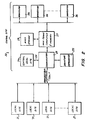
- FIG. 2 illustrates a block diagram of the system including a central site 22 and a plurality of linked local sites 21.
- Each local site 21 monitors broadcasting in its geographic region.
- the local sites 21 are located at cable television head end stations to assure a clear input signal.
- the local site 21 is capable of recognizing and identifying known broadcast segments and logging occurrences of such segments by date, time, duration, channel, identification, and other desirable infor- mation.
- the local site is also capable of recognizing the occurrence of potentially and new unknown segments, and of generating temporary key signatures for such unknown segments so that it can maintain a log of all occurrences of each such segment pending the identification of the segment by the central site 22.
- Local site 21 sends to central site 22 via communications channels 23a, b all log information for recognized known segments, plus information relating to all potential new and unknown segments, and receives in return software updates, signature library updates, and requests for additional information. If a new signature transmitted to and received by one local site 21 originated as an unknown segment originally transmitted to the central site by that local site 21, the local site 21 merges the temporary log into other data awaiting transmission to central site 22, and then purges the temporary signature from its database.
- One local site 21a is located at or near the central site 22 and is connected to the remainder of central site 22 by high-speed direct data line 24.
- This "central-local" site is identical to the other local sites 21 and serves the same function as the other local sites 21 for the broadcast market in which it and central site 22 are located.
- central-local site 21a is connected to central site 22 by direct high-speed data link 24, new segments monitored by central-local site 21a are quickly available to central site 22 for identification.
- the signatures for those new segments that are of national scope can then be quickly disseminated to the remote local sites 21 to minimize the number of times a local site 21 will classify a received segment as an unknown, and thereby to prevent communications channels 23a, b from being burdened unnecessarily with the transmission of signature and other data (compressed audio and video) corresponding to locally unknown national segments.
- the audio and video information corresponding to new and unknown segments must be transmitted to the central site 22 via comunications channels 23a, b to be reviewed by an operator during the identification process, the data is gathered by local site 21 in a compressed format to reduce communications overhead and expense.
- Compression of the video data preferably is accomplished as follows. First, not every frame is captured. Preferably, only one frame every four seconds is captured to create a "slide show" effect, with an option at the request of an operator at central site 22 to capture frames more frequently. Second, as is well known, a television video frame consists of two interlaced fields occurring 1/60 second apart. In the "slide show", small motion between the fields causes a noticeable flicker. Therefore, only one field is captured, which still provides a recognizable image. Third, not all pixels are necessary for a sufficiently recognizable image. It has been found that 160 x 120 pixels is sufficient, with an option at the request of an operator at central site 22 to capture 320 x 240 pixels per field. Fourth, it is not necessary to capture color information.
- Audio compression is more difficult to accomplish. Considerable information can be removed from video data while still maintaining a recognizable image. However, only a smaller amount of information can be removed from audio data without the remaining audio becoming difficult or impossible to understand, or unacceptably fatiguing for human operators.
- ADPCM Adaptive Differential Pulse Code Modulation
- ADPCM techniques and circuitry are well known.
- the frame signature data and the temporary segment or key signature generated for that unknown segment, and the compressed audio and video information for that segment are stored.
- the local site 21 is polled periodically by central site 22 and at those times the stored frame signature data and the temporary signatures are transmitted to central site 22 for identification via communications channels 23a, b.
- the audio and video information are transmitted optionally, but these data are always stored by local site 21 until the identification and signature of the segment are returned by the central site 22.
- signature co-processor 25 associated with central site 22 first checks the frame signature data against the global signature database, which contains all signatures from all local databases for all broadcast segments known to the system, to determine whether or not the "unknown" segment in fact previously had been identified and is already known to the system (perhaps because a different local site saw the broadcast segment before), but the signature for which had not yet been sent to all local sites 21 or had been identified as being of limited geographic scope and so sent to only some of local sites 21.
- the global signature for that segment (which may differ somewhat from the temporary signature) is transmitted back to the originating local site, and the originating local site 21 is instructed to replace the temporary key signature generated locally with the global key signature. If the frame signature data are not matched to a signature in the global database, the corresponding temporary key signature is added to a separate portion of the global database used to store temporary signatures.
- This "temporary global data-base” allows coprocessor 25 to carry out the grouping of like unknowns, previously discussed, because if the same unknown comes in from another local site 21 it should be matched by the temporary signature stored in the global database, thereby indicating to copro- cessor 25 that it is probably the same segment which has already been sent by another local site 21.
- coprocessor 25 causes host computer 27 to request the compressed audio and/or video data from local site 21 if those data have not already been transmitted.
- audio and video data preferably are not initially transmitted from local sites 21 on the theory that the frame signature data may be identified as a known segment upon comparison to the global database.
- the audio and/or video data may also have already been sent for another segment in the group. Further, audio and video need not both necessarily be transmitted. For some new and unknown segments, perhaps only the audio, or only the video, can enable the identification, while for other new and unknown segments both will be necessary.
- the operator will request one set of data. In this case, unknown segment data are stored until the missing audio or video data arrive, and then queued to an operator workstation 26. If the operator determines that the audio (if only video was sent) or video (if only audio was sent) data are also needed, the unknown data are again stored until the missing information arrives, when the data are requeued. Similarly, the operator may determine that higher resolution video (320 x 240 pixels or more frames per second) is needed and the unknown data again are stored. In a case where high resolution video is requested, if local site 21 always captures the high resolution video and simply does not transmit it for purposes of economy, it can be transmitted quickly on request. However, the system may be implemented in such a way that local site 21 does not routinely capture the high resolution video, in which case it is necessary to wait until the segment is broadcast again in that locality.
- the operator may also determine that the information captured as a result of the signal artifacts is actually two segments (e.g., in a 30-second interval, two 15-second commercials occurred), or that two consecutive intervals were each half of a single segment (e.g., two 30-second segments represent one 60-second commercial). In such a case, the operator instructs the system to break up or concatenate the segments, recreate the frame signature and segment signature data, and restart the identification process for the resulting segment or segments.
- the frame signature data for each segment in the group must be aligned with the frame signature data for each other segment in the group before a global key signature can be constructed. Alignment is necessary because different segments in the group may have been captured by local sites 21 by the detection of different artifacts. Thus, the segments may not all have been captured identically -- i.e., between the same points. For example, a set of segment data in a group for a broadcast segment nominally 60 seconds in length may in fact, as captured, be only 55 seconds in length because the segment was broadcast incompletely. Or, a member segment of the group may be too long or too short because it was captured as a consequence of the detection of a fade-to-black artifact or of an audio power change artifact.
- Alignment is carried out by coprocessor 25.
- the frame signature data for the first segment in the group are placed in a buffer.
- data for a second segment are clocked word-by-word into another buffer and an exclusive-NOR between all bits of the two segments is continually performed as the second segment is clocked in.
- an exclusive-NOR between all bits of the two segments is continually performed as the second segment is clocked in.
- the aligned data then are used as a base-line to align the remaining segments in the group.
- the alignment process is time-consuming. However, it is not necessary that alignment be done on real-time basis. Preferably, alignment is performed at night, or at some other time when system activity is at a low point.
- a best fit of both the frame signature data and the mask data is calculated by assigning to each bit position the value of that bit position in the majority of segments.
- the signature coprocessor 25 then generates a new global signature for the segment using the best fit parametized data.
- the new global signature After the new global signature has been generated, it is compared to the frame signature data for all of the unknown segments in the group to which it applies to make certain that the data for each segment matches the signature. If the new global signature does not latch each set of frame signature data, this signifies either that an error was made in selecting the keyword or another of the data words, or that one or more sets of data in the group are really not representative of the same segment. In such a case, an operator may have to view additional segments in the group.
- the signature is transmitted back to each local site 21 or to an appropriate subset of local sites if the newly identified segment is not of national scope.
- the respective local sites 21 then merge the data they had been keeping based on the temporary signatures and send it to central site 22, replace the temporary signatures they had been retaining with the new global signature in their local databases, and purge the audio, video, and frame signature data for that segment.
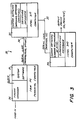
- a first preferred embodiment of a local site 30 is shown diagrammatically in FIG. 3, and includes an IBM PC personal computer 31 and two Intel 310 computers 32 33, interconnected by conventional RS-232C serial links 34, 35.
- Personal computer 31 uses a circuit card 36 and a software program to extract video parameter data from incoming video signals.
- Computer 32 creates signatures for new and unknown segments and matches existing signatures maintained in a signature library against incoming frame signature data.
- Computer 33 logs the "hits" or matches made by personal computer 32.
- a frame grabber card 36 such as the PC Vision Frame Grabber by Imaging Technologies, in personal computer 31 generates 512 x 256 pixels for each frame of incoming video information. However, frame grabber 36 is utilized so that only one field per frame is sampled. Frame grabber 36 also provides a video field clock that is used by computer 31. Computer 31 processes the frame grabber output to produce a four-bit word representing each frame.
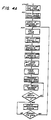
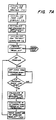
- a flow chart of a computer program used in personal computer 31 is shown in FIG. 4. The flowchart will be readily understood by those of ordinary skill in the art.
- the parametized data from personal computer 31 are transmitted over serial link 34 to computer 32 where they are clocked into a section of RAM partitioned, using pointers, as a modulo-2048 circular buffer.
- the buffer holds 34 seconds of data.
- Frame grabber 36 and personal computer 31 are too slow to grab all of the frame data in real time (although in the second preferred embodiment, described below, this function is performed by hardware which does operate in real time). Resultantly, some data are lost.
- the data that are provided over serial link 34 are inserted into the buffer in their current real-time positions.
- Computer 32 "backfills" the buffer by filling in the empty positions with the next succeeding real time data.
- Computer 32 creates signatures and matches incoming frame signature data to a signature data-base as described above, without using the designated frame keyword lookup technique.
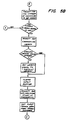
- a flowchart of the signature generation program is shown in FIG. 5.
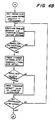
- a flowchart of the signature detection program is shown in FIG. 6. The flowcharts will be readily understood by those of ordinary skill in the art.
- each segment is divided into nine sections -- a half-section at the beginning, followed by eight full sections, and a half-section at the end.
- the two half-sections are discarded to account for possible truncation of the beginning or end of the segment when it is broadcast.
- a word is then selected, using the previously described criteria of stable data, noise-free data, Hamming distance, and entropy, from each of the eight sections.
- the signatures created are stored in the memory of computer 32 while the match data are transmitted over serial link 35 to computer 33 which keeps track of the matches.
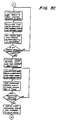
- a flowchart of a program used in computer 33 is shown in FIG. 7. The flowchart will be readily understood by those of ordinary skill in the art.
- Signatures are generated in the system of FIG. 3 by the computer 32. However, the generation of signatures is not initiated as earlier described and as implemented in the second preferred embodiment (described below). Rather, in the system of FIG. 3, an operator must "prime” the system by specifying the segment length, playing a tape into the system and manually starting the buffer filling process. Computer 32 then builds a signature automatically. However, there is no threshold or guard-band computed here as was earlier described, and as implemented in the second preferred embodiment (described below). In the second preferred embodiment, a threshold asso- ciated with the signature is modified by subtracting from the default threshold one-half the number of masked bits in the signature, while in the system of FIG. 3 the default threshold is augmented at the time of comparison by one-half the number of masked bits in the data being compared.
- FIGS. 8-12 A second preferred embodiment of the system of the invention is shown in FIGS. 8-12.
- FIGS. 8-11B show the details of local sites 21.
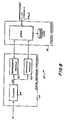
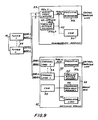
- FIG. 8 is a block diagram of local site 21.
- the local site 21 is comprised of two major subsystems: the signal processing subsystem 80 and the control computer 81.
- the signal processing subsystem 80 receives incoming RF broadcast signals and performs three distinct tasks:
- the hardware of signal processing subsystem 80 includes matching module 82, compression module 83, and one or more tuners 84 (there is one tuner for each broadcast station to be monitored).
- Tuner 84 may be any conventional RF tuner, and in the preferred embodiment is Zenith model ST-3100.
- Matching module 82 and compression module 83 are built around the well-known Intel Corporation Multibuse II Bus Structure. Multibuse II is described in the Multibuse II Bus Architecture Databook (Intel Order No. 230893) and the Multibuse II Bus Architecture Specification Handbook (Intel Order No. 146077C), both of which are incorporated herein by reference. The first two tasks discussed above are performed in matching module 82. The third task is performed in compression module 83.
- Each of the two modules 82, 83 includes a Central Services Module (CSM) 90 which is a standard off-the-shelf item (such as Intel Order No. SBC-CSM-001) required in all Multibuse II systems.
- CSM Central Services Module
- Each module also has an executive microcomputer board 91a, 91b which controls communications between the respective module and control computer 81. All components on each module are interconnected on public bus 92, while those components which require large amounts of high-speed data transfer between them are additionally interconnected by private bus 93.
- Matching module 82 further includes one channel card 94 for each channel to be monitored -- e.g., one for each commercial station in the local market.
- Channel cards 94 generate the 16 bits per frame of parametized signal data and the corre- sponding 16-bit mask for both audio and video in accordance with the methods earlier described.
- Channel cards 94 also signal the occurrence of signal artifacts which indicate, and are used to delineate and capture, potential unknown segments.
- Also contained within matching module 82 are two circular buffer memories 95.
- One buffer 95 is for audio and the other is for video. These buffers store on a temporary basis the incoming parametized frame signature data, as earlier described. In this preferred embodiment, the maximum length of broadcast segments to be recognized is assumed to be one minute.
- each buffer can hold 4,096 frames, which is 136.5 seconds, of video at a frame rate of thirty frames per second, or just over two minutes. 4,096 is 212, so the offset data associated with each sig- nature (as earlier described) is 12 bits long. Parametized signal information is moved from channel cards 94 to the circular buffers 95 when requested by executive microcomputer 91a.
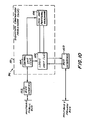
- Matching module 82 also includes correlation card 96, shown in more detail in FIG. 10.
- Correlation card 96 performs the task of recognizing incoming broadcast segments. Correlation card 96 accomplishes this by comparing incoming video and audio frame signature data with the locally stored database of key signatures to find matches.
- the local signature database is stored in memory 97 (up to 13 megabytes of conventional random access memory). Since correlation card 96 in the preferred embodiment may operate on both audio and video data (although, e.g., only video can be used), correlation card 96 must have sufficient capacity to process an amount of data equivalent to twice the number of channels to be monitored.
- Correlation card 96 performs all functions required to generate the raw data for the final correlation, or determination of a segment match.
- Executive microcomputer 91a accumulates the matches resulting from key signature comparisons done by correlation card 96, and then transmits the accumulated matches to control computer 81.
- correlation card 96 contains signature comparison processor (SCP) 101 and two independent interfaces 102, 103 to the Multibuse II public and private buses.
- SCP 101 is a programmable element which operates under command of executive microcomputer 91a. SCP 101 is responsible for the following primary functions:
- Control unit 104 of SCP 101 directs the operation of SCP 101.
- Control unit 104 includes memory which contains all microprogram instructions defining SCP operation. It also contains sufficient functionality to allow for the efficient sequencing of the required microinstructions. Control unit operation is directed, at an upper level, by instructions generated by executive microcomputer 91a.
- Logic unit 105 performs all address and data manipulations required to load both incoming and previously defined reference signatures into onboard buffers for comparison. Signature data is resident in external, offboard memory accessible by the private bus; logic unit 105 and control unit 104 together execute all private bus interface functions.
- Logic unit 105 also generates messages to and interprets messages from executive microcomputer 91a.
- An example of a message interpreted by logic unit 105 is a request to compare selected key signatures in the key signature database to the current, incoming segment signature.
- An example of a message generated by logic unit 105 is that which is generated at the end of a comparison which defines how well the incoming signature matches the reference (how many total correct or incorrect bits after comparison).
- the logic unit peripheral hardware module 106 is responsible for assisting logic unit 105 in performing signature comparisons. Specifically, the module contains logic which is intended to increase the processing capability of SCP 101. The features of module 106 are:
- Executive microcomputer 91a is a standard commercial microcomputer card (e.g., Intel Order No. SBC-286-100) based on an 80286 microprocessor. The function of this card is to:
- Compression module 83 includes (in addition to central services module 90 and executive micro- computer 91b) audio capture card 98a, video capture card 98b, and associated circular buffer memories 99a, 99b.
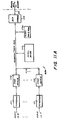
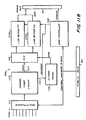
- the audio and video capture cards are shown in more detail in FIGS. 11A and 11B, respec- tively.
- Audio and video capture cards 98a, 98b each can monitor up to eight broadcast channels (monitoring more channels requires multiple cards).
- Video card 98b captures incoming video frames at a slide-show rate of one frame per second and digitizes and compresses the video data, while audio card 98a digitizes and captures audio continually, for each of the eight channels.
- a conventional 1-of-8 multiplexer 110 (implemented in this embodiment as a T-switch circuit design using CMOS 4066 integrated circuits), selects one of the eight channels for capture.
- the audio from each channel is fed to one of up to eight combination filter/coder/decoder circuits 111, such as a National Semiconductor 3054 integrated circuit.
- combination circuit 111 the audio signal is passed through a low-pass filter and then through a coder/decoder which performs a logarithmic analog-to-digital conversion resulting in a digital signal with a compressed amplitude (the audio signal is expanded again prior to being audited by an operator at central site 22).
- the compressed digital signal is then passed through an adaptive differential pulse code modulator (ADPCM) 112 similar to that used by the telephone industry -- e.g., a NEC 7730 integrated circuit -- for further compression.
- ADPCM adaptive differential pulse code modulator
- An Intel 80188 microprocessor 113 controls the movement of the compressed audio data from ADPCM 112 through bus interface 114 to private bus 93 of compression module 83, and thence to circular buffer memory 99a.
- a JEDEC-standard RAM/EPROM 113a contains programs and memory workspace used by microprocessor 113.
- common video circuit 115 uses the sync information contained in the received analog video signal to generate clock pulses and addresses for analog-to- digital conversion of the video signal.
- Circuit 115 outputs both address signals and digitized data signals representing the video at the rate of one field per second at 116 and 117, respectively.
- the data pass to arithmetic logic unit (ALU) 118 which further compresses the video data by reducing each video field or frame to 160 (horizontal) by 120 (vertical) pixels, each pixel averaging four-by-two pixel areas in size, using gray scale pixel averaging.
- ALU arithmetic logic unit
- the address data pass from common video circuit 115 to dither prom 119 which contains a table of pseudorandom numbers -- one for each video address output by circuit 115.
- dither prom 119 contains a table of pseudorandom numbers -- one for each video address output by circuit 115.
- ALU 118 contains a table of pseudorandom numbers -- one for each video address output by circuit 115.
- This dithering technique by which a low-information-content video signal can be visually improved, allows the video frame to be compressed to as few as 9600 bytes.
- the dithered compressed video data are then passed to one of two line buffers 1101a, b (one buffer is filled while the other is being read and emptied), from which they are passed under the control of direct memory access controller 1102 to private bus 93 of compression module 83, and thence to circular buffer memory 99b.
- the audio and video data are placed in circular buffers 99a and 99b holding the most recent two minutes of data for that channel under the direc- tion of control computer 81 and executive microcomputer 91b.
- Executive microcomputer 91b preferably is a standard commercial microcomputer card (e.g., Intel order No. SBC-286-100) based on an 80286 microprocessor. This card provides an interface path to the control computer 81. All data to be transferred to the central site is requested by control computer 81.
- the signal processing subsystem 80 can be referred to as the "front end" of local site 21.
- Control computer 81 can be referred to as the "back end”.
- Control computer 81 (FIG. 8) is preferably a commercially available MicroVAX II minicomputer manufactured by Digital Equipment Corporation (DEC), running the DEC VMS virtual memory operating system. Between one and nine megabytes of RAM memory are provided along with one DEC RA81 Winchester disk drive (with controller) having a capacity of 456 megabytes.
- a DPV11 synchronous interface connects the control computer 81 to communications channels 23a, b via a modem.
- a DRV11 direct memory access controller connects control computer 81 to signal processing subsystem 80.
- control computer 81 A function of control computer 81 is to determine, using detected signal artifacts, when new and as yet unknown broadcast segments may have been received. Control computer 81 also keeps track of the temporary log for such segments until the segments have been identified by central site 22. Another function of control computer 81 is to determine, based on duration and other criteria, such as time of day, whether or not matches accumulated by executive microcomputer 91a actually indicate that a segment has been recognized. (For example, during "prime time" no commercials are normally broadcast at, e.g., 7 minutes after the hour.) In performing these functions, control computer 81 exercises its ability to control all segment processing subsystem 80 functions via executive microcomputers 91a, 91b.
- Control computer 81 can instruct modules 82 and 83 to tune to a particular channel to capture audio/video data, to compare a pair of frame and key signatures, or to generate a local signature. These instructions can originate in control computer 81 itself or ultimately at central site 22. For example, in identifying a new segment, an operator may need higher resolution video information. In such a case, control computer 81 would act on instructions from central site 22 by requesting module 83 to capture the required data when the desired segment is next received. Control computer 81 also stores on disk a backup copy of the signature database stored in RAM memory 97.
- central system 22 includes central-local site 21a, coprocessor 25, mainframe "host” computer and memory 27 with associated mass storage device 28, communications processor 29 and workstations 26.
- Coprocessor 25 is used to assist with certain computationally intensive functions related to the signature processing requirements of the central site 22.
- the "front end" of coprocessor 25 is identical to matching module 82 of local site 21, earlier described, except for the omission from coprocessor 25 of channel cards 94. It is preferred, however, that the memory for the signature database within coprocessor 25 be expanded over that of the local site to ensure that all key signatures used at all local sites can be resident in coprocessor 25.
- the "back end" of coprocessor 25 preferably uses the same MicroVAX computer used by local sites 21 (FIG. 8), although a different type of computer could be used. Another alternative is that the coprocessor front end may be attached to communications processor 29 at the central site. It is also preferred that the coprocessor hardware be duplicated at central site 22 so that a backup system is available in case of a failure of the primary coprocessor.
- the coprocessor's signature generating and comparing functions are performed in the front end, while its checking and grouping functions are controlled by its back end utilizing the comparison capabilities of the front end as described above.
- Workstation 26 is the vehicle by which new and unknown segments are presented to, and classified by, human operators.
- a secondary function of workstation 26 is to act as a terminal in the maintenance of host resident databases.
- Workstation 26 is made up of the following:
- workstation 26 The heart of workstation 26 is the IBM 3270 AT computer.
- the 3270 AT is a blend of an IBM 3270 terminal and an IBM AT personal computer. By combining the power of these components, a very effective mainframe workstation is created.
- Workstation 26 allows easy communication with host 27 and has its own processing capability. Up to four sessions with host 27 can be started as well as a local process all viewed in separate windows on the console screen. A combination of host and local processes are used by the operator.
- the video card contained in the 3270 AT can display two different segments.
- Each video card consists of a pair of "ping-pong" (A/B RAM) memories for holding compressed gray scale video data.
- the ping-pong memories can be used in one of two ways. First a segment can be pre-loaded into RAM A while RAM B is being displayed. Second, the ping-pong memories can be used to load the next frame of a segment while the other is being displayed. Gray scale data is returned to video format and smoothed before being passed through the video digital-to-analog converter.
- An audio control card is also provided in the 3270 AT.
- ADPCM circuits e.g., NEC 7730
- Workstation 26 supports the identification process of new commercial segments and contains self-test routines to check the status of the machine and components. It is possible for workstation 26 to operate in a somewhat stand-alone mode requesting needed information from host 27 and passing results back. Alternatively, host 27 could control the application and send audio/video requests to work-station 26. The operator at workstation 26 controls the audio and video cards to cause the audio and/or video portions of selected segments to be displayed or output.
- Host computer 27 is preferably an IBM main- frame of the 308X series, such as an IBM 3083.
- Host computer 27 maintains a copy of the global signature databast and an archive of all parametized and compressed audio/video data from which the signature database was generated. The archive allows recreation of the signature database in the event, e.g., of an accidental catastrophic loss of data.
- Host computer 27 uses the following commercially available software packages:
- Host 27 also commands the workstation 26, coprocessor 25 and, ultimately, local site 21. For example, it may be determined that additional information is needed from a particular local site 21. Host 27 acts on that determination by instructing the appropriate local site control computer 81 to request that its signal processing subsystem 80 capture additional data, or upload some data previously captured, for example.
- Host 27 also uses information transmitted by the various local sites 21 as to the occurrences of segments to compile a log of occurrences and one or more reports requested by the system users.
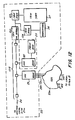
- Communications channels 23a, b and communications processor 29 are shown diagrammatically in more detail in FIG. 12.
- coprocessor 25 has a separate control computer 121, although, as stated above, the functions of that computer could be handled by communications proces- sor 29.
- central site 22 and local sites 21 are coordinated by Digital Equip- ment Corporation (DEC) equipment. Therefore, communications throughout the system are based on DEC's DECNet protocol.
- DECNet protocol is run on a local area network 120.
- An SNA gateway 122 manufactured by DEC is connected to local area network 120 to translate between DECNet and IBM's Systems Network Architecture to allow communications between host 27 and the rest of the system.
- An IBM 3725 communications control device 123 interfaces between SNA gateway 122 and host 27.
- An IBM 3724 cluster controller 124 interfaces between device 123 and workstations 26, allowing workstations 26 to communicate with host 27.
- Central-local site 21a is connected to local area network 120 by high-speed link 24 as earlier discussed.
- Communications control computer 29 is preferably a Digital Equipment Corporation VAX 8200.
- Coprocessor control computer 121 is the identical computer and in fact, as discussed above, its function can be performed by communications control computer 29 if desired.
- Communications control computer 29 interfaces between local area network 120 and local sites 21.
- local sites 21 with which high-speed or high-volume communications is necessary or desired e.g., major "hot" markets such as New York, Chicago or Los Angeles -- communication can be by high-speed leased line 23b.
- a lower speed packet switching data network 23a running the well-known X.25 protocol is used.
- the X.25 protocol is transparent to DECNet and is available on such commercial data communications networks as Telenet or Tymnet.
- Communication lines 125 between individual local sites 21 and network 23a can be provided either by leased line or over the telephone dial-up network.
Landscapes
- Engineering & Computer Science (AREA)
- Multimedia (AREA)
- Signal Processing (AREA)
- Physics & Mathematics (AREA)
- General Physics & Mathematics (AREA)
- Theoretical Computer Science (AREA)
- Acoustics & Sound (AREA)
- Testing, Inspecting, Measuring Of Stereoscopic Televisions And Televisions (AREA)
- Television Systems (AREA)
Applications Claiming Priority (2)
| Application Number | Priority Date | Filing Date | Title |
|---|---|---|---|
| US06/859,134 US4739398A (en) | 1986-05-02 | 1986-05-02 | Method, apparatus and system for recognizing broadcast segments |
| US859134 | 1986-05-02 |
Publications (3)
| Publication Number | Publication Date |
|---|---|
| EP0248533A2 EP0248533A2 (en) | 1987-12-09 |
| EP0248533A3 EP0248533A3 (en) | 1989-09-06 |
| EP0248533B1 true EP0248533B1 (en) | 1994-08-31 |
Family
ID=25330135
Family Applications (1)
| Application Number | Title | Priority Date | Filing Date |
|---|---|---|---|
| EP87303968A Expired - Lifetime EP0248533B1 (en) | 1986-05-02 | 1987-05-01 | Method, apparatus and system for recognising broadcast segments |
Country Status (6)
| Country | Link |
|---|---|
| US (1) | US4739398A (enExample) |
| EP (1) | EP0248533B1 (enExample) |
| JP (3) | JPS6324786A (enExample) |
| AU (1) | AU585809B2 (enExample) |
| CA (1) | CA1323415C (enExample) |
| DE (1) | DE3750437T2 (enExample) |
Cited By (3)
| Publication number | Priority date | Publication date | Assignee | Title |
|---|---|---|---|---|
| EP2127400A4 (en) * | 2007-02-27 | 2011-05-25 | Landmark Digital Services Llc | SYSTEM AND METHOD FOR MONITORING AND RECOGNIZING GENERAL BROADCAST DATA |
| US9465867B2 (en) * | 2014-12-01 | 2016-10-11 | W. Leo Hoarty | System and method for continuous media segment identification |
| US10116972B2 (en) | 2009-05-29 | 2018-10-30 | Inscape Data, Inc. | Methods for identifying video segments and displaying option to view from an alternative source and/or on an alternative device |
Families Citing this family (322)
| Publication number | Priority date | Publication date | Assignee | Title |
|---|---|---|---|---|
| JPS6356091A (ja) * | 1986-08-26 | 1988-03-10 | Video Res:Kk | テレビ・コマーシャル放送確認方法 |
| US4814883A (en) * | 1988-01-04 | 1989-03-21 | Beam Laser Systems, Inc. | Multiple input/output video switch for commerical insertion system |
| US5031228A (en) * | 1988-09-14 | 1991-07-09 | A. C. Nielsen Company | Image recognition system and method |
| US4858000A (en) * | 1988-09-14 | 1989-08-15 | A. C. Nielsen Company | Image recognition audience measurement system and method |
| US5019899A (en) * | 1988-11-01 | 1991-05-28 | Control Data Corporation | Electronic data encoding and recognition system |
| US7594250B2 (en) * | 1992-04-02 | 2009-09-22 | Debey Henry C | Method and system of program transmission optimization using a redundant transmission sequence |
| JPH0666738B2 (ja) * | 1990-04-06 | 1994-08-24 | 株式会社ビデオ・リサーチ | Cm自動確認装置 |
| US6175312B1 (en) | 1990-05-29 | 2001-01-16 | Microchip Technology Incorporated | Encoder and decoder microchips and remote control devices for secure unidirectional communication |
| CA2036205C (en) * | 1990-06-01 | 1996-11-19 | Russell J. Welsh | Program monitoring unit |
| WO1991019989A1 (en) * | 1990-06-21 | 1991-12-26 | Reynolds Software, Inc. | Method and apparatus for wave analysis and event recognition |
| US5121440A (en) * | 1990-08-30 | 1992-06-09 | Monolithic Resources Corporation | Analog video character recognition system |
| US5200822A (en) * | 1991-04-23 | 1993-04-06 | National Broadcasting Company, Inc. | Arrangement for and method of processing data, especially for identifying and verifying airing of television broadcast programs |
| GB2258065A (en) * | 1991-07-26 | 1993-01-27 | Mcconnells Developments Limite | Television programme and advertising data analysis |
| US10361802B1 (en) | 1999-02-01 | 2019-07-23 | Blanding Hovenweep, Llc | Adaptive pattern recognition based control system and method |
| US6418424B1 (en) | 1991-12-23 | 2002-07-09 | Steven M. Hoffberg | Ergonomic man-machine interface incorporating adaptive pattern recognition based control system |
| US8352400B2 (en) | 1991-12-23 | 2013-01-08 | Hoffberg Steven M | Adaptive pattern recognition based controller apparatus and method and human-factored interface therefore |
| US6850252B1 (en) | 1999-10-05 | 2005-02-01 | Steven M. Hoffberg | Intelligent electronic appliance system and method |
| US7242988B1 (en) | 1991-12-23 | 2007-07-10 | Linda Irene Hoffberg | Adaptive pattern recognition based controller apparatus and method and human-factored interface therefore |
| US5903454A (en) | 1991-12-23 | 1999-05-11 | Hoffberg; Linda Irene | Human-factored interface corporating adaptive pattern recognition based controller apparatus |
| US6400996B1 (en) | 1999-02-01 | 2002-06-04 | Steven M. Hoffberg | Adaptive pattern recognition based control system and method |
| US6678461B1 (en) | 1992-04-10 | 2004-01-13 | Avid Technology, Inc. | Media recorder for capture and playback of live and prerecorded audio and/or video information |
| US6058236A (en) * | 1992-04-10 | 2000-05-02 | Avid Technology, Inc. | System and method for digitally capturing video segments from a video assist of a film camera |
| US5436653A (en) * | 1992-04-30 | 1995-07-25 | The Arbitron Company | Method and system for recognition of broadcast segments |
| US5721788A (en) * | 1992-07-31 | 1998-02-24 | Corbis Corporation | Method and system for digital image signatures |
| GB9221678D0 (en) * | 1992-10-15 | 1992-11-25 | Taylor Nelson Group Limited | Identifying a received programme stream |
| US5437050A (en) * | 1992-11-09 | 1995-07-25 | Lamb; Robert G. | Method and apparatus for recognizing broadcast information using multi-frequency magnitude detection |
| CA2106143C (en) * | 1992-11-25 | 2004-02-24 | William L. Thomas | Universal broadcast code and multi-level encoded signal monitoring system |
| US5577266A (en) * | 1993-04-08 | 1996-11-19 | Digital D.J. Inc. | Broadcast system with associated data capabilities |
| KR100343517B1 (ko) * | 1993-06-28 | 2002-11-29 | 다우 베네룩스 엔. 브이. | 확장프로그램간통신서버 |
| US5355161A (en) * | 1993-07-28 | 1994-10-11 | Concord Media Systems | Identification system for broadcast program segments |
| CN1047488C (zh) * | 1993-08-31 | 1999-12-15 | 联合企业股份有限公司和无线电产业保护两合公司 | 检测非所愿的电视图象的方法和装置 |
| US5485518A (en) * | 1993-09-30 | 1996-01-16 | Yellowstone Environmental Science, Inc. | Electronic media program recognition and choice |
| US5481294A (en) * | 1993-10-27 | 1996-01-02 | A. C. Nielsen Company | Audience measurement system utilizing ancillary codes and passive signatures |
| US5768426A (en) * | 1993-11-18 | 1998-06-16 | Digimarc Corporation | Graphics processing system employing embedded code signals |
| US7313251B2 (en) * | 1993-11-18 | 2007-12-25 | Digimarc Corporation | Method and system for managing and controlling electronic media |
| US5748763A (en) * | 1993-11-18 | 1998-05-05 | Digimarc Corporation | Image steganography system featuring perceptually adaptive and globally scalable signal embedding |
| US5841978A (en) * | 1993-11-18 | 1998-11-24 | Digimarc Corporation | Network linking method using steganographically embedded data objects |
| US7171016B1 (en) | 1993-11-18 | 2007-01-30 | Digimarc Corporation | Method for monitoring internet dissemination of image, video and/or audio files |
| US5822436A (en) * | 1996-04-25 | 1998-10-13 | Digimarc Corporation | Photographic products and methods employing embedded information |
| US5581658A (en) * | 1993-12-14 | 1996-12-03 | Infobase Systems, Inc. | Adaptive system for broadcast program identification and reporting |
| US5488425A (en) * | 1993-12-22 | 1996-01-30 | At&T Corp. | Apparatus for storing video information by recognizing video frames |
| US7418474B2 (en) * | 1994-03-03 | 2008-08-26 | Schwab Barry H | Secure identification system |
| US6353699B1 (en) * | 1994-03-03 | 2002-03-05 | Barry H. Schwab | Method and apparatus for compiling audio/video information from remote sites into a final video program |
| US5526427A (en) * | 1994-07-22 | 1996-06-11 | A.C. Nielsen Company | Universal broadcast code and multi-level encoded signal monitoring system |
| US7724919B2 (en) * | 1994-10-21 | 2010-05-25 | Digimarc Corporation | Methods and systems for steganographic processing |
| US6560349B1 (en) * | 1994-10-21 | 2003-05-06 | Digimarc Corporation | Audio monitoring using steganographic information |
| US8094949B1 (en) | 1994-10-21 | 2012-01-10 | Digimarc Corporation | Music methods and systems |
| GB9504376D0 (en) * | 1995-03-04 | 1995-04-26 | Televitesse Systems Inc | Automatic broadcast monitoring system |
| EP0872120A1 (en) | 1995-03-07 | 1998-10-21 | Interval Research Corporation | System and method for selective recording of information |
| US7805500B2 (en) * | 1995-05-08 | 2010-09-28 | Digimarc Corporation | Network linking methods and apparatus |
| US7224819B2 (en) * | 1995-05-08 | 2007-05-29 | Digimarc Corporation | Integrating digital watermarks in multimedia content |
| US7486799B2 (en) * | 1995-05-08 | 2009-02-03 | Digimarc Corporation | Methods for monitoring audio and images on the internet |
| US6760463B2 (en) * | 1995-05-08 | 2004-07-06 | Digimarc Corporation | Watermarking methods and media |
| US6829368B2 (en) * | 2000-01-26 | 2004-12-07 | Digimarc Corporation | Establishing and interacting with on-line media collections using identifiers in media signals |
| US7711564B2 (en) * | 1995-07-27 | 2010-05-04 | Digimarc Corporation | Connected audio and other media objects |
| US6411725B1 (en) * | 1995-07-27 | 2002-06-25 | Digimarc Corporation | Watermark enabled video objects |
| US6505160B1 (en) * | 1995-07-27 | 2003-01-07 | Digimarc Corporation | Connected audio and other media objects |
| US6577746B1 (en) * | 1999-12-28 | 2003-06-10 | Digimarc Corporation | Watermark-based object linking and embedding |
| US7562392B1 (en) | 1999-05-19 | 2009-07-14 | Digimarc Corporation | Methods of interacting with audio and ambient music |
| US6965682B1 (en) | 1999-05-19 | 2005-11-15 | Digimarc Corp | Data transmission by watermark proxy |
| US8180844B1 (en) | 2000-03-18 | 2012-05-15 | Digimarc Corporation | System for linking from objects to remote resources |
| US7505605B2 (en) * | 1996-04-25 | 2009-03-17 | Digimarc Corporation | Portable devices and methods employing digital watermarking |
| JP3625344B2 (ja) * | 1996-11-05 | 2005-03-02 | 株式会社ビデオリサーチ | 視聴チャンネル検出装置 |
| US8306811B2 (en) * | 1996-08-30 | 2012-11-06 | Digimarc Corporation | Embedding data in audio and detecting embedded data in audio |
| US7269330B1 (en) | 1996-11-01 | 2007-09-11 | Televentions, Llc | Method and apparatus for controlling a video recorder/player to selectively alter a video signal |
| US5999689A (en) * | 1996-11-01 | 1999-12-07 | Iggulden; Jerry | Method and apparatus for controlling a videotape recorder in real-time to automatically identify and selectively skip segments of a television broadcast signal during recording of the television signal |
| US6771316B1 (en) | 1996-11-01 | 2004-08-03 | Jerry Iggulden | Method and apparatus for selectively altering a televised video signal in real-time |
| US6002443A (en) | 1996-11-01 | 1999-12-14 | Iggulden; Jerry | Method and apparatus for automatically identifying and selectively altering segments of a television broadcast signal in real-time |
| US6088484A (en) * | 1996-11-08 | 2000-07-11 | Hughes Electronics Corporation | Downloading of personalization layers for symbolically compressed objects |
| US5893062A (en) | 1996-12-05 | 1999-04-06 | Interval Research Corporation | Variable rate video playback with synchronized audio |
| US6263507B1 (en) * | 1996-12-05 | 2001-07-17 | Interval Research Corporation | Browser for use in navigating a body of information, with particular application to browsing information represented by audiovisual data |
| US6675383B1 (en) | 1997-01-22 | 2004-01-06 | Nielsen Media Research, Inc. | Source detection apparatus and method for audience measurement |
| CA2196930C (en) * | 1997-02-06 | 2005-06-21 | Nael Hirzalla | Video sequence recognition |
| DE19728099A1 (de) * | 1997-07-02 | 1999-01-07 | Klaus Dr Ing Schulze | Verfahren und Vorrichtung zur Erkennung unikater Bildfolgen |
| JPH1155201A (ja) | 1997-07-29 | 1999-02-26 | Sony Corp | 情報処理装置および方法、情報処理システム、並びに伝送媒体 |
| JPH11122203A (ja) * | 1997-10-09 | 1999-04-30 | Video Research:Kk | 放送確認システム、及びこのシステムに使用される映像素材制作装置及び放送確認装置 |
| US6972802B2 (en) * | 1997-10-21 | 2005-12-06 | Bray J Richard | Language filter for home TV |
| US6166780A (en) * | 1997-10-21 | 2000-12-26 | Principle Solutions, Inc. | Automated language filter |
| US7139031B1 (en) | 1997-10-21 | 2006-11-21 | Principle Solutions, Inc. | Automated language filter for TV receiver |
| US6961954B1 (en) | 1997-10-27 | 2005-11-01 | The Mitre Corporation | Automated segmentation, information extraction, summarization, and presentation of broadcast news |
| US6080816A (en) * | 1997-11-10 | 2000-06-27 | E. I. Du Pont De Nemours And Company | Coatings that contain reactive silicon oligomers |
| US6173271B1 (en) * | 1997-11-26 | 2001-01-09 | California Institute Of Technology | Television advertising automated billing system |
| ES2141039B1 (es) * | 1998-01-30 | 2000-10-16 | Mayo Audiovisual S A | Sistema automatico de deteccion y reconocimiento de anuncios televisados. |
| US7689532B1 (en) | 2000-07-20 | 2010-03-30 | Digimarc Corporation | Using embedded data with file sharing |
| DE69830163D1 (de) | 1998-05-12 | 2005-06-16 | Nielsen Media Res Inc | Zuschauerermittlungssystem für digitales fernsehen |
| US7644282B2 (en) | 1998-05-28 | 2010-01-05 | Verance Corporation | Pre-processed information embedding system |
| IL127569A0 (en) | 1998-09-16 | 1999-10-28 | Comsense Technologies Ltd | Interactive toys |
| US20100030838A1 (en) * | 1998-08-27 | 2010-02-04 | Beepcard Ltd. | Method to use acoustic signals for computer communications |
| US6607136B1 (en) * | 1998-09-16 | 2003-08-19 | Beepcard Inc. | Physical presence digital authentication system |
| US8332478B2 (en) | 1998-10-01 | 2012-12-11 | Digimarc Corporation | Context sensitive connected content |
| US7334735B1 (en) | 1998-10-02 | 2008-02-26 | Beepcard Ltd. | Card for interaction with a computer |
| US6246803B1 (en) | 1998-12-27 | 2001-06-12 | The University Of Kansas | Real-time feature-based video stream validation and distortion analysis system using color moments |
| US6934461B1 (en) * | 1999-01-05 | 2005-08-23 | Interval Research Corporation | Low attention recording, with particular application to social recording |
| US7904187B2 (en) | 1999-02-01 | 2011-03-08 | Hoffberg Steven M | Internet appliance system and method |
| US8364136B2 (en) | 1999-02-01 | 2013-01-29 | Steven M Hoffberg | Mobile system, a method of operating mobile system and a non-transitory computer readable medium for a programmable control of a mobile system |
| US6289514B1 (en) | 1999-03-29 | 2001-09-11 | Qcom Tv, Inc. | System and method for the near-real time capture and reporting of large population consumer behaviors concerning television use |
| US8874244B2 (en) * | 1999-05-19 | 2014-10-28 | Digimarc Corporation | Methods and systems employing digital content |
| US7302574B2 (en) * | 1999-05-19 | 2007-11-27 | Digimarc Corporation | Content identifiers triggering corresponding responses through collaborative processing |
| US8095796B2 (en) * | 1999-05-19 | 2012-01-10 | Digimarc Corporation | Content identifiers |
| US20020032734A1 (en) | 2000-07-26 | 2002-03-14 | Rhoads Geoffrey B. | Collateral data combined with user characteristics to select web site |
| US6871180B1 (en) | 1999-05-25 | 2005-03-22 | Arbitron Inc. | Decoding of information in audio signals |
| US7194752B1 (en) | 1999-10-19 | 2007-03-20 | Iceberg Industries, Llc | Method and apparatus for automatically recognizing input audio and/or video streams |
| US7174293B2 (en) * | 1999-09-21 | 2007-02-06 | Iceberg Industries Llc | Audio identification system and method |
| US8019609B2 (en) | 1999-10-04 | 2011-09-13 | Dialware Inc. | Sonic/ultrasonic authentication method |
| US7155735B1 (en) | 1999-10-08 | 2006-12-26 | Vulcan Patents Llc | System and method for the broadcast dissemination of time-ordered data |
| US6469749B1 (en) * | 1999-10-13 | 2002-10-22 | Koninklijke Philips Electronics N.V. | Automatic signature-based spotting, learning and extracting of commercials and other video content |
| CA2809775C (en) * | 1999-10-27 | 2017-03-21 | The Nielsen Company (Us), Llc | Audio signature extraction and correlation |
| US7191462B1 (en) * | 1999-11-08 | 2007-03-13 | Kendyl A. Román | System for transmitting video images over a computer network to a remote receiver |
| US6329489B1 (en) | 1999-12-20 | 2001-12-11 | E. I. Du Pont De Nemours And Company | Process for producing reactive silane oligomers |
| US6397041B1 (en) | 1999-12-22 | 2002-05-28 | Radio Propagation Services, Inc. | Broadcast monitoring and control system |
| US6757682B1 (en) * | 2000-01-28 | 2004-06-29 | Interval Research Corporation | Alerting users to items of current interest |
| US6737957B1 (en) | 2000-02-16 | 2004-05-18 | Verance Corporation | Remote control signaling using audio watermarks |
| US6834308B1 (en) | 2000-02-17 | 2004-12-21 | Audible Magic Corporation | Method and apparatus for identifying media content presented on a media playing device |
| US20040255334A1 (en) * | 2000-03-28 | 2004-12-16 | Gotuit Audio, Inc. | Methods and apparatus for seamlessly changing volumes during playback using a compact disk changer |
| FR2807275B1 (fr) * | 2000-04-04 | 2003-01-24 | Mobiclick | Systeme permettant de transmettre a un usager des informations relativement a une sequence sonore qu'il ecoute ou a ecoutee |
| CN100592788C (zh) * | 2000-04-14 | 2010-02-24 | 日本电信电话株式会社 | 与广播信息相关的信息取得方法、系统和装置 |
| JP4507351B2 (ja) * | 2000-04-27 | 2010-07-21 | ソニー株式会社 | 信号処理装置及び方法 |
| US8121843B2 (en) * | 2000-05-02 | 2012-02-21 | Digimarc Corporation | Fingerprint methods and systems for media signals |
| US7617509B1 (en) | 2000-06-23 | 2009-11-10 | International Business Machines Corporation | Method and system for automated monitoring of quality of service of digital video material distribution and play-out |
| US7853664B1 (en) | 2000-07-31 | 2010-12-14 | Landmark Digital Services Llc | Method and system for purchasing pre-recorded music |
| JP3775186B2 (ja) * | 2000-08-10 | 2006-05-17 | 日本電気株式会社 | 放送確認システム、放送確認装置および方法、放送確認プログラムを記録した記録媒体 |
| US8010988B2 (en) * | 2000-09-14 | 2011-08-30 | Cox Ingemar J | Using features extracted from an audio and/or video work to obtain information about the work |
| US8205237B2 (en) | 2000-09-14 | 2012-06-19 | Cox Ingemar J | Identifying works, using a sub-linear time search, such as an approximate nearest neighbor search, for initiating a work-based action, such as an action on the internet |
| US7129972B2 (en) * | 2000-09-25 | 2006-10-31 | Canon Kabushiki Kaisha | Image sensing device for transmitting images |
| GB2384596A (en) * | 2000-10-23 | 2003-07-30 | Ntt Comm Corp | Musical composition recognition method and system, storage medium where musical composition program is stored, commercial recognition method and system, |
| US7562012B1 (en) | 2000-11-03 | 2009-07-14 | Audible Magic Corporation | Method and apparatus for creating a unique audio signature |
| US20020072982A1 (en) | 2000-12-12 | 2002-06-13 | Shazam Entertainment Ltd. | Method and system for interacting with a user in an experiential environment |
| AU2002232817A1 (en) * | 2000-12-21 | 2002-07-01 | Digimarc Corporation | Methods, apparatus and programs for generating and utilizing content signatures |
| US8103877B2 (en) | 2000-12-21 | 2012-01-24 | Digimarc Corporation | Content identification and electronic tickets, coupons and credits |
| KR100400542B1 (ko) * | 2001-02-28 | 2003-10-08 | 엘지전자 주식회사 | 디지털 방송 수신장치의 광고를 이용한 시스템 소프트웨어업그레이드 장치 및 방법 |
| US7359889B2 (en) * | 2001-03-02 | 2008-04-15 | Landmark Digital Services Llc | Method and apparatus for automatically creating database for use in automated media recognition system |
| US7197160B2 (en) * | 2001-03-05 | 2007-03-27 | Digimarc Corporation | Geographic information systems using digital watermarks |
| US9219708B2 (en) * | 2001-03-22 | 2015-12-22 | DialwareInc. | Method and system for remotely authenticating identification devices |
| EP1490767B1 (en) * | 2001-04-05 | 2014-06-11 | Audible Magic Corporation | Copyright detection and protection system and method |
| US7248715B2 (en) * | 2001-04-06 | 2007-07-24 | Digimarc Corporation | Digitally watermarking physical media |
| US7046819B2 (en) * | 2001-04-25 | 2006-05-16 | Digimarc Corporation | Encoded reference signal for digital watermarks |
| US8572640B2 (en) * | 2001-06-29 | 2013-10-29 | Arbitron Inc. | Media data use measurement with remote decoding/pattern matching |
| US6968337B2 (en) * | 2001-07-10 | 2005-11-22 | Audible Magic Corporation | Method and apparatus for identifying an unknown work |
| US7529659B2 (en) | 2005-09-28 | 2009-05-05 | Audible Magic Corporation | Method and apparatus for identifying an unknown work |
| US8972481B2 (en) * | 2001-07-20 | 2015-03-03 | Audible Magic, Inc. | Playlist generation method and apparatus |
| US7877438B2 (en) * | 2001-07-20 | 2011-01-25 | Audible Magic Corporation | Method and apparatus for identifying new media content |
| KR20040024870A (ko) * | 2001-07-20 | 2004-03-22 | 그레이스노트 아이엔씨 | 음성 기록의 자동 확인 |
| US20030135623A1 (en) * | 2001-10-23 | 2003-07-17 | Audible Magic, Inc. | Method and apparatus for cache promotion |
| US20030131350A1 (en) | 2002-01-08 | 2003-07-10 | Peiffer John C. | Method and apparatus for identifying a digital audio signal |
| AU2003210625A1 (en) * | 2002-01-22 | 2003-09-02 | Digimarc Corporation | Digital watermarking and fingerprinting including symchronization, layering, version control, and compressed embedding |
| US20030154493A1 (en) * | 2002-02-14 | 2003-08-14 | Kagle Jonathan C. | Identifying unique broadcasts |
| US6766523B2 (en) * | 2002-05-31 | 2004-07-20 | Microsoft Corporation | System and method for identifying and segmenting repeating media objects embedded in a stream |
| US7461392B2 (en) * | 2002-07-01 | 2008-12-02 | Microsoft Corporation | System and method for identifying and segmenting repeating media objects embedded in a stream |
| US20040091111A1 (en) * | 2002-07-16 | 2004-05-13 | Levy Kenneth L. | Digital watermarking and fingerprinting applications |
| DK1384849T3 (da) | 2002-07-22 | 2011-02-28 | Hunter Douglas Ind Bv | Skinne til et jalousi og fremgangsmåde til fastgørelse af en skinne til et jalousi |
| US7239981B2 (en) | 2002-07-26 | 2007-07-03 | Arbitron Inc. | Systems and methods for gathering audience measurement data |
| US9711153B2 (en) | 2002-09-27 | 2017-07-18 | The Nielsen Company (Us), Llc | Activating functions in processing devices using encoded audio and detecting audio signatures |
| US7222071B2 (en) | 2002-09-27 | 2007-05-22 | Arbitron Inc. | Audio data receipt/exposure measurement with code monitoring and signature extraction |
| US8959016B2 (en) | 2002-09-27 | 2015-02-17 | The Nielsen Company (Us), Llc | Activating functions in processing devices using start codes embedded in audio |
| CA2499967A1 (en) * | 2002-10-15 | 2004-04-29 | Verance Corporation | Media monitoring, management and information system |
| US7978874B2 (en) * | 2002-10-21 | 2011-07-12 | Digimarc Corporation | Digital watermarking for workflow by tracking content or content identifiers with respect to time |
| US7483835B2 (en) * | 2002-12-23 | 2009-01-27 | Arbitron, Inc. | AD detection using ID code and extracted signature |
| US8332326B2 (en) * | 2003-02-01 | 2012-12-11 | Audible Magic Corporation | Method and apparatus to identify a work received by a processing system |
| US7359006B1 (en) * | 2003-05-20 | 2008-04-15 | Micronas Usa, Inc. | Audio module supporting audio signature |
| US7509180B2 (en) * | 2003-05-23 | 2009-03-24 | Microsoft Corporation | Extending digital rights management and authentication to audio speakers |
| US7077548B2 (en) * | 2003-06-02 | 2006-07-18 | Infocus Corporation | Compliant coupling member for projection device lamp assembly |
| MXPA05014162A (es) | 2003-06-20 | 2006-03-13 | Nielsen Media Res Inc | Aparato y metodos de identificacion de programa a base de firma para uso con sistemas de difusion digital. |
| US20050044561A1 (en) * | 2003-08-20 | 2005-02-24 | Gotuit Audio, Inc. | Methods and apparatus for identifying program segments by detecting duplicate signal patterns |
| US7369677B2 (en) | 2005-04-26 | 2008-05-06 | Verance Corporation | System reactions to the detection of embedded watermarks in a digital host content |
| US9055239B2 (en) * | 2003-10-08 | 2015-06-09 | Verance Corporation | Signal continuity assessment using embedded watermarks |
| US20060239501A1 (en) | 2005-04-26 | 2006-10-26 | Verance Corporation | Security enhancements of digital watermarks for multi-media content |
| US20070039018A1 (en) * | 2005-08-09 | 2007-02-15 | Verance Corporation | Apparatus, systems and methods for broadcast advertising stewardship |
| WO2005048602A1 (en) * | 2003-11-17 | 2005-05-26 | Koninklijke Philips Electronics, N.V. | Commercial insertion into video streams based on surrounding program content |
| US7483975B2 (en) * | 2004-03-26 | 2009-01-27 | Arbitron, Inc. | Systems and methods for gathering data concerning usage of media data |
| US8738763B2 (en) | 2004-03-26 | 2014-05-27 | The Nielsen Company (Us), Llc | Research data gathering with a portable monitor and a stationary device |
| US20060031879A1 (en) * | 2004-04-30 | 2006-02-09 | Vulcan Inc. | Management and non-linear presentation of news-related broadcasted or streamed multimedia content |
| US20060031916A1 (en) * | 2004-04-30 | 2006-02-09 | Vulcan Inc. | Management and non-linear presentation of broadcasted or streamed multimedia content |
| US20060031885A1 (en) * | 2004-04-30 | 2006-02-09 | Vulcan Inc. | Management and non-linear presentation of music-related broadcasted or streamed multimedia content |
| US8953908B2 (en) * | 2004-06-22 | 2015-02-10 | Digimarc Corporation | Metadata management and generation using perceptual features |
| US20060002479A1 (en) * | 2004-06-22 | 2006-01-05 | Fernandes Felix C A | Decoder for H.264/AVC video |
| US8130746B2 (en) | 2004-07-28 | 2012-03-06 | Audible Magic Corporation | System for distributing decoy content in a peer to peer network |
| US8406607B2 (en) | 2004-08-12 | 2013-03-26 | Gracenote, Inc. | Selection of content from a stream of video or audio data |
| WO2006023770A2 (en) * | 2004-08-18 | 2006-03-02 | Nielsen Media Research, Inc. | Methods and apparatus for generating signatures |
| US7386542B2 (en) * | 2004-08-30 | 2008-06-10 | The Mitre Corporation | Personalized broadcast news navigator |
| WO2006075301A1 (en) | 2005-01-14 | 2006-07-20 | Philips Intellectual Property & Standards Gmbh | A method and a system for constructing virtual video channel |
| GB0500838D0 (en) * | 2005-01-15 | 2005-02-23 | Accentus Plc | Catalytic reactor |
| US7492821B2 (en) * | 2005-02-08 | 2009-02-17 | International Business Machines Corporation | System and method for selective image capture, transmission and reconstruction |
| US8020004B2 (en) | 2005-07-01 | 2011-09-13 | Verance Corporation | Forensic marking using a common customization function |
| US8781967B2 (en) * | 2005-07-07 | 2014-07-15 | Verance Corporation | Watermarking in an encrypted domain |
| CA2626798A1 (en) | 2005-10-21 | 2007-04-26 | Nielsen Media Research, Inc. | Methods and apparatus for metering portable media players |
| CN106877957B (zh) * | 2005-12-12 | 2019-08-27 | 尼尔逊媒介研究股份有限公司 | 在家庭中收集媒体的方法、设备和系统 |
| US9015740B2 (en) | 2005-12-12 | 2015-04-21 | The Nielsen Company (Us), Llc | Systems and methods to wirelessly meter audio/visual devices |
| US8185351B2 (en) | 2005-12-20 | 2012-05-22 | Arbitron, Inc. | Methods and systems for testing ability to conduct a research operation |
| US7627878B2 (en) * | 2005-12-23 | 2009-12-01 | Eloda Inc. | Method and System for automated auditing of advertising |
| US7559657B2 (en) | 2006-01-30 | 2009-07-14 | Infocus Corporation | Projection device |
| DK1826932T3 (da) * | 2006-02-22 | 2011-10-17 | Media Evolution Technologies Inc | Fremgangsmåde og apparatur til generering af digitale audiosignaturer |
| KR101635128B1 (ko) | 2006-03-27 | 2016-06-30 | 닐슨 미디어 리서치 인코퍼레이티드 | 무선통신장치에 표현되는 미디어 컨텐츠의 미터링 방법 및 시스템 |
| US7735101B2 (en) | 2006-03-28 | 2010-06-08 | Cisco Technology, Inc. | System allowing users to embed comments at specific points in time into media presentation |
| JP4665836B2 (ja) * | 2006-05-31 | 2011-04-06 | 日本ビクター株式会社 | 楽曲分類装置、楽曲分類方法、及び楽曲分類プログラム |
| CA2654933C (en) | 2006-06-15 | 2013-07-30 | The Nielsen Company (Us), Llc | Methods and apparatus to meter content exposure using closed caption information |
| US7661121B2 (en) * | 2006-06-22 | 2010-02-09 | Tivo, Inc. | In-band data recognition and synchronization system |
| CA2658977A1 (en) | 2006-07-12 | 2008-01-17 | Arbitron Inc. | Monitoring usage of a portable user appliance |
| US20080051029A1 (en) * | 2006-08-25 | 2008-02-28 | Bradley James Witteman | Phone-based broadcast audio identification |
| WO2008043082A2 (en) | 2006-10-05 | 2008-04-10 | Splunk Inc. | Time series search engine |
| WO2008070050A2 (en) * | 2006-12-04 | 2008-06-12 | Swarmcast, Inc. | Automatic configuration of embedded media player |
| US8312558B2 (en) | 2007-01-03 | 2012-11-13 | At&T Intellectual Property I, L.P. | System and method of managing protected video content |
| US8107419B2 (en) * | 2007-02-19 | 2012-01-31 | Celtro Ltd | Method and system for improving bandwidth utilization over a fixed network |
| US8060372B2 (en) * | 2007-02-20 | 2011-11-15 | The Nielsen Company (Us), Llc | Methods and appratus for characterizing media |
| WO2008137385A2 (en) | 2007-05-02 | 2008-11-13 | Nielsen Media Research, Inc. | Methods and apparatus for generating signatures |
| US8006314B2 (en) | 2007-07-27 | 2011-08-23 | Audible Magic Corporation | System for identifying content of digital data |
| CA2705549C (en) | 2007-11-12 | 2015-12-01 | The Nielsen Company (Us), Llc | Methods and apparatus to perform audio watermarking and watermark detection and extraction |
| US8165451B2 (en) * | 2007-11-20 | 2012-04-24 | Echostar Technologies L.L.C. | Methods and apparatus for displaying information regarding interstitials of a video stream |
| US8165450B2 (en) | 2007-11-19 | 2012-04-24 | Echostar Technologies L.L.C. | Methods and apparatus for filtering content in a video stream using text data |
| US8136140B2 (en) * | 2007-11-20 | 2012-03-13 | Dish Network L.L.C. | Methods and apparatus for generating metadata utilized to filter content from a video stream using text data |
| GB2467273B (en) * | 2007-12-11 | 2013-01-23 | Ambx Uk Ltd | Processing a content signal |
| US9984369B2 (en) | 2007-12-19 | 2018-05-29 | At&T Intellectual Property I, L.P. | Systems and methods to identify target video content |
| US8037256B2 (en) * | 2007-12-20 | 2011-10-11 | Advanced Micro Devices, Inc. | Programmable address processor for graphics applications |
| US8930003B2 (en) | 2007-12-31 | 2015-01-06 | The Nielsen Company (Us), Llc | Data capture bridge |
| EP2442465A3 (en) | 2007-12-31 | 2013-05-29 | Arbitron Inc. | Survey data acquisition |
| US8457951B2 (en) | 2008-01-29 | 2013-06-04 | The Nielsen Company (Us), Llc | Methods and apparatus for performing variable black length watermarking of media |
| EP2263335B1 (en) * | 2008-03-05 | 2014-07-23 | The Nielsen Company (US), LLC | Methods and apparatus for generating signatures |
| US8606085B2 (en) * | 2008-03-20 | 2013-12-10 | Dish Network L.L.C. | Method and apparatus for replacement of audio data in recorded audio/video stream |
| US8245262B2 (en) * | 2008-04-07 | 2012-08-14 | Samsung Electronics Co., Ltd. | System and method for synchronization of television signals associated with multiple broadcast networks |
| US8156520B2 (en) | 2008-05-30 | 2012-04-10 | EchoStar Technologies, L.L.C. | Methods and apparatus for presenting substitute content in an audio/video stream using text data |
| US20090307741A1 (en) * | 2008-06-09 | 2009-12-10 | Echostar Technologies L.L.C. | Methods and apparatus for dividing an audio/video stream into multiple segments using text data |
| US8259938B2 (en) | 2008-06-24 | 2012-09-04 | Verance Corporation | Efficient and secure forensic marking in compressed |
| US8364698B2 (en) | 2008-07-11 | 2013-01-29 | Videosurf, Inc. | Apparatus and software system for and method of performing a visual-relevance-rank subsequent search |
| US9124769B2 (en) | 2008-10-31 | 2015-09-01 | The Nielsen Company (Us), Llc | Methods and apparatus to verify presentation of media content |
| US10880340B2 (en) | 2008-11-26 | 2020-12-29 | Free Stream Media Corp. | Relevancy improvement through targeting of information based on data gathered from a networked device associated with a security sandbox of a client device |
| US10977693B2 (en) | 2008-11-26 | 2021-04-13 | Free Stream Media Corp. | Association of content identifier of audio-visual data with additional data through capture infrastructure |
| US9519772B2 (en) | 2008-11-26 | 2016-12-13 | Free Stream Media Corp. | Relevancy improvement through targeting of information based on data gathered from a networked device associated with a security sandbox of a client device |
| US9961388B2 (en) | 2008-11-26 | 2018-05-01 | David Harrison | Exposure of public internet protocol addresses in an advertising exchange server to improve relevancy of advertisements |
| US10334324B2 (en) | 2008-11-26 | 2019-06-25 | Free Stream Media Corp. | Relevant advertisement generation based on a user operating a client device communicatively coupled with a networked media device |
| US9154942B2 (en) | 2008-11-26 | 2015-10-06 | Free Stream Media Corp. | Zero configuration communication between a browser and a networked media device |
| US10567823B2 (en) | 2008-11-26 | 2020-02-18 | Free Stream Media Corp. | Relevant advertisement generation based on a user operating a client device communicatively coupled with a networked media device |
| US10419541B2 (en) | 2008-11-26 | 2019-09-17 | Free Stream Media Corp. | Remotely control devices over a network without authentication or registration |
| US9386356B2 (en) | 2008-11-26 | 2016-07-05 | Free Stream Media Corp. | Targeting with television audience data across multiple screens |
| US9026668B2 (en) | 2012-05-26 | 2015-05-05 | Free Stream Media Corp. | Real-time and retargeted advertising on multiple screens of a user watching television |
| US9986279B2 (en) | 2008-11-26 | 2018-05-29 | Free Stream Media Corp. | Discovery, access control, and communication with networked services |
| US8180891B1 (en) | 2008-11-26 | 2012-05-15 | Free Stream Media Corp. | Discovery, access control, and communication with networked services from within a security sandbox |
| US10631068B2 (en) | 2008-11-26 | 2020-04-21 | Free Stream Media Corp. | Content exposure attribution based on renderings of related content across multiple devices |
| US9390167B2 (en) | 2010-07-29 | 2016-07-12 | Soundhound, Inc. | System and methods for continuous audio matching |
| US8407735B2 (en) * | 2008-12-24 | 2013-03-26 | Echostar Technologies L.L.C. | Methods and apparatus for identifying segments of content in a presentation stream using signature data |
| US8510771B2 (en) * | 2008-12-24 | 2013-08-13 | Echostar Technologies L.L.C. | Methods and apparatus for filtering content from a presentation stream using signature data |
| US8588579B2 (en) * | 2008-12-24 | 2013-11-19 | Echostar Technologies L.L.C. | Methods and apparatus for filtering and inserting content into a presentation stream using signature data |
| US8281395B2 (en) | 2009-01-07 | 2012-10-02 | Micron Technology, Inc. | Pattern-recognition processor with matching-data reporting module |
| US8326127B2 (en) * | 2009-01-30 | 2012-12-04 | Echostar Technologies L.L.C. | Methods and apparatus for identifying portions of a video stream based on characteristics of the video stream |
| KR101398272B1 (ko) * | 2009-03-13 | 2014-06-27 | 닛본 덴끼 가부시끼가이샤 | 화상 식별자 조합 장치 |
| US8199651B1 (en) | 2009-03-16 | 2012-06-12 | Audible Magic Corporation | Method and system for modifying communication flows at a port level |
| US8438596B2 (en) | 2009-04-08 | 2013-05-07 | Tivo Inc. | Automatic contact information transmission system |
| US8687839B2 (en) * | 2009-05-21 | 2014-04-01 | Digimarc Corporation | Robust signatures derived from local nonlinear filters |
| US10375451B2 (en) | 2009-05-29 | 2019-08-06 | Inscape Data, Inc. | Detection of common media segments |
| US9055309B2 (en) | 2009-05-29 | 2015-06-09 | Cognitive Networks, Inc. | Systems and methods for identifying video segments for displaying contextually relevant content |
| US9449090B2 (en) | 2009-05-29 | 2016-09-20 | Vizio Inscape Technologies, Llc | Systems and methods for addressing a media database using distance associative hashing |
| US10949458B2 (en) | 2009-05-29 | 2021-03-16 | Inscape Data, Inc. | System and method for improving work load management in ACR television monitoring system |
| US8769584B2 (en) * | 2009-05-29 | 2014-07-01 | TVI Interactive Systems, Inc. | Methods for displaying contextually targeted content on a connected television |
| US8437617B2 (en) * | 2009-06-17 | 2013-05-07 | Echostar Technologies L.L.C. | Method and apparatus for modifying the presentation of content |
| US8490131B2 (en) * | 2009-11-05 | 2013-07-16 | Sony Corporation | Automatic capture of data for acquisition of metadata |
| US20110197224A1 (en) * | 2010-02-09 | 2011-08-11 | Echostar Global B.V. | Methods and Apparatus For Selecting Advertisements For Output By A Television Receiver Based on Social Network Profile Data |
| US8934758B2 (en) | 2010-02-09 | 2015-01-13 | Echostar Global B.V. | Methods and apparatus for presenting supplemental content in association with recorded content |
| CA2943957C (en) * | 2010-05-04 | 2017-10-03 | Avery Li-Chun Wang | Methods and systems for synchronizing media |
| US9020415B2 (en) | 2010-05-04 | 2015-04-28 | Project Oda, Inc. | Bonus and experience enhancement system for receivers of broadcast media |
| US9311708B2 (en) | 2014-04-23 | 2016-04-12 | Microsoft Technology Licensing, Llc | Collaborative alignment of images |
| US9413477B2 (en) | 2010-05-10 | 2016-08-09 | Microsoft Technology Licensing, Llc | Screen detector |
| US9508011B2 (en) * | 2010-05-10 | 2016-11-29 | Videosurf, Inc. | Video visual and audio query |
| US10192138B2 (en) | 2010-05-27 | 2019-01-29 | Inscape Data, Inc. | Systems and methods for reducing data density in large datasets |
| US9838753B2 (en) | 2013-12-23 | 2017-12-05 | Inscape Data, Inc. | Monitoring individual viewing of television events using tracking pixels and cookies |
| US9047371B2 (en) | 2010-07-29 | 2015-06-02 | Soundhound, Inc. | System and method for matching a query against a broadcast stream |
| GB2483250A (en) * | 2010-08-31 | 2012-03-07 | British Broadcasting Corp | Producing edit decision list by comparing edited video with source video |
| US8838978B2 (en) | 2010-09-16 | 2014-09-16 | Verance Corporation | Content access management using extracted watermark information |
| US9313593B2 (en) | 2010-12-30 | 2016-04-12 | Dolby Laboratories Licensing Corporation | Ranking representative segments in media data |
| US8786785B2 (en) * | 2011-04-05 | 2014-07-22 | Microsoft Corporation | Video signature |
| US9035163B1 (en) | 2011-05-10 | 2015-05-19 | Soundbound, Inc. | System and method for targeting content based on identified audio and multimedia |
| US8732739B2 (en) | 2011-07-18 | 2014-05-20 | Viggle Inc. | System and method for tracking and rewarding media and entertainment usage including substantially real time rewards |
| US8533481B2 (en) | 2011-11-03 | 2013-09-10 | Verance Corporation | Extraction of embedded watermarks from a host content based on extrapolation techniques |
| US8615104B2 (en) | 2011-11-03 | 2013-12-24 | Verance Corporation | Watermark extraction based on tentative watermarks |
| US8923548B2 (en) | 2011-11-03 | 2014-12-30 | Verance Corporation | Extraction of embedded watermarks from a host content using a plurality of tentative watermarks |
| US8682026B2 (en) | 2011-11-03 | 2014-03-25 | Verance Corporation | Efficient extraction of embedded watermarks in the presence of host content distortions |
| US8745403B2 (en) | 2011-11-23 | 2014-06-03 | Verance Corporation | Enhanced content management based on watermark extraction records |
| US9696336B2 (en) | 2011-11-30 | 2017-07-04 | The Nielsen Company (Us), Llc | Multiple meter detection and processing using motion data |
| US9323902B2 (en) | 2011-12-13 | 2016-04-26 | Verance Corporation | Conditional access using embedded watermarks |
| US9547753B2 (en) | 2011-12-13 | 2017-01-17 | Verance Corporation | Coordinated watermarking |
| US10957310B1 (en) | 2012-07-23 | 2021-03-23 | Soundhound, Inc. | Integrated programming framework for speech and text understanding with meaning parsing |
| US9571606B2 (en) | 2012-08-31 | 2017-02-14 | Verance Corporation | Social media viewing system |
| US8726304B2 (en) | 2012-09-13 | 2014-05-13 | Verance Corporation | Time varying evaluation of multimedia content |
| US9106964B2 (en) | 2012-09-13 | 2015-08-11 | Verance Corporation | Enhanced content distribution using advertisements |
| US8869222B2 (en) | 2012-09-13 | 2014-10-21 | Verance Corporation | Second screen content |
| US9081778B2 (en) | 2012-09-25 | 2015-07-14 | Audible Magic Corporation | Using digital fingerprints to associate data with a work |
| US9992729B2 (en) | 2012-10-22 | 2018-06-05 | The Nielsen Company (Us), Llc | Systems and methods for wirelessly modifying detection characteristics of portable devices |
| US9106953B2 (en) * | 2012-11-28 | 2015-08-11 | The Nielsen Company (Us), Llc | Media monitoring based on predictive signature caching |
| EP2926148B1 (en) | 2012-11-30 | 2019-07-31 | The Nielsen Company (US), LLC | Multiple meter detection and processing using motion data |
| US9158760B2 (en) | 2012-12-21 | 2015-10-13 | The Nielsen Company (Us), Llc | Audio decoding with supplemental semantic audio recognition and report generation |
| US9195649B2 (en) | 2012-12-21 | 2015-11-24 | The Nielsen Company (Us), Llc | Audio processing techniques for semantic audio recognition and report generation |
| US9183849B2 (en) | 2012-12-21 | 2015-11-10 | The Nielsen Company (Us), Llc | Audio matching with semantic audio recognition and report generation |
| US8645984B1 (en) * | 2013-02-05 | 2014-02-04 | Samsung Electronics Co., Ltd. | Method and system for verifying content authenticity in smart TV |
| US9262793B2 (en) | 2013-03-14 | 2016-02-16 | Verance Corporation | Transactional video marking system |
| US9325381B2 (en) | 2013-03-15 | 2016-04-26 | The Nielsen Company (Us), Llc | Methods, apparatus and articles of manufacture to monitor mobile devices |
| US9161074B2 (en) | 2013-04-30 | 2015-10-13 | Ensequence, Inc. | Methods and systems for distributing interactive content |
| US9251549B2 (en) | 2013-07-23 | 2016-02-02 | Verance Corporation | Watermark extractor enhancements based on payload ranking |
| US9208334B2 (en) | 2013-10-25 | 2015-12-08 | Verance Corporation | Content management using multiple abstraction layers |
| US10203399B2 (en) | 2013-11-12 | 2019-02-12 | Big Sky Financial Corporation | Methods and apparatus for array based LiDAR systems with reduced interference |
| US9507849B2 (en) | 2013-11-28 | 2016-11-29 | Soundhound, Inc. | Method for combining a query and a communication command in a natural language computer system |
| US20160379087A1 (en) * | 2013-12-12 | 2016-12-29 | Metaio Gmbh | Method for determining a similarity value between a first image and a second image |
| US9955192B2 (en) | 2013-12-23 | 2018-04-24 | Inscape Data, Inc. | Monitoring individual viewing of television events using tracking pixels and cookies |
| US9292488B2 (en) | 2014-02-01 | 2016-03-22 | Soundhound, Inc. | Method for embedding voice mail in a spoken utterance using a natural language processing computer system |
| US11295730B1 (en) | 2014-02-27 | 2022-04-05 | Soundhound, Inc. | Using phonetic variants in a local context to improve natural language understanding |
| CN106170988A (zh) | 2014-03-13 | 2016-11-30 | 凡瑞斯公司 | 使用嵌入式代码的交互式内容获取 |
| US9360554B2 (en) | 2014-04-11 | 2016-06-07 | Facet Technology Corp. | Methods and apparatus for object detection and identification in a multiple detector lidar array |
| US9794313B2 (en) * | 2014-05-09 | 2017-10-17 | Cisco Technology, Inc. | Methods and systems to facilitate synchronization of multiple media streams |
| US9564123B1 (en) | 2014-05-12 | 2017-02-07 | Soundhound, Inc. | Method and system for building an integrated user profile |
| CN118138844A (zh) | 2015-01-30 | 2024-06-04 | 构造数据有限责任公司 | 用于识别视频片段以及显示从替代源和/或在替代设备上观看的选项的方法 |
| US10036801B2 (en) | 2015-03-05 | 2018-07-31 | Big Sky Financial Corporation | Methods and apparatus for increased precision and improved range in a multiple detector LiDAR array |
| WO2016168556A1 (en) | 2015-04-17 | 2016-10-20 | Vizio Inscape Technologies, Llc | Systems and methods for reducing data density in large datasets |
| BR112018000801A2 (pt) | 2015-07-16 | 2018-09-04 | Inscape Data Inc | sistema, e método |
| HK1255124A1 (zh) | 2015-07-16 | 2019-08-02 | 构造数据有限责任公司 | 对视频段的未来收看的预测以优化系统资源利用 |
| CA2992521C (en) | 2015-07-16 | 2024-05-07 | Inscape Data, Inc. | System and method for improving work load management in acr television monitoring system |
| MX387045B (es) | 2015-07-16 | 2025-03-19 | Inscape Data Inc | Deteccion de segmentos de medios comunes. |
| US10080062B2 (en) | 2015-07-16 | 2018-09-18 | Inscape Data, Inc. | Optimizing media fingerprint retention to improve system resource utilization |
| US9866816B2 (en) | 2016-03-03 | 2018-01-09 | 4D Intellectual Properties, Llc | Methods and apparatus for an active pulsed 4D camera for image acquisition and analysis |
| US10785329B2 (en) * | 2017-01-05 | 2020-09-22 | The Nielsen Company (Us), Llc | Methods and apparatus to facilitate meter to meter matching for media identification |
| CA3058975A1 (en) | 2017-04-06 | 2018-10-11 | Inscape Data, Inc. | Systems and methods for improving accuracy of device maps using media viewing data |
| US11025972B2 (en) | 2018-04-08 | 2021-06-01 | Qligent Corporation | Method and system for analyzing audio, video, and audio-video media data streams |
| US11275933B2 (en) * | 2018-08-24 | 2022-03-15 | Genpact Luxembourg S.Á R.L | Systems and methods for segmentation of report corpus using visual signatures |
| US10911824B2 (en) | 2018-11-05 | 2021-02-02 | The Nielsen Company (Us), Llc | Methods and apparatus to generate reference signatures |
| RU2704484C1 (ru) * | 2018-12-26 | 2019-10-29 | Кирилл Владимирович Мальцев | Способ определения предпочтений медиапользователей |
| US11172269B2 (en) | 2020-03-04 | 2021-11-09 | Dish Network L.L.C. | Automated commercial content shifting in a video streaming system |
| US20240087586A1 (en) * | 2021-01-29 | 2024-03-14 | Hewlett-Packard Development Company, L.P. | Acoustic pattern determination |
Family Cites Families (36)
| Publication number | Priority date | Publication date | Assignee | Title |
|---|---|---|---|---|
| US2330241A (en) * | 1941-10-17 | 1943-09-28 | W O Neil | Radio receiving device |
| US2630525A (en) * | 1951-05-25 | 1953-03-03 | Musicast Inc | System for transmitting and receiving coded entertainment programs |
| US3004104A (en) * | 1954-04-29 | 1961-10-10 | Muzak Corp | Identification of sound and like signals |
| GB898607A (en) * | 1958-06-09 | 1962-06-14 | Nielsen A C Co | Improvements in or relating to methods of and apparatus for monitoring the use of radio receivers |
| US3070798A (en) * | 1958-06-09 | 1962-12-25 | Nielsen A C Co | System for determining the listening habits of wave signal receiver users |
| US3148245A (en) * | 1958-12-22 | 1964-09-08 | Nielsen A C Co | System for determining the listening habits of wave signal receiver users |
| US3396240A (en) * | 1964-09-28 | 1968-08-06 | Honeywell Inc | Data channel monitor |
| US3415947A (en) * | 1965-02-24 | 1968-12-10 | Honeywell Inc | Data channel monitor |
| US3466394A (en) * | 1966-05-02 | 1969-09-09 | Ibm | Voice verification system |
| US3845391A (en) * | 1969-07-08 | 1974-10-29 | Audicom Corp | Communication including submerged identification signal |
| JPS5619141B1 (enExample) * | 1970-10-24 | 1981-05-06 | ||
| US3700815A (en) * | 1971-04-20 | 1972-10-24 | Bell Telephone Labor Inc | Automatic speaker verification by non-linear time alignment of acoustic parameters |
| US3919479A (en) * | 1972-09-21 | 1975-11-11 | First National Bank Of Boston | Broadcast signal identification system |
| US3885217A (en) * | 1973-07-11 | 1975-05-20 | Computer Specifics Corp | Data transmission system |
| US4025851A (en) * | 1975-11-28 | 1977-05-24 | A.C. Nielsen Company | Automatic monitor for programs broadcast |
| US4244029A (en) * | 1977-12-12 | 1981-01-06 | Goodyear Aerospace Corporation | Digital video correlator |
| US4225967A (en) * | 1978-01-09 | 1980-09-30 | Fujitsu Limited | Broadcast acknowledgement method and system |
| US4420769A (en) * | 1978-03-22 | 1983-12-13 | Novak Albert P | Device for the automatic editing, at the receiver, of unwanted program material from broadcast electrical signals |
| US4281217A (en) * | 1978-03-27 | 1981-07-28 | Dolby Ray Milton | Apparatus and method for the identification of specially encoded FM stereophonic broadcasts |
| US4227177A (en) * | 1978-04-27 | 1980-10-07 | Dialog Systems, Inc. | Continuous speech recognition method |
| US4200861A (en) * | 1978-09-01 | 1980-04-29 | View Engineering, Inc. | Pattern recognition apparatus and method |
| US4230990C1 (en) * | 1979-03-16 | 2002-04-09 | John G Lert Jr | Broadcast program identification method and system |
| US4305101A (en) * | 1979-04-16 | 1981-12-08 | Codart, Inc. | Method and apparatus for selectively recording a broadcast |
| US4390904A (en) * | 1979-09-20 | 1983-06-28 | Shelton Video Editors, Inc. | Automatic circuit and method for editing commercial messages from television signals |
| US4283735A (en) * | 1979-09-21 | 1981-08-11 | David Jagger | Method and apparatus for selectively deleting during video tape recording |
| US4466122A (en) * | 1981-02-17 | 1984-08-14 | Sidney Auerbach | Discriminator for pattern recognition |
| SE8106186L (sv) * | 1981-10-20 | 1983-04-21 | Hans Olof Kohler | Forfarande och anordning for att bestemma en analyssignals overenstemmelse med minst en referenssignal |
| US4520404A (en) * | 1982-08-23 | 1985-05-28 | Kohorn H Von | System, apparatus and method for recording and editing broadcast transmissions |
| US4450531A (en) * | 1982-09-10 | 1984-05-22 | Ensco, Inc. | Broadcast signal recognition system and method |
| US4499601A (en) * | 1982-10-18 | 1985-02-12 | Matthews Gordon H | Method and apparatus for automatically detecting and playing desired audio segments over a broadcast receiver. |
| US4547804A (en) * | 1983-03-21 | 1985-10-15 | Greenberg Burton L | Method and apparatus for the automatic identification and verification of commercial broadcast programs |
| US4635096A (en) * | 1983-04-08 | 1987-01-06 | Sony Corporation | Test signal generator |
| GB2138642B (en) * | 1983-04-22 | 1986-08-20 | Video Res | Audience rating measuring system for television receivers and video tape recorders |
| FR2559002B1 (fr) * | 1984-01-27 | 1986-09-05 | Gam Steffen | Procede et dispositif de detection d'une information audiovisuelle diffusee par un emetteur |
| US4697209A (en) * | 1984-04-26 | 1987-09-29 | A. C. Nielsen Company | Methods and apparatus for automatically identifying programs viewed or recorded |
| US4677466A (en) * | 1985-07-29 | 1987-06-30 | A. C. Nielsen Company | Broadcast program identification method and apparatus |
-
1986
- 1986-05-02 US US06/859,134 patent/US4739398A/en not_active Expired - Lifetime
-
1987
- 1987-04-30 CA CA000536107A patent/CA1323415C/en not_active Expired - Fee Related
- 1987-05-01 AU AU72437/87A patent/AU585809B2/en not_active Ceased
- 1987-05-01 EP EP87303968A patent/EP0248533B1/en not_active Expired - Lifetime
- 1987-05-01 DE DE3750437T patent/DE3750437T2/de not_active Expired - Fee Related
- 1987-05-02 JP JP62109631A patent/JPS6324786A/ja active Granted
-
1992
- 1992-08-18 JP JP4219415A patent/JP2702647B2/ja not_active Expired - Fee Related
- 1992-08-18 JP JP4219416A patent/JP2702361B2/ja not_active Expired - Fee Related
Cited By (3)
| Publication number | Priority date | Publication date | Assignee | Title |
|---|---|---|---|---|
| EP2127400A4 (en) * | 2007-02-27 | 2011-05-25 | Landmark Digital Services Llc | SYSTEM AND METHOD FOR MONITORING AND RECOGNIZING GENERAL BROADCAST DATA |
| US10116972B2 (en) | 2009-05-29 | 2018-10-30 | Inscape Data, Inc. | Methods for identifying video segments and displaying option to view from an alternative source and/or on an alternative device |
| US9465867B2 (en) * | 2014-12-01 | 2016-10-11 | W. Leo Hoarty | System and method for continuous media segment identification |
Also Published As
| Publication number | Publication date |
|---|---|
| JPH066834A (ja) | 1994-01-14 |
| DE3750437D1 (de) | 1994-10-06 |
| JP2702647B2 (ja) | 1998-01-21 |
| US4739398A (en) | 1988-04-19 |
| JPS6324786A (ja) | 1988-02-02 |
| JPH066833A (ja) | 1994-01-14 |
| EP0248533A2 (en) | 1987-12-09 |
| AU7243787A (en) | 1987-11-12 |
| CA1323415C (en) | 1993-10-19 |
| DE3750437T2 (de) | 1995-04-06 |
| AU585809B2 (en) | 1989-06-22 |
| EP0248533A3 (en) | 1989-09-06 |
| JP2702361B2 (ja) | 1998-01-21 |
| JPH0569356B2 (enExample) | 1993-09-30 |
Similar Documents
| Publication | Publication Date | Title |
|---|---|---|
| EP0248533B1 (en) | Method, apparatus and system for recognising broadcast segments | |
| US4857999A (en) | Video monitoring system | |
| US7870574B2 (en) | Method and apparatus for automatically recognizing input audio and/or video streams | |
| AU678163B2 (en) | Method and system for recognition of broadcast segments | |
| US5319453A (en) | Method and apparatus for video signal encoding, decoding and monitoring | |
| US6978047B2 (en) | Method and apparatus for storing digital video content provided from a plurality of cameras | |
| JP3485766B2 (ja) | デジタルビデオデータから索引付け情報を抽出するシステムとその方法 | |
| EP1081960A1 (en) | Signal processing method and video/voice processing device | |
| JP2003511934A (ja) | コマーシャル及び他のビデオコンテンツの標識に基づく自動的突き止め、習得及び抽出 | |
| JPH11505682A (ja) | 自動放送監視システム | |
| CN110942027A (zh) | 遮挡策略的确定方法及装置、存储介质、电子装置 | |
| US5987150A (en) | Video capturing using on-screen graphics | |
| CN109120896B (zh) | 安防视频监控卫士系统 | |
| CA2628654C (en) | Method and system for updating a broadcast segment recognition database | |
| JPH03173291A (ja) | ビデオ信号もしくはtv送信フレームからデジタルサインを生成する方法及び放送ビデオセグメントの連続パターン認識装置 | |
| US20040205122A1 (en) | Method and system for real-time monitoring image transmission | |
| WO1998035495A2 (en) | Multichannel television sound stereo and surround sound encoder | |
| US7826674B1 (en) | Content signal analysis | |
| KR200328758Y1 (ko) | 데이터와 디지털 비디오 데이터를 이용한 검색 및 확인시스템 | |
| CA1332462C (en) | Video monitoring system | |
| GB2327167A (en) | Identification of television commercials | |
| HK40018648A (en) | Method and apparatus for video recognition | |
| HK40018648B (en) | Method and apparatus for video recognition | |
| WO1995034166A1 (en) | Method and apparatus for video signal encoding, decoding and monitoring | |
| HK1051938B (en) | Method and system for recognition of audio broadcast segments |
Legal Events
| Date | Code | Title | Description |
|---|---|---|---|
| PUAI | Public reference made under article 153(3) epc to a published international application that has entered the european phase |
Free format text: ORIGINAL CODE: 0009012 |
|
| AK | Designated contracting states |
Kind code of ref document: A2 Designated state(s): DE FR GB IT |
|
| RAP1 | Party data changed (applicant data changed or rights of an application transferred) |
Owner name: CONTROL DATA CORPORATION |
|
| PUAL | Search report despatched |
Free format text: ORIGINAL CODE: 0009013 |
|
| AK | Designated contracting states |
Kind code of ref document: A3 Designated state(s): DE FR GB IT |
|
| 17P | Request for examination filed |
Effective date: 19900209 |
|
| 17Q | First examination report despatched |
Effective date: 19920427 |
|
| RAP1 | Party data changed (applicant data changed or rights of an application transferred) |
Owner name: CERIDIAN CORPORATION |
|
| GRAA | (expected) grant |
Free format text: ORIGINAL CODE: 0009210 |
|
| AK | Designated contracting states |
Kind code of ref document: B1 Designated state(s): DE FR GB IT |
|
| REF | Corresponds to: |
Ref document number: 3750437 Country of ref document: DE Date of ref document: 19941006 |
|
| ET | Fr: translation filed | ||
| ITF | It: translation for a ep patent filed | ||
| PLBE | No opposition filed within time limit |
Free format text: ORIGINAL CODE: 0009261 |
|
| STAA | Information on the status of an ep patent application or granted ep patent |
Free format text: STATUS: NO OPPOSITION FILED WITHIN TIME LIMIT |
|
| 26N | No opposition filed | ||
| REG | Reference to a national code |
Ref country code: GB Ref legal event code: IF02 |
|
| PGFP | Annual fee paid to national office [announced via postgrant information from national office to epo] |
Ref country code: GB Payment date: 20030411 Year of fee payment: 17 |
|
| PGFP | Annual fee paid to national office [announced via postgrant information from national office to epo] |
Ref country code: FR Payment date: 20030424 Year of fee payment: 17 |
|
| PGFP | Annual fee paid to national office [announced via postgrant information from national office to epo] |
Ref country code: DE Payment date: 20030722 Year of fee payment: 17 |
|
| PG25 | Lapsed in a contracting state [announced via postgrant information from national office to epo] |
Ref country code: GB Free format text: LAPSE BECAUSE OF NON-PAYMENT OF DUE FEES Effective date: 20040501 |
|
| PG25 | Lapsed in a contracting state [announced via postgrant information from national office to epo] |
Ref country code: DE Free format text: LAPSE BECAUSE OF NON-PAYMENT OF DUE FEES Effective date: 20041201 |
|
| GBPC | Gb: european patent ceased through non-payment of renewal fee |
Effective date: 20040501 |
|
| PG25 | Lapsed in a contracting state [announced via postgrant information from national office to epo] |
Ref country code: FR Free format text: LAPSE BECAUSE OF NON-PAYMENT OF DUE FEES Effective date: 20050131 |
|
| REG | Reference to a national code |
Ref country code: FR Ref legal event code: ST |
|
| PG25 | Lapsed in a contracting state [announced via postgrant information from national office to epo] |
Ref country code: IT Free format text: LAPSE BECAUSE OF NON-PAYMENT OF DUE FEES;WARNING: LAPSES OF ITALIAN PATENTS WITH EFFECTIVE DATE BEFORE 2007 MAY HAVE OCCURRED AT ANY TIME BEFORE 2007. THE CORRECT EFFECTIVE DATE MAY BE DIFFERENT FROM THE ONE RECORDED. Effective date: 20050501 |