EP0246657A2 - Kühlmodul für Chips mit integrierten Schaltungen mit einer Anordnung zur Verhinderung von Kühlmittel-Lecks - Google Patents
Kühlmodul für Chips mit integrierten Schaltungen mit einer Anordnung zur Verhinderung von Kühlmittel-Lecks Download PDFInfo
- Publication number
- EP0246657A2 EP0246657A2 EP87107481A EP87107481A EP0246657A2 EP 0246657 A2 EP0246657 A2 EP 0246657A2 EP 87107481 A EP87107481 A EP 87107481A EP 87107481 A EP87107481 A EP 87107481A EP 0246657 A2 EP0246657 A2 EP 0246657A2
- Authority
- EP
- European Patent Office
- Prior art keywords
- coolant
- integrated circuit
- circuit chips
- cooling module
- molecular compound
- Prior art date
- Legal status (The legal status is an assumption and is not a legal conclusion. Google has not performed a legal analysis and makes no representation as to the accuracy of the status listed.)
- Granted
Links
Images


Classifications
-
- H10W40/772—
-
- H10W40/77—
-
- H10W72/07251—
-
- H10W72/20—
-
- H10W72/877—
Definitions
- This invention relates to an integrated circuit chips cooling module having a coolant leakage prevention device. More particularly, it relates to an integrated circuit chips cooling module provided with a coolant leakage prevention device and a coolant leakage detection means in the field of water-cooled multichip modules which are required to be of high reliability for use in a high speed computer among others.
- An object of this invention is to provide an integrated circuit chips cooling module provided with a coolant leakage prevention device or a coolant leakage detection means in the coolant flow system, which, when coolant leakage takes place, detects the location of leakage and transmits an alarm or the like as well as repairs automatically the spot of leakage, thereby to permit uninterrupted operation of the integrated circuit chips cooling module until the time of scheduled maintenance inspection.
- a coated portion comprising an organic or inorganic high- molecular compound curable upon reacting with the leaked coolant to keep the latter from leaking is formed at least on a part of the coolant flow system of the integrated circuit chips cooling module, particularly on the surface of the portion where the coolant leakage may possibly take place such as the bellows-like pipes, thereby to keep automatically the coolant from leakage and to actuate a display for the location of leakage or to transmit an alarm by detecting the by-product formed in said curing reaction.
- the formation of the coated portion can be achieved by a customary method such as coating, dipping, or the like.
- the coated portion in providing the coated portion, it may as well to make double the wall of the portion where the possibility of leakage exists and fill the gap of double-wall with the high-molecular compound.
- the coolants used in the coolant flow system of the present integrated circuit chips cooling module there may be mentioned water, Freon, Fluorinert (3M Co. USA), etc.
- the high-molecular compounds useful for the coolant leakage prevention according to this invention are organic as well as inorganic types curable upon reaction with the coolant, thereby yielding a plastic product which is relatively resilient and exhibits good adherence to the surface of coolant flow system.
- the inorganic high-molecular compound is that having in the molecule a recurring unit M-L (where n is a relatively large number) formed by an atom M and another atom L.
- a high-molecular compound having the aforesaid function can be used.
- organic high-molecular compounds mention may be made of various polymers including those obtained from organic silane compounds having the aforesaid function.
- a generally employed coolant is water.
- a preferred high-molecular compound is a polymer formed by the reaction under anhydrous conditions between a reactive polysiloxane represented by the general formula (wherein R represents an alkyl group such as methyl or ethyl group, a phenyl group, or a fluoroalkyl group) and a polyfunctional silane compound (crosslinking agent) having a hydrolyzable group such as alkoxy, acetoxy, or ketoxime group.
- a polymer Upon contact with water, such a polymer becomes cured by condensation reaction of the alcohol, oxime, acetic acid, amide, or amine elimination type, thereby yielding an organic silicone rubber excellent in resilience and adherence, which automatically seals the leaking spot.
- a by-product such as alcohol, oxime, acetic acid, or the like.
- a leakage detection means which detects the by-product such as an alcohol by a sensor and actuates a display for the location of water leakage or transmits an alarm.
- the integrated circuit chips cooling module of this invention when the leakage of coolant occurs in the defective coolant flow system through a pin hole for example, the high-molecular compound disposed around the pin hole reacts with the coolant and the curing reaction takes place. Contrary to the case of covering with a film-like material, the pin hole is covered with a cured composition to keep the coolant from further leaking and, as a consequence, the normal operation of the cooling module can be continued without interruption. Further, in this case, a detection sensor disposed inside the integrated circuit chips cooling module detects the by-product formed in the curing reaction of the high-molecular compound and an alarm is transmitted by the leakage detection indicator. The alarm allows the operator of the cooling module to confirm the location of leakage on the cooling module and, if necessary, to replace the module.
- the coolant used in the coolant flow system is water and the high-molecular compound curable by reacting with water is a polymer having several alkoxyl end groups which is obtained by the reaction under anhydrous conditions between a reactive polysiloxane having a hydroxyl group at both ends and a crosslinking agent methyltrimethoxysilane
- the polymer becomes cured by the condensation reaction of the alcohol elimination type as shown below, yielding an organic silicone rubber which tightly closes the spot where leakage occurs, such as, for example, a pin hole in a bellows-like pipe.
- the by-product of said curing reaction is methanol.
- the methanol formed by the above reaction is detected by means of an alcohol detection sensor provided in the integrated circuit chips cooling module and a leak detection indicator transmits an alarm and indicates the location of leak position.
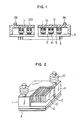
- Fig. 1 is a rough drawing illustrating the general structure of the integrated circuit chips cooling module of this invention.
- the integrated circuit chips cooling module 100 is made by enclosing a large number of integrated circuit chips 2 mounted on a wiring substrate 3 with solder terminals 4 within a space encompassed with said wiring substrate 3 and a sealing hut 5 and affords a cooling means.
- the sealing is done by joining with solder 6 the edges of said sealing hut 5 to said wiring substrate 3.
- On the wiring substrate 3, a large number of integrated circuit chips 2 are electrically interconnected by way of solder terminals 4.
- the heat generated by the integrated circuit chips 2 is transmitted to cooling members 1 mounted on each integrated circuit chips 2 and is removed by a coolant flowing through the cooling members 1.
- the coolant is fed through a coolant inlet nozzle 8a provided on the sealing hut 5 to a coolant channel 7, then flows via a bellows-like pipe 10 through each cooling member 1 and discharged from a coolant outlet nozzle 8b to the outside of integrated circuit chips cooling module 100.
- Fig. 2 is a perspective view illustrating an example of the internal structure of a cooling member 1 in the cooling module of Fig. 1.
- the cooling member 1 is constructed from an integrally molded bottom plate 12 and cooling fins 13, peripheral portions of the bottom plate 12, and a cap 11 soldered to the bottom plate at edges.
- Bellows-like pipes 11 are fixed to the top surface of cooling member 1, and serves to connect to coolant channels 7 provided in the sealing hut 5, as shown in Fig. 2. Owing to the spring action of bellows-like pipes 2, the cooling member 1 is pressed against or fixed to the top surface of integrated circuit chips 2.
- the heat generated in the integrated circuit chips 2 is transmitted, through the contact surface against or to which the cooling member 1 is pressed or fixed, successively to bottom plate 12, cooling fins 13, and the coolant.
- Fig. 3 is an enlarged sectional view illustrativelying a principal part of the integrated circuit chips cooling module in an embodiment of this invention and shows a collant flow system employing bellows-like pipes.
- a cooling member 1 with cooling fins formed therein and coolant channels 7 provided in the wall of a sealing hut 5 are interconnected by employing bellows-like pipes 10 to feed a coolant to the cooling member 1.
- the cooling member 1 is joined by pressure welding or anchoring to each of a plurality of integrated circuit chips which are signal-connected via solder terminals 4 to a wiring substrate (multilayer wiring substrate).
- each of the integrated circuit chips 2 is transmitted through the pressure welded or anchored interface from cooling fins to the coolant, then through the coolant channels 7 to the outside of the cooling module.
- an organic or inorganic high-molecular compound 14 (shown by hatching), which undergoes curing reaction upon contact with the leaked coolant, is coated on the surface of bellows-like pipes 10 where the possibility of coolant leakage is highest throughout the coolant flow system. If a pin hole appears in the bellows-like pipe 10, the coolant leakage is automatically stopped by the curing of high-molecular compound 14 and it becomes unnecessary to interrupt the operation of cooling module for repair.
- a high-molecular compound a polymer formed by the reaction under anhydrous conditions between a reactive polysiloxane and a polyfunctional silane compound.
- a polymer becomes cured to yield a rubber-like elastomer which does not impair the flexibility of bellows-like pipe 10. Since this polymer exhibits excellent adherence to various plastics and metals, the material of bellows-like pipe is not limited to any special one.
- a polymer upon reaction with water, gives an alcohol, oxime, acetic acid, amide, or acetone as by-product.
- a ploymer which undergoes condensation reaction of the alcohol elimination type, thereby yielding an alcohol as by-product.
- a typical example of such high-molecular compounds is a polymer having several alkoxyl end groups which is formed by the reaction under anhydrous conditions between a reactive polysiloxane having a hydroxyl group at both ends and a crosslinking agent methyltrimethoxysilane.
- Fig. 4 is an enlarged sectional view illustrativelying a principal part of the integrated circuit chips cooling module in another embodiment of this invention.
- the latter instead of coating a high-molecular compound 14 on the surface of bellows-like pipe 10, the latter is constructed to have a double-wall, the gap between the outer wall 17 and inner wall being filled with a high-molecular compound 14.
- Such a structure is effective in case the high-molecular compound 14 has a high fluidity so that it is difficult to retain a uniform thickness of the layer of high-molecular compound if applied by coating.
- the outer wall 17 serves as an additional barrier against the leak coolant and, as a consequence, it has an advantage over the structure shown in Fig. 3 in confronting an emergency of large leakage.
- Fig. 5 is a schematic drawing illustrating an integrated circuit chips cooling module provided with a leak detection means in still another embodiment of this invention.
- coolant flow system is constructed using bellows-like pipes coated with a high-molecular compound (not shown in Fig. 5 to avoid complication) curable upon contact with a coolant.
- the integrated circuit chips cooling module 100 contains a built-in sensor 15 for detecting the by-product formed in the curing reaction of the high-molecular compound 14.
- the output of the sensor 15 is connected to a leak detection indicator 16 disposed outside the cooling module 100.
- an alcohol detection sensor employing an oxide semiconductor as the detection sensor 15.
- the detection sensor 15 employing an oxide semiconductor shows a change in resistance by adsorption of alcohol molecules to its surface. The change in resistance can be detected by means of a bridge circuit.
- the output signal from the detection sensor 15 is fetched by the line passing through the wall of a sealing hut 5. It is also possible to fetch the signal via in- and out-put pins 9. It is further possible to transmit only the leak detection signal to the leak detection indicator 16 by integrating the detection sensor 15 and the bridge circuit (not shown).
- the present embodiment it is possible to detect the coolant leakage as well as to repair automatically the coolant leak spot.
Landscapes
- Cooling Or The Like Of Semiconductors Or Solid State Devices (AREA)
Applications Claiming Priority (2)
| Application Number | Priority Date | Filing Date | Title |
|---|---|---|---|
| JP61117415A JPH0797617B2 (ja) | 1986-05-23 | 1986-05-23 | 冷媒漏洩防止装置 |
| JP117415/86 | 1986-05-23 |
Publications (3)
| Publication Number | Publication Date |
|---|---|
| EP0246657A2 true EP0246657A2 (de) | 1987-11-25 |
| EP0246657A3 EP0246657A3 (en) | 1988-01-07 |
| EP0246657B1 EP0246657B1 (de) | 1991-04-03 |
Family
ID=14711078
Family Applications (1)
| Application Number | Title | Priority Date | Filing Date |
|---|---|---|---|
| EP87107481A Expired EP0246657B1 (de) | 1986-05-23 | 1987-05-22 | Kühlmodul für Chips mit integrierten Schaltungen mit einer Anordnung zur Verhinderung von Kühlmittel-Lecks |
Country Status (4)
| Country | Link |
|---|---|
| US (1) | US4870477A (de) |
| EP (1) | EP0246657B1 (de) |
| JP (1) | JPH0797617B2 (de) |
| DE (1) | DE3769009D1 (de) |
Cited By (4)
| Publication number | Priority date | Publication date | Assignee | Title |
|---|---|---|---|---|
| EP0364758A3 (de) * | 1988-09-21 | 1990-08-29 | Hitachi, Ltd. | Halbleitermodul mit Kühlstrukturen und elektronischer Computer mit Verwendung dieses Halbleitermoduls |
| EP0411119A4 (en) * | 1988-04-08 | 1991-05-22 | Hitachi, Ltd. | Semiconductor module, its cooling system and computer using the cooling system |
| GB2287582A (en) * | 1994-03-17 | 1995-09-20 | Fujitsu Ltd | Cooling device having refrigerant leakage sensor |
| GB2393330A (en) * | 2002-09-18 | 2004-03-24 | Hewlett Packard Development Co | Circuit cooling apparatus |
Families Citing this family (27)
| Publication number | Priority date | Publication date | Assignee | Title |
|---|---|---|---|---|
| US5198889A (en) * | 1990-06-30 | 1993-03-30 | Kabushiki Kaisha Toshiba | Cooling apparatus |
| JP2728105B2 (ja) * | 1991-10-21 | 1998-03-18 | 日本電気株式会社 | 集積回路用冷却装置 |
| CA2088821C (en) * | 1992-02-05 | 1999-09-07 | Hironobu Ikeda | Cooling structure for integrated circuit |
| US5218515A (en) * | 1992-03-13 | 1993-06-08 | The United States Of America As Represented By The United States Department Of Energy | Microchannel cooling of face down bonded chips |
| US5339214A (en) * | 1993-02-12 | 1994-08-16 | Intel Corporation | Multiple-fan microprocessor cooling through a finned heat pipe |
| US5529115A (en) * | 1994-07-14 | 1996-06-25 | At&T Global Information Solutions Company | Integrated circuit cooling device having internal cooling conduit |
| US5390077A (en) * | 1994-07-14 | 1995-02-14 | At&T Global Information Solutions Company | Integrated circuit cooling device having internal baffle |
| US6333849B1 (en) | 1996-07-01 | 2001-12-25 | Compaq Computer Corporation | Apparatus for liquid cooling of specific computer components |
| US20030033346A1 (en) * | 2001-08-10 | 2003-02-13 | Sun Microsystems, Inc. | Method, system, and program for managing multiple resources in a system |
| US20030033398A1 (en) * | 2001-08-10 | 2003-02-13 | Sun Microsystems, Inc. | Method, system, and program for generating and using configuration policies |
| US7252139B2 (en) * | 2001-08-29 | 2007-08-07 | Sun Microsystems, Inc. | Method and system for cooling electronic components |
| US7133907B2 (en) * | 2001-10-18 | 2006-11-07 | Sun Microsystems, Inc. | Method, system, and program for configuring system resources |
| US6965559B2 (en) * | 2001-10-19 | 2005-11-15 | Sun Microsystems, Inc. | Method, system, and program for discovering devices communicating through a switch |
| US20030135609A1 (en) * | 2002-01-16 | 2003-07-17 | Sun Microsystems, Inc. | Method, system, and program for determining a modification of a system resource configuration |
| US7103889B2 (en) | 2002-07-23 | 2006-09-05 | Sun Microsystems, Inc. | Method, system, and article of manufacture for agent processing |
| US20040024887A1 (en) * | 2002-07-31 | 2004-02-05 | Sun Microsystems, Inc. | Method, system, and program for generating information on components within a network |
| US20040022200A1 (en) * | 2002-07-31 | 2004-02-05 | Sun Microsystems, Inc. | Method, system, and program for providing information on components within a network |
| US7143615B2 (en) | 2002-07-31 | 2006-12-05 | Sun Microsystems, Inc. | Method, system, and program for discovering components within a network |
| US6953227B2 (en) * | 2002-12-05 | 2005-10-11 | Sun Microsystems, Inc. | High-power multi-device liquid cooling |
| US6826948B1 (en) * | 2003-10-09 | 2004-12-07 | Delphi Technologies, Inc. | Leak detection apparatus for a liquid circulation cooling system |
| US7327578B2 (en) * | 2004-02-06 | 2008-02-05 | Sun Microsystems, Inc. | Cooling failure mitigation for an electronics enclosure |
| US9869983B2 (en) | 2014-12-05 | 2018-01-16 | International Business Machines Corporation | Cooling system leak detection |
| GB2543549B (en) * | 2015-10-21 | 2020-04-15 | Andor Tech Limited | Thermoelectric Heat pump system |
| US10856446B2 (en) * | 2018-02-08 | 2020-12-01 | Juniper Networks, Inc. | Cooling for slot mounted electrical modules |
| TWI725422B (zh) * | 2018-05-31 | 2021-04-21 | 技嘉科技股份有限公司 | 液冷導熱裝置、液冷循環系統以及漏液偵測方法 |
| CN112860042B (zh) * | 2021-02-09 | 2025-02-07 | 华勤技术股份有限公司 | 液冷装置及电子设备 |
| US11934213B2 (en) * | 2021-02-18 | 2024-03-19 | Asia Vital Components (China) Co., Ltd. | Liquid-cooling device |
Family Cites Families (9)
| Publication number | Priority date | Publication date | Assignee | Title |
|---|---|---|---|---|
| DE1817880C3 (de) * | 1967-12-28 | 1978-12-21 | Packo, Joseph John, Fort Lauderdale, Fla. (V.St.A.) | Verfahren zur Anzeige des Vorhandenseins eines unsichtbaren Gases |
| ZA783081B (en) * | 1978-09-15 | 1980-08-27 | J Grobler | The sealing of leaks in tanks and the like |
| US4304805A (en) * | 1978-12-04 | 1981-12-08 | Joseph J. Packo | Sealing leaks by polymerization of volatilized aminosilane monomers |
| JPS55156349A (en) * | 1979-05-25 | 1980-12-05 | Hitachi Ltd | Semiconductor device |
| JPS58106852A (ja) * | 1981-12-18 | 1983-06-25 | Mitsubishi Electric Corp | 電力用半導体装置 |
| JPS59200495A (ja) * | 1983-04-27 | 1984-11-13 | 株式会社日立製作所 | マルチチツプ・モジユ−ル |
| JPH0673364B2 (ja) * | 1983-10-28 | 1994-09-14 | 株式会社日立製作所 | 集積回路チップ冷却装置 |
| JPS60160149A (ja) * | 1984-01-26 | 1985-08-21 | Fujitsu Ltd | 集積回路装置の冷却方式 |
| JPH06101523B2 (ja) * | 1985-03-04 | 1994-12-12 | 株式会社日立製作所 | 集積回路チツプ冷却装置 |
-
1986
- 1986-05-23 JP JP61117415A patent/JPH0797617B2/ja not_active Expired - Lifetime
-
1987
- 1987-05-21 US US07/052,396 patent/US4870477A/en not_active Expired - Lifetime
- 1987-05-22 EP EP87107481A patent/EP0246657B1/de not_active Expired
- 1987-05-22 DE DE8787107481T patent/DE3769009D1/de not_active Expired - Lifetime
Cited By (8)
| Publication number | Priority date | Publication date | Assignee | Title |
|---|---|---|---|---|
| EP0411119A4 (en) * | 1988-04-08 | 1991-05-22 | Hitachi, Ltd. | Semiconductor module, its cooling system and computer using the cooling system |
| EP0364758A3 (de) * | 1988-09-21 | 1990-08-29 | Hitachi, Ltd. | Halbleitermodul mit Kühlstrukturen und elektronischer Computer mit Verwendung dieses Halbleitermoduls |
| US4977443A (en) * | 1988-09-21 | 1990-12-11 | Hitachi, Ltd. | Semiconductor module and an electronic computer using the semiconductor module |
| GB2287582A (en) * | 1994-03-17 | 1995-09-20 | Fujitsu Ltd | Cooling device having refrigerant leakage sensor |
| US5537291A (en) * | 1994-03-17 | 1996-07-16 | Fujitsu Limited | Cooling device for integrated circuit element |
| GB2287582B (en) * | 1994-03-17 | 1996-12-18 | Fujitsu Ltd | Cooling device for integrated circuit element |
| GB2393330A (en) * | 2002-09-18 | 2004-03-24 | Hewlett Packard Development Co | Circuit cooling apparatus |
| GB2393330B (en) * | 2002-09-18 | 2005-11-16 | Hewlett Packard Development Co | Circuit cooling apparatus |
Also Published As
| Publication number | Publication date |
|---|---|
| JPS62274757A (ja) | 1987-11-28 |
| DE3769009D1 (de) | 1991-05-08 |
| US4870477A (en) | 1989-09-26 |
| EP0246657B1 (de) | 1991-04-03 |
| EP0246657A3 (en) | 1988-01-07 |
| JPH0797617B2 (ja) | 1995-10-18 |
Similar Documents
| Publication | Publication Date | Title |
|---|---|---|
| EP0246657B1 (de) | Kühlmodul für Chips mit integrierten Schaltungen mit einer Anordnung zur Verhinderung von Kühlmittel-Lecks | |
| EP0539555B1 (de) | Gehäuseanordnung für ein funktionales bauelement und herstellungsverfahren | |
| EP0630046B1 (de) | Kühlapparat für integrierte Schaltungschips | |
| EP1626616A1 (de) | Steuerschaltung eines Motors | |
| EP1734578B1 (de) | Gekühlte elektronische Anordnung und Methode zum Kühlen einer Leiterplatte | |
| EP0219674B1 (de) | Kühlungsanordnung für elektronische Bauelemente | |
| CN115297693B (zh) | 液冷板和电子设备 | |
| TWI807225B (zh) | 測漏系統 | |
| US20090273904A1 (en) | Heat-dissipation module and electronic apparatus having the same | |
| JP7662801B2 (ja) | 液冷装置及び機器 | |
| EP3358922B1 (de) | Bordsteuerungsvorrichtung | |
| JPH04206555A (ja) | 電子機器の冷却装置 | |
| JP4464806B2 (ja) | 電力変換装置 | |
| CN112865440B (zh) | 一种启动发电一体机 | |
| CN118053817A (zh) | 电子器件及其制作方法、主板及电子设备 | |
| US7320359B2 (en) | Liquid cooling element and connection arrangement of liquid cooling element | |
| CN221598482U (zh) | 散热装置及电子设备 | |
| JPH0260151A (ja) | 集積回路パッケージの温度検出構造 | |
| CN220986011U (zh) | 电源装置、服务器节点以及服务器 | |
| CN116264761B (zh) | 冷凝液排放装置、电子组件和制造冷凝液排放装置的方法 | |
| EP0484320B1 (de) | Kühlmodule für Vorrichtungen mit elektronischem Schaltkreis | |
| CN223066167U (zh) | 芯片封装结构和电子设备 | |
| JPH02184061A (ja) | 集積回路パッケージの温度検出構造 | |
| JPH0856088A (ja) | 電子機器の冷却装置 | |
| JPH01241154A (ja) | 半導体冷却装置 |
Legal Events
| Date | Code | Title | Description |
|---|---|---|---|
| PUAI | Public reference made under article 153(3) epc to a published international application that has entered the european phase |
Free format text: ORIGINAL CODE: 0009012 |
|
| PUAL | Search report despatched |
Free format text: ORIGINAL CODE: 0009013 |
|
| AK | Designated contracting states |
Kind code of ref document: A2 Designated state(s): DE FR GB |
|
| AK | Designated contracting states |
Kind code of ref document: A3 Designated state(s): DE FR GB |
|
| RIN1 | Information on inventor provided before grant (corrected) |
Inventor name: YAMADA, MINORU Inventor name: NAKANISHI, KEIICHIROU HITACHI DAINI KYOSHINRYO |
|
| 17P | Request for examination filed |
Effective date: 19880111 |
|
| 17Q | First examination report despatched |
Effective date: 19900322 |
|
| GRAA | (expected) grant |
Free format text: ORIGINAL CODE: 0009210 |
|
| AK | Designated contracting states |
Kind code of ref document: B1 Designated state(s): DE FR GB |
|
| REF | Corresponds to: |
Ref document number: 3769009 Country of ref document: DE Date of ref document: 19910508 |
|
| ET | Fr: translation filed | ||
| PLBE | No opposition filed within time limit |
Free format text: ORIGINAL CODE: 0009261 |
|
| STAA | Information on the status of an ep patent application or granted ep patent |
Free format text: STATUS: NO OPPOSITION FILED WITHIN TIME LIMIT |
|
| 26N | No opposition filed | ||
| PGFP | Annual fee paid to national office [announced via postgrant information from national office to epo] |
Ref country code: FR Payment date: 20010316 Year of fee payment: 15 |
|
| PGFP | Annual fee paid to national office [announced via postgrant information from national office to epo] |
Ref country code: GB Payment date: 20010426 Year of fee payment: 15 |
|
| PGFP | Annual fee paid to national office [announced via postgrant information from national office to epo] |
Ref country code: DE Payment date: 20010730 Year of fee payment: 15 |
|
| REG | Reference to a national code |
Ref country code: GB Ref legal event code: IF02 |
|
| PG25 | Lapsed in a contracting state [announced via postgrant information from national office to epo] |
Ref country code: GB Free format text: LAPSE BECAUSE OF NON-PAYMENT OF DUE FEES Effective date: 20020522 |
|
| PG25 | Lapsed in a contracting state [announced via postgrant information from national office to epo] |
Ref country code: DE Free format text: LAPSE BECAUSE OF NON-PAYMENT OF DUE FEES Effective date: 20021203 |
|
| GBPC | Gb: european patent ceased through non-payment of renewal fee |
Effective date: 20020522 |
|
| PG25 | Lapsed in a contracting state [announced via postgrant information from national office to epo] |
Ref country code: FR Free format text: LAPSE BECAUSE OF NON-PAYMENT OF DUE FEES Effective date: 20030131 |
|
| REG | Reference to a national code |
Ref country code: FR Ref legal event code: ST |