EP0246572B1 - Selektives, zeolithisches Sorbentmittel und Verfahren zu dessen Aktivierung - Google Patents
Selektives, zeolithisches Sorbentmittel und Verfahren zu dessen Aktivierung Download PDFInfo
- Publication number
- EP0246572B1 EP0246572B1 EP87107074A EP87107074A EP0246572B1 EP 0246572 B1 EP0246572 B1 EP 0246572B1 EP 87107074 A EP87107074 A EP 87107074A EP 87107074 A EP87107074 A EP 87107074A EP 0246572 B1 EP0246572 B1 EP 0246572B1
- Authority
- EP
- European Patent Office
- Prior art keywords
- chabazite
- argon
- oxygen
- nitrogen
- adsorbent
- Prior art date
- Legal status (The legal status is an assumption and is not a legal conclusion. Google has not performed a legal analysis and makes no representation as to the accuracy of the status listed.)
- Expired - Lifetime
Links
Images




Classifications
-
- B—PERFORMING OPERATIONS; TRANSPORTING
- B01—PHYSICAL OR CHEMICAL PROCESSES OR APPARATUS IN GENERAL
- B01D—SEPARATION
- B01D53/00—Separation of gases or vapours; Recovering vapours of volatile solvents from gases; Chemical or biological purification of waste gases, e.g. engine exhaust gases, smoke, fumes, flue gases, aerosols
- B01D53/02—Separation of gases or vapours; Recovering vapours of volatile solvents from gases; Chemical or biological purification of waste gases, e.g. engine exhaust gases, smoke, fumes, flue gases, aerosols by adsorption, e.g. preparative gas chromatography
- B01D53/04—Separation of gases or vapours; Recovering vapours of volatile solvents from gases; Chemical or biological purification of waste gases, e.g. engine exhaust gases, smoke, fumes, flue gases, aerosols by adsorption, e.g. preparative gas chromatography with stationary adsorbents
-
- C—CHEMISTRY; METALLURGY
- C01—INORGANIC CHEMISTRY
- C01B—NON-METALLIC ELEMENTS; COMPOUNDS THEREOF; METALLOIDS OR COMPOUNDS THEREOF NOT COVERED BY SUBCLASS C01C
- C01B23/00—Noble gases; Compounds thereof
-
- B—PERFORMING OPERATIONS; TRANSPORTING
- B01—PHYSICAL OR CHEMICAL PROCESSES OR APPARATUS IN GENERAL
- B01D—SEPARATION
- B01D53/00—Separation of gases or vapours; Recovering vapours of volatile solvents from gases; Chemical or biological purification of waste gases, e.g. engine exhaust gases, smoke, fumes, flue gases, aerosols
- B01D53/02—Separation of gases or vapours; Recovering vapours of volatile solvents from gases; Chemical or biological purification of waste gases, e.g. engine exhaust gases, smoke, fumes, flue gases, aerosols by adsorption, e.g. preparative gas chromatography
-
- B—PERFORMING OPERATIONS; TRANSPORTING
- B01—PHYSICAL OR CHEMICAL PROCESSES OR APPARATUS IN GENERAL
- B01J—CHEMICAL OR PHYSICAL PROCESSES, e.g. CATALYSIS OR COLLOID CHEMISTRY; THEIR RELEVANT APPARATUS
- B01J20/00—Solid sorbent compositions or filter aid compositions; Sorbents for chromatography; Processes for preparing, regenerating or reactivating thereof
- B01J20/02—Solid sorbent compositions or filter aid compositions; Sorbents for chromatography; Processes for preparing, regenerating or reactivating thereof comprising inorganic material
- B01J20/10—Solid sorbent compositions or filter aid compositions; Sorbents for chromatography; Processes for preparing, regenerating or reactivating thereof comprising inorganic material comprising silica or silicate
- B01J20/16—Alumino-silicates
- B01J20/18—Synthetic zeolitic molecular sieves
-
- C—CHEMISTRY; METALLURGY
- C01—INORGANIC CHEMISTRY
- C01B—NON-METALLIC ELEMENTS; COMPOUNDS THEREOF; METALLOIDS OR COMPOUNDS THEREOF NOT COVERED BY SUBCLASS C01C
- C01B13/00—Oxygen; Ozone; Oxides or hydroxides in general
- C01B13/02—Preparation of oxygen
- C01B13/0229—Purification or separation processes
- C01B13/0248—Physical processing only
- C01B13/0259—Physical processing only by adsorption on solids
- C01B13/0262—Physical processing only by adsorption on solids characterised by the adsorbent
- C01B13/027—Zeolites
-
- C—CHEMISTRY; METALLURGY
- C01—INORGANIC CHEMISTRY
- C01B—NON-METALLIC ELEMENTS; COMPOUNDS THEREOF; METALLOIDS OR COMPOUNDS THEREOF NOT COVERED BY SUBCLASS C01C
- C01B3/00—Hydrogen; Gaseous mixtures containing hydrogen; Separation of hydrogen from mixtures containing it; Purification of hydrogen; Reversible storage of hydrogen
- C01B3/50—Separation of hydrogen or hydrogen-containing gases from gaseous mixtures, e.g. purification
- C01B3/56—Separation of hydrogen or hydrogen-containing gases from gaseous mixtures, e.g. purification by contacting with solids; Regeneration of used solids
-
- C—CHEMISTRY; METALLURGY
- C01—INORGANIC CHEMISTRY
- C01B—NON-METALLIC ELEMENTS; COMPOUNDS THEREOF; METALLOIDS OR COMPOUNDS THEREOF NOT COVERED BY SUBCLASS C01C
- C01B2203/00—Integrated processes for the production of hydrogen or synthesis gas
- C01B2203/04—Integrated processes for the production of hydrogen or synthesis gas containing a purification step for the hydrogen or the synthesis gas
- C01B2203/042—Purification by adsorption on solids
-
- C—CHEMISTRY; METALLURGY
- C01—INORGANIC CHEMISTRY
- C01B—NON-METALLIC ELEMENTS; COMPOUNDS THEREOF; METALLOIDS OR COMPOUNDS THEREOF NOT COVERED BY SUBCLASS C01C
- C01B2203/00—Integrated processes for the production of hydrogen or synthesis gas
- C01B2203/04—Integrated processes for the production of hydrogen or synthesis gas containing a purification step for the hydrogen or the synthesis gas
- C01B2203/0465—Composition of the impurity
-
- C—CHEMISTRY; METALLURGY
- C01—INORGANIC CHEMISTRY
- C01B—NON-METALLIC ELEMENTS; COMPOUNDS THEREOF; METALLOIDS OR COMPOUNDS THEREOF NOT COVERED BY SUBCLASS C01C
- C01B2203/00—Integrated processes for the production of hydrogen or synthesis gas
- C01B2203/04—Integrated processes for the production of hydrogen or synthesis gas containing a purification step for the hydrogen or the synthesis gas
- C01B2203/0465—Composition of the impurity
- C01B2203/047—Composition of the impurity the impurity being carbon monoxide
-
- C—CHEMISTRY; METALLURGY
- C01—INORGANIC CHEMISTRY
- C01B—NON-METALLIC ELEMENTS; COMPOUNDS THEREOF; METALLOIDS OR COMPOUNDS THEREOF NOT COVERED BY SUBCLASS C01C
- C01B2203/00—Integrated processes for the production of hydrogen or synthesis gas
- C01B2203/04—Integrated processes for the production of hydrogen or synthesis gas containing a purification step for the hydrogen or the synthesis gas
- C01B2203/0465—Composition of the impurity
- C01B2203/048—Composition of the impurity the impurity being an organic compound
-
- C—CHEMISTRY; METALLURGY
- C01—INORGANIC CHEMISTRY
- C01B—NON-METALLIC ELEMENTS; COMPOUNDS THEREOF; METALLOIDS OR COMPOUNDS THEREOF NOT COVERED BY SUBCLASS C01C
- C01B2210/00—Purification or separation of specific gases
- C01B2210/0043—Impurity removed
- C01B2210/0078—Noble gases
- C01B2210/0082—Argon
Definitions
- the present invention is directed to a selective zeolitic adsorbent, a method of activation thereof, and the processes utilizing the selective adsorbent.
- the zeolites referenced in the article were exchanged with Li + , K + , Rb + , Cs + , Ag + , Mg2+, Ca2+, Sr + , Ba2+ and Cd 2+ and subsequently heated at 300 ° C to 500 ° C for four to several hours.
- Japanese Patent Application 59,233,203 teaches the use of various cation forms of mordenite for separating argon from gaseous mixtures containing nitrogen; no details are given concerning the activation procedure.
- German Patent 104,962 discloses a process for separating argon from gaseous mixtures containing nitrogen and/or oxygen using various forms of mordenite.
- the patent teaches that argon in dry air can be separated from nitrogen and oxygen over a sodium mordenite adsorbent, however, the nitrogen and the oxygen coelute unseparated.
- the present invention relates to the activation of a zeolitic composition to produce a highly selective adsorbent and the uses for the adsorbent.
- the activation procedure requires that the base zeolite has at least a portion (preferably a minimum of 50% by weight) of the exchangeable ion capacity as a metal cation with a charge density of 2.0 or greater. These metal cations with a charge density of 2.0 or greater can be present because they are naturally occurring or because the original cations have been exchanged according to any of the established methods in the art.
- the zeolitic composition Once the zeolitic composition has these cations present in the structure, the zeolite must be thoroughly dehydrated.
- This dehydration is accomplished by heating the zeolitic material for a period of time at temperatures generally in excess of 400 ° C in the presence of a non-reactive atmosphere.
- non-reactive atmosphere it is meant any gas or atmosphere that during heating of the zeolite to elevated temperatures will not cause alteration of the zeolite framework structure or the cations within the structure.
- thorough dehydration it is meant that the zeolite has a final water content less than 1.5% by weight, preferably 0.5% by weight.
- the zeolite can undergo an additional step for further increased separation ability. This additional treatment is carried out by heating the dehydrated zeolite in the presence of an oxidizing atmosphere at elevated temperatures.
- the present invention contemplates combining the dehydration step and the oxidation step into a single operation.
- the phenomenon of selective adsorption by molecular sieve zeolites may arise from one of two properties inherent to these crystalline materials.
- the first property of a molecular sieve that give rise to selective adsorption is because of the extremely uniform porosity demonstrated by these crystalline aluminosilicates.
- the size or shape of one or more components of a mixture to be separated by selective adsorption may preclude its adsorption by the materials.
- the separation of n-paraffins from branched chain paraffins is an example of this effect.
- n-paraffin component of a mixture is readily adsorbed, but branched chain paraffins are excluded from adsorption by virtue of their configuration, effecting a separation of the components which is the basis of several commercial processes. If, however, the molecules of the mixture to be separated are all small enough to enter the zeolite crystals, selective adsorption may nonetheless be demonstrated by a second mechanism, cationic charge density.
- Charge density is defined as Q/r 3 , where Q is the valence state of the cation and r is the crystal ionic radius in Angstroms.
- Zeolites have large quantities of exchangeable ion capacity present within their aluminosilicate framework.
- Exchangeable ion capacity refers to the charge-compensating cations which are present within the zeolitic structure and that can be replaced by other cations in any proportion as long as the electric neutrality of the zeolitic structure is maintained. These cations are situated such that a high proportion may come into contact with adsorbates small enough to enter the crystalline zeolite framework. The energetic interaction of these cations with polar or polarizable adsorbates results in these adsorbates being selectively adsorbed from a mixture of less polar or polarizable species.
- the starting material was cation exchanged according to the following generalized procedure. Basically, the starting material is ion exchanged in the presence of an excess of a water soluble salt, such as chloride, nitrate, sulfate and the like, of any polyvalent metal.
- the polyvalent metal can be of the divalent or trivalent transition elements of Groups Ib to 7b and Group 8 of the periodic table, the divalent alkaline earth metal elements of Group 2a and the lanthanide rare earth series.
- the polyvalent metal is selected from a group consisting of magnesium, calcium, strontium, barium and mixtures thereof. Still more preferably the polyvalent metal is calcium or magnesium or mixtures thereof.
- a conventional ion exchange procedure is to repeatedly exchange the starting material with the polyvalent material in an aqueous solution at temperatures up to those at which reflux occurs, e.g. up to about 100 ° C and about 101.325 kPa (1 atmosphere), for a period of 2 to 48 hours until a major portion of the original cations in the accessible portion of the starting material are replaced by polyvalent ions.
- the materials are ready for thermal activation.
- the zeolitic adsorbent In order to achieve the maximum heat of adsorption for a given adsorbate, the zeolitic adsorbent must be thoroughly dehydrated. Therefore, the effect of thermal dehydration procedures on the adsorption properties of the polyvalent forms of several zeolitic adsorbents were studied. When compared to the sodium form, longer times and/or high temperatures are needed to fully dehydrate the polyvalent forms of the adsorbents, particularly, if they contain high charge density cations such as calcium or magnesium. When fully dehydrated, the charge balancing cations are left in a dehydrated/dehydroxylated state where they exhibit superior separating properties.
- the highly exchanged zeolitic adsorbent must be thoroughly dehydrated. Water, being quite polar, is strongly bound to cations having high charge density. It has long been recognized that these materials must be activated or dehydrated at elevated temperatures to remove water or other polar substances which would block adsorption. Dehydration of zeolitic adsorbents for gas adsorption generally means the residual water content in the adsorbent is less than 1.5% by weight water. However, previous zeolite surface scientists in the field of gas adsorption have failed to recognize that the conditions required to achieve this level of dehydration vary depending upon the nature of the charge-compensating cations.
- non-reactive atmosphere any gas or atmosphere that during the heating of the zeolite to elevated temperatures will not cause alteration of the zeolite framework structure or the cations within the structure.
- Typical non-reactive atmospheres are helium, nitrogen, argon, hydrogen, carbon tetrafluoride, other fluorinated hydrocarbons as are typically sold under the trademark of Freon, zero air and the like.
- oxygen/argon separation is a direct result of the electric field density surrounding these cations being sufficiently high to interact effectively with the small quadrapole of oxygen allowing it to be separated from argon.
- Oxygen with its smaller quadrapole compared to nitrogen and concomitantly smaller degree of interaction with a given electrostatic energy field, is much less sensitive to the charge density of the cation present and requires very high fields to be selectively adsorbed from adsorbates having similar energetics but no quadrapole moment such as argon.
- Another very important aspect of the present invention is the unexpected result that carrying out a secondary treatment on the dehydrated zeolitic adsorbents results in a further improvement and significantly expands the utility of these materials.
- the detectability limits for analyzing oxygen in argon as well as other gases are greatly expanded.
- the zeolitic adsorbents used as a chromatographic material after this secondary treatment in combination with a helium ionization detector could quantify ppb levels of gases including oxygen in the presence of argon.
- Ca-chabazite can be used to separate oxygen from argon at trace levels at temperatures as high as 85 ° C. This has resulted in much shorter analysis times, as well as eliminating the need for subambient cooling used with Molecular Sieve 5A, the conventional packing material.
- Other previously difficult separations performed with the Ca-chabazite include trace analysis of oxygen in bulk hydrogen and nitrogen in bulk argon.
- a crystalline form of calcium chabazite has been used to separate trace oxygen (s 2.4 ppm) from bulk argon and trace argon (s 5 ppm) from bulk oxygen. Both of these separations have not been achieved with any commercially available material.
- a 500 g sample of 1.587 mm (1/16 inch) pellets of chabazite (AW-500 obtained from Linde Division of Union Carbide) was exchanged with a one liter portion of 1 M CaC1 2 .
- the 1 M CaCI 2 was added slowly to the zeolite contained in a two liter round-bottom flask equipped with a condenser. The solution was brought to reflux over a 30 minute period and held for an additional hour. The exchange solution was decanted and the pellets were washed three times with approximately two liter portions of distilled water. After the wash, a fresh one liter portion of 1 M CaCI 2 was added to the zeolite pellets and the contents were brought to reflux.
- AW-500 obtained from Linde Division of Union Carbide
- a calcium exchanged chabazite zeolite which was prepared by the procedure of Example 1, was subjected to a heat treatment during which helium gas was flowing over the chabazite.
- the conditions for the heat treating were as follows: the chabazite was gradually heated from 40 ° C to 400 ° C using a 3 ° C/min heating ramp, once the 400 ° C temperature was achieved the material was heat soaked for an additional eight hours. The material was then allowed to cool to ambient temperature with the helium stream passing over the material.
- the flow rates of helium measured at ambient temperature, were 185 ml/min at a column temperature of 40 ° C and 67 ml/min at a column temperature of 400 ° C; inlet helium pressure was 618.5 KpA (75 psig).
- a calcium exchanged chabazite zeolite which was prepared by the procedure of Example 1, was subjected to a heat treatment during which helium gas was flowing over the chabazite.
- the conditions for the heat treating were as follows: the chabazite was gradually heated from 40 ° C to 400 ° C using a 3 ° C/min heating ramp, once the. 400 ° C temperature was achieved the material was heat soaked for an additional eight hours. The material was then allowed to cool to ambient temperature with the helium stream passing over the material.
- the flow rates of helium measured at ambient temperature, were 125 ml/min at a column temperature of 40°C and 17 ml/min at a column temperature of 400 ° C; inlet helium pressure was 363.4 kPa (38 psig).
- a calcium exchanged chabazite zeolite which was prepared by the procedure of Example 1, was subjected to a heat treatment during which helium gas was flowing over the chabazite.
- the conditions for the heat treating were as follows: the chabazite was gradually heated from 40 ° C to 400 ° C using a 3 ° C/min heating ramp, once the 400 ° C temperature was achieved the material was heat soaked for an additional twenty four (24) hours. The material was then allowed to cool to ambient temperature with the helium stream passing over the material.
- the flow rates of helium measured at ambient temperature, were 185 ml/min at a column temperature of 40 ° C and 67 ml/min at a column temperature of 400 ° C; inlet helium pressure was 618.5kPa (75 psig).
- a calcium exchanged chabazite zeolite which was prepared by the procedure of Example 1, was subjected to a heat treatment during which helium gas was flowing over the chabazite.
- the conditions for the heat treating were as follows; the chabazite was gradually heated from 40 ° C to 325 ° C using a 3 ° C/min heating ramp, once the 325 ° C temperature was achieved the material was heat soaked for an additional eight hours. The material was then allowed to cool to ambient temperature with the helium stream passing over the material.
- the flow rate of helium measured at ambient temperature, was 67 ml/min at a column temperature of 325 ° C; inlet helium pressure was 556.5 kPa (66 psig).
- a calcium exchanged chabazite zeolite which was prepared by the procedure of Example 1, was subjected to a heat treatment during which helium gas was flowing over the chabazite.
- the conditions for the heat treating were as follows: the chabazite was gradually heated from 40 ° C to 250 ° C using a 3 ° C/min heating ramp, once the 250 ° C temperature was achieved the material was heat soaked for an additional eight hours. The material was then allowed to cool to ambient temperature with the helium stream passing over the material.
- the flow rate of helium measured at 35 ambient temperature, was 67 ml/min at a column temperature of 250°C; inlet helium pressure was 528.9 kPa (62 psig).
- a calcium exchanged chabazite zeolite which was prepared by the procedure of Example 1, was subjected to a heat treatment during which helium gas was flowing over the chabazite.
- the conditions for the heat treating were as follows: the chabazite was gradually heated from 40 ° C to 400 ° C using a 12 ° C/min heating ramp, once the 400 ° C temperature was achieved the material was heat soaked for an additional eight hours. The material was then allowed to cool to ambient temperature with the helium stream passing over the material.
- the flow rates of helium measured at ambient temperature, were 185 ml/min at a column temperature of 40°C and 67 ml/min at a column temperature of 400 ° C; inlet helium pressure was 618.5 kPa (75 psig).
- a calcium exchanged chabazite zeolite which was prepared by the procedure of Example 1, was subjected to a heat treatment during which nitrogen gas was flowing over the chabazite.
- the conditions for the heat treating were as follows: the chabazite was gradually heated from 40 ° C to 400 ° C using a 3 ° C/min heating ramp, once the 400 ° C temperature was achieved the material was heat soaked for an additional eight hours. The material was then allowed to cool to ambient temperature with the nitrogen stream passing over the material.
- the flow rates of nitrogen measured at ambient temperature, were 185 ml/min at a column temperature of 40 ° C and 67 ml/min at a column temperature of 400 ° C; inlet nitrogen pressure was 618.5 kPa (75 psig).
- a calcium exchanged chabazite zeolite which was prepared by the procedure of Example 2, was subjected to an oxidation treatment.
- the oxidation treatment conditions were as follows: the material was gradually heated from 40 ° C to 250 ° C using a 10 ° C/min heating ramp, once the 250 ° C temperature was achieved the oxidation was allowed to continue for another 1.5 hours.
- the oxidizing gas used in the treatment is zero air; zero air is a synthetic 79/21 volume percent mixture of nitrogen and oxygen, its C0 2 content is ⁇ 1 ppm, H 2 0 content is ⁇ 2 ppm, and total hydrocarbon content is ⁇ 0.1 ppm.
- the zero air flow rates measured at ambient temperature, were 130 ml/min at a column temperature of 40 ° C and 100 ml/min at a column temperature of 250 ° C; inlet zero air pressure was 515.1 kPa (60 psig).
- a calcium exchanged chabazite zeolite which was prepared by the procedure of Example 2, was subjected to an oxidation treatment.
- the oxidation treatment conditions were as follows: the material was gradually heated from 40 ° C to 250 ° C using a 10 ° C/min heating ramp, once the 250 ° C temperature was achieved the oxidation was allowed to continue for another eight hours.
- the oxidizing gas used in the treatment is zero air.
- the zero air flow rates, measured at ambient temperature, were 130 ml/min at a column temperature of 40 ° C and 100 ml/min at a column temperature of 250 ° C; inlet zero air pressure was 515.1 kPa (60 psig).
- a calcium exchanged chabazite zeolite which was prepared by the procedure of Example 2, was subjected to an oxidation treatment.
- the oxidation treatment conditions were as follows: the material was gradually heated from 40 ° C to 100 ° C using a 10 ° C/min heating ramp, once the 100 ° C temperature was achieved the oxidation was allowed. to continue for another 1.5 hours.
- the oxidizing gas used in the treatment is zero air.
- the zero air flow rate was 100 ml/min at a column temperature of 100 ° C; inlet zero air pressure was 473.7 kPa (54 psig).
- a calcium exchanged chabazite zeolite which was prepared by the procedure of Example 2, was subjected to an oxidation treatment.
- the oxidation treatment conditions were as follows: the material was gradually heated from 40 ° C to 250°C using a 10 ° C/min heating ramp, once the 250 ° C temperature was achieved the oxidation was allowed to continue for another 1.5 hours.
- the oxidizing gas used in the treatment is zero air.
- the zero air flow rates, measured at ambient temperature, were 60 ml/min at a column temperature of 40°C and 20 ml/min at a column temperature of 250 ° C; inlet zero air pressure was 363.4 kPa (38 psig).
- a calcium exchanged chabazite zeolite which was prepared by the procedure of Example 2, was subjected to an oxidation treatment.
- the oxidation treatment conditions were as follows: the material was gradually heated from 40 ° C to 400 ° C using a 10°C/min heating ramp, once the 400 ° C temperature was achieved the oxidation was allowed to continue for another 1.5 hours.
- the oxidizing gas used in the treatment is zero air.
- the zero air flow rates, measured at ambient temperature, were 130 ml/min at a column temperature of 40 ° C and 100 ml/min at a column temperature of 400 ° C; inlet zero air pressure was 515.1 kPa (60 psig).
- a calcium exchanged chabazite zeolite which was prepared by the procedure of Example 2, was subjected to an oxidation treatment.
- the oxidation treatment conditions were as follows: the material was gradually heated from 40 ° C to 250 ° C using a 2 ° C/min heating ramp, once the 250 ° C temperature was achieved the oxidation was allowed to continue for another 1.5 hours.
- the oxidizing gas used in the treatment is zero air.
- the zero air flow rates, measured at ambient temperature, were 130 ml/min at a column temperature of 40 ° C and 100 ml/min at a column temperature of 250 ° C; inlet zero air pressure was 515.1 kPa (60 psig).
- a calcium exchanged chabazite zeolite which was prepared by the procedure of Example 2, was subjected to an oxidation treatment.
- the oxidation treatment conditions were as follows: the material was gradually heated from 40 ° C to 250 ° C using a 10 ° C/min heating ramp, once the 250 ° C temperature was achieved the oxidation was allowed to continue for another 1.5 hours.
- the oxidizing gas used in the treatment is N 2 0.
- the N 2 0 flow rates, measured at ambient temperature, were 130 ml/min at a column temperature of 40 ° C and 100 ml/min at a column temperature of 250°C; inlet N 2 0 pressure was 515.1 kPa (60 psig).
- a 500 g sample of 1.587 mm (1/16 inch) pellets of chabazite (AW-500 obtained from Linde) was exchanged with a one liter portion of 1 M MgCI 2 .
- the 1 M MgC1 2 was added slowly to the zeolite contained in a two liter round-bottom flask equipped with a condenser. The solution was brought to reflux over a 30 minute period and held for an additional hour. The exchange solution was decanted and the pellets were washed three times with approximately two liter portions of distilled water. After the wash, a fresh one liter portion of 1 M MgC1 2 was added to the zeolite pellets and the contents were brought to reflux.
- a magnesium exchanged chabazite zeolite which was prepared by the procedure of Example 16, was subjected to a heat treatment during which helium gas was flowing over the chabazite.
- the conditions for the heat treating were as follows: the chabazite was gradually heated from 40 ° C to 400 ° C using a 3°C/min heating ramp, once the 400°C temperature was achieved the material was heat soaked for an additional eight hours. The material was then allowed to cool to ambient temperature with the helium stream passing over the material.
- the flow rates of helium measured at ambient temperature, were 185 ml/min at a column temperature of 40 ° C and 67 ml/min at a column temperature of 400 ° C; inlet helium pressure was 618.5 kPa (75 psig).
- a magnesium exchanged chabazite zeolite which was prepared by the procedure of Example 17, was subjected to an oxidation treatment.
- the oxidation treatment conditions were as follows: the material was gradually heated from 40°C to 250 ° C using a 10°C/min heating ramp, once the 250°C temperature was achieved the oxidation was allowed to continue for another 1.5 hours.
- the oxidizing gas used in the treatment is zero air.
- the zero air flow rates, measured at ambient temperature, were 130 ml/min at a column temperature of 40 ° C and 100 ml/min at a column temperature of 250°C; inlet zero air pressure was 515.1 kPa (60 psig).
- a 500 g sample of 1.587 mm (1/16 inch) pellets of chabazite (AW-500 obtained from Linde) was exchanged with a one liter portion of 1 M NiCl 2 .
- the 1 M NiC1 2 was added slowly to the zeolite contained in a two liter round-bottom flask equipped with a condenser. The solution was brought to reflux over a 30 minute period and held for an additional hour. The exchange solution was decanted and the pellets were washed three times with approximately two liter portions of distilled water. After the wash, a fresh one liter portion of 1 M NiCi 2 was added to the zeolite pellets and the contents were brought to reflux. The exchange and wash procedures were repeated so as to have a total of four exchanges.
- the zeolite was placed in a flat pan and air dried. Elemental analysis showed that 64% of the exchange capacity was nickel. The zeolite material was then ground to a 60/80 mesh and then placed into an 3.175 mm (0.125 inch) O.D. x 2.159 mm (0.085 inch) I.D. x 1.83 m (6 foot) length of 304 stainless steel tubing.
- a nickel exchanged chabazite zeolite which was prepared by the procedure of Example 19, was subjected to a heat treatment during which helium gas was flowing over the chabazite.
- the conditions for the heat treating were as follows: the chabazite was gradually heated from 40 ° C to 400 ° C using a 3 ° C/min heating ramp, once the 400 ° C temperature was achieved the material was heat soaked for an additional eight hours. The material was then allowed to cool to ambient temperature with the helium stream passing over the material.
- the flow rates of helium measured at ambient temperature, were 185 ml/min at a column temperature of 40 ° C and 67 ml/min at a column temperature of 400 ° C; inlet helium pressure was 618.5 kPa (75 psig).
- a nickel exchanged chabazite zeolite which was prepared by the procedure of Example 20, was subjected to an oxidation treatment.
- the oxidation treatment conditions were as follows: the material was gradually heated from 40°C to 250°C using a 10 ° C/min heating ramp, once the 250 ° C temperature was achieved the oxidation was allowed to continue for another 1.5 hours.
- the oxidizing gas used in the treatment is zero air.
- the zero air flow rates, measured at ambient temperature, were 130 ml/min at a column temperature of 40 ° C and 100 ml/min at a column temperature of 250 ° C; inlet zero air pressure was 515.1 kPa (60 psig).
- a 500 g sample of 1.587 mm (1/16 inch) pellets of chabazite (AW-500 obtained from Linde) was exchanged with a one liter portion of 1 M NaCI.
- the 1 M NaCI was added slowly to the zeolite contained in a two liter round-bottom flask equipped with a condenser. The solution. was brought to reflux over a 30 minute period and held for an additional hour. The exchange solution was decanted and the pellets were washed three times with approximately two liter portions of distilled water. After the wash, a fresh one liter portion of 1 M NaCI was added to the zeolite pellets and the contents were brought to reflux. The exchange and wash procedures were repeated so as to have a total of four exchanges.
- the zeolite was placed in a flat pan and air dried. Elemental analysis showed that 67% of the exchangeable ions were in the sodium form, 24% were in the calcium form, and 11% were in the magnesium form.
- the zeolite material was then ground to a 60/80 mesh and then placed into an 3.175 mm (0.125 inch) O.D. x2.159 mm (0.085 inch) I. D. x1.83 m (6 foot) length of 304 stainless steel tubing.
- a sodium exchanged chabazite zeolite which was prepared by the procedure of Example 22, was subjected to a heat treatment during which helium gas was flowing over the chabazite.
- the conditions for the heat treating were as follows: the chabazite was gradually heated from 40 ° C to 400°C using a 3°C/min heating ramp, once the 400 ° C temperature was achieved the material was heat soaked for an additional eight hours. The material was then allowed to cool to ambient temperature with the helium stream passing over the material.
- the flow rates of helium measured at ambient temperature, were 185 ml/min at a column temperature of 40°C and 67 ml/min at a column temperature of 400 ° C; inlet helium pressure was 618.5 kPa (75 psig).
- a sodium exchanged chabazite zeolite which was prepared by the procedure of Example 23, was subjected to an oxidation treatment.
- the oxidation treatment conditions were as follows: the material was gradually heated from 40°C to 250°C using a 10 ° C/min heating ramp, once the 250°C temperature was achieved the oxidation was allowed to continue for another 1.5 hours.
- the oxidizing gas used in the treatment is zero air.
- the zero air flow rates, measured at ambient temperature, were 130 ml/min at a column temperature of 40 ° C and 100 ml/min at a column temperature of 250 ° C; inlet zero air pressure was 515.1 kPa (60 psig).
- An aluminum exchanged chabazite was prepared by exchanging the ammonium form of chabazite with an aqueous AI(NOs) 3 solution.
- a 200 g portion of 1.587 mm (1/16 inch) pellets of ammonium chabazite was exchanged by adding 500 cm 3 of 0.1 M AI(NO 3 ) 3 solution to the zeolite, bringing the solution to reflux and maintaining the reflux for an hour. After cooling, the exchange solution was decanted, and the pellets were washed three times with approximately one liter portions of distilled water. After the wash, a fresh 500 cm3 portion of 0.1 M AI(NO 3 ) 3 solution was added, and the above procedure was repeated.
- An aluminum exchanged chabazite zeolite which was prepared by the procedure of Example 25, was subjected to a heat treatment during which helium gas was flowing over the chabazite.
- the conditions for the heat treating were as follows: the chabazite was gradually heated from 40°C to 400°C using a 3 ° C/min heating ramp, once the 400 ° C temperature was achieved the material was heat soaked for an additional eight hours. The material was then allowed to cool to ambient temperature with the helium stream passing over the material.
- the flow rates of helium measured at ambient temperature, were 185 ml/min at a column temperature of 40 ° C and 67 ml/min at a column temperature of 400 ° C; inlet helium pressure was 618.5 kPa (75 psig).
- An aluminum exchanged chabazite zeolite which was prepared by the procedure of Example 26, was subjected to an oxidation treatment.
- the oxidation treatment conditions were as follows: the material was gradually heated from 40 ° C to 250 ° C using a 10 ° C/min heating ramp, once the 250 ° C temperature was achieved the oxidation was allowed to continue for another 1.5 hours.
- the oxidizing gas used in the treatment is zero air.
- the zero air flow rates, measured at ambient temperature, were 130 ml/min at a column temperature of 40 ° C and 100 ml/min at a column temperature of 250 ° C; inlet zero air pressure was 515.1 kPa (60 psig).
- the 1 M CaC1 2 was added slowly to the zeolite contained in a two liter round-bottom flask equipped with a condenser. The solution was brought to reflux over a 30 minute period and held for an additional hour. The exchange solution was decanted and the pellets were washed three times with approximately two liter portions of distilled water. After the wash, a fresh one liter portion of 1M CaCI 2 was added to the zeolite pellets and the contents were brought to reflux.
- a calcium exchanged X zeolite which was prepared by the procedure of Example 28, was subjected to a heat treatment during which helium gas was flowing over the chabazite.
- the conditions for the heat treating were as follows: the chabazite was gradually heated from 40 ° C to 400 ° C using a 3 ° C/min heating ramp, once the 400 ° C temperature was achieved the material was heat soaked for an additional eight hours. The material was then allowed to cool to ambient temperature with the helium stream passing over the material.
- the flow rates of helium measured at ambient temperature, were 185 ml/min at a column temperature of 40 ° C and 67 ml/min at a column temperature of 400 ° C; inlet helium pressure was 618. 5kPa (75 psig).
- a calcium exchanged X zeolite which was prepared by the procedure of Example 29, was subjected to an oxidation treatment.
- the oxidation treatment conditions were as follows: the material was gradually heated from 40 ° C to 250 ° C using a 10 ° C/min heating ramp, once the 250°C temperature was achieved the oxidation was allowed to continue for another 1.5 hours.
- the oxidizing gas used in the treatment is zero air.
- the zero air flow rates, measured at ambient temperature, were 130 ml/min at a column temperature of 40 ° C and 100 ml/min at a column temperature of 250 ° C; inlet zero air pressure was 515.1 kPa (60 psig).
- the 1 M CaCI 2 was added slowly to the zeolite contained in a two liter round-bottom flask equipped with a condenser. The solution was brought to reflux over a 30 minute period and held for an additional hour. The exchange solution was decanted and the pellets were washed three times with approximately two liter portions of distilled water. After the wash, a fresh one liter portion of 1 M CaCI 2 was added to the zeolite pellets and the contents were brought to reflux.
- a calcium exchanged A zeolite which was prepared by the procedure of Example 31, was subjected to a heat treatment during which helium gas was flowing over the chabazite.
- the conditions for the heat treating were as follows: the chabazite was gradually heated from 40 ° C to 400 ° C using a 3 ° C/min heating ramp, once the 400 ° C temperature was achieved the material was heat soaked for an additional eight hours. The material was then allowed to cool to ambient temperature with the helium stream passing over the material.
- the flow rates of helium measured at ambient temperature, were 185 ml/min at a column temperature of 40 ° C and 67 ml/min at a column temperature of 400 ° C; inlet helium pressure was 618.5 kPa (75 psig).
- the oxidation treatment conditions were as follows: the material was gradually heated from 40 ° C to 250 ° C using a 10 ° C/min heating ramp, once the 250 ° C temperature was achieved the oxidation was allowed to continue for another 1.5 hours.
- the oxidizing gas used in the treatment is zero air.
- the zero air flow rates, measured at ambient temperature, were 130 ml/min at a column temperature of 40 ° C and 100 ml/min at a column temperature of 250 ° C; inlet zero air pressure was 515.1 kPa (60 psig).
- a calcium exchanged chabazite zeolite which was prepared by the procedure of Example 1, was subjected to an oxidation treatment.
- the oxidation treatment conditions were as follows: the material was gradually heated from 40°C to 400°C using a 10°C/min heating ramp, once the 400°C temperature was achieved the oxidation was allowed to continue for another eight hours.
- the oxidizing gas used in the treatment is zero air.
- the zero air flow rates, measured at ambient temperature, were 130 mi/min at a column temperature of 40 ° C and 100 ml/min at a column temperature of 400 ° C; inlet zero air pressure was 515.1 kPa (60 psig).
- the material did not undergo a heat treatment as described in Examples 11 through VI-II.
- Example 2 Ion exchange procedures identical to those of Example 1 were carried out on a naturally occurring chabazite obtained from Durkee, Oregon. Elemental analysis of the exchanged chabazite indicated that 70% of the exchangeable cations were in the calcium form.
- the zeolite material was then ground to a 60/80 mesh and then placed into an 3.175 mm (0.125 inch) O.D. x 2.159 mm (0.085 inch) I.D. x 1.83 m (6 foot) length of 304 stainless steel tubing.
- a calcium exchanged chabazite which was prepared by the procedure of Example 35, was subjected to a heat treatment during which helium gas was flowing over the chabazite.
- the conditions for the heat treating were as follows: the chabazite was gradually heated from 40 ° C .to 400 ° C using a 3 ° C/min heating ramp, once the 400 ° C temperature was achieved the material was heat soaked for an additional eight hours. The material was then allowed to cool to ambient temperature with the helium stream passing over the material.
- the flow rates of helium measured at ambient temperature, were 185 ml/min at a column temperature of 40 ° C and 67 ml/min at a column temperature of 400°C; inlet helium pressure was (618.5 kPa (75 psig).
- a calcium exchanged chabazite which was prepared by the procedure of Example 36, was subjected to an oxidation treatment.
- the oxidation treatment conditions were as follows: the material was gradually heated from 40 ° C to 250 ° C using a 10 ° C/min heating ramp, once the 250°C temperature was achieved the oxidation was allowed to continue for another 1.5 hours.
- the oxidizing gas used in the treatment is zero air.
- the zero air flow rates, measured at ambient temperature, were 130 ml/min at a column temperature of 40 ° C and 100 ml/min at a column temperature of 250°C; inlet zero air pressure was 515.1 kPa (60 psig).
- a calcium exchanged mordenite which was prepared by the procedure of Example 38, was subjected to a heat treatment during which helium gas was flowing over the mordenite.
- the conditions for the heat treating were as follows: the mordenite was gradually heated from 40 ° C to 400 ° C using a 3 ° C/min heating ramp, once the 400 ° C temperature was achieved the material was heat soaked for an additional eight hours. The material was then allowed to cool to ambient temperature with the helium stream passing over the material.
- the flow rates of helium measured at ambient temperature, were 185 ml/min at a column temperature of 40 ° C and 67 ml/min at a column temperature of 400 ° C; inlet helium pressure was 618.5 kPa (75 psig).
- a calcium exchanged mordenite which was prepared by the procedure of Example 39, was subjected to an oxidation treatment.
- the oxidation treatment conditions were as follows: the material was gradually heated from 40 ° C to 250°C using a 10 ° C/min heating ramp, once the 250 ° C temperature was achieved the oxidation was allowed to continue for another 1.5 hours.
- the oxidizing gas used in the treatment is zero air.
- the zero air flow rates, measured at ambient temperature, were 130 ml/min at a column temperature of 40°C and 100 ml/min at a column temperature of 250 ° C; inlet zero air pressure was 515.1 kPa (60 psig).
- a calcium exchanged mordenite which was prepared by the procedure of Example 40, was subjected to an additional oxidation treatment.
- the oxidation treatment conditions were as follows: the material was gradually heated from 40°C to 400 ° C using a 10 ° C/min heating ramp, once the 400°C temperature was achieved the oxidation was allowed to continue for another 16 hours.
- the oxidizing gas used in the treatment is zero air.
- the zero air flow rates, measured at ambient temperature, were 130 mi/min at a column temperature of 40°C; inlet zero air pressure was 515.1 kPa (60 psig).
- a calcium exchanged chabazite zeolite which was prepared by the procedure of Example 1, was subjected to an oxidation treatment.
- the oxidation treatment conditions were as follows: the material was gradually heated from 40 ° C to 400 ° C using a 10°C/min heating ramp, once the 400°C temperature was achieved the oxidation was allowed to continue for another 23 hours.
- the oxidizing gas used in the treatment is zero air.
- the zero air flow rates, measured at ambient temperature, were 130 ml/min at a column temperature of 40 ° C and 100 ml/min at a column temperature of 400 ° C; inlet zero air pressure was 515.1 kPa (60 psig).
- the material did not undergo a heat treatment as described in Examples II through VIII.
- a calcium chabazite adsorbent prepared as described in Example 1 was packed into a 1.83 (6 foot) by 6.35 mm (1/4 inch) stainless steel column and dehydrated according to the procedure in Example 4. The column was evaluated for analyses of percent levels of argon and oxygen using the following set of instrumental conditions:
- the column separated argon and oxygen with sufficient resolution for good quantification.
- the argon response factors of the two standards indicated linearity of response over the the concentration range of 1 to 15 percent argon. Analysis of room air vs.
- the gas chromatographic analyses were performed at 40 ° C and 70 ° C using a helium carrier gas. An ultrasonic detector was used to evaluate these materials. The two temperatures were chosen so that heats of adsorptions could be calculated for the samples.
- the chromatographic analyses of the above examples are listed in Table I. Table I details the retention time (R T ), peak height (PH), and attenuation (Attn), in addition, the amount of dry zeolitic adsorbent material in the column is listed. An entry of ND on the table is indicative that oxygen was not detected by the analysis and hence no data were obtained.
- Retention time data at 40 ° C and 70°C were used to calculate the isosteric heat of adsorption ( A H ads ), as well as, argon/oxygen selectivity and Henry constants.
- Resolution gives an indication of the peak shape and the degree of skewness or asymmetry. Resolution is related to peak height, because for constant peak area, increases in peak height must be accompanied by decreased peak width.
- Peak height is measured in millimeters using a scale because an integration does not always pick up peaks that result from low concentration components which approach the detection limit of the detector.
- the gas chromatography method was limited to the low pressure region of the isotherm and represents a limiting value for the selectivities that might be approached in the adsorption of gaseous mixtures at zero coverage. Nevertheless, the method is rapid and valuable for screening and ranking adsorbent performance and is reproducible to within 10%.
- the retention volume of an injected species into the adsorbent is the product of the retention time and the corrected flow rate.
- the adsorption Henry constant for the jth adsorbate can be calculated from the following equation: K has the unit cm3/gm or moles/gm/moles/cm3.
- x is the initial slope of an adsorption isotherm in which the quantity on the ordinate has the units of moles/gm and the abcissa has the units of moles/cc.
- ⁇ can be converted to the initial slope C 1 of the isotherm in which the quantity on the abcissa is the partial pressure of the adsorbate in units of pressure.
- Isotherms from gravimetrics or volumetric data are usually of the form: where R is the gas constant and T is the gas chromatograph temperature in K.
- the selectivity ratio of species 2 over species 1 is defined as: where nj(ads) is the number of moles in the adsorbed phase and nj(g as ) is the number of moles in the gas phase.
- the selectivity ratio of, for example, oxygen and argon separation is calculated from:
- Table I gives the retention times for all the examples listed in the application.
- the ND entry for oxygen means that it was not detected.
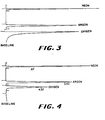
- the most important result to note in Table I is that for the lowest concentration gas blend the oxygen-argon separation could only be observed after the adsorbents received the oxidation treatment. For example, compare Example 2 to Examples 9 or 10 and Examples 17 to 18. Also, note that in each case treating the dehydrated zeolitic adsorbent with zero air improves the resolution of the peaks and allows the separation of ppb levels of argon and oxygen.
- Table II presents the thermodynamic properties of the zeolitic adsorbents prepared by the methods described in the above examples. These values, which are derived using standard procedures from the data in Table I, give the intrinsic properties of the material. In particular, the selectivity is only dependent on the temperature and is sometimes referred to as a separation factor. This factor in combination with the resolution factor (i.e., peak shape) will dictate whether or not two components are baseline resolved.
- Example 2 to 8 show the effect of changing the process parameters used to dehydrate calcium chabazite. Comparison of the results in Table I, Example 2 to Example 3 shows that lowering the flow rate during dehydration of chabazite does not substantially effect the chromatography. Increasing the period of dehydration at 400°C from 8 to 24 hours significantly increases the retention times and improves the separation factor, compare Examples 2 and 4.
- Example 8 used dry nitrogen instead of helium and illustrates that other dry nonreactive purge gases can be used to dehydrate the adsorbents.
- the material is then subjected to an oxidizing atmosphere at elevated temperatures.
- This oxidation step increases the separation ability of the zeolite, especially for the separation of argon and oxygen.
- the following conditions were examined:
- Criteria used for evaluating these conditioning parameters were resolution of the argon and oxygen peaks and detectability of oxygen in Blend 1.
- Example 9 resulted in the highest calculated Rs factor and separated the oxygen in Blend 1.
- Examples 10-15, with the exception of 11, also gave excellent R s factors and separated 2.2 ng of oxygen.
- the range of calculated R s factors fall close to the experimental error of the experiment.
- examples 9-10 and 12-15 fall within the limits of the tested experimental parameter.
- Example 11 shows that at 100 ° C, 2.2 ng of oxygen were not detected.
- preferred conditioning parameters are: Examples 9 and 15 show that zero air and nitrous oxide can be used to properly condition the Ca-chabazite for Ar/0 2 separation and low concentration 0 2 detectability.
- Example 25 The procedure in Example 25 was a single attempt at preparing an example of a trivalent ion possessing a high charge density, i.e. aluminum, and during this attempt, no control of the pH was made.
- the gas chromatographic results for the material prepared according to Example 34 shows that zero air can be used as both a purge and reactive gas to bring about the simultaneous dehydration and oxidation of the adsorbents of the invention thus simplifying the activation procedure without any reduction in the adsorbent's separating ability.
- Air treatment at 400 ° C without prior inert gas heating was evaluated. Examples 34 and 42 clearly illustrate the fact that this single step activation works as well as prior inert gas heat treatment. Air treatment at 400 ° C for 23 hours showed slightly better resolution, especially at the 70 ° C analysis, than the 8- hour treatment. This experiment also clearly shows that the inert gas does not work for reducing oxygen peak tailing or resolving oxygen at concentrations of 2.2 ng and lower.
- Air treated Ca-chabazite has been demonstrated to be an excellent adsorbent for separating a wide concentration range (to ng levels) of argon and oxygen in bulk He at elevated temperatures with short columns, e.g., 1.83 m (six feet).
- other trace gases such as hydrogen, nitrogen, methane and carbon monoxide in He have been separated and analyzed with Ca-chabazite chromatographic packing materials. Trace nitrogen, methane and carbon monoxide have been resolved on a 0.46 m (1.5 feet) Ca-chabazite column.
- the mild oxidation of a thoroughly dehydrated, divalent metal exchanged, preferably, and alkaline earth metal exchanged, zeolite produces an adsorbent which is selective in its adsorption abilities and can readily separate low level concentration of argon and oxygen from a gas stream, in particular, a helium stream.
- this mild oxidation also enables the adsorbent to separate argon from oxygen, thereby providing a beneficial analytical technique.
- this adsorbent used as a chromatographic material provides a wide range of versatility allowing both difficult as well as more routine separations to be achieved with a single column over a very large range of concentrations.
- any adsorbent can be used to affect the separation of a gaseous mixture in two ways: 1) using a carrier gas stream (such as GC analysis), or 2) by the principle of frontal analysis. Since we have shown that the polyvalent forms of chabazite effectively separate oxygen and nitrogen from argon it should be possible to remove oxygen and nitrogen from argon by the principle of frontal analysis. The efficiency of such a process will depend on a number of factors including the concentrations of the components to be removed, temperature of the process, and adsorption properties of the various gases on the particular adsorbent.
- chabazite Due to the high heats of adsorption for nitrogen exhibited by the thoroughly dehydrated polyvalent forms of chabazite, they have sufficient nitrogen capacity to have practical utility for removing nitrogen impurities from argon. This is a direct consequence of the thermodynamic adsorption properties of these adsorbents.
- the calcium form of chabazite has a limiting nitrogen heat of adsorption of -46.0 KJ/mole (-11.0 kcal/mole) and a nitrogen/argon selectivity of 15 at 30 ° C. The high values for these intrinsic properties are directly responsible for the increased capacity of these adsorbents for nitrogen in the presence of argon.
- Activation of the calcium chabazite to a level of optimum performance can be carried out by any method which will remove all the water from the zeolite cavity including that surrounding the cations without causing structural collapse of the zeolite.
- a temperature of 400-500 ° C should be maintained while the adsorbent is purged with a brisk flow of a nonreactive gas.
- the adsorbent can be activated to similar temperatures under vacuum. Increasing the number of divalent cations accessible to nitrogen will improve the adsorption capacity.
- the higher the exchange level of the polyvalent cation the better. At the least a majority of the exchangeable ions should be in the divalent form.
- the increased nitrogen capacity and higher nitrogen/argon selectivity for the chabazite described by this invention results in a superior nitrogen scavenger adsorbent.
- Table VIII give the adsorption properties for several adsorbents which were thoroughly dehydrated by being activated to 400 ° C for at least eight hours.
- the Henry constant determined from the GC screening provides a relative measure of the capacity in the linear (low pressure) region of the isotherm. The largest improvements occur when the calcium exchange level of chabazite is increased.
- thermodynamic data alone is not sufficient to determine if the selectivity and capacity enhancements observed for calcium chabazite would provide a significant impact for a purification process.
- the following examples show the utility of calcium chabazite as a nitrogen scavenger and its superiority over the calcium mordenite of the prior art.
- calcium chabazite should have even higher relative capacities due to its relatively high average heat of adsorption for nitrogen.
- Example 44 The same experiment conducted in Example 44 was run identically, except that the feed gas contained only 3.5 ppm nitrogen in argon. Outlet nitrogen concentrations were as follows:
- equilibrium capacity for the mixture was estimated as 0.0026 g nitrogen per 100 g adsorbent in the presence of bulk argon.
- the mass transfer zone length was estimated as 22 cm.
- the calcium chabazite vessel was approximately 2 inches in diameter and contained 370 grams of material.
- the bed was regenerated as in Example 44 and then submerged in a dry ice/methylene chloride bath at -78 ° C.
- 1.133 m 3 /h (40 SCFH) of argon containing 37.5 vppm nitrogen and 9.5 vppm oxygen were compressed to 584.0 kPa (70 psig) and passed through the purification system.
- Outlet nitrogen concentrations from the chabazite bed were as follows:
- the saturated bed capacity for the mixture was estimated as .02 g nitrogen per 100 g adsorbent. It should be noted that this nitrogen capacity may be lower than what could be ideally achieved since it is known that the feed gas to the chabazite bed did have at least 1 vppm moisture present due to an experimental problem.
- the separation of nitrogen from CF 4 provides an example of how these chabazite adsorbents are superior for removing gas contaminants from bulk gases which are too large to enter the zeolitic cavity, even if the heat of adsorption of the bulk gas is similar to that of the impurity.
- Table IX summarizes the results for a series of GC studies which demonstrate that calcium chabazite effectively excludes CF 4 and can be used to remove nitrogen and oxygen. Henry constants and isosteric heats determined by GC evaluation are given for nitrogen, oxygen, and CF 4 . No studies were carried out with CO, but it is expected that it will be readily adsorbed on any of these adsorbents since it has a permanent dipole.
- Sodium A zeolite is small pore zeolite which totally excludes CF 4 .
- the retention time for CF 4 is less than that for the inert Ne used to obtain dead volume for the column.
- the nitrogen and particularly oxygen capacity (indicated by the Henry constants) on this adsorbent are impracticably low.
- Ca exchange of NaA results in a larger pore zeolite which adsorbs CF 4 readily and has a CF 4 capacity 3 times that for nitrogen and 12 times that for oxygen, therefore it is totally ineffective for CF 4 cleanup.
- Sodium X is a large pore faujasite in which CF 4 has over three times the capacity of nitrogen and also would be ineffective for a CF 4 purification process. It is reasonable to expect that any ion form of X or A zeolite would be inappropriate to use for this application.
- Table IX shows the large improvement in capacities that are achieved for oxygen and nitrogen in the low pressure region by using a chabazite molecular sieve; the chabazite has twice the oxygen and nitrogen capacity as CaA and essentially excludes CF 4 .
- the small Henry constants (K ⁇ 0.1) for CF 4 are inconsistent with the A H values and are most likely due to strong surface adsorption of a small quantity of CF 4 . It is noteworthy that while nitrogen and CF 4 have comparable heats of adsorption on chabazite, the Henry constant is much smaller for CF 4 . This strongly suggests that CF 4 is largely excluded from the zeolite micropores but adsorbs to a negligible extent on the external surface of the crystals.
- Mordenites in the sodium and calcium form were also evaluated. They exclude CF 4 and are substantially better than A or X type but inferior to the chabazites.
- a vessel was charged with 228 g of calcium chabazite adsorbent. The material was then activated and cooled as described in Example 44. A feed gas containing 570 ppm nitrogen in CF 4 was passed through the bed at 0.174 m 3 /h (6.15 SCFH). Outlet nitrogen concentrations were as follows:
- Example 47 The same experiment conducted in Example 47 was run identically, except that the feed gas contained 4600 ppm nitrogen in CF 4 . Outlet nitrogen concentrations were as follows:
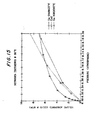
- Figure 14 presents the nitrogen isotherms at 30 ° C for the calcium forms of chabazite, X zeolite, and mordenite.
- the high nitrogen heat of adsorption for Ca Chabazite is reflected in the isotherm shape.
- both CaX and Ca Mordenite have higher nitrogen capacities compared to Ca chabazite.
- the Ca chabazite has significantly greater nitrogen capacity, see Figure 15.
- Figure 16 shows the nitrogen and argon isotherms at 30 ° C for Ca chabazite and clearly shows the large selectivity for nitrogen over argon at these conditions.
Landscapes
- Chemical & Material Sciences (AREA)
- Organic Chemistry (AREA)
- Inorganic Chemistry (AREA)
- Analytical Chemistry (AREA)
- Chemical Kinetics & Catalysis (AREA)
- Engineering & Computer Science (AREA)
- General Chemical & Material Sciences (AREA)
- Oil, Petroleum & Natural Gas (AREA)
- Combustion & Propulsion (AREA)
- Geology (AREA)
- General Life Sciences & Earth Sciences (AREA)
- Life Sciences & Earth Sciences (AREA)
- Solid-Sorbent Or Filter-Aiding Compositions (AREA)
- Silicates, Zeolites, And Molecular Sieves (AREA)
- Separation Of Gases By Adsorption (AREA)
Claims (9)
Applications Claiming Priority (2)
| Application Number | Priority Date | Filing Date | Title |
|---|---|---|---|
| US06/866,531 US4713362A (en) | 1986-05-22 | 1986-05-22 | Selective zeolitic adsorbent and a method for activation thereof |
| US866531 | 1986-05-22 |
Publications (3)
| Publication Number | Publication Date |
|---|---|
| EP0246572A2 EP0246572A2 (de) | 1987-11-25 |
| EP0246572A3 EP0246572A3 (en) | 1988-06-15 |
| EP0246572B1 true EP0246572B1 (de) | 1990-08-22 |
Family
ID=25347800
Family Applications (1)
| Application Number | Title | Priority Date | Filing Date |
|---|---|---|---|
| EP87107074A Expired - Lifetime EP0246572B1 (de) | 1986-05-22 | 1987-05-15 | Selektives, zeolithisches Sorbentmittel und Verfahren zu dessen Aktivierung |
Country Status (6)
| Country | Link |
|---|---|
| US (1) | US4713362A (de) |
| EP (1) | EP0246572B1 (de) |
| JP (1) | JPS62286516A (de) |
| KR (1) | KR910001229B1 (de) |
| DE (1) | DE3764398D1 (de) |
| ES (1) | ES2017077B3 (de) |
Families Citing this family (15)
| Publication number | Priority date | Publication date | Assignee | Title |
|---|---|---|---|---|
| US5242797A (en) * | 1986-03-21 | 1993-09-07 | Myron J. Block | Nucleic acid assay method |
| US5026532A (en) * | 1989-04-06 | 1991-06-25 | Air Products And Chemicals, Inc. | Process for the preparation of an improved chabazite for the purification of bulk gases |
| US4943304A (en) * | 1989-04-06 | 1990-07-24 | Air Products And Chemicals, Inc. | Process for the purification of bulk gases using chabazite adsorbents |
| US5174979A (en) * | 1989-10-06 | 1992-12-29 | Uop | Mixed ion-exchanged zeolites and processes for the use thereof in gas separations |
| US5425240A (en) * | 1992-10-01 | 1995-06-20 | The Boc Group, Inc. | Purification of oxygen by cryogenic adsorption |
| US5612489A (en) * | 1996-02-14 | 1997-03-18 | Air Products And Chemicals, Inc. | Enhanced sensitivity for oxygen and other interactive gases in sample gases using gas chromatography |
| JP3470183B2 (ja) * | 1999-10-28 | 2003-11-25 | 日本酸素株式会社 | 酸素ガス中に含まれる微量不純物の分析方法 |
| RU2175884C1 (ru) * | 2000-05-24 | 2001-11-20 | Куричев Андрей Александрович | Способ получения сорбента на основе цеолита |
| KR20020037609A (ko) * | 2000-11-15 | 2002-05-22 | 이후근 | 유해가스 제거용 흡착제 제조방법 |
| CA2625477C (en) | 2005-10-19 | 2014-05-13 | Panalytique Inc. | Chromatographic systems and methods for eliminating interference from interfering agents |
| US8239171B2 (en) | 2006-02-28 | 2012-08-07 | Panalytique Inc. | System and method of eliminating interference for impurities measurement in noble gases |
| WO2011110345A1 (en) * | 2010-03-12 | 2011-09-15 | Services Petroliers Schlumberger | Micro-fabricated chromatograph column with sputtered stationary phase |
| CN113634223A (zh) * | 2020-05-11 | 2021-11-12 | 上海久古新材料有限公司 | 一种高载银量的银沸石分子筛吸附剂及其制备方法和应用 |
| CN115676786B (zh) * | 2022-10-27 | 2024-04-19 | 江苏中科敬远节能科技有限公司 | 常温下基于银分子筛吸附的氦氖分离工艺 |
| CN117361557B (zh) * | 2023-11-23 | 2025-12-19 | 北京科技大学 | 一种沸石改性方法、改性沸石及在二氧化碳捕集中的应用 |
Family Cites Families (12)
| Publication number | Priority date | Publication date | Assignee | Title |
|---|---|---|---|---|
| US1813174A (en) * | 1925-09-22 | 1931-07-07 | Arthur B Lamb | Process of making activated sorbent material |
| FR1215969A (fr) * | 1957-12-13 | 1960-04-21 | Chemical Construction Corp | Procédé de préparation d'hydrogène pur |
| US3150942A (en) * | 1959-10-19 | 1964-09-29 | Chemical Construction Corp | Method of purifying a hydrogen gas stream by passing said gas in series through 13x and 4a or 5a molecular sieves |
| NL262128A (de) * | 1960-03-09 | 1900-01-01 | ||
| US3121625A (en) * | 1960-10-05 | 1964-02-18 | Universal Oil Prod Co | Adsorptive separation of gas mixtures |
| US3239471A (en) * | 1963-07-01 | 1966-03-08 | Union Oil Co | Pretreatment of pelleted zeolites to improve crushing strength |
| US3374056A (en) * | 1964-12-03 | 1968-03-19 | Grace W R & Co | Process for increasing the thermal stability of synthetic faujasite |
| US3391075A (en) * | 1966-04-08 | 1968-07-02 | Mobil Oil Corp | Catalytic conversion of hydrocarbons with the use of a steam treated y type of crystalline aluminosilicate |
| JPS4970877A (de) * | 1972-09-25 | 1974-07-09 | ||
| DD104962A1 (de) * | 1973-05-21 | 1974-04-05 | ||
| US4544378A (en) * | 1982-11-15 | 1985-10-01 | Air Products And Chemicals, Inc. | Nitrogen adsorption process |
| DK149326C (da) * | 1984-01-10 | 1986-09-15 | Haldor Topsoe As | Fremgangsmaade til fremstilling af katalysatorer til anvendelse ved ethersyntese |
-
1986
- 1986-05-22 US US06/866,531 patent/US4713362A/en not_active Expired - Fee Related
-
1987
- 1987-05-15 EP EP87107074A patent/EP0246572B1/de not_active Expired - Lifetime
- 1987-05-15 DE DE8787107074T patent/DE3764398D1/de not_active Expired - Lifetime
- 1987-05-15 ES ES87107074T patent/ES2017077B3/es not_active Expired - Lifetime
- 1987-05-22 JP JP62125621A patent/JPS62286516A/ja active Pending
- 1987-05-22 KR KR1019870005182A patent/KR910001229B1/ko not_active Expired
Also Published As
| Publication number | Publication date |
|---|---|
| US4713362A (en) | 1987-12-15 |
| ES2017077B3 (es) | 1991-01-01 |
| KR870010891A (ko) | 1987-12-18 |
| KR910001229B1 (ko) | 1991-02-26 |
| DE3764398D1 (de) | 1990-09-27 |
| EP0246572A3 (en) | 1988-06-15 |
| EP0246572A2 (de) | 1987-11-25 |
| JPS62286516A (ja) | 1987-12-12 |
Similar Documents
| Publication | Publication Date | Title |
|---|---|---|
| Ackley et al. | Application of natural zeolites in the purification and separation of gases | |
| US4744805A (en) | Selective adsorption process using an oxidized ion-exchanged dehydrated chabizite adsorbent | |
| US4713362A (en) | Selective zeolitic adsorbent and a method for activation thereof | |
| US4747854A (en) | Selective chromatographic process using an ion-exchanged, dehydrated chabazite adsorbent | |
| Padin et al. | Molecular sieve sorbents for kinetic separation of propane/propylene | |
| US4964889A (en) | Selective adsorption on magnesium-containing clinoptilolites | |
| US4544378A (en) | Nitrogen adsorption process | |
| US3024867A (en) | Drying of natural gas by adsorption | |
| Epiepang et al. | Low-pressure performance evaluation of CO2, H2O and CH4 on Li-LSX as a superior adsorbent for air prepurification | |
| Silva et al. | Equilibrium and kinetics ofn–hexane sorption in pellets of 5A zeolite | |
| Triebe et al. | Adsorption of nitrogen, carbon monoxide, carbon dioxide and nitric oxide on molecular sieves | |
| Epiepang et al. | Air separation sorbents: Mixed-cation zeolites with minimum lithium and silver | |
| JP2002504418A (ja) | 速度増進型気体分離 | |
| US4732584A (en) | Process for the purification of permanent gases using chabazite adsorbents | |
| JPS59107920A (ja) | 空気分離用の改良した多価イオン交換吸着剤 | |
| JP2002177773A (ja) | モノリス吸着剤の活性化方法 | |
| EP0391350A2 (de) | Die Reinigung von Gasen mit Chabazitadsorbentien | |
| Costa et al. | Adsorption of gaseous hydrocarbons on activated carbon: Characteristic kinetic curve | |
| Thomas et al. | Separations with molecular sieves | |
| KR101017697B1 (ko) | C2-c3 올레핀의 정제를 위한 흡착제 | |
| Santacesaria et al. | Separation of xylenes on Y zeolites in the vapor phase. 1. Determination of the adsorption equilibrium parameters and of the kinetic regime | |
| US3164453A (en) | Water removal from gas mixtures | |
| Valenzuela et al. | Gas adsorption equilibria | |
| Triebe et al. | Adsorption of nitrogen and carbon monoxide on clinoptilolite: Determination and prediction of pure and binary isotherms | |
| Ruthven | Sorption and diffusion in molecular sieve zeolites |
Legal Events
| Date | Code | Title | Description |
|---|---|---|---|
| PUAI | Public reference made under article 153(3) epc to a published international application that has entered the european phase |
Free format text: ORIGINAL CODE: 0009012 |
|
| 17P | Request for examination filed |
Effective date: 19870515 |
|
| AK | Designated contracting states |
Kind code of ref document: A2 Designated state(s): BE DE ES FR GB NL |
|
| PUAL | Search report despatched |
Free format text: ORIGINAL CODE: 0009013 |
|
| AK | Designated contracting states |
Kind code of ref document: A3 Designated state(s): BE DE ES FR GB NL |
|
| 17Q | First examination report despatched |
Effective date: 19890301 |
|
| GRAA | (expected) grant |
Free format text: ORIGINAL CODE: 0009210 |
|
| AK | Designated contracting states |
Kind code of ref document: B1 Designated state(s): BE DE ES FR GB NL |
|
| REF | Corresponds to: |
Ref document number: 3764398 Country of ref document: DE Date of ref document: 19900927 |
|
| ET | Fr: translation filed | ||
| PGFP | Annual fee paid to national office [announced via postgrant information from national office to epo] |
Ref country code: GB Payment date: 19910415 Year of fee payment: 5 |
|
| PGFP | Annual fee paid to national office [announced via postgrant information from national office to epo] |
Ref country code: FR Payment date: 19910416 Year of fee payment: 5 |
|
| PGFP | Annual fee paid to national office [announced via postgrant information from national office to epo] |
Ref country code: ES Payment date: 19910517 Year of fee payment: 5 |
|
| PGFP | Annual fee paid to national office [announced via postgrant information from national office to epo] |
Ref country code: DE Payment date: 19910529 Year of fee payment: 5 |
|
| PGFP | Annual fee paid to national office [announced via postgrant information from national office to epo] |
Ref country code: NL Payment date: 19910531 Year of fee payment: 5 |
|
| PLBE | No opposition filed within time limit |
Free format text: ORIGINAL CODE: 0009261 |
|
| STAA | Information on the status of an ep patent application or granted ep patent |
Free format text: STATUS: NO OPPOSITION FILED WITHIN TIME LIMIT |
|
| 26N | No opposition filed | ||
| PGFP | Annual fee paid to national office [announced via postgrant information from national office to epo] |
Ref country code: BE Payment date: 19911003 Year of fee payment: 5 |
|
| PG25 | Lapsed in a contracting state [announced via postgrant information from national office to epo] |
Ref country code: GB Effective date: 19920515 |
|
| PG25 | Lapsed in a contracting state [announced via postgrant information from national office to epo] |
Ref country code: ES Free format text: LAPSE BECAUSE OF NON-PAYMENT OF DUE FEES Effective date: 19920516 |
|
| PG25 | Lapsed in a contracting state [announced via postgrant information from national office to epo] |
Ref country code: BE Effective date: 19920531 |
|
| BERE | Be: lapsed |
Owner name: AIR PRODUCTS AND CHEMICALS INC. Effective date: 19920531 |
|
| PG25 | Lapsed in a contracting state [announced via postgrant information from national office to epo] |
Ref country code: NL Effective date: 19921201 |
|
| GBPC | Gb: european patent ceased through non-payment of renewal fee |
Effective date: 19920515 |
|
| NLV4 | Nl: lapsed or anulled due to non-payment of the annual fee | ||
| PG25 | Lapsed in a contracting state [announced via postgrant information from national office to epo] |
Ref country code: FR Effective date: 19930129 |
|
| PG25 | Lapsed in a contracting state [announced via postgrant information from national office to epo] |
Ref country code: DE Effective date: 19930202 |
|
| REG | Reference to a national code |
Ref country code: FR Ref legal event code: ST |
|
| REG | Reference to a national code |
Ref country code: ES Ref legal event code: FD2A Effective date: 19990503 |