EP0246530A2 - Système de décodage de signaux de données - Google Patents
Système de décodage de signaux de données Download PDFInfo
- Publication number
- EP0246530A2 EP0246530A2 EP87106818A EP87106818A EP0246530A2 EP 0246530 A2 EP0246530 A2 EP 0246530A2 EP 87106818 A EP87106818 A EP 87106818A EP 87106818 A EP87106818 A EP 87106818A EP 0246530 A2 EP0246530 A2 EP 0246530A2
- Authority
- EP
- European Patent Office
- Prior art keywords
- clock signal
- data signals
- frequency
- clock
- fed
- Prior art date
- Legal status (The legal status is an assumption and is not a legal conclusion. Google has not performed a legal analysis and makes no representation as to the accuracy of the status listed.)
- Granted
Links
Images
Classifications
-
- G—PHYSICS
- G08—SIGNALLING
- G08G—TRAFFIC CONTROL SYSTEMS
- G08G1/00—Traffic control systems for road vehicles
- G08G1/09—Arrangements for giving variable traffic instructions
- G08G1/091—Traffic information broadcasting
- G08G1/092—Coding or decoding of the information
-
- H—ELECTRICITY
- H03—ELECTRONIC CIRCUITRY
- H03L—AUTOMATIC CONTROL, STARTING, SYNCHRONISATION OR STABILISATION OF GENERATORS OF ELECTRONIC OSCILLATIONS OR PULSES
- H03L7/00—Automatic control of frequency or phase; Synchronisation
- H03L7/06—Automatic control of frequency or phase; Synchronisation using a reference signal applied to a frequency- or phase-locked loop
- H03L7/08—Details of the phase-locked loop
-
- H—ELECTRICITY
- H04—ELECTRIC COMMUNICATION TECHNIQUE
- H04L—TRANSMISSION OF DIGITAL INFORMATION, e.g. TELEGRAPHIC COMMUNICATION
- H04L7/00—Arrangements for synchronising receiver with transmitter
- H04L7/0079—Receiver details
- H04L7/0083—Receiver details taking measures against momentary loss of synchronisation, e.g. inhibiting the synchronisation, using idle words or using redundant clocks
-
- H—ELECTRICITY
- H04—ELECTRIC COMMUNICATION TECHNIQUE
- H04L—TRANSMISSION OF DIGITAL INFORMATION, e.g. TELEGRAPHIC COMMUNICATION
- H04L7/00—Arrangements for synchronising receiver with transmitter
- H04L7/02—Speed or phase control by the received code signals, the signals containing no special synchronisation information
- H04L7/033—Speed or phase control by the received code signals, the signals containing no special synchronisation information using the transitions of the received signal to control the phase of the synchronising-signal-generating means, e.g. using a phase-locked loop
Definitions
- the invention is based on a system according to the type of the main claim.
- RDS radio data system
- a subcarrier is modulated with digital signals.
- a subcarrier of 57 kHz is amplitude-modulated with a biphase-coded data signal using the double sideband method, the carrier being suppressed.
- the biphase coding means that no spectral lines appear in the vicinity of the carrier, so that there is compatibility with the traffic radio system.
- a synchronous demodulator is provided in the receiver, to which a regenerated subcarrier is supplied in addition to the modulated signal.
- a frequency signal is generated from this regenerated subcarrier by frequency division Corresponds to the bit frequency of the data signals and is used to decode the biphase-coded signals.
- the system according to the invention with the characterizing features of the main claim has the advantage that disturbances are recognized, the number of unusable bits can be detected and the decoding can be continued immediately when the reception starts again properly.
- the invention makes it possible to obtain information largely despite disturbances, for example to regenerate a complete, error-free telegram from several disturbed data telegrams.
- the second clock signal from a divider chain, a crystal oscillator and a frequency or phase locked loop.
- a microphone processor and corresponding programs possible.
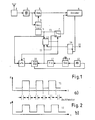
- the demodulated output signals of an FM receiver 1 are fed to a synchronous demodulator 3 via a bandpass filter 2, whose center frequency is 57 kHz.
- the output signals of the bandpass 2 are also fed to a carrier regenerator 4, which supplies a regenerated 57 kHz carrier to the synchronous demodulator 3.
- the output signals of the synchronous demodulator 3 are decoded in a decoder 6 known per se.
- a bit clock signal which is obtained from the regenerated subcarrier with the aid of a frequency divider 5, is required for decoding the output signals of the synchronous demodulator 3.
- this bit clock signal - hereinafter referred to as the first clock signal - is passed directly to the clock input of the decoder 6, the first clock signal in the system according to the invention reaches the clock input of the decoder 6 via a switch 7.
- a quartz oscillator 8 is also synchronized with the first clock signal T1. This takes place in that the first clock signal T1 is fed via a gate circuit 9 to a frequency and phase comparison circuit 10. The output voltage of the controllable quartz oscillator 8 is fed via a frequency divider 11 to a further input of the frequency and phase comparison circuit 10. Depending on the frequency and / or phase offset, a control voltage is fed to the controllable quartz oscillator via a low-pass filter 12.
- the controllable quartz oscillator 8 is tuned in frequency to the bit clock frequency of the transmitted data signal. Quartz oscillators can only be detuned by a slight change in frequency, which is not disadvantageous when using the controllable crystal oscillator 8 according to the invention, since the bit clock is generated on the transmitter side with very high accuracy. However, if there are sudden frequency or phase changes in the first clock signal T1, this is a sign that interference, in particular due to multipath reception, is present. In such a case, the output signal of the frequency divider 11 is fed to the clock input of the decoder 6 as a second clock signal T2 via the changeover switch 7.
- the first clock signal T1 and the second clock signal T2 are fed to a comparator 13. If, with the aid of this comparator, a phase deviation between the clock signals is found which exceeds a predetermined value, a signal is fed to the control input of the changeover switch 7, which switches the changeover switch 7 in brings the lower position. Furthermore, the gate circuit 9 is supplied with a signal which prevents the further supply of the first clock signal T1 to the frequency and phase comparison circuit 10. This prevents the faulty first clock signal T1 from trying to drag the controllable crystal oscillator 8.
- the output signal of the comparator 13 can be blocked by a signal supplied by a flip-flop 14.
- the flip-flop 14 is set by a pulse supplied at 15.
- a pulse is fed to input 15. It is thereby achieved that the decoder 6 is in any case operated with the first clock signal T1 in a start-up phase after switching on or after a transmitter change. Since the second clock signal T2 has a high frequency constancy and thus a high inertia, it remains in the range of the permissible deviation from the target frequency even during longer faults, but requires a longer time for synchronization after switching on or after a transmitter change.
- the first clock signal T1 in diagram a) and the second clock signal T2 in diagram b) are shown in FIG.
- Time windows are provided in the comparator 13, each of which lies in the region of the edges of the second clock signal. If the edges of the first clock signal T1 are also in these time windows, the comparator 13 emits a signal which brings the changeover switch 7 into the upper position, so that the first clock signal T1 goes to Decoder 6 is passed. This is the case with the first clock period shown in FIG. 2.
Landscapes
- Engineering & Computer Science (AREA)
- Computer Networks & Wireless Communication (AREA)
- Signal Processing (AREA)
- Multimedia (AREA)
- Physics & Mathematics (AREA)
- General Physics & Mathematics (AREA)
- Synchronisation In Digital Transmission Systems (AREA)
- Compression Or Coding Systems Of Tv Signals (AREA)
- Selective Calling Equipment (AREA)
Priority Applications (1)
| Application Number | Priority Date | Filing Date | Title |
|---|---|---|---|
| AT87106818T ATE69918T1 (de) | 1986-05-16 | 1987-05-11 | System zur decodierung von datensignalen. |
Applications Claiming Priority (2)
| Application Number | Priority Date | Filing Date | Title |
|---|---|---|---|
| DE3616590 | 1986-05-16 | ||
| DE19863616590 DE3616590A1 (de) | 1986-05-16 | 1986-05-16 | System zur decodierung von datensignalen |
Publications (3)
| Publication Number | Publication Date |
|---|---|
| EP0246530A2 true EP0246530A2 (fr) | 1987-11-25 |
| EP0246530A3 EP0246530A3 (en) | 1988-10-05 |
| EP0246530B1 EP0246530B1 (fr) | 1991-11-27 |
Family
ID=6301003
Family Applications (1)
| Application Number | Title | Priority Date | Filing Date |
|---|---|---|---|
| EP87106818A Expired - Lifetime EP0246530B1 (fr) | 1986-05-16 | 1987-05-11 | Système de décodage de signaux de données |
Country Status (3)
| Country | Link |
|---|---|
| EP (1) | EP0246530B1 (fr) |
| AT (1) | ATE69918T1 (fr) |
| DE (2) | DE3616590A1 (fr) |
Cited By (4)
| Publication number | Priority date | Publication date | Assignee | Title |
|---|---|---|---|---|
| FR2675972A1 (fr) * | 1991-04-25 | 1992-10-30 | Alcatel Telspace | Dispositif de recuperation de rythme. |
| WO1997044930A1 (fr) * | 1996-05-23 | 1997-11-27 | Philips Electronics N.V. | Circuit generateur de frequence |
| EP1158706A1 (fr) * | 2000-05-23 | 2001-11-28 | Sony International (Europe) GmbH | Décodeur RDS pour réduire l'influence de pointes de bruit en utilisant un dispositif d'élimination de bruit |
| EP2267901A1 (fr) * | 2009-06-19 | 2010-12-29 | Siemens Aktiengesellschaft | Procédé et dispositif de conversion d'un signal analogique |
Family Cites Families (6)
| Publication number | Priority date | Publication date | Assignee | Title |
|---|---|---|---|---|
| US3795872A (en) * | 1972-09-18 | 1974-03-05 | Bell Telephone Labor Inc | Protection scheme for clock signal recovery arrangement |
| US4369515A (en) * | 1980-10-06 | 1983-01-18 | Gte Automatic Electric Labs Inc. | Clock synchronization circuit |
| NL8201056A (nl) * | 1982-03-15 | 1983-10-03 | Philips Nv | Fm-ontvanger voor de ontvangst van fm-signalen met zenderkarakterisering. |
| DE3302700A1 (de) * | 1983-01-27 | 1984-08-02 | Siemens AG, 1000 Berlin und 8000 München | Schaltungsanordnung zum einstellen der mittenfrequenz des oszillators eines phasenregelkreises |
| DE3309270A1 (de) * | 1983-03-15 | 1984-09-20 | Siemens AG, 1000 Berlin und 8000 München | Synchronisation nachziehbarer taktoszillatoren bei der uebertragung digitaler signale |
| DE3407450A1 (de) * | 1984-02-29 | 1985-08-29 | Siemens AG, 1000 Berlin und 8000 München | Pulsregenerierschaltung |
-
1986
- 1986-05-16 DE DE19863616590 patent/DE3616590A1/de not_active Withdrawn
-
1987
- 1987-05-11 EP EP87106818A patent/EP0246530B1/fr not_active Expired - Lifetime
- 1987-05-11 AT AT87106818T patent/ATE69918T1/de not_active IP Right Cessation
- 1987-05-11 DE DE8787106818T patent/DE3774760D1/de not_active Expired - Fee Related
Cited By (4)
| Publication number | Priority date | Publication date | Assignee | Title |
|---|---|---|---|---|
| FR2675972A1 (fr) * | 1991-04-25 | 1992-10-30 | Alcatel Telspace | Dispositif de recuperation de rythme. |
| WO1997044930A1 (fr) * | 1996-05-23 | 1997-11-27 | Philips Electronics N.V. | Circuit generateur de frequence |
| EP1158706A1 (fr) * | 2000-05-23 | 2001-11-28 | Sony International (Europe) GmbH | Décodeur RDS pour réduire l'influence de pointes de bruit en utilisant un dispositif d'élimination de bruit |
| EP2267901A1 (fr) * | 2009-06-19 | 2010-12-29 | Siemens Aktiengesellschaft | Procédé et dispositif de conversion d'un signal analogique |
Also Published As
| Publication number | Publication date |
|---|---|
| ATE69918T1 (de) | 1991-12-15 |
| DE3616590A1 (de) | 1987-11-19 |
| EP0246530B1 (fr) | 1991-11-27 |
| DE3774760D1 (de) | 1992-01-09 |
| EP0246530A3 (en) | 1988-10-05 |
Similar Documents
| Publication | Publication Date | Title |
|---|---|---|
| EP0304799B1 (fr) | Dispositif pour démoduler un signal biphasé | |
| DE2748746C2 (fr) | ||
| DE4191766C2 (de) | Frequenzsteuerschaltkreis für einen einstellbaren Empfänger-Oszillator | |
| DE68918857T2 (de) | Digitaler Empfänger mit Unter-Nyquistabtastrate. | |
| DE2907182A1 (de) | Funksignal-uebertragungssystem | |
| DE60128694T2 (de) | Datenübertragung mittels pulsbreitenmodulation | |
| DE3685616T2 (de) | Phasenverriegelte taktregenerierschaltung fuer digitale uebertragungssysteme. | |
| DE60123625T2 (de) | Datenübertragung mittels pulsbreitenmodulation | |
| EP0721262B2 (fr) | Méthode et dispositif de synchronisation en phase avec un signal RDS | |
| EP0469622B1 (fr) | Procédé et dispositif pour démoduler un signal à codage biphasé | |
| DE4444601C1 (de) | Verfahren und Vorrichtung zur empfängerseitigen RDS-Phasensynchronisation | |
| EP0291826B1 (fr) | Démodulteur numérique | |
| EP0246530A2 (fr) | Système de décodage de signaux de données | |
| DE3216088A1 (de) | Vorrichtung zur erkennung von signalen, die wenigstens ein erstes und ein zweites auf einer traegerwelle aufmoduliertes signal umfassen | |
| EP0256287B1 (fr) | Démodulateur pour la démodulation de signaux d'entrée | |
| DE4234603C2 (de) | Demodulator- und Fehlerkorrektur-Schaltung für Radio-Daten-Signale | |
| DE19933215B4 (de) | Verfahren zum Feststellen einer RDS-Rundfunkwelle und RDS-Empfänger | |
| DE19847019A1 (de) | Demodulator für ein Multiplexsignal eines RDS-Rundfunkempfängers | |
| EP0290830B1 (fr) | Démodulateur pour la démodulation de signaux d'entrée | |
| DE69209890T2 (de) | MSK-Modulator | |
| DE3723343A1 (de) | Verfahren zum uebertragen eines digitalen zusatzsignals in einem ukw-fm-signal | |
| DE2051879A1 (de) | Empfanger für in einem bestimmten Signalband liegende, auf eine Tragerfre quenz aufmoduherte Impulse | |
| DE4238373C2 (de) | Schaltungsanordnung zur Regenerierung eines Hilfsträgers für die Demodulation von Radio-Daten-Signalen | |
| DE3733082A1 (de) | Fm-multiplex-rundfunkempfaenger | |
| DE4205016C2 (de) | Demodulator für Radio-Daten-Signale |
Legal Events
| Date | Code | Title | Description |
|---|---|---|---|
| PUAI | Public reference made under article 153(3) epc to a published international application that has entered the european phase |
Free format text: ORIGINAL CODE: 0009012 |
|
| AK | Designated contracting states |
Kind code of ref document: A2 Designated state(s): AT DE FR GB IT SE |
|
| PUAL | Search report despatched |
Free format text: ORIGINAL CODE: 0009013 |
|
| AK | Designated contracting states |
Kind code of ref document: A3 Designated state(s): AT DE FR GB IT SE |
|
| 17P | Request for examination filed |
Effective date: 19880825 |
|
| 17Q | First examination report despatched |
Effective date: 19901025 |
|
| GRAA | (expected) grant |
Free format text: ORIGINAL CODE: 0009210 |
|
| AK | Designated contracting states |
Kind code of ref document: B1 Designated state(s): AT DE FR GB IT SE |
|
| REF | Corresponds to: |
Ref document number: 69918 Country of ref document: AT Date of ref document: 19911215 Kind code of ref document: T |
|
| ET | Fr: translation filed | ||
| GBT | Gb: translation of ep patent filed (gb section 77(6)(a)/1977) | ||
| REF | Corresponds to: |
Ref document number: 3774760 Country of ref document: DE Date of ref document: 19920109 |
|
| ITF | It: translation for a ep patent filed | ||
| PLBE | No opposition filed within time limit |
Free format text: ORIGINAL CODE: 0009261 |
|
| STAA | Information on the status of an ep patent application or granted ep patent |
Free format text: STATUS: NO OPPOSITION FILED WITHIN TIME LIMIT |
|
| 26N | No opposition filed | ||
| EAL | Se: european patent in force in sweden |
Ref document number: 87106818.5 |
|
| PGFP | Annual fee paid to national office [announced via postgrant information from national office to epo] |
Ref country code: GB Payment date: 19960429 Year of fee payment: 10 |
|
| PGFP | Annual fee paid to national office [announced via postgrant information from national office to epo] |
Ref country code: FR Payment date: 19960517 Year of fee payment: 10 |
|
| PGFP | Annual fee paid to national office [announced via postgrant information from national office to epo] |
Ref country code: AT Payment date: 19960523 Year of fee payment: 10 |
|
| PGFP | Annual fee paid to national office [announced via postgrant information from national office to epo] |
Ref country code: SE Payment date: 19960528 Year of fee payment: 10 |
|
| PGFP | Annual fee paid to national office [announced via postgrant information from national office to epo] |
Ref country code: DE Payment date: 19960723 Year of fee payment: 10 |
|
| PG25 | Lapsed in a contracting state [announced via postgrant information from national office to epo] |
Ref country code: GB Effective date: 19970511 Ref country code: AT Effective date: 19970511 |
|
| PG25 | Lapsed in a contracting state [announced via postgrant information from national office to epo] |
Ref country code: SE Effective date: 19970512 |
|
| GBPC | Gb: european patent ceased through non-payment of renewal fee |
Effective date: 19970511 |
|
| PG25 | Lapsed in a contracting state [announced via postgrant information from national office to epo] |
Ref country code: FR Free format text: LAPSE BECAUSE OF NON-PAYMENT OF DUE FEES Effective date: 19980130 |
|
| EUG | Se: european patent has lapsed |
Ref document number: 87106818.5 |
|
| PG25 | Lapsed in a contracting state [announced via postgrant information from national office to epo] |
Ref country code: DE Free format text: LAPSE BECAUSE OF NON-PAYMENT OF DUE FEES Effective date: 19980203 |
|
| REG | Reference to a national code |
Ref country code: FR Ref legal event code: ST |
|
| PG25 | Lapsed in a contracting state [announced via postgrant information from national office to epo] |
Ref country code: IT Free format text: LAPSE BECAUSE OF NON-PAYMENT OF DUE FEES;WARNING: LAPSES OF ITALIAN PATENTS WITH EFFECTIVE DATE BEFORE 2007 MAY HAVE OCCURRED AT ANY TIME BEFORE 2007. THE CORRECT EFFECTIVE DATE MAY BE DIFFERENT FROM THE ONE RECORDED. Effective date: 20050511 |