EP0246187A2 - 2-Pyridyl-penem-Verbindungen - Google Patents
2-Pyridyl-penem-Verbindungen Download PDFInfo
- Publication number
- EP0246187A2 EP0246187A2 EP87810278A EP87810278A EP0246187A2 EP 0246187 A2 EP0246187 A2 EP 0246187A2 EP 87810278 A EP87810278 A EP 87810278A EP 87810278 A EP87810278 A EP 87810278A EP 0246187 A2 EP0246187 A2 EP 0246187A2
- Authority
- EP
- European Patent Office
- Prior art keywords
- formula
- lower alkyl
- pyridyl
- penem
- compounds
- Prior art date
- Legal status (The legal status is an assumption and is not a legal conclusion. Google has not performed a legal analysis and makes no representation as to the accuracy of the status listed.)
- Granted
Links
- -1 2-Pyridyl penem compounds Chemical class 0.000 title claims description 194
- 150000001875 compounds Chemical class 0.000 claims abstract description 129
- 125000000217 alkyl group Chemical group 0.000 claims abstract description 103
- 125000003178 carboxy group Chemical group [H]OC(*)=O 0.000 claims abstract description 87
- 150000003839 salts Chemical class 0.000 claims abstract description 56
- 125000002887 hydroxy group Chemical group [H]O* 0.000 claims abstract description 46
- 238000000034 method Methods 0.000 claims abstract description 35
- 125000003349 3-pyridyl group Chemical group N1=C([H])C([*])=C([H])C([H])=C1[H] 0.000 claims abstract description 24
- 230000008569 process Effects 0.000 claims abstract description 23
- 125000000339 4-pyridyl group Chemical group N1=C([H])C([H])=C([*])C([H])=C1[H] 0.000 claims abstract description 18
- 125000004453 alkoxycarbonyl group Chemical group 0.000 claims description 28
- 125000002924 primary amino group Chemical group [H]N([H])* 0.000 claims description 25
- 229910052736 halogen Inorganic materials 0.000 claims description 23
- 150000002367 halogens Chemical class 0.000 claims description 23
- 238000002360 preparation method Methods 0.000 claims description 23
- 239000002253 acid Substances 0.000 claims description 21
- 125000003545 alkoxy group Chemical group 0.000 claims description 21
- 125000003282 alkyl amino group Chemical group 0.000 claims description 16
- 230000004962 physiological condition Effects 0.000 claims description 16
- 125000003917 carbamoyl group Chemical group [H]N([H])C(*)=O 0.000 claims description 14
- 125000000524 functional group Chemical group 0.000 claims description 11
- 125000004414 alkyl thio group Chemical group 0.000 claims description 9
- 125000004093 cyano group Chemical group *C#N 0.000 claims description 9
- 125000004066 1-hydroxyethyl group Chemical group [H]OC([H])([*])C([H])([H])[H] 0.000 claims description 8
- 125000004423 acyloxy group Chemical group 0.000 claims description 8
- 150000002148 esters Chemical class 0.000 claims description 8
- BFYPGIMLKFZWEI-UTMSNSNXSA-N (5r,6s)-6-[(1r)-1-hydroxyethyl]-7-oxo-3-pyridin-3-yl-4-thia-1-azabicyclo[3.2.0]hept-2-ene-2-carboxylic acid Chemical compound S([C@@H]1[C@H](C(N1C=1C(O)=O)=O)[C@H](O)C)C=1C1=CC=CN=C1 BFYPGIMLKFZWEI-UTMSNSNXSA-N 0.000 claims description 7
- 125000004029 hydroxymethyl group Chemical group [H]OC([H])([H])* 0.000 claims description 7
- 125000001997 phenyl group Chemical group [H]C1=C([H])C([H])=C(*)C([H])=C1[H] 0.000 claims description 7
- 229910052698 phosphorus Inorganic materials 0.000 claims description 7
- 239000011574 phosphorus Substances 0.000 claims description 7
- 239000000825 pharmaceutical preparation Substances 0.000 claims description 6
- 125000001476 phosphono group Chemical group [H]OP(*)(=O)O[H] 0.000 claims description 6
- OAICVXFJPJFONN-UHFFFAOYSA-N Phosphorus Chemical compound [P] OAICVXFJPJFONN-UHFFFAOYSA-N 0.000 claims description 5
- 125000005236 alkanoylamino group Chemical group 0.000 claims description 4
- 150000002894 organic compounds Chemical class 0.000 claims description 4
- 125000000369 oxido group Chemical group [*]=O 0.000 claims description 4
- 150000001768 cations Chemical class 0.000 claims description 3
- 125000003356 phenylsulfanyl group Chemical group [*]SC1=C([H])C([H])=C([H])C([H])=C1[H] 0.000 claims description 3
- 229910052717 sulfur Inorganic materials 0.000 claims description 3
- RYHVSYFEFNMRIC-AHCWWPBBSA-N (5r,6s)-3-(2-chloropyridin-3-yl)-6-[(1r)-1-hydroxyethyl]-7-oxo-4-thia-1-azabicyclo[3.2.0]hept-2-ene-2-carboxylic acid Chemical compound S([C@@H]1[C@H](C(N1C=1C(O)=O)=O)[C@H](O)C)C=1C1=CC=CN=C1Cl RYHVSYFEFNMRIC-AHCWWPBBSA-N 0.000 claims description 2
- GWZNDRNADWOTMI-NMVAGQKNSA-N 1-ethoxycarbonyloxyethyl (5r,6s)-6-[(1r)-1-hydroxyethyl]-7-oxo-3-pyridin-3-yl-4-thia-1-azabicyclo[3.2.0]hept-2-ene-2-carboxylate Chemical compound O=C([C@H]([C@@H](C)O)[C@H]1S2)N1C(C(=O)OC(C)OC(=O)OCC)=C2C1=CC=CN=C1 GWZNDRNADWOTMI-NMVAGQKNSA-N 0.000 claims description 2
- NINIDFKCEFEMDL-UHFFFAOYSA-N Sulfur Chemical compound [S] NINIDFKCEFEMDL-UHFFFAOYSA-N 0.000 claims description 2
- QVGXLLKOCUKJST-UHFFFAOYSA-N atomic oxygen Chemical compound [O] QVGXLLKOCUKJST-UHFFFAOYSA-N 0.000 claims description 2
- 239000001301 oxygen Substances 0.000 claims description 2
- 229910052760 oxygen Inorganic materials 0.000 claims description 2
- 239000011593 sulfur Substances 0.000 claims description 2
- 239000003937 drug carrier Substances 0.000 claims 1
- 239000000463 material Substances 0.000 claims 1
- PXQLVRUNWNTZOS-UHFFFAOYSA-N sulfanyl Chemical class [SH] PXQLVRUNWNTZOS-UHFFFAOYSA-N 0.000 claims 1
- 230000000844 anti-bacterial effect Effects 0.000 abstract description 3
- XLYOFNOQVPJJNP-UHFFFAOYSA-N water Substances O XLYOFNOQVPJJNP-UHFFFAOYSA-N 0.000 description 65
- XEKOWRVHYACXOJ-UHFFFAOYSA-N Ethyl acetate Chemical compound CCOC(C)=O XEKOWRVHYACXOJ-UHFFFAOYSA-N 0.000 description 54
- 235000002639 sodium chloride Nutrition 0.000 description 46
- IAZDPXIOMUYVGZ-WFGJKAKNSA-N Dimethyl sulfoxide Chemical compound [2H]C([2H])([2H])S(=O)C([2H])([2H])[2H] IAZDPXIOMUYVGZ-WFGJKAKNSA-N 0.000 description 44
- YMWUJEATGCHHMB-UHFFFAOYSA-N Dichloromethane Chemical compound ClCCl YMWUJEATGCHHMB-UHFFFAOYSA-N 0.000 description 39
- 150000003254 radicals Chemical class 0.000 description 33
- YXFVVABEGXRONW-UHFFFAOYSA-N Toluene Chemical compound CC1=CC=CC=C1 YXFVVABEGXRONW-UHFFFAOYSA-N 0.000 description 30
- 159000000000 sodium salts Chemical class 0.000 description 30
- 239000000243 solution Substances 0.000 description 24
- 238000006243 chemical reaction Methods 0.000 description 20
- QTBSBXVTEAMEQO-UHFFFAOYSA-N Acetic acid Chemical compound CC(O)=O QTBSBXVTEAMEQO-UHFFFAOYSA-N 0.000 description 19
- LFQSCWFLJHTTHZ-UHFFFAOYSA-N Ethanol Chemical compound CCO LFQSCWFLJHTTHZ-UHFFFAOYSA-N 0.000 description 19
- 239000007858 starting material Substances 0.000 description 19
- 239000000203 mixture Substances 0.000 description 17
- RTZKZFJDLAIYFH-UHFFFAOYSA-N Diethyl ether Chemical compound CCOCC RTZKZFJDLAIYFH-UHFFFAOYSA-N 0.000 description 16
- 125000003277 amino group Chemical group 0.000 description 16
- 239000000460 chlorine Substances 0.000 description 11
- 125000006239 protecting group Chemical group 0.000 description 11
- KDLHZDBZIXYQEI-UHFFFAOYSA-N Palladium Chemical compound [Pd] KDLHZDBZIXYQEI-UHFFFAOYSA-N 0.000 description 10
- 229910052783 alkali metal Inorganic materials 0.000 description 10
- 150000001732 carboxylic acid derivatives Chemical class 0.000 description 10
- 239000003795 chemical substances by application Substances 0.000 description 10
- CSCPPACGZOOCGX-UHFFFAOYSA-N Acetone Chemical compound CC(C)=O CSCPPACGZOOCGX-UHFFFAOYSA-N 0.000 description 9
- WEVYAHXRMPXWCK-UHFFFAOYSA-N Acetonitrile Chemical compound CC#N WEVYAHXRMPXWCK-UHFFFAOYSA-N 0.000 description 9
- OKKJLVBELUTLKV-UHFFFAOYSA-N Methanol Chemical compound OC OKKJLVBELUTLKV-UHFFFAOYSA-N 0.000 description 9
- VYPSYNLAJGMNEJ-UHFFFAOYSA-N Silicium dioxide Chemical compound O=[Si]=O VYPSYNLAJGMNEJ-UHFFFAOYSA-N 0.000 description 9
- 239000002585 base Substances 0.000 description 9
- 239000012442 inert solvent Substances 0.000 description 9
- FVAUCKIRQBBSSJ-UHFFFAOYSA-M sodium iodide Chemical compound [Na+].[I-] FVAUCKIRQBBSSJ-UHFFFAOYSA-M 0.000 description 9
- QGZKDVFQNNGYKY-UHFFFAOYSA-N Ammonia Chemical compound N QGZKDVFQNNGYKY-UHFFFAOYSA-N 0.000 description 8
- JUJWROOIHBZHMG-UHFFFAOYSA-N Pyridine Chemical compound C1=CC=NC=C1 JUJWROOIHBZHMG-UHFFFAOYSA-N 0.000 description 8
- WYURNTSHIVDZCO-UHFFFAOYSA-N Tetrahydrofuran Chemical compound C1CCOC1 WYURNTSHIVDZCO-UHFFFAOYSA-N 0.000 description 8
- 150000001340 alkali metals Chemical class 0.000 description 8
- 239000002904 solvent Substances 0.000 description 8
- KRHYYFGTRYWZRS-UHFFFAOYSA-M Fluoride anion Chemical compound [F-] KRHYYFGTRYWZRS-UHFFFAOYSA-M 0.000 description 7
- 229910052751 metal Inorganic materials 0.000 description 7
- 239000002184 metal Substances 0.000 description 7
- 239000000741 silica gel Substances 0.000 description 7
- 229910002027 silica gel Inorganic materials 0.000 description 7
- 238000003756 stirring Methods 0.000 description 7
- UHOVQNZJYSORNB-UHFFFAOYSA-N Benzene Chemical compound C1=CC=CC=C1 UHOVQNZJYSORNB-UHFFFAOYSA-N 0.000 description 6
- IAZDPXIOMUYVGZ-UHFFFAOYSA-N Dimethylsulphoxide Chemical compound CS(C)=O IAZDPXIOMUYVGZ-UHFFFAOYSA-N 0.000 description 6
- DGAQECJNVWCQMB-PUAWFVPOSA-M Ilexoside XXIX Chemical compound C[C@@H]1CC[C@@]2(CC[C@@]3(C(=CC[C@H]4[C@]3(CC[C@@H]5[C@@]4(CC[C@@H](C5(C)C)OS(=O)(=O)[O-])C)C)[C@@H]2[C@]1(C)O)C)C(=O)O[C@H]6[C@@H]([C@H]([C@@H]([C@H](O6)CO)O)O)O.[Na+] DGAQECJNVWCQMB-PUAWFVPOSA-M 0.000 description 6
- 229910052784 alkaline earth metal Inorganic materials 0.000 description 6
- 239000003054 catalyst Substances 0.000 description 6
- 238000004587 chromatography analysis Methods 0.000 description 6
- NFHFRUOZVGFOOS-UHFFFAOYSA-N palladium;triphenylphosphane Chemical compound [Pd].C1=CC=CC=C1P(C=1C=CC=CC=1)C1=CC=CC=C1.C1=CC=CC=C1P(C=1C=CC=CC=1)C1=CC=CC=C1.C1=CC=CC=C1P(C=1C=CC=CC=1)C1=CC=CC=C1.C1=CC=CC=C1P(C=1C=CC=CC=1)C1=CC=CC=C1 NFHFRUOZVGFOOS-UHFFFAOYSA-N 0.000 description 6
- RIOQSEWOXXDEQQ-UHFFFAOYSA-N triphenylphosphine Chemical compound C1=CC=CC=C1P(C=1C=CC=CC=1)C1=CC=CC=C1 RIOQSEWOXXDEQQ-UHFFFAOYSA-N 0.000 description 6
- FAPWRFPIFSIZLT-UHFFFAOYSA-M Sodium chloride Chemical class [Na+].[Cl-] FAPWRFPIFSIZLT-UHFFFAOYSA-M 0.000 description 5
- 125000002252 acyl group Chemical group 0.000 description 5
- 125000001584 benzyloxycarbonyl group Chemical group C(=O)(OCC1=CC=CC=C1)* 0.000 description 5
- 125000004432 carbon atom Chemical group C* 0.000 description 5
- 239000003480 eluent Substances 0.000 description 5
- 125000001495 ethyl group Chemical group [H]C([H])([H])C([H])([H])* 0.000 description 5
- 150000004820 halides Chemical class 0.000 description 5
- 239000012074 organic phase Substances 0.000 description 5
- 229910052763 palladium Inorganic materials 0.000 description 5
- UYWQUFXKFGHYNT-UHFFFAOYSA-N phenylmethyl ester of formic acid Natural products O=COCC1=CC=CC=C1 UYWQUFXKFGHYNT-UHFFFAOYSA-N 0.000 description 5
- 239000011541 reaction mixture Substances 0.000 description 5
- 238000006722 reduction reaction Methods 0.000 description 5
- HEMHJVSKTPXQMS-UHFFFAOYSA-M sodium hydroxide Inorganic materials [OH-].[Na+] HEMHJVSKTPXQMS-UHFFFAOYSA-M 0.000 description 5
- RYHBNJHYFVUHQT-UHFFFAOYSA-N 1,4-Dioxane Chemical compound C1COCCO1 RYHBNJHYFVUHQT-UHFFFAOYSA-N 0.000 description 4
- VEXZGXHMUGYJMC-UHFFFAOYSA-M Chloride anion Chemical compound [Cl-] VEXZGXHMUGYJMC-UHFFFAOYSA-M 0.000 description 4
- KRHYYFGTRYWZRS-UHFFFAOYSA-N Fluorane Chemical compound F KRHYYFGTRYWZRS-UHFFFAOYSA-N 0.000 description 4
- UFHFLCQGNIYNRP-UHFFFAOYSA-N Hydrogen Chemical compound [H][H] UFHFLCQGNIYNRP-UHFFFAOYSA-N 0.000 description 4
- ISWSIDIOOBJBQZ-UHFFFAOYSA-N Phenol Chemical compound OC1=CC=CC=C1 ISWSIDIOOBJBQZ-UHFFFAOYSA-N 0.000 description 4
- XYFCBTPGUUZFHI-UHFFFAOYSA-N Phosphine Natural products P XYFCBTPGUUZFHI-UHFFFAOYSA-N 0.000 description 4
- UIIMBOGNXHQVGW-UHFFFAOYSA-M Sodium bicarbonate Chemical compound [Na+].OC([O-])=O UIIMBOGNXHQVGW-UHFFFAOYSA-M 0.000 description 4
- QAOWNCQODCNURD-UHFFFAOYSA-N Sulfuric acid Chemical compound OS(O)(=O)=O QAOWNCQODCNURD-UHFFFAOYSA-N 0.000 description 4
- 239000004480 active ingredient Substances 0.000 description 4
- 239000013543 active substance Substances 0.000 description 4
- 125000005092 alkenyloxycarbonyl group Chemical group 0.000 description 4
- 125000005103 alkyl silyl group Chemical group 0.000 description 4
- OBETXYAYXDNJHR-UHFFFAOYSA-N alpha-ethylcaproic acid Natural products CCCCC(CC)C(O)=O OBETXYAYXDNJHR-UHFFFAOYSA-N 0.000 description 4
- 229910021529 ammonia Inorganic materials 0.000 description 4
- 239000012043 crude product Substances 0.000 description 4
- DIOQZVSQGTUSAI-UHFFFAOYSA-N decane Chemical compound CCCCCCCCCC DIOQZVSQGTUSAI-UHFFFAOYSA-N 0.000 description 4
- 125000003754 ethoxycarbonyl group Chemical group C(=O)(OCC)* 0.000 description 4
- 239000001257 hydrogen Substances 0.000 description 4
- 229910052739 hydrogen Inorganic materials 0.000 description 4
- 239000000543 intermediate Substances 0.000 description 4
- 125000002496 methyl group Chemical group [H]C([H])([H])* 0.000 description 4
- 125000000449 nitro group Chemical group [O-][N+](*)=O 0.000 description 4
- UMJSCPRVCHMLSP-UHFFFAOYSA-N pyridine Natural products COC1=CC=CN=C1 UMJSCPRVCHMLSP-UHFFFAOYSA-N 0.000 description 4
- 239000011734 sodium Substances 0.000 description 4
- PUZPDOWCWNUUKD-UHFFFAOYSA-M sodium fluoride Chemical compound [F-].[Na+] PUZPDOWCWNUUKD-UHFFFAOYSA-M 0.000 description 4
- GGCZERPQGJTIQP-UHFFFAOYSA-N sodium;9,10-dioxoanthracene-2-sulfonic acid Chemical compound [Na+].C1=CC=C2C(=O)C3=CC(S(=O)(=O)O)=CC=C3C(=O)C2=C1 GGCZERPQGJTIQP-UHFFFAOYSA-N 0.000 description 4
- 239000000126 substance Substances 0.000 description 4
- 125000001424 substituent group Chemical group 0.000 description 4
- FPGGTKZVZWFYPV-UHFFFAOYSA-M tetrabutylammonium fluoride Chemical compound [F-].CCCC[N+](CCCC)(CCCC)CCCC FPGGTKZVZWFYPV-UHFFFAOYSA-M 0.000 description 4
- UMGDCJDMYOKAJW-UHFFFAOYSA-N thiourea Chemical compound NC(N)=S UMGDCJDMYOKAJW-UHFFFAOYSA-N 0.000 description 4
- 125000003903 2-propenyl group Chemical group [H]C([*])([H])C([H])=C([H])[H] 0.000 description 3
- FBPFZTCFMRRESA-KVTDHHQDSA-N D-Mannitol Chemical compound OC[C@@H](O)[C@@H](O)[C@H](O)[C@H](O)CO FBPFZTCFMRRESA-KVTDHHQDSA-N 0.000 description 3
- HHLFWLYXYJOTON-UHFFFAOYSA-N Glyoxylic acid Natural products OC(=O)C=O HHLFWLYXYJOTON-UHFFFAOYSA-N 0.000 description 3
- 229930195725 Mannitol Natural products 0.000 description 3
- AFVFQIVMOAPDHO-UHFFFAOYSA-N Methanesulfonic acid Chemical compound CS(O)(=O)=O AFVFQIVMOAPDHO-UHFFFAOYSA-N 0.000 description 3
- KWYUFKZDYYNOTN-UHFFFAOYSA-M Potassium hydroxide Chemical compound [OH-].[K+] KWYUFKZDYYNOTN-UHFFFAOYSA-M 0.000 description 3
- 229920002472 Starch Polymers 0.000 description 3
- ZMANZCXQSJIPKH-UHFFFAOYSA-N Triethylamine Chemical compound CCN(CC)CC ZMANZCXQSJIPKH-UHFFFAOYSA-N 0.000 description 3
- 125000004442 acylamino group Chemical group 0.000 description 3
- 125000004466 alkoxycarbonylamino group Chemical group 0.000 description 3
- 150000001412 amines Chemical class 0.000 description 3
- 150000003863 ammonium salts Chemical class 0.000 description 3
- 150000008064 anhydrides Chemical class 0.000 description 3
- 125000000852 azido group Chemical group *N=[N+]=[N-] 0.000 description 3
- 125000003236 benzoyl group Chemical group [H]C1=C([H])C([H])=C(C([H])=C1[H])C(*)=O 0.000 description 3
- 239000011230 binding agent Substances 0.000 description 3
- 125000001589 carboacyl group Chemical group 0.000 description 3
- 229910052799 carbon Inorganic materials 0.000 description 3
- 239000003638 chemical reducing agent Substances 0.000 description 3
- KRKNYBCHXYNGOX-UHFFFAOYSA-N citric acid Chemical compound OC(=O)CC(O)(C(O)=O)CC(O)=O KRKNYBCHXYNGOX-UHFFFAOYSA-N 0.000 description 3
- 238000001816 cooling Methods 0.000 description 3
- 238000010438 heat treatment Methods 0.000 description 3
- 238000005984 hydrogenation reaction Methods 0.000 description 3
- 238000007327 hydrogenolysis reaction Methods 0.000 description 3
- 208000015181 infectious disease Diseases 0.000 description 3
- 239000000594 mannitol Substances 0.000 description 3
- 235000010355 mannitol Nutrition 0.000 description 3
- 238000004519 manufacturing process Methods 0.000 description 3
- 229910052757 nitrogen Inorganic materials 0.000 description 3
- 239000012071 phase Substances 0.000 description 3
- 238000000746 purification Methods 0.000 description 3
- 230000009467 reduction Effects 0.000 description 3
- 230000002829 reductive effect Effects 0.000 description 3
- 229910052708 sodium Inorganic materials 0.000 description 3
- 235000009518 sodium iodide Nutrition 0.000 description 3
- 239000011877 solvent mixture Substances 0.000 description 3
- 238000003797 solvolysis reaction Methods 0.000 description 3
- 235000019698 starch Nutrition 0.000 description 3
- 125000000020 sulfo group Chemical class O=S(=O)([*])O[H] 0.000 description 3
- YLQBMQCUIZJEEH-UHFFFAOYSA-N tetrahydrofuran Natural products C=1C=COC=1 YLQBMQCUIZJEEH-UHFFFAOYSA-N 0.000 description 3
- 125000003396 thiol group Chemical class [H]S* 0.000 description 3
- JOXIMZWYDAKGHI-UHFFFAOYSA-N toluene-4-sulfonic acid Chemical compound CC1=CC=C(S(O)(=O)=O)C=C1 JOXIMZWYDAKGHI-UHFFFAOYSA-N 0.000 description 3
- DBGVGMSCBYYSLD-UHFFFAOYSA-N tributylstannane Chemical compound CCCC[SnH](CCCC)CCCC DBGVGMSCBYYSLD-UHFFFAOYSA-N 0.000 description 3
- BDZBKCUKTQZUTL-UHFFFAOYSA-N triethyl phosphite Chemical compound CCOP(OCC)OCC BDZBKCUKTQZUTL-UHFFFAOYSA-N 0.000 description 3
- OBETXYAYXDNJHR-SSDOTTSWSA-M (2r)-2-ethylhexanoate Chemical compound CCCC[C@@H](CC)C([O-])=O OBETXYAYXDNJHR-SSDOTTSWSA-M 0.000 description 2
- NYRKYJIEHRNLPD-UTMSNSNXSA-N (5r,6s)-6-[(1r)-1-hydroxyethyl]-7-oxo-3-pyridin-4-yl-4-thia-1-azabicyclo[3.2.0]hept-2-ene-2-carboxylic acid Chemical compound S([C@@H]1[C@H](C(N1C=1C(O)=O)=O)[C@H](O)C)C=1C1=CC=NC=C1 NYRKYJIEHRNLPD-UTMSNSNXSA-N 0.000 description 2
- YVRGKFXJZCTTRB-UHFFFAOYSA-N 1-chloroethyl ethyl carbonate Chemical compound CCOC(=O)OC(C)Cl YVRGKFXJZCTTRB-UHFFFAOYSA-N 0.000 description 2
- NGNBDVOYPDDBFK-UHFFFAOYSA-N 2-[2,4-di(pentan-2-yl)phenoxy]acetyl chloride Chemical compound CCCC(C)C1=CC=C(OCC(Cl)=O)C(C(C)CCC)=C1 NGNBDVOYPDDBFK-UHFFFAOYSA-N 0.000 description 2
- 125000000954 2-hydroxyethyl group Chemical group [H]C([*])([H])C([H])([H])O[H] 0.000 description 2
- VHYFNPMBLIVWCW-UHFFFAOYSA-N 4-Dimethylaminopyridine Chemical compound CN(C)C1=CC=NC=C1 VHYFNPMBLIVWCW-UHFFFAOYSA-N 0.000 description 2
- XKRFYHLGVUSROY-UHFFFAOYSA-N Argon Chemical compound [Ar] XKRFYHLGVUSROY-UHFFFAOYSA-N 0.000 description 2
- CIWBSHSKHKDKBQ-JLAZNSOCSA-N Ascorbic acid Chemical compound OC[C@H](O)[C@H]1OC(=O)C(O)=C1O CIWBSHSKHKDKBQ-JLAZNSOCSA-N 0.000 description 2
- IJGRMHOSHXDMSA-UHFFFAOYSA-N Atomic nitrogen Chemical compound N#N IJGRMHOSHXDMSA-UHFFFAOYSA-N 0.000 description 2
- LSNNMFCWUKXFEE-UHFFFAOYSA-M Bisulfite Chemical compound OS([O-])=O LSNNMFCWUKXFEE-UHFFFAOYSA-M 0.000 description 2
- WKBOTKDWSSQWDR-UHFFFAOYSA-N Bromine atom Chemical compound [Br] WKBOTKDWSSQWDR-UHFFFAOYSA-N 0.000 description 2
- 0 C(C1)CC11C*CC1 Chemical compound C(C1)CC11C*CC1 0.000 description 2
- BVKZGUZCCUSVTD-UHFFFAOYSA-L Carbonate Chemical compound [O-]C([O-])=O BVKZGUZCCUSVTD-UHFFFAOYSA-L 0.000 description 2
- ZAMOUSCENKQFHK-UHFFFAOYSA-N Chlorine atom Chemical compound [Cl] ZAMOUSCENKQFHK-UHFFFAOYSA-N 0.000 description 2
- HEDRZPFGACZZDS-UHFFFAOYSA-N Chloroform Chemical compound ClC(Cl)Cl HEDRZPFGACZZDS-UHFFFAOYSA-N 0.000 description 2
- XDTMQSROBMDMFD-UHFFFAOYSA-N Cyclohexane Chemical compound C1CCCCC1 XDTMQSROBMDMFD-UHFFFAOYSA-N 0.000 description 2
- QXNVGIXVLWOKEQ-UHFFFAOYSA-N Disodium Chemical class [Na][Na] QXNVGIXVLWOKEQ-UHFFFAOYSA-N 0.000 description 2
- VZCYOOQTPOCHFL-OWOJBTEDSA-N Fumaric acid Chemical compound OC(=O)\C=C\C(O)=O VZCYOOQTPOCHFL-OWOJBTEDSA-N 0.000 description 2
- DHMQDGOQFOQNFH-UHFFFAOYSA-N Glycine Chemical compound NCC(O)=O DHMQDGOQFOQNFH-UHFFFAOYSA-N 0.000 description 2
- VEXZGXHMUGYJMC-UHFFFAOYSA-N Hydrochloric acid Chemical compound Cl VEXZGXHMUGYJMC-UHFFFAOYSA-N 0.000 description 2
- FYYHWMGAXLPEAU-UHFFFAOYSA-N Magnesium Chemical compound [Mg] FYYHWMGAXLPEAU-UHFFFAOYSA-N 0.000 description 2
- CSNNHWWHGAXBCP-UHFFFAOYSA-L Magnesium sulfate Chemical compound [Mg+2].[O-][S+2]([O-])([O-])[O-] CSNNHWWHGAXBCP-UHFFFAOYSA-L 0.000 description 2
- 241001465754 Metazoa Species 0.000 description 2
- FXHOOIRPVKKKFG-UHFFFAOYSA-N N,N-Dimethylacetamide Chemical compound CN(C)C(C)=O FXHOOIRPVKKKFG-UHFFFAOYSA-N 0.000 description 2
- 229930182555 Penicillin Natural products 0.000 description 2
- JGSARLDLIJGVTE-MBNYWOFBSA-N Penicillin G Chemical compound N([C@H]1[C@H]2SC([C@@H](N2C1=O)C(O)=O)(C)C)C(=O)CC1=CC=CC=C1 JGSARLDLIJGVTE-MBNYWOFBSA-N 0.000 description 2
- NBIIXXVUZAFLBC-UHFFFAOYSA-N Phosphoric acid Chemical compound OP(O)(O)=O NBIIXXVUZAFLBC-UHFFFAOYSA-N 0.000 description 2
- 239000004721 Polyphenylene oxide Substances 0.000 description 2
- PMZURENOXWZQFD-UHFFFAOYSA-L Sodium Sulfate Chemical compound [Na+].[Na+].[O-]S([O-])(=O)=O PMZURENOXWZQFD-UHFFFAOYSA-L 0.000 description 2
- 241000295644 Staphylococcaceae Species 0.000 description 2
- 241000191967 Staphylococcus aureus Species 0.000 description 2
- DTQVDTLACAAQTR-UHFFFAOYSA-N Trifluoroacetic acid Chemical compound OC(=O)C(F)(F)F DTQVDTLACAAQTR-UHFFFAOYSA-N 0.000 description 2
- XSQUKJJJFZCRTK-UHFFFAOYSA-N Urea Natural products NC(N)=O XSQUKJJJFZCRTK-UHFFFAOYSA-N 0.000 description 2
- HCHKCACWOHOZIP-UHFFFAOYSA-N Zinc Chemical compound [Zn] HCHKCACWOHOZIP-UHFFFAOYSA-N 0.000 description 2
- 125000003668 acetyloxy group Chemical group [H]C([H])([H])C(=O)O[*] 0.000 description 2
- 230000002378 acidificating effect Effects 0.000 description 2
- 238000006136 alcoholysis reaction Methods 0.000 description 2
- 125000001931 aliphatic group Chemical group 0.000 description 2
- 239000003513 alkali Substances 0.000 description 2
- 229910001515 alkali metal fluoride Inorganic materials 0.000 description 2
- 229910001413 alkali metal ion Inorganic materials 0.000 description 2
- 150000001342 alkaline earth metals Chemical class 0.000 description 2
- 150000003973 alkyl amines Chemical class 0.000 description 2
- 125000004390 alkyl sulfonyl group Chemical group 0.000 description 2
- 150000001450 anions Chemical class 0.000 description 2
- RDOXTESZEPMUJZ-UHFFFAOYSA-N anisole Chemical compound COC1=CC=CC=C1 RDOXTESZEPMUJZ-UHFFFAOYSA-N 0.000 description 2
- 239000008346 aqueous phase Substances 0.000 description 2
- 239000007864 aqueous solution Substances 0.000 description 2
- 150000004982 aromatic amines Chemical class 0.000 description 2
- 150000004945 aromatic hydrocarbons Chemical class 0.000 description 2
- WPYMKLBDIGXBTP-UHFFFAOYSA-N benzoic acid Chemical compound OC(=O)C1=CC=CC=C1 WPYMKLBDIGXBTP-UHFFFAOYSA-N 0.000 description 2
- GDTBXPJZTBHREO-UHFFFAOYSA-N bromine Substances BrBr GDTBXPJZTBHREO-UHFFFAOYSA-N 0.000 description 2
- 229910052794 bromium Inorganic materials 0.000 description 2
- YCIMNLLNPGFGHC-UHFFFAOYSA-N catechol Chemical compound OC1=CC=CC=C1O YCIMNLLNPGFGHC-UHFFFAOYSA-N 0.000 description 2
- 239000007795 chemical reaction product Substances 0.000 description 2
- 239000003153 chemical reaction reagent Substances 0.000 description 2
- 229910052801 chlorine Inorganic materials 0.000 description 2
- 238000004440 column chromatography Methods 0.000 description 2
- 238000006482 condensation reaction Methods 0.000 description 2
- 150000003983 crown ethers Chemical class 0.000 description 2
- 150000004292 cyclic ethers Chemical class 0.000 description 2
- BADXJIPKFRBFOT-UHFFFAOYSA-N dimedone Chemical compound CC1(C)CC(=O)CC(=O)C1 BADXJIPKFRBFOT-UHFFFAOYSA-N 0.000 description 2
- 239000006260 foam Substances 0.000 description 2
- 238000001640 fractional crystallisation Methods 0.000 description 2
- 150000008282 halocarbons Chemical class 0.000 description 2
- 150000002373 hemiacetals Chemical class 0.000 description 2
- 230000007062 hydrolysis Effects 0.000 description 2
- 238000006460 hydrolysis reaction Methods 0.000 description 2
- 238000011065 in-situ storage Methods 0.000 description 2
- 238000002329 infrared spectrum Methods 0.000 description 2
- 238000002955 isolation Methods 0.000 description 2
- 229910052749 magnesium Inorganic materials 0.000 description 2
- BDAGIHXWWSANSR-UHFFFAOYSA-N methanoic acid Natural products OC=O BDAGIHXWWSANSR-UHFFFAOYSA-N 0.000 description 2
- 125000000956 methoxy group Chemical group [H]C([H])([H])O* 0.000 description 2
- 125000001160 methoxycarbonyl group Chemical group [H]C([H])([H])OC(*)=O 0.000 description 2
- 150000007522 mineralic acids Chemical class 0.000 description 2
- 230000007935 neutral effect Effects 0.000 description 2
- 125000004433 nitrogen atom Chemical group N* 0.000 description 2
- 231100000252 nontoxic Toxicity 0.000 description 2
- 230000003000 nontoxic effect Effects 0.000 description 2
- 230000000269 nucleophilic effect Effects 0.000 description 2
- 125000001181 organosilyl group Chemical group [SiH3]* 0.000 description 2
- HHXMXAQDOUCLDN-RXMQYKEDSA-N penem Chemical compound S1C=CN2C(=O)C[C@H]21 HHXMXAQDOUCLDN-RXMQYKEDSA-N 0.000 description 2
- 150000002961 penems Chemical class 0.000 description 2
- 229940049954 penicillin Drugs 0.000 description 2
- 230000000144 pharmacologic effect Effects 0.000 description 2
- 229910000073 phosphorus hydride Inorganic materials 0.000 description 2
- 229920000570 polyether Polymers 0.000 description 2
- BWHMMNNQKKPAPP-UHFFFAOYSA-L potassium carbonate Chemical compound [K+].[K+].[O-]C([O-])=O BWHMMNNQKKPAPP-UHFFFAOYSA-L 0.000 description 2
- 108090000765 processed proteins & peptides Proteins 0.000 description 2
- 238000007363 ring formation reaction Methods 0.000 description 2
- 125000003808 silyl group Chemical group [H][Si]([H])([H])[*] 0.000 description 2
- 229910000030 sodium bicarbonate Inorganic materials 0.000 description 2
- 235000017557 sodium bicarbonate Nutrition 0.000 description 2
- 239000011775 sodium fluoride Substances 0.000 description 2
- 235000013024 sodium fluoride Nutrition 0.000 description 2
- 229910001415 sodium ion Inorganic materials 0.000 description 2
- 229910052938 sodium sulfate Inorganic materials 0.000 description 2
- 235000011152 sodium sulphate Nutrition 0.000 description 2
- 239000007787 solid Substances 0.000 description 2
- 238000006467 substitution reaction Methods 0.000 description 2
- 238000003786 synthesis reaction Methods 0.000 description 2
- 125000000999 tert-butyl group Chemical group [H]C([H])([H])C(*)(C([H])([H])[H])C([H])([H])[H] 0.000 description 2
- VZCYOOQTPOCHFL-UHFFFAOYSA-N trans-butenedioic acid Natural products OC(=O)C=CC(O)=O VZCYOOQTPOCHFL-UHFFFAOYSA-N 0.000 description 2
- 125000000026 trimethylsilyl group Chemical group [H]C([H])([H])[Si]([*])(C([H])([H])[H])C([H])([H])[H] 0.000 description 2
- LENZDBCJOHFCAS-UHFFFAOYSA-N tris Chemical compound OCC(N)(CO)CO LENZDBCJOHFCAS-UHFFFAOYSA-N 0.000 description 2
- 229910052725 zinc Inorganic materials 0.000 description 2
- 239000011701 zinc Substances 0.000 description 2
- JNBRDOQHPXUXLY-UHFFFAOYSA-N (2,5-difluorophenyl)hydrazine Chemical compound NNC1=CC(F)=CC=C1F JNBRDOQHPXUXLY-UHFFFAOYSA-N 0.000 description 1
- QBYIENPQHBMVBV-HFEGYEGKSA-N (2R)-2-hydroxy-2-phenylacetic acid Chemical compound O[C@@H](C(O)=O)c1ccccc1.O[C@@H](C(O)=O)c1ccccc1 QBYIENPQHBMVBV-HFEGYEGKSA-N 0.000 description 1
- CJENMEQZVVEEMH-ZPDRFLDPSA-N (5R,6S)-3-(4-carbamoylpyridin-3-yl)-6-[(1R)-1-hydroxyethyl]-7-oxo-4-thia-1-azabicyclo[3.2.0]hept-2-ene-2-carboxylic acid Chemical compound S([C@@H]1[C@H](C(N1C=1C(O)=O)=O)[C@H](O)C)C=1C1=CN=CC=C1C(N)=O CJENMEQZVVEEMH-ZPDRFLDPSA-N 0.000 description 1
- CWFAMVUHPHYDIO-SNVBAGLBSA-N (5r)-3-pyridin-2-yl-4-thia-1-azabicyclo[3.2.0]hept-2-en-7-one Chemical class S([C@@H]1CC(N1C=1)=O)C=1C1=CC=CC=N1 CWFAMVUHPHYDIO-SNVBAGLBSA-N 0.000 description 1
- YHNRMSKCLPWTDW-PBSSZDIGSA-N (5r,6s)-3-(2,6-dichloropyridin-4-yl)-6-[(1r)-1-hydroxyethyl]-7-oxo-4-thia-1-azabicyclo[3.2.0]hept-2-ene-2-carboxylic acid Chemical compound S([C@@H]1[C@H](C(N1C=1C(O)=O)=O)[C@H](O)C)C=1C1=CC(Cl)=NC(Cl)=C1 YHNRMSKCLPWTDW-PBSSZDIGSA-N 0.000 description 1
- NPECYVVHHKLEAK-KIXYHFEESA-N (5r,6s)-3-(2-carbamoylpyridin-3-yl)-6-[(1r)-1-hydroxyethyl]-7-oxo-4-thia-1-azabicyclo[3.2.0]hept-2-ene-2-carboxylic acid Chemical compound S([C@@H]1[C@H](C(N1C=1C(O)=O)=O)[C@H](O)C)C=1C1=CC=CN=C1C(N)=O NPECYVVHHKLEAK-KIXYHFEESA-N 0.000 description 1
- JEICGTIGBUZQHR-AHCWWPBBSA-N (5r,6s)-3-(2-carboxypyridin-3-yl)-6-[(1r)-1-hydroxyethyl]-7-oxo-4-thia-1-azabicyclo[3.2.0]hept-2-ene-2-carboxylic acid Chemical compound S([C@@H]1[C@H](C(N1C=1C(O)=O)=O)[C@H](O)C)C=1C1=CC=CN=C1C(O)=O JEICGTIGBUZQHR-AHCWWPBBSA-N 0.000 description 1
- LQHBKFAWWWUTEH-XYZUUMPBSA-N (5r,6s)-3-(4-carboxypyridin-3-yl)-6-[(1r)-1-hydroxyethyl]-7-oxo-4-thia-1-azabicyclo[3.2.0]hept-2-ene-2-carboxylic acid Chemical compound S([C@@H]1[C@H](C(N1C=1C(O)=O)=O)[C@H](O)C)C=1C1=CN=CC=C1C(O)=O LQHBKFAWWWUTEH-XYZUUMPBSA-N 0.000 description 1
- PGJFRMGIRXBTID-XYZUUMPBSA-N (5r,6s)-3-(6-aminopyridin-3-yl)-6-[(1r)-1-hydroxyethyl]-7-oxo-4-thia-1-azabicyclo[3.2.0]hept-2-ene-2-carboxylic acid Chemical compound S([C@@H]1[C@H](C(N1C=1C(O)=O)=O)[C@H](O)C)C=1C1=CC=C(N)N=C1 PGJFRMGIRXBTID-XYZUUMPBSA-N 0.000 description 1
- MFZGBFKVOPMHMK-XYZUUMPBSA-N (5r,6s)-3-(6-chloropyridin-3-yl)-6-[(1r)-1-hydroxyethyl]-7-oxo-4-thia-1-azabicyclo[3.2.0]hept-2-ene-2-carboxylic acid Chemical compound S([C@@H]1[C@H](C(N1C=1C(O)=O)=O)[C@H](O)C)C=1C1=CC=C(Cl)N=C1 MFZGBFKVOPMHMK-XYZUUMPBSA-N 0.000 description 1
- GODBWNUXNDZYQF-LJXOEOAUSA-N (5r,6s)-3-[4-(2-aminoethoxycarbonyl)pyridin-3-yl]-6-[(1r)-1-hydroxyethyl]-7-oxo-4-thia-1-azabicyclo[3.2.0]hept-2-ene-2-carboxylic acid Chemical compound S([C@@H]1[C@H](C(N1C=1C(O)=O)=O)[C@H](O)C)C=1C1=CN=CC=C1C(=O)OCCN GODBWNUXNDZYQF-LJXOEOAUSA-N 0.000 description 1
- NMEXQCVYBWQSOT-OTDPEBBPSA-N (5r,6s)-3-[4-(2-cyanoethoxycarbonyl)pyridin-3-yl]-6-[(1r)-1-hydroxyethyl]-7-oxo-4-thia-1-azabicyclo[3.2.0]hept-2-ene-2-carboxylic acid Chemical compound S([C@@H]1[C@H](C(N1C=1C(O)=O)=O)[C@H](O)C)C=1C1=CN=CC=C1C(=O)OCCC#N NMEXQCVYBWQSOT-OTDPEBBPSA-N 0.000 description 1
- RXDMFDREJYHWCF-XIDCRBKBSA-N (5r,6s)-3-[6-(aminomethyl)pyridin-3-yl]-6-[(1r)-1-hydroxyethyl]-7-oxo-4-thia-1-azabicyclo[3.2.0]hept-2-ene-2-carboxylic acid Chemical compound S([C@@H]1[C@H](C(N1C=1C(O)=O)=O)[C@H](O)C)C=1C1=CC=C(CN)N=C1 RXDMFDREJYHWCF-XIDCRBKBSA-N 0.000 description 1
- FLBVJQGVNAJVMB-XIDCRBKBSA-N (5r,6s)-6-[(1r)-1-hydroxyethyl]-3-(4-methoxycarbonylpyridin-3-yl)-7-oxo-4-thia-1-azabicyclo[3.2.0]hept-2-ene-2-carboxylic acid Chemical compound COC(=O)C1=CC=NC=C1C1=C(C(O)=O)N2C(=O)[C@H]([C@@H](C)O)[C@H]2S1 FLBVJQGVNAJVMB-XIDCRBKBSA-N 0.000 description 1
- BJEPYKJPYRNKOW-REOHCLBHSA-N (S)-malic acid Chemical compound OC(=O)[C@@H](O)CC(O)=O BJEPYKJPYRNKOW-REOHCLBHSA-N 0.000 description 1
- YJTKZCDBKVTVBY-UHFFFAOYSA-N 1,3-Diphenylbenzene Chemical group C1=CC=CC=C1C1=CC=CC(C=2C=CC=CC=2)=C1 YJTKZCDBKVTVBY-UHFFFAOYSA-N 0.000 description 1
- IXPNQXFRVYWDDI-UHFFFAOYSA-N 1-methyl-2,4-dioxo-1,3-diazinane-5-carboximidamide Chemical compound CN1CC(C(N)=N)C(=O)NC1=O IXPNQXFRVYWDDI-UHFFFAOYSA-N 0.000 description 1
- GBBUSZHBSZVBHP-RSAASHCRSA-N 2,2-dimethylpropanoyloxymethyl (5r,6s)-6-[(1r)-1-hydroxyethyl]-7-oxo-3-pyridin-3-yl-4-thia-1-azabicyclo[3.2.0]hept-2-ene-2-carboxylate Chemical compound S([C@@H]1[C@H](C(N1C=1C(=O)OCOC(=O)C(C)(C)C)=O)[C@H](O)C)C=1C1=CC=CN=C1 GBBUSZHBSZVBHP-RSAASHCRSA-N 0.000 description 1
- HZAXFHJVJLSVMW-UHFFFAOYSA-N 2-Aminoethan-1-ol Chemical compound NCCO HZAXFHJVJLSVMW-UHFFFAOYSA-N 0.000 description 1
- 125000000022 2-aminoethyl group Chemical group [H]C([*])([H])C([H])([H])N([H])[H] 0.000 description 1
- ICSNLGPSRYBMBD-UHFFFAOYSA-N 2-aminopyridine Chemical group NC1=CC=CC=N1 ICSNLGPSRYBMBD-UHFFFAOYSA-N 0.000 description 1
- 125000001340 2-chloroethyl group Chemical group [H]C([H])(Cl)C([H])([H])* 0.000 description 1
- RXTRRIFWCJEMEL-UHFFFAOYSA-N 2-chloropyridine-3-carbonyl chloride Chemical compound ClC(=O)C1=CC=CN=C1Cl RXTRRIFWCJEMEL-UHFFFAOYSA-N 0.000 description 1
- 125000003006 2-dimethylaminoethyl group Chemical group [H]C([H])([H])N(C([H])([H])[H])C([H])([H])C([H])([H])* 0.000 description 1
- XKTYXVDYIKIYJP-UHFFFAOYSA-N 3h-dioxole Chemical group C1OOC=C1 XKTYXVDYIKIYJP-UHFFFAOYSA-N 0.000 description 1
- OSWFIVFLDKOXQC-UHFFFAOYSA-N 4-(3-methoxyphenyl)aniline Chemical compound COC1=CC=CC(C=2C=CC(N)=CC=2)=C1 OSWFIVFLDKOXQC-UHFFFAOYSA-N 0.000 description 1
- JKCFPKRUQSUHGS-UHFFFAOYSA-N 6-methylpyridine-3-carbonyl chloride;hydrochloride Chemical compound Cl.CC1=CC=C(C(Cl)=O)C=N1 JKCFPKRUQSUHGS-UHFFFAOYSA-N 0.000 description 1
- ZCYVEMRRCGMTRW-UHFFFAOYSA-N 7553-56-2 Chemical compound [I] ZCYVEMRRCGMTRW-UHFFFAOYSA-N 0.000 description 1
- 229920001817 Agar Polymers 0.000 description 1
- GUBGYTABKSRVRQ-XLOQQCSPSA-N Alpha-Lactose Chemical compound O[C@@H]1[C@@H](O)[C@@H](O)[C@@H](CO)O[C@H]1O[C@@H]1[C@@H](CO)O[C@H](O)[C@H](O)[C@H]1O GUBGYTABKSRVRQ-XLOQQCSPSA-N 0.000 description 1
- 241000894006 Bacteria Species 0.000 description 1
- 241001148536 Bacteroides sp. Species 0.000 description 1
- 239000005711 Benzoic acid Substances 0.000 description 1
- BVKZGUZCCUSVTD-UHFFFAOYSA-M Bicarbonate Chemical compound OC([O-])=O BVKZGUZCCUSVTD-UHFFFAOYSA-M 0.000 description 1
- CPELXLSAUQHCOX-UHFFFAOYSA-M Bromide Chemical compound [Br-] CPELXLSAUQHCOX-UHFFFAOYSA-M 0.000 description 1
- 239000004215 Carbon black (E152) Substances 0.000 description 1
- 229930186147 Cephalosporin Natural products 0.000 description 1
- FBPFZTCFMRRESA-FSIIMWSLSA-N D-Glucitol Natural products OC[C@H](O)[C@H](O)[C@@H](O)[C@H](O)CO FBPFZTCFMRRESA-FSIIMWSLSA-N 0.000 description 1
- FBPFZTCFMRRESA-JGWLITMVSA-N D-glucitol Chemical compound OC[C@H](O)[C@@H](O)[C@H](O)[C@H](O)CO FBPFZTCFMRRESA-JGWLITMVSA-N 0.000 description 1
- FEWJPZIEWOKRBE-JCYAYHJZSA-N Dextrotartaric acid Chemical compound OC(=O)[C@H](O)[C@@H](O)C(O)=O FEWJPZIEWOKRBE-JCYAYHJZSA-N 0.000 description 1
- BWLUMTFWVZZZND-UHFFFAOYSA-N Dibenzylamine Chemical compound C=1C=CC=CC=1CNCC1=CC=CC=C1 BWLUMTFWVZZZND-UHFFFAOYSA-N 0.000 description 1
- XBPCUCUWBYBCDP-UHFFFAOYSA-N Dicyclohexylamine Chemical compound C1CCCCC1NC1CCCCC1 XBPCUCUWBYBCDP-UHFFFAOYSA-N 0.000 description 1
- 241000588921 Enterobacteriaceae Species 0.000 description 1
- 241000194032 Enterococcus faecalis Species 0.000 description 1
- PXGOKWXKJXAPGV-UHFFFAOYSA-N Fluorine Chemical compound FF PXGOKWXKJXAPGV-UHFFFAOYSA-N 0.000 description 1
- 108010010803 Gelatin Proteins 0.000 description 1
- WQZGKKKJIJFFOK-GASJEMHNSA-N Glucose Natural products OC[C@H]1OC(O)[C@H](O)[C@@H](O)[C@@H]1O WQZGKKKJIJFFOK-GASJEMHNSA-N 0.000 description 1
- 239000004471 Glycine Substances 0.000 description 1
- 241000606768 Haemophilus influenzae Species 0.000 description 1
- YZCKVEUIGOORGS-UHFFFAOYSA-N Hydrogen atom Chemical compound [H] YZCKVEUIGOORGS-UHFFFAOYSA-N 0.000 description 1
- GUBGYTABKSRVRQ-QKKXKWKRSA-N Lactose Natural products OC[C@H]1O[C@@H](O[C@H]2[C@H](O)[C@@H](O)C(O)O[C@@H]2CO)[C@H](O)[C@@H](O)[C@H]1O GUBGYTABKSRVRQ-QKKXKWKRSA-N 0.000 description 1
- WHXSMMKQMYFTQS-UHFFFAOYSA-N Lithium Chemical compound [Li] WHXSMMKQMYFTQS-UHFFFAOYSA-N 0.000 description 1
- 244000151018 Maranta arundinacea Species 0.000 description 1
- 235000010804 Maranta arundinacea Nutrition 0.000 description 1
- HTLZVHNRZJPSMI-UHFFFAOYSA-N N-ethylpiperidine Chemical compound CCN1CCCCC1 HTLZVHNRZJPSMI-UHFFFAOYSA-N 0.000 description 1
- 229910002651 NO3 Inorganic materials 0.000 description 1
- 241000588653 Neisseria Species 0.000 description 1
- NHNBFGGVMKEFGY-UHFFFAOYSA-N Nitrate Chemical compound [O-][N+]([O-])=O NHNBFGGVMKEFGY-UHFFFAOYSA-N 0.000 description 1
- 240000007594 Oryza sativa Species 0.000 description 1
- 235000007164 Oryza sativa Nutrition 0.000 description 1
- 239000002202 Polyethylene glycol Substances 0.000 description 1
- ZLMJMSJWJFRBEC-UHFFFAOYSA-N Potassium Chemical compound [K] ZLMJMSJWJFRBEC-UHFFFAOYSA-N 0.000 description 1
- NPYPAHLBTDXSSS-UHFFFAOYSA-N Potassium ion Chemical compound [K+] NPYPAHLBTDXSSS-UHFFFAOYSA-N 0.000 description 1
- OFOBLEOULBTSOW-UHFFFAOYSA-N Propanedioic acid Natural products OC(=O)CC(O)=O OFOBLEOULBTSOW-UHFFFAOYSA-N 0.000 description 1
- 241000589516 Pseudomonas Species 0.000 description 1
- IWYDHOAUDWTVEP-UHFFFAOYSA-N R-2-phenyl-2-hydroxyacetic acid Natural products OC(=O)C(O)C1=CC=CC=C1 IWYDHOAUDWTVEP-UHFFFAOYSA-N 0.000 description 1
- FOIXSVOLVBLSDH-UHFFFAOYSA-N Silver ion Chemical compound [Ag+] FOIXSVOLVBLSDH-UHFFFAOYSA-N 0.000 description 1
- FKNQFGJONOIPTF-UHFFFAOYSA-N Sodium cation Chemical compound [Na+] FKNQFGJONOIPTF-UHFFFAOYSA-N 0.000 description 1
- 235000021355 Stearic acid Nutrition 0.000 description 1
- 241000194017 Streptococcus Species 0.000 description 1
- 241000193996 Streptococcus pyogenes Species 0.000 description 1
- KDYFGRWQOYBRFD-UHFFFAOYSA-N Succinic acid Natural products OC(=O)CCC(O)=O KDYFGRWQOYBRFD-UHFFFAOYSA-N 0.000 description 1
- CZMRCDWAGMRECN-UGDNZRGBSA-N Sucrose Chemical compound O[C@H]1[C@H](O)[C@@H](CO)O[C@@]1(CO)O[C@@H]1[C@H](O)[C@@H](O)[C@H](O)[C@@H](CO)O1 CZMRCDWAGMRECN-UGDNZRGBSA-N 0.000 description 1
- 229930006000 Sucrose Natural products 0.000 description 1
- FEWJPZIEWOKRBE-UHFFFAOYSA-N Tartaric acid Natural products [H+].[H+].[O-]C(=O)C(O)C(O)C([O-])=O FEWJPZIEWOKRBE-UHFFFAOYSA-N 0.000 description 1
- 235000012419 Thalia geniculata Nutrition 0.000 description 1
- ATJFFYVFTNAWJD-UHFFFAOYSA-N Tin Chemical compound [Sn] ATJFFYVFTNAWJD-UHFFFAOYSA-N 0.000 description 1
- GSEJCLTVZPLZKY-UHFFFAOYSA-N Triethanolamine Chemical compound OCCN(CCO)CCO GSEJCLTVZPLZKY-UHFFFAOYSA-N 0.000 description 1
- 239000007983 Tris buffer Substances 0.000 description 1
- 241000209140 Triticum Species 0.000 description 1
- 235000021307 Triticum Nutrition 0.000 description 1
- 240000008042 Zea mays Species 0.000 description 1
- 235000005824 Zea mays ssp. parviglumis Nutrition 0.000 description 1
- 235000002017 Zea mays subsp mays Nutrition 0.000 description 1
- CLWRFNUKIFTVHQ-UHFFFAOYSA-N [N].C1=CC=NC=C1 Chemical group [N].C1=CC=NC=C1 CLWRFNUKIFTVHQ-UHFFFAOYSA-N 0.000 description 1
- 125000000738 acetamido group Chemical group [H]C([H])([H])C(=O)N([H])[*] 0.000 description 1
- DPXJVFZANSGRMM-UHFFFAOYSA-N acetic acid;2,3,4,5,6-pentahydroxyhexanal;sodium Chemical compound [Na].CC(O)=O.OCC(O)C(O)C(O)C(O)C=O DPXJVFZANSGRMM-UHFFFAOYSA-N 0.000 description 1
- 125000002777 acetyl group Chemical group [H]C([H])([H])C(*)=O 0.000 description 1
- SFIPPEJRUGDKRJ-OTDPEBBPSA-N acetyloxymethyl (5r,6s)-6-[(1r)-1-hydroxyethyl]-7-oxo-3-pyridin-3-yl-4-thia-1-azabicyclo[3.2.0]hept-2-ene-2-carboxylate Chemical compound S([C@@H]1[C@H](C(N1C=1C(=O)OCOC(C)=O)=O)[C@H](O)C)C=1C1=CC=CN=C1 SFIPPEJRUGDKRJ-OTDPEBBPSA-N 0.000 description 1
- 150000007513 acids Chemical class 0.000 description 1
- 239000008186 active pharmaceutical agent Substances 0.000 description 1
- 230000010933 acylation Effects 0.000 description 1
- 238000005917 acylation reaction Methods 0.000 description 1
- 125000005042 acyloxymethyl group Chemical group 0.000 description 1
- 239000003463 adsorbent Substances 0.000 description 1
- 239000008272 agar Substances 0.000 description 1
- 235000010419 agar Nutrition 0.000 description 1
- 235000010443 alginic acid Nutrition 0.000 description 1
- 239000000783 alginic acid Substances 0.000 description 1
- 229920000615 alginic acid Polymers 0.000 description 1
- 229960001126 alginic acid Drugs 0.000 description 1
- 150000004781 alginic acids Chemical class 0.000 description 1
- 229910000288 alkali metal carbonate Inorganic materials 0.000 description 1
- 150000008041 alkali metal carbonates Chemical class 0.000 description 1
- 229910000272 alkali metal oxide Inorganic materials 0.000 description 1
- 229910001860 alkaline earth metal hydroxide Inorganic materials 0.000 description 1
- 125000005194 alkoxycarbonyloxy group Chemical group 0.000 description 1
- 150000001350 alkyl halides Chemical class 0.000 description 1
- 125000005360 alkyl sulfoxide group Chemical group 0.000 description 1
- 125000002947 alkylene group Chemical group 0.000 description 1
- BJEPYKJPYRNKOW-UHFFFAOYSA-N alpha-hydroxysuccinic acid Natural products OC(=O)C(O)CC(O)=O BJEPYKJPYRNKOW-UHFFFAOYSA-N 0.000 description 1
- 229910000147 aluminium phosphate Inorganic materials 0.000 description 1
- SNAAJJQQZSMGQD-UHFFFAOYSA-N aluminum magnesium Chemical compound [Mg].[Al] SNAAJJQQZSMGQD-UHFFFAOYSA-N 0.000 description 1
- 125000002431 aminoalkoxy group Chemical group 0.000 description 1
- 125000004202 aminomethyl group Chemical group [H]N([H])C([H])([H])* 0.000 description 1
- 125000004397 aminosulfonyl group Chemical group NS(=O)(=O)* 0.000 description 1
- 239000003708 ampul Substances 0.000 description 1
- 238000005349 anion exchange Methods 0.000 description 1
- 239000003242 anti bacterial agent Substances 0.000 description 1
- 229940088710 antibiotic agent Drugs 0.000 description 1
- 239000007900 aqueous suspension Substances 0.000 description 1
- 229910052786 argon Inorganic materials 0.000 description 1
- 239000012300 argon atmosphere Substances 0.000 description 1
- 125000003118 aryl group Chemical group 0.000 description 1
- 239000011668 ascorbic acid Substances 0.000 description 1
- 235000010323 ascorbic acid Nutrition 0.000 description 1
- 229960005070 ascorbic acid Drugs 0.000 description 1
- 238000010533 azeotropic distillation Methods 0.000 description 1
- MNFORVFSTILPAW-UHFFFAOYSA-N azetidin-2-one Chemical compound O=C1CCN1 MNFORVFSTILPAW-UHFFFAOYSA-N 0.000 description 1
- 150000001540 azides Chemical class 0.000 description 1
- JUHORIMYRDESRB-UHFFFAOYSA-N benzathine Chemical compound C=1C=CC=CC=1CNCCNCC1=CC=CC=C1 JUHORIMYRDESRB-UHFFFAOYSA-N 0.000 description 1
- 229940077388 benzenesulfonate Drugs 0.000 description 1
- SRSXLGNVWSONIS-UHFFFAOYSA-M benzenesulfonate Chemical compound [O-]S(=O)(=O)C1=CC=CC=C1 SRSXLGNVWSONIS-UHFFFAOYSA-M 0.000 description 1
- 235000010233 benzoic acid Nutrition 0.000 description 1
- 229960004365 benzoic acid Drugs 0.000 description 1
- 150000003939 benzylamines Chemical class 0.000 description 1
- WQZGKKKJIJFFOK-VFUOTHLCSA-N beta-D-glucose Chemical compound OC[C@H]1O[C@@H](O)[C@H](O)[C@@H](O)[C@@H]1O WQZGKKKJIJFFOK-VFUOTHLCSA-N 0.000 description 1
- 230000015572 biosynthetic process Effects 0.000 description 1
- NHYXMAKLBXBVEO-UHFFFAOYSA-N bromomethyl acetate Chemical compound CC(=O)OCBr NHYXMAKLBXBVEO-UHFFFAOYSA-N 0.000 description 1
- 125000005997 bromomethyl group Chemical group 0.000 description 1
- 239000000872 buffer Substances 0.000 description 1
- 239000007853 buffer solution Substances 0.000 description 1
- KDYFGRWQOYBRFD-NUQCWPJISA-N butanedioic acid Chemical compound O[14C](=O)CC[14C](O)=O KDYFGRWQOYBRFD-NUQCWPJISA-N 0.000 description 1
- 125000004744 butyloxycarbonyl group Chemical group 0.000 description 1
- 159000000007 calcium salts Chemical class 0.000 description 1
- CJZGTCYPCWQAJB-UHFFFAOYSA-L calcium stearate Chemical compound [Ca+2].CCCCCCCCCCCCCCCCCC([O-])=O.CCCCCCCCCCCCCCCCCC([O-])=O CJZGTCYPCWQAJB-UHFFFAOYSA-L 0.000 description 1
- 239000008116 calcium stearate Substances 0.000 description 1
- 235000013539 calcium stearate Nutrition 0.000 description 1
- 150000001718 carbodiimides Chemical class 0.000 description 1
- BVKZGUZCCUSVTD-UHFFFAOYSA-N carbonic acid Chemical compound OC(O)=O BVKZGUZCCUSVTD-UHFFFAOYSA-N 0.000 description 1
- 239000001768 carboxy methyl cellulose Substances 0.000 description 1
- 150000007942 carboxylates Chemical class 0.000 description 1
- 150000001735 carboxylic acids Chemical class 0.000 description 1
- 125000002057 carboxymethyl group Chemical group [H]OC(=O)C([H])([H])[*] 0.000 description 1
- 239000012876 carrier material Substances 0.000 description 1
- 238000009903 catalytic hydrogenation reaction Methods 0.000 description 1
- 239000001913 cellulose Substances 0.000 description 1
- 229920002678 cellulose Polymers 0.000 description 1
- 229940124587 cephalosporin Drugs 0.000 description 1
- 150000001780 cephalosporins Chemical class 0.000 description 1
- 150000008280 chlorinated hydrocarbons Chemical class 0.000 description 1
- 125000004218 chloromethyl group Chemical group [H]C([H])(Cl)* 0.000 description 1
- 229960004106 citric acid Drugs 0.000 description 1
- 239000003086 colorant Substances 0.000 description 1
- 239000007859 condensation product Substances 0.000 description 1
- 235000005822 corn Nutrition 0.000 description 1
- 230000018044 dehydration Effects 0.000 description 1
- 238000006297 dehydration reaction Methods 0.000 description 1
- 239000008121 dextrose Substances 0.000 description 1
- ZBCBWPMODOFKDW-UHFFFAOYSA-N diethanolamine Chemical compound OCCNCCO ZBCBWPMODOFKDW-UHFFFAOYSA-N 0.000 description 1
- LXCYSACZTOKNNS-UHFFFAOYSA-N diethoxy(oxo)phosphanium Chemical compound CCO[P+](=O)OCC LXCYSACZTOKNNS-UHFFFAOYSA-N 0.000 description 1
- 239000003085 diluting agent Substances 0.000 description 1
- VAYGXNSJCAHWJZ-UHFFFAOYSA-N dimethyl sulfate Chemical compound COS(=O)(=O)OC VAYGXNSJCAHWJZ-UHFFFAOYSA-N 0.000 description 1
- 125000006222 dimethylaminomethyl group Chemical group [H]C([H])([H])N(C([H])([H])[H])C([H])([H])* 0.000 description 1
- 239000007884 disintegrant Substances 0.000 description 1
- 238000004821 distillation Methods 0.000 description 1
- GRWZHXKQBITJKP-UHFFFAOYSA-L dithionite(2-) Chemical compound [O-]S(=O)S([O-])=O GRWZHXKQBITJKP-UHFFFAOYSA-L 0.000 description 1
- 238000001035 drying Methods 0.000 description 1
- 239000003995 emulsifying agent Substances 0.000 description 1
- 239000000839 emulsion Substances 0.000 description 1
- 125000004185 ester group Chemical group 0.000 description 1
- 239000012374 esterification agent Substances 0.000 description 1
- MHYCRLGKOZWVEF-UHFFFAOYSA-N ethyl acetate;hydrate Chemical compound O.CCOC(C)=O MHYCRLGKOZWVEF-UHFFFAOYSA-N 0.000 description 1
- OAMZXMDZZWGPMH-UHFFFAOYSA-N ethyl acetate;toluene Chemical compound CCOC(C)=O.CC1=CC=CC=C1 OAMZXMDZZWGPMH-UHFFFAOYSA-N 0.000 description 1
- 125000006534 ethyl amino methyl group Chemical group [H]N(C([H])([H])*)C([H])([H])C([H])([H])[H] 0.000 description 1
- 239000000284 extract Substances 0.000 description 1
- 239000000706 filtrate Substances 0.000 description 1
- 239000000796 flavoring agent Substances 0.000 description 1
- 235000019634 flavors Nutrition 0.000 description 1
- 239000011737 fluorine Substances 0.000 description 1
- 229910052731 fluorine Inorganic materials 0.000 description 1
- 235000003599 food sweetener Nutrition 0.000 description 1
- 235000019253 formic acid Nutrition 0.000 description 1
- 238000004108 freeze drying Methods 0.000 description 1
- 239000001530 fumaric acid Substances 0.000 description 1
- 229920000159 gelatin Polymers 0.000 description 1
- 239000008273 gelatin Substances 0.000 description 1
- 239000007903 gelatin capsule Substances 0.000 description 1
- 235000019322 gelatine Nutrition 0.000 description 1
- 235000011852 gelatine desserts Nutrition 0.000 description 1
- 229940047650 haemophilus influenzae Drugs 0.000 description 1
- 125000005843 halogen group Chemical group 0.000 description 1
- 125000001072 heteroaryl group Chemical group 0.000 description 1
- 125000000623 heterocyclic group Chemical group 0.000 description 1
- 229930195733 hydrocarbon Natural products 0.000 description 1
- 150000002430 hydrocarbons Chemical class 0.000 description 1
- 230000003301 hydrolyzing effect Effects 0.000 description 1
- MSYBLBLAMDYKKZ-UHFFFAOYSA-N hydron;pyridine-3-carbonyl chloride;chloride Chemical compound Cl.ClC(=O)C1=CC=CN=C1 MSYBLBLAMDYKKZ-UHFFFAOYSA-N 0.000 description 1
- XLYOFNOQVPJJNP-UHFFFAOYSA-M hydroxide Chemical compound [OH-] XLYOFNOQVPJJNP-UHFFFAOYSA-M 0.000 description 1
- 238000000338 in vitro Methods 0.000 description 1
- 238000001727 in vivo Methods 0.000 description 1
- 239000011261 inert gas Substances 0.000 description 1
- 239000003978 infusion fluid Substances 0.000 description 1
- 150000007529 inorganic bases Chemical class 0.000 description 1
- 238000007918 intramuscular administration Methods 0.000 description 1
- 238000007912 intraperitoneal administration Methods 0.000 description 1
- 238000001990 intravenous administration Methods 0.000 description 1
- 239000011630 iodine Substances 0.000 description 1
- 229910052740 iodine Inorganic materials 0.000 description 1
- PELJISAVHGXLAL-UHFFFAOYSA-N iodomethyl 2,2-dimethylpropanoate Chemical compound CC(C)(C)C(=O)OCI PELJISAVHGXLAL-UHFFFAOYSA-N 0.000 description 1
- 150000002500 ions Chemical class 0.000 description 1
- 125000000959 isobutyl group Chemical group [H]C([H])([H])C([H])(C([H])([H])[H])C([H])([H])* 0.000 description 1
- 125000001449 isopropyl group Chemical group [H]C([H])([H])C([H])(*)C([H])([H])[H] 0.000 description 1
- 150000003951 lactams Chemical group 0.000 description 1
- 150000002596 lactones Chemical class 0.000 description 1
- 239000008101 lactose Substances 0.000 description 1
- 239000007788 liquid Substances 0.000 description 1
- 229910001416 lithium ion Inorganic materials 0.000 description 1
- 239000000314 lubricant Substances 0.000 description 1
- 238000012792 lyophilization process Methods 0.000 description 1
- 239000011777 magnesium Substances 0.000 description 1
- HQKMJHAJHXVSDF-UHFFFAOYSA-L magnesium stearate Substances [Mg+2].CCCCCCCCCCCCCCCCCC([O-])=O.CCCCCCCCCCCCCCCCCC([O-])=O HQKMJHAJHXVSDF-UHFFFAOYSA-L 0.000 description 1
- 235000019359 magnesium stearate Nutrition 0.000 description 1
- 229910052943 magnesium sulfate Inorganic materials 0.000 description 1
- 235000019341 magnesium sulphate Nutrition 0.000 description 1
- VZCYOOQTPOCHFL-UPHRSURJSA-N maleic acid Chemical compound OC(=O)\C=C/C(O)=O VZCYOOQTPOCHFL-UPHRSURJSA-N 0.000 description 1
- 239000011976 maleic acid Substances 0.000 description 1
- 239000001630 malic acid Substances 0.000 description 1
- 235000011090 malic acid Nutrition 0.000 description 1
- 229940099690 malic acid Drugs 0.000 description 1
- 229960002510 mandelic acid Drugs 0.000 description 1
- 150000002736 metal compounds Chemical class 0.000 description 1
- 229940098779 methanesulfonic acid Drugs 0.000 description 1
- UZKWTJUDCOPSNM-UHFFFAOYSA-N methoxybenzene Substances CCCCOC=C UZKWTJUDCOPSNM-UHFFFAOYSA-N 0.000 description 1
- YDCHPLOFQATIDS-UHFFFAOYSA-N methyl 2-bromoacetate Chemical compound COC(=O)CBr YDCHPLOFQATIDS-UHFFFAOYSA-N 0.000 description 1
- 125000006533 methyl amino methyl group Chemical group [H]N(C([H])([H])[H])C([H])([H])* 0.000 description 1
- 229920000609 methyl cellulose Polymers 0.000 description 1
- 239000001923 methylcellulose Substances 0.000 description 1
- 235000010981 methylcellulose Nutrition 0.000 description 1
- 125000004108 n-butyl group Chemical group [H]C([H])([H])C([H])([H])C([H])([H])C([H])([H])* 0.000 description 1
- 125000002004 n-butylamino group Chemical group [H]N(*)C([H])([H])C([H])([H])C([H])([H])C([H])([H])[H] 0.000 description 1
- 125000003136 n-heptyl group Chemical group [H]C([H])([H])C([H])([H])C([H])([H])C([H])([H])C([H])([H])C([H])([H])C([H])([H])* 0.000 description 1
- 125000001280 n-hexyl group Chemical group C(CCCCC)* 0.000 description 1
- 125000000740 n-pentyl group Chemical group [H]C([H])([H])C([H])([H])C([H])([H])C([H])([H])C([H])([H])* 0.000 description 1
- 125000004123 n-propyl group Chemical group [H]C([H])([H])C([H])([H])C([H])([H])* 0.000 description 1
- 125000004706 n-propylthio group Chemical group C(CC)S* 0.000 description 1
- 230000003472 neutralizing effect Effects 0.000 description 1
- 239000012299 nitrogen atmosphere Substances 0.000 description 1
- 238000007344 nucleophilic reaction Methods 0.000 description 1
- QIQXTHQIDYTFRH-UHFFFAOYSA-N octadecanoic acid Chemical compound CCCCCCCCCCCCCCCCCC(O)=O QIQXTHQIDYTFRH-UHFFFAOYSA-N 0.000 description 1
- OQCDKBAXFALNLD-UHFFFAOYSA-N octadecanoic acid Natural products CCCCCCCC(C)CCCCCCCCC(O)=O OQCDKBAXFALNLD-UHFFFAOYSA-N 0.000 description 1
- 150000007524 organic acids Chemical class 0.000 description 1
- 150000007530 organic bases Chemical class 0.000 description 1
- 239000003960 organic solvent Substances 0.000 description 1
- 230000003204 osmotic effect Effects 0.000 description 1
- MUBZPKHOEPUJKR-UHFFFAOYSA-N oxalic acid group Chemical group C(C(=O)O)(=O)O MUBZPKHOEPUJKR-UHFFFAOYSA-N 0.000 description 1
- MUMZUERVLWJKNR-UHFFFAOYSA-N oxoplatinum Chemical compound [Pt]=O MUMZUERVLWJKNR-UHFFFAOYSA-N 0.000 description 1
- 125000003232 p-nitrobenzoyl group Chemical group [N+](=O)([O-])C1=CC=C(C(=O)*)C=C1 0.000 description 1
- 150000002941 palladium compounds Chemical class 0.000 description 1
- 238000007911 parenteral administration Methods 0.000 description 1
- 239000000546 pharmaceutical excipient Substances 0.000 description 1
- 229910003446 platinum oxide Inorganic materials 0.000 description 1
- 229920001223 polyethylene glycol Polymers 0.000 description 1
- 239000001267 polyvinylpyrrolidone Substances 0.000 description 1
- 229920000036 polyvinylpyrrolidone Polymers 0.000 description 1
- 235000013855 polyvinylpyrrolidone Nutrition 0.000 description 1
- 239000011591 potassium Substances 0.000 description 1
- 229910052700 potassium Inorganic materials 0.000 description 1
- XAEFZNCEHLXOMS-UHFFFAOYSA-M potassium benzoate Chemical compound [K+].[O-]C(=O)C1=CC=CC=C1 XAEFZNCEHLXOMS-UHFFFAOYSA-M 0.000 description 1
- 229910000027 potassium carbonate Inorganic materials 0.000 description 1
- 229910001414 potassium ion Inorganic materials 0.000 description 1
- 239000002243 precursor Substances 0.000 description 1
- 239000003755 preservative agent Substances 0.000 description 1
- 102000004196 processed proteins & peptides Human genes 0.000 description 1
- HNOLIWBAJVIBOU-UHFFFAOYSA-N prop-2-enyl 2-chloro-2-oxoacetate Chemical compound ClC(=O)C(=O)OCC=C HNOLIWBAJVIBOU-UHFFFAOYSA-N 0.000 description 1
- KOUKXHPPRFNWPP-UHFFFAOYSA-N pyrazine-2,5-dicarboxylic acid;hydrate Chemical compound O.OC(=O)C1=CN=C(C(O)=O)C=N1 KOUKXHPPRFNWPP-UHFFFAOYSA-N 0.000 description 1
- RVQZKNOMKUSGCI-UHFFFAOYSA-N pyridine-4-carbonyl chloride Chemical compound ClC(=O)C1=CC=NC=C1 RVQZKNOMKUSGCI-UHFFFAOYSA-N 0.000 description 1
- 230000009257 reactivity Effects 0.000 description 1
- 238000010992 reflux Methods 0.000 description 1
- 230000001105 regulatory effect Effects 0.000 description 1
- 235000009566 rice Nutrition 0.000 description 1
- 238000006798 ring closing metathesis reaction Methods 0.000 description 1
- 229920006395 saturated elastomer Polymers 0.000 description 1
- 125000002914 sec-butyl group Chemical group [H]C([H])([H])C([H])([H])C([H])(*)C([H])([H])[H] 0.000 description 1
- 238000000926 separation method Methods 0.000 description 1
- 238000007086 side reaction Methods 0.000 description 1
- 239000000377 silicon dioxide Substances 0.000 description 1
- 229940054334 silver cation Drugs 0.000 description 1
- 235000010413 sodium alginate Nutrition 0.000 description 1
- 239000000661 sodium alginate Substances 0.000 description 1
- 229940005550 sodium alginate Drugs 0.000 description 1
- CDBYLPFSWZWCQE-UHFFFAOYSA-L sodium carbonate Substances [Na+].[Na+].[O-]C([O-])=O CDBYLPFSWZWCQE-UHFFFAOYSA-L 0.000 description 1
- 229910000029 sodium carbonate Inorganic materials 0.000 description 1
- 235000019812 sodium carboxymethyl cellulose Nutrition 0.000 description 1
- 229920001027 sodium carboxymethylcellulose Polymers 0.000 description 1
- JVBXVOWTABLYPX-UHFFFAOYSA-L sodium dithionite Chemical compound [Na+].[Na+].[O-]S(=O)S([O-])=O JVBXVOWTABLYPX-UHFFFAOYSA-L 0.000 description 1
- RZWQDAUIUBVCDD-UHFFFAOYSA-M sodium;benzenethiolate Chemical compound [Na+].[S-]C1=CC=CC=C1 RZWQDAUIUBVCDD-UHFFFAOYSA-M 0.000 description 1
- 239000000600 sorbitol Substances 0.000 description 1
- 239000003381 stabilizer Substances 0.000 description 1
- 239000008107 starch Substances 0.000 description 1
- 239000008117 stearic acid Substances 0.000 description 1
- 238000007920 subcutaneous administration Methods 0.000 description 1
- 239000005720 sucrose Substances 0.000 description 1
- BDHFUVZGWQCTTF-UHFFFAOYSA-M sulfonate Chemical compound [O-]S(=O)=O BDHFUVZGWQCTTF-UHFFFAOYSA-M 0.000 description 1
- 150000003457 sulfones Chemical class 0.000 description 1
- 239000003765 sweetening agent Substances 0.000 description 1
- 230000009885 systemic effect Effects 0.000 description 1
- 239000000454 talc Substances 0.000 description 1
- 229910052623 talc Inorganic materials 0.000 description 1
- 239000011975 tartaric acid Substances 0.000 description 1
- 235000002906 tartaric acid Nutrition 0.000 description 1
- LMBFAGIMSUYTBN-MPZNNTNKSA-N teixobactin Chemical compound C([C@H](C(=O)N[C@@H]([C@@H](C)CC)C(=O)N[C@@H](CO)C(=O)N[C@H](CCC(N)=O)C(=O)N[C@H]([C@@H](C)CC)C(=O)N[C@@H]([C@@H](C)CC)C(=O)N[C@@H](CO)C(=O)N[C@H]1C(N[C@@H](C)C(=O)N[C@@H](C[C@@H]2NC(=N)NC2)C(=O)N[C@H](C(=O)O[C@H]1C)[C@@H](C)CC)=O)NC)C1=CC=CC=C1 LMBFAGIMSUYTBN-MPZNNTNKSA-N 0.000 description 1
- ISIJQEHRDSCQIU-UHFFFAOYSA-N tert-butyl 2,7-diazaspiro[4.5]decane-7-carboxylate Chemical compound C1N(C(=O)OC(C)(C)C)CCCC11CNCC1 ISIJQEHRDSCQIU-UHFFFAOYSA-N 0.000 description 1
- 125000001981 tert-butyldimethylsilyl group Chemical group [H]C([H])([H])[Si]([H])(C([H])([H])[H])[*]C(C([H])([H])[H])(C([H])([H])[H])C([H])([H])[H] 0.000 description 1
- 150000003510 tertiary aliphatic amines Chemical class 0.000 description 1
- 150000003512 tertiary amines Chemical class 0.000 description 1
- QSUJAUYJBJRLKV-UHFFFAOYSA-M tetraethylazanium;fluoride Chemical compound [F-].CC[N+](CC)(CC)CC QSUJAUYJBJRLKV-UHFFFAOYSA-M 0.000 description 1
- 150000003573 thiols Chemical class 0.000 description 1
- 229910052723 transition metal Inorganic materials 0.000 description 1
- IMFACGCPASFAPR-UHFFFAOYSA-N tributylamine Chemical compound CCCCN(CCCC)CCCC IMFACGCPASFAPR-UHFFFAOYSA-N 0.000 description 1
- 125000004044 trifluoroacetyl group Chemical group FC(C(=O)*)(F)F 0.000 description 1
- CYTQBVOFDCPGCX-UHFFFAOYSA-N trimethyl phosphite Chemical compound COP(OC)OC CYTQBVOFDCPGCX-UHFFFAOYSA-N 0.000 description 1
- JQZIKLPHXXBMCA-UHFFFAOYSA-N triphenylmethanethiol Chemical compound C=1C=CC=CC=1C(C=1C=CC=CC=1)(S)C1=CC=CC=C1 JQZIKLPHXXBMCA-UHFFFAOYSA-N 0.000 description 1
- 238000005406 washing Methods 0.000 description 1
- 239000000080 wetting agent Substances 0.000 description 1
- 235000014101 wine Nutrition 0.000 description 1
Classifications
-
- C—CHEMISTRY; METALLURGY
- C07—ORGANIC CHEMISTRY
- C07D—HETEROCYCLIC COMPOUNDS
- C07D499/00—Heterocyclic compounds containing 4-thia-1-azabicyclo [3.2.0] heptane ring systems, i.e. compounds containing a ring system of the formula:, e.g. penicillins, penems; Such ring systems being further condensed, e.g. 2,3-condensed with an oxygen-, nitrogen- or sulfur-containing hetero ring
- C07D499/88—Compounds with a double bond between positions 2 and 3 and a carbon atom having three bonds to hetero atoms with at the most one bond to halogen, e.g. an ester or nitrile radical, directly attached in position 2
-
- A—HUMAN NECESSITIES
- A61—MEDICAL OR VETERINARY SCIENCE; HYGIENE
- A61P—SPECIFIC THERAPEUTIC ACTIVITY OF CHEMICAL COMPOUNDS OR MEDICINAL PREPARATIONS
- A61P31/00—Antiinfectives, i.e. antibiotics, antiseptics, chemotherapeutics
- A61P31/04—Antibacterial agents
Definitions
- the invention relates to 2-pyridyl-penem compounds of the formula wherein R 1 is lower alkyl substituted by hydroxy or protected hydroxy, Rz is carboxyl or functionally modified carboxyl and R 3 is optionally substituted 3-pyridyl or optionally substituted 4-pyridyl, salts of compounds of formula I which have a salt-forming group, process for Production of compounds of formula I, pharmaceutical preparations containing such compounds and their use for the production of pharmaceutical preparations or as active pharmaceutical ingredients.
- Functionally modified carboxyl Rz is in particular esterified carboxyl or protected carboxyl Rz 'which can be cleaved under physiological conditions.
- Esterified carboxyl groups R 2 which are cleavable (ie metabolizable) under physiological conditions are known from caphalosporin, penicillin and penem chemistry.
- Suitable groups are primarily acyloxymethoxycarbonyl groups, in which acyl means, for example, the residue of an organic carboxylic acid, primarily an optionally substituted lower alkane carboxylic acid, or in which acyloxymethyl forms the residue of a lactone.
- Such groups are, for example, lower alkanoyloxymethoxycarbonyl, amino lower alkanoyloxymethoxycarbonyl, in particular a-amino lower alkanoyloxymethoxycarbonyl, and 4-crotonolactonyl.
- R 3 are unsubstituted or can be substituted, for example by optionally etherified or esterified hydroxy, for example hydroxyl, lower alkoxy, amino lower alkoxy, lower alkanoyloxy or halogen, optionally etherified mercapto, for example mercapto, lower alkylthio, amino lower alkylthio or phenylthio, lower alkyl Lower alkyl, such as hydroxy-lower alkyl, lower alkanoyloxy-lower alkyl, carboxy-lower alkyl, lower alkoxycarbonyl-lower alkyl, lower alkoxycarbonyl-substituted alkyl substituted by cyano or amino, carbamoyl-lower alkyl, carbamoyloxy-lower alkyl, cyano-lower alkyl, halogen-lower alkyl, optionally N-lower alkylated amino-lower alkyl, lower amino
- the substituents are bonded in particular to carbon atoms of the pyridyl radical R 3 , but can also, as in particular optionally substituted lower alkyl or oxido, be bonded to the pyridyl nitrogen atom.
- Lower alkyl substituted by hydroxy R 1 is, in particular in the a-position, substituted by lower alkyl and means, for example, hydroxymethyl, 1-hydroxyethyl, 1-hydroxyprop-1-yl or 2-hydroxy-prop-2-yl.
- Lower alkanoyloxymethoxycarbonyl is e.g. Acetoxymethoxycarbonyl or pivaloyloxymethoxycarbonyl.
- a-amino lower alkanoyloxymethoxycarbonyl is e.g. Glycyloxymethoxycarbonyl, valyloxymethoxycarbonyl or leucyloxymethoxycarbonyl.
- alkoxycarbonyloxy lower alkoxycarbonyl is e.g. Aethoxycarbonyloxymethoxycarbonyl or 1-Aethoxycarbonyloxyäthoxycarbonyl.
- alkoxy lower alkoxycarbonyl is e.g. Methoxymethoxycarbonyl or 1-methoxyethoxycarbonyl.
- a 2-oxo-1,3-dioxolen-4-ylmethoxy group which is optionally substituted in the 5-position of the dioxolen ring by lower alkyl or phenyl, is primarily a 5-phenyl and primarily a 5-methyl-2-oxo-l, 3-dioxolen-4-ylmethoxy group.
- Lower alkoxy is e.g. Methoxy, furthermore ethoxy, n-propyloxy, isopropyloxy, n-butyloxy, 1sobutyloxy or tert-butyloxy, and also n-pentyloxy, n-hexyloxy or n-heptyloxy, while amino lower alkoxy, in particular 2- or 3-amino lower alkoxy, such as 2-aminoethoxy or 2-aminopropyloxy.
- Lower alkanoyloxy is e.g. Acetyloxy or propionyloxy.
- Halogen is e.g. Fluorine, chlorine, bromine or iodine.
- Lower alkylthio is e.g. Methylthio, ethylthio or n-propylthio, while amino lower alkylthio especially 2- or 3-amino lower alkylthio, e.g. 2-aminoethylthio.
- Lower alkyl is e.g. Methyl, ethyl, n-propyl, isopropyl, n-butyl, isobutyl, sec-butyl or tert-butyl, furthermore n-pentyl, n-hexyl or n-heptyl.
- Hydroxy lower alkyl is e.g. Hydroxymethyl, 2-hydroxyethyl or 2,3-dihydroxypropyl.
- Lower alkanoyloxy lower alkyl is e.g. Acetoxymethyl or 2-acetoxy-ethyl.
- Carboxy lower alkyl is e.g. Carboxymethyl, 1-carboxy, 2-carboxy or 1,2-dicarboxyethyl.
- Lower alkoxycarbonyl-lower alkyl is e.g. corresponding methyl or ethyl, such as methoxycarbonyl or ethoxycarbonylmethyl or 2-methoxycarbonylethyl.
- Lower alkoxycarbonyl-lower alkyl substituted by cyano or amino is e.g. lower alkoxycarbonyl-lower alkyl correspondingly substituted in the 2- or 3-position, e.g. 2-aminoethoxycarbonylmethyl or ethyl and 2-cyanoethoxycarbonylmethyl or ethyl.
- Carbamoyl lower alkyl is e.g. Carbamoylmethyl or 2-carbamoylethyl, while carbamoyloxy lower alkyl e.g. Is carbamoyloxymethyl or 2-carbamoyloxyethyl.
- Cyano lower alkyl is e.g. Cyanomethyl, while halogen lower alkyl e.g. Is chloromethyl, bromomethyl, 2-chloroethyl or 2,2-dichloroethyl.
- Amino lower alkyl is e.g. Aminomethyl or 2-aminoethyl
- lower alkylamino lower alkyl e.g. Methylaminomethyl, ethylaminomethyl, 2-methylaminoethyl or 2-ethylaminoethyl and di-lower alkylamino lower alkyl e.g. Is dimethylaminomethyl, 2-dimethylaminoethyl or 2-diethylaminoethyl.
- Lower alkanoyamino lower alkyl is e.g. Acetaminomethyl, 2-acetaminoethyl or formylaminomethyl.
- Amino-carboxy-lower alkyl is e.g. 2-amino-2-carboxy-ethyl or 1-amino-l-carboxymethyl.
- Sulfone lower alkyl is e.g. Sulfomethyl or 2-sulfoethyl.
- Lower alkylamino is e.g. Methylamino, ethylamino, n-propylamino, isopropylamino or n-butylamino, while di-lower alkylamino e.g. Dimethylamino, diethylamino, di-n-propylamino or diisopropylamino means.
- Niederalkanoylamino is e.g. Formylamino, acetylamino or propionylamino.
- Lower alkoxycarbonyl is, for example, methoxycarbonyl or ethoxycarbonyl.
- Lower alkoxycarbonyl substituted by cyano or amino is, above all, corresponding lower alkoxycarbonyl substituted in the 2- or 3-position, for example 2-cyanoethoxycarbonyl or 2-aminoethoxycarbonyl.
- R i is hydroxymethyl and in particular 1-hydroxyethyl.
- Rz are carboxyl and esterified carboxyl which is cleavable under physiological conditions, e.g. Lower alkanoyloxymethoxycarbonyl, such as acetoxymethoxycarbonyl or pivaloyloxymethoxycarbonyl, and 1-lower alkoxycarbonyloxy-lower alkoxycarbonyl, such as 1-ethoxycarbonyloxyethoxycarbonyl.
- Lower alkanoyloxymethoxycarbonyl such as acetoxymethoxycarbonyl or pivaloyloxymethoxycarbonyl
- 1-lower alkoxycarbonyloxy-lower alkoxycarbonyl such as 1-ethoxycarbonyloxyethoxycarbonyl.
- Preferred radicals R 3 are 3-pyridyl and substituted by hydroxy, lower alkoxy, amino-lower alkoxy, halogen, lower alkyl, hydroxy-lower alkyl, carbamoyloxy-lower alkyl, carboxy-lower alkyl, lower alkoxycarbonyl-lower alkyl, carbamoyl-lower alkyl, amino-lower alkyl, cyano-lower alkyl, amino, carboxy, lower alkoxycarbonyl-6-hydroxamidyl or carbamoyl, e.g.
- the functional groups present in the compounds of the formula 1, such as hydroxyl, carboxy or amino groups, in particular the hydroxyl group in the radical R 1 and the carboxyl group R 2 , are optionally protected by protective groups which are active in the penem, penicillin, cephalosporin and peptide chemistry can be used.
- Such protection Groups protect the functional groups in question from undesired condensation reactions, substitution reactions and the like during the synthesis of the compound of formula 1 from its precursors.
- Such protecting groups are light, i.e. without unwanted side reactions taking place, for example solvolytic or reductive, can be split off.
- a hydroxyl group in the R i radical, and also a hydroxyl group in the R 3 radical can be protected, for example by acyl radicals.
- Suitable acyl radicals are, for example, lower alkanoyl optionally substituted by halogen, for example acetyl, dichloroacetyl or trifluoroacetyl, benzoyl optionally substituted by nitro, for example benzoyl, 4-nitrobenzoyl or 2,4-dinitrobenzoyl, optionally lower alkoxycarbonyl substituted by halogen, for example 2-bromoethoxycarbonyl or 2,2 , 2-trichloroethoxycarbonyl, lower alkenyloxycarbonyl, for example allyloxycarbonyl, lower alkenyloxyoxalyl, for example allyloxyoxalyl, or phenyl-lower alkoxycarbonyl optionally substituted by nitro, for example benzyloxycarbon
- hydroxy protecting groups are, for example, trisubstituted silyl, such as tri-lower alkylsilyl, for example trimethylsilyl, dimethyl- (2,3-dimethylbut-2-yl) silyl or tert-butyldimethylsilyl, and 2-oxa- or 2-thiacycloalkyl with 5 to 7 Carbon atoms, for example 2-tetrahydropyranyl or 2-tetrahydrofuranyl.
- Preferred hydroxy protective groups are tri-lower alkylsilyl, lower alkenyloxyoxalyl and lower alkenyloxycarbonyl.
- a carboxyl group R 2 and also a carboxyl group present in the radical Ra, is usually protected in esterified form, the ester group being used under mild conditions, for example under mildly reductive, such as hydrogenolytic, or mildly solvolytic, such as acidolytic or, in particular, basic or neutral hydrolytic conditions, is easily cleavable.
- esterified carboxyl groups contain as esterifying groups primarily lower alkyl groups which are branched in the 1-position or suitably substituted in the 1- or 2-position.
- Suitable carboxyl groups present in esterified form are, inter alia, benzyloxycarbonyl optionally substituted by nitro or lower alkoxy, such as methoxy, for example 4-nitrobenzyloxycarbonyl or 4-methoxybenzyloxycarbonyl, lower alkanoylmethoxycarbonyl, such as acetonyloxycarbonyl, benzoylmethoxycarbonyl, in which the benzoyl group is optionally substituted, for example, by halogen, such as halogen, such as halogen is, for example phenacyloxycarbonyl, halogen-lower alkoxycarbonyl, such as 2-halogen-lower alkoxycarbonyl, for example 2,2,2-trichloroethoxycarbonyl or 2-bromithoxycarbonyl, lower-alkenyloxycarbonyl, for example allyloxycarbonyl, or in the 2-position by lower alkylsulfonyl, cyano or trisubstituted si
- Preferred protected carboxyl groups are the 4-nitrobenzyloxycarbonyl, lower alkenyloxycarbonyl, in particular allyloxycarbonyl, and the ethoxycarbonyl group substituted in the 2-position by tri-lower alkylsilyl, for example trimethylsilyl or di-n-butylmethylsilyl.
- a protected amino group in the R 3 radical can be present, for example, in the form of an easily cleavable acylamino group or as an azido group.
- acyl is, for example, the acyl residue of an organic acid with, for example, up to 12 carbon atoms, in particular a lower alkane carboxylic acid optionally substituted, for example, by halogen or phenyl, or in particular a carbonic acid semiester.
- Such acyl groups are, for example, halogeno lower alkanoyl, such as 2-haloacetyl, in particular 2,2,2-trifluoro- or 2,2,2-trichloroacetyl, lower alkenyloxycarbonyl, for example allyloxycarbonyl, optionally substituted in the 1- or 2-position, lower alkoxycarbonyl, such as lower alkoxycarbonyl, for example tert .
- benzyloxycarbonyl for example 4-nitrobenzyloxycarbonyl, 2-halo-lower alkoxycarbonyl, for example 2,2,2-trichloroethoxycarbonyl or 2-bromoethoxycarbonyl, or 2- (trisubstituted silyl) ethoxycarbonyl, such as 2-tri-lower alkylsilylethoxycarbonyl or 2-triethyloxycarbonyl, for example 2 - (Di-n-butylmethylsilyl) ethoxy
- a monosubstituted amino group e.g. Lower alkylamino is protected in the same way as an amino group, for example as substituted lower alkenyloxycarbonylamino.
- a protected sulfo group in the radical R 3 is protected in the same way as a protected carboxyl group, especially in esterified form.
- Salts of compounds according to the invention are primarily pharmaceutically acceptable, non-toxic salts of compounds of the formula I.
- Such salts are formed, for example, from the acidic groups present in compounds of the formula 1, for example carboxyl groups, and are primarily metal or ammonium salts, such as alkali metal and alkaline earth metal, for example sodium, potassium, magnesium or calcium salts, and also ammonium salts with ammonia or suitable organic amines, such as lower alkylamines, for example triethylamine, hydroxy-lower alkylamines, for example 2-hydroxyethylamine, bis (2-hydroxyethyl) amine , Tris (2-hydroxyethyl) amine or 2-amino-1,3-di-hydroxy-2-hydroxymethyl-propane (“Tris”), basic aliphatic Esters of carboxylic acids, for example 4-aminobenzoic acid, 2-diethylamino ethyl ester, lower alkylene amines, for example 1-eth
- Compounds of the formula I with a basic group can be acid addition salts, for example with inorganic acids, such as hydrochloric acid, sulfuric acid or phosphoric acid, or with suitable organic carboxylic or sulfonic acid, for example acetic acid, succinic acid, fumaric acid, maleic acid, tartaric acid, oxalic acid Form citric acid, benzoic acid, mandelic acid, malic acid, ascorbic acid, methanesulfonic acid or 4-toluenesulfonic acid.
- Compounds of the formula I with an acidic and with a basic group can also be present in the form of internal salts, ie in zwitterionic form.
- compounds of the formula I with a pyridinio group R 3 as carboxylate (Rz is COO ⁇ ) can be present.
- the Penem compounds of the formula I can have an additional center of chirality in the radical R 1 .
- 1-hydroxyethyl can be present as substituent R 1 in the R, S or in the racemic R, S configuration.
- a radical R 1 which has an asymmetric carbon atom, in particular 1-hydroxyethyl has the R configuration.
- the invention accordingly relates to the pure diastereomers and mixtures of the diastereomers of compounds of the formula I which have an additional center of chirality in the radical R 1 .
- the compounds of formula 1 have valuable pharmacological properties or can be used as intermediates for the preparation of such compounds with valuable pharmacological properties.
- Compounds of the formula I in which R 1 is lower alkyl substituted by hydroxy, R 3 is those described under formula I has the meanings given, where functional groups are in unprotected form, and R 2 is carboxyl or an esterified carboxyl group which is cleavable under physiological conditions, and pharmacologically acceptable salts of such compounds with salt-forming groups have antibacterial effects. For example, they are active in vitro against gram positive and gram negative cocci, such as Staphylococci (incl.
- Me t hicillin-resistant staphylococci such as Staphylococcus aureus, Streptococcus pyogenes, pneumoniae Streptococcus, Streptococcus faecalis and spec Neisseria.
- Staphylococcus aureus Streptococcus pyogenes
- pneumoniae Streptococcus Streptococcus faecalis
- spec Neisseria In minimum concentrations of ⁇ 0.01 to approx. 8 ⁇ g / ml and against gram-negative rod-shaped bacteria, such as Enterobacteriaceae and Haemophilus influenzae, Pseudomonas and Anaerobier, e.g. Bacteroides sp., in minimal concentrations of approx. 0.02 to approx.
- ED 50 values of approx. 0.5 to approx. 15 mg / kg result when compounds according to the invention are administered parenterally or orally.
- the new compounds can be administered as oral or parenteral broad-spectrum antibacterial antibiotics, e.g. in the form of appropriate pharmaceutical preparations, used to treat infections.
- the invention relates in particular to compounds of the formula I in which R i is lower alkyl substituted by hydroxy or protected hydroxy; R 2 is carboxyl, esterified carboxyl which is cleavable under physiological conditions or protected carboxyl R 2 '; and R 3 3-pyridyl ,.
- the invention relates primarily to compounds of the formula I in which R 1 is hydroxymethyl or 1-hydroxyethyl, R 2 is carboxyl or esterified carboxyl which is cleavable under physiological conditions and R 3 is 3-pyridyl, by hydroxy, lower alkoxy, amino-lower alkoxy, halogen, lower alkyl, hydroxy-lower alkyl, Carboxy-lower alkyl, lower alkoxycarbonyl-lower alkyl, carbamoyloxy-lower alkyl, carbamoyl-lower alkyl, amino-lower alkyl, cyano-lower alkyl, amino, carboxy, lower alkoxycarbonyl or carbamoyl substituted 3-pyridyl, 4-pyridyl or substituted by hydroxy, halogen, lower alkyl, carbamoyloxy-lower alkyl and carbamoyl compounds of the 4-carbamoyl group, or carbamoyl compounds, the substituted
- the invention relates primarily to compounds of the formula I in which R i is hydroxymethyl or 1-hydroxyethyl, R 2 is carboxyl or esterified carboxyl which is cleavable under physiological conditions and R 3 is 3-pyridyl or 3-pyridyl substituted by lower alkyl or halogen, and Salts of compounds of formula I.
- the invention relates primarily to the compounds of the formula I mentioned in the examples and their salts, in particular their pharmaceutically acceptable salts.
- the compounds of the present invention can be prepared by methods known per se.
- the new compounds are prepared, for example, by using a ylide compound of the formula wherein R 1 and R 3 have the meanings given under formula 1, R 2 'represents a protected carboxyl group, Z represents oxygen or sulfur and X ⁇ either represents a trisubstituted phosphoniogroup or a doubly esterified phosphonogroup together with a cation, closes, or closes one Compound of formula wherein R 1 and R 3 have the meanings given under formula I and Rz 'and Z have the meanings given under formula II, treated with an organic compound of trivalent phosphorus, and, if desired or necessary, in an available compound of formula I protected functional groups in converts the free functional groups and / or, if desired, converts a free carboxyl group Rz in an available compound of formula I into an esterified carboxyl group Rz which is cleavable under physiological conditions, and / or, if desired, in an available compound of formula I one R 3 is converted to another R 3 and /
- the group X ⁇ in the starting material of the formula II is one of the phosphonio or phosphono groups customary in Wittig condensation reactions, in particular a triaryl, for example triphenyl, or tri-lower alkyl, for example tri-n-butylphosphonio group, or one by lower alkyl, for example ethyl, doubly esterified phosphono group, the symbol X ⁇ for the case of the phosphono group additionally comprising the cation of a strong base, in particular a suitable metal such as alkali metal ion, for example the lithium, sodium or potassium ion.
- Preferred as group X ⁇ are triphenylphosphonio on the one hand and diethylphosphono on the other hand together with an alkali metal ion, for example the sodium ion.
- the ring closure can occur spontaneously, i.e. in the manufacture of the starting materials, or by heating, e.g. in a temperature range from about 30 ° C to 160 ° C, preferably from about 80 ° C to about 120 ° C.
- the reaction is preferably carried out in a suitable inert solvent such as an aliphatic, cycloaliphatic or aromatic hydrocarbon, e.g. Cyclohexane, benzene or toluene, a halogenated hydrocarbon, e.g. Methylene chloride, an ether, e.g. Diethyl ether, a cyclic ether, e.g.
- Dioxane or tetrahydrofuran a carboxylic acid amide, a lower alkyl sulfoxide, or a lower alkanol or in a mixture thereof and, if necessary, in an inert gas, e.g. Nitrogen atmosphere.
- an inert gas e.g. Nitrogen atmosphere.
- An organic compound of trivalent phosphorus is derived, for example, from phosphorous acid and is, in particular, an ester thereof with a lower alkanol, for example methanol or ethanol, and / or an optionally substituted aromatic hydroxy compound, for example phenol or catechol, or an amide ester thereof of the formula P (OR a ) 2 N (R b ) 2 , in which R a and R b independently of one another are lower alkyl, for example methyl, or aryl, for example Phenyl.
- Preferred compounds of trivalent phosphorus are tri-lower alkyl phosphites, for example trimethyl phosphite or triethyl phosphite.
- the reaction is preferably carried out in an inert solvent such as an aromatic hydrocarbon, e.g. Benzene or toluene, an ether, e.g. Dioxane or tetrahydrofuran, or a halogenated hydrocarbon, e.g. Methylene chloride or chloroform, at a temperature of about 20 ° to 140 ° C, preferably from about 80 ° to about 120 ° C, wherein reacting 1 molar equivalent of a compound of formula III with at least 2 molar equivalents of the phosphorus compound.
- the compound of formula III is placed in an inert solvent and the phosphorus compound, preferably dissolved in the same inert solvent, is added dropwise over a longer period, e.g. over a period of 2 to 4 hours.
- the starting material of the formula III is prepared as indicated below and is reacted with the organic compound of trivalent phosphorus without isolation from the reaction mixture, the end products of the formula 1 being formed.
- these, for example protected carboxyl, hydroxyl and / or amino groups can be dissolved in a manner known per se by means of solvolysis, in particular hydrolysis, Alcoholysis or Acidoly.e, or by means of reduction, in particular hydrogenolysis or chemical reduction, if appropriate gradually or simultaneously released.
- the protected carboxyl group can be released in a manner known per se.
- ethoxycarbonyl substituted by a trisubstituted silyl group can be converted into free carboxyl in the 2-position by treatment with a carboxylic acid such as formic acid or trifluoroacetic acid, optionally with the addition of a nucleophilic compound such as phenol or anisole.
- Optionally substituted benzyloxycarbonyl can be cleaved, for example, by means of hydrogenolysis, ie by treatment with hydrogen in the presence of a metallic hydrogenation catalyst, such as a palladium catalyst.
- a metallic hydrogenation catalyst such as a palladium catalyst.
- suitably substituted benzyloxycarbonyl, such as 4-nitrobenzyloxycarbonyl can also be obtained by chemical reduction, for example by treatment with an alkali metal, for example sodium dithionite, or with a reducing metal, for example tin, usually in the presence of a hydrogen-donating agent which together with the Metal nascent hydrogen is capable of converting, such as a suitable carboxylic acid, for example a lower alkane carboxylic acid optionally substituted, for example by hydroxy, for example acetic acid, or an alcohol or thiol, preferably with water being added, into free carboxyl.
- a suitable carboxylic acid for example a lower alkane carboxylic acid optionally
- An allyl protective group can be split off, for example, by reaction with a palladium compound, for example tetrakis (triphenylphosphine) palladium, optionally in the presence of triphenylphosphine and with the addition of an allyl group acceptor, such as a carboxylic acid, for example 2-ethylhexanoic acid, or a salt thereof or tributyltin hydride or Dimedon.
- a palladium compound for example tetrakis (triphenylphosphine) palladium
- triphenylphosphine triphenylphosphine
- an allyl group acceptor such as a carboxylic acid, for example 2-ethylhexanoic acid, or a salt thereof or tributyltin hydride or Dimedon.
- 2-halo-lower alkoxycarbonyl (optionally after converting a 2-bromo-lower alkoxycarbonyl group into a corresponding 2-iodo-lower alkoxycarbonyl group) or benzoylmethoxycarbonyl in free carboxyl can also be used convert, wherein benzoylmethoxycarbonyl can also be cleaved by treatment with a nucleophilic, preferably salt-forming reagent, such as sodium thiophenolate or sodium iodide.
- a nucleophilic, preferably salt-forming reagent such as sodium thiophenolate or sodium iodide.
- Substituted 2-silylethoxycarbonyl can also be obtained by treating with a fluoride anion-providing salt of hydrofluoric acid, such as an alkali metal fluoride, e.g. sodium fluoride, in the presence of a macrocyclic polyether ("crown ether") or with a fluoride of an organic quaternary base, such as tetraniederalkylammonium fluoride, e.g. tetrabutylammonium fluoride free carboxyl are transferred.
- a fluoride anion-providing salt of hydrofluoric acid such as an alkali metal fluoride, e.g. sodium fluoride
- a macrocyclic polyether such as tetraniederalkylammonium fluoride, e.g. tetrabutylammonium fluoride free carboxyl are transferred.
- a lower alkoxycarbonyl group substituted in the 2-position by lower alkylsulfonyl or cyano can be converted into free carboxyl, for example by treatment with a basic agent, such as an alkali metal or alkaline earth metal hydroxide or carbonate, for example sodium or potassium hydroxide or sodium or potassium carbonate.
- a basic agent such as an alkali metal or alkaline earth metal hydroxide or carbonate, for example sodium or potassium hydroxide or sodium or potassium carbonate.
- esters can be produced, for example, by reacting an optionally in situ salt of the acid with a reactive ester of a corresponding alcohol and a strong inorganic acid, such as sulfuric acid, or a strong organic sulfonic acid, such as 4-toluenesulfonic acid.
- the carboxyl protecting group can be split off as described above and a resulting compound of the formula 1 can be converted into a free carboxyl group or a salt thereof by reaction with the reactive ester of a corresponding alcohol Transfer compound of formula I, wherein R 2 is an esterified carboxyl group cleavable under physiological conditions.
- the protected hydroxyl group in can known wines are converted into the free hydroxy group.
- a hydroxyl group protected by a suitable acyl group or an organic silyl group, such as a correspondingly protected amino group is released (au);
- a tri-lower alkylsilyl group can also be split off, for example, with tetrabutylammonium fluoride and acetic acid (carboxy groups protected by trisubstituted silylethoxy are not split under these conditions).
- a compound of the formula I obtainable according to the invention with a protected amino group in the radical R 3 , this can be converted into the free amino group in a manner known per se, for example depending on the type of protective group, preferably by means of solvolysis or reduction.
- 2-halo-lower alkoxycarbonylamino optionally after converting a 2-bromo-lower alkoxycarbonylamino group to a 2-iodo-lower alkoxycarbonylamino group
- 4-nitrobenzyloxycarbonylamino by treating with a suitable chemical reducing agent such as zinc in the presence of a suitable carboxylic acid.
- benzyloxycarbonylamino can, for example, by means of hydrogenolysis, ie by treatment with hydrogen in the presence of a suitable hydrogenation catalyst, such as a palladium catalyst, and allyloxycarbonylamino by reaction with a compound of palladium, for example tetrakis (triphenylphosphine) palladium, optionally in the presence of triphenylphosphine and in the presence an allyl group acceptor, such as a carboxylic acid, for example 2-ethylhexanoic acid, or a salt thereof or tributyltin hydride or dimedone.
- a suitable hydrogenation catalyst such as a palladium catalyst
- allyloxycarbonylamino by reaction with a compound of palladium, for example tetrakis (triphenylphosphine) palladium, optionally in the presence of triphenylphosphine and in the presence an allyl group acceptor, such as a carboxy
- An amino group protected by 2-halogeno lower alkanoyl for example 2-chloroacetyl
- 2-chloroacetyl can be released by treatment with thiourea in the presence of a base or with a salt, such as an alkali metal salt, of the thiourea and subsequent solvolysis, such as alcoholysis or hydrolysis, of the condensation product formed.
- An amino group protected by 2-substituted silylethoxycarbonyl can be treated by treatment with an Fluoride anion-providing salt of hydrofluoric acid, such as an alkali metal fluoride, for example sodium fluoride, in the presence of a macrocyclic polyether ("crown ether") or with a fluoride of an organic quaternary base, such as tetraniederalkylammonium fluoride, for example tetraethylammonium fluoride, are converted into the free amino group.
- an Fluoride anion-providing salt of hydrofluoric acid such as an alkali metal fluoride, for example sodium fluoride
- a macrocyclic polyether such as tetraniederalkylammonium fluoride, for example tetraethylammonium fluoride
- An amino group protected in the form of an azido group is converted, for example, by reduction into free amino, for example by catalytic hydrogenation with hydrogen in the presence of a hydrogenation catalyst such as platinum oxide or palladium, or by treatment with zinc in the presence of an acid such as acetic acid.
- a hydrogenation catalyst such as platinum oxide or palladium
- this carboxyl group can be converted into a functionally modified carboxyl group, such as an esterified carboxyl group or carbamoyl, by processes known per se.
- a compound of formula I in which R 3 is substituted by carboxyl with an optionally substituted lower alkanol a compound of formula I in which R 3 is substituted by optionally substituted lower alkoxycarbonyl is obtained, preferably in the presence of a suitable condensing agent , for example a carbodiimide, works or the water formed is removed by azeotropic distillation.
- a suitable condensing agent for example a carbodiimide
- carboxyl groups on radicals R 3 can also be converted into reactive functional derivatives, such as mixed anhydrides, for example acid halides, or activated esters, and these can be converted into correspondingly esterified carboxyl groups or with ammonia by reaction with an appropriate alcohol, for example an optionally substituted lower alkanol, or with ammonia convert a carbamoyl group, using mixed anhydrides preferably in the presence an acid-binding agent, such as an aromatic or tertiary amine or an alkali metal or alkaline earth metal carbonate.
- reactive functional derivatives such as mixed anhydrides, for example acid halides, or activated esters
- the amino group can be converted into a substituted amino group, for example a lower alkylamino, di-lower alkylamino or lower alkanoylamino group.
- the conversion into a lower alkylamino or di-lower alkylamino group takes place, for example, by reaction with a reactive esterified lower alkanol, for example a lower alkyl halide or sulfonate, in the presence of a basic condensing agent such as a hydroxide or carbonate of an alkali or alkaline earth metal or a heteroaromatic nitrogen base, for example pyridine.
- amino can be converted into lower alkanoylamino by treatment with the reactive functional derivative of a lower alkane carboxylic acid, for example the corresponding carboxylic acid halide.
- Compounds of the formula I with an unsubstituted pyridine nitrogen atom in the radical R 3 can furthermore be converted into compounds of the formula 1 by reaction with the reactive ester of an optionally substituted lower alkanol, for example a benzenesulfonate, p-toluenesulfonate, methanesulfonate or halide, for example chloride , wherein R 3 is a pyridyl radical substituted on the nitrogen atom by optionally substituted lower alkyl.
- Salts of compounds of formula 1 with salt-forming groups can be prepared in a manner known per se. So you can salts of compounds of formula I with a free carboxyl or sulfo group, for example by treatment with metal compounds, such as alkali metal salts of suitable organic carboxylic acid, for example the sodium salt of ⁇ -ethylcaproic acid, or with inorganic alkali or alkaline earth metal salts, for example sodium hydrogen carbonate, or with Form ammonia or with a suitable organic amine, preferably using stoichiometric amounts or only a small excess of the salt-forming agent.
- Acid addition salts Compounds of the formula I are obtained in the usual way, for example by treatment with a suitable acid or a suitable anion exchange reagent.
- Internal salts of compounds of formula 1 can be formed, for example, by neutralizing salts, such as acid addition salts, to the isoelectric point, for example with weak bases, or by treatment with ion exchangers.
- Salts can be converted into the free compounds in a conventional manner, metal and ammonium salts e.g. by treatment with suitable acids and acid addition salts e.g. by treating with a suitable basic agent.
- Obtained mixtures of isomeric compounds can be separated into the individual isomers in a manner known per se.
- Mixtures of diastereomeric compounds can be separated, for example, by fractional crystallization.
- Racemates obtained can be e.g. allow to react with an optically active auxiliary, separate the resulting mixture of two diastereomeric compounds by fractional crystallization and split the individual diastereomers into the optically active compounds.
- the process also includes those embodiments according to which compounds obtained as intermediates are used as starting materials and the remaining process steps are carried out with them, or the process is terminated at any stage.
- starting materials in the form of derivatives can be used or prepared in situ, if appropriate under the reaction conditions.
- Suitable starting compounds of the formula IV, in which W is a radical which is easily exchangeable by nucleophilic reaction, for example lower alkanoyloxy, such as acetyloxy or sulfonyloxy R o -SO 2 -, in which R o is, for example, lower alkyl optionally substituted by hydroxy, such as methyl, tert-butyl or 2- Hydroxyethyl is known, for example, from published European Patent Application No. 82113, German Offenlegungsschrift No. 3 224 055 and German Offentechnischsschrift No. 3 013 997 or can be prepared in an analogous manner.
- a compound introducing the radical -SC (-Z) -R 3 is, for example, an acid of the formula R 3 -C (-Z) -SH or in particular a salt thereof, for example an alkali metal salt such as the sodium or potassium salt thereof.
- the substitution can be carried out in an organic solvent, such as in a lower alkanol, a lower alkanecarboxamide, a cyclic ether, or in a similar inert solvent at room temperature or at a slightly elevated or reduced temperature, for example at about 0 ° to about 40 ° C.
- a triphenylmethylthio or lower alkanoylthio radical W ' is introduced in an analogous manner by reaction with an alkali metal salt, for example the sodium salt, a thioneower alkane carboxylic acid, for example thioacetic acid, or triphenylmethyl mercaptan.
- an alkali metal salt for example the sodium salt
- a thioneower alkane carboxylic acid for example thioacetic acid
- triphenylmethyl mercaptan triphenylmethyl mercaptan
- an acid-binding agent such as a tertiary aliphatic amine, an aromatic amine, or in particular an alkali metal or alkaline earth metal carbonate or hydrogen carbonate.
- an inert solvent such as a chlorinated hydrocarbon or an ether
- Compounds of the formula VI in which X o represents a reactive esterified hydroxyl group, in particular halogen, for example chlorine or bromine, are prepared by combining a compound of the formula V with a glyoxylic acid compound of the formula R 2 '-CHO or a suitable one Derivative thereof, such as a hydrate, hemihydrate or hemiacetal, for example a hemiacetal, with a lower alkanol, for example methanol or ethanol, and in a compound of the formula VI in which X o is hydroxy, the hydroxyl group is converted into a reactive esterified hydroxyl group.
- the compounds of formula VI are usually used as a mixture of the two isomers [with respect to the grouping -GH (R'z) X o ] obtained.
- the addition of the glyoxylic acid ester compound to the nitrogen atom of the lactam ring in the compound of formula V takes place at room temperature or, if necessary, with heating.
- water is formed which, if necessary, by distillation, for example azeotropically, or removed using a suitable dehydration agent.
- the process is preferably carried out in the presence of a suitable inert solvent or solvent mixture.
- the conversion of a hydroxyl group X o into a reactive esterified hydroxyl group X o in a compound of the formula VI is carried out by treatment with a suitable esterification agent, for example with a thionyl halide, for example chloride, preferably in the presence of a basic, primarily organic basic agent, such as an aliphatic tertiary amine, or a heterocyclic base of the pyridine type.
- a suitable solvent for example dioxane or tetrahydrofuran, or a solvent mixture, if necessary with cooling, for example at about -30 ° to about 30 ° C.
- the starting material of formula (II) is obtained by combining a compound of formula (VI) with a suitable phosphine compound, such as a tri-lower alkylphosphine, for example tri-n-butylphoaphin, or a triarylphosphine, for example triphenylphosphine a suitable phosphite compound, such as a tri-lower alkyl phosphite, for example triethyl phosphite, or an alkali metal di-lower alkyl phosphite, for example diethyl phosphite, and an optionally obtainable compound of the formula (II '), in which W' is triphenylmethylthio or lower alkanoylthio, into a compound of the formula ( II ') transferred, where W' represents the radical -SC (-Z) -R 3 .
- a suitable phosphine compound such as a tri-lower alkylphos
- the reaction with the phosphine or phosphite compound is preferably carried out in a suitable inert solvent, such as a hydrocarbon or an ether, or in a solvent mixture.
- a suitable inert solvent such as a hydrocarbon or an ether, or in a solvent mixture.
- the reaction is carried out under cooling or at an elevated temperature, for example between -10 ° and + 100 ° C, preferably at about 20 ° to 80 ° C.
- a basic agent such as an organic base, for example an amine, or "polystyrene-Hunig base", or an inorganic base, for example an alkali metal carbonate
- the primary phosphonium compound of the formula wherein X 'is a phosphono group or a phosphonio group together with an anion, depending on the meaning of the radical X o (cf. formula VI), for example chloride is converted into the ylide starting material of the formula II.
- the invention also relates to the new starting compounds and new intermediates obtainable according to the process, such as those of the formulas (II), (III), furthermore (V) and (VI) (W 'stands for the radical -SC (-Z) -R 3 ) and the specified processes for their preparation.
- the pharmacologically useful compounds of the present invention can e.g. be used for the preparation of pharmaceutical preparations which contain a therapeutically effective amount of the active substance together or in a mixture with inorganic or organic, solid or liquid, pharmaceutically acceptable excipients which are suitable for oral or parenteral, i.e. e.g. intramuscular, intravenous, subcutaneous or intraperitoneal, administration are suitable.
- tablets or gelatin capsules which contain the active ingredient together with diluents, e.g. Lactose, dextrose, sucrose, mannitol, sorbitol, cellulose and / or glycine, and lubricants, e.g. Silica, talc, stearic acid or salts thereof, such as magnesium or calcium stearate, and / or polyethylene glycol. Tablets also contain binders, e.g.
- disintegrants e.g. Starches, agar, alginic acid or salts thereof, such as sodium alginate, and / or effervescent mixtures or adsorbents, colors, flavors or sweeteners.
- Infusion solutions are preferred for parenteral administration, preferably isotonic aqueous solutions or suspensions, these e.g. from lyophilized preparations which contain the active substance alone or together with a carrier material, e.g. Mannitol can be prepared before use.
- a carrier material e.g. Mannitol
- Such preparations can be sterilized and / or auxiliary substances, e.g. Preservatives, stabilizers, wetting agents and / or emulsifiers, solubilizers, salts for regulating the osmotic pressure and / or buffers.
- the present pharmaceutical preparations which, if desired, can contain further pharmacologically valuable substances, are prepared in a manner known per se, for example by means of conventional mixtures, Solution or lyophilization processes, produced and contain from about 0.1% to 100%, in particular from about 1% to about 50%, lyophilisates up to 100% of the active ingredient.
- daily doses oral or parenteral
- approximately 200 mg to approximately 1 g are used to treat warm-blooded animals (humans and animals) of approximately 70 kg in weight.
- the starting material can be produced as follows:
- the starting material can be produced as follows:
- the starting material can be produced as follows:
- the starting material can be produced as follows:
- the crude oxalic acid amide ester thus obtained is stirred in 24 ml of distilled triethyl phosphite for 135 minutes at room temperature, then mixed with 25 ml of olefin-free decane and concentrated in a high vacuum. This concentration with decane is repeated twice.
- the crude phosphorane is dissolved in 40 ml of absolute toluene and stirred overnight at 110 ° under argon. After concentration, the title compound is purified by chromatography on silica gel (mobile phase toluene to toluene / ethyl acetate 95: 5).
- the protected penem compound thus obtained is, as described in Example 2, in the sodium salt of (5R, 6S) -2- (3-pyridyl) -6 - [(IR) -1-hydroxyethyl] -2-penem-3 -converts carboxylic acid.
- the starting material is produced as follows:
- the combined organic extracts are washed with a saturated aqueous NaHC0 3 solution and then with saturated sodium chloride solution, dried over MgSO 4 and evaporated.
- the crude product obtained is purified by chromatography on silica gel with toluene / ethyl acetate.
- the mixture is then stirred at 0 ° for 3 hours, then diluted with ethyl acetate and washed three times with water.
- the organic phases are dried over sodium sulfate and concentrated on a rotary evaporator.
- the crude product is purified on 10 g of silica gel with the eluent ethyl acetate. The title compound is obtained as a white foam.
- Example 18 Dry ampoules or vials containing 0.5 g (5R, 6S) -2- (3-pyridyl) -6 - [(1R) -1-hydroxyethyl] -2-penem-3-carboxylic acid, sodium salt as active substance, are manufactured as follows:
- composition for 1 ampoule or vial:
- a sterile aqueous solution of the active substance and the mannitol is subjected to freeze-drying under aseptic conditions in 5 ml ampoules or 5 ml vials, and the ampoules or vials are sealed and checked.
Landscapes
- Chemical & Material Sciences (AREA)
- Organic Chemistry (AREA)
- Health & Medical Sciences (AREA)
- Life Sciences & Earth Sciences (AREA)
- General Health & Medical Sciences (AREA)
- General Chemical & Material Sciences (AREA)
- Medicinal Chemistry (AREA)
- Nuclear Medicine, Radiotherapy & Molecular Imaging (AREA)
- Oncology (AREA)
- Pharmacology & Pharmacy (AREA)
- Communicable Diseases (AREA)
- Animal Behavior & Ethology (AREA)
- Chemical Kinetics & Catalysis (AREA)
- Public Health (AREA)
- Veterinary Medicine (AREA)
- Pharmaceuticals Containing Other Organic And Inorganic Compounds (AREA)
- Pyridine Compounds (AREA)
- Cephalosporin Compounds (AREA)
- Inks, Pencil-Leads, Or Crayons (AREA)
- Nitrogen Condensed Heterocyclic Rings (AREA)
Abstract
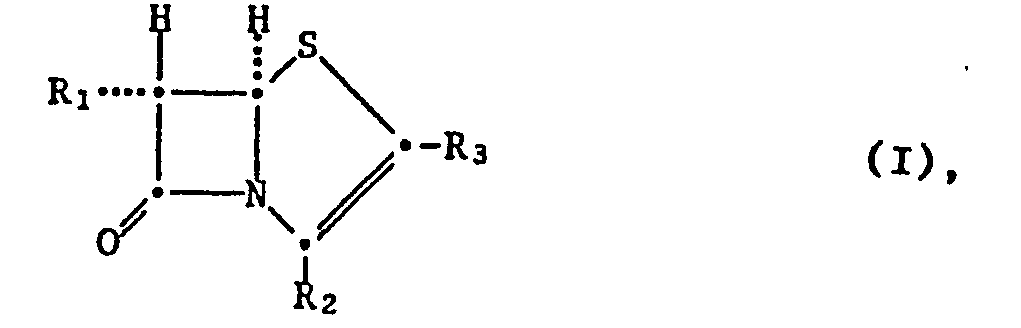
Description
- Die Erfindung betrifft 2-Pyridyl-penem-Verbindungen der Formel

- Die vor- und nachstehend verwendeten Definitionen haben im Rahmen der vorliegenden Beschreibung vorzugsweise die folgenden Bedeutungen:
- Funktionell abgewandeltes Carboxyl Rz ist insbesondere unter physiologischen Bedingungen spaltbares verestertes Carboxyl oder geschütztes Carboxyl Rz'.
- Unter physiologischen Bedingungen spaltbare (d.h. metabolilierbare) veresterte Carboxylgruppen R2 sind aus der Caphalosporin-, Penicillin- und Penemchemie bekannt. Geeignete Gruppen sind in erster Linie Acyloxymethoxycarbonylgruppen, worin Acyl z.B. den Rest einer organischen Carbonsäure, in erster Linie einer gegebenenfalls substituierten Niederalkancarbonsäure, bedeutet oder worin Acyloxymethyl den Rest eines Lactons bildet. Solche Gruppen sind z.B. Niederalkanoyloxymethoxycarbonyl, Aminoniederalkanoyloxymethoxycarbonyl, insbesondere a-Aminoniederalkanoyloxymethoxycarbonyl, und 4-Crotonolactonyl. Weitere unter physiologischen Bedingungen spaltbare veresterte Carboxylgruppen Rz sind z.B. 5-Indanyloxycarbonyl, Phthalidyloxycarbonyl, 1-Niederalkoxyearbonyloxyniederalkoxycarbonyl, 1-Niederalkoxyniederalkoxycarbonyl oder auch 2-oxo-1,3-dioxolen-4-ylmethoxycarbonyl, welches in 5-Stellung des Dioxolenringes gegebenenfalls durch Niederalkyl oder Phenyl substituiert ist.
- 3- bzw. 4-Pyridyl-Reste R3 sind unsubstituiert oder können z.B. durch gegebenenfalls veräthertes oder verestertes Hydroxy, z.B. Hydroxy, Niederalkoxy, Aminoniederalkoxy, Niederalkanoyloxy oder Halogen, gegebenenfalls veräthertes Mercapto, z.B. Mercapto, Niederalkylthio, Aminoniederalkylthio oder Phenylthio, Niederalkyl, substituiertes Niederalkyl, wie Hydroxyniederalkyl, Niederalkanoyloxyniederalkyl, Carboxyniederalkyl, Niederalkoxycarbonylniederalkyl, durch Cyano oder Amino substituiertes Niederalkoxycarbonyl niederalkyl, Carbamoylniederalkyl, Carbamoyloxyniederalkyl, Cyanoniederalkyl, Halogenniederalkyl, gegebenenfalls N-niederalkyliertes Aminoniederalkyl, z.B. Aminoniederalkyl, Niederalkylaminoniederalkyl oder Diniederalkylaminoniederalkyl, Niederalkanoylaminoniederalkyl, Amino-carboxy-niederalkyl und Sulfoniederalkyl, gegebenenfalls substituiertes Amino, z.B. Amino, Niederalkylamino, Diniederalkylamino oder Acylamino, wie Niederalkanoylamino, gegebenenfalls funktionell abgewandeltes Carboxyl oder Sulfo, z.B. Carboxyl, verestertes Carboxyl, wie Niederalkoxycarbonyl oder durch Cyano oder Amino substituiertes Niederalkoxycarbonyl, gegebenenfalls N-niederalkyliertes Carbamoyl, wie Carbamoyl, Cyano, Sulfo oder Sulfamoyl, Oxido und/oder gegebenenfalls durch Niederalkyl, Niederalkoxy und/oder Halogen substituiertes Phenyl substituiert, wie insbesondere mono- oder auch poly-, in erster Linie mono- oder disubstituiert, sein.
- Die Substituenten sind insbesondere an Kohlenstoffatomen des Pyridyl-Restes R3 gebunden, können aber auch, wie insbesondere gegebenenfalls wie angegeben substituiertes Niederalkyl oder Oxido, am Pyridyl-Stickstoffatom gebunden sein.
- In der vorliegenden Beschreibung bedeutet der im Zusammenhang mit Definitionen von Gruppen bzw. Verbindungen verwendete Ausdruck "nieder", dass die entsprechenden Gruppen bzw. Verbindungen, sofern nicht ausdrücklich anders definiert, 1 bis 7, bevorzugt 1 bis 4, Kohlenstoffatome enthalten.
- Durch Hydroxy substituiertes Niederalkyl R1 ist insbesondere in a-Stellung durch Hydroxy substituiertes Niederalkyl und bedeutet z.B. Hydroxymethyl, 1-Hydroxyäthyl, 1-Hydroxyprop-1-yl oder 2-Hydroxy-prop-2-yl.
- Niederalkanoyloxymethoxycarbonyl ist z.B. Acetoxymethoxycarbonyl oder Pivaloyloxymethoxycarbonyl.
- a-Aminoniederalkanoyloxymethoxycarbonyl ist z.B. Glycyloxymethoxycarbonyl, Valyloxymethoxycarbonyl oder Leucyloxymethoxycarbonyl.
- 1-Niederalkoxycarbonyloxyniederalkoxycarbonyl ist z.B. Aethoxycarbonyloxymethoxycarbonyl oder 1-Aethoxycarbonyloxyäthoxycarbonyl.
- 1-Niederalkoxyniederalkoxycarbonyl ist z.B. Methoxymethoxycarbonyl oder 1-Methoxyäthoxycarbonyl.
- Bei einer 2-Oxo-1,3-dioxolen-4-ylmethoxy-Gruppe, welche in 5-Stellung des Dioxolenringes gegebenenfalls durch Niederalkyl oder Phenyl substituiert ist, handelt es sich vor allem um eine 5-Phenyl- und in erster Linie um eine 5-Methyl-2-oxo-l,3-dioxolen-4-ylmethoxy-Gruppe.
- Niederalkoxy ist z.B. Methoxy, ferner Aethoxy, n-Propyloxy, Isopropyloxy, n-Butyloxy, 1sobutyloxy oder tert.-Butyloxy, sowie n-Pentyloxy, n-Hexyloxy oder n-Heptyloxy, während Aminoniederalkoxy insbesondere 2- oder 3-Aminoniederalkoxy, wie 2-Aminoäthoxy oder 2-Aminopropyloxy, ist.
- Niederalkanoyloxy ist z.B. Acetyloxy oder Propionyloxy.
- Halogen ist z.B. Fluor, Chlor, Brom oder Jod.
- Niederalkylthio ist z.B. Methylthio, Aethylthio oder n-Propylthio, während Aminoniederalkylthio insbesondere 2- oder 3-Aminoniederalkylthio, z.B. 2-Aminoäthylthio, ist.
- Niederalkyl ist z.B. Methyl, Aethyl, n-Propyl, Isopropyl, n-Butyl, Isobutyl, sek.-Butyl oder tert.-Butyl, ferner n-Pentyl, n-Hexyl oder n-Heptyl.
- Hydroxyniederalkyl ist z.B. Hydroxymethyl, 2-Hydroxyäthyl oder 2,3-Dihydroxypropyl.
- Niederalkanoyloxyniederalkyl ist z.B. Acetoxymethyl oder 2-Acetoxy- äthyl.
- Carboxyniederalkyl ist z.B. Carboxymethyl, 1-Carboxy-, 2-Carboxy-oder 1,2-Dicarboxyäthyl.
- Niederalkoxycarbonylniederalkyl ist z.B. entsprechendes Methyl oder Aethyl, wie Methoxycarbonyl- oder Aethoxycarbonylmethyl oder 2-Methoxycarbonyläthyl.
- Durch Cyano oder Amino substituiertes Niederalkoxycarbonylniederalkyl ist z.B. entsprechend in 2- oder 3-Stellung substituiertes Niederalkoxycarbonylniederalkyl, z.B. 2-Aminoäthoxycarbonylmethyl oder -äthyl sowie 2-Cyanoäthoxycarbonylmethyl oder -äthyl.
- Carbamoylniederalkyl ist z.B. Carbamoylmethyl oder 2-Carbamoyläthyl, während Carbamoyloxyniederalkyl z.B. Carbamoyloxymethyl oder 2-Carbamoyloxyäthyl ist.
- Cyanoniederalkyl ist z.B. Cyanomethyl, während Halogenniederalkyl z.B. Chlormethyl, Brommethyl, 2-Chloräthyl oder 2,2-Dichloräthyl ist.
- Aminoniederalkyl ist z.B. Aminomethyl oder 2-Aminoäthyl, während Niederalkylaminoniederalkyl z.B. Methylaminomethyl, Aethylaminomethyl, 2-Methylaminoäthyl oder 2-Aethylaminoäthyl und Diniederalkylaminoniederalkyl z.B. Dimethylaminomethyl, 2-Dimethylaminoäthyl oder 2-Diäthylaminoäthyl ist.
- Niederalkanoyiaminoniederalkyl ist z.B. Acetaminomethyl, 2-Acetaminoäthyl oder Formylaminomethyl.
- Amino-carboxy-niederalkyl ist z.B. 2-Amino-2-carboxy-äthyl oder auch 1-Amino-l-carboxymethyl.
- Sulfoniederalkyl ist z.B. Sulfomethyl oder 2-Sulfoäthyl.
- Niederalkylamino ist z.B. Methylamino, Aethylamino, n-Propylamino, Isopropylamino oder n-Butylamino, während Diniederalkylamino z.B. Dimethylamino, Diäthylamino, Di-n-propylamino oder Diisopropylamino bedeutet.
- Niederalkanoylamino ist z.B. Formylamino, Acetylamino oder Propionylamino.
- Niederalkoxycarbonyl ist z.B. Methoxycarbonyl oder Aethoxycarbonyl. Durch Cyano oder Amino substituiertes Niederalkoxycarbonyl ist vor allem entsprechendes in 2- oder 3-Stellung substituiertes Niederalkoxycarbonyl, z.B. 2-Cyanoäthoxycarbonyl oder 2-Aminoäthoxycarbonyl.
- Bevorzugt als Rest Ri ist Hydroxymethyl und insbesondere 1-Hydroxyäthyl.
- Bevorzugt als Rest Rz sind Carboxyl und unter physiologischen Bedingungen spaltbares verestertes Carboxyl, z.B. Niederalkanoyloxymethoxycarbonyl, wie Acetoxymethoxycarbonyl oder Pivaloyloxymethoxycarbonyl, und 1-Niederalkoxycarbonyloxy-niederalkoxycarbonyl, wie 1-Aethoxycarbonyloxyäthoxycarbonyl.
- Bevorzugte Reste R3 sind 3-Pyridyl und durch Hydroxy, Niederalkoxy, Aminoniederalkoxy, Halogen, Niederalkyl, Hydroxyniederalkyl, Carbamoyloxyniederalkyl, Carboxyniederalkyl, Niederalkoxycarbonylniederalkyl, Carbamoylniederalkyl, Aminoniederalkyl, Cyanoniederalkyl, Amino, Carboxy, Niederalkoxycarbonyl oder Carbamoyl substituiertes 3-Pyridyl, z.B. 6-Hydroxypyrid-3-yl, 6-(2-Aminoäthoxy)-pyrid-3-yl, 2-, 4- oder 6-Chlor-pyrid-3-yl, 2-, 4- oder 6-Methyl- pyrid-3-yl, 1-Carboxymethyl-, 1-Carbamoylmethyl- oder 1-Methyl-3-pyridinio, 6-Hydroxymethyl-pyrid-3-yl, 6-Carbamoyloxymethyl-pyrid-3-yl, 6-Aminomethyl-pyrid-3-yl, 2- oder 6-Amino-pyrid-3-yl, 2-, 4-oder 6-Carboxy-pyrid-3-yl, 2-, 4- oder 6-Methoxycarbonyl-pyrid-3-yl, oder 2-, 4- oder 6-Carbamoyl-pyrid-3-yl, ferner 4-Pyridyl oder durch Hydroxy, Halogen, Niederalkyl, Carbamoyloxyniederalkyl oder Carbamoyl substituiertes 4-Pyridyl, z.B. 2,6-Dichlor-pyrid-4-yl oder 1-Methyl-4-pyridinio.
- Die in den Verbindungen der Formel 1 vorhandenen funktionellen Gruppen, wie Hydroxy-, Carboxy- oder Aminogruppen, insbesondere die Hydroxygruppe im Rest R1 und die Carboxylgruppe R2, sind gegebenenfalls durch Schutzgruppen geschützt, die in der Penem-, Penicillin-, Cephalosporin- und Peptidchemie verwendet werden. Solche Schutzgruppen schützen die betreffenden funktionellen Gruppen vor unerwünschten Kondensationsreaktionen, Substitutionsreaktionen und dergleichen während der Synthese der Verbindung der Formel 1 aus ihren Vorstufen.
- Solche Schutzgruppen sind leicht, d.h. ohne dass unerwünschte Nebenreaktionen stattfinden, beispielsweise solvolytisch oder reduktiv, abspaltbar.
- Schutzgruppen dieser Art sowie ihre Einführung und Abspaltung sind beispielsweise beschrieben in
J.F.W. McOmie, "Protective Groups in Organic Chemistry", Plenum Press, London, New York, 1973,
T.W. Greene, "Protective Groups in Organic Synthesis", Wiley, New York, 1981,
"The Peptides", Vol. I, Schroeder und Luebke, Academic Press, London, New York, 1965 und
Houben-Weyl, "Methoden der Organischen Chemie", Band 15/1, Georg Thieme Verlag, Stuttgart, 1974. - In Verbindungen der Formel (I) kann eine Hydroxygruppe im Rest Ri, ferner eine im Rest R3 vorhandene Hydroxygruppe, beispielsweise durch Acylreste geschützt sein. Geeignete Acylreste sind z.B. gegebenenfalls durch Halogen substituiertes Niederalkanoyl, z.B. Acetyl, Dichloracetyl oder Trifluoracetyl, gegebenenfalls durch Nitro substituiertes Benzoyl, z.B. Benzoyl, 4-Nitrobenzoyl oder 2,4-Dinitrobenzoyl, gegebenenfalls durch Halogen substituiertes Niederalkoxycarbonyl, z.B. 2-Bromäthoxycarbonyl oder 2,2,2-Trichloräthoxycarbonyl, Niederalkenyloxycarbonyl, z.B. Allyloxycarbonyl, Niederalkenyloxyoxalyl, z.B. Allyloxyoxalyl, oder gegebenenfalls durch Nitro substituiertes Phenylniederalkoxycarbonyl, z.B. Benzyloxycarbonyl oder 4-Nitrobenzyloxycarbonyl. Weitere geeignete Hydroxyschutzgruppen sind z.B. trisubstituiertes Silyl, wie Triniederalkylsilyl, z.B. Trimethylsilyl, Dimethyl-(2,3-dimethylbut-2-yl)-silyl oder tert.-Butyl-dimethylsilyl, und 2-Oxa- oder 2-Thiacycloalkyl mit 5 bis 7 Kohlenstoffatomen, z.B. 2-Tetrahydropyranyl oder 2-Tetrahydrofuranyl. Bevorzugt als Hydroxyschutzgruppen sind Triniederalkylsilyl, Niederalkenyloxyoxalyl und Niederalkenyloxycarbonyl.
- Eine Carboxylgruppe R2, ferner auch eine im Rest Ra vorhandene Carboxylgruppe, ist üblicherweise in veresterter Form geschützt, wobei die Estergruppe unter schonenden Bedingungen, z.B. unter schonend reduktiven, wie hydrogenolytischen, oder schonend solvolytischen, wie acidolytischen oder insbesondere basisch oder neutral hydrolytischen Bedingungen, leicht spaltbar ist. Solche veresterten Carboxylgruppen enthalten als veresternde Gruppen in erster Linie in 1-Stellung verzweigte oder in 1- oder 2-Stellung geeignet substituierte Niederalkylgruppen. Geeignete in veresterter Form vorliegende Carboxylgruppen sind unter anderen gegebenenfalls durch Nitro oder Niederalkoxy, wie Methoxy, substituiertes Benzyloxycarbonyl, z.B. 4-Nitrobenzyloxycarbonyl oder 4-Methoxybenzyloxycarbonyl, Niederalkanoylmethoxycarbonyl, wie Acetonyloxycarbonyl, Benzoylmethoxycarbonyl, worin die Benzoylgruppe gegebenenfalls, z.B. durch Halogen, wie Brom, substituiert ist, z.B. Phenacyloxycarbonyl, Halogenniederalkoxycarbonyl, wie 2-Halogenniederalkoxycarbonyl, z.B. 2,2,2-Trichloräthoxycarbonyl oder 2-Bromithoxycarbonyl, Niederalkenyloxycarbonyl, z.B. Allyloxycarbonyl, oder in 2-Stellung durch Niederalkylsulfonyl, Cyano oder trisubstituiertes Silyl, wie Triniederalkylsilyl oder Triphenylsilyl, substituiertes Aethoxycarbonyl, z.B. 2-Methylsulfonyläthoxycarbonyl, 2-Cyanoäthoxycarbonyl, 2-Trimethylsilyläthoxycarbonyl oder 2-(Di-n-butyl-methylsilyl)-äthoxycarbonyl. Bevorzugte geschützte Carboxylgruppen sind die 4-Nitrobenzyloxycarbonyl-, Niederalkenyloxycarbonyl-, insbesondere Allyloxycarbonyl-, und die in 2-Stellung durch Triniederalkylsilyl, z.B. Trimethylsilyl oder Di-n-butyl-methylsilyl, substituierte Aethoxycarbonylgruppe.
- Eine geschützte Aminogruppe im Rest R3 kann beispielsweise in Form einer leicht spaltbaren Acylaminogruppe oder als Azidogruppe vorliegen. In einer entsprechenden Acylaminogruppe ist Acyl beispielsweise der Acylrest einer organischen Säure mit z.B. bis zu 12 Kohlenstoffatomen, insbesondere einer gegebenenfalls z.B. durch Halogen oder Phenyl, substituierten Niederalkancarbonsäure oder insbesondere eines Kohlensäurehalbesters. Solche Acylgruppen sind beispielsweise Halogenniederalkanoyl, wie 2-Halogenacetyl, insbesondere 2,2,2-Trifluor- oder 2,2,2-Trichloracetyl, Niederalkenyloxycarbonyl, z.B. Allyloxycarbonyl, gegebenenfalls in 1- oder 2-Stellung substituiertes Niederalkoxycarbonyl, wie Niederalkoxycarbonyl, z.B. tert.Butoxycarbonyl, gegebenenfalls substituiertes Benzyloxycarbonyl, z.B. 4-Nitrobenzyloxycarbonyl, 2-Halogenniederalkoxycarbonyl, z.B. 2,2,2-Trichloräthoxycarbonyl oder 2-Bromäthoxycarbonyl, oder 2-(trisubstituiertes Silyl)-äthoxycarbonyl, wie 2-Triniederalkylsilyläthoxycarbonyl, z.B. 2-Trimethylsilyläthoxycarbonyl oder 2-(Di-n-butylmethyl-silyl)-äthoxycarbonyl. Bevorzugte geschützte Aminogruppen sind Azido, Niederalkenyloxycarbonylamino, z.B. Allyloxycarbonylamino, und gegebenenfalls durch Nitro substituiertes Benzyloxycarbonylamino.
- Eine monosubstituierte Aminogruppe, z.B. Niederalkylamino, ist in gleicher Weise wie eine Aminogruppe, beispielsweise als substituiertes Niederalkenyloxycarbonylamino, geschützt.
- Eine geschützte Sulfogruppe im Rest R3 ist in gleicher Weise wie eine geschützte Carboxylgruppe, insbesondere in veresterter Form geschützt.
- Salze von erfindungsgemässen Verbindungen sind in erster Linie pharmazeutisch annehmbare, nicht-toxische Salze von Verbindungen der Formel I. Solche Salze werden beispielsweise von den in Verbindungen der Formel 1 vorhandenen sauren Gruppen, z.B. Carboxylgruppen, gebildet und sind in erster Linie Metall- oder Ammoniumsalze, wie Alkalimetall- und Erdalkalimetall-, z.B. Natrium-, Kalium-, Magnesium- oder Kalziumsalze, sowie Ammoniumsalze mit Ammoniak oder geeigneten organischen Aminen, wie Niederalkylaminen, z.B. Triäthylamin, Hydroxyniederalkylaminen, z.B. 2-Hydroxyäthylamin, Bis-(2-hydroxyäthyl)-amin, Tris-(2-hydroxyäthyl)-amin oder 2-Amino-1,3-di- hydroxy-2-hydroxymethyl-propan ("Tris"), basischen aliphatischen Estern von Carbonsäuren, z.B. 4-Aminobenzoesäure-2-diäthylamino- äthylester, Niederalkylenaminen, z.B. 1-Aethyl-piperidin, Cycloalkylaminen, z.B. Dicyclohexylamin, oder Benzylaminen, z.B. N,N'-Di- benzyläthylendiamin, Dibenzylamin oder H-Benzyl-ß-phenäthylamin. Verbindungen der Formel I mit einer basischen Gruppe, z.B. mit einer Aminogruppe, können Säureadditionssalze, z.B. mit anorganischen Säuren, wie Salzsäure, Schwefelsäure oder Phosphorsäure, oder mit geeigneten organischen Carbon- oder Sulfonsäure, z.B. Essigsäure, Bernsteinsäure, Fumarsäure, Maleinsäure, Weinsäure, Oxalsäure, Zitronensäure, Benzoesäure, Mandelsäure, Aepfelsäure, Ascorbinsäure, Methansulfonsäure oder 4-Toluolsulfonsäure bilden. Verbindungen der Formel I mit einer sauren und mit einer basischen Gruppe können auch in Form von inneren Salze, d.h. in zwitterionischer Form, vorliegen. Beispielsweise können Verbindungen der Formel I mit einer Pyridinio-Gruppe R3 als Carboxylat (Rz ist COO⊖) vorliegen.
- Zur Isolierung oder Reinigung können auch pharmazeutisch ungeeignete Salze Verwendung finden. Zur therapeutischen Anwendung gelangen nur die pharmazeutisch annehmbaren, nicht-toxischen Salze, die deshalb bevorzugt sind.
- Die Penem-Verbindungen der Formel I können im Rest R1 ein zusätzliches Chiralitätszentrum besitzen. Beispielsweise kann 1-Hydroxyäthyl als Substituent R1 in der R-, in der S- oder in der racemischen R,S-Konfiguration vorliegen. In bevorzugten Penem-Verbindungen der Formel 1 weist ein Rest Rl, welcher ein asymmetrisches Kohlenstoffatom besitzt, insbesondere 1-Hydroxyäthyl, die R-Konfiguration auf. Die Erfindung betrifft demgemäss die reinen Diastereomeren und Mischungen der Diastereomeren von Verbindungen der Formel I, welche im Rest R1 ein zusätzliches Chiralitätszentrum aufweisen.
- Die Verbindungen der Formel 1 weisen wertvolle pharmakologische Eigenschaften auf oder können als Zwischenprodukte zur Herstellung von solchen Verbindungen mit wertvollen pharmakologischen Eigenschaften verwendet werden. Verbindungen der Formel I, worin R1 durch Hydroxy substituiertes Niederalkyl ist, R3 die unter Formel I angegebene Bedeutungen hat, wobei funktionelle Gruppen in ungeschützter Form vorliegen, und R2 Carboxyl oder eine unter physiologischen Bedingungen spaltbare veresterte Carboxylgruppe darstellt, und pharmakologisch annehmbare Salze von solchen Verbindungen mit salzbildenden Gruppen haben antibakterielle Wirkungen. Beispielsweise sind sie in vitro gegen grampositive und gramnegative Kokken, z.B. Staphylokokken (inkl. Methicillin-resistente Staphylokokken), wie Staphylococcus aureus, Streptococcus pyogenes, Streptococcus pneumoniae, Streptococcus faecalis und Neisseria spec., in minimalen Konzentrationen von <0,01 bis ca. 8 ug/ml und gegen gramnegative Stäbchenbakterien, wie Enterobacteriaceae und Haemophilus influenzae, Pseudomonas und Anaerobier, z.B. Bacteroides sp., in minimalen Konzentrationen von ca. 0,02 bis ca. 64 µg/ml wirksam In vivo, bei der systemischen Infektion der Maus, z.B. durch Staphylococcus aureus, ergeben sich bei parenteraler oder oraler Applikation erfindungsgemässer Verbindungen ED50-Werte von ca 0,5 bis ca. 15 mg/kg.
- Die neuen Verbindungen können als oral oder parenteral applizierbare antibakterielle Breitspektrum-Antibiotika, z.B. in Form von entsprechenden pharmazeutischen Präparaten, zur Behandlung von Infektionen Verwendung finden.
- Verbindungen der Formel I, worin mindestens eine der vorhandenen funktionellen Gruppen in geschützter Form vorliegt, können als Zwischenprodukte zur Herstellung der oben genannten pharmakologisch wirksamen Verbindungen der Formel I verwendet werden.
- Die Erfindung betrifft vor allem Verbindungen der Formel I, worin Ri durch Hydroxy oder geschütztes Hydroxy substituiertes Niederalkyl ist; R2 Carboxyl, unter physiologischen Bedingungen spaltbares verestertes Carboxyl oder geschütztes Carboxyl R2' bedeutet; und R3 3-Pyridyl,. 4-Pyridyl oder durch Hydroxy, Niederalkoxy, Aminoniederalkoxy, Niederalkanoyloxy, Halogen, Mercapto, Niederalkylthio, Aminoniederalkylthio, Phenylthio, Niederalkyl, Hydroxyniederalkyl, Niederalkanoyloxyniederalkyl, Carboxyniederalkyl, Niederalkoxycarbonylniederalkyl, durch Cyano oder Amino substituiertes Niederalkoxycarbonylniederalkyl, Carbamoylniederalkyl, Carbamoyloxyniederalkyl, Cyanoniederalkyl, Halogenniederalkyl, Aminoniederalkyl, Niederalkylaminoniederalkyl, Diniederalkylaminoniederalkyl, Niederalkanoylaminoniederalkyl, Amino-carboxy-niederalkyl, Sulfoniederalkyl, Amino, Niederalkylamino, Diniederalkylamino, Niederalkanoylamino, Carboxyl, Niederalkoxycarbonyl, durch Cyano oder Amino substituiertes Niederalkoxycarbonyl, Carbamoyl, Cyano, Sulfo, Sulfamoyl, Oxido und/oder gegebenenfalls durch Niederalkyl, Niederalkoxy und/oder Halogen substituiertes Phenyl substituiertes 3- oder 4-Pyridyl darstellt, und Salze von Verbindungen der Formel I.
- Die Erfindung betrifft hauptsächlich Verbindungen der Formel I, worin R1 Hydroxymethyl oder 1-Hydroxyäthyl ist, R2 Carboxyl oder unter physiologischen Bedingungen spaltbares verestertes Carboxyl bedeutet und R3 3-Pyridyl, durch Hydroxy, Niederalkoxy, Aminoniederalkoxy, Halogen, Niederalkyl, Hydroxyniederalkyl, Carboxyniederalkyl, Niederalkoxycarbonylniederalkyl, Carbamoyloxyniederalkyl, Carbamoylniederalkyl, Aminoniederalkyl, Cyanoniederalkyl, Amino, Carboxy, Niederalkoxycarbonyl oder Carbamoyl substituiertes 3-Pyridyl, 4-Pyridyl oder durch Hydroxy, Halogen, Niederalkyl, Carbamoyloxyniederalkyl oder Carbamoyl substituiertes 4-Pyridyl bedeutet, und Salze von Verbindungen der Formel I.
- Die Erfindung betrifft in erster Linie Verbindungen der Formel I, worin Ri Hydroxymethyl oder 1-Hydroxyäthyl ist, R2 Carboxyl oder unter physiologischen Bedingungen spaltbares verestertes Carboxyl bedeutet und R3 3-Pyridyl oder durch Niederalkyl oder Halogen substituiertes 3-Pyridyl darstellt, und Salze von Verbindungen der Formel I.
- Die Erfindung betrifft in erster Linie die in den Beispielen genannten Verbindungen der Formel I und deren Salze, insbesondere deren pharmazeutisch annehmbare Salze.
- Die Verbindungen der vorliegenden Erfindung können nach an sich bekannten Verfahren hergestellt werden.
- Die neuen Verbindungen werden z.B. hergestellt, indem man eine Ylid-Verbindung der Formel


- In den Ausgangsverbindungen der Formeln II und III sind funktionelle Gruppen, wie eine freie Hydroxygruppe im Rest R1 sowie weitere im Rest R3 enthaltene funktionelle Gruppen, vorzugsweise durch konventionelle Schutzgruppen, z.B. durch die oben genannten, geschützt.
- Die Gruppe X⊕ im Ausgangsmaterial der Formel II ist eine der bei Wittig-Kondensationsreaktionen gebräuchlichen Phosphonio- oder Phosphonogruppen, insbesondere eine Triaryl-, z.B. Triphenyl-, oder Triniederalkyl-, z.B. Tri-n-butylphosphoniogruppe, oder eine durch Niederalkyl, z.B. Aethyl, zweifach veresterte Phosphonogruppe, wobei das Symbol X⊕ für den Fall der Phosphonogruppe zusätzlich das Kation einer starken Base, insbesondere ein geeignetes Metall-, wie Alkalimetallion, z.B. das Lithium-, Natrium- oder Kaliumion, umfasst. Bevorzugt als Gruppe X⊕ sind einerseits Triphenylphosphonio und andererseits Diäthylphosphono zusammen mit einem Alkalimetall-, z.B. dem Natriumion.
- Der Ringschluss kann spontan, d.h. bei der Herstellung der Ausgangsstoffe, oder durch Erwärmen, z.B. in einem Temperaturbereich von etwa 30°C bis 160°C, vorzugsweise von etwa 80°C bis etwa 120°C, erfolgen. Die Reaktion wird vorzugsweise in einem geeigneten inerten Lösungsmittel, wie in einem aliphatischen, cycloaliphatischen oder aromatischen Kohlenwasserstoff, z.B. Cyclohexan, Benzol oder Toluol, einem halogenierten Kohlenwasserstoff, z.B. Methylenchlorid, einem Aether, z.B. Diäthyläther, einem cyclischen Aether, z.B. Dioxan oder Tetrahydrofuran, einem Carbonsäureamid, einem Diniederalkylsulfoxid, oder einem Niederalkanol oder in einem Gemisch davon, und, falls notwendig, in einer Inertgas-, z.B. Stickstoffatmosphäre, durchgeführt.
- Eine organische Verbindung des dreiwertigen Phosphors leitet sich z.B. von phosphoriger Säure ab und ist insbesondere ein Ester derselben mit einem Niederalkanol, z.B. Methanol oder Aethanol, und/oder einer gegebenenfalls substituierten aromatischen Hydroxyverbindung, z.B. Phenol oder Brenzcatechin, oder ein Amidester derselben der Formel P(ORa)2N(Rb)2, worin Ra und Rb unabhängig voneinander Niederalkyl, z.B. Methyl, oder Aryl, z.B. Phenyl, bedeuten. Bevorzugte Verbindungen des dreiwertigen Phosphors sind Triniederalkylphosphite, z.B. Trimethylphosphit oder Triäthylphosphit.
- Die Reaktion wird vorzugsweise in einem inerten Lösungsmittel, wie einem aromatischen Kohlenwasserstoff, z.B. Benzol oder Toluol, einem Aether, z.B. Dioxan oder Tetrahydrofuran, oder einem halogenierten Kohlenwasserstoff, z.B. Methylenchlorid oder Chloroform, bei einer Temperatur von etwa 20° bis 140°C, bevorzugt von etwa 80° bis etwa 120°C, durchgeführt, wobei man 1 Moläquivalent einer Verbindung der Formel III mit mindestens 2 Moläquivalenten der Phosphorverbindung umsetzt. Beispielsweise legt man die Verbindung der Formel III in einem inerten Lösungsmittel vor und tropft die Phosphorverbindung, vorzugsweise in dem gleichen inerten Lösungsmittel gelöst, über einen längeren Zeitraum, z.B. während eines Zeitraums von 2 bis 4 Stunden, hinzu.
- In einer bevorzugten Ausführungsform des Verfahrens stellt man das Ausgangsmaterial der Formel III wie weiter unten angegeben her und setzt es ohne Isolierung aus dem Reaktionsgemisch mit der organischen Verbindung des dreiwertigen Phosphors um, wobei die Endprodukte der Formel 1 entstehen.
- Verfahrensgemäss erhältliche Verbindungen der Formel 1 können in an sich bekannter Weise in andere Verbindungen der Formel 1 überführt werden.
- So können in einer erhältlichen Verbindung der Formel I, worin eine oder mehrere funktionelle Gruppen geschützt sind, diese, z.B. geschützte Carboxyl-, Hydroxy- und/oder Aminogruppen, in an sich bekannter Weise mittels Solvolyse, insbesondere Hydrolyse, Alkoholyse oder Acidoly.e, oder mittels Reduktion, insbesondere Hydrogenolyse oder chemische Reduktion, gegebenenfalls stufenweise oder gleichzeitig freigesetzt werden.
- In einer verfahrensgemäss erhältlichen Verbindung der Formel I, worin Rz eine geschützte Carboxylgruppe bedeutet und/oder worin der Rest R3 geschütztes Carboxyl als Substituenten enthält, kann die geschützte Carboxylgruppe in an sich bekannter Weise freigesetzt werden. So kann man in 2-Stellung durch eine trisubstituierte Silylgruppe substituiertes Aethoxycarbonyl z.B. durch Behandeln mit einer Carbonsäure, wie Ameisensäure oder Trifluoressigsäure, gegebenenfalls unter Zugabe einer nucleophilen Verbindung, wie Phenol oder Anisol, in freies Carboxyl überführen. Gegebenenfalls substituiertes Benzyloxycarbonyl kann z.B. mittels Hydrogenolyse, d.h. durch Behandeln mit Wasserstoff in Gegenwart eines metallischen Hydrierkatalysators, wie eines Palladiumkatalysators, gespalten werden. Ferner kann man geeignet substituiertes Benzyloxycarbonyl, wie 4-Nitrobenzyloxycarbonyl, auch mittels chemischer Reduktion, z.B. durch Behandeln mit einem Alkalimetall-, z.B. Natriumdithionit, oder mit einem reduzierenden Metall, z.B. Zinn, üblicherweise in Gegenwart eines Wasserstoff-abgebenden Mittels, das zusammen mit dem Metall nascierenden Wasserstoff zu erzeugen vermag, wie einer geeigneten Carbonsäure, z.B. einer gegebenenfalls, z.B. durch Hydroxy, substituierten Niederalkancarbonsäure, z.B. Essigsäure, oder eines Alkohols oder Thiols, wobei man vorzugsweise Wasser zugibt, in freies Carboxyl überführen. Die Abspaltung einer Allylschutzgruppe kann z.B. durch Umsetzung mit einer Verbindung des Palladiums, z.B. Tetrakis-(triphenylphosphin)-palladium, gegebenenfalls in Gegenwart von Triphenylphosphin und unter Zusatz eines Allylgruppenakzeptors, wie einer Carbonsäure, z.B. 2-Aethylhexansäure, oder eines Salzes davon oder Tributylzinnhydrid oder Dimedon, erfolgen. Durch Behandeln mit einem reduzierenden Metall oder Metallsalz, wie oben beschrieben, kann man auch 2-Halogenniederalkoxycarbonyl (gegebenenfalls nach Umwandlung einer 2-Bromniederalkoxycarbonylgruppe in eine entsprechende 2-Jodniederalkoxycarbonylgruppe) oder Benzoylmethoxycarbonyl in freies Carboxyl umwandeln, wobei Benzoylmethoxycarbonyl auch durch Behandeln mit einem nucleophilen, vorzugsweise salzbildenden Reagenz, wie Natriumthiophenolat oder Natriumjodid, gespalten werden kann. Substituiertes 2-Silyläthoxycarbonyl kann auch durch Behandeln mit einem das Fluoridanion liefernden Salz der Fluorwasserstoffsäure, wie einem Alkalimetallfluorid, z.B. Natriumfluorid, in Anwesenheit eines makrocyclischen Polyäthers ("Kronenäther") oder mit einem Fluorid einer organischen quaternären Base, wie Tetraniederalkylammoniumfluorid, z.B. Tetrabutylammoniumfluorid, in freies Carboxyl überführt werden. Eine in 2-Stellung durch Niederalkylsulfonyl oder Cyano substituierte Niederalkoxycarbonylgruppe kann z.B. durch Behandeln mit einem basischen Mittel, wie einem Alkalimetall- oder Erdalkalimetallhydroxid oder -carbonat, z.B. Natrium-oder Kaliumhydroxid oder Natrium- oder Kaliumcarbonat, in freies Carboxyl übergeführt werden.
- Andererseits können auch Verbindungen der Formel.I, worin R2 Carboxyl bedeutet, in Verbindungen der Formel I überführt werden, worin Rz eine unter physiologischen Bedingungen spaltbare veresterte Carboxylgruppe darstellt. Solche Ester können z.B. durch Umsetzung eines gegebenenfalls in situ hergestellten Salzes der Säure mit einem reaktionsfähigen Ester eines entsprechenden Alkohols und einer starken anorganischen Säure, wie Schwefelsäure, oder einer starken organischen Sulfonsäure, wie 4-Toluolsulfonsäure, hergestellt werden. Ferner kann man in Verbindungen der Formel I, die eine in veresterter Form geschützte Carboxylgruppe enthalten, die Carboxylschutzgruppe wie oben beschrieben abspalten und eine entstandene Verbindung der Formel 1 mit einer freien Carboxylgruppe oder ein Salz davon durch Umsetzen mit dem reaktionsfähige Ester eines entsprechenden Alkohols in eine Verbindung der Formel I überführen, worin R2 eine unter physiologischen Bedingungen spaltbare veresterte Carboxylgruppe darstellt.
- In verfahrensgemäss erhältlichen Verbindungen der Formel I, worin der Rest Ri und/oder gegebenenfalls der Rest R3 geschütztes Hydroxyl als Substituenten enthält, kann die geschützte Hydroxygruppe in an sich bekannter Weine in die freie Hydroxygruppe UberfUhrt werden. Beispielsweise wird eine durch eine geeignete Acylgruppe oder eine organische Silylgruppe geschützte Hydroxygruppe wie eine entaprechend geschützte Aminogruppe freigesetzt (a.u.); eine Triniederalkylsilylgruppe kann z.B. auch mit Tetrabutylammoniumfluorid und Essigsäure abgespalten werden (unter diesen Bedingungen werden durch trisubstituiertes Silyläthoxy geschützte Carboxygruppen nicht gespalten).
- In einer erfindungsgemäss erhältlichen Verbindung der Formel I mit einer geschützten Aminogruppe im Rest R3 kann diese in an sich bekannter Weise, z.B. je nach Art der Schutzgruppe, vorzugsweise mittels Solvolyse oder Reduktion, in die freie Aminogruppe übergeführt werden. Beispielsweise kann 2-Halogenniederalkoxycarbonylamino (gegebenenfalls nach Umwandlung einer 2-Bromniederalkoxycarbonylaminogruppe in eine 2-Jodniederalkoxycarbonylaminogruppe) und 4-Nitrobenzyloxycarbonylamino durch Behandeln mit einem geeigneten chemischen Reduktionsmittel, wie Zink in Gegenwart einer geeigneten Carbonsäure. wie wässriger Essigsäure, oder katalytisch mit Wasserstoff in Gegenwart eines Palladiumkatalysators oder durch Behandeln mit einem Alkalimetall-, z.B. Natriumdithionit gespalten werden. Gegebenenfalls substituiertes Benzyloxycarbonylamino kann z.B. mittels Hydrogenolyse, d.h. durch Behandeln mit Wasserstoff in Gegenwart eines geeigneten Hydrierkatalysators, wie eines Palladiumkatalysators, und Allyloxycarbonylamino durch Umsetzen mit einer Verbindung des Palladiums, z.B. Tetrakis-(triphenylphosphin)-palladium, gegebenenfalls in Gegenwart von Triphenylphosphin und in Gegenwart eines Allylgruppenakzeptors, wie einer Carbonsäure, z.B. 2-Aethylhexansäure, oder eines Salzes davon oder Tributylzinnhydrid oder Dimedon, gespalten werden. Eine durch 2-Halogenniederalkanoyl, z.B. 2-Chloracetyl, geschützte Aminogruppe kann durch Behandeln mit Thioharnstoff in Gegenwart einer Base oder mit einem Salz, wie einem Alkalimetall-Salz, des Thioharnstoffs und anschliessender Solvolyse, wie Alkoholyse oder Hydrolyse, des entstandenen Kondensationsproduktes freigesetzt werden. Eine durch 2-substituiertes Silyläthoxycarbonyl geschützte Aminogruppe kann durch Behandeln mit einem Fluoridanionen liefernden Salz der Fluorwasserstoffsäure, wie einem Alkalimetallfluorid, z.B. Natriumfluorid, in Anwesenheit eines makrocyclischen Polyäthers ("Kronenäther") oder mit einem Fluorid einer organischen quaternären Base, wie Tetraniederalkylammoniumfluorid, z.B. Tetraäthylammoniumfluorid, in die freie Aminogruppe übergeführt werden. Eine in Form einer Azidogruppe geschützte Aminogruppe wird z.B. durch Reduktion in freies Amino überführt, beispielsweise durch katalytische Hydrierung mit Wasserstoff in Gegenwart eines Hydrierkatalysators, wie Platinoxid oder Palladium, oder durch Behandeln mit Zink in Gegenwart einer Säure, wie Essigsäure.
- In Verbindungen der Formel 1 kann man weiterhin einen Rest R3 in einen anderen Rest R3 überführen.
- So kann beispielsweise in Verbindungen der Formel I, worin der Rest R3 durch eine Carboxylgruppe substituiert ist, diese Carboxylgruppe nach an sich bekannten Verfahren in eine funktionell abgewandelte Carboxylgruppe, wie in eine veresterte Carboxylgruppe oder in Carbamoyl, überführt werden. Beispielsweise erhält man durch Umsetzen einer Verbindung der Formel I, worin der Rest R3 durch Carboxyl substituiert ist, mit einem gegebenenfalls substituierten Niederalkanol eine Verbindung der Formel I, worin R3 durch gegebenenfalls substituiertes Niederalkoxycarbonyl substituiert ist, wobei man vorzugsweise in Gegenwart eines geeigneten Kondensationsmittels, z.B. eines Carbodiimids, arbeitet oder das entstehende Wasser durch azeotrope Destillation entfernt. Andererseits kann man Carboxylgruppen an Resten R3 auch in reaktionsfähige funktionelle Derivate, wie gemischte Anhydride, z.B. Säurehalogenide, oder aktivierte Ester, überführen und diese durch Umsetzen mit einem entsprechenden Alkohol, z.B. einem gegebenenfalls substituierten Niederalkanol, oder mit Ammoniak in entsprechend veresterte Carboxylgruppen oder in eine Carbamoylgruppe umwandeln, wobei man bei Verwendung von gemischten Anhydriden vorzugsweise in Gegenwart eines säurebindenden Mittels, wie eines aromatischen oder tertiären Amins oder eines Alkalimetall- oder Erdalkalimetallcarbonats, arbeitet.
- In Verbindungen der Formel I, worin der Rest R3 durch Amino substituiert ist, kann die Aminogruppe in eine aubstituierte Aminogruppe, z.B. eine Niederalkylamino-, Diniederalkylamino- oder Niederalkanoylaminogruppe, überführt werden. Die UeberfUhrung in eine Niederalkylamino- oder Diniederalkylaminogruppe erfolgt beispielsweise durch Reaktion mit einem reaktionsfähigen veresterten Niederalkanol, beispielsweise einem Niederalkylhalogenid oder -sulfonat, in Gegenwart eines basischen Kondensationsmittels, wie eines Hydroxids oder Carbonats eines Alkali- oder Erdalkalimetalls oder einer heteroaromatischen Stickstoffbase, z.B. Pyridin. In analoger Weise kann Amino durch Behandeln mit dem reaktionsfähigen funktionellen Derivat einer Niederalkancarbonsäure, z.B. dem entsprechenden Carbonsäurehalogenid, in Niederalkanoylamino umgewandelt werden. Verbindungen der Formel I mit einem unsubstituierten Pyridin-Stickstoffatom im Rest R3 können ferner durch Umsetzen mit den reaktionsfähigen Ester eines gegebenenfalls substituierten Niederalkanols, beispielsweise eines Benzolsulfonats, p-Toluolsulfonats, Methansulfonats oder Halogenids, z.B. Chlorids, davon in Verbindungen der Formel 1 überführt werden, worin R3 ein am Stickstoffatom durch gegebenenfalls substituiertes Niederalkyl substituierter PyridylRest ist.
- Salze von Verbindungen der Formel 1 mit salzbildenden Gruppen können in an sich bekannter Weise hergestellt werden. So kann man Salze von Verbindungen der Formel I mit einer freien Carboxyl- oder Sulfogruppe z.B. durch Behandeln mit Metallverbindungen, wie Alkalimetallsalzen von geeigneten organischen Carbonsäure, z.B. dem Natriumsalz der a-Aethylcapronsäure, oder mit anorganischen Alkali-oder Erdalkalimetallsalzen, z.B. Natriumhydrogencarbonat, oder mit Ammoniak oder mit einem geeigneten organischen Amin bilden, wobei man vorzugsweise stöchiometrische Mengen oder nur einen kleinen Ueberschuss des salzbildenden Mittels verwendet. Säureadditionssalze von Verbindungen der Formel I erhält man in üblicher Weise, z.B. durch Behandeln mit einer geeigneten Säure oder einem geeigneten Anionenaustauscherreagenz. Innere Salze von Verbindungen der Formel 1 können z.B. durch Neutralisieren von Salzen, wie Säureadditionssalzen, auf den isoelektrischen Punkt, z.B. mit schwachen Basen, oder durch Behandeln mit Ionenaustauschern gebildet werden.
- Salze können in üblicher Weise in die freien Verbindungen überführt werden, Metall- und Ammoniumsalze z.B. durch Behandeln mit geeigneten Säuren und Säureadditionssalze z.B. durch Behandeln mit einem geeigneten basischen Mittel.
- Erhaltene Gemische von isomeren Verbindungen können in an sich bekannter Weise in die einzelnen Isomere aufgetrennt werden. Gemische diastereomerer Verbindungen lassen sich beispielsweise durch fraktionierte Kristallisation trennen. Erhaltene Racemate kann man z.B. mit einem optisch aktiven Hilfsstoff reagieren lassen, das entstandene Gemisch zweier diastereomerer Verbindungen durch fraktionierte Kristallisation trennen und die einzelnen Diastereomere in die optisch aktiven Verbindungen spalten.
- Bei allen nachträglichen Umwandlungen erhaltener Verbindungen der Formel 1 werden solche Reaktionen bevorzugt, die unter gemässigt alkalischen oder insbesondere neutralen Bedingungen erfolgen.
- Das Verfahren umfasst auch diejenigen Ausführungsformen, wonach als Zwischenprodukte anfallende Verbindungen als Ausgangsstoffe verwendet und die restlichen Verfahrensschritte mit diesen durchgeführt werden, oder das Verfahren auf irgendeiner Stufe abgebrochen wird. Ferner können Ausgangsstoffe in Form von Derivaten verwendet oder in situ, gegebenenfalls unter den Reaktionsbedingungen, hergestellt werden.
- Die Ausgangsverbindungen der Formeln II und III können, wie in dem folgenden Reaktionsschema I angegeben, hergestellt werden:

- In den Verbindungen der Formel V, VI und II'steht W für den Rest -S-C(=Z)-R3 oder für Triphenylmethylthio oder Niederalkanoylthio.
- Geeignete Ausgangsverbindungen der Formel IV, worin W ein durch nucleophile Reaktion leicht austauschbarer Rest, z.B. Niederalkanoyloxy, wie Acetyloxy, oder Sulfonyloxy Ro-SO2-, worin Ro z.B. gegebenenfalls durch Hydroxy substituierten Niederalkyl, wie Methyl, tert.Butyl oder 2-Hydroxyäthyl, ist, sind beispielsweise aus der veröffentlichten Europäischen Patentanmeldung Nr. 82113, der Deutschen Offenlegungsschrift Nr. 3 224 055 und der Deutschen Offenlegungsschrift Nr. 3 013 997 bekannt oder können in dazu analoger Weise hergestellt werden.
- Eine den Rest -S-C(-Z)-R3 einführende Verbindung ist beispielsweise eine Säure der Formel R3-C(-Z)-SH oder insbesondere ein Salz, z.B. ein Alkalimetallsalz, wie das Natrium- oder Kaliumsalz, davon. Die Substitution kann in einem organischen Lösungsmittel, wie in einem Niederalkanol, einem Niederalkancarbonsäureamid, einem cyclischen Aether, oder in einem ähnlichen inerten Lösungsmittel bei Raumtemperatur oder bei etwas erhöhter oder erniedrigter Temperatur, z.B. bei etwa 0° bis etwa 40°C, durchgeführt werden. Die Einführung eines Triphenylmethylthio- oder Niederalkanoylthio-Restes W' erfolgt in analoger Weise durch Umsetzen mit einem Alkalimetallsalz, z.B. dem Natriumsalz, einer Thioniederalkancarbonsäure, z.B. Thioessigsäure, oder des Triphenylmethylmercaptans.
- Eine Ausgangsverbindung der Formel (III) wird erhalten, indem man ein Azetidinon der Formel (V), in der W' für den Rest -S-C(=Z)-R3 steht, mit einer Säure der Formel R2'-COOH oder insbesondere einem reaktionsfähigen Derivat, wie einem Ester oder Säurehalogenid, z.B. dem Säurechlorid, davon bei einer Temperatur von -50° bis 80°C, bevorzugt bei -20° bis 0°C, in einem inerten Lösungsmittel, wie einem der bei der Umsetzung von Verbindungen der Formel (III) zu Verbindungen der Formel I genannten, behandelt. Bei Verwendung eines Säurehalogenids arbeitet man vorzugsweise in Gegenwart eines säurebindenden Mittels, wie eines tertiären aliphatischen Amins, eines aromatischen Amins, oder insbesondere eines Alkalimetall- oder Erdalkalimetallcarbonats oder -hydrogencarbonats.
- Verbindungen der Formel (V), worin W für Triphenylmethylthio oder Niederalkanoylthio steht, können in die Ausgangsverbindungen der Formel V, worin W' für den Rest -S-C(-Z)-R3 steht, überführt werden, indem man sie in Gegenwart einer Base, z.B. Pyridin oder Tri-n-butylamin, in einem geeigneten Lösungsmittel, z.B. Diäthyläther oder Methanol, mit einem Salz der Formel MA, worin M für ein Uebergangsmetallkation, insbesondere für das Silberkation, steht, und A ein gebräuchliches Anion darstellt, welches die Löslichkeit des Salzes MA in dem gewählten Lösungsmittel begünstigt, z.B. das Nitrat-, Acetat- oder Fluorid-Anion, umsetzt, und das entstandene Salz der Formel

- Verbindungen der Formel VI, worin Xo für eine reaktionsfähige veresterte Hydroxygruppe, insbesondere für Halogen, z.B. Chlor oder Brom, steht, werden hergestellt, indem man eine Verbindung der Formel V mit einer Glyoxylsäure-Verbindung der Formel R2'-CHO oder einem geeigneten Derivat davon, wie einem Hydrat, Hemihydrat oder Halbacetal, z.B. einem Halbacetal mit einem Niederalkanol, z.B. Methanol oder Aethanol, umsetzt, und in einer erhaltenen Verbindung der Formel VI, worin Xo für Hydroxy steht, die Hydroxygruppe in eine reaktionsfähige veresterte Hydroxygruppe umwandelt. Die Verbindungen der Formel VI werden üblicherweise als Gemisch der beiden Isomere [bezüglich der Gruppierung-GH(R'z)Xo ] erhalten.

- Die Anlagerung der Glyoxylsäureester-Verbindung an das Stickstoffatom des Lactamrings in der Verbindung der Formel V findet bei Raumtemperatur oder, falls notwendig, unter Erwärmen, statt. Bei Verwendung des Hydrats der Glyoxylsäure-Verbindung wird Wasser gebildet, das, wenn notwendig, durch Destillation, z.B. azeotrop, oder durch Verwendung eines geeigneten Dehydratationemittels enfernt wird. Vorzugsweise arbeitet man in Gegenwart eines geeigneten inerten Lösungsmittels oder Lösungsmittelgemisches.
- Die Ueberführung einer Hydroxygruppe Xo in eine reaktionsfähige veresterte Hydroxygruppe Xo in einer Verbindung der Formel VI wird durch Behandeln mit einem geeigneten Veresterungsmittel durchgeführt, z.B. mit einem Thionylhalogenid, z.B. -chlorid, vorzugsweise in Gegenwart eines basischen, in erster Linie organischen basischen Mittels, wie eines aliphatischen tertiären Amins, oder einer heterocyclischen Base vom Pyridintyp. Vorzugsweise arbeitet man in Gegenwart eines geeigneten Lösungsmittels, z.B. Dioxan oder Tetrahydrofuran, oder eines Lösungsmittelgemisches, wenn notwendig unter Kühlen, z.B. bei etwa -30° bis etwa 30°C.
- Das Ausgangsmaterial der Formel (II) wird erhalten, indem man eine Verbindung der Formel (VI) mit einer geeigneten Phosphin-Verbindung, wie einem Triniederalkylphosphin, z.B. Tri-n-butyl-phoaphin, oder einem Triaryl-phosphin, z.B. Triphenylphosphin, oder mit einer geeigneten Phosphit-Verbindung, wie einem Triniederalkylphosphit, z.B. Triäthylphosphit, oder einem Alkalimetalldiniederalkylphosphit, z.B. -diäthylphosphit, behandelt, und eine gegebenenfalls erhältlichen Verbindung der Formel (II'), worin W' für Triphenylmethylthio oder Niederalkanoylthio steht, in eine Verbindung der Formel (II') überführt, worin W' für den Rest -S-C(-Z)-R3 steht.
- Die Umsetzung mit der Phosphin- bzw. Phosphit-Verbindung wird vorzugsweise in einem geeigneten inerten Lösungsmittel, wie einem Kohlenwasserstoff, oder einem Aether, oder in einem Lösungsmittelgemisch vorgenommen. Je nach Reaktionsfähigkeit arbeitet man unter Kühlen oder bei erhöhter Temperatur, etwa zwischen -10° und +100°C, bevorzugt bei etwa 20° bis 80°C. Ueblicherweise arbeitet man in Gegenwart eines basischen Mittels, wie einer organischen Base, z.B. eines Amins, oder "Polystyol-Hünigbase", oder einer anorganischen Base, z.B. eines Alkalimetallcarbonats, wobei die primär entstandene Phosphoniumverbindung der Formel

- Die Einführung des Restes -S-C(=Z)-R3 in Verbindungen der Formel II', worin W für Niederalkanoylthio oder Triphenylmethylthio steht, kann in analoger Weise erfolgen, wie unter Stufe 2 beschrieben.
- Man kann das im Reaktionschema I beschriebene Verfahren zur Herstellung der Verbindungen der Formeln (II), (III), (V) und (VI), sowie die angegebenen Verfahren zur Herstellung der Endprodukte der Formel (I) auch mit optisch inaktiven Verbindungen durchführen und auf einer beliebigen Verfahrensstufe aus einem erhaltenen Diastereomerengemisch oder Racemat in bekannter Weise die optisch aktiven Verbindungen gemäss der vorliegenden Erfindung isolieren.
- Die Erfindung betrifft ebenfalls die neuen Ausgangsverbindungen sowie verfahrensgemäss erhältliche neue Zwischenprodukte, wie diejenigen der Formeln (II), (III), ferner (V) und (VI) (W' steht für den Rest -S-C(-Z)-R3) sowie die angegebenen Verfahren zu ihrer Herstellung.
- Vorzugsweise werden solche Ausgangsverbindungen verwendet und die Reaktionsbedingungen so gewählt, dass man zu den vorstehend als besonders bevorzugt aufgeführten Verbindungen der Formel I gelangt.
- Die pharmakologisch verwendbaren Verbindungen der vorliegenden Erfindung können z.B. zur Herstellung von pharmazeutischen Präparaten verwendet werden, welche eine therapeutisch wirksame Menge der Aktivsubstanz zusammen oder im Gemisch mit anorganischen oder organischen, festen oder flüssigen, pharmazeutisch annehmbaren Trägerstoffen enthalten, die sich zur oralen oder zur parenteralen, d.h. z.B. intramuskulären, intravenösen, subcutanen oder intraperitonealen, Verabreichung eignen.
- Zur oralen Verabreichung verwendet man Tabletten oder Gelatinekapseln, welche den Wirkstoff zusammen mit Verdünnungsmitteln, z.B. Lactose, Dextrose, Sucrose, Mannitol, Sorbitol, Cellulose und/oder Glycin, und Schmiermitteln, z.B. Kieselerde, Talk, Stearinsäure oder Salze davon, wie Magnesium- oder Calciumstearat, und/oder Polyäthylenglykol, aufweisen. Tabletten enthalten ebenfalls Bindemittel, z.B. Magnesiumaluminiumsilikat, Stärken, wie Mais-, Weizen-, Reis-oder Pfeilwurzstärke, Gelatine, Tragacant, Methylcellulose, Natriumcarboxymethylcellulose und/oder Polyvinylpyrrolidon, und, wenn erwünscht, Sprengmittel, z.B. Stärken, Agar, Alginsäure oder Salze davon, wie Natriumalginat, und/oder Brausemischungen oder Adsorptionsmittel, Farbstoffe, Geschmackstoffe oder Süssmittel.
- Zur parenteralen Verabreichung eignen sich in erster Linie Infusionslösungen, vorzugsweise isotonische wässrige Lösungen oder Suspensionen, wobei diese z.B. aus lyophilisierten Präparaten, welche die Wirksubstanz allein oder zusammen mit einem Trägermaterial, z.B. Mannit enthalten, vor Gebrauch hergestellt werden können. Solche Präparate können sterilisiert sein und/oder Hilfsstoffe, z.B. Konservier-, Stabilisier-, Netz- und/oder Emulgiermittel, Löslichkeitsvermittler, Salze zur Regulierung des osmotischen Druckes und/oder Puffer enthalten.
- Die vorliegenden pharmazeutischen Präparate, die, wenn erwünscht, weitere pharmakologisch wertvolle Stoffe enthalten können, werden in an sich bekannter Weise, z.B. mittels konventionellen Mischungs-, Lösungs- oder Lyophilisierungsverfahren, hergestellt und enthalten von etwa 0,1 % bis 100 %, insbesondere von etwa 1 % bis etwa 50 %, Lyophilisate bis zu 100 % des Aktivstoffs.
- Je nach Art der Infektion und Zustand des infizierten Organismus verwendet man tägliche Dosen (oral oder parenteral) von etwa 200 mg bis etwa 1 g zur Behandlung von Warmblütern (Menschen und Tiere) von etwa 70 kg Gewicht.
- Die folgenden Beispiele dienen zur Illustration der Erfindung. Temperaturen werden in Celsiusgraden angegeben.
- Eine Lösung von 3,1 g 2-[(3S,4R)-3-[(1R)-1-Allyloxycarbonyloxy- äthyl]-4-nicotinoylthio-2-oxo-azetidin-1-yl]-2-triphenylphosphor- anylidenessigsäureallylester in 600 ml Toluol wird unter Argonatmosphäre 3 Stunden bei Rückflusstemperatur gerührt. Dann wird das Lösungsmittel abgedampft und das Rohprodukt durch Chromatographie an Silicagel gereinigt. (Laufmittel Toluol/Aethylacetat 9:1 bis 85:15) Rf (Aethylacetat): 0,5
- IR (CH2Cl2): 1795; 1747; 1715; 1575 cm-1.
- Das Ausgangsmaterial kann wie folgt hergestellt werden:
- 2-[(3S,4R)-3-[(1R)-1-Allyloxycarbonyloxyäthyl]-4-nicotinoylthio-2-oxo-azetidin-1-yl]-2-triphenylphosphoranylidenessigsäureallylester 6,96 g Silbersalz des 2-[(3S,4R)-3-[(1R)-1-Allyloxycarbonyloxy- äthyl]-4-mercapto-2-oxo-azetidin-1-yl]-2-triphenylphosphoranyliden- essigsäureallylesters werden in 110 ml Methylenchlorid gelöst, bei 0° mit 3,2 ml Pyridin, 200 mg 4-Dimethylaminopyridin und anschliessend mit 2,68 g Nicotinoylchlorid-Hydrochlorid versetzt. Nach 20 Minuten Rühren bei 0° wird der Feststoff über Hyflo abfiltriert und das Filtrat wird mit wässriger Natriumhydrogencarbonat-Lösung und dann mit gesättigter NaCl-Lösung gewaschen. Nach Trocknen Über MgSO4 wird das Lösungsmittel abgedampft. Der Rückstand wird durch Chromatographie an Silicagel (Laufmittel Toluol-Aethylacetat 9:1 bis 3:2) gereinigt.
- DC (Aethylacetat) R - 0,33
- IR (CH2Cl2): 1755; 1670; 1645; 1585 cm-1.
- Eine Lösung von 1,1 g (5R,6S)-2-(3-Pyridyl)-6-[(1R)-1-Allyloxy- carbonyloxyäthyl]-2-penem-3-carbonsäureallylester in 48 ml THF wird mit 110 mg Tetrakis-(triphenylphosphin)-palladium und 1,6 ml Tributylzinnhydrid versetzt. Nach 35 Minuten Rühren bei Raumtemperatur wird das Gemisch mit 0,36 ml Essigsäure tropfenweise versetzt und weitere 30 Minuten gerührt. Die Lösung wird am Rotationsverdampfer konzentriert. Der Rückstand wird in Wasser-Aethylacetat aufgenommen und mittels NaHC03 neutral gestellt. Die wässrige Phase wird zweimal mit Aethylacetat nachgewaschen und am Hochvakuum konzentriert. Die Reinigung durch Chromatographie an Opti UPC12 (Laufmittel Wasser) ergibt die Titelsubstanz.
- DC (Opti UPC12; Wasser) Rf = 0,61
- IR (DMSO-d6); 1772; 1620 cm-1.
- Analog Beispiel 1 werden 0,3 g 2-[(3S,4R)-3-[(lR)-1-Allyloxycarbon- yloxyäthyl]-4-(6-methylnicotinoylthio)-2-oxo-azetidin-1-yl]-2-tri- phenylphosphoranylidenessigsäureallylester in die Titelverbindung überführt.
- IR (CH2Cl2): 1790; 1742; 1710 cm-1.
- Das Ausgangsmaterial kann wie folgt hergestellt werden:
- Analog Beispiel 1 werden 0,415 g Silbersalz des 2-[(3S,4R)-3-[(1R)-1-Allyloxycarbonyloxyäthyl]-4-mercapto-2-oxo-azetidin-1-yl]-2-tri- phenylphosphoranylidenessigsäureallylesters und 0,18 g 6-Methylnicotinoylchlorid-Hydrochlorid in die Titelverbindung überführt. IR(CH2C12): 1760; 1670; 1620; 1590 cm-1.
- Analog Beispiel 2 werden 100 mg (5R,6S)-2-(6-Methyl-pyrid-3-yl)-6-[(1R)-1-allyloxycarbonyloxyäthyl]-2-penem-3-carbonsäureallylester in die Titelverbindung überführt.
- IR (DMSO-d6): 1772; 1619 cm-1.
- Analog Beispiel 1 werden 1,2 g 2-[(3S,4R)-3-[(1R)-1-Allyloxycarbon- yloxyäthyl]-4-(2-chlornicotinaylthio)-2-oxo-azetidin-1-yl]-2-tri- phenylphosphoranylidenessigsäureallylester in die Titelverbindung überführt.
- IR (CH2Cl2): 1795; 1750; 1720; 1570 cm-1.
- Das Ausgangsmaterial kann wie folgt hergestellt werden:
- Analog Beispiel 1 werden 1,74 g Silbersalz des 2-[(3S,4R)-3-[(lR)-1-Allyloxycarbonyloxyäthyl]-4-mercapto-2-oxo-azetidin-1-yl]-2-tri- phenylphosphoranylidenessigsäureallylesters und 0,6 g 2-Chlornicotinsäurechlorid in die Titelverbindung überführt.
- IR (CH2Cl2): 1760; 1685; 1610; 1570 cm-1.
- Analog Beispiel 2 werden 0,23 g (5R,6S)-2-(2-Chlor-pyrid-3-yl)-6-[(1R)-1-allyloxycarbonyloxyäthyl]-2-penem-3-carbonsäureallylester in die Titelverbindung überführt.
- IR (DMSO-d6): 1775, 1620 cm-1.
- 62 mg (5R,6S)-2-(3-Pyridyl)-6-[(1R)-1-hydroxyäthyl]-2-penem-3-carbonsäure, Natriumsalz werden in 1,5 ml abs. DMF gelöst, auf 0° abgekühlt und mit 53 µl Jodmethylpivalat versetzt. Nach 1 Stunde Rühren wird das Reaktionsgemisch mit Aethylacetat verdünnt, dreimal mit gesätigter NaCl-Lösung gewaschen, getrocknet und eingeengt. Durch Säulenchromatographie an Silicagel (Laufmittel Toluol/Aethylacetat 3:1 bis 1:1) erhält man die Titelverbindung. Rf (Aethylacetat): 0,34
- IR (CH2C12): 3600; 1790; 1750; 1730; 1570 cm-1.
- UV (Aethanol) λmax: 340 nm.
- Eine Lösung von 32 mg (5R,6S)-2-(3-Pyridyl)-6-[(1R)-1-hydroxyäthyl]-2-penem-3-carbonsäure, Natriumsalz in 1,2 ml Wasser und 1,2 ml Dioxan wird bei pH 8 mit 58 µl Dimethylsulfat versetzt. Nach 45 Minuten wird das Reaktionsgemisch zweimal mit Aether gewaschen. Nach Einstellen des pH auf 7,5 wird die Lösung am Hochvakuum konzentriert und an OPTI UPC12 chromatographiert (Laufmittel: Wasser).
- Rf (Wasser/Acetonitril 4:1): 0,54
- IR (DMSO-d6): 1776; 1624 cm-1
- UV (Wasser) λ : 336 nm max
- Analog Beispiel 1 werden 1,5 g 2-[(3S,4R)-3-[(lR)-1-Allyloxycar- bonyloxyäthyl]-4-isonicotinoylthio-2-oxo-azetidin-1-yl]-2-tri- phenylphosphoranylidenessigsäureallylester in 350 ml Toluol in die Titelverbindung überführt.
- DC (Aethylacetat) Rf = 0,50
- IR (CH2Cl2): 1795; 1745; 1715 cm-1
- Das Ausgangsmaterial kann wie folgt hergestellt werden:
- Analog Beispiel 1 werden 3,48 g Silbersalz des 2-[(3S,4R)-3-[(1R)-1-Allyloxycarbonyloxyäthyl]-4-mercapto-2-oxo-azetidin-lyl]-2-tri- phenylphosphoranylidenessigsäureallylesters mit Isonicotinsäurechlorid in die Titelverbindung überführt.
- DC (Aethylacetat) Rf = 0,30
- IR (CH2Cl2): 1760; 1765; 1620 cm-1
- Analog Beispiel 2 werden 0,71 g (5R,6S)-2-(4-Pyridyl)-6-[(1R)-1- allyloxycarbonyloxyäthyl]-2-penem-3-carbonsäureallylester in die Titelverbindung überführt.
- UV (Wasser λmax: 341 nm
- IR (DMSO-d6): 3434; 1776; 1624; 1592 cm
- Analog Beispiel 8 wird ausgehend von 24 mg (5R,6S)-2-(4-Pyridyl)-6-[(lR)-1-hydroxyäthyl]-2-penem-3-carbonsäure, Natriumsalz die Titelverbindung hergestellt. DC (Wasser/Acetonitril 4:1) Rf = 0,50; IR (DMSO-d6): 1785; 1637 cm-1
- UV (Wasser) λmax : 405 nm
- 31 mg (5R,6S)-2-(3-Pyridyl)-6-[(1R)-1-hydroxyäthyl]-2-penem-3-carbonsäure, Natriumsalz werden in 0,3 ml Wasser gelöst und mit einer Lösung von 9,3 µl Bromessigsäuremethylester in 0,1 ml Aceton veraetzt. Nach 2 Stunden Rühren bei Raumtemperatur und weiteren 6 Stunden bei 35° wird mit Wasser verdünnt und durch Chromatographie auf Opti UPC12 (Laufmittel H20) und die Titelsubstanz erhalten. DC (Opti UPC12; Wasser/Acetonitril 4:1) Rf = 0,38;
- UV (Wasser) λmax = 333 nm
- IR (DMSO-d6): 3433; 1776; 1752; 1624 cm
- 1,2 g Natriumjodid werden in 3,7 ml Aceton gelöst und mit 0,275 ml Aethyl-1-chloräthylcarbonat versetzt. Das Gemisch wird bei Raumtemperatur während 3 Stunden gerührt. Anschliessend wird die Lösung auf 10,5 ml Methylenchlorid getropft und von den ausgefallenen anorganischen Salzen abfiltriert. Die Methylenchloridlösung wird bis auf
- 2 ml eingeengt und bei 0° zu einer Lösung von 0,314 g (1 mMol) (5R,6S)-2-(3-Pyridyl)-6-[(1R)-1-hydroxyäthyl)-2-penem-3-carbonsäure in 4 ml Dimethylacetamid gegeben. Dann wird während 3 Stunden bei 0° gerührt, anschliessend mit Aethylacetat verdünnt und dreimal mit Wasser gewaschen. Die organischen Phasen werden über Natriumsulfat getrocknet und am Rotationsverdampfer eingeengt. Das Rohprodukt wird an 10 g Silicagel mit dem Laufmittel Aethylacetat gereinigt. Man erhält die Titelverbindung als weissen Schaum. IR-Spektrum (Methylenchlorid): 3600; 1790; 1755; 1722; 1670 cm-1.
- UV (Aethanol) λmax: 341 nm.
- Eine Lösung von 4,37 g (3S,4R)-3-[(1R)-1-Allyloxycarbonyloxyäthyl]-4-nicotinoylthio-azetidin-2-on in 45 ml trockenem Methylenchlorid wird nacheinander bei -20° mit 1,76 ml Allyloxalylchlorid und 2,43 ml Hünig-Base versetzt. Nach 25 Minuten Rühren bei -20° wird das Reaktionsgemisch auf 50 ml einer pH 7-Pufferlösung gegossen, und die organische Phase nach Waschen mit gesättigter Kochsalz-Lösung getrocknet und eingeengt. Der so erhaltene rohe Oxalsäureamidester wird in 24 ml destilliertem Triäthylphosphit während 135 Minuten bei Raumtemperatur gerührt, anschliessend mit 25 ml olefinfreiem Decan versetzt und am Hochvakuum eingeengt. Dieses Einengen mit Decan wird zweimal wiederholt. Das rohe Phosphoran wird in 40 ml absolutem Toluol gelöst und über Nacht bei 110° unter Argon gerührt. Nach Einengen wird die Titelverbindung durch Chromatographie an Silicagel (Laufmittel Toluol bis Toluol/Aethylacetat 95:5) gereinigt.
- DC (Aethylacetat) Rf = 0,50
- IR (CH2Cl2): 1795; 1747; 1715; 1575 cm-1.
- Die so erhaltene geschütze Penem-Verbindung wird, wie in Beispiel 2 beschrieben, in das Natriumsalz der (5R,6S)-2-(3-Pyridyl)-6-[(IR)-1-hydroxyäthyl]-2-penem-3-carbonsäure überführt.
- Das Ausgangsmaterial wird wie folgt hergestellt:
- 7 g (3S,4R)-3-[(1R)-1-Allyloxycarbonyloxyäthyl]-4-acetoxy-azetidin-2-on (vgl. Europäische Patentanmeldung Nr. 126709) und 4,2 g Thionicotinsäure werden in 180 ml Methylenchlorid gelöst. Diese Lösung wird zuerst mit 180 ml Wasser und dann mit 30 ml 1 N NaOH-Lösung versetzt. Die kräftig gerührte Emulsion wird 1,5 h bei Raumtemperatur gerührt. Dann wird die organische Phase abgetrennt und die wässrige Phase zweimal mit Methylenchlorid extrahiert. Die vereinigten organischen Extrakte werden mit einer gesättigten wässrigen NaHC03-Lösung und dann mit gesättigter Kochsalz-Lösung gewaschen, über MgSO4 getrocknet und eingedampft. Das erhaltene Rohprodukt wird durch Chromatographie an Silicagel mit Toluol/ Aethylacetat gereinigt.
- IR (CH2Cl2); 3400; 1780; 1743; 1670 cm-1.
- 63,1 mg (5R,6S)-2-(3-Pyridyl)-6-[(1R)-1-hydroxyäthyl)-2-penem-3-carbonsäure-Natriumsalz werden in 2 ml aba. DMF und 0,2 ml aba. DMSO gelöst und bei 0° unter Rühren tropfenweise mit einer Lösung von 39,8 mg Acetoxybrommethan in 0,3 ml abs. DMF versetzt. Nach 30 Minuten Rühren bei 0° und anschliessend 30 Minuten bei Raumtemperatur wird das Reaktionsgemisch mit Aethylacetat verdünnt und zweimal mit gesättigter Kochsalz-Lösung gewaschen. Die organische Phase wird über Magnesiumsulfat getrocknet und eingedampft. Die Reinigung durch Säulenchromatographie (Laufmittel Aethylacetat) ergibt die Titelverbindung. IR (Methylenchlorid): 3585; 1792; 1765; 1728; 1580 cm-1; UV (Aethanol) λmax = 339 nm.
- 1,2 g Natriumjodid werden in 3,7 ml Aceton gelöst und mit 0,275 ml Aethyl-1-chloräthylcarbonat versetzt. Das Gemisch wird bei Raumtemperatur während 3 Stunden gerührt. Anschliessend wird die Lösung auf 15 ml Methylenchlorid getropft und von den ausgefallenen anorganischen Salze abfiltriert. Die Methylenchloridlösung wird bis auf 2 ml eingeengt und bei 0° zu einer Lösung von 0,291 g (1 mMol) (5R,6S)-2-(4-Pyridyl)-6-[(1R)-hydroxyethyl)-2-penem-3-carbonsäure, Natriumsalz in 4 ml Dimethylacetamid gegeben. Dann wird während 3 Stunden bei 0° gerührt, anschliessend mit Aethylacetat verdünnt und dreimal mit Wasser gewaschen. Die organischen Phasen werden über Natriumsulfat getrocknet und am Rotationsverdampfer eingeengt. Das Rohprodukt wird an 10 g Silicagel mit dem Laufmittel Aethylacetat gereinigt. Man erhält die Titelverbindung als weissen Schaum.
- IR-Spektrum (Methylenchlorid): 1790; 1740 cm-1.
- Beispiel 17: In analoger Weise, wie in den vorangehenden Beispielen beschrieben, können die folgenden Verbindungen hergestellt werden:
- (5R,6S)-6-[(lR)-1-Hydroxyäthyl)-2-(6-methoxycarbonyl-pyrid-3-yl)-2- penem-3-carbonsäure, Natriumsalz, UV (Wasser) λmax 325 nm; IR (DMSO-d6): 1771 cm-1.
- (5R,6S)-6-[(1R)-1-Hydroxyäthyl)-2-(2-methoxycarbonyl-pyrid-3-yl)-2- penem-3-carbonsäure, Natriumsalz, UV (Wasser) λmax 315 nm; IR (DMSO-d6): 1773 cm-1.
- (5R,6S)-6-[(1R)-1-Hydroxyäthyl)-2-(6-hydroxy-pyrid-3-yl)-2-penem-3-carbonsäure, Natriumsalz, UV (Wasser) λmax 323 nm; IR (DMSO-d6): 1772 cm-1.
- (5R,6S)-6-[(1R)-1-Hydroxyäthyl)-2-(6-hydroxymethyl-pyrid-3-yl)-2- penem-3-carbonsäure, Natriumsalz, UV (Wasser) λmax 325 nm; IR (DMSO-d6): 1773 cm .
- (5R,6S)-6-[(1R)-1-Hydroxyäthyl)-2-(2-methylthio-pyrid-3-yl)-2-penem-3-carbonsäure, Natriumsalz, UV (Wasser) λmax 310 nm; IR (DMSO-d6): 1765 cm -1.
- (5R,6S)-2-(6-Chlor-pyrid-3-yl)-6-[(1R)-1-hydroxyäthyl]-2-penem-3-carbonsäure, Natriumsalz, UV (Wasser) λmax 328 nm; IR (DMSO-d6): 1770 cm-1.
- (5R,6S)-2-(2-Amino-pyrid-3-yl)-6-[(1R)-1-hydroxyäthyl)-2-penem-3-carbonsäure, Natriumsalz, UV (Wasser) λmax 312 nm; IR (DMSO-d6): 1768 cm-1.
- (5R,6S)-2-(6-Amino-pyrid-3-yl)-6-[(1R)-1-hydroxyäthyl]-2-penem-3-carbonsäure, Natriumsalz, UV (Wasser) λmax 325 nm; IR (DMSO-d6): 1771 cm .
- (5R,6S)-2-(4-Carbamoyl-pyrid-3-yl)-6-[(1R)-1-hydroxyäthyl]-2-penem-3-carbonsäure, Natriumsalz, UV (Wasser) λmax 318 nm; IR ('DMSO-d6): 1773 cm-1.
- (5R,6S)-2-(2-Carbamoyl-pyrid-3-yl)-6-[(1R)-1-hydroxyäthyl]-2-penem-3-carbonsäure, Natriumsalz, UV (Wasser) λmax 315 nm; IR (DMSO-d6): 1770 cm-1.
- (5R,6S)-2-(6-Aminomethyl-pyrid-3-yl)-6-[(1R)-1-hydroxyäthyl]-2- penem-3-carbonsäure, Natriumsalz, UV (Wasser) λmax 327 nm; IR (DMSO-d6): 1771 cm-1.
- (5R,6S)-2-(2,6-Dichlor-pyrid-4-yl)-6-[(1R)-1-hydroxyäthyl]-2-penem-3-carbonsäure, Natriumsalz, UV (Wasser) λmax 321 nm; IR (DMSO-d6): 1773 cm-1.
- (5R,6S)-2-(6-Carbamoyloxymethyl-pyrid-3-yl)-6-[(lR)-1-hydroxyäthyll-2-penem-3-carbonsäure, Natriumsalz, UV (Wasser) λmax 324 nm; IR (DMSO-d6): 1772 cm-1.
- (5R,6S)-2-[6-(2-Aminoäthoxy)-pyrid-3-yl)-6-[(1R)-1-hydroxyäthyl]-2- penem-3-carbonsäure, Natriumsalz, UV (Wasser) λmax 322 nm; IR (DMSO-d6): 1774 cm-1.
- (5R,6S)-2-(2-Carboxy-pyrid-3-yl)-6-[(1R)-1-hydroxyäthyl]-2-penem-3-carbonsäure, Dinatriumsalz, UV (Wasser) λmax 313 nm; IR (DMSO-d6): 1771 cm 1.
- (5R,6S)-2-(4-Carboxy-pyrid-3-yl)-6-[(1R)-1-hydroxyäthyl]-2-penem-3-carbonsäure, Dinatriumsalz, UV (Wasser) λmax 315 nm; IR (DMSO-d6): 1772 cm 1.
- (5R,6S)-2-(1-Carbamoylmethyl-3-pyridinio)-6-[(1R)-1-hydroxyäthyl]-2- penem-3-carboxylat, UV (Wasser) λmax 333 nm; IR (DMSO-d6): 3435; 1776; 1700; 1623 cm-1.
- (5R,6S)-2-(1-Carboxylatomethyl-3-pyridinio)-6-[(1R)-1-hydroxyäthyl]-2-penem-3-carbonsäure, Natriumsalz, IR (KBr): 1769; 1630; 1375 cm-1.
- (5R,6S)-2-(1-Cyanomethyl-3-pyridinio)-6-[(1R)-1-hydroxyäthyl]-2- penem-3-carboxylat, UV (Wasser) 1 max 332 nm.
- (5R,6S)-2-(4-Methoxycarbonyl-pyrid-3-yl)-6-[(1R)-1-hydroxyäthyl]-2- penem-3-carbonsäure, Natriumsalz UV (Wasser) λmax: 278 nm; IR (DMSO-d6): 3437; 1773; 1733; 1618 cm-1.
- (5R,6S)-2-(4-Cyanoäthoxycarbonyl-pyrid-3-yl)-6-[(1R)-1-hydroxyäthyl]-2-penem-3-carbonsäure UV (Wasser) λmax: 280 nm; IR (DMSO-d6): 3431; 1772; 1737; 1617 cm .
- (5R,6S)-2-(2-Cyanoathoxycarbonyl-pyrid-3-yl)-6-[(1R)-1-hydroxyäthyl]-2-penem-3-carbonsäure, Natriumsalz UV (Wasser) λ max: 308 nm; IR (DMSO-d6): 3433; 1773; 1738; 1619 cm-1.
- (5R,6S)-2-(4-Aminoäthoxycarbonyl-pyrid-3-yl)-6-[(1R)-1-hydroxyäthyl]-2-penem-3-carbonsäure UV (Wasser) λmax: 277 nm; IR (DMSO-d6): 3400; 1772; 1687; 1572 cm-1.
- (5R,6S)-2-(1-Cyanoäthoxycarbonylmethyl-3-pyridino)-6-[(1R)-1-hydroxyäthyl]-2-penem-3-carboxylat UV (Wasser) λmax: 334 nm; IR (KBr): 2250; 1765; 1630; 1370 cm .
- Beispiel 18: Trockenampullen oder Vials, enthaltend 0,5 g (5R,6S)-2-(3-Pyridyl)-6-[(1R)-1-hydroxyäthyl]-2-penem-3-carbonsäure, Natriumsalz als Wirksubstanz, werden wie folgt hergestellt:
- Zusammensetzung (für 1 Ampulle oder Vial):

- Eine sterile wässrige Lösung der Wirksubstanz und des Mannits wird unter aseptischen Bedingungen in 5 ml-Ampullen oder 5 ml-Vials der Gefriertrocknung unterworfen und die Ampullen bzw. Vials verschlossen und geprüft.
- Anstelle des obengenannten Wirkstoffs kann auch dieselbe Menge eines anderen Wirkstoffs der vorangehenden Beispiele verwendet werden.
Claims (20)


Priority Applications (1)
| Application Number | Priority Date | Filing Date | Title |
|---|---|---|---|
| AT87810278T ATE72438T1 (de) | 1986-05-06 | 1987-04-30 | 2-pyridyl-penem-verbindungen. |
Applications Claiming Priority (2)
| Application Number | Priority Date | Filing Date | Title |
|---|---|---|---|
| CH1846/86 | 1986-05-06 | ||
| CH184686 | 1986-05-06 |
Publications (3)
| Publication Number | Publication Date |
|---|---|
| EP0246187A2 true EP0246187A2 (de) | 1987-11-19 |
| EP0246187A3 EP0246187A3 (en) | 1988-03-16 |
| EP0246187B1 EP0246187B1 (de) | 1992-02-05 |
Family
ID=4219979
Family Applications (1)
| Application Number | Title | Priority Date | Filing Date |
|---|---|---|---|
| EP87810278A Expired - Lifetime EP0246187B1 (de) | 1986-05-06 | 1987-04-30 | 2-Pyridyl-penem-Verbindungen |
Country Status (14)
| Country | Link |
|---|---|
| US (1) | US4826832A (de) |
| EP (1) | EP0246187B1 (de) |
| JP (1) | JPS62263183A (de) |
| AT (1) | ATE72438T1 (de) |
| AU (1) | AU603795B2 (de) |
| CA (1) | CA1293502C (de) |
| DE (1) | DE3776590D1 (de) |
| DK (1) | DK169623B1 (de) |
| ES (1) | ES2038207T3 (de) |
| GR (1) | GR3003735T3 (de) |
| IE (1) | IE59714B1 (de) |
| NZ (1) | NZ220195A (de) |
| PT (1) | PT84819B (de) |
| ZA (1) | ZA873198B (de) |
Cited By (5)
| Publication number | Priority date | Publication date | Assignee | Title |
|---|---|---|---|---|
| GB2207133A (en) * | 1987-07-15 | 1989-01-25 | Erba Carlo Spa | Penem derivatives |
| EP0462521A1 (de) * | 1990-06-19 | 1991-12-27 | Takeda Chemical Industries, Ltd. | Kristallines Penem, Herstellung und Verwendung |
| EP0499274A1 (de) * | 1991-02-15 | 1992-08-19 | Takeda Chemical Industries, Ltd. | Kristallines Penem, seine Herstellung und Verwendung |
| EP0597401A3 (de) * | 1992-11-11 | 1995-07-26 | Takeda Chemical Industries Ltd | Herstellung von Penem-Verbindungen. |
| US5492903A (en) * | 1990-06-19 | 1996-02-20 | Takeda Chemical Industries Ltd. | Crystalline esters of (+)-(5R, 6S)-6-[(R)-1-hydroxyethyl]-3-(3-pyridyl)-7-oxo-4-thia-1-azabicyclo[3.2.0]he |
Families Citing this family (5)
| Publication number | Priority date | Publication date | Assignee | Title |
|---|---|---|---|---|
| EP0042026B1 (de) * | 1978-02-02 | 1986-01-08 | Ciba-Geigy Ag | 3,4-Disubstituierte Azetidin-2-onverbindungen und Verfahren zu ihrer Herstellung |
| DE3688960D1 (de) * | 1985-09-11 | 1993-10-07 | Ciba Geigy | Synthese von Beta-Lactamverbindungen. |
| EP0587565B1 (de) * | 1991-06-06 | 1998-08-19 | Medevec Licensing B.V. | Intraokuläre linse mit einer haptischen verankerungsplatte |
| CN1171639C (zh) * | 1999-10-12 | 2004-10-20 | 第一三得利制药株式会社 | 口服药物组合物 |
| US20040202714A1 (en) * | 1999-10-12 | 2004-10-14 | Daiichi Suntory Pharma Co., Ltd. | Oral pharmaceutical composition |
Family Cites Families (15)
| Publication number | Priority date | Publication date | Assignee | Title |
|---|---|---|---|---|
| US4168314A (en) * | 1977-11-17 | 1979-09-18 | Merck & Co., Inc. | 6-(1'-Hydroxyethyl)-2-aminoethylthio-pen-2-em-3-carboxylic acid |
| EP0042026B1 (de) * | 1978-02-02 | 1986-01-08 | Ciba-Geigy Ag | 3,4-Disubstituierte Azetidin-2-onverbindungen und Verfahren zu ihrer Herstellung |
| US4272437A (en) * | 1978-12-18 | 1981-06-09 | Bristol-Myers Company | Antibacterial agents, and 4-thio azetidinone intermediates |
| JPS5625110A (en) * | 1978-12-18 | 1981-03-10 | Bristol Myers Co | Antibacterial |
| IL58576A (en) * | 1978-12-18 | 1985-12-31 | Bristol Myers Co | 2-substituted and 2,6-disubstituted penem compounds,their preparation and pharmaceutical compositions containing them |
| US4386030A (en) * | 1979-12-31 | 1983-05-31 | Merck & Co., Inc. | Process for preparing 6-(1'-hydroxyethyl)-2-substituted-pen-2-em-3-carboxylic acid |
| US4742052A (en) * | 1981-07-15 | 1988-05-03 | Sumitomo Pharmaceuticals Company, Limited | Antibacterial β-lactam compounds |
| NZ201471A (en) * | 1981-08-10 | 1985-09-13 | Merck & Co Inc | Antibacterial compositions containing penems and dipeptidase inhibitors |
| US4540580A (en) * | 1982-11-16 | 1985-09-10 | Schering Corporation | 2-[(1'R)-1'-Aminoalkyl]penems |
| EP0109044B1 (de) * | 1982-11-16 | 1986-10-15 | Schering Corporation | Peneme, sie enthaltende pharmazeutische Zusammensetzungen, Verfahren zu deren Herstellung |
| EP0109362A1 (de) * | 1982-11-16 | 1984-05-23 | Ciba-Geigy Ag | Heterocyclylverbindungen, Verfahren zu ihrer Herstellung, pharmazeutische Präparate, welche diese Verbindungen enthalten, und Verwendung von letzteren |
| EP0148128A3 (de) * | 1983-12-30 | 1985-08-07 | Ciba-Geigy Ag | Neue optisch aktive Penem-Verbindungen |
| GB8416652D0 (en) * | 1984-06-29 | 1984-08-01 | Erba Farmitalia | Penem derivatives |
| US4617300A (en) * | 1984-09-21 | 1986-10-14 | Schering Corporation | 2(N-heterocyclyl) penems |
| EP0199675A1 (de) * | 1985-04-17 | 1986-10-29 | Ciba-Geigy Ag | Heterocyclyl-penem-Verbindungen |
-
1987
- 1987-04-27 US US07/042,768 patent/US4826832A/en not_active Expired - Lifetime
- 1987-04-30 AT AT87810278T patent/ATE72438T1/de not_active IP Right Cessation
- 1987-04-30 EP EP87810278A patent/EP0246187B1/de not_active Expired - Lifetime
- 1987-04-30 ES ES198787810278T patent/ES2038207T3/es not_active Expired - Lifetime
- 1987-04-30 DE DE8787810278T patent/DE3776590D1/de not_active Expired - Lifetime
- 1987-05-01 JP JP62106454A patent/JPS62263183A/ja active Granted
- 1987-05-04 PT PT84819A patent/PT84819B/pt unknown
- 1987-05-04 CA CA000536310A patent/CA1293502C/en not_active Expired - Lifetime
- 1987-05-05 NZ NZ220195A patent/NZ220195A/xx unknown
- 1987-05-05 DK DK228687A patent/DK169623B1/da not_active IP Right Cessation
- 1987-05-05 ZA ZA873198A patent/ZA873198B/xx unknown
- 1987-05-05 AU AU72512/87A patent/AU603795B2/en not_active Expired
- 1987-05-11 IE IE118287A patent/IE59714B1/en not_active IP Right Cessation
-
1992
- 1992-02-06 GR GR910402104T patent/GR3003735T3/el unknown
Cited By (5)
| Publication number | Priority date | Publication date | Assignee | Title |
|---|---|---|---|---|
| GB2207133A (en) * | 1987-07-15 | 1989-01-25 | Erba Carlo Spa | Penem derivatives |
| EP0462521A1 (de) * | 1990-06-19 | 1991-12-27 | Takeda Chemical Industries, Ltd. | Kristallines Penem, Herstellung und Verwendung |
| US5492903A (en) * | 1990-06-19 | 1996-02-20 | Takeda Chemical Industries Ltd. | Crystalline esters of (+)-(5R, 6S)-6-[(R)-1-hydroxyethyl]-3-(3-pyridyl)-7-oxo-4-thia-1-azabicyclo[3.2.0]he |
| EP0499274A1 (de) * | 1991-02-15 | 1992-08-19 | Takeda Chemical Industries, Ltd. | Kristallines Penem, seine Herstellung und Verwendung |
| EP0597401A3 (de) * | 1992-11-11 | 1995-07-26 | Takeda Chemical Industries Ltd | Herstellung von Penem-Verbindungen. |
Also Published As
| Publication number | Publication date |
|---|---|
| ATE72438T1 (de) | 1992-02-15 |
| JPS62263183A (ja) | 1987-11-16 |
| DE3776590D1 (de) | 1992-03-19 |
| PT84819B (pt) | 1989-12-29 |
| EP0246187A3 (en) | 1988-03-16 |
| EP0246187B1 (de) | 1992-02-05 |
| US4826832A (en) | 1989-05-02 |
| AU603795B2 (en) | 1990-11-29 |
| CA1293502C (en) | 1991-12-24 |
| AU7251287A (en) | 1987-11-12 |
| PT84819A (en) | 1987-06-01 |
| JPH0339514B2 (de) | 1991-06-14 |
| DK169623B1 (da) | 1994-12-27 |
| ES2038207T3 (es) | 1993-07-16 |
| DK228687A (da) | 1987-11-07 |
| IE59714B1 (en) | 1994-03-23 |
| GR3003735T3 (de) | 1993-03-16 |
| DK228687D0 (da) | 1987-05-05 |
| ZA873198B (en) | 1987-12-30 |
| NZ220195A (en) | 1989-01-06 |
| IE871182L (en) | 1987-11-06 |
Similar Documents
| Publication | Publication Date | Title |
|---|---|---|
| CH646173A5 (de) | Thia-azaverbindungen mit beta-lactamring. | |
| EP0246187B1 (de) | 2-Pyridyl-penem-Verbindungen | |
| EP0110826B1 (de) | 6-Hydroxyniederalkyl-penem-Verbindungen, Verfahren zu ihrer Herstellung, pharmazeutische Präparate, welche diese Verbindungen enthalten, und Verwendung von letzteren | |
| EP0278911B1 (de) | Bicyclische beta-Lactam-carbonsäuren | |
| AT395590B (de) | 2-methoxymethylpenemverbindungen, verfahren zu deren herstellung und sie enthaltende pharmazeutische zusammensetzungen | |
| EP0125208A1 (de) | Aminoniederalkyl-penem-Verbindungen, Verfahren zu ihrer Herstellung, pharmazeutische Präparate, welche diese Verbindungen enthalten, und Verwendung von letzteren | |
| DE3317742C2 (de) | ||
| EP0199675A1 (de) | Heterocyclyl-penem-Verbindungen | |
| DD211562A5 (de) | Verfahren zur herstellung von 2-heterocyclylniederalkyl-2-penem-verbindungen | |
| US4656165A (en) | Aminomethyl penem compounds | |
| EP0112283B1 (de) | Heterocyclylthioverbindungen, Verfahren zu ihrer Herstellung, pharmazeutische Präparate, welche diese Verbindungen enthalten, und Verwendung von letzteren | |
| EP0252885A1 (de) | Bicyclische Thiaazaverbindungen | |
| EP0125207A1 (de) | 2-Tetrazolylpropyl-2-penem-Verbindungen, Verfahren zu ihrer Herstellung, pharmazeutische Präparate, welche diese Verbindungen enthalten, und Verwendung von letzteren | |
| CH620444A5 (en) | Process for the preparation of bicyclic unsaturated thiaaza compounds | |
| US4540580A (en) | 2-[(1'R)-1'-Aminoalkyl]penems | |
| US4540579A (en) | 2-[(R) Amino acid alkyl]penems | |
| DD260070A5 (de) | Verfahren zur herstellung von aminoacyloxymethyl-verbindungen | |
| EP0171362A1 (de) | Neue Aminoalkylpenem-Verbindungen | |
| EP0297042A1 (de) | Substituierte Penem-Verbindungen | |
| EP0201459A1 (de) | Acylaminomethylpenemverbindungen, ihre Herstellung und sie enthaltende pharmazeutische Präparate | |
| EP0275233A1 (de) | 2-Heterocyclylalkyl-2-penem-Verbindungen | |
| EP0148128A2 (de) | Neue optisch aktive Penem-Verbindungen | |
| CH662568A5 (en) | Process for preparing aminomethyl compounds | |
| CH662119A5 (en) | Aminomethyl-penem compounds | |
| EP0082113A1 (de) | 2-Aminobutyl-2-penem Derivate, Verfahren zu ihrer Herstellung und sie enthaltende pharmazeutische Präparate |
Legal Events
| Date | Code | Title | Description |
|---|---|---|---|
| PUAI | Public reference made under article 153(3) epc to a published international application that has entered the european phase |
Free format text: ORIGINAL CODE: 0009012 |
|
| 17P | Request for examination filed |
Effective date: 19870502 |
|
| AK | Designated contracting states |
Kind code of ref document: A2 Designated state(s): AT BE CH DE ES FR GB GR IT LI LU NL SE |
|
| PUAL | Search report despatched |
Free format text: ORIGINAL CODE: 0009013 |
|
| AK | Designated contracting states |
Kind code of ref document: A3 Designated state(s): AT BE CH DE ES FR GB GR IT LI LU NL SE |
|
| 17Q | First examination report despatched |
Effective date: 19900521 |
|
| GRAA | (expected) grant |
Free format text: ORIGINAL CODE: 0009210 |
|
| AK | Designated contracting states |
Kind code of ref document: B1 Designated state(s): AT BE CH DE ES FR GB GR IT LI LU NL SE |
|
| REF | Corresponds to: |
Ref document number: 72438 Country of ref document: AT Date of ref document: 19920215 Kind code of ref document: T |
|
| REF | Corresponds to: |
Ref document number: 3776590 Country of ref document: DE Date of ref document: 19920319 |
|
| ITF | It: translation for a ep patent filed | ||
| ET | Fr: translation filed | ||
| GBT | Gb: translation of ep patent filed (gb section 77(6)(a)/1977) | ||
| REG | Reference to a national code |
Ref country code: GR Ref legal event code: FG4A Free format text: 3003735 |
|
| PLBE | No opposition filed within time limit |
Free format text: ORIGINAL CODE: 0009261 |
|
| STAA | Information on the status of an ep patent application or granted ep patent |
Free format text: STATUS: NO OPPOSITION FILED WITHIN TIME LIMIT |
|
| 26N | No opposition filed | ||
| REG | Reference to a national code |
Ref country code: ES Ref legal event code: FG2A Ref document number: 2038207 Country of ref document: ES Kind code of ref document: T3 |
|
| ITTA | It: last paid annual fee | ||
| EPTA | Lu: last paid annual fee | ||
| EAL | Se: european patent in force in sweden |
Ref document number: 87810278.9 |
|
| REG | Reference to a national code |
Ref country code: CH Ref legal event code: PFA Free format text: CIBA-GEIGY AG TRANSFER- NOVARTIS AG |
|
| REG | Reference to a national code |
Ref country code: GB Ref legal event code: 732E |
|
| NLS | Nl: assignments of ep-patents |
Owner name: NOVARTIS AG |
|
| REG | Reference to a national code |
Ref country code: ES Ref legal event code: PC2A |
|
| REG | Reference to a national code |
Ref country code: FR Ref legal event code: TP |
|
| REG | Reference to a national code |
Ref country code: GB Ref legal event code: IF02 |
|
| PGFP | Annual fee paid to national office [announced via postgrant information from national office to epo] |
Ref country code: FR Payment date: 20060224 Year of fee payment: 20 |
|
| PGFP | Annual fee paid to national office [announced via postgrant information from national office to epo] |
Ref country code: BE Payment date: 20060228 Year of fee payment: 20 Ref country code: CH Payment date: 20060228 Year of fee payment: 20 Ref country code: NL Payment date: 20060228 Year of fee payment: 20 |
|
| PGFP | Annual fee paid to national office [announced via postgrant information from national office to epo] |
Ref country code: AT Payment date: 20060309 Year of fee payment: 20 |
|
| PGFP | Annual fee paid to national office [announced via postgrant information from national office to epo] |
Ref country code: GB Payment date: 20060313 Year of fee payment: 20 |
|
| PGFP | Annual fee paid to national office [announced via postgrant information from national office to epo] |
Ref country code: DE Payment date: 20060317 Year of fee payment: 20 Ref country code: GR Payment date: 20060317 Year of fee payment: 20 |
|
| PGFP | Annual fee paid to national office [announced via postgrant information from national office to epo] |
Ref country code: ES Payment date: 20060403 Year of fee payment: 20 |
|
| PGFP | Annual fee paid to national office [announced via postgrant information from national office to epo] |
Ref country code: IT Payment date: 20060430 Year of fee payment: 20 |
|
| PGFP | Annual fee paid to national office [announced via postgrant information from national office to epo] |
Ref country code: LU Payment date: 20060703 Year of fee payment: 20 |
|
| PG25 | Lapsed in a contracting state [announced via postgrant information from national office to epo] |
Ref country code: NL Free format text: LAPSE BECAUSE OF EXPIRATION OF PROTECTION Effective date: 20070430 |
|
| PG25 | Lapsed in a contracting state [announced via postgrant information from national office to epo] |
Ref country code: ES Free format text: LAPSE BECAUSE OF EXPIRATION OF PROTECTION Effective date: 20070503 |
|
| REG | Reference to a national code |
Ref country code: GB Ref legal event code: PE20 |
|
| REG | Reference to a national code |
Ref country code: CH Ref legal event code: PL |
|
| NLV7 | Nl: ceased due to reaching the maximum lifetime of a patent |
Effective date: 20070430 |
|
| REG | Reference to a national code |
Ref country code: ES Ref legal event code: FD2A Effective date: 20070503 |
|
| EUG | Se: european patent has lapsed | ||
| PG25 | Lapsed in a contracting state [announced via postgrant information from national office to epo] |
Ref country code: GB Free format text: LAPSE BECAUSE OF EXPIRATION OF PROTECTION Effective date: 20070429 |
|
| BE20 | Be: patent expired |
Owner name: *NOVARTIS A.G. Effective date: 20070430 |
|
| PGFP | Annual fee paid to national office [announced via postgrant information from national office to epo] |
Ref country code: SE Payment date: 20060317 Year of fee payment: 20 |