EP0243894A2 - Wasserstoffbehandlungskatalysator und Träger mit einer doppelt verteilten Porenstruktur - Google Patents
Wasserstoffbehandlungskatalysator und Träger mit einer doppelt verteilten Porenstruktur Download PDFInfo
- Publication number
- EP0243894A2 EP0243894A2 EP87106000A EP87106000A EP0243894A2 EP 0243894 A2 EP0243894 A2 EP 0243894A2 EP 87106000 A EP87106000 A EP 87106000A EP 87106000 A EP87106000 A EP 87106000A EP 0243894 A2 EP0243894 A2 EP 0243894A2
- Authority
- EP
- European Patent Office
- Prior art keywords
- group
- catalyst
- metals
- micropore
- metal
- Prior art date
- Legal status (The legal status is an assumption and is not a legal conclusion. Google has not performed a legal analysis and makes no representation as to the accuracy of the status listed.)
- Granted
Links
Images


Classifications
-
- B—PERFORMING OPERATIONS; TRANSPORTING
- B01—PHYSICAL OR CHEMICAL PROCESSES OR APPARATUS IN GENERAL
- B01J—CHEMICAL OR PHYSICAL PROCESSES, e.g. CATALYSIS OR COLLOID CHEMISTRY; THEIR RELEVANT APPARATUS
- B01J35/00—Catalysts, in general, characterised by their form or physical properties
- B01J35/60—Catalysts, in general, characterised by their form or physical properties characterised by their surface properties or porosity
-
- C—CHEMISTRY; METALLURGY
- C10—PETROLEUM, GAS OR COKE INDUSTRIES; TECHNICAL GASES CONTAINING CARBON MONOXIDE; FUELS; LUBRICANTS; PEAT
- C10G—CRACKING HYDROCARBON OILS; PRODUCTION OF LIQUID HYDROCARBON MIXTURES, e.g. BY DESTRUCTIVE HYDROGENATION, OLIGOMERISATION, POLYMERISATION; RECOVERY OF HYDROCARBON OILS FROM OIL-SHALE, OIL-SAND, OR GASES; REFINING MIXTURES MAINLY CONSISTING OF HYDROCARBONS; REFORMING OF NAPHTHA; MINERAL WAXES
- C10G45/00—Refining of hydrocarbon oils using hydrogen or hydrogen-generating compounds
- C10G45/02—Refining of hydrocarbon oils using hydrogen or hydrogen-generating compounds to eliminate hetero atoms without changing the skeleton of the hydrocarbon involved and without cracking into lower boiling hydrocarbons; Hydrofinishing
- C10G45/04—Refining of hydrocarbon oils using hydrogen or hydrogen-generating compounds to eliminate hetero atoms without changing the skeleton of the hydrocarbon involved and without cracking into lower boiling hydrocarbons; Hydrofinishing characterised by the catalyst used
-
- B—PERFORMING OPERATIONS; TRANSPORTING
- B01—PHYSICAL OR CHEMICAL PROCESSES OR APPARATUS IN GENERAL
- B01J—CHEMICAL OR PHYSICAL PROCESSES, e.g. CATALYSIS OR COLLOID CHEMISTRY; THEIR RELEVANT APPARATUS
- B01J35/00—Catalysts, in general, characterised by their form or physical properties
- B01J35/60—Catalysts, in general, characterised by their form or physical properties characterised by their surface properties or porosity
- B01J35/61—Surface area
- B01J35/615—100-500 m2/g
-
- B—PERFORMING OPERATIONS; TRANSPORTING
- B01—PHYSICAL OR CHEMICAL PROCESSES OR APPARATUS IN GENERAL
- B01J—CHEMICAL OR PHYSICAL PROCESSES, e.g. CATALYSIS OR COLLOID CHEMISTRY; THEIR RELEVANT APPARATUS
- B01J35/00—Catalysts, in general, characterised by their form or physical properties
- B01J35/60—Catalysts, in general, characterised by their form or physical properties characterised by their surface properties or porosity
- B01J35/63—Pore volume
- B01J35/638—Pore volume more than 1.0 ml/g
-
- B—PERFORMING OPERATIONS; TRANSPORTING
- B01—PHYSICAL OR CHEMICAL PROCESSES OR APPARATUS IN GENERAL
- B01J—CHEMICAL OR PHYSICAL PROCESSES, e.g. CATALYSIS OR COLLOID CHEMISTRY; THEIR RELEVANT APPARATUS
- B01J35/00—Catalysts, in general, characterised by their form or physical properties
- B01J35/60—Catalysts, in general, characterised by their form or physical properties characterised by their surface properties or porosity
- B01J35/64—Pore diameter
- B01J35/647—2-50 nm
-
- B—PERFORMING OPERATIONS; TRANSPORTING
- B01—PHYSICAL OR CHEMICAL PROCESSES OR APPARATUS IN GENERAL
- B01J—CHEMICAL OR PHYSICAL PROCESSES, e.g. CATALYSIS OR COLLOID CHEMISTRY; THEIR RELEVANT APPARATUS
- B01J35/00—Catalysts, in general, characterised by their form or physical properties
- B01J35/60—Catalysts, in general, characterised by their form or physical properties characterised by their surface properties or porosity
- B01J35/64—Pore diameter
- B01J35/651—50-500 nm
-
- B—PERFORMING OPERATIONS; TRANSPORTING
- B01—PHYSICAL OR CHEMICAL PROCESSES OR APPARATUS IN GENERAL
- B01J—CHEMICAL OR PHYSICAL PROCESSES, e.g. CATALYSIS OR COLLOID CHEMISTRY; THEIR RELEVANT APPARATUS
- B01J35/00—Catalysts, in general, characterised by their form or physical properties
- B01J35/60—Catalysts, in general, characterised by their form or physical properties characterised by their surface properties or porosity
- B01J35/66—Pore distribution
- B01J35/69—Pore distribution bimodal
Definitions
- This invention relates to a catalyst support with a unique bidisperse micropore size distribution and to the resulting hydroprocessing catalyst which is made from the support and to a process to hydrotreat heavy petroleum feeds.
- Shiroto et al in U. S. Patent 4,444,655 discuss extensively eight different types of processes for hydrotreating using various kinds of catalysts and point out that none of the processes is satisfactory.
- Their solution is to use a catalyst having 1-30% by of catalytic metals (1) where the average pore diameter (APD) is from about 180 to 500 Angstrom units, (2) where the minimum total pore volume is calculated by a formula which is dependent on the APD and which has at least 0.35 cc/ g of volume in pores from 180 to about 500 Angstrom units and (3) where the total surface area is at least 104 m 2 /g.
- APD average pore diameter
- this catalyst does certainly relax the limitations relating to the diffusion of metal-containing high molecular compounds into the pores, it shows a sharp reduction in activity due to metal accumulation in the pores having a diameter not greater than about 100 Angstrom units, and the mouths of these pores are likely to be blocked, as is the case with the catalyst used for the group (1) [which is their prior art catalyst with small pores].
- the catalyst for the group (5) fails to maintain a high activity for a long time for the feedstock oil having a high metal content, and eventually, only the larger pores act mainly for demetallization. Therefore, it is not considered to have an improved efficiency over the catalysts for groups (1) and (3) [which is their prior art catalyst with macro pores] which are used individually.”
- Mulaskey in U. S. Patent 4,102,822 discloses a catalyst composition in the form of a pack of particles with different size particles without reference to the pore size distribution of these particles. There are channels forming interconnected macropores which contribute from 3 to 45 of the pore volume.
- a further and special advantage of the catalyst is that a mixture of two or more different kinds of particles having different catalytic activities may be used in the preparation of the catalyst pack or cluster therein, thereby yielding a catalyst having bi- or polymodal activity.
- It is an object of this invention is to prepare a catalyst support containing a bidisperse distribution.
- a catalyst having a bidisperse micropore structure has a bimodal pore size distribution in the micropore region.
- Catalyst supports and preferred desulfurization and demetallization catalysts are made with a bidisperse micropore size distribution in the micropore region.
- the pore volumes of the two micropore modes are chosen such that feed molecules can diffuse into the pellet via each of the microporous pathways.
- the size of the smaller micropores serves to screen out the larger metal containing molecules from entering the pores according to a "screen door" effect described by Hamner in U. S. 4,051,021.
- This screen door effect is a phenomenom that permits entry of relatively small molecules such as sulfur into the pores while simultaneously inhibiting the entry of relatively large molecules.
- the catalyst had only small pores and the larger molecules passed through the reactor virtually untreated. It is the object of the present invention to optimally provide both small and larger micropores within a single catalyst pellet.
- the higher surface activity of the small micropore materials will enhance the hydrodesulfurization activity of the catalyst.
- the smaller micropore region which screens out the larger metal bearing molecules while allowing entry to the smaller sulfur molecules, typically has an average diameter of less than 100 Angstrom units.
- the larger micropores are chosen such that the pore size is equal to or larger than 100 Angstrom units and much larger than the average diameter of the metal bearing molecules.
- the average metal bearing molecules have sizes of 20 Angstrom units or higher as determined, for example, by Gel Permeation Chromatography or Size Exclusion Chromatography with an Inductively Coupled Plasma.
- the larger micropore region has larger micropores where the average diameter is between about 100 and 600 Angstrom units and more preferably between 100 and 250 Angstrom units.
- catalyst supports can be made in the form of formates such as extrudates. As a result there may be larger pores between the grains of the refractory oxide which will serve as macropores.
- catalysts By adding various known desulfurization metals and demetalization metals in each of the two micropore modes very effective catalysts can be formed for use in hydroprocessing heavy feeds.
- two different types of powders are mixed together. One provides the small micropores and the other provides the larger micropores.
- either powder can be preloaded with desulfurization and/or demetallation metals.
- the large-micropore, low-metals impregnated fraction of the catalyst are thought to allow the metals in the petroleum which are to be removed to access the catalyst internals where they react within the catalyst pores and deposit as metal sulfides.
- the small-pore alumina fraction impregnated with desulfurization metals such as Co and Mo are considered to provide the necessary desulfurization activity.
- the catalyst support and resulting catalyst is made of two types of micropore materials.
- the small pore micropore material can be designated Material 1 and it preferably has an average pore diameter below about 100 Angstrom units.
- the larger micropore material is designated Material 2 in Fig. 1 and it is chosen to preferably have a pore diameter much larger than the size of the metal bearing molecules in the heavy feed being treated for desulfurization and demetallization. Since the molecular size distribution for the metal bearing species may range from 20 Angstrom units to as large as 100 Angstrom units, the size of the larger micropore is chosen so that most of the molecules can easily diffuse through.
- the large micropore region should have larger micropores where the average pore diameter is at least five times the average diameter of the metal bearing molecules in a heavy feed to be processed.
- Preferred average pore diameters are between about 100 and 600 Angstrom units and more preferably between 100 and 250 Angstrom units.
- the amount of the small micropore material and the large micropore material can each range from 5% to 95% by weight of the total with the more preferred ranges being 30%-70%.
- the cumulative pore volume distribution is obtained using Hg porosimetry. In this method, the pressure of Hg is increased and the volume intruded into the sample is measured.
- the instrument used was a Micromeretics Autopore 9200.
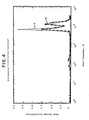
- the pore volume distribution is obtained by relating the intrusion pressure to diameter (using a contact angle of 140°) and by differentiating the cumulative pore volume distribution. An example of such a distribution is shown in Figure 4 and consists of two distinctly separated peaks in the micropore region. A point in between the two peaks is identified and the pore volume in each of the micropore modes is obtained.
- Hg porosimetry is also used to calculate the fractional contribution of each of the micropore modes to the total surface area. For a fraction alphas of surface area from smaller micropores, the diameters are calculated as and
- the size of the metals bearing molecules will vary depending on the quality and type of the feedstock treated. For example, using analytical and preparative Gel Permeation Chromatograph at ambient conditions, the average size of the vanadium bearing molecules may be as large as 65 Angstrom units for an Arab Light vacuum resid and 40 Angstrom units for a Wilmington crude (Hall and Herron, Adv. Chem. Ser., 195, 1981, page 149). Processing conditions such as temperature, pressure, and gas composition (as, for example, hydrogen partial pressure) may also effect the size of the metal and sulfur bearing species. The larger asphaltenic molecules are believed to deflocculate at reaction conditions thereby reducing their size.
- the size of the metal bearing species at reaction conditions varies from 20 to 50 Angstrom units. Larger micropore diameters in the range of 100-600 Angstrom units would allow metal molecules to easily access the internals of the catalyst.
- sulfur bearing species in heavy oils are either thiophene, benzothiophene or dibenzothiophene based and have a molecular size of between 6 to 10 Angstrom units.
- a small fraction of the sulfur may also be present in the asphaltene fractior and have a larger molecule size. Smaller micropore diameters in the range 30-100 Angstrom units would be suitable for the treatment of most of the sulfur species.
- the two sizes of micropores can be formulated by various means. For example, one can use different forms of alumina. One form would be made of grains of small micropores while the other form is made of grains of larger micropores. By mixing these two forms together one obtains the desired mixture. As another example, one could take grains of one pore size of alumina and calcine a portion to change its pore size. A third possibility is to use two completely different materials having different pore sizes such as alumina and silica. These grains could then be mulled together and extruded in a manner standardly practiced in the art. Calcination treatment after extrusion could be used to additionally modify the pore structure of the extrudate.
- micropores After mixing together the two different size micropore materials they can be extruded to form formates. During the process of extrusion there may be channels between the various grains which form macropores having diameters greater than 600 Angstrom units. Such a resulting catalyst support can be characterized trimodal since it has a bidisperse micropore size characterization with the two different types of micropore regions and it then has this third region of much larger micropores.
- various metals can be added to the catalyst support.
- desulfurization metals are metals of Group VIB such as Cr, Mo and W and Group VIII which include Fe, Co, and Ni in addition to six other members which are Ru, Rh, Pd, Os, Ir and Pt with preferred metals being Mo, W, Ni and Co, with especially preferred metals being Co and Mo.
- Co and Mo are added to the catalyst and calcined it forms CoO and MoO 3 and this MoO3 can be present in an amount of 0.1-30% by weight with CoO present in the 0.1-5% by weight range.
- the demetallization metals include members of Group VIB which are Cr, Mo and W; members of Group VIII as listed above; members of Group VB which are V, Nb and Ta; and members of Group VIIB which are Mn, Tc and Re.
- Especially preferred metals are Mo as well as other low activity and especially hydrogenation metals such as Fe, Mn, Ni, Co, and W. Again these metal oxides can be present in a weight range of 0.1-30% by weight.
- the Mo oxide present in the small micropores in an amount of 8-30% by weight and to have the metal oxide present in the larger micropores in an amount of 0.1-8% by weight.
- One way to obtain this different level of metal oxide loadings is to impregnate the small micropore grains with desulfurization metals such as Co and Mo and to then separately impregnate the large micropores with either a different material which is a demetallization metal or to a lesser extent.
- Another preparation method that may be used is the equilibrium adsorption of metals onto the alumina surface with an excess of impregnation solution.
- the Mo loading in each of the grains will be proportional to the local surface area.
- Catalysts can also be prepared by the incipient wetness method of impregnation which is standardly practiced in the art.
- Catalysts can also be prepared by first forming particles of a refractory oxide powder having a small micropore region having an average pore diameter of less than 100 Angstrom units and a large micropore region having an average pore diameter which is much larger than the average diameter of the metal bearing molecules in a heavy feed to be processed. Then the particles are calcined to form a catalyst support which is impregnated with one or more catalytic metal components selected from the group consisting of a metal belonging to Group VB, VIB, VIIB and VIII of the Periodic Table. These catalytic metal components are present in an amount of between about 0.1% and about 30% in terms of metal oxide based on the total weight of the catalyst.
- Another way to make the catalysts is to first impregnate particles of a refractory oxide powder having a small micropore region with an average pore diameter of less than 100 Angstrom units with one or more desulfurization catalytic metal components belonging to Groups VIB and VIII of the Periodic Table. These impregnated particles are then mixed with a refractory oxide powder having a large micropore region with an average diameter which is much larger than the average diameter of the metal bearing molecules in a heavy feed to be processed. The mixture is formed into catalyst particles and the particles are calcined to form a hydrotreating catalyst.
- the catalyst particles after the catalyst particles are formed and before calcination, the catalyst particles can be further impregnated with one or more demetallization catalytic metal components belonging to Groups VB, VIB, VIIB and VIII of the Periodic Table. Then after the calcination the resulting catalyst will have desulfurization metals in the small pores in the proper amount and the demetallization metals in the larger pores.
- Catalyst of this invention prepared having less than 5% of pores of diameter greater than 600 Angstrom units are preferred in the treatment of lighter feeds because of increased surface area. Macropores would reduce the active surface area per volume of reactor but may be preferred in cases where high metal levels in the feed may cause external plugging of the catalyst pores.
- the catalysts can be used in a process for hydrotreating a heavy hydrocarbon oil containing asphaltenes. Such a process involves preferably reacting the heavy hydrocarbon oil in the presence of the catalyst with hydrogen at a temperature of between 300° and 500°C, with a hydrogen pressure of between 50 and 250 atmospheres and with a liquid space velocity of between 0.1 and 10 hour .
- the Thiele modulus (defined standardly in chemical reaction engineering) is given as where R is the equivalent radius of a spherical pellet and ⁇ i is the effectiveness factor, where 1 . is the diameter of the grain and k i is the volumetric rate constant.
- the conversion at the reactor outlet for a first order reaction rate where ⁇ r is the reactor void fraction and LHSV is the liquid hourly space velocity.
- Rate constant k is proportional to the surface area of the grain. This would typically be the case if the catalysts were prepared using an equilibrium adsorption process with excess impregnation solution. Also, assume that the sulfur containing molecules are 7 Angstrom units in size, that the metal bearing species are 40 Angstrom units in size and that the intrinsic rate constant for both metals and sulfur removal is the same.
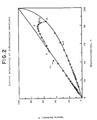
- Curve I in Figure (2) illustrates the initial selectivity performance of a unimodal catalyst having 70 Angstrom units micropores.
- Curve II in Figure 2 represents the initial activity of a 200 Angstrom units unimodal catalyst. Points A and B show the initial activity of the small and large pore catalysts at the same LH SV.
- Curve III ( Figure 2) shows the initial selectivity performance of the catalysts of this invention.
- the catalysts are prepared by mixing various volume fractions of grains having 70 Angstrom units and 200 Angstrom units pores.
- Catalyst desulfurization activity decreases as one proceeds from Point A to Point B along Curve III in Figure 2.
- the demetallation activity is maximum at Point C.
- a catalyst at point C would contain from 30-40 vol % of the smaller pore material.
- Figure 3 compares the initial performance of the catalyst of this invention with that of a unimodal micropore catalyst of varied micropore diameter.
- the catalyst of this invention represented by the solid line has a higher initial metals removal at a fixed desulfurization level compared with the various unimodal micropore catalysts represented by the dashed line.
- the catalyst of the invention will have a longer life compared with a catalyst having only the smaller micropores. Since a substantial fraction of pores on the external surface on the catalyst are larger micropores, the time for catalyst deactivation via pore mouth plugging will be comparable to that of a catalyst having only larger micropores.
- Shiroto et al patent divides hydrotreating developments for the removal of sulfur, metals, nitrogen, and asphaltenes fall into eight categories. Neither it, nor any other patents of which we are aware, discuss catalysts with bidisperse micropore size distributions as in the case of the present invention.
- Shiroto et al's category (3) relates to catalysts with pores greater than 200 Angstrom units which are also the type of pores used in his catalyst. Such catalysts show superior metals and asphaltene removal activity and durability. However, the desulfurization activity of such catalysts is lower because of the lower surface area of the catalyst.
- This example illustrates making a bidisperse micropore size catalyst support according to this invention which is substantially free of macropores (i.e. with a diameter greater than 600 Angstrom units).
- This example demonstrates the flexibility in controlling the relative pore volumes of the two different size micropores to make catalyst supports.
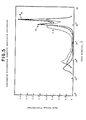
- Three bidisperse micropore size extrudates were prepared by combining varying amounts of calcined SRA (2 hours at 1750°F) with uncalcined Catapal which is an alumina made by Conco Co. and which has micropores of around 30-80 Angstrom units.
- the extrudates labelled A, B and C contained respectively 10, 20, and 50% alumina from the calcined SRA.
- the extrudates were calcined for 2 hours at 1100°F and their pore size distributions are shown in Figure 5.
- the pore structures are set forth in Table 1.
- This example illustrates that the bidisperse micropore size distribution support may be obtained by extrusion of powders of different chemical compositions.
- a trimodal extrudate catalyst according to the present invention was made as follows.
- SRA alumina powder which was prepared according to the method set forth in U. S. Patent 4,154,812 was calcined at 1800°F for 2 hours.
- Catapal alumina powder obtained from Conoco was separately impregnated with 14.7% MoO 3 and 3.3% CoO by the pore filling method with a solution of ammonium heptamolybdate and cobalt nitrate.
- the impregnated powder was dried at 230°F.
- a 50:50 by weight mixture (on an Al 2 O 3 basis) of the calcined SRA powder and the impregnated Catapal was mulled together and extruded as 1/16" cylindrical extrudates.
- a bimodal extrudate catalyst was made as follows.
- a commercially available 1/16 inch extrudate catalyst contained 16.7% MoO 3 and 3.9% CoO on a total catalyst basis.
- a bimodal cylindrical extrudate of 1/16 inch diameter was prepared from SRA alumina. This support was calcined for two hours at 1600°F and impregnated with a solution of crude phosphomolybdic acid and cobalt nitrate to obtain a catalyst having 15% MoO 3 , 3.3% CoO and 1% P on a total catalyst basis. The catalyst was oven dried and calcined at 1000°F for two hours.
- Table 2 The physical properties are set forth in Table 2. Again, it is bimodal in the sense that it has micropores and much larger macropores, but it does not have the micropore region divided into two zones.
- a commercially available unimodal catalyst having 14.4% MoO 3 , 3.18% CoO, 9.9% SiO 2 and 0.11% P was obtained for comparison.
- This catalyst has a small micropore diameter of 78A.
- the physical properties are set forth in Table 2. It does not have any larger size pores to treat or carry in the large metal bearing molecules.
- a bimodal cylindrical extrudate of 1/16 inch diameter was prepared from SRA alumina.
- the support was calcined for two hours at 1400°F and impregnated with a solution of cobalt nitrate, ammonium heptamolybdate and citric acid to obtain a catalyst have 12.9% MoO 3 , 2.9% CoO on a total catalyst basis.
- the catalyst was oven dried and calcined at 1000°F for two hours.
- the physical properties are set forth in Table 2.
- the catalyst is bimodal in the sense that it has micropores and much larger macropores, but it does not have the micropore region divided into two zones.
- Example 4 The catalysts according to Example 4 and Comparison Examples 1-3 prepared above were compared for their initial activity for sulfur and metals removal.
- the catalysts were evaluated at a liquid hourly space velocity (LHSV) of 0.5 using a Lloydminster feed (the properties of which are set forth in Table 3) at a temperature of 750°F, a pressure of 1500 psi and a hydrogen circulation of 5000 scf/bbl.
- LHSV liquid hourly space velocity
- Table 3 The stabilized initial activity comparisons after 36 hours of testing for sulfur, nickel and vanadium removal are set forth in Table 4.
- the catalyst of Example 4 according to the present invention is seen to be clearly superior for sulfur and metals removal.
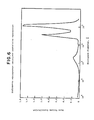
- the two bimodal catalysts of Comp. Exs. 1 and 2 have similar micropore volumes as our catalyst of Example 4, but they do not have the micropore region divided into two zones as is the present catalyst with its bidisperse micropore size region having one mode with a diameter below 100 Angstrom units and a second mode, above 100 Angstrom units, having a diameter of 140 Angstrom units.
- These two comparison catalysts have similar activity, but in all instances they are not as selective as our catalyst.
- the unimodal catalyst of Comp. Ex. 3 does not have the larger pores needed for demetalization and thus it is seen to have the lowest metals activity of all of the catalysts.
- This example illustrates the durability testing of the catalysts.
- Example 4 The catalysts of Example 4 and Comparison Examples 1, 2 and 3 were compared for sulfur and metals removal for 40 days on stream.
- the conditions of the test were Lloydminster vacuum resid, 750°F, 1500 psi, 1.0 L HS V and a hydrogen circulation of 4000 scf/bbl.
- the relative activities of sulfur and metals removal as a function of time on stream are shown in Table 5.
- the catalyst of the present invention in Example 4 shows superior performance in demetallation over all other catalysts tested and is only marginally less active to Comparison Example 1 in desulfurization after 30 days on stream.
- This example illustrates another durability testing of the catalysts.
- Example 4 The catalyst of Example 4 and Comparison Example 4 were compared for sulfur and metals removal using a Boscan Feed, the properties of which are set forth in Table 3.
- the reactor was operated in the upflow mode and the conditions of the test were 750°F, 2000 psi, 1.0 LHSV and a hydrogen circulation of 4000 scf/bbl.
- the relative activities for sulfur and metals removal are shown in Table 6.
- the catalyst of the present invention in Example 4 shows superior demetallation and desulfurization performance and longer life than Comparison catalyst 4.
Landscapes
- Chemical & Material Sciences (AREA)
- Engineering & Computer Science (AREA)
- Chemical Kinetics & Catalysis (AREA)
- Oil, Petroleum & Natural Gas (AREA)
- Organic Chemistry (AREA)
- General Chemical & Material Sciences (AREA)
- Materials Engineering (AREA)
- Catalysts (AREA)
- Production Of Liquid Hydrocarbon Mixture For Refining Petroleum (AREA)
- Organic Low-Molecular-Weight Compounds And Preparation Thereof (AREA)
Priority Applications (1)
| Application Number | Priority Date | Filing Date | Title |
|---|---|---|---|
| AT87106000T ATE95078T1 (de) | 1986-05-02 | 1987-04-24 | Wasserstoffbehandlungskatalysator und traeger mit einer doppelt verteilten porenstruktur. |
Applications Claiming Priority (2)
| Application Number | Priority Date | Filing Date | Title |
|---|---|---|---|
| US85910486A | 1986-05-02 | 1986-05-02 | |
| US859104 | 1986-05-02 |
Publications (3)
| Publication Number | Publication Date |
|---|---|
| EP0243894A2 true EP0243894A2 (de) | 1987-11-04 |
| EP0243894A3 EP0243894A3 (en) | 1988-10-05 |
| EP0243894B1 EP0243894B1 (de) | 1993-09-29 |
Family
ID=25330043
Family Applications (1)
| Application Number | Title | Priority Date | Filing Date |
|---|---|---|---|
| EP87106000A Revoked EP0243894B1 (de) | 1986-05-02 | 1987-04-24 | Wasserstoffbehandlungskatalysator und Träger mit einer doppelt verteilten Porenstruktur |
Country Status (7)
| Country | Link |
|---|---|
| EP (1) | EP0243894B1 (de) |
| JP (1) | JPS62262750A (de) |
| AT (1) | ATE95078T1 (de) |
| AU (1) | AU7228087A (de) |
| BR (1) | BR8702061A (de) |
| CA (1) | CA1284982C (de) |
| DE (1) | DE3787559T2 (de) |
Cited By (6)
| Publication number | Priority date | Publication date | Assignee | Title |
|---|---|---|---|---|
| US5266300A (en) * | 1989-08-02 | 1993-11-30 | Texaco Inc. | Method of making porous alumina |
| WO2002000338A1 (en) * | 2000-06-28 | 2002-01-03 | Noritatsu Tsubaki | Bimodal porous material and catalyst using the same |
| WO2011069933A2 (de) | 2009-12-11 | 2011-06-16 | Basf Se | Verfahren zur regenerierung eines ruthenium-haltigen geträgerten hydrierkatalysators |
| US8598060B2 (en) | 2006-07-31 | 2013-12-03 | Basf Se | Method of regenerating ruthenium catalysts for the ring hydrogenation of phthalates |
| US9084983B2 (en) | 2009-12-15 | 2015-07-21 | Basf Se | Catalyst and process for hydrogenating aromatics |
| CN110773181A (zh) * | 2018-07-31 | 2020-02-11 | 中国石油化工股份有限公司 | 一种加氢活性保护催化剂及其制备与应用 |
Families Citing this family (3)
| Publication number | Priority date | Publication date | Assignee | Title |
|---|---|---|---|---|
| JP2742413B2 (ja) * | 1987-06-18 | 1998-04-22 | 株式会社日本触媒 | メタクロレイン合成用触媒および再現性に優れたその製造方法 |
| JP5776492B2 (ja) * | 2011-10-25 | 2015-09-09 | 東ソー株式会社 | オキシ塩素化触媒の製造方法 |
| JP5817435B2 (ja) * | 2011-10-25 | 2015-11-18 | 東ソー株式会社 | オキシ塩素化触媒の製造法 |
Family Cites Families (7)
| Publication number | Priority date | Publication date | Assignee | Title |
|---|---|---|---|---|
| US4054508A (en) * | 1975-02-21 | 1977-10-18 | Mobil Oil Corporation | Demetalation and desulfurization of residual oil utilizing hydrogen and trickle beds of catalysts in three zones |
| US4134856A (en) * | 1975-04-18 | 1979-01-16 | Toa Nenryo Kogyo Kabushiki Kaisha | Catalyst for hydro-refining hydrocarbon oils |
| NZ184201A (en) * | 1976-08-12 | 1979-10-25 | Mobil Oil Corp | Residium hydroprocessing catalyst of group vi-b and viii metal sulfides and/or oxides on alumina |
| US4225421A (en) * | 1979-03-13 | 1980-09-30 | Standard Oil Company (Indiana) | Process for hydrotreating heavy hydrocarbons |
| US4326993A (en) * | 1979-12-17 | 1982-04-27 | Mobil Oil Corporation | Novel cracking catalysts and catalyst supports |
| DD160820A3 (de) * | 1981-04-30 | 1984-04-04 | Petrolchemisches Kom Schwedt D | Entschwefeln und feinentmetallisieren hochsiedender erdoel-kohlenwasserstoff-rohstoffe |
| CA1195278A (en) * | 1981-09-28 | 1985-10-15 | Chevron Research And Technology Company | Layered residua treatment catalyst process and temperature profile |
-
1987
- 1987-03-19 CA CA000532395A patent/CA1284982C/en not_active Expired - Lifetime
- 1987-04-24 DE DE87106000T patent/DE3787559T2/de not_active Revoked
- 1987-04-24 AT AT87106000T patent/ATE95078T1/de not_active IP Right Cessation
- 1987-04-24 EP EP87106000A patent/EP0243894B1/de not_active Revoked
- 1987-04-28 BR BR8702061A patent/BR8702061A/pt unknown
- 1987-04-28 JP JP62103391A patent/JPS62262750A/ja active Pending
- 1987-04-30 AU AU72280/87A patent/AU7228087A/en not_active Abandoned
Cited By (6)
| Publication number | Priority date | Publication date | Assignee | Title |
|---|---|---|---|---|
| US5266300A (en) * | 1989-08-02 | 1993-11-30 | Texaco Inc. | Method of making porous alumina |
| WO2002000338A1 (en) * | 2000-06-28 | 2002-01-03 | Noritatsu Tsubaki | Bimodal porous material and catalyst using the same |
| US8598060B2 (en) | 2006-07-31 | 2013-12-03 | Basf Se | Method of regenerating ruthenium catalysts for the ring hydrogenation of phthalates |
| WO2011069933A2 (de) | 2009-12-11 | 2011-06-16 | Basf Se | Verfahren zur regenerierung eines ruthenium-haltigen geträgerten hydrierkatalysators |
| US9084983B2 (en) | 2009-12-15 | 2015-07-21 | Basf Se | Catalyst and process for hydrogenating aromatics |
| CN110773181A (zh) * | 2018-07-31 | 2020-02-11 | 中国石油化工股份有限公司 | 一种加氢活性保护催化剂及其制备与应用 |
Also Published As
| Publication number | Publication date |
|---|---|
| BR8702061A (pt) | 1988-02-09 |
| DE3787559D1 (de) | 1993-11-04 |
| DE3787559T2 (de) | 1994-04-21 |
| ATE95078T1 (de) | 1993-10-15 |
| AU7228087A (en) | 1987-11-05 |
| EP0243894A3 (en) | 1988-10-05 |
| EP0243894B1 (de) | 1993-09-29 |
| JPS62262750A (ja) | 1987-11-14 |
| CA1284982C (en) | 1991-06-18 |
Similar Documents
| Publication | Publication Date | Title |
|---|---|---|
| US4588709A (en) | Catalyst for removing sulfur and metal contaminants from heavy crudes and residues | |
| JP5140817B2 (ja) | 触媒を使用して炭化水素原料装入物の水素化精製および/または水素化転化の処理方法 | |
| US5616530A (en) | Hydroconversion process employing catalyst with specified pore size distribution | |
| EP1060794B2 (de) | Katalysator zur hydrodesulforierung und verfahren zu seiner herstellung | |
| US5416054A (en) | Hydroconversion catalyst with specified pore size distribution | |
| EP1567617B1 (de) | Hydroprocessing von kohlenwasserstoff mittels einer mischung von katalysatoren | |
| JP2016016404A (ja) | 高密度モリブデンを有する水素化処理触媒及びその調製方法 | |
| WO1997008274A1 (en) | Hydroconversion process employing a catalyst with specified pore size distribution and no added silica | |
| US20040163999A1 (en) | HPC process using a mixture of catalysts | |
| CA2531079C (en) | A process and catalyst for the selective hydrogenation of diolefins contained in an olefin containing stream and for the removal of arsenic therefrom and a method of making such catalyst | |
| US5320743A (en) | Mild hydrocracking of heavy hydrocarbon feedstocks employing silica-alumina catalysts | |
| US4908344A (en) | Hydroprocessing catalyst and support having bidisperse pore structure | |
| EP1567262A1 (de) | Hydroprocessing von schweren kohlenwasserstoffen mittels einer mischung von katalysatoren | |
| US4791090A (en) | Hydroprocessing catalyst and support having bidisperse pore structure | |
| US7186329B2 (en) | High-macropore hydroprocessing catalyst and its use | |
| CA1335728C (en) | Catalyst composition for hydrogenation of heavy hydrocarbon oil | |
| US4394302A (en) | Hydrodesulfurization catalyst on lithium-containing support and method for its preparation | |
| EP0243894B1 (de) | Wasserstoffbehandlungskatalysator und Träger mit einer doppelt verteilten Porenstruktur | |
| US4642179A (en) | Catalyst for removing sulfur and metal contaminants from heavy crudes and residues | |
| US4443558A (en) | Highly stable hydroprocessing catalyst | |
| JPH0431737B2 (de) | ||
| US4724226A (en) | Boria-promoted HP catalyst | |
| JP7269247B2 (ja) | 重油中の金属及び硫黄の削減のための水素化処理触媒 | |
| US4447317A (en) | Hydroprocessing with lithium-containing catalyst | |
| RU2610869C2 (ru) | Катализатор гидропереработки и способы получения и применения такого катализатора |
Legal Events
| Date | Code | Title | Description |
|---|---|---|---|
| PUAI | Public reference made under article 153(3) epc to a published international application that has entered the european phase |
Free format text: ORIGINAL CODE: 0009012 |
|
| AK | Designated contracting states |
Kind code of ref document: A2 Designated state(s): AT BE CH DE FR GB IT LI LU NL SE |
|
| PUAL | Search report despatched |
Free format text: ORIGINAL CODE: 0009013 |
|
| AK | Designated contracting states |
Kind code of ref document: A3 Designated state(s): AT BE CH DE FR GB IT LI LU NL SE |
|
| RAP1 | Party data changed (applicant data changed or rights of an application transferred) |
Owner name: W.R. GRACE & CO.-CONN. (A CONNECTICUT CORP.) |
|
| 17P | Request for examination filed |
Effective date: 19890311 |
|
| 17Q | First examination report despatched |
Effective date: 19890802 |
|
| GRAA | (expected) grant |
Free format text: ORIGINAL CODE: 0009210 |
|
| AK | Designated contracting states |
Kind code of ref document: B1 Designated state(s): AT BE CH DE FR GB IT LI LU NL SE |
|
| PG25 | Lapsed in a contracting state [announced via postgrant information from national office to epo] |
Ref country code: SE Effective date: 19930929 Ref country code: LI Effective date: 19930929 Ref country code: CH Effective date: 19930929 Ref country code: AT Effective date: 19930929 |
|
| REF | Corresponds to: |
Ref document number: 95078 Country of ref document: AT Date of ref document: 19931015 Kind code of ref document: T |
|
| REF | Corresponds to: |
Ref document number: 3787559 Country of ref document: DE Date of ref document: 19931104 |
|
| ITF | It: translation for a ep patent filed | ||
| ET | Fr: translation filed | ||
| REG | Reference to a national code |
Ref country code: CH Ref legal event code: PL |
|
| PG25 | Lapsed in a contracting state [announced via postgrant information from national office to epo] |
Ref country code: LU Free format text: LAPSE BECAUSE OF NON-PAYMENT OF DUE FEES Effective date: 19940430 |
|
| PLBI | Opposition filed |
Free format text: ORIGINAL CODE: 0009260 |
|
| 26 | Opposition filed |
Opponent name: AKZO NOBEL N.V. Effective date: 19940615 |
|
| NLR1 | Nl: opposition has been filed with the epo |
Opponent name: AKZO NOBEL N.V. |
|
| PGFP | Annual fee paid to national office [announced via postgrant information from national office to epo] |
Ref country code: GB Payment date: 19960415 Year of fee payment: 10 |
|
| PGFP | Annual fee paid to national office [announced via postgrant information from national office to epo] |
Ref country code: DE Payment date: 19960429 Year of fee payment: 10 |
|
| PGFP | Annual fee paid to national office [announced via postgrant information from national office to epo] |
Ref country code: BE Payment date: 19960612 Year of fee payment: 10 |
|
| PGFP | Annual fee paid to national office [announced via postgrant information from national office to epo] |
Ref country code: FR Payment date: 19970409 Year of fee payment: 11 |
|
| PG25 | Lapsed in a contracting state [announced via postgrant information from national office to epo] |
Ref country code: GB Effective date: 19970424 |
|
| PGFP | Annual fee paid to national office [announced via postgrant information from national office to epo] |
Ref country code: NL Payment date: 19970428 Year of fee payment: 11 |
|
| PG25 | Lapsed in a contracting state [announced via postgrant information from national office to epo] |
Ref country code: BE Effective date: 19970430 |
|
| APAE | Appeal reference modified |
Free format text: ORIGINAL CODE: EPIDOS REFNO |
|
| BERE | Be: lapsed |
Owner name: W.R. GRACE & CO.-CONN. Effective date: 19970430 |
|
| GBPC | Gb: european patent ceased through non-payment of renewal fee |
Effective date: 19970424 |
|
| PG25 | Lapsed in a contracting state [announced via postgrant information from national office to epo] |
Ref country code: DE Free format text: LAPSE BECAUSE OF NON-PAYMENT OF DUE FEES Effective date: 19980101 |
|
| PG25 | Lapsed in a contracting state [announced via postgrant information from national office to epo] |
Ref country code: NL Free format text: LAPSE BECAUSE OF NON-PAYMENT OF DUE FEES Effective date: 19981101 |
|
| NLV4 | Nl: lapsed or anulled due to non-payment of the annual fee |
Effective date: 19981101 |
|
| REG | Reference to a national code |
Ref country code: FR Ref legal event code: ST |
|
| APAC | Appeal dossier modified |
Free format text: ORIGINAL CODE: EPIDOS NOAPO |
|
| RDAG | Patent revoked |
Free format text: ORIGINAL CODE: 0009271 |
|
| STAA | Information on the status of an ep patent application or granted ep patent |
Free format text: STATUS: PATENT REVOKED |
|
| 27W | Patent revoked |
Effective date: 19990225 |
|
| APAH | Appeal reference modified |
Free format text: ORIGINAL CODE: EPIDOSCREFNO |
|
| PG25 | Lapsed in a contracting state [announced via postgrant information from national office to epo] |
Ref country code: FR Free format text: LAPSE BECAUSE OF NON-PAYMENT OF DUE FEES Effective date: 19980430 |
|
| PLAB | Opposition data, opponent's data or that of the opponent's representative modified |
Free format text: ORIGINAL CODE: 0009299OPPO |