EP0242732A1 - Flammfeste Polyamide - Google Patents
Flammfeste Polyamide Download PDFInfo
- Publication number
- EP0242732A1 EP0242732A1 EP87105306A EP87105306A EP0242732A1 EP 0242732 A1 EP0242732 A1 EP 0242732A1 EP 87105306 A EP87105306 A EP 87105306A EP 87105306 A EP87105306 A EP 87105306A EP 0242732 A1 EP0242732 A1 EP 0242732A1
- Authority
- EP
- European Patent Office
- Prior art keywords
- polyamide
- weight
- consist
- radical
- polyphosphonate
- Prior art date
- Legal status (The legal status is an assumption and is not a legal conclusion. Google has not performed a legal analysis and makes no representation as to the accuracy of the status listed.)
- Granted
Links
- 239000004952 Polyamide Substances 0.000 title claims abstract description 33
- 229920002647 polyamide Polymers 0.000 title claims abstract description 33
- 239000000203 mixture Substances 0.000 claims abstract description 38
- 229920006012 semi-aromatic polyamide Polymers 0.000 claims abstract description 11
- 239000003063 flame retardant Substances 0.000 claims abstract description 9
- RNFJDJUURJAICM-UHFFFAOYSA-N 2,2,4,4,6,6-hexaphenoxy-1,3,5-triaza-2$l^{5},4$l^{5},6$l^{5}-triphosphacyclohexa-1,3,5-triene Chemical compound N=1P(OC=2C=CC=CC=2)(OC=2C=CC=CC=2)=NP(OC=2C=CC=CC=2)(OC=2C=CC=CC=2)=NP=1(OC=1C=CC=CC=1)OC1=CC=CC=C1 RNFJDJUURJAICM-UHFFFAOYSA-N 0.000 claims abstract description 6
- 229920001169 thermoplastic Polymers 0.000 claims abstract description 4
- 239000004416 thermosoftening plastic Substances 0.000 claims abstract description 4
- YMWUJEATGCHHMB-UHFFFAOYSA-N Dichloromethane Chemical compound ClCCl YMWUJEATGCHHMB-UHFFFAOYSA-N 0.000 claims description 18
- 238000000465 moulding Methods 0.000 claims description 13
- -1 alkyl radical Chemical group 0.000 claims description 9
- 125000004432 carbon atom Chemical group C* 0.000 claims description 9
- QIGBRXMKCJKVMJ-UHFFFAOYSA-N Hydroquinone Chemical compound OC1=CC=C(O)C=C1 QIGBRXMKCJKVMJ-UHFFFAOYSA-N 0.000 claims description 6
- 125000003118 aryl group Chemical group 0.000 claims description 5
- 239000000654 additive Substances 0.000 claims description 4
- 125000000217 alkyl group Chemical group 0.000 claims description 3
- 239000000463 material Substances 0.000 claims description 3
- 150000005840 aryl radicals Chemical class 0.000 claims description 2
- 229910052799 carbon Inorganic materials 0.000 claims description 2
- 229910002091 carbon monoxide Inorganic materials 0.000 claims description 2
- GATNOFPXSDHULC-UHFFFAOYSA-N ethylphosphonic acid Chemical compound CCP(O)(O)=O GATNOFPXSDHULC-UHFFFAOYSA-N 0.000 claims description 2
- YACKEPLHDIMKIO-UHFFFAOYSA-N methylphosphonic acid Chemical compound CP(O)(O)=O YACKEPLHDIMKIO-UHFFFAOYSA-N 0.000 claims description 2
- 229910052760 oxygen Inorganic materials 0.000 claims description 2
- 150000003008 phosphonic acid esters Chemical class 0.000 claims description 2
- 150000003254 radicals Chemical class 0.000 claims description 2
- 229910052717 sulfur Inorganic materials 0.000 claims description 2
- 125000004178 (C1-C4) alkyl group Chemical group 0.000 claims 1
- 239000004305 biphenyl Substances 0.000 claims 1
- NAQMVNRVTILPCV-UHFFFAOYSA-N hexane-1,6-diamine Chemical compound NCCCCCCN NAQMVNRVTILPCV-UHFFFAOYSA-N 0.000 description 22
- QQVIHTHCMHWDBS-UHFFFAOYSA-N isophthalic acid Chemical compound OC(=O)C1=CC=CC(C(O)=O)=C1 QQVIHTHCMHWDBS-UHFFFAOYSA-N 0.000 description 22
- RLSSMJSEOOYNOY-UHFFFAOYSA-N m-cresol Chemical compound CC1=CC=CC(O)=C1 RLSSMJSEOOYNOY-UHFFFAOYSA-N 0.000 description 14
- KKEYFWRCBNTPAC-UHFFFAOYSA-N Terephthalic acid Chemical compound OC(=O)C1=CC=C(C(O)=O)C=C1 KKEYFWRCBNTPAC-UHFFFAOYSA-N 0.000 description 6
- WNLRTRBMVRJNCN-UHFFFAOYSA-N adipic acid Chemical compound OC(=O)CCCCC(O)=O WNLRTRBMVRJNCN-UHFFFAOYSA-N 0.000 description 6
- 239000000155 melt Substances 0.000 description 5
- 239000000243 solution Substances 0.000 description 5
- CNPURSDMOWDNOQ-UHFFFAOYSA-N 4-methoxy-7h-pyrrolo[2,3-d]pyrimidin-2-amine Chemical compound COC1=NC(N)=NC2=C1C=CN2 CNPURSDMOWDNOQ-UHFFFAOYSA-N 0.000 description 4
- HPUPGAFDTWIMBR-UHFFFAOYSA-N [methyl(phenoxy)phosphoryl]oxybenzene Chemical compound C=1C=CC=CC=1OP(=O)(C)OC1=CC=CC=C1 HPUPGAFDTWIMBR-UHFFFAOYSA-N 0.000 description 4
- 238000004519 manufacturing process Methods 0.000 description 4
- CXMXRPHRNRROMY-UHFFFAOYSA-N sebacic acid Chemical compound OC(=O)CCCCCCCCC(O)=O CXMXRPHRNRROMY-UHFFFAOYSA-N 0.000 description 4
- DZIHTWJGPDVSGE-UHFFFAOYSA-N 4-[(4-aminocyclohexyl)methyl]cyclohexan-1-amine Chemical compound C1CC(N)CCC1CC1CCC(N)CC1 DZIHTWJGPDVSGE-UHFFFAOYSA-N 0.000 description 3
- 235000011037 adipic acid Nutrition 0.000 description 3
- 239000001361 adipic acid Substances 0.000 description 3
- VCCBEIPGXKNHFW-UHFFFAOYSA-N biphenyl-4,4'-diol Chemical group C1=CC(O)=CC=C1C1=CC=C(O)C=C1 VCCBEIPGXKNHFW-UHFFFAOYSA-N 0.000 description 3
- 230000000052 comparative effect Effects 0.000 description 3
- 238000013329 compounding Methods 0.000 description 3
- 150000004985 diamines Chemical class 0.000 description 3
- 239000008187 granular material Substances 0.000 description 3
- DPQHRXRAZHNGRU-UHFFFAOYSA-N 2,4,4-trimethylhexane-1,6-diamine Chemical compound NCC(C)CC(C)(C)CCN DPQHRXRAZHNGRU-UHFFFAOYSA-N 0.000 description 2
- FZZMTSNZRBFGGU-UHFFFAOYSA-N 2-chloro-7-fluoroquinazolin-4-amine Chemical compound FC1=CC=C2C(N)=NC(Cl)=NC2=C1 FZZMTSNZRBFGGU-UHFFFAOYSA-N 0.000 description 2
- 239000004953 Aliphatic polyamide Substances 0.000 description 2
- XLOMVQKBTHCTTD-UHFFFAOYSA-N Zinc monoxide Chemical compound [Zn]=O XLOMVQKBTHCTTD-UHFFFAOYSA-N 0.000 description 2
- 229920003231 aliphatic polyamide Polymers 0.000 description 2
- 239000000945 filler Substances 0.000 description 2
- BDJRBEYXGGNYIS-UHFFFAOYSA-N nonanedioic acid Chemical compound OC(=O)CCCCCCCC(O)=O BDJRBEYXGGNYIS-UHFFFAOYSA-N 0.000 description 2
- KIDHWZJUCRJVML-UHFFFAOYSA-N putrescine Chemical compound NCCCCN KIDHWZJUCRJVML-UHFFFAOYSA-N 0.000 description 2
- MRERMGPPCLQIPD-NBVRZTHBSA-N (3beta,5alpha,9alpha,22E,24R)-3,5,9-Trihydroxy-23-methylergosta-7,22-dien-6-one Chemical compound C1C(O)CCC2(C)C(CCC3(C(C(C)/C=C(\C)C(C)C(C)C)CCC33)C)(O)C3=CC(=O)C21O MRERMGPPCLQIPD-NBVRZTHBSA-N 0.000 description 1
- PBLZLIFKVPJDCO-UHFFFAOYSA-N 12-aminododecanoic acid Chemical compound NCCCCCCCCCCCC(O)=O PBLZLIFKVPJDCO-UHFFFAOYSA-N 0.000 description 1
- RNLHGQLZWXBQNY-UHFFFAOYSA-N 3-(aminomethyl)-3,5,5-trimethylcyclohexan-1-amine Chemical compound CC1(C)CC(N)CC(C)(CN)C1 RNLHGQLZWXBQNY-UHFFFAOYSA-N 0.000 description 1
- IGSBHTZEJMPDSZ-UHFFFAOYSA-N 4-[(4-amino-3-methylcyclohexyl)methyl]-2-methylcyclohexan-1-amine Chemical compound C1CC(N)C(C)CC1CC1CC(C)C(N)CC1 IGSBHTZEJMPDSZ-UHFFFAOYSA-N 0.000 description 1
- BDBZTOMUANOKRT-UHFFFAOYSA-N 4-[2-(4-aminocyclohexyl)propan-2-yl]cyclohexan-1-amine Chemical compound C1CC(N)CCC1C(C)(C)C1CCC(N)CC1 BDBZTOMUANOKRT-UHFFFAOYSA-N 0.000 description 1
- SLXKOJJOQWFEFD-UHFFFAOYSA-N 6-aminohexanoic acid Chemical compound NCCCCCC(O)=O SLXKOJJOQWFEFD-UHFFFAOYSA-N 0.000 description 1
- 239000005995 Aluminium silicate Substances 0.000 description 1
- KXDHJXZQYSOELW-UHFFFAOYSA-N Carbamic acid Chemical class NC(O)=O KXDHJXZQYSOELW-UHFFFAOYSA-N 0.000 description 1
- VGGSQFUCUMXWEO-UHFFFAOYSA-N Ethene Chemical compound C=C VGGSQFUCUMXWEO-UHFFFAOYSA-N 0.000 description 1
- 239000005977 Ethylene Substances 0.000 description 1
- 239000004609 Impact Modifier Substances 0.000 description 1
- 229920000877 Melamine resin Polymers 0.000 description 1
- 239000006057 Non-nutritive feed additive Substances 0.000 description 1
- 229920002292 Nylon 6 Polymers 0.000 description 1
- 229920002302 Nylon 6,6 Polymers 0.000 description 1
- ABLZXFCXXLZCGV-UHFFFAOYSA-N Phosphorous acid Chemical class OP(O)=O ABLZXFCXXLZCGV-UHFFFAOYSA-N 0.000 description 1
- FDLQZKYLHJJBHD-UHFFFAOYSA-N [3-(aminomethyl)phenyl]methanamine Chemical compound NCC1=CC=CC(CN)=C1 FDLQZKYLHJJBHD-UHFFFAOYSA-N 0.000 description 1
- ISKQADXMHQSTHK-UHFFFAOYSA-N [4-(aminomethyl)phenyl]methanamine Chemical compound NCC1=CC=C(CN)C=C1 ISKQADXMHQSTHK-UHFFFAOYSA-N 0.000 description 1
- 239000002253 acid Substances 0.000 description 1
- 125000001931 aliphatic group Chemical group 0.000 description 1
- 235000012211 aluminium silicate Nutrition 0.000 description 1
- 229960002684 aminocaproic acid Drugs 0.000 description 1
- 229920006020 amorphous polyamide Polymers 0.000 description 1
- 229910000410 antimony oxide Inorganic materials 0.000 description 1
- 239000010425 asbestos Substances 0.000 description 1
- 239000002585 base Substances 0.000 description 1
- 239000006229 carbon black Substances 0.000 description 1
- 150000001875 compounds Chemical class 0.000 description 1
- 229920001577 copolymer Polymers 0.000 description 1
- 238000004132 cross linking Methods 0.000 description 1
- QYQADNCHXSEGJT-UHFFFAOYSA-N cyclohexane-1,1-dicarboxylate;hydron Chemical compound OC(=O)C1(C(O)=O)CCCCC1 QYQADNCHXSEGJT-UHFFFAOYSA-N 0.000 description 1
- 230000007423 decrease Effects 0.000 description 1
- 150000001991 dicarboxylic acids Chemical class 0.000 description 1
- 239000000975 dye Substances 0.000 description 1
- 230000000694 effects Effects 0.000 description 1
- 239000010433 feldspar Substances 0.000 description 1
- 230000009970 fire resistant effect Effects 0.000 description 1
- 239000011521 glass Substances 0.000 description 1
- 239000003365 glass fiber Substances 0.000 description 1
- 150000002366 halogen compounds Chemical class 0.000 description 1
- 238000002347 injection Methods 0.000 description 1
- 239000007924 injection Substances 0.000 description 1
- 238000001746 injection moulding Methods 0.000 description 1
- NLYAJNPCOHFWQQ-UHFFFAOYSA-N kaolin Chemical compound O.O.O=[Al]O[Si](=O)O[Si](=O)O[Al]=O NLYAJNPCOHFWQQ-UHFFFAOYSA-N 0.000 description 1
- 150000003951 lactams Chemical class 0.000 description 1
- JDSHMPZPIAZGSV-UHFFFAOYSA-N melamine Chemical compound NC1=NC(N)=NC(N)=N1 JDSHMPZPIAZGSV-UHFFFAOYSA-N 0.000 description 1
- 150000007974 melamines Chemical class 0.000 description 1
- 239000012803 melt mixture Substances 0.000 description 1
- 239000002184 metal Substances 0.000 description 1
- 229910052751 metal Inorganic materials 0.000 description 1
- 238000000034 method Methods 0.000 description 1
- 239000010445 mica Substances 0.000 description 1
- 229910052618 mica group Inorganic materials 0.000 description 1
- 238000012986 modification Methods 0.000 description 1
- 230000004048 modification Effects 0.000 description 1
- VTRUBDSFZJNXHI-UHFFFAOYSA-N oxoantimony Chemical compound [Sb]=O VTRUBDSFZJNXHI-UHFFFAOYSA-N 0.000 description 1
- 239000000049 pigment Substances 0.000 description 1
- 229920002857 polybutadiene Polymers 0.000 description 1
- 229920000642 polymer Polymers 0.000 description 1
- 238000012667 polymer degradation Methods 0.000 description 1
- 229920000193 polymethacrylate Polymers 0.000 description 1
- 238000002360 preparation method Methods 0.000 description 1
- 239000010453 quartz Substances 0.000 description 1
- 239000012779 reinforcing material Substances 0.000 description 1
- 230000000979 retarding effect Effects 0.000 description 1
- 229910052895 riebeckite Inorganic materials 0.000 description 1
- 150000003839 salts Chemical class 0.000 description 1
- VYPSYNLAJGMNEJ-UHFFFAOYSA-N silicon dioxide Inorganic materials O=[Si]=O VYPSYNLAJGMNEJ-UHFFFAOYSA-N 0.000 description 1
- 239000003381 stabilizer Substances 0.000 description 1
- 239000000126 substance Substances 0.000 description 1
- 125000005346 substituted cycloalkyl group Chemical group 0.000 description 1
- RAHZWNYVWXNFOC-UHFFFAOYSA-N sulfur dioxide Inorganic materials O=S=O RAHZWNYVWXNFOC-UHFFFAOYSA-N 0.000 description 1
- 230000002195 synergetic effect Effects 0.000 description 1
- 239000000454 talc Substances 0.000 description 1
- 229910052623 talc Inorganic materials 0.000 description 1
- BIKXLKXABVUSMH-UHFFFAOYSA-N trizinc;diborate Chemical class [Zn+2].[Zn+2].[Zn+2].[O-]B([O-])[O-].[O-]B([O-])[O-] BIKXLKXABVUSMH-UHFFFAOYSA-N 0.000 description 1
- 239000010456 wollastonite Substances 0.000 description 1
- 229910052882 wollastonite Inorganic materials 0.000 description 1
- 239000011787 zinc oxide Substances 0.000 description 1
Classifications
-
- C—CHEMISTRY; METALLURGY
- C08—ORGANIC MACROMOLECULAR COMPOUNDS; THEIR PREPARATION OR CHEMICAL WORKING-UP; COMPOSITIONS BASED THEREON
- C08L—COMPOSITIONS OF MACROMOLECULAR COMPOUNDS
- C08L77/00—Compositions of polyamides obtained by reactions forming a carboxylic amide link in the main chain; Compositions of derivatives of such polymers
Definitions
- the invention relates to thermoplastically processable, flame-resistant polyamide compositions which consist of mixtures of amorphous, partially aromatic polyamides and 3-40% by weight of polyphosphonates.
- polyamides Due to their good mechanical and electrical properties and their good resistance to chemicals, polyamides have found many uses as a material for the technical sector. They are used to manufacture parts for mechanical and automotive engineering, as well as for the manufacture of housings, covers and control boxes. Fire-retardant products are becoming increasingly important, especially for the electrical sector. The use of polyamides in a fire-resistant setting and with good electrical properties, such as high tracking resistance, is desirable for these applications. These requirements are not always met by the addition of the known flame retardants. Often you also get cloudy, opaque products when flame retarding transparent polyamides.
- thermoplastic, flame-resistant molding compositions made from amorphous, partially aromatic polyamides which contain 3 to 40% by weight, preferably 3 to 20% by weight, in particular 8 to 15% by weight, of polyphosphonates in the polyamide / polyphosphonate Mixture in addition to 97 to 60 wt .-%, preferably 97 to 80 wt .-% and in particular 92 to 85 wt .-% of the polyamides mentioned, and optionally further, conventional additives to the molding compositions.
- Suitable polyamides are preferably those which are composed of at least 30 mol% of aromatic polyamide-forming components, particularly preferably 50 mol% of aromatic dicarboxylic acids.
- amorphous, partially aromatic polyamides are preferably those made from aromatic dicarboxylic acids, such as isophthalic acid or terephthalic acid, where aliphatic or cycloaliphatic dicarboxylic acids such as adipic acid, sebacic acid, azelaic acid, decanedicarboxylic acid, cyclohexanedicarboxylic acid can also be used, and diamines.
- aromatic dicarboxylic acids such as isophthalic acid or terephthalic acid
- aliphatic or cycloaliphatic dicarboxylic acids such as adipic acid, sebacic acid, azelaic acid, decanedicarboxylic acid, cyclohexanedicarboxylic acid can also be used, and diamines.
- diamines The choice of diamines is not subject to any restrictions; it is possible to use all diamines suitable for the production of thermoplastic, deformable polyamides.
- Examples are tetramethylene diamine, hexamethylene diamine, the isomer mixture of 2,2,4- and 2,4,4-trimethylhexamethylene diamine, bis- (4-aminocyclohexyl) methane, bis- (4-aminocyclohexyl) propane, 4,4'-diamino- 3,3 ⁇ -dimethyl-dicyclohexylmethane, 3-aminomethyl-3,5,5-trimethylcyclohexylamine, m- and p-xylylenediamine.
- aminocarboxylic acids or their lactams can also be used as comonomers, for example ⁇ -aminocaproic acid, ⁇ -aminoundecanoic acid and ⁇ -aminolauric acid.
- Preferred amorphous, partially aromatic polyamides are those made from isophthalic acid and hexamethylene diamine or from terephthalic acid and the isomer mixture of 2,2,4- and 2,4,4-trimethylhexamethylene diamine or from isophthalic acid, terephthalic acid, decanedicarboxylic acid, hexamethylene diamine and bis (4-aminocyclohexyl) methane or from adipic acid, isophthalic acid, hexamethylene diamine, 4,4'-diamino-3,3'-dimethyldicyclohexyl methane or from adipic acid, hexamethylene diamine, bis (4-aminocyclohexyl) methane or from laurine lactam, Isophthalic acid, 4,4 ⁇ -diamino-3,3 ⁇ -dimethyl-dicyclohexylmethane.
- Particularly preferred polyamides are amorphous polyamides made from isophthalic acid and hexamethylene diamine.
- Suitable polyphosphonates and their preparation are described for example in German Offenlegungsschrift 2 944 093. They consist of recurring units of the structure where R is an alkyl radical with 1-6, preferably 1-3 C atoms or an optionally substituted cycloalkyl with 5-30, preferably 6-12 C atoms, an alkyl radical with 7-30, preferably 7-16 C atoms , or an aryl radical having 6-30, preferably 6-18 C atoms.
- aromatic rings of X can also be substituted independently of one another by alkyl groups (A) having 1-4 C atoms (up to 4 alkyl groups per aromatic ring).
- Particularly preferred polyphosphonates are the phosphonic acid esters of 4,4'-dihydroxy diphenyl and / or hydroquinone with methanephosphonic acid and / or ethanephosphonic acid.
- the polyphosphonates preferably have average molecular weights (number average n determined osmometrically in methylene chloride) from 2,000 to 80,000, in particular 4,000 to 40,000.
- the compounds are compounded on conventional single and multi-screw extruders of conventional design.
- the premixed polymers can be directly in the Extruders are given. But you can also dose the polyphosphonate in already melted polyamide. This method of operation is useful if a sensitive polyphosphonate is used.
- masterbatches i.e. Melt mixtures of high proportions of polyphosphonates (for example 50 to 90% by weight) and small proportions (for example 50 to 10% by weight) of amorphous, partially aromatic polyamides with the amorphous, partially aromatic polyamides to give polyamides according to the invention, in order to achieve the preferably 3 to 20% by weight of molding compositions containing polyphosphonates.
- the compounding should take place at temperatures of 260 to 285 ° C, preferably 270 to 285 ° C.
- thermoplastically processable, flame-retardant polyamide molding compositions according to the invention can contain the usual additives and auxiliaries in conventional amounts according to the state of the art, for example one or more fillers, in particular glass fibers, in amounts of 10 to 60% by weight, based on the mixture as a whole.
- Fillers in particular glass fibers, in amounts of 10 to 60% by weight, based on the mixture as a whole.
- Micro-glass balls, chalk, quartz such as asbestos, feldspar, mica, talc, wollastonite and kaolin in calcined and non-calcined form are also suitable as fillers and reinforcing materials.
- dyes and pigments in particular carbon black and / or nigrosine bases, stabilizers and processing aids are too name, furthermore the impact modifiers known from the prior art, for example based on copolymers of ethylene, poly (meth) acrylates and grafted polybutadienes and many others, as described in the literature and in patents.
- other flame retardants can also be used, for example halogen compounds of the known type, optionally with the addition of synergistic additives such as zinc oxide, zinc borates, antimony oxide, metal salts and / or melamine or melamine derivatives of the known type.
- the molding compositions according to the invention are not inflammable, have good homogeneity and have good mechanical and electrical properties.
- the transparency of the polyamides is not affected by the flame retardant finish according to the invention. They are suitable for the production of injection molded parts for technical applications, for example for housing parts, covers, transparent parts for measuring devices or also for filaments.
- Example 1 is repeated, a mixture of 15 parts by weight of polyphosphonate and 75 parts by weight of polyamide being produced.
- the melt temperature is 276 ° C.
- the moldings from this mixture are transparent and show fire behavior according to UL Subj. 94 V O for 1.6 mm wall thickness.
- the tracking resistance (VDE 0303, part 1, DIN 53 480) has the following values: KB 600; KC 600.
- the product can be processed into moldings with an impact strength (DIN 53 453) of 42 kJ / m2 and a heat resistance of 130 ° C (Vicat, VSTB).
- the relative viscosities measured at 25 ° C in an Ubbelohde viscometer, are: Polyphosphonate: 1.234 (0.5 percent solution in methylene chloride Polyamide: 2.5 (1 percent solution in m-cresol) Mixture; 2.4 (1 percent solution in m-cresol).
- Example 4 As described in Example 4, a mixture of 90 parts by weight. Polyphosphonate and 10 parts by weight. amorphous, partially aromatic polyamide compounded at 274 ° C melt temperature. The mixture has a relative viscosity of 1.4; the impact strength according to DIN 53 453 is 4 kJ / m2, the heat resistance according to Vicat, VSTB is 127 ° C. Too high a proportion of polyphosphonate can be compounded, but leads to high polymer degradation.
Landscapes
- Chemical & Material Sciences (AREA)
- Health & Medical Sciences (AREA)
- Chemical Kinetics & Catalysis (AREA)
- Medicinal Chemistry (AREA)
- Polymers & Plastics (AREA)
- Organic Chemistry (AREA)
- Compositions Of Macromolecular Compounds (AREA)
Abstract
Description
- Die Erfindung betrifft thermoplastisch verarbeitbare, flammfeste Polyamidmassen, die aus Mischungen aus amorphen, teilaromatischen Polyamiden und 3-40 Gew.-% an Polyphosphonaten bestehen.
- Polyamide haben aufgrund ihrer guten mechanischen und elektrischen Eigenschaften sowie wegen ihrer guten Beständigkeit gegen Chemikalien vielfache Anwendung als Werkstoff für den technischen Bereich gefunden. Sie dienen zur Herstellung von Teilen für den Maschinenbau und Automobilbau, ferner zur Herstellung von Gehäusen, Abdeckungen und Schaltkästen. Dabei gewinnen vor allem für den Elektrosektor brandwidrige Produkte immer mehr an Bedeutung. Gerade für diese Anwendungen ist die Verwendung von Polyamiden in brandwidriger Einstellung und mit guten elektrischen Eigenschaften, wie hoher Kriechstromfestigkeit, wünschenswert. Durch den Zusatz der bekannten Flammschutzmittel werden diese Anforderungen nicht immer erfüllt. Oft erhält man auch trübe, undurchsichtige Produkte beim Flammfestausrüsten transparenter Polyamide.
- So ist es bisher nicht in zufriedenstellender Weise gelungen, aus den technisch wichtigen aliphatischen Polyamiden und Polyphosphonaten gut verarbeitbare Mischungen mit ausreichender Zähigkeit herzustellen. Wegen der beträchtlichen Erhöhung der Schmelzviskosität ist eine problemlose Compoundierung und nachfolgende Verarbeitung durch Spritzguß bei Mischungen mit hohem Polyamidanteil nicht möglich, während bei Mischungen mit hohem Polyphosphonatanteil die Zähigkeit drastisch abnimmt.
- Überraschenderweise wurde nun gefunden, daß man amorphe, teilaromatischem, flammfeste, thermoplastisch gut verarbeitbare Polyamidmischungen erhält, die zu Polyamidmassen mit hoher Kriechstromfestigkeit führen, wenn man die Polyamide mit Phosphonaten ausrüstet. Bei dieser Flammfestmodifizierung behalten transparente Polyamide ihre Transparenz und zeigen nicht den Vernetzungseffekt wie bei Zusatz von Polyphosphonaten zu aliphatischen Polyamiden.
- Gegenstand der Erfindung sind daher thermoplastische, flammfeste Formmassen aus amorphen, teilaromatischen Polyamiden, die 3 bis 40 Gew.-%, vorzugsweise 3 bis 20 Gew.-%, insbesondere 8 bis 15 Gew.-% an Polyphosphonaten in der Polyamid-/Polyphosphonat-Mischung neben 97 bis 60 Gew.-%, vorzugsweise 97 bis 80 Gew.-% und insbesondere 92 bis 85 Gew.-% an den genannten Polyamiden, sowie gegebenenfalls weitere, übliche Zusätze zu den Formmassen enthalten.
- Geeignete Polyamide sind vorzugsweise solche, die zumindest zu 30 Mol-% aus aromatischen polyamidbildenden Komponenten, besonders bevorzugt zu 50 Mol-% aus aromatischen Dicarbonsäuren aufgebaut sind.
- Beispiele für amorphe, teilaromatische Polyamide sind vorzugsweise solche aus aromatischen Dicarbonsäuren, wie Isophthalsäure oder Terephthalsäure, wobei gegebenenfalls aliphatische oder cycloaliphatische Dicarbonsäuren wie Adipinsäure, Sebazinsäure, Azelainsäure, Dekandicarbonsäure, Cyclohexandicarbonsäure mitverwendet werden können, und Diaminen. Die Auswahl der Diamine unterliegt keiner Beschränkung; es können alle zur Herstellung von thermoplatisch verformbaren Polyamiden geeigneten Diamine verwendet werden. Beispiele sind Tetramethylendiamin, Hexamethylendiamin, das Isomerengemisch aus 2,2,4-und 2,4,4-Trimethylhexamethylendiamin, Bis-(4-aminocyclohexyl)-methan, Bis-(4-aminocyclohexyl)-propan, 4,4ʹ-Diamino-3,3ʹ-dimethyl-dicyclohexylmethan, 3-Aminomethyl-3,5,5-trimethylcyclohexylamin, m- und p-Xylylendiamin. Schließlich können auch Aminocarbonsäuren bzw. ihre Lactame als Comonomere mit eingesetzt werden, beispielsweise ε-Aminocapronsäure, ω-Aminoundekansäure und ω-Aminolaurinsäure.
- Bevorzugte amorphe, teilaromatische Polyamide sind solche aus Isophthalsäure und Hexamethylendiamin oder aus Terephthalsäure und dem Isomerengemisch aus 2,2,4- und 2,4,4-Trimethylhexamethylendiamin oder aus Isophthalsäure, Terephthalsäure, Dekandicarbonsäure, Hexamethylendiamin und Bis-(4-aminocyclohexyl)-methan oder aus Adipinsäure, Isophthalsäure, Hexamethylendiamin, 4,4ʹ-Diamino-3,3ʹ-dimethyl-dicyclohexylmethan oder aus Adipinsäure, Hexamethylendiamin, Bis-(4-aminocyclohexyl)-methan oder aus Laurinlactam, Isophthalsäure, 4,4ʹ-Diamino-3,3ʹ-dimethyl-dicyclohexylmethan.
- Besonders bevorzugte Polyamide sind amorphe Polyamide aus Isophthalsäure und Hexamethylendiamin.
- Geeignete Polyphosphonate und deren Herstellung sind beispielsweise in der Deutschen Offenlegungsschrift 2 944 093 beschrieben. Sie bestehen aus wiederkehrenden Einheiten der Struktur

- X bedeutet mindestens einen der Reste Phenylen oder einen Rest
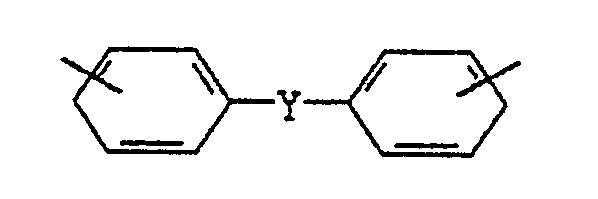
- Die aromatischen Ringe von X können auch unabhängig voneinander mit Alkylgruppen (A) mit 1-4 C-Atomen (bis zu 4 Alkylgruppen pro aromatischer Ring) substituiert sein.
- Besonders bevorzugte Polyphosphonate sind die Phosphonsäureester des 4,4ʹ-Dihyroxydiphenyls und/oder des Hydrochinons mit Methanphosphonsäure und/oder Ethanphosphonsäure.
- Die Polyphosphonate besitzen vorzugsweise mittlere Molekulargewichte (Zahlenmitteln osmometrisch in Methylenchlorid bestimmt) von 2000 bis 80 000, insbesondere 4000 bis 40 000.

- Die Compoundierung der Mischungen erfolgt auf handelsüblichen Ein- und Mehrwellenextrudern herkömmlicher Bauart. Dabei können die vorgemischten Polymeren direkt in den Extruder gegeben werden. Man kann aber auch das Polyphosphonat in bereits geschmolzenes Polyamid dosieren. Diese Arbeitsweise bietet sich an, wenn ein empfindliches Polyphosphonat verwendet wird.
- Zur Compoundierung können gegebenenfalls auch sog. "Masterbatches", d.h. Schmelzmischungen aus hohen Anteilen Polyphosphonaten (z.B. 50 bis 90 Gew.-%) und geringen Anteilen (z.B. 50 bis 10 Gew.-%) an amorphen, teilaromatischen Polyamiden mit den amorphen, teilaromatischen Polyamiden zu erfindungsgemäßen Polyamiden vermischt werden, um zu den anspruchsgemäßen, vorzugsweise 3 bis 20 Gew.-%, Polyphosphonate enthaltenden Formmassen zu gelangen.
- Die Compoundierung sollte bei Temperaturen von 260 bis 285°C, vorzugsweise 270 bis 285°C erfolgen.
- Die erfindungsgemäßen, thermoplastisch verarbeitbaren, flammfesten Polyamidformmassen können die üblichen Zusätze und Hilfsmittel in üblichen Mengen nach dem Stand der Technik, beispielsweise einen oder mehrere Füllstoffe, insbesondere Glasfasern in Mengen von 10 bis 60 Gew.-%, bezogen auf die gesamte Mischung enthalten. Als weitere Füll- und Verstärkungsstoffe kommen Mikroglaskugeln, Kreide, Quarze wie Asbest, Feldspat, Glimmer, Talkum, Wollastonit sowie Kaolin in calzinierter und nicht calzinierter Form in Betracht. Außerdem sind Farbstofffe und Pigmente, insbesondere Farbruße und/oder Nigrosinbasen, Stabilisatoren sowie Verarbeitungshilfsmittel zu nennen, ferner die dem Stand der Technik bekannten Schlagzähmodifikatoren, beispielsweise auf der Basis von Copolymerisaten des Ethylens, Poly(meth)acrylaten und gepfropften Polybutadienen und viele andere mehr, wie in der Literatur und in Patenten beschrieben. Je nach Verwendungszweck können auch weitere Flammschutzmittel mitverwendet werden, z.B. Halogenverbindungen der bekannten Art, gegebenenfalls unter Zusatz von synergistischen Additiven wie Zinkoxid, Zinkboraten, Antimonoxid, Metallsalzen und/oder Melamin bzw. Melaminderivaten der bekannten Art.
- Die erfindungsgemäßen Formmassen zeichnen sich durch eine Schwerentflammbarkeit, durch gute Homogenität und gute mechanische und elektrische Eigenschaften aus. Außerdem wird durch die erfindungsgemäße Flammfestausrüstung die Transparenz der Polyamide nicht beeinflußt. Sie eignen sich zur Herstellung von Spritzgießteilen für technische Anwendungen, beispielsweise für Gehäuseteile, Abdeckungen, transparente Teile für Meßgeräte oder auch für Filamente.
- In 90 Gew.-Teile eines Polyamides aus Isophthalsäure und Hexamethylendiamin mit einer relativen Viskosität von 2,5, gemessen an einer einprozentigen Lösung in m-Kresol bei 25°C werden 10 Gew.-Teile eines Polyphosphonates, hergestellt aus Dihydroxydiphenyl und Methanphosphonsäurediphenylester (ηrel - 1,100, gemessen an einer 0,5 %igen Lösung in Methylenchlorid bei 25°C) auf einem Einwellenextruder (Haake) bei einer Massetemperatur von 278°C eingearbeitet. Das Granulat wird zu transparenten Formkörpern verarbeitet. Das Brandverhalten nach UL, Subj. 94 ist V O für 1,6 mm Wandstärke.
- Beispiel 1 wird wiederholt wobei eine Mischung aus 15 Gew.-Teilen Polyphosphonat und 75 Gew.-Teilen Polyamid hergestellt wird. Die Massetemperatur beträgt 276°C. Die Formkörper aus dieser Mischung sind transparent und zeigen ein Brandverhalten nach UL Subj. 94 V O für 1,6 mm Wandstärke.
- In einem Doppelwellenextruder (ZSK 32 der Firma Werner & Pfleiderer) werden 88 Gew.-Teile Polyamid aus Isophthalsäure und Hexamethylendiamin (ηrel = 2,5) und 12 Gew.-Teile Polyphosphonat, hergestellt aus Methanphosphon säure und 4,4ʹ-Dihydroxydiphenyl (ηrel = 1,100) bei 285°C Massetemperatur gemischt. Man erhält ein Produkt mit einer relativen Viskosität von 2,4, das zu transparenten Formkörpern verarbeitet werden kann. Das Brandverhalten nach UL, Subj. 94 ist V O für 1,6 mm Wandstärke.
- Die Kriechstromfestigkeit (VDE 0303, Teil 1, DIN 53 480) hat folgende Werte:
KB 600; KC 600. - Eine Mischung aus 80 Gew.-Tle. eines Polyamids aus Isophthalsäure und Hexamethylendiamin und 20 Gew.-Tle. eines Polyphosphonats, hergestellt gemäß DE-A 2 944 093 aus Methanphosphonsäurediphenylester und 4,4ʹ-Dihydroxydiphenyl, wird in einem Einwellenextruder (Haake) bei 274°C Massetemperatur compoundiert. Das Produkt läßt sich zu Formkörpern mit einer Schlagzähigkeit (DIN 53 453) von 42 kJ/m² und einer Wärmeformbeständigkeit von 130°C (Vicat, VSTB) verarbeiten.
- Die relativen Viskositäten, gemessen bei 25°C in einem Ubbelohde-Viskosimeter, betragen:
Polyphosphonat: 1,234 (0,5 prozentige Lösung in Methylenchlorid
Polyamid: 2,5 (1 prozentige Lösung in m-Kresol)
Mischung; 2,4 (1 prozentige Lösung in m-Kresol). - Eine Mischung aus 90 Gew.-Tle. des Polyamids aus Isophthalsäure und Hexamethylendiamin aus Beispiel 4 und 10 Gew.-Tle. eines niedermolekularen Polyphosphonats hergestellt aus Dihydroxydiphenyl und Methanphosphonsäurediphenylester (ηrel - 1,100, 0,5 %ig in Methylenchlorid) werden auf einem Doppelwellenextruder (ZSK 32 der Firma Werner & Pfleiderer) bei 262°C Massetemperatur compoundiert. Man erhält eine Mischung mit einer relativen Viskosität von 2,33 (1 %ig in m-Kresol). Das Granulat wurde zu Formkörpern verarbeitet; die Schlagzähigkeit nach DIN 53 453 beträgt 8 x nicht gebrochen, 2 x 10³ kJ/m².
- 95 Gew.-Tle. des Polyamids aus Isophthalsäure und Hexamethylendiamin aus Beispiel 4 und 5 Gew.-Tle. eines Polyphosphonats, hergestellt aus Hydrochinon und Methanphosphonsäurediphenylester (ηrel = 1,16, 0,5 %ig in Methylenchlorid), werden auf einem Doppelwellenextruder (ZSK 32 der Firma Werner & Pfleiderer) bei einer Massetemperatur von 247°C compoundiert. Man erhält ein gut verarbeitbares Produkt mit einer relativen Viskosität von 2,9 (1 %ig in m-Kresol).
- Wie in Beispiel 4 beschrieben, wird eine Mischung aus 90 Gew.-Tle. Polyphosphonat und10 Gew.-Tle. amorphes, teilaromatisches Polyamid bei 274°C Massetemperatur compoundiert. Die Mischung hat eine relative Viskosität von 1,4; die Schlagzähigkeit nach DIN 53 453 beträgt 4 kJ/m², die Wärmeformbeständigkeit nach Vicat, VSTB ist 127°C. Ein zu hoher Polyphosphonatanteil ist zwar compoundierbar, führt aber zu hohem Polymerabbau.
- Es wird versucht, 20 Gew.-Tle. Polyphosphonat (gemäß Beispiel 4) und 80 Gew.-Tle. Polyamid-66 (ηrel = 3,0, 1 %ig in m-Kresol) in einem Einwellenextruder (Haake) bei 270°C Massetemperatur zu mischen. Da die Mischung dabei vernetzt, ist die Herstellung eines brauchbaren, verarbeitbaren Granulats nicht möglich.
- Eine Mischung aus 10 Gew.-Tle. Polyphosphonat (gemäß Beispiel 4) und 90 Gew.-Tle. Polyamid 6 (ηrel = 3,0 1 %ig in m-Kresol) werden in einem Einwellenextruder (Haake) gegeben. Das Material läßt sich bei einer Temperatur von ca. 270°C nicht extrudieren, da es bereits im Extruder vernetzt.
Claims (6)
1. 60-97 Gew.-% eines amorphen, teilaromatischen Polyamids und
2. 3-40 Gew.-% eines Polyphosphonats,
wobei die Summe der beiden Komponenten 1) + 2) immer 100 Gew.-% betragen muß und die Mischung gegebenenfalls zusätzlich übliche Zusätze und Hilfsmittel in üblichen Mengen enthält,
bestehen.
1. 97-80 Gew.-% eines amorphen, teilaromatischen Polyamids und
2. 3-20 Gew.-% eines Polyphosphonats
bestehen.
1. 92-85 Gew.-% eines amorphen, teilaromatischen Polyamids und
2. 8-15 Gew.-% eines Polyphosphonats
bestehen.
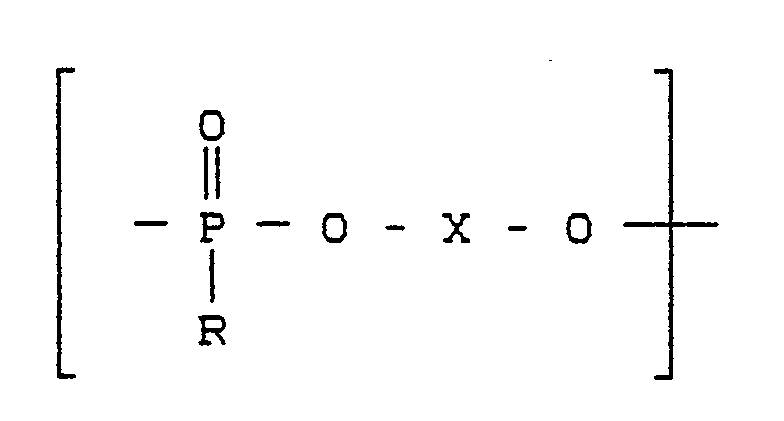
R einen Alkylrest mit 1-6, vorzugsweise 1-3 C-Atomen oder einen gegebenenfalls substituierten Cycloalkylrest mit 5-30, vorzugsweise 6-12 C-Atomen, einen Alkylrest mit 7-30, vorzugsweise 7-16 C-Atomen, oder einen Arylrest mit 6-30, vorzugsweise 6-18 C-Atomen,
X mindestens einen der Reste Phenylen oder einen Rest

mit Y = einer Bindung oder einem C₁-C₅-, vorzugsweise C₁-C₃-Alkylenrest, C₅-C₁₂-, vorzugsweise C₆-C₁₀-Cycloalkylenrest oder ein Brückenglied S, O, SO₂, CO oder C(CH₃)₂ darstellt und die aromatischen Ringe gegebenenfalls mit C₁-C₄-Alkylgruppen (A) mit bis zu 4 Alkylgruppen pro Ring substituiert sind.
Applications Claiming Priority (4)
| Application Number | Priority Date | Filing Date | Title |
|---|---|---|---|
| DE19863613490 DE3613490A1 (de) | 1986-04-22 | 1986-04-22 | Flammfeste polyamide |
| DE3613491 | 1986-04-22 | ||
| DE3613490 | 1986-04-22 | ||
| DE19863613491 DE3613491A1 (de) | 1986-04-22 | 1986-04-22 | Mischungen aus polyamiden und polyphosphonaten |
Publications (2)
| Publication Number | Publication Date |
|---|---|
| EP0242732A1 true EP0242732A1 (de) | 1987-10-28 |
| EP0242732B1 EP0242732B1 (de) | 1992-01-08 |
Family
ID=25843092
Family Applications (1)
| Application Number | Title | Priority Date | Filing Date |
|---|---|---|---|
| EP87105306A Expired - Lifetime EP0242732B1 (de) | 1986-04-22 | 1987-04-10 | Flammfeste Polyamide |
Country Status (3)
| Country | Link |
|---|---|
| US (1) | US4788259A (de) |
| EP (1) | EP0242732B1 (de) |
| DE (1) | DE3775816D1 (de) |
Cited By (3)
| Publication number | Priority date | Publication date | Assignee | Title |
|---|---|---|---|---|
| US6153677A (en) * | 1993-12-23 | 2000-11-28 | Ems-Inventa Ag | Flame-retardant thermoplastic polyamide molding composition and article molded therefrom |
| WO2004076536A1 (en) * | 2003-02-24 | 2004-09-10 | Triton Systems Inc. | Branched polyphosphonates |
| WO2004076537A1 (en) * | 2003-02-24 | 2004-09-10 | Triton Systems, Inc. | Linear polyphosphonates and methods of making |
Families Citing this family (15)
| Publication number | Priority date | Publication date | Assignee | Title |
|---|---|---|---|---|
| DE3833694A1 (de) * | 1988-10-04 | 1990-04-05 | Bayer Ag | Flammgeschuetzte, gut kristallisierende polyethylenterephthalatformmassen |
| EP0817812A1 (de) * | 1995-03-31 | 1998-01-14 | Siemens Aktiengesellschaft | Flammwidrige polyamide |
| GB9609606D0 (en) * | 1996-05-08 | 1996-07-10 | T & N Technology Ltd | Fire-resistant monofilament |
| DE10009756B4 (de) * | 2000-03-01 | 2004-03-25 | Ems-Chemie Ag | Farblose, hochtransparente Polyamid-Blends mit verbesserter Spannungsrissbeständigkeit |
| US7645850B2 (en) * | 2005-08-11 | 2010-01-12 | Frx Polymers, Inc. | Poly(block-phosphonato-ester) and poly(block-phosphonato-carbonate) and methods of making same |
| US7666932B2 (en) * | 2005-10-17 | 2010-02-23 | Frx Polymers, Inc. | Compositions comprising polyphosphonates and additives that exhibit an advantageous combination of properties, and methods related thereto |
| US7838604B2 (en) * | 2005-12-01 | 2010-11-23 | Frx Polymers, Inc. | Method for the production of block copolycarbonate/phosphonates and compositions therefrom |
| WO2014116669A1 (en) | 2013-01-22 | 2014-07-31 | Frx Polymers, Inc. | Phosphorus containing epoxy compounds and compositions therefrom |
| WO2014197462A1 (en) * | 2013-06-03 | 2014-12-11 | Polyone Corporation | Flame retardant high temperature nylon |
| WO2015021299A1 (en) * | 2013-08-08 | 2015-02-12 | Polyone Corporation | Flame retardant poly(hexano-6-lactam) |
| WO2015021302A1 (en) * | 2013-08-08 | 2015-02-12 | Polyone Corporation | Flame retardant poly(hexamethylene adipamide) |
| CN103992639A (zh) * | 2014-04-30 | 2014-08-20 | 赵雪雅 | 一种导热尼龙塑料及其制备方法和应用 |
| CN113493607B (zh) * | 2021-07-26 | 2022-04-08 | 洪湖市一泰科技有限公司 | 尼龙阻燃复合材料及其制备方法 |
| CN113372717A (zh) * | 2021-07-26 | 2021-09-10 | 洪湖市一泰科技有限公司 | 高温尼龙阻燃材料及其制备方法 |
| CN113416413B (zh) * | 2021-07-26 | 2022-04-12 | 洪湖市一泰科技有限公司 | 玻纤增强尼龙10t阻燃复合材料及其制备方法与应用 |
Citations (4)
| Publication number | Priority date | Publication date | Assignee | Title |
|---|---|---|---|---|
| DE1770359A1 (de) * | 1967-05-08 | 1970-03-12 | Monsanto Co | Polymere Zubereitungen |
| US4078016A (en) * | 1976-05-17 | 1978-03-07 | Celanese Corporation | Halogenated aromatic polymer/metal phosphinate polymer flame retardant composition |
| DE2944093A1 (de) * | 1979-10-31 | 1981-05-14 | Bayer Ag, 5090 Leverkusen | Verfahren zur herstellung von thermoplastischen aromatischen polyphosphonaten verbesserter thermischer alterungsbestaendigkeit und deren verwendung |
| EP0077493A2 (de) * | 1981-10-19 | 1983-04-27 | Mobay Corporation | Polysulfon-Polyphosphonat-Formmassen |
Family Cites Families (5)
| Publication number | Priority date | Publication date | Assignee | Title |
|---|---|---|---|---|
| US3576793A (en) * | 1967-05-08 | 1971-04-27 | Monsanto Co | Polymers of alkylene diphosphonic acids and salts and copolymers thereof |
| US3544509A (en) * | 1967-05-08 | 1970-12-01 | Monsanto Co | Diphosphonic acids and salts thereof as flame retardants |
| JPS5282955A (en) * | 1975-12-29 | 1977-07-11 | Toyobo Co Ltd | Flame resistance compositions |
| JPS57192460A (en) * | 1981-05-18 | 1982-11-26 | Teijin Ltd | Polyamide composition |
| DE3460574D1 (en) * | 1983-01-21 | 1986-10-09 | Ciba Geigy Ag | Sterically hindered polymeric phosphonate stabilizing agent |
-
1987
- 1987-04-10 EP EP87105306A patent/EP0242732B1/de not_active Expired - Lifetime
- 1987-04-10 DE DE8787105306T patent/DE3775816D1/de not_active Expired - Lifetime
- 1987-04-10 US US07/037,033 patent/US4788259A/en not_active Expired - Fee Related
Patent Citations (4)
| Publication number | Priority date | Publication date | Assignee | Title |
|---|---|---|---|---|
| DE1770359A1 (de) * | 1967-05-08 | 1970-03-12 | Monsanto Co | Polymere Zubereitungen |
| US4078016A (en) * | 1976-05-17 | 1978-03-07 | Celanese Corporation | Halogenated aromatic polymer/metal phosphinate polymer flame retardant composition |
| DE2944093A1 (de) * | 1979-10-31 | 1981-05-14 | Bayer Ag, 5090 Leverkusen | Verfahren zur herstellung von thermoplastischen aromatischen polyphosphonaten verbesserter thermischer alterungsbestaendigkeit und deren verwendung |
| EP0077493A2 (de) * | 1981-10-19 | 1983-04-27 | Mobay Corporation | Polysulfon-Polyphosphonat-Formmassen |
Non-Patent Citations (2)
| Title |
|---|
| PATENT ABSTRACTS OF JAPAN, Band 1, Nr. 120 (C-77), 12. Oktober 1977, Seite 2849 C 77; & JP - A - 52 82955 (TOYO BOSEKI) 07.11.1977 * |
| PATENT ABSTRACTS OF JAPAN, Band 7, Nr. 39 (C-151)[1184], 17. Februar 1983; & JP - A - 57 192 460 (TEIJIN) 26.11.1982 * |
Cited By (5)
| Publication number | Priority date | Publication date | Assignee | Title |
|---|---|---|---|---|
| US6153677A (en) * | 1993-12-23 | 2000-11-28 | Ems-Inventa Ag | Flame-retardant thermoplastic polyamide molding composition and article molded therefrom |
| WO2004076536A1 (en) * | 2003-02-24 | 2004-09-10 | Triton Systems Inc. | Branched polyphosphonates |
| WO2004076537A1 (en) * | 2003-02-24 | 2004-09-10 | Triton Systems, Inc. | Linear polyphosphonates and methods of making |
| US7816486B2 (en) | 2003-02-24 | 2010-10-19 | Frx Polymers, Inc. | Branched polyphosphonates |
| EP2275473A1 (de) * | 2003-02-24 | 2011-01-19 | FRX Polymers LLC | Verzweigte Polyphosphonate |
Also Published As
| Publication number | Publication date |
|---|---|
| EP0242732B1 (de) | 1992-01-08 |
| DE3775816D1 (de) | 1992-02-20 |
| US4788259A (en) | 1988-11-29 |
Similar Documents
| Publication | Publication Date | Title |
|---|---|---|
| EP0242732B1 (de) | Flammfeste Polyamide | |
| DE602004013463T2 (de) | Flammgeschützte polyamid-zusammensetzungen mittels aluminiumhypophosphit | |
| DE60115673T3 (de) | Halogenfreie flammhemmende zusammensetzung und flammhemmende polyamid-zusammensetzung | |
| DE3874796T2 (de) | Brandgeschuetzte polyamidmischung mit guter hitzeresistenter eigenschaft. | |
| DE69121599T2 (de) | Thermoplastische Harzzusammensetzung | |
| EP1121388B1 (de) | Mit kupferkomplexen und organischen halogenverbindungen stabilisierte polyamidzusammensetzung | |
| EP1276816B1 (de) | Polyarylethersulfon/polyamid-blends mit verbesserter zähigkeit und fliessfähigkeit | |
| EP1613698A1 (de) | Flammgeschützte polyamidformmassen | |
| EP0002514B2 (de) | Verfahren zum Flammfest- Ausrüsten von thermoplastischen Kunststoffen | |
| DE4136994A1 (de) | Thermoplastische formmassen mit lasersensitiver pigmentierung | |
| EP0745642B1 (de) | Thermostabile, witterungsbeständige Polyamidformmassen | |
| EP0287955A1 (de) | Verfahren zur Herstellung von brandgeschützten, roten Phosphor enthaltenden thermoplastischen Formmassen auf der Basis von Polyestern oder Polyamiden | |
| DE68921404T2 (de) | Polyarylensulfidzusammensetzung und Formmasse, die eine Metallverbindung enhält. | |
| DE4138386A1 (de) | Flammfeste thermoplastische formmassen | |
| EP3652242A1 (de) | Flammhemmende polyamidzusammensetzungen mit hoher wärmeformbeständigkeit und deren verwendung | |
| EP0332965A1 (de) | Aromatische Polyamide als Flammschutzmittel-Synergisten mit Antidripping-Wirkung für aliphatische Polyamidformmassen und ihre Verwendung | |
| DE3208486C2 (de) | Flammfeste Polyamid-Formmasse und Verfahren zu ihrer Herstellung | |
| EP0605864B1 (de) | Schwerentflammbare Polyamidformmassen | |
| EP0245675B1 (de) | Flammfeste Polyamide | |
| DE3613490A1 (de) | Flammfeste polyamide | |
| EP0591731A1 (de) | Fliessfähige Polyamidformmassen | |
| DE4021501A1 (de) | Halogenfreie, flammfest ausgeruestete abs-formmassen | |
| WO1990002775A1 (de) | Schlagzähe polyester- und polyamidformmassen | |
| EP0590392B1 (de) | Formmassen auf der Basis von Polyarylethern und schlagzähmodifizierten teilaromatischen Copolyamiden | |
| EP0006549A1 (de) | Stabilisierte, flammgeschützte, thermoplastische Formmassen |
Legal Events
| Date | Code | Title | Description |
|---|---|---|---|
| PUAI | Public reference made under article 153(3) epc to a published international application that has entered the european phase |
Free format text: ORIGINAL CODE: 0009012 |
|
| 17P | Request for examination filed |
Effective date: 19870410 |
|
| AK | Designated contracting states |
Kind code of ref document: A1 Designated state(s): DE ES FR GB IT NL |
|
| 17Q | First examination report despatched |
Effective date: 19890810 |
|
| GRAA | (expected) grant |
Free format text: ORIGINAL CODE: 0009210 |
|
| AK | Designated contracting states |
Kind code of ref document: B1 Designated state(s): DE ES FR GB IT NL |
|
| PG25 | Lapsed in a contracting state [announced via postgrant information from national office to epo] |
Ref country code: IT Free format text: LAPSE BECAUSE OF FAILURE TO SUBMIT A TRANSLATION OF THE DESCRIPTION OR TO PAY THE FEE WITHIN THE PRESCRIBED TIME-LIMIT;WARNING: LAPSES OF ITALIAN PATENTS WITH EFFECTIVE DATE BEFORE 2007 MAY HAVE OCCURRED AT ANY TIME BEFORE 2007. THE CORRECT EFFECTIVE DATE MAY BE DIFFERENT FROM THE ONE RECORDED. Effective date: 19920108 Ref country code: GB Effective date: 19920108 Ref country code: NL Effective date: 19920108 |
|
| REF | Corresponds to: |
Ref document number: 3775816 Country of ref document: DE Date of ref document: 19920220 |
|
| PG25 | Lapsed in a contracting state [announced via postgrant information from national office to epo] |
Ref country code: ES Free format text: LAPSE BECAUSE OF FAILURE TO SUBMIT A TRANSLATION OF THE DESCRIPTION OR TO PAY THE FEE WITHIN THE PRESCRIBED TIME-LIMIT Effective date: 19920419 |
|
| PG25 | Lapsed in a contracting state [announced via postgrant information from national office to epo] |
Ref country code: FR Effective date: 19920529 |
|
| EN | Fr: translation not filed | ||
| NLV1 | Nl: lapsed or annulled due to failure to fulfill the requirements of art. 29p and 29m of the patents act | ||
| GBV | Gb: ep patent (uk) treated as always having been void in accordance with gb section 77(7)/1977 [no translation filed] | ||
| PLBE | No opposition filed within time limit |
Free format text: ORIGINAL CODE: 0009261 |
|
| STAA | Information on the status of an ep patent application or granted ep patent |
Free format text: STATUS: NO OPPOSITION FILED WITHIN TIME LIMIT |
|
| 26N | No opposition filed | ||
| PG25 | Lapsed in a contracting state [announced via postgrant information from national office to epo] |
Ref country code: DE Effective date: 19930101 |
|
| REG | Reference to a national code |
Ref country code: FR Ref legal event code: ST |