EP0242535A2 - Verfahren zur Herstellung grobkristalliner Nicotinsäure hoher Reinheit - Google Patents
Verfahren zur Herstellung grobkristalliner Nicotinsäure hoher Reinheit Download PDFInfo
- Publication number
- EP0242535A2 EP0242535A2 EP87102566A EP87102566A EP0242535A2 EP 0242535 A2 EP0242535 A2 EP 0242535A2 EP 87102566 A EP87102566 A EP 87102566A EP 87102566 A EP87102566 A EP 87102566A EP 0242535 A2 EP0242535 A2 EP 0242535A2
- Authority
- EP
- European Patent Office
- Prior art keywords
- nicotinic acid
- acid
- cyanopyridine
- solution
- nicotinate
- Prior art date
- Legal status (The legal status is an assumption and is not a legal conclusion. Google has not performed a legal analysis and makes no representation as to the accuracy of the status listed.)
- Granted
Links
- PVNIIMVLHYAWGP-UHFFFAOYSA-N Niacin Chemical compound OC(=O)C1=CC=CN=C1 PVNIIMVLHYAWGP-UHFFFAOYSA-N 0.000 title claims abstract description 62
- 235000001968 nicotinic acid Nutrition 0.000 title claims abstract description 36
- 239000011664 nicotinic acid Substances 0.000 title claims abstract description 36
- 229960003512 nicotinic acid Drugs 0.000 title claims abstract description 27
- 238000000034 method Methods 0.000 title claims description 16
- 238000002360 preparation method Methods 0.000 title claims description 3
- GZPHSAQLYPIAIN-UHFFFAOYSA-N 3-pyridinecarbonitrile Chemical compound N#CC1=CC=CN=C1 GZPHSAQLYPIAIN-UHFFFAOYSA-N 0.000 claims abstract description 15
- 239000002253 acid Substances 0.000 claims abstract description 10
- 229910052500 inorganic mineral Inorganic materials 0.000 claims abstract description 9
- 239000011707 mineral Substances 0.000 claims abstract description 9
- 150000008044 alkali metal hydroxides Chemical class 0.000 claims abstract description 8
- 239000000243 solution Substances 0.000 claims description 19
- QGZKDVFQNNGYKY-UHFFFAOYSA-N Ammonia Chemical compound N QGZKDVFQNNGYKY-UHFFFAOYSA-N 0.000 claims description 14
- QAOWNCQODCNURD-UHFFFAOYSA-N Sulfuric acid Chemical compound OS(O)(=O)=O QAOWNCQODCNURD-UHFFFAOYSA-N 0.000 claims description 12
- VEXZGXHMUGYJMC-UHFFFAOYSA-N Hydrochloric acid Chemical compound Cl VEXZGXHMUGYJMC-UHFFFAOYSA-N 0.000 claims description 8
- 229910021529 ammonia Inorganic materials 0.000 claims description 7
- 239000000725 suspension Substances 0.000 claims description 5
- 239000003513 alkali Substances 0.000 claims description 4
- 239000007864 aqueous solution Substances 0.000 claims description 4
- XLYOFNOQVPJJNP-UHFFFAOYSA-N water Substances O XLYOFNOQVPJJNP-UHFFFAOYSA-N 0.000 claims description 4
- 238000006243 chemical reaction Methods 0.000 claims description 3
- 239000002244 precipitate Substances 0.000 claims description 2
- -1 alkali metal nicotinate Chemical class 0.000 abstract description 2
- 229910052783 alkali metal Inorganic materials 0.000 abstract 1
- 230000003301 hydrolyzing effect Effects 0.000 abstract 1
- HEMHJVSKTPXQMS-UHFFFAOYSA-M Sodium hydroxide Chemical compound [OH-].[Na+] HEMHJVSKTPXQMS-UHFFFAOYSA-M 0.000 description 12
- 238000001556 precipitation Methods 0.000 description 5
- KWYUFKZDYYNOTN-UHFFFAOYSA-M Potassium hydroxide Chemical compound [OH-].[K+] KWYUFKZDYYNOTN-UHFFFAOYSA-M 0.000 description 4
- 239000000047 product Substances 0.000 description 4
- 238000007127 saponification reaction Methods 0.000 description 4
- 229910001854 alkali hydroxide Inorganic materials 0.000 description 3
- 238000001228 spectrum Methods 0.000 description 3
- DFPAKSUCGFBDDF-UHFFFAOYSA-N Nicotinamide Chemical compound NC(=O)C1=CC=CN=C1 DFPAKSUCGFBDDF-UHFFFAOYSA-N 0.000 description 2
- 150000007513 acids Chemical class 0.000 description 2
- ONJIBHRZSUEBDS-UHFFFAOYSA-N azane;pyridine-3-carboxylic acid Chemical compound [NH4+].[O-]C(=O)C1=CC=CN=C1 ONJIBHRZSUEBDS-UHFFFAOYSA-N 0.000 description 2
- 238000004140 cleaning Methods 0.000 description 2
- 230000007062 hydrolysis Effects 0.000 description 2
- 238000006460 hydrolysis reaction Methods 0.000 description 2
- 239000000203 mixture Substances 0.000 description 2
- 239000002245 particle Substances 0.000 description 2
- 238000005903 acid hydrolysis reaction Methods 0.000 description 1
- 229910052788 barium Inorganic materials 0.000 description 1
- DSAJWYNOEDNPEQ-UHFFFAOYSA-N barium atom Chemical compound [Ba] DSAJWYNOEDNPEQ-UHFFFAOYSA-N 0.000 description 1
- RQPZNWPYLFFXCP-UHFFFAOYSA-L barium dihydroxide Chemical compound [OH-].[OH-].[Ba+2] RQPZNWPYLFFXCP-UHFFFAOYSA-L 0.000 description 1
- 229910001863 barium hydroxide Inorganic materials 0.000 description 1
- 238000009835 boiling Methods 0.000 description 1
- 239000000872 buffer Substances 0.000 description 1
- 239000006227 byproduct Substances 0.000 description 1
- 230000003197 catalytic effect Effects 0.000 description 1
- 238000002425 crystallisation Methods 0.000 description 1
- 230000008025 crystallization Effects 0.000 description 1
- 238000000354 decomposition reaction Methods 0.000 description 1
- 238000007791 dehumidification Methods 0.000 description 1
- 238000010790 dilution Methods 0.000 description 1
- 239000012895 dilution Substances 0.000 description 1
- 239000003814 drug Substances 0.000 description 1
- 238000001035 drying Methods 0.000 description 1
- 238000005516 engineering process Methods 0.000 description 1
- 239000012065 filter cake Substances 0.000 description 1
- 238000010574 gas phase reaction Methods 0.000 description 1
- 238000005469 granulation Methods 0.000 description 1
- 230000003179 granulation Effects 0.000 description 1
- 239000007791 liquid phase Substances 0.000 description 1
- 150000002763 monocarboxylic acids Chemical class 0.000 description 1
- 235000005152 nicotinamide Nutrition 0.000 description 1
- 239000011570 nicotinamide Substances 0.000 description 1
- 229910052757 nitrogen Inorganic materials 0.000 description 1
- 125000004433 nitrogen atom Chemical group N* 0.000 description 1
- 230000003647 oxidation Effects 0.000 description 1
- 238000007254 oxidation reaction Methods 0.000 description 1
- SIOXPEMLGUPBBT-UHFFFAOYSA-N picolinic acid Chemical class OC(=O)C1=CC=CC=N1 SIOXPEMLGUPBBT-UHFFFAOYSA-N 0.000 description 1
- FLEVOWUFZJNVSR-UHFFFAOYSA-N pyridine-3-carbonitrile;pyridine-3-carboxylic acid Chemical compound N#CC1=CC=CN=C1.OC(=O)C1=CC=CN=C1 FLEVOWUFZJNVSR-UHFFFAOYSA-N 0.000 description 1
- 239000000376 reactant Substances 0.000 description 1
- 239000011541 reaction mixture Substances 0.000 description 1
- 230000035484 reaction time Effects 0.000 description 1
- 238000011084 recovery Methods 0.000 description 1
- 238000007873 sieving Methods 0.000 description 1
- KFLRWGSAMLBHBV-UHFFFAOYSA-M sodium;pyridine-3-carboxylate Chemical compound [Na+].[O-]C(=O)C1=CC=CN=C1 KFLRWGSAMLBHBV-UHFFFAOYSA-M 0.000 description 1
- 238000001256 steam distillation Methods 0.000 description 1
- 239000000126 substance Substances 0.000 description 1
- 238000005979 thermal decomposition reaction Methods 0.000 description 1
- 239000010409 thin film Substances 0.000 description 1
- 238000005406 washing Methods 0.000 description 1
Images
Classifications
-
- C—CHEMISTRY; METALLURGY
- C07—ORGANIC CHEMISTRY
- C07D—HETEROCYCLIC COMPOUNDS
- C07D213/00—Heterocyclic compounds containing six-membered rings, not condensed with other rings, with one nitrogen atom as the only ring hetero atom and three or more double bonds between ring members or between ring members and non-ring members
- C07D213/02—Heterocyclic compounds containing six-membered rings, not condensed with other rings, with one nitrogen atom as the only ring hetero atom and three or more double bonds between ring members or between ring members and non-ring members having three double bonds between ring members or between ring members and non-ring members
- C07D213/04—Heterocyclic compounds containing six-membered rings, not condensed with other rings, with one nitrogen atom as the only ring hetero atom and three or more double bonds between ring members or between ring members and non-ring members having three double bonds between ring members or between ring members and non-ring members having no bond between the ring nitrogen atom and a non-ring member or having only hydrogen or carbon atoms directly attached to the ring nitrogen atom
- C07D213/60—Heterocyclic compounds containing six-membered rings, not condensed with other rings, with one nitrogen atom as the only ring hetero atom and three or more double bonds between ring members or between ring members and non-ring members having three double bonds between ring members or between ring members and non-ring members having no bond between the ring nitrogen atom and a non-ring member or having only hydrogen or carbon atoms directly attached to the ring nitrogen atom with hetero atoms or with carbon atoms having three bonds to hetero atoms with at the most one bond to halogen, e.g. ester or nitrile radicals, directly attached to ring carbon atoms
- C07D213/78—Carbon atoms having three bonds to hetero atoms, with at the most one bond to halogen, e.g. ester or nitrile radicals
- C07D213/79—Acids; Esters
- C07D213/803—Processes of preparation
-
- C—CHEMISTRY; METALLURGY
- C07—ORGANIC CHEMISTRY
- C07D—HETEROCYCLIC COMPOUNDS
- C07D213/00—Heterocyclic compounds containing six-membered rings, not condensed with other rings, with one nitrogen atom as the only ring hetero atom and three or more double bonds between ring members or between ring members and non-ring members
- C07D213/02—Heterocyclic compounds containing six-membered rings, not condensed with other rings, with one nitrogen atom as the only ring hetero atom and three or more double bonds between ring members or between ring members and non-ring members having three double bonds between ring members or between ring members and non-ring members
- C07D213/04—Heterocyclic compounds containing six-membered rings, not condensed with other rings, with one nitrogen atom as the only ring hetero atom and three or more double bonds between ring members or between ring members and non-ring members having three double bonds between ring members or between ring members and non-ring members having no bond between the ring nitrogen atom and a non-ring member or having only hydrogen or carbon atoms directly attached to the ring nitrogen atom
- C07D213/60—Heterocyclic compounds containing six-membered rings, not condensed with other rings, with one nitrogen atom as the only ring hetero atom and three or more double bonds between ring members or between ring members and non-ring members having three double bonds between ring members or between ring members and non-ring members having no bond between the ring nitrogen atom and a non-ring member or having only hydrogen or carbon atoms directly attached to the ring nitrogen atom with hetero atoms or with carbon atoms having three bonds to hetero atoms with at the most one bond to halogen, e.g. ester or nitrile radicals, directly attached to ring carbon atoms
- C07D213/78—Carbon atoms having three bonds to hetero atoms, with at the most one bond to halogen, e.g. ester or nitrile radicals
- C07D213/79—Acids; Esters
- C07D213/80—Acids; Esters in position 3
Definitions
- the present invention relates to a process for producing coarse-crystalline nicotinic acid of high purity, which is precipitated from alkaline alkali nicotinate solutions by adding mineral acid.
- DE-PS 828 246 also relates to the saponification of 3-cyanopyridine.
- the 3-cyanopyridine is reacted with an excess of barium hydroxide, the barium is then precipitated with sulfuric acid and a crude nicotinic acid is separated off, which still has to be purified.
- the low selectivity has so far prevented the technical implementation of the catalytic gas phase reaction.
- the product is finely crystalline and very dusty.
- the grain size distribution ranges from 5 ⁇ to 150 ⁇ . Since nicotinic acid is very irritating to the skin (Kirk-Othmer, Encyclopedia of Chemical Technology, Vol. 24, Third Edition, 86), hygiene problems can arise for both the manufacturer and the processor.
- the object of the invention is a process which makes it possible to produce a coarsely crystalline product suitable for pharmaceuticals and foodstuffs in high yields without granulation and cleaning stage, by saponification of 3-cyanopyridine with alkali hydroxide and subsequent precipitation of nicotinic acid.
- the invention relates to a process for the preparation of coarse crystalline nicotinic acid of high purity, in which 3-cyanopyridine is saponified with alkali metal hydroxide and the nicotinic acid is subsequently obtained from the nicotinate formed, which is characterized in that an aqueous solution of 3-cyanopyridine with equimolar amounts of a Alkali hydroxide, dissolved in water, at temperatures between 130 ° and 190 ° C and pressures between 1.5 and 2.0 MPa within 4 to 20 minutes, preferably 7 to 15 minutes, in a pressure reactor, e.g. B. a flow tube, the ammonia released in the reaction, by known methods, for. B.
- a pressure reactor e.g. B. a flow tube
- the ammonia-free alkali nicotinate solution at temperatures between 99 and 135 ° C, preferably 110 ° C, optionally under a pressure of 0.1 - 0.4 MPa, if the temperature is above the boiling point of the solution, slowly with a added aqueous mineral acid in such a way that the pH of the solution remains above 3.7, the nicotinic acid suspension which forms then cools to 0 ° to 20 ° C., and the crystallized nicotinic acid is separated off, for example by centrifuging, washing, drying and at Classified needs.
- the process according to the invention can be carried out both continuously and batchwise.
- a product is obtained which is dust-free and has pharmaceutical quality (European Pharmaceutical Book Vol. III, 164 (1978).
- the particle size distribution depends on the precipitation temperature and the rate of addition of the mineral acid to the nicotinate solution.
- the desired grain spectrum between 150 and 300 ⁇ (> 75%) can be achieved if the mineral acid is added continuously within 2 to 4 h, preferably 2.5 to 3.5 h.
- Particularly suitable acids are hydrochloric acid and sulfuric acid, hydrochloric acid in a concentration of 10 to 25% by weight, preferably 15% by weight, sulfuric acid in a concentration of 15 to 25% by weight, preferably 20% by weight.
- the mineral acids may only be added in such an amount that the pH of the solution does not reach 3.7.
- a pH of 3.9 to 4.1, in particular pH 4.0, is particularly suitable.
- Sodium hydroxide and potassium hydroxide in the form of 10 to 40% by weight aqueous solutions are particularly suitable as alkali hydroxides.
- 3-cyanopyridine is used in the form of aqueous solutions containing 10 to 50% by weight of 3-cyanopyridine.
- Both reactants are preferably mixed together before being fed into the hydrolysis reactor.
- the resulting nicotinate solution is then obtained in the appropriate dilution depending on the starting solutions.
- the nicotinic acid precipitates, it can also be concentrated by known measures, in particular to 30 to 60% by weight.
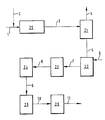
- the process is carried out as follows: Via line 1, an aqueous 3-cyanopyridine solution is pumped into the heated hydrolysis reactor 20 after admixing alkali metal hydroxide (line 2). The reaction mixture passes via line 3 into the stripper 21. Via line 4, the ammonia / water vapor mixture escapes and becomes ammonia recovery. The ammonia-free alkali nicotinate solution passes through line 5 into the precipitation reactor 22, which is simultaneously fed via line 6 with aqueous mineral acid. After the precipitation, the nicotinic acid suspension is drawn off via line 7 and the crystallization in crystallizer 23 continues. With the help of line 8, the centrifuge 24 is charged for dehumidification.
- the filter cake then reaches the dryer 25 via line 9. After classification 26, the nicotinic acid is obtained via line 11. The oversize is ground and the undersize is recycled.
- the mixture is centrifuged, washed, dried and the nicotinic acid obtained is classified by sieving.
- a pharmaceutical grade nicotinic acid is obtained with a yield of 97.2%, based on the 3-cyanopyridine used.
- the wash liquors are recycled.
- the grain size distribution is between 150 and 300 ⁇ (> 90%).
- Example 2 The procedure is as in Example 1, but uses 20% sulfuric acid to release the nicotinic acid and cools the suspension to 20 ° C. The yield is 94.8%. The purity meets the requirements of pharmacopoeias. The grain spectrum is between 150 and 300 ⁇ (> 90%).
- Example 2 The procedure is as in Example 1, but instead of sodium hydroxide solution uses 5.39 kg of a 30% strength potassium hydroxide solution per hour and carries out the precipitation analogously to Example 2 with sulfuric acid. The yield is 93.6%. The purity corresponds to the pharmacopoeias. The grain spectrum is between 150 and 300 ⁇ (> 90%).
Landscapes
- Chemical & Material Sciences (AREA)
- Organic Chemistry (AREA)
- Pyridine Compounds (AREA)
Abstract
Description
- Die vorliegende Erfindung betrifft ein Verfahren zur Herstellung grobkristalliner Nicotinsäure hoher Reinheit, die man aus alkalischen Alkalinicotinat-Lösungen durch Zusatz von Mineralsäure ausfällt.
- Zur Herstellung von Nicotinsäure sind viele Verfahren bekannt.
- Man kann sie durch Flüssigphasenoxidation von Alkylpyridinen (DE-OS 2 046 556, US-PS 4 001 257), saure Hydrolyse des 3-Cyanopyridins (DE-OS 2 438 263), oder Verseifung von 3-Cyanopyridin mit Ammoniak und anschließender Zersetzung des Ammoniumnicotinats mittels Wasserdampfdestillation gewinnen.
- Bekannt ist zwar die Verwendung von Natronlauge für diesen Zweck (C.A. 65, 5446 a (1966), PL-PS 50 077), die Autoren dieser Patentschrift halten jedoch Ammoniak für geeigneter.
- Die DE-PS 828 246 betrifft auch die Verseifung von 3-Cyanopyridin Gemäß dieser Druckschrift setzt man das 3-Cyanopyridin mit einem Überschuß an Bariumhydroxid um, fällt anschließend das Barium mit Schwefelsäure aus und trennt eine Rohnicotinsäure ab, die noch gereinigt werden muß.
- Die geringe Selektivität hat bisher die technische Realisierung der katalytischen Gasphasenreaktion verhindert.
- Die Verfahren, die durch ammoniokalische Verseifung von 3-Cyanopyridin Nicotinsäure gewinnen, besitzen den Nachteil, daß das hier anfallende Nebenprodukt Nicotinsäureamid Selektivität und Ausbeute schmälert und außerdem hohe Reaktionszeiten nötig sind (J.E. Paustian et al. Chemtech March 1981, 176 Fig. 4. J.A. Arkhipova et al. Zurnal Prikl. Khim. 35 (2), 366-369, (1962), B.V. Suvorov et al. Zurnal Prikl. Khim. 45, 2716-2718 (1972)). Wegen der starken Sublimationsneigung der Nicotinsäure führt die thermische Zersetzung von Ammoniumnicotinat mittels Wasserdampf zu Betriebsstörungen infolge von Verstopfungen, die sich nur durch hohen apparativen Aufwand minimieren lassen (DE-OS 2 423 755).
- Ein Nachteil aller oben beschriebenen Verfahren besteht darin, daß man eine Nicotinsäure erhält, die erst durch zusätzliche Reinigungsmaßnahmen die Anforderung für Pharma- und Lebensmittelqualität erfüllt (Ullmann, Encyklopädie der technischen Chemie, 4. Auflage, Bd. 23, 709 (1983)).
- Dazu kommt, daß das Produkt feinkristallin anfällt und stark staubt. Die Korngrößenverteilung reicht von 5 µ bis 150 µ. Da Nicotinsäure sehr hautreizend wirkt (Kirk-Othmer, Encyclopedia of Chemical Technology, Vol. 24, Third Edition, 86) kann es zu arbeitshygienischen Problemen sowohl beim Hersteller als auch beim Weiterverarbeiter kommen.
- Man versucht dieses Problem dadurch zu umgehen, daß man die feinkristalline Nicotinsäure granuliert und so ein Produkt mit einem Kornspektrum zwischen 100 und 315 µ (min 90 %) erhält (Lonza Revue 1/85, 14-15).
- Aufgabe der Erfindung ist ein Verfahren, das es ermöglicht, ohne Granulations- und Reinigungsstufe, durch Verseifung von 3-Cyanopyridin mit Alkalihydroxid und anschließendes Ausfällen von Nicotinsäure mit hohen Ausbeuten eine grobkristalline, für Pharmazeutika und Lebensmittel geeignete Ware herzustellen.
- Gegenstand der Erfindung ist ein Verfahren zur Herstellung grobkristalliner Nicotinsäure hoher Reinheit, bei dem man 3-Cyanopyridin mit Alkalihydroxid verseift und die Nicotinsäure anschließend aus dem gebildeten Nicotinat gewinnt, das dadurch gekennzeichnet ist, daß man eine wässrige Lösung von 3-Cyanopyridin mit äquimolaren Mengen eines Alkalihydroxids, gelöst in Wasser, bei Temperaturen zwischen 130 ° und 190 °C und Drücken zwischen 1,5 und 2,0 MPa innerhalb von 4 bis 20 Minuten, bevorzugt 7 bis 15 Minuten, in einem Druckreaktor, z. B. einem Strömungsrohr, umsetzt, das bei der Reaktion freigesetzte Ammoniak, nach bekannten Methoden, z. B. durch Strippen abtrennt, die ammoniakfreie Alkalinicotinatlösung bei Temperaturen zwischen 99 und 135 °C, bevorzugt 110 °C, gegebenenfalls unter einem Druck von 0,1 - 0,4 MPa, wenn die Temperatur über dem Siedepunkt der Lösung liegt, langsam mit einer wässrigen Mineralsäure in der Weise versetzt, daß der pH-Wert der Lösung oberhalb von 3,7 bleibt, die sich bildende Nicotinsäuresuspension anschließend auf 0 ° bis 20 °C abkühlt, und die auskristallisierte Nicotinsäure abtrennt, beispielsweise durch Zentrifugieren, wäscht, trocknet und bei Bedarf klassiert. Das erfindungsgemäße Verfahren ist sowohl kontinuierlich als auch diskontinuierlich durchführbar.
- Man erhält ein Produkt, das staubfrei ist und Pharma-Qualität (Europ. Arzneimittelbuch Bd. III, 164 (1978) besitzt.
- Die Kornverteilung ist abhängig von der Fällungstemperatur und der Zugabegeschwindigkeit der Mineralsäure zur Nicotinatlösung.
- Das gewünschte Kornspektrum zwischen 150 und 300 µ (> 75%), erreicht man, wenn man die Mineralsäure innerhalb von 2 bis 4 h, bevorzugt 2,5 bis 3,5 h, kontinuierlich zusetzt.
- Als Säure besonders geeignet sind Salzsäure und Schwefelsäure, Salzsäure in einer Konzentration von 10 bis 25 Gew.-%, bevorzugt 15 Gew.-%, Schwefelsäure, in einer Konzentration von 15 bis 25 Gew.-%, bevorzugt 20 Gew.-%.
- Die Mineralsäuren dürfen nur in einer solchen Menge zudosiert werden, daß der pH-Wert der Lösung 3,7 nicht erreicht.
- Besonders geeignet ist ein pH-Wert von 3,9 bis 4,1, insbesondere pH = 4,0.
- Diese Tatsache überrascht den Fachmann, da nach allgemeinem Grundwissen Ampholyte -und dazu gehören die Pyridincarbonsäuren-im isoelektrischen Punkt die geringste Löslichkeit aufweisen. Dieser wird für Nicotinsäure mit pH = 3,42 angegeben (Beilstein, Monocarbonsäuren CnH2n-7NO₂ mit einem Stickstoffatom, E III/IV 22, Seite 350, 1979)
- Als Alkalihydroxide besonders geeignet sind Natriumhydroxid und Kaliumhydroxid in Form von 10 bis 40 Gew.-%igen wässrigen Lösungen.
- 3-Cyanopyridin setzt man in Form von wässrigen Lösungen mit einem Gehalt von 10 bis 50 Gew.-% 3-Cyanopyridin ein.
- Beide Reaktanden werden vorzugsweise vor der Einspeisung in den Hydrolysereaktor miteinander vermischt.
- Die entstehende Nicotinatlösung fällt dann in der von den Ausgangslösungen abhängigen entsprechenden Verdünnung an.
- Sie kann aber vor dem Ausfällen der Nicotinsäure auch durch bekannte Maßnahmen aufkonzentriert werden, insbesondere auf 30 bis 60 Gew.-%.
- Wie aus der Zeichnung zu entnehmen, wird der Prozeß wie folgt geführt:
Über die Leitung 1 pumpt man eine wässrige 3-Cyanopyridinlösung, nach Zumischen von Alkalihydroxid (Leitung 2), in den beheizten Hydrolysereaktor 20. Die Reaktionsmischung gelangt über die Leitung 3 in den Stripper 21. Über die Leitung 4 entweicht das Ammoniak-Wasserdampfgemisch und wird einer Ammoniakrückgewinnung zugeführt. Durch die Leitung 5 gelangt die ammoniakfreie Alkalinicotinatlösung in den Fällreaktor 22, der gleichzeitig über die Leitung 6 mit wässriger Mineralsäure beschickt wird. Nach der Fällung zieht man die Nicotinsäuresupension über die Leitung 7 ab und setzt die Kristallisation im Kristallisator 23 fort. Mit Hilfe der Leitung 8 beschickt man zur Entfeuchtung die Zentrifuge 24. - Danach gelangt der Filterkuchen über die Leitung 9 in den Trockner 25. Nach Klassierung 26 erhält man über die Leitung 11 die Nicotinsäure. Das Überkorn wird vermahlen und das Unterkorn recycliert.
- In den folgenden Beispielen ist die Erfindung weiter beschrieben:
- Stündlich speist man 10 kg einer 30 %igen wässrigen 3-Cyanopyridinlösung, der stündlich 3,85 kg einer 30 %igen Natronlauge zugemischt werden, in ein auf 180 °C beheiztes Strömungsrohr ein.
Nach einer Verweilzeit von 10 Minuten bei einem Druck von 2,0 MPa wird die Reaktionslösung auf Normaldruck entspannt und mit Hilfe eines Dünnschichtverdampfers das entstandene Ammoniak abgetrennt. Aus der so erhaltenen ammoniakfreien Natriumnicotinatlösung fällt man innerhalb von 3 h bei 110 °C, durch Zugabe einer 15 %igen wässrigen Salzsäure bis zu einem pH-Wert von 3,9 bis 4,0, die Nicotinsäure aus. Nach Abkühlung der Suspension auf 2 °C wird zentrifugiert, gewaschen, getrocknet und die erhaltene Nicotinsäure durch Versieben klassiert. Mit einer Ausbeute von 97,2 %, bezogen auf das eingesetzte 3-Cyanopyridin, wird eine Nicotinsäure in Pharmaqualität erhalten. Die anfallenden Waschlaugen werden recycliert. Die Kornverteilung liegt zwischen 150 und 300 µ (>90 %). - Es wird wie in Beispiel 1 verfahren, setzt jedoch zur Freisetzung der Nicotinsäure 20 %ige Schwefelsäure ein und kühlt die Suspension auf 20 °C ab. Die Ausbeute beträgt 94,8 %. Die Reinheit entspricht den Anforderungen den Pharmakopöen. Das Kornspektrum liegt zwischen 150 und 300 µ (>90 %).
- Es wird wie in Beispiel 1 verfahren, setzt jedoch statt Natronlauge stündlich 5,39 kg einer 30 %igen Kalilauge ein und führt die Fällung analog Beispiel 2 mit Schwefelsäure durch. Die Ausbeute beträgt 93,6 %. Die Reinheit entspricht den Pharmakopöen. Das Kornspektrum liegt zwischen 150 und 300 µ (>90 %).
Claims (4)
Priority Applications (1)
| Application Number | Priority Date | Filing Date | Title |
|---|---|---|---|
| AT87102566T ATE80875T1 (de) | 1986-04-25 | 1987-02-24 | Verfahren zur herstellung grobkristalliner nicotinsaeure hoher reinheit. |
Applications Claiming Priority (2)
| Application Number | Priority Date | Filing Date | Title |
|---|---|---|---|
| DE3614019 | 1986-04-25 | ||
| DE19863614019 DE3614019A1 (de) | 1986-04-25 | 1986-04-25 | Verfahren zur herstellung grobkristalliner nicotinsaeure hoher reinheit |
Publications (3)
| Publication Number | Publication Date |
|---|---|
| EP0242535A2 true EP0242535A2 (de) | 1987-10-28 |
| EP0242535A3 EP0242535A3 (en) | 1988-02-03 |
| EP0242535B1 EP0242535B1 (de) | 1992-09-23 |
Family
ID=6299517
Family Applications (1)
| Application Number | Title | Priority Date | Filing Date |
|---|---|---|---|
| EP87102566A Expired - Lifetime EP0242535B1 (de) | 1986-04-25 | 1987-02-24 | Verfahren zur Herstellung grobkristalliner Nicotinsäure hoher Reinheit |
Country Status (8)
| Country | Link |
|---|---|
| US (1) | US4959478A (de) |
| EP (1) | EP0242535B1 (de) |
| JP (1) | JPS62255481A (de) |
| AT (1) | ATE80875T1 (de) |
| BR (1) | BR8701742A (de) |
| CA (1) | CA1294625C (de) |
| DE (2) | DE3614019A1 (de) |
| ES (1) | ES2033703T3 (de) |
Families Citing this family (8)
| Publication number | Priority date | Publication date | Assignee | Title |
|---|---|---|---|---|
| US6818229B1 (en) | 1993-09-20 | 2004-11-16 | Kos Pharmaceuticals, Inc. | Intermediate release nicotinic acid compositions for treating hyperlipidemia |
| US6080428A (en) | 1993-09-20 | 2000-06-27 | Bova; David J. | Nicotinic acid compositions for treating hyperlipidemia and related methods therefor |
| US6746691B2 (en) | 1993-09-20 | 2004-06-08 | Kos Pharmaceuticals, Inc. | Intermediate release nicotinic acid compositions for treating hyperlipidemia having unique biopharmaceutical characteristics |
| US6676967B1 (en) | 1993-09-20 | 2004-01-13 | Kos Pharmaceuticals, Inc. | Methods for reducing flushing in individuals being treated with nicotinic acid for hyperlipidemia |
| US6129930A (en) | 1993-09-20 | 2000-10-10 | Bova; David J. | Methods and sustained release nicotinic acid compositions for treating hyperlipidemia at night |
| CN1173949C (zh) * | 1996-02-09 | 2004-11-03 | 莱利工业公司 | 在基本上绝热的条件下氰基吡啶类水解的连续式方式 |
| ES2632766T3 (es) * | 2013-07-26 | 2017-09-15 | Dsm Ip Assets B.V. | Formulaciones pulverulentas mejoradas de ácidos o ésteres orgánicos que tienen un sistema de anillo aromático |
| CN116462629A (zh) * | 2023-04-27 | 2023-07-21 | 安徽瑞邦生物科技有限公司 | 一种烟酸分离提纯的方法 |
Citations (5)
| Publication number | Priority date | Publication date | Assignee | Title |
|---|---|---|---|---|
| DE828246C (de) | 1948-10-02 | 1953-07-02 | Degussa | Verfahren zur Herstellung von Nicotinsaeure |
| DE2046556A1 (de) | 1969-09-24 | 1971-04-22 | Lonza AG. Gampel, Wallis (Schweiz) | Verfahren zur Herstellung von Pyndincar bonsauren |
| DE2438263A1 (de) | 1973-10-10 | 1975-04-17 | Sun Ventures Inc | Verfahren zur katalytischen saeurehydrolyse von aromatischen oder heterocyclischen nitrilen zu den entsprechenden saeuren |
| DE2423755A1 (de) | 1974-04-05 | 1975-10-16 | Lummus Co | Vorrichtung zur durchfuehrung der hydrolyse eines phthalonitrils |
| US4001257A (en) | 1972-12-02 | 1977-01-04 | Nippon Soda Company Limited | Process for producing nicotinic acid |
Family Cites Families (3)
| Publication number | Priority date | Publication date | Assignee | Title |
|---|---|---|---|---|
| DE6129C (de) * | GUTEHOFFNUNGSHÜTTE, AKTIENVEREIN FÜR BERGBAU UND HÜTTENBETRIEB in Oberhausen II. a. d. Ruhr | Selbstthätige Kippvorrichtung für Eisenbahnwagen | ||
| GB1474461A (en) * | 1973-11-15 | 1977-05-25 | Lummus Co | Production of nicotinic acid |
| US3929811A (en) * | 1973-11-15 | 1975-12-30 | Lummus Co | Production of pyridine nitriles and carboxylic acids |
-
1986
- 1986-04-25 DE DE19863614019 patent/DE3614019A1/de not_active Withdrawn
-
1987
- 1987-02-24 AT AT87102566T patent/ATE80875T1/de active
- 1987-02-24 EP EP87102566A patent/EP0242535B1/de not_active Expired - Lifetime
- 1987-02-24 DE DE8787102566T patent/DE3781824D1/de not_active Expired - Lifetime
- 1987-02-24 ES ES198787102566T patent/ES2033703T3/es not_active Expired - Lifetime
- 1987-04-13 BR BR8701742A patent/BR8701742A/pt unknown
- 1987-04-23 JP JP62098791A patent/JPS62255481A/ja active Granted
- 1987-04-24 CA CA000535511A patent/CA1294625C/en not_active Expired - Lifetime
-
1989
- 1989-02-28 US US07/318,414 patent/US4959478A/en not_active Expired - Fee Related
Patent Citations (5)
| Publication number | Priority date | Publication date | Assignee | Title |
|---|---|---|---|---|
| DE828246C (de) | 1948-10-02 | 1953-07-02 | Degussa | Verfahren zur Herstellung von Nicotinsaeure |
| DE2046556A1 (de) | 1969-09-24 | 1971-04-22 | Lonza AG. Gampel, Wallis (Schweiz) | Verfahren zur Herstellung von Pyndincar bonsauren |
| US4001257A (en) | 1972-12-02 | 1977-01-04 | Nippon Soda Company Limited | Process for producing nicotinic acid |
| DE2438263A1 (de) | 1973-10-10 | 1975-04-17 | Sun Ventures Inc | Verfahren zur katalytischen saeurehydrolyse von aromatischen oder heterocyclischen nitrilen zu den entsprechenden saeuren |
| DE2423755A1 (de) | 1974-04-05 | 1975-10-16 | Lummus Co | Vorrichtung zur durchfuehrung der hydrolyse eines phthalonitrils |
Non-Patent Citations (7)
| Title |
|---|
| B.V. SUVOROV ET AL., ZURNAL PRIKL. KHIM., vol. 45, 1972, pages 2716 - 2718 |
| J.A. ARKHIPOVA ET AL., ZURNAL PRIKL. KHIM., vol. 35, no. 2, 1962, pages 366 - 369 |
| J.E. PAUSTIAN ET AL., CHEMTECH MARCH, 1981, pages 176 |
| KIRK-OTHMER: "Encyclopedia of Chemical Techno-Logy", vol. 24, pages: 86 |
| LONZA REVUE, vol. 1, no. 85, pages 14 - 15 |
| ULLMANN: "Encyklopädie der technischen Chemie", vol. 23, 1983, pages: 709 |
| ZWECK, C.A., vol. 65, 1966, pages 5446 |
Also Published As
| Publication number | Publication date |
|---|---|
| JPS62255481A (ja) | 1987-11-07 |
| DE3614019A1 (de) | 1987-11-05 |
| ATE80875T1 (de) | 1992-10-15 |
| CA1294625C (en) | 1992-01-21 |
| ES2033703T3 (es) | 1993-04-01 |
| EP0242535B1 (de) | 1992-09-23 |
| BR8701742A (pt) | 1988-01-12 |
| EP0242535A3 (en) | 1988-02-03 |
| DE3781824D1 (de) | 1992-10-29 |
| JPH0588708B2 (de) | 1993-12-24 |
| US4959478A (en) | 1990-09-25 |
Similar Documents
| Publication | Publication Date | Title |
|---|---|---|
| EP0242535B1 (de) | Verfahren zur Herstellung grobkristalliner Nicotinsäure hoher Reinheit | |
| EP0068219B1 (de) | Verfahren zur Herstellung von Carbonsäuren und N-tert. Alkylaminen | |
| DE69302848T2 (de) | Verfahren zur Herstellung von Guanidinderivativen | |
| EP0057861B1 (de) | Verfahren zur Herstellung von Nitroanilinen | |
| DE2158562C3 (de) | Verfahren zur Herstellung von Glutaminsäure-5-methylester | |
| EP0013007B1 (de) | Verfahren zur Herstellung von 4-Methyl-2-aminobenzthiazol | |
| EP0220135B1 (de) | Verfahren zur Herstellung von Chloranil | |
| EP0027658B1 (de) | Verfahren zur Herstellung von 3-Nitro-4-aminotoluol | |
| EP0601353B1 (de) | Verfahren zur Herstellung von N-(2-Sulfatoethyl)piperazin hoher Reinheit | |
| DE69810084T2 (de) | Verfahren zur herstellung von 2-hydroxy-6-trifluormethylpyridin | |
| EP0541003A2 (de) | Verbessertes Verfahren zur Herstellung von Guanin und seiner Alkalimetallsalze | |
| EP0345688B1 (de) | Verfahren zur Herstellung von 4-Nitro-3-trifluormethyl-anilin | |
| DE2226405A1 (de) | Verfahren zur herstellung von 3-nitro4-amino-toluol | |
| EP0523619A2 (de) | Verfahren zur Herstellung von N-Cyanimidocarbonaten | |
| US2738352A (en) | Purification of pyridine compounds | |
| DE2536689C3 (de) | Verfahren zur Herstellung von Melamin aus Cyanamid und/oder Dicyandiamid | |
| EP0015876A1 (de) | Verfahren zur Herstellung von Hydrochinon | |
| DE3506681A1 (de) | Verfahren zur herstellung von pyridin-2,3-dicarbonsaeure | |
| EP0018321B1 (de) | Verfahren zur Herstellung von Cyamelurtrichlorid | |
| DE2316495B2 (de) | Verfahren zur herstellung von 4- hydroxy-3-nitrobenzoesaeure | |
| EP0218980A2 (de) | Verfahren zur Herstellung von Tetrachlor-3-imino-isoindolin-1-on | |
| DD160111A1 (de) | Verfahren zur herstellung von reinem 2,6-dichlor-4-nitroanilin | |
| EP0144830A1 (de) | Verfahren zur Herstellung von 4,4'-Diaminobenzophenonen | |
| EP0135102A2 (de) | Verfahren zur Herstellung von 2,2'-Dibenzothiazolyldisulfid | |
| DE3247995A1 (de) | Verfahren zur herstellung von uracil |
Legal Events
| Date | Code | Title | Description |
|---|---|---|---|
| PUAI | Public reference made under article 153(3) epc to a published international application that has entered the european phase |
Free format text: ORIGINAL CODE: 0009012 |
|
| 17P | Request for examination filed |
Effective date: 19870224 |
|
| AK | Designated contracting states |
Kind code of ref document: A2 Designated state(s): AT BE CH DE ES GB IT LI NL SE |
|
| PUAL | Search report despatched |
Free format text: ORIGINAL CODE: 0009013 |
|
| AK | Designated contracting states |
Kind code of ref document: A3 Designated state(s): AT BE CH DE ES GB IT LI NL SE |
|
| 17Q | First examination report despatched |
Effective date: 19900802 |
|
| ITTA | It: last paid annual fee | ||
| GRAA | (expected) grant |
Free format text: ORIGINAL CODE: 0009210 |
|
| AK | Designated contracting states |
Kind code of ref document: B1 Designated state(s): AT BE CH DE ES GB IT LI NL SE |
|
| REF | Corresponds to: |
Ref document number: 80875 Country of ref document: AT Date of ref document: 19921015 Kind code of ref document: T |
|
| ITF | It: translation for a ep patent filed | ||
| REF | Corresponds to: |
Ref document number: 3781824 Country of ref document: DE Date of ref document: 19921029 |
|
| GBT | Gb: translation of ep patent filed (gb section 77(6)(a)/1977) |
Effective date: 19930106 |
|
| REG | Reference to a national code |
Ref country code: ES Ref legal event code: FG2A Ref document number: 2033703 Country of ref document: ES Kind code of ref document: T3 |
|
| PLBE | No opposition filed within time limit |
Free format text: ORIGINAL CODE: 0009261 |
|
| STAA | Information on the status of an ep patent application or granted ep patent |
Free format text: STATUS: NO OPPOSITION FILED WITHIN TIME LIMIT |
|
| 26N | No opposition filed | ||
| EAL | Se: european patent in force in sweden |
Ref document number: 87102566.4 |
|
| PGFP | Annual fee paid to national office [announced via postgrant information from national office to epo] |
Ref country code: GB Payment date: 19970113 Year of fee payment: 11 |
|
| PGFP | Annual fee paid to national office [announced via postgrant information from national office to epo] |
Ref country code: SE Payment date: 19970123 Year of fee payment: 11 |
|
| PGFP | Annual fee paid to national office [announced via postgrant information from national office to epo] |
Ref country code: AT Payment date: 19970128 Year of fee payment: 11 |
|
| PGFP | Annual fee paid to national office [announced via postgrant information from national office to epo] |
Ref country code: ES Payment date: 19970218 Year of fee payment: 11 |
|
| PG25 | Lapsed in a contracting state [announced via postgrant information from national office to epo] |
Ref country code: GB Free format text: LAPSE BECAUSE OF NON-PAYMENT OF DUE FEES Effective date: 19980224 Ref country code: AT Free format text: LAPSE BECAUSE OF NON-PAYMENT OF DUE FEES Effective date: 19980224 |
|
| PG25 | Lapsed in a contracting state [announced via postgrant information from national office to epo] |
Ref country code: SE Free format text: LAPSE BECAUSE OF NON-PAYMENT OF DUE FEES Effective date: 19980225 Ref country code: ES Free format text: LAPSE BECAUSE OF EXPIRATION OF PROTECTION Effective date: 19980225 |
|
| GBPC | Gb: european patent ceased through non-payment of renewal fee |
Effective date: 19980224 |
|
| EUG | Se: european patent has lapsed |
Ref document number: 87102566.4 |
|
| PGFP | Annual fee paid to national office [announced via postgrant information from national office to epo] |
Ref country code: NL Payment date: 19990119 Year of fee payment: 13 |
|
| PGFP | Annual fee paid to national office [announced via postgrant information from national office to epo] |
Ref country code: DE Payment date: 19990122 Year of fee payment: 13 |
|
| PGFP | Annual fee paid to national office [announced via postgrant information from national office to epo] |
Ref country code: CH Payment date: 19990201 Year of fee payment: 13 |
|
| PG25 | Lapsed in a contracting state [announced via postgrant information from national office to epo] |
Ref country code: LI Free format text: LAPSE BECAUSE OF NON-PAYMENT OF DUE FEES Effective date: 20000229 Ref country code: CH Free format text: LAPSE BECAUSE OF NON-PAYMENT OF DUE FEES Effective date: 20000229 |
|
| REG | Reference to a national code |
Ref country code: ES Ref legal event code: FD2A Effective date: 20000301 |
|
| PG25 | Lapsed in a contracting state [announced via postgrant information from national office to epo] |
Ref country code: NL Free format text: LAPSE BECAUSE OF NON-PAYMENT OF DUE FEES Effective date: 20000901 |
|
| REG | Reference to a national code |
Ref country code: CH Ref legal event code: PL |
|
| NLV4 | Nl: lapsed or anulled due to non-payment of the annual fee |
Effective date: 20000901 |
|
| PG25 | Lapsed in a contracting state [announced via postgrant information from national office to epo] |
Ref country code: DE Free format text: LAPSE BECAUSE OF NON-PAYMENT OF DUE FEES Effective date: 20001201 |
|
| PGFP | Annual fee paid to national office [announced via postgrant information from national office to epo] |
Ref country code: BE Payment date: 20010213 Year of fee payment: 15 |
|
| PG25 | Lapsed in a contracting state [announced via postgrant information from national office to epo] |
Ref country code: BE Free format text: LAPSE BECAUSE OF NON-PAYMENT OF DUE FEES Effective date: 20020228 |
|
| BERE | Be: lapsed |
Owner name: DEGUSSA A.G. Effective date: 20020228 |
|
| PG25 | Lapsed in a contracting state [announced via postgrant information from national office to epo] |
Ref country code: IT Free format text: LAPSE BECAUSE OF NON-PAYMENT OF DUE FEES;WARNING: LAPSES OF ITALIAN PATENTS WITH EFFECTIVE DATE BEFORE 2007 MAY HAVE OCCURRED AT ANY TIME BEFORE 2007. THE CORRECT EFFECTIVE DATE MAY BE DIFFERENT FROM THE ONE RECORDED. Effective date: 20050224 |