EP0241160A2 - Entwicklungsverfahren - Google Patents
Entwicklungsverfahren Download PDFInfo
- Publication number
- EP0241160A2 EP0241160A2 EP87302286A EP87302286A EP0241160A2 EP 0241160 A2 EP0241160 A2 EP 0241160A2 EP 87302286 A EP87302286 A EP 87302286A EP 87302286 A EP87302286 A EP 87302286A EP 0241160 A2 EP0241160 A2 EP 0241160A2
- Authority
- EP
- European Patent Office
- Prior art keywords
- toner
- magnetic
- component type
- latent image
- electrostatic latent
- Prior art date
- Legal status (The legal status is an assumption and is not a legal conclusion. Google has not performed a legal analysis and makes no representation as to the accuracy of the status listed.)
- Granted
Links
Images

Classifications
-
- G—PHYSICS
- G03—PHOTOGRAPHY; CINEMATOGRAPHY; ANALOGOUS TECHNIQUES USING WAVES OTHER THAN OPTICAL WAVES; ELECTROGRAPHY; HOLOGRAPHY
- G03G—ELECTROGRAPHY; ELECTROPHOTOGRAPHY; MAGNETOGRAPHY
- G03G13/00—Electrographic processes using a charge pattern
- G03G13/06—Developing
- G03G13/08—Developing using a solid developer, e.g. powder developer
-
- G—PHYSICS
- G03—PHOTOGRAPHY; CINEMATOGRAPHY; ANALOGOUS TECHNIQUES USING WAVES OTHER THAN OPTICAL WAVES; ELECTROGRAPHY; HOLOGRAPHY
- G03G—ELECTROGRAPHY; ELECTROPHOTOGRAPHY; MAGNETOGRAPHY
- G03G9/00—Developers
- G03G9/08—Developers with toner particles
- G03G9/0821—Developers with toner particles characterised by physical parameters
-
- G—PHYSICS
- G03—PHOTOGRAPHY; CINEMATOGRAPHY; ANALOGOUS TECHNIQUES USING WAVES OTHER THAN OPTICAL WAVES; ELECTROGRAPHY; HOLOGRAPHY
- G03G—ELECTROGRAPHY; ELECTROPHOTOGRAPHY; MAGNETOGRAPHY
- G03G9/00—Developers
- G03G9/08—Developers with toner particles
- G03G9/0821—Developers with toner particles characterised by physical parameters
- G03G9/0823—Electric parameters
-
- G—PHYSICS
- G03—PHOTOGRAPHY; CINEMATOGRAPHY; ANALOGOUS TECHNIQUES USING WAVES OTHER THAN OPTICAL WAVES; ELECTROGRAPHY; HOLOGRAPHY
- G03G—ELECTROGRAPHY; ELECTROPHOTOGRAPHY; MAGNETOGRAPHY
- G03G9/00—Developers
- G03G9/08—Developers with toner particles
- G03G9/087—Binders for toner particles
- G03G9/08702—Binders for toner particles comprising macromolecular compounds obtained by reactions only involving carbon-to-carbon unsaturated bonds
- G03G9/08726—Polymers of unsaturated acids or derivatives thereof
- G03G9/08728—Polymers of esters
-
- G—PHYSICS
- G03—PHOTOGRAPHY; CINEMATOGRAPHY; ANALOGOUS TECHNIQUES USING WAVES OTHER THAN OPTICAL WAVES; ELECTROGRAPHY; HOLOGRAPHY
- G03G—ELECTROGRAPHY; ELECTROPHOTOGRAPHY; MAGNETOGRAPHY
- G03G9/00—Developers
- G03G9/08—Developers with toner particles
- G03G9/097—Plasticisers; Charge controlling agents
- G03G9/09733—Organic compounds
- G03G9/09775—Organic compounds containing atoms other than carbon, hydrogen or oxygen
Definitions
- This invention relates to a developing method for converting an electrostatic latent image formed on a photosensitive material or dielectric into a visible image in an electronic photographic or electrostatic recording apparatus.
- a two-component type developing method is widely used to convert an electrostatic latent image formed on an electrostatic image holding means composed of a photosentive material or dielectric into a visible image of good quality.
- the toner relative to a toner conveyer In the one-component developing method generally, the toner relative to a toner conveyer must be charged efficientry for an extremely short time and obtain a charge amount (e.g., about -0.5 15 ⁇ C when a selenium photosensitive drum is used) sufficient to convert an electrostatic latent image formed on a photosensitive drum or dielectric into a visible image in a non-contact state.
- a charge amount e.g., about -0.5 15 ⁇ C when a selenium photosensitive drum is used
- the problem is that the toner cannot be charged enough to carry out the aforesaid image visualization by the friction between the toner used in the conventional two-component type developing method and the toner conveyer.
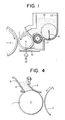
- a process of forming such a thin layer will be described by way of example. As shown in Fig. 4, an elastic blade 2 is forced to contact a toner conveyer 1 with a pressure of 20g/cm 500g/cm.
- Toner 4 contained in a toner container 3 is converyed as the toner conveyer 1 rotates and uniformly thinly applied by the eleastic blade 2 onto the surface of the toner conveyer 1 and moved to an electrostatic image holder 5 arranged an extremely small space apart from the toner conveyer 1 and then transferred from the electrostatic image holder 5 to a toner image fixing medium such as paper. Accordingly, toner 6 should have high flow a bility and be solidification resistant. However, the toner in the toner container 3 tends to being solidified while being conveyed as the toner conveyer 1 rotates and the massive toner is not applied to the surface of the toner conveyer 1.
- the toner 4 conveyed by the toner conveyer 1 meets with a high facial pressure because of the contact between the elestic blade 2 and the toner conveyer 1.
- the problem is that the frictional heat thus generated softens the toner 4 and causes it to stick to the surface of the toner conveyer 1, whereby a thin uniform layer of toner is not formed.
- the large part of the toner is composed of resin, great percentage of resin exists on the surface of the toner.
- a pigment in general is negatively charged and, particularly in the case of carbon black, it is negatively charged.
- the resin negatively charged by the friction with the elastic blade is used as toner to be positively charged, it causes an opposite polarity to be produced by the charge generated on the surface of the toner particle between the toner particles; the toner and the toner conveyer; and the toner and the elastic blade. Consequently, troubles such as development fog and the scattering of toner may occur.
- the aforesaid problems frequently occur particularly when many sheets of copying paper are piled up and therefore the conventional one-component type toner is practically unusable in a copying machine.
- the frictional charge caused between the toner and toner conveyer determines the tripo-potential of the toner.
- the polarity of the tripo-potential should be determined using a combination of binder resin and a coloring agent.
- An object of the present invention is to provide a developing method wherein there is used positively charged non-magnetic one-component type toner whose frictonal charge quantity distribution is not only sharp but also uniform without causing developing fog and the scattering of toner on the periphery of a latent image edge so as to honestly convert the electrostatic latent image into a visible image of good quality.
- Another object of the present invention is to provide a developing method wherein there is used positively charged non-magnetic one-component type toner that can continously be supplied from a toner container onto a toner conveyer and formed into a uniform thin layer of toner on the toner conveyer.
- Still another object of the present invention is to provide a developing method wherein there is used positively charged non-magnetic one-component type toner that can be conserved stably.
- a further object of the present invention is to provide a developing method wherein there is used positively charged non-magnetic one-component type toner that hardly produces off-setting even though a number of images are developed with fixation readily made.
- the 'frictional charge quantity relative to the surface area' in this case means the value obtained by crushing and dividing the toner into particles ranging in diameter from 5 to 25 ⁇ m, 50% of which being cause to be 9 ⁇ 15 ⁇ m in average diameter by % weight, and mixing the toner thus processed with 3 weight % of oxidized iron powder (TEF-V of Nihon Teppun) as a carrier, placing the mixture on a 400-mesh conductive net, with an N2 gas with a pressure of 1 kg/cm2, the charged amount being measured by means of blow-off method (using TB-200 of Toshiba Chemical K.K), and dividing the charged amount by the surface area measured through the BET.
- TEZ-V of Nihon Teppun oxidized iron powder
- the liquid nitogen is removed and restored to the normal temperature 5 minutes later.
- the quantities of N2 gases on the primary and secondary sides are measured by a deterctor for detecting thermal conductivity to obtain the surface area and divided by the weight of the specimen to obtain the surface area of the toner.
- the reason for limiting the frictional charge amount to a range of 30 ⁇ C/m2 ⁇ 100 ⁇ C/m2 according to the present invention is attributed to the fact that, if the toner frictional charge amount is less than 30 ⁇ C/m2, the toner may hardly charged and conveyed by the toner conveyer. If the amount exceeds 100 ⁇ C/m2 on the contrary, the toner will stuck to the toner conveyer so strong that no image is formed on the electrostatic image holder.
- the reason for limiting the toner fluidity to 5 g or less according to the present invention is due to the fact that, if the toner fludity exceeds 5 g., the toner will be solidified and hardly be supplied from the toner container to the toner conveyer continuously.
- the non-magnetic one-component type tone contains at least resin whose glass transition point is over 50°C; softening point 110°C ⁇ 160°C; and frictional charge amount relative to the surface area +25 ⁇ 150 ⁇ C/m2 and a coloring agent.
- the glass transition point of the resin used for the positively charged non-magnetic one-component type toner is lower than 50°C, conservancey stability will be deteriorated and, if it is lower than 110°C, off -setting will be produced or otherwise, it if it exceeds 160°C, the toner will not be fixed.
- the resin fit for use as such toner should conform, in the frictional charge amount, to +25 ⁇ 150 ⁇ C/m2, preferably +50 ⁇ 120 ⁇ C/m2, over 50°C in the glass transition point and 110°C ⁇ 160°C in the softening point.
- the 'softening point' designates a temperature at which a plunger is moved and resin is made to flow out of the die under the following conditions: Cross sectional area of plunger: 1 cm2 Die (length): 10 mm Die (diameter): Application of load: 10 kg f Preheating: 300 sec Starting temperature: 100 °C Temperature rising speed: 2.5 °C/min
- the frictional charge amount is less than +25 ⁇ C/m2, the resin is hardly charged and, if it exceeds 150 ⁇ C/m2, it becomes defficult to form an image on the electrostatic image holder.
- the glass transition point is lower than 50°C, the conservance stability is deteriorated, whereas if the softening point is less than 110°C, the off-setting is easily produced. On the contrary, if it exceeds 160°C, the toner is hardly fixed.
- any type of resin may be used provided the aforesaid conditions are satsilied according to the present invention: e.g., polystyrene and its copolymer; polyester and its copolymer; polyethylene and its copolymer; acrylate and metacrylate resin and their copolymers; silicon resin; polypropylene and its copolymer; wax; polyamide resin; and polyurethane resin, independently or in combination.
- the resin most suitable for use in the present invention is a styrene (meta) acrylamino-metacryle copolymer whose glass transition point being over 50°C and softening point being 110 ⁇ 160°C.
- acrylic or metacrylic component for use in the synthesization of the aforesaid copolymer use can be made of all kinds of known acrylic acids and their derivatives and metacrylic acids and their derivaties, including acrylic acids, acrylic acid esters such as methyl acrylate, ethyl acrylate, propyl acrylate, isopropyl acrylate, butyl acrylate, isobutyle acrylate, pentyl acrylate, hexyl acrylate, peptyl acrylate and octyl acrylate; metacrylic acids; and metacrylic acid esters such as methyl metacrylate, ethyl metacrylate, propyl metacrylate, isopropyl metacrylate, butyl metacrylate, isobutyl metacrylate, pentyl metacrylate, hexyl metacrylate, hexyl metacrylate and octyl metacrylate.
- acrylic acids acrylic acid esters such as methyl
- a metacrylic acid derivative represented by a formula as follows is most suitable for use. (However, R1, R2, R3, R4 constitute an alkyle group with the number of carbons 1 ⁇ 8)
- the monomer having the amino group represented by the above general formula includes, e.g., 2-dimethylamino -2-methylpropyl metacrylate, 2-dimethylamino-2-ethylbutyl metacrylate, 2-dimethylamino-2-propylhexyl metacrylate, 2-diethylamino-2-methylpropyl metacrylate, 2-diethylamino-2-ethylbutyl metacrylate, 2-diethylamino-2-propylhexyl metacrylate, etc.
- a nytril initiator representing azobis (isobutyl nitril), azobis 2-(2-naphthyl) propyl nitril, etc. may be used.
- the non-magnetic one-component type toner is what contains at least binder resin as the main component whose glass transition point is high than 50°C and softening point ranges from 110 to 160°C and a coloring agent; and its surface is treated with a silane coupling agent having a amino group.
- silane coupling agent having a amino group a silane compound expressed by the following general formula is suitable.
- the silane compound expressed by the above general formula includes: H2 N(CH2)3 Si (OCH3)3, H2 N(CH2)3 Si (OC2 H5)3, H2 N(CH2)3 Si (CH3) OC H3)2, H2 N(CH2)3 Si (CH3)2 (OC2 H5), H2 N(CH2)2 NH(CH2)3 Si(OCH3)3, H2 N(CH2)2 NH(CH2)3 CH3 Si(OCH3)3, H2 N(CH2)2 NH(CH2)3 Si(CH3) (OCH3)2, H2 NCO(NH(CH2)3 Si(OC2 H5)3 (H5 C2)2 N(CH2)3 Si(OCH3)3 (HOCH2 CH2)2N(CH2)3 Si(OCH3)3
- the silane coupling agent is composed of one or two kinds components.
- a known coloring agent may be used in the present invention, including carbon black, first yellow G, benzine yellow, pigment yellow, indian first, orange, ilgazine red, carmine FB, permanent bordeau FRR, pigment orange R, resol red 2G, lake red C, rhodamine FB, rohodamine B lake phthalocyanine blue, pigment blue, brilliant green B, phthalocyanine green, quinacridone, etc.
- Wax may be added, if necessary, to the positively charge one-component type tone to improve the off-setting characteristics and further a charge controlling agent may be added to control the frictional charge amount.
- a charge controlling agent use can be made of an amino compound, a 4th grade ammonium compound, an organic dye and its salt, a nigrosine base, a monoazo compound and its metal complex material, polyamine resin, amino resin, etc.
- hydrophobic colloidal fine particles having the same polarity such as colloidal silica may also be added to the non-magnetic one-component type toner according the present invention to improve its fluidity and solidification resistance to the extent that the amount added will not affect the charge amount of the toner; e.g., 0.05 ⁇ 5 parts by weight every 100 parts by weight of the toner.
- Fig. 1 is a schematic sectional view of an embodiment of the present invention.
- An elastic blade 12 is pressed against a toner conveyer 11 with a pressure of 20g/cm ⁇ 500g/cm.
- Toner 14 contained in a toner container 13 is conveyed while the toner conveyer 11 rotates and formed by the elastic blade 12 into an extremely thin layer of toner particles on the surface of the toner conveyer, which are further charged opposite to the electrostatic charge by the friction between the toner conveyer and the elastic blade.
- the toner applied to the surface of the toner conveuer is moved to an electrostatic image holder 15 when it gains access to the holder 15 and transferred from the holder 15 to a toner image fixing medium such as paper.
- the toner allowed to remain on the toner conveyer is recovered to the toner container through the gap between a recovery blade 16 and the toner conveyer 11.
- Numeral 18 designates an agitator for agitating the toner.
- a d.c or a.c. bias or a combination of them generated by superposing one on the other may be applied across the toner conveyer 11 and the electrostatic image holder 15.
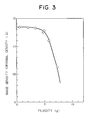
- the frictional charge amount relative to the surface area of the non-magnetic one-component type toner without the range of +25 ⁇ 150 ⁇ C/m2 results in the inferior layer formation or image density reduction and, as shown in Fig. 3, a fluidity exceeding over 5 g also results in the acceleration of the image density resuction.
- the product thus kneaded was cooled and crushed by a hammer mill roughly and then a jet mill finely. It was then subjected to air calssification to obtain 5 ⁇ 25 ⁇ m toner.
- the frictional charge amount measured through the toner blow-off method was proved +53.4 ⁇ C/m2 with a fluidity of 3.4 g.
- the image fixed using a heat-roll fixing device was seen to offer excellent fixation and off-set within the range of 170°C-220°C and images of the same quality were obtained even after 10,000 images were developed.
- polyester was used as resin for the toner with the charge amount exceeding the upper limit according to the present invention in Comparative Example 1; acrylic resin for the toner with the charge amount exceeding the lower limit according the present invention in Comparative Example 2; and the same resin as what was used in the embodiment 1 for the toner with the charge amount exceeding the upper limit according to the present invention.
- Those types of toner were examined under the same conditions as those in the embodiment 1. Styrene 85 parts; n-butyl metacrylate 10 parts; Di-ethyl amino ethyl metacrylate 5 parts; Azobis isobutylonitril 8 parts.
- 95 parts of the resin thus obtained, 4 parts of carbon black and 1 part of wax were subjected to preliminary blending using a ball mill for about two hours and then kneaded using a pressure kneader for about one hour.
- the product thus kneaded was finely crushed by a jet mill and the crushed one was classified through the air classification method so that toner 5 ⁇ 25 ⁇ m in size was obtained.
- Example 1 The copying machine employed in Example 1 was used to supply the one-component type non-magnetic toner to the apparatus illustrated for developing purposes, whereby a clear image free from development fog was obtained.
- the 50% weight-average particle size of that toner was 12.3 ⁇ m, whereas its frictional charge amount was +31.5 ⁇ C/m2.
- the tripo charge of the non-magnetic one-component type toner thus obtained was measured through the blow-off method (of Tosiba Chemical) and the result obtained was 25.3 ⁇ C/g.
- An OPC photosensitive means conveying a negatively charged latent image was used for a copying machine sold on the market (LEODRY Model No. 3301 of Toshiba Corp) and reconstructed and the aforesaid one-component type non-magnetic toner was supplied to the apparetus illustrated for developing purposes, whereby a clear image free from develoment fog was obtained.
- Example 2 The same process as that in Example was executed, except that cyanin blue-G-500 N (of Sanyo Pigment) instead of black carbon in the case of Example 1 was used. A favorable visible image free from development fog was obtaind.
- the 50% average-weight particle size was 12.0 ⁇ m, whereas tripo-aharge was +22.8 ⁇ C/g.
- the frictional charge amount across the toner and the elastic blade or the toner and the toner conveyer is stabilized and controllable in such a manner as to make it suitable for the developing system in use.
- the possible problems attributed to development fog and the toner scattered around the edge of the latent image can now be solved, whereby a high image density become available.
- the initial properties can be maintained and images of high quality can be supplied for a long time and besides the frictional charge amount of the toner is stable even though it is used in an high-temperature high-humidity or low-temperature low-humidity atmosphere.
- the toner according to the present invention is alnost nearly unaffected in an atmosphere at normal temperatures and humidity and free from not only development fog but also reduction in image desity. Moreover, it provides development faithful to a latent image with high transfer efficiency.
Landscapes
- Physics & Mathematics (AREA)
- General Physics & Mathematics (AREA)
- Chemical & Material Sciences (AREA)
- Chemical Kinetics & Catalysis (AREA)
- Spectroscopy & Molecular Physics (AREA)
- Developing Agents For Electrophotography (AREA)
Applications Claiming Priority (6)
| Application Number | Priority Date | Filing Date | Title |
|---|---|---|---|
| JP61058351A JPS62215964A (ja) | 1986-03-18 | 1986-03-18 | 現像方法 |
| JP58351/86 | 1986-03-18 | ||
| JP67512/86 | 1986-03-26 | ||
| JP61067512A JPH0827555B2 (ja) | 1986-03-26 | 1986-03-26 | 現像方法 |
| JP231015/86 | 1986-09-29 | ||
| JP61231015A JP2760492B2 (ja) | 1986-09-29 | 1986-09-29 | 現像方法 |
Publications (3)
| Publication Number | Publication Date |
|---|---|
| EP0241160A2 true EP0241160A2 (de) | 1987-10-14 |
| EP0241160A3 EP0241160A3 (en) | 1989-08-16 |
| EP0241160B1 EP0241160B1 (de) | 1994-02-23 |
Family
ID=27296567
Family Applications (1)
| Application Number | Title | Priority Date | Filing Date |
|---|---|---|---|
| EP87302286A Expired - Lifetime EP0241160B1 (de) | 1986-03-18 | 1987-03-17 | Entwicklungsverfahren |
Country Status (3)
| Country | Link |
|---|---|
| US (1) | US4833059A (de) |
| EP (1) | EP0241160B1 (de) |
| DE (1) | DE3789121T2 (de) |
Cited By (10)
| Publication number | Priority date | Publication date | Assignee | Title |
|---|---|---|---|---|
| FR2611281A1 (fr) * | 1987-02-25 | 1988-08-26 | Toshiba Kk | Procede de developpement d'une image electrostatique |
| EP0369452A3 (de) * | 1988-11-18 | 1991-11-27 | Mitsubishi Rayon Co., Ltd. | Harz für Entwickler |
| EP0461507A3 (en) * | 1990-06-14 | 1992-08-05 | Xerox Corporation | Meterless single component development |
| GB2258053A (en) * | 1991-07-24 | 1993-01-27 | Nippon Zeon Co | Non magnetic one component developer |
| US5255057A (en) * | 1992-05-29 | 1993-10-19 | Eastman Kodak Company | Gray scale monocomponent nonmagnetic development system |
| GB2273787A (en) * | 1992-12-16 | 1994-06-29 | Seiko Epson Corp | Developing method and system |
| EP0703502A1 (de) * | 1994-07-22 | 1996-03-27 | Kabushiki Kaisha Toshiba | Positiv geladener Einkomponententoner und Entwicklungsverfahren unter seiner Verwendung |
| EP0690354A3 (de) * | 1994-06-29 | 1996-08-28 | Mita Industrial Co Ltd | Entwicklung nach dem Kontaktverfahren |
| US5766813A (en) * | 1992-12-16 | 1998-06-16 | Seiko Epson Corporation | Developing method and system for transferring toner from a toner carrier member to a latent image carrier |
| EP0778503A3 (de) * | 1995-12-08 | 1999-05-12 | Brother Kogyo Kabushiki Kaisha | Elektrophotographische Bilderzeugungsvorrichtung mit positif geladenem Toner |
Families Citing this family (10)
| Publication number | Priority date | Publication date | Assignee | Title |
|---|---|---|---|---|
| JP2806453B2 (ja) * | 1987-12-16 | 1998-09-30 | 株式会社リコー | 静電荷像現像用乾式カラートナー |
| JPH03179478A (ja) * | 1989-12-08 | 1991-08-05 | Toshiba Corp | 画像形成装置 |
| JPH03261978A (ja) * | 1990-03-13 | 1991-11-21 | Toshiba Corp | 現像方法及び現像装置 |
| JP3197934B2 (ja) * | 1992-03-24 | 2001-08-13 | キヤノン株式会社 | 現像装置 |
| JPH09166890A (ja) * | 1995-12-15 | 1997-06-24 | Fuji Xerox Co Ltd | 非磁性一成分現像剤および画像形成方法 |
| US5842099A (en) * | 1997-12-17 | 1998-11-24 | Eastman Kodak Company | Application of clear marking particles to images where the marking particle coverage is uniformly decreased towards the edges of the receiver member |
| US6805669B2 (en) | 2001-01-25 | 2004-10-19 | Rebecca L. Swanbom | Method and device for marking skin during an ultrasound examination |
| US20070225605A1 (en) * | 2001-01-25 | 2007-09-27 | Swanbom Rebecca L | Method and Device for Marking Skin During an Ultrasound Examination |
| US7223238B2 (en) | 2001-01-25 | 2007-05-29 | Swanbom Rebecca L | Method and device for marking skin during an ultrasound examination |
| US6946410B2 (en) * | 2002-04-05 | 2005-09-20 | E. I. Du Pont De Nemours And Company | Method for providing nano-structures of uniform length |
Family Cites Families (12)
| Publication number | Priority date | Publication date | Assignee | Title |
|---|---|---|---|---|
| US2895847A (en) * | 1953-12-21 | 1959-07-21 | Battelle Development Corp | Electric image development |
| US3152012A (en) * | 1960-12-19 | 1964-10-06 | Ibm | Apparatus for the development of electrostatic images |
| US3731146A (en) * | 1970-12-23 | 1973-05-01 | Ibm | Toner distribution process |
| US3909258A (en) * | 1972-03-15 | 1975-09-30 | Minnesota Mining & Mfg | Electrographic development process |
| NL7508056A (nl) * | 1975-07-07 | 1977-01-11 | Oce Van Der Grinten Nv | Tonerpoeder voor het ontwikkelen van elektro- statische beelden. |
| US4121931A (en) * | 1976-06-30 | 1978-10-24 | Minnesota Mining And Manufacturing Company | Electrographic development process |
| JPS5933909B2 (ja) * | 1980-07-01 | 1984-08-18 | コニカ株式会社 | 静電荷像現像用トナ−の製造方法 |
| US4557991A (en) * | 1983-03-25 | 1985-12-10 | Konishiroku Photo Industry Co., Ltd. | Toner for development of electrostatic image containing binder resin and wax |
| DE3413833A1 (de) * | 1983-04-12 | 1984-10-18 | Canon K.K., Tokio/Tokyo | Entwicklungsverfahren und entwickler dafuer |
| DE3466093D1 (en) * | 1983-04-28 | 1987-10-15 | Kao Corp | Magnetic toner |
| JPS6087343A (ja) * | 1983-10-19 | 1985-05-17 | Canon Inc | 現像方法 |
| JPS60229035A (ja) * | 1984-04-27 | 1985-11-14 | Canon Inc | 現像方法 |
-
1987
- 1987-03-16 US US07/026,265 patent/US4833059A/en not_active Expired - Fee Related
- 1987-03-17 DE DE3789121T patent/DE3789121T2/de not_active Expired - Fee Related
- 1987-03-17 EP EP87302286A patent/EP0241160B1/de not_active Expired - Lifetime
Cited By (16)
| Publication number | Priority date | Publication date | Assignee | Title |
|---|---|---|---|---|
| FR2611281A1 (fr) * | 1987-02-25 | 1988-08-26 | Toshiba Kk | Procede de developpement d'une image electrostatique |
| US5114823A (en) * | 1987-02-25 | 1992-05-19 | Kabushiki Kaisha Toshiba | Developing method for electrostatic images |
| EP0369452A3 (de) * | 1988-11-18 | 1991-11-27 | Mitsubishi Rayon Co., Ltd. | Harz für Entwickler |
| EP0461507A3 (en) * | 1990-06-14 | 1992-08-05 | Xerox Corporation | Meterless single component development |
| GB2258053A (en) * | 1991-07-24 | 1993-01-27 | Nippon Zeon Co | Non magnetic one component developer |
| GB2258053B (en) * | 1991-07-24 | 1995-10-18 | Nippon Zeon Co | Non-magnetic one-component developer and development process |
| US5328792A (en) * | 1991-07-24 | 1994-07-12 | Nippon Zeon Co., Ltd. | Non-magnetic one-component developer and development process |
| US5255057A (en) * | 1992-05-29 | 1993-10-19 | Eastman Kodak Company | Gray scale monocomponent nonmagnetic development system |
| US5439769A (en) * | 1992-12-16 | 1995-08-08 | Seiko Epson Corporation | Developing method and system |
| GB2273787A (en) * | 1992-12-16 | 1994-06-29 | Seiko Epson Corp | Developing method and system |
| GB2273787B (en) * | 1992-12-16 | 1996-10-02 | Seiko Epson Corp | Developing method and system |
| US5659858A (en) * | 1992-12-16 | 1997-08-19 | Seiko Epson Corporation | Developing method and system |
| US5766813A (en) * | 1992-12-16 | 1998-06-16 | Seiko Epson Corporation | Developing method and system for transferring toner from a toner carrier member to a latent image carrier |
| EP0690354A3 (de) * | 1994-06-29 | 1996-08-28 | Mita Industrial Co Ltd | Entwicklung nach dem Kontaktverfahren |
| EP0703502A1 (de) * | 1994-07-22 | 1996-03-27 | Kabushiki Kaisha Toshiba | Positiv geladener Einkomponententoner und Entwicklungsverfahren unter seiner Verwendung |
| EP0778503A3 (de) * | 1995-12-08 | 1999-05-12 | Brother Kogyo Kabushiki Kaisha | Elektrophotographische Bilderzeugungsvorrichtung mit positif geladenem Toner |
Also Published As
| Publication number | Publication date |
|---|---|
| DE3789121D1 (de) | 1994-03-31 |
| EP0241160A3 (en) | 1989-08-16 |
| US4833059A (en) | 1989-05-23 |
| EP0241160B1 (de) | 1994-02-23 |
| DE3789121T2 (de) | 1994-08-04 |
Similar Documents
| Publication | Publication Date | Title |
|---|---|---|
| EP0241160A2 (de) | Entwicklungsverfahren | |
| CA1334056C (en) | Magnetic toner | |
| US5849448A (en) | Carrier for developer of electrostatic latent image, method for making said carrier | |
| EP0681218B1 (de) | Bilderzeugungsverfahren | |
| EP0829770B1 (de) | Elektrophotographischer Träger und elektrophotographischer Entwickler | |
| US5800959A (en) | Electrostatic latent image developer | |
| JP3344611B2 (ja) | 静電荷像現像用現像剤 | |
| JPS59174857A (ja) | 圧力定着性磁性トナ−の製造方法 | |
| EP0448305B1 (de) | Träger und Verfahren zu seiner Herstellung für die Entwicklung elektrostatischer Bilder | |
| EP0479875B1 (de) | Trockene elektrofotografische tonerzusammensetzung | |
| JPH0259982B2 (de) | ||
| JP2571203B2 (ja) | 静電荷像現像用一成分トナー | |
| JPH01193871A (ja) | 現像剤 | |
| JPH07199527A (ja) | 静電荷像現像用カラートナー、現像剤及び画像製造方法 | |
| US20050277049A1 (en) | Carrier and two-component developing agent | |
| JP2760492B2 (ja) | 現像方法 | |
| JPH11231571A (ja) | 非磁性1成分現像用トナー | |
| JP4261642B2 (ja) | 現像用磁性トナー及び現像方法 | |
| JPH09304974A (ja) | 静電荷像現像用キャリア、現像剤および現像方法 | |
| JPH07244401A (ja) | 静電潜像現像用トナー | |
| JPH0827555B2 (ja) | 現像方法 | |
| JP2002049183A (ja) | 静電潜像現像用帯電部材、静電潜像現像剤、及び画像形成方法 | |
| JPS63212944A (ja) | 現像剤 | |
| JPH049862A (ja) | フルカラー画像形成方法 | |
| JPH068965B2 (ja) | 現像方法 |
Legal Events
| Date | Code | Title | Description |
|---|---|---|---|
| PUAI | Public reference made under article 153(3) epc to a published international application that has entered the european phase |
Free format text: ORIGINAL CODE: 0009012 |
|
| AK | Designated contracting states |
Kind code of ref document: A2 Designated state(s): DE FR GB |
|
| 17P | Request for examination filed |
Effective date: 19871118 |
|
| PUAL | Search report despatched |
Free format text: ORIGINAL CODE: 0009013 |
|
| AK | Designated contracting states |
Kind code of ref document: A3 Designated state(s): DE FR GB |
|
| 17Q | First examination report despatched |
Effective date: 19911121 |
|
| GRAA | (expected) grant |
Free format text: ORIGINAL CODE: 0009210 |
|
| AK | Designated contracting states |
Kind code of ref document: B1 Designated state(s): DE FR GB |
|
| PG25 | Lapsed in a contracting state [announced via postgrant information from national office to epo] |
Ref country code: FR Free format text: LAPSE BECAUSE OF NON-PAYMENT OF DUE FEES Effective date: 19940223 |
|
| PGFP | Annual fee paid to national office [announced via postgrant information from national office to epo] |
Ref country code: FR Payment date: 19940310 Year of fee payment: 8 |
|
| REF | Corresponds to: |
Ref document number: 3789121 Country of ref document: DE Date of ref document: 19940331 |
|
| EN | Fr: translation not filed | ||
| PLBE | No opposition filed within time limit |
Free format text: ORIGINAL CODE: 0009261 |
|
| STAA | Information on the status of an ep patent application or granted ep patent |
Free format text: STATUS: NO OPPOSITION FILED WITHIN TIME LIMIT |
|
| 26N | No opposition filed | ||
| PGFP | Annual fee paid to national office [announced via postgrant information from national office to epo] |
Ref country code: GB Payment date: 19960308 Year of fee payment: 10 |
|
| PGFP | Annual fee paid to national office [announced via postgrant information from national office to epo] |
Ref country code: DE Payment date: 19960328 Year of fee payment: 10 |
|
| PG25 | Lapsed in a contracting state [announced via postgrant information from national office to epo] |
Ref country code: GB Effective date: 19970317 |
|
| GBPC | Gb: european patent ceased through non-payment of renewal fee |
Effective date: 19970317 |
|
| PG25 | Lapsed in a contracting state [announced via postgrant information from national office to epo] |
Ref country code: DE Effective date: 19971202 |