EP0240887B1 - Fliessfähige Formmassen auf Polyamidbasis - Google Patents
Fliessfähige Formmassen auf Polyamidbasis Download PDFInfo
- Publication number
- EP0240887B1 EP0240887B1 EP87104658A EP87104658A EP0240887B1 EP 0240887 B1 EP0240887 B1 EP 0240887B1 EP 87104658 A EP87104658 A EP 87104658A EP 87104658 A EP87104658 A EP 87104658A EP 0240887 B1 EP0240887 B1 EP 0240887B1
- Authority
- EP
- European Patent Office
- Prior art keywords
- moulding compounds
- polyamides
- bis
- compounds according
- thermoplastically processible
- Prior art date
- Legal status (The legal status is an assumption and is not a legal conclusion. Google has not performed a legal analysis and makes no representation as to the accuracy of the status listed.)
- Expired - Lifetime
Links
- 239000004952 Polyamide Substances 0.000 title claims description 39
- 229920002647 polyamide Polymers 0.000 title claims description 39
- 238000000465 moulding Methods 0.000 title description 20
- 230000009969 flowable effect Effects 0.000 title description 2
- 229930185605 Bisphenol Natural products 0.000 claims description 23
- IISBACLAFKSPIT-UHFFFAOYSA-N bisphenol A Chemical compound C=1C=C(O)C=CC=1C(C)(C)C1=CC=C(O)C=C1 IISBACLAFKSPIT-UHFFFAOYSA-N 0.000 claims description 19
- VPWNQTHUCYMVMZ-UHFFFAOYSA-N 4,4'-sulfonyldiphenol Chemical class C1=CC(O)=CC=C1S(=O)(=O)C1=CC=C(O)C=C1 VPWNQTHUCYMVMZ-UHFFFAOYSA-N 0.000 claims description 15
- 229920001971 elastomer Polymers 0.000 claims description 14
- 239000005060 rubber Substances 0.000 claims description 12
- NIXOWILDQLNWCW-UHFFFAOYSA-M Acrylate Chemical compound [O-]C(=O)C=C NIXOWILDQLNWCW-UHFFFAOYSA-M 0.000 claims description 7
- ISWSIDIOOBJBQZ-UHFFFAOYSA-N phenol group Chemical group C1(=CC=CC=C1)O ISWSIDIOOBJBQZ-UHFFFAOYSA-N 0.000 claims description 7
- 125000002496 methyl group Chemical group [H]C([H])([H])* 0.000 claims description 6
- 229910052760 oxygen Inorganic materials 0.000 claims description 6
- 229910052717 sulfur Inorganic materials 0.000 claims description 6
- 150000001993 dienes Chemical class 0.000 claims description 5
- 229920006114 semi-crystalline semi-aromatic polyamide Polymers 0.000 claims description 5
- 239000000126 substance Substances 0.000 claims description 4
- 125000001495 ethyl group Chemical group [H]C([H])([H])C([H])([H])* 0.000 claims description 2
- 239000000206 moulding compound Substances 0.000 claims 12
- IPZJQDSFZGZEOY-UHFFFAOYSA-N dimethylmethylene Chemical compound C[C]C IPZJQDSFZGZEOY-UHFFFAOYSA-N 0.000 claims 1
- 239000000203 mixture Substances 0.000 description 17
- 150000002989 phenols Chemical class 0.000 description 9
- 238000004519 manufacturing process Methods 0.000 description 7
- XLYOFNOQVPJJNP-UHFFFAOYSA-N water Substances O XLYOFNOQVPJJNP-UHFFFAOYSA-N 0.000 description 7
- -1 polyethylenes Polymers 0.000 description 4
- NLHHRLWOUZZQLW-UHFFFAOYSA-N Acrylonitrile Chemical compound C=CC#N NLHHRLWOUZZQLW-UHFFFAOYSA-N 0.000 description 3
- 208000015943 Coeliac disease Diseases 0.000 description 3
- CERQOIWHTDAKMF-UHFFFAOYSA-N Methacrylic acid Chemical compound CC(=C)C(O)=O CERQOIWHTDAKMF-UHFFFAOYSA-N 0.000 description 3
- YXFVVABEGXRONW-UHFFFAOYSA-N Toluene Chemical compound CC1=CC=CC=C1 YXFVVABEGXRONW-UHFFFAOYSA-N 0.000 description 3
- 229920000642 polymer Polymers 0.000 description 3
- 235000013824 polyphenols Nutrition 0.000 description 3
- KAKZBPTYRLMSJV-UHFFFAOYSA-N Butadiene Chemical compound C=CC=C KAKZBPTYRLMSJV-UHFFFAOYSA-N 0.000 description 2
- 101100387923 Caenorhabditis elegans dos-1 gene Proteins 0.000 description 2
- 229920002292 Nylon 6 Polymers 0.000 description 2
- KKEYFWRCBNTPAC-UHFFFAOYSA-N Terephthalic acid Chemical compound OC(=O)C1=CC=C(C(O)=O)C=C1 KKEYFWRCBNTPAC-UHFFFAOYSA-N 0.000 description 2
- 238000010521 absorption reaction Methods 0.000 description 2
- 239000000654 additive Substances 0.000 description 2
- WNLRTRBMVRJNCN-UHFFFAOYSA-N adipic acid Chemical compound OC(=O)CCCCC(O)=O WNLRTRBMVRJNCN-UHFFFAOYSA-N 0.000 description 2
- 239000000956 alloy Substances 0.000 description 2
- 229910045601 alloy Inorganic materials 0.000 description 2
- 238000005275 alloying Methods 0.000 description 2
- PXKLMJQFEQBVLD-UHFFFAOYSA-N bisphenol F Chemical compound C1=CC(O)=CC=C1CC1=CC=C(O)C=C1 PXKLMJQFEQBVLD-UHFFFAOYSA-N 0.000 description 2
- 125000005521 carbonamide group Chemical group 0.000 description 2
- 229920001577 copolymer Polymers 0.000 description 2
- 150000004985 diamines Chemical class 0.000 description 2
- 239000000806 elastomer Substances 0.000 description 2
- JBKVHLHDHHXQEQ-UHFFFAOYSA-N epsilon-caprolactam Chemical compound O=C1CCCCCN1 JBKVHLHDHHXQEQ-UHFFFAOYSA-N 0.000 description 2
- 150000002148 esters Chemical class 0.000 description 2
- 239000000835 fiber Substances 0.000 description 2
- 125000002887 hydroxy group Chemical group [H]O* 0.000 description 2
- 125000004464 hydroxyphenyl group Chemical group 0.000 description 2
- 238000001746 injection moulding Methods 0.000 description 2
- QQVIHTHCMHWDBS-UHFFFAOYSA-N isophthalic acid Chemical compound OC(=O)C1=CC=CC(C(O)=O)=C1 QQVIHTHCMHWDBS-UHFFFAOYSA-N 0.000 description 2
- RLSSMJSEOOYNOY-UHFFFAOYSA-N m-cresol Chemical compound CC1=CC=CC(O)=C1 RLSSMJSEOOYNOY-UHFFFAOYSA-N 0.000 description 2
- CXMXRPHRNRROMY-UHFFFAOYSA-N sebacic acid Chemical compound OC(=O)CCCCCCCCC(O)=O CXMXRPHRNRROMY-UHFFFAOYSA-N 0.000 description 2
- 239000007858 starting material Substances 0.000 description 2
- TYFQFVWCELRYAO-UHFFFAOYSA-N suberic acid Chemical compound OC(=O)CCCCCCC(O)=O TYFQFVWCELRYAO-UHFFFAOYSA-N 0.000 description 2
- RAHZWNYVWXNFOC-UHFFFAOYSA-N sulfur dioxide Inorganic materials O=S=O RAHZWNYVWXNFOC-UHFFFAOYSA-N 0.000 description 2
- PWGJDPKCLMLPJW-UHFFFAOYSA-N 1,8-diaminooctane Chemical compound NCCCCCCCCN PWGJDPKCLMLPJW-UHFFFAOYSA-N 0.000 description 1
- BLDLRWQLBOJPEB-UHFFFAOYSA-N 2-(2-hydroxyphenyl)sulfanylphenol Chemical class OC1=CC=CC=C1SC1=CC=CC=C1O BLDLRWQLBOJPEB-UHFFFAOYSA-N 0.000 description 1
- XSVZEASGNTZBRQ-UHFFFAOYSA-N 2-(2-hydroxyphenyl)sulfinylphenol Chemical class OC1=CC=CC=C1S(=O)C1=CC=CC=C1O XSVZEASGNTZBRQ-UHFFFAOYSA-N 0.000 description 1
- QUWAJPZDCZDTJS-UHFFFAOYSA-N 2-(2-hydroxyphenyl)sulfonylphenol Chemical class OC1=CC=CC=C1S(=O)(=O)C1=CC=CC=C1O QUWAJPZDCZDTJS-UHFFFAOYSA-N 0.000 description 1
- JHOPNNNTBHXSHY-UHFFFAOYSA-N 2-(4-hydroxyphenyl)phenol Chemical group C1=CC(O)=CC=C1C1=CC=CC=C1O JHOPNNNTBHXSHY-UHFFFAOYSA-N 0.000 description 1
- YQPCHPBGAALCRT-UHFFFAOYSA-N 2-[1-(carboxymethyl)cyclohexyl]acetic acid Chemical compound OC(=O)CC1(CC(O)=O)CCCCC1 YQPCHPBGAALCRT-UHFFFAOYSA-N 0.000 description 1
- KYGLCUAXJICESS-UHFFFAOYSA-N 2-[2,3-di(propan-2-yl)phenyl]phenol Chemical class CC(C)C1=CC=CC(C=2C(=CC=CC=2)O)=C1C(C)C KYGLCUAXJICESS-UHFFFAOYSA-N 0.000 description 1
- KNHMONRHIZVFJV-UHFFFAOYSA-N 4-[(4-hydroxy-3,5-dimethylphenyl)methyl]-2,6-dimethylphenol 4-[1-(4-hydroxyphenyl)ethyl]phenol 4-[(4-hydroxyphenyl)methyl]phenol 4-[2-(4-hydroxyphenyl)propan-2-yl]phenol Chemical compound OC1=CC=C(C=C1)C(C)(C)C1=CC=C(C=C1)O.OC1=CC=C(C=C1)C(C)C1=CC=C(C=C1)O.OC1=C(C=C(C=C1C)CC1=CC(=C(C(=C1)C)O)C)C.OC1=CC=C(C=C1)CC1=CC=C(C=C1)O KNHMONRHIZVFJV-UHFFFAOYSA-N 0.000 description 1
- FHIYALNFDSUCEZ-UHFFFAOYSA-N 4-[(4-hydroxy-3,5-dimethylphenyl)methyl]-2,6-dimethylphenol 4-[2-(4-hydroxy-3,5-dimethylphenyl)propan-2-yl]-2,6-dimethylphenol 4-[(4-hydroxyphenyl)methyl]phenol 4-[2-(4-hydroxyphenyl)propan-2-yl]phenol Chemical compound OC1=C(C=C(C=C1C)C(C)(C)C1=CC(=C(C(=C1)C)O)C)C.OC1=CC=C(C=C1)C(C)(C)C1=CC=C(C=C1)O.OC1=C(C=C(C=C1C)CC1=CC(=C(C(=C1)C)O)C)C.OC1=CC=C(C=C1)CC1=CC=C(C=C1)O FHIYALNFDSUCEZ-UHFFFAOYSA-N 0.000 description 1
- NIXOWILDQLNWCW-UHFFFAOYSA-N Acrylic acid Chemical compound OC(=O)C=C NIXOWILDQLNWCW-UHFFFAOYSA-N 0.000 description 1
- VYZAMTAEIAYCRO-UHFFFAOYSA-N Chromium Chemical group [Cr] VYZAMTAEIAYCRO-UHFFFAOYSA-N 0.000 description 1
- VGGSQFUCUMXWEO-UHFFFAOYSA-N Ethene Chemical compound C=C VGGSQFUCUMXWEO-UHFFFAOYSA-N 0.000 description 1
- 239000005977 Ethylene Substances 0.000 description 1
- JHWNWJKBPDFINM-UHFFFAOYSA-N Laurolactam Chemical compound O=C1CCCCCCCCCCCN1 JHWNWJKBPDFINM-UHFFFAOYSA-N 0.000 description 1
- OFOBLEOULBTSOW-UHFFFAOYSA-N Malonic acid Chemical compound OC(=O)CC(O)=O OFOBLEOULBTSOW-UHFFFAOYSA-N 0.000 description 1
- VVQNEPGJFQJSBK-UHFFFAOYSA-N Methyl methacrylate Chemical compound COC(=O)C(C)=C VVQNEPGJFQJSBK-UHFFFAOYSA-N 0.000 description 1
- NDGFKJXYIIQOCI-UHFFFAOYSA-N OC1=C(C=C(C=C1C)C(=O)C1=CC(=C(C(=C1)C)O)C)C.OC1=CC=C(C=C1)C(=O)C1=CC=C(C=C1)O Chemical compound OC1=C(C=C(C=C1C)C(=O)C1=CC(=C(C(=C1)C)O)C)C.OC1=CC=C(C=C1)C(=O)C1=CC=C(C=C1)O NDGFKJXYIIQOCI-UHFFFAOYSA-N 0.000 description 1
- DKOAWDCKXYTFOL-UHFFFAOYSA-N OC1=C(C=CC=C1)C(=O)C1=C(C=CC=C1)O.OC1=C(C=CC=C1)OC1=C(C=CC=C1)O Chemical class OC1=C(C=CC=C1)C(=O)C1=C(C=CC=C1)O.OC1=C(C=CC=C1)OC1=C(C=CC=C1)O DKOAWDCKXYTFOL-UHFFFAOYSA-N 0.000 description 1
- 239000005062 Polybutadiene Substances 0.000 description 1
- 239000004698 Polyethylene Substances 0.000 description 1
- UCKMPCXJQFINFW-UHFFFAOYSA-N Sulphide Chemical compound [S-2] UCKMPCXJQFINFW-UHFFFAOYSA-N 0.000 description 1
- XTXRWKRVRITETP-UHFFFAOYSA-N Vinyl acetate Chemical compound CC(=O)OC=C XTXRWKRVRITETP-UHFFFAOYSA-N 0.000 description 1
- ISKQADXMHQSTHK-UHFFFAOYSA-N [4-(aminomethyl)phenyl]methanamine Chemical class NCC1=CC=C(CN)C=C1 ISKQADXMHQSTHK-UHFFFAOYSA-N 0.000 description 1
- 235000011037 adipic acid Nutrition 0.000 description 1
- 239000001361 adipic acid Substances 0.000 description 1
- 125000002723 alicyclic group Chemical group 0.000 description 1
- 150000001335 aliphatic alkanes Chemical class 0.000 description 1
- 125000001931 aliphatic group Chemical group 0.000 description 1
- 125000000217 alkyl group Chemical group 0.000 description 1
- 150000001408 amides Chemical class 0.000 description 1
- 150000001413 amino acids Chemical class 0.000 description 1
- 125000003118 aryl group Chemical group 0.000 description 1
- VCCBEIPGXKNHFW-UHFFFAOYSA-N biphenyl-4,4'-diol Chemical group C1=CC(O)=CC=C1C1=CC=C(O)C=C1 VCCBEIPGXKNHFW-UHFFFAOYSA-N 0.000 description 1
- 125000004432 carbon atom Chemical group C* 0.000 description 1
- 150000001735 carboxylic acids Chemical class 0.000 description 1
- 230000000052 comparative effect Effects 0.000 description 1
- 238000013329 compounding Methods 0.000 description 1
- 230000003750 conditioning effect Effects 0.000 description 1
- 229920006039 crystalline polyamide Polymers 0.000 description 1
- 150000001924 cycloalkanes Chemical class 0.000 description 1
- QYQADNCHXSEGJT-UHFFFAOYSA-N cyclohexane-1,1-dicarboxylate;hydron Chemical compound OC(=O)C1(C(O)=O)CCCCC1 QYQADNCHXSEGJT-UHFFFAOYSA-N 0.000 description 1
- 125000000113 cyclohexyl group Chemical group [H]C1([H])C([H])([H])C([H])([H])C([H])(*)C([H])([H])C1([H])[H] 0.000 description 1
- 230000007547 defect Effects 0.000 description 1
- 150000001991 dicarboxylic acids Chemical class 0.000 description 1
- 229920003244 diene elastomer Polymers 0.000 description 1
- 125000002897 diene group Chemical group 0.000 description 1
- 239000000975 dye Substances 0.000 description 1
- 238000001125 extrusion Methods 0.000 description 1
- 239000000945 filler Substances 0.000 description 1
- 229920000578 graft copolymer Polymers 0.000 description 1
- 239000012760 heat stabilizer Substances 0.000 description 1
- NAQMVNRVTILPCV-UHFFFAOYSA-N hexane-1,6-diamine Chemical class NCCCCCCN NAQMVNRVTILPCV-UHFFFAOYSA-N 0.000 description 1
- 229910052739 hydrogen Inorganic materials 0.000 description 1
- 239000001257 hydrogen Substances 0.000 description 1
- 238000010348 incorporation Methods 0.000 description 1
- 125000003392 indanyl group Chemical group C1(CCC2=CC=CC=C12)* 0.000 description 1
- 150000003951 lactams Chemical class 0.000 description 1
- 239000000155 melt Substances 0.000 description 1
- 238000002844 melting Methods 0.000 description 1
- 230000008018 melting Effects 0.000 description 1
- 238000002156 mixing Methods 0.000 description 1
- 239000003607 modifier Substances 0.000 description 1
- 239000006082 mold release agent Substances 0.000 description 1
- 230000003287 optical effect Effects 0.000 description 1
- 125000001997 phenyl group Chemical group [H]C1=C([H])C([H])=C(*)C([H])=C1[H] 0.000 description 1
- 239000004033 plastic Substances 0.000 description 1
- 229920003023 plastic Polymers 0.000 description 1
- 239000004014 plasticizer Substances 0.000 description 1
- 229920002587 poly(1,3-butadiene) polymer Polymers 0.000 description 1
- 229920002857 polybutadiene Polymers 0.000 description 1
- 229920000573 polyethylene Polymers 0.000 description 1
- 150000008442 polyphenolic compounds Chemical class 0.000 description 1
- 238000002360 preparation method Methods 0.000 description 1
- 150000003839 salts Chemical class 0.000 description 1
- 239000000243 solution Substances 0.000 description 1
- 238000009987 spinning Methods 0.000 description 1
- 150000003457 sulfones Chemical class 0.000 description 1
- 125000000999 tert-butyl group Chemical group [H]C([H])([H])C(*)(C([H])([H])[H])C([H])([H])[H] 0.000 description 1
Classifications
-
- C—CHEMISTRY; METALLURGY
- C08—ORGANIC MACROMOLECULAR COMPOUNDS; THEIR PREPARATION OR CHEMICAL WORKING-UP; COMPOSITIONS BASED THEREON
- C08K—Use of inorganic or non-macromolecular organic substances as compounding ingredients
- C08K5/00—Use of organic ingredients
- C08K5/36—Sulfur-, selenium-, or tellurium-containing compounds
- C08K5/37—Thiols
- C08K5/375—Thiols containing six-membered aromatic rings
-
- C—CHEMISTRY; METALLURGY
- C08—ORGANIC MACROMOLECULAR COMPOUNDS; THEIR PREPARATION OR CHEMICAL WORKING-UP; COMPOSITIONS BASED THEREON
- C08K—Use of inorganic or non-macromolecular organic substances as compounding ingredients
- C08K5/00—Use of organic ingredients
- C08K5/04—Oxygen-containing compounds
- C08K5/13—Phenols; Phenolates
-
- C—CHEMISTRY; METALLURGY
- C08—ORGANIC MACROMOLECULAR COMPOUNDS; THEIR PREPARATION OR CHEMICAL WORKING-UP; COMPOSITIONS BASED THEREON
- C08K—Use of inorganic or non-macromolecular organic substances as compounding ingredients
- C08K5/00—Use of organic ingredients
- C08K5/36—Sulfur-, selenium-, or tellurium-containing compounds
- C08K5/41—Compounds containing sulfur bound to oxygen
-
- C—CHEMISTRY; METALLURGY
- C08—ORGANIC MACROMOLECULAR COMPOUNDS; THEIR PREPARATION OR CHEMICAL WORKING-UP; COMPOSITIONS BASED THEREON
- C08L—COMPOSITIONS OF MACROMOLECULAR COMPOUNDS
- C08L77/00—Compositions of polyamides obtained by reactions forming a carboxylic amide link in the main chain; Compositions of derivatives of such polymers
Definitions
- the invention relates to thermoplastically processable molding compositions based on polyamides which contain special diphenols and are impact-modified with diene or acrylate rubbers.
- thermoplastically processable polyamides essentially depends on the hydrogen bonds that are active between different carbonamide groups.
- the hydrophilicity caused by the polarity of the carbonamide groups also has a major influence on this, since it has a clearly measurable water absorption both when stored in water and in a standard climate (see, for example, Plastic Handbook Volume VI, Polyamides, Carl-Hanser-Verlag, Kunststoff, 1966, p. 458 ff ) caused.
- the impact strength of moldings made of polyamides depends considerably on the water content of the moldings.
- those are particularly from Easily flowing and thus easily processable polyamides with medium molecular weights produced molded articles relatively sensitive to impact stress. This applies in particular to moldings made from partially crystalline polyamides.
- the toughness of these moldings can be significantly improved by conditioning with water. At the same time, however, there is a softening of the products, which can be observed particularly clearly by a drastic reduction in the rigidity, measured by the modulus of elasticity.
- the toughness level of unmodified polyamides is unsatisfactory, especially at temperatures below room temperature.
- the toughness of the products is improved.
- the flowability of the products is deteriorated at the same time, making their processing more difficult.
- Examples of the bisphenol groups to be used according to the invention are: Dihydroxydiphenyls Bis (hydroxyphenyl) alkanes Bis (hydroxyphenyl) cycloalkanes Bis (hydroxyphenyl) sulfides Bis (hydroxyphenyl) ether Bis (hydroxyphenyl) ketones Bis (hydroxyphenyl) sulfoxides Bis (hydroxyphenyl) sulfones and ⁇ , ⁇ -bis (hydroxyphenyl) diisopropylbenzenes.
- Particularly suitable bisphenols are: Bis (4-hydroxyphenyl) methane Bis (4-hydroxy-3,5-dimethylphenyl) methane 2,2-bis (4-hydroxyphenyl) propane 2,2-bis (4-hydroxy-3,5-dimethylphenyl) propane 2,2-bis (4-hydroxy-3,5'-diethylphenyl) propane 1,1-bis (4-hydroxyphenyl) cyclohexane Bis (4-hydroxyphenyl) sulfone Bis (4-hydroxy-3,5-dimethylphenyl) sulfone Bis (4-hydroxphenyl) sulfide.
- the bisphenols mentioned can be used alone or in mixtures.
- the latter products can also be used in their raw quality, ie contaminated with the corresponding 2,4-isomers and with small amounts of bisphenols with indane structure, chromium structure and also the homologous trinuclear trisphenols.
- Sterically hindered phenols i.e. in at least one, preferably in all o-positions to the phenolic OH group with ⁇ C3 groups (e.g. with t-butyl, cyclohexyl) substituted phenols used as heat stabilizers in polyamides.
- DOS 1 769 662 special phenols were used which lead to an improved deformation resistance of fibers, bristles and yarns, whereby the phenols with less than 4 benzene rings are also mandatory in one or both o-positions to the phenolic OH groups secondary or tertiary Alkyl groups, ie sterically demanding groups.
- DOS 1 912 111 describes plasticized polyamides which contain, as plasticizer components, mixtures of esters of long-chain carboxylic acids and phenolic compounds.
- DOS 3 248 329 recommends the use of monophenols to reduce the water absorption of partially crystalline polyamides.
- GB-A 1 203 283 describes polyamide compositions, in particular for spinning fibers, which contain phenols of a certain composition in amounts of 2-10 OH equivalents per 100 amide equivalents. The phenols differ from the claimed phenols.
- the bisphenols to be used according to the invention are used in the impact-modified molding compositions based on polyamides, preferably 5-35% by weight, particularly preferably 10-30% by weight, based on the proportion of polyamide.
- Linear polycondensates of diamines and dicarboxylic acids such as 6,6-, 6,7-, 6,8-, 6,9-, 6,10-, 6,12-, 8,8-, 12,12-polyamide can be used as polyamides from amino acids or the corresponding lactams with at least 5 carbon atoms, such as, for example, ⁇ -caprolactam, laurolactam or polycondensates from aromatic dicarboxylic acid such as isophthalic acid, terephthalic acid with diamines such as hexamethylenediamines, octamethylenediamine, from araliphatic starting materials such as m- or p-xylylenediamines and adipic acid, suberic acid, sebacic acid, polycondensates based on alicyclic starting materials such as cyclohexanedicarboxylic acid, cyclohexanediacetic acid, diamino-dicyclohexylmethamine, is
- Partly crystalline polyamides are preferably used, particularly preferably PA-6 and PA-6.6, in particular with relative viscosities (measured in 1% solution in m-cresol at 25 ° C.) of 1.6-2.5 for amorphous and of 2 , 5-5.0, preferably from 2.7-4.5, for the partially crystalline polyamides.
- the impact-modifying component is present in the molding compositions according to the invention at 5-60% by weight, preferably 10-40% by weight, particularly preferably 12-30% by weight, based on the PA content.
- Suitable proportions in the molding compositions according to the invention are, for example 55-85% by weight polyamide 10 - 30 wt .-% of the rubber component 5 - 15% by weight bisphenols, the sum of the components should always be 100% by weight.
- the polyamide component, the rubber component and the bisphenol component can be mixed with one another above the melting point of the polyamide. This can e.g. immediately after the production of the polyamide by admixing the bisphenol modifier to the melt to be spun as a strand, the alloying with the rubber components then taking place subsequently.
- the polyamides modified according to the invention are preferably prepared by mixing all starting components, i.e. of the polyamide, the toughening polymer partner and the bisphenol component, manufactured in conventional screw machines.
- the bisphenol component can therefore already together with the polyamide component in the filler neck of the extruder metered in or added to the masses to be extruded at a later point in time during the extrusion.
- the readily flowable, impact-resistant polyamide molding compositions according to the invention are distinguished by greatly improved flowability and better processability, as well as trouble-free surfaces, less flow seam images (in the case of large moldings made from tools with several sprues), with an essentially constant property profile compared to comparable molding compositions which do not contain bisphenols . In individual cases, it is even possible to improve the stability against the influence of moisture, inorganic salts, heat and UV light ("weather stability").
- the new molding compositions are particularly suitable for the production of moldings by the injection molding process, in particular for large-area and complicated moldings which are otherwise difficult to manufacture or often cannot be produced when processing with surface defects.
- the products are preferably suitable for applications in automotive engineering (bumpers, spoilers, body parts).
- the product melt was discharged as a strand into a water bath, granulated and dried to a water content of ⁇ 0.05% by weight.
- Example 1 was repeated with the difference that the individual components shown in Table 1 were used for the preparation.
Landscapes
- Chemical & Material Sciences (AREA)
- Health & Medical Sciences (AREA)
- Chemical Kinetics & Catalysis (AREA)
- Medicinal Chemistry (AREA)
- Polymers & Plastics (AREA)
- Organic Chemistry (AREA)
- Compositions Of Macromolecular Compounds (AREA)
- Treatments Of Macromolecular Shaped Articles (AREA)
- Moulds For Moulding Plastics Or The Like (AREA)
- Polyamides (AREA)
Description
- Gegenstand der Erfindung sind thermoplastisch verarbeitbare, mit Dien- oder Acrylatkautschuken schlagzäh-modifizierte Formmassen auf Basis von Polyamiden, die spezielle Diphenole enthalten.
- Das bekannte hochwertige Eigenschaftsniveau der thermoplastisch verarbeitbaren Polyamide hängt wesentlich von den zwischen verschiedenen Carbonamidgruppen wirksamen Wasserstoffbrücken ab. Auch die durch die Polarität der Carbonamidgruppen bedingte Hydrophilie hat darauf einen großen Einfluß, da sie eine deutlich meßbare Wasseraufnahme sowohl bei Wasserlagerung als auch im Normklima (s. z.B. Kunststoffhandbuch Band VI, Polyamide, Carl-Hanser-Verlag, München, 1966, S. 458 ff) verursacht.
- So hängt z.B. die Schlagzähigkeit von Formkörpern aus Polyamiden erheblich vom Wassergehalt der Formkörper ab. Im wasserfreien Zustand, z.B. nach der Herstellung der Formkörper durch Spritzgießen, sind besonders die aus leicht fließenden und damit leicht verarbeitbaren Polyamiden mit mittleren Molekulargewichten hergestellten Formkörper relativ empfindlich gegen Schlagbeanspruchung. Dies gilt besonders für Formkörper aus teilkristallinen Polyamiden.
- Durch das Konditionieren mit Wasser kann die Zähigkeit dieser Formkörper zwar deutlich verbessert werden. Es tritt jedoch parallel dazu eine Weichmachung der Produkte ein, die besonders deutlich durch eine drastische Verminderung der Steifigkeit, gemessen durch den E-Modul, zu beobachten ist.
- Für viele Einsatzgebiete, z.B. für Werkzeuggehäuse, aber insbesondere auch für Funktions- und Karosserieteile im Automobilbereich ist das Zähigkeitsniveau nicht modifizierter Polyamide, insbesondere bei Temperaturen unterhalb Raumtemperatur nicht zufriedenstellend.
- Um dies zu verbessern, wurde eine Vielzahl von Maßnahmen vorgeschlagen, so z.B. das Zumischen von bestimmten elastomeren Polymeren. So werden u.a. Polyethylene, Copolymerisate des Ethylens mit polaren Comonomeren wie Vinylacetat, (Meth)acrylsäure-(ester) als zähigkeitsverbessernde Zusätze vorgeschlagen oder geeignet modifizierte Kautschuke wie z.B. Copolymere aus Butadien und Acrylnitril.
- In allen Fällen wird eine Verbesserung der Zähigkeit der Produkte erzielt. Je nach Typ und Menge der zur Zähigkeitsverbesserung zugefügten Komponenten wird jedoch gleichzeitig die Fließfähigkeit der Produkte verschlechtert und damit ihre Verarbeitbarkeit erschwert.
- Dies gilt insbesondere für die Herstellung von großflächigen Formteilen, wie sie zunehmend im Automobilbau gewünscht werden, wie z.B. Karosserieteile, Spoiler, Stoßfänger, wo schon durch die Verarbeitungsprobleme Oberflächenstörungen an Fertigteilen auftreten können oder wegen der schlechten Fließfähigkeit z.B. von Legierungen aus Polyamiden und Kautschuk-Elastomeren die Formen häufig nur schwer überhaupt zu füllen sind.
- Dies hat zur praktischen Konsequenz, daß zum Füllen von Werkzeugen, insbesondere für größerflächige Formteile, immer mehr Angußstellen benötigt werden, d.h. die Werkzeuge immer aufwendiger werden müssen und daß, bedingt auch durch die Angußstellen, unerwünschte Fließnähte auftreten, die die optischen und die mechanischen Gebrauchseigenschaften der Formteile beeinträchtigen können.
- Es besteht daher ein Bedarf an Formmassen auf Basis von schlagzäh modifizierten Polyamiden mit guten technischen Gebrauchseigenschaften, die sich durch bessere Fließfähigkeit und damit verbesserte Verarbeitbarkeit und höhere Steifigkeit auszeichnen, d.h. die die oben genannten Nachteile nicht haben.
- Überraschend wurde nunmehr gefunden, daß man die oben genannten Nachteile überwinden und insbesondere die Fließfähigkeit von Produkten zur Herstellung von Polyamid-Formmassen, die mit Dien- und/oder Acrylatkautschuken schlagzäh eingestellt sind dadurch drastisch verbessern kann, wenn man die Produkte mit speziellen Bisphenolen modifiziert.
- Gegenstand der Erfindung sind daher thermoplastisch verarbeitbare Polyamid-Formmassen enthaltend Dien- und/oder Acrylatkautschuke dadurch gekennzeichnet, daß die Formmassen 3-40 Gew.-%, vorzugsweise 5-35 Gew.-%, besonders bevorzugt 10-30 Gew.-%, bezogen auf den Polyamidanteil, von Bisphenolen der allgemeinen Formel I enthalten

wobei - m und n
- unabhängig voneinander ganze Zahlen von 0-4 vorzugsweise 0, 1, 2 besonders bevorzugt 0, bedeuten;
- R
- für eine Methyl- und Ethylgruppe, vorzugsweise eine Methylgruppe, steht, mit der Maßgabe, daß die Summe der aliphatischen C-Atome aller an einem Phenolring gebundenen Rest R <6, vorzugsweise <3, ist,
- X
- eine chemische Bindung oder einen bivalenten, aliphatischen C₁-C₃- oder C₅-C₆-Cycloalkylenrest O, S, SO, SO₂, CO bzw. -O(CH₂)pO- mit p = 2 oder 4 bedeutet
- Beispiele für die erfindungsgemäß einzusetzenden Bisphenol-Gruppen sind:
Dihydroxydiphenyle
Bis-(hydroxyphenyl)-alkane
Bis-(hydroxyphenyl)-cycloalkane
Bis-(hydroxyphenyl)-sulfide
Bis-(hydroxyphenyl)-ether
Bis-(hydroxyphenyl)-ketone
Bis-(hydroxyphenyl)-sulfoxide
Bis-(hydroxyphenyl)-sulfone und
α,α-Bis-(hydroxyphenyl)-diisopropylbenzole. - Erfindungsgemäß einzusetzende Vertreter der genannten Gruppen von Bisphenolen sind:
4,4'-Dihydroxydiphenyl, gegebenenfalls im Gemisch mit
2,4'-Dihydroxydiphenyl
4,4'-Dihydroxy-3,3',5,5'-tetramethyldiphenyl
4,4'-Dihydroxy-3,3'-dimethyldiphenyl
Bis-(4-hydroxyphenyl)-methan
Bis-(4-hydroxy-3,5-dimethylphenyl)-methan
Bis-(4-hydroxyphenyl)-ethan
2,2-Bis-(4-hydroxyphenyl)propan ("Bisphenol A")
1,1-Bis-(4-hydroxyphenyl)-cyclohexan
1,1-Bis-(4-hydroxy-3,5-dimethylphenyl)-cyclohexan
Bis-(4-hydroxphenyl)-sulfon
Bis-(4-hydroxyphenyl)-sulfid
Bis-(4-hydroxy-3,5-dimethylphenyl)-sulfid
Bis-(4-hydroxy-3,5-dimethylphenyl)-sulfon
Bis-(4-hydroxyphenyl)-oxid
Bis-(4-hydroxy-3,5-dimethylphenyl)-oxid
Bis-(4-hydroxyphenyl)-keton
Bis-(4-hydroxy-3,5-dimethylphenyl)-keton


- Besonders geeignete Bisphenole sind:
Bis-(4-hydroxyphenyl)-methan
Bis-(4-hydroxy-3,5-dimethylphenyl)-methan
2,2-Bis-(4-hydroxyphenyl)-propan
2,2-Bis-(4-hydroxy-3,5-dimethylphenyl)-propan
2,2-Bis-(4-hydroxy-3,5'-diethylphenyl)-propan
1,1-Bis-(4-hydroxyphenyl)-cyclohexan
Bis-(4-hydroxyphenyl)-sulfon
Bis-(4-hydroxy-3,5-dimethylphenyl)-sulfon
Bis-(4-hydroxphenyl)-sulfid. - Die genannten Bisphenole können allein oder in Gemischen eingesetzt werden.
- Ganz besonders bevorzugt sind
Bis-(4-hydroxyphenyl)-methan und
Bis-(4-hydroxyphenyl)-propan. - Die letztgenannten Produkte können auch in ihrer Rohqualität, d.h. verunreinigt mit den entsprechenden 2,4-Isomeren sowie mit kleinen Mengen Bisphenolen mit Indan-Struktur, Chromanstruktur und auch den homologen Dreikerntrisphenolen eingesetzt werden.
- Der Einsatz von Phenolen zur Verbesserung spezieller Eigenschaften von Polyamiden ist zwar seit langem bekannt,
- So werden sterisch gehinderte Phenole, d.h. in mindestens einer, vorzugsweise in allen o-Stellungen zur phenolischen OH-Gruppe mit ≧ C₃ Gruppen (z.B. mit t-Butyl, Cyclohexyl) substituierte Phenole als Wärmestabilisatoren in Polyamiden verwendet.
- Diese Produkte zeigen jedoch wegen ihrer sterischen Hinderungen und wegen des hohen Anteils aliphatischer C-Atome in den Phenolmolekülen in höheren Konzentrationen Verträglichkeitsprobleme (Ausschwitzen!) und sind zudem recht kostspielig.
- In der DOS 1 769 662 wurden spezielle Phenole eingesetzt, die zu einer verbesserten Deformationsbeständigkeit von Fasern, Borsten und Garnen führen, wobei die Phenole mit weniger als 4 Benzolringen ebenfalls zwingend in einer oder beiden o-Stellungen zu den phenolischen OH-Gruppen sekundäre oder tertiäre Alkylgruppen, d.h. sterisch anspruchsvolle Gruppen, tragen müssen.
- Auch diese Polyphenole sind im Sinne der Erfindung wenig brauchbar.
- Die DOS 1 912 111 beschreibt weichgemachte Polyamide, die als Weichmacherkomponenten Gemische aus Estern langkettiger Carbonsäuren und phenolischen Verbindungen enthalten.
- In dieser wie in den vorgenannten anderen Schriften findet sich kein Hinweis auf durch Legierung schlagzäh eingestellte Polyamide.
- In der DOS 3 248 329 wird die Verwendung von Monophenolen zur Verminderung der Wasseraufnahme von teilkristallinen Polyamiden empfohlen.
- Die dort genannten Monophenole neigen bei höheren Konzentrationen zum Ausschwitzen und zu Belagbildung, vermutlich auch wegen des geringen Gehaltes phenolischer Gruppen in den Monophenolen.
- In der GB-A 1 203 283 werden Polyamidzusammensetzungen, insbesondere zur Verspinnung von Fasern, beschrieben, welche Phenole bestimmter Zusammensetzung in Mengen von 2 - 10 OH-Äquivalenten pro 100 Amid-Äquivalenten enthalten, beschrieben, Die Phenole unterscheiden sich von den beanspruchten Phenolen.
- Die erfindungsgemäß einzusetzenden Bisphenole werden in die schlagzäh-modifizierten Formmassen auf Basis von Polyamiden, vorzugsweise zu 5-35 Gew,-%, besonders bevorzugt zu 10-30 Gew.-%, bezogen auf den Polyamidanteil eingesetzt.
- Als Polyamide können lineare Polykondensate aus Diaminen und Dicarbonsäuren wie 6,6-, 6,7-, 6,8-, 6,9-, 6,10-, 6,12-, 8,8-, 12,12-Polyamid aus Aminosäuren bzw. den entsprechenden Lactamen mit mindestens 5 C-Atomen, wie z.B. ε-Caprolactam, Laurinlactam oder Polykondensate aus aromatischen Dicarbonsäure wie Isophthalsäure, Terephthalsäure mit Diaminen wie Hexamethylendiaminen, Octamethylendiamin, aus araliphatischen Ausgangsstoffen wie m- oder p-Xylylendiaminen und Adipinsäure, Korksäure, Sebazinsäure, Polykondensate auf Basis von alicyclischen Ausgangsstoffen wie Cyclohexandicarbonsäure, Cyclohexandiessigsäure, Diamino-dicyclohexylmethanen, Isophorondiamin verwendet werden.
- Vorzugsweise werden teilkristalline Polyamide verwendet, besonders bevorzugt PA-6 und PA-6,6, insbesondere mit relativen Viskositäten (gemessen in 1 % Lösung in m-Kresol bei 25°C) von 1,6-2,5 bei amorphen sowie von 2,5-5,0, bevorzugt von 2,7-4,5, bei den teilkristallinen Polyamiden.
- Die schlagzäh-modifizierende Komponente ist mit 5-60 Gew.-%, vorzugsweise 10-40 Gew.-%, besonders bevorzugt 12-30 Gew.-%, bezogen auf den PA-Anteil, in den erfindungsgemäßen Formmassen enthalten.
- Besonders wirksam im Sinne einer stark verbesserten Fließfähigkeit und damit erleichterter Verarbeitung sind die erfindungsgemäß einzusetzenden Bisphenole in Legierungen aus den genannten Polyamiden, besonders bevorzugt, teilkristallinen Polyamiden, und bekannten Dien- und/oder Acrylatkautschuke, die vorzugsweise Anteile an polaren Gruppen eingebaut enthalten, wie
- Butadien-Polymeren, die auch mit Comonomeren wie z.B. Acrylnitril, (Meth)Acrylsäure und/oder (Meth)Acryl säureestern copolymerisiert oder in eine Kern/Mantel-Struktur gepfropft sein können.
- Solche zur Erhöhung der Zähigkeit von Polyamiden geeigneten Polymeren sind seit langem bekannt und beispielsweise in DE-PS 2 444 584 (= US-PS 4 022 748), DE-OS 2 726 256 (= US-PS 4 096 202) genannt.
- Geeignete Mengenverhältnisse in den erfindungsgemäßen Formmassen sind z.B.
55 - 85 Gew.-% Polyamid
10 - 30 Gew.-% der Kautschukkomponente
5 - 15 Gew.-% Bisphenole,
wobei die Summe der Komponenten immer 100 Gew.-% ergeben soll. - Zur Herstellung der erfindungsgemäßen Produkte zur Fertigung von schlagzäh eingestellten Formmassen auf Polyamidbasis können die Polyamidkomponente, die Kautschukkomponente und die Bisphenolkomponente oberhalb des Schmelzpunktes des Polyamids miteinander vermischt werden. Dies kann z.B. unmittelbar nach der Herstellung des Polyamids durch Zumischen des Bisphenol-Modifikators zu der als Strang abzuspinnenden Schmelze erfolgen, wobei die Legierung mit den Kautschukkomponenten dann nachträglich erfolgt. Vorzugsweise werden die erfindungsgemäß modifizierten Polyamide jedoch durch Mischen aller Ausgangskomponenten, d.h. des Polyamids, der schlagzäh machenden Polymerpartner und der Bisphenol-Komponente, in üblichen Schneckenmaschinen hergestellt.
- Analog kann bei der zusätzlichen Einarbeitung von anderen Additiven, wie z.B. Farbstoffen oder Entformungshilfsmitteln, verfahren werden.
- Die Bisphenolkomponente kann daher mit der Polyamid-Komponente schon gemeinsam in den Einfüllstutzen des Extruders eindosiert oder zu einem späteren Zeitpunkt während der Extrusion den zu extrudierenden Massen zugesetzt werden.
- Zur Compoundierung eignen sich übliche bekannte Apparaturen. Doppelschneckenextruder werden bevorzugt eingesetzt.
- Die erfindungsgemäßen, gut fließfähigen, schlagzäh eingestellten Polyamidformmassen zeichnen sich bei sonst im wesentilchen konstantem Eigenschaftsbild gegenüber vergleichbaren Formmassen, die keine Bisphenole enthalten, durch stark verbesserte Fließfähigkeit und bessere Verarbeitbarkeit sowie störungsfreie Oberflächen, weniger Fließnahtabbildungen (bei großen Formteilen aus Werkzeugen mit mehreren Angüssen) aus. In Einzelfällen ist zusätzlich sogar eine Verbesserung der Stabilität gegen den Einfluß von Feuchtigkeit, anorganischen Salzen, Hitze und UV-Licht ("Wetterstabilität") zu erzielen.
- Die neuen Formmassen eignen sich besonders zur Herstellung von Formkörpern nach dem Spritzgießverfahren, insbesondere für großflächige und komplizierte Formteile, die sonst nur mit hohem technischem Aufwand bei der Verarbeitung mit Oberflächenstörungen oder oft gar nicht herstellbar sind.
- Vorzugsweise eignen sich die Produkte für Anwendungen im Automobilbau (Stoßfänger, Spoiler, Karosserieteile).
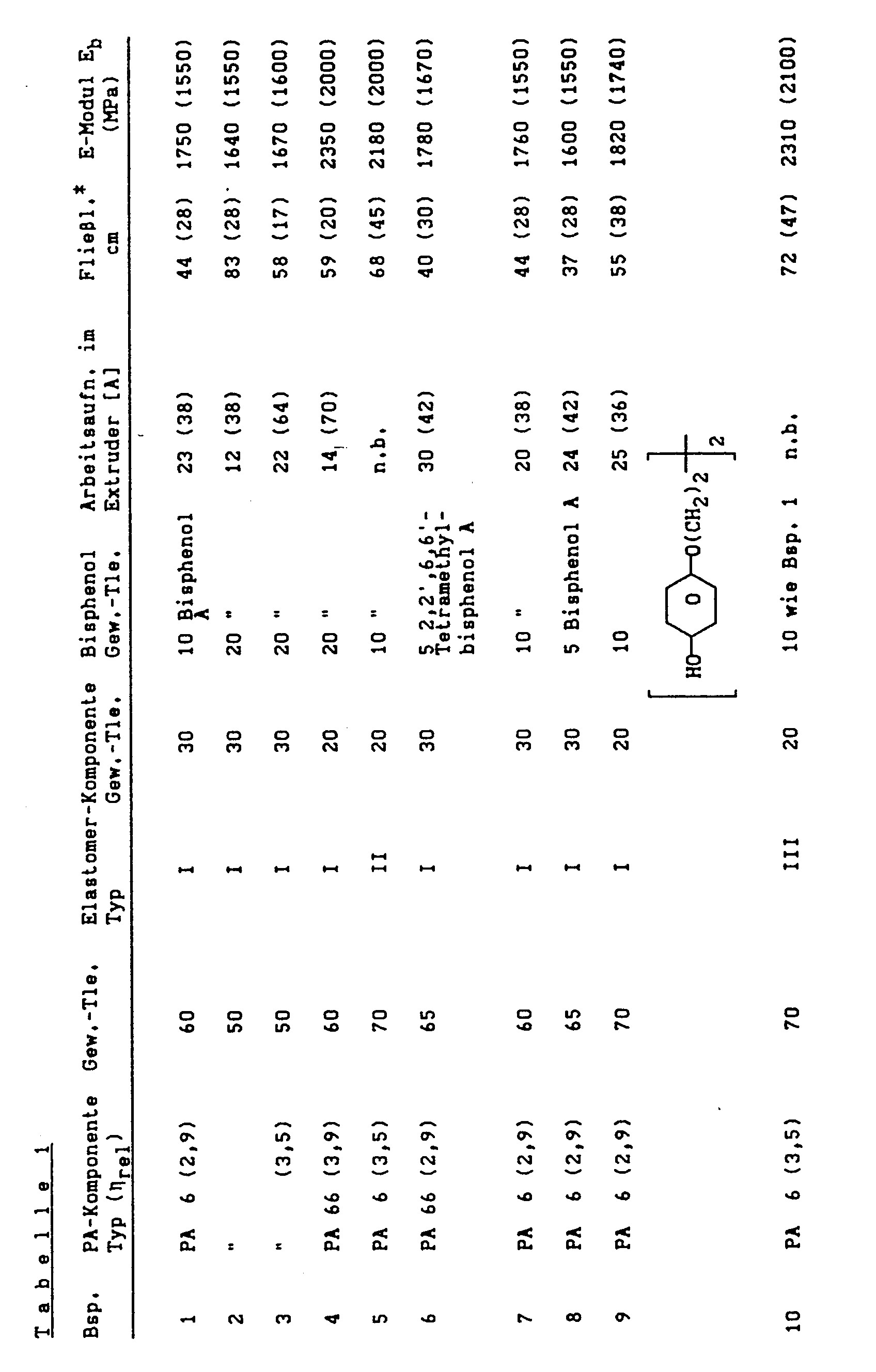
- 70 Gew.-Teile eines Polyamid-6 mit einer relativen Viskosität von 2,9, 30 Gew.-Teile eines Elastomers I (Pfropfpolymerisat aus 80 % Pfropfgrundlage aus vernetztem Polybutadien - Gelgehalt > 70 %, gemessen in Toluol - und 20 % Pfropfauflage aus Methylmethacrylat) und 10 Gew.-Teile Bisphenol A werden getrennt, aber gleichzeitig, in einen Zweiwellenextruder vom Typ ZSK 32 eindosiert und bei 90 Upm und 260°C extrudiert.
- Die Arbeitsaufnahme im Extruder unter den genannten Bedingungen betrug 23 A, ohne den Zusatz von Bisphenol 38 A.
- Die Produktschmelze wurde als Strang in ein Wasserbad ausgetragen, granuliert und bis zu einem Wassergehalt von < 0,05 Gew.-% getrocknet.
- Gemessene Produkteigenschaften sind in Tabelle 1 aufgeführt.
- (Anmerkung: Bei den Vergleichsprodukten wurden zu den Gewichtsteilen Polyamid zusätzlich die bei der Bisphenolkomponente genannten Mengen als Polyamid eingesetzt).
- Beispiel 1 wurde wiederholt mit dem Unterschied, daß die aus Tabelle 1 ersichtlichen Einzelkomponenten zur Herstellung eingesetzt wurden.
- Eigenschaften der hergestellten Produkte sind in Tabelle 1 mitaufgeführt (Vergleichswerte ohne Bisphenol-Zusatz in Klammern).


X ist bevorzugt eine chemische Bindung ein C₁-C₃-Alkylenrest, O, S, SO₂, besonders bevorzugt -CH₂, -C(CH₃)₂- oder SO₂.
Claims (8)
- Thermoplastisch verarbeitbare Polyamid-Formmassen, enthaltend Dien- und/oder Acrylatkautschuke, dadurch gekennzeichnet, daß die Formmassen 3-35 Gew.-% bezogen auf den Polyamidanteil, Bisphenole der Formeln 2,2-Bis-(4-hydroxyphenyl)propan ("Bisphenol A"),

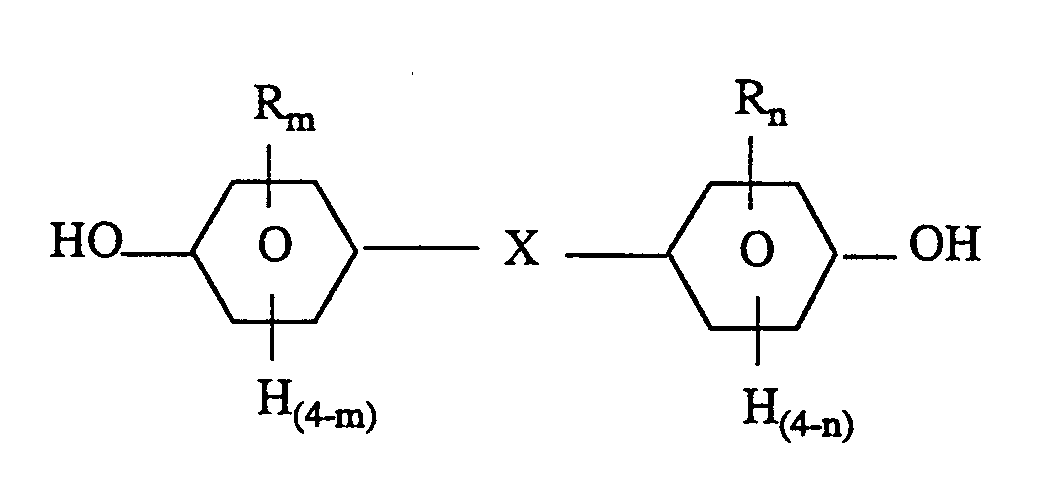 R für eine CH₃-, C₂H₅-Gruppe steht, mit der Maßgabe, daß die Summe der aliphatischen C-Atome aller an die Phenolringe gebundenen Reste R < 6, ist.m und n unabhängig voneinander ganze Zahlen von 0-4, undX eine chemische Bindung, einen C₁-C₃-Alkylen-, oder C₅-C₆-Cycloalkylenrest, O, S, SO, SO₂, CO oder O-(CH₂)p-O- mit p=2 oder 4 bedeutetund die Formmassen 10-40 Gew.-%, bezogen auf den Polyamid-Anteil, eines Dien-und/oder Acrylat-Kautschuks enthalten.
 - Thermoplastisch verarbeitbare Formmassen nach Anspruch 1, dadurch gekennzeichnet, daß als Polyamide teilkristalline Polyamide eingesetzt werden.
- Thermoplastisch verarbeitbare Formmassen nach Ansprüchen 1 oder 2, dadurch gekennzeichnet, daß die Formmassen 12-30 Gew.-%, bezogen auf den Polyamid-Anteil, eines Dien-und/oder Acrylatkautschuks enthalten.
- Thermoplastisch verarbeitbare Formmassen nach Ansprüchen 1-3, dadurch gekennzeichnet, daß Bisphenole eingesetzt werden, bei denen R eine Methylgruppe darstellt, m und n, unabhängig voneinander 0, 1 oder 2 sind und in denen X eine chemische Bindung, ein C₁-C₃-Alkylenradikal, O, S oder SO₂ ist.
- Thermoplastisch verarbeitbare Formmassen nach Ansprüchen 1-4, dadurch gekennzeichnet, daß Bisphenole eingesetzt werden, bei denen X, -CH₂-, -C(CH₃)₂- oder -SO₂- ist.
- Thermoplastisch verarbeitbare Formmassen nach den Ansprüchen 1-5, dadurch gekennzeichnet, daß Bisphenole eingesetzt werden, bei denen m und n beide Null sind.
- Thermoplastisch verarbeitbare Formmassen nach Ansprüchen 1-6, dadurch gekennzeichnet, daß als Bisphenole Bisphenol A eingesetzt wird.
- Formkörper mit -gegenüber Bisphenolfreien Formmassen- erhöhtem E-Modul aus thermoplastisch verarbeitbaren Formmassen nach den Ansprüchen 1-7.
Applications Claiming Priority (2)
| Application Number | Priority Date | Filing Date | Title |
|---|---|---|---|
| DE3612159 | 1986-04-11 | ||
| DE19863612159 DE3612159A1 (de) | 1986-04-11 | 1986-04-11 | Fliessfaehige formmassen auf polyamidbasis |
Publications (3)
| Publication Number | Publication Date |
|---|---|
| EP0240887A2 EP0240887A2 (de) | 1987-10-14 |
| EP0240887A3 EP0240887A3 (en) | 1989-04-26 |
| EP0240887B1 true EP0240887B1 (de) | 1992-11-11 |
Family
ID=6298433
Family Applications (1)
| Application Number | Title | Priority Date | Filing Date |
|---|---|---|---|
| EP87104658A Expired - Lifetime EP0240887B1 (de) | 1986-04-11 | 1987-03-30 | Fliessfähige Formmassen auf Polyamidbasis |
Country Status (4)
| Country | Link |
|---|---|
| EP (1) | EP0240887B1 (de) |
| JP (1) | JP2505195B2 (de) |
| DE (2) | DE3612159A1 (de) |
| ES (1) | ES2044854T3 (de) |
Families Citing this family (10)
| Publication number | Priority date | Publication date | Assignee | Title |
|---|---|---|---|---|
| KR910003257B1 (ko) * | 1988-03-14 | 1991-05-25 | 주식회사 럭키 | 열가소성 수지 조성물 |
| DE3934711A1 (de) * | 1989-10-18 | 1991-04-25 | Bayer Ag | Polyamid-formmassen mit bisphenolen hoher glastemperatur |
| DE4002605A1 (de) * | 1990-01-30 | 1991-09-26 | Bayer Ag | Polyamidformmassen |
| US5434209A (en) * | 1991-06-27 | 1995-07-18 | Basf Aktiengesellschaft | Flameproofed thermoplastic polyamide molding materials |
| DE102005050958A1 (de) | 2005-10-25 | 2007-04-26 | Lanxess Deutschland Gmbh | Polyamid-Formmassen mit verbesserter Fließfähigkeit |
| DE102008032205A1 (de) | 2008-07-09 | 2010-01-14 | Lanxess Deutschland Gmbh | Fließverbesserte Thermoplasten |
| CN103443203B (zh) | 2011-01-18 | 2015-12-02 | 巴斯夫欧洲公司 | 耐水解性聚酰胺 |
| US8629220B2 (en) | 2011-01-18 | 2014-01-14 | Basf Se | Hydrolysis-resistant polyamides |
| US8629206B2 (en) | 2011-01-20 | 2014-01-14 | Basf Se | Flame-retardant thermoplastic molding composition |
| US8653168B2 (en) | 2011-05-10 | 2014-02-18 | Basf Se | Flame-retardant thermoplastic molding composition |
Family Cites Families (3)
| Publication number | Priority date | Publication date | Assignee | Title |
|---|---|---|---|---|
| US2374576A (en) * | 1940-10-10 | 1945-04-24 | Du Pont | Polyamides |
| GB1203283A (en) * | 1967-06-26 | 1970-08-26 | Ici Ltd | Synthetic polyamide compositions |
| DE3200070A1 (de) * | 1982-01-05 | 1983-07-14 | Bayer Ag, 5090 Leverkusen | Schlagzaehe polyamid-formmassen |
-
1986
- 1986-04-11 DE DE19863612159 patent/DE3612159A1/de not_active Withdrawn
-
1987
- 1987-03-30 DE DE8787104658T patent/DE3782524D1/de not_active Expired - Lifetime
- 1987-03-30 EP EP87104658A patent/EP0240887B1/de not_active Expired - Lifetime
- 1987-03-30 ES ES87104658T patent/ES2044854T3/es not_active Expired - Lifetime
- 1987-04-07 JP JP62083949A patent/JP2505195B2/ja not_active Expired - Lifetime
Also Published As
| Publication number | Publication date |
|---|---|
| EP0240887A3 (en) | 1989-04-26 |
| DE3782524D1 (de) | 1992-12-17 |
| JPS62243647A (ja) | 1987-10-24 |
| JP2505195B2 (ja) | 1996-06-05 |
| ES2044854T3 (es) | 1994-01-16 |
| EP0240887A2 (de) | 1987-10-14 |
| DE3782524T (de) | 1992-12-17 |
| DE3612159A1 (de) | 1987-10-22 |
Similar Documents
| Publication | Publication Date | Title |
|---|---|---|
| DE68927469T2 (de) | Polyamidharz-Zusammensetzungen | |
| EP0112542B1 (de) | Polyamide mit verminderter Wasseraufnahme | |
| DE10057455C2 (de) | Polyamid-Formmassen mit verbesserten Eigenschaften | |
| DE69311223T2 (de) | Formbare kristalline Polyesterzusammensetzung | |
| EP0000186B1 (de) | Thermoplastisch verarbeitbare Polycarbonatmischungen, Verfahren zu deren Bereitung und deren Verwendung zur Herstellung von Formkörpern | |
| EP0106241B1 (de) | Schlagzähe Polyamide | |
| DE3640875A1 (de) | Thermoplastische formmassen auf der basis von polycarbonaten, polyestern und polyamiden | |
| DE3728334C2 (de) | ||
| EP0331001A1 (de) | Thermoplastische Formmassen auf der Basis von Polyamiden | |
| EP0224847B1 (de) | Verstärkte Polyamide mit verbessertem Fliessverhalten | |
| EP0240887A2 (de) | Fliessfähige Formmassen auf Polyamidbasis | |
| DE69103171T2 (de) | Polyamid-Harzmasse. | |
| EP0194523B1 (de) | Hydrophobierte, leichtfliessende thermoplastische Polyamide | |
| DE3717218A1 (de) | Glasfaserverstaerkte stabilisierte polyamidformmasse | |
| DE69904663T2 (de) | Verfahren zur Verbesserung der Oberfläche von kompatibilisierten Polyphenylenether-Polyamid-Mischungen | |
| EP0591731B1 (de) | Fliessfähige Polyamidformmassen | |
| EP0166321A2 (de) | Hydrophobe Polyamide | |
| US5212224A (en) | Free flowing moulding materials based on polyamides containing bisphenols | |
| EP0439732A2 (de) | Polyamidformmassen | |
| DE3616280C3 (de) | Thermoplastische Polyamidformmassen mit geringer Wasseraufnahme | |
| EP0279342B1 (de) | Polyamidmischungen und Formkörper daraus | |
| DE1569025A1 (de) | Verbesserungen an oder Bezug auf Brueckenbindungen enthaltende Polymere | |
| DE69716265T2 (de) | Polyamid zusammensetzung mit hoher fliessfähigkeit | |
| DE2904832A1 (de) | Thermoplastische massen, verfahren zu ihrer herstellung sowie ihre verwendung | |
| DE2307895A1 (de) | Thermoplastische formmassen |
Legal Events
| Date | Code | Title | Description |
|---|---|---|---|
| PUAI | Public reference made under article 153(3) epc to a published international application that has entered the european phase |
Free format text: ORIGINAL CODE: 0009012 |
|
| 17P | Request for examination filed |
Effective date: 19870331 |
|
| AK | Designated contracting states |
Kind code of ref document: A2 Designated state(s): DE ES FR GB IT |
|
| PUAL | Search report despatched |
Free format text: ORIGINAL CODE: 0009013 |
|
| AK | Designated contracting states |
Kind code of ref document: A3 Designated state(s): DE ES FR GB IT |
|
| 17Q | First examination report despatched |
Effective date: 19910424 |
|
| GRAA | (expected) grant |
Free format text: ORIGINAL CODE: 0009210 |
|
| AK | Designated contracting states |
Kind code of ref document: B1 Designated state(s): DE ES FR GB IT |
|
| ITF | It: translation for a ep patent filed | ||
| REF | Corresponds to: |
Ref document number: 3782524 Country of ref document: DE Date of ref document: 19921217 |
|
| ET | Fr: translation filed | ||
| GBT | Gb: translation of ep patent filed (gb section 77(6)(a)/1977) |
Effective date: 19920205 |
|
| PLBE | No opposition filed within time limit |
Free format text: ORIGINAL CODE: 0009261 |
|
| STAA | Information on the status of an ep patent application or granted ep patent |
Free format text: STATUS: NO OPPOSITION FILED WITHIN TIME LIMIT |
|
| 26N | No opposition filed | ||
| REG | Reference to a national code |
Ref country code: ES Ref legal event code: FG2A Ref document number: 2044854 Country of ref document: ES Kind code of ref document: T3 |
|
| REG | Reference to a national code |
Ref country code: GB Ref legal event code: IF02 |
|
| PGFP | Annual fee paid to national office [announced via postgrant information from national office to epo] |
Ref country code: DE Payment date: 20020215 Year of fee payment: 16 |
|
| PGFP | Annual fee paid to national office [announced via postgrant information from national office to epo] |
Ref country code: FR Payment date: 20020226 Year of fee payment: 16 |
|
| PGFP | Annual fee paid to national office [announced via postgrant information from national office to epo] |
Ref country code: ES Payment date: 20020325 Year of fee payment: 16 |
|
| PGFP | Annual fee paid to national office [announced via postgrant information from national office to epo] |
Ref country code: GB Payment date: 20020327 Year of fee payment: 16 |
|
| PG25 | Lapsed in a contracting state [announced via postgrant information from national office to epo] |
Ref country code: GB Free format text: LAPSE BECAUSE OF NON-PAYMENT OF DUE FEES Effective date: 20030330 |
|
| PG25 | Lapsed in a contracting state [announced via postgrant information from national office to epo] |
Ref country code: ES Free format text: LAPSE BECAUSE OF NON-PAYMENT OF DUE FEES Effective date: 20030331 |
|
| PG25 | Lapsed in a contracting state [announced via postgrant information from national office to epo] |
Ref country code: DE Free format text: LAPSE BECAUSE OF NON-PAYMENT OF DUE FEES Effective date: 20031001 |
|
| GBPC | Gb: european patent ceased through non-payment of renewal fee |
Effective date: 20030330 |
|
| PG25 | Lapsed in a contracting state [announced via postgrant information from national office to epo] |
Ref country code: FR Free format text: LAPSE BECAUSE OF NON-PAYMENT OF DUE FEES Effective date: 20031127 |
|
| REG | Reference to a national code |
Ref country code: FR Ref legal event code: ST |
|
| REG | Reference to a national code |
Ref country code: ES Ref legal event code: FD2A Effective date: 20030331 |
|
| PG25 | Lapsed in a contracting state [announced via postgrant information from national office to epo] |
Ref country code: IT Free format text: LAPSE BECAUSE OF NON-PAYMENT OF DUE FEES;WARNING: LAPSES OF ITALIAN PATENTS WITH EFFECTIVE DATE BEFORE 2007 MAY HAVE OCCURRED AT ANY TIME BEFORE 2007. THE CORRECT EFFECTIVE DATE MAY BE DIFFERENT FROM THE ONE RECORDED. Effective date: 20050330 |