EP0240825A2 - Lubricant system for plate and shape-rolling mills - Google Patents
Lubricant system for plate and shape-rolling mills Download PDFInfo
- Publication number
- EP0240825A2 EP0240825A2 EP87104244A EP87104244A EP0240825A2 EP 0240825 A2 EP0240825 A2 EP 0240825A2 EP 87104244 A EP87104244 A EP 87104244A EP 87104244 A EP87104244 A EP 87104244A EP 0240825 A2 EP0240825 A2 EP 0240825A2
- Authority
- EP
- European Patent Office
- Prior art keywords
- component
- lubricant system
- weight
- lubricant
- carrier medium
- Prior art date
- Legal status (The legal status is an assumption and is not a legal conclusion. Google has not performed a legal analysis and makes no representation as to the accuracy of the status listed.)
- Withdrawn
Links
Classifications
-
- C—CHEMISTRY; METALLURGY
- C10—PETROLEUM, GAS OR COKE INDUSTRIES; TECHNICAL GASES CONTAINING CARBON MONOXIDE; FUELS; LUBRICANTS; PEAT
- C10M—LUBRICATING COMPOSITIONS; USE OF CHEMICAL SUBSTANCES EITHER ALONE OR AS LUBRICATING INGREDIENTS IN A LUBRICATING COMPOSITION
- C10M173/00—Lubricating compositions containing more than 10% water
- C10M173/02—Lubricating compositions containing more than 10% water not containing mineral or fatty oils
-
- C—CHEMISTRY; METALLURGY
- C10—PETROLEUM, GAS OR COKE INDUSTRIES; TECHNICAL GASES CONTAINING CARBON MONOXIDE; FUELS; LUBRICANTS; PEAT
- C10M—LUBRICATING COMPOSITIONS; USE OF CHEMICAL SUBSTANCES EITHER ALONE OR AS LUBRICATING INGREDIENTS IN A LUBRICATING COMPOSITION
- C10M173/00—Lubricating compositions containing more than 10% water
-
- C—CHEMISTRY; METALLURGY
- C10—PETROLEUM, GAS OR COKE INDUSTRIES; TECHNICAL GASES CONTAINING CARBON MONOXIDE; FUELS; LUBRICANTS; PEAT
- C10M—LUBRICATING COMPOSITIONS; USE OF CHEMICAL SUBSTANCES EITHER ALONE OR AS LUBRICATING INGREDIENTS IN A LUBRICATING COMPOSITION
- C10M103/00—Lubricating compositions characterised by the base-material being an inorganic material
-
- C—CHEMISTRY; METALLURGY
- C10—PETROLEUM, GAS OR COKE INDUSTRIES; TECHNICAL GASES CONTAINING CARBON MONOXIDE; FUELS; LUBRICANTS; PEAT
- C10M—LUBRICATING COMPOSITIONS; USE OF CHEMICAL SUBSTANCES EITHER ALONE OR AS LUBRICATING INGREDIENTS IN A LUBRICATING COMPOSITION
- C10M107/00—Lubricating compositions characterised by the base-material being a macromolecular compound
-
- C—CHEMISTRY; METALLURGY
- C10—PETROLEUM, GAS OR COKE INDUSTRIES; TECHNICAL GASES CONTAINING CARBON MONOXIDE; FUELS; LUBRICANTS; PEAT
- C10M—LUBRICATING COMPOSITIONS; USE OF CHEMICAL SUBSTANCES EITHER ALONE OR AS LUBRICATING INGREDIENTS IN A LUBRICATING COMPOSITION
- C10M111/00—Lubrication compositions characterised by the base-material being a mixture of two or more compounds covered by more than one of the main groups C10M101/00 - C10M109/00, each of these compounds being essential
- C10M111/04—Lubrication compositions characterised by the base-material being a mixture of two or more compounds covered by more than one of the main groups C10M101/00 - C10M109/00, each of these compounds being essential at least one of them being a macromolecular organic compound
-
- C—CHEMISTRY; METALLURGY
- C10—PETROLEUM, GAS OR COKE INDUSTRIES; TECHNICAL GASES CONTAINING CARBON MONOXIDE; FUELS; LUBRICANTS; PEAT
- C10M—LUBRICATING COMPOSITIONS; USE OF CHEMICAL SUBSTANCES EITHER ALONE OR AS LUBRICATING INGREDIENTS IN A LUBRICATING COMPOSITION
- C10M125/00—Lubricating compositions characterised by the additive being an inorganic material
-
- C—CHEMISTRY; METALLURGY
- C10—PETROLEUM, GAS OR COKE INDUSTRIES; TECHNICAL GASES CONTAINING CARBON MONOXIDE; FUELS; LUBRICANTS; PEAT
- C10M—LUBRICATING COMPOSITIONS; USE OF CHEMICAL SUBSTANCES EITHER ALONE OR AS LUBRICATING INGREDIENTS IN A LUBRICATING COMPOSITION
- C10M143/00—Lubricating compositions characterised by the additive being a macromolecular hydrocarbon or such hydrocarbon modified by oxidation
-
- C—CHEMISTRY; METALLURGY
- C10—PETROLEUM, GAS OR COKE INDUSTRIES; TECHNICAL GASES CONTAINING CARBON MONOXIDE; FUELS; LUBRICANTS; PEAT
- C10M—LUBRICATING COMPOSITIONS; USE OF CHEMICAL SUBSTANCES EITHER ALONE OR AS LUBRICATING INGREDIENTS IN A LUBRICATING COMPOSITION
- C10M145/00—Lubricating compositions characterised by the additive being a macromolecular compound containing oxygen
-
- C—CHEMISTRY; METALLURGY
- C10—PETROLEUM, GAS OR COKE INDUSTRIES; TECHNICAL GASES CONTAINING CARBON MONOXIDE; FUELS; LUBRICANTS; PEAT
- C10M—LUBRICATING COMPOSITIONS; USE OF CHEMICAL SUBSTANCES EITHER ALONE OR AS LUBRICATING INGREDIENTS IN A LUBRICATING COMPOSITION
- C10M149/00—Lubricating compositions characterised by the additive being a macromolecular compound containing nitrogen
-
- C—CHEMISTRY; METALLURGY
- C10—PETROLEUM, GAS OR COKE INDUSTRIES; TECHNICAL GASES CONTAINING CARBON MONOXIDE; FUELS; LUBRICANTS; PEAT
- C10M—LUBRICATING COMPOSITIONS; USE OF CHEMICAL SUBSTANCES EITHER ALONE OR AS LUBRICATING INGREDIENTS IN A LUBRICATING COMPOSITION
- C10M169/00—Lubricating compositions characterised by containing as components a mixture of at least two types of ingredient selected from base-materials, thickeners or additives, covered by the preceding groups, each of these compounds being essential
-
- C—CHEMISTRY; METALLURGY
- C10—PETROLEUM, GAS OR COKE INDUSTRIES; TECHNICAL GASES CONTAINING CARBON MONOXIDE; FUELS; LUBRICANTS; PEAT
- C10M—LUBRICATING COMPOSITIONS; USE OF CHEMICAL SUBSTANCES EITHER ALONE OR AS LUBRICATING INGREDIENTS IN A LUBRICATING COMPOSITION
- C10M169/00—Lubricating compositions characterised by containing as components a mixture of at least two types of ingredient selected from base-materials, thickeners or additives, covered by the preceding groups, each of these compounds being essential
- C10M169/04—Mixtures of base-materials and additives
-
- C—CHEMISTRY; METALLURGY
- C10—PETROLEUM, GAS OR COKE INDUSTRIES; TECHNICAL GASES CONTAINING CARBON MONOXIDE; FUELS; LUBRICANTS; PEAT
- C10M—LUBRICATING COMPOSITIONS; USE OF CHEMICAL SUBSTANCES EITHER ALONE OR AS LUBRICATING INGREDIENTS IN A LUBRICATING COMPOSITION
- C10M2201/00—Inorganic compounds or elements as ingredients in lubricant compositions
-
- C—CHEMISTRY; METALLURGY
- C10—PETROLEUM, GAS OR COKE INDUSTRIES; TECHNICAL GASES CONTAINING CARBON MONOXIDE; FUELS; LUBRICANTS; PEAT
- C10M—LUBRICATING COMPOSITIONS; USE OF CHEMICAL SUBSTANCES EITHER ALONE OR AS LUBRICATING INGREDIENTS IN A LUBRICATING COMPOSITION
- C10M2201/00—Inorganic compounds or elements as ingredients in lubricant compositions
- C10M2201/003—Inorganic compounds or elements as ingredients in lubricant compositions used as base material
-
- C—CHEMISTRY; METALLURGY
- C10—PETROLEUM, GAS OR COKE INDUSTRIES; TECHNICAL GASES CONTAINING CARBON MONOXIDE; FUELS; LUBRICANTS; PEAT
- C10M—LUBRICATING COMPOSITIONS; USE OF CHEMICAL SUBSTANCES EITHER ALONE OR AS LUBRICATING INGREDIENTS IN A LUBRICATING COMPOSITION
- C10M2201/00—Inorganic compounds or elements as ingredients in lubricant compositions
- C10M2201/04—Elements
- C10M2201/0403—Elements used as base material
-
- C—CHEMISTRY; METALLURGY
- C10—PETROLEUM, GAS OR COKE INDUSTRIES; TECHNICAL GASES CONTAINING CARBON MONOXIDE; FUELS; LUBRICANTS; PEAT
- C10M—LUBRICATING COMPOSITIONS; USE OF CHEMICAL SUBSTANCES EITHER ALONE OR AS LUBRICATING INGREDIENTS IN A LUBRICATING COMPOSITION
- C10M2201/00—Inorganic compounds or elements as ingredients in lubricant compositions
- C10M2201/04—Elements
- C10M2201/041—Carbon; Graphite; Carbon black
-
- C—CHEMISTRY; METALLURGY
- C10—PETROLEUM, GAS OR COKE INDUSTRIES; TECHNICAL GASES CONTAINING CARBON MONOXIDE; FUELS; LUBRICANTS; PEAT
- C10M—LUBRICATING COMPOSITIONS; USE OF CHEMICAL SUBSTANCES EITHER ALONE OR AS LUBRICATING INGREDIENTS IN A LUBRICATING COMPOSITION
- C10M2201/00—Inorganic compounds or elements as ingredients in lubricant compositions
- C10M2201/04—Elements
- C10M2201/041—Carbon; Graphite; Carbon black
- C10M2201/042—Carbon; Graphite; Carbon black halogenated, i.e. graphite fluoride
-
- C—CHEMISTRY; METALLURGY
- C10—PETROLEUM, GAS OR COKE INDUSTRIES; TECHNICAL GASES CONTAINING CARBON MONOXIDE; FUELS; LUBRICANTS; PEAT
- C10M—LUBRICATING COMPOSITIONS; USE OF CHEMICAL SUBSTANCES EITHER ALONE OR AS LUBRICATING INGREDIENTS IN A LUBRICATING COMPOSITION
- C10M2201/00—Inorganic compounds or elements as ingredients in lubricant compositions
- C10M2201/04—Elements
- C10M2201/043—Sulfur; Selenenium; Tellurium
- C10M2201/0433—Sulfur; Selenenium; Tellurium used as base material
-
- C—CHEMISTRY; METALLURGY
- C10—PETROLEUM, GAS OR COKE INDUSTRIES; TECHNICAL GASES CONTAINING CARBON MONOXIDE; FUELS; LUBRICANTS; PEAT
- C10M—LUBRICATING COMPOSITIONS; USE OF CHEMICAL SUBSTANCES EITHER ALONE OR AS LUBRICATING INGREDIENTS IN A LUBRICATING COMPOSITION
- C10M2201/00—Inorganic compounds or elements as ingredients in lubricant compositions
- C10M2201/06—Metal compounds
-
- C—CHEMISTRY; METALLURGY
- C10—PETROLEUM, GAS OR COKE INDUSTRIES; TECHNICAL GASES CONTAINING CARBON MONOXIDE; FUELS; LUBRICANTS; PEAT
- C10M—LUBRICATING COMPOSITIONS; USE OF CHEMICAL SUBSTANCES EITHER ALONE OR AS LUBRICATING INGREDIENTS IN A LUBRICATING COMPOSITION
- C10M2201/00—Inorganic compounds or elements as ingredients in lubricant compositions
- C10M2201/06—Metal compounds
- C10M2201/061—Carbides; Hydrides; Nitrides
-
- C—CHEMISTRY; METALLURGY
- C10—PETROLEUM, GAS OR COKE INDUSTRIES; TECHNICAL GASES CONTAINING CARBON MONOXIDE; FUELS; LUBRICANTS; PEAT
- C10M—LUBRICATING COMPOSITIONS; USE OF CHEMICAL SUBSTANCES EITHER ALONE OR AS LUBRICATING INGREDIENTS IN A LUBRICATING COMPOSITION
- C10M2201/00—Inorganic compounds or elements as ingredients in lubricant compositions
- C10M2201/06—Metal compounds
- C10M2201/065—Sulfides; Selenides; Tellurides
- C10M2201/066—Molybdenum sulfide
-
- C—CHEMISTRY; METALLURGY
- C10—PETROLEUM, GAS OR COKE INDUSTRIES; TECHNICAL GASES CONTAINING CARBON MONOXIDE; FUELS; LUBRICANTS; PEAT
- C10M—LUBRICATING COMPOSITIONS; USE OF CHEMICAL SUBSTANCES EITHER ALONE OR AS LUBRICATING INGREDIENTS IN A LUBRICATING COMPOSITION
- C10M2201/00—Inorganic compounds or elements as ingredients in lubricant compositions
- C10M2201/08—Inorganic acids or salts thereof
-
- C—CHEMISTRY; METALLURGY
- C10—PETROLEUM, GAS OR COKE INDUSTRIES; TECHNICAL GASES CONTAINING CARBON MONOXIDE; FUELS; LUBRICANTS; PEAT
- C10M—LUBRICATING COMPOSITIONS; USE OF CHEMICAL SUBSTANCES EITHER ALONE OR AS LUBRICATING INGREDIENTS IN A LUBRICATING COMPOSITION
- C10M2201/00—Inorganic compounds or elements as ingredients in lubricant compositions
- C10M2201/08—Inorganic acids or salts thereof
- C10M2201/081—Inorganic acids or salts thereof containing halogen
-
- C—CHEMISTRY; METALLURGY
- C10—PETROLEUM, GAS OR COKE INDUSTRIES; TECHNICAL GASES CONTAINING CARBON MONOXIDE; FUELS; LUBRICANTS; PEAT
- C10M—LUBRICATING COMPOSITIONS; USE OF CHEMICAL SUBSTANCES EITHER ALONE OR AS LUBRICATING INGREDIENTS IN A LUBRICATING COMPOSITION
- C10M2201/00—Inorganic compounds or elements as ingredients in lubricant compositions
- C10M2201/08—Inorganic acids or salts thereof
- C10M2201/082—Inorganic acids or salts thereof containing nitrogen
-
- C—CHEMISTRY; METALLURGY
- C10—PETROLEUM, GAS OR COKE INDUSTRIES; TECHNICAL GASES CONTAINING CARBON MONOXIDE; FUELS; LUBRICANTS; PEAT
- C10M—LUBRICATING COMPOSITIONS; USE OF CHEMICAL SUBSTANCES EITHER ALONE OR AS LUBRICATING INGREDIENTS IN A LUBRICATING COMPOSITION
- C10M2201/00—Inorganic compounds or elements as ingredients in lubricant compositions
- C10M2201/08—Inorganic acids or salts thereof
- C10M2201/084—Inorganic acids or salts thereof containing sulfur, selenium or tellurium
-
- C—CHEMISTRY; METALLURGY
- C10—PETROLEUM, GAS OR COKE INDUSTRIES; TECHNICAL GASES CONTAINING CARBON MONOXIDE; FUELS; LUBRICANTS; PEAT
- C10M—LUBRICATING COMPOSITIONS; USE OF CHEMICAL SUBSTANCES EITHER ALONE OR AS LUBRICATING INGREDIENTS IN A LUBRICATING COMPOSITION
- C10M2201/00—Inorganic compounds or elements as ingredients in lubricant compositions
- C10M2201/10—Compounds containing silicon
- C10M2201/102—Silicates
-
- C—CHEMISTRY; METALLURGY
- C10—PETROLEUM, GAS OR COKE INDUSTRIES; TECHNICAL GASES CONTAINING CARBON MONOXIDE; FUELS; LUBRICANTS; PEAT
- C10M—LUBRICATING COMPOSITIONS; USE OF CHEMICAL SUBSTANCES EITHER ALONE OR AS LUBRICATING INGREDIENTS IN A LUBRICATING COMPOSITION
- C10M2201/00—Inorganic compounds or elements as ingredients in lubricant compositions
- C10M2201/10—Compounds containing silicon
- C10M2201/102—Silicates
- C10M2201/103—Clays; Mica; Zeolites
-
- C—CHEMISTRY; METALLURGY
- C10—PETROLEUM, GAS OR COKE INDUSTRIES; TECHNICAL GASES CONTAINING CARBON MONOXIDE; FUELS; LUBRICANTS; PEAT
- C10M—LUBRICATING COMPOSITIONS; USE OF CHEMICAL SUBSTANCES EITHER ALONE OR AS LUBRICATING INGREDIENTS IN A LUBRICATING COMPOSITION
- C10M2201/00—Inorganic compounds or elements as ingredients in lubricant compositions
- C10M2201/16—Carbon dioxide
-
- C—CHEMISTRY; METALLURGY
- C10—PETROLEUM, GAS OR COKE INDUSTRIES; TECHNICAL GASES CONTAINING CARBON MONOXIDE; FUELS; LUBRICANTS; PEAT
- C10M—LUBRICATING COMPOSITIONS; USE OF CHEMICAL SUBSTANCES EITHER ALONE OR AS LUBRICATING INGREDIENTS IN A LUBRICATING COMPOSITION
- C10M2201/00—Inorganic compounds or elements as ingredients in lubricant compositions
- C10M2201/18—Ammonia
-
- C—CHEMISTRY; METALLURGY
- C10—PETROLEUM, GAS OR COKE INDUSTRIES; TECHNICAL GASES CONTAINING CARBON MONOXIDE; FUELS; LUBRICANTS; PEAT
- C10M—LUBRICATING COMPOSITIONS; USE OF CHEMICAL SUBSTANCES EITHER ALONE OR AS LUBRICATING INGREDIENTS IN A LUBRICATING COMPOSITION
- C10M2205/00—Organic macromolecular hydrocarbon compounds or fractions, whether or not modified by oxidation as ingredients in lubricant compositions
-
- C—CHEMISTRY; METALLURGY
- C10—PETROLEUM, GAS OR COKE INDUSTRIES; TECHNICAL GASES CONTAINING CARBON MONOXIDE; FUELS; LUBRICANTS; PEAT
- C10M—LUBRICATING COMPOSITIONS; USE OF CHEMICAL SUBSTANCES EITHER ALONE OR AS LUBRICATING INGREDIENTS IN A LUBRICATING COMPOSITION
- C10M2205/00—Organic macromolecular hydrocarbon compounds or fractions, whether or not modified by oxidation as ingredients in lubricant compositions
- C10M2205/003—Organic macromolecular hydrocarbon compounds or fractions, whether or not modified by oxidation as ingredients in lubricant compositions used as base material
-
- C—CHEMISTRY; METALLURGY
- C10—PETROLEUM, GAS OR COKE INDUSTRIES; TECHNICAL GASES CONTAINING CARBON MONOXIDE; FUELS; LUBRICANTS; PEAT
- C10M—LUBRICATING COMPOSITIONS; USE OF CHEMICAL SUBSTANCES EITHER ALONE OR AS LUBRICATING INGREDIENTS IN A LUBRICATING COMPOSITION
- C10M2205/00—Organic macromolecular hydrocarbon compounds or fractions, whether or not modified by oxidation as ingredients in lubricant compositions
- C10M2205/02—Organic macromolecular hydrocarbon compounds or fractions, whether or not modified by oxidation as ingredients in lubricant compositions containing acyclic monomers
-
- C—CHEMISTRY; METALLURGY
- C10—PETROLEUM, GAS OR COKE INDUSTRIES; TECHNICAL GASES CONTAINING CARBON MONOXIDE; FUELS; LUBRICANTS; PEAT
- C10M—LUBRICATING COMPOSITIONS; USE OF CHEMICAL SUBSTANCES EITHER ALONE OR AS LUBRICATING INGREDIENTS IN A LUBRICATING COMPOSITION
- C10M2205/00—Organic macromolecular hydrocarbon compounds or fractions, whether or not modified by oxidation as ingredients in lubricant compositions
- C10M2205/02—Organic macromolecular hydrocarbon compounds or fractions, whether or not modified by oxidation as ingredients in lubricant compositions containing acyclic monomers
- C10M2205/026—Butene
-
- C—CHEMISTRY; METALLURGY
- C10—PETROLEUM, GAS OR COKE INDUSTRIES; TECHNICAL GASES CONTAINING CARBON MONOXIDE; FUELS; LUBRICANTS; PEAT
- C10M—LUBRICATING COMPOSITIONS; USE OF CHEMICAL SUBSTANCES EITHER ALONE OR AS LUBRICATING INGREDIENTS IN A LUBRICATING COMPOSITION
- C10M2205/00—Organic macromolecular hydrocarbon compounds or fractions, whether or not modified by oxidation as ingredients in lubricant compositions
- C10M2205/14—Synthetic waxes, e.g. polythene waxes
-
- C—CHEMISTRY; METALLURGY
- C10—PETROLEUM, GAS OR COKE INDUSTRIES; TECHNICAL GASES CONTAINING CARBON MONOXIDE; FUELS; LUBRICANTS; PEAT
- C10M—LUBRICATING COMPOSITIONS; USE OF CHEMICAL SUBSTANCES EITHER ALONE OR AS LUBRICATING INGREDIENTS IN A LUBRICATING COMPOSITION
- C10M2205/00—Organic macromolecular hydrocarbon compounds or fractions, whether or not modified by oxidation as ingredients in lubricant compositions
- C10M2205/16—Paraffin waxes; Petrolatum, e.g. slack wax
-
- C—CHEMISTRY; METALLURGY
- C10—PETROLEUM, GAS OR COKE INDUSTRIES; TECHNICAL GASES CONTAINING CARBON MONOXIDE; FUELS; LUBRICANTS; PEAT
- C10M—LUBRICATING COMPOSITIONS; USE OF CHEMICAL SUBSTANCES EITHER ALONE OR AS LUBRICATING INGREDIENTS IN A LUBRICATING COMPOSITION
- C10M2205/00—Organic macromolecular hydrocarbon compounds or fractions, whether or not modified by oxidation as ingredients in lubricant compositions
- C10M2205/17—Fisher Tropsch reaction products
-
- C—CHEMISTRY; METALLURGY
- C10—PETROLEUM, GAS OR COKE INDUSTRIES; TECHNICAL GASES CONTAINING CARBON MONOXIDE; FUELS; LUBRICANTS; PEAT
- C10M—LUBRICATING COMPOSITIONS; USE OF CHEMICAL SUBSTANCES EITHER ALONE OR AS LUBRICATING INGREDIENTS IN A LUBRICATING COMPOSITION
- C10M2209/00—Organic macromolecular compounds containing oxygen as ingredients in lubricant compositions
-
- C—CHEMISTRY; METALLURGY
- C10—PETROLEUM, GAS OR COKE INDUSTRIES; TECHNICAL GASES CONTAINING CARBON MONOXIDE; FUELS; LUBRICANTS; PEAT
- C10M—LUBRICATING COMPOSITIONS; USE OF CHEMICAL SUBSTANCES EITHER ALONE OR AS LUBRICATING INGREDIENTS IN A LUBRICATING COMPOSITION
- C10M2209/00—Organic macromolecular compounds containing oxygen as ingredients in lubricant compositions
- C10M2209/02—Macromolecular compounds obtained by reactions only involving carbon-to-carbon unsaturated bonds
-
- C—CHEMISTRY; METALLURGY
- C10—PETROLEUM, GAS OR COKE INDUSTRIES; TECHNICAL GASES CONTAINING CARBON MONOXIDE; FUELS; LUBRICANTS; PEAT
- C10M—LUBRICATING COMPOSITIONS; USE OF CHEMICAL SUBSTANCES EITHER ALONE OR AS LUBRICATING INGREDIENTS IN A LUBRICATING COMPOSITION
- C10M2209/00—Organic macromolecular compounds containing oxygen as ingredients in lubricant compositions
- C10M2209/02—Macromolecular compounds obtained by reactions only involving carbon-to-carbon unsaturated bonds
- C10M2209/04—Macromolecular compounds obtained by reactions only involving carbon-to-carbon unsaturated bonds containing monomers having an unsaturated radical bound to an alcohol or ester thereof; bound to an aldehyde, ketonic, ether, ketal or acetal radical
-
- C—CHEMISTRY; METALLURGY
- C10—PETROLEUM, GAS OR COKE INDUSTRIES; TECHNICAL GASES CONTAINING CARBON MONOXIDE; FUELS; LUBRICANTS; PEAT
- C10M—LUBRICATING COMPOSITIONS; USE OF CHEMICAL SUBSTANCES EITHER ALONE OR AS LUBRICATING INGREDIENTS IN A LUBRICATING COMPOSITION
- C10M2209/00—Organic macromolecular compounds containing oxygen as ingredients in lubricant compositions
- C10M2209/02—Macromolecular compounds obtained by reactions only involving carbon-to-carbon unsaturated bonds
- C10M2209/06—Macromolecular compounds obtained by reactions only involving carbon-to-carbon unsaturated bonds containing monomers having an unsaturated radical bound to an acyloxy radical of saturated carboxylic or carbonic acid
-
- C—CHEMISTRY; METALLURGY
- C10—PETROLEUM, GAS OR COKE INDUSTRIES; TECHNICAL GASES CONTAINING CARBON MONOXIDE; FUELS; LUBRICANTS; PEAT
- C10M—LUBRICATING COMPOSITIONS; USE OF CHEMICAL SUBSTANCES EITHER ALONE OR AS LUBRICATING INGREDIENTS IN A LUBRICATING COMPOSITION
- C10M2209/00—Organic macromolecular compounds containing oxygen as ingredients in lubricant compositions
- C10M2209/02—Macromolecular compounds obtained by reactions only involving carbon-to-carbon unsaturated bonds
- C10M2209/06—Macromolecular compounds obtained by reactions only involving carbon-to-carbon unsaturated bonds containing monomers having an unsaturated radical bound to an acyloxy radical of saturated carboxylic or carbonic acid
- C10M2209/062—Vinyl esters of saturated carboxylic or carbonic acids, e.g. vinyl acetate
-
- C—CHEMISTRY; METALLURGY
- C10—PETROLEUM, GAS OR COKE INDUSTRIES; TECHNICAL GASES CONTAINING CARBON MONOXIDE; FUELS; LUBRICANTS; PEAT
- C10M—LUBRICATING COMPOSITIONS; USE OF CHEMICAL SUBSTANCES EITHER ALONE OR AS LUBRICATING INGREDIENTS IN A LUBRICATING COMPOSITION
- C10M2209/00—Organic macromolecular compounds containing oxygen as ingredients in lubricant compositions
- C10M2209/02—Macromolecular compounds obtained by reactions only involving carbon-to-carbon unsaturated bonds
- C10M2209/08—Macromolecular compounds obtained by reactions only involving carbon-to-carbon unsaturated bonds containing monomers having an unsaturated radical bound to a carboxyl radical, e.g. acrylate type
- C10M2209/084—Acrylate; Methacrylate
-
- C—CHEMISTRY; METALLURGY
- C10—PETROLEUM, GAS OR COKE INDUSTRIES; TECHNICAL GASES CONTAINING CARBON MONOXIDE; FUELS; LUBRICANTS; PEAT
- C10M—LUBRICATING COMPOSITIONS; USE OF CHEMICAL SUBSTANCES EITHER ALONE OR AS LUBRICATING INGREDIENTS IN A LUBRICATING COMPOSITION
- C10M2209/00—Organic macromolecular compounds containing oxygen as ingredients in lubricant compositions
- C10M2209/10—Macromolecular compoundss obtained otherwise than by reactions only involving carbon-to-carbon unsaturated bonds
-
- C—CHEMISTRY; METALLURGY
- C10—PETROLEUM, GAS OR COKE INDUSTRIES; TECHNICAL GASES CONTAINING CARBON MONOXIDE; FUELS; LUBRICANTS; PEAT
- C10M—LUBRICATING COMPOSITIONS; USE OF CHEMICAL SUBSTANCES EITHER ALONE OR AS LUBRICATING INGREDIENTS IN A LUBRICATING COMPOSITION
- C10M2209/00—Organic macromolecular compounds containing oxygen as ingredients in lubricant compositions
- C10M2209/10—Macromolecular compoundss obtained otherwise than by reactions only involving carbon-to-carbon unsaturated bonds
- C10M2209/103—Polyethers, i.e. containing di- or higher polyoxyalkylene groups
- C10M2209/104—Polyethers, i.e. containing di- or higher polyoxyalkylene groups of alkylene oxides containing two carbon atoms only
-
- C—CHEMISTRY; METALLURGY
- C10—PETROLEUM, GAS OR COKE INDUSTRIES; TECHNICAL GASES CONTAINING CARBON MONOXIDE; FUELS; LUBRICANTS; PEAT
- C10M—LUBRICATING COMPOSITIONS; USE OF CHEMICAL SUBSTANCES EITHER ALONE OR AS LUBRICATING INGREDIENTS IN A LUBRICATING COMPOSITION
- C10M2209/00—Organic macromolecular compounds containing oxygen as ingredients in lubricant compositions
- C10M2209/12—Polysaccharides, e.g. cellulose, biopolymers
-
- C—CHEMISTRY; METALLURGY
- C10—PETROLEUM, GAS OR COKE INDUSTRIES; TECHNICAL GASES CONTAINING CARBON MONOXIDE; FUELS; LUBRICANTS; PEAT
- C10M—LUBRICATING COMPOSITIONS; USE OF CHEMICAL SUBSTANCES EITHER ALONE OR AS LUBRICATING INGREDIENTS IN A LUBRICATING COMPOSITION
- C10M2217/00—Organic macromolecular compounds containing nitrogen as ingredients in lubricant compositions
-
- C—CHEMISTRY; METALLURGY
- C10—PETROLEUM, GAS OR COKE INDUSTRIES; TECHNICAL GASES CONTAINING CARBON MONOXIDE; FUELS; LUBRICANTS; PEAT
- C10M—LUBRICATING COMPOSITIONS; USE OF CHEMICAL SUBSTANCES EITHER ALONE OR AS LUBRICATING INGREDIENTS IN A LUBRICATING COMPOSITION
- C10M2217/00—Organic macromolecular compounds containing nitrogen as ingredients in lubricant compositions
- C10M2217/02—Macromolecular compounds obtained from nitrogen containing monomers by reactions only involving carbon-to-carbon unsaturated bonds
- C10M2217/024—Macromolecular compounds obtained from nitrogen containing monomers by reactions only involving carbon-to-carbon unsaturated bonds containing monomers having an unsaturated radical bound to an amido or imido group
-
- C—CHEMISTRY; METALLURGY
- C10—PETROLEUM, GAS OR COKE INDUSTRIES; TECHNICAL GASES CONTAINING CARBON MONOXIDE; FUELS; LUBRICANTS; PEAT
- C10M—LUBRICATING COMPOSITIONS; USE OF CHEMICAL SUBSTANCES EITHER ALONE OR AS LUBRICATING INGREDIENTS IN A LUBRICATING COMPOSITION
- C10M2217/00—Organic macromolecular compounds containing nitrogen as ingredients in lubricant compositions
- C10M2217/02—Macromolecular compounds obtained from nitrogen containing monomers by reactions only involving carbon-to-carbon unsaturated bonds
- C10M2217/028—Macromolecular compounds obtained from nitrogen containing monomers by reactions only involving carbon-to-carbon unsaturated bonds containing monomers having an unsaturated radical bound to a nitrogen-containing hetero ring
-
- C—CHEMISTRY; METALLURGY
- C10—PETROLEUM, GAS OR COKE INDUSTRIES; TECHNICAL GASES CONTAINING CARBON MONOXIDE; FUELS; LUBRICANTS; PEAT
- C10M—LUBRICATING COMPOSITIONS; USE OF CHEMICAL SUBSTANCES EITHER ALONE OR AS LUBRICATING INGREDIENTS IN A LUBRICATING COMPOSITION
- C10M2217/00—Organic macromolecular compounds containing nitrogen as ingredients in lubricant compositions
- C10M2217/04—Macromolecular compounds from nitrogen-containing monomers obtained otherwise than by reactions only involving carbon-to-carbon unsaturated bonds
- C10M2217/044—Polyamides
-
- C—CHEMISTRY; METALLURGY
- C10—PETROLEUM, GAS OR COKE INDUSTRIES; TECHNICAL GASES CONTAINING CARBON MONOXIDE; FUELS; LUBRICANTS; PEAT
- C10M—LUBRICATING COMPOSITIONS; USE OF CHEMICAL SUBSTANCES EITHER ALONE OR AS LUBRICATING INGREDIENTS IN A LUBRICATING COMPOSITION
- C10M2217/00—Organic macromolecular compounds containing nitrogen as ingredients in lubricant compositions
- C10M2217/04—Macromolecular compounds from nitrogen-containing monomers obtained otherwise than by reactions only involving carbon-to-carbon unsaturated bonds
- C10M2217/045—Polyureas; Polyurethanes
-
- C—CHEMISTRY; METALLURGY
- C10—PETROLEUM, GAS OR COKE INDUSTRIES; TECHNICAL GASES CONTAINING CARBON MONOXIDE; FUELS; LUBRICANTS; PEAT
- C10M—LUBRICATING COMPOSITIONS; USE OF CHEMICAL SUBSTANCES EITHER ALONE OR AS LUBRICATING INGREDIENTS IN A LUBRICATING COMPOSITION
- C10M2217/00—Organic macromolecular compounds containing nitrogen as ingredients in lubricant compositions
- C10M2217/06—Macromolecular compounds obtained by functionalisation op polymers with a nitrogen containing compound
-
- C—CHEMISTRY; METALLURGY
- C10—PETROLEUM, GAS OR COKE INDUSTRIES; TECHNICAL GASES CONTAINING CARBON MONOXIDE; FUELS; LUBRICANTS; PEAT
- C10N—INDEXING SCHEME ASSOCIATED WITH SUBCLASS C10M RELATING TO LUBRICATING COMPOSITIONS
- C10N2050/00—Form in which the lubricant is applied to the material being lubricated
- C10N2050/01—Emulsions, colloids, or micelles
-
- C—CHEMISTRY; METALLURGY
- C10—PETROLEUM, GAS OR COKE INDUSTRIES; TECHNICAL GASES CONTAINING CARBON MONOXIDE; FUELS; LUBRICANTS; PEAT
- C10N—INDEXING SCHEME ASSOCIATED WITH SUBCLASS C10M RELATING TO LUBRICATING COMPOSITIONS
- C10N2050/00—Form in which the lubricant is applied to the material being lubricated
- C10N2050/015—Dispersions of solid lubricants
- C10N2050/02—Dispersions of solid lubricants dissolved or suspended in a carrier which subsequently evaporates to leave a lubricant coating
Definitions
- the invention relates to a lubricant system for sheet metal and profile rolling mills.
- the alkylene polymer burns and the resulting gases are able to act as separators.
- the remaining graphite can absorb current and local load peaks and generally acts as a dry lubricant.
- the attempt to transfer the lubricant mentioned specifically to the sheet metal and profile rolling processes failed.
- the known lubricants could no longer suffice.
- the object of the invention was to provide a lubricant system which is easy to use and leaves behind a lubricant in the form of a film which ensures perfect lubrication between sheets and profiles and the rolls of a rolling mill.
- a lubricant system for sheet metal and profile rolling mills which is a lubricating component a) from the series of solid lubricants and at least one of components b) and c), the components b) an adhesive component from the series of organic water-insoluble adhesives which disintegrate at temperatures up to 300 ° C. and have a softening point of 20 to 180 ° C., and c) a thickener for aqueous suspensions from the series of alginates, celluloses, starches, gums, clays, alone or in a mixture with one another, and a component d) in the form of a liquid, as a carrier medium.
- the lubricant system is used in sheet metal and profile rolling mills, with the slabs usually being fed to mechanical descaling from a pusher furnace in a highly heated state. Immediately thereafter, the slabs run, for example, into a continuous finishing series with usually 6 to 7 roll stands. The rolled sheet or profile is then cooled and wound up.
- a roll stand essentially consists of two opposing working cylinders, the sheet or profile being guided through the roll gap.
- the slabs have a temperature of approx. 1200 ° C when they enter the first mill stand and the sheet or profile formed from it still has a temperature of around 1000 ° C in the third stand. Therefore, the rolling cylinders have to be cooled with considerable amounts of water.
- a lubricant system which contains 25 to 95% by weight of component a) and 5 to 75% by weight of components b) and c) and with d) a suspension containing a), b) and c) from 5 to 30% by weight in d).
- the substances belonging to component a) include solid lubricants, expediently from the series graphite, MoS2, CaF2 and BN. Mixtures of these can optionally also be used. Synthetic graphite with a grain size of less than 100 micrometers is preferably used.
- Component b) includes substances from the range of organic, water-insoluble, optionally water-swellable adhesives which disintegrate at temperatures up to 300 ° C. and have a softening point of 20 to 180 ° C.
- useful hydrocarbon resins from the series include coumarone indene resins with a softening point of 105 to 145 ° C., aliphatic and / or aromatic petroleum resin mixtures with 4 to 10 carbon atoms in the base molecules, terpene resins, rosin derivatives, polyisobutylene, Polyamide resins with an average molecular weight of 6000 to 9000, and mixtures thereof.
- Adhesive components made from hydrocarbon resins are, for example, thermoplastic resins made from aromatic petroleum cuts.
- the polyamide resins with a molecular weight of 6000-9000 and with adhesive properties include the reactive polyamide resins. Furthermore, rosin and the derivatives of polymerized rosin or modified esters of rosin can be added to component b). Mixtures of the compounds mentioned can optionally also be used. In the context of the present invention, bitumen, such as Grahamite and Gilsonite, must also be mentioned in the series of the adhesive components b). However, all the advantages cannot be achieved with this, in particular the transmission effect is absent.
- Component b) can also advantageously be a mixture of at least one of the compounds mentioned with paraffins or waxes. However, the paraffins or waxes should not amount to more than 50% by weight of the total amount of resin.
- Component c) comprises the series of thickeners used for the preparation of aqueous suspensions.
- compositions of lubricant systems contain 30 to 90% by weight, preferably 40 to 90% by weight, of component a).
- Components b) and c) should be 5 to 75% by weight of all three components a), b) and c) and can be from 0 to 75% by weight of component b) and 0 to 75% by weight of component c) consist.
- compositions contain 25 to 95% by weight of component a) and 5 to 75% by weight of component b).
- Such lubricant systems are characterized by the fact that the dry lubricant adheres quickly and safely to the roller surface.
- compositions contain 25 to 95% by weight of component a) and 5 to 75% by weight of component c).
- the high proportion of thickeners ensures that there is a stable, aqueous suspension and that good evaporation and adhesion of the dry lubricant on the rollers can be observed even after the carrier medium has evaporated. Excellent results can be achieved with a system containing 40 to 95% by weight of component a) and 5 to 60% by weight of component c).
- Component d) is the carrier medium for the components mentioned.
- Water can preferably be used as the carrier medium. Water volatilizes easily at the processing and application temperatures of the lubricant system without leaving or developing harmful fumes or decomposition products.
- a carrier medium is necessary in order to bring the various components into a processable, ie spreadable and preferably sprayable, form.
- a homogeneous suspension is produced using the carrier medium.
- the composition according to the invention also ensures homogeneity during the transport of the suspension to the processing site and after spraying. Already during the spraying and at the latest when the lubricant system hits the roller cylinders, the carrier medium evaporates at least partially, while the remaining components, still in homogeneous distribution, form a firmly adhering, now waterproof film.
- the organic components start to burn off and thus create a gas separation pad.
- the graphite particles are adhered to while the organic components are still present and are able to develop their lubricating effect evenly distributed.
- the graphite also remains fully retained in its lubricating properties after all organic components have been removed.
- water glass it can be advantageous to add up to 5% by weight of water glass to the lubricant system.
- the water glass on the one hand has a lubricating effect at high temperatures and on the other hand is a film former for the lubricants.
- the lubricant is advantageously admixed with amounts of 0.1 to 3% by weight of a bactericide or biocide.
- Suspension aids and surfactants are also not essential for the stability of the suspension and are sometimes also undesirable.
- the stability of the suspension is primarily aimed at by means of the viscosity using the thickeners.
- the lubricant system according to the present invention produces a transfer effect.
- the scaffolds following the scaffold lubricated with a lubricant according to the present invention also have considerable energy savings and wear reduction. This is done without lubricating the subsequent stands.
- the lubricants according to the invention can be produced in such a way that the individual components are premixed without the carrier medium. These components are usually in dry, powdered form, whereby the grain size of the powder can be predetermined and selected and mixed together according to the requirements. The dry powder mixture can then be easily packaged and transported. In the area of the rolling mill, the dry lubricant powder can be mixed in a suitable mixer with the carrier medium, usually water, to form the required lubricant system in the form of a stable, homogeneous suspension. This suspension remains stable over long periods of time and is then advantageously applied via spray nozzles at 20 to 150 bar and in quantities of 0.5 to 5 l / min. applied to the roller cylinders per spray nozzle.
- Another key feature was a reduction in the energy consumption of the roll stand by an average of 15% and a reduction in roller wear by 35%.
- the second stand still shows a 10% reduction in energy consumption and 8% reduced roller wear
- the 3rd stand still shows an 8% reduced energy consumption.
- Example 2 The procedure was as in Example 1; again a solid lubricant system with a solids content of 10% by weight was produced in an aqueous suspension, the solid lubricant 88% by weight graphite (grain size less than 100 micrometers) 1% by weight water glass and 11% by weight alkyl cellulose contained. This suspension was applied using 8 nozzles in an amount of 0.7 l / min. and nozzle sprayed onto the working cylinders of the 1st stand. The result is shown in the table.
Landscapes
- Chemical & Material Sciences (AREA)
- Chemical Kinetics & Catalysis (AREA)
- General Chemical & Material Sciences (AREA)
- Oil, Petroleum & Natural Gas (AREA)
- Organic Chemistry (AREA)
- Inorganic Chemistry (AREA)
- Lubricants (AREA)
- Compositions Of Macromolecular Compounds (AREA)
Abstract
Schmierstoffsystem für Blech- und Profilwalzwerke, enthaltend einen Festschmierstoff, eine klebende Komponente und/oder ein Verdickungsmittel, sowie Wasser als Trägermedium. Dieses Schmierstoffsystem wird als Suspension auf die Arbeitszylinder im Walzgerüst aufgesprüht, wobei das Wasser wenigstens teilweise verdampft und sich eine fest haftende, wasserfeste, schmierende und trennende Schicht auf den Arbeitszylindern bildern. Lubricant system for sheet metal and profile rolling mills, containing a solid lubricant, an adhesive component and / or a thickener, as well as water as a carrier medium. This lubricant system is sprayed as a suspension onto the working cylinders in the roll stand, the water evaporating at least partially and a firmly adhering, waterproof, lubricating and separating layer being formed on the working cylinders.
Description
Die Erfindung betrifft ein Schmierstoffsystem für Blech- und Profilwalzwerke.The invention relates to a lubricant system for sheet metal and profile rolling mills.
Es ist aus den CH-PS 596 294 und 609 728 bekannt, Schmierstoffe, enthaltend Graphit, Alkylenpolymere oder -copolymere, Filmstabilisatoren und Suspensionshilfsmittel, für die Schmierung von Dornen in Walzstrassen für die Herstellung von nahtlosen Rohren anzuwenden. Die Schmierstoffe werden in Form einer wässrigen Suspension auf den heissen Dornen aufgesprüht, wobei das Wasser verdampft und ein Schmierfilm zurückbleibt, in dem die Graphitpartikel im Alkylenpolymer in gleichmässiger Verteilung vorliegen. Wird der Dorn im Walzgerüst in die Luppe eingeführt, bildet die Schmelze des Alkylenpolymeren einen hydrodynamischen Schmierfilm, während des Walzens brennt das Alkylenpolymer ab und die entstehenden Gase vermögen trennend zu wirken. Der zurückbleibende Graphit kann momentane und lokale Belastungsspitzen auffangen und wirkt generell als Trockenschmierstoff.
Der Versuch, den genannten Schmierstoff speziell auf die Blech- und Profilwalzverfahren zu übertragen,schlug fehl. In Anbetracht der wesentlich längeren zur Verfügung stehenden Zeit für das Auftragen der Schmierstoffsuspension, das Verdampfen des Trägermediums und das Ausbilden einer gleichmässig dicken, wasserfesten, schmierenden Schicht konnten die bekannten Schmierstoffe nicht mehr genügen.It is known from CH-PS 596 294 and 609 728 to use lubricants containing graphite, alkylene polymers or copolymers, film stabilizers and suspension aids for the lubrication of mandrels in rolling mills for the production of seamless tubes. The lubricants are sprayed onto the hot thorns in the form of an aqueous suspension, the water evaporating and leaving a lubricating film in which the graphite particles in the alkylene polymer are present in a uniform distribution. If the mandrel in the mill stand is inserted into the billet, the alkylene polymer melt forms a hydrodynamic lubricating film. During the rolling process, the alkylene polymer burns and the resulting gases are able to act as separators. The remaining graphite can absorb current and local load peaks and generally acts as a dry lubricant.
The attempt to transfer the lubricant mentioned specifically to the sheet metal and profile rolling processes failed. In view of the much longer time available for applying the lubricant suspension, the evaporation of the carrier medium and the formation of a uniformly thick, waterproof, lubricating layer, the known lubricants could no longer suffice.
Aufgabe der Erfindung war es, ein Schmierstoffsystem zur Verfügung zu stellen, das einfach anzuwenden ist und einen Schmierstoff in Form eines Filmes zurücklässt, der eine einwandfreie Schmierung zwischen Blechen und Profilen und den Walzen einer Walzstrasse gewährleistet.The object of the invention was to provide a lubricant system which is easy to use and leaves behind a lubricant in the form of a film which ensures perfect lubrication between sheets and profiles and the rolls of a rolling mill.
Erfindungsgemäß wird dies mit einem Schmierstoffsystem für Blech- und Profilwalzwerke, das eine schmierende Komponente
a) aus der Reihe der Festschmierstoffe und wenigstens eine der Komponenten b) und c) enthält, wobei die Komponenten
b) eine klebende Komponente aus der Reihe der organischen wasserunlöslichen Klebstoffe, die bei Temperaturen bis 300°C zerfallen und einen Erweichungspunkt von 20 bis 180°C aufweisen, und
c) ein Verdickungsmittel für wässrige Suspensionen aus der Reihe der Alginate, der Cellulosen, der Stärken, der Gummen, der Tone, allein oder im Gemisch untereinander, bedeuten, und
eine Komponente
d) in Form einer Flüssigkeit, als Trägermedium, enthält, erreicht.According to the invention, this is done with a lubricant system for sheet metal and profile rolling mills, which is a lubricating component
a) from the series of solid lubricants and at least one of components b) and c), the components
b) an adhesive component from the series of organic water-insoluble adhesives which disintegrate at temperatures up to 300 ° C. and have a softening point of 20 to 180 ° C., and
c) a thickener for aqueous suspensions from the series of alginates, celluloses, starches, gums, clays, alone or in a mixture with one another, and
a component
d) in the form of a liquid, as a carrier medium.
Das Schmierstoffsystem wird in Blech- und Profilwalzwerken eingesetzt, wobei die Brammen beispielsweise aus einem Stossofen in hocherhitztem Zustand in der Regel einer mechanischen Entzunderung zugeführt werden. Unmittelbar daran laufen die Brammen beispielsweise in eine kontinuierliche Fertigstaffel mit üblicherweise 6 bis 7 Walzgerüsten. Das ausgewalzte Blech oder Profil wird dann gekühlt und aufgewickelt.The lubricant system is used in sheet metal and profile rolling mills, with the slabs usually being fed to mechanical descaling from a pusher furnace in a highly heated state. Immediately thereafter, the slabs run, for example, into a continuous finishing series with usually 6 to 7 roll stands. The rolled sheet or profile is then cooled and wound up.
Ein Walzgerüst besteht im wesentlichen aus zwei sich gegenüber liegenden Arbeitszylindern, wobei das Blech oder Profil durch den Walzenspalt geführt wird. Die Brammen weisen eine Temperatur von ca. 1200°C auf, wenn sie in das erste Walzgerüst eintreten und das daraus geformte Blech oder Profil hat immer noch eine Temperatur von rund 1000°C im 3. Gerüst. Deshalb müssen die Walzzylinder mit erheblichen Mengen Wasser gekühlt werden.A roll stand essentially consists of two opposing working cylinders, the sheet or profile being guided through the roll gap. The slabs have a temperature of approx. 1200 ° C when they enter the first mill stand and the sheet or profile formed from it still has a temperature of around 1000 ° C in the third stand. Therefore, the rolling cylinders have to be cooled with considerable amounts of water.
Nach der Erfindung wird zweckmässig ein Schmierstoffsystem angewendet, das 25 bis 95 Gew.% der Komponente a) und 5 bis 75 Gew.% der Komponenten b) und c) enthält und mit d) eine Suspension mit einem Gehalt an a), b) und c) von 5 bis 30 Gew.% in d) bildet.According to the invention, a lubricant system is expediently used which contains 25 to 95% by weight of component a) and 5 to 75% by weight of components b) and c) and with d) a suspension containing a), b) and c) from 5 to 30% by weight in d).
Zu den der Komponente a) zugehörigen Stoffen gehören Festschmierstoffe, zweckmässig aus der Reihe Graphit, MoS₂, CaF₂ und BN. Gemische davon können gegebenenfalls auch angewendet werden. Vorzugsweise wird synthetischer Graphit mit einer Korngrösse von kleiner als 100 Mikrometer eingesetzt.The substances belonging to component a) include solid lubricants, expediently from the series graphite, MoS₂, CaF₂ and BN. Mixtures of these can optionally also be used. Synthetic graphite with a grain size of less than 100 micrometers is preferably used.
Zur Komponente b) zählen Stoffe aus der Reihe der organischen, wasserunlöslichen, gegebenenfalls wasserquellbaren Klebstoffe, die bei Temperaturen bis 300°C zerfallen und einen Erweichungspunkt von 20 bis 180°C aufweisen.
Aus dieser Reihe sind als zweckmässig Kohlenwasserstoffharze aus der Reihe Cumaron-Inden-Harze mit einem Erweichungspunkt von 105 bis 145°C, aliphatische und/oder aromatische Petrolharzgemische mit 4 bis 10 C-Atomen in den Basis-Molekülen, Terpenharze, Kolophoniumderivate, Polyisobutylen, Polyamid-Harze mit einem mittleren Molekulargewicht von 6000 bis 9000, und Mischungen davon zu nennen.
Klebende Komponenten aus Kohlenwasserstoffharzen sind beispielsweise thermoplastische, aus aromatischen Erdölschnitten hergestellte Harze.Component b) includes substances from the range of organic, water-insoluble, optionally water-swellable adhesives which disintegrate at temperatures up to 300 ° C. and have a softening point of 20 to 180 ° C.
From this series, useful hydrocarbon resins from the series include coumarone indene resins with a softening point of 105 to 145 ° C., aliphatic and / or aromatic petroleum resin mixtures with 4 to 10 carbon atoms in the base molecules, terpene resins, rosin derivatives, polyisobutylene, Polyamide resins with an average molecular weight of 6000 to 9000, and mixtures thereof.
Adhesive components made from hydrocarbon resins are, for example, thermoplastic resins made from aromatic petroleum cuts.
Zu den Polyamidharzen mit einem Molekulargewicht von 6000-9000 und mit klebenden Eigenschaften gehören die reaktiven Polyamidharze.
Ferner können zur Komponente b) Kolophonium, sowie die Derivate polymerisierten Kolophoniums oder modifizierter Ester des Kolophoniums zugezählt werden.
Mischungen aus den genannten Verbindungen können gegebenenfalls auch zur Anwendung gelangen.
Im Rahmen vorliegender Erfindung muss in der Reihe der klebenden Komponenten b) auch Bitumen, wie Grahamite und Gilsonite genannt werden. Alle Vorteile lassen sich damit aber nicht erreichen, insbesondere fehlt der Uebertragungseffekt.
Vorteilhaft kann die Komponente b) auch eine Mischung wenigstens einer der genannten Verbindungen mit Paraffinen oder Wachsen sein. Dabei sollen die Paraffine oder Wachse aber nicht mehr als 50 Gew.% der Gesamtharzmenge betragen.The polyamide resins with a molecular weight of 6000-9000 and with adhesive properties include the reactive polyamide resins.
Furthermore, rosin and the derivatives of polymerized rosin or modified esters of rosin can be added to component b).
Mixtures of the compounds mentioned can optionally also be used.
In the context of the present invention, bitumen, such as Grahamite and Gilsonite, must also be mentioned in the series of the adhesive components b). However, all the advantages cannot be achieved with this, in particular the transmission effect is absent.
Component b) can also advantageously be a mixture of at least one of the compounds mentioned with paraffins or waxes. However, the paraffins or waxes should not amount to more than 50% by weight of the total amount of resin.
Die Komponente c) umfasst die Reihe der Verdickungsmittel, wie sie für die Herstellung wässriger Suspensionen verwendet werden. Es können die Alginate, Cellulosen, wie Alkyl- und Hydroxyalkylcellulosen, Carboxymethylcellulosen, Hydroxyethylcellulosen und Hydroxypropylcellulosen, Gummen, wie Guar-Gummi, Agar-Gummi, Gummi-arabicum, Ghatti-Gummi, Karaya-Gummi, Tragacanth-Gummi, Karoben-Johannisbrot-Gummi, Tamarind-Gummi und Xanthan-Gummi, Pectine, Polyacrylamide, Polyacrylsäuren und deren Homologen, Polyethylenglykol, Polyethylenoxid, Polyvinylalkohol, Polyvinylacetat, Polyvinylpyrrolidon, Stärke und deren Modifikationen, Kleister, wie Stärke- und Cellulosekleister, Carrageen, Polysaccharide, Wasserglas, Tone, insbesondere die hochplastischen Tone, Montmorrillonit, Bentonit, Kaolin, modifizierter Montmorrillonit, Hectorit, Attapulgit und die Derivate genannter Stoffgruppen und Mischungen genannter Substanzen untereinander, wobei die Tone als anorganische Substanzen nicht mehr als 20 Gew.% der genannten Komponente c) ausmachen sollen, angewendet werden.Component c) comprises the series of thickeners used for the preparation of aqueous suspensions. The alginates, celluloses, such as alkyl and hydroxyalkyl celluloses, carboxymethyl celluloses, hydroxyethyl celluloses and hydroxypropyl celluloses, gums, such as guar gum, agar gum, gum arabic, ghatti gum, karaya gum, tragacanth gum, carob carob- Gum, tamarind gum and xanthan gum, pectins, polyacrylamides, polyacrylic acids and their homologues, polyethylene glycol, polyethylene oxide, polyvinyl alcohol, polyvinyl acetate, polyvinylpyrrolidone, starch and its modifications, paste, such as starch and cellulose paste, Carrageenan, polysaccharides, water glass, clays, especially the highly plastic clays, montmorrillonite, bentonite, kaolin, modified montmorrillonite, hectorite, attapulgite and the derivatives of the above-mentioned groups of substances and mixtures of the above-mentioned substances with one another, the clays as inorganic substances not more than 20% by weight of the component c) should be used.
Weitere zweckmässige Zusammensetzungen von Schmierstoffsystemen enthalten 30 bis 90 Gew.%, bevorzugt 40 bis 90 Gew.%, der Komponente a).
Die Komponenten b) und c) sollen 5 bis 75 Gew.% aller drei Komponenten a), b) und c) betragen und können aus 0 bis 75 Gew.% der Komponente b) und 0 bis 75 Gew.% der Komponente c) bestehen.Further expedient compositions of lubricant systems contain 30 to 90% by weight, preferably 40 to 90% by weight, of component a).
Components b) and c) should be 5 to 75% by weight of all three components a), b) and c) and can be from 0 to 75% by weight of component b) and 0 to 75% by weight of component c) consist.
Bevorzugte Zusammensetzungen enthalten 25 bis 95 Gew.% der Komponente a) und 5 bis 75 Gew.% der Komponente b).
Derartige Schmierstoffsysteme weisen sich dadurch aus, dass der Trockenschmierstoff rasch und sicher auf der Walzenoberfläche haftet.Preferred compositions contain 25 to 95% by weight of component a) and 5 to 75% by weight of component b).
Such lubricant systems are characterized by the fact that the dry lubricant adheres quickly and safely to the roller surface.
Weitere bevorzugte Zusammensetzungen enthalten 25 bis 95 Gew.% der Komponente a) und 5 bis 75 Gew.% der Komponente c). Mit dem hohen Anteil an Verdickungsmitteln wird erreicht, dass eine stabile, wässrige Suspension vorliegt und sich auch nach dem Verdampfen des Trägermediums eine gute Schichtbildung und Haftung des Trockenschmierstoffes auf den Walzen beobachten lässt. Ausgezeichnete Resultate können mit einem System erreicht werden, das 40 bis 95 Gew.% der Komponente a) und 5 bis 60 Gew.% der Komponente c) enthält.Further preferred compositions contain 25 to 95% by weight of component a) and 5 to 75% by weight of component c). The high proportion of thickeners ensures that there is a stable, aqueous suspension and that good evaporation and adhesion of the dry lubricant on the rollers can be observed even after the carrier medium has evaporated. Excellent results can be achieved with a system containing 40 to 95% by weight of component a) and 5 to 60% by weight of component c).
Die Komponente d) stellt das Trägermedium für die genannten Komponenten dar. Als Trägermedium kann bevorzugt Wasser angewendet werden. Wasser verflüchtigt sich leicht bei den Verarbeitungs- und Anwendungstemperaturen des Schmierstoffsystems, ohne schädliche Abgase oder Zersetzungsprodukte zu hinterlassen oder zu entwickeln.
Ein Trägermedium ist notwendig, um die verschiedenen Komponenten in eine verarbeitbare, d.h. aufstreichbare und bevorzugt aufsprühbare Form zu bringen. Mit Hilfe des Trägermediums wird eine homogene Suspension hergestellt. Auch während des Transportes der Suspension zum Verarbeitungsort und nach dem Versprühen wird durch die erfindungsgemässe Zusammensetzung die Homogenität gewahrt. Schon während des Versprühens und spätestens beim Auftreffen des Schmierstoffsystems auf den Walzzylindern verdampft das Trägermedium wenigstens teilweise, während die verbleibenden Komponenten, nach wie vor in homogener Verteilung, einen festhaftenden, nunmehr wasserfesten Film bilden. Sobald die Walzzylinder mit dem Blech oder Profil in Berührung kommen, beginnen die organischen Bestandteile abzubrennen und erzeugen so ein Gastrennpolster. Die Graphitteilchen werden, so lange noch organische Bestandteile vorliegen, klebend festgehalten und vermögen ihre schmierende Wirkung gleichmässig verteilt zu entfalten. Darüber hinaus bleibt der Graphit auch nach dem Abrennen aller organischen Bestandteile in seiner Schmierwirksamkeit voll erhalten.Component d) is the carrier medium for the components mentioned. Water can preferably be used as the carrier medium. Water volatilizes easily at the processing and application temperatures of the lubricant system without leaving or developing harmful fumes or decomposition products.
A carrier medium is necessary in order to bring the various components into a processable, ie spreadable and preferably sprayable, form. A homogeneous suspension is produced using the carrier medium. The composition according to the invention also ensures homogeneity during the transport of the suspension to the processing site and after spraying. Already during the spraying and at the latest when the lubricant system hits the roller cylinders, the carrier medium evaporates at least partially, while the remaining components, still in homogeneous distribution, form a firmly adhering, now waterproof film. As soon as the rolling cylinders come into contact with the sheet or profile, the organic components start to burn off and thus create a gas separation pad. The graphite particles are adhered to while the organic components are still present and are able to develop their lubricating effect evenly distributed. In addition, the graphite also remains fully retained in its lubricating properties after all organic components have been removed.
Es kann vorteilhaft sein, dem Schmierstoffsystem bis zu 5 Gew.% Wasserglas zuzusetzen. Das Wasserglas hat einerseits eine schmierende Wirkung bei hohen Temperaturen und stellt andererseits einen Filmbildner für die Schmierstoffe dar.It can be advantageous to add up to 5% by weight of water glass to the lubricant system. The water glass on the one hand has a lubricating effect at high temperatures and on the other hand is a film former for the lubricants.
Um einem bakteriellen Angriff, insbesondere bei Anwesenheit von Stärke oder Kleistern, vorzubeugen, werden dem Schmierstoff vorteilhaft Mengen von 0,1 bis 3 Gew.% eines Bakterizides oder Biocids beigemischt.To prevent bacterial attack, especially in the presence of starch or paste, the lubricant is advantageously admixed with amounts of 0.1 to 3% by weight of a bactericide or biocide.
Suspensionshilfmittel und Tenside sind auch für die Suspensionsstabilität nicht zwingend und teilweise auch unerwünscht. Die Stabilität der Suspension wird in erster Linie über die Viskosität mit Hilfe der Verdickungsmittel angestrebt.Suspension aids and surfactants are also not essential for the stability of the suspension and are sometimes also undesirable. The stability of the suspension is primarily aimed at by means of the viscosity using the thickeners.
Es ist davon auszugehen, dass sich der hydrodynamische Schmierfilm, wie er im Stand der Technik, beispielsweise in der CH-PS 596 294 beschrieben wird, bei vorliegender Anwendung nicht ausbilden kann, da die Verweilzeit des Schmierstoffes auf der Walzenoberfläche bis zur Verarbeitung des Bleches oder Profils zu kurz ist. Es wurde nun gefunden, dass die spezifischen Erfordernisse bezüglich des Schmierens und Trennens beim Blech- und Profilwalzen mit dem erfindungsgemässen Schmierstoff erfüllt werden.It can be assumed that the hydrodynamic lubricating film as described in the prior art, for example in CH-PS 596 294, cannot form in the present application, since the lubricant remains on the roll surface until the sheet is processed or Profile is too short. It has now been found that the specific requirements with regard to lubrication and separation in sheet metal and profile rolling are met with the lubricant according to the invention.
Darüberhinaus wurde festgestellt, dass sich mit dem Schmierstoffsystem nach vorliegender Erfindung ein Uebertragungseffekt einstellt. Dem mit einem Schmierstoff nach vorliegender Erfindung geschmierten Gerüst nachfolgenden Gerüste weisen ebenfalls erhebliche Energieeinsparungen und Verschleissverminderung auf. Dies, ohne dass die nachfolgenden Gerüste geschmiert werden.Furthermore, it was found that the lubricant system according to the present invention produces a transfer effect. The scaffolds following the scaffold lubricated with a lubricant according to the present invention also have considerable energy savings and wear reduction. This is done without lubricating the subsequent stands.
Die erfindungsgemässen Schmierstoffe können derart hergestellt werden, dass die einzelnen Komponenten, ohne das Trägermedium, vorgemischt werden. Diese Bestandteile liegen in der Regel in trockener, pulverisierter Form vor, wobei sich die Korngrösse der Pulver vorbestimmen und entsprechend den Erfordernissen auswählen und zusammenmischen lässt. Das trockene Pulvergemisch kann dann auch leicht verpackt und transportiert werden. Im Bereich des Walzwerkes kann das trockene Schmierstoffpulver in einem geeigneten Mischer mit dem Trägermedium, in der Regel Wasser, zum erforderlichen Schmierstoffsystem in Form einer stabilen homogenen Suspension vermischt und aufgeschlossen werden. Diese Suspension bleibt über lange Zeiträume stabil und wird dann vorteilhaft über Sprühdüsen bei 20 bis 150 bar und in Mengen von 0,5 bis 5 l/min. pro Sprühdüse auf die Walzzylinder aufgebracht.The lubricants according to the invention can be produced in such a way that the individual components are premixed without the carrier medium. These components are usually in dry, powdered form, whereby the grain size of the powder can be predetermined and selected and mixed together according to the requirements. The dry powder mixture can then be easily packaged and transported. In the area of the rolling mill, the dry lubricant powder can be mixed in a suitable mixer with the carrier medium, usually water, to form the required lubricant system in the form of a stable, homogeneous suspension. This suspension remains stable over long periods of time and is then advantageously applied via spray nozzles at 20 to 150 bar and in quantities of 0.5 to 5 l / min. applied to the roller cylinders per spray nozzle.
Durch trockenes Vormischen von
35 Gew.% Graphit (Korngrösse kleiner als 100 Mikrometer)
40 Gew.% Kohlenwasserstoffharz gemahlen, mit Erweichungspunkt von 100°C
10 Gew.% Stärkekleister
5 Gew.% Carboxymethylcellulose
10 Gew.% Bentonit
wurde ein Festschmierstoff hergestellt, der mit Wasser in einem Intensivmischer zu einem Festschmierstoffsystem mit 10Gew.% Feststoffgehalt suspendiert wurde.
Die Suspension wurde mit 60 bar über 8 Düsen mit jeweils 1,2 l/min. auf die beiden Arbeitszylinder des 1. Gerüstes einer Fertigstaffel innerhalb eines Blechwalzwerkes über die ganze Walzenbreite aufgesprüht.
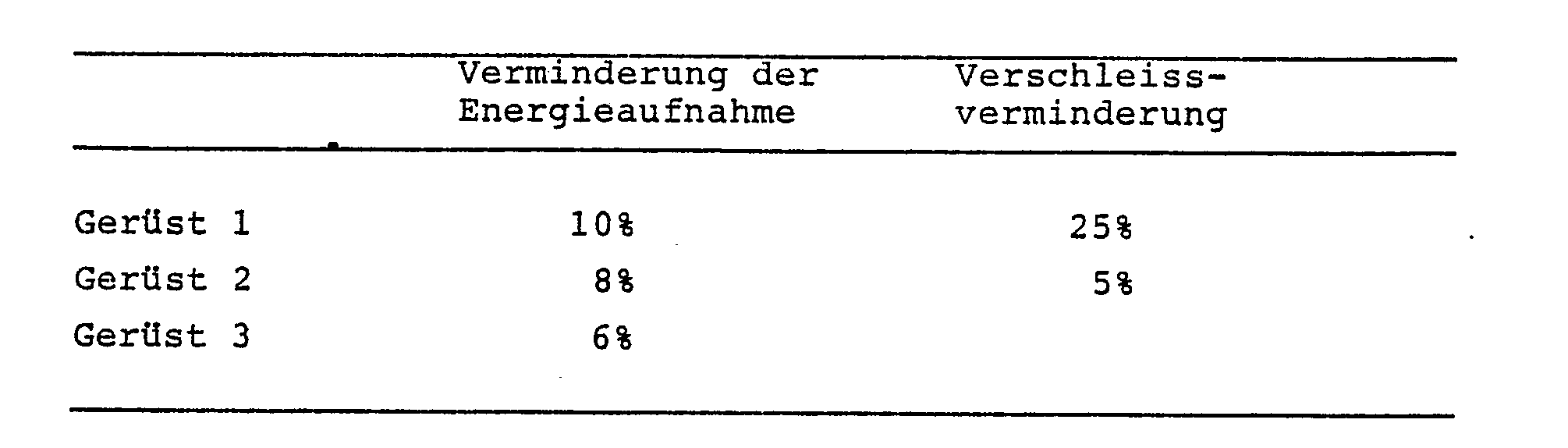
Die gewalzten Bleche wiesen eine wesentlich verbesserte Qualität auf, die sich durch eine verbesserte Rauhigkeit, also eine hervorragende Oberflächenqualität, bemerkbar machte. Wesentliches Merkmal darüber hinaus war eine Verminderung der Energieaufnahme des Walzgerüstes um durchschnittlich 15% und eine Verminderung des Walzenverschleisses von 35%. Darüber hinaus konnte festgestellt werden, dass sich ein Uebertragungseffekt einstellte, so dass das 2. Gerüst noch eine um 10% verminderte Energieaufnahme und um 8% verminderten Walzenverschleiss und das 3. Gerüst immer noch eine 8% verminderte Energieaufnahme zeigt.By premixing dry
35% by weight graphite (grain size less than 100 micrometers)
40% by weight of hydrocarbon resin, with a softening point of 100 ° C
10% by weight starch paste
5% by weight carboxymethyl cellulose
10% by weight bentonite
a solid lubricant was produced, which was suspended with water in an intensive mixer to form a solid lubricant system with a solids content of 10% by weight.
The suspension was at 60 bar through 8 nozzles each with 1.2 l / min. sprayed onto the two working cylinders of the first stand of a finishing line within a sheet metal rolling mill over the entire width of the roll.
The rolled sheets had a significantly improved quality, which was noticeable by an improved roughness, that is to say an excellent surface quality. Another key feature was a reduction in the energy consumption of the roll stand by an average of 15% and a reduction in roller wear by 35%. In addition, it was found that there was a transmission effect, so that the second stand still shows a 10% reduction in energy consumption and 8% reduced roller wear, and the 3rd stand still shows an 8% reduced energy consumption.
Es wurde wie in Beispiel 1 vorgegangen; wiederum wurde ein Festschmierstoffsystem mit 10 Gew.% Feststoffgehalt in einer wässrigen Suspension hergestellt, wobei der Festschmierstoff
88 Gew.% Graphit (Korngrösse kleiner als 100 Mikrometer)
1 Gew.% Wasserglas und
11 Gew.% Alkylcellulose
enthielt. Diese Suspension wurde mittels 8 Düsen in einer Menge von 0,7 l/min. und Düse auf die Arbeitszylinder des 1. Gerüstes aufgesprüht. Das Ergebnis ergibt sich auf der Tabelle.
88% by weight graphite (grain size less than 100 micrometers)
1% by weight water glass and
11% by weight alkyl cellulose
contained. This suspension was applied using 8 nozzles in an amount of 0.7 l / min. and nozzle sprayed onto the working cylinders of the 1st stand. The result is shown in the table.
Es wurden folgende Festschmierstoffsysteme, jeweils als wässrige Suspensionen, mit 5 Gew.% Feststoffgehalt hergestellt:

Bei der Anwendung beim Blechwalzen im 1. Gerüst der Walzstrasse ergaben sich Resultate bezüglich der Energieaufnahme und des Walzenverschleisses, die vergleichbar waren mit den Resultaten aus Beispielen 1 und 2.


Claims (7)
b) eine klebende Komponente aus der Reihe der organischen wasserunlöslichen Klebstoffe, die bei Temperaturen bis 300°C zerfallen und einen Erweichungspunkt von 20 bis 180°C aufweisen, und
c) ein Verdickungsmittel für wässrige Suspensionen aus der Reihe der Alginate, der Cellulosen, der Stärken, der Gummen, der Tone, allein oder im Gemisch untereinander, bedeuten,und
eine Komponente
d) in Form einer Flüssigkeit, als Trägermedium, enthält, wobei die Komponente d) eine Suspension mit einem Gehalt an a), b) und c) von 5 bis 30 Gew.-% in d) bildet.1. Lubricant system for sheet metal and profile rolling mills, characterized in that it contains 25 to 95 wt .-% of a lubricating component a) from the range of solid lubricants and 5 to 75 wt .-% of one of components b) and c), wherein the components
b) an adhesive component from the series of organic water-insoluble adhesives which disintegrate at temperatures up to 300 ° C. and have a softening point of 20 to 180 ° C., and
c) a thickener for aqueous suspensions from the series of alginates, celluloses, starches, gums, clays, alone or in a mixture with one another, and
a component
d) in the form of a liquid, as the carrier medium, component d) forming a suspension with a), b) and c) of 5 to 30% by weight in d).
Applications Claiming Priority (2)
| Application Number | Priority Date | Filing Date | Title |
|---|---|---|---|
| CH1322/86A CH669129A5 (en) | 1986-04-04 | 1986-04-04 | LUBRICANT SYSTEM FOR SHEET AND PROFILE ROLLING MILLS. |
| CH1322/86 | 1986-04-04 |
Publications (2)
| Publication Number | Publication Date |
|---|---|
| EP0240825A2 true EP0240825A2 (en) | 1987-10-14 |
| EP0240825A3 EP0240825A3 (en) | 1988-08-24 |
Family
ID=4207732
Family Applications (1)
| Application Number | Title | Priority Date | Filing Date |
|---|---|---|---|
| EP87104244A Withdrawn EP0240825A3 (en) | 1986-04-04 | 1987-03-23 | Lubricant system for plate and shape-rolling mills |
Country Status (11)
| Country | Link |
|---|---|
| US (1) | US4808324A (en) |
| EP (1) | EP0240825A3 (en) |
| JP (1) | JPS62250099A (en) |
| KR (1) | KR870010169A (en) |
| CN (1) | CN87102555A (en) |
| AU (1) | AU594754B2 (en) |
| BR (1) | BR8701496A (en) |
| CA (1) | CA1273002A (en) |
| CH (1) | CH669129A5 (en) |
| SU (1) | SU1574179A3 (en) |
| ZA (1) | ZA872115B (en) |
Cited By (4)
| Publication number | Priority date | Publication date | Assignee | Title |
|---|---|---|---|---|
| EP0554822A1 (en) * | 1992-02-06 | 1993-08-11 | Lonza Ag | Mandrel lubricant for the manufacture of seamless tubes |
| EP0611817A1 (en) * | 1991-09-13 | 1994-08-24 | Nihon Parkerizing Co., Ltd. | Lubricant composition for hot plastic working |
| WO1997002334A1 (en) * | 1995-07-04 | 1997-01-23 | Timcal Ag | Lubricant for pass rollers |
| CN100408315C (en) * | 2006-06-01 | 2008-08-06 | 鞍山市宏图防腐工程有限公司 | Lathe type rubber roller lining machine and rubber lining method |
Families Citing this family (46)
| Publication number | Priority date | Publication date | Assignee | Title |
|---|---|---|---|---|
| JPH0637632B2 (en) * | 1988-08-16 | 1994-05-18 | 新日鐵化学株式会社 | Lubricant composition for high temperature |
| CA1329802C (en) * | 1988-08-30 | 1994-05-24 | Nippon Kokan Kabushiki Kaisha | Lubricant for the production of seamless steel pipes |
| US5099667A (en) * | 1989-06-16 | 1992-03-31 | Lonza Ltd. | System for suspending and applying solid lubricants to tools or work pieces |
| US5468401A (en) * | 1989-06-16 | 1995-11-21 | Chem-Trend, Incorporated | Carrier-free metalworking lubricant and method of making and using same |
| GB8926904D0 (en) * | 1989-11-28 | 1990-01-17 | Unilever Plc | Thickening system |
| US5213166A (en) * | 1989-12-12 | 1993-05-25 | Mitsui-Cyanamid, Ltd. | Pile driving and pile removing method |
| EP0448944B1 (en) * | 1990-03-26 | 1994-09-14 | Lonza Ag | Method and device for intervalwise spraying of a suspension of lubricant |
| JPH0826342B2 (en) * | 1990-05-16 | 1996-03-13 | 日本鋼管株式会社 | Lubricant for mandrel mill |
| EP0465840B1 (en) * | 1990-07-10 | 1994-11-02 | Lonza Ag | Filtering device, especially for the separation of coarse particles from a lubricant suspension and use thereof |
| US5164433A (en) * | 1991-04-17 | 1992-11-17 | Rheox, Inc. | Rheological agents and thickeners |
| US5294355A (en) * | 1992-12-28 | 1994-03-15 | Desilube Technology, Inc. | Thermally and oxidatively stable solid lubricants |
| JP2586871B2 (en) * | 1993-03-02 | 1997-03-05 | 協同油脂株式会社 | Non-graphite lubricating oil dispersed in oil |
| US5476580A (en) * | 1993-05-17 | 1995-12-19 | Electrochemicals Inc. | Processes for preparing a non-conductive substrate for electroplating |
| US6303181B1 (en) | 1993-05-17 | 2001-10-16 | Electrochemicals Inc. | Direct metallization process employing a cationic conditioner and a binder |
| US6710259B2 (en) | 1993-05-17 | 2004-03-23 | Electrochemicals, Inc. | Printed wiring boards and methods for making them |
| US5690805A (en) * | 1993-05-17 | 1997-11-25 | Electrochemicals Inc. | Direct metallization process |
| US5725807A (en) * | 1993-05-17 | 1998-03-10 | Electrochemicals Inc. | Carbon containing composition for electroplating |
| US6171468B1 (en) | 1993-05-17 | 2001-01-09 | Electrochemicals Inc. | Direct metallization process |
| US5503506A (en) * | 1993-06-24 | 1996-04-02 | Hughes Aircraft Company | High precision, high surface finish broaching tool |
| US5589095A (en) * | 1994-09-30 | 1996-12-31 | Hughes Aircraft Company | Coolant/lubricant for machining operations |
| FR2753987B1 (en) * | 1996-10-02 | 1998-12-18 | Valeo Systemes Dessuyage | COMPOSITION FOR PERFORMING A COATING ON A WIPER BLADE OF A WINDSCREEN WIPER, AND METHOD FOR COATING A WIPING BLADE OF SUCH A COATING |
| US5691286A (en) * | 1996-10-15 | 1997-11-25 | Dylon Industries Inc. | Environmentally friendly sugar mill bearing lubricant |
| US6090756A (en) * | 1997-06-26 | 2000-07-18 | David Thomas Brown | Ballistics conditioning with molybdenum disulfide |
| US6169059B1 (en) * | 1998-11-19 | 2001-01-02 | Superior Graphite Co. | High-temperature, water-based lubricant and process for making the same |
| RU2156279C1 (en) * | 1999-01-29 | 2000-09-20 | Закрытое акционерное общество "ЭКОХИММАШ" | Grease for hot pressure metal working and method of preparation thereof |
| TW588108B (en) * | 2000-08-07 | 2004-05-21 | Nihon Parkerizing | Aqueous lubricant for plastic working of metallic material and method for forming lubricant film |
| JP3984158B2 (en) * | 2000-08-07 | 2007-10-03 | 日本パーカライジング株式会社 | Water-based lubricant for metal material plastic working and method for treating lubricating film |
| AU2001291574A1 (en) * | 2000-09-29 | 2002-04-08 | Kelsan Technologies Corp. | Friction control compositions |
| KR100391307B1 (en) * | 2001-06-04 | 2003-07-16 | 한라공조주식회사 | Method for preparing a solid film lubricant |
| US6576598B2 (en) | 2001-08-22 | 2003-06-10 | David Thomas Brown | Ballistics conditioning |
| RU2224008C1 (en) * | 2002-12-23 | 2004-02-20 | Федеральное государственное унитарное предприятие "Московское машиностроительное производственное предприятие "Салют" | Hot metal forming grease |
| DE102004006130A1 (en) * | 2003-12-23 | 2005-07-28 | Sms Demag Ag | Method for rolling milling material, especially useful for hot wide strip rolling in a finishing train or a continuous casting and rolling plant and giving decreased roll wear and decreased energy consumption |
| KR100643781B1 (en) | 2004-12-17 | 2006-11-10 | 김영량 | Method for producing surface lubricant treatment agent used in cold forging process |
| KR100751775B1 (en) | 2005-11-23 | 2007-09-04 | 주식회사 케이에스티 | Solid lubricant coating composition with excellent high temperature lubrication properties |
| JP5277421B2 (en) * | 2007-05-07 | 2013-08-28 | 大同化学工業株式会社 | Hot rolling oil composition |
| FR2925507A1 (en) * | 2008-04-08 | 2009-06-26 | Valeo Systemes Dessuyage | Preparing coating composition, useful for wiper blade of windshield wiper for motor vehicles, by preparing lubricant dispersion, introducing polymer microparticles in dispersion and contacting microparticle dispersion with resin dispersion |
| KR101116237B1 (en) * | 2009-08-12 | 2012-03-09 | 서울대학교산학협력단 | Nanofibrous silk nerve conduit for the regeneration of injured nerve and preparation method thereof |
| CN101864339B (en) * | 2010-04-29 | 2013-03-13 | 张岳 | Water-based lubricant for titanium tube rolling |
| CN102877648B (en) * | 2012-10-12 | 2014-08-20 | 长沙圣华科技发展有限公司 | Anti-carbonization maintenance film and method for cast-in-situ concrete vertical face |
| CN104031725B (en) * | 2014-06-27 | 2015-12-30 | 无锡市崇安区科技创业服务中心 | A kind of anti-bacterial lubricant and preparation method thereof |
| DE102017215713A1 (en) * | 2017-09-06 | 2019-03-07 | Sms Group Gmbh | Method for operating a rolling or metallurgical plant |
| CN112094683A (en) * | 2020-08-17 | 2020-12-18 | 沈阳中钛装备制造有限公司 | Release agent and preparation method and application thereof |
| CN113621433A (en) * | 2021-07-29 | 2021-11-09 | 四川中德铝业有限公司 | Special cooling liquid for aluminum alloy extruded cakes |
| CN113528223B (en) * | 2021-08-12 | 2023-09-19 | 陕西喜盛石油化工有限公司 | Anti-wear hydraulic oil and its production process |
| CN116463164A (en) * | 2023-04-07 | 2023-07-21 | 合肥乾丰润滑科技有限公司 | Environment-friendly industrial lubricant and preparation device thereof |
| CN116554953B (en) * | 2023-05-05 | 2024-10-29 | 泰州学院 | A titanium alloy surface anti-wear and friction reducing water-dispersible emulsion and its use method |
Family Cites Families (46)
| Publication number | Priority date | Publication date | Assignee | Title |
|---|---|---|---|---|
| US2735814A (en) * | 1956-02-21 | Die forging compound | ||
| US2176879A (en) * | 1937-11-20 | 1939-10-24 | Acheson Colloids Corp | Method of disintegrating, dispersing and stabilizing graphite and product |
| DE865041C (en) * | 1944-11-14 | 1953-01-29 | Wmf Wuerttemberg Metallwaren | Process to facilitate the non-cutting deformation of metallic workpieces |
| US2588625A (en) * | 1945-03-15 | 1952-03-11 | Aluminum Co Of America | Forging lubricant and method of using same |
| NL177969C (en) * | 1952-04-30 | Mitsui Petrochemical Ind | OF AT LEAST TWO LAYERS OF TUBULAR STRUCTURE FOR IRRIGATION. | |
| US3198735A (en) * | 1961-10-20 | 1965-08-03 | Edward R Lamson | Solid lubricant composition and method for lubricating anti-friction bearing structures |
| US3242075A (en) * | 1962-04-09 | 1966-03-22 | Acheson Ind Inc | High temperature lubricant |
| US3341454A (en) * | 1963-02-25 | 1967-09-12 | Hodson Corp | Lubricant composition |
| US3344065A (en) * | 1965-01-25 | 1967-09-26 | Molykote Produktions G M B H | Extreme pressure lubricants |
| US3384580A (en) * | 1967-05-09 | 1968-05-21 | Acheson Ind Inc | Graphite dispersions |
| GB1223562A (en) * | 1967-09-05 | 1971-02-24 | British Petroleum Co | Improved method of preparing oleophilic compounds |
| US3472770A (en) * | 1967-09-08 | 1969-10-14 | Chevron Res | Novel pinion grease |
| US3558488A (en) * | 1968-03-07 | 1971-01-26 | North American Rockwell | Protective and lubricating composition |
| US3838048A (en) * | 1968-06-17 | 1974-09-24 | Diamond Shamrock Corp | Polyvinylfluoride bearings |
| GB1287331A (en) * | 1970-01-29 | 1972-08-31 | Ciba Geigy Uk Ltd | Phosphorodithioic acid esters |
| GB1374976A (en) * | 1970-12-01 | 1974-11-20 | British Petroleum Co | Oleophilic graphite |
| US3801504A (en) * | 1971-03-22 | 1974-04-02 | Texaco Inc | Non-flammable water based hot forging lubricating compositions |
| US3843529A (en) * | 1972-08-10 | 1974-10-22 | Dow Corning | Metal working lubricant compositions |
| US3908038A (en) * | 1973-03-28 | 1975-09-23 | Allied Chem | Thermoplastic molding compositions |
| US3833502A (en) * | 1973-04-30 | 1974-09-03 | Nalco Chemical Co | Method for improving the adherence of metalworking coolants to metal surfaces |
| US4055503A (en) * | 1973-10-11 | 1977-10-25 | Robert Bosch G.M.B.H. | Lubricating powder and method of producing same and relatively slideable components |
| GB1438215A (en) * | 1974-05-08 | 1976-06-03 | Lonz Ltd | High temperature lubricant |
| DE2430249C3 (en) * | 1974-06-24 | 1977-03-17 | Chemische Fabrik Budenheim Rudolf A. Oetker, 6501 Budenheim | HIGH TEMPERATURE LUBRICANT FOR THE HOT FORMING OF METALS |
| US4039337A (en) * | 1974-10-23 | 1977-08-02 | Ball Brothers Research Corporation | Release coating for glass manufacture |
| GB1525395A (en) * | 1974-10-23 | 1978-09-20 | Ball Brothers Res Corp | Release coating |
| US3994847A (en) * | 1974-12-30 | 1976-11-30 | Ball Corporation | Aqueous dispersion of polyphenylene sulfide metal phosphate binder and solid lubricant for glass molds coating |
| US4050932A (en) * | 1975-04-07 | 1977-09-27 | General Motors Corporation | Colloidal graphite forging lubricant and method |
| US4104178A (en) * | 1975-10-24 | 1978-08-01 | Wyman-Gordon Company | Water-based forging lubricant |
| US3983042A (en) * | 1975-10-24 | 1976-09-28 | Wyman-Gordon Company | Water-based forging lubricant |
| CA1075223A (en) * | 1975-12-12 | 1980-04-08 | Donald G. Needham | Poly (arylene sulfide) antifriction composition |
| SU586195A1 (en) * | 1976-05-19 | 1977-12-30 | Институт Химии Высокомолекулярных Соединений Ан Украинской Сср | "spga-1" lubricant for cold plastic working of metals |
| GB1600734A (en) * | 1977-03-08 | 1981-10-21 | British Petroleum Co | Fire resistant grease |
| US4321295A (en) * | 1977-12-23 | 1982-03-23 | Ramu International | Modified graphite and process for using same |
| GB1569730A (en) * | 1978-05-30 | 1980-06-18 | Ciba Geigy Ag | 0,0-diiso-propyl-s-(2-carboethoxyethyl)-phosphorodithioate and lubricating oil compositions containing it |
| US4206060A (en) * | 1978-10-23 | 1980-06-03 | Sumitomo Kinzoku Kogyo Kabushiki Kaisha | Bolt and nut unit coated with lubricant |
| FR2440985A1 (en) * | 1978-11-07 | 1980-06-06 | Nord Tech Rech Applic | ADDITIVE OIL COMPOSITIONS FOR INTERNAL COMBUSTION ENGINES |
| DE2849617A1 (en) * | 1978-11-15 | 1980-05-29 | Dow Corning Gmbh | AQUEOUS LUBRICANT |
| US4228020A (en) * | 1979-05-04 | 1980-10-14 | Edwin Cooper, Inc. | Lubricating oil composition |
| US4357249A (en) * | 1980-09-11 | 1982-11-02 | Arguto, Inc. | Self-lubricating bearing and the like, and method of making same |
| JPH0694044B2 (en) * | 1981-04-16 | 1994-11-24 | バドガ−.フイリツプ.オ− | How to provide a lubricious surface to a metal |
| SU981351A1 (en) * | 1981-05-08 | 1982-12-15 | Ждановский металлургический институт | Lubricant for metal press-working |
| SU1030405A1 (en) * | 1982-04-09 | 1983-07-23 | Всесоюзный Ордена Трудового Красного Знамени Научно-Исследовательский И Конструкторско-Технологический Институт Трубной Промышленности | Release agent for hot metal press-working |
| JPS5918799A (en) * | 1982-07-23 | 1984-01-31 | Nippon Steel Corp | Lubricant for hot processing of steel stock |
| ZA84247B (en) * | 1983-02-18 | 1984-09-26 | Lonza Ag | Parting and lubricating agent in solid form |
| US4454050A (en) * | 1983-03-21 | 1984-06-12 | Pennwalt Corporation | Aqueous release agent and lubricant |
| CH660023A5 (en) * | 1984-05-30 | 1987-03-13 | Lonza Ag | HIGH-TEMPERATURE LUBRICANT FOR CHIP-FREE HOT FORMING OF METALS. |
-
1986
- 1986-04-04 CH CH1322/86A patent/CH669129A5/en not_active IP Right Cessation
-
1987
- 1987-03-03 CA CA000531035A patent/CA1273002A/en not_active Expired - Fee Related
- 1987-03-23 EP EP87104244A patent/EP0240825A3/en not_active Withdrawn
- 1987-03-23 ZA ZA872115A patent/ZA872115B/en unknown
- 1987-03-31 KR KR870003000A patent/KR870010169A/en not_active Withdrawn
- 1987-03-31 US US07/032,010 patent/US4808324A/en not_active Expired - Lifetime
- 1987-04-01 CN CN198787102555A patent/CN87102555A/en active Pending
- 1987-04-01 SU SU874202387A patent/SU1574179A3/en active
- 1987-04-02 BR BR8701496A patent/BR8701496A/en unknown
- 1987-04-02 JP JP62082189A patent/JPS62250099A/en active Pending
- 1987-04-03 AU AU71020/87A patent/AU594754B2/en not_active Ceased
Cited By (4)
| Publication number | Priority date | Publication date | Assignee | Title |
|---|---|---|---|---|
| EP0611817A1 (en) * | 1991-09-13 | 1994-08-24 | Nihon Parkerizing Co., Ltd. | Lubricant composition for hot plastic working |
| EP0554822A1 (en) * | 1992-02-06 | 1993-08-11 | Lonza Ag | Mandrel lubricant for the manufacture of seamless tubes |
| WO1997002334A1 (en) * | 1995-07-04 | 1997-01-23 | Timcal Ag | Lubricant for pass rollers |
| CN100408315C (en) * | 2006-06-01 | 2008-08-06 | 鞍山市宏图防腐工程有限公司 | Lathe type rubber roller lining machine and rubber lining method |
Also Published As
| Publication number | Publication date |
|---|---|
| EP0240825A3 (en) | 1988-08-24 |
| ZA872115B (en) | 1987-11-25 |
| US4808324A (en) | 1989-02-28 |
| CN87102555A (en) | 1987-10-14 |
| AU7102087A (en) | 1987-10-08 |
| CH669129A5 (en) | 1989-02-28 |
| CA1273002A (en) | 1990-08-21 |
| JPS62250099A (en) | 1987-10-30 |
| SU1574179A3 (en) | 1990-06-23 |
| AU594754B2 (en) | 1990-03-15 |
| KR870010169A (en) | 1987-11-30 |
| BR8701496A (en) | 1988-01-19 |
Similar Documents
| Publication | Publication Date | Title |
|---|---|---|
| EP0240825A2 (en) | Lubricant system for plate and shape-rolling mills | |
| EP0743352B1 (en) | Lubricant composition suitable for application on metal workpieces during hot-forming | |
| DE2450716A1 (en) | HIGH TEMPERATURE LUBRICANT FOR HOT DEFORMING METALS | |
| DD233379A5 (en) | HIGH-TEMPERATURE LUBRICANT FOR THE SPANLESS HOT FORMING OF METALS | |
| EP0554822B1 (en) | Mandrel lubricant for the manufacture of seamless tubes | |
| DE2849617A1 (en) | AQUEOUS LUBRICANT | |
| CH670106A5 (en) | ||
| DE3855381T2 (en) | Water-based composition for removing coatings | |
| EP2089498A2 (en) | Graphite-containing high-temperature lubricant for high-grade steels and carbon steels | |
| DE4100582C2 (en) | Lubricating composition for hot and hot forging and their use | |
| DE69528452T2 (en) | LUBRICANTS FOR HOT ROLLING STAINLESS STEEL WITH HIGH CHROME CONTENT | |
| EP0261438B1 (en) | Lubricant for forging steel | |
| CH596294A5 (en) | High temp. lubricants for hot forming of metals | |
| CH609728A5 (en) | High temperature lubricant for the hot-forming of metals | |
| DE2730753C3 (en) | Chill coating for ingot casting of steel | |
| JPS5813696A (en) | Water-based lubricant for hot rolling and hot rolling process using the same | |
| DE3123726A1 (en) | Adhesive oils | |
| DE68906192T2 (en) | WATER-DISPERSIBLE COMPOSITIONS WITH CLEANING OR PROTECTIVE EFFECT ON STEEL SHEETS AND METHOD FOR THEIR PRODUCTION. | |
| DE1944632A1 (en) | Lubricant concentrate for non-cutting met - al forming | |
| WO1990013621A1 (en) | Lubricant for reducing friction between rubber and metal | |
| WO1997002334A1 (en) | Lubricant for pass rollers | |
| DE2700040A1 (en) | LUBRICANT SYSTEM FOR HOT FORMING OF METALS | |
| JPH0536478B2 (en) | ||
| DE1191518B (en) | Phosphate-containing coating compounds for air filters | |
| JPH05214358A (en) | Lubricant composition for high temperature |
Legal Events
| Date | Code | Title | Description |
|---|---|---|---|
| PUAI | Public reference made under article 153(3) epc to a published international application that has entered the european phase |
Free format text: ORIGINAL CODE: 0009012 |
|
| AK | Designated contracting states |
Kind code of ref document: A2 Designated state(s): AT BE CH DE ES FR GB IT LI LU NL |
|
| PUAL | Search report despatched |
Free format text: ORIGINAL CODE: 0009013 |
|
| AK | Designated contracting states |
Kind code of ref document: A3 Designated state(s): AT BE CH DE ES FR GB IT LI LU NL |
|
| 17P | Request for examination filed |
Effective date: 19881124 |
|
| 17Q | First examination report despatched |
Effective date: 19890719 |
|
| STAA | Information on the status of an ep patent application or granted ep patent |
Free format text: STATUS: THE APPLICATION IS DEEMED TO BE WITHDRAWN |
|
| 18D | Application deemed to be withdrawn |
Effective date: 19891130 |
|
| RIN1 | Information on inventor provided before grant (corrected) |
Inventor name: LANINI, MARCO Inventor name: PERIARD, JACQUES, DR. Inventor name: STAUB, HANS RUDOLF |