EP0240760A2 - Procédé et dispositif de précipitation de dérivés chargés négativement de lignine - Google Patents
Procédé et dispositif de précipitation de dérivés chargés négativement de lignine Download PDFInfo
- Publication number
- EP0240760A2 EP0240760A2 EP87103478A EP87103478A EP0240760A2 EP 0240760 A2 EP0240760 A2 EP 0240760A2 EP 87103478 A EP87103478 A EP 87103478A EP 87103478 A EP87103478 A EP 87103478A EP 0240760 A2 EP0240760 A2 EP 0240760A2
- Authority
- EP
- European Patent Office
- Prior art keywords
- precipitation
- reactor
- computer
- precipitant
- absorption
- Prior art date
- Legal status (The legal status is an assumption and is not a legal conclusion. Google has not performed a legal analysis and makes no representation as to the accuracy of the status listed.)
- Withdrawn
Links
Images

Classifications
-
- C—CHEMISTRY; METALLURGY
- C08—ORGANIC MACROMOLECULAR COMPOUNDS; THEIR PREPARATION OR CHEMICAL WORKING-UP; COMPOSITIONS BASED THEREON
- C08H—DERIVATIVES OF NATURAL MACROMOLECULAR COMPOUNDS
- C08H6/00—Macromolecular compounds derived from lignin, e.g. tannins, humic acids
-
- D—TEXTILES; PAPER
- D21—PAPER-MAKING; PRODUCTION OF CELLULOSE
- D21C—PRODUCTION OF CELLULOSE BY REMOVING NON-CELLULOSE SUBSTANCES FROM CELLULOSE-CONTAINING MATERIALS; REGENERATION OF PULPING LIQUORS; APPARATUS THEREFOR
- D21C11/00—Regeneration of pulp liquors or effluent waste waters
- D21C11/02—Regeneration of pulp liquors or effluent waste waters of acid, neutral or alkaline sulfite lye
Definitions
- the invention is directed to a process for the precipitation of negatively charged lignin derivatives, such as ligninsulfonic acid and chlorine lignins from sulfite waste liquor by means of polyimines not added in excess, the pH and the temperature being kept approximately constant and the precipitation rate based on the UV absorption of the Supernatant of the precipitation is determined.
- negatively charged lignin derivatives such as ligninsulfonic acid and chlorine lignins from sulfite waste liquor
- the pulp industry is opening up the wood raw materials to a large extent using the sulfite process.
- Both lignin derivatives exist as macromolecules and have a similar chemical structure.
- the bleaching effluent is still discharged into the receiving water and, as a result, it poses a considerable environmental burden.
- the regulations which have been extremely stringent in the meantime, are increasingly forcing the pulp industry to solve this emissions problem as cleanly as possible.
- Most of the sulphite waste liquor is currently still being burned, which is also not without problems and does not have an advantageous energy balance.
- DE-PS 30 38 241 describes the extraction of lignin sulfonates from sulfite waste liquor via a precipitation complex by adding polycations.
- the process disclosed therein leads to a highly concentrated product and is characterized by the reusability of the precipitating agent polyimine.
- Z.Wasser-Abwasser-Forschung, 19, 33 to 37 (1986) reports on the precipitation of chlorine lignin from pulp waste water by polyimine. After this, when water is added, a water-insoluble symplex is formed. According to the knowledge gained from these processes, the addition of the precipitant in excess leads to the partial redissolution of this symplex.
- This object is achieved by the invention in a process under the above-mentioned requirements in such a way that the setting of the pH and the addition of precipitant is controlled by a process computer and the UV absorption in a secondary circuit connected to the precipitation reactor after the precipitation has been separated off and the measured value determined is entered into the computer.
- the idea of a computer-controlled process sequence is used particularly advantageously in such a process, which is highly sensitive because of the excess problem with the precipitant. In this way, an optimal regulation of the addition of precipitant is made possible.
- the absorption measurement assumes an absorption maximum of the lignin derivatives at 280 nm. The UV absorption of the supernatant thus decreases as the precipitation rate increases. If these measured values are entered into a computer, the process can be controlled in a perfect and optimal manner.
- the invention also relates to a device for carrying out the claimed process, at least one reactor being used.
- this reactor is connected to a pH meter and to a secondary circuit which, in the direction of flow, has a device for separating the sediment from the supernatant to be measured and a UV absorption meter, both measuring devices being coupled to a computer, which in turn is connected to shut-off devices is coupled in the supply lines for the pH reagents and the precipitant and in the connecting line with the reactor and a settling vessel.
- the measured values from the pH meter and absorption meter are received as signals in the process computer and are compared there, for example, with preprogrammed empirical values.
- the output of the computer then form pulses for influencing shut-off elements, such as valves, pumps or the like. in the different supply lines.
- the sediment is removed from the sample taken from the reactor and the remaining supernatant is fed to the measurement.
- centrifuge possibly a once-through centrifuge, in the secondary circuit for separating the precipitate.
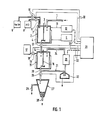
- the waste water to be treated is introduced through the feed line 1 into a reactor 2 which is provided with an agitator 3.
- the reactor 2 is provided with a heating device 4 which, with the aid of a thermostat 5, adjusts the reactor content to a desired value and maintains it constant.
- the feed lines 6 and 7 open into the reactor, of which the former is connected to a storage vessel 8 for an acid, the latter to a storage vessel 9 for an alkali. Both lines 6 and 7 are each provided with a valve 10. Of course, appropriate conveying devices such as pumps or the like can, if necessary, also in their place. be provided.
- the reactor 2 is connected via the probe line 11 to a pH meter 12 which determines the corresponding values of the liquid in the reactor 2.
- the bottom outlet of the reactor 2 is connected via a line 14 provided with a shut-off valve 13 to a further reactor 15, which in turn contains an agitator 16.
- This storage container 17 serves to hold a precipitant.
- a secondary circuit 21 branches off from the drain line 20 of the reactor 15, in which a centrifuge 22 and a photometer 23 for determining the UV absorption are arranged one behind the other in the direction of flow. With the line 24, this secondary circuit 21 opens again into the reactor 15.
- the drain line 20 is provided with a shut-off valve 26 and it opens into a settling tank 27 in which the sediment settles on the ground, from where it is removed through the opening 28, while the supernatant is decanted and removed through the line 29.
- the pH meter 12 and the photometer 23 are coupled via lines 30 to a process computer 31 which registers the measured values determined and, if necessary, compares them with preprogrammed comparison values.
- the outputs 32 of this computer 31 are connected to the shut-off valves 10, 13, 18, 26 and are used to transmit corresponding control pulses.
- the waste liquor is introduced through line 1 into the reactor 2 and heated there to the desired process temperature with constant stirring.
- the pH meter 12 measures the pH of the reactor contents and enters this value into the computer 31. This compares the actual value with the predetermined target value and, if there is a difference, gives a corresponding pulse to one of the valves 10, upon opening of which a quantity of acid or alkali previously calculated and preprogrammed from corresponding empirical values is taken from the storage containers 8 or 9 and is introduced into the reactor 2. This process is repeated with the amount to be added generally decreasing until the actual value and the desired value of the pH value match. This state triggers a further signal to the valve 13 in the computer 31, which opens and allows the contents to flow from the reactor 2 into the subsequent reactor 15.
- the reactor contents are constantly in motion by an agitator 16 held. Since the secondary circuit 21 is connected to the interior of the reactor 15, the liquid reaches the photometer 23 directly or, as shown in FIG. 1, via the centrifuge 22, which determines the optical density of the liquid at 280 nm.
- This measured value At o is entered in the computer 31 and compared there with a predetermined and preprogrammed empirical value. This triggers a signal to the valve 18 which opens and allows the precipitant to flow from the reservoir 17 into the reactor 15. First about 80% of the pre-calculated amount of precipitant is added.
- the continuous centrifuge 22 is put into operation, which separates the flocculated sediment contained in the liquid and supplies the supernatant, if necessary via a pump (not shown in detail), to the photometer 23, its optical Density is measured by UV absorption.
- This measured value At 1 is entered into the computer 31 and there causes a further signal to the valve 18 in the feed line 19 for the precipitant, of which a much smaller amount is now added, however. If the photometer 23 then determines a new stabilized measured value of the UV absorption in the supernatant supplied to it, this measured value At 2 is compared with the previous value At 1.
- the pre-calculated amount of precipitant was added, namely 16 ml of 10% (w / w) polyethyleneimine solution.
- the mixture was stirred for 10 minutes and then again in the secondary circuit 21 with the centrifuge 22 switched on, the optical density in the photometer 23 was measured again.
- the dead volume in the secondary circuit 21 was a total of 400 ml with the centrifuge switched on A constant measurement of the UV absorption was added to two ml of polyethyleneimine and measured again. This process was repeated until a constant optical density value was reached.
- the entire precipitation process took 22 minutes.
- the contents of the reactor 15 were then pumped into a settling vessel 27 in the form of an Imhoff vessel. After a further 15 minutes, an easily filterable sediment had formed. After filtration, the filter cake had a water content of 75-80% and could be disposed of.
- the filtrate or the supernatant from the precipitation had the following values:
Landscapes
- Chemical & Material Sciences (AREA)
- Chemical Kinetics & Catalysis (AREA)
- Engineering & Computer Science (AREA)
- Biochemistry (AREA)
- Materials Engineering (AREA)
- Health & Medical Sciences (AREA)
- Life Sciences & Earth Sciences (AREA)
- Medicinal Chemistry (AREA)
- Polymers & Plastics (AREA)
- Organic Chemistry (AREA)
- Removal Of Specific Substances (AREA)
- Compounds Of Unknown Constitution (AREA)
- Luminescent Compositions (AREA)
- Photoreceptors In Electrophotography (AREA)
Applications Claiming Priority (2)
| Application Number | Priority Date | Filing Date | Title |
|---|---|---|---|
| DE19863611676 DE3611676A1 (de) | 1986-04-08 | 1986-04-08 | Verfahren und vorrichtung zum ausfaellen von negativ geladenen lignin-derivaten |
| DE3611676 | 1986-04-08 |
Publications (2)
| Publication Number | Publication Date |
|---|---|
| EP0240760A2 true EP0240760A2 (fr) | 1987-10-14 |
| EP0240760A3 EP0240760A3 (fr) | 1988-09-21 |
Family
ID=6298156
Family Applications (1)
| Application Number | Title | Priority Date | Filing Date |
|---|---|---|---|
| EP87103478A Withdrawn EP0240760A3 (fr) | 1986-04-08 | 1987-03-11 | Procédé et dispositif de précipitation de dérivés chargés négativement de lignine |
Country Status (4)
| Country | Link |
|---|---|
| EP (1) | EP0240760A3 (fr) |
| DE (1) | DE3611676A1 (fr) |
| FI (1) | FI871513A7 (fr) |
| NO (1) | NO871465L (fr) |
Family Cites Families (2)
| Publication number | Priority date | Publication date | Assignee | Title |
|---|---|---|---|---|
| US3518204A (en) * | 1967-11-01 | 1970-06-30 | Betz Laboratories | Control of the rate of precipitate growth and of precipitation in aqueous systems |
| DE3038241C2 (de) * | 1980-10-10 | 1983-01-05 | Gesellschaft für Biotechnologische Forschung mbH (GBF), 3300 Braunschweig | Verfahren zur Ausfällung von Ligninsulfonaten aus Sulfitablaugen |
-
1986
- 1986-04-08 DE DE19863611676 patent/DE3611676A1/de active Granted
-
1987
- 1987-03-11 EP EP87103478A patent/EP0240760A3/fr not_active Withdrawn
- 1987-04-07 NO NO871465A patent/NO871465L/no unknown
- 1987-04-07 FI FI871513A patent/FI871513A7/fi not_active IP Right Cessation
Also Published As
| Publication number | Publication date |
|---|---|
| NO871465L (no) | 1987-10-09 |
| FI871513A0 (fi) | 1987-04-07 |
| DE3611676A1 (de) | 1987-10-15 |
| DE3611676C2 (fr) | 1988-12-01 |
| EP0240760A3 (fr) | 1988-09-21 |
| FI871513A7 (fi) | 1987-10-09 |
| NO871465D0 (no) | 1987-04-07 |
Similar Documents
| Publication | Publication Date | Title |
|---|---|---|
| DE3041460C2 (fr) | ||
| EP0019176A1 (fr) | Procédé pour la déshydratation de boues d'eaux résiduaires sur les filtres-presses | |
| EP0384329A1 (fr) | Procédé de conditionnement de lisier | |
| DE2422889B2 (de) | Kontinuierliches Verfahren zur ZuckerrUckgewinnung aus Klärungs-Schaum | |
| DE3517886A1 (de) | Verfahren zur gewinnung von fluessigkeit aus einer restsubstanz und vorrichtung zur durchfuehrung derselben | |
| EP0335280B1 (fr) | Procédé de purification d'eau usée ayant une forte concentration d'ions ammonium | |
| DE1642404A1 (de) | Verfahren zum Behandeln von Abwasser | |
| DE69908916T2 (de) | Verfahren und vorrichtung zur behandlung von abwasser in einem bioreaktor, einer ultrafiltrationseinheit und einer membranfiltrationeinheit | |
| DE1908596A1 (de) | Verfahren zur aaeroben Zersetzung von Klaerschlamm | |
| DE2617837C2 (de) | Vorrichtung zur Aufbereitung von mineralischen Schwerschlamm enthaltendem Wasser | |
| DE3611676C2 (fr) | ||
| EP0013986A1 (fr) | Procédé pour l'élimination de l'ammoniac de solutions ammoniacales, en particulier des eaux de cokerie | |
| EP0019733A1 (fr) | Procédé pour optimaliser l'activité d'assimilation de microorganismes dans le substrat d'un système de réaction biologique | |
| EP0218896A1 (fr) | Procédé pour le prétraitement de déchets organiques d'abbatoirs | |
| DE2524172A1 (de) | Verbessertes verfahren zur wasser-, abwasser- und schlammbehandlung mit flockungsmitteln | |
| DE102017123807A1 (de) | Verbessertes Verfahren zur Kohlenstoffdioxid-Extraktion von Phosphaten aus Rohstoffen | |
| DE4104094A1 (de) | Verfahren und vorrichtung zur reinigung von abwasser | |
| EP0421265A1 (fr) | Procédé et appareil pour mélanger une solution de flocculants avec de l'eau boueuse à filtrer | |
| DE3731513C2 (fr) | ||
| DE69710628T2 (de) | Verfahren zur Reinigung proteinhaltiger Abwässer | |
| EP0606291B1 (fr) | Procede et dispositif pour la recuperation de constituants provenant de dispersions de colorants | |
| DE1956923B2 (de) | Verfahren zum Behandeln kommunaler Abwasser | |
| DE2738957A1 (de) | Verfahren zur behandlung von abwaessern, insbesonders industrieabwaessern mit organischen bestandteilen unter gewinnung eines als duengemittel geeigneten schlammes durch ausflockung, bzw. faellung geloester oder suspendierter verunreinigungen und vorrichtung zur durchfuehrung des verfahrens | |
| DE3022679C2 (fr) | ||
| DE69121727T2 (de) | Verfahren und vorrichtung in einer anlage zur rückgewinnung von chemikalien in einer sulfatzellstoff-anlage |
Legal Events
| Date | Code | Title | Description |
|---|---|---|---|
| PUAI | Public reference made under article 153(3) epc to a published international application that has entered the european phase |
Free format text: ORIGINAL CODE: 0009012 |
|
| AK | Designated contracting states |
Kind code of ref document: A2 Designated state(s): AT BE CH FR LI LU NL SE |
|
| RAP1 | Party data changed (applicant data changed or rights of an application transferred) |
Owner name: G.A. PFLEIDERER UNTERNEHMENSVERWALTUNG GMBH & CO. |
|
| PUAL | Search report despatched |
Free format text: ORIGINAL CODE: 0009013 |
|
| AK | Designated contracting states |
Kind code of ref document: A3 Designated state(s): AT BE CH FR LI LU NL SE |
|
| 17P | Request for examination filed |
Effective date: 19890321 |
|
| 17Q | First examination report despatched |
Effective date: 19901130 |
|
| STAA | Information on the status of an ep patent application or granted ep patent |
Free format text: STATUS: THE APPLICATION IS DEEMED TO BE WITHDRAWN |
|
| 18D | Application deemed to be withdrawn |
Effective date: 19910611 |
|
| RIN1 | Information on inventor provided before grant (corrected) |
Inventor name: WEHR, KONRADFORSTBOTANISCHES INSTITUT DER Inventor name: LOVAS, GABORFORSTBOTANISCHES INSTITUT DER Inventor name: MILSTEIN, OLEG, DR.FORSTBOTANISCHES INSTITUT Inventor name: HAARS, ANNEGRET, DR.FORSTBOTANISCHES INSTITUT Inventor name: HUETTERMANN, ALOYS, PROF. DR.FORSTBOTANISCHES |