EP0240760A2 - Process and apparatus for the precipitation of negatively charged derivatives of lignine - Google Patents
Process and apparatus for the precipitation of negatively charged derivatives of lignine Download PDFInfo
- Publication number
- EP0240760A2 EP0240760A2 EP87103478A EP87103478A EP0240760A2 EP 0240760 A2 EP0240760 A2 EP 0240760A2 EP 87103478 A EP87103478 A EP 87103478A EP 87103478 A EP87103478 A EP 87103478A EP 0240760 A2 EP0240760 A2 EP 0240760A2
- Authority
- EP
- European Patent Office
- Prior art keywords
- precipitation
- reactor
- computer
- precipitant
- absorption
- Prior art date
- Legal status (The legal status is an assumption and is not a legal conclusion. Google has not performed a legal analysis and makes no representation as to the accuracy of the status listed.)
- Withdrawn
Links
Images

Classifications
-
- C—CHEMISTRY; METALLURGY
- C08—ORGANIC MACROMOLECULAR COMPOUNDS; THEIR PREPARATION OR CHEMICAL WORKING-UP; COMPOSITIONS BASED THEREON
- C08H—DERIVATIVES OF NATURAL MACROMOLECULAR COMPOUNDS
- C08H6/00—Macromolecular compounds derived from lignin, e.g. tannins, humic acids
-
- D—TEXTILES; PAPER
- D21—PAPER-MAKING; PRODUCTION OF CELLULOSE
- D21C—PRODUCTION OF CELLULOSE BY REMOVING NON-CELLULOSE SUBSTANCES FROM CELLULOSE-CONTAINING MATERIALS; REGENERATION OF PULPING LIQUORS; APPARATUS THEREFOR
- D21C11/00—Regeneration of pulp liquors or effluent waste waters
- D21C11/02—Regeneration of pulp liquors or effluent waste waters of acid, neutral or alkaline sulfite lye
Definitions
- the invention is directed to a process for the precipitation of negatively charged lignin derivatives, such as ligninsulfonic acid and chlorine lignins from sulfite waste liquor by means of polyimines not added in excess, the pH and the temperature being kept approximately constant and the precipitation rate based on the UV absorption of the Supernatant of the precipitation is determined.
- negatively charged lignin derivatives such as ligninsulfonic acid and chlorine lignins from sulfite waste liquor
- the pulp industry is opening up the wood raw materials to a large extent using the sulfite process.
- Both lignin derivatives exist as macromolecules and have a similar chemical structure.
- the bleaching effluent is still discharged into the receiving water and, as a result, it poses a considerable environmental burden.
- the regulations which have been extremely stringent in the meantime, are increasingly forcing the pulp industry to solve this emissions problem as cleanly as possible.
- Most of the sulphite waste liquor is currently still being burned, which is also not without problems and does not have an advantageous energy balance.
- DE-PS 30 38 241 describes the extraction of lignin sulfonates from sulfite waste liquor via a precipitation complex by adding polycations.
- the process disclosed therein leads to a highly concentrated product and is characterized by the reusability of the precipitating agent polyimine.
- Z.Wasser-Abwasser-Forschung, 19, 33 to 37 (1986) reports on the precipitation of chlorine lignin from pulp waste water by polyimine. After this, when water is added, a water-insoluble symplex is formed. According to the knowledge gained from these processes, the addition of the precipitant in excess leads to the partial redissolution of this symplex.
- This object is achieved by the invention in a process under the above-mentioned requirements in such a way that the setting of the pH and the addition of precipitant is controlled by a process computer and the UV absorption in a secondary circuit connected to the precipitation reactor after the precipitation has been separated off and the measured value determined is entered into the computer.
- the idea of a computer-controlled process sequence is used particularly advantageously in such a process, which is highly sensitive because of the excess problem with the precipitant. In this way, an optimal regulation of the addition of precipitant is made possible.
- the absorption measurement assumes an absorption maximum of the lignin derivatives at 280 nm. The UV absorption of the supernatant thus decreases as the precipitation rate increases. If these measured values are entered into a computer, the process can be controlled in a perfect and optimal manner.
- the invention also relates to a device for carrying out the claimed process, at least one reactor being used.
- this reactor is connected to a pH meter and to a secondary circuit which, in the direction of flow, has a device for separating the sediment from the supernatant to be measured and a UV absorption meter, both measuring devices being coupled to a computer, which in turn is connected to shut-off devices is coupled in the supply lines for the pH reagents and the precipitant and in the connecting line with the reactor and a settling vessel.
- the measured values from the pH meter and absorption meter are received as signals in the process computer and are compared there, for example, with preprogrammed empirical values.
- the output of the computer then form pulses for influencing shut-off elements, such as valves, pumps or the like. in the different supply lines.
- the sediment is removed from the sample taken from the reactor and the remaining supernatant is fed to the measurement.
- centrifuge possibly a once-through centrifuge, in the secondary circuit for separating the precipitate.
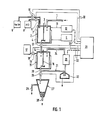
- the waste water to be treated is introduced through the feed line 1 into a reactor 2 which is provided with an agitator 3.
- the reactor 2 is provided with a heating device 4 which, with the aid of a thermostat 5, adjusts the reactor content to a desired value and maintains it constant.
- the feed lines 6 and 7 open into the reactor, of which the former is connected to a storage vessel 8 for an acid, the latter to a storage vessel 9 for an alkali. Both lines 6 and 7 are each provided with a valve 10. Of course, appropriate conveying devices such as pumps or the like can, if necessary, also in their place. be provided.
- the reactor 2 is connected via the probe line 11 to a pH meter 12 which determines the corresponding values of the liquid in the reactor 2.
- the bottom outlet of the reactor 2 is connected via a line 14 provided with a shut-off valve 13 to a further reactor 15, which in turn contains an agitator 16.
- This storage container 17 serves to hold a precipitant.
- a secondary circuit 21 branches off from the drain line 20 of the reactor 15, in which a centrifuge 22 and a photometer 23 for determining the UV absorption are arranged one behind the other in the direction of flow. With the line 24, this secondary circuit 21 opens again into the reactor 15.
- the drain line 20 is provided with a shut-off valve 26 and it opens into a settling tank 27 in which the sediment settles on the ground, from where it is removed through the opening 28, while the supernatant is decanted and removed through the line 29.
- the pH meter 12 and the photometer 23 are coupled via lines 30 to a process computer 31 which registers the measured values determined and, if necessary, compares them with preprogrammed comparison values.
- the outputs 32 of this computer 31 are connected to the shut-off valves 10, 13, 18, 26 and are used to transmit corresponding control pulses.
- the waste liquor is introduced through line 1 into the reactor 2 and heated there to the desired process temperature with constant stirring.
- the pH meter 12 measures the pH of the reactor contents and enters this value into the computer 31. This compares the actual value with the predetermined target value and, if there is a difference, gives a corresponding pulse to one of the valves 10, upon opening of which a quantity of acid or alkali previously calculated and preprogrammed from corresponding empirical values is taken from the storage containers 8 or 9 and is introduced into the reactor 2. This process is repeated with the amount to be added generally decreasing until the actual value and the desired value of the pH value match. This state triggers a further signal to the valve 13 in the computer 31, which opens and allows the contents to flow from the reactor 2 into the subsequent reactor 15.
- the reactor contents are constantly in motion by an agitator 16 held. Since the secondary circuit 21 is connected to the interior of the reactor 15, the liquid reaches the photometer 23 directly or, as shown in FIG. 1, via the centrifuge 22, which determines the optical density of the liquid at 280 nm.
- This measured value At o is entered in the computer 31 and compared there with a predetermined and preprogrammed empirical value. This triggers a signal to the valve 18 which opens and allows the precipitant to flow from the reservoir 17 into the reactor 15. First about 80% of the pre-calculated amount of precipitant is added.
- the continuous centrifuge 22 is put into operation, which separates the flocculated sediment contained in the liquid and supplies the supernatant, if necessary via a pump (not shown in detail), to the photometer 23, its optical Density is measured by UV absorption.
- This measured value At 1 is entered into the computer 31 and there causes a further signal to the valve 18 in the feed line 19 for the precipitant, of which a much smaller amount is now added, however. If the photometer 23 then determines a new stabilized measured value of the UV absorption in the supernatant supplied to it, this measured value At 2 is compared with the previous value At 1.
- the pre-calculated amount of precipitant was added, namely 16 ml of 10% (w / w) polyethyleneimine solution.
- the mixture was stirred for 10 minutes and then again in the secondary circuit 21 with the centrifuge 22 switched on, the optical density in the photometer 23 was measured again.
- the dead volume in the secondary circuit 21 was a total of 400 ml with the centrifuge switched on A constant measurement of the UV absorption was added to two ml of polyethyleneimine and measured again. This process was repeated until a constant optical density value was reached.
- the entire precipitation process took 22 minutes.
- the contents of the reactor 15 were then pumped into a settling vessel 27 in the form of an Imhoff vessel. After a further 15 minutes, an easily filterable sediment had formed. After filtration, the filter cake had a water content of 75-80% and could be disposed of.
- the filtrate or the supernatant from the precipitation had the following values:
Landscapes
- Chemical & Material Sciences (AREA)
- Chemical Kinetics & Catalysis (AREA)
- Engineering & Computer Science (AREA)
- Biochemistry (AREA)
- Materials Engineering (AREA)
- Health & Medical Sciences (AREA)
- Life Sciences & Earth Sciences (AREA)
- Medicinal Chemistry (AREA)
- Polymers & Plastics (AREA)
- Organic Chemistry (AREA)
- Removal Of Specific Substances (AREA)
- Compounds Of Unknown Constitution (AREA)
- Luminescent Compositions (AREA)
- Photoreceptors In Electrophotography (AREA)
Abstract
Die Erfindung bezieht sich auf ein Verfahren zum Ausfällen von negativ geladenen Lignin-Derivaten, wie Ligninsulfonsäure und Chlorligninen aus Sulfitablaugen mittels nicht im Überschuß zugesetzten Polyiminen, wobei der pH-Wert und die Temperatur annähernd konstant gehalten werden und die Fällungsrate anhand der UV-Absorption des Überstandes des Niederschlags ermittelt wird, wobei die Einstellung des pH-Wertes und der Zusatz an Fällungsmittel durch einen Prozeßrechner gesteuert und die UV-Absorption in einem mit dem Fällungsreaktor verbundenen Nebenkreislauf nach Abtrennung des Niederschlages gemessen und der ermittelte Meßwert in den Rechner eingegeben wird.The invention relates to a process for the precipitation of negatively charged lignin derivatives, such as ligninsulfonic acid and chlorine lignins from sulfite waste liquor by means of polyimines not added in excess, the pH and the temperature being kept approximately constant and the precipitation rate based on the UV absorption of the Supernatant of the precipitate is determined, the setting of the pH and the addition of precipitant being controlled by a process computer and the UV absorption measured in a secondary circuit connected to the precipitation reactor after the precipitation has been separated off and the measured value determined being entered into the computer.
Weiterhin bezieht sich die Erfindung auf eine Vorrichtung zur Durchführung des Verfahrens, wobei der Reaktor mit einem pH-Meter und mit einem Nebenkreislauf verbunden ist, der in Strömungsrichtung hintereinander eine Vorrichtung (Zentrifuge) zum Trennen des Niederschlags von dem zu messenden Überstand und einen UV-Absorptionsmesser aufweist und wobei beide Meßgeräte mit einem Rechner gekoppelt sind, der seinerseits mit Ansperrorganen für die pH-Reagenzien und das Fällungsmittel sowie in der Verbindungsleitung zwischen dem Reaktor und einem Absetzgefäß gekoppelt ist. 
Description
Die Erfindung richtet sich auf ein Verfahren zum Ausfällen von negativ geladenen Lignin-Derivaten, wie Ligninsulfonsäure und Chlorligninen aus Sulfitablaugen mittels nicht im Überschuß zugesetzten Polyiminen, wobei der pH-Wert und die Temperatur annähernd konstant gehalten werden und die Fällungsrate anhand der UV-Absorption des Überstandes des Niederschlags ermittelt wird.The invention is directed to a process for the precipitation of negatively charged lignin derivatives, such as ligninsulfonic acid and chlorine lignins from sulfite waste liquor by means of polyimines not added in excess, the pH and the temperature being kept approximately constant and the precipitation rate based on the UV absorption of the Supernatant of the precipitation is determined.
Die Zellstoffindustrie schließt in großem Umfang die Holzrohstoffe nach dem Sulfitverfahren auf. Hierbei entstehen Abwässer in Form der sogenannten Sulfitablauge und, aus der Bleicherei, chlorligninhaltige Bleichereiabwässer. Beide Lignin-Derivate liegen als Makromoleküle vor und weisen eine ähnliche chemische Struktur auf. Die Bleichereiabwässer gelangen noch heute zum großen Teil ungeklärt in den Vorfluter, und sie stellen infolgedessen eine erhebliche Umweltbelastung dar. Die zwischenzeitlich außerordentlich verschärften Vorschriften zwingen die Zellstoffindustrie zunehmend zu einer möglichst sauberen Lösung dieses Emmissionsproblems. Der größte Teile der Sulfitablauge wird gegenwärtig noch verbrannt, was ebenfalls weder unproblematisch ist, noch eine vorteilhafte Energiebilanz aufweist. Die Abgänge der Bleicherei hingegen können vornehmlich aus Korrosionsgründen nicht eingedampft und verbrannt werden. Die organischen Chlorverbindungen wiedersetzen sich infolge ihrer hohen Toxizität auch weitgehend einem biologischen Abbau. Der Wirkungsgrad solcher Verfahren ist außerordentlich gering. Nach gegenwärtiger Auffassung läßt sich eine befriedigende Lösung nur durch kombinierte chemische, physikalische und biologische Behandlung erzielen.The pulp industry is opening up the wood raw materials to a large extent using the sulfite process. This produces wastewater in the form of the so-called sulfite waste liquor and, from the bleaching plant, chlorine lignin-containing bleaching plant wastewater. Both lignin derivatives exist as macromolecules and have a similar chemical structure. To a large extent, the bleaching effluent is still discharged into the receiving water and, as a result, it poses a considerable environmental burden. The regulations, which have been extremely stringent in the meantime, are increasingly forcing the pulp industry to solve this emissions problem as cleanly as possible. Most of the sulphite waste liquor is currently still being burned, which is also not without problems and does not have an advantageous energy balance. The bleacher's outlets, on the other hand, cannot be evaporated and burned, primarily for reasons of corrosion. Due to their high toxicity, the organic chlorine compounds largely resist biodegradation. The efficiency of such processes is extremely low. According to the current view, a satisfactory solution can only be achieved through combined chemical, physical and biological treatment.
Die Gewinnung von Ligninsulfonaten aus Sulfitablauge über einen Fällungskomplex durch Zugabe von Polykationen beschreibt die DE-PS 30 38 241. Das dort offenbarte Verfahren führt zu einem hochkonzentrierten Produkt und zeichnet sich durch die Wiederverwendbarkeit des Fällungsmittels Polyimin aus. In Z.Wasser-Abwasser-Forschung, 19,33 bis 37 (1986) wird über das Ausfällen von Chlorlignin aus Zellstoffabwasser durch Polyimin referiert. Hiernach bildet sich bei der Zugabe von Polyäthylenimin ein wasserunlöslicher Symplex. Nach den bei diesen Verfahren gewonnenen Erkenntnissen führt die Zugabe des Fällungsmittels im Überschuß zur teilweisen Wieder-Auflösung dieses Symplex. Andererseits ist es dann auch im Überstand vorhanden, und stört dann die weiteren biologischen Reinigungsstufen. Schließlich verteuert diese Erscheinung das Verfahren. Es wird deshalb eine Verfahrensweise angestrebt, die den Zusatz des Fällungsmittels im Überschuß zuverlässig vermeidet. Es kommt hinzu, daß der Symplex selbst nach Zugabe des Fällungsmittels nicht sofort in gut fällbarer und auch abtrennbarer Form vorliegt, ein Umstand, der das Verfahren erheblich kompliziert. Infolgedessen sind in der Praxis durchgeführte Versuche mit der Polyiminfällung von Bleichereiabwässern gescheitert. Es besteht deshalb ein ausgesprochenes Bedürfnis nach einer wirtschaftlich arbeitenden Methode zum Ausfällen von Lignin-Derivaten, wie Ligninsulfonsäure und Chlorligninen aus Abwässern der Zellstoffindustrie, welches vor allem den entscheidenden Gesichtspunkten der Verminderung der Umweltbelastung Rechnung trägt.DE-PS 30 38 241 describes the extraction of lignin sulfonates from sulfite waste liquor via a precipitation complex by adding polycations. The process disclosed therein leads to a highly concentrated product and is characterized by the reusability of the precipitating agent polyimine. Z.Wasser-Abwasser-Forschung, 19, 33 to 37 (1986) reports on the precipitation of chlorine lignin from pulp waste water by polyimine. After this, when water is added, a water-insoluble symplex is formed. According to the knowledge gained from these processes, the addition of the precipitant in excess leads to the partial redissolution of this symplex. On the other hand, it is also present in the supernatant and then interferes with the further biological purification stages. Ultimately, this phenomenon makes the procedure more expensive. A method is therefore sought which reliably avoids the addition of the precipitant in excess. In addition, even after the precipitant has been added, the symplex is not immediately present in a readily precipitable and also separable form, a fact which complicates the process considerably. As a result, attempts made in practice to precipitate polyimine from bleaching waste water have failed. There is therefore a pronounced need for an economically working method for the precipitation of lignin derivatives, such as ligninsulfonic acid and chlorine lignins from waste water from the pulp industry, which takes into account the decisive aspects of reducing the environmental impact.
Diese Aufgabe löst die Erfindung bei einem Verfahren unter den eingangs genannten Vorgaben in der Weise, daß die Einstellung des pH-Wertes und der Zusatz an Fällungsmittel durch einen Prozeßrechner gesteuert und die UV-Absorption in einem mit dem Fällungsreaktor verbundenen Nebenkreislauf nach Abtrennung des Niederschlags gemessen und der ermittelte Meßwert in den Rechner eingegeben wird. Der Gedanke eines rechnergesteuerten Verfahrensablaufs kommt bei einem solchen wegen des Überschußproblems beim Fällungsmittel hochsensiblen Verfahren besonders vorteilhaft zur Anwendung. Auf diese Weise wird eine optimale Regelung des Zusatzes an Fällungsmittel ermöglicht. Die Absorptionsmessung geht von einem Absorptionsmaximum der Lignin-Derivate bei 280 nm aus. Mit steigender Fällungsrate sinkt somit die UV-Absorption des Überstandes. Gehen diese Meßwerte in einen Rechner ein, läßt sich das Verfahren in einwandfreier und optimaler Weise steuern.This object is achieved by the invention in a process under the above-mentioned requirements in such a way that the setting of the pH and the addition of precipitant is controlled by a process computer and the UV absorption in a secondary circuit connected to the precipitation reactor after the precipitation has been separated off and the measured value determined is entered into the computer. The idea of a computer-controlled process sequence is used particularly advantageously in such a process, which is highly sensitive because of the excess problem with the precipitant. In this way, an optimal regulation of the addition of precipitant is made possible. The absorption measurement assumes an absorption maximum of the lignin derivatives at 280 nm. The UV absorption of the supernatant thus decreases as the precipitation rate increases. If these measured values are entered into a computer, the process can be controlled in a perfect and optimal manner.
Es liegt im Rahmen der Erfindung, auch den Zufluß der Ablauge in den Fällungsreaktor und den Ablauf aus diesem nach erfolgter Ausfällung in ein Absetzgefäß durch den Rechner zu steuern.It is within the scope of the invention to also control the inflow of the waste liquor into the precipitation reactor and the outflow therefrom after the precipitation into a settling vessel by the computer.
Zwar setzt unmittelbar mit beginnendem Zusatz des Fällungsmittels zu der Ablauge die Sedimentbildung ein, doch hat die praktische Befassung mit dem Verfahren gezeigt, daß dann der Symplex noch nicht sofort in gut fällbarer Form vorliegt. Der Fällungsvorgang erfordert vielmehr eine gewisse "Reifezeit", in welcher sich die positiv und negativ geladenen Makromoleküle aneinander-lagern und damit den Niederschlag bilden. Von besonderer Bedeutung ist der Gedanke, die Ablauge mit dem Fällungsmittel eine kurze Zeitdauer von ca. 15 Minuten in dem Reaktor zu belassen, für die anschließende Messung des Absorptionsgrades. Erst dann, wenn der Symplex in gut fällbarer Form vorliegt, läßt sich der Erfolg des Verfahrens quantitativ zutreffend bestimmen.Although sedimentation begins immediately when the precipitant begins to be added to the waste liquor, practical examination of the process has shown that the symplex is not immediately available in a readily precipitable form. Rather, the precipitation process requires a certain "ripening time" during which the positively and negatively charged macromolecules accumulate and thus form the precipitate. Of particular importance is the idea of leaving the waste liquor with the precipitant in the reactor for a short period of about 15 minutes for the subsequent measurement of the degree of absorption. Only when the symplex is present in a form that is easy to understand can the success of the method be quantitatively correct.
Die Erfindung befaßt sich darüber hinaus mit einer Vorrichtung zur Durchführung des beanspruchten Verfahrens, wobei wenigstens ein Reaktor Verwendung findet. Dieser Reaktor ist erfindungsgemäß mit einem pH-Meter und mit einem Nebenkreislauf verbunden, der in Strömungsrichtung hintereinander eine Vorrichtung zum Trennen des Sediments von dem zu messenden Überstand und einen UV-Absorptionsmesser aufweist, wobei beide Meßgeräte mit einem Rechner gekoppelt sind, der seinerseits mit Absperrorganen in den Zuführleitungen für die pH-Reagenzien und das Fällungsmittel sowie in der Verbindungsleitung mit dem Reaktor und einem Absetzgefäß gekoppelt ist. Bei dieser Vorrichtung gehen die Meßwerte von pH-Messer und Absorptionsmesser als Signale in den Prozeßrechner ein und werden dort beispielsweise mit vorprogrammierten Erfahrungswerten verglichen. Den Ausgang des Rechners bilden dann Impulse zur Beeinflußung von Absperrorganen, wie Ventilen, Pumpen od.dgl. in den verschiedenen Zuleitungen. In dem Nebenkreislauf wird die aus dem Reaktor entnommene Probe von dem Sediment befreit und der verbleibende Überstand der Messung zugeführt.The invention also relates to a device for carrying out the claimed process, at least one reactor being used. According to the invention, this reactor is connected to a pH meter and to a secondary circuit which, in the direction of flow, has a device for separating the sediment from the supernatant to be measured and a UV absorption meter, both measuring devices being coupled to a computer, which in turn is connected to shut-off devices is coupled in the supply lines for the pH reagents and the precipitant and in the connecting line with the reactor and a settling vessel. In this device, the measured values from the pH meter and absorption meter are received as signals in the process computer and are compared there, for example, with preprogrammed empirical values. The output of the computer then form pulses for influencing shut-off elements, such as valves, pumps or the like. in the different supply lines. In the secondary circuit, the sediment is removed from the sample taken from the reactor and the remaining supernatant is fed to the measurement.
Als besonders vorteilhaft hat es sich erwiesen, zwei Reaktoren hintereinander anzuordnen, von denen einer der pH-Wert und Temperatureinstellung und der andere der Fällungsreaktion dient. Beide hintereinandergeschalteten Reaktoren arbeiten im Takt miteinander.It has proven to be particularly advantageous to arrange two reactors one behind the other, one of which is used for pH adjustment and temperature adjustment and the other for the precipitation reaction. Both reactors connected in series work in time with each other.
Schließlich liegt es im Rahmen der Erfindung, in dem Nebenkreislauf eine Zentrifuge, gegebenenfalls eine Durchlaufzentrifuge, zum Abtrennen des Niederschlags vorzusehen.Finally, it is within the scope of the invention to provide a centrifuge, possibly a once-through centrifuge, in the secondary circuit for separating the precipitate.
Weitere Merkmale, Einzelheiten und Vorteile der Erfindung ergeben sich aus der folgenden Beschreibung sowie der Zeichnung. Hierbei zeigen:
- Fig. 1 eine bevorzugte Ausführungsform in Gestalt eines Fluß- und Regelschemas und
- Fig. 2 ein Diagramm über das Ergebnis der UV-Absorption im Verhältnis zu dem zugesetzten Fällungsmittel.
- Fig. 1 shows a preferred embodiment in the form of a flow and control scheme
- 2 shows a diagram of the result of the UV absorption in relation to the added precipitant.
Das zu behandelnde Abwasser wird durch die Zuleitung 1 in einen Reaktor 2 eingeführt, der mit einem Rührwerk 3 versehen ist. Der Reaktor 2 ist mit einer Heizeinrichtung 4 versehen, die unter Zuhilfenahme eines Thermostaten 5 den Reaktorinhalt auf einen gewünschten Wert einstellt und konstant erhält. In den Reaktor münden die Zuleitungen 6 und 7, von denen die erstere mit einem Vorratsgefäß 8 für eine Säure, die letztere mit einem Vorratsgefäß 9 für eine Lauge verbunden ist. Beide Leitungen 6 und 7 sind mit je einem Ventil 10 versehen. Selbstverständlich können an deren Stelle, gegebenenfalls auch zusätzlich, entsprechende Fördereinrichtungen, wie Pumpen od.dgl. vorgesehen sein. Weiter ist der Reaktor 2 über die Sondenleitung 11 mit einem pH-Meter 12 verbunden, der die entsprechenden Werte der im Reaktor 2 befindlichen Flüssigkeit ermittelt.The waste water to be treated is introduced through the
Der Bodenauslauf des Reaktors 2 ist über eine mit einem Absperrventil 13 versehene Leitung 14 mit einem weiteren Reaktor 15 verbunden, der seinerseits wieder ein Rührwerk 16 enthält. In diesen Reaktor 15 mündet eine mit dem Behälter 17 verbundene und mit einem Absperrventil 18 versehene Leitung 19. Dieser Vorratsbehälter 17 dient zur Aufnahme eines Fällungsmittels. Von der Abflußleitung 20 des Reaktors 15 zweigt ein Nebenkreislauf 21 ab, in dem in Strömungrichtung hintereinander eine Zentrifuge 22 und ein Photometer 23 zur Ermittlung der UV-Absorption angeordnet ist. Mit der Leitung 24 mündet dieser Nebenkreislauf 21 wieder in den Reaktor 15 ein.The bottom outlet of the reactor 2 is connected via a
Die Abflußleitung 20 ist mit einem Absperrventil 26 versehen, und sie mündet in einen Absetzbehälter 27, in welchem sich das Sediment am Boden absetzt, von wo es durch die Öffnung 28 entnommen wird, während der Überstand dekantiert und durch die Leitung 29 entnommen wird.The drain line 20 is provided with a shut-off
Das pH-Meter 12 und das Photometer 23 sind über Leitungen 30 mit einem Prozeßrechner 31 gekoppelt, der die ermittelten Meßwerte registriert und gegebenenfalls mit vorprogrammierten Vergleichswerten vergleicht. Die Ausgänge 32 dieses Rechners 31 sind mit den Absperrventilen 10, 13, 18, 26 verbunden und dienen der Übermittlung entsprechender Regelimpulse.The
Das Verfahren läuft etwa wie folgt ab:The procedure is as follows:
Die Ablauge wird durch die Leitung 1 in den Reaktor 2 eingeführt und dort unter ständigem Rühren auf die gewünschte Verfahrenstemperatur erwärmt. Zugleich mißt das pH-Meter 12 den pH-Wert des Reaktorinhalts und gibt diesen Wert in den Rechner 31 ein. Dieser vergleicht den Ist-Wert mit dem vorgegebenen Soll-Wert und gibt bei vorhandener Differenz einen entsprechenden Impuls an eines der Ventile 10, bei deren Öffnen eine aus entsprechenden Erfahrungswerten zuvor errechnete und vorprogrammierte Menge an Säure oder Lauge aus den Vorratsbehältern 8 oder 9 entnommen und in den Reaktor 2 eingeführt wird. Dieser Vorgang wiederholt sich mit im allgemeinen jeweils geringer werdender zuzusetzender Menge solange, bis Ist-Wert und Soll-Wert des pH-Wertes übereinstimmen. Dieser Zustand löst im Rechner 31 ein weiteres Signal an das Ventil 13 aus, welches öffnet und den Inhalt aus dem Reaktor 2 in den nachfolgenden Reaktor 15 strömen läßt. Auch hier wird der Reaktorinhalt durch ein Rührwerk 16 ständig in Bewegung gehalten. Da der Nebenkreislauf 21 mit dem Inneren des Reaktors 15 in Verbindung steht, gelangt die Flüssigkeit direkt oder, wie in Figur 1 dargestellt über die Zentrifuge 22, in das Photometer 23, welches die optische Dichte der Flüssigkeit bei 280 nm ermittelt. Dieser Meßwert At o wird im Rechner 31 eingegeben und dort mit einem vorgegebenen und vorprogrammierten Erfahrungswert verglichen. Dies löst ein Signal an das Ventil 18 aus, welches öffnet und das Fällungsmittel aus dem Vorratsbehälter 17 in den Reaktor 15 einströmen läßt. Es werden zunächst etwa 80 % der vorberechneten erforderlichen Menge an Fällungsmittel zugesetzt. Nach einer Verweilzeit von etwa 10 Minuten nach Beendigung des Zusatzes an Fällungsmittel wird die Durchlaufzentrifuge 22 in Betrieb gesetzt, welche das in der Flüssigkeit enthaltene ausgeflockte Sediment abtrennt und den Überstand, gegenenfalls über eine nicht im einzelnen dargestellte Pumpe, dem Photometer 23 zuführt, dessen optische Dichte durch die UV-Absorption gemessen wird. Dieser Meßwert At 1 geht in den Rechner 31 ein und veranlaßt dort ein weiteres Signal an das Ventil 18 in der Zuleitung 19 für das Fällungsmittel, von dem nun allerdings eine wesentlich geringere Menge zugesetzt wird. Ermittelt daraufhin das Photometer 23 einen neuen stabilisierten Meßwert der UV-Absorption in dem ihm zugeführten Überstand, wird dieser Meßwert At 2 mit dem vorhergehenden Wert At 1 verglichen. Ergibt sich eine Differenz in der Weise, daß At 2 < At 1, gilt dies als Anzeige für eine weiter ablaufende Fällungsreaktion. Daraufhin veranlaßt der Rechner 31 eine erneute Zugabe einer wiederum etwas geringeren Menge des Fällungsmittels aus dem Vorratsbehälter 17 in den Reaktor 15. Dieser Vorgang wiederholt sich solange, bis At n = At n - 1 ist. Daraus folgt, daß die maximale Fällungsrate erreicht ist, die wiederum dem minimalen Verbrauch an Fällungsmittel entspricht. Dieser Vorgang ist in Figur 2 graphisch dargestellt.The waste liquor is introduced through
Im folgenden wird die Erfindung anhand eines Beispiels erläutert, welches sich auf ein Bleichereiabwasser der Stufen C und E eines inländischen Zellstoffherstellers bezieht (C = Chlorierungsstufe, E = Extraktionsstufe). Das Abwasser hatte die folgenden ökologisch bedeutsamen Parameter:
CSB mg/l 2560
A 230 (pH 5,3) 19
A 280 (pH 5,3) 14
A 464 = Färbung 0,79
AOX (Gehalt an chlororganischen Verbindüngen) mg/l 57
pH 7,2In the following, the invention is explained using an example which relates to a bleaching plant waste water of stages C and E from a domestic pulp manufacturer (C = chlorination stage, E = extraction stage). The wastewater had the following ecologically significant parameters:
COD mg / l 2560
A 230 (pH 5.3) 19
A 280 (pH 5.3) 14
A 464 = color 0.79
AOX (content of organochlorine compounds) mg / l 57
pH 7.2
Zehn Liter dieses Abwassers wurden dem Reaktor 2 zugegeben und dort unter Rühren bei 100 UpM innerhalb von etwa 15 Minuten auf die gewünschte Temperatur von 50°C gebracht. Der pH-Wert dieser Lösung wurde mit dem oben beschriebenen Meß- und Regelsystem auf einen Wert von pH = 5,2 eingestellt, wobei 15 ml einer 1 n Schwefelsäure benötigt wurden. Nach Erreichen des eingestellten Soll-Wertes wurde die Lösung in den Reaktor 15 überführt und dort wieder mit 100 UpM gerührt, während der vorherige Reaktorbehälter 2 erneut mit Abwasser gefüllt und dieses für die Weiterbehandlung vorbereitet wurde. Die optische Dichte wurde zunächst gemessen (A 280), indem in dem Nebenkreislauf 21 die Lösung mit einer Durchlaufgeschwindigkeit von ca. 100 ml/min. durch das Photometer 23 gepumpt wurde (Zeitverbrauch ca. 3 Minuten). Dann wurde die vorberechnete Menge an Fällungsmittel zugeben, nämlich 16 ml 10 % (w/w) Polyäthylenimin-Lösung. Es wurde 10 Minuten gerührt und dann wiederum im Nebenkreislauf 21 bei eingeschalteter Zentrifuge 22 die optische Dichte im Photometer 23 erneut gemessen. Das Totvolumen im Nebenkreislauf 21 betrug mit eingeschalteter Zentrifuge insgesamt 400 ml. Nach Erreichen eines konstanten Meßwerts der UV-Absorption wurden zwei ml Polyäthylenimin zugegeben und erneut gemessen. Dieser Vorgang wiederholte sich solange, bis ein konstanter Wert der optischen Dichte erreicht wurde.Ten liters of this wastewater were added to the reactor 2 and brought to the desired temperature of 50 ° C. in about 15 minutes with stirring at 100 rpm. The pH of this solution was adjusted to a value of 5.2 using the measuring and control system described above, 15 ml of a 1N sulfuric acid being required. After reaching the setpoint value, the solution was transferred to the

Der gesamte Fällungsvorgang benötigte 22 Minuten. Danach wurde der Inhalt des Reaktors 15 in ein Absetzgefäß 27 in Form eines Imhoffgefäßes umgepumpt. Nach weiteren 15 Minuten hatte sich ein leicht filtrierbares Sediment gebildet. Der Filterkuchen hatte nach Filtration einen Wassergehalt von 75 - 80 % und konnte entsorgt werden. Das Filtrat bzw. der Überstand der Fällung hatte die folgenden Werte:

Claims (5)
Applications Claiming Priority (2)
| Application Number | Priority Date | Filing Date | Title |
|---|---|---|---|
| DE19863611676 DE3611676A1 (en) | 1986-04-08 | 1986-04-08 | METHOD AND DEVICE FOR FABRICATING NEGATIVELY CHARGED LIGNIN DERIVATIVES |
| DE3611676 | 1986-04-08 |
Publications (2)
| Publication Number | Publication Date |
|---|---|
| EP0240760A2 true EP0240760A2 (en) | 1987-10-14 |
| EP0240760A3 EP0240760A3 (en) | 1988-09-21 |
Family
ID=6298156
Family Applications (1)
| Application Number | Title | Priority Date | Filing Date |
|---|---|---|---|
| EP87103478A Withdrawn EP0240760A3 (en) | 1986-04-08 | 1987-03-11 | Process and apparatus for the precipitation of negatively charged derivatives of lignine |
Country Status (4)
| Country | Link |
|---|---|
| EP (1) | EP0240760A3 (en) |
| DE (1) | DE3611676A1 (en) |
| FI (1) | FI871513A7 (en) |
| NO (1) | NO871465L (en) |
Family Cites Families (2)
| Publication number | Priority date | Publication date | Assignee | Title |
|---|---|---|---|---|
| US3518204A (en) * | 1967-11-01 | 1970-06-30 | Betz Laboratories | Control of the rate of precipitate growth and of precipitation in aqueous systems |
| DE3038241C2 (en) * | 1980-10-10 | 1983-01-05 | Gesellschaft für Biotechnologische Forschung mbH (GBF), 3300 Braunschweig | Process for the precipitation of lignosulphonates from sulphite waste liquors |
-
1986
- 1986-04-08 DE DE19863611676 patent/DE3611676A1/en active Granted
-
1987
- 1987-03-11 EP EP87103478A patent/EP0240760A3/en not_active Withdrawn
- 1987-04-07 NO NO871465A patent/NO871465L/en unknown
- 1987-04-07 FI FI871513A patent/FI871513A7/en not_active IP Right Cessation
Also Published As
| Publication number | Publication date |
|---|---|
| NO871465L (en) | 1987-10-09 |
| FI871513A0 (en) | 1987-04-07 |
| DE3611676A1 (en) | 1987-10-15 |
| DE3611676C2 (en) | 1988-12-01 |
| EP0240760A3 (en) | 1988-09-21 |
| FI871513A7 (en) | 1987-10-09 |
| NO871465D0 (en) | 1987-04-07 |
Similar Documents
| Publication | Publication Date | Title |
|---|---|---|
| DE3041460C2 (en) | ||
| EP0019176A1 (en) | Process for dewatering waste water sludges on compartment filter presses | |
| EP0384329A1 (en) | Process for upgrading liquid manure | |
| DE2422889B2 (en) | Continuous process for the recovery of sugar from clarifying foam | |
| DE3517886A1 (en) | METHOD FOR OBTAINING LIQUID FROM A REMAINING SUBSTANCE AND DEVICE FOR IMPLEMENTING THE SAME | |
| EP0335280B1 (en) | Process for the purification of wastewater containing high concentration of ammonium ion | |
| DE1642404A1 (en) | Process for treating waste water | |
| DE69908916T2 (en) | METHOD AND DEVICE FOR TREATING WASTEWATER IN A BIOREACTOR, ULTRAFILTRATION UNIT AND MEMBRANE FILTRATION UNIT | |
| DE1908596A1 (en) | Process for the aerobic decomposition of sewage sludge | |
| DE2617837C2 (en) | Device for the treatment of water containing mineral heavy sludge | |
| DE3611676C2 (en) | ||
| EP0013986A1 (en) | Process for the removal of ammonia from ammonia containing solutions, especially coke oven waters | |
| EP0019733A1 (en) | Process for optimalizing the metabolic activity of micro-organisms in the substrate of a biologic reaction system | |
| EP0218896A1 (en) | Process for the preliminary treatment of organic slaughterhouse waste | |
| DE2524172A1 (en) | IMPROVED PROCEDURE FOR WATER, SEWAGE AND SLUDGE TREATMENT WITH FLOCKING AGENTS | |
| DE102017123807A1 (en) | Improved process for carbon dioxide extraction of phosphates from raw materials | |
| DE4104094A1 (en) | Procedure and device for pre-clearing waste liq. such as pig slurry - after removal of coarse solid material, water undergoes ozonisation and electrolysis in prepn. for biological treatment | |
| EP0421265A1 (en) | Process and apparatus for admixing of a flocculant solution to sludge liquid before filtration | |
| DE3731513C2 (en) | ||
| DE69710628T2 (en) | Process for the purification of protein-containing waste water | |
| EP0606291B1 (en) | Process and device for recovering components from dyestuff dispersions | |
| DE1956923B2 (en) | Process for treating municipal waste water | |
| DE2738957A1 (en) | METHOD FOR TREATMENT OF WASTEWATER, IN PARTICULAR INDUSTRIAL WASTEWATER WITH ORGANIC COMPONENTS, WITH THE OBTAINING OF A SLUDGE SUITABLE AS A THINNING AGENT BY FLOCKING, OR. FILLING OF LOSSED OR SUSPENDED CONTAMINATION AND DEVICE FOR CARRYING OUT THE PROCESS | |
| DE3022679C2 (en) | ||
| DE69121727T2 (en) | METHOD AND DEVICE IN A PLANT FOR RECOVERY OF CHEMICALS IN A SULFATE CELLULAR PLANT |
Legal Events
| Date | Code | Title | Description |
|---|---|---|---|
| PUAI | Public reference made under article 153(3) epc to a published international application that has entered the european phase |
Free format text: ORIGINAL CODE: 0009012 |
|
| AK | Designated contracting states |
Kind code of ref document: A2 Designated state(s): AT BE CH FR LI LU NL SE |
|
| RAP1 | Party data changed (applicant data changed or rights of an application transferred) |
Owner name: G.A. PFLEIDERER UNTERNEHMENSVERWALTUNG GMBH & CO. |
|
| PUAL | Search report despatched |
Free format text: ORIGINAL CODE: 0009013 |
|
| AK | Designated contracting states |
Kind code of ref document: A3 Designated state(s): AT BE CH FR LI LU NL SE |
|
| 17P | Request for examination filed |
Effective date: 19890321 |
|
| 17Q | First examination report despatched |
Effective date: 19901130 |
|
| STAA | Information on the status of an ep patent application or granted ep patent |
Free format text: STATUS: THE APPLICATION IS DEEMED TO BE WITHDRAWN |
|
| 18D | Application deemed to be withdrawn |
Effective date: 19910611 |
|
| RIN1 | Information on inventor provided before grant (corrected) |
Inventor name: WEHR, KONRADFORSTBOTANISCHES INSTITUT DER Inventor name: LOVAS, GABORFORSTBOTANISCHES INSTITUT DER Inventor name: MILSTEIN, OLEG, DR.FORSTBOTANISCHES INSTITUT Inventor name: HAARS, ANNEGRET, DR.FORSTBOTANISCHES INSTITUT Inventor name: HUETTERMANN, ALOYS, PROF. DR.FORSTBOTANISCHES |