EP0240530B1 - Teilenförmige zusammensetzungen von ferromagnetische metalloxalaten in form von nadelartigen, submikronen teilchen, ihre herstellung und ihre verwendung - Google Patents
Teilenförmige zusammensetzungen von ferromagnetische metalloxalaten in form von nadelartigen, submikronen teilchen, ihre herstellung und ihre verwendung Download PDFInfo
- Publication number
- EP0240530B1 EP0240530B1 EP86905854A EP86905854A EP0240530B1 EP 0240530 B1 EP0240530 B1 EP 0240530B1 EP 86905854 A EP86905854 A EP 86905854A EP 86905854 A EP86905854 A EP 86905854A EP 0240530 B1 EP0240530 B1 EP 0240530B1
- Authority
- EP
- European Patent Office
- Prior art keywords
- solution
- particles
- fact
- oxalate
- water
- Prior art date
- Legal status (The legal status is an assumption and is not a legal conclusion. Google has not performed a legal analysis and makes no representation as to the accuracy of the status listed.)
- Expired - Lifetime
Links
Images

Classifications
-
- C—CHEMISTRY; METALLURGY
- C01—INORGANIC CHEMISTRY
- C01B—NON-METALLIC ELEMENTS; COMPOUNDS THEREOF; METALLOIDS OR COMPOUNDS THEREOF NOT COVERED BY SUBCLASS C01C
- C01B13/00—Oxygen; Ozone; Oxides or hydroxides in general
- C01B13/14—Methods for preparing oxides or hydroxides in general
- C01B13/18—Methods for preparing oxides or hydroxides in general by thermal decomposition of compounds, e.g. of salts or hydroxides
-
- B—PERFORMING OPERATIONS; TRANSPORTING
- B82—NANOTECHNOLOGY
- B82Y—SPECIFIC USES OR APPLICATIONS OF NANOSTRUCTURES; MEASUREMENT OR ANALYSIS OF NANOSTRUCTURES; MANUFACTURE OR TREATMENT OF NANOSTRUCTURES
- B82Y30/00—Nanotechnology for materials or surface science, e.g. nanocomposites
-
- C—CHEMISTRY; METALLURGY
- C07—ORGANIC CHEMISTRY
- C07C—ACYCLIC OR CARBOCYCLIC COMPOUNDS
- C07C55/00—Saturated compounds having more than one carboxyl group bound to acyclic carbon atoms
- C07C55/02—Dicarboxylic acids
- C07C55/06—Oxalic acid
- C07C55/07—Salts thereof
-
- G—PHYSICS
- G11—INFORMATION STORAGE
- G11B—INFORMATION STORAGE BASED ON RELATIVE MOVEMENT BETWEEN RECORD CARRIER AND TRANSDUCER
- G11B5/00—Recording by magnetisation or demagnetisation of a record carrier; Reproducing by magnetic means; Record carriers therefor
- G11B5/62—Record carriers characterised by the selection of the material
- G11B5/68—Record carriers characterised by the selection of the material comprising one or more layers of magnetisable material homogeneously mixed with a bonding agent
- G11B5/70—Record carriers characterised by the selection of the material comprising one or more layers of magnetisable material homogeneously mixed with a bonding agent on a base layer
- G11B5/706—Record carriers characterised by the selection of the material comprising one or more layers of magnetisable material homogeneously mixed with a bonding agent on a base layer characterised by the composition of the magnetic material
-
- G—PHYSICS
- G11—INFORMATION STORAGE
- G11B—INFORMATION STORAGE BASED ON RELATIVE MOVEMENT BETWEEN RECORD CARRIER AND TRANSDUCER
- G11B5/00—Recording by magnetisation or demagnetisation of a record carrier; Reproducing by magnetic means; Record carriers therefor
- G11B5/62—Record carriers characterised by the selection of the material
- G11B5/68—Record carriers characterised by the selection of the material comprising one or more layers of magnetisable material homogeneously mixed with a bonding agent
- G11B5/70—Record carriers characterised by the selection of the material comprising one or more layers of magnetisable material homogeneously mixed with a bonding agent on a base layer
- G11B5/714—Record carriers characterised by the selection of the material comprising one or more layers of magnetisable material homogeneously mixed with a bonding agent on a base layer characterised by the dimension of the magnetic particles
-
- C—CHEMISTRY; METALLURGY
- C01—INORGANIC CHEMISTRY
- C01P—INDEXING SCHEME RELATING TO STRUCTURAL AND PHYSICAL ASPECTS OF SOLID INORGANIC COMPOUNDS
- C01P2004/00—Particle morphology
- C01P2004/01—Particle morphology depicted by an image
- C01P2004/03—Particle morphology depicted by an image obtained by SEM
-
- C—CHEMISTRY; METALLURGY
- C01—INORGANIC CHEMISTRY
- C01P—INDEXING SCHEME RELATING TO STRUCTURAL AND PHYSICAL ASPECTS OF SOLID INORGANIC COMPOUNDS
- C01P2004/00—Particle morphology
- C01P2004/10—Particle morphology extending in one dimension, e.g. needle-like
-
- C—CHEMISTRY; METALLURGY
- C01—INORGANIC CHEMISTRY
- C01P—INDEXING SCHEME RELATING TO STRUCTURAL AND PHYSICAL ASPECTS OF SOLID INORGANIC COMPOUNDS
- C01P2004/00—Particle morphology
- C01P2004/54—Particles characterised by their aspect ratio, i.e. the ratio of sizes in the longest to the shortest dimension
-
- C—CHEMISTRY; METALLURGY
- C01—INORGANIC CHEMISTRY
- C01P—INDEXING SCHEME RELATING TO STRUCTURAL AND PHYSICAL ASPECTS OF SOLID INORGANIC COMPOUNDS
- C01P2004/00—Particle morphology
- C01P2004/60—Particles characterised by their size
- C01P2004/62—Submicrometer sized, i.e. from 0.1-1 micrometer
-
- C—CHEMISTRY; METALLURGY
- C01—INORGANIC CHEMISTRY
- C01P—INDEXING SCHEME RELATING TO STRUCTURAL AND PHYSICAL ASPECTS OF SOLID INORGANIC COMPOUNDS
- C01P2004/00—Particle morphology
- C01P2004/60—Particles characterised by their size
- C01P2004/64—Nanometer sized, i.e. from 1-100 nanometer
Definitions
- the subject of the present invention is particulate compositions of ferromagnetic metal oxalates, in the form of needle-like submicronic particles, their preparation and their application in particular as intermediate products in the preparation of magnetic powders.
- These powders can be obtained from organic salts, and in particular from oxalates; see for example US Patent 3,317,574 and US Patent 3,994,819.
- the density of the recorded information depends on the size of the particles, and the values indicated above correspond to optimal values since, for lower values, the phenomena of superparamagnetism can intervene and decrease the performances.
- this process does not allow ferrous sulfate to be used as a starting product: it is necessary to use at least part of ferrous chloride, more soluble but more expensive, to avoid operating on excessive volumes of solution .
- the present invention is based on the discovery of a new process which has made it possible for the first time to obtain particles of simple or mixed oxalates of ferromagnetic metals having dimensions and needle-like ratios in accordance with the optimal standards recalled above.
- the method of the invention also has the advantage of not requiring cooling, of allowing the exclusive use of ferrous sulfate, and of being faster than the previous methods.
- the present invention therefore relates to a particulate composition of simple or mixed ferromagnetic metal oxalate, characterized in that it consists of needle-like particles having a length ranging from 0.05 to 0.5 micrometer, with more than 60 % of the particles having a length equal to the average length ⁇ 0.1 micrometer and an acicular ratio greater than 3, said average length being between 0.15 and 0.35 micrometer.
- the process of the invention even makes it possible in certain cases to prepare particulate compositions of oxalates in which more than 80% of the particles, and even sometimes more than 90% of the particles, have these characteristics. It is this great homogeneity of the particles which constitutes one of the most important characteristics of the invention.
- Said oxalate is a mixed oxalate comprising, in addition to at least one ferromagnetic metal, at least one bivalent metal chosen from copper, zinc, cadmium, magnesium, manganese, alkaline earth metals (calcium, barium, strontium), europium, ytterbium, tin and lead;
- Said oxalate also contains, as an adjuvant or doping agent, one or more elements chosen from lithium, potassium, aluminum, scandium, titanium, vanadium, chromium, yttrium, zirconium, niobium, molybdenum, bismuth, arsenic, antimony, silicon, germanium, boron, gallium, indium and trivalent rare earths (e.g.
- agent dopant is a function of the intended use for the final product and is generally less than 3% by weight;
- Said oxalate is an iron-based oxalate containing at least 60% of iron atoms relative to all of the metal atoms;
- At least one of said organic solvents is an alcohol
- One of the main characteristics of the process of the invention is to operate in the presence of a minimum of water, without however requiring the use of solvents and anhydrous reagents; for example, the salts and oxalic acid can be used in the form of hydrates, and the ethanol used can be 95% or even 90% commercial alcohol. It is using the minimum amount of water that it has been possible to obtain, according to the process of the invention, acicular homogeneous particles of very small dimensions.
- organic solvents capable of solubilizing oxalic acid with a minimum of water, or even without water water of crystallization of oxalic acid excepted
- organic solvents capable of solubilizing oxalic acid with a minimum of water, or even without water (water of crystallization of oxalic acid excepted)
- solvents capable of solubilizing oxalic acid with a minimum of water, or even without water (water of crystallization of oxalic acid excepted)
- solvents capable of solubilizing oxalic acid with a minimum of water, or even without water (water of crystallization of oxalic acid excepted)
- solvents capable of solubilizing oxalic acid with a minimum of water, or even without water (water of crystallization of oxalic acid excepted)
- solvents with the lowest dielectric constants will give smaller particles.
- the acid used must not give an insoluble salt with the metals of the starting salts.
- the acid stabilizes the ferrous salts if they are present.
- the second organic solvent present in the salt solution
- the water does not represent more than 70% by volume of the starting salt solution.
- the solvents used for salt and for oxalic acid are generally different. However, ethanol can be used, for example, in both cases.
- At least one of said first and second organic solvents is an alcohol (mono-alcohol or polyol), since this promotes the production of needle-like particles.
- the invention also relates to a process, as defined above, in which the particle size is adjusted by the choice of solvents, the particle sizes being all the more reduced as the constant dielectric strength of organic solvents is lower and that water is absent or present in small quantities.
- the amount of oxalic acid used is at least equal to the stoichiometric amount. It is generally preferred to use a slight excess of oxalic acid, for example of the order of 10 mol%, in order to precipitate the metals of the starting salt or salts as much as possible.
- the addition of the salt solution to the oxalic acid solution must be gradual. However, excessively long durations should be avoided for this addition. It is generally carried out in less than thirty minutes, and preferably in 15 minutes or less (for example in 5 to 15 minutes).
- vn agitates the p solution of oxalic acid and the salt solution is gradually introduced into said agitated solution by spraying the salt solution over the solution of oxalic acid.
- the amount of doping agent present in the oxalate particles obtained by the process of the invention obviously depends on the solubility of the doping agent in the reaction medium.
- the process of the invention has the advantage of not requiring costly cooling, nor of long periods of precipitation which, linked to the use of relatively low concentrations, greatly increase the cost of the products prepared according to the prior processes.
- the process of the present invention allows the use of iron salts only in the form of ferrous sulfate.
- process of the present application makes it possible to operate at ambient temperature, and with more concentrated solutions, which avoids the use of too large volumes of solution.
- the polyols which can be used for preparing the starting mineral salt solutions are generally all polyols (in particular diols and triols) liquid at room temperature, which, in combination optionally with water or with methanol, allow d '' obtaining sufficiently concentrated solutions of said mineral salts, including ferrous sulfate (solutions with a concentration greater than 1 M, and preferably close to 2M).
- polyols which can be used in the process of the present application, mention will be made in particular of ethylene glycol, glycerol, diethylene glycol, propylene glycol, etc., as well as their mixtures, or alternatively mixtures of at least one of these polyols with other solvents such as a lower alkanol.
- the reaction rate can thus be 20 times greater than that obtained by the prior art of US Pat. No. 3,994,819.
- a subject of the invention is also the use of the particulate oxalate compositions thus obtained in the preparation of particles of oxides, nitrides, oxynitrides, borides, carbonitrides, oxycarbonitrides, metals or alloys corresponding metals which can be obtained from oxalates according to known methods; see for example British patent 679,172, US patent 3,317,574, French patents 2,180,575 and 2,284,580, etc.
- a 0.5 molar oxalic acid solution A is prepared by dissolving 13.75 grams of oxalic acid in 95% by volume ethyl alcohol at room temperature.
- a solution B twice molar is prepared by dissolving 26 grams of iron sulfate II, 1 gram of cobalt sulfate II (CoS0 4 , 7H 2 0) and 0.7 gram of zinc sulfate (ZnS0 4 , 7H 2 0) in a mixture containing 60% water and 40% ethylene glycol to which 0.5 ml of 12N HCl is added.
- solution B is introduced by spraying at a rate of 7 l / hour in order to obtain a precipitate of mixed oxalate of Fe, Co, Zn of formula (Fe 0.938 Co 0.38 Zn 0.24 ) C 2 O 4 , 2H 2 0.
- the spraying is carried out using a sprayer making it possible to obtain drops having average dimensions of 0.8 mm.
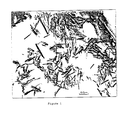
- Figure 1 is an electron micrograph of the particles obtained.
- a solution B twice molar is prepared by dissolving 25.9 grams of iron sulfate II (FeS0 4 , 7H 2 O), 0.9 grams of cobalt sulfate (CoS0 4 , 7H 2 0), and 1.2 g zinc sulfate (ZnSO 4 , 7H 2 0) in a mixture containing 30% water and 70% methanol to which 10 ml of 12 N hydrochloric acid are added
- solution B is introduced by spraying at the rate of 7 l / hour in order to obtain a precipitate of mixed oxalate of Fe, Co, Zn of formula:
- Figure 2 is an electron micrograph of the particles obtained.
- a solution A is prepared identical to that of the preceding examples.
- a twice molar solution B is prepared by dissolving 25.9 grams of iron II sulfate (FeS0 4 , 7H 2 O), 0.9 grams of cobalt sulfate (CoS0 4 , 7H 2 0) and 1.2 grams of zinc sulfate (Zn S0 4 , 7H 2 0) in a mixture containing 25% water, 25% ethylene glycol and 50% methanol, to which 0.5 ml of 12 N hydrochloric acid is added
- solution B is introduced by spraying, at a rate of 7 l / hour, in order to obtain a precipitate of mixed oxalate of Fe, Co, Zn of formula:
- a solution A is prepared identical to that of the preceding examples.
- a twice molar solution B is prepared by dissolving 26 grams of iron sulfate II (FeS0 4 , 7H 2 0) 1 gram of cobalt sulfate (CoS0 4 , 7H 2 O) and 0.7 grams of zinc sulfate (ZnS0 4 , 7H 2 0) in a mixture containing 20% water, 40% ethylene glycol and 40% glycerol, to which 0.5 ml of 12N hydrochloric acid is added.
- FeS0 4 , 7H 2 0 iron sulfate II
- CoS0 4 , 7H 2 O cobalt sulfate
- ZnS0 4 , 7H 2 0 zinc sulfate
- solution B is introduced by spraying, at a rate of 7 l / hour, in order to obtain a precipitate of mixed oxalate of Fe, Co, Zn of formula:
- the dimensions of the particles are similar to those of the particles of Example 1.
- the dimensions of the particles are similar to those of the particles of Example 1.
- the dimensions of the particles are similar to those of the particles of Example 2.
- Example 2 The procedure is as in Example 1, but 0.45 g of TiCl 3 is also added to solution B. Oxalate particles are obtained corresponding (apart from the titanium oxalate dopant) to the formula given in Example 1. These particles contain 0.25% by weight of titanium.
- the dimensions of the particles are similar to those of the particles of Example 1.
- Example 2 The procedure is as in Example 1, but additionally to the solution B 3g of SbCl 3 is added . Obtained oxalate particles corresponding (apart from the antimony oxalate dopant) to the formula given in Example 1. These particles contain 0.15% by weight of antimony.
- the dimensions of the particles are similar to those of the particles of Example 1.
- Example 2 The procedure is as in Example 1, but 0.45 g of TiCl 3 and 1.5 g of AICI 3 are also added to solution B. Oxalate particles are obtained corresponding (apart from the titanium and aluminum oxalate dopant) to the formula given in Example 1. These particles contain 0.05% by weight of titanium and 0.7% of aluminum.
- the dimensions of the particles are similar to those of the particles of Example 1.
- Example 2 The procedure is as in Example 1, but 0.5 g of VCI 3 is also added to solution B. Particles of oxalate corresponding (the doping agent of vanadium oxalate apart) are obtained with the formula given in Example 1. These particles contain 1.2% by weight of vanadium.
- the dimensions of the particles are similar to those of the particles of Example 1.
- Example 2 The procedure is as in Example 1, but additionally to the solution B 0.3 g of KCI. Obtained particles of oxalate corresponding (the potassium oxalate dopant aside) to the formula given in Example 1. These particles contain 0.3% by weight of potassium.
- the dimensions of the particles are similar to those of the particles of Example 1.
- Example 2 The procedure is as in Example 2, but additionally 0.5 g of YbC1 2 is added to solution B. Obtained oxalate particles corresponding (apart from the dopant ytterbium oxalate) to the formula given in Example 2. These particles contain 2% by weight of ytterbium.
- the dimensions of the particles are similar to those of the particles of Example 2.
- Example 2 The procedure is as in Example 2, but additionally to the solution B 0.5 g of GdCI 3 , 6H 2 0. Obtained oxalate particles corresponding (apart from the gadolinium oxalate dopant) to the formula given in Example 2. These particles contain 2.8% by weight of gadolinium.
- the dimensions of the particles are similar to those of the particles of Example 2.
- Example 2 The procedure is as in Example 2, but 0.5 g of DyCl 3 is also added to solution B. Obtained oxalate particles corresponding (apart from the dysprosium oxalate dopant) to the formula given in Example 2. These particles contain 2.7% by weight of dysprosium.
- the dimensions of the particles are similar to those of the particles of Example 2.
- a 0.5 molar oxalic acid solution A is prepared by dissolving 13.75 g of oxalic acid in 95% by volume ethyl alcohol at room temperature.
- a solution B twice molar is prepared by dissolving, in a mixture containing 60% water and 40% ethylene glycol, the following salts:
- Solution B is introduced into strongly agitated solution A, by spraying above solution A, at a rate of 7 liters / h, of solution B, using a sprayer making it possible to obtain drops of 0 , 8 mm on average.
- the precipitated oxalate particles are washed and dried.
- dysprosium is introduced in the form of DyCl 3 ; ytterbium in the form of YbCl 2 ; gadolinium in the form of GdCI 3 ; europium in the form of Eu (N 03 ) 2 ; antimony as SbCl 3 ; titanium in the form of TiCl 3 ; vanadium in the form of VCI 3 ; gallium in the form of Ga 2 (So 4 ) 3 ; and aluminum in the form of AICI 3 .
- the oxalate particles of Example 20 were doped with boron by contacting with an aqueous solution at 3% by weight of boric acid, at the rate of 500 ml of this solution for 15 g of oxalate. .
- a 0.5 molar oxalic acid solution A is prepared by dissolving 13.75 g of oxalic acid in 95% by volume ethyl alcohol at room temperature.
- a twice molar solution B is prepared by dissolving 27.8 g of iron sulfate II (FeS0 4 , 7H 2 0) in a mixture containing 60% water and 40% propanediol-1.2 to which 1 ml is added. of HCI 12N.
- Solution B is introduced dropwise at a rate of 0.8 liters / hour into the abortement solution in order to obtain a precipitate of iron oxalate.
- a solution A is prepared identical to that of the previous example.
- a twice molar solution B is prepared by dissolving 18.4 g of FeC1 2 , 4H 2 0, 0.96 g of CoCl 2 , 6H 2 0, 0.45 g of ZnC1 2 and 0.8 g of BaC1 2 in a mixture containing 60% water and 40% propanediol-1,2 to which 1 ml HCl 12N is added.
- solution B is added as before in order to obtain a mixed oxalate precipitate of formula:
- a solution A is prepared identical to that of the previous example.
- a solution B twice molar is prepared by dissolving 19.9 g of FeCl 2 , 4H 2 0 in a mixture containing 60% water and 40% propanediol-1.2, to which is added 0.5 ml of 12N HCl .
- solution B is added as before in order to obtain a precipitate of iron oxalate.
- a solution A is prepared identical to that of the previous example.
- a twice molar solution B is prepared by dissolving 19.9 g of FeCl 2 , 4H 2 0 in a mixture containing 50% propanol-1 and 50% methanol, to which 1.5 ml of 12N hydrochloric acid is added.
- solution B is added as before in order to obtain a precipitate of iron oxalate.
- a 0.5 molar oxalic acid solution A is prepared by dissolving 13.75 g of oxalic acid in butanol-1 at room temperature.
- a solution B 1.5 times molar is prepared by dissolving 19.9 g of FeCl 2 , 4H 2 0 in a mixture containing 90% ethanol and 10% water to which 1.5 ml of 12N HCl is added.
- solution B is added as before in order to obtain a precipitate of iron oxalate.
- a twice molar emulsion B is prepared by dissolving 19.9 g of FeCl 2 , 4H 2 O in a mixture containing 60% water and 40% tetrahydrofuran (THF) to which 0.5 ml of 12N HCl is added.
- THF tetrahydrofuran
- Solution B is added as before to solution A in order to obtain a precipitate of iron oxalate.
- Iron oxlate particles are obtained having an average length of 0.31 ⁇ 0.1 ⁇ m and an average diameter of 0.046 ⁇ m.
Landscapes
- Chemical & Material Sciences (AREA)
- Organic Chemistry (AREA)
- Engineering & Computer Science (AREA)
- Nanotechnology (AREA)
- Composite Materials (AREA)
- Condensed Matter Physics & Semiconductors (AREA)
- General Physics & Mathematics (AREA)
- Materials Engineering (AREA)
- Crystallography & Structural Chemistry (AREA)
- Inorganic Chemistry (AREA)
- Physics & Mathematics (AREA)
- Compounds Of Iron (AREA)
- Manufacture Of Metal Powder And Suspensions Thereof (AREA)
- Organic Low-Molecular-Weight Compounds And Preparation Thereof (AREA)
- Polyesters Or Polycarbonates (AREA)
- Hard Magnetic Materials (AREA)
- Catalysts (AREA)
- Magnetic Record Carriers (AREA)
- Inorganic Compounds Of Heavy Metals (AREA)
- Pharmaceuticals Containing Other Organic And Inorganic Compounds (AREA)
Claims (18)

Priority Applications (1)
| Application Number | Priority Date | Filing Date | Title |
|---|---|---|---|
| AT86905854T ATE52244T1 (de) | 1985-09-30 | 1986-09-30 | Teilenfoermige zusammensetzungen von ferromagnetische metalloxalaten in form von nadelartigen, submikronen teilchen, ihre herstellung und ihre verwendung. |
Applications Claiming Priority (2)
| Application Number | Priority Date | Filing Date | Title |
|---|---|---|---|
| FR8514438A FR2587989B1 (fr) | 1985-09-30 | 1985-09-30 | Compositions particulaires d'oxalates de metaux ferromagnetiques, sous forme de particules aciculaires submicroniques, leur preparation et leur application |
| FR8514438 | 1985-09-30 |
Publications (2)
| Publication Number | Publication Date |
|---|---|
| EP0240530A1 EP0240530A1 (de) | 1987-10-14 |
| EP0240530B1 true EP0240530B1 (de) | 1990-04-25 |
Family
ID=9323369
Family Applications (1)
| Application Number | Title | Priority Date | Filing Date |
|---|---|---|---|
| EP86905854A Expired - Lifetime EP0240530B1 (de) | 1985-09-30 | 1986-09-30 | Teilenförmige zusammensetzungen von ferromagnetische metalloxalaten in form von nadelartigen, submikronen teilchen, ihre herstellung und ihre verwendung |
Country Status (6)
| Country | Link |
|---|---|
| US (1) | US4803291A (de) |
| EP (1) | EP0240530B1 (de) |
| JP (1) | JPS63501948A (de) |
| DE (1) | DE3670628D1 (de) |
| FR (1) | FR2587989B1 (de) |
| WO (1) | WO1987002033A1 (de) |
Families Citing this family (18)
| Publication number | Priority date | Publication date | Assignee | Title |
|---|---|---|---|---|
| US5011822A (en) * | 1989-01-10 | 1991-04-30 | Allied-Signal Inc. | Preparation of a uniform mixed metal oxide and superconductive oxides |
| FR2660650B1 (fr) * | 1990-04-09 | 1993-01-08 | Centre Nat Rech Scient | Procede de preparation de particules d'hexaferrites. |
| US5435830A (en) * | 1991-09-20 | 1995-07-25 | Murata Manufacturing Co., Ltd. | Method of producing fine powders |
| DE4339841A1 (de) * | 1993-11-23 | 1995-05-24 | Basf Magnetics Gmbh | Feinteiliges nadfelförmiges magnetisches modifiziertes Chromdioxid |
| WO1997015526A1 (en) * | 1995-10-27 | 1997-05-01 | E.I. Du Pont De Nemours And Company | Hydrothermal process for making ultrafine metal oxide powders |
| FR2741386B1 (fr) * | 1995-11-21 | 1998-02-06 | Ecia Equip Composants Ind Auto | Convertisseur catalytique, element de ligne d'echappement muni de ce convertisseur, et procede de fabrication de ce convertisseur |
| US6193904B1 (en) * | 1998-03-12 | 2001-02-27 | Northrop Grumman Corporation | Method for preparation of ferrites |
| DE19822663A1 (de) * | 1998-05-20 | 1999-12-02 | Starck H C Gmbh Co Kg | Sinteraktive Metall- und Legierungspulver für pulvermetallurgische Anwendungen und Verfahren zu deren Herstellung und deren Verwendung |
| FR2794672B1 (fr) * | 1999-06-10 | 2001-09-07 | Asb Aerospatiale Batteries | Procede de preparation de poudres metalliques, poudres metalliques ainsi preparees et compacts incluant ces poudres |
| CN101209961B (zh) * | 2006-12-30 | 2011-04-06 | 比亚迪股份有限公司 | 一种草酸亚铁水合盐晶体的制备方法 |
| CN101058536B (zh) * | 2007-01-24 | 2010-12-08 | 湖南化工研究院 | 超微细草酸亚铁的制备方法 |
| WO2009117718A1 (en) * | 2008-03-20 | 2009-09-24 | Northeastern University | Direct chemical synthesis of rare earth-transition metal alloy magnetic materials |
| EP2231514A4 (de) * | 2008-04-07 | 2013-04-10 | Byd Co Ltd | Verfahren zur herstellung einer zur herstellung von lithiumeisenphosphat verwendeten eisenquelle und verfahren zur herstellung von lithiumeisenphosphat |
| WO2011148463A1 (ja) | 2010-05-25 | 2011-12-01 | エム・テクニック株式会社 | ドープ元素量を制御された析出物質の製造方法 |
| CN101948379B (zh) * | 2010-09-01 | 2013-04-10 | 中国科学院宁波材料技术与工程研究所 | 一种电池级草酸亚铁的制备方法 |
| JP5598989B2 (ja) * | 2011-02-07 | 2014-10-01 | エム・テクニック株式会社 | ドープ元素量を制御された析出物質の製造方法 |
| CN108417786B (zh) * | 2018-01-15 | 2020-08-25 | 昆明理工大学 | 一种棒状多层微孔草酸亚铁锂离子电池负极材料制备方法 |
| CN115888592B (zh) * | 2022-12-15 | 2025-11-25 | 中核四0四有限公司 | 一种调控金属草酸盐沉淀形貌的装置与方法 |
Family Cites Families (11)
| Publication number | Priority date | Publication date | Assignee | Title |
|---|---|---|---|---|
| US2636892A (en) * | 1948-04-23 | 1953-04-28 | Int Standard Electric Corp | Production of metal oxalates |
| US3317574A (en) * | 1961-07-21 | 1967-05-02 | Sony Corp | Method of making finely divided ferrous metal salts of organic acids |
| US4170602A (en) * | 1973-09-28 | 1979-10-09 | Graham Magnetics, Inc. | Method of producing acicular metal crystal |
| US4004917A (en) * | 1973-09-28 | 1977-01-25 | Graham Magnetics Incorporated | Acicular metallic powders produced from the organometallic salts |
| US3994819A (en) * | 1974-09-13 | 1976-11-30 | Agence Nationale De Valorisation De La Recherche (Anvar) | Method for the preparation of acicular particles containing iron and other divalent metals |
| FR2284580A2 (fr) * | 1974-09-13 | 1976-04-09 | Anvar | Procede de preparation de solutions solides d'oxydes de fer et de metaux bivalents tels que le cobalt, et produits obtenus |
| DE2815712A1 (de) * | 1978-04-12 | 1979-10-25 | Bayer Ag | Eisenoxide zur magnetischen signalaufzeichnung und verfahren zu deren herstellung |
| DE2935444A1 (de) * | 1979-09-01 | 1981-03-19 | Basf Ag, 6700 Ludwigshafen | Verfahren zur herstellung von nadelfoermigen ferrimagnetischem eisenoxid |
| FR2487326A1 (fr) * | 1980-07-24 | 1982-01-29 | Kodak Pathe | Procede de preparation de particules aciculaires d'oxyde de fer magnetique |
| FR2531260B1 (fr) * | 1982-07-29 | 1986-04-11 | Centre Nat Rech Scient | Materiaux ferromagnetiques derives des nitrures de fer, leur preparation et leur application comme materiau d'enregistrement magnetique |
| JPS61107537A (ja) * | 1984-10-31 | 1986-05-26 | Fuji Photo Film Co Ltd | 磁気記録媒体 |
-
1985
- 1985-09-30 FR FR8514438A patent/FR2587989B1/fr not_active Expired
-
1986
- 1986-09-30 WO PCT/FR1986/000338 patent/WO1987002033A1/fr not_active Ceased
- 1986-09-30 EP EP86905854A patent/EP0240530B1/de not_active Expired - Lifetime
- 1986-09-30 JP JP61505196A patent/JPS63501948A/ja active Pending
- 1986-09-30 US US07/062,941 patent/US4803291A/en not_active Expired - Fee Related
- 1986-09-30 DE DE8686905854T patent/DE3670628D1/de not_active Expired - Lifetime
Also Published As
| Publication number | Publication date |
|---|---|
| FR2587989A1 (fr) | 1987-04-03 |
| US4803291A (en) | 1989-02-07 |
| JPS63501948A (ja) | 1988-08-04 |
| WO1987002033A1 (fr) | 1987-04-09 |
| FR2587989B1 (fr) | 1987-11-13 |
| DE3670628D1 (de) | 1990-05-31 |
| EP0240530A1 (de) | 1987-10-14 |
Similar Documents
| Publication | Publication Date | Title |
|---|---|---|
| WO1987002033A1 (fr) | Compositions particulaires d'oxalates de metaux ferromagnetiques, sous forme de particules aciculaires submicroniques, leur preparation et leur application | |
| Dong et al. | Polyol synthesis of nanoparticles: status and options regarding metals, oxides, chalcogenides, and non-metal elements | |
| EP3150306B1 (de) | Beschichtete kupferartikel und verfahren zur herstellung davon | |
| RU2344162C2 (ru) | Синтез наночастиц, содержащих ванадат металла (iii) | |
| US20060204754A1 (en) | Metal nano-particles coated with silicon oxide and manufacturing method thereof | |
| EP0473511A1 (de) | Material auf Basis eines elektrisch leitenden Polymers mit Magnetteilchen und Herstellungsverfahren | |
| Jiang et al. | Single cytidine units-templated syntheses of multi-colored water-soluble Au nanoclusters | |
| EP2112211A1 (de) | Quarzpartikel, das eine organische Lanthanoid-Verbindung enthält, sowie entsprechendes Herstellungsverfahren und entsprechende Anwendungen | |
| EP2240942A1 (de) | Verfahren zur herstellung von silicabeschichteten metallnanopartikeln | |
| CN102858684A (zh) | 批量生产具有均匀尺寸的银纳米粒子的方法 | |
| TWI259852B (en) | Gold plating solution and gold plating method | |
| CN101070383A (zh) | 聚1,5-萘二胺纳米管的制备方法 | |
| WO2005051846A2 (fr) | Procede de preparation d'une poudre submicronique, nanostructuree, de sesquioxyde, oxohydroxyde, hydroxyde ou oxyde mixte de terre rare | |
| FR2660650A1 (fr) | Procede de preparation de particules d'hexaferrites. | |
| CN120058738A (zh) | 一种油气井用磺酸基冠醚中性除垢剂及其制备方法和应用 | |
| EP3074472A1 (de) | Dispersionen aus silbernanopartikeln | |
| EP0305262B1 (de) | Ammoniumuranatplutonat, Verfahren zu dessen Herstellung und seine Verwendung zur Herstellung von Uran-/Plutonium-Mischoxid | |
| EP0188941B1 (de) | Elektrochromische flüssige Kristalle auf der Basis von substituierten Phthalocyaninen | |
| FR2531260A1 (fr) | Materiaux ferromagnetiques derives des nitrures de fer, leur preparation et leur application comme materiau d'enregistrement magnetique | |
| EP4399257A1 (de) | Verfahren zur synthese kolloidaler suspensionen von nanostäbchen | |
| CN107474828A (zh) | 一种油溶性硫系半导体量子点的水溶化方法 | |
| JP2010105149A (ja) | 半導体ナノ粒子及びその製造方法 | |
| CN118563324A (zh) | 一种包覆益母草渣碳点缓蚀剂、制备方法及应用 | |
| Abdullah et al. | Novel processing for softly agglomerated luminescent Y2O3: Eu3+ nanoparticles using polymeric precursors | |
| JP2022512415A (ja) | 酸化タングステンナノ粒子を合成する方法 |
Legal Events
| Date | Code | Title | Description |
|---|---|---|---|
| PUAI | Public reference made under article 153(3) epc to a published international application that has entered the european phase |
Free format text: ORIGINAL CODE: 0009012 |
|
| AK | Designated contracting states |
Kind code of ref document: A1 Designated state(s): AT BE CH DE FR GB IT LI LU NL SE |
|
| 17P | Request for examination filed |
Effective date: 19870902 |
|
| 17Q | First examination report despatched |
Effective date: 19890420 |
|
| GRAA | (expected) grant |
Free format text: ORIGINAL CODE: 0009210 |
|
| AK | Designated contracting states |
Kind code of ref document: B1 Designated state(s): AT BE CH DE FR GB IT LI LU NL SE |
|
| REF | Corresponds to: |
Ref document number: 52244 Country of ref document: AT Date of ref document: 19900515 Kind code of ref document: T |
|
| GBT | Gb: translation of ep patent filed (gb section 77(6)(a)/1977) | ||
| REF | Corresponds to: |
Ref document number: 3670628 Country of ref document: DE Date of ref document: 19900531 |
|
| ITF | It: translation for a ep patent filed | ||
| PLBE | No opposition filed within time limit |
Free format text: ORIGINAL CODE: 0009261 |
|
| STAA | Information on the status of an ep patent application or granted ep patent |
Free format text: STATUS: NO OPPOSITION FILED WITHIN TIME LIMIT |
|
| 26N | No opposition filed | ||
| ITTA | It: last paid annual fee | ||
| EPTA | Lu: last paid annual fee | ||
| PGFP | Annual fee paid to national office [announced via postgrant information from national office to epo] |
Ref country code: GB Payment date: 19940729 Year of fee payment: 9 Ref country code: FR Payment date: 19940729 Year of fee payment: 9 |
|
| PGFP | Annual fee paid to national office [announced via postgrant information from national office to epo] |
Ref country code: LU Payment date: 19940801 Year of fee payment: 9 |
|
| PGFP | Annual fee paid to national office [announced via postgrant information from national office to epo] |
Ref country code: BE Payment date: 19940901 Year of fee payment: 9 |
|
| PGFP | Annual fee paid to national office [announced via postgrant information from national office to epo] |
Ref country code: AT Payment date: 19940909 Year of fee payment: 9 |
|
| PGFP | Annual fee paid to national office [announced via postgrant information from national office to epo] |
Ref country code: CH Payment date: 19940927 Year of fee payment: 9 |
|
| PGFP | Annual fee paid to national office [announced via postgrant information from national office to epo] |
Ref country code: DE Payment date: 19940929 Year of fee payment: 9 |
|
| PGFP | Annual fee paid to national office [announced via postgrant information from national office to epo] |
Ref country code: SE Payment date: 19940930 Year of fee payment: 9 Ref country code: NL Payment date: 19940930 Year of fee payment: 9 |
|
| EAL | Se: european patent in force in sweden |
Ref document number: 86905854.5 |
|
| PG25 | Lapsed in a contracting state [announced via postgrant information from national office to epo] |
Ref country code: LU Free format text: LAPSE BECAUSE OF NON-PAYMENT OF DUE FEES Effective date: 19950930 Ref country code: LI Effective date: 19950930 Ref country code: GB Effective date: 19950930 Ref country code: CH Effective date: 19950930 Ref country code: BE Effective date: 19950930 Ref country code: AT Effective date: 19950930 |
|
| PG25 | Lapsed in a contracting state [announced via postgrant information from national office to epo] |
Ref country code: SE Effective date: 19951001 |
|
| BERE | Be: lapsed |
Owner name: UNIVERSITE PAUL SABATIER (TOULOUSE III) Effective date: 19950930 Owner name: CENTRE NATIONAL DE LA RECHERCHE SCIENTIFIQUE CNRS Effective date: 19950930 |
|
| PG25 | Lapsed in a contracting state [announced via postgrant information from national office to epo] |
Ref country code: NL Effective date: 19960401 |
|
| REG | Reference to a national code |
Ref country code: CH Ref legal event code: PL |
|
| GBPC | Gb: european patent ceased through non-payment of renewal fee |
Effective date: 19950930 |
|
| PG25 | Lapsed in a contracting state [announced via postgrant information from national office to epo] |
Ref country code: FR Effective date: 19960531 |
|
| PG25 | Lapsed in a contracting state [announced via postgrant information from national office to epo] |
Ref country code: DE Effective date: 19960601 |
|
| NLV4 | Nl: lapsed or anulled due to non-payment of the annual fee |
Effective date: 19960401 |
|
| EUG | Se: european patent has lapsed |
Ref document number: 86905854.5 |
|
| REG | Reference to a national code |
Ref country code: FR Ref legal event code: ST |
|
| PG25 | Lapsed in a contracting state [announced via postgrant information from national office to epo] |
Ref country code: IT Free format text: LAPSE BECAUSE OF NON-PAYMENT OF DUE FEES Effective date: 20050930 |