EP0240095B1 - Katalysatorszusammensetzungen und damit katalysierten Zusammensetzungen - Google Patents
Katalysatorszusammensetzungen und damit katalysierten Zusammensetzungen Download PDFInfo
- Publication number
- EP0240095B1 EP0240095B1 EP87300151A EP87300151A EP0240095B1 EP 0240095 B1 EP0240095 B1 EP 0240095B1 EP 87300151 A EP87300151 A EP 87300151A EP 87300151 A EP87300151 A EP 87300151A EP 0240095 B1 EP0240095 B1 EP 0240095B1
- Authority
- EP
- European Patent Office
- Prior art keywords
- group
- value
- general formula
- formulation
- further characterised
- Prior art date
- Legal status (The legal status is an assumption and is not a legal conclusion. Google has not performed a legal analysis and makes no representation as to the accuracy of the status listed.)
- Expired - Lifetime
Links
- 239000000203 mixture Substances 0.000 title claims description 114
- 239000003054 catalyst Substances 0.000 title claims description 14
- 238000009472 formulation Methods 0.000 claims description 59
- -1 polysiloxanes Polymers 0.000 claims description 45
- 150000001875 compounds Chemical class 0.000 claims description 39
- 229920001296 polysiloxane Polymers 0.000 claims description 19
- 150000002430 hydrocarbons Chemical group 0.000 claims description 18
- QVGXLLKOCUKJST-UHFFFAOYSA-N atomic oxygen Chemical compound [O] QVGXLLKOCUKJST-UHFFFAOYSA-N 0.000 claims description 17
- 239000001301 oxygen Substances 0.000 claims description 17
- 229910052760 oxygen Inorganic materials 0.000 claims description 17
- XUIMIQQOPSSXEZ-UHFFFAOYSA-N Silicon Chemical group [Si] XUIMIQQOPSSXEZ-UHFFFAOYSA-N 0.000 claims description 13
- 125000004433 nitrogen atom Chemical group N* 0.000 claims description 13
- 229910052710 silicon Inorganic materials 0.000 claims description 13
- 150000001879 copper Chemical class 0.000 claims description 12
- 239000007788 liquid Substances 0.000 claims description 12
- 125000001997 phenyl group Chemical group [H]C1=C([H])C([H])=C(*)C([H])=C1[H] 0.000 claims description 12
- 150000003961 organosilicon compounds Chemical class 0.000 claims description 11
- 125000005375 organosiloxane group Chemical group 0.000 claims description 11
- XLYOFNOQVPJJNP-UHFFFAOYSA-N water Substances O XLYOFNOQVPJJNP-UHFFFAOYSA-N 0.000 claims description 11
- 125000002496 methyl group Chemical group [H]C([H])([H])* 0.000 claims description 10
- 229910052757 nitrogen Inorganic materials 0.000 claims description 9
- 238000005691 oxidative coupling reaction Methods 0.000 claims description 8
- RYGMFSIKBFXOCR-UHFFFAOYSA-N Copper Chemical compound [Cu] RYGMFSIKBFXOCR-UHFFFAOYSA-N 0.000 claims description 7
- 125000004432 carbon atom Chemical group C* 0.000 claims description 7
- 239000010949 copper Substances 0.000 claims description 7
- 125000000217 alkyl group Chemical group 0.000 claims description 6
- 125000002947 alkylene group Chemical group 0.000 claims description 6
- 125000004966 cyanoalkyl group Chemical group 0.000 claims description 6
- 238000002156 mixing Methods 0.000 claims description 6
- 229930195735 unsaturated hydrocarbon Chemical group 0.000 claims description 6
- 125000004805 propylene group Chemical group [H]C([H])([H])C([H])([*:1])C([H])([H])[*:2] 0.000 claims description 5
- 150000003377 silicon compounds Chemical class 0.000 claims description 5
- CREXVNNSNOKDHW-UHFFFAOYSA-N azaniumylideneazanide Chemical group N[N] CREXVNNSNOKDHW-UHFFFAOYSA-N 0.000 claims description 4
- 229910052802 copper Inorganic materials 0.000 claims description 4
- 125000001495 ethyl group Chemical group [H]C([H])([H])C([H])([H])* 0.000 claims description 3
- 125000000623 heterocyclic group Chemical group 0.000 claims description 3
- 125000004435 hydrogen atom Chemical group [H]* 0.000 claims description 3
- 230000003647 oxidation Effects 0.000 claims description 3
- 238000007254 oxidation reaction Methods 0.000 claims description 3
- 125000004430 oxygen atom Chemical group O* 0.000 claims description 3
- 125000005650 substituted phenylene group Chemical group 0.000 claims description 3
- 125000000843 phenylene group Chemical group C1(=C(C=CC=C1)*)* 0.000 claims description 2
- 239000010703 silicon Substances 0.000 claims description 2
- VGGSQFUCUMXWEO-UHFFFAOYSA-N Ethene Chemical compound C=C VGGSQFUCUMXWEO-UHFFFAOYSA-N 0.000 claims 1
- 239000005977 Ethylene Substances 0.000 claims 1
- YXFVVABEGXRONW-UHFFFAOYSA-N Toluene Chemical compound CC1=CC=CC=C1 YXFVVABEGXRONW-UHFFFAOYSA-N 0.000 description 42
- OKKJLVBELUTLKV-UHFFFAOYSA-N Methanol Chemical compound OC OKKJLVBELUTLKV-UHFFFAOYSA-N 0.000 description 21
- RTZKZFJDLAIYFH-UHFFFAOYSA-N Diethyl ether Chemical compound CCOCC RTZKZFJDLAIYFH-UHFFFAOYSA-N 0.000 description 16
- 239000000243 solution Substances 0.000 description 15
- IJGRMHOSHXDMSA-UHFFFAOYSA-N Atomic nitrogen Chemical compound N#N IJGRMHOSHXDMSA-UHFFFAOYSA-N 0.000 description 14
- KPUWHANPEXNPJT-UHFFFAOYSA-N disiloxane Chemical class [SiH3]O[SiH3] KPUWHANPEXNPJT-UHFFFAOYSA-N 0.000 description 14
- 239000000463 material Substances 0.000 description 10
- 125000001424 substituent group Chemical group 0.000 description 10
- 238000006243 chemical reaction Methods 0.000 description 9
- 239000000047 product Substances 0.000 description 9
- 239000002244 precipitate Substances 0.000 description 8
- 230000001590 oxidative effect Effects 0.000 description 7
- 238000003756 stirring Methods 0.000 description 7
- 230000001419 dependent effect Effects 0.000 description 6
- 239000003921 oil Substances 0.000 description 6
- 238000004132 cross linking Methods 0.000 description 5
- 239000004205 dimethyl polysiloxane Substances 0.000 description 5
- ISWSIDIOOBJBQZ-UHFFFAOYSA-N phenol group Chemical group C1(=CC=CC=C1)O ISWSIDIOOBJBQZ-UHFFFAOYSA-N 0.000 description 5
- 229920000435 poly(dimethylsiloxane) Polymers 0.000 description 5
- CSCPPACGZOOCGX-UHFFFAOYSA-N Acetone Chemical compound CC(C)=O CSCPPACGZOOCGX-UHFFFAOYSA-N 0.000 description 4
- JUJWROOIHBZHMG-UHFFFAOYSA-N Pyridine Chemical compound C1=CC=NC=C1 JUJWROOIHBZHMG-UHFFFAOYSA-N 0.000 description 4
- 239000000706 filtrate Substances 0.000 description 4
- 239000011541 reaction mixture Substances 0.000 description 4
- DDTHMESPCBONDT-UHFFFAOYSA-N 4-(4-oxocyclohexa-2,5-dien-1-ylidene)cyclohexa-2,5-dien-1-one Chemical compound C1=CC(=O)C=CC1=C1C=CC(=O)C=C1 DDTHMESPCBONDT-UHFFFAOYSA-N 0.000 description 3
- VYPSYNLAJGMNEJ-UHFFFAOYSA-N Silicium dioxide Chemical compound O=[Si]=O VYPSYNLAJGMNEJ-UHFFFAOYSA-N 0.000 description 3
- 239000002253 acid Substances 0.000 description 3
- 230000015572 biosynthetic process Effects 0.000 description 3
- 230000003197 catalytic effect Effects 0.000 description 3
- 230000008878 coupling Effects 0.000 description 3
- 238000010168 coupling process Methods 0.000 description 3
- 238000005859 coupling reaction Methods 0.000 description 3
- 239000012530 fluid Substances 0.000 description 3
- VVAHBRVAXFGEPI-UHFFFAOYSA-N methyl 2-cyano-2-phenylacetate Chemical compound COC(=O)C(C#N)C1=CC=CC=C1 VVAHBRVAXFGEPI-UHFFFAOYSA-N 0.000 description 3
- 239000003208 petroleum Substances 0.000 description 3
- 150000003839 salts Chemical class 0.000 description 3
- 239000007787 solid Substances 0.000 description 3
- 239000002904 solvent Substances 0.000 description 3
- WREVCRYZAWNLRZ-UHFFFAOYSA-N 2-allyl-6-methyl-phenol Chemical compound CC1=CC=CC(CC=C)=C1O WREVCRYZAWNLRZ-UHFFFAOYSA-N 0.000 description 2
- 239000004606 Fillers/Extenders Substances 0.000 description 2
- CSNNHWWHGAXBCP-UHFFFAOYSA-L Magnesium sulfate Chemical compound [Mg+2].[O-][S+2]([O-])([O-])[O-] CSNNHWWHGAXBCP-UHFFFAOYSA-L 0.000 description 2
- KYQCOXFCLRTKLS-UHFFFAOYSA-N Pyrazine Chemical compound C1=CN=CC=N1 KYQCOXFCLRTKLS-UHFFFAOYSA-N 0.000 description 2
- WYURNTSHIVDZCO-UHFFFAOYSA-N Tetrahydrofuran Chemical compound C1CCOC1 WYURNTSHIVDZCO-UHFFFAOYSA-N 0.000 description 2
- CIUQDSCDWFSTQR-UHFFFAOYSA-N [C]1=CC=CC=C1 Chemical compound [C]1=CC=CC=C1 CIUQDSCDWFSTQR-UHFFFAOYSA-N 0.000 description 2
- 230000005587 bubbling Effects 0.000 description 2
- CREMABGTGYGIQB-UHFFFAOYSA-N carbon carbon Chemical compound C.C CREMABGTGYGIQB-UHFFFAOYSA-N 0.000 description 2
- 239000011203 carbon fibre reinforced carbon Substances 0.000 description 2
- 238000012505 colouration Methods 0.000 description 2
- 238000013329 compounding Methods 0.000 description 2
- 238000001816 cooling Methods 0.000 description 2
- ORTQZVOHEJQUHG-UHFFFAOYSA-L copper(II) chloride Chemical compound Cl[Cu]Cl ORTQZVOHEJQUHG-UHFFFAOYSA-L 0.000 description 2
- QTMDXZNDVAMKGV-UHFFFAOYSA-L copper(ii) bromide Chemical compound [Cu+2].[Br-].[Br-] QTMDXZNDVAMKGV-UHFFFAOYSA-L 0.000 description 2
- IRJGZWIEFFOYJN-UHFFFAOYSA-N copper;pyridine Chemical compound [Cu].C1=CC=NC=C1 IRJGZWIEFFOYJN-UHFFFAOYSA-N 0.000 description 2
- 229920001971 elastomer Polymers 0.000 description 2
- RRAFCDWBNXTKKO-UHFFFAOYSA-N eugenol Chemical compound COC1=CC(CC=C)=CC=C1O RRAFCDWBNXTKKO-UHFFFAOYSA-N 0.000 description 2
- 239000000945 filler Substances 0.000 description 2
- 229910052736 halogen Inorganic materials 0.000 description 2
- 150000002367 halogens Chemical class 0.000 description 2
- 125000002887 hydroxy group Chemical group [H]O* 0.000 description 2
- 238000011065 in-situ storage Methods 0.000 description 2
- 239000004615 ingredient Substances 0.000 description 2
- HVOYZOQVDYHUPF-UHFFFAOYSA-N n,n',n'-trimethylethane-1,2-diamine Chemical compound CNCCN(C)C HVOYZOQVDYHUPF-UHFFFAOYSA-N 0.000 description 2
- 239000012299 nitrogen atmosphere Substances 0.000 description 2
- 238000002360 preparation method Methods 0.000 description 2
- UMJSCPRVCHMLSP-UHFFFAOYSA-N pyridine Natural products COC1=CC=CN=C1 UMJSCPRVCHMLSP-UHFFFAOYSA-N 0.000 description 2
- 238000010992 reflux Methods 0.000 description 2
- 238000000926 separation method Methods 0.000 description 2
- 238000003860 storage Methods 0.000 description 2
- NXJXPHIPLSPARJ-UHFFFAOYSA-N CC(C=CCC1=C)=C1O Chemical compound CC(C=CCC1=C)=C1O NXJXPHIPLSPARJ-UHFFFAOYSA-N 0.000 description 1
- DCERHCFNWRGHLK-UHFFFAOYSA-N C[Si](C)C Chemical compound C[Si](C)C DCERHCFNWRGHLK-UHFFFAOYSA-N 0.000 description 1
- NXXYKOUNUYWIHA-UHFFFAOYSA-N Cc(cccc1C)c1O Chemical compound Cc(cccc1C)c1O NXXYKOUNUYWIHA-UHFFFAOYSA-N 0.000 description 1
- NPBVQXIMTZKSBA-UHFFFAOYSA-N Chavibetol Natural products COC1=CC=C(CC=C)C=C1O NPBVQXIMTZKSBA-UHFFFAOYSA-N 0.000 description 1
- 229910021589 Copper(I) bromide Inorganic materials 0.000 description 1
- 229910021591 Copper(I) chloride Inorganic materials 0.000 description 1
- 229910021590 Copper(II) bromide Inorganic materials 0.000 description 1
- 239000005770 Eugenol Substances 0.000 description 1
- VQTUBCCKSQIDNK-UHFFFAOYSA-N Isobutene Chemical group CC(C)=C VQTUBCCKSQIDNK-UHFFFAOYSA-N 0.000 description 1
- 239000005909 Kieselgur Substances 0.000 description 1
- PCNDJXKNXGMECE-UHFFFAOYSA-N Phenazine Natural products C1=CC=CC2=NC3=CC=CC=C3N=C21 PCNDJXKNXGMECE-UHFFFAOYSA-N 0.000 description 1
- UVMRYBDEERADNV-UHFFFAOYSA-N Pseudoeugenol Natural products COC1=CC(C(C)=C)=CC=C1O UVMRYBDEERADNV-UHFFFAOYSA-N 0.000 description 1
- CZPWVGJYEJSRLH-UHFFFAOYSA-N Pyrimidine Chemical compound C1=CN=CN=C1 CZPWVGJYEJSRLH-UHFFFAOYSA-N 0.000 description 1
- 239000000654 additive Substances 0.000 description 1
- 230000002411 adverse Effects 0.000 description 1
- 125000001931 aliphatic group Chemical group 0.000 description 1
- 125000003545 alkoxy group Chemical group 0.000 description 1
- 150000001408 amides Chemical class 0.000 description 1
- 150000001450 anions Chemical class 0.000 description 1
- 239000007864 aqueous solution Substances 0.000 description 1
- 125000003118 aryl group Chemical group 0.000 description 1
- 125000000484 butyl group Chemical group [H]C([*])([H])C([H])([H])C([H])([H])C([H])([H])[H] 0.000 description 1
- 238000006555 catalytic reaction Methods 0.000 description 1
- 238000000576 coating method Methods 0.000 description 1
- 229920001577 copolymer Polymers 0.000 description 1
- 150000004699 copper complex Chemical class 0.000 description 1
- OXBLHERUFWYNTN-UHFFFAOYSA-M copper(I) chloride Chemical compound [Cu]Cl OXBLHERUFWYNTN-UHFFFAOYSA-M 0.000 description 1
- ARUVKPQLZAKDPS-UHFFFAOYSA-L copper(II) sulfate Chemical compound [Cu+2].[O-][S+2]([O-])([O-])[O-] ARUVKPQLZAKDPS-UHFFFAOYSA-L 0.000 description 1
- 229910000366 copper(II) sulfate Inorganic materials 0.000 description 1
- NKNDPYCGAZPOFS-UHFFFAOYSA-M copper(i) bromide Chemical compound Br[Cu] NKNDPYCGAZPOFS-UHFFFAOYSA-M 0.000 description 1
- WIVXEZIMDUGYRW-UHFFFAOYSA-L copper(i) sulfate Chemical compound [Cu+].[Cu+].[O-]S([O-])(=O)=O WIVXEZIMDUGYRW-UHFFFAOYSA-L 0.000 description 1
- 239000013078 crystal Substances 0.000 description 1
- 229960003280 cupric chloride Drugs 0.000 description 1
- 229940045803 cuprous chloride Drugs 0.000 description 1
- USIUVYZYUHIAEV-UHFFFAOYSA-N diphenyl ether Chemical class C=1C=CC=CC=1OC1=CC=CC=C1 USIUVYZYUHIAEV-UHFFFAOYSA-N 0.000 description 1
- 239000006185 dispersion Substances 0.000 description 1
- 230000000694 effects Effects 0.000 description 1
- 239000000806 elastomer Substances 0.000 description 1
- 125000000816 ethylene group Chemical group [H]C([H])([*:1])C([H])([H])[*:2] 0.000 description 1
- 229960002217 eugenol Drugs 0.000 description 1
- 238000011049 filling Methods 0.000 description 1
- 238000001914 filtration Methods 0.000 description 1
- 239000011521 glass Substances 0.000 description 1
- 230000009931 harmful effect Effects 0.000 description 1
- 125000004464 hydroxyphenyl group Chemical group 0.000 description 1
- 230000031700 light absorption Effects 0.000 description 1
- 229910052943 magnesium sulfate Inorganic materials 0.000 description 1
- 235000019341 magnesium sulphate Nutrition 0.000 description 1
- 238000004519 manufacturing process Methods 0.000 description 1
- 239000002184 metal Substances 0.000 description 1
- 229910052751 metal Inorganic materials 0.000 description 1
- CSJDCSCTVDEHRN-UHFFFAOYSA-N methane;molecular oxygen Chemical compound C.O=O CSJDCSCTVDEHRN-UHFFFAOYSA-N 0.000 description 1
- 125000000956 methoxy group Chemical group [H]C([H])([H])O* 0.000 description 1
- 150000002989 phenols Chemical class 0.000 description 1
- 229920000642 polymer Polymers 0.000 description 1
- 229920001955 polyphenylene ether Polymers 0.000 description 1
- 238000004382 potting Methods 0.000 description 1
- 238000001556 precipitation Methods 0.000 description 1
- 125000002924 primary amino group Chemical group [H]N([H])* 0.000 description 1
- 125000001436 propyl group Chemical group [H]C([*])([H])C([H])([H])C([H])([H])[H] 0.000 description 1
- QQONPFPTGQHPMA-UHFFFAOYSA-N propylene Natural products CC=C QQONPFPTGQHPMA-UHFFFAOYSA-N 0.000 description 1
- PBMFSQRYOILNGV-UHFFFAOYSA-N pyridazine Chemical compound C1=CC=NN=C1 PBMFSQRYOILNGV-UHFFFAOYSA-N 0.000 description 1
- 150000003222 pyridines Chemical class 0.000 description 1
- SBYHFKPVCBCYGV-UHFFFAOYSA-N quinuclidine Chemical compound C1CC2CCN1CC2 SBYHFKPVCBCYGV-UHFFFAOYSA-N 0.000 description 1
- 239000012429 reaction media Substances 0.000 description 1
- 230000002441 reversible effect Effects 0.000 description 1
- 239000000565 sealant Substances 0.000 description 1
- 239000012258 stirred mixture Substances 0.000 description 1
- YLQBMQCUIZJEEH-UHFFFAOYSA-N tetrahydrofuran Natural products C=1C=COC=1 YLQBMQCUIZJEEH-UHFFFAOYSA-N 0.000 description 1
Classifications
-
- C—CHEMISTRY; METALLURGY
- C08—ORGANIC MACROMOLECULAR COMPOUNDS; THEIR PREPARATION OR CHEMICAL WORKING-UP; COMPOSITIONS BASED THEREON
- C08K—Use of inorganic or non-macromolecular organic substances as compounding ingredients
- C08K5/00—Use of organic ingredients
- C08K5/0091—Complexes with metal-heteroatom-bonds
-
- C—CHEMISTRY; METALLURGY
- C07—ORGANIC CHEMISTRY
- C07F—ACYCLIC, CARBOCYCLIC OR HETEROCYCLIC COMPOUNDS CONTAINING ELEMENTS OTHER THAN CARBON, HYDROGEN, HALOGEN, OXYGEN, NITROGEN, SULFUR, SELENIUM OR TELLURIUM
- C07F7/00—Compounds containing elements of Groups 4 or 14 of the Periodic Table
- C07F7/02—Silicon compounds
- C07F7/08—Compounds having one or more C—Si linkages
- C07F7/0834—Compounds having one or more O-Si linkage
- C07F7/0838—Compounds with one or more Si-O-Si sequences
-
- C—CHEMISTRY; METALLURGY
- C08—ORGANIC MACROMOLECULAR COMPOUNDS; THEIR PREPARATION OR CHEMICAL WORKING-UP; COMPOSITIONS BASED THEREON
- C08G—MACROMOLECULAR COMPOUNDS OBTAINED OTHERWISE THAN BY REACTIONS ONLY INVOLVING UNSATURATED CARBON-TO-CARBON BONDS
- C08G77/00—Macromolecular compounds obtained by reactions forming a linkage containing silicon with or without sulfur, nitrogen, oxygen or carbon in the main chain of the macromolecule
- C08G77/04—Polysiloxanes
- C08G77/38—Polysiloxanes modified by chemical after-treatment
- C08G77/382—Polysiloxanes modified by chemical after-treatment containing atoms other than carbon, hydrogen, oxygen or silicon
- C08G77/388—Polysiloxanes modified by chemical after-treatment containing atoms other than carbon, hydrogen, oxygen or silicon containing nitrogen
-
- C—CHEMISTRY; METALLURGY
- C08—ORGANIC MACROMOLECULAR COMPOUNDS; THEIR PREPARATION OR CHEMICAL WORKING-UP; COMPOSITIONS BASED THEREON
- C08K—Use of inorganic or non-macromolecular organic substances as compounding ingredients
- C08K5/00—Use of organic ingredients
- C08K5/54—Silicon-containing compounds
- C08K5/544—Silicon-containing compounds containing nitrogen
- C08K5/5477—Silicon-containing compounds containing nitrogen containing nitrogen in a heterocyclic ring
-
- B—PERFORMING OPERATIONS; TRANSPORTING
- B01—PHYSICAL OR CHEMICAL PROCESSES OR APPARATUS IN GENERAL
- B01J—CHEMICAL OR PHYSICAL PROCESSES, e.g. CATALYSIS OR COLLOID CHEMISTRY; THEIR RELEVANT APPARATUS
- B01J2531/00—Additional information regarding catalytic systems classified in B01J31/00
- B01J2531/10—Complexes comprising metals of Group I (IA or IB) as the central metal
- B01J2531/16—Copper
-
- B—PERFORMING OPERATIONS; TRANSPORTING
- B01—PHYSICAL OR CHEMICAL PROCESSES OR APPARATUS IN GENERAL
- B01J—CHEMICAL OR PHYSICAL PROCESSES, e.g. CATALYSIS OR COLLOID CHEMISTRY; THEIR RELEVANT APPARATUS
- B01J31/00—Catalysts comprising hydrides, coordination complexes or organic compounds
- B01J31/16—Catalysts comprising hydrides, coordination complexes or organic compounds containing coordination complexes
- B01J31/165—Polymer immobilised coordination complexes, e.g. organometallic complexes
- B01J31/1658—Polymer immobilised coordination complexes, e.g. organometallic complexes immobilised by covalent linkages, i.e. pendant complexes with optional linking groups, e.g. on Wang or Merrifield resins
- B01J31/1675—Polymer immobilised coordination complexes, e.g. organometallic complexes immobilised by covalent linkages, i.e. pendant complexes with optional linking groups, e.g. on Wang or Merrifield resins the linkage being to an organometallic polymer covered by groups B01J31/123 - B01J31/127, e.g. polyhydrosiloxanes
-
- B—PERFORMING OPERATIONS; TRANSPORTING
- B01—PHYSICAL OR CHEMICAL PROCESSES OR APPARATUS IN GENERAL
- B01J—CHEMICAL OR PHYSICAL PROCESSES, e.g. CATALYSIS OR COLLOID CHEMISTRY; THEIR RELEVANT APPARATUS
- B01J31/00—Catalysts comprising hydrides, coordination complexes or organic compounds
- B01J31/16—Catalysts comprising hydrides, coordination complexes or organic compounds containing coordination complexes
- B01J31/18—Catalysts comprising hydrides, coordination complexes or organic compounds containing coordination complexes containing nitrogen, phosphorus, arsenic or antimony as complexing atoms, e.g. in pyridine ligands, or in resonance therewith, e.g. in isocyanide ligands C=N-R or as complexed central atoms
- B01J31/1805—Catalysts comprising hydrides, coordination complexes or organic compounds containing coordination complexes containing nitrogen, phosphorus, arsenic or antimony as complexing atoms, e.g. in pyridine ligands, or in resonance therewith, e.g. in isocyanide ligands C=N-R or as complexed central atoms the ligands containing nitrogen
- B01J31/181—Cyclic ligands, including e.g. non-condensed polycyclic ligands, comprising at least one complexing nitrogen atom as ring member, e.g. pyridine
Definitions
- This invention is concerned with catalyst compositions and compositions catalysed therewith and is particularly concerned with curing organosilicon compounds by an oxidative coupling reaction.
- Organosiloxanes which may be cured via an oxidative coupling reaction include phenylcyanoacetyl-functional polysiloxanes and phenol-functional polysiloxanes for example those having a hydroxyphenylene or a (hydroxy phenyl)-alkylene group as disclosed in U.K. patent specification 1 203 071.
- compositions curable at room temperature to elastomers on exposure to atmospheric oxygen comprising an arylolsilicon compound chosen from certain arylolsilanes, arylolsiloxanes or copolymeric arylolsiloxanes and a basic copper salt complex with certain nitrogen containing heterocyclic compounds as exemplified by pyridine, said complex being soluble in the arylolsilicon compound.
- patent specification 1 203 071 discloses room temperature curable compositions when exposed to atmospheric oxygen which comprise certain arylolsilicon compounds and a basic pyridine-copper salt complex or basic substituted pyridine-copper salt complex or a basic complex of a copper salt with a nitrogen containing heterocyclic compound selected from quinuclidine, pyridazine, pyrimidine and pyrazine.
- the catalysts are complexes which preferably are derived from pyridine which is a material not generally favoured due to physiologically harmful properties.
- a catalyst for an oxidative reaction between arylolsilicon or arylcyanoacetylsilicon compounds may comprise a copper complex of certain diamino siloxane compounds.
- the invention provides in one of its aspects a composition
- a composition comprising a complex of a copper salt in oxidation state II formed by mixing copper or a copper salt, an organosilicon compound containing 1 to 3 units according to the general formula (i) in which each R represents a monovalent group attached to the silicon atom, R' represents a group including two amino nitrogen atoms linked by a group R'' having a structure such that the two nitrogen atoms may enter into a heterocyclic ring structure including two nitrogen atoms, a copper atom and from 2 to 5 inclusive carbon atoms linking the nitrogen atoms, and a has a value of 0, 1, 2 or 3, and water in presence of oxygen.
- a composition according to the invention contains a complex in which copper is present in oxidation state II. This appears to be essential in order to achieve the desired catalytic properties.
- the particular anion of the copper salt employed has no effect on the type of product obtained.
- a cupric or cuprous salt and also copper metal which is oxidized in situ to a cupric salt can be employed. The only requirement is that the salt must be capable of existing in the cupric state and must form a complex with the organosilicon compound which bias solubility in the reaction medium employed for the oxidative reaction.
- Copper salts suitable for preparation of the complex include cuprous chloride, cupric chloride, cuprous bromide, cupric bromide, cuprous sulfate and cupric sulfate.
- Organosilicon compounds suitable for use in forming the complex of the copper salt include at least one unit having a substituent including two amino nitrogen atoms. It is believed that unbonded pairs of electrons of the nitrogen atoms become associated with copper atoms in forming the complex, and that the group linking the two amino nitrogen atoms influences the stability of the complex and therefore its catalytic activity.
- the most suitable group R' for catalysis of oxidative cure of a particular composition depends to some extent on the nature of that composition. Thus, the group R' may include aromatic or cycloaliphatic or aliphatic groups.
- R3 represents an alkylene group having a chain of at least three carbon atoms linking silicon and nitrogen atoms
- R'' represents an alkylene group having from 2 to 5 inclusive carbon atoms linking the nitrogen atoms
- each Q represents a hydrogen atom or an alkyl group attached to a nitrogen atom.
- the group R'' is an ethylene group (whereby the heterocyclic ring system comprises two carbon atoms) each group Q is a methyl or an ethyl group and the group R3 is propylene.
- the organosilicon compound used in preparing a composition according to the invention may comprise one or more than one unit according to the formula (i).
- the unit (i) may take the form R3SiR' e.g. (CH3)3Si(CH2)3N(CH3)CH2CH2N(CH3)2 or RR'SiO. It is necessary for these units (i) to diffuse in the composition to be catalysed and therefore the presence of no more than two or three units of formula (i) per organosilicon molecule is regarded as appropriate.
- Preferred organosilicon compounds are organosiloxanes in which a has the value 1 or 2, and which also include at least one unit according to the general formula (ii) in which each R is as defined above and b has a value of 0, 1, 2 or 3.
- the units (i) then may be present as capping or crosslinking units, but preferably are present as chain units i.e. preferably a has the value 1.
- the units of the formula (ii) present in the organosiloxane promote solubility of the complex in polydiorganosiloxane media and insolubility in water.
- the organosiloxane have many units of formula (ii), but increasing numbers of these units lead to polyorganosiloxanes which are less mobile within the formulation to be catalysed.
- Preferred compositions according to the invention comprise complexes which are soluble in the formulation to be catalysed.
- satisfactory oxidative curing may be achieved by use of complexes which are effectively in the form of substantially stable colloidal solutions which are readily miscible with the formulation to be catalysed for suitable dispersion therein.
- organosiloxanes having from 2 to 50 units of formula (ii) are satisfactory.
- the organosiloxane is according to the average general formula R3Si(OSiR2) x (OSi(R)R3N(Q)R''NQ2) y OSiR3 in which x has a value from 5 to 30, more preferably from 12 to 20 and y has a value from 1 to 3.
- the substituents R in formulae (i) and (ii) are monovalent groups, and may be any of those groups conventionally present in polydiorganosiloxanes provided they do not interfere with preparation of the complex and do not adversely affect the performance of the complex in catalysing cure of formulations in which it is employed.
- the most suitable monovalent groups in this context are those compatible with those of the formulation to be catalysed.
- the most appropriate monovalent groups are the lower alkyl groups for example methyl groups.
- we prefer that at least 85% of the substituents R of the organosiloxane employed to provide the complex are methyl groups.
- a composition according to the invention is formed from the copper salt, the organosilicon compound and water in presence of oxygen.
- the materials may be mixed together in any convenient order.
- a mutual solvent for example methanol
- the composition may be formed in situ in the formulation to be catalysed for example by mixing the copper salt and organosilicon compound, adding this mixture and water to the formulation to be catalysed and bubbling oxygen through the formulation.
- the composition comprising the complex is prepared prior to admixture with the formulation to be catalysed. For example one may mix an aqueous solution of the copper salt in the organosilicon compound. Stirring of the mixture in air, with or without bubbling air through the mixture, introduces sufficient oxygen for production of the complex.
- a composition according to the invention may be employed to catalyse oxidative coupling reactions of formulations comprising polysiloxanes curable by an oxidative coupling reaction for example polysiloxanes having substituted phenol, phenylcyanoacetic acid ester and amide substituents.
- a composition according to the invention is soluble or at least colloidally soluble in polysiloxanes and insoluble in water. It is thus not readily leached from oxidatively cured polysiloxane formulations by water. It uses amino compounds which are less physiologically undesirable than pyridine compounds.
- compositions comprising arylolsilicones or arylcyanoacetylsilicones which are fluid at room temperature and which remain workable in absence of oxygen and which crosslink on exposure to air or oxygen at room temperature via oxidative cure of for example phenolic or phenylcyanoacetyl groups linked to polysiloxane molecules and may thus find use for example in sealants, potting compounds or coatings.
- Arylolsilicones which may be employed in such curable formulations include arylolsilicon compounds as defined.
- arylolsilicon compounds as defined polysiloxanes comprising units according to the general formula (ii) and at least one unit per polysiloxane chain according to the general formula (iv) in which each R and each A represents a monovalent hydrocarbon group, a halogenated monovalent hydrocarbon group, a cyanoalkyl group or an unsaturated hydrocarbon group attached to the silicon atom, each A' represents a substituted or unsubstituted divalent group and A'' represents a phenylene radical or a substituted phenylene radical, b has the value 0, 1, 2 or 3 and c has the value 0, 1, 2 or 3.
- the preferred polysiloxanes comprise units R and A which are alkyl groups or phenyl groups, the most preferred groups R and A being methyl groups.
- the group A' may be any suitable chain linking the A''OH groups to the silicon atom. It may have substituents in the chain for example oxygen or on the chain for example halogen.
- b is preferably 2 or 3 and c 1 or 2.
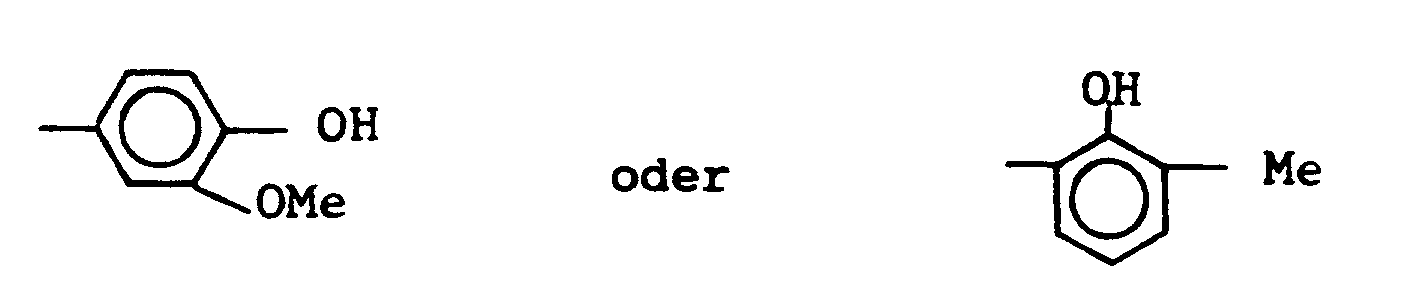
- the group A'' is preferably a substituted phenylene group in which the substituent is a lower alkyl or alkoxy group for example a methyl, ethyl, propyl, butyl or methoxy group.
- a curable formulation may be provided by mixing an arylolsilicon compound and a composition according to the invention under inert conditions, for example in a nitrogen atmosphere.
- Other compounding ingredients may be included in such a formulation, for example fillers and extenders. Upon exposure to oxygen or air the formulations cure readily at room temperature to provide crosslinked products.
- amounts up to 5% complex by weight of the formulation may be used, depending on whether short tack-free times or significant depth of cure are required. Generally the skinover time and the tack-free time decrease as the concentration of the complex is increased.
- Selected formulations comprising a polysiloxane having about 95 units of dimethylsiloxane and 5 units of methylsiloxane units having 3-(2 hydroxy-3 methyl phenyl) propyl substituents per polysiloxane molecule, and 3% by weight of the formulation of a preferred complex, have skinover times of around 10-20 seconds and are tack-free within 10 minutes. Similar formulations containing 1% of complex achieve the same conditions in 2 and 20 minutes respectively.
- a colloidal red precipitate may be formed in the uncured parts of the formulation and also in samples which are stored in absence of oxygen, for example under nitrogen. This colloidal red precipitate may be caused to dissolve again and so to disappear if the formulation is stirred and simultaneously exposed to air for some time. The formation of this red precipitate is thus reversible and does not appear to strongly influence the catalytic activity.
- uncured samples of the selected formulations in which such a red precipitate had been formed were exposed to air, they started to cure immediately and formed a skin within minutes. The tack-free times were also comparable with those of freshly prepared formulations.
- the rate of cure achieved at the surface and in depth, and the formation of red precipitate as aforesaid is dependent not only on the concentration of complex but also on the nature and number of crosslinking sites e.g. phenol groups available in the formulation to be cured. Formulations having less active sites, or lower concentration of sites, tend to exhibit greater depth of cure and slower surface cure for a given concentration of complex, and a reduced tendency to produce a red precipitate.
- the invention provides in another of its aspects a formulation comprising 100 parts by weight of an arylol-silicon compound comprising units according to the general formula (ii) and at least one unit according to the general formula (iv) in which each R and each A represents a monovalent hydrocarbon group, a halogenated monovalent hydrocarbon group, a cyanoalkyl group or an unsaturated hydrocarbon group attached to the silicon atom, each A' represents a substituted or unsubstituted divalent group and A'' represents a phenylene group or a substituted phenylene group and b has the value 0, 1, 2 or 3 and c has the value 0, 1, 2 or 3, and up to 5 parts by weight of a catalyst provided by a complex according to the invention.
- Arylcyanoacetylsilicones which may be employed in formulations curable in the presence of a catalyst composition according to the invention include arylcyanoacetylsilicon compounds as defined.
- arylcyanoacetylsilicon compounds as defined polysiloxanes comprising units according to the genera formula (ii) and at least one unit per polysiloxane chain according to the general formula (v) in which each R and each A represents a monovalent hydrocarbon group, a halogenated monovalent hydrocarbon group, a cyanoalkyl group or an unsaturated hydrocarbon group attached to the silicon atom, each A' represents a substituted or unsubstituted divalent group, X represents an oxygen atom or the group -NH- and Z represents a phenyl radical or a substituted phenyl radical, b has the value 0, 1, 2, or 3 and c has the value 0, 1, 2 or 3.
- the preferred polysiloxanes comprise units R and A which are alkyl groups or phenyl groups, the most preferred groups R and A being methyl groups.
- the group A' may be any suitable chain linking the XC(O)CH(Z) (CN) groups to the silicon atom. It may have substituents in the chain for example oxygen or on the chain for example halogen.
- an alkylene group for example a propylene group or an isobutylene group, b preferably has the value 2 or 3 and c 1 or 2.
- the group Z is preferably an unsubstituted phenyl group.
- Arylcyanoacetylsilicones can be either arylcyanoacetoxyalkyl or arylcyanoacetamidoalkyl silicones.
- the preferred arylcyanoacetylsilicones are those silicones having at least one silicon-bonded substituent of the formula We believe that formulations containing the preferred arylcyanoacetylsilicon compounds in which a preferred composition according to the invention is included as catalyst material, cure in presence of oxygen via carbon-carbon coupling between the CH groups to which the phenyl groups are linked. The curing reaction yields linkages which serve as cross links between siloxane chains. Accordingly, the density of crosslinks produced is dependent upon the number of units according to formula (v) present per molecule. Useful products have been demonstrated which employ from about 2% to about 10% units of formula (v), per polydimethylsiloxane molecule.
- a curable formulation may be provided by mixing an arylcyanoacetylsilicon compound and a composition according to the invention under inert conditions, for example in a nitrogen atmosphere.
- Other compounding ingredients may be included in such a formulation, for example fillers and extenders.
- oxygen e.g. oxygen of the air, the formulations cure readily at room temperature to provide crosslinked products.
- amounts up to 5% complex by weight of the formulation may be used, depending on whether short tack-free times or significant depth of cure are required. Generally the skinover time and the tack-free time decrease as the concentration of the complex is increased.
- Selected formulations comprising a polysiloxane having about 95 units of dimethylsiloxane and 5 units of methylsiloxane units having phenylcyanoacetamidopropyl substituents per polysiloxane molecule, and 1% by weight of the formulation of a preferred complex, have skinover times of around 30 minutes and are tack-free within 20 hours.
- a first illustrative complex which may be represented by the formula [Cu(OH) (Me3SiO)2MeSi(CH2)3N(CH3)CH2CH2N(CH3)2)]+2Cl ⁇ 2 was prepared by way of the reaction Cu2Cl2 + (Me3SiO)2MeSi(CH2)3N(CH3)CH2CH2N(CH3)2 + H2O + 1 ⁇ 2O2 ⁇ complex in the following way.
- a second illustrative complex which may be represented by the formula [Cu(OH) (Me3SiO(Me2SiO)15(MeZSiO)SiMe3)]+2 Cl ⁇ 2 where Z is (CH2)3N(CH3)CH2CH2N(CH3)2 was prepared in the following way.
- An N-(N',N'-dimethylaminoethyl)-N-methylaminopropyl-functional polysiloxane was prepared according to the scheme Me3SiO(Me2SiO)15(MeSi(CH2)3N(CH3)CH2CH2N(CH3)2)OSiMe3.
- a third illustrative complex was prepared according to the scheme Cu2Cl2+2L+H2O+1 ⁇ 2O2 ⁇ (Cu(OH)L)2Cl2 in which L represents (Me3SiO)2MeSi(CH2)3NHCH2CH2NH2).
- L represents (Me3SiO)2MeSi(CH2)3NHCH2CH2NH2).
- 3.2g Cu2Cl2 was suspended in 15ml methanol, 0.2ml water was added and then 6.4g L. This mixture was stirred in air for 5 hours. Within the first minutes an exothermic reaction started and the colour of the reaction mixture changed from pale green to intensive blue. All volatile components were then distilled off under vacuum at room temperature and the blue green solid residue was dissolved in toluene and filtered through diatomaceous earth. The solvent was removed again and a blue green solid remained.
- a first arylolsilicon compound was employed. This compound was made in the following way. 9.1g 2-allyl-6-methylphenol were dissolved in 100ml toluene, (7.7 x 10 ⁇ 6 mol) chloroplatinic acid added and heated under stirring to 85-90°C. Within 20 minutes 90.0g Me3SiO(Me2SiO)95(MeHSiO)5SiMe3 were added and the temperature kept at 90°C for 2 hours. In vacuum the toluene and all other volatile compounds were distilled off (up to 0.2mbar/140°C).
- a second mixture was set up with 0.1% of the same complex. Within three hours no skin was formed but the siloxane changed colour from pale yellow to light brown to a depth of 15mm. 24 hours after exposure to air the surface was tack-free. After 4 weeks it had cured to a depth of 20mm. The uncured siloxane remained a clear, pale yellow.
- the second illustrative complex was employed together with a second arylolsilicon compound prepared in the following way.
- a formulation consisting of a mixture of the second arylolsilicon compound and 0.5% by weight of the second illustrative complex changed colour after exposure to air. Within one hour the colour of the surface of the liquid changed from pale yellow to red-brown. After 24 hours it was still liquid, a skin was produced only after 3 days but the surface was still tacky and the colour of the total sample throughout the total depth of 40mm had changed to red brown. After 11 days it was tack-free and the colour was slightly darker.
- a third arylolsilicon compound was used. This compound differed from the first arylolsilicon compound in the number of reactive sites i.e. phenol groups available in each polysiloxane chain.
- the third arylolsilicon compound was prepared in the following way. 56.2g Me2HSiO(Me2SiO)150SiMe2H, 1.5g 2-allyl-6-methylphenol, 50ml toluene and 3.1 x 10 ⁇ 6 mol chloroplatinic acid mixed and heated under stirring to 85-90°C for 2.5 hours. The product was stripped from toluene and other volatile compounds at 0.3mbar/160°C.
- the material produced was according to the general formula A formulation consisting of a mixture of this third arylolsilicon compound and 0.5% by weight of the second illustrative complex had a brown surface after exposure to air for 20 seconds. A skin formed slowly, after several hours, and the surface was tack-free after 24 hours.
- the first illustrative complex was employed together with a first a phenylcyanoacetylsiloxane.
- the siloxane was prepared as follows. 55 g of carbohydroxy functional siloxane represented thus and 5.6g of methyl-phenylcyanoacetate was heated under vacuum (3mbar) to 180°C whereupon methanol distilled off from the reaction mixture. The obtained product was according to the average general which was a viscous pale yellow liquid, 100 parts of this phenylcyanoacetoxy-functional siloxane and 1 part of the first illustrative complex were blended under nitrogen and then exposed to air at room temperature.
- the first illustrative complex was employed together with a second phenylcyanoacetylsiloxane.
- the siloxane was prepared as follows. 7.8g of aminopropyl-functional siloxane represented thus and 0.88g of methyl-phenylcyanoacetate was heated under vacuum (3mbar) to 90 - 100°C whereupon methanol distilled off from the reaction mixture. After 20 minutes the obtained product was according to the average general formula which was a very viscous pale yellow liquid. 100 parts of this phenylcyanoacetoxy-functional siloxane and 1 part of the first illustrative complex were blended under nitrogen, degassed under vacuum and then exposed to air at room temperature. Within 30 minutes a skin had been formed on the surface of the sample and after 20 hours the sample was cured to a clear pale green tack-free rubber to a depth of 5mm.
- the first illustrative complex was employed together with a third phenylcyanoacetylsiloxane.
- the siloxane was prepared as follows. 93g of aminopropyl functional siloxane represented thus and 4.2g of methyl-phenylcyanoacetate was heated under vacuum (3mbar) to 115°C whereupon methanol distilled off from the reaction mixture.
- the obtained product was according to the average general formula 100 parts of this phenylcyanoacetoxy-functional siloxane and 0.8 part of the first illustrative complex were blended under nitrogen, degassed under vacuum and then exposed to air at room temperature. Within 5 hours a skin had been formed on the surface of the sample and after 24 hours the surface was tack-free and the sample cured to a depth of 6mm. After 2 weeks the sample had cured to a depth of 20mm.
Landscapes
- Chemical & Material Sciences (AREA)
- Organic Chemistry (AREA)
- Health & Medical Sciences (AREA)
- Chemical Kinetics & Catalysis (AREA)
- Medicinal Chemistry (AREA)
- Polymers & Plastics (AREA)
- General Chemical & Material Sciences (AREA)
- Silicon Polymers (AREA)
- Catalysts (AREA)
- Compositions Of Macromolecular Compounds (AREA)
Claims (15)
- Zusammensetzung, die mindestens kolloidal in Polysiloxanen löslich und in Wasser unlöslich ist, bestehend aus einem Komplex eines Kupersalzes im Oxidationszustand II, das gebildet wird durch Vermischen von Kupfer oder einem Kupfersalz, einer Organosiliciumverbindung, die 1 bis 3 Einheiten der allgemeinen Formel (i)

- Zusammensetzung nach Anspruch 1, dadurch gekennzeichnet, daß die Gruppe R' der allgemeinen Formel (iii) R³N(Q)R''NQ₂ entspricht, worin R³ eine Alkylengruppe darstellt mit einer Kette mit mindestens drei Kohlenstoffatomen, die Silicium- und Stickstoffatome verbinden, R'' eine Alkylengruppe darstellt mit 2 bis einschließlich 5 Kohlenstoffatomen, die die Stickstoffatome verbinden und wobei jeder Rest Q ein Wasserstoffatom oder eine Alkylgruppe, die an ein Stickstoffatom gebunden ist, darstellt.
- Zusammensetzung nach Anspruch 2, dadurch gekennzeichnet, daß jeder Rest Q ein Wasserstoffatom oder eine Methyl- oder Ethylgruppe darstellt.
- Zusammensetzung nach einem der vorhergehenden Ansprüche, dadurch gekennzeichnet, daß die Organosiliciumverbindung ein Organosiloxan ist, das mindestens eine Einheit gemäß der allgemeinen Formel (ii)

- Zusammensetzung nach Anspruch 4, dadurch gekennzeichnet, daß das Organosiloxan 5 bis 30 Einheiten gemäß der allgemeinen Formel (ii) einschließt und daß in den Einheiten (i) a den Wert 1 oder 2 hat.
- Zusammensetzung nach Anspruch 4 oder Anspruch 5, dadurch gekennzeichnet, daß das Organosiloxan der durchschnittlichen allgemeinen Formel R₃Si(OSiR₂)x(OSi(R)R³N(Q)R''NQ₂)yOSiR₃ entspricht, worin x einen Wert von 12 bis 20 hat, y einen Wert von 1 bis 3 hat und mindestens 85 % der vorhandenen Gruppen R Methylgruppen sind.
- Zusammensetzung nach einem der Ansprüche 2 bis 6, dadurch gekennzeichnet, daß R³ eine Propylengruppe darstellt und R'' eine Ethylen- oder Propylengruppe darstellt.
- Formulierung umfassend 100 Gewichtsteile einer Siliciumverbindung und bis zu 5 Gewichtsteile eines Katalysators für eine oxidative Kupplungsreaktion, dadurch gekennzeichnet, daß der Katalysator gebildet wird von einem Komplex nach einem der vorhergehenden Ansprüche und daß die Siliciumverbindung eine Arylolsiliciumverbindung ist, die Einheiten gemäß der allgemeinen Formel (ii)


- Formulierung nach Anspruch 8, dadurch gekennzeichnet, daß die Arylolsiliciumverbindung etwa 2 bis etwa 10 Einheiten gemäß der allgemeinen Formel (iv) pro Molekül umfaßt.
- Formulierung nach Anspruch 8 oder Anspruch 9, dadurch gekennzeichnet, daß jeder Rest R und jeder Rest A eine Methylgruppe darstellt, jeder Rest A' -(CH₂)₃- darstellt, b den Wert 2 oder 3 hat und c den Wert 1 oder 2 hat.
- Formulierung nach einem der Ansprüche 8 bis 10, dadurch gekennzeichnet, daß jeder Rest A''
- Formulierung umfassend 100 Gewichtsteile einer Siliciumverbindung und bis zu 5 Gewichtsteile eines Katalysators für eine oxidative Kupplungsreaktion, dadurch gekennzeichnet, daß der Katalysator gebildet wird von einem Komplex nach einem der Ansprüche 1 bis 7, wobei die Siliciumverbindung eine Arylcyanoacetylsiliciumverbindung ist, die Einheiten gemäß der allgemeinen Formel (ii)


- Formulierung nach Anspruch 12, dadurch gekennzeichnet, daß die Arylcyanoacetylsiliciumverbindung etwa 2 bis etwa 10 Einheiten gemäß der allgemeinen Formel (v) pro Molekül umfaßt.
- Formulierung nach Anspruch 12 oder Anspruch 13, dadurch gekennzeichnet, daß jeder Rest R und jeder Rest A eine Methylgruppe darstellt, jeder Rest A' -(CH₂)₃ oder -CH₂-CH(CH₃)CH₂- darstellt, b den Wert 2 oder 3 hat und c den Wert 1 oder 2 hat.
- Formulierung nach einem der Ansprüche 12 bis 14, dadurch gekennzeichnet, daß jeder Rest Z eine Phenylgruppe darstellt.
Applications Claiming Priority (2)
| Application Number | Priority Date | Filing Date | Title |
|---|---|---|---|
| GB8606634 | 1986-03-18 | ||
| GB868606634A GB8606634D0 (en) | 1986-03-18 | 1986-03-18 | Catalyst compositions |
Publications (3)
| Publication Number | Publication Date |
|---|---|
| EP0240095A2 EP0240095A2 (de) | 1987-10-07 |
| EP0240095A3 EP0240095A3 (en) | 1989-03-15 |
| EP0240095B1 true EP0240095B1 (de) | 1993-03-31 |
Family
ID=10594791
Family Applications (1)
| Application Number | Title | Priority Date | Filing Date |
|---|---|---|---|
| EP87300151A Expired - Lifetime EP0240095B1 (de) | 1986-03-18 | 1987-01-08 | Katalysatorszusammensetzungen und damit katalysierten Zusammensetzungen |
Country Status (6)
| Country | Link |
|---|---|
| US (1) | US4859647A (de) |
| EP (1) | EP0240095B1 (de) |
| JP (1) | JPH069661B2 (de) |
| CA (1) | CA1285259C (de) |
| DE (1) | DE3785068T2 (de) |
| GB (1) | GB8606634D0 (de) |
Families Citing this family (6)
| Publication number | Priority date | Publication date | Assignee | Title |
|---|---|---|---|---|
| JP2769840B2 (ja) * | 1989-03-24 | 1998-06-25 | チッソ株式会社 | 水酸基含有置換基を有するシロキサン化合物 |
| CA2015806A1 (en) * | 1989-05-02 | 1990-11-02 | Thomas C. Williams | Ambient temperature curable polyorganosiloxanes |
| CA2025289A1 (en) * | 1989-12-22 | 1991-06-23 | Kevin M. Snow | Silicone macromers and thermoplastic flame retardant silicone-polyphenylene ether graft copolymers obtained therefrom |
| US5204438A (en) * | 1989-12-22 | 1993-04-20 | General Electric Company | Silicone macromers and thermoplastic flame retardant silicone-polyphenylene ether graft copolymers obtained therefrom |
| EP0515196A3 (en) * | 1991-05-24 | 1993-06-09 | General Electric Company | Method for making silicone polyphenylene ether graft copolymers and products |
| JP2542152B2 (ja) * | 1991-10-30 | 1996-10-09 | ゼネラル・エレクトリック・カンパニイ | 熱可塑性シリコ―ン−ポリフェニレンエ―テルブロック共重合体の製造法 |
Family Cites Families (18)
| Publication number | Priority date | Publication date | Assignee | Title |
|---|---|---|---|---|
| DE1545184A1 (de) * | 1961-09-01 | 1969-12-11 | Wacker Chemie Gmbh | Verfahren zur Herstellung von Katalysatoren fuer die Polymerisation von aethylenisch ungesaettigten,polymerisierbaren Verbindungen |
| US3410820A (en) * | 1966-08-01 | 1968-11-12 | Gen Electric | Room temperature vulcanizing compositions |
| US3833505A (en) * | 1972-05-24 | 1974-09-03 | Gen Electric | Silicone fluids useful as hydraulic fluids |
| DE2633811C2 (de) * | 1976-07-28 | 1983-11-10 | Bayer Ag, 5090 Leverkusen | Verfahren zur Herstellung von Nitrodiphenylaminen |
| US4248993A (en) * | 1977-06-29 | 1981-02-03 | Shin-Etsu Chemical Co. Ltd. | Room temperature curable organopolysiloxane |
| JPS5437184A (en) * | 1977-08-29 | 1979-03-19 | Kanegafuchi Chem Ind Co Ltd | Novel diallylphthalate curable compound, its preparation, and adhesive and paint containing resin therefrom |
| DE2823820A1 (de) * | 1978-05-31 | 1979-12-06 | Siemens Ag | Verfahren zur vernetzung und stabilisierung von radikalisch vernetzbaren polymeren |
| ZA794221B (en) * | 1978-09-05 | 1981-03-25 | British Petroleum Co | Process for the preparation of a functionalised solid product |
| US4220556A (en) * | 1979-01-19 | 1980-09-02 | Exxon Research & Engineering Co. | Silylhydrocarbyl phosphine transition metal complexes |
| JPS55152745A (en) * | 1979-05-17 | 1980-11-28 | Kanegafuchi Chem Ind Co Ltd | Curable composition |
| JPS5817536B2 (ja) * | 1979-06-21 | 1983-04-07 | 株式会社東芝 | エポキシ樹脂系組成物 |
| US4293676A (en) * | 1979-12-03 | 1981-10-06 | Dow Corning Corporation | Oxygen-curable mercaptoorganosiloxane compositions containing both redox and iron carbonyl compounds and method of forming higher molecular weight products therefrom |
| JPS5742705A (en) * | 1980-08-29 | 1982-03-10 | Chisso Corp | Production of polyethylene |
| US4400327A (en) * | 1981-12-30 | 1983-08-23 | Union Carbide Corporation | Preparation of siloxylated metal-containing catalysts |
| BR8306198A (pt) * | 1982-11-16 | 1984-07-31 | Gen Electric | Composicao catalitica util para a preparacao de resina de eter de polifenileno e aperfeicoamento em processo para a preparacao da dita resina de eter de polifenileno |
| US4526954A (en) * | 1983-12-28 | 1985-07-02 | Union Carbide Corporation | Organosiloxane polymers and compositions containing same curable upon exposure to gaseous oxygen |
| US4507455A (en) * | 1984-05-11 | 1985-03-26 | Dow Corning Corporation | Silicones bearing acylated diaminohydrocarbyl radicals and method therefor |
| US4689422A (en) * | 1985-12-27 | 1987-08-25 | Texaco Inc. | Novel ligand catalyst systems formed by reaction of carbonyl compounds with organosilicon compounds |
-
1986
- 1986-03-18 GB GB868606634A patent/GB8606634D0/en active Pending
-
1987
- 1987-01-08 DE DE8787300151T patent/DE3785068T2/de not_active Expired - Fee Related
- 1987-01-08 EP EP87300151A patent/EP0240095B1/de not_active Expired - Lifetime
- 1987-03-03 US US07/021,366 patent/US4859647A/en not_active Expired - Fee Related
- 1987-03-10 CA CA000531567A patent/CA1285259C/en not_active Expired - Lifetime
- 1987-03-18 JP JP62061416A patent/JPH069661B2/ja not_active Expired - Lifetime
Also Published As
| Publication number | Publication date |
|---|---|
| JPS62234551A (ja) | 1987-10-14 |
| JPH069661B2 (ja) | 1994-02-09 |
| DE3785068T2 (de) | 1993-08-05 |
| US4859647A (en) | 1989-08-22 |
| GB8606634D0 (en) | 1986-04-23 |
| DE3785068D1 (de) | 1993-05-06 |
| EP0240095A2 (de) | 1987-10-07 |
| EP0240095A3 (en) | 1989-03-15 |
| CA1285259C (en) | 1991-06-25 |
Similar Documents
| Publication | Publication Date | Title |
|---|---|---|
| US5175325A (en) | Platinum complexes and use thereof | |
| EP0545591B1 (de) | Wärmehärtbare Organopolysiloxanmassen und vorgefertigte latente Platinkatalysatoren | |
| US5057476A (en) | Platinum catalyst composition, method for its preparation and curable organopolysiloxane compositions containing same | |
| US20040127668A1 (en) | Silicone condensation reaction | |
| KR100237819B1 (ko) | 열경화성 오르가노폴리실록산 조성물, 예비성형된 잠재성 백금 촉매 및 그의 제조 방법 | |
| HUE025139T2 (en) | Compounds having a guanidine structure and their use as an polysiloxane polycondensation catalyst | |
| US3410820A (en) | Room temperature vulcanizing compositions | |
| EP0031994A2 (de) | Schwefel enthaltende Organopolysiloxane und diese enthaltende härtbare Zusammensetzungen | |
| KR102408313B1 (ko) | 하이드로실릴화 및 탈수소 실릴화 촉매로서 유용한 나노입자 | |
| JPS6323929A (ja) | 液体ポリジオルガノシロキサンの調製法 | |
| EP0240095B1 (de) | Katalysatorszusammensetzungen und damit katalysierten Zusammensetzungen | |
| JPH0352785B2 (de) | ||
| JPH0583569B2 (de) | ||
| JPH0660309B2 (ja) | 反応性酸化防止剤及びその製法 | |
| EP0574265A2 (de) | Synthese von Epoxysiliconen | |
| US5250486A (en) | Polyphenylene ether process and resin composition | |
| KR102354560B1 (ko) | 엔온 첨가제를 사용하여 백금 유기실록산 착물을 제조하는 방법 | |
| JPH0633352B2 (ja) | 硬化性シリコーン組成物 | |
| EP0491190A2 (de) | Verfahren zur Herstellung von Polyphenylenether und Harzzusammensetzung | |
| US5098980A (en) | Platinum catalyst composition, method for its preparation and curable organopolysiloxane compositions containing same | |
| JP3700270B2 (ja) | フェノール縮合物の製造方法 | |
| EP1148079B1 (de) | Diacetylengruppen-enthaltende Polyorganosiloxane, Ihre Zwischenprodukte und daraus hergestellte gehärtete Zusammensetzungen | |
| JPS6236053B2 (de) | ||
| EP0423684A2 (de) | Silacyclobutan enthaltende Polycyclosiloxane | |
| JPH05293833A (ja) | 離型剤及び離型性向上方法 |
Legal Events
| Date | Code | Title | Description |
|---|---|---|---|
| PUAI | Public reference made under article 153(3) epc to a published international application that has entered the european phase |
Free format text: ORIGINAL CODE: 0009012 |
|
| AK | Designated contracting states |
Kind code of ref document: A2 Designated state(s): BE DE FR GB |
|
| PUAL | Search report despatched |
Free format text: ORIGINAL CODE: 0009013 |
|
| AK | Designated contracting states |
Kind code of ref document: A3 Designated state(s): BE DE FR GB |
|
| 17P | Request for examination filed |
Effective date: 19890717 |
|
| 17Q | First examination report despatched |
Effective date: 19910528 |
|
| GRAA | (expected) grant |
Free format text: ORIGINAL CODE: 0009210 |
|
| AK | Designated contracting states |
Kind code of ref document: B1 Designated state(s): BE DE FR GB |
|
| REF | Corresponds to: |
Ref document number: 3785068 Country of ref document: DE Date of ref document: 19930506 |
|
| ET | Fr: translation filed | ||
| BECA | Be: change of holder's address |
Free format text: 930331 *DOW CORNING LTD:CARDIFF ROAD BARRY SOUTH GLAMORGAN CF6 7YL WALES |
|
| PLBE | No opposition filed within time limit |
Free format text: ORIGINAL CODE: 0009261 |
|
| STAA | Information on the status of an ep patent application or granted ep patent |
Free format text: STATUS: NO OPPOSITION FILED WITHIN TIME LIMIT |
|
| 26N | No opposition filed | ||
| PGFP | Annual fee paid to national office [announced via postgrant information from national office to epo] |
Ref country code: BE Payment date: 19950111 Year of fee payment: 9 |
|
| PG25 | Lapsed in a contracting state [announced via postgrant information from national office to epo] |
Ref country code: BE Effective date: 19960131 |
|
| BERE | Be: lapsed |
Owner name: DOW CORNING LTD Effective date: 19960131 |
|
| PGFP | Annual fee paid to national office [announced via postgrant information from national office to epo] |
Ref country code: GB Payment date: 19961217 Year of fee payment: 11 |
|
| PGFP | Annual fee paid to national office [announced via postgrant information from national office to epo] |
Ref country code: FR Payment date: 19970121 Year of fee payment: 11 |
|
| PGFP | Annual fee paid to national office [announced via postgrant information from national office to epo] |
Ref country code: DE Payment date: 19970128 Year of fee payment: 11 |
|
| PG25 | Lapsed in a contracting state [announced via postgrant information from national office to epo] |
Ref country code: GB Free format text: LAPSE BECAUSE OF NON-PAYMENT OF DUE FEES Effective date: 19980108 |
|
| PG25 | Lapsed in a contracting state [announced via postgrant information from national office to epo] |
Ref country code: FR Free format text: THE PATENT HAS BEEN ANNULLED BY A DECISION OF A NATIONAL AUTHORITY Effective date: 19980131 |
|
| GBPC | Gb: european patent ceased through non-payment of renewal fee |
Effective date: 19980108 |
|
| PG25 | Lapsed in a contracting state [announced via postgrant information from national office to epo] |
Ref country code: DE Free format text: LAPSE BECAUSE OF NON-PAYMENT OF DUE FEES Effective date: 19981001 |
|
| REG | Reference to a national code |
Ref country code: FR Ref legal event code: ST |