EP0239705B1 - Signalvorbereitung für einen berührungsaktiven Bildschirm - Google Patents
Signalvorbereitung für einen berührungsaktiven Bildschirm Download PDFInfo
- Publication number
- EP0239705B1 EP0239705B1 EP86309970A EP86309970A EP0239705B1 EP 0239705 B1 EP0239705 B1 EP 0239705B1 EP 86309970 A EP86309970 A EP 86309970A EP 86309970 A EP86309970 A EP 86309970A EP 0239705 B1 EP0239705 B1 EP 0239705B1
- Authority
- EP
- European Patent Office
- Prior art keywords
- digital
- analog
- light
- signal
- detecting means
- Prior art date
- Legal status (The legal status is an assumption and is not a legal conclusion. Google has not performed a legal analysis and makes no representation as to the accuracy of the status listed.)
- Expired
Links
Images




Classifications
-
- G—PHYSICS
- G06—COMPUTING OR CALCULATING; COUNTING
- G06F—ELECTRIC DIGITAL DATA PROCESSING
- G06F3/00—Input arrangements for transferring data to be processed into a form capable of being handled by the computer; Output arrangements for transferring data from processing unit to output unit, e.g. interface arrangements
- G06F3/01—Input arrangements or combined input and output arrangements for interaction between user and computer
- G06F3/03—Arrangements for converting the position or the displacement of a member into a coded form
- G06F3/041—Digitisers, e.g. for touch screens or touch pads, characterised by the transducing means
- G06F3/042—Digitisers, e.g. for touch screens or touch pads, characterised by the transducing means by opto-electronic means
- G06F3/0421—Digitisers, e.g. for touch screens or touch pads, characterised by the transducing means by opto-electronic means by interrupting or reflecting a light beam, e.g. optical touch-screen
-
- G—PHYSICS
- G01—MEASURING; TESTING
- G01V—GEOPHYSICS; GRAVITATIONAL MEASUREMENTS; DETECTING MASSES OR OBJECTS; TAGS
- G01V8/00—Prospecting or detecting by optical means
- G01V8/10—Detecting, e.g. by using light barriers
- G01V8/20—Detecting, e.g. by using light barriers using multiple transmitters or receivers
-
- H—ELECTRICITY
- H03—ELECTRONIC CIRCUITRY
- H03K—PULSE TECHNIQUE
- H03K17/00—Electronic switching or gating, i.e. not by contact-making and –breaking
- H03K17/94—Electronic switching or gating, i.e. not by contact-making and –breaking characterised by the way in which the control signals are generated
- H03K17/941—Electronic switching or gating, i.e. not by contact-making and –breaking characterised by the way in which the control signals are generated using an optical detector
Definitions
- This invention relates to the detection of a member interrupting one or more beams transmitted between an emitter and an associated detector in an irradiated field, and more particularly relates to touch input detection systems for determining the intrusion and the relative position of a stylus within an irradiated field generally adjacent to an electronic display and formed by a plurality of infrared emitter/detector pairs.
- Amplification has been used in devices other than touch input systems in order to calibrate optoelectric devices.
- computing means are used for adjusting the activating signal fed to a light emitting element so that a predetermined light level is received by one or more associated photosensors. Calibration is achieved, however, by increasing the intensity of light emanating from the affected light source. Such an expedient is unattractive in the case of touch input systems in which optoelectric devices are closely spaced.
- Detection systems comprising a plurality of light emitting and detecting pairs located around the periphery of an irradiated field have been employed in a number of applications.
- infrared detector fields can be used as a safety interlock or an anti-intrusion system for preventing access to a certain area or as a safety barrier around a machine.
- One ever increasing use of such systems is as a touch input device to an electronic display.
- an array of infrared light emitters and detectors can be positioned around the periphery of an electronic display such as a CRT or a flat panel display.
- a number of such systems employ an X-Y matrix of emitters and detectors with associated emitters and detectors being axially aligned in pairs.
- a touch input system would be characterized as afar-looking application. Near-looking applications are those applications in which the emitter and detector are located in close proximity. The majority of the applications for conventional infrared opto devices emitters and detectors employ a separation of only a few centimeters. Many touch input systems position the emitters and detectors more than a foot apart, and some have a spacing of several feet. In near-looking application in which the opto devices are closely spaced, the total power output of the devices is more critical than the on-axis intensity.
- LEDs produced in the same process may range in light output by a factor of up to 4 to 1.
- Conventional phototransistors may range in sensitivity by the same factor. Therefore, when randomly paired together to form emitter/detector pairs, the output signals can vary over a range of 16 to 1 or even greater. This wide range of output signals can create difficulties in processing the output signals to determine broken beams.
- Careful preselection of available opto devices is one method of obtaining acceptable performance for touch input systems. Many of the opto devices from any manufacturing batch must be excluded as totally unacceptable for use in touch input systems. Thus, devices at the low end of the distribution must be totally eliminated. This preselection is based on total power output rather than on-axis intensity so that even the "better" opto devices may not be suitable for use in touch input systems. Thus, devices which may pass a selection process based on total power output may fail when the alignment problems associated with mounting the devices are combined with low on-axis intensity. Random pairing of devices will result in some devices producing below minimum output signals. Generally, the opto devices in a touch input matrix are mounted on printed circuit boards, and the complete assembly is tested.
- touch input systems employing signal preconditioning in the manner described herein can be used to compensate for environmental contaminates such as dirt or dust which reduce the output signal of opto pairs.
- Signal preconditioning also allows for special treatment at the edges of an opto matrix device, where reflection has traditionally been a problem.
- Signal preconditioning also permits a reduction in the LED drive current, allowing the selection of low current and lower cost multiplexing devices. In addition, lower LED drive current will extend the life of the LEDs. Low drive current also reduces the effect of thermal shock on LEDs.
- Signal preconditioning will also allow the selection of the devices to be independent of the matrix size and dimensions and will permit the devices to be used in higher ambient light environments. Furthermore, maintenance of touch input systems will be improved since replacement of failed opto devices will not require a selection process to insure suitable system operation.
- An input detection system for detecting the intrusion of an opaque element, such as a stylus, into an irradiated field employs signal preconditioning or programmable amplification of the output of each detector in the opto matrix array.
- the preferred embodiment of this invention comprises a touch input system suitable for use in conjunction with an electronic display. Upon the introduction of a stylus, such as the operator's finger, into an invisible infrared irradiated field formed by a array of infrared emitters and detectors, the position of the stylus relative to the display can be determined. In this manner, information can be communicated directly through the display to a host computer controlling both the display and the scanning operation of the opto matrix touch input system.
- X and Y arrays of light emitting infrared LEDs are located on two sides of a frame. Similar X and Y arrays of infrared detectors, such as phototransistors, are located on the opposite sides of the array.
- the emitters and detectors are disposed in axially aligned emitter/detector pairs. Although the emitter and detector packages are axially aligned, the problems inherent with conventional opto devices do not insure that the light emitted and received from devices in the same pair are axially aligned. Only mechanical alignment of the device packages themselves can be established.
- the emitter/detector array is employed in conjunction with a microprocessor computing system, which in the preferred embodiment of the invention, controls the sequential activation of the emitter/detector pairs and can communicate with a host computer controlling the display.
- An analog signal from the infrared detectors is converted to a digital signal for input into the microprocessor.
- the analog signal input into the analog to digital converter of converting circuitry is preconditioned to remove signal variations due to inconsistencies in the conventional emitters and detectors.
- a programmable amplifier responsive to the microprocessor preconditions the analog signals sequentially received from the light detecting phototransistors.
- the signals originally received from the photodetectors are individually amplified prior to input into the analog to digital converter to ensure that all signals input into the analog to digital converter and output from the analog to digital converter to the microprocessor are essentially constant or are at least within a prescribed normalized range.
- the present invention consists in an input detection apparatus for detecting the intrusion of an opaque element into an irradiated field comprising an array of light emitting means and an array of light detecting means, located on the periphery of the irradiated field, individual light emitting means being aligned with associated individual light detecting means, intrusion of the opaque element into the irradiated field blocking light from at least one individual light emitting means normally incident on the associated light detecting means; analog to digital converting means responsive to an analog signal dependent upon the intensity of light incident on each light detecting means, for transmitting a digital signal corresponding to the analog signal; digital computing means receiving the digital signal from the analog to digital converting means, the digital computing means comprising means for denoting the absence of incident light on individual light detecting means to detect the intrusion of an opaque element into the irradiated field; the apparatus being characterized by programmable amplification means responsive to the digital computing means for amplifying the analog signal from the light detecting means by a preset amplification factor individual to each light
- Figure 1 is a view illustrating the operator's use of a touch input system positioned adjacent an electronic CRT display.
- Figure 2 is a view of an opto matrix frame illustrating the opto matrix beams.
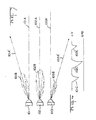
- Figure 3 demonstrates the variations and total power intensity and on-axis intensity encountered with conventional light emitting diodes.
- Figure 4 demonstrates variation in signal strength corresponding to the emitters shown in Figure 5.
- Figure 5 shows the matrix of X and Y emitters.
- Figure 6 shows a matrix and X and Y detectors in the form of phototransistors.
- FIG. 7 shows the interrelationship of the various components necessary for signal preconditioning.
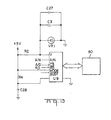
- Figure 8 shows a portion of the programmable amplification circuit employed in the preferred embodiment of this invention, including an analog multiplexer-demultiplexer used as an analog switch and a sample and hold circuit.
- Figure 9 shows the remainder of the programmable amplification means consisting of a dual digital to analog converter and a difference amplifier.
- Figure 10 shows an analog to digital converter receiving preconditioned signals from the programmable amplifier and inputting a digitized signal into a digital microprocessor.
- the preferred embodiment of this invention is intended for use in communicating with an electronic display which comprises an input and output means for a digital computer.
- the operator 16 can communicate with the display 12 of a CRT 10 by positioning an opaque member such as his finger 18 in the touch sensitive area.
- Input to a computer through the display screen 12 is accomplished by use of an opto matrix touch input frame 20 which can be positioned adjacent the video display.
- the opto matrix frame 20 establishes an irradiated field adjacent the display which permits detection of an intruding stylus, such as the operator's finger 18, into the irradiated field and also determines a precise position relative to the video display.
- an operator 16 can simple choose one of several alternative inputs displayed at various locations on a screen, and can perform other interactions with the display 12, such as cursor control.
- cursor control By using infrared emitters and detectors, the beam pattern established within the irradiated field will not optically interfere with the electric display.
- a touch input system of this type can be employed either as an alternative to or in addition to a conventional keyboard 14.
- Figure 2 shows a conventional optical matrix 20 comprising a plurality of emitters and detectors located around the periphery of an intermediate irradiated field.
- emitters are located along two sides of the rectangular matrix.
- Corresponding detectors are located along the opposite sides.
- a plurality of X emitters, X1, X2,...XN are located along the lower surface of the opto matrix frame 20.
- These X emitters comprise conventional infrared light emitting diodes and are generally positioned on predetermined centerlines along the lower periphery of the frame.
- a plurality of Y emitters, Y1, Y2,...YN are located along the left side of the opto matrix frame 20.
- These Y emitters also comprise conventional infrared light emitting diodes and are spaced apart on the same centerlines.
- the X and Y emitters individually transmit beams within the irradiated field forming a grid of infrared beams.
- a plurality of photodetectors, X1 ⁇ , X2 ⁇ ,...XN ⁇ , comprising a linear array of photodetectors are positioned along the top of frame 20.
- these X photodetectors, X1 ⁇ , X2 ⁇ ,...XN ⁇ each comprise conventional infrared phototransistors.
- a similar linear array of Y photodetectors, Y1 ⁇ , Y2 ⁇ ,...YN ⁇ are positioned along the right side of frame 20. Individual photodetectors located along either the X axis or the Y axis are geometrically aligned with associated light emitting elements to form a plurality of emitter/detector pairs.
- emitter X1 and photodetector X1 ⁇ are axially aligned as shown in Figure 2.
- the opto matrix frame 20 comprises a printed circuit board having the emitters and detectors affixed thereto on precise centerlines. Even though associated emitter/detector pairs are axially aligned, the light incident on each detector cannot be confined to the light emitted from corresponding LEDs. As shown in Figure 2, normal dispersion of light insures that some portion of the light emitted from individual LEDs will be incident upon detectors adjacent the associated photodetector.
- FIG. 2 assumes that the light beams emitted from emitters such as X1 and Y1 are precisely centered around the axis of alignment between associated emitters and detectors. However, with conventional LEDs, such alignment cannot be maintained.
- Figure 3 shows three side by size light emitting LEDs 101, 102 and 103. These LEDs 101, 102 and 103 can represent the light emitting patterns of LEDs arbitrarily distributed at any point within the emitter arrays. Although the emitters 101, 102 and 103 would be mechanically aligned along respective axis 101A, 102A and 103A, the light emission pattern for each of these emitters would not be the same.
- the central emitter 102 shows a light emitting device having an on-axis optical dispersion.
- LED 101 shows a conventional LED in which the optical intensity is not aligned with the geometrical axis 101A of the LED.
- envelope 101B representative of the light emitted from LED 101, is along the axis 101A ⁇ rather than the axis 101A.
- LED 101 is similar to the intensity of LED 102, as represented by the similarities between the envelope 101B and 102B, the amount of light radiated along axis 101A would differ significantly from that radiated along axis 102A.
- LED 103 illustrates a conventional emitter in which the light is not only emitted primarily along axis 103A ⁇ , rather than 103A, but the overall power output, as represented by a comparison of envelopes 103B and 102B, is significantly less than that of an optimum LED 102.
- Figure 4 indirectly represents the intensity of light as seen by photodetectors. Note that the relative signal strength shown at 101C, 102C and 103C is affected both by the relative intensity of the LEDs (compare 102B and 103B) and by the alignment and on-axis intensity of the emitted light (compare 101C and 102C).
- the considerations illustrated in Figures 2, 3 and 4 thus show that the signal from phototransistors within the array in a touch entry device will not be the same--thus creating problems in determining whether a detector has been blocked by the intrusion of an opaque element or stylus or whether the fully irradiated signal from the emitter merely falls in the low output range anticipated using conventional LEDs. It is this problem which has necessitated preselection of both LEDs and photodetectors, since photodetectors exhibit many of the same problems described with reference to light emitting diodes.
- FIG. 5 shows the emitter activation circuitry employed in the preferred embodiment of this invention.
- the array of X emitters X1, X2,...XN and the array of Y emitters Y1, Y2,...YN are interconnected in a matrix wit the emitters and detectors being actuated by signals from a microprocessor.
- the LEDs in this embodiment are configured in six banks or rows with the anode of the LEDs in each bank or row being commoned.
- the LEDs are also positioned in eight columns with the cathodes of LEDs in the same columns also being current sunk.
- each LED within the matrix is uniquely positioned and has a unique address within the matrix.
- the individual rows or banks of LEDs are addressable by the microprocessor through four signal lines AA, AB, AC and AD which serve to select which one of the six banks of source drivers to the LEDs is selected. These four signals feed a three line to eight line active high output decoder U17, which in the preferred embodiment of this invention comprises a 54HC237 active high output decoder.
- One of the active high outputs on this device is high at any one time, and that high output in turn activates one of six darlington pairs in the ULN2074B devices U18 and U19.
- the selected darlington pair turns on source current to one bank of infrared LEDs through a resistor R7, which in the preferred embodiment of this invention can be in the range of 1.0 to 30 ohms.
- the other axis of the infrared LED matrix is enabled using a 54LS145 4 -line to 10-line binary coded decimal converter active low decoder U20.
- Decoder U20 is activated by the microprocessor through input signal lines BA, BB, BC and BD. If only a single row and a single column is selected, only the single LED having that specific row and column address within the LED matrix will be activated in response to unique signals the microprocessor.
- the matrix of photodetectors X1 ⁇ , X2 ⁇ ,...XN ⁇ and Y1 ⁇ , Y2 ⁇ ,...YN ⁇ are configured in a matrix as shown in Figure 6 in a fashion similar to the emitter matrix. As shown in example of Figure 6, the photodetectors are positioned in six rows and eight columns. Again, each individual phototransistor is sequentially selected by addressing the appropriate row and column corresponding to the unique address of the selected photodetector. Selection of the individual photodetectors is again controlled by the microprocessor.
- One axis of the matrix one of the six rows of photodetectors, is selected by inputting signals DA, DB, DC and DD from the microprocessor into a 54LS145 4-line to 10-line binary coded decimal decoder U12.
- the other axis, one out of 8 columns, of the photodetector matrix is selected using a 54HC4051 analog multiplexer U11.
- Signals CA, CB and CC are input into analog multiplexer U11.
- One of the eight output lines from the analog multiplexer U11 is selected by the three input lines CA, CB and CC. If no photodetector is selected, input line INH is driven high and the photosignal is held at a certain voltage level using resistors R1 and R11 shown in Figure 8.
- That quiescent voltage level, which is labeled QCSIG is fed in the common 10 pin of device U11.
- the signal detected to each selected photodetector will be riding on top of the quiescent level on QCSIG.
- the signal QCSIG feeds one port of an AD7528 dual digital to analog converter U5 shown in Figure 9.
- the photosignal at QCSIG also drives an IO input pin of a 54HC 40 53 analog multiplexer-demultiplexer U8 shown in Figure 8.
- Figure 7 is a schematic showing the elements for preconditioning a signal prior to transmission of that signal to an analog to digital converter.
- the signals QC0 to QC7 output from the photodetectors and input into the analog multiplexer U11 are output into a programmable amplifier 40.
- the amplified signals are in turn transmitted to an analog to digital converter 60.
- the digital signals from the analog to digital converter 60 are then transmitted to a microprocessor computing means 80.
- the microprocessor then compares the digital signals received from A-D converter 60 with a normalized range of signals for each photodetector. If the signals transmitted to microprocessor 80 do not fall within a prescribed normalized range, the signal is transmitted along bus 100 to programmable amplifier 40 to provide amplification for each of the signals.
- the system initializes itself by scanning the touch matrix and sequentially reading, composing and writing to the programmable amplifier until each address signal from the matrix is within a prescribed range. These initial signals are transmitted upon initial activation of the touch input system prior to the use of the device to detect a stylus located within the irradiated field of the matrix.
- the programmable amplifier 40 applies an appropriate gain to the signals received from respective photodetectors, and the analog photodetector signal multiplied by an appropriate gain in amplifier 40 is then transmitted to the A-D converter 60.
- the digital signals are stored in memory within the microprocessor 80 until all signals are sufficiently amplified. This feedback loop operation continues until all of the signals from all of the photodetectors are within the appropriate normalized range. At this point, the various gains for individual photodetector pairs are stored within the microprocessor memory. The device is then in condition to permit detection of a stylus located at any position within the irradiated field.
- Figure 8 shows an analog switch and a hold circuit which comprises a part of the programmable amplifier 40 shown in Figure 7.
- the analog multiplexer-demultiplexer U8, into which the photosignal QCSIG is input, is used as an analog switch.
- switch U8 When switch U8 is closed, the voltage on QCSIG resides on capacitor C33. With switch U8 closed, which occurs when LCSELD goes high, the signal that was on QCSIG will remain on C33 until the switch is again open.
- the TLC274A opamp U6 serves as a high impedance buffer for a capacitor C33.
- the output QCREF of the high impedance buffer and QCSIG are in turn input into an AD7528 non-buffered ladder-type dual digital to analog converter (DAC) U5.
- the dual digital to analog converter is used to feed a TLC274A opamp U7.
- This device is configured as a differential amplifier with a gain determined by the dual digital to analog converter and resistors R3 and R6. Appropriate selected of the values of resistors R3 and R6 gives an approximate range of gain of 1 to 256.
- the output AIN of the differential amplifier U7 shown in Figure 9, is in turn input into an AD7576 analog to digital converter U9. This analog to digital converter converts the analog signal into a digital level value is read by the microprocessor 80.
- a touch entry device employing programmable amplification in the manner described herein, is also capable of adjusting for variations in the signal level over time.
- a certain signal level or reference value may be established within the computing means to identify interruption of a beam by the intrusion of an opaque member such as a stylus. For example, a change in signal level of 50% or more may be identified as a broken beam condition. Any change less than this fractional signal level can be considered a change in the output of the opto devices which must be adjusted by changing the programmable amplification for that signal.
Landscapes
- Engineering & Computer Science (AREA)
- Theoretical Computer Science (AREA)
- General Engineering & Computer Science (AREA)
- Physics & Mathematics (AREA)
- General Physics & Mathematics (AREA)
- Life Sciences & Earth Sciences (AREA)
- Human Computer Interaction (AREA)
- General Life Sciences & Earth Sciences (AREA)
- Geophysics (AREA)
- Position Input By Displaying (AREA)
- Length Measuring Devices By Optical Means (AREA)
- Geophysics And Detection Of Objects (AREA)
- Electronic Switches (AREA)
Claims (8)
- Eingabeerfassungsgerät zur Erfassung des Eindringens eines undurchsichtigen Elements (18) in ein bestrahltes Feld (12)
mit einer Gruppierung lichtaussendender Mittel (X1, X2...XN; Y1,Y2...YN) und einer Gruppierung lichtnachweisender Mittel (X1',X2'....XN'; Y1',Y2....YN'), die sich an dem Rand des bestrahlten Feldes (12) befinden, wobei individuelle lichtaussendende Mittel (X1,X2...XN) zu den zugehörigen lichtnachweisenden Mitteln (X1',X2'....XN') ausgerichtet sind, wobei das Eindringen das undurchsichtigen Elements (18) in das bestrahlte Feld (12) das Licht von mindestens einem individuellen lichtaussendenden Mittel blockiert, das normalerweise auf das zugehörige lichtnachweisende Mittel auftrifft,
mit einem Analog-Digital-Wandler (60), der auf ein analoges Signal reagiert, welches von dar Lichtintensität abhängt, das auf jedes lichtnachweisende Mittel auftrifft, um ein digitales Signal zu übermitteln, welches dem analogen Signal entspricht, mit einem digitalen Datenverarbeitungsgarät (80), das das digitale Signal von dem Analog-Digital-Wandler (60) empfängt, wobei das digitale Datenverarbeitungsgarät (80) eine Einrichtung aufweist, um die Abwesenheit von auffallendem Licht auf individuellen lichtnachweisenden Mitteln anzuzeigen, um das Eindringen eines undurchsichtigen Elements in das bestrahlte Feld (12) nachzuweisen,
dadurch gekennzeichnet,
daß es einen programmierbaren Verstärker (40) aufweist, der auf das digitale Datenverarbeitungsgerät (80) anspricht, um das analoge Signal von den lichtnachweisenden Mitteln mit einem vorbestimmten Verstärkungsfaktor zu verstärken, der individuell für jedes lichtnachweisende Mittel ist, wobei das verstärkte analoge Signal in den Analog-Digital-Wandler (60) eingegeben wird,
daß bei Nachweis von unblockiertem auffallendem Licht das digitale Datenverarbeitungsgerät (80) die Intensität des verstärkten analogen Signals mit einem normalisierten Bereich von Signalintensitäten vergleicht,
und daß das digitale Datenverarbeitungsgerät (80) den gespeicherten Wert das vorbestimmten Varstärkungsfaktors individuell für jedes lichtnachweisende Mittel durch einen Wert ersetzt, der der benötigten Verstärkung entspricht, um die analogen Signale in den normalisierten Bereich zu bringen. - Gerät nach Anspruch 1, dadurch gekennzeichnet,
daß die auf der Achse (101A, 102A, 103A) befindliche Intensität des unblockierten Lichts, das auf individuelle lichtnachweisende Mittel (X1`....XN',Y1'...YN') auffällt, in derselben Gruppierung ungleich innerhalb der Gruppierung ist. - Gerät nach Anspruch 2, dadurch gekennzeichnet,
daß die auf der Achse (101A, 102A, 103A) befindliche Intensität getrennter einzelner lichtaussendender Mittel (101, 102, 103) in derselben Gruppierung ungleich innerhalb der Gruppierung ist. - Gerät nach Anspruch 3, dadurch gekennzeichnet,
daß der programmierbare Verstärker (40) so angeordnet ist, daß er die analogen Signale von allen lichtnachweisenden Mitteln verstärkt. - Gerät nach Anspruch 3, dadurch gekennzeichnet,
daß das digitale Datenverarbeitungsgerät (80) eine Einrichtung zum Vergleich des digitalen Signalausgangs des Analog-Digital-Wandlers (60) mit einem vorbestimmten Referenzwert aufweist, welcher gleich einem Bruchteil des verstärkten analogen Signals entsprechend unblockiertem auf treffendem Licht ist, um zu entscheiden, ob das Licht durch die Einführung eines undurchsichtigen Elements (18) blockiert ist. - Gerät nach Anspruch 3, dadurch gekennzeichnet,
daß der programmierbare Verstärker (40) einen Sample- und HoldSchaltkreis (U8, C33), einen Digital-Analog-Wandler (U5) und einen Differenzverstärker (U7) aufweist. - Gerät nach Anspruch 6, dadurch gekennzeichnet,
daß der Digital-Analog-Wandler (U5) Mittel aufweist, um die Verstärkung in Abhängigkeit von dem Signal zu verändern, welches durch das Datenverarbeitungsgerät (80) von dem Analog-Digital-Wandler erhalten wird. - Gerät nach Anspruch 7, dadurch gekennzeichnet,
daß der Digital-Analog-Wandler (U5) einen ungepufferten dualen Digital-Analog-Wandler vom Leitertyp mit offener Schleife enthält.
Applications Claiming Priority (2)
| Application Number | Priority Date | Filing Date | Title |
|---|---|---|---|
| US06/835,015 US4684801A (en) | 1986-02-28 | 1986-02-28 | Signal preconditioning for touch entry device |
| US835015 | 1986-02-28 |
Publications (2)
| Publication Number | Publication Date |
|---|---|
| EP0239705A1 EP0239705A1 (de) | 1987-10-07 |
| EP0239705B1 true EP0239705B1 (de) | 1991-07-24 |
Family
ID=25268357
Family Applications (1)
| Application Number | Title | Priority Date | Filing Date |
|---|---|---|---|
| EP86309970A Expired EP0239705B1 (de) | 1986-02-28 | 1986-12-19 | Signalvorbereitung für einen berührungsaktiven Bildschirm |
Country Status (5)
| Country | Link |
|---|---|
| US (1) | US4684801A (de) |
| EP (1) | EP0239705B1 (de) |
| JP (1) | JPS62206404A (de) |
| DE (1) | DE3680521D1 (de) |
| HK (1) | HK128394A (de) |
Families Citing this family (58)
| Publication number | Priority date | Publication date | Assignee | Title |
|---|---|---|---|---|
| JPS62163138A (ja) * | 1986-01-13 | 1987-07-18 | Nippon Denso Co Ltd | 画像表示システムのための表示切換信号発生装置 |
| US5025411A (en) * | 1986-12-08 | 1991-06-18 | Tektronix, Inc. | Method which provides debounced inputs from a touch screen panel by waiting until each x and y coordinates stop altering |
| JPS63172325A (ja) * | 1987-01-10 | 1988-07-16 | Pioneer Electronic Corp | タツチパネル制御装置 |
| US4855590A (en) * | 1987-06-25 | 1989-08-08 | Amp Incorporated | Infrared touch input device having ambient compensation |
| JPS6465625A (en) * | 1987-09-07 | 1989-03-10 | Alps Electric Co Ltd | Optical type coordinate input device |
| JPH01314324A (ja) * | 1988-06-14 | 1989-12-19 | Sony Corp | タッチパネル装置 |
| US5164714A (en) * | 1988-06-20 | 1992-11-17 | Amp Incorporated | Modulated touch entry system and method with synchronous detection |
| US4988983A (en) * | 1988-09-02 | 1991-01-29 | Carroll Touch, Incorporated | Touch entry system with ambient compensation and programmable amplification |
| US4916308A (en) * | 1988-10-17 | 1990-04-10 | Tektronix, Inc. | Integrated liquid crystal display and optical touch panel |
| US5194863A (en) * | 1989-04-10 | 1993-03-16 | International Business Machines Corporation | Touch panel display |
| EP0450203A3 (en) * | 1989-04-10 | 1991-11-21 | International Business Machines Corporation | Touch panel display |
| US5107253A (en) * | 1989-11-13 | 1992-04-21 | Tektronix, Inc. | Stylus position detection system for optical touch panel |
| EP0438057B1 (de) * | 1990-01-16 | 1996-10-23 | Carroll Touch Incorporated | Infrarotberührungsempfindliche Eingabevorrichtung und Lichterzeugeraktivierungsschaltung |
| US5138468A (en) * | 1990-02-02 | 1992-08-11 | Dz Company | Keyless holographic lock |
| CH681756A5 (de) * | 1990-11-12 | 1993-05-14 | Beat Decoi | |
| US5341133A (en) * | 1991-05-09 | 1994-08-23 | The Rowland Institute For Science, Inc. | Keyboard having touch sensor keys for conveying information electronically |
| USD338656S (en) | 1991-07-02 | 1993-08-24 | Tusk, Incorporated | Workslate computer unit |
| USRE40891E1 (en) | 1991-11-26 | 2009-09-01 | Sandio Technology Corp. | Methods and apparatus for providing touch-sensitive input in multiple degrees of freedom |
| US6597347B1 (en) | 1991-11-26 | 2003-07-22 | Itu Research Inc. | Methods and apparatus for providing touch-sensitive input in multiple degrees of freedom |
| US5605406A (en) * | 1992-08-24 | 1997-02-25 | Bowen; James H. | Computer input devices with light activated switches and light emitter protection |
| US5577848A (en) * | 1992-08-24 | 1996-11-26 | Bowen; James H. | Light controlled touch pad for cursor and selection control on a computer display |
| US5577733A (en) * | 1994-04-08 | 1996-11-26 | Downing; Dennis L. | Targeting system |
| US6476798B1 (en) | 1994-08-22 | 2002-11-05 | International Game Technology | Reduced noise touch screen apparatus and method |
| US5635724A (en) * | 1995-06-07 | 1997-06-03 | Intecolor | Method and apparatus for detecting the location of an object on a surface |
| US6278443B1 (en) * | 1998-04-30 | 2001-08-21 | International Business Machines Corporation | Touch screen with random finger placement and rolling on screen to control the movement of information on-screen |
| WO2000029870A1 (de) * | 1998-11-16 | 2000-05-25 | Siemens Aktiengesellschaft | Optischer näherungsschalter |
| US6316777B1 (en) * | 1999-04-02 | 2001-11-13 | Indigo Systems Corporation | Constant power snapshot microemitter array with integral digital interface, isolated substrate current return, and linearized signal response |
| JP2001147106A (ja) * | 1999-11-24 | 2001-05-29 | Namco Ltd | 受光パターン検出装置 |
| EP2009676B8 (de) | 2002-05-08 | 2012-11-21 | Phoseon Technology, Inc. | Halbleitermaterial-Prüfsystem |
| US6956226B2 (en) * | 2003-01-15 | 2005-10-18 | Hewlett-Packard Development Company, L.P. | Light image sensor test of opto-electronics for in-circuit test |
| US7423227B2 (en) * | 2003-09-04 | 2008-09-09 | Avago Technologies Ecbu Ip Pte Ltd | Apparatus for optical navigation |
| US7819550B2 (en) * | 2003-10-31 | 2010-10-26 | Phoseon Technology, Inc. | Collection optics for led array with offset hemispherical or faceted surfaces |
| WO2005043954A2 (en) * | 2003-10-31 | 2005-05-12 | Phoseon Technology, Inc. | Series wiring of highly reliable light sources |
| WO2005091392A1 (en) | 2004-03-18 | 2005-09-29 | Phoseon Technology, Inc. | Micro-reflectors on a substrate for high-density led array |
| TWI257718B (en) * | 2004-03-18 | 2006-07-01 | Phoseon Technology Inc | Direct cooling of LEDs |
| EP1743384B1 (de) * | 2004-03-30 | 2015-08-05 | Phoseon Technology, Inc. | Led-gruppe mit led-detektoren auf gruppenbasis |
| PL1756876T3 (pl) * | 2004-04-12 | 2011-10-31 | Phoseon Technology Inc | Matryca led o dużej gęstości |
| TWI302756B (en) * | 2004-04-19 | 2008-11-01 | Phoseon Technology Inc | Imaging semiconductor structures using solid state illumination |
| US7598949B2 (en) * | 2004-10-22 | 2009-10-06 | New York University | Multi-touch sensing light emitting diode display and method for using the same |
| CA2588806A1 (en) * | 2004-12-09 | 2006-06-15 | Rpo Pty Limited | Optical power distribution devices |
| KR101288758B1 (ko) | 2004-12-30 | 2013-07-23 | 포세온 테크날러지 인코퍼레이티드 | 산업 공정에서 광원을 사용하는 시스템 및 방법 |
| TWI291237B (en) * | 2005-10-07 | 2007-12-11 | Integrated Digital Technologie | Photo detector array |
| US8748796B2 (en) * | 2005-10-07 | 2014-06-10 | Integrated Digital Technologies, Inc. | Interactive display panel having touch-sensing functions |
| US9064772B2 (en) * | 2005-10-07 | 2015-06-23 | Integrated Digital Technologies, Inc. | Touch screen system having dual touch sensing function |
| US8575536B2 (en) * | 2005-10-07 | 2013-11-05 | Integrated Digital Technologies Inc. | Pixel array and touch sensing display panel having the same |
| US7642527B2 (en) * | 2005-12-30 | 2010-01-05 | Phoseon Technology, Inc. | Multi-attribute light effects for use in curing and other applications involving photoreactions and processing |
| KR101003170B1 (ko) * | 2006-09-25 | 2010-12-22 | 인테그레이티드 디지털 테크놀로지스, 인코포레이티드 | 광 검출기 어레이 |
| US8264468B1 (en) | 2007-06-19 | 2012-09-11 | Imaging Systems Technology, Inc. | Touch system for blue screen |
| US8330730B1 (en) | 2007-09-04 | 2012-12-11 | Imaging Systems Technology, Inc. | Calibrating of interactive touch system for image compositing |
| US8426799B2 (en) * | 2008-08-07 | 2013-04-23 | Rapt Ip Limited | Optical control system with feedback control |
| EP2338105B1 (de) | 2008-08-07 | 2012-12-19 | Owen Drumm | Optische steuersysteme mit modulierten emittern |
| CN102171637B (zh) | 2008-08-07 | 2015-08-12 | 拉普特知识产权公司 | 用于检测光学触摸敏感装置中的多触摸事件的方法和设备 |
| US9092092B2 (en) | 2008-08-07 | 2015-07-28 | Rapt Ip Limited | Detecting multitouch events in an optical touch-sensitive device using touch event templates |
| EP2734914B1 (de) | 2011-07-22 | 2016-11-23 | Rapt IP Limited | Optischer koppler zur verwendung in einer berührungsempfindlichen optischen vorrichtung |
| CO6820274A1 (es) * | 2012-06-26 | 2013-12-31 | Velez Juan Camilo Diaz | Luminaria led de ultrabajo consumo multiplexada |
| US9524060B2 (en) | 2012-07-13 | 2016-12-20 | Rapt Ip Limited | Low power operation of an optical touch-sensitive device for detecting multitouch events |
| US11893188B2 (en) | 2018-05-18 | 2024-02-06 | 1004335 Ontario Inc. | Optical touch sensor devices and systems |
| GB2602915B (en) | 2020-04-03 | 2022-11-09 | 1004335 Ontario Inc Carrying On Business As A D Metro | Optical touch sensor systems and optical detectors with noise mitigation |
Family Cites Families (9)
| Publication number | Priority date | Publication date | Assignee | Title |
|---|---|---|---|---|
| US4097731A (en) * | 1977-06-02 | 1978-06-27 | Burroughs Corporation | Automatic gain control for photosensing devices |
| US4243879A (en) * | 1978-04-24 | 1981-01-06 | Carroll Manufacturing Corporation | Touch panel with ambient light sampling |
| SE428250B (sv) * | 1979-05-31 | 1983-06-13 | Bert Jonsson | Fotoelektrisk anordning for avkenning av foremal |
| CA1187959A (en) * | 1981-11-06 | 1985-05-28 | Kalervo Virtanen | Signalling device for vehicles |
| US4459476A (en) * | 1982-01-19 | 1984-07-10 | Zenith Radio Corporation | Co-ordinate detection system |
| US4559452A (en) * | 1982-06-02 | 1985-12-17 | Fujitsu Limited | Apparatus for detecting edge of semitransparent plane substance |
| JPS5970990A (ja) * | 1982-10-18 | 1984-04-21 | Ricoh Co Ltd | 調光方法 |
| US4591710A (en) * | 1983-07-11 | 1986-05-27 | Electro Mechanical Systems, Inc. | Ambient light and electromagnetic noise reduction circuit |
| DE3408261A1 (de) * | 1984-03-07 | 1985-09-19 | Hansa Metallwerke Ag, 7000 Stuttgart | Annaeherungsschalter sowie steuerschaltungsanordnung hierfuer |
-
1986
- 1986-02-28 US US06/835,015 patent/US4684801A/en not_active Expired - Fee Related
- 1986-12-19 DE DE8686309970T patent/DE3680521D1/de not_active Expired - Fee Related
- 1986-12-19 EP EP86309970A patent/EP0239705B1/de not_active Expired
-
1987
- 1987-02-27 JP JP62045105A patent/JPS62206404A/ja active Pending
-
1994
- 1994-11-17 HK HK128394A patent/HK128394A/en not_active IP Right Cessation
Also Published As
| Publication number | Publication date |
|---|---|
| EP0239705A1 (de) | 1987-10-07 |
| US4684801A (en) | 1987-08-04 |
| JPS62206404A (ja) | 1987-09-10 |
| DE3680521D1 (de) | 1991-08-29 |
| HK128394A (en) | 1994-11-25 |
Similar Documents
| Publication | Publication Date | Title |
|---|---|---|
| EP0239705B1 (de) | Signalvorbereitung für einen berührungsaktiven Bildschirm | |
| US4988983A (en) | Touch entry system with ambient compensation and programmable amplification | |
| US4703316A (en) | Touch panel input apparatus | |
| EP0095948B1 (de) | Detektieren der Kanten von Gegenständen | |
| CA1225723A (en) | Touch sensitive device | |
| US4737631A (en) | Filter of photoelectric touch panel with integral spherical protrusion lens | |
| JP2769621B2 (ja) | 光学式入力装置 | |
| US5635724A (en) | Method and apparatus for detecting the location of an object on a surface | |
| US4818859A (en) | Low profile opto-device assembly with specific optoelectronic lead mount | |
| JPH0357563B2 (de) | ||
| US8400406B1 (en) | IR touch | |
| JPS60243728A (ja) | 座標入力装置 | |
| JP2004533696A (ja) | 物体の場所を光学的に検出する方法と装置 | |
| US5886776A (en) | Laser beam receiver circuit | |
| SE457151B (sv) | Anordning foer optisk avkaenning av foeremaal | |
| US7030361B2 (en) | Receiver circuit with “M” sectors each with “N” channels | |
| US9865764B2 (en) | Image capture device with integrated illumination and method for producing the device | |
| US4395127A (en) | Optical paper detector | |
| JPH0474643B2 (de) | ||
| US9013450B1 (en) | IR touch | |
| EP4129123A1 (de) | Optisches paketerkennungssystem | |
| JPH0612512B2 (ja) | 光学式タッチパネルの受光素子の感度調整方法 | |
| US6100822A (en) | Optical sensing system using multiple detectors at various positions for generating position signals | |
| US3223845A (en) | Optical transducer for measuring distance | |
| EP0438057A2 (de) | Infrarotberührungsempfindliche Eingabevorrichtung und Lichterzeugeraktivierungsschaltung |
Legal Events
| Date | Code | Title | Description |
|---|---|---|---|
| PUAI | Public reference made under article 153(3) epc to a published international application that has entered the european phase |
Free format text: ORIGINAL CODE: 0009012 |
|
| AK | Designated contracting states |
Kind code of ref document: A1 Designated state(s): DE FR GB IT NL |
|
| 17P | Request for examination filed |
Effective date: 19880326 |
|
| 17Q | First examination report despatched |
Effective date: 19891003 |
|
| GRAA | (expected) grant |
Free format text: ORIGINAL CODE: 0009210 |
|
| ITF | It: translation for a ep patent filed | ||
| AK | Designated contracting states |
Kind code of ref document: B1 Designated state(s): DE FR GB IT NL |
|
| REF | Corresponds to: |
Ref document number: 3680521 Country of ref document: DE Date of ref document: 19910829 |
|
| ET | Fr: translation filed | ||
| PLBE | No opposition filed within time limit |
Free format text: ORIGINAL CODE: 0009261 |
|
| STAA | Information on the status of an ep patent application or granted ep patent |
Free format text: STATUS: NO OPPOSITION FILED WITHIN TIME LIMIT |
|
| 26N | No opposition filed | ||
| PGFP | Annual fee paid to national office [announced via postgrant information from national office to epo] |
Ref country code: GB Payment date: 19971107 Year of fee payment: 12 |
|
| PGFP | Annual fee paid to national office [announced via postgrant information from national office to epo] |
Ref country code: FR Payment date: 19971203 Year of fee payment: 12 |
|
| PGFP | Annual fee paid to national office [announced via postgrant information from national office to epo] |
Ref country code: DE Payment date: 19971229 Year of fee payment: 12 |
|
| PGFP | Annual fee paid to national office [announced via postgrant information from national office to epo] |
Ref country code: NL Payment date: 19980914 Year of fee payment: 13 |
|
| PG25 | Lapsed in a contracting state [announced via postgrant information from national office to epo] |
Ref country code: GB Free format text: LAPSE BECAUSE OF NON-PAYMENT OF DUE FEES Effective date: 19981219 |
|
| GBPC | Gb: european patent ceased through non-payment of renewal fee |
Effective date: 19981219 |
|
| PG25 | Lapsed in a contracting state [announced via postgrant information from national office to epo] |
Ref country code: FR Free format text: LAPSE BECAUSE OF NON-PAYMENT OF DUE FEES Effective date: 19990831 |
|
| REG | Reference to a national code |
Ref country code: FR Ref legal event code: ST |
|
| PG25 | Lapsed in a contracting state [announced via postgrant information from national office to epo] |
Ref country code: DE Free format text: LAPSE BECAUSE OF NON-PAYMENT OF DUE FEES Effective date: 19991001 |
|
| PG25 | Lapsed in a contracting state [announced via postgrant information from national office to epo] |
Ref country code: NL Free format text: LAPSE BECAUSE OF NON-PAYMENT OF DUE FEES Effective date: 20000701 |
|
| NLV4 | Nl: lapsed or anulled due to non-payment of the annual fee |
Effective date: 20000701 |
|
| PG25 | Lapsed in a contracting state [announced via postgrant information from national office to epo] |
Ref country code: IT Free format text: LAPSE BECAUSE OF NON-PAYMENT OF DUE FEES Effective date: 20051219 |