EP0239290A2 - Mikrowellenöfen und Verfahren zum Kochen von Lebensmitteln - Google Patents
Mikrowellenöfen und Verfahren zum Kochen von Lebensmitteln Download PDFInfo
- Publication number
- EP0239290A2 EP0239290A2 EP87302142A EP87302142A EP0239290A2 EP 0239290 A2 EP0239290 A2 EP 0239290A2 EP 87302142 A EP87302142 A EP 87302142A EP 87302142 A EP87302142 A EP 87302142A EP 0239290 A2 EP0239290 A2 EP 0239290A2
- Authority
- EP
- European Patent Office
- Prior art keywords
- hot air
- cavity
- time
- cooking
- air temperature
- Prior art date
- Legal status (The legal status is an assumption and is not a legal conclusion. Google has not performed a legal analysis and makes no representation as to the accuracy of the status listed.)
- Granted
Links
Images



Classifications
-
- H—ELECTRICITY
- H05—ELECTRIC TECHNIQUES NOT OTHERWISE PROVIDED FOR
- H05B—ELECTRIC HEATING; ELECTRIC LIGHT SOURCES NOT OTHERWISE PROVIDED FOR; CIRCUIT ARRANGEMENTS FOR ELECTRIC LIGHT SOURCES, IN GENERAL
- H05B6/00—Heating by electric, magnetic or electromagnetic fields
- H05B6/64—Heating using microwaves
- H05B6/647—Aspects related to microwave heating combined with other heating techniques
- H05B6/6482—Aspects related to microwave heating combined with other heating techniques combined with radiant heating, e.g. infrared heating
-
- H—ELECTRICITY
- H05—ELECTRIC TECHNIQUES NOT OTHERWISE PROVIDED FOR
- H05B—ELECTRIC HEATING; ELECTRIC LIGHT SOURCES NOT OTHERWISE PROVIDED FOR; CIRCUIT ARRANGEMENTS FOR ELECTRIC LIGHT SOURCES, IN GENERAL
- H05B6/00—Heating by electric, magnetic or electromagnetic fields
- H05B6/64—Heating using microwaves
- H05B6/6447—Method of operation or details of the microwave heating apparatus related to the use of detectors or sensors
- H05B6/645—Method of operation or details of the microwave heating apparatus related to the use of detectors or sensors using temperature sensors
-
- H—ELECTRICITY
- H05—ELECTRIC TECHNIQUES NOT OTHERWISE PROVIDED FOR
- H05B—ELECTRIC HEATING; ELECTRIC LIGHT SOURCES NOT OTHERWISE PROVIDED FOR; CIRCUIT ARRANGEMENTS FOR ELECTRIC LIGHT SOURCES, IN GENERAL
- H05B6/00—Heating by electric, magnetic or electromagnetic fields
- H05B6/64—Heating using microwaves
- H05B6/647—Aspects related to microwave heating combined with other heating techniques
- H05B6/6473—Aspects related to microwave heating combined with other heating techniques combined with convection heating
Definitions
- This invention relates to microwave ovens of the type having both a magnetron for delivering microwave power to the oven cavity and a forced hot air system for delivering a forced flow of hot air through the oven cavity.
- the invention also relates to a method of cooking food in such a microwave oven.
- the Applicants' UK Patent Specifications Nos 2127658A and 2137860A disclose microwave ovens of this type. In these ovens, control of the cooking process depends upon monitoring the variation of hot air temperature with time. This can vary from individual oven to oven because of manufacturing tolerances and variations in characteristics of components.
- the invention aims to provide a microwave oven which follows a cooking sequence dependent upon values measured during cooking, so compensating for variations between individual ovens.
- a microwave oven comprises a cavity for receiving a food item to be cooked, a magnetron for delivering microwave power to the cavity, a forced hot air system including a fan and an electrical resistance heating element which are disposed in a compartment separated from the cavity by a dividing panel, the panel having a first aperture serving as a hot air outlet aperture for the cavity and a second aperture serving as a hot air inlet aperture for the cavity, whereby the fan draws air into the compartment from the cavity through the outlet aperture, directs the air over the heating element and thence returns the air to the cavity through the inlet aperture, means for monitoring the variation of hot air temperature with time and determining the particular time at which the hot air temperature reaches a predetermined value, and means at said particular time for:
- the determination of the maximum hot air temperature in 2) above is preferably done thermostatically.
- the means for monitoring the variation of hot air temperature with time preferably comprises a thermistor located adjacent the fan.
- the latter is conveniently mounted immediately behind the hot air outlet aperture, and may have a horizontally rotatable impeller with a plurality of blades angularly spaced around the impeller and operative to draw air into the compartment and thence force the air over the resistance heating element to heat the air.
- the temperature sensor is preferably located substantially midway between the outer periphery of the fan and the adjacent wall of a casing which defines the margin of the compartment.
- the thermostatic control may be effected with the aid of a second thermistor located adjacent the inlet aperture to the cavity, preferably just downstream of the heating element.
- the oven may have the facility of producing a well done or a lightly done result, in addition to the normal result, in which case the first and second characteristics are altered to produce, in the case of the user requiring a well done result, a longer remaining cooking time and a higher maximum hot air temperature or, in the case of the user requiring a lightly done result, a shorter remaining cooking time and a lower maximum hot air temperature.
- the oven may have the facility of selecting one program for ordinary baked items, excluding cakes, and another program for frozen foods and cakes.
- the oven stores first and second characteristics suitable for said one program and first and second characteristics suitable for said another program.
- the various control functions are conveniently carried out by a microprocessor connected to the thermistors and operative to control energisation of the magnetron and the hot air system.
- the oven should commence from a cold condition, which in practice means less than about 80°C.
- the cooking time as automatically determined by the oven tends to be less for a warm start than for a cold start.
- This can cause the food item to be less well cooked if it is cooked after a warm start than after a genuine cold start, and the following preferred feature of the invention aims to correct this variation.
- the oven has means for forcing cold or cool air through the cavity in order to cool the latter during a cool down period before a subsequent cooking operation, a thermostat to determine the temperature of the air flow and means for terminating the cool down period and initiating the cooking operation by the simultaneous application of forced hot air and microwave power when the air flow temperature drops to a cool down temperature, and wherein microwave power is applied to the cavity during the cool down period.
- the cool or cold air is blown through the cavity by directing air from a magnetron cooling fan into the cavity during the cool down period.
- the invention also includes within its scope a method of cooking food in a microwave oven according to the said one aspect.
- the oven is similar in construction and in circuit configuration to the ovens disclosed in the applicants' two aforementioned UK patent specifications.
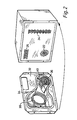
- the oven has a food-receiving cavity 10 which is closable by a hinged front door 12 and in the base of which is located a rotatable turntable 14.
- a magnetron (not shown) delivers microwave power to the cavity through an inlet 16, and cooling air from a magnetron blower fan is capable of entering the cavity through a perforated inlet 18.
- the rear panel 20 of the cavity has a perforated outlet aperture 22 and a perforated inlet aperture 24, these two apertures respectively serving for the exit and entry of forced air to the cavity.
- the cavity has a further vent 25, a perforated area 26 which is illuminated, and the front of the casing of the oven has a control panel 30.
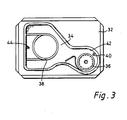
- the rear of the oven has a casing 32 shaped to provide a hot air compartment 34 through which air passes behind the panel 20.
- a fan 36 disposed behind the outlet aperture 22, and an electrical resistance heating element 38, disposed behind the inlet aperture 24.
- the fan 36 is rotatable about a horizontal axis and has around its periphery a plurality of impeller blades which draw air from the cavity 10, through the outlet aperture 22, and thence force the air over the electrical resistance heating element 38 where it is heated, before redirecting the air back into the cavity 10 through the inlet aperture 24.
- a temperature sensor in the form of a thermistor bead 40 is located in the compartment 34 at a position spaced midway between the outer periphery of the blades of the fan 36 and the adjacent wall 42 defining the peripheral margin of the hot air compartment in this region. It will be seen from Figure 3 that the thermistor bead 40 is located at an angle of about 45° from a vertical line passing through the rotational axis of the fan 36. A further thermistor bead 44 is located in a conventional position just downstream of the electrical resistance heating element 38.
- Signals from the two thermistor beads 40, 44 provide an accurate indication of cooking progress and the variations of temperature with time, as detected by the two thermistor beads 40, 44, are used by the microprocessor of the oven in order to control the lengths and durations of the microwave power and hot air power, in a manner now to be described.
- the curve 50 shows the variation of hot air temperature, as detected by thermistor bead 40, plotted against cooking time.
- Curve 50 applies for nominal mains voltage.
- Curves 52 and 54 apply if the voltage is +6% or -6% respectively of the nominal voltage.
- the thermistor bead 40 records a predetermined value of hot air temperature of 180°C
- the corresponding time T is noted by the oven microprocessor.
- the microprocessor refers to the characteristics of Figures 5 and 6 in order to determine the remaining cooking time from Figure 5 and the maximum hot air temperature for thermostatically controlling the hot air temperature as detected by the thermistor bead 44, by reference to the second characteristic of Figure 6.
- the vertical scale of Figure 5 is the factor k by which the particular time T must be multiplied to give the total cooking time.
- the curves of Figures 5 and 6 are pre-programmed into the microprocessor.
- Curve 48 in Figure 4 shows the temperature variation as detected by the thermistor 44, but there is no thermostatic control of the hot air temperature as detected by the thermistor 44 between time zero and time T.
- the microprocessor refers to the graph of Figure 5 to determine that the total cooking time is 1.3 times 12 minutes (ie 15.6 minutes), by reference to the characteristic 56. If the user requires a well done result or a lightly done result, the microprocessor refers to curve 58 or 60, respectively. Cooking continues, at the same levels of microwave power and hot air power, from the particular time of 12 minutes to the end of cooking at 15.6 minutes, at which the microprocessor turns off the magnetron and the hot air power and signals the end of cooking. There is thus a remaining cooking time of 3.6 minutes after the particular time of 12 minutes.
- the microprocessor determines the maximum hot air temperature from Figure 6 which, in this example, is about 235°C for a normal result.
- the hot air temperature (as detected by the thermistor bead 44) is limited to a maximum of 235°C for the remaining cooking time of 3.6 minutes, ie the interval from the particular time T of 12 minutes to the end of cooking at 15.6 minutes.
- thermostatic control is applied over the interval from the particular time T to the end of cooking.
- Figures 4, 5 and 6 are for ordinary baked items excluding cakes.
- Figures 7, 8 and 9 are corresponding graphs for frozen foods and cakes, and the same reference numerals are used for equivalent features.
- the domestic plug/socket can take only a limited power
- Microwave power is applied to the cavity during the cool down period. This compensates for the fact that the cooking operation is likely to last for a shorter period of time (in comparison with a cold start) because of the residual heat in the metal parts surrounding the oven cavity.
- point 80 on the graph indicates the food being placed in the oven cavity (at the time datum) which is warm as the result of a preceding cooking operation.
- Point 90 is determination of the thermistor temperature 40 after 1 minute. Assuming this temperature to be above the particular cool down temperature TC, automatic cool down is initiated and cool air from the magnetron blower is directed into the oven cavity and microwave power is simultaneously applied throughout a cool down period 82. The thermistor 40 monitors the air temperature and when this drops to the particular cool down temperature TC, (eg 80°C) the cool down period 82 terminates (at time x) and the cooking operation commences.
Landscapes
- Physics & Mathematics (AREA)
- Electromagnetism (AREA)
- Electric Ovens (AREA)
- Control Of High-Frequency Heating Circuits (AREA)
- General Preparation And Processing Of Foods (AREA)
Applications Claiming Priority (6)
| Application Number | Priority Date | Filing Date | Title |
|---|---|---|---|
| GB8607486 | 1986-03-26 | ||
| GB868607486A GB8607486D0 (en) | 1986-03-26 | 1986-03-26 | Microwave ovens |
| GB8607901 | 1986-04-01 | ||
| GB868607901A GB8607901D0 (en) | 1986-04-01 | 1986-04-01 | Microwave ovens |
| GB868624938A GB8624938D0 (en) | 1986-10-17 | 1986-10-17 | Microwave ovens |
| GB8624938 | 1986-10-17 |
Publications (3)
| Publication Number | Publication Date |
|---|---|
| EP0239290A2 true EP0239290A2 (de) | 1987-09-30 |
| EP0239290A3 EP0239290A3 (en) | 1988-05-11 |
| EP0239290B1 EP0239290B1 (de) | 1991-12-11 |
Family
ID=27262970
Family Applications (1)
| Application Number | Title | Priority Date | Filing Date |
|---|---|---|---|
| EP87302142A Expired EP0239290B1 (de) | 1986-03-26 | 1987-03-12 | Mikrowellenöfen und Verfahren zum Kochen von Lebensmitteln |
Country Status (6)
| Country | Link |
|---|---|
| US (1) | US4794219A (de) |
| EP (1) | EP0239290B1 (de) |
| JP (1) | JP2534862B2 (de) |
| AU (1) | AU592163B2 (de) |
| CA (1) | CA1273405A (de) |
| DE (1) | DE3775091D1 (de) |
Cited By (4)
| Publication number | Priority date | Publication date | Assignee | Title |
|---|---|---|---|---|
| EP0327262A1 (de) * | 1988-02-05 | 1989-08-09 | Microwave Ovens Limited | Mikrowellenöfen und Verfahren, um darin Lebensmittel aufzutauen |
| EP0717582A3 (de) * | 1994-12-16 | 1997-01-22 | Lg Electronics Inc | Heizzeit Kontrolvorrichtung und Verwendung dieses in Mikrowellenofen |
| EP0730391A3 (de) * | 1995-02-28 | 1997-03-26 | Samsung Electronics Co Ltd | Apparat und Methode zur Temperaturreglung für Mikrowellenofen |
| CN112032782A (zh) * | 2020-08-21 | 2020-12-04 | 连尚(新昌)网络科技有限公司 | 一种用于加热食物的方法、装置及设备 |
Families Citing this family (10)
| Publication number | Priority date | Publication date | Assignee | Title |
|---|---|---|---|---|
| EP0358344B1 (de) * | 1988-09-09 | 1994-03-30 | Microwave Ovens Limited | Mikrowellenöfen |
| US5254823A (en) * | 1991-09-17 | 1993-10-19 | Turbochef Inc. | Quick-cooking oven |
| GB9209350D0 (en) * | 1992-04-30 | 1992-06-17 | Microwave Ovens Ltd | Microwave ovens and methods of cooking food |
| US6249710B1 (en) | 1996-05-14 | 2001-06-19 | Microwave Science, Llc | Method and apparatus for managing the thermal activity of a microwave oven |
| US7092988B1 (en) | 1997-05-27 | 2006-08-15 | Jeffrey Bogatin | Rapid cooking oven with broadband communication capability to increase ease of use |
| US8224892B2 (en) | 2000-04-28 | 2012-07-17 | Turbochef Technologies, Inc. | Rapid cooking oven with broadband communication capability to increase ease of use |
| KR20040047079A (ko) * | 2002-11-29 | 2004-06-05 | 삼성전자주식회사 | 가열조리장치 및 그 제어방법 |
| KR20050077334A (ko) | 2004-01-27 | 2005-08-02 | 삼성전자주식회사 | 벽걸이형 전자레인지 |
| KR101752523B1 (ko) | 2010-07-01 | 2017-06-29 | 고지 엘티디. | 무선 주파수 에너지에 의한 대상물 처리 |
| US9992824B2 (en) | 2010-10-29 | 2018-06-05 | Goji Limited | Time estimation for energy application in an RF energy transfer device |
Family Cites Families (15)
| Publication number | Priority date | Publication date | Assignee | Title |
|---|---|---|---|---|
| CH572709A5 (de) * | 1975-01-22 | 1976-02-27 | Elektromaschinen Ag | |
| AU523161B2 (en) * | 1979-02-02 | 1982-07-15 | Matsushita Electric Industrial Co., Ltd. | Heater with sensor |
| US4379964A (en) * | 1979-07-20 | 1983-04-12 | Matsushita Electric Industrial Co., Ltd. | Method of food heating control by detecting liberated gas or vapor and temperature of food |
| US4337384A (en) * | 1979-08-01 | 1982-06-29 | Matsushita Electric Industrial Co., Ltd. | Cooking appliance of the hot air circulating type |
| US4447693A (en) * | 1979-09-06 | 1984-05-08 | Litton Systems, Inc. | Power controlled microwave oven |
| JPS56102617A (en) * | 1980-01-18 | 1981-08-17 | Matsushita Electric Ind Co Ltd | Heating cooker |
| CA1199076A (en) * | 1981-07-06 | 1986-01-07 | Takeshi Tanabe | Microwave heating appliance with simplified user's operation |
| CA1190604A (en) * | 1981-07-21 | 1985-07-16 | Takeshi Tanabe | Combined microwave oven and grill oven with automated cooking performance |
| CA1192618A (en) * | 1981-09-03 | 1985-08-27 | Sharp Kabushiki Kaisha | Microwave oven with automatic cooking performance having additional heating process |
| JPS58220385A (ja) * | 1982-06-16 | 1983-12-21 | 三洋電機株式会社 | 電子制御式調理器 |
| DE99705T1 (de) * | 1982-07-17 | 1986-07-03 | Microwave Ovens Ltd., Shirley, Surrey | Mikrowellenoefen und kochverfahren fuer lebensmittel. |
| GB8307123D0 (en) * | 1983-03-15 | 1983-04-20 | Microwave Ovens Ltd | Microwave ovens |
| JPS60131793A (ja) * | 1983-12-20 | 1985-07-13 | 松下電器産業株式会社 | 自動高周波加熱装置 |
| GB8417644D0 (en) * | 1984-07-11 | 1984-08-15 | Microwave Ovens Ltd | Microwave ovens |
| EP0187543A3 (de) * | 1985-01-03 | 1988-03-30 | Microwave Ovens Limited | Mikrowellenherd und Verfahren zur Zubereitung von Speisen |
-
1987
- 1987-03-12 EP EP87302142A patent/EP0239290B1/de not_active Expired
- 1987-03-12 DE DE8787302142T patent/DE3775091D1/de not_active Expired - Fee Related
- 1987-03-18 AU AU70142/87A patent/AU592163B2/en not_active Ceased
- 1987-03-19 CA CA000532464A patent/CA1273405A/en not_active Expired - Fee Related
- 1987-03-25 JP JP62072978A patent/JP2534862B2/ja not_active Expired - Lifetime
-
1988
- 1988-07-05 US US07/214,828 patent/US4794219A/en not_active Expired - Lifetime
Cited By (6)
| Publication number | Priority date | Publication date | Assignee | Title |
|---|---|---|---|---|
| EP0327262A1 (de) * | 1988-02-05 | 1989-08-09 | Microwave Ovens Limited | Mikrowellenöfen und Verfahren, um darin Lebensmittel aufzutauen |
| AU606259B2 (en) * | 1988-02-05 | 1991-01-31 | Microwave Ovens Limited | Microwave ovens and methods of defrosting food therein |
| EP0717582A3 (de) * | 1994-12-16 | 1997-01-22 | Lg Electronics Inc | Heizzeit Kontrolvorrichtung und Verwendung dieses in Mikrowellenofen |
| EP0730391A3 (de) * | 1995-02-28 | 1997-03-26 | Samsung Electronics Co Ltd | Apparat und Methode zur Temperaturreglung für Mikrowellenofen |
| US5814794A (en) * | 1995-02-28 | 1998-09-29 | Samsung Electronics Co., Ltd. | Temperature control apparatus of microwave oven and method thereof |
| CN112032782A (zh) * | 2020-08-21 | 2020-12-04 | 连尚(新昌)网络科技有限公司 | 一种用于加热食物的方法、装置及设备 |
Also Published As
| Publication number | Publication date |
|---|---|
| DE3775091D1 (de) | 1992-01-23 |
| JPS62242729A (ja) | 1987-10-23 |
| AU592163B2 (en) | 1990-01-04 |
| EP0239290A3 (en) | 1988-05-11 |
| AU7014287A (en) | 1987-10-01 |
| US4794219A (en) | 1988-12-27 |
| JP2534862B2 (ja) | 1996-09-18 |
| EP0239290B1 (de) | 1991-12-11 |
| CA1273405A (en) | 1990-08-28 |
Similar Documents
| Publication | Publication Date | Title |
|---|---|---|
| EP0358344B1 (de) | Mikrowellenöfen | |
| EP0281263B1 (de) | Mikrowellenherd und Verfahren zum Kochen von Speisen | |
| EP0239290B1 (de) | Mikrowellenöfen und Verfahren zum Kochen von Lebensmitteln | |
| EP0327262B1 (de) | Mikrowellenöfen und Verfahren, um darin Lebensmittel aufzutauen | |
| US4661670A (en) | Microwave ovens having modified final cooking stages | |
| US5319171A (en) | Cooking appliance with a gas sensor and temperature sensor | |
| EP1535493B1 (de) | Kombinierter toaster und mikrowellenherd und steuerverfahren dafür | |
| US20040040953A1 (en) | Toaster cum microwave oven and method for operating the same | |
| JPS62297631A (ja) | 電子レンジ | |
| EP0066637B1 (de) | Verfahren zum Aufbräunen von Nahrungsmitteln in einem Mikrowellenherd | |
| EP0788311A1 (de) | Elektronischer regler zur zubereitung von nahrungsmitteln in heissluftbacköfen | |
| JP7798676B2 (ja) | 高周波加熱調理器 | |
| JPH05322171A (ja) | 加熱調理器 | |
| JPS63238335A (ja) | マイクロ波オーブンおよびそれによる食品調理法 | |
| JPH06265155A (ja) | 高周波加熱装置 | |
| CA1220837A (en) | Heating appliance | |
| JP2786754B2 (ja) | 加熱調理器 | |
| JPH10274416A (ja) | 加熱調理器 | |
| JPH08159481A (ja) | 加熱調理器 | |
| JPH0674459A (ja) | 高周波加熱装置 | |
| JPH07231854A (ja) | 加熱調理器 | |
| JPH05144562A (ja) | 高周波加熱装置 | |
| JPH09189422A (ja) | 加熱調理器 |
Legal Events
| Date | Code | Title | Description |
|---|---|---|---|
| PUAI | Public reference made under article 153(3) epc to a published international application that has entered the european phase |
Free format text: ORIGINAL CODE: 0009012 |
|
| AK | Designated contracting states |
Kind code of ref document: A2 Designated state(s): BE DE FR GB IT SE |
|
| PUAL | Search report despatched |
Free format text: ORIGINAL CODE: 0009013 |
|
| RHK1 | Main classification (correction) |
Ipc: H05B 6/68 |
|
| AK | Designated contracting states |
Kind code of ref document: A3 Designated state(s): BE DE FR GB IT SE |
|
| 17P | Request for examination filed |
Effective date: 19880609 |
|
| REG | Reference to a national code |
Ref country code: GB Ref legal event code: 732 |
|
| 17Q | First examination report despatched |
Effective date: 19900711 |
|
| GRAA | (expected) grant |
Free format text: ORIGINAL CODE: 0009210 |
|
| AK | Designated contracting states |
Kind code of ref document: B1 Designated state(s): BE DE FR GB IT SE |
|
| PG25 | Lapsed in a contracting state [announced via postgrant information from national office to epo] |
Ref country code: IT Free format text: LAPSE BECAUSE OF FAILURE TO SUBMIT A TRANSLATION OF THE DESCRIPTION OR TO PAY THE FEE WITHIN THE PRESCRIBED TIME-LIMIT;WARNING: LAPSES OF ITALIAN PATENTS WITH EFFECTIVE DATE BEFORE 2007 MAY HAVE OCCURRED AT ANY TIME BEFORE 2007. THE CORRECT EFFECTIVE DATE MAY BE DIFFERENT FROM THE ONE RECORDED. Effective date: 19911211 Ref country code: BE Effective date: 19911211 |
|
| REF | Corresponds to: |
Ref document number: 3775091 Country of ref document: DE Date of ref document: 19920123 |
|
| ET | Fr: translation filed | ||
| PLBE | No opposition filed within time limit |
Free format text: ORIGINAL CODE: 0009261 |
|
| STAA | Information on the status of an ep patent application or granted ep patent |
Free format text: STATUS: NO OPPOSITION FILED WITHIN TIME LIMIT |
|
| GBPC | Gb: european patent ceased through non-payment of renewal fee | ||
| REG | Reference to a national code |
Ref country code: GB Ref legal event code: 728C |
|
| 26N | No opposition filed | ||
| REG | Reference to a national code |
Ref country code: GB Ref legal event code: 728A |
|
| EAL | Se: european patent in force in sweden |
Ref document number: 87302142.2 |
|
| REG | Reference to a national code |
Ref country code: GB Ref legal event code: IF02 |
|
| PGFP | Annual fee paid to national office [announced via postgrant information from national office to epo] |
Ref country code: GB Payment date: 20020128 Year of fee payment: 16 |
|
| PGFP | Annual fee paid to national office [announced via postgrant information from national office to epo] |
Ref country code: FR Payment date: 20020131 Year of fee payment: 16 |
|
| PGFP | Annual fee paid to national office [announced via postgrant information from national office to epo] |
Ref country code: DE Payment date: 20020219 Year of fee payment: 16 |
|
| PGFP | Annual fee paid to national office [announced via postgrant information from national office to epo] |
Ref country code: SE Payment date: 20020318 Year of fee payment: 16 |
|
| PG25 | Lapsed in a contracting state [announced via postgrant information from national office to epo] |
Ref country code: GB Free format text: LAPSE BECAUSE OF NON-PAYMENT OF DUE FEES Effective date: 20030312 |
|
| PG25 | Lapsed in a contracting state [announced via postgrant information from national office to epo] |
Ref country code: SE Free format text: LAPSE BECAUSE OF NON-PAYMENT OF DUE FEES Effective date: 20030313 |
|
| PG25 | Lapsed in a contracting state [announced via postgrant information from national office to epo] |
Ref country code: DE Free format text: LAPSE BECAUSE OF NON-PAYMENT OF DUE FEES Effective date: 20031001 |
|
| EUG | Se: european patent has lapsed | ||
| GBPC | Gb: european patent ceased through non-payment of renewal fee |
Effective date: 20030312 |
|
| PG25 | Lapsed in a contracting state [announced via postgrant information from national office to epo] |
Ref country code: FR Free format text: LAPSE BECAUSE OF NON-PAYMENT OF DUE FEES Effective date: 20031127 |
|
| REG | Reference to a national code |
Ref country code: FR Ref legal event code: ST |