EP0237417B1 - Procédé de piégeage de liquides - Google Patents
Procédé de piégeage de liquides Download PDFInfo
- Publication number
- EP0237417B1 EP0237417B1 EP87400477A EP87400477A EP0237417B1 EP 0237417 B1 EP0237417 B1 EP 0237417B1 EP 87400477 A EP87400477 A EP 87400477A EP 87400477 A EP87400477 A EP 87400477A EP 0237417 B1 EP0237417 B1 EP 0237417B1
- Authority
- EP
- European Patent Office
- Prior art keywords
- textile
- metallized
- fibers
- face
- trapping
- Prior art date
- Legal status (The legal status is an assumption and is not a legal conclusion. Google has not performed a legal analysis and makes no representation as to the accuracy of the status listed.)
- Expired
Links
- 239000007788 liquid Substances 0.000 title claims description 47
- 238000000034 method Methods 0.000 title claims description 27
- 238000010521 absorption reaction Methods 0.000 title 1
- 239000004753 textile Substances 0.000 claims description 43
- 239000000835 fiber Substances 0.000 claims description 37
- 239000003973 paint Substances 0.000 claims description 17
- 239000000463 material Substances 0.000 claims description 14
- -1 polypropylene Polymers 0.000 claims description 10
- 229910052751 metal Inorganic materials 0.000 claims description 9
- 239000002184 metal Substances 0.000 claims description 9
- 230000001681 protective effect Effects 0.000 claims description 9
- 238000005507 spraying Methods 0.000 claims description 6
- 239000004743 Polypropylene Substances 0.000 claims description 5
- 239000002923 metal particle Substances 0.000 claims description 5
- 229920001155 polypropylene Polymers 0.000 claims description 5
- 238000004040 coloring Methods 0.000 claims description 4
- 239000004698 Polyethylene Substances 0.000 claims description 3
- 239000004033 plastic Substances 0.000 claims description 3
- 229920003023 plastic Polymers 0.000 claims description 3
- 229920000573 polyethylene Polymers 0.000 claims description 3
- 239000002985 plastic film Substances 0.000 claims description 2
- 229920006255 plastic film Polymers 0.000 claims description 2
- 239000010408 film Substances 0.000 description 13
- 230000000873 masking effect Effects 0.000 description 10
- 239000002245 particle Substances 0.000 description 9
- 238000001465 metallisation Methods 0.000 description 5
- 239000000049 pigment Substances 0.000 description 5
- 239000011253 protective coating Substances 0.000 description 5
- 239000002390 adhesive tape Substances 0.000 description 4
- 230000032798 delamination Effects 0.000 description 4
- 239000004745 nonwoven fabric Substances 0.000 description 4
- 238000001926 trapping method Methods 0.000 description 4
- 229910052782 aluminium Inorganic materials 0.000 description 3
- XAGFODPZIPBFFR-UHFFFAOYSA-N aluminium Chemical compound [Al] XAGFODPZIPBFFR-UHFFFAOYSA-N 0.000 description 3
- QSHDDOUJBYECFT-UHFFFAOYSA-N mercury Chemical compound [Hg] QSHDDOUJBYECFT-UHFFFAOYSA-N 0.000 description 3
- 239000000853 adhesive Substances 0.000 description 2
- 230000001070 adhesive effect Effects 0.000 description 2
- 239000003595 mist Substances 0.000 description 2
- 239000000123 paper Substances 0.000 description 2
- 238000004026 adhesive bonding Methods 0.000 description 1
- 230000004075 alteration Effects 0.000 description 1
- 239000004411 aluminium Substances 0.000 description 1
- YFXPPSKYMBTNAV-UHFFFAOYSA-N bensultap Chemical compound C=1C=CC=CC=1S(=O)(=O)SCC(N(C)C)CSS(=O)(=O)C1=CC=CC=C1 YFXPPSKYMBTNAV-UHFFFAOYSA-N 0.000 description 1
- 238000004140 cleaning Methods 0.000 description 1
- 239000011248 coating agent Substances 0.000 description 1
- 238000000576 coating method Methods 0.000 description 1
- 238000010276 construction Methods 0.000 description 1
- 238000005034 decoration Methods 0.000 description 1
- 230000008034 disappearance Effects 0.000 description 1
- 230000000694 effects Effects 0.000 description 1
- 238000002474 experimental method Methods 0.000 description 1
- 239000004744 fabric Substances 0.000 description 1
- 239000010419 fine particle Substances 0.000 description 1
- 239000003292 glue Substances 0.000 description 1
- 238000007654 immersion Methods 0.000 description 1
- 238000004519 manufacturing process Methods 0.000 description 1
- 229910052753 mercury Inorganic materials 0.000 description 1
- 238000010422 painting Methods 0.000 description 1
- 238000002360 preparation method Methods 0.000 description 1
- 230000008439 repair process Effects 0.000 description 1
- 230000002441 reversible effect Effects 0.000 description 1
- 229920006395 saturated elastomer Polymers 0.000 description 1
- 238000009958 sewing Methods 0.000 description 1
- 238000007592 spray painting technique Methods 0.000 description 1
- 239000000126 substance Substances 0.000 description 1
- 239000010409 thin film Substances 0.000 description 1
- 239000002966 varnish Substances 0.000 description 1
- 238000003466 welding Methods 0.000 description 1
Images
Classifications
-
- D—TEXTILES; PAPER
- D06—TREATMENT OF TEXTILES OR THE LIKE; LAUNDERING; FLEXIBLE MATERIALS NOT OTHERWISE PROVIDED FOR
- D06M—TREATMENT, NOT PROVIDED FOR ELSEWHERE IN CLASS D06, OF FIBRES, THREADS, YARNS, FABRICS, FEATHERS OR FIBROUS GOODS MADE FROM SUCH MATERIALS
- D06M11/00—Treating fibres, threads, yarns, fabrics or fibrous goods made from such materials, with inorganic substances or complexes thereof; Such treatment combined with mechanical treatment, e.g. mercerising
- D06M11/83—Treating fibres, threads, yarns, fabrics or fibrous goods made from such materials, with inorganic substances or complexes thereof; Such treatment combined with mechanical treatment, e.g. mercerising with metals; with metal-generating compounds, e.g. metal carbonyls; Reduction of metal compounds on textiles
-
- B—PERFORMING OPERATIONS; TRANSPORTING
- B05—SPRAYING OR ATOMISING IN GENERAL; APPLYING FLUENT MATERIALS TO SURFACES, IN GENERAL
- B05B—SPRAYING APPARATUS; ATOMISING APPARATUS; NOZZLES
- B05B12/00—Arrangements for controlling delivery; Arrangements for controlling the spray area
- B05B12/16—Arrangements for controlling delivery; Arrangements for controlling the spray area for controlling the spray area
- B05B12/20—Masking elements, i.e. elements defining uncoated areas on an object to be coated
- B05B12/24—Masking elements, i.e. elements defining uncoated areas on an object to be coated made at least partly of flexible material, e.g. sheets of paper or fabric
-
- Y—GENERAL TAGGING OF NEW TECHNOLOGICAL DEVELOPMENTS; GENERAL TAGGING OF CROSS-SECTIONAL TECHNOLOGIES SPANNING OVER SEVERAL SECTIONS OF THE IPC; TECHNICAL SUBJECTS COVERED BY FORMER USPC CROSS-REFERENCE ART COLLECTIONS [XRACs] AND DIGESTS
- Y10—TECHNICAL SUBJECTS COVERED BY FORMER USPC
- Y10T—TECHNICAL SUBJECTS COVERED BY FORMER US CLASSIFICATION
- Y10T428/00—Stock material or miscellaneous articles
- Y10T428/25—Web or sheet containing structurally defined element or component and including a second component containing structurally defined particles
- Y10T428/256—Heavy metal or aluminum or compound thereof
-
- Y—GENERAL TAGGING OF NEW TECHNOLOGICAL DEVELOPMENTS; GENERAL TAGGING OF CROSS-SECTIONAL TECHNOLOGIES SPANNING OVER SEVERAL SECTIONS OF THE IPC; TECHNICAL SUBJECTS COVERED BY FORMER USPC CROSS-REFERENCE ART COLLECTIONS [XRACs] AND DIGESTS
- Y10—TECHNICAL SUBJECTS COVERED BY FORMER USPC
- Y10T—TECHNICAL SUBJECTS COVERED BY FORMER US CLASSIFICATION
- Y10T428/00—Stock material or miscellaneous articles
- Y10T428/29—Coated or structually defined flake, particle, cell, strand, strand portion, rod, filament, macroscopic fiber or mass thereof
- Y10T428/2913—Rod, strand, filament or fiber
- Y10T428/2927—Rod, strand, filament or fiber including structurally defined particulate matter
-
- Y—GENERAL TAGGING OF NEW TECHNOLOGICAL DEVELOPMENTS; GENERAL TAGGING OF CROSS-SECTIONAL TECHNOLOGIES SPANNING OVER SEVERAL SECTIONS OF THE IPC; TECHNICAL SUBJECTS COVERED BY FORMER USPC CROSS-REFERENCE ART COLLECTIONS [XRACs] AND DIGESTS
- Y10—TECHNICAL SUBJECTS COVERED BY FORMER USPC
- Y10T—TECHNICAL SUBJECTS COVERED BY FORMER US CLASSIFICATION
- Y10T442/00—Fabric [woven, knitted, or nonwoven textile or cloth, etc.]
- Y10T442/60—Nonwoven fabric [i.e., nonwoven strand or fiber material]
- Y10T442/654—Including a free metal or alloy constituent
- Y10T442/657—Vapor, chemical, or spray deposited metal layer
-
- Y—GENERAL TAGGING OF NEW TECHNOLOGICAL DEVELOPMENTS; GENERAL TAGGING OF CROSS-SECTIONAL TECHNOLOGIES SPANNING OVER SEVERAL SECTIONS OF THE IPC; TECHNICAL SUBJECTS COVERED BY FORMER USPC CROSS-REFERENCE ART COLLECTIONS [XRACs] AND DIGESTS
- Y10—TECHNICAL SUBJECTS COVERED BY FORMER USPC
- Y10T—TECHNICAL SUBJECTS COVERED BY FORMER US CLASSIFICATION
- Y10T442/00—Fabric [woven, knitted, or nonwoven textile or cloth, etc.]
- Y10T442/60—Nonwoven fabric [i.e., nonwoven strand or fiber material]
- Y10T442/654—Including a free metal or alloy constituent
- Y10T442/658—Particulate free metal or alloy constituent
-
- Y—GENERAL TAGGING OF NEW TECHNOLOGICAL DEVELOPMENTS; GENERAL TAGGING OF CROSS-SECTIONAL TECHNOLOGIES SPANNING OVER SEVERAL SECTIONS OF THE IPC; TECHNICAL SUBJECTS COVERED BY FORMER USPC CROSS-REFERENCE ART COLLECTIONS [XRACs] AND DIGESTS
- Y10—TECHNICAL SUBJECTS COVERED BY FORMER USPC
- Y10T—TECHNICAL SUBJECTS COVERED BY FORMER US CLASSIFICATION
- Y10T442/00—Fabric [woven, knitted, or nonwoven textile or cloth, etc.]
- Y10T442/60—Nonwoven fabric [i.e., nonwoven strand or fiber material]
- Y10T442/659—Including an additional nonwoven fabric
- Y10T442/673—Including particulate material other than fiber
Definitions
- the present invention relates to a process for trapping liquids, coloring or not, with or without pigment, in a nonwoven fabric and to the implementation of said process.
- This masking is carried out for example using a cover which globally protects the entire vehicle.
- covers may include panels making it possible to release surface elements (door, wing, front cover, etc.) to be repainted, according to French patent No. PV. 46.310 of the applicant corresponding to DE-B 1 646 100.
- a flexible paper cover is applied to the edges of the cut panel and to the sheet metal, and precisely delimits the surface to be treated. Since the cover is stuck on the entire perimeter of the surface, there can be no paint leakage towards the remaining surface of the bodywork.
- the cover and the protective clothing receive stains and fine particles of paint. These dry out and may flake off.
- very fine scales of paint are drawn into the projection and sprayed with the paint on the bodywork.
- the scales produce a grainy effect which should be avoided.
- the protective material used effectively protects against direct splashes, it does not retain the paint which, once dry, can come off.
- the present invention aims to provide a solution to these drawbacks.
- the invention relates to a process for trapping liquids, coloring or not, with or without pigment, in a textile made of fibers, nonwoven, and the implementations of said process and it is characterized in that said textile is metallized under vacuum by spraying metal particles onto at least one face of the textile and over a portion of its thickness so that the surface fibers, or in the immediate vicinity of the surface, are coated with metal while remaining independent of each other.
- the subject of the invention is also a use of a textile consisting of fibers, nonwoven and metallized only over part of its thickness with metal particles sprayed on at least one face, the surface fibers or in the immediate vicinity of the surface. being coated with metal while remaining independent of each other, as protective masking for carrying out painting work on bodies or bodywork parts.
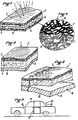
- FIG. 1 represents the implementation of the trapping method according to the invention
- FIG. 2 represents a first variant implementation of the trapping method according to the invention
- FIG. 3 represents a second variant of implementation of the trapping method according to the invention.
- FIG. 4 represents a detailed view of the trapping of liquid according to the method of the invention.
- FIG. 5 represents a variant use of the method according to the invention.
- the figures show a non-woven textile 1, composed of intertwined fibers 9.
- these fibers are made of polypropylene but this condition is not compulsory and any material of this type could be used.
- the fabric thus metallized should be about as flexible after treatment as before.
- the vacuum metallization can be done by spraying aluminum in mercury vapors. And we get good results by spraying an amount of 0.5 to lgr./m2 on a polypropylene material of 30 to 80 grJm2.
- the trap is then completed by applying a second protective coating to the opposite face or lower face 5.
- the liquid is trapped between the metallized surface and the plastic skin.
- This skin 8 must be waterproof, flexible, thin and light so that the entire textile trap remains flexible.
- the two thicknesses are not necessarily contiguous and there may be a space between the two thicknesses , the assembly being carried out by gluing, sewing, or welding or any other means on the edges of the parts.
- the trap works as follows:
- the experiment makes it possible to observe that the particles, in contact with a metallized fiber, slip on the fiber and gradually gather around the fiber to form a very fine drop 7, practically invisible to the naked eye. Surprisingly enough, the particles do not extend over the fibers and do not clog the space 4 between the fibers; they approach each other and on the contrary leave the space between the metallized fibers free of liquid.
- liquid particles are no longer absorbed in these new fibers which are metallized but immediately agglomerate in fine drops around them.
- this implementation of the trapping process is used for small quantities of liquids.
- the liquid not absorbed in the thickness of the material meets the film and extends over it without passing through it.
- the upper surface retains its metallic exterior appearance and flexibility.
- This implementation is preferably used in the manufacture of protective clothing.
- the liquid passes through the metallized layer and is partly absorbed in the non-metallized thickness of the textile.
- this first thickness is sufficient, but in the event of a significant quantity of liquid, a second thickness of textile, untreated, absorbs the excess so that on the lower face 11 of the trap thus formed no trace of liquid can appear, the operator's skin or clothing thus being completely protected.
- the trapping process is used in particular to produce covers 13 and protective clothing for touch-up operations on bodywork, cars or the like.
- the houses 13 will be produced so as to trap the paint on its two faces.
- metallization on the two faces is sufficient to make the protection identical on both sides.
- the textile can be cut and folded back on itself, for example on the cover 14, the lower face becoming the upper face, and being exposed to projections.
- the cover panels are equipped with zippers 16 which notably facilitate the masking.
- the method makes it possible to use a cover which completely covers the vehicle 20.
- the slides 16 By the slides 16, the panel corresponding to the sheet metal to be painted is opened and the masking is carried out without any particular cover, directly by applying an adhesive tape 15 on the edges of the open panel and on the body thus delimited.
- the method is preferably used to prevent the particles of liquids from detaching from a material and moving towards a surface which one wishes to protect. But it can find a completely different application: that of being a decorative material; the metallized surface being always free of liquid, the incident light is reflected on it so that the eye does not perceive the fine droplets of liquid agglomerated around the fibers, nor the liquid trapped on the impermeable film; he only sees the metallic aspect.
- the upper face then takes on the metallic appearance tinged with the pigment of the trapped liquid.
- Trapping can therefore be used for decoration purposes, or for interior arrangements.
Landscapes
- Engineering & Computer Science (AREA)
- Textile Engineering (AREA)
- Details Or Accessories Of Spraying Plant Or Apparatus (AREA)
- Chemical Or Physical Treatment Of Fibers (AREA)
- Application Of Or Painting With Fluid Materials (AREA)
- Laminated Bodies (AREA)
- Decoration Of Textiles (AREA)
Applications Claiming Priority (2)
| Application Number | Priority Date | Filing Date | Title |
|---|---|---|---|
| FR8603498A FR2595731B1 (fr) | 1986-03-12 | 1986-03-12 | Procede de piegeage de liquides |
| FR8603498 | 1986-03-12 |
Publications (2)
| Publication Number | Publication Date |
|---|---|
| EP0237417A1 EP0237417A1 (fr) | 1987-09-16 |
| EP0237417B1 true EP0237417B1 (fr) | 1989-07-12 |
Family
ID=9333035
Family Applications (1)
| Application Number | Title | Priority Date | Filing Date |
|---|---|---|---|
| EP87400477A Expired EP0237417B1 (fr) | 1986-03-12 | 1987-03-04 | Procédé de piégeage de liquides |
Country Status (5)
| Country | Link |
|---|---|
| US (1) | US4738894A (https=) |
| EP (1) | EP0237417B1 (https=) |
| JP (1) | JPS62227468A (https=) |
| DE (2) | DE237417T1 (https=) |
| FR (1) | FR2595731B1 (https=) |
Families Citing this family (9)
| Publication number | Priority date | Publication date | Assignee | Title |
|---|---|---|---|---|
| EP0351018A1 (en) * | 1988-07-15 | 1990-01-17 | ENGICOM, naamloze vennootschap | Absorbent element |
| US4886120A (en) * | 1989-02-01 | 1989-12-12 | Conoco Inc. | Process for secondary oil recovery utilizing propoxylated ethoxylated surfactants in seawater |
| CA2073783A1 (en) * | 1992-03-12 | 1993-09-13 | Kimberly-Clark Corporation | Elastomeric metallized fabric and process to make the same |
| US5656355A (en) * | 1992-03-12 | 1997-08-12 | Kimberly-Clark Corporation | Multilayer elastic metallized material |
| US5316837A (en) * | 1993-03-09 | 1994-05-31 | Kimberly-Clark Corporation | Stretchable metallized nonwoven web of non-elastomeric thermoplastic polymer fibers and process to make the same |
| DE69921302T2 (de) * | 1999-04-07 | 2005-03-24 | Tricor Direct, Inc., Branford | Maskierungsscheibe mit absorbierenden Belag |
| BRPI0816639A2 (pt) * | 2007-10-10 | 2015-03-10 | 3M Innovative Properties Co | "artigos e métodos de mascaramento ou proteção de um substrato" |
| WO2010080224A1 (en) * | 2008-12-19 | 2010-07-15 | 3M Innovative Properties Company | Prefilter for spray paint booth and method of reducing contamination |
| MX337308B (es) | 2009-05-12 | 2016-02-25 | 3M Innovative Properties Co | Articulo protector para producir lineas de pintura precisas y metodo para mejorar el desempeño de linea de pintura de articulos protectores. |
Family Cites Families (6)
| Publication number | Priority date | Publication date | Assignee | Title |
|---|---|---|---|---|
| DE1182631B (de) * | 1961-09-27 | 1964-12-03 | Georg Werner Kunsch | Verfahren zur Metallisierung von textilen Flaechengebilden durch Aufdampfen von Metallen im Hochvakuum |
| FR1492033A (fr) * | 1966-01-18 | 1967-08-18 | Bordes Peinture Et Cie Sa | Housse de protection pour automobiles permettant de masquer un ou plusieurs panneaux pendant peinture des autres panneaux |
| DE2112731B1 (de) * | 1971-03-17 | 1972-10-12 | Helmut Frielingsdorf | Schablone zum Nachlackieren von Kraftfahrzeugen |
| US3934066A (en) * | 1973-07-18 | 1976-01-20 | W. R. Grace & Co. | Fire-resistant intumescent laminates |
| GB1526531A (en) * | 1977-02-28 | 1978-09-27 | Clementson J | Paint mask |
| US4540625A (en) * | 1984-01-09 | 1985-09-10 | Hughes Aircraft Company | Flexible air permeable non-woven fabric filters |
-
1986
- 1986-03-12 FR FR8603498A patent/FR2595731B1/fr not_active Expired
-
1987
- 1987-03-04 EP EP87400477A patent/EP0237417B1/fr not_active Expired
- 1987-03-04 DE DE198787400477T patent/DE237417T1/de active Pending
- 1987-03-04 DE DE8787400477T patent/DE3760308D1/de not_active Expired
- 1987-03-11 US US07/024,582 patent/US4738894A/en not_active Expired - Fee Related
- 1987-03-12 JP JP62055440A patent/JPS62227468A/ja active Granted
Also Published As
| Publication number | Publication date |
|---|---|
| FR2595731A1 (fr) | 1987-09-18 |
| DE3760308D1 (en) | 1989-08-17 |
| US4738894A (en) | 1988-04-19 |
| FR2595731B1 (fr) | 1988-06-10 |
| DE237417T1 (de) | 1988-07-21 |
| JPS62227468A (ja) | 1987-10-06 |
| EP0237417A1 (fr) | 1987-09-16 |
| JPH0542306B2 (https=) | 1993-06-28 |
Similar Documents
| Publication | Publication Date | Title |
|---|---|---|
| FR3030314B1 (fr) | Procede de realisation d'une piece d'aspect de vehicule automobile | |
| EP0237417B1 (fr) | Procédé de piégeage de liquides | |
| CA1323141C (fr) | Element d'attache auto-agrippante notamment pour change complet a usage unique et procede pour sa fabrication | |
| WO2003092996A1 (en) | Improved adhesive tape for masking | |
| FR2825245A1 (fr) | Dispositif pour l'application d'un produit de bronzage artificiel | |
| FR3008080A1 (fr) | Dispositif de conditionnement | |
| KR101895553B1 (ko) | 세정 시트 및 그 제조 방법 | |
| EP0394117A1 (fr) | Revêtement stratifié, élément thermiquement isolant pourvu d'un tel revêtement | |
| FR2560536A1 (fr) | Procede de nettoyage et de renovation des panneaux isolants multiparois, destine notamment aux vitrages des constructions, et moyens de mise en oeuvre du procede | |
| FR2914312A1 (fr) | Ruban adhesif de masquage de pieces | |
| EP0134730A2 (fr) | Revêtement d'imperméabilisation ou d'étanchéité verticale des façades d'immeubles et son procédé de fabrication et de mise en oeuvre | |
| FR3021746A1 (fr) | Etiquette comprenant une encre hydrochrome et recipient comportant une telle etiquette | |
| EP2491437B1 (fr) | Procédé de coloration sélective, composant transparent a structure cellulaire resultant d'un tel procede | |
| EP3287195B1 (fr) | Kit de masquage à positionnement optimisé et procédé associé | |
| JPH07185490A (ja) | 油汚れの除去方法 | |
| FR2644437A1 (fr) | Produit stratiforme en feuille pour emballage | |
| DE60225615T2 (de) | Thermogeformte Platte mit Schall und thermischen Isolationseigenschaften | |
| KR100530634B1 (ko) | 도장작업용 보조테이프 및 이를 구비한 커버 | |
| FR3076836A3 (fr) | Système d'aide au façonnage en plusieurs parties pour cadre de fenêtre | |
| JPS623211Y2 (https=) | ||
| FR2924323A1 (fr) | Gant de cirage et lustrage pour les souliers | |
| KR20100041329A (ko) | 낙진 방지용 자동차용 커버 | |
| KR20200030778A (ko) | 도장 보호용 오염 방지테이프 | |
| EP1042979A1 (fr) | Dispositif de nettoyage et de séchage simultanés pour vitres, meubles et objets analogues | |
| FR3106766A1 (fr) | Dispositif de masquage pour une opération en plusieurs phases |
Legal Events
| Date | Code | Title | Description |
|---|---|---|---|
| PUAI | Public reference made under article 153(3) epc to a published international application that has entered the european phase |
Free format text: ORIGINAL CODE: 0009012 |
|
| AK | Designated contracting states |
Kind code of ref document: A1 Designated state(s): DE ES GB IT |
|
| 17P | Request for examination filed |
Effective date: 19871001 |
|
| DET | De: translation of patent claims | ||
| 17Q | First examination report despatched |
Effective date: 19881117 |
|
| GRAA | (expected) grant |
Free format text: ORIGINAL CODE: 0009210 |
|
| AK | Designated contracting states |
Kind code of ref document: B1 Designated state(s): DE ES GB IT |
|
| GBT | Gb: translation of ep patent filed (gb section 77(6)(a)/1977) | ||
| REF | Corresponds to: |
Ref document number: 3760308 Country of ref document: DE Date of ref document: 19890817 |
|
| ITF | It: translation for a ep patent filed | ||
| PG25 | Lapsed in a contracting state [announced via postgrant information from national office to epo] |
Ref country code: ES Free format text: LAPSE BECAUSE OF FAILURE TO SUBMIT A TRANSLATION OF THE DESCRIPTION OR TO PAY THE FEE WITHIN THE PRESCRIBED TIME-LIMIT Effective date: 19891023 |
|
| PLBE | No opposition filed within time limit |
Free format text: ORIGINAL CODE: 0009261 |
|
| STAA | Information on the status of an ep patent application or granted ep patent |
Free format text: STATUS: NO OPPOSITION FILED WITHIN TIME LIMIT |
|
| 26N | No opposition filed | ||
| PGFP | Annual fee paid to national office [announced via postgrant information from national office to epo] |
Ref country code: GB Payment date: 19910222 Year of fee payment: 5 |
|
| ITTA | It: last paid annual fee | ||
| PG25 | Lapsed in a contracting state [announced via postgrant information from national office to epo] |
Ref country code: GB Effective date: 19920304 |
|
| GBPC | Gb: european patent ceased through non-payment of renewal fee | ||
| PGFP | Annual fee paid to national office [announced via postgrant information from national office to epo] |
Ref country code: DE Payment date: 19950324 Year of fee payment: 9 |
|
| PG25 | Lapsed in a contracting state [announced via postgrant information from national office to epo] |
Ref country code: DE Effective date: 19961203 |
|
| PG25 | Lapsed in a contracting state [announced via postgrant information from national office to epo] |
Ref country code: IT Free format text: LAPSE BECAUSE OF NON-PAYMENT OF DUE FEES;WARNING: LAPSES OF ITALIAN PATENTS WITH EFFECTIVE DATE BEFORE 2007 MAY HAVE OCCURRED AT ANY TIME BEFORE 2007. THE CORRECT EFFECTIVE DATE MAY BE DIFFERENT FROM THE ONE RECORDED. Effective date: 20050304 |