EP0230121B1 - Process of polymerizing propylene - Google Patents
Process of polymerizing propylene Download PDFInfo
- Publication number
- EP0230121B1 EP0230121B1 EP86309570A EP86309570A EP0230121B1 EP 0230121 B1 EP0230121 B1 EP 0230121B1 EP 86309570 A EP86309570 A EP 86309570A EP 86309570 A EP86309570 A EP 86309570A EP 0230121 B1 EP0230121 B1 EP 0230121B1
- Authority
- EP
- European Patent Office
- Prior art keywords
- reaction tank
- transition metal
- production rate
- metal catalyst
- organoaluminum
- Prior art date
- Legal status (The legal status is an assumption and is not a legal conclusion. Google has not performed a legal analysis and makes no representation as to the accuracy of the status listed.)
- Expired - Lifetime
Links
Images



Classifications
-
- C—CHEMISTRY; METALLURGY
- C08—ORGANIC MACROMOLECULAR COMPOUNDS; THEIR PREPARATION OR CHEMICAL WORKING-UP; COMPOSITIONS BASED THEREON
- C08F—MACROMOLECULAR COMPOUNDS OBTAINED BY REACTIONS ONLY INVOLVING CARBON-TO-CARBON UNSATURATED BONDS
- C08F2/00—Processes of polymerisation
-
- C—CHEMISTRY; METALLURGY
- C08—ORGANIC MACROMOLECULAR COMPOUNDS; THEIR PREPARATION OR CHEMICAL WORKING-UP; COMPOSITIONS BASED THEREON
- C08F—MACROMOLECULAR COMPOUNDS OBTAINED BY REACTIONS ONLY INVOLVING CARBON-TO-CARBON UNSATURATED BONDS
- C08F10/00—Homopolymers and copolymers of unsaturated aliphatic hydrocarbons having only one carbon-to-carbon double bond
- C08F10/04—Monomers containing three or four carbon atoms
- C08F10/06—Propene
-
- B—PERFORMING OPERATIONS; TRANSPORTING
- B01—PHYSICAL OR CHEMICAL PROCESSES OR APPARATUS IN GENERAL
- B01J—CHEMICAL OR PHYSICAL PROCESSES, e.g. CATALYSIS OR COLLOID CHEMISTRY; THEIR RELEVANT APPARATUS
- B01J19/00—Chemical, physical or physico-chemical processes in general; Their relevant apparatus
- B01J19/0006—Controlling or regulating processes
-
- C—CHEMISTRY; METALLURGY
- C08—ORGANIC MACROMOLECULAR COMPOUNDS; THEIR PREPARATION OR CHEMICAL WORKING-UP; COMPOSITIONS BASED THEREON
- C08F—MACROMOLECULAR COMPOUNDS OBTAINED BY REACTIONS ONLY INVOLVING CARBON-TO-CARBON UNSATURATED BONDS
- C08F10/00—Homopolymers and copolymers of unsaturated aliphatic hydrocarbons having only one carbon-to-carbon double bond
-
- C—CHEMISTRY; METALLURGY
- C08—ORGANIC MACROMOLECULAR COMPOUNDS; THEIR PREPARATION OR CHEMICAL WORKING-UP; COMPOSITIONS BASED THEREON
- C08F—MACROMOLECULAR COMPOUNDS OBTAINED BY REACTIONS ONLY INVOLVING CARBON-TO-CARBON UNSATURATED BONDS
- C08F110/00—Homopolymers of unsaturated aliphatic hydrocarbons having only one carbon-to-carbon double bond
- C08F110/04—Monomers containing three or four carbon atoms
- C08F110/06—Propene
Definitions
- This invention relates to a process for polymerizing propylene, ie. for the production of a propylene homopolymer of copolymer. More specifically, it relates to a process for producing a propylene homopolymer or copolymer of uniform quality at a constant production rate.
- polypropylene polypropylene
- olefins eg. propylene
- a catalyst such as a Ziegler-Natta catalyst
- Polypropylenes have already been produced industrially at a production scale of several hundred tons per day.
- polypropylene it is desired to produce polypropylene of uniform quality at a constant production rate. Removal of the heat of polymerization is difficult where the reactor has a large capacity. Therefore, polypropylene is usually produced in a continuous operation by using a reactor with two or more polymerization tanks connected in series.
- US-A-3,220,998 discloses an olefin polymerization process in which the production rate of the polymer is controlled by correcting the feed rate of one of the catalysts.
- US-A-3,726,849 discloses a propylene polymerization process in which the production rate is controlled by varying the feed rate of the catalyst using the heat generated in the reactor for calculating the actual production rate.
- US-A-3,257,375 discloses a similar method of control applied to an olefin polymerization process.
- the above prior art processes suffer from the problem that they are relatively expensive, since control is mediated at least in part at the level of the supply of expensive transition metal catalysts.
- the present invention solves this problem and so results in a significant cost saving by providing a process in which (so long as the weight ratio of the organoaluminium to the transition metal catalyst is within a specific range) control of polymer production rate is mediated via changes in the amount of relatively cheap organoaluminium compound alone.
- Ziegler-Natta catalysts are known for use in the production of polyproplene; see for example US-A-3,726,849. Many kinds of Ziegler-Natta catalysts are also used upon actual, ie. industrial production of polyproplene. However, the preformance of a catalyst varies considerably from one preparation lot to another. The production rate thus varies if the catalyst is charged simply at a constant rate into a reactor. As mentioned above, it is therefore the practice to vary the amount of the catalyst to be charged; and such practice is disclosed in US-A-3,726,849.
- the production rate per unit amount of catalyst varies depending on the performance of the catalyst, so that the amount of catalyst residue remaining in the resulting polypropylene varies. Therefore, the product obtained fails to possess uniform quality.
- the above method involves another problem, in that a transition metal catalyst, which is costly and requires relatively complex apparatus for its preparation and charging into a reaction tank, must be used in varied amounts.
- An object of this invention is to provide a process for producing a propylene homopolymer or copolymer of uniform quality at a constant production rate.
- the inventors have carried out extensive research with a view toward developing solutions to the above-mentioned problems, and have found that they can be solved by controlling the production rate of a propylene homopolymer or copolymer by a special method which this invention embodies.
- a process for continuously producing propylene homopolymer or a propylene copolymer at a constant production rate in the presence of a catalyst system composed of a transition metal catalyst and an organoaluminium compound which comprises: determining beforehand in a continuous polymerization process, which is similar to that carried out in an actual polymerization apparatus, the relation between the amount of organoaluminium charged into the process and the production rate of polypropylene per unit amount of a transition metal catalyst; determining from said relation a specific range within which, i.e., below a specific upper limit but above a specific lower limit, the production rate of polypropylene per unit amount of a transition metal catalyst can be controlled without modifications to the physical properties of the resulting polypropylene by changing the weight ratio of the organoaluminium to the transition metal catalyst; calculating the production rate of the homopolymer or copolymer in a reaction tank from the quantity of heat generated per unit time in the reaction tank, by dividing the quantity of heat generated
- the invention comprehends propylene polymers produced by the above-defined method and also apparatus designed, constructed and adapted to operate so as to perform the above-defined method.
- propylene copolymer as used herein means a copolymer of propylene and one or more of other ⁇ -olefins copolymerizable with propylene, for example, ethylene, butene-1, hexene-1 and so on. Although no particular limitation is imposed on the proportion of such one or more ⁇ -olefins to be used upon production of a propylene copolymer in accordance with this invention, they may preferably be used up to about 40 wt.% in total based on the whole polymer.
- propylene should be interpreted to embrace not only propylene alone but also mixtures of propylene and other ⁇ -olefins copolymerizable with propylene.
- polypropylene means not only propylene homopolymers but also copolymers of the above mixtures.
- the performance of the resulting transition metal catalyst is not the same even when it is prepared under certain predetermined constant conditions.
- the production rate of polypropylene actually varies by various unknown factors in the production of propylene on an industrial scale even when the same catalyst is used.
- the present invention finds its basis in the discovery that the production rate of polypropylene per unit amount of a transition metal catalyst can be varied significantly by the weight ratio of an organoaluminum compound to the transition metal catalyst and the production rate of polypropylene can be expressed in terms of the amounts of respective catalyst components retained in each tank.
- variations in stereoregularity and molecular weight distribution which considerably affect the physical properties of polypropoylene to be obtained are ignorably small even if the weight ratio of the organoaluminum/transition metal catalyst is changed over a substantially wide range.
- catalyst systems composed of a transition metal catalyst, which comprises a titanium halide supported on a magnesium halide, and an organoaluminum compound is suitable.
- a catalyst system capable of achieving the above-mentioned characteristics even when the weight ratio of the organoaluminum/transition metal catalyst is changed over such a wide range as to absorb substantially usual variations in activities among production lots, may be mentioned a catalyst system composed of a transition metal catalyst with a titanium halide supported on a magnesium halide, an oxygen-containing organic compound, a dialkylaluminum halide and a trialkylaluminum. It is suitable to control the polymerization rate of propylene by changing the weight ratio of the trialkylaluminum/transition metal catalyst.
- the polymerization of propylene can be effected by any one of the following processes: solution polymerization making use of an inert liquid medium, bulk polymerization utilizing liquid propylene itself as a medium, and vapor-phase polymerization conducted substantially in the absence of any liquid medium.
- the transition metal catalyst is usually prepared batchwise, because the batchwise preparation allows one to obtain a transition metal catalyst with good performance, requires simple facilities and permits use of a simple apparatus for the recovery of various compounds employed in the preparation. Therefore, the performance of the catalyst varies from one preparation lot to another. If a polymerization reaction is conducted at a constant rate of charging of the catalyst, the production rate of polypropylene varies. If the charging rate of the organoaluminum is changed after actual detection of a change in the production rate of polypropylene from the amount of obtained polypropylene, such a change of the charging rate results in a considerable variation in the production rate of polypropylene.
- the present invention can therefore bring about greater effects as the amount of the transition metal catalyst per preparation lot increases, the transition metal catalyst of the same lot can be used for a longer period of time, and the retention time of the transition metal catalyst in the polymerization system becomes longer.
- FIGURE 1 illustrates, by way of example, variations in the production rate of polypropylene per unit amount of a transition metal catalyst and the stereoregularity and molecular weight distribution of the resultant polypropylene in each of three tanks connected in series when the charging rate of an organoaluminum was changed in a three-tank continuous polymerization process while maintaining the charging rate of the transition metal catalyst at a constant level.
- the weight ratio of the triethylaluminum/transition metal catalyst was changed solely.
- the activities, namely, the production rate of polypropylene per unit amount of the transition metal catalyst can be changed up to 3 times or so within the range indicated by an arrow in an upper part of FIGURE 1 (without altering the molecular weight distribution and stereoregularity) by changing the weight ratio of the organoaluminum to the transition metal catalyst.
- the production rate of polypropylene can be controlled by changing the above-mentioned weight ratio below a specific upper limit but above a specific lower limit.
- the production rate of polypropylene in each polymerization tank can be calculated by detecting the quantity of heat generated in the polymerization tank.
- the exact quantity of heat generated in each polymerization tank can be determined by correcting the quantity of heat added to and/or removed from the polymerization tank in order to maintain its temperature constant by the quantity of heat released from the polymerization tank, which is governed by the apparatus and environment.
- a value, which is obtained by dividing the exact quantity of generated heat with the quantity of polymerization heat upon polymerization of propylene, is the production rate of polypropylene.
- the production rate of polypropylene at a given moment can be detected.
- the charging rate of the organoaluminum for example, in accordance with the relation depicted in FIGURE 1 by comparing a desired production rate with a production rate calculated by the above procedure at a given moment.
- the retention time in each tank is long, the difference between the actual production rate of polypropylene and the desired production rate becomes greater as time goes on.
- the charging rate of the organoaluminum is therefore determined in the following manner.
- the amount of the organoaluminum retained in each tank at the time when the production rate of polypropylene has been detected is calculated as a cumulative value on the basis of the amount of the organoaluminum charged cumulatively in the tank by that time. Since each tank is a complete mixing tank, the amount of the organoaluminum retained in the tank, namely, the cumulative value can be determined by a simple calculation on the basis of the charging rates of the organoaluminum, a polymerization solvent, propylene and polypropylene to the tank as well as their discharging rates from the tank.
- the amount of the organoaluminum required to be retained in order to achieve a desired production rate (the target amount of the organoaluminum) can be determined.
- the charging rate of the organoaluminum is then set so as to achieve the target amount of the organoaluminum.
- the organoaluminum is charged for a given time at a charging rate which is determined by multiplying the charging rate of the organoaluminum per unit time to achieve the target amount with a specific factor or by introducing the charging rate in a specific equation, thereby achieving the target amount of the organoaluminum upon an elapsed time of a certain period of time. Thereafter, the organoaluminum may be charged at a constant charging rate per unit time.
- FIGURE 2 shows by way of example the relation among time passed (t0 - t) and the charging rate and retained amount of the organoaluminum.
- This invention has been completed on the basis of a finding that the production rate of polypropylene per unit amount of a transition metal catalyst can be controlled without modifications to the physical properties of the resulting polypropylene by changing the weight ratio of the organoaluminum to the transition metal catalyst within a specific range. Since the organoaluminum as a catalyst residue can be removed rather easily, its adverse effects to the physical properties of polypropylene are relatively small compared with the transition metal catalyst. It is hence possible to produce polypropylene of uniform quality at a constant production rate by polymerizing propylene in accordance with the process of this invention.
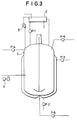
- FIGURE 3 illustrates one example of an apparatus suitable for use in the practice of the polymerization process of this invention, in which there are shown a reaction tank 1, reflux condenser 2, blower 3, pump 4 for charging a slurry mixture of a transition metal catalyst, flowmeter and thermometer F-1 for a condensate, flowmeter and thermometer F-2 for cooling water to be charged, thermometer F-3 for the cooling water to be discharged, flowmeter F-4 for propylene to be charged, flowmeter F-5 for an organoaluminum to be charged, and flowmeter F-6 for a slurry to be discharged.
- a reaction tank 1 for a condensate
- flowmeter and thermometer F-2 for cooling water to be charged
- thermometer F-3 for the cooling water to be discharged
- flowmeter F-4 for propylene to be charged
- flowmeter F-5 for an organoaluminum to be charged
- flowmeter F-6 for a slurry to be discharged.
- an oscillating mill equipped with a grinding pot having an internal capacity of 600 ml and containing 80 steel balls each 12 mm across.
- the pot was charged with 20 g of magnesium chloride, 4 ml of tetraethoxysilane and 2 ml of ⁇ , ⁇ , ⁇ -trichlorotoluene, and thereafter they were ground.
- Ten grams of the above-ground mixture and 50 ml of titanium tetrachloride were added to a 200-ml round bottom flask. After stirring the contents at 80°C for 2 hours, the supernatant was removed by decantation and 100 ml of n-heptane was then added.
- the resultant mixture was stirred at 80°C for 15 minutes and the supernatant was then removed by decantation. This washing operation was repeated 7 times. Thereafter, 100 ml of n-heptane was added to obtain a slurry of a transmission metal catalyst.
- propylene was polymerized by bulk polymerization while using propylene itself as a medium. After deactivation of the catalyst, the thus-obtained polymer was washed with propylene in a counter-flow cleaning tower. Thereafter, unreacted propylene was caused to evaporate off to obtain it as propylene powder.
- the catalyst As the catalyst, a mixture obtained by mixing the transition metal catalyst obtained by the above preparation procedure, methyl toluylate and diethylaluminum chloride in proportions of 100 g, 200 ml and 425 ml was charged at a charging rage of 4 g/hr in terms of the transition metal catalyst to the first tank only. The polymer slurry of the first tank was continuously transferred to the second tank, followed by transfer to the third tank for deactivation of the catalyst.
- the production rate (short-term value) of polypropylene in each of the first and second tanks was calculated on the basis of a value, which was obtained by correcting the sum of the quantity of heat removed from the tank by the reflux condenser (specifically, calculated from the amount and temperature of the condensate and the amounts and temperatures of gas charged to and discharged from the condenser) and the quantity of heat removed by a jacket (calculated from the amount of the cooling water supplied to the jacket and the temperatures of of the inflowing and outflowing cooling water) with the quantity of released heat which is calculated in view of the overall structure of the tank and its operating conditions.
- Propylene was polymerized while charging triethylaluminum to the first and second tanks at such charging rates that the thus-calculated production rates in the first and second tanks became equal to their corresponding desired constant values, in other words, the amounts of the organoaluminum retained in the first and second tanks became equal to their corresponding amounts of the organoaluminum required for achieving the desired constant values respectively.
- polypropylene of uniform quality (percentage of residue after extraction in boiling n-heptane for 6 hours: 96.8 ⁇ 0.2%; MW/MN: 6.4 ⁇ 0.2) was obtained at a constant production rate (40 kg/hr ⁇ 0.5 kg/hr).
Landscapes
- Chemical & Material Sciences (AREA)
- Chemical Kinetics & Catalysis (AREA)
- Organic Chemistry (AREA)
- Health & Medical Sciences (AREA)
- Medicinal Chemistry (AREA)
- Polymers & Plastics (AREA)
- Transition And Organic Metals Composition Catalysts For Addition Polymerization (AREA)
- Addition Polymer Or Copolymer, Post-Treatments, Or Chemical Modifications (AREA)
- Polymerisation Methods In General (AREA)
Applications Claiming Priority (2)
| Application Number | Priority Date | Filing Date | Title |
|---|---|---|---|
| JP276694/85 | 1985-12-11 | ||
| JP60276694A JPS62138504A (ja) | 1985-12-11 | 1985-12-11 | プロピレンの重合方法 |
Publications (2)
| Publication Number | Publication Date |
|---|---|
| EP0230121A1 EP0230121A1 (en) | 1987-07-29 |
| EP0230121B1 true EP0230121B1 (en) | 1993-04-21 |
Family
ID=17573021
Family Applications (1)
| Application Number | Title | Priority Date | Filing Date |
|---|---|---|---|
| EP86309570A Expired - Lifetime EP0230121B1 (en) | 1985-12-11 | 1986-12-09 | Process of polymerizing propylene |
Country Status (10)
| Country | Link |
|---|---|
| EP (1) | EP0230121B1 (ref) |
| JP (1) | JPS62138504A (ref) |
| KR (1) | KR920000784B1 (ref) |
| CN (1) | CN1009200B (ref) |
| AU (1) | AU577482B2 (ref) |
| CA (1) | CA1286839C (ref) |
| DE (1) | DE3688323T2 (ref) |
| FI (1) | FI864954A7 (ref) |
| IN (1) | IN165144B (ref) |
| PT (1) | PT83914B (ref) |
Families Citing this family (2)
| Publication number | Priority date | Publication date | Assignee | Title |
|---|---|---|---|---|
| CN1069652C (zh) * | 1991-04-11 | 2001-08-15 | 国家医药管理局上海医药设计院 | 丙烯聚合方法及聚合反应器 |
| JP3331031B2 (ja) * | 1993-12-15 | 2002-10-07 | 昭和電工株式会社 | ポリオレフィン重合反応器のスタートアップ制御方法および装置 |
Family Cites Families (6)
| Publication number | Priority date | Publication date | Assignee | Title |
|---|---|---|---|---|
| US3257375A (en) * | 1960-09-06 | 1966-06-21 | Phillips Petroleum Co | Control of catalyst addition to polymerization reactions |
| US3220998A (en) * | 1961-05-04 | 1965-11-30 | Phillips Petroleum Co | Control of exothermic process carried out in series of reactors |
| US3726849A (en) * | 1963-02-06 | 1973-04-10 | K Shaw | Continuous process for the solution polymerization of olefinic monomers |
| DE3015089A1 (de) * | 1980-04-19 | 1981-10-22 | Basf Ag, 6700 Ludwigshafen | Verfahren zum herstellen von homopolymerisaten oder copolymerisaten des propylens |
| DE3144312A1 (de) * | 1981-11-07 | 1983-05-19 | Basf Ag, 6700 Ludwigshafen | Verfahren zur herstellung von propylen-ethylen-polymerisaten vom typ der sogenannten block-copolymerisate |
| GB8424180D0 (en) * | 1984-09-25 | 1984-10-31 | Shell Int Research | Sequential polymerization of ethylene and propylene |
-
1985
- 1985-12-11 JP JP60276694A patent/JPS62138504A/ja active Pending
-
1986
- 1986-11-27 CA CA000523990A patent/CA1286839C/en not_active Expired - Lifetime
- 1986-12-02 IN IN871/CAL/86A patent/IN165144B/en unknown
- 1986-12-03 FI FI864954A patent/FI864954A7/fi not_active IP Right Cessation
- 1986-12-03 AU AU66052/86A patent/AU577482B2/en not_active Ceased
- 1986-12-09 EP EP86309570A patent/EP0230121B1/en not_active Expired - Lifetime
- 1986-12-09 DE DE86309570T patent/DE3688323T2/de not_active Expired - Fee Related
- 1986-12-11 CN CN86108501A patent/CN1009200B/zh not_active Expired
- 1986-12-11 KR KR1019860010580A patent/KR920000784B1/ko not_active Expired
- 1986-12-11 PT PT83914A patent/PT83914B/pt not_active IP Right Cessation
Also Published As
| Publication number | Publication date |
|---|---|
| KR920000784B1 (ko) | 1992-01-23 |
| FI864954A7 (fi) | 1987-06-12 |
| DE3688323T2 (de) | 1993-11-18 |
| JPS62138504A (ja) | 1987-06-22 |
| FI864954A0 (fi) | 1986-12-03 |
| CA1286839C (en) | 1991-07-23 |
| AU577482B2 (en) | 1988-09-22 |
| DE3688323D1 (de) | 1993-05-27 |
| CN1009200B (zh) | 1990-08-15 |
| CN86108501A (zh) | 1987-07-01 |
| PT83914A (en) | 1987-01-01 |
| PT83914B (pt) | 1989-01-17 |
| EP0230121A1 (en) | 1987-07-29 |
| IN165144B (ref) | 1989-08-19 |
| AU6605286A (en) | 1987-06-18 |
| KR870006088A (ko) | 1987-07-09 |
Similar Documents
| Publication | Publication Date | Title |
|---|---|---|
| EP0004789B1 (en) | Catalyst component for alpha-olefin polymerization and use thereof | |
| JPH075655B2 (ja) | 触媒成分及び重合用触媒系 | |
| EP0174116B1 (en) | Polymerization catalyst | |
| JPH0699507B2 (ja) | 触媒成分及び重合用触媒系 | |
| US5064796A (en) | Support adjuvant for improved vanadium polymerization catalyst | |
| EP0069593B1 (en) | Polymerization process | |
| US4562170A (en) | Polymerization catalyst | |
| CA1276334C (en) | Process for the production of block copolymer of propylene | |
| EP0170384A2 (en) | Polymerization catalyst | |
| CA1286839C (en) | Polymerization process of propylene | |
| KR890004064B1 (ko) | 프로필렌 단일중합체 또는 공중합체의 제조방법 | |
| US4618660A (en) | Polymerization catalyst | |
| US3475517A (en) | Process for making block polymers of olefins | |
| US4489198A (en) | Polymerization of ethylene with a catalyst comprising several transition metal compounds | |
| CA1293833C (en) | Process for the production of block copolymer of propylene | |
| EP0249984B1 (en) | Process for producing butene-1 polymer | |
| KR0181729B1 (ko) | 지이글러-나타형 촉매계 | |
| CA1078806A (en) | Process for preparing polyolefins | |
| US3631012A (en) | Process for preventing or reducing deposits and clogging in the continuous polymerization and copolymerization of olefins by the | |
| JPS61179208A (ja) | プロピレンの重合方法 | |
| US3272789A (en) | Treatment of olefin polymers to remove catalyst residues | |
| KR920006449B1 (ko) | 프로필렌의 블록공중합체의 제조방법 | |
| US3474158A (en) | Continuous block copolymer production | |
| US5536802A (en) | Polymers of 3 ethyl-1-hexene | |
| JPS6147709A (ja) | プロピレンの重合方法 |
Legal Events
| Date | Code | Title | Description |
|---|---|---|---|
| PUAI | Public reference made under article 153(3) epc to a published international application that has entered the european phase |
Free format text: ORIGINAL CODE: 0009012 |
|
| AK | Designated contracting states |
Kind code of ref document: A1 Designated state(s): BE DE FR GB IT NL |
|
| 17P | Request for examination filed |
Effective date: 19870821 |
|
| 17Q | First examination report despatched |
Effective date: 19890202 |
|
| GRAA | (expected) grant |
Free format text: ORIGINAL CODE: 0009210 |
|
| AK | Designated contracting states |
Kind code of ref document: B1 Designated state(s): BE DE FR GB IT NL |
|
| ITF | It: translation for a ep patent filed | ||
| REF | Corresponds to: |
Ref document number: 3688323 Country of ref document: DE Date of ref document: 19930527 |
|
| ET | Fr: translation filed | ||
| PLBE | No opposition filed within time limit |
Free format text: ORIGINAL CODE: 0009261 |
|
| STAA | Information on the status of an ep patent application or granted ep patent |
Free format text: STATUS: NO OPPOSITION FILED WITHIN TIME LIMIT |
|
| 26N | No opposition filed | ||
| PGFP | Annual fee paid to national office [announced via postgrant information from national office to epo] |
Ref country code: GB Payment date: 19951130 Year of fee payment: 10 |
|
| PGFP | Annual fee paid to national office [announced via postgrant information from national office to epo] |
Ref country code: FR Payment date: 19951212 Year of fee payment: 10 |
|
| PGFP | Annual fee paid to national office [announced via postgrant information from national office to epo] |
Ref country code: DE Payment date: 19951214 Year of fee payment: 10 |
|
| PGFP | Annual fee paid to national office [announced via postgrant information from national office to epo] |
Ref country code: NL Payment date: 19951230 Year of fee payment: 10 |
|
| PGFP | Annual fee paid to national office [announced via postgrant information from national office to epo] |
Ref country code: BE Payment date: 19960130 Year of fee payment: 10 |
|
| PG25 | Lapsed in a contracting state [announced via postgrant information from national office to epo] |
Ref country code: GB Effective date: 19961209 |
|
| PG25 | Lapsed in a contracting state [announced via postgrant information from national office to epo] |
Ref country code: BE Effective date: 19961231 |
|
| BERE | Be: lapsed |
Owner name: MITSUI TOATSU CHEMICALS INC. Effective date: 19961231 |
|
| PG25 | Lapsed in a contracting state [announced via postgrant information from national office to epo] |
Ref country code: NL Effective date: 19970701 |
|
| GBPC | Gb: european patent ceased through non-payment of renewal fee |
Effective date: 19961209 |
|
| PG25 | Lapsed in a contracting state [announced via postgrant information from national office to epo] |
Ref country code: FR Effective date: 19970829 |
|
| NLV4 | Nl: lapsed or anulled due to non-payment of the annual fee |
Effective date: 19970701 |
|
| PG25 | Lapsed in a contracting state [announced via postgrant information from national office to epo] |
Ref country code: DE Effective date: 19970902 |
|
| REG | Reference to a national code |
Ref country code: FR Ref legal event code: ST |
|
| PG25 | Lapsed in a contracting state [announced via postgrant information from national office to epo] |
Ref country code: IT Free format text: LAPSE BECAUSE OF NON-PAYMENT OF DUE FEES;WARNING: LAPSES OF ITALIAN PATENTS WITH EFFECTIVE DATE BEFORE 2007 MAY HAVE OCCURRED AT ANY TIME BEFORE 2007. THE CORRECT EFFECTIVE DATE MAY BE DIFFERENT FROM THE ONE RECORDED. Effective date: 20051209 |