EP0218366B1 - Polyester aus 3-Hydroxy-4'-(4-hydroxyphenyl)benzophenon oder 3,4'-Dihydroxybenzophenon und Dicarbonsäuren - Google Patents
Polyester aus 3-Hydroxy-4'-(4-hydroxyphenyl)benzophenon oder 3,4'-Dihydroxybenzophenon und Dicarbonsäuren Download PDFInfo
- Publication number
- EP0218366B1 EP0218366B1 EP86306794A EP86306794A EP0218366B1 EP 0218366 B1 EP0218366 B1 EP 0218366B1 EP 86306794 A EP86306794 A EP 86306794A EP 86306794 A EP86306794 A EP 86306794A EP 0218366 B1 EP0218366 B1 EP 0218366B1
- Authority
- EP
- European Patent Office
- Prior art keywords
- units
- per
- derived repeating
- repeating units
- glycol
- Prior art date
- Legal status (The legal status is an assumption and is not a legal conclusion. Google has not performed a legal analysis and makes no representation as to the accuracy of the status listed.)
- Expired
Links
- 229920000728 polyester Polymers 0.000 title claims description 63
- 229920000642 polymer Polymers 0.000 title claims description 52
- MCGDIYVRXFISGF-UHFFFAOYSA-N (3-hydroxyphenyl)-[4-(4-hydroxyphenyl)phenyl]methanone Chemical compound C1=CC(O)=CC=C1C1=CC=C(C(=O)C=2C=C(O)C=CC=2)C=C1 MCGDIYVRXFISGF-UHFFFAOYSA-N 0.000 title description 7
- LJQVLJXQHTULEP-UHFFFAOYSA-N (3-hydroxyphenyl)-(4-hydroxyphenyl)methanone Chemical compound C1=CC(O)=CC=C1C(=O)C1=CC=CC(O)=C1 LJQVLJXQHTULEP-UHFFFAOYSA-N 0.000 title description 5
- 150000001991 dicarboxylic acids Chemical class 0.000 title description 2
- LYCAIKOWRPUZTN-UHFFFAOYSA-N Ethylene glycol Chemical compound OCCO LYCAIKOWRPUZTN-UHFFFAOYSA-N 0.000 claims description 140
- WGCNASOHLSPBMP-UHFFFAOYSA-N hydroxyacetaldehyde Natural products OCC=O WGCNASOHLSPBMP-UHFFFAOYSA-N 0.000 claims description 70
- 125000002496 methyl group Chemical group [H]C([H])([H])* 0.000 claims description 9
- 125000000732 arylene group Chemical group 0.000 claims description 7
- 125000001495 ethyl group Chemical group [H]C([H])([H])C([H])([H])* 0.000 claims description 7
- 239000000203 mixture Substances 0.000 claims description 6
- 230000004927 fusion Effects 0.000 claims description 4
- 125000002947 alkylene group Chemical group 0.000 claims description 3
- 239000000155 melt Substances 0.000 claims description 3
- WSLDOOZREJYCGB-UHFFFAOYSA-N 1,2-Dichloroethane Chemical compound ClCCCl WSLDOOZREJYCGB-UHFFFAOYSA-N 0.000 claims description 2
- WXNZTHHGJRFXKQ-UHFFFAOYSA-N 4-chlorophenol Chemical compound OC1=CC=C(Cl)C=C1 WXNZTHHGJRFXKQ-UHFFFAOYSA-N 0.000 claims description 2
- 150000001261 hydroxy acids Chemical class 0.000 claims 13
- 125000004432 carbon atom Chemical group C* 0.000 claims 5
- 125000000956 methoxy group Chemical group [H]C([H])([H])O* 0.000 claims 2
- IJGRMHOSHXDMSA-UHFFFAOYSA-N Atomic nitrogen Chemical compound N#N IJGRMHOSHXDMSA-UHFFFAOYSA-N 0.000 description 68
- QTBSBXVTEAMEQO-UHFFFAOYSA-N Acetic acid Chemical compound CC(O)=O QTBSBXVTEAMEQO-UHFFFAOYSA-N 0.000 description 60
- QQVIHTHCMHWDBS-UHFFFAOYSA-N isophthalic acid Chemical compound OC(=O)C1=CC=CC(C(O)=O)=C1 QQVIHTHCMHWDBS-UHFFFAOYSA-N 0.000 description 36
- 229910052757 nitrogen Inorganic materials 0.000 description 34
- KKEYFWRCBNTPAC-UHFFFAOYSA-N Terephthalic acid Chemical compound OC(=O)C1=CC=C(C(O)=O)C=C1 KKEYFWRCBNTPAC-UHFFFAOYSA-N 0.000 description 30
- 239000011521 glass Substances 0.000 description 19
- 238000006068 polycondensation reaction Methods 0.000 description 19
- 238000010926 purge Methods 0.000 description 19
- MVPBIOPMJWUHEZ-UHFFFAOYSA-N acetic acid;(3-hydroxyphenyl)-[4-(4-hydroxyphenyl)phenyl]methanone Chemical compound CC(O)=O.CC(O)=O.C1=CC(O)=CC=C1C1=CC=C(C(=O)C=2C=C(O)C=CC=2)C=C1 MVPBIOPMJWUHEZ-UHFFFAOYSA-N 0.000 description 16
- 230000006835 compression Effects 0.000 description 16
- 238000007906 compression Methods 0.000 description 16
- 239000007788 liquid Substances 0.000 description 15
- 229910000634 wood's metal Inorganic materials 0.000 description 15
- 239000007787 solid Substances 0.000 description 13
- 230000003287 optical effect Effects 0.000 description 9
- XLYOFNOQVPJJNP-UHFFFAOYSA-N water Substances O XLYOFNOQVPJJNP-UHFFFAOYSA-N 0.000 description 9
- 238000002844 melting Methods 0.000 description 7
- 230000008018 melting Effects 0.000 description 7
- 230000000704 physical effect Effects 0.000 description 7
- 238000010992 reflux Methods 0.000 description 7
- WFDIJRYMOXRFFG-UHFFFAOYSA-N Acetic anhydride Chemical compound CC(=O)OC(C)=O WFDIJRYMOXRFFG-UHFFFAOYSA-N 0.000 description 6
- OKKJLVBELUTLKV-UHFFFAOYSA-N Methanol Chemical compound OC OKKJLVBELUTLKV-UHFFFAOYSA-N 0.000 description 6
- 230000009477 glass transition Effects 0.000 description 6
- 230000007704 transition Effects 0.000 description 6
- 238000005481 NMR spectroscopy Methods 0.000 description 5
- 238000012360 testing method Methods 0.000 description 5
- IJFXRHURBJZNAO-UHFFFAOYSA-N 3-hydroxybenzoic acid Chemical compound OC(=O)C1=CC=CC(O)=C1 IJFXRHURBJZNAO-UHFFFAOYSA-N 0.000 description 4
- GDBUZIKSJGRBJP-UHFFFAOYSA-N 4-acetoxy benzoic acid Chemical compound CC(=O)OC1=CC=C(C(O)=O)C=C1 GDBUZIKSJGRBJP-UHFFFAOYSA-N 0.000 description 4
- KRHYYFGTRYWZRS-UHFFFAOYSA-N Fluorane Chemical compound F KRHYYFGTRYWZRS-UHFFFAOYSA-N 0.000 description 4
- UIIMBOGNXHQVGW-UHFFFAOYSA-M Sodium bicarbonate Chemical compound [Na+].OC([O-])=O UIIMBOGNXHQVGW-UHFFFAOYSA-M 0.000 description 4
- WTEOIRVLGSZEPR-UHFFFAOYSA-N boron trifluoride Chemical compound FB(F)F WTEOIRVLGSZEPR-UHFFFAOYSA-N 0.000 description 4
- 239000000835 fiber Substances 0.000 description 4
- 238000010438 heat treatment Methods 0.000 description 4
- VLKZOEOYAKHREP-UHFFFAOYSA-N n-Hexane Chemical compound CCCCCC VLKZOEOYAKHREP-UHFFFAOYSA-N 0.000 description 4
- 239000000047 product Substances 0.000 description 4
- 229910000030 sodium bicarbonate Inorganic materials 0.000 description 4
- 239000000243 solution Substances 0.000 description 4
- XEKOWRVHYACXOJ-UHFFFAOYSA-N Ethyl acetate Chemical compound CCOC(C)=O XEKOWRVHYACXOJ-UHFFFAOYSA-N 0.000 description 3
- KGCNTCOIVYATJZ-UHFFFAOYSA-N acetic acid;(3-hydroxyphenyl)-(4-hydroxyphenyl)methanone Chemical compound CC(O)=O.CC(O)=O.C1=CC(O)=CC=C1C(=O)C1=CC=CC(O)=C1 KGCNTCOIVYATJZ-UHFFFAOYSA-N 0.000 description 3
- 238000006243 chemical reaction Methods 0.000 description 3
- -1 chloro, bromo, methyl Chemical group 0.000 description 3
- 230000003247 decreasing effect Effects 0.000 description 3
- 238000001914 filtration Methods 0.000 description 3
- 239000002904 solvent Substances 0.000 description 3
- AKOGNYJNGMLDOA-UHFFFAOYSA-N (4-acetyloxyphenyl) acetate Chemical compound CC(=O)OC1=CC=C(OC(C)=O)C=C1 AKOGNYJNGMLDOA-UHFFFAOYSA-N 0.000 description 2
- 229910015900 BF3 Inorganic materials 0.000 description 2
- CTVWZGJOBPXWSC-UHFFFAOYSA-N COC(CC=C1)C=C1[NH+](c(cc1)ccc1-c(cc1)ccc1OC)[O-] Chemical compound COC(CC=C1)C=C1[NH+](c(cc1)ccc1-c(cc1)ccc1OC)[O-] CTVWZGJOBPXWSC-UHFFFAOYSA-N 0.000 description 2
- OLDDBPHKHHBFTM-UHFFFAOYSA-N COc(cc1)ccc1-c(cc1)ccc1[NH+](c1cccc(OC)c1)[O-] Chemical compound COc(cc1)ccc1-c(cc1)ccc1[NH+](c1cccc(OC)c1)[O-] OLDDBPHKHHBFTM-UHFFFAOYSA-N 0.000 description 2
- 229920001634 Copolyester Polymers 0.000 description 2
- UFWIBTONFRDIAS-UHFFFAOYSA-N Naphthalene Chemical compound C1=CC=CC2=CC=CC=C21 UFWIBTONFRDIAS-UHFFFAOYSA-N 0.000 description 2
- 239000002253 acid Substances 0.000 description 2
- RWCCWEUUXYIKHB-UHFFFAOYSA-N benzophenone Chemical compound C=1C=CC=CC=1C(=O)C1=CC=CC=C1 RWCCWEUUXYIKHB-UHFFFAOYSA-N 0.000 description 2
- 239000012965 benzophenone Substances 0.000 description 2
- 238000012512 characterization method Methods 0.000 description 2
- TVIDDXQYHWJXFK-UHFFFAOYSA-N dodecanedioic acid Chemical compound OC(=O)CCCCCCCCCCC(O)=O TVIDDXQYHWJXFK-UHFFFAOYSA-N 0.000 description 2
- 238000001035 drying Methods 0.000 description 2
- 150000002148 esters Chemical class 0.000 description 2
- 238000001125 extrusion Methods 0.000 description 2
- 150000002334 glycols Chemical class 0.000 description 2
- 229910000040 hydrogen fluoride Inorganic materials 0.000 description 2
- 239000000463 material Substances 0.000 description 2
- 238000000034 method Methods 0.000 description 2
- 238000000399 optical microscopy Methods 0.000 description 2
- 238000006116 polymerization reaction Methods 0.000 description 2
- 239000000843 powder Substances 0.000 description 2
- 238000002360 preparation method Methods 0.000 description 2
- 235000017557 sodium bicarbonate Nutrition 0.000 description 2
- TYFQFVWCELRYAO-UHFFFAOYSA-N suberic acid Chemical compound OC(=O)CCCCCCC(O)=O TYFQFVWCELRYAO-UHFFFAOYSA-N 0.000 description 2
- QAOWNCQODCNURD-UHFFFAOYSA-N sulfuric acid Substances OS(O)(=O)=O QAOWNCQODCNURD-UHFFFAOYSA-N 0.000 description 2
- 238000005406 washing Methods 0.000 description 2
- BJNWFLGHFAIHAX-UHFFFAOYSA-N (4-acetyloxy-3-chlorophenyl) acetate Chemical compound CC(=O)OC1=CC=C(OC(C)=O)C(Cl)=C1 BJNWFLGHFAIHAX-UHFFFAOYSA-N 0.000 description 1
- PXGZQGDTEZPERC-UHFFFAOYSA-N 1,4-cyclohexanedicarboxylic acid Chemical compound OC(=O)C1CCC(C(O)=O)CC1 PXGZQGDTEZPERC-UHFFFAOYSA-N 0.000 description 1
- 125000001140 1,4-phenylene group Chemical group [H]C1=C([H])C([*:2])=C([H])C([H])=C1[*:1] 0.000 description 1
- CBCKQZAAMUWICA-UHFFFAOYSA-N 1,4-phenylenediamine Chemical compound NC1=CC=C(N)C=C1 CBCKQZAAMUWICA-UHFFFAOYSA-N 0.000 description 1
- WPVCFEULGFXPJD-UHFFFAOYSA-M CC(C)(c(cc1)ccc1[O-])c(cc1)ccc1OC Chemical compound CC(C)(c(cc1)ccc1[O-])c(cc1)ccc1OC WPVCFEULGFXPJD-UHFFFAOYSA-M 0.000 description 1
- KGRRYOFTKDWCMT-UHFFFAOYSA-M CC1(C=CC(C(C(F)(F)F)(C(F)(F)F)c(cc2)ccc2[O-])=CC1)OC Chemical compound CC1(C=CC(C(C(F)(F)F)(C(F)(F)F)c(cc2)ccc2[O-])=CC1)OC KGRRYOFTKDWCMT-UHFFFAOYSA-M 0.000 description 1
- DMCLBTSQJNTZQQ-UHFFFAOYSA-M CC1(C=CC(OC2(C)C=CC([O-])=CC2)=CC1)OC Chemical compound CC1(C=CC(OC2(C)C=CC([O-])=CC2)=CC1)OC DMCLBTSQJNTZQQ-UHFFFAOYSA-M 0.000 description 1
- SONCKFCUICWAHE-UHFFFAOYSA-N CC1C(COC)=CC(CC(CC2(C)C=CC(OC)=CC2)(C(F)(F)F)C(F)(F)F)=CC1 Chemical compound CC1C(COC)=CC(CC(CC2(C)C=CC(OC)=CC2)(C(F)(F)F)C(F)(F)F)=CC1 SONCKFCUICWAHE-UHFFFAOYSA-N 0.000 description 1
- GNDLQJYOFCIYBY-UHFFFAOYSA-N CC1C=CC([NH+](c(cc2)ccc2C(CC2)=CC=C2OC)[O-])=CC1OC Chemical compound CC1C=CC([NH+](c(cc2)ccc2C(CC2)=CC=C2OC)[O-])=CC1OC GNDLQJYOFCIYBY-UHFFFAOYSA-N 0.000 description 1
- BBWHIKPQDWITIW-UHFFFAOYSA-N COC(C1)=CC=CC1[NH+](c(cc1)ccc1OC)[O-] Chemical compound COC(C1)=CC=CC1[NH+](c(cc1)ccc1OC)[O-] BBWHIKPQDWITIW-UHFFFAOYSA-N 0.000 description 1
- XQQVUKPIRSNALF-UHFFFAOYSA-M COC(CC=C1)C=C1C(C1C=CC([O-])=CC1)=O Chemical compound COC(CC=C1)C=C1C(C1C=CC([O-])=CC1)=O XQQVUKPIRSNALF-UHFFFAOYSA-M 0.000 description 1
- FVXLUAZRMDXZGK-UHFFFAOYSA-M COC(CC=C1)C=C1C(c(cc1)ccc1[O-])=O Chemical compound COC(CC=C1)C=C1C(c(cc1)ccc1[O-])=O FVXLUAZRMDXZGK-UHFFFAOYSA-M 0.000 description 1
- VMYMVYSDTFZQQZ-UHFFFAOYSA-N COc(cc1)ccc1C(CC1)=CC=C1[NH+](c1cccc(OC)c1)[O-] Chemical compound COc(cc1)ccc1C(CC1)=CC=C1[NH+](c1cccc(OC)c1)[O-] VMYMVYSDTFZQQZ-UHFFFAOYSA-N 0.000 description 1
- VXHUUSKYUDVHOS-UHFFFAOYSA-M COc(cc1)ccc1S(c(cc1)ccc1[O-])(=O)=O Chemical compound COc(cc1)ccc1S(c(cc1)ccc1[O-])(=O)=O VXHUUSKYUDVHOS-UHFFFAOYSA-M 0.000 description 1
- ASHGTJPOSUFTGB-UHFFFAOYSA-M COc1cc([O-])ccc1 Chemical compound COc1cc([O-])ccc1 ASHGTJPOSUFTGB-UHFFFAOYSA-M 0.000 description 1
- WWKJEGBQEFYAJF-UHFFFAOYSA-N COc1ccc(C2C=CC([NH+](c3cccc(OC)c3)[O-])=CC2)cc1 Chemical compound COc1ccc(C2C=CC([NH+](c3cccc(OC)c3)[O-])=CC2)cc1 WWKJEGBQEFYAJF-UHFFFAOYSA-N 0.000 description 1
- MPICJBIZMVKJNS-UHFFFAOYSA-N Cc1ccc(CS(CC2C=CC(OC)=CC2)(=O)=O)cc1 Chemical compound Cc1ccc(CS(CC2C=CC(OC)=CC2)(=O)=O)cc1 MPICJBIZMVKJNS-UHFFFAOYSA-N 0.000 description 1
- ISWSIDIOOBJBQZ-UHFFFAOYSA-N Phenol Chemical compound OC1=CC=CC=C1 ISWSIDIOOBJBQZ-UHFFFAOYSA-N 0.000 description 1
- KFFMWMICIUYVRJ-UHFFFAOYSA-N acetic acid (2-hydroxyphenyl)-[4-(4-hydroxyphenyl)phenyl]methanone Chemical compound C(C)(=O)O.C(C)(=O)O.OC1=C(C(=O)C2=CC=C(C=C2)C2=CC=C(C=C2)O)C=CC=C1 KFFMWMICIUYVRJ-UHFFFAOYSA-N 0.000 description 1
- UOVSFUMYWSITMH-UHFFFAOYSA-N acetic acid 4-aminophenol Chemical compound C(C)(=O)O.C(C)(=O)O.NC1=CC=C(C=C1)O UOVSFUMYWSITMH-UHFFFAOYSA-N 0.000 description 1
- BSPZSNZSYCFYBF-UHFFFAOYSA-N acetic acid;2-phenylbenzene-1,4-diol Chemical compound CC(O)=O.CC(O)=O.OC1=CC=C(O)C(C=2C=CC=CC=2)=C1 BSPZSNZSYCFYBF-UHFFFAOYSA-N 0.000 description 1
- 125000003368 amide group Chemical group 0.000 description 1
- 238000004458 analytical method Methods 0.000 description 1
- 238000000137 annealing Methods 0.000 description 1
- 125000003118 aryl group Chemical group 0.000 description 1
- YXVFYQXJAXKLAK-UHFFFAOYSA-N biphenyl-4-ol Chemical compound C1=CC(O)=CC=C1C1=CC=CC=C1 YXVFYQXJAXKLAK-UHFFFAOYSA-N 0.000 description 1
- 239000006227 byproduct Substances 0.000 description 1
- 125000002915 carbonyl group Chemical group [*:2]C([*:1])=O 0.000 description 1
- 238000005266 casting Methods 0.000 description 1
- 125000001309 chloro group Chemical group Cl* 0.000 description 1
- 238000000748 compression moulding Methods 0.000 description 1
- 238000002425 crystallisation Methods 0.000 description 1
- 230000008025 crystallization Effects 0.000 description 1
- 125000002993 cycloalkylene group Chemical group 0.000 description 1
- 150000005690 diesters Chemical class 0.000 description 1
- 230000000694 effects Effects 0.000 description 1
- 238000011067 equilibration Methods 0.000 description 1
- 229910052738 indium Inorganic materials 0.000 description 1
- APFVFJFRJDLVQX-UHFFFAOYSA-N indium atom Chemical compound [In] APFVFJFRJDLVQX-UHFFFAOYSA-N 0.000 description 1
- 238000002347 injection Methods 0.000 description 1
- 239000007924 injection Substances 0.000 description 1
- 238000001746 injection moulding Methods 0.000 description 1
- 239000004973 liquid crystal related substance Substances 0.000 description 1
- 238000002074 melt spinning Methods 0.000 description 1
- 238000012986 modification Methods 0.000 description 1
- 230000004048 modification Effects 0.000 description 1
- 125000001997 phenyl group Chemical group [H]C1=C([H])C([H])=C(*)C([H])=C1[H] 0.000 description 1
- 238000013031 physical testing Methods 0.000 description 1
- 238000003825 pressing Methods 0.000 description 1
- 230000002035 prolonged effect Effects 0.000 description 1
- 239000000376 reactant Substances 0.000 description 1
- 239000011347 resin Substances 0.000 description 1
- 229920005989 resin Polymers 0.000 description 1
- 238000003756 stirring Methods 0.000 description 1
- 125000001424 substituent group Chemical group 0.000 description 1
Classifications
-
- C—CHEMISTRY; METALLURGY
- C08—ORGANIC MACROMOLECULAR COMPOUNDS; THEIR PREPARATION OR CHEMICAL WORKING-UP; COMPOSITIONS BASED THEREON
- C08G—MACROMOLECULAR COMPOUNDS OBTAINED OTHERWISE THAN BY REACTIONS ONLY INVOLVING UNSATURATED CARBON-TO-CARBON BONDS
- C08G63/00—Macromolecular compounds obtained by reactions forming a carboxylic ester link in the main chain of the macromolecule
- C08G63/02—Polyesters derived from hydroxycarboxylic acids or from polycarboxylic acids and polyhydroxy compounds
- C08G63/12—Polyesters derived from hydroxycarboxylic acids or from polycarboxylic acids and polyhydroxy compounds derived from polycarboxylic acids and polyhydroxy compounds
- C08G63/16—Dicarboxylic acids and dihydroxy compounds
- C08G63/18—Dicarboxylic acids and dihydroxy compounds the acids or hydroxy compounds containing carbocyclic rings
- C08G63/19—Hydroxy compounds containing aromatic rings
- C08G63/193—Hydroxy compounds containing aromatic rings containing two or more aromatic rings
Definitions
- This invention relates to polyester polymers of 3-hydroxy,4'-(4-hydroxyphenyl)benzophenone or 3,4'-dihydroxybenzophenone and dicarboxylic acids that are processable in the molten phase, and may be processed to produce molded articles, fibers and films. Films of these polyesters are biaxially orientable, thus yielding products of substantial strength in two dimensions.
- melt fabricable polyesters containing at least 85 mole % of 3-hydroxy,4'-(4-hydroxyphenyl)-benzophenone and at least 85 mole % of the diacid of p-phenylene, 2,6-naphthalene, or p,p'-bi-phenylene, are known in the art and are described in Irwin U.S. Patent 4245082. Films prepared from the polyester polymers of Irwin cannot be biaxially oriented.
- U.S. Patent 4224433 to Calundann et al. discloses wholly aromatic polyesters in which approximately 15 to 30 mole percent of the units polymerized may be a mixture of isophthalic acid and terephthalic acid.
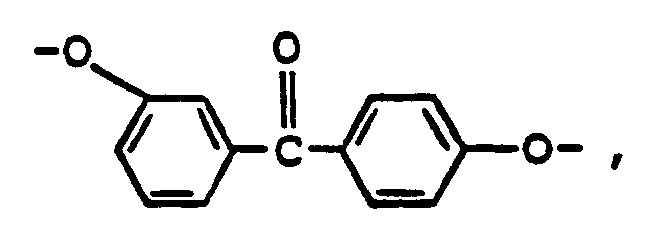
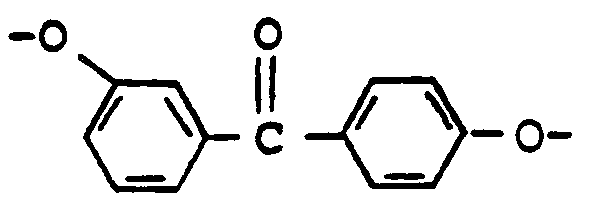
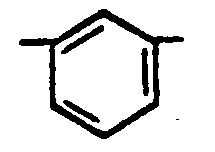
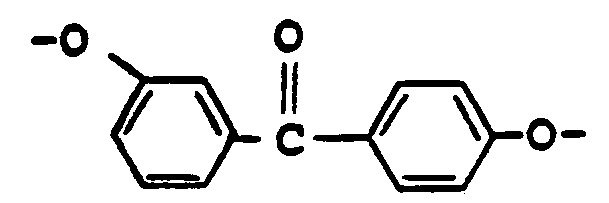
- the polyesters of the present invention contain glycol-derived repeating units of polymerized 3-hydroxy,4'-(4-hydroxyphenyl)benzophenone, i.e., or 3,4'-dihydroxybenzophenone, i.e., bonded to repeating units of aromatic dicarboxylic acid units.
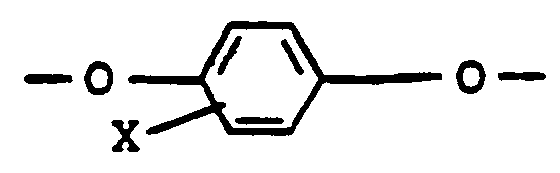
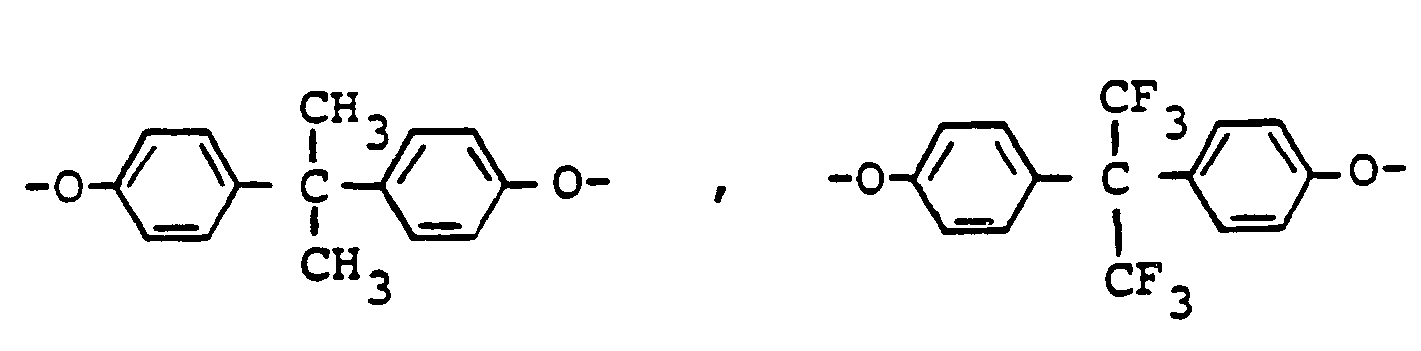
- the polyesters contain at least 10 mole percent of the glycol-derived repeating units. Any remaining glycol-derived units are of the structure -O-R-O- wherein R is 6C-14C arylene.
- the diacid-derived repeating units are of the structure -C(O)-R'-C(O)- wherein R' is 4C-14C alkylene or 6C-14C arylene.
- alkylene includes cycloalkylene.
- the polyesters optionally comprises monoacid-monohydroxy derived repeating units of the structure O-R"-COO-, wherein R" is 6C-14C arylene.
- polyesters can be injection molded, spun into fibers, and formed into films by extrusion or pressing.
- the films may be stretched up to five-fold at temperatures above the glass transition temperature.
- the polyesters of this invention generally have glass transition temperatures in the range of about 40 to 180°C, and have inherent viscosities of at least 0.5 dl/g as defined by the equation.
- ( ⁇ rel) represents the relative viscosity
- C represents a concentration of 0.5 gram of the polyester in 100 ml of solvent.
- the relative viscosity (n rel) is determined by dividing the flow time in a capillary viscometer of the dilute solution by the flow time for the pure solvent. Flow times are determined at 25°C., and the solvent is a 50/50 volume mixture of p-chlorophenol and 1,2-dichloroethane.
- the polymers of the present invention exhibit a heat of fusion ( ⁇ H f ) of less than 1.5 Joules per gram and preferably 0 Joules per gram, measured as described below.
- heat of fusion is meant the energy per gram involved in conversion from the solid crystalline state to the liquid crystalline state. Prolonged exposure to temperatures above the Tg of a given polymer of the present invention can cause a crystalline phase to develop which will have a higher AHf.
- thermal characterization of the polymers is done on a Du Pont Thermal Analyzer, Model 1090 equipped with a Du Pont DSC cell.
- a known weight of resin (usually 5 to 10 mg) is sealed in a DSC pan and maintained under nitrogen throughout the test.
- the sample is subjected to a heating cycle to remove any crystallinity, thereby eliminating the effects of prior thermal history.
- This cycle consists of heating to 360°C at 25°C/min. and holding at 360°C for two minutes. Crystallization under controlled conditions is effected in a cooldown cycle wherein the sample is cooled from 360° to 40°C at a rate of 30°C/min. and then maintained at 40°C for five minutes.
- Thermal characterization parameters are taken from the second heatup cycle which consists of heating from 40°C to 360°C at 25°C/min.
- the glass transition temperature (Tg) is defined as the inflection point where the heat flow - temperature curve changes in slope. Crystalline melting shows a characteristic endothermic peak where the melting point (Tm) is taken as the tip of the peak.
- Polymers of the class described herein having low values of (A H,) are stretchable whereas similar polymers derived from 3-hydroxy-4'-(4-hydroxyphenyl)benzophenone or 3,4'-dihydroxybenzophenone with high values of (A H f ) are not stretchable.
- the polymers of the present invention exhibit optical anisotropy.
- Optical anisotropy is an indication that the polymer is in the form of liquid crystals which results in the polymer being much more readily melt processable than polymers which are isotropic.
- Optical anisotropy of the copolyester melts can be determined by modification of known procedures. It is well known that optically anisotropic materials cause polarized light to be rotated, whereas rotation of polarized light is zero for isotropic materials. Thus, optical anisotropy can be determined by placing a sample of the polymer between crossed polarizers on a heating stage of a polarizing microscope and bringing the temperature up to and beyond the polymer flow temperature. If the polymer is optically anisotropic in the melt, a bright field will be observed at temperatures above the polymer flow temperature. This may be confirmed through use of the thermooptical test (TOT) which is described in U.S. 4,118,372. Polymers which pass this test are considered to be optically anisotropic. The apparatus is similar to that described by I. Kirshenbaum, R. B. Isaacson, and W. C. Feist. Polymer Letters, 2, 897-901 (1964).
- the polyesters are prepared by combining substantially equal molar amounts of glycols and diacids.
- the glycols may be added in the form of diesters such as the diacetates.
- the free glycol can be reacted with a dichloride of the diacid, the free acid, or esters thereof.
- the mixture is heated in a reaction vessel under an inert atmosphere with stirring for about 1 to 3 hours, at a temperature above the melting points of the reactants.
- a vacuum is usually applied during the course of the reaction to remove volatile byproduct such as acetic acid.
- the polymers of the present invention are useful as films which can be subjected to high temperatures.
- the polyester may be spun into filament by the conventional melt spinning techniques.
- the polymers of the present invention can be molded and spun into fibers in addition to being made into biaxially orientable films.
- a sheet of polymer 5 to 20 mils (127 to 508 urn) thick, is prepared either by extrusion through a slit die at about 300°C, or by compression molding between two plates at 320°C for 30 seconds in a hydraulic press.
- strips 0.5 in. (1.3 cm) wide by 1.5 to 3 in. (1.3 to 7.6 cm) long cut from the polymer sheets are mounted in the jaws of a tensile tester which is inside a heated compartment maintained at 80° to 190°C. After a heatup time of 0.2 to 3 minutes, the samples are elongated at a rate of 20% to 500% per minute.
- Tensile properties were measured with an Instron machine using a constant head speed of 0.05 cm/ min at 25°C, relative humidity of 50%, and a grip distance of 2.5 cm.
- the modulus reported in the initial Young's modulus derived from a stress-strain curve determined without an extensiometer. Strength is the strength at break.
- the elongation is also the elongation at break. Whenever the sample does not break, the sign > is used.
- the solid was filtered, washed with methanol, and dried at 90°C under vacuum.
- the product was 150 grams of 100% pure 3-hydroxy, 4'(4-hydroxyphenyl)benzophenone diacetate as determined by NMR analysis. Its melting point was 120-121 °C.
- the pressure is then gradually reduced to 5 KPa over a period of 1 hour and 20 minutes and then it is further reduced to 0.04 KPa.
- the reactor is maintained at 260°C for 4 hours until the desired viscosity is obtained.
- the product had 200 grams of polymer having a structure as determined by MNR analysis consisting of perfectly alternating carbonyl hexamethylene carbonyl and oxy-3-benzoyl-4-phenyl-4-phenoxy units.
- the inherent viscosity was 0.87 dlg- 1 .
- the polyester had a Tg of 60°C and a liquid crystalline anisotropic-isotropic transition of 170°C; that is, the anisotropy of the polyester melt under crossed polarized light fades at 170°C.
- the polyester had no solid crystalline to liquid crystalline transition (AH, of 0 Joule per g).
- the polyester has dead bend properties.
- a polyester prepared similarly to that of Example 1 was extruded as a film. Dimensions of the sample were 8.1 x 76 mm. Thickness was variable. The film was uniaxially stretched in the machine direction while heat was applied with the following conditions of temperature, elongation, speed, and drawing ratio. Results are as follows:
- the polyester was the same as Example 1. It was compression molded at 190°C with a thickness of 0.5 mm. The sheet was cut into dimensions 50 x 50 mm and biaxially stretched at 80°C to 400% with a stretching speed of 200 cm/min.
- the resulting film was shiny, tough, and had the following balanced properties:
- the inherent viscosity was 1.23 dlg - '.
- the polyester was analyzed by NMR to consist of perfectly alternating carbonyl and oxy-3-benzoyl-4-phenyl-4-phenoxy units. Films of the polyester were compression molded at 175°C to provide test specimens having dimensions of 0.3 x 2 x 21.5 mm. Results were as follows:
- a polyester prepared as in Example 4 was compression molded into a sheet and cut into a square shape 50 x 50 mm. It was biaxially stretched 100% at 60°C. Results are as follows:
- the polyester has a Tg of 132°C, a liquid crystalline phase up to >350°C and a ⁇ H 1 of 0 J/g.
- the polymer was melted in an extruder at 330°C and extruded through a 20 cm lip die at 300°C to produce a film with a thickness of 0.1 to 0.18 mm.
- the extruded film was quenched on a cooled casting drum to give a smooth film.
- the inherent viscosity was 0.8 dlg-'.
- the glass transition temperature was 134°C as determined by DSC.
- the polymer had a liquid crystalline phase up to 350°C as determined by optical microscopy and a ⁇ H 1 of 0 J/g.
- a molded film of the polymer was uniaxially stretched 100% at 170°C.
- the inherent viscosity was 1.5 dlg -1 ⁇
- the glass transition temperature was 133°C as determined by a differential scanning calorimeter (DSC).
- the polymer had a liquid crystalline phase up to above 350°C as determined by optical microscopy and a AH, of 0 J/g. Compression molded film can be stretched up to 100% at 16G-180°C.
- Partial vacuum (5 KPa) was applied for 20 min., then full vacuum (0.03 KPa) for 15 min. at 290°C and 2 hrs. 25 min. at 320°C.
- the yield of polymer was 92% (117 g).
- the inherent viscosity was 1.4 dlg -1 ⁇
- the Tg was 115°C as determined by DSC and the ⁇ H f was 0 J/g.
- the polymer was compression molded at 320°C and then biaxially stretched at 165°C at a rate of 500% per minute.
- the yield was 91 % (110 g.).
- the inherent viscosity was 0.5 dlg-'.
- the Tg was 146°C as determined by DSC.
- the AH f was 0 Joules per gram.
- the polymer was compression molded at 320°C and uniaxially stretched at 160°C up to 100% (2X). The rate of stretching was 4000%/min.
- Partial vacuum (5 KPa) was applied for 10 min., then full vacuum (0.03 KPa) for 3 hrs. The yield is almost quantitative.
- the polyester was compression molded at 220°C. Samples cut along the flow pattern and uniaxially stretched at 180°C in a hot box using an Instron machine at the cross head speed of 12.5 mm/min. (0.5"/ mm) to the 100% extension. The tensile strength thus obtained was 40.9 Kpsi (280 MPa).
- the yield was 94% (138 grams).
- the inherent viscosity was 1 dlg-'.
- the Tg was 131°C as determined by DSC, ⁇ H f was 0 J./g.
- the polymer forms a liquid crystalline phase up to above 350°C as determined by optical microscope.
- the above polymer was compression molded at 200°C (0.25 mm thick).
- a sheet of 50 x 50 mm was cut and biaxially stretched up to 200% in each direction to give a smooth film with the following physical properties (nonheat treated):
- the temperature was increased to 265°C for 2 hr at 5 min. 28 ml of acetic acid was collected. The temperature was increased to 310°C for 25 min. Nitrogen was blown in for 15 min. Partial vacuum (5 KPa) was applied for 15 min. then full vacuum (0.03 KPa) for 3 hr at 310°C. The yield of polymer was 91 % (98 g). The inherent viscosity was 1 dlg -1 ⁇ The Tg was 116°C as determined by DSC. It had no melting point (crystalline-liquid crystalline transition even after annealing at 220°C for 74 hr), ⁇ H f was 0 J/g.
- the polyester was compression molded at 320°C for 1 min. It was biaxially stretched at 175°C to give a smooth and shiny film. Physical properties of film (50 pm thick) were:
- the yield of polymer was 91% (90 g).
- the inherent viscosity was 1.1 dlg -1 ⁇
- the Tg was 110°C as determined by DSC.
- the polymer as made did not have any crystalline phase, ⁇ H f was 0 J./g.
- the above polyester was compression molded at 320°C for 1 min. It was biaxially stretched at 175°C to give a smooth and shiny film. Physical properties of the film (50 pm or 2 mil thick) were:
- a polymer sheet was compression molded at 260°C and then biaxially stretched at 160°C at a rate of 500% per minute.
- the yield of polymer was 92% (96 g) - the inherent viscosity was 1.6 dlg -1 ⁇
- the Tg was 106°C as determined by DSC, and a ⁇ H f of 0 J./g.
- the polymer was compression molded at 320°C and then uniaxially stretched at 200°C at a rate of 500% per minute.
- Partial vacuum (5 KPa) was applied for 15 mins., then full vacuum (0.03 KPa) for 20 mins. at 320°C, 45 mins. at 330°C, and 3 hrs 40 mins. at 350°C.
- the yield of polymer was 96% (122 grams).
- the inherent viscosity was 1.4 dlg-'.
- the inherent viscosity was 1 dlg - '.
- the Tg was 127°C as determined by DSC, ⁇ H f was 0 J./g.
- the polymer had a liquid crystalline phase up to above 350°C as determined by optical microscope.
- the yield was 94% (120 grams).
- the inherent viscosity was 1.1 dlg -1 ⁇
- the Tg was 118°C as determined by DSC, ⁇ H f was 0 J./g.
- the polymer had a liquid crystalline phase up to above 350°C as determined by optical microscope.
- Examples 22 to 24 illustrate that some of the ester links of the polymers of the present invention can be replaced with amide links without materially affecting the essential properties of the resulting polymers.
- Partial vacuum (5 KPa) was applied for 10 mins. and full vacuum (0.03 KPa) for 45 mins. at 280°C and 2 hrs at 300°C.
- the yield was 94% (15 grams).
- the inherent viscosity was 0.8 dlg -1 ⁇
- the Tg was 148°C as determined by DSC, and a ⁇ H f of 0 J./g. It had a liquid crystalline phase up to above 350°C as determined by optical microscope.
Landscapes
- Chemical & Material Sciences (AREA)
- Health & Medical Sciences (AREA)
- Chemical Kinetics & Catalysis (AREA)
- Medicinal Chemistry (AREA)
- Polymers & Plastics (AREA)
- Organic Chemistry (AREA)
- Polyesters Or Polycarbonates (AREA)
Claims (30)
















Applications Claiming Priority (2)
| Application Number | Priority Date | Filing Date | Title |
|---|---|---|---|
| US06/772,619 US4617369A (en) | 1985-09-04 | 1985-09-04 | Polyester polymers of 3-hydroxy-4'-(4-hydroxyphenyl)benzophenone or 3,4'-dihydroxybenzophenone and dicarboxylic acids |
| US772619 | 1985-09-04 |
Publications (2)
| Publication Number | Publication Date |
|---|---|
| EP0218366A1 EP0218366A1 (de) | 1987-04-15 |
| EP0218366B1 true EP0218366B1 (de) | 1990-11-22 |
Family
ID=25095671
Family Applications (1)
| Application Number | Title | Priority Date | Filing Date |
|---|---|---|---|
| EP86306794A Expired EP0218366B1 (de) | 1985-09-04 | 1986-09-03 | Polyester aus 3-Hydroxy-4'-(4-hydroxyphenyl)benzophenon oder 3,4'-Dihydroxybenzophenon und Dicarbonsäuren |
Country Status (5)
| Country | Link |
|---|---|
| US (1) | US4617369A (de) |
| EP (1) | EP0218366B1 (de) |
| JP (1) | JPS6289722A (de) |
| CA (1) | CA1267246A (de) |
| DE (1) | DE3675731D1 (de) |
Families Citing this family (21)
| Publication number | Priority date | Publication date | Assignee | Title |
|---|---|---|---|---|
| DE3517948A1 (de) * | 1985-05-18 | 1986-11-20 | Bayer Ag, 5090 Leverkusen | Thermotrope aromatische polyester mit hervorragenden mechanischen eigenschaften und guter verarbeitbarkeit, verfahren zu ihrer herstellung und ihre verwendung zur herstellung von formkoerpern, filamenten, fasern und folien |
| US4746566A (en) * | 1987-05-06 | 1988-05-24 | E. I. Dupont De Nemours And Company | Optically anisotropic melt forming aromatic copolyesters based on t-butyl-4-hydroxybenzoic acid |
| IT1222091B (it) * | 1987-07-22 | 1990-08-31 | Montedison Spa | Poliestri liquido cristallini termotropici |
| US5268443A (en) * | 1989-05-30 | 1993-12-07 | The Dow Chemical Company | Liquid crystalline copolyesters of 4-hydroxybenzoic acid and substituted 4-hydroxybenzoic acids |
| US5281754A (en) * | 1992-04-13 | 1994-01-25 | International Business Machines Corporation | Melody composer and arranger |
| JP3373528B2 (ja) | 1996-09-11 | 2003-02-04 | デュポン カナダ インコーポレイテッド | 液晶ポリマー層を含有する熱交換器 |
| CA2263603A1 (en) | 1996-09-11 | 1998-03-19 | Kenneth Earl Stevens | Polymeric multilayer heat exchangers containing a barrier layer |
| US6379795B1 (en) | 1999-01-19 | 2002-04-30 | E. I. Du Pont De Nemours And Company | Injection moldable conductive aromatic thermoplastic liquid crystalline polymeric compositions |
| US6364008B1 (en) | 1999-01-22 | 2002-04-02 | E. I. Du Pont De Nemours And Company | Heat exchanger with tube plates |
| WO2002029347A2 (en) | 2000-10-06 | 2002-04-11 | E.I. Du Pont De Nemours And Company | Heat exchanger made from bendable plastic tubing |
| CA2476187A1 (en) * | 2002-02-13 | 2003-08-21 | Dupont Canada Inc. | Method for manufacturing fuel cell separator plates under low shear strain |
| US20050082720A1 (en) * | 2003-01-23 | 2005-04-21 | Bloom Joy S. | Moldings of liquid crystalline polymer powders |
| CA2538761A1 (en) * | 2005-03-08 | 2006-09-08 | Anthony Joseph Cesaroni | Method for sealing heat exchanger tubes |
| US7547849B2 (en) * | 2005-06-15 | 2009-06-16 | E.I. Du Pont De Nemours And Company | Compositions useful in electronic circuitry type applications, patternable using amplified light, and methods and compositions relating thereto |
| US20090017309A1 (en) * | 2007-07-09 | 2009-01-15 | E. I. Du Pont De Nemours And Company | Compositions and methods for creating electronic circuitry |
| US8475924B2 (en) | 2007-07-09 | 2013-07-02 | E.I. Du Pont De Nemours And Company | Compositions and methods for creating electronic circuitry |
| US20100193950A1 (en) * | 2009-01-30 | 2010-08-05 | E.I.Du Pont De Nemours And Company | Wafer level, chip scale semiconductor device packaging compositions, and methods relating thereto |
| US7772418B1 (en) * | 2009-02-26 | 2010-08-10 | E.I. Du Pont De Nemours And Company | Process for producing 3,4′ diacetoxybenzophenone |
| US7772441B1 (en) * | 2009-02-26 | 2010-08-10 | E.I. Du Pont De Nemours And Company | Process for producing 3,4′ dihydroxybenzophenone |
| US12391794B2 (en) | 2019-06-28 | 2025-08-19 | Eastman Chemical Company | Polycondensation pre-polyesters, other copolyester precursors, and copolyesters made therefrom |
| JP2022137515A (ja) * | 2021-03-09 | 2022-09-22 | 三菱ケミカル株式会社 | ポリエステルおよびその製造方法 |
Family Cites Families (10)
| Publication number | Priority date | Publication date | Assignee | Title |
|---|---|---|---|---|
| US4245082A (en) * | 1979-07-09 | 1981-01-13 | E. I. Du Pont De Nemours And Company | Polyesters derived from 3,4'-dihydroxy-benzophenones or 3-hydroxy-4'-(4-hydroxyphenyl-)benzophenone and certain aromatic dicarboxylic acids and filaments thereof |
| GB2030158B (en) * | 1978-08-08 | 1982-12-01 | Du Pont | Polyesters derived from 3,4'-dihydroxybenzophenones or 3-hydroxy-4'-(4-hydroxyphenyl-) benzophenone and certain aromatic dicarboxylic acids and filaments thereof |
| US4224433A (en) * | 1979-03-16 | 1980-09-23 | Celanese Corporation | Thermotropic polyesters of 2,6-dihydroxyanthraquinone |
| US4269965A (en) * | 1979-09-17 | 1981-05-26 | E. I. Du Pont De Nemours And Company | Aromatic polyester which forms optically anisotropic melts and filaments thereof |
| US4447592A (en) * | 1983-06-13 | 1984-05-08 | E. I. Du Pont De Nemours And Company | Anisotropic melt polyesters of 6-hydroxy-2-naphthoic acid |
| DE3325787A1 (de) * | 1983-07-16 | 1985-01-24 | Bayer Ag, 5090 Leverkusen | Mesomorphe aromatische polyester mit hoher steifigkeit und zaehigkeit, verfahren zu ihrer herstellung und ihre verwendung zur herstellung von formkoerpern, filamenten, fasern und folien |
| US4496712A (en) * | 1983-12-16 | 1985-01-29 | E. I. Du Pont De Nemours And Company | Optically anisotropic melt forming copolyesters |
| US4499259A (en) * | 1983-12-16 | 1985-02-12 | E. I. Du Pont De Nemours And Company | Optically anisotropic melt forming copolyesters |
| DE3415530A1 (de) * | 1984-04-26 | 1985-10-31 | Bayer Ag, 5090 Leverkusen | Thermotrope aromatische polyester hoher steifigkeit und zaehigkeit, verfahren zu ihrer herstellung und ihre verwendung zur herstellung von formkoerpern, filamenten, fasern und folien |
| US4500699A (en) * | 1984-06-26 | 1985-02-19 | E. I. Du Pont De Nemours And Company | Optically anisotropic melt forming copolyesters |
-
1985
- 1985-09-04 US US06/772,619 patent/US4617369A/en not_active Expired - Lifetime
-
1986
- 1986-09-02 CA CA000517295A patent/CA1267246A/en not_active Expired
- 1986-09-03 DE DE8686306794T patent/DE3675731D1/de not_active Expired - Lifetime
- 1986-09-03 EP EP86306794A patent/EP0218366B1/de not_active Expired
- 1986-09-04 JP JP61206932A patent/JPS6289722A/ja active Pending
Also Published As
| Publication number | Publication date |
|---|---|
| CA1267246A (en) | 1990-03-27 |
| EP0218366A1 (de) | 1987-04-15 |
| US4617369A (en) | 1986-10-14 |
| JPS6289722A (ja) | 1987-04-24 |
| DE3675731D1 (de) | 1991-01-03 |
Similar Documents
| Publication | Publication Date | Title |
|---|---|---|
| EP0218366B1 (de) | Polyester aus 3-Hydroxy-4'-(4-hydroxyphenyl)benzophenon oder 3,4'-Dihydroxybenzophenon und Dicarbonsäuren | |
| EP0242959B1 (de) | Optisch anisotrope schmelzenbildende aromatische Copolyester auf Basis von t-Butylhydrochinon | |
| EP0095938B1 (de) | Aromatische Polyester und hochfeste Fasern daraus | |
| US4614789A (en) | Thermotropic aromatic polyesters with high rigidity, a process for the production thereof and the use thereof for the production of mouldings, filaments, fibres and films | |
| US4536561A (en) | Thermotropic, wholly aromatic polyesters | |
| US4245082A (en) | Polyesters derived from 3,4'-dihydroxy-benzophenones or 3-hydroxy-4'-(4-hydroxyphenyl-)benzophenone and certain aromatic dicarboxylic acids and filaments thereof | |
| JPH0192410A (ja) | 繊維生成性ポリエステル共重合体のフイラメント | |
| US4778927A (en) | Wholly aromatic mesomorphic polyesters and the preparation thereof | |
| US4864013A (en) | Resin having excellent heat resistance and exhibiting anisotropy in molten state | |
| Irwin et al. | 3, 4'-Dihydroxybenzophenone terephthalate: an all-aromatic thermotropic polyester with a helical chain conformation | |
| JP2506352B2 (ja) | 全芳香族ポリエステル及びそれを用いた射出成形品の製造法 | |
| JPH0232122A (ja) | サーモトロピックコポリエステル | |
| EP0289802A2 (de) | Optisch anisotrope schmelzenbildende aromatische Copolyester auf der Basis von t-Butyl-4-hydroxy-benzoesäure | |
| JPH0718065A (ja) | サーモトロピック液晶芳香族ポリエステル類 | |
| JPS60147433A (ja) | ポリエステル共重合体 | |
| AU624855B2 (en) | Thermotropic liquid crystalline aromatic polyesters | |
| JP2862740B2 (ja) | 芳香族ポリエーテルエステル | |
| EP0305070B1 (de) | Aus der Schmelze verarbeitbare Copolyester | |
| CA1305275C (en) | Thermotropic liquid crystalline polyesters | |
| JPS61239013A (ja) | 高性能繊維の製造法 | |
| JP3132881B2 (ja) | 液晶性ポリエステルの製造方法 | |
| KR800001711B1 (ko) | 신규 합성 폴리에스테르의 제조방법 | |
| JPH01201327A (ja) | サーモトロピック液晶芳香族ポリエステル類 | |
| JPS62282602A (ja) | ポリエステル中空糸状分離膜 | |
| JP2614999B2 (ja) | サーモトロピツク液晶性ポリエステル |
Legal Events
| Date | Code | Title | Description |
|---|---|---|---|
| PUAI | Public reference made under article 153(3) epc to a published international application that has entered the european phase |
Free format text: ORIGINAL CODE: 0009012 |
|
| AK | Designated contracting states |
Kind code of ref document: A1 Designated state(s): DE FR GB IT NL |
|
| 17P | Request for examination filed |
Effective date: 19870313 |
|
| 17Q | First examination report despatched |
Effective date: 19880928 |
|
| GRAA | (expected) grant |
Free format text: ORIGINAL CODE: 0009210 |
|
| AK | Designated contracting states |
Kind code of ref document: B1 Designated state(s): DE FR GB IT NL |
|
| ITF | It: translation for a ep patent filed | ||
| REF | Corresponds to: |
Ref document number: 3675731 Country of ref document: DE Date of ref document: 19910103 |
|
| ET | Fr: translation filed | ||
| PGFP | Annual fee paid to national office [announced via postgrant information from national office to epo] |
Ref country code: GB Payment date: 19910806 Year of fee payment: 6 |
|
| PGFP | Annual fee paid to national office [announced via postgrant information from national office to epo] |
Ref country code: FR Payment date: 19910809 Year of fee payment: 6 |
|
| PLBE | No opposition filed within time limit |
Free format text: ORIGINAL CODE: 0009261 |
|
| STAA | Information on the status of an ep patent application or granted ep patent |
Free format text: STATUS: NO OPPOSITION FILED WITHIN TIME LIMIT |
|
| ITTA | It: last paid annual fee | ||
| PGFP | Annual fee paid to national office [announced via postgrant information from national office to epo] |
Ref country code: NL Payment date: 19910930 Year of fee payment: 6 |
|
| 26N | No opposition filed | ||
| PG25 | Lapsed in a contracting state [announced via postgrant information from national office to epo] |
Ref country code: GB Effective date: 19920903 |
|
| PG25 | Lapsed in a contracting state [announced via postgrant information from national office to epo] |
Ref country code: NL Effective date: 19930401 |
|
| GBPC | Gb: european patent ceased through non-payment of renewal fee |
Effective date: 19920903 |
|
| NLV4 | Nl: lapsed or anulled due to non-payment of the annual fee | ||
| PG25 | Lapsed in a contracting state [announced via postgrant information from national office to epo] |
Ref country code: FR Effective date: 19930528 |
|
| REG | Reference to a national code |
Ref country code: FR Ref legal event code: ST |
|
| PGFP | Annual fee paid to national office [announced via postgrant information from national office to epo] |
Ref country code: DE Payment date: 19950606 Year of fee payment: 10 |
|
| PG25 | Lapsed in a contracting state [announced via postgrant information from national office to epo] |
Ref country code: DE Effective date: 19970603 |
|
| PG25 | Lapsed in a contracting state [announced via postgrant information from national office to epo] |
Ref country code: IT Free format text: LAPSE BECAUSE OF NON-PAYMENT OF DUE FEES;WARNING: LAPSES OF ITALIAN PATENTS WITH EFFECTIVE DATE BEFORE 2007 MAY HAVE OCCURRED AT ANY TIME BEFORE 2007. THE CORRECT EFFECTIVE DATE MAY BE DIFFERENT FROM THE ONE RECORDED. Effective date: 20050903 |