EP0213636B1 - Frequenz-Synthesierer nach der Art einer Phasenregelschleife mit einer Bemusterungsschaltung - Google Patents
Frequenz-Synthesierer nach der Art einer Phasenregelschleife mit einer Bemusterungsschaltung Download PDFInfo
- Publication number
- EP0213636B1 EP0213636B1 EP86112180A EP86112180A EP0213636B1 EP 0213636 B1 EP0213636 B1 EP 0213636B1 EP 86112180 A EP86112180 A EP 86112180A EP 86112180 A EP86112180 A EP 86112180A EP 0213636 B1 EP0213636 B1 EP 0213636B1
- Authority
- EP
- European Patent Office
- Prior art keywords
- frequency
- signal
- frequency divider
- division factor
- stage
- Prior art date
- Legal status (The legal status is an assumption and is not a legal conclusion. Google has not performed a legal analysis and makes no representation as to the accuracy of the status listed.)
- Expired
Links
- 238000005070 sampling Methods 0.000 title claims description 5
- 230000010355 oscillation Effects 0.000 claims description 12
- 230000001419 dependent effect Effects 0.000 claims description 3
- 230000002194 synthesizing effect Effects 0.000 claims 1
- 238000010586 diagram Methods 0.000 description 6
- 230000003247 decreasing effect Effects 0.000 description 4
- NAWXUBYGYWOOIX-SFHVURJKSA-N (2s)-2-[[4-[2-(2,4-diaminoquinazolin-6-yl)ethyl]benzoyl]amino]-4-methylidenepentanedioic acid Chemical compound C1=CC2=NC(N)=NC(N)=C2C=C1CCC1=CC=C(C(=O)N[C@@H](CC(=C)C(O)=O)C(O)=O)C=C1 NAWXUBYGYWOOIX-SFHVURJKSA-N 0.000 description 3
- 230000015556 catabolic process Effects 0.000 description 2
- 238000006731 degradation reaction Methods 0.000 description 2
- 239000013078 crystal Substances 0.000 description 1
- 230000004044 response Effects 0.000 description 1
- 230000002747 voluntary effect Effects 0.000 description 1
Images


Classifications
-
- H—ELECTRICITY
- H03—ELECTRONIC CIRCUITRY
- H03L—AUTOMATIC CONTROL, STARTING, SYNCHRONISATION OR STABILISATION OF GENERATORS OF ELECTRONIC OSCILLATIONS OR PULSES
- H03L7/00—Automatic control of frequency or phase; Synchronisation
- H03L7/06—Automatic control of frequency or phase; Synchronisation using a reference signal applied to a frequency- or phase-locked loop
- H03L7/16—Indirect frequency synthesis, i.e. generating a desired one of a number of predetermined frequencies using a frequency- or phase-locked loop
- H03L7/20—Indirect frequency synthesis, i.e. generating a desired one of a number of predetermined frequencies using a frequency- or phase-locked loop using a harmonic phase-locked loop, i.e. a loop which can be locked to one of a number of harmonically related frequencies applied to it
Definitions
- the present invention relates to a frequency synthesizer having a phase-locked loop (PLL).
- the frequency synthesizer will be abbreviated to a PLL synthesizer hereinafter.
- a conventional PLL synthesizer comprises a voltage controlled oscillator (VCO).
- VCO voltage controlled oscillator
- the oscillating frequency of the VCO is divided at a variable frequency divider and the resultant divided signal is compared in frequency and phase with a reference signal.
- the compared output is fed back to the VCO as a control voltage signal.
- the oscillating frequency of the VCO is controlled by the control voltage signal.
- a division factor of the variable frequency divider is changed, the oscillating frequency of the VCO changes in steps of a frequency of the reference signal which is referred to as a step frequency.
- a desired frequency signal is obtained, as an output signal of the PLL synthesizer, from the VCO by adjusting the division factor of the variable frequency divider.
- a reference signal having the step frequency is obtained from a reference signal generator through a fixed frequency divider.
- GB-A-2 021 338 discloses a synthesiser with a VCO, a reference oscillator, a frequency divider and a phase detector.
- the phase noise characteristic of the VCO is degraded and it is difficult to determine the step frequency to be a reduced value, as will later be described.
- a PLL synthesizer of the present invention comprises oscillation generating means controlled by a control signal for generating, as the output oscillation signal, a controlled oscillation signal of a controlled frequency dependent on the control signal, and reference signal generating means for generating a reference signal having a constant reference frequency.
- the controlled oscillation signal is sampled by the reference signal at sampling means and a sampled signal is produced.
- the reference signal is frequency divided by a first division factor at frequency divider means and a first divided signal is produced.
- Control means adjusts the first division factor to be a value determined by the controlled frequency and the reference frequency.
- Detecting means detects a phase difference between the sampled signal and the first divided signal and produces a D.C. voltage signal depending on the phase difference.
- the D.C. voltage signal is negatively fed back, as the control signal, to the oscillation generating means.
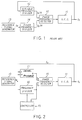
- the PLL synthesizer shown therein comprises a VCO 11 for generating an output signal of a frequency fo controlled by a control voltage signal.
- the output signal is applied to a variable frequency divider 12 where the frequency f o is divided by a division factor N adjusted or set therein to thereby produce a divided signal having a frequency fo/N.
- a reference signal generator 13 is, for example, a crystal oscillator, and generates a reference signal having a reference frequency f R which is constant.
- the reference signal is supplied to a fixed frequency divider 14 at which its frequency f R is divided by a fixed division factor M to thereby produce a comparing signal having a frequency f R /M.
- the divided signal and the comparing signal are supplied to a phase frequency detector 15, which produces a D.C. voltage signal depending on the phase difference between the divided signal and the comparing signal.
- the D.C. voltage is applied to he VCO 11 as the control voltage signal for controlling the frequency of the output signal of the VCO 11.
- the oscillating frequency fo of the VCO 11 is represented by the following equation:
- the frequency f R /M of the comparing signal is equivalently multiplied by N, as will be understood from equation (1).
- the frequency multiplication increases the phase modulation index, so that the phase noise characteristic of the VCO 11 is degraded, as described hereinbefore.
- the oscillating frequency fo of the VCO 11 is disadvantageously frequency modulated by the low frequency component.
- the phase locked loop is made to have a decreased loop bandwidth so as to avoid the frequency modulation, the phase noise of the VCO 11 cannot sufficiently be suppressed in the phase locked loop. Accordingly, the frequency f R /M of the comparing signal cannot sufficiently be reduced, so that it is difficult to change the oscillating frequency f o in steps of a reduced frequency, as described hereinbefore.
- a PLL synthesizer according to an embodiment of the present invention comprises a VCO 11, a reference signal generator 13 and a phase frequency detector 15 similar to the known PLL synthesizer.
- a signal processor 21 and a frequency divider 22 are used in place of the variable and the fixed frequency dividers in the known PLL synthesizer, respectively.
- the signal processor 21 is for sampling and holding the output signal of the frequency fo from the VCO 11 by the reference signal of the frequency f R from the reference signal generator 13 to produce a processed signal.
- the signal processor 21 can be made by a D-type flipflop having a D input terminal D and a clock input terminal CK which receive the output signal from VCO 11 and the reference signal from reference signal generator 13, respectively.
- the processed signal is obtained from an output terminal Q of the D-type flipflop.
- a frequency to of the processed signal is given by the following formulae: where fo > f R and m is a positive integer.
- a period of the processed signal is integer times of a period (1/f R ) of the reference signal.
- f R /f Q is not always integer but is integer only when the frequency fo is specific value. Accordingly, the period of the processed signal is not constant but changes.
- the signal processor 21 produces a first signal having a period of p/f R and a second signal having another period (p - 1 )/f R repeatedly for a long time of A cycles under a condition of equations (2) and (3).
- (A - i) represents the number of cycles where the signal having the period of (p - 1 )/f R is present during A cycles. Accordingly, the period of A cycles is given by: Accordingly, the frequency f o is a mean value of two frequencies f R /p and f R /(p - 1) and is given by:
- a value of p is determined by the above- described definition of p, and values of A and i are also determined from formulae (2), (3), and (5).
- the producing pattern is determined by the values of A and i.
- the frequency f R of the reference signal from reference signal generator 13 is divided at the frequency divider 22, which produces a comparing signal having a frequency f c .
- the division factor of the frequency divider 22 is set to one of p and (p - 1) by a controller 23 according to the producing pattern. Accordingly, the frequency f c of the comparing signal is equal to the frequency f Q of the processed signal in the stable state of the phase locked loop.
- the processed signal and the comparing signal are supplied to the phase frequency detector 15 and are compared thereat.
- the phase frequency detector 15 produces a D.C. voltage signal depending upon the phase difference between both of the processed and the comparing signals.
- Any retiming means such as D-type flipflops can be used at the output sides of the sampler 21 and frequency divider 22 so as to make both of the processed and the comparing signals in-phase with the reference signal.
- the oscillating frequency fo can be changed by changing the division factor and/or the producing pattern set in the frequency divider 22.
- the oscillating frequency fo can be increased or decreased by 1 when the value of A is increased or decreased by 1 while the value of being increased or decreased by p
- an initial oscillating frequency of the VCO is determined by designating a frequency band within which the VCO can oscillate or by feeding a predetermined voltage signal to the VCO together with the control voltage signal from the phase-frequency detector.
- the oscillating frequency fo of the VCO 11 is stabilized at 648 MHz.
- the division factor of the frequency divider 22 is set to be p and (p - 1) switchingly according to the producing pattern determined by the values of A and i by controller 23, the oscillating frequency f o is changed to 469 MHz and is stabilized thereat.
- controller 23 for setting into the frequency divider 22 a division factor p or (p - 1) selectively according to the producing pattern determined by A and i.
- an embodiment of the controller 23 comprises a data memory 231.
- the data memory 231 stores a series of division factor data comprising values of p and (p - 1) arranged according to the producing pattern.
- a control circuit 232 reads the series of division factor data to a parallel-series (P/S) converter 233.
- the P/S converter 233 converts the read parallel data into serial data and applies the values of the division factor data into frequency divider 22 one after another in synchronization with the output signal from the frequency divider 22.
- the data memory 231 stores a series of 6-bit data of 1, 0, 0, 0, 0, 0, 0.
- the 6-bit data are supplied to the frequency divider 22 one bit after another.
- the frequency divider 22 makes the division factor of 5 when receiving "1 ", while making the division factor of 4 in response to reception of "0".
- the division factor of the frequency divider 22 can be set to a desired value determined by the reference frequency f R and the desired oscillating frequency fo of the VCO 11.
- Fig. 4 shows another embodiment of the controller.
- S represents one of two division factors p and (p - 1) which is present in the series of division factor data more times than the other.
- S 4 as is noted from formula (9).
- the period changes according to a pattern represented by the following formula:
- a 1 represents the numerical sequence represented by formula (9) while A2 representing the numerical sequence represented by formula (10).
- N n represents a number of elements in the numerical sequence
- S n represents an element which is present more times than the other in the numerical sequence
- t n is given by:
- the values of n, N n , S n and t n for Example 2 are given in Table 1.
- S 1 to S n and t 1 to t n can be calculated from given frequencies of fo and f R using formulae (13), (14), and (15). Front the calculated S 1 to S n and t 1 to tn the numerical sequence A 1 , that is, a series of division factor data can be obtained by calculation. Since the calculation is complex, it is difficult to design an arithmetic circuit for calculating the series of division factor data.
- the controller 23' of Fig. 4 can provide the series of division factor data to the frequency divider 22 without performing such a complex calculation.
- the controller 23' comprises a control circuit 41 which calculates S 1 to S n and t 1 to t n from given frequencies fo and f R using the formulae (13), (14), and (15).
- the controller 23' further comprises a plurality of (n - 1) frequency dividers 42-1 to 42-(n - 1).
- Each frequency divider of 42-1 to 42-(n - 1) has a similar arrangement of the frequency divider 22.
- each frequency divider of 22 and 42 comprises two data input terminals S and t, a selection terminal x, an arithmetic circuit 51, and a variable frequency divider 52.
- the arithmetic circuit 51 receives data S k and t k through data input terminals x and t and a selection signal x k through selection terminal and executes the calculation represented by the following equations: When and when
- frequency dividers 42-1 to 42-(n - 1) are connected in a multistage form such that one stage frequency divider receives an output frequency from the next preceding stage frequency divider. While, the output signal from one stage frequency divider is also supplied to the selection terminal of the next preceding stage frequency divider.
- the first frequency divider 42-1 receives the output signal having a frequency f 01 , from the frequency divider 22 and divides the frequency f 01 .
- An output signal having a frequency fo2 of frequency divider 42-1 is supplied to the next succeeding stage frequency divider and also applied to the selection terminal x 1 of the frequency divider 22 as the selection signal.
- the control circuit 41 supplies the calculated S 1 to S n and ti to t n to data input terminals S and t of the frequency dividers 22 and 42-1 to 42-(n - 1).
- S 1 to S 3 and ti to t 3 have values shown in Table 1 and are calculated in control circuit 41.
- S 1 and t 1 are applied to the data input terminals of frequency divider 22.
- An output signal of the first stage frequency divider 42-1 of the controller 23' is applied to the selection terminal x 1 of frequency divider 22.
- the value of x 1 is determined by the output signal from the first stage frequency divider 42-1.
- the values 12 and 1 of S 2 and t 2 in Table 1 are set in frequency divider 42-1 by the control circuit 41.
- the selection signal x 2 is provided by an output of the second stage frequency divider 42-2.
- the values 4 and 0 of S 3 and t 3 in Table 1 are set to the second frequency divider 42-2 by control circuit 41.
- y 3 is always 4 from equations (16) and (17), so that the selection signal x 3 is maintained "0". Accordingly, the division factor of second stage frequency divider 42-2 is maintained 4, and the output frequency fo2 from first stage frequency divider 42-1 is divided by 4. Therefore, the second stage frequency divider 42-2 produces "1" " signal once per 4 cycles of the frequency fo2 and produces "0" signal during the remaining 3 cycles.
- the division factor of first stage frequency divider 42-1 is 12 once per 4 cycles of- the frequency fo2 and is 13 for the remaining 3 cycles. That is, the series of division factor data in first stage frequency divider 42-1 is represented by the numerical sequence of formula (10).
- the division factor of frequency divider 22 is changed so that a first pattern is present where the division factor is 5 once per 13 cycles of the frequency f c and 4 during the remaining 12 cycles, and thereafter a second pattern is repeated 4 times where the division factor is 5 once per 12 cycles and 4 during the remaining 11 cycles.
- the series of division factor data in the frequency divider 22 is equal to the numerical sequence represented by formula (9). That is, the division factor of frequency divider 22 is set according to the series of division factor data determined by the given frequencies of fo and f R .
- Example 1 N n , S n , and t n are given in Table 2.
- the second frequency divider 42-2 always produces "1" signal. Accordingly, the division factor of the first frequency divider 42-1 is always 6. This is equivalent to the case where the values in Table 2 are directly set to frequency dividers 22 and 42-1.
- the frequency of the comparing signal is not lower than f R /p, and therefore, it can be maintained comparatively high. Therefore, the loop band-width of the phase locked loop can be determined comparatively large, so that the phase noise in the VCO output signal can be sufficiently suppressed. Further, since the VCO output signal is not frequency divided but is frequency converted to a signal of a reduced frequency by sampling, the phase noise characteristic of the VCO output is not degraded. Therefore, the step frequency can be reduced without degradation of the phase noise characteristic.
Landscapes
- Stabilization Of Oscillater, Synchronisation, Frequency Synthesizers (AREA)
Claims (7)
gekennzeichnet durch


Applications Claiming Priority (4)
| Application Number | Priority Date | Filing Date | Title |
|---|---|---|---|
| JP60194093A JPH0659030B2 (ja) | 1985-09-03 | 1985-09-03 | 周波数シンセサイザ |
| JP194093/85 | 1985-09-03 | ||
| JP61205464A JPS6361509A (ja) | 1986-09-01 | 1986-09-01 | 周波数シンセサイザ |
| JP205464/86 | 1986-09-01 |
Publications (3)
| Publication Number | Publication Date |
|---|---|
| EP0213636A2 EP0213636A2 (de) | 1987-03-11 |
| EP0213636A3 EP0213636A3 (en) | 1988-10-19 |
| EP0213636B1 true EP0213636B1 (de) | 1992-04-15 |
Family
ID=26508301
Family Applications (1)
| Application Number | Title | Priority Date | Filing Date |
|---|---|---|---|
| EP86112180A Expired EP0213636B1 (de) | 1985-09-03 | 1986-09-03 | Frequenz-Synthesierer nach der Art einer Phasenregelschleife mit einer Bemusterungsschaltung |
Country Status (5)
| Country | Link |
|---|---|
| US (1) | US4679004A (de) |
| EP (1) | EP0213636B1 (de) |
| AU (1) | AU583775B2 (de) |
| CA (1) | CA1260563A (de) |
| DE (1) | DE3684839D1 (de) |
Families Citing this family (4)
| Publication number | Priority date | Publication date | Assignee | Title |
|---|---|---|---|---|
| US4820994A (en) * | 1986-10-20 | 1989-04-11 | Siemens Aktiengesellschaft | Phase regulating circuit |
| CA1290407C (en) * | 1986-12-23 | 1991-10-08 | Shigeki Saito | Frequency synthesizer |
| US4829301A (en) * | 1987-11-13 | 1989-05-09 | Ford Aerospace & Communications Corporation | Digital first order hold circuit |
| DE19947095A1 (de) * | 1999-09-30 | 2001-05-03 | Siemens Ag | Vorrichtung zur Synchronisierung des Rahmentaktes in Einheiten/Knoten datenübertragender Systeme |
Family Cites Families (8)
| Publication number | Priority date | Publication date | Assignee | Title |
|---|---|---|---|---|
| GB1151505A (en) * | 1965-08-13 | 1969-05-07 | Plessey Co Ltd | Improvements relating to Variable Ratio Frequency Divider Circuit Arrangements |
| US3928813A (en) * | 1974-09-26 | 1975-12-23 | Hewlett Packard Co | Device for synthesizing frequencies which are rational multiples of a fundamental frequency |
| US4162450A (en) * | 1977-12-16 | 1979-07-24 | Gte Laboratories Incorporated | Programmable divider |
| FR2426358A1 (fr) * | 1978-05-17 | 1979-12-14 | Trt Telecom Radio Electr | Synthetiseur de frequence a division directe a pas apres virgule |
| US4314208A (en) * | 1978-05-26 | 1982-02-02 | Racal Group Services Limited | Frequency adjusting methods and systems |
| US4316150A (en) * | 1980-01-09 | 1982-02-16 | Tektronix, Inc. | Phase locked loop including phase detector system controlled by enable pulses |
| US4423381A (en) * | 1981-01-16 | 1983-12-27 | Cincinnati Electronics Corporation | Pulse control circuit |
| US4392113A (en) * | 1981-02-12 | 1983-07-05 | Jackson Charles R | Phase-locked loop including non-linear phase detector of the sample and hold type |
-
1986
- 1986-09-02 CA CA000517270A patent/CA1260563A/en not_active Expired
- 1986-09-02 US US06/903,212 patent/US4679004A/en not_active Expired - Lifetime
- 1986-09-03 AU AU62193/86A patent/AU583775B2/en not_active Ceased
- 1986-09-03 EP EP86112180A patent/EP0213636B1/de not_active Expired
- 1986-09-03 DE DE8686112180T patent/DE3684839D1/de not_active Expired - Lifetime
Also Published As
| Publication number | Publication date |
|---|---|
| DE3684839D1 (de) | 1992-05-21 |
| CA1260563A (en) | 1989-09-26 |
| US4679004A (en) | 1987-07-07 |
| EP0213636A2 (de) | 1987-03-11 |
| AU583775B2 (en) | 1989-05-04 |
| AU6219386A (en) | 1987-03-05 |
| EP0213636A3 (en) | 1988-10-19 |
Similar Documents
| Publication | Publication Date | Title |
|---|---|---|
| US5065408A (en) | Fractional-division synthesizer for a voice/data communications systems | |
| US4609881A (en) | Frequency synthesizers | |
| EP0800276B1 (de) | Frequenzvervielfacher, bei dem das Multiplikationsverhältnis in der ersten Stufe grösser ist als in den nachfolgenden Stufen | |
| US6943598B2 (en) | Reduced-size integrated phase-locked loop | |
| EP0929940B1 (de) | Frequenzsynthetisierer mit phasenfehlerrückkopplung zur wellenformauswahl | |
| US4556984A (en) | Frequency multiplier/divider apparatus and method | |
| US4878027A (en) | Direct frequency synthesizer using powers of two synthesis techniques | |
| EP1307960B1 (de) | Frequenzsynthesizer | |
| US4679004A (en) | Frequency synthesizer of a phase-locked type with a sampling circuit | |
| EP0563400A1 (de) | Frequenzkonverter, mehrstufiger frequenzkonverter und frequenzsynthetisierer mit solchen konvertern | |
| JPH10173719A (ja) | Pam方式通信装置のタイミング制御回路 | |
| KR102718725B1 (ko) | 위상고정루프를 포함하고, 기준입력신호의 주파수를 제어하여 정수경계스퍼를 회피할 수 있는 장치 | |
| US6556087B2 (en) | Fractional frequency division frequency synthesizer having rounded phase control value | |
| JP3305587B2 (ja) | ディジタル遅延制御クロック発生器及びこのクロック発生器を使用する遅延ロックループ | |
| US4095190A (en) | Tuning system | |
| EP0566274A1 (de) | Frequenzsynthetisierer mit einem Phasenregelkreis | |
| JPS58168333A (ja) | 位相同期ル−プ回路の位相比較方式 | |
| US5349613A (en) | Digital phase locked loop, and digital oscillator arranged to be used in the digital phase locked loop | |
| GB2100534A (en) | Frequency synthesiser | |
| JP3797791B2 (ja) | Pllシンセサイザ発振器 | |
| JP2000022534A (ja) | 周波数シンセサイザ | |
| JPS6348016A (ja) | 周波数シンセサイザ | |
| JPS6253520A (ja) | 周波数シンセサイザ | |
| JPS6361509A (ja) | 周波数シンセサイザ | |
| SHAKHGILDYAN et al. | General design principles of high speed frequency synthesizers based on phase synchronization systems[Abstract Only] |
Legal Events
| Date | Code | Title | Description |
|---|---|---|---|
| PUAI | Public reference made under article 153(3) epc to a published international application that has entered the european phase |
Free format text: ORIGINAL CODE: 0009012 |
|
| 17P | Request for examination filed |
Effective date: 19860903 |
|
| AK | Designated contracting states |
Kind code of ref document: A2 Designated state(s): DE FR IT NL |
|
| PUAL | Search report despatched |
Free format text: ORIGINAL CODE: 0009013 |
|
| AK | Designated contracting states |
Kind code of ref document: A3 Designated state(s): DE FR IT NL |
|
| 17Q | First examination report despatched |
Effective date: 19901102 |
|
| GRAA | (expected) grant |
Free format text: ORIGINAL CODE: 0009210 |
|
| AK | Designated contracting states |
Kind code of ref document: B1 Designated state(s): DE FR IT NL |
|
| REF | Corresponds to: |
Ref document number: 3684839 Country of ref document: DE Date of ref document: 19920521 |
|
| ET | Fr: translation filed | ||
| ITF | It: translation for a ep patent filed | ||
| NLR4 | Nl: receipt of corrected translation in the netherlands language at the initiative of the proprietor of the patent | ||
| PLBE | No opposition filed within time limit |
Free format text: ORIGINAL CODE: 0009261 |
|
| STAA | Information on the status of an ep patent application or granted ep patent |
Free format text: STATUS: NO OPPOSITION FILED WITHIN TIME LIMIT |
|
| 26N | No opposition filed | ||
| PGFP | Annual fee paid to national office [announced via postgrant information from national office to epo] |
Ref country code: FR Payment date: 19980909 Year of fee payment: 13 |
|
| PGFP | Annual fee paid to national office [announced via postgrant information from national office to epo] |
Ref country code: NL Payment date: 19980930 Year of fee payment: 13 |
|
| PGFP | Annual fee paid to national office [announced via postgrant information from national office to epo] |
Ref country code: DE Payment date: 19981127 Year of fee payment: 13 |
|
| PG25 | Lapsed in a contracting state [announced via postgrant information from national office to epo] |
Ref country code: NL Free format text: LAPSE BECAUSE OF NON-PAYMENT OF DUE FEES Effective date: 20000401 |
|
| PG25 | Lapsed in a contracting state [announced via postgrant information from national office to epo] |
Ref country code: FR Free format text: LAPSE BECAUSE OF NON-PAYMENT OF DUE FEES Effective date: 20000531 |
|
| NLV4 | Nl: lapsed or anulled due to non-payment of the annual fee |
Effective date: 20000401 |
|
| PG25 | Lapsed in a contracting state [announced via postgrant information from national office to epo] |
Ref country code: DE Free format text: LAPSE BECAUSE OF NON-PAYMENT OF DUE FEES Effective date: 20000701 |
|
| REG | Reference to a national code |
Ref country code: FR Ref legal event code: ST |
|
| PG25 | Lapsed in a contracting state [announced via postgrant information from national office to epo] |
Ref country code: IT Free format text: LAPSE BECAUSE OF NON-PAYMENT OF DUE FEES;WARNING: LAPSES OF ITALIAN PATENTS WITH EFFECTIVE DATE BEFORE 2007 MAY HAVE OCCURRED AT ANY TIME BEFORE 2007. THE CORRECT EFFECTIVE DATE MAY BE DIFFERENT FROM THE ONE RECORDED. Effective date: 20050903 |