EP0203892B1 - Ein mit Biozid ausgerüstetes wässriges System - Google Patents
Ein mit Biozid ausgerüstetes wässriges System Download PDFInfo
- Publication number
- EP0203892B1 EP0203892B1 EP19860810222 EP86810222A EP0203892B1 EP 0203892 B1 EP0203892 B1 EP 0203892B1 EP 19860810222 EP19860810222 EP 19860810222 EP 86810222 A EP86810222 A EP 86810222A EP 0203892 B1 EP0203892 B1 EP 0203892B1
- Authority
- EP
- European Patent Office
- Prior art keywords
- biocide
- water
- compound
- ppm
- formula
- Prior art date
- Legal status (The legal status is an assumption and is not a legal conclusion. Google has not performed a legal analysis and makes no representation as to the accuracy of the status listed.)
- Expired - Lifetime
Links
Classifications
-
- C—CHEMISTRY; METALLURGY
- C02—TREATMENT OF WATER, WASTE WATER, SEWAGE, OR SLUDGE
- C02F—TREATMENT OF WATER, WASTE WATER, SEWAGE, OR SLUDGE
- C02F1/00—Treatment of water, waste water, or sewage
- C02F1/50—Treatment of water, waste water, or sewage by addition or application of a germicide or by oligodynamic treatment
-
- Y—GENERAL TAGGING OF NEW TECHNOLOGICAL DEVELOPMENTS; GENERAL TAGGING OF CROSS-SECTIONAL TECHNOLOGIES SPANNING OVER SEVERAL SECTIONS OF THE IPC; TECHNICAL SUBJECTS COVERED BY FORMER USPC CROSS-REFERENCE ART COLLECTIONS [XRACs] AND DIGESTS
- Y02—TECHNOLOGIES OR APPLICATIONS FOR MITIGATION OR ADAPTATION AGAINST CLIMATE CHANGE
- Y02W—CLIMATE CHANGE MITIGATION TECHNOLOGIES RELATED TO WASTEWATER TREATMENT OR WASTE MANAGEMENT
- Y02W10/00—Technologies for wastewater treatment
- Y02W10/30—Wastewater or sewage treatment systems using renewable energies
- Y02W10/37—Wastewater or sewage treatment systems using renewable energies using solar energy
Definitions
- the invention relates to the use of a special polymeric quaternary ammonium compound for combating bacteria, algae and other microorganisms in the water of a cooling circuit or a swimming pool.
- quaternary ammonium compounds have bactericidal properties.
- the biocidal activity of the compounds is explained by their surface-active properties (Angele, M.H., Seife, Oele, Fette, Wachsen 101, p. 274, 1975).
- the quaternary ammonium compounds also have a certain foaming power.
- Foam formation has an adverse effect on the use of biocides in cooling circuits, since the cooling tower cup can over-foam (Held, H.D.,dewasser, Vulkan-Verlag, Essen 1984, p. 212).
- BE-A-855 178 discloses polymeric quaternary ammonium compounds which contain a 4,4'-dimethylene diphenylene group. For these non-foaming compounds, a certain bacterial activity over a period of a maximum of 3 hours is disclosed.
- DE-A-2 657 582 describes polymeric quaternary ammonium compounds and their use in particular as dyeing aids for textiles.
- the antibacterial activity against three bacterial strains is also described (example 23).
- the antibacterial activity of quaternary ammonium compounds has been known for a long time.
- the present invention relates to the use of polymeric quaternary ammonium salts of the general formula (1), where n is an integer between 4 and 60, m is an integer between 2 and 20 and X e is fluoride, chloride, bromide or iodide, for combating microorganisms in the water of a cooling circuit or a swimming pool.
- a compound of formula (I) in which m is 3 to 12 is preferably used.
- a compound of formula (1) in which m is 6 and n is an integer between 10 and 15 is particularly preferably used.
- the main field of application of the invention are cooling water circuits, as used in e.g. Power plants, chemical production plants, heat pumps or air conditioning systems are available.
- the dosage of the biocide of formula (I) depends on the pollution and the dilution in the cooling circuit. It takes place every 2 to 4 weeks, depending on the type of cooling circuit.
- auxiliaries can be added, such as Corrosion inhibitors, scale inhibitors, biodispersants, water softening agents, masking agents e.g. polymeric phosphites, phosphates, amides of phosphoric acid, phosphonic acids, polymeric carboxylic acids of e.g. Acrylic acid or maleic acid, its anhydrides or salts and other additives.
- Another main area of application of the invention is the control of harmful organisms in swimming pools.
- the biocide of formula (I) is added to the water every 2 weeks.
- the dosage is carried out in the concentration ranges known to the person skilled in the art. Concentrations of 1 to 100 ppm and in particular of 5 to 40 ppm can preferably be used.
- ammonium compounds of the formula (1) can be prepared by the method described in DE-A-2 657 582.
- the degree of polymerization n is between 4 and 60.
- the fresh water supply is adjusted so that the loss of spray and evaporation is compensated for and the biocide of formula (I) is diluted to half its original concentration in 24 hours.
- the cooling circuit is infected by the natural incidence of dust and not by targeted inoculation.
- the cooling circuit is first treated twice a week and then at increasing intervals with 10 ppm of compound B.
- the experiment is evaluated by determining the germ titer by means of dilution and spatula directly before the addition of biocide and 3 hours afterwards, and by visual observation of the growth on the plates.
- the biocide Since the half-life of the cooling circuit is 24 hours, the biocide is diluted within 2 days after the addition so that the harmful organisms should grow again. On the other hand, it can be seen from the table that the number of bacteria has been reduced to practically zero bacteria during the entire test period. During the entire test period, no algae or bacterial slime can be found on the wooden parts.
- Example 1 The cooling circuit described in Example 1 is used. Deviating from example 1, the cooling circuit is in the room, loss of splash water is prevented by a plastic coating and there is no loss of drainage.
- the cooling water is treated with 30 ppm of compound B at the beginning of the experiment and again after 8 days. As the following table shows, a double dose is sufficient to keep the cooling water practically sterile for a period of 3 months.
- Example 2 The experimental setup from Example 2 is used.
- the cooling circuit is treated with 30 ppm biocide of the formula (1) at the start of the experiment.
- the table shows that a single treatment of the cooling water with the compounds used according to the invention reduces the bacterial count over a period of 14 or 21 days, while an increase in the bacterial count can be seen in the untreated cooling water.
- the swimming pool model is illuminated with daylight lamps in 14-hour light-10 hour dark changes.
- the water temperature is 25-30 ° C.
- the model swimming pool is inoculated weekly with 10 ⁇ l of a 1 + 1 + 1 etc. mixed culture of the overnight cultures from
- the concentration of compound B is 10 mg / l. After a week, it is increased to 20 mg / I and maintained by subsequent dosing. The experiment is evaluated by visual observation and bacterial count determination on Caso agar and algae agar.
- the concentration of compound B is 20 ppm and is maintained by replenishing.
- the experiment is evaluated by visual observation and determination of the bacterial count on caso agar and algae agar.
Landscapes
- Life Sciences & Earth Sciences (AREA)
- Hydrology & Water Resources (AREA)
- Engineering & Computer Science (AREA)
- Environmental & Geological Engineering (AREA)
- Water Supply & Treatment (AREA)
- Chemical & Material Sciences (AREA)
- Organic Chemistry (AREA)
- Agricultural Chemicals And Associated Chemicals (AREA)
- Organic Low-Molecular-Weight Compounds And Preparation Thereof (AREA)
Description
- Die Erfindung betrifft die Verwendung einer speziellen polymeren quaternären Ammoniumverbindung zur Bekämpfung von Bakterien, Algen und anderen Mikroorganismen im Wasser eines Kühlkreislaufs oder eines Schwimmbeckens.
- Es ist seit mehr als 30 Jahren bekannt, dass quaternäre Ammoniumverbindungen bakterizide Eigenschaften besitzen. Die biozide Wirksamkeit der Verbindungen wird mit durch ihre oberflächenaktiven Eigenschaften erklärt (Angele, M. H., Seife, Oele, Fette, Wachse 101, S. 274, 1975). Wie die meisten oberflächenaktiven Substanzen haben auch die quaternären Ammoniumverbindungen eine gewisse Schaumkraft.
- Für die Anwendung von Bioziden in Kühlkreisläufen wirkt sich die Schaumbildung nachteilig aus, da es zum Ueberschäumen der Kühlturmtasse kommen kann (Held, H. D., Kühlwasser, Vulkan-Verlag, Essen 1984, S. 212).
- Häufig ist bei dem obenerwähnten Anwendungsgebiet die Zugabe von Antischaummittel erforderlich, was ein ökologischer und ökonomischer Nachteil ist, oder die Konzentration des Biozids muss herabgesetzt werden, so dass eine zuverlässige Wirksamkeit gegenüber dem Wuchs von Bakterien und anderen Mikroorganismen nicht mehr gewährleistet ist. Ausserdem müssen die üblichen, bei der Wasserbehandlung benutzten Biozide in relativ kurzen Zeitabständen nachdosiert werden, um die rasch wieder steigende Keimzahl unter Kontrolle zu halten.
- Aus der BE-A-855 178 sind polymere quaternäre Ammonium-verbindungen bekannt, die eine 4,4'-Dimethylendiphenylengruppe enthalten. Für diese nicht schäumenden Verbindungen wird eine gewisse bakterriaide Wirksamkeit über eine Zeitspanne von maximal 3 Stunden offenbart.
- In der DE-A-2 657 582 werden polymere quaternäre Ammoniumverbindungen beschrieben und ihre Verwendung insbesondere als Färbereihilfsmittel für Textilien. Neben anderen Verwendungen wie Fällungsmittel in der Abwasserreinigung und Antistatika für Textilmaterialien wird auch die antibakterielle Aktivität gegenüber drei Bakterienstämmen beschrieben (Beispiel 23). Wie schon erwähnt, ist die antibakterielle Aktivität von quaternären Ammoniumverbindungen seit langem bekannt.
- Es war nicht zu erwarten, dass einige der in der DE-Offenlegungsschrift beschriebenen Verbindungen eine hohe biologische Aktivität zeigen, ohne dabei zu schäumen, und sich daher für die Bekämpfung von Mikroorganismen in Kühlkreisläufen und Schwimmbecken eignen.
- Es ist nun ferner ausserordentlich überraschend, dass diese speziellen Ammoniumverbindungen eine nicht zu erwartende langanhaltende biozide Wirkung besitzen. Die Verwendung dieser Verbindungen zur Bekämpfung von Schadorganismen bedeutet nicht nur eine bequeme Handhabung, sondern auch einen geringeren Verbrauch an Biozid und damit eine geringere Belastung für die Umwelt.
- Die vorliegende Erfindung betrifft die Verwendung von polymeren quaternären Ammoniumsalzen der allgemeinen Formel (1),
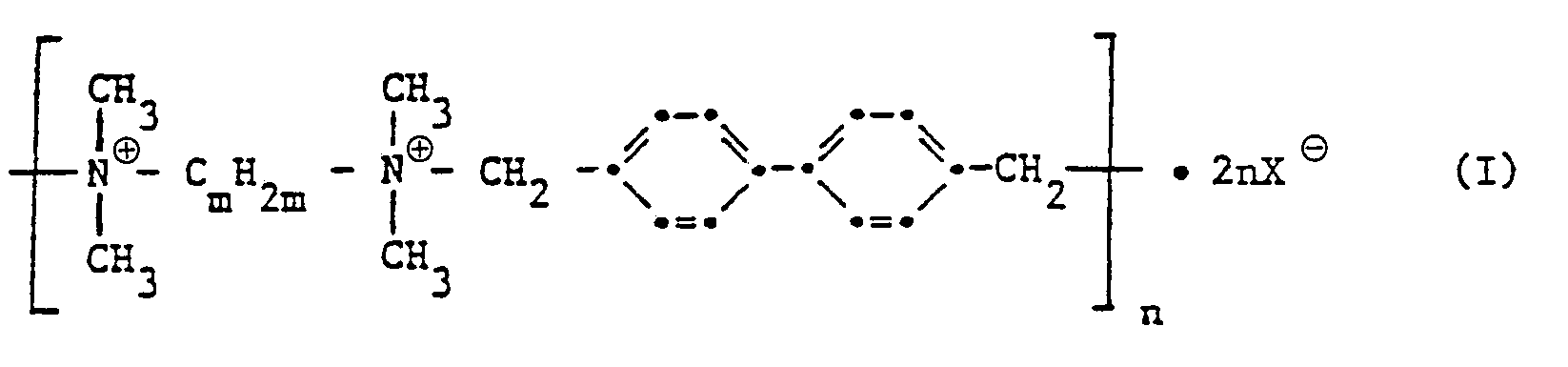
- Bevorzugt wird eine Verbindung der Formel (I), worin m 3 bis 12 ist, verwendet.
- Besonders bevorzugt wird eine Verbindung der Formel (1), worin m 6 ist und n eine ganze Zahl zwischen 10 und 15 ist, verwendet.
- Von Interesse ist die Verwendung einer Verbindung der Formel (I), worin n 6 bis 20 ist.
- Von besonderem Interesse ist die Verwendung einer Verbindung der Formel (1), worin n 10 bis 15 ist. Ebenfalls bevorzugt ist die Verwendung einer Verbindung der Formel (I), worin Xe Chlorid ist.
- Das hauptsächliche Einsatzgebiet der Erfindung sind Kühlwasserkreisläufe, wie sie in z.B. Kraftwerken, chemischen Produktionsanlagen, Wärmepumpen oder Klimaanlagen vorliegen. Die Dosierung des Biozids der Formel (I) ist von der Verschmutzung und der Verdünnung im Kühlkreislauf abhängig. Sie erfolgt je nach Art des Kühlkreislaufs alle 2 bis 4 Wochen.
- Insbesondere bei der Bekämpfung von Schadorganismen im Kühlwasser können weitere übliche Hilfsmittel zugegeben werden, wie z.B. Korrosionsinhibitoren, Kesselsteinverhinderer, Biodispergatoren, Mittel für die Weichmachung des Wassers, Maskierungsmittel, z.B. polymere Phosphite, Phosphate, Amide der Phosphorsäure, Phosphonsäuren, polymere Carbonsäuren von z.B. Acrylsäure oder Maleinsäure, deren Anhydride oder Salze und andere Zusätze.
- Ein weiteres hauptsächliches Einsatzgebiet der Erfindung ist die Bekämpfung von Schadorganismen in Schwimmbecken. Dabei wird dem Wasser im Abstand von 2 Wochen das Biozid der Formel (I) zugesetzt.
- Die Dosierung erfolgt je nach Verwendungszweck in den dem Fachmann bekannten Konzentrationsbereichen. Vorzugsweise können Konzentrationen von 1 bis 100 ppm und insbesondere von 5 bis 40 ppm eingesetzt werden.
- Die Herstellung der Ammoniumverbindungen der Formel (1) kann nach der in der DE-A-2 657 582 beschriebenen Methode erfolgen.
- Die langanhaltende biozide Wirkung von


- Bei den getesteten Verbindungen liegt der Polymerisationsgrad n zwischen 4 und 60.
- Der im Freien stehende und damit der natürlichen Sonneneinstrahlung, dem Staubeinfall und den Witterungseinflüssen ausgesetzte Kühlkreislauf besteht aus:
- a) einem Kunststoff-Fass mit einem Volumen von 113 I und einem Ueberlauf,
- b) einer Pumpe (21 I/min bei 3 m Förderhöhe),
- c) einem Kühlturm mit Oregon-(Splint), Oregon-(Kernholz), Eiche-, Fichte-, Asbestzement- und PVC-Platte.
- Die Frischwasserzufuhr ist so eingestellt, dass der Spritz- und Verdunstungsverlust ausgeglichen wird und das Biozid der Formel (I) in 24 Stunden auf die Hälfte seiner ursprünglichen Konzentration verdünnt wird.
- Der Kühlkreislauf ist durch den natürlichen Staubeinfall und nicht durch gezielte Beimpfung infiziert.
- Zur Verhinderung der Schleimbildung und des Algenwuchses wird der Kühlkreislauf zunächst 2 mal pro Woche und dann in grösser werdenden Zeitabständen mit 10 ppm der Verbindung B behandelt.
- Ausgewertet wird der Versuch durch Bestimmung des Keimtiters mittels Verdünnen und Ausspateln jeweils direckt vor der Biozid-Zugabe und 3 Stunden danach sowie durch visuelle Beobachtung des Bewuchses auf den Platten.

- Da die Halbwertszeit des Kühlkreislaufs 24 Stunden beträgt, wird nach der Zugabe das Biozid innerhalb von 2 Tagen so verdünnt, dass die Schadorganismen erneut wachsen sollten. Dagegen lässt sich der Tabelle entnehmen, dass die Keimzahl während des ganzen Versuchszeitraums praktisch auf null Keime reduziert ist. Während der gesamten Versuchszeit können auf den Holzteilen keinerlei Algen oder bakterieller Schleim festgestellt werden.
- Es wird der im Beispiel 1 beschriebene Kühlkreislauf benutzt. Abweichend vom Beispiel 1 befindet sich der Kühlkreislauf im Raum, wird Spritzwasserverlust durch einen Plastiküberzug verhindert und ist kein Abschlemmverlust vorhanden.
- Das Kühlwasser wird zu Beginn des Versuchs und noch einmal nach 8 Tagen mit 30 ppm der Verbindung B behandelt. Wie die folgende Tabelle zeigt, genügt eine zweimalige Dosierung, um das Kühlwasser über einen Zeitraum von 3 Monaten praktisch steril zu halten.

- Es wird die Versuchsanordnung aus Beispiel 2 benutzt. Der Kühlkreislauf wird zu Beginn des Versuchs mit 30 ppm Biozid der Formel (1) behandelt.
- Die folgende Tabelle zeigt die biologische Wirksamkeit, ausgedrückt im Logarithmus der Keimreduktionen in Abhängigkeit von der Zeit (KRt).
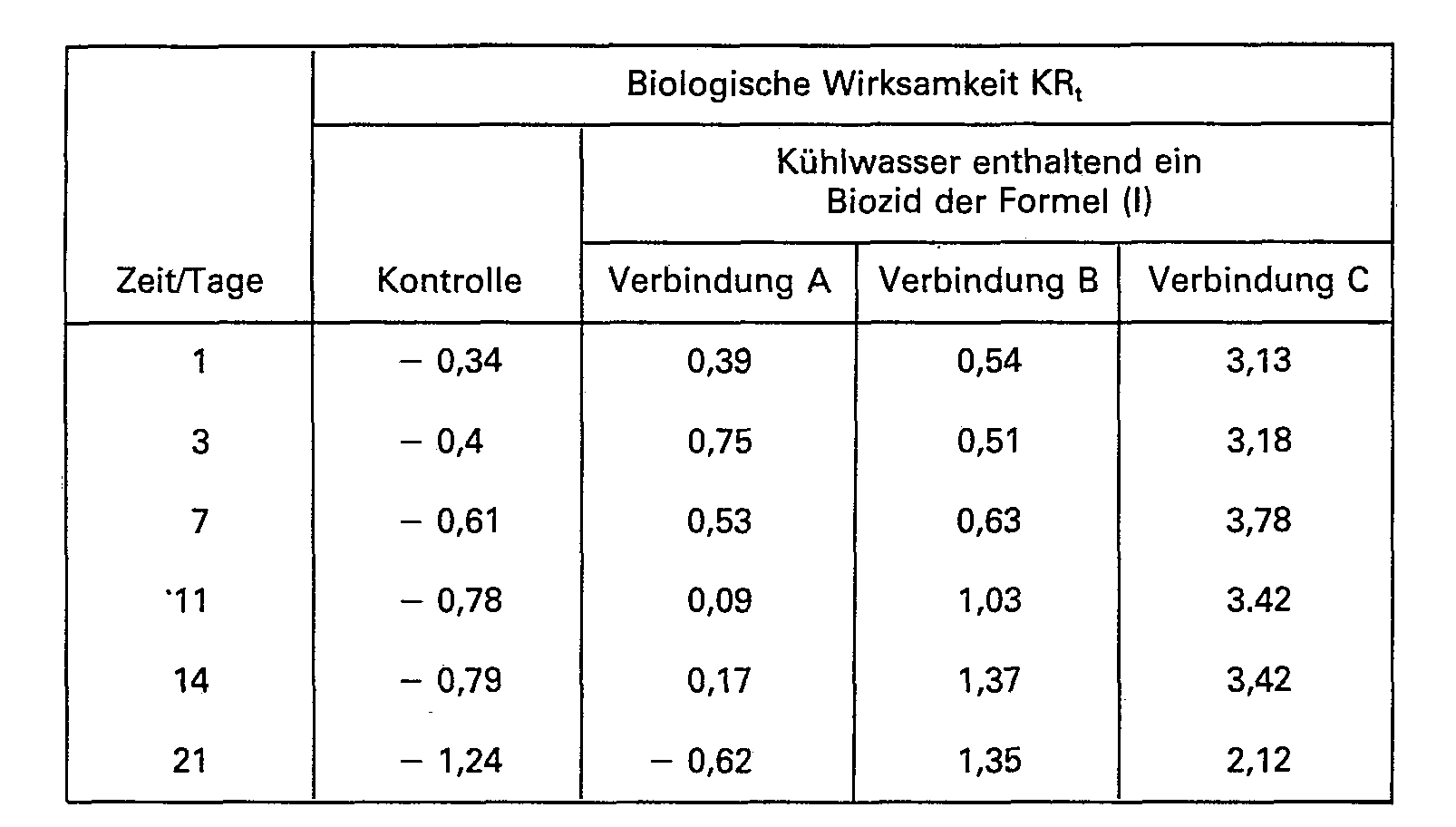
- Kontrolle: KR, = log KBE - log KBE (Ko)
- Kühlwasser mit Biozid: KR, = log KBE - KBE (D)
- KBE: Anzahl koloniebildender Einheiten pro ml ohne Einwirkung des Biozids zum Zeitpunkt null (konstanter Wert).
- KBE (Ko): Anzahl koloniebildender Einheiten pro ml ohne Einwirkung des Biozids.
- KBE (D): Anzahl koloniebildender Einheiten pro ml nach Einwirkung des Biozids.
- Der Tabelle ist zu entnehmen, dass eine einmalige Behandlung des Kühlwassers mit den erfindungsgemäss verwendeten Verbindungen die Keimzahl über einen Zeitraum von 14 bzw. 21 Tagen reduziert, während in dem unbehandelten Kühlwasser ein Anstieg der Keimzahl zu erkennen ist.
- Es wird ein im Laboratorium installiertes Schwimmbad-Modell benutzt, bestehend aus:
- a) einem Aquarium (Volumen: 55 I)
- b) einer Pumpe (Leistung: 27 I/min) (Die Rezirkulationsrate wird durch einen Abzweig auf 100 I/h reduziert.)
- c) einem Sandfilter (ca. 1 I Filterstand)
- Das Schwimmbad-Modell wird mit Tageslichtlampen im 14-Stunden Licht-10 Stunden Dunkelwechsel beleuchtet. Die Wassertemperatur stellt sich dabei auf 25-30°C ein.
- Das Modellschwimmbad wird wöchentlich angeimpft mit jeweils 10 µl einer 1 + 1 + 1 etc. Mischkultur der Uebernachtkulturen von

- Ausserdem werden 10 ml einer 1 + 1 + 1 + etc. Mischkultur der 14-tägigen Algenkulturen von
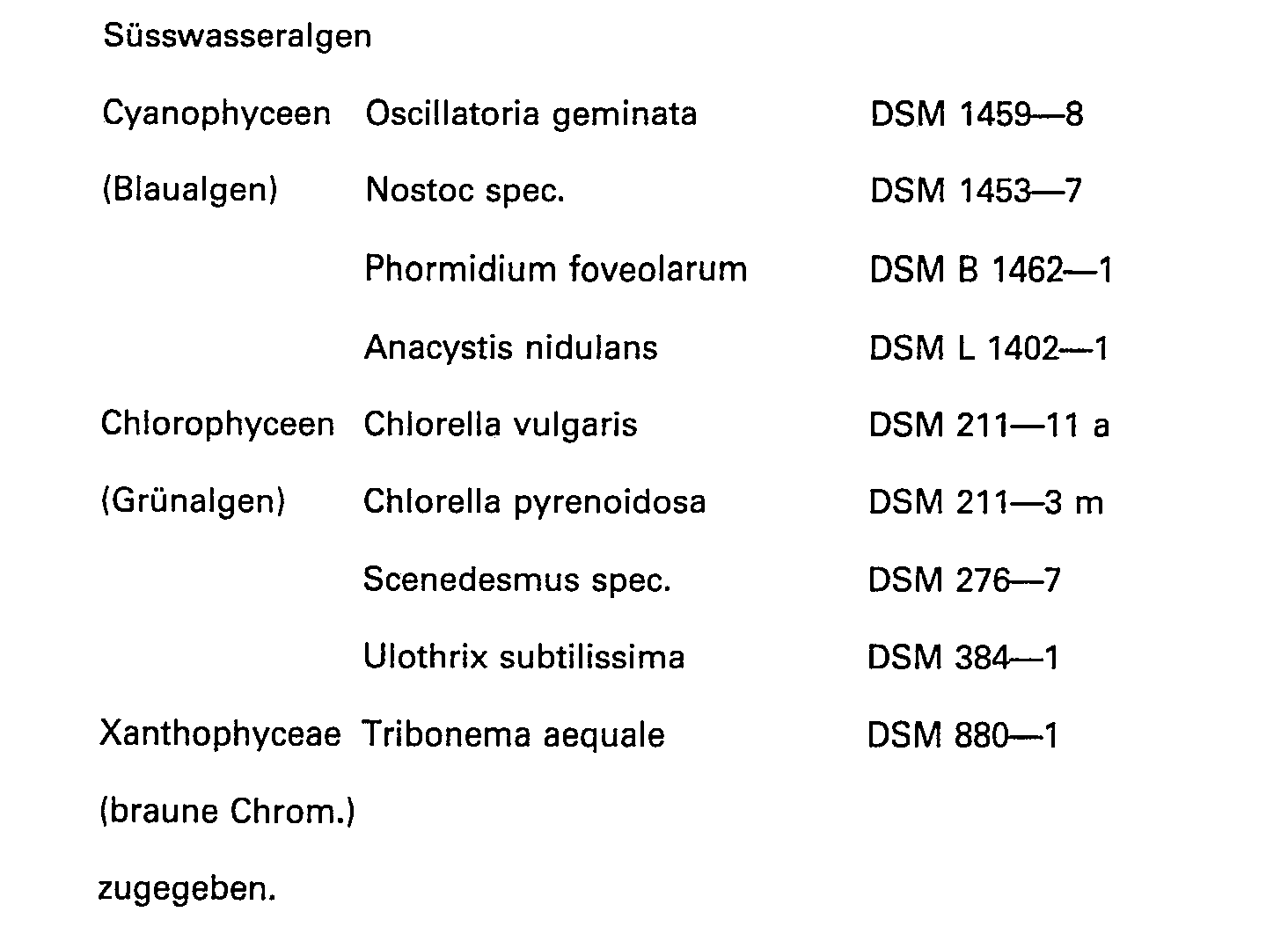
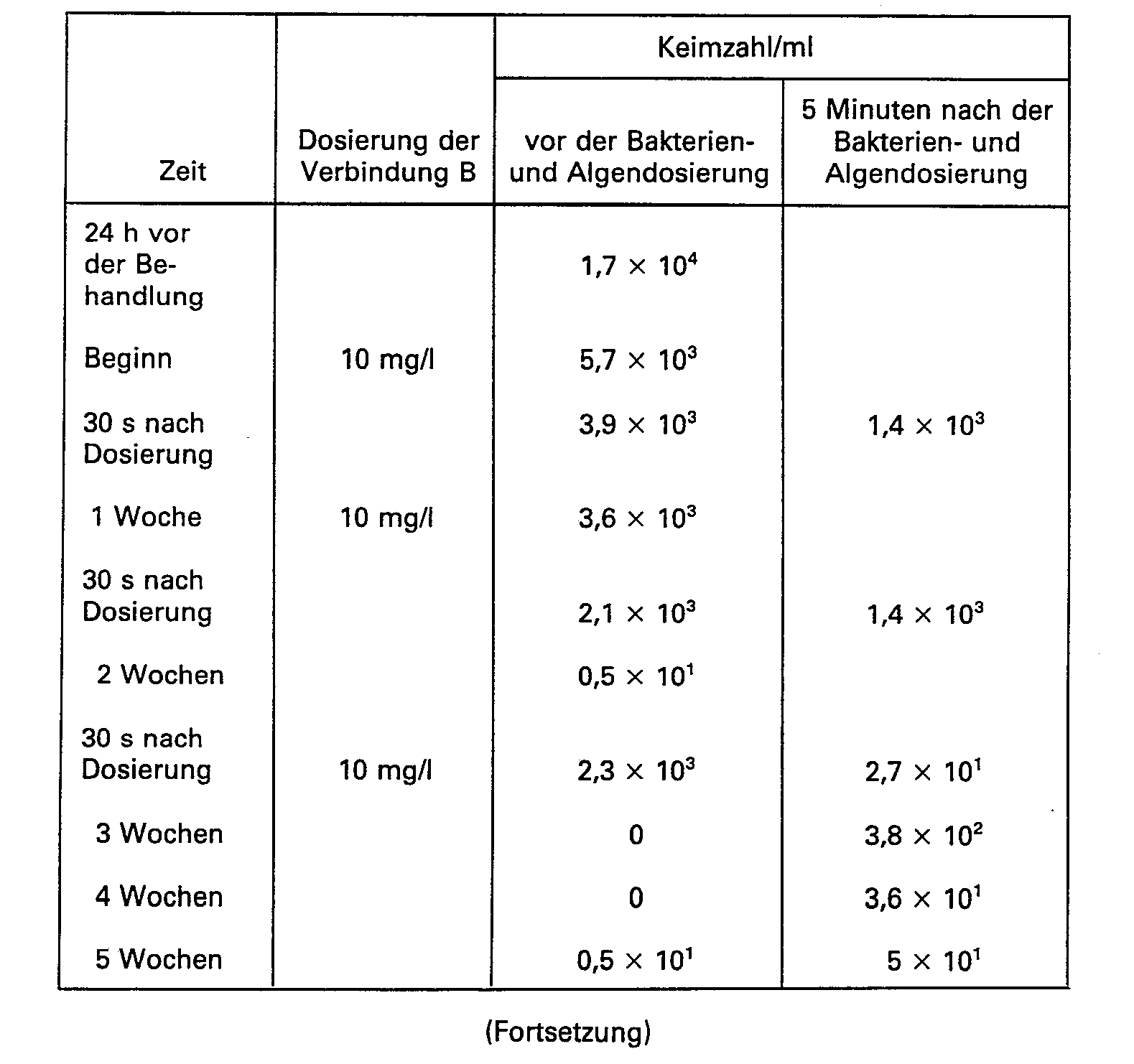
- Zunächst beträgt die Konzentration der Verbindung B 10 mg/I. Nach einer Woche wird sie auf 20 mg/I erhöht und durch Nachdosierung aufrecht erhalten. Ausgewertet wird der Versuch durch visuelle Beobachtung und Keimzahlbestimmung auf Caso-Agar und Algen-Agar.
- Wie die folgende Tabelle zeigt, halten 20 ppm der Verbindung B das Wasser nahezu steril. Algenwuchs kann über den gesamten Versuchszeitraum von 26 Wochen nicht festgestellt werden.

- Ein in einem Park gelegenes Versuchschwimmbad, das mit Ortswasser gefüllt ist, hat folgende Daten:
- Volumen: 8,5 m3
- Wassertiefe: 0,4 m
- Sandfilter: ca. 4 x Gesamtvolumen Umwälzung pro Tag
- Lage: ganztägig Sonne
- Der Versuch wird während der Sommermonate durchgeführt.
- Die Konzentration der Verbindung B beträgt 20 ppm und wird durch Nachdosierung aufrecht erhalten.
- Ausgewertet wird der Versuch durch visuelle Beobachtung und Bestimmung der Keimzahl auf Caso-Agar und Algen-Agar.
- Versuchsergebnisse:
- 1. Die Algenkeimzahl ist während des gesamten Versuchszeitraums kleiner als 101 Keime/ml.
- 2. Mit der Dosierung von 20 ppm der Verbindung B und Nachdosieren auf 20 ppm wird das Schwimmbadwasser nahezu steril gehalten.
- 3. Das Wasser macht über den gesamten Versuchszeitraum visuell einen hervorragenden Eindruck.
Claims (6)

Applications Claiming Priority (2)
| Application Number | Priority Date | Filing Date | Title |
|---|---|---|---|
| CH224485 | 1985-05-28 | ||
| CH2244/85 | 1985-05-28 |
Publications (3)
| Publication Number | Publication Date |
|---|---|
| EP0203892A2 EP0203892A2 (de) | 1986-12-03 |
| EP0203892A3 EP0203892A3 (en) | 1988-01-07 |
| EP0203892B1 true EP0203892B1 (de) | 1990-10-03 |
Family
ID=4229225
Family Applications (1)
| Application Number | Title | Priority Date | Filing Date |
|---|---|---|---|
| EP19860810222 Expired - Lifetime EP0203892B1 (de) | 1985-05-28 | 1986-05-22 | Ein mit Biozid ausgerüstetes wässriges System |
Country Status (5)
| Country | Link |
|---|---|
| US (1) | US4752318A (de) |
| EP (1) | EP0203892B1 (de) |
| JP (1) | JP2572571B2 (de) |
| CA (1) | CA1276796C (de) |
| DE (1) | DE3674640D1 (de) |
Families Citing this family (4)
| Publication number | Priority date | Publication date | Assignee | Title |
|---|---|---|---|---|
| DE3840103C2 (de) * | 1988-11-28 | 1994-10-06 | Bayrol Chem Fab Gmbh | Verfahren zum Entkeimen und Entalgung von Wasser |
| AR243854A1 (es) * | 1989-10-12 | 1993-09-30 | Buckman Labor Inc | Proceso para inhibir la adhesion de celulas bacterianas a superficies solidas y controlar la contaminacion biologica en circuitos acuosos. |
| US5169777A (en) * | 1989-10-27 | 1992-12-08 | The United States Of America As Represented By The Secretary Of The Army | Composition of biologically pure cultures of Alcaligenes denitrificans denitrificans and a porous carrier useful for biodegradation |
| ES3019938T3 (en) * | 2021-02-08 | 2025-05-21 | C Square Bioscience Gmbh | Device and method for regulating the content of microorganisms |
Family Cites Families (8)
| Publication number | Priority date | Publication date | Assignee | Title |
|---|---|---|---|---|
| US3721292A (en) * | 1971-08-05 | 1973-03-20 | Vetco Offshore Ind Inc | Marine riser liner apparatus and methods of installing such apparatus |
| JPS5116703A (ja) * | 1974-07-31 | 1976-02-10 | Kawasaki Heavy Ind Ltd | Jikojoshoshikikozotaino shijikyakufuriidorotsupuhajikikoseigyohoho |
| CH592417A5 (en) * | 1975-05-26 | 1977-10-31 | Carnag Fleischhandel Ag Winter | Extractor for ribs from sides of pork - has foot pedal actuated hydraulics requiring minimal effort from operator |
| US4018592A (en) * | 1975-07-21 | 1977-04-19 | Buckman Laboratories, Inc. | Method of controlling the growth of algae |
| CH1669775A4 (de) * | 1975-12-23 | 1977-06-30 | ||
| DE2634051A1 (de) * | 1976-07-29 | 1978-02-02 | Henkel Kgaa | Antimikrobielle mittel zur konservierung von industrie- und brauchwasser |
| NL7708479A (nl) * | 1976-08-12 | 1978-02-14 | Itd Ind Inc | Zonweringsprodukten. |
| CA1073464A (en) * | 1977-05-26 | 1980-03-11 | Harold A. Green | Polymeric quaternary ammonium compounds |
-
1986
- 1986-05-22 DE DE8686810222T patent/DE3674640D1/de not_active Expired - Lifetime
- 1986-05-22 EP EP19860810222 patent/EP0203892B1/de not_active Expired - Lifetime
- 1986-05-22 US US06/865,719 patent/US4752318A/en not_active Expired - Lifetime
- 1986-05-26 CA CA 509945 patent/CA1276796C/en not_active Expired - Lifetime
- 1986-05-28 JP JP12319186A patent/JP2572571B2/ja not_active Expired - Lifetime
Also Published As
| Publication number | Publication date |
|---|---|
| JPS61278396A (ja) | 1986-12-09 |
| CA1276796C (en) | 1990-11-27 |
| EP0203892A3 (en) | 1988-01-07 |
| DE3674640D1 (de) | 1990-11-08 |
| US4752318A (en) | 1988-06-21 |
| JP2572571B2 (ja) | 1997-01-16 |
| EP0203892A2 (de) | 1986-12-03 |
Similar Documents
| Publication | Publication Date | Title |
|---|---|---|
| DE69233103T2 (de) | Verfahren und Mittel zur Desinfektion von Wasser | |
| EP0066544B1 (de) | Wasseraufbereitung | |
| DE68928874T2 (de) | Biozide Zusammensetzungen | |
| DE69621043T2 (de) | Anwendung von amides zur kontrolle des biobewuchses | |
| DE2822818C2 (de) | ||
| CN1116041A (zh) | 含4,5-二氯-2-n-辛基-3-异噻唑酮和某些商用杀生物剂的协同杀微生物组合物 | |
| Boyd | Aluminum sulfate (alum) for precipitating clay turbidity from fish ponds | |
| DE69630212T2 (de) | Aluminium- und mehrbasische carbonsäuren-haltiges flockungsmittel | |
| DE69811505T2 (de) | Verfahren und zusammensetzungen zur bekämpfung von biologischer verschmutzung unter verwendung von sulfaminsäuren | |
| EP0203892B1 (de) | Ein mit Biozid ausgerüstetes wässriges System | |
| US20080230094A1 (en) | Method to inhibit growth of microorganisms in aqueous systems and on substrates using persulfate and a bromide | |
| WO1991007090A1 (de) | Bekämpfung von schleimbildenden mikroorganismen | |
| DE69512340T2 (de) | Verfahren zur Bekämpfung von biologischen Verschmutzungen bei der Erdölförderung | |
| DE19517463C2 (de) | Verfahren zur algiziden Behandlung von Wasser | |
| DE69834340T2 (de) | ANWENDUNG VON AMINOMETHYLPHOSPHONSÄUREN ODER DEREN SALZE ZUM iNHIBIEREN DES ANHAFTENS VON BAKTERIEN AN DER TACHNOBERFLÄCHE UND BEHERRSCHUNG DES BIOBEWUCHSES | |
| EP0017611B1 (de) | Verfahren zum Bekämpfen von Schadorganismen und Mittel für diese Bekämpfung | |
| DE69628043T2 (de) | Kontrolle von bioverschmützungen mit n-alkylheterocyclischen verbindungen | |
| DE2131029A1 (de) | Mittel zur bekaempfung und verhinderung des wachstums von algen und mikroorganismen in waessrigen systemen | |
| US20040084383A1 (en) | Method to inhibit growth of microorganisms in aqueous systems and on substrates using a persulfate and a bromide | |
| EP0079308B1 (de) | Verwendung von Mono- und Dibromdicyanomethan zur Bekämpfung von Schadorganismen und Mittel für die Bekämpfung von Schadorganismen | |
| DE2221545C3 (de) | Verfahren zur Herstellung von Aquariumwasser | |
| US3905797A (en) | Algaecide and herbicide composition | |
| DE1906588A1 (de) | Verfahren zur Steuerung des Wachstums von Kulturen von Mikroorganismen,insbesondere zur biologischen Behandlung bzw. Aufbereitung von Abwaessern | |
| DE3135194C2 (de) | Verfahren zur Verhinderung der Bildung bzw. des Wachstums von Algen und Schleim bildenden Bakterien in offenen Brauchwassersystemen | |
| DE69016344T2 (de) | Verwendung von wasserlöslichen ionenen Polymeren zur Verhütung von Bakterienansätzen und zum Reduzieren von biologischer Verschmutzung in wässerigen Systemen. |
Legal Events
| Date | Code | Title | Description |
|---|---|---|---|
| PUAI | Public reference made under article 153(3) epc to a published international application that has entered the european phase |
Free format text: ORIGINAL CODE: 0009012 |
|
| AK | Designated contracting states |
Kind code of ref document: A2 Designated state(s): DE FR GB IT NL |
|
| PUAL | Search report despatched |
Free format text: ORIGINAL CODE: 0009013 |
|
| AK | Designated contracting states |
Kind code of ref document: A3 Designated state(s): DE FR GB IT NL |
|
| 17P | Request for examination filed |
Effective date: 19860522 |
|
| 17Q | First examination report despatched |
Effective date: 19890308 |
|
| GRAA | (expected) grant |
Free format text: ORIGINAL CODE: 0009210 |
|
| AK | Designated contracting states |
Kind code of ref document: B1 Designated state(s): DE FR GB IT NL |
|
| ITF | It: translation for a ep patent filed | ||
| REF | Corresponds to: |
Ref document number: 3674640 Country of ref document: DE Date of ref document: 19901108 |
|
| ET | Fr: translation filed | ||
| GBT | Gb: translation of ep patent filed (gb section 77(6)(a)/1977) | ||
| PLBE | No opposition filed within time limit |
Free format text: ORIGINAL CODE: 0009261 |
|
| STAA | Information on the status of an ep patent application or granted ep patent |
Free format text: STATUS: NO OPPOSITION FILED WITHIN TIME LIMIT |
|
| 26N | No opposition filed | ||
| ITTA | It: last paid annual fee | ||
| REG | Reference to a national code |
Ref country code: GB Ref legal event code: 732E |
|
| REG | Reference to a national code |
Ref country code: FR Ref legal event code: TP |
|
| NLS | Nl: assignments of ep-patents |
Owner name: FMC CORPORATION (UK) LIMITED TE MANCHESTER, GROOT- |
|
| PGFP | Annual fee paid to national office [announced via postgrant information from national office to epo] |
Ref country code: NL Payment date: 19980324 Year of fee payment: 13 |
|
| PGFP | Annual fee paid to national office [announced via postgrant information from national office to epo] |
Ref country code: GB Payment date: 19980403 Year of fee payment: 13 |
|
| PGFP | Annual fee paid to national office [announced via postgrant information from national office to epo] |
Ref country code: FR Payment date: 19980508 Year of fee payment: 13 |
|
| PGFP | Annual fee paid to national office [announced via postgrant information from national office to epo] |
Ref country code: DE Payment date: 19980529 Year of fee payment: 13 |
|
| PG25 | Lapsed in a contracting state [announced via postgrant information from national office to epo] |
Ref country code: GB Free format text: LAPSE BECAUSE OF NON-PAYMENT OF DUE FEES Effective date: 19990522 |
|
| PG25 | Lapsed in a contracting state [announced via postgrant information from national office to epo] |
Ref country code: NL Free format text: LAPSE BECAUSE OF NON-PAYMENT OF DUE FEES Effective date: 19991201 |
|
| GBPC | Gb: european patent ceased through non-payment of renewal fee |
Effective date: 19990522 |
|
| PG25 | Lapsed in a contracting state [announced via postgrant information from national office to epo] |
Ref country code: FR Free format text: LAPSE BECAUSE OF NON-PAYMENT OF DUE FEES Effective date: 20000131 |
|
| NLV4 | Nl: lapsed or anulled due to non-payment of the annual fee |
Effective date: 19991201 |
|
| PG25 | Lapsed in a contracting state [announced via postgrant information from national office to epo] |
Ref country code: DE Free format text: LAPSE BECAUSE OF NON-PAYMENT OF DUE FEES Effective date: 20000301 |
|
| REG | Reference to a national code |
Ref country code: FR Ref legal event code: ST |
|
| PG25 | Lapsed in a contracting state [announced via postgrant information from national office to epo] |
Ref country code: IT Free format text: LAPSE BECAUSE OF NON-PAYMENT OF DUE FEES;WARNING: LAPSES OF ITALIAN PATENTS WITH EFFECTIVE DATE BEFORE 2007 MAY HAVE OCCURRED AT ANY TIME BEFORE 2007. THE CORRECT EFFECTIVE DATE MAY BE DIFFERENT FROM THE ONE RECORDED. Effective date: 20050522 |