EP0200229A2 - Beschichtungszusammensetzung zur Enteisung - Google Patents
Beschichtungszusammensetzung zur Enteisung Download PDFInfo
- Publication number
- EP0200229A2 EP0200229A2 EP86106033A EP86106033A EP0200229A2 EP 0200229 A2 EP0200229 A2 EP 0200229A2 EP 86106033 A EP86106033 A EP 86106033A EP 86106033 A EP86106033 A EP 86106033A EP 0200229 A2 EP0200229 A2 EP 0200229A2
- Authority
- EP
- European Patent Office
- Prior art keywords
- composition
- coating composition
- compound
- parts
- alkali metal
- Prior art date
- Legal status (The legal status is an assumption and is not a legal conclusion. Google has not performed a legal analysis and makes no representation as to the accuracy of the status listed.)
- Granted
Links
Images
Classifications
-
- C—CHEMISTRY; METALLURGY
- C09—DYES; PAINTS; POLISHES; NATURAL RESINS; ADHESIVES; COMPOSITIONS NOT OTHERWISE PROVIDED FOR; APPLICATIONS OF MATERIALS NOT OTHERWISE PROVIDED FOR
- C09K—MATERIALS FOR MISCELLANEOUS APPLICATIONS, NOT PROVIDED FOR ELSEWHERE
- C09K3/00—Materials not provided for elsewhere
- C09K3/18—Materials not provided for elsewhere for application to surfaces to minimize adherence of ice, mist or water thereto; Thawing or antifreeze materials for application to surfaces
-
- C—CHEMISTRY; METALLURGY
- C08—ORGANIC MACROMOLECULAR COMPOUNDS; THEIR PREPARATION OR CHEMICAL WORKING-UP; COMPOSITIONS BASED THEREON
- C08K—Use of inorganic or non-macromolecular organic substances as compounding ingredients
- C08K5/00—Use of organic ingredients
- C08K5/0008—Organic ingredients according to more than one of the "one dot" groups of C08K5/01 - C08K5/59
-
- C—CHEMISTRY; METALLURGY
- C08—ORGANIC MACROMOLECULAR COMPOUNDS; THEIR PREPARATION OR CHEMICAL WORKING-UP; COMPOSITIONS BASED THEREON
- C08K—Use of inorganic or non-macromolecular organic substances as compounding ingredients
- C08K5/00—Use of organic ingredients
- C08K5/49—Phosphorus-containing compounds
- C08K5/51—Phosphorus bound to oxygen
-
- C—CHEMISTRY; METALLURGY
- C08—ORGANIC MACROMOLECULAR COMPOUNDS; THEIR PREPARATION OR CHEMICAL WORKING-UP; COMPOSITIONS BASED THEREON
- C08L—COMPOSITIONS OF MACROMOLECULAR COMPOUNDS
- C08L57/00—Compositions of unspecified polymers obtained by reactions only involving carbon-to-carbon unsaturated bonds
- C08L57/06—Homopolymers or copolymers containing elements other than carbon and hydrogen
- C08L57/08—Homopolymers or copolymers containing elements other than carbon and hydrogen containing halogen atoms
-
- C—CHEMISTRY; METALLURGY
- C08—ORGANIC MACROMOLECULAR COMPOUNDS; THEIR PREPARATION OR CHEMICAL WORKING-UP; COMPOSITIONS BASED THEREON
- C08L—COMPOSITIONS OF MACROMOLECULAR COMPOUNDS
- C08L67/00—Compositions of polyesters obtained by reactions forming a carboxylic ester link in the main chain; Compositions of derivatives of such polymers
-
- C—CHEMISTRY; METALLURGY
- C08—ORGANIC MACROMOLECULAR COMPOUNDS; THEIR PREPARATION OR CHEMICAL WORKING-UP; COMPOSITIONS BASED THEREON
- C08L—COMPOSITIONS OF MACROMOLECULAR COMPOUNDS
- C08L71/00—Compositions of polyethers obtained by reactions forming an ether link in the main chain; Compositions of derivatives of such polymers
-
- C—CHEMISTRY; METALLURGY
- C08—ORGANIC MACROMOLECULAR COMPOUNDS; THEIR PREPARATION OR CHEMICAL WORKING-UP; COMPOSITIONS BASED THEREON
- C08L—COMPOSITIONS OF MACROMOLECULAR COMPOUNDS
- C08L75/00—Compositions of polyureas or polyurethanes; Compositions of derivatives of such polymers
- C08L75/04—Polyurethanes
-
- C—CHEMISTRY; METALLURGY
- C09—DYES; PAINTS; POLISHES; NATURAL RESINS; ADHESIVES; COMPOSITIONS NOT OTHERWISE PROVIDED FOR; APPLICATIONS OF MATERIALS NOT OTHERWISE PROVIDED FOR
- C09D—COATING COMPOSITIONS, e.g. PAINTS, VARNISHES OR LACQUERS; FILLING PASTES; CHEMICAL PAINT OR INK REMOVERS; INKS; CORRECTING FLUIDS; WOODSTAINS; PASTES OR SOLIDS FOR COLOURING OR PRINTING; USE OF MATERIALS THEREFOR
- C09D175/00—Coating compositions based on polyureas or polyurethanes; Coating compositions based on derivatives of such polymers
- C09D175/04—Polyurethanes
-
- C—CHEMISTRY; METALLURGY
- C09—DYES; PAINTS; POLISHES; NATURAL RESINS; ADHESIVES; COMPOSITIONS NOT OTHERWISE PROVIDED FOR; APPLICATIONS OF MATERIALS NOT OTHERWISE PROVIDED FOR
- C09D—COATING COMPOSITIONS, e.g. PAINTS, VARNISHES OR LACQUERS; FILLING PASTES; CHEMICAL PAINT OR INK REMOVERS; INKS; CORRECTING FLUIDS; WOODSTAINS; PASTES OR SOLIDS FOR COLOURING OR PRINTING; USE OF MATERIALS THEREFOR
- C09D201/00—Coating compositions based on unspecified macromolecular compounds
-
- C—CHEMISTRY; METALLURGY
- C09—DYES; PAINTS; POLISHES; NATURAL RESINS; ADHESIVES; COMPOSITIONS NOT OTHERWISE PROVIDED FOR; APPLICATIONS OF MATERIALS NOT OTHERWISE PROVIDED FOR
- C09D—COATING COMPOSITIONS, e.g. PAINTS, VARNISHES OR LACQUERS; FILLING PASTES; CHEMICAL PAINT OR INK REMOVERS; INKS; CORRECTING FLUIDS; WOODSTAINS; PASTES OR SOLIDS FOR COLOURING OR PRINTING; USE OF MATERIALS THEREFOR
- C09D5/00—Coating compositions, e.g. paints, varnishes or lacquers, characterised by their physical nature or the effects produced; Filling pastes
Definitions
- the present invention relates to a coating composition for preventing ice deposition, and more particularly to a deicing coating composition which comprises a synthetic resin coating composition of the organic solvent type and a fluorine-containing compound having a perfluoroalkyl group, with addition of an alkali metal compound to the resin composition when required, and which is adapted to prevent ice deposition from firmly adhering to the surface of articles.
- the proposed deicing coating composition of the organopolysiloxane resin type has the drawbacks of being costly because the organopolysiloxane resin is much more expensive than other synthetic resins and necessitating a primer before application because of the poor adhesion of the composition to the article to be coated.
- the object of the present invention is to provide deicing coating compositions as improvements over the conventional compositions mentioned above.
- the present invention provides a deicing coating composition characterized in that the composition comprises a synthetic resin coating composition of the organic solvent type and 0.1 to 75 parts by weightt per 100 parts by weight of the resin solids of the component composition, of at least one fluorine-containing compound selected from the group consisting of urethane, phosphate, phosphonic acid derivative, phosphinic acid derivative, polyether, polyester and polyvinyl compounds having a perfluoroalkyl group with 6 to 20 carbon atoms.
- the invention also provides a deicing coating composition prepared by adding to the above deicing coating composition 0.1 to 50 parts by weight of an alkali metal compound per 100 parts by weight of the resin solids of the component composition, the alkali metal compound being represented by the formula wherein M is an alkali metal selected from among Li, Na a and K, X is an inorganic acid radical hydroxyl group or organic acid radical, and a is an integer of from 1 to 4.
- the deicing coating composition of the present invention has ability to prevent ice deposition presumably because the fluorine-containing compound present forms a mierophase separation structure in the coating formed from the composition to become firmly fixed to the coating and also acts to reduce the surface energy of the coating. Further when the alkali metal compound is used conjointly with the fluorine-containing compound, the alkali metal compound will coact with the latter to produce a synergistic effect to prevent ice deposition. The action of the alkali metal compound will be described, for examples with reference to a lithium compound.
- the ionic radius of I.i ⁇ is small (0.6 angstrom), so that the hydration energy is as great as 125Kg cal g/ion.
- Na ⁇ has hydration energy of 94.6Kg cal g/ion.
- the ion Around the Li ⁇ ion, the ion has attracted thereto five molecules of water and further ten molecules of water around these water molecules. The water molecules are positioned very close to the lithium ion and are therefore held attracted thereto with greater energy than the hydrogen bond without forming hydrogen bonds. Consequently, the lithium compound trapped in the matrix of the organic resin does not permit freezing of the water molecules attracted thereto on the surface of the coatings thus obviating adhesion of ice.
- the Na G ion and K ⁇ ion act similarly, the Lie ion is exceedingly effective and is therefore more suitable.
- the synthetic resin coating composition of the organic solvent type to be used in the present invention may be in the form of an organic solvent solution or organic solvent dispersion.
- Known synthetic resin coating compositions are usable which include, for example, coating compositions of acrylic resins, polyurethane resins, epoxy resins, alkyd resins and the like.
- acrylic resin, polyurethane resin and epoxy resin coating compositions are desirable since these compositions are more excellent than the others in the properties of coatings at low temperatures of up to 0°C.
- Typical examples of synthetic resin coating compositions of the organic solvent type will be described below.
- Acrylic resin type coating composition is prepared by adding to an acrylic resin obtained by polymerizing at least one ethylenically unsaturated monomer by a conventional method, an organic solvent, as required, crosslinking agent (melamine resin, polyisocyanate, alkoxysilane compound, etc. ), coloring agent (pigment, dye), auxiliary agent (pigment-dispersing agent, surface flowability adjusting agent, etc. ).
- crosslinking agent melamine resin, polyisocyanate, alkoxysilane compound, etc.
- coloring agent pigment, dye
- auxiliary agent pigment-dispersing agent, surface flowability adjusting agent, etc.
- Examples of useful ethylenically unsaturated monomers which constitute the acrylic resin are (meth)acrylic C 1 ⁇ 18 alkyl esters such as methyl (meth)acrylate, ethyl (meth)acrylate, propyl (meth)acrylate; isopropyl (meth)acrylate, butyl (meth)acrylate, hexyl (meth)acrylate, 2-ethylhexyl (meth)acrylate, octyl (meth)acrylate, lauryl (meth)acrylate, etc; glycidyl (meth)-acrylate; (meth)acrylic C 2 ⁇ 18 alkoxyalkyl esters such as methoxybutyl (meth)aerylate, methoxyethyl (meth)acrylate, ethoxybutyl (meth)acrylate, etc; (meth)acrylic C 2 ⁇ 3 alkenyl esters such as allyl (meth)acrylate, ete
- an unsaturated monomer other than the above acrylic monomers can be used conjointly in order to obtain a desired property.
- These monomers include styrene, ⁇ methylstyrene, vinyltoluene, acrylonitrile, methacrylonitrile, acrolein, methacrolein, butadiene, isoprene, etc.
- the acrylic type resin useful in the invention has a number average molecular weight of about 3,000 to about 100,000, preferably of about 15,000 to about 45,000, and has a glass transition temperature of -40 to +80°C, preferably of -20 to +50°C,
- polyurethane resin 'type coating compositions are those cured with a polyol and those cured with moisture.
- useful polyisocyanate compounds are tolylene diisocyanate, diplienyl ⁇ methane diisocyanate, lysine diisocyanate methyl ester, dicyclohexylmethane diisocyanate; isophorone diisocyanate, xylylene diisocyanate, hexamethylene diisocyanate, 4,4' ⁇ diphenylmethane diisocyanate, Desmodur N [OCN(CH 2 ) 6 N ⁇ CONH-(CH 2 ) 6 NCO] 2 , product of Bayer A G, W .
- polystyrene resin polystyrene resin
- polyester polyol polystyrene resin
- acryl polyol polystyrene resin
- epoxy polyol polystyrene resin
- the polyurethane resin type coating composition can be prepared by mixing the above binder component with an organic solvent, coloring agent, auxiliary agent, etc, and is excellent in durability, bending property, resistance to chemicals, etc. compared with other synthetic resin coating composition.
- I n an epoxy resin coating composition
- a conventional epoxy resin as a binder component.
- polyglycidyl ether of polyphenol can be used which is obtained by reacting a polyphenol and epichlorohydrin in the presence of an alkali.
- Examples of useful polyphenols are bis( 4 ⁇ hydroxyphenyl) ⁇ 2,2-propane, 4,4'-dihydroxyhenzophenone, bis( 4 -hydroxyphenyl) ⁇ 1,1 ⁇ ethane, bis(4-hydroxyphenyl)-1,1-isobutane, bis( 4-hydroxy-tert-butylphenyl)-2,2-propane, bis( 2 hydraxynaphthyl)methane, 1,5-dihydroxynaphthalene, etc.
- epoxy resin which is prepared by reacting diglycidyl ether with the above polyphenol and subsequently reacting epichlorohydrin with the resulting product.
- epoxy resins preferable are those having a number average molecular weight of at least about 350, more preferably of about 350 to 5,000, an epoxy equivalent of 150 to 4,000, more preferably of 190 to 2,000.
- examples of commercially available epoxy resins are Epikote 828, 1001, 1002, 1004, 1007 (product of Shell Oil 1 Co. , Ltd. ), etc.
- Furhter t as a hardener for epoxy resin can be used polyamine, polyamide and like conventional ones.
- the epoxy resin coating composition is prepared by mixing the above epoxy resin, hardener, organic solvent, coloring agent, auxiliary agent, etc. conjointly.
- an alkyd resin coating composition it is posaible to use a known alkyd resin prepared by a usual method as a binder component.
- useful alkyd resins are oil - modified alkyd resin, rosin-modified alkyd resin, phenolic resin - modified alkyd resin, styrenated alkyd resin, acryl-modified alkyd resin, epoxy resin-modified alkyd resin, silicone resin -modified alkyd resin, oil - free alkyd resin (polyester resin), etc.
- the alkyd resin coating composition can be obtained by adding to the above alkyd resin an organic solvent, coloring agent, auxiliary agent and the like.
- the deicing coating composition of the invention is prepared by adding to the above synthetic resin coating composition of the organic solvent type, at least one fluorine-containing compound selected from the group consisting of urethane, phosphate, phosphonic acid derivative, phosphinic acid derivative, polyether, polyester and polyvinyl compounds, each having a perfluoroalkyl group of 6 to 20 carbon atoms.
- the urethane compounds include the following compound.
- the compound of the formula (1) is obtained, as described in U S Patent Nos. 3398182 and 3484281, by mixing with heating the starting fluorine-containing alcohol (one mole) and diisocyanate compound (one mole) with or without presence of a catalyst such as triethylamine, etc. to perform a first-step reaction, and subsequently adding to the resulting product one mole of a specific alcohol, amine or carboxylic acid compound etc.
- a catalyst such as triethylamine, etc.
- Rf, X, Y and Z are determined depending on structure of the starting material.
- fluorine-containing alcohols known compounds are widely used.
- the following compounds are exemplified. wherein d is 5 to 9 e is 1 or 2
- R 4 is -CH 3 or-C 2 H 5 , wherein u is 7 to 12, v is 1 or 2, wherein u is 7 to 12, v is 1 or 2.
- diisocyanate compounds known compounds can widely be used such as tolylene diisocyanate, diphenylmethane diisocyanate (MD I ), hydrogenated M D I , hexamethylene diisocyanate, etc.
- MD I diphenylmethane diisocyanate
- M D I hydrogenated M D I
- hexamethylene diisocyanate etc.
- the residue of the diisocyanate compound becomes divalent organic group Y,
- alcohols, amines or carboxylic acid compounds known compounds are widely used such as phenol, cyclohexanol, ethylene glycol, aliphatic alcohols having 1 to 7 carbon atoms, aniline, aliphatic amines having 1 to 3 carbon atoms, benzoic acid, aliphatic carboxylic acids having 1 to 3 carbon atoms, etc.
- the residue of these compounds becomes monovalent organic group Z.
- the compound of the formula (2) can be prepared, for example, by reacting a diisocyanate compound of the formula OCNYNCO with a fluorine-containing alcohol of the formula RfXOH to obtain a compound of the formula and subsequently reacting the resulting compound with water.
- a diisocyanate compound of the formula OCNYNCO with a fluorine-containing alcohol of the formula RfXOH to obtain a compound of the formula and subsequently reacting the resulting compound with water.
- the diisocyanate compound and fluorine-containing alcohol the same compounds as above can be used.
- the compound of the formula (3) is prepared, for examgle, by reacting one mole of a polyisocyanate compound of the formula R 2 (NCO)b with a mole(s) of a fluorine-containing alcohol of the formula RfXOH to obtain a compound of the formula and reacting one mole of the resulting compound with (b-a) mole(s) of a lower alcohol of the formula R 3 OH.
- a s polyisocyanate compound for examples the following compounds are usable.
- fluorine-containing alcohol the same compounds as above are used.
- lower alcohol are used methanol, ethanol, propanol, butanol and the like.
- polyether compounds As polyether compounds are shown the following compounds.
- a copolymer (9) comprising structural units (a) and (b), the unit (a) being or wherein Rf is same as above, p is an integer of 1 to 10, the unit (b) being wherein r is an integer of 1 to 4 , s is an integer of 2 to 10 when r is 1, an integer of 1 to 8 when r is 2, an integer of 0 to (12-2r) when r is 3 or 4, whenin R 9 and R 10 are each CH 3 , CH 2 Cl, CH 2 F, GH 2 OCH 3 , CH 2 CC 2 H 5 , GH 2 COCOCH 3 , CH 2 OC 6 H 5 , CH 2 0H, CH 2 CN or H, provided that at least one of them being other than hydrogen or wherein q is 2 or 3.
- the epoxides which are copolymerizable with the above 3-perfluoroalkyl-1,2-epoxypropane monomer include ethylene oxide, propylene oxide, epichlorohydrin, epifluoro- hydrint perfluoropropylene oxide, isobutyolene oxide, butadiene oxide, styrene oxide, methyl glycidyl ether, allyl glycidyl ether, etc.
- the polymer or copolymer of the compound having the formula (8) is disclosed, for example, in Japanese UnexaMined patent publication No. 1971-25361 or British patent No. 782615.
- a part of the structural unit (b) may be substituted, when required, by other oxyethylene group of the formula wherein R 11 to R 14 are each hydrogen or substituted or unsubstituted alkyl or aryl.
- Other oxyethylene group is used in an amount of 0 to 80 mole% based on the total amount of copolymer.
- copolymer (9) can be prepared by reacting an epoxide of the formula with the following cyclic ether or cyclic formal under a polymerization condition, wherein r as s are same as above, wherein R 9 and R 10 are same as above, or wherein q is same as above.
- the copolymer (10) can be prepared, for example, by reacting under a polymerization condition, an epoxide of the formula wherein R and t are same as above, and an cyclic acid anhydride of the formula wherein R 15 is same as above.
- polyvinyl compound for example, ⁇ -perfluoroalkylvinyl polymer (14) which comprises the following structural unit (a) and, when desired, unit (b) in addition thereto, wherein Rf is same as above, and wherein D is OR 20 , OCOR 20 or COOR 20 , E is hydrogen or COOR 21 , R 20 and R 21 are same or different and are each alkyl having 1 to 18 carbon atoms, provided that E is hydrogen when D is O R 20 or OCOR 20
- the copolymer (14) is prepared, for example, by reacting under a polymerization condition a vinyl compound of the formula wherein Rf is same as above, other monomer and, when required, alkyl vinyl ether, organic acid vinyl ester or maleic ester represented by the formula wherein D and E are same as above.
- Examples of useful other monomers, another starting material are alkyl acrylate, alkyl methacrylate, acrylonitrile, methacrylonitrile, aliphatic acid vinyl ester, styrene, alkyl substituted styrene, vinyl halide, vinylidene halide, aliphatic acid allyl ester, vinyl alkyl ketone, vinyl alkyl ether, conjugated 1,3-diene, etc.
- alkyl vinyl ether organic acid vinyl ester and maleic ester.
- the deicing coating composition of the invention can be prepared by adding to 100 parts by weight of the resin solids of the above synthetic resin coating composition of the organic solvent type, 0.1 to 75 parts by weight, preferably 0.1 to 30 parts by weight of at least one fluorine-containing compound, and homogeneously dissolving or dispersing the compound therein, the fluorine-containing compound being selected from among urethane, phosphate, phoa p honic acid derivative, phosphinic acid derivative, polyether, polyester and polyvinyl compound, each having perfluoroalkyl group having 6 to 20 carbon atoms.
- the coating composition With less than 0.1 part by weight of the compound, the coating composition has no deicing ability, whereas with more than 75 parts by weight, the deicing ability is not sufficient due to loss of phase-separated structure.
- the alkali metal compound of the formula Ma ⁇ X ⁇ is, when required, added to the coating composition.
- M is an alkali metal which is selected from among Li, Na and K, Li being most preferable.
- X is inorganic acid radical, hydroxyl or organic acid radical.
- Inorganic acid radical means a residue removed from an inorganic acid molecule at least one hydrogen atoms which can be replaced by metal, and includes F ⁇ , Cl ⁇ Br ⁇ , I ⁇ and like single atoms, NO 3 ⁇ , CO 3 2 ⁇ , PO 4 3 ⁇ , HPO 4 2 ⁇ , SO 4 2 ⁇ , HSO 1 ⁇ , Cr 2 O 7 2 ⁇ , SiO 4 1 ⁇ , SiO 3 2 ⁇ , BO 2 ⁇ , VO 4 3 ⁇ , WO 4 2 ⁇ and like groups, etc.
- Organic acid radieal is a residue obtained by removing at least one hydrogen atoms which can be replaced by metal from a saturated or unsaturated mono-or polycarboxylic acid molecule.
- the radicals are HCOO ⁇ ⁇ saturated monocarboxylic acid radical of the formula GH 3 (CH 2 )xCOO ⁇ (x: integer of 0 to 20), saturated dicarboxylic acid radical of the formula unsaturated acid radical such as maleic acid radical, oleic acid radical, linoleic acid radical, etc,, polycarboxylic acid radical such as tartaric acid radical, citric acid radical, trimellitic acid radical, pyromellitic acid radieal, etc. and a is usually an integer of 1 to 4, determined depending on the kinds of inorganic or organic acid radical.
- Typical examples of the alkali metal compounds represented by the above formula are LiF, LiCl, LiBr, LiI , NaF, NaCl, NaBr, NaI, KF, KCI, KBr, K I, LiNO 3 , NaNO 3 , KNO 3 , Li 2 CO 3 , Na 2 CO 3 , K 2 CO 3 , Li 3 PO 4 , Na 3 PO 4 , K 3 PO 4 , Li 2 SO 4, Na 2 SO 4 , K 2 SO 4 ; LiMnO 4 , NaMnO 4 , KMnO 4 , Li 2 Cr 2 O 7 , Na 2 Cr 2 O 7 , K 2 Cr 2 O 7 , Li,SiO 4 , Li 2 SiO 3 , Na 4 SiO 4, Na 2 SiO 3 , K 4 SiO 4 , K 2 Si 3 , LiBO 2 , NaBO 2 , KBO 2 , Li 3 VO 4 , Na 3 VO 4 , K 3 VO 4 , Li 2 WO 4 , Na
- alkali metal compounds chlorides thereof are most excellent in deicing ability.
- Carbanates, silicates and acetates of alkali metal compounds have the second best property in preventing ice deposition. These are preferable because they exhibit continuous deicing property and hardly produce rust.
- t lithium salts are most preferable compared with sodium salts or potassium salts, since lithium salts have an excellent deicing property.
- the alkali meta compound is added in an amount of 0.1 to 50 parts by weight, preferably 1 to 20 parts by weight per 100 parts by weight of the resin solids of the synthetic resin coating composition of the organic solvent type. With less than 0.1 part by weight of alkali metal compound, the coating composition has a low deicing ability, whereas with more than 50 parts by weight, the coating is low in its property and can not withstand for a long period of use.
- the coating composition of the invention is usually employed in a low temperature atmosphere below 0°C from a purpose thereof, the composition possibly has a defect that the resulting coating may crack or break.
- the cellulose derivatives include both of ester-modified and ether-modified type cellulose derivative having an average molecular weight of usually about 3,000 to about 200,000, preferably about 5,000 to about 50,000.
- Examples of the former ester-modified type cellulose derivatives are nitrocellulose, cellulose acetate butyrate, cellulose acetate propionate, cellulose acetate phthalate, acetylcellulose, etc. These cellulose ester has preferably an average esterification degree of 15 to 70%.
- the latter ether-modified type cellulose derivatives include methylcellulose, ethylcellulose, butyl - cellulose, carboxymethylcellulose, hydroxyethylcellulose, hydroxypropylcellulose, etc. These cellulose ether has particularly an avegare etherification degree of 30 to 70 %.
- cellulose acetate butyrate is preferable from a view point of cost and excellent property in tenacity.
- the cellulose derivative is used in an amount of up to 20 parts by weight, preferably up to 10 parts by weight per 100 parts by weight of the resin solids of the synthetic resin coating composition of the organic solvent type.
- deicing coating composition of the invention to the synthetic resin coating composition of the organic solvent type is preveously added an organic solvent which dissolves effectively a fluorine-containing compound such as an urethane compound having a perfluoroalkyl group, etc. Subsequently, to the mixture is added the fluorine-containing compound and, when required, alkali metal compound and the resulting mixture is admixed with a mixer or the like.
- a fluorine-containing compound such as an urethane compound having a perfluoroalkyl group, etc.
- the present composition can be applied to an under coat as a top coat, or can be coated directly on a metal, plastics, glass, wood material, etc. Further, the present composition can be used as laminated on the article in the form of a molded product.
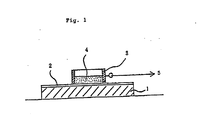
- Fig. 1 is a sectional view showing a device for testing the coating composition of the invention for deicing ability.
- 1 is a flat stainless steel plate, 2 coating, 3 stainless steel ring, 4 ice and 5 tensile testing machine.
- the deicing coating compositions were prepared by adding each solution of 1 to 6 containing the fluorine-containing compound listed below to an acrylic resin coating composition of the organic solvent type ("Acrylic No. 1000", a product of Kansai Paint Co. , Ltd., 45% solid concn,, room-temperatare, curing type), and thoroughly stirring the mixture by use of a mixer.
- the obtained coating composition was coated by an applicator on a stainless steel plate for deicing test and dried at room temperature.
- the coating had a thickness of 10 ⁇ m after drying.
- the coating was freezed at-10°C for 2 hours according to later-mentioned test method and then ice breaking strength was measured by use of a tensile testing machine (tensile speedy 250mm/min).
- the dcicing coating compositions were prepared by adding each solution of the fluorine-containing compound, and alkali metal compound listed in Table 2 to an urethane resin coating composition of the organic solvent type ("Retan PG-80 Clear", a product of Kansai Paint Co. Ltd., 40% solid concn.), and thoroughly stirring the mixture by use of a mixer.
- the obtained coating composition was coated by an applicator on a stainless steel plate for deicing test and dried at room temperature.
- the coating had a thickness of 80 ⁇ m after drying. Ice breaking strength was measured in the same manner as in Example 1.
Landscapes
- Chemical & Material Sciences (AREA)
- Organic Chemistry (AREA)
- Medicinal Chemistry (AREA)
- Polymers & Plastics (AREA)
- Health & Medical Sciences (AREA)
- Chemical Kinetics & Catalysis (AREA)
- Engineering & Computer Science (AREA)
- Materials Engineering (AREA)
- Life Sciences & Earth Sciences (AREA)
- Wood Science & Technology (AREA)
- Combustion & Propulsion (AREA)
- Paints Or Removers (AREA)
- Materials Applied To Surfaces To Minimize Adherence Of Mist Or Water (AREA)
Applications Claiming Priority (2)
| Application Number | Priority Date | Filing Date | Title |
|---|---|---|---|
| JP94888/85 | 1985-05-02 | ||
| JP60094888A JPS61254675A (ja) | 1985-05-02 | 1985-05-02 | 着氷防止塗料組成物 |
Publications (3)
| Publication Number | Publication Date |
|---|---|
| EP0200229A2 true EP0200229A2 (de) | 1986-11-05 |
| EP0200229A3 EP0200229A3 (en) | 1988-07-20 |
| EP0200229B1 EP0200229B1 (de) | 1992-03-11 |
Family
ID=14122582
Family Applications (1)
| Application Number | Title | Priority Date | Filing Date |
|---|---|---|---|
| EP86106033A Expired - Lifetime EP0200229B1 (de) | 1985-05-02 | 1986-05-02 | Beschichtungszusammensetzung zur Enteisung |
Country Status (4)
| Country | Link |
|---|---|
| US (1) | US4685967A (de) |
| EP (1) | EP0200229B1 (de) |
| JP (1) | JPS61254675A (de) |
| DE (1) | DE3684169D1 (de) |
Families Citing this family (8)
| Publication number | Priority date | Publication date | Assignee | Title |
|---|---|---|---|---|
| JPH0684496B2 (ja) * | 1985-05-31 | 1994-10-26 | 神東塗料株式会社 | 改良された着雪着氷防止用被覆材 |
| JP2568655B2 (ja) * | 1988-11-26 | 1997-01-08 | 関西ペイント株式会社 | 着氷防止用貼着シート |
| JP4061656B2 (ja) * | 1993-12-28 | 2008-03-19 | ダイキン工業株式会社 | 塗料組成物および塗装物 |
| US20070063169A1 (en) * | 2005-09-22 | 2007-03-22 | Fmc Corporation | Deicing composition |
| US20120082806A1 (en) | 2010-10-04 | 2012-04-05 | Kyle Ryan Kissell | Heatable coating with nanomaterials |
| JP2013100493A (ja) * | 2011-10-19 | 2013-05-23 | Daikin Industries Ltd | 表面処理剤組成物およびその用途 |
| US8911832B2 (en) * | 2011-12-02 | 2014-12-16 | Ppg Industries Ohio, Inc. | Method of mitigating ice build-up on a substrate |
| WO2017221294A1 (ja) * | 2016-06-20 | 2017-12-28 | 学校法人 関西大学 | コーティング用組成物 |
Family Cites Families (12)
| Publication number | Priority date | Publication date | Assignee | Title |
|---|---|---|---|---|
| US2681324A (en) * | 1951-08-09 | 1954-06-15 | Du Pont | Polytetrafluoroethylene coating compositions |
| CA1027129A (en) * | 1972-08-25 | 1978-02-28 | Sameeh S. Toukan | Fluorine and sulfur-containing compositions |
| CH576927A5 (de) * | 1973-06-27 | 1976-06-30 | Ciba Geigy Ag | |
| JPS5239647B2 (de) * | 1974-05-27 | 1977-10-06 | ||
| JPS51126220A (en) * | 1975-04-25 | 1976-11-04 | Asahi Glass Co Ltd | A composition suitable fos use in forming coats on smooth surfaces |
| US4215178A (en) * | 1978-04-28 | 1980-07-29 | Chloeta F. Martin | Non-stick rubber liner |
| JPS56138197A (en) * | 1980-03-31 | 1981-10-28 | Daikin Ind Ltd | Aqueous dispersion of phosphoric ester containing perfluoroalkyl or alkenyl group |
| FR2483447A1 (fr) * | 1980-06-03 | 1981-12-04 | Ugine Kuhlmann | Composition et procede pour la protection des materiaux contre les souillures |
| JPS587461A (ja) * | 1981-07-06 | 1983-01-17 | Meisei Kagaku Kogyo Kk | ラツカ−組成物 |
| JPS5850269A (ja) * | 1981-09-18 | 1983-03-24 | 加藤発条株式会社 | 自動車用ドアの開閉チエツク装置 |
| JPS5925868A (ja) * | 1982-08-04 | 1984-02-09 | Kansai Paint Co Ltd | 着氷防止材料用組成物 |
| JPS59120661A (ja) * | 1982-12-27 | 1984-07-12 | Dainippon Ink & Chem Inc | 塗料用硬化性樹脂組成物 |
-
1985
- 1985-05-02 JP JP60094888A patent/JPS61254675A/ja active Pending
-
1986
- 1986-04-28 US US06/856,342 patent/US4685967A/en not_active Expired - Fee Related
- 1986-05-02 EP EP86106033A patent/EP0200229B1/de not_active Expired - Lifetime
- 1986-05-02 DE DE8686106033T patent/DE3684169D1/de not_active Expired - Lifetime
Also Published As
| Publication number | Publication date |
|---|---|
| EP0200229B1 (de) | 1992-03-11 |
| JPS61254675A (ja) | 1986-11-12 |
| DE3684169D1 (de) | 1992-04-16 |
| US4685967A (en) | 1987-08-11 |
| EP0200229A3 (en) | 1988-07-20 |
Similar Documents
| Publication | Publication Date | Title |
|---|---|---|
| KR100195554B1 (ko) | 화합성 중합체로 농후화시킨 항공기 결빙 방지 유체 | |
| CA2022957C (en) | Phosphoric acid esters, method of producing them, and use thereof as dispersants | |
| US6001913A (en) | Latex compositions containing ethylenically unsaturated esters of long-chain alkenols | |
| US20010031883A1 (en) | Novel internally plasticizing and crosslinkable monomers and applications thereof | |
| US4507363A (en) | Polyoxyalkyleneamine modified epoxy coatings for corroded metal surfaces | |
| EP0200229A2 (de) | Beschichtungszusammensetzung zur Enteisung | |
| DE3529222C2 (de) | ||
| DE3873423T2 (de) | Kavitationsbestaendiges polymer und beschichtung daraus. | |
| BR0308192B1 (pt) | Composição de adesivo de flocos e método para aplicar uma composição de adesivo de flocos a um substrato elastomérico | |
| EP2657271B1 (de) | Tensid und verwendung für wässrige zusammensetzungen | |
| EP3283495B1 (de) | Härter und härtungsbeschleuniger mit flammschutzwirkung zur härtung von epoxidharzen (ii) | |
| KR20170084024A (ko) | 수계 수지 분산체 및 도료 | |
| EP0720613A1 (de) | Vinyl äther urethan-silane | |
| CN113122121A (zh) | 具有半互穿网络结构的含磷聚氨酯-丙烯酸树脂阻燃涂料及其制法和应用 | |
| WO2001044380A2 (en) | Novel internally plasticized and low voc latex compositions and applications thereof | |
| KR101932242B1 (ko) | 수성 에폭시 코팅제, 그 제조방법 및 이를 이용한 방수공법 | |
| CN112322158A (zh) | 一种阻燃型uv氧化双重固化三防漆及其制备方法 | |
| CN119307212B (zh) | 一种高耐热性水性粘结剂及其制备方法 | |
| EP2313463A2 (de) | Epoxid/(meth)acrylat zusammensetzung | |
| KR100671177B1 (ko) | 도막용 접착 촉진제 | |
| EP0541169A1 (de) | Zweikomponentensystem für Beschichtungen | |
| CN112442212A (zh) | 一种含磷的反应型阻燃剂及其制备方法和应用 | |
| CN114163648B (zh) | 一种有机氟改性环氧树脂、制备方法及防腐涂料 | |
| CN109652000A (zh) | 一种新型电子印刷电路板披覆胶及其制备方法 | |
| KR20200088272A (ko) | 접착제 제형 |
Legal Events
| Date | Code | Title | Description |
|---|---|---|---|
| PUAI | Public reference made under article 153(3) epc to a published international application that has entered the european phase |
Free format text: ORIGINAL CODE: 0009012 |
|
| AK | Designated contracting states |
Kind code of ref document: A2 Designated state(s): DE FR GB |
|
| PUAL | Search report despatched |
Free format text: ORIGINAL CODE: 0009013 |
|
| AK | Designated contracting states |
Kind code of ref document: A3 Designated state(s): DE FR GB |
|
| 17P | Request for examination filed |
Effective date: 19890110 |
|
| 17Q | First examination report despatched |
Effective date: 19900511 |
|
| GRAA | (expected) grant |
Free format text: ORIGINAL CODE: 0009210 |
|
| AK | Designated contracting states |
Kind code of ref document: B1 Designated state(s): DE FR GB |
|
| REF | Corresponds to: |
Ref document number: 3684169 Country of ref document: DE Date of ref document: 19920416 |
|
| ET | Fr: translation filed | ||
| PLBE | No opposition filed within time limit |
Free format text: ORIGINAL CODE: 0009261 |
|
| STAA | Information on the status of an ep patent application or granted ep patent |
Free format text: STATUS: NO OPPOSITION FILED WITHIN TIME LIMIT |
|
| 26N | No opposition filed | ||
| PGFP | Annual fee paid to national office [announced via postgrant information from national office to epo] |
Ref country code: GB Payment date: 19940422 Year of fee payment: 9 |
|
| PGFP | Annual fee paid to national office [announced via postgrant information from national office to epo] |
Ref country code: FR Payment date: 19940511 Year of fee payment: 9 Ref country code: DE Payment date: 19940511 Year of fee payment: 9 |
|
| PG25 | Lapsed in a contracting state [announced via postgrant information from national office to epo] |
Ref country code: GB Effective date: 19950502 |
|
| GBPC | Gb: european patent ceased through non-payment of renewal fee |
Effective date: 19950502 |
|
| PG25 | Lapsed in a contracting state [announced via postgrant information from national office to epo] |
Ref country code: DE Effective date: 19960201 |
|
| PG25 | Lapsed in a contracting state [announced via postgrant information from national office to epo] |
Ref country code: FR Effective date: 19960229 |
|
| REG | Reference to a national code |
Ref country code: FR Ref legal event code: ST |
|
| REG | Reference to a national code |
Ref country code: FR Ref legal event code: ST |