EP0197360A1 - Verwendung von Efomycinen als Leistungsförderer bei Tieren, Efomycine und ihre Herstellung - Google Patents
Verwendung von Efomycinen als Leistungsförderer bei Tieren, Efomycine und ihre Herstellung Download PDFInfo
- Publication number
- EP0197360A1 EP0197360A1 EP86103539A EP86103539A EP0197360A1 EP 0197360 A1 EP0197360 A1 EP 0197360A1 EP 86103539 A EP86103539 A EP 86103539A EP 86103539 A EP86103539 A EP 86103539A EP 0197360 A1 EP0197360 A1 EP 0197360A1
- Authority
- EP
- European Patent Office
- Prior art keywords
- efomycin
- solution
- bruker
- mhz
- given
- Prior art date
- Legal status (The legal status is an assumption and is not a legal conclusion. Google has not performed a legal analysis and makes no representation as to the accuracy of the status listed.)
- Granted
Links
- 238000002360 preparation method Methods 0.000 title claims abstract description 7
- 241001465754 Metazoa Species 0.000 title claims description 24
- 239000000203 mixture Substances 0.000 claims abstract description 60
- 150000001875 compounds Chemical class 0.000 claims abstract description 34
- 244000005700 microbiome Species 0.000 claims abstract description 11
- HEDRZPFGACZZDS-UHFFFAOYSA-N Chloroform Chemical compound ClC(Cl)Cl HEDRZPFGACZZDS-UHFFFAOYSA-N 0.000 claims description 44
- HEDRZPFGACZZDS-MICDWDOJSA-N Trichloro(2H)methane Chemical compound [2H]C(Cl)(Cl)Cl HEDRZPFGACZZDS-MICDWDOJSA-N 0.000 claims description 26
- 238000000034 method Methods 0.000 claims description 26
- CZDYPVPMEAXLPK-UHFFFAOYSA-N tetramethylsilane Chemical compound C[Si](C)(C)C CZDYPVPMEAXLPK-UHFFFAOYSA-N 0.000 claims description 22
- 235000015097 nutrients Nutrition 0.000 claims description 21
- IJGRMHOSHXDMSA-UHFFFAOYSA-N Atomic nitrogen Chemical compound N#N IJGRMHOSHXDMSA-UHFFFAOYSA-N 0.000 claims description 16
- 238000000655 nuclear magnetic resonance spectrum Methods 0.000 claims description 16
- 238000010265 fast atom bombardment Methods 0.000 claims description 15
- 239000000126 substance Substances 0.000 claims description 15
- 238000010521 absorption reaction Methods 0.000 claims description 12
- 238000000921 elemental analysis Methods 0.000 claims description 12
- OKTJSMMVPCPJKN-UHFFFAOYSA-N Carbon Chemical compound [C] OKTJSMMVPCPJKN-UHFFFAOYSA-N 0.000 claims description 11
- 229910052500 inorganic mineral Inorganic materials 0.000 claims description 11
- 239000011707 mineral Substances 0.000 claims description 11
- 230000000704 physical effect Effects 0.000 claims description 11
- 238000001819 mass spectrum Methods 0.000 claims description 10
- 229910052799 carbon Inorganic materials 0.000 claims description 9
- 150000003839 salts Chemical class 0.000 claims description 9
- 229910052757 nitrogen Inorganic materials 0.000 claims description 8
- 229930014626 natural product Natural products 0.000 claims description 6
- 241000204060 Streptomycetaceae Species 0.000 claims description 5
- 241000187747 Streptomyces Species 0.000 claims description 4
- 239000003651 drinking water Substances 0.000 claims description 3
- 235000020188 drinking water Nutrition 0.000 claims description 3
- XLYOFNOQVPJJNP-ZSJDYOACSA-N Heavy water Chemical compound [2H]O[2H] XLYOFNOQVPJJNP-ZSJDYOACSA-N 0.000 claims description 2
- 239000000654 additive Substances 0.000 claims description 2
- 238000002329 infrared spectrum Methods 0.000 claims description 2
- 230000001737 promoting effect Effects 0.000 claims 2
- 239000004606 Fillers/Extenders Substances 0.000 claims 1
- 239000003795 chemical substances by application Substances 0.000 claims 1
- 239000003085 diluting agent Substances 0.000 claims 1
- 239000003623 enhancer Substances 0.000 claims 1
- 244000144972 livestock Species 0.000 abstract description 3
- 239000000243 solution Substances 0.000 description 46
- OKKJLVBELUTLKV-UHFFFAOYSA-N Methanol Chemical compound OC OKKJLVBELUTLKV-UHFFFAOYSA-N 0.000 description 24
- 239000004480 active ingredient Substances 0.000 description 19
- XEKOWRVHYACXOJ-UHFFFAOYSA-N Ethyl acetate Chemical compound CCOC(C)=O XEKOWRVHYACXOJ-UHFFFAOYSA-N 0.000 description 18
- 229910001868 water Inorganic materials 0.000 description 16
- QTBSBXVTEAMEQO-UHFFFAOYSA-N Acetic acid Chemical compound CC(O)=O QTBSBXVTEAMEQO-UHFFFAOYSA-N 0.000 description 15
- 239000002609 medium Substances 0.000 description 13
- 238000004587 chromatography analysis Methods 0.000 description 12
- XBDQKXXYIPTUBI-UHFFFAOYSA-N Propionic acid Chemical compound CCC(O)=O XBDQKXXYIPTUBI-UHFFFAOYSA-N 0.000 description 11
- 238000000855 fermentation Methods 0.000 description 11
- 230000004151 fermentation Effects 0.000 description 11
- XLYOFNOQVPJJNP-UHFFFAOYSA-N water Chemical compound O XLYOFNOQVPJJNP-UHFFFAOYSA-N 0.000 description 11
- 235000002639 sodium chloride Nutrition 0.000 description 10
- CSCPPACGZOOCGX-UHFFFAOYSA-N Acetone Chemical compound CC(C)=O CSCPPACGZOOCGX-UHFFFAOYSA-N 0.000 description 9
- OSERMIPXNLXAPD-MJMYBOKFSA-N elaiophylin Chemical compound O([C@@H]1C[C@@](O)(O[C@H](C)[C@H]1CC)[C@@H](C)[C@H](O)[C@H](C)[C@@H]1[C@H](/C=C/C=C/C(=O)O[C@@H]([C@@H](C)/C=C/C=C/C(=O)O1)[C@@H](C)[C@@H](O)[C@H](C)[C@]1(O)O[C@H](C)[C@@H](CC)[C@H](O[C@@H]2O[C@@H](C)[C@@H](O)[C@@H](O)C2)C1)C)[C@H]1C[C@H](O)[C@H](O)[C@H](C)O1 OSERMIPXNLXAPD-MJMYBOKFSA-N 0.000 description 9
- VYPSYNLAJGMNEJ-UHFFFAOYSA-N Silicium dioxide Chemical compound O=[Si]=O VYPSYNLAJGMNEJ-UHFFFAOYSA-N 0.000 description 8
- 240000008042 Zea mays Species 0.000 description 7
- 235000013336 milk Nutrition 0.000 description 7
- 239000008267 milk Substances 0.000 description 7
- 210000004080 milk Anatomy 0.000 description 7
- 235000010755 mineral Nutrition 0.000 description 7
- 239000002904 solvent Substances 0.000 description 7
- 239000011573 trace mineral Substances 0.000 description 7
- 235000013619 trace mineral Nutrition 0.000 description 7
- GVJHHUAWPYXKBD-UHFFFAOYSA-N (±)-α-Tocopherol Chemical compound OC1=C(C)C(C)=C2OC(CCCC(C)CCCC(C)CCCC(C)C)(C)CCC2=C1C GVJHHUAWPYXKBD-UHFFFAOYSA-N 0.000 description 6
- 241000283690 Bos taurus Species 0.000 description 6
- FAPWRFPIFSIZLT-UHFFFAOYSA-M Sodium chloride Chemical compound [Na+].[Cl-] FAPWRFPIFSIZLT-UHFFFAOYSA-M 0.000 description 6
- HEMHJVSKTPXQMS-UHFFFAOYSA-M Sodium hydroxide Chemical compound [OH-].[Na+] HEMHJVSKTPXQMS-UHFFFAOYSA-M 0.000 description 6
- KRKNYBCHXYNGOX-UHFFFAOYSA-N citric acid Chemical compound OC(=O)CC(O)(C(O)=O)CC(O)=O KRKNYBCHXYNGOX-UHFFFAOYSA-N 0.000 description 6
- -1 mannitol or glycerin Chemical compound 0.000 description 6
- 235000012054 meals Nutrition 0.000 description 6
- 229940088594 vitamin Drugs 0.000 description 6
- 229930003231 vitamin Natural products 0.000 description 6
- 235000013343 vitamin Nutrition 0.000 description 6
- 239000011782 vitamin Substances 0.000 description 6
- 241001655322 Streptomycetales Species 0.000 description 5
- 235000002017 Zea mays subsp mays Nutrition 0.000 description 5
- 238000004140 cleaning Methods 0.000 description 5
- 238000004128 high performance liquid chromatography Methods 0.000 description 5
- 239000007788 liquid Substances 0.000 description 5
- 238000004519 manufacturing process Methods 0.000 description 5
- 239000012071 phase Substances 0.000 description 5
- 239000000047 product Substances 0.000 description 5
- 235000019260 propionic acid Nutrition 0.000 description 5
- 235000018102 proteins Nutrition 0.000 description 5
- 108090000623 proteins and genes Proteins 0.000 description 5
- 102000004169 proteins and genes Human genes 0.000 description 5
- IUVKMZGDUIUOCP-BTNSXGMBSA-N quinbolone Chemical compound O([C@H]1CC[C@H]2[C@H]3[C@@H]([C@]4(C=CC(=O)C=C4CC3)C)CC[C@@]21C)C1=CCCC1 IUVKMZGDUIUOCP-BTNSXGMBSA-N 0.000 description 5
- 239000000741 silica gel Substances 0.000 description 5
- 229910002027 silica gel Inorganic materials 0.000 description 5
- 239000011734 sodium Substances 0.000 description 5
- 238000012360 testing method Methods 0.000 description 5
- CURLTUGMZLYLDI-UHFFFAOYSA-N Carbon dioxide Chemical compound O=C=O CURLTUGMZLYLDI-UHFFFAOYSA-N 0.000 description 4
- AUNGANRZJHBGPY-SCRDCRAPSA-N Riboflavin Chemical compound OC[C@@H](O)[C@@H](O)[C@@H](O)CN1C=2C=C(C)C(C)=CC=2N=C2C1=NC(=O)NC2=O AUNGANRZJHBGPY-SCRDCRAPSA-N 0.000 description 4
- 235000005824 Zea mays ssp. parviglumis Nutrition 0.000 description 4
- 150000003863 ammonium salts Chemical class 0.000 description 4
- 238000009395 breeding Methods 0.000 description 4
- 230000001488 breeding effect Effects 0.000 description 4
- 235000005822 corn Nutrition 0.000 description 4
- 239000003925 fat Substances 0.000 description 4
- 235000013372 meat Nutrition 0.000 description 4
- 229920002647 polyamide Polymers 0.000 description 4
- 210000004767 rumen Anatomy 0.000 description 4
- FPIPGXGPPPQFEQ-UHFFFAOYSA-N 13-cis retinol Natural products OCC=C(C)C=CC=C(C)C=CC1=C(C)CCCC1(C)C FPIPGXGPPPQFEQ-UHFFFAOYSA-N 0.000 description 3
- WEVYAHXRMPXWCK-UHFFFAOYSA-N Acetonitrile Chemical compound CC#N WEVYAHXRMPXWCK-UHFFFAOYSA-N 0.000 description 3
- 241000251468 Actinopterygii Species 0.000 description 3
- 229920001817 Agar Polymers 0.000 description 3
- VTYYLEPIZMXCLO-UHFFFAOYSA-L Calcium carbonate Chemical compound [Ca+2].[O-]C([O-])=O VTYYLEPIZMXCLO-UHFFFAOYSA-L 0.000 description 3
- YMWUJEATGCHHMB-UHFFFAOYSA-N Dichloromethane Chemical compound ClCCl YMWUJEATGCHHMB-UHFFFAOYSA-N 0.000 description 3
- LFQSCWFLJHTTHZ-UHFFFAOYSA-N Ethanol Chemical compound CCO LFQSCWFLJHTTHZ-UHFFFAOYSA-N 0.000 description 3
- 241001494479 Pecora Species 0.000 description 3
- 239000004952 Polyamide Substances 0.000 description 3
- 235000019764 Soybean Meal Nutrition 0.000 description 3
- 241000282887 Suidae Species 0.000 description 3
- ZMANZCXQSJIPKH-UHFFFAOYSA-N Triethylamine Chemical compound CCN(CC)CC ZMANZCXQSJIPKH-UHFFFAOYSA-N 0.000 description 3
- 244000098338 Triticum aestivum Species 0.000 description 3
- FPIPGXGPPPQFEQ-BOOMUCAASA-N Vitamin A Natural products OC/C=C(/C)\C=C\C=C(\C)/C=C/C1=C(C)CCCC1(C)C FPIPGXGPPPQFEQ-BOOMUCAASA-N 0.000 description 3
- 229930003427 Vitamin E Natural products 0.000 description 3
- 239000013543 active substance Substances 0.000 description 3
- 239000008272 agar Substances 0.000 description 3
- FPIPGXGPPPQFEQ-OVSJKPMPSA-N all-trans-retinol Chemical compound OC\C=C(/C)\C=C\C=C(/C)\C=C\C1=C(C)CCCC1(C)C FPIPGXGPPPQFEQ-OVSJKPMPSA-N 0.000 description 3
- 230000000844 anti-bacterial effect Effects 0.000 description 3
- 239000001913 cellulose Substances 0.000 description 3
- 229920002678 cellulose Polymers 0.000 description 3
- 239000010949 copper Substances 0.000 description 3
- 230000000694 effects Effects 0.000 description 3
- 239000003480 eluent Substances 0.000 description 3
- 238000002474 experimental method Methods 0.000 description 3
- 239000000284 extract Substances 0.000 description 3
- 238000000605 extraction Methods 0.000 description 3
- 235000019197 fats Nutrition 0.000 description 3
- 235000019688 fish Nutrition 0.000 description 3
- 239000006260 foam Substances 0.000 description 3
- WIGCFUFOHFEKBI-UHFFFAOYSA-N gamma-tocopherol Natural products CC(C)CCCC(C)CCCC(C)CCCC1CCC2C(C)C(O)C(C)C(C)C2O1 WIGCFUFOHFEKBI-UHFFFAOYSA-N 0.000 description 3
- 239000002054 inoculum Substances 0.000 description 3
- 238000002955 isolation Methods 0.000 description 3
- 239000000463 material Substances 0.000 description 3
- 239000013642 negative control Substances 0.000 description 3
- 230000000384 rearing effect Effects 0.000 description 3
- 239000011780 sodium chloride Substances 0.000 description 3
- FVAUCKIRQBBSSJ-UHFFFAOYSA-M sodium iodide Chemical compound [Na+].[I-] FVAUCKIRQBBSSJ-UHFFFAOYSA-M 0.000 description 3
- 239000004455 soybean meal Substances 0.000 description 3
- 230000001954 sterilising effect Effects 0.000 description 3
- 238000003756 stirring Methods 0.000 description 3
- 235000019155 vitamin A Nutrition 0.000 description 3
- 239000011719 vitamin A Substances 0.000 description 3
- 239000011709 vitamin E Substances 0.000 description 3
- 235000019165 vitamin E Nutrition 0.000 description 3
- 229940046009 vitamin E Drugs 0.000 description 3
- 229940045997 vitamin a Drugs 0.000 description 3
- 239000011701 zinc Substances 0.000 description 3
- JKQXZKUSFCKOGQ-JLGXGRJMSA-N (3R,3'R)-beta,beta-carotene-3,3'-diol Chemical compound C([C@H](O)CC=1C)C(C)(C)C=1/C=C/C(/C)=C/C=C/C(/C)=C/C=C/C=C(C)C=CC=C(C)C=CC1=C(C)C[C@@H](O)CC1(C)C JKQXZKUSFCKOGQ-JLGXGRJMSA-N 0.000 description 2
- VYIRVAXUEZSDNC-TXDLOWMYSA-N (3R,3'S,5'R)-3,3'-dihydroxy-beta-kappa-caroten-6'-one Chemical compound C([C@H](O)CC=1C)C(C)(C)C=1/C=C/C(/C)=C/C=C/C(/C)=C/C=C/C=C(C)C=CC=C(C)C=CC(=O)[C@]1(C)C[C@@H](O)CC1(C)C VYIRVAXUEZSDNC-TXDLOWMYSA-N 0.000 description 2
- IIZPXYDJLKNOIY-JXPKJXOSSA-N 1-palmitoyl-2-arachidonoyl-sn-glycero-3-phosphocholine Chemical compound CCCCCCCCCCCCCCCC(=O)OC[C@H](COP([O-])(=O)OCC[N+](C)(C)C)OC(=O)CCC\C=C/C\C=C/C\C=C/C\C=C/CCCCC IIZPXYDJLKNOIY-JXPKJXOSSA-N 0.000 description 2
- OVBFMEVBMNZIBR-UHFFFAOYSA-N 2-methylvaleric acid Chemical compound CCCC(C)C(O)=O OVBFMEVBMNZIBR-UHFFFAOYSA-N 0.000 description 2
- GUBGYTABKSRVRQ-XLOQQCSPSA-N Alpha-Lactose Chemical compound O[C@@H]1[C@@H](O)[C@@H](O)[C@@H](CO)O[C@H]1O[C@@H]1[C@@H](CO)O[C@H](O)[C@H](O)[C@H]1O GUBGYTABKSRVRQ-XLOQQCSPSA-N 0.000 description 2
- 101000775660 Anarhichas lupus Type-3 ice-structuring protein 1.5 Proteins 0.000 description 2
- 101000775628 Anarhichas lupus Type-3 ice-structuring protein 1.9 Proteins 0.000 description 2
- 241000272517 Anseriformes Species 0.000 description 2
- CIWBSHSKHKDKBQ-JLAZNSOCSA-N Ascorbic acid Chemical compound OC[C@H](O)[C@H]1OC(=O)C(O)=C1O CIWBSHSKHKDKBQ-JLAZNSOCSA-N 0.000 description 2
- VYIRVAXUEZSDNC-LOFNIBRQSA-N Capsanthyn Natural products CC(=C/C=C/C=C(C)/C=C/C=C(C)/C=C/C1=C(C)CC(O)CC1(C)C)C=CC=C(/C)C=CC(=O)C2(C)CC(O)CC2(C)C VYIRVAXUEZSDNC-LOFNIBRQSA-N 0.000 description 2
- 239000004217 Citranaxanthin Substances 0.000 description 2
- SLQHGWZKKZPZEK-JKEZLOPUSA-N Citranaxanthin Natural products CC(=C/C=C/C=C(C)/C=C/C=C(C)/C(=O)C)C=CC=C(/C)C=CC1=C(C)CCCC1(C)C SLQHGWZKKZPZEK-JKEZLOPUSA-N 0.000 description 2
- AUNGANRZJHBGPY-UHFFFAOYSA-N D-Lyxoflavin Natural products OCC(O)C(O)C(O)CN1C=2C=C(C)C(C)=CC=2N=C2C1=NC(=O)NC2=O AUNGANRZJHBGPY-UHFFFAOYSA-N 0.000 description 2
- SRBFZHDQGSBBOR-IOVATXLUSA-N D-xylopyranose Chemical compound O[C@@H]1COC(O)[C@H](O)[C@H]1O SRBFZHDQGSBBOR-IOVATXLUSA-N 0.000 description 2
- 239000004470 DL Methionine Substances 0.000 description 2
- ULGZDMOVFRHVEP-RWJQBGPGSA-N Erythromycin Chemical compound O([C@@H]1[C@@H](C)C(=O)O[C@@H]([C@@]([C@H](O)[C@@H](C)C(=O)[C@H](C)C[C@@](C)(O)[C@H](O[C@H]2[C@@H]([C@H](C[C@@H](C)O2)N(C)C)O)[C@H]1C)(C)O)CC)[C@H]1C[C@@](C)(OC)[C@@H](O)[C@H](C)O1 ULGZDMOVFRHVEP-RWJQBGPGSA-N 0.000 description 2
- PEDCQBHIVMGVHV-UHFFFAOYSA-N Glycerine Chemical compound OCC(O)CO PEDCQBHIVMGVHV-UHFFFAOYSA-N 0.000 description 2
- GUBGYTABKSRVRQ-QKKXKWKRSA-N Lactose Natural products OC[C@H]1O[C@@H](O[C@H]2[C@H](O)[C@@H](O)C(O)O[C@@H]2CO)[C@H](O)[C@@H](O)[C@H]1O GUBGYTABKSRVRQ-QKKXKWKRSA-N 0.000 description 2
- 229920001732 Lignosulfonate Polymers 0.000 description 2
- 241000124008 Mammalia Species 0.000 description 2
- XUMBMVFBXHLACL-UHFFFAOYSA-N Melanin Chemical compound O=C1C(=O)C(C2=CNC3=C(C(C(=O)C4=C32)=O)C)=C2C4=CNC2=C1C XUMBMVFBXHLACL-UHFFFAOYSA-N 0.000 description 2
- MJVAVZPDRWSRRC-UHFFFAOYSA-N Menadione Chemical compound C1=CC=C2C(=O)C(C)=CC(=O)C2=C1 MJVAVZPDRWSRRC-UHFFFAOYSA-N 0.000 description 2
- 229930191564 Monensin Natural products 0.000 description 2
- GAOZTHIDHYLHMS-UHFFFAOYSA-N Monensin A Natural products O1C(CC)(C2C(CC(O2)C2C(CC(C)C(O)(CO)O2)C)C)CCC1C(O1)(C)CCC21CC(O)C(C)C(C(C)C(OC)C(C)C(O)=O)O2 GAOZTHIDHYLHMS-UHFFFAOYSA-N 0.000 description 2
- IMNFDUFMRHMDMM-UHFFFAOYSA-N N-Heptane Chemical compound CCCCCCC IMNFDUFMRHMDMM-UHFFFAOYSA-N 0.000 description 2
- MVTQIFVKRXBCHS-SMMNFGSLSA-N N-[(3S,6S,12R,15S,16R,19S,22S)-3-benzyl-12-ethyl-4,16-dimethyl-2,5,11,14,18,21,24-heptaoxo-19-phenyl-17-oxa-1,4,10,13,20-pentazatricyclo[20.4.0.06,10]hexacosan-15-yl]-3-hydroxypyridine-2-carboxamide (10R,11R,12E,17E,19E,21S)-21-hydroxy-11,19-dimethyl-10-propan-2-yl-9,26-dioxa-3,15,28-triazatricyclo[23.2.1.03,7]octacosa-1(27),6,12,17,19,25(28)-hexaene-2,8,14,23-tetrone Chemical compound CC(C)[C@H]1OC(=O)C2=CCCN2C(=O)c2coc(CC(=O)C[C@H](O)\C=C(/C)\C=C\CNC(=O)\C=C\[C@H]1C)n2.CC[C@H]1NC(=O)[C@@H](NC(=O)c2ncccc2O)[C@@H](C)OC(=O)[C@@H](NC(=O)[C@@H]2CC(=O)CCN2C(=O)[C@H](Cc2ccccc2)N(C)C(=O)[C@@H]2CCCN2C1=O)c1ccccc1 MVTQIFVKRXBCHS-SMMNFGSLSA-N 0.000 description 2
- PVNIIMVLHYAWGP-UHFFFAOYSA-N Niacin Chemical compound OC(=O)C1=CC=CN=C1 PVNIIMVLHYAWGP-UHFFFAOYSA-N 0.000 description 2
- 101000643905 Nostoc sp. (strain PCC 7120 / SAG 25.82 / UTEX 2576) Cytochrome b6-f complex iron-sulfur subunit 3 Proteins 0.000 description 2
- 241000283973 Oryctolagus cuniculus Species 0.000 description 2
- NBIIXXVUZAFLBC-UHFFFAOYSA-N Phosphoric acid Chemical compound OP(O)(O)=O NBIIXXVUZAFLBC-UHFFFAOYSA-N 0.000 description 2
- 101000775697 Pseudopleuronectes americanus Ice-structuring protein 3 Proteins 0.000 description 2
- 241000282898 Sus scrofa Species 0.000 description 2
- 235000021307 Triticum Nutrition 0.000 description 2
- 239000004182 Tylosin Substances 0.000 description 2
- 229930194936 Tylosin Natural products 0.000 description 2
- ISAKRJDGNUQOIC-UHFFFAOYSA-N Uracil Chemical compound O=C1C=CNC(=O)N1 ISAKRJDGNUQOIC-UHFFFAOYSA-N 0.000 description 2
- XSQUKJJJFZCRTK-UHFFFAOYSA-N Urea Chemical compound NC(N)=O XSQUKJJJFZCRTK-UHFFFAOYSA-N 0.000 description 2
- 239000004188 Virginiamycin Substances 0.000 description 2
- 108010080702 Virginiamycin Proteins 0.000 description 2
- JKQXZKUSFCKOGQ-LQFQNGICSA-N Z-zeaxanthin Natural products C([C@H](O)CC=1C)C(C)(C)C=1C=CC(C)=CC=CC(C)=CC=CC=C(C)C=CC=C(C)C=CC1=C(C)C[C@@H](O)CC1(C)C JKQXZKUSFCKOGQ-LQFQNGICSA-N 0.000 description 2
- QOPRSMDTRDMBNK-RNUUUQFGSA-N Zeaxanthin Natural products CC(=C/C=C/C=C(C)/C=C/C=C(C)/C=C/C1=C(C)CCC(O)C1(C)C)C=CC=C(/C)C=CC2=C(C)CC(O)CC2(C)C QOPRSMDTRDMBNK-RNUUUQFGSA-N 0.000 description 2
- XLOMVQKBTHCTTD-UHFFFAOYSA-N Zinc monoxide Chemical compound [Zn]=O XLOMVQKBTHCTTD-UHFFFAOYSA-N 0.000 description 2
- 239000003463 adsorbent Substances 0.000 description 2
- 238000005273 aeration Methods 0.000 description 2
- 150000001298 alcohols Chemical class 0.000 description 2
- JKQXZKUSFCKOGQ-LOFNIBRQSA-N all-trans-Zeaxanthin Natural products CC(=C/C=C/C=C(C)/C=C/C=C(C)/C=C/C1=C(C)CC(O)CC1(C)C)C=CC=C(/C)C=CC2=C(C)CC(O)CC2(C)C JKQXZKUSFCKOGQ-LOFNIBRQSA-N 0.000 description 2
- 235000001014 amino acid Nutrition 0.000 description 2
- 150000001413 amino acids Chemical class 0.000 description 2
- 239000003242 anti bacterial agent Substances 0.000 description 2
- 229940088710 antibiotic agent Drugs 0.000 description 2
- 239000003963 antioxidant agent Substances 0.000 description 2
- 235000006708 antioxidants Nutrition 0.000 description 2
- OSERMIPXNLXAPD-UHFFFAOYSA-N azalomycin B Natural products CCC1C(C)OC(O)(C(C)C(O)C(C)C2C(C=CC=CC(=O)OC(C(C)C=CC=CC(=O)O2)C(C)C(O)C(C)C2(O)OC(C)C(CC)C(OC3OC(C)C(O)C(O)C3)C2)C)CC1OC1CC(O)C(O)C(C)O1 OSERMIPXNLXAPD-UHFFFAOYSA-N 0.000 description 2
- 239000002585 base Substances 0.000 description 2
- OHJMTUPIZMNBFR-UHFFFAOYSA-N biuret Chemical compound NC(=O)NC(N)=O OHJMTUPIZMNBFR-UHFFFAOYSA-N 0.000 description 2
- 239000007853 buffer solution Substances 0.000 description 2
- 235000010216 calcium carbonate Nutrition 0.000 description 2
- 239000001506 calcium phosphate Substances 0.000 description 2
- WRANYHFEXGNSND-LOFNIBRQSA-N capsanthin Natural products CC(=C/C=C/C=C(C)/C=C/C=C(C)/C=C/C1=C(C)CC(O)CC1(C)C)C=CC=C(/C)C=CC(=O)C2(C)CCC(O)C2(C)C WRANYHFEXGNSND-LOFNIBRQSA-N 0.000 description 2
- 235000018889 capsanthin Nutrition 0.000 description 2
- 239000001569 carbon dioxide Substances 0.000 description 2
- 229910002092 carbon dioxide Inorganic materials 0.000 description 2
- 229920003086 cellulose ether Polymers 0.000 description 2
- 235000013339 cereals Nutrition 0.000 description 2
- 241000050645 cinereus group Species 0.000 description 2
- PRDJTOVRIHGKNU-ZWERVMMHSA-N citranaxanthin Chemical compound CC(=O)\C=C\C(\C)=C\C=C\C(\C)=C\C=C\C=C(/C)\C=C\C=C(/C)\C=C\C1=C(C)CCCC1(C)C PRDJTOVRIHGKNU-ZWERVMMHSA-N 0.000 description 2
- 235000019247 citranaxanthin Nutrition 0.000 description 2
- PRDJTOVRIHGKNU-UHFFFAOYSA-N citranaxanthine Natural products CC(=O)C=CC(C)=CC=CC(C)=CC=CC=C(C)C=CC=C(C)C=CC1=C(C)CCCC1(C)C PRDJTOVRIHGKNU-UHFFFAOYSA-N 0.000 description 2
- 239000012141 concentrate Substances 0.000 description 2
- OPTASPLRGRRNAP-UHFFFAOYSA-N cytosine Chemical compound NC=1C=CNC(=O)N=1 OPTASPLRGRRNAP-UHFFFAOYSA-N 0.000 description 2
- 238000001514 detection method Methods 0.000 description 2
- 235000014113 dietary fatty acids Nutrition 0.000 description 2
- 239000003995 emulsifying agent Substances 0.000 description 2
- 150000002148 esters Chemical class 0.000 description 2
- 238000001704 evaporation Methods 0.000 description 2
- 230000008020 evaporation Effects 0.000 description 2
- 229930195729 fatty acid Natural products 0.000 description 2
- 239000000194 fatty acid Substances 0.000 description 2
- 150000004665 fatty acids Chemical class 0.000 description 2
- 239000000706 filtrate Substances 0.000 description 2
- 235000013312 flour Nutrition 0.000 description 2
- 239000012530 fluid Substances 0.000 description 2
- 238000009472 formulation Methods 0.000 description 2
- 239000001963 growth medium Substances 0.000 description 2
- 238000011081 inoculation Methods 0.000 description 2
- 150000007529 inorganic bases Chemical class 0.000 description 2
- 150000002500 ions Chemical class 0.000 description 2
- JVTAAEKCZFNVCJ-UHFFFAOYSA-N lactic acid Chemical compound CC(O)C(O)=O JVTAAEKCZFNVCJ-UHFFFAOYSA-N 0.000 description 2
- 239000008101 lactose Substances 0.000 description 2
- 239000000787 lecithin Substances 0.000 description 2
- 229940067606 lecithin Drugs 0.000 description 2
- 235000010445 lecithin Nutrition 0.000 description 2
- AXZKOIWUVFPNLO-UHFFFAOYSA-N magnesium;oxygen(2-) Chemical compound [O-2].[Mg+2] AXZKOIWUVFPNLO-UHFFFAOYSA-N 0.000 description 2
- FFEARJCKVFRZRR-UHFFFAOYSA-N methionine Chemical compound CSCCC(N)C(O)=O FFEARJCKVFRZRR-UHFFFAOYSA-N 0.000 description 2
- 229930182817 methionine Natural products 0.000 description 2
- 235000006109 methionine Nutrition 0.000 description 2
- 230000002906 microbiologic effect Effects 0.000 description 2
- 150000007522 mineralic acids Chemical class 0.000 description 2
- 238000002156 mixing Methods 0.000 description 2
- 235000013379 molasses Nutrition 0.000 description 2
- 229960005358 monensin Drugs 0.000 description 2
- GAOZTHIDHYLHMS-KEOBGNEYSA-N monensin A Chemical compound C([C@@](O1)(C)[C@H]2CC[C@@](O2)(CC)[C@H]2[C@H](C[C@@H](O2)[C@@H]2[C@H](C[C@@H](C)[C@](O)(CO)O2)C)C)C[C@@]21C[C@H](O)[C@@H](C)[C@@H]([C@@H](C)[C@@H](OC)[C@H](C)C(O)=O)O2 GAOZTHIDHYLHMS-KEOBGNEYSA-N 0.000 description 2
- 150000002823 nitrates Chemical class 0.000 description 2
- GLDOVTGHNKAZLK-UHFFFAOYSA-N octadecan-1-ol Chemical compound CCCCCCCCCCCCCCCCCCO GLDOVTGHNKAZLK-UHFFFAOYSA-N 0.000 description 2
- 150000007524 organic acids Chemical class 0.000 description 2
- 150000007530 organic bases Chemical class 0.000 description 2
- 239000003960 organic solvent Substances 0.000 description 2
- 239000001688 paprika extract Substances 0.000 description 2
- 235000012658 paprika extract Nutrition 0.000 description 2
- 238000011197 physicochemical method Methods 0.000 description 2
- 238000001556 precipitation Methods 0.000 description 2
- 239000003755 preservative agent Substances 0.000 description 2
- 238000003825 pressing Methods 0.000 description 2
- 238000000746 purification Methods 0.000 description 2
- 235000019192 riboflavin Nutrition 0.000 description 2
- 239000002151 riboflavin Substances 0.000 description 2
- 229960002477 riboflavin Drugs 0.000 description 2
- 239000007787 solid Substances 0.000 description 2
- 230000028070 sporulation Effects 0.000 description 2
- 238000004659 sterilization and disinfection Methods 0.000 description 2
- UCSJYZPVAKXKNQ-HZYVHMACSA-N streptomycin Chemical compound CN[C@H]1[C@H](O)[C@@H](O)[C@H](CO)O[C@H]1O[C@@H]1[C@](C=O)(O)[C@H](C)O[C@H]1O[C@@H]1[C@@H](NC(N)=N)[C@H](O)[C@@H](NC(N)=N)[C@H](O)[C@H]1O UCSJYZPVAKXKNQ-HZYVHMACSA-N 0.000 description 2
- 239000000758 substrate Substances 0.000 description 2
- KBPHJBAIARWVSC-XQIHNALSSA-N trans-lutein Natural products CC(=C/C=C/C=C(C)/C=C/C=C(C)/C=C/C1=C(C)CC(O)CC1(C)C)C=CC=C(/C)C=CC2C(=CC(O)CC2(C)C)C KBPHJBAIARWVSC-XQIHNALSSA-N 0.000 description 2
- WBPYTXDJUQJLPQ-VMXQISHHSA-N tylosin Chemical compound O([C@@H]1[C@@H](C)O[C@H]([C@@H]([C@H]1N(C)C)O)O[C@@H]1[C@@H](C)[C@H](O)CC(=O)O[C@@H]([C@H](/C=C(\C)/C=C/C(=O)[C@H](C)C[C@@H]1CC=O)CO[C@H]1[C@@H]([C@H](OC)[C@H](O)[C@@H](C)O1)OC)CC)[C@H]1C[C@@](C)(O)[C@@H](O)[C@H](C)O1 WBPYTXDJUQJLPQ-VMXQISHHSA-N 0.000 description 2
- 229960004059 tylosin Drugs 0.000 description 2
- 235000019375 tylosin Nutrition 0.000 description 2
- FGQOOHJZONJGDT-UHFFFAOYSA-N vanillin Natural products COC1=CC(O)=CC(C=O)=C1 FGQOOHJZONJGDT-UHFFFAOYSA-N 0.000 description 2
- 235000012141 vanillin Nutrition 0.000 description 2
- MWOOGOJBHIARFG-UHFFFAOYSA-N vanillin Chemical compound COC1=CC(C=O)=CC=C1O MWOOGOJBHIARFG-UHFFFAOYSA-N 0.000 description 2
- 229960003842 virginiamycin Drugs 0.000 description 2
- 235000019373 virginiamycin Nutrition 0.000 description 2
- 150000003722 vitamin derivatives Chemical class 0.000 description 2
- 235000010930 zeaxanthin Nutrition 0.000 description 2
- 239000001775 zeaxanthin Substances 0.000 description 2
- 229940043269 zeaxanthin Drugs 0.000 description 2
- IMWCPTKSESEZCL-SPSNFJOYSA-H (e)-but-2-enedioate;iron(3+) Chemical compound [Fe+3].[Fe+3].[O-]C(=O)\C=C\C([O-])=O.[O-]C(=O)\C=C\C([O-])=O.[O-]C(=O)\C=C\C([O-])=O IMWCPTKSESEZCL-SPSNFJOYSA-H 0.000 description 1
- OWEGMIWEEQEYGQ-UHFFFAOYSA-N 100676-05-9 Natural products OC1C(O)C(O)C(CO)OC1OCC1C(O)C(O)C(O)C(OC2C(OC(O)C(O)C2O)CO)O1 OWEGMIWEEQEYGQ-UHFFFAOYSA-N 0.000 description 1
- KUNNUNBSGQSGDY-UHFFFAOYSA-N 2-butyl-6-methylphenol Chemical compound CCCCC1=CC=CC(C)=C1O KUNNUNBSGQSGDY-UHFFFAOYSA-N 0.000 description 1
- 239000001763 2-hydroxyethyl(trimethyl)azanium Substances 0.000 description 1
- AEDORKVKMIVLBW-BLDDREHASA-N 3-oxo-3-[[(2r,3s,4s,5r,6r)-3,4,5-trihydroxy-6-[[5-hydroxy-4-(hydroxymethyl)-6-methylpyridin-3-yl]methoxy]oxan-2-yl]methoxy]propanoic acid Chemical compound OCC1=C(O)C(C)=NC=C1CO[C@H]1[C@H](O)[C@@H](O)[C@H](O)[C@@H](COC(=O)CC(O)=O)O1 AEDORKVKMIVLBW-BLDDREHASA-N 0.000 description 1
- 241000203809 Actinomycetales Species 0.000 description 1
- 241000252073 Anguilliformes Species 0.000 description 1
- 241000972773 Aulopiformes Species 0.000 description 1
- 241000271566 Aves Species 0.000 description 1
- 235000016068 Berberis vulgaris Nutrition 0.000 description 1
- 241000335053 Beta vulgaris Species 0.000 description 1
- NLZUEZXRPGMBCV-UHFFFAOYSA-N Butylhydroxytoluene Chemical compound CC1=CC(C(C)(C)C)=C(O)C(C(C)(C)C)=C1 NLZUEZXRPGMBCV-UHFFFAOYSA-N 0.000 description 1
- OYPRJOBELJOOCE-UHFFFAOYSA-N Calcium Chemical compound [Ca] OYPRJOBELJOOCE-UHFFFAOYSA-N 0.000 description 1
- 241000282472 Canis lupus familiaris Species 0.000 description 1
- 241000283707 Capra Species 0.000 description 1
- 241000252229 Carassius auratus Species 0.000 description 1
- 241000700112 Chinchilla Species 0.000 description 1
- 235000019743 Choline chloride Nutrition 0.000 description 1
- 235000008733 Citrus aurantifolia Nutrition 0.000 description 1
- 241000272201 Columbiformes Species 0.000 description 1
- 241000938605 Crocodylia Species 0.000 description 1
- 241000270722 Crocodylidae Species 0.000 description 1
- 241000252233 Cyprinus carpio Species 0.000 description 1
- FBPFZTCFMRRESA-KVTDHHQDSA-N D-Mannitol Chemical compound OC[C@@H](O)[C@@H](O)[C@H](O)[C@H](O)CO FBPFZTCFMRRESA-KVTDHHQDSA-N 0.000 description 1
- ZZZCUOFIHGPKAK-UHFFFAOYSA-N D-erythro-ascorbic acid Natural products OCC1OC(=O)C(O)=C1O ZZZCUOFIHGPKAK-UHFFFAOYSA-N 0.000 description 1
- HMFHBZSHGGEWLO-SOOFDHNKSA-N D-ribofuranose Chemical compound OC[C@H]1OC(O)[C@H](O)[C@@H]1O HMFHBZSHGGEWLO-SOOFDHNKSA-N 0.000 description 1
- 241000283014 Dama Species 0.000 description 1
- 229920001353 Dextrin Polymers 0.000 description 1
- 239000004375 Dextrin Substances 0.000 description 1
- 235000019739 Dicalciumphosphate Nutrition 0.000 description 1
- 108010082495 Dietary Plant Proteins Proteins 0.000 description 1
- 101100229963 Drosophila melanogaster grau gene Proteins 0.000 description 1
- DYUAQFZABAEMQI-UHFFFAOYSA-N Elaiophylin Natural products CCC1C(C)OC(O)(CC1OC2CC(O)C(O)C(C)O2)C(C)C(O)C(C)C(OC(=O)C=CC=CC(C)C(OC(=O)C=CC=C)C(C)C(O)C(C)C3(O)CC(OC4CC(O)C(O)C(C)O4)C(CC)C(C)O3)C(C)C DYUAQFZABAEMQI-UHFFFAOYSA-N 0.000 description 1
- 241000283086 Equidae Species 0.000 description 1
- 239000004258 Ethoxyquin Substances 0.000 description 1
- 241000282326 Felis catus Species 0.000 description 1
- 235000019733 Fish meal Nutrition 0.000 description 1
- 206010016717 Fistula Diseases 0.000 description 1
- 241000287828 Gallus gallus Species 0.000 description 1
- WQZGKKKJIJFFOK-GASJEMHNSA-N Glucose Natural products OC[C@H]1OC(O)[C@H](O)[C@@H](O)[C@@H]1O WQZGKKKJIJFFOK-GASJEMHNSA-N 0.000 description 1
- 108010068370 Glutens Proteins 0.000 description 1
- 235000010469 Glycine max Nutrition 0.000 description 1
- 240000005979 Hordeum vulgare Species 0.000 description 1
- 235000007340 Hordeum vulgare Nutrition 0.000 description 1
- 235000014647 Lens culinaris subsp culinaris Nutrition 0.000 description 1
- 244000043158 Lens esculenta Species 0.000 description 1
- 240000006240 Linum usitatissimum Species 0.000 description 1
- 235000004431 Linum usitatissimum Nutrition 0.000 description 1
- GUBGYTABKSRVRQ-PICCSMPSSA-N Maltose Natural products O[C@@H]1[C@@H](O)[C@H](O)[C@@H](CO)O[C@@H]1O[C@@H]1[C@@H](CO)OC(O)[C@H](O)[C@H]1O GUBGYTABKSRVRQ-PICCSMPSSA-N 0.000 description 1
- 240000003183 Manihot esculenta Species 0.000 description 1
- 235000016735 Manihot esculenta subsp esculenta Nutrition 0.000 description 1
- 229930195725 Mannitol Natural products 0.000 description 1
- 240000004658 Medicago sativa Species 0.000 description 1
- 235000017587 Medicago sativa ssp. sativa Nutrition 0.000 description 1
- 241000772415 Neovison vison Species 0.000 description 1
- YJQPYGGHQPGBLI-UHFFFAOYSA-N Novobiocin Natural products O1C(C)(C)C(OC)C(OC(N)=O)C(O)C1OC1=CC=C(C(O)=C(NC(=O)C=2C=C(CC=C(C)C)C(O)=CC=2)C(=O)O2)C2=C1C YJQPYGGHQPGBLI-UHFFFAOYSA-N 0.000 description 1
- 239000001888 Peptone Substances 0.000 description 1
- 108010080698 Peptones Proteins 0.000 description 1
- 241000286209 Phasianidae Species 0.000 description 1
- 229920003171 Poly (ethylene oxide) Polymers 0.000 description 1
- 239000004793 Polystyrene Substances 0.000 description 1
- 241000287530 Psittaciformes Species 0.000 description 1
- PYMYPHUHKUWMLA-LMVFSUKVSA-N Ribose Natural products OC[C@@H](O)[C@@H](O)[C@@H](O)C=O PYMYPHUHKUWMLA-LMVFSUKVSA-N 0.000 description 1
- 240000004808 Saccharomyces cerevisiae Species 0.000 description 1
- 235000014680 Saccharomyces cerevisiae Nutrition 0.000 description 1
- 240000000111 Saccharum officinarum Species 0.000 description 1
- 235000007201 Saccharum officinarum Nutrition 0.000 description 1
- 241000277331 Salmonidae Species 0.000 description 1
- 101100397225 Schizosaccharomyces pombe (strain 972 / ATCC 24843) isp3 gene Proteins 0.000 description 1
- 229920005654 Sephadex Polymers 0.000 description 1
- 241000287231 Serinus Species 0.000 description 1
- 241000270295 Serpentes Species 0.000 description 1
- PMZURENOXWZQFD-UHFFFAOYSA-L Sodium Sulfate Chemical compound [Na+].[Na+].[O-]S([O-])(=O)=O PMZURENOXWZQFD-UHFFFAOYSA-L 0.000 description 1
- 241000191967 Staphylococcus aureus Species 0.000 description 1
- 229920002472 Starch Polymers 0.000 description 1
- NHUHCSRWZMLRLA-UHFFFAOYSA-N Sulfisoxazole Chemical compound CC1=NOC(NS(=O)(=O)C=2C=CC(N)=CC=2)=C1C NHUHCSRWZMLRLA-UHFFFAOYSA-N 0.000 description 1
- 241000656145 Thyrsites atun Species 0.000 description 1
- 235000011941 Tilia x europaea Nutrition 0.000 description 1
- 241001125862 Tinca tinca Species 0.000 description 1
- 229930003268 Vitamin C Natural products 0.000 description 1
- 239000005862 Whey Substances 0.000 description 1
- 102000007544 Whey Proteins Human genes 0.000 description 1
- 108010046377 Whey Proteins Proteins 0.000 description 1
- 235000016383 Zea mays subsp huehuetenangensis Nutrition 0.000 description 1
- 238000011481 absorbance measurement Methods 0.000 description 1
- 230000002378 acidificating effect Effects 0.000 description 1
- 230000002411 adverse Effects 0.000 description 1
- 239000003513 alkali Substances 0.000 description 1
- HMFHBZSHGGEWLO-UHFFFAOYSA-N alpha-D-Furanose-Ribose Natural products OCC1OC(O)C(O)C1O HMFHBZSHGGEWLO-UHFFFAOYSA-N 0.000 description 1
- 229910000147 aluminium phosphate Inorganic materials 0.000 description 1
- 150000001412 amines Chemical class 0.000 description 1
- 230000000845 anti-microbial effect Effects 0.000 description 1
- 230000000840 anti-viral effect Effects 0.000 description 1
- 238000013459 approach Methods 0.000 description 1
- 239000002152 aqueous-organic solution Substances 0.000 description 1
- PYMYPHUHKUWMLA-UHFFFAOYSA-N arabinose Natural products OCC(O)C(O)C(O)C=O PYMYPHUHKUWMLA-UHFFFAOYSA-N 0.000 description 1
- QVGXLLKOCUKJST-UHFFFAOYSA-N atomic oxygen Chemical compound [O] QVGXLLKOCUKJST-UHFFFAOYSA-N 0.000 description 1
- 244000052616 bacterial pathogen Species 0.000 description 1
- 235000004251 balanced diet Nutrition 0.000 description 1
- 235000015278 beef Nutrition 0.000 description 1
- SRBFZHDQGSBBOR-UHFFFAOYSA-N beta-D-Pyranose-Lyxose Natural products OC1COC(O)C(O)C1O SRBFZHDQGSBBOR-UHFFFAOYSA-N 0.000 description 1
- WQZGKKKJIJFFOK-VFUOTHLCSA-N beta-D-glucose Chemical compound OC[C@H]1O[C@@H](O)[C@H](O)[C@@H](O)[C@@H]1O WQZGKKKJIJFFOK-VFUOTHLCSA-N 0.000 description 1
- GUBGYTABKSRVRQ-QUYVBRFLSA-N beta-maltose Chemical compound OC[C@H]1O[C@H](O[C@H]2[C@H](O)[C@@H](O)[C@H](O)O[C@@H]2CO)[C@H](O)[C@@H](O)[C@@H]1O GUBGYTABKSRVRQ-QUYVBRFLSA-N 0.000 description 1
- 230000031018 biological processes and functions Effects 0.000 description 1
- 230000037396 body weight Effects 0.000 description 1
- 239000002374 bone meal Substances 0.000 description 1
- 229940036811 bone meal Drugs 0.000 description 1
- 239000006227 byproduct Substances 0.000 description 1
- 239000011575 calcium Substances 0.000 description 1
- 229910052791 calcium Inorganic materials 0.000 description 1
- 229910000019 calcium carbonate Inorganic materials 0.000 description 1
- 229910000389 calcium phosphate Inorganic materials 0.000 description 1
- 235000011010 calcium phosphates Nutrition 0.000 description 1
- CJZGTCYPCWQAJB-UHFFFAOYSA-L calcium stearate Chemical compound [Ca+2].CCCCCCCCCCCCCCCCCC([O-])=O.CCCCCCCCCCCCCCCCCC([O-])=O CJZGTCYPCWQAJB-UHFFFAOYSA-L 0.000 description 1
- 235000013539 calcium stearate Nutrition 0.000 description 1
- 239000008116 calcium stearate Substances 0.000 description 1
- 229940041514 candida albicans extract Drugs 0.000 description 1
- 150000001720 carbohydrates Chemical class 0.000 description 1
- 235000014633 carbohydrates Nutrition 0.000 description 1
- 125000004432 carbon atom Chemical group C* 0.000 description 1
- 235000021466 carotenoid Nutrition 0.000 description 1
- 150000001747 carotenoids Chemical class 0.000 description 1
- 238000005119 centrifugation Methods 0.000 description 1
- 229920001429 chelating resin Polymers 0.000 description 1
- 238000006243 chemical reaction Methods 0.000 description 1
- 235000013330 chicken meat Nutrition 0.000 description 1
- 150000008280 chlorinated hydrocarbons Chemical class 0.000 description 1
- SGMZJAMFUVOLNK-UHFFFAOYSA-M choline chloride Chemical compound [Cl-].C[N+](C)(C)CCO SGMZJAMFUVOLNK-UHFFFAOYSA-M 0.000 description 1
- 229960003178 choline chloride Drugs 0.000 description 1
- GVPFVAHMJGGAJG-UHFFFAOYSA-L cobalt dichloride Chemical compound [Cl-].[Cl-].[Co+2] GVPFVAHMJGGAJG-UHFFFAOYSA-L 0.000 description 1
- AGVAZMGAQJOSFJ-WZHZPDAFSA-M cobalt(2+);[(2r,3s,4r,5s)-5-(5,6-dimethylbenzimidazol-1-yl)-4-hydroxy-2-(hydroxymethyl)oxolan-3-yl] [(2r)-1-[3-[(1r,2r,3r,4z,7s,9z,12s,13s,14z,17s,18s,19r)-2,13,18-tris(2-amino-2-oxoethyl)-7,12,17-tris(3-amino-3-oxopropyl)-3,5,8,8,13,15,18,19-octamethyl-2 Chemical compound [Co+2].N#[C-].[N-]([C@@H]1[C@H](CC(N)=O)[C@@]2(C)CCC(=O)NC[C@@H](C)OP(O)(=O)O[C@H]3[C@H]([C@H](O[C@@H]3CO)N3C4=CC(C)=C(C)C=C4N=C3)O)\C2=C(C)/C([C@H](C\2(C)C)CCC(N)=O)=N/C/2=C\C([C@H]([C@@]/2(CC(N)=O)C)CCC(N)=O)=N\C\2=C(C)/C2=N[C@]1(C)[C@@](C)(CC(N)=O)[C@@H]2CCC(N)=O AGVAZMGAQJOSFJ-WZHZPDAFSA-M 0.000 description 1
- FDJOLVPMNUYSCM-UVKKECPRSA-L cobalt(3+);[(2r,3s,4r,5s)-5-(5,6-dimethylbenzimidazol-1-yl)-4-hydroxy-2-(hydroxymethyl)oxolan-3-yl] [(2r)-1-[3-[(2r,3r,4z,7s,9z,12s,13s,14z,17s,18s,19r)-2,13,18-tris(2-amino-2-oxoethyl)-7,12,17-tris(3-amino-3-oxopropyl)-3,5,8,8,13,15,18,19-octamethyl-2,7, Chemical compound [Co+3].N#[C-].C1([C@H](CC(N)=O)[C@@]2(C)CCC(=O)NC[C@@H](C)OP([O-])(=O)O[C@H]3[C@H]([C@H](O[C@@H]3CO)N3C4=CC(C)=C(C)C=C4N=C3)O)[N-]\C2=C(C)/C([C@H](C\2(C)C)CCC(N)=O)=N/C/2=C\C([C@H]([C@@]/2(CC(N)=O)C)CCC(N)=O)=N\C\2=C(C)/C2=N[C@]1(C)[C@@](C)(CC(N)=O)[C@@H]2CCC(N)=O FDJOLVPMNUYSCM-UVKKECPRSA-L 0.000 description 1
- 239000003086 colorant Substances 0.000 description 1
- 238000004440 column chromatography Methods 0.000 description 1
- 239000000470 constituent Substances 0.000 description 1
- 229910052802 copper Inorganic materials 0.000 description 1
- 229910000365 copper sulfate Inorganic materials 0.000 description 1
- ARUVKPQLZAKDPS-UHFFFAOYSA-L copper(II) sulfate Chemical compound [Cu+2].[O-][S+2]([O-])([O-])[O-] ARUVKPQLZAKDPS-UHFFFAOYSA-L 0.000 description 1
- 235000012343 cottonseed oil Nutrition 0.000 description 1
- 239000012228 culture supernatant Substances 0.000 description 1
- 229940104302 cytosine Drugs 0.000 description 1
- 239000013530 defoamer Substances 0.000 description 1
- 238000003795 desorption Methods 0.000 description 1
- 235000019425 dextrin Nutrition 0.000 description 1
- NEFBYIFKOOEVPA-UHFFFAOYSA-K dicalcium phosphate Chemical compound [Ca+2].[Ca+2].[O-]P([O-])([O-])=O NEFBYIFKOOEVPA-UHFFFAOYSA-K 0.000 description 1
- 229910000390 dicalcium phosphate Inorganic materials 0.000 description 1
- 229940038472 dicalcium phosphate Drugs 0.000 description 1
- AIUDWMLXCFRVDR-UHFFFAOYSA-N dimethyl 2-(3-ethyl-3-methylpentyl)propanedioate Chemical class CCC(C)(CC)CCC(C(=O)OC)C(=O)OC AIUDWMLXCFRVDR-UHFFFAOYSA-N 0.000 description 1
- 150000002016 disaccharides Chemical class 0.000 description 1
- 238000001035 drying Methods 0.000 description 1
- 239000000975 dye Substances 0.000 description 1
- 208000001848 dysentery Diseases 0.000 description 1
- 238000001493 electron microscopy Methods 0.000 description 1
- 239000000839 emulsion Substances 0.000 description 1
- 238000005516 engineering process Methods 0.000 description 1
- 229960003276 erythromycin Drugs 0.000 description 1
- DECIPOUIJURFOJ-UHFFFAOYSA-N ethoxyquin Chemical compound N1C(C)(C)C=C(C)C2=CC(OCC)=CC=C21 DECIPOUIJURFOJ-UHFFFAOYSA-N 0.000 description 1
- 229940093500 ethoxyquin Drugs 0.000 description 1
- 235000019285 ethoxyquin Nutrition 0.000 description 1
- 230000002349 favourable effect Effects 0.000 description 1
- 235000021050 feed intake Nutrition 0.000 description 1
- 239000012467 final product Substances 0.000 description 1
- 235000013332 fish product Nutrition 0.000 description 1
- 239000004467 fishmeal Substances 0.000 description 1
- 230000003890 fistula Effects 0.000 description 1
- 235000004426 flaxseed Nutrition 0.000 description 1
- 238000004108 freeze drying Methods 0.000 description 1
- 238000004817 gas chromatography Methods 0.000 description 1
- 238000012817 gel-diffusion technique Methods 0.000 description 1
- 239000008103 glucose Substances 0.000 description 1
- 235000021312 gluten Nutrition 0.000 description 1
- 150000004676 glycans Chemical class 0.000 description 1
- 235000011187 glycerol Nutrition 0.000 description 1
- 239000012535 impurity Substances 0.000 description 1
- 238000011534 incubation Methods 0.000 description 1
- 208000015181 infectious disease Diseases 0.000 description 1
- 238000009413 insulation Methods 0.000 description 1
- 229910052742 iron Inorganic materials 0.000 description 1
- XEEYBQQBJWHFJM-UHFFFAOYSA-N iron Substances [Fe] XEEYBQQBJWHFJM-UHFFFAOYSA-N 0.000 description 1
- 230000001788 irregular Effects 0.000 description 1
- 150000002576 ketones Chemical class 0.000 description 1
- 239000004310 lactic acid Substances 0.000 description 1
- 235000014655 lactic acid Nutrition 0.000 description 1
- 239000004571 lime Substances 0.000 description 1
- HCWCAKKEBCNQJP-UHFFFAOYSA-N magnesium orthosilicate Chemical class [Mg+2].[Mg+2].[O-][Si]([O-])([O-])[O-] HCWCAKKEBCNQJP-UHFFFAOYSA-N 0.000 description 1
- 239000000395 magnesium oxide Substances 0.000 description 1
- CPLXHLVBOLITMK-UHFFFAOYSA-N magnesium oxide Inorganic materials [Mg]=O CPLXHLVBOLITMK-UHFFFAOYSA-N 0.000 description 1
- 235000012245 magnesium oxide Nutrition 0.000 description 1
- 239000000391 magnesium silicate Chemical class 0.000 description 1
- 229910052919 magnesium silicate Inorganic materials 0.000 description 1
- 235000019792 magnesium silicate Nutrition 0.000 description 1
- 235000009973 maize Nutrition 0.000 description 1
- 229910052748 manganese Inorganic materials 0.000 description 1
- 239000011572 manganese Substances 0.000 description 1
- 239000000594 mannitol Substances 0.000 description 1
- 235000010355 mannitol Nutrition 0.000 description 1
- 238000005259 measurement Methods 0.000 description 1
- 229910052750 molybdenum Inorganic materials 0.000 description 1
- 150000002772 monosaccharides Chemical class 0.000 description 1
- 230000000877 morphologic effect Effects 0.000 description 1
- 239000005445 natural material Substances 0.000 description 1
- 230000007935 neutral effect Effects 0.000 description 1
- 229910052759 nickel Inorganic materials 0.000 description 1
- 229960003512 nicotinic acid Drugs 0.000 description 1
- 235000001968 nicotinic acid Nutrition 0.000 description 1
- 239000011664 nicotinic acid Substances 0.000 description 1
- QJGQUHMNIGDVPM-UHFFFAOYSA-N nitrogen group Chemical group [N] QJGQUHMNIGDVPM-UHFFFAOYSA-N 0.000 description 1
- 229960002950 novobiocin Drugs 0.000 description 1
- YJQPYGGHQPGBLI-KGSXXDOSSA-N novobiocin Chemical compound O1C(C)(C)[C@H](OC)[C@@H](OC(N)=O)[C@@H](O)[C@@H]1OC1=CC=C(C(O)=C(NC(=O)C=2C=C(CC=C(C)C)C(O)=CC=2)C(=O)O2)C2=C1C YJQPYGGHQPGBLI-KGSXXDOSSA-N 0.000 description 1
- 239000002777 nucleoside Substances 0.000 description 1
- 150000003833 nucleoside derivatives Chemical class 0.000 description 1
- 239000006877 oatmeal agar Substances 0.000 description 1
- 239000003921 oil Substances 0.000 description 1
- 235000019198 oils Nutrition 0.000 description 1
- 235000005985 organic acids Nutrition 0.000 description 1
- 239000012074 organic phase Substances 0.000 description 1
- 239000001301 oxygen Substances 0.000 description 1
- 229910052760 oxygen Inorganic materials 0.000 description 1
- 235000019319 peptone Nutrition 0.000 description 1
- 229940066779 peptones Drugs 0.000 description 1
- 230000035479 physiological effects, processes and functions Effects 0.000 description 1
- 229920001451 polypropylene glycol Polymers 0.000 description 1
- 229920001282 polysaccharide Polymers 0.000 description 1
- 239000005017 polysaccharide Substances 0.000 description 1
- 229920002223 polystyrene Polymers 0.000 description 1
- 244000144977 poultry Species 0.000 description 1
- 235000013594 poultry meat Nutrition 0.000 description 1
- 239000000843 powder Substances 0.000 description 1
- 239000003531 protein hydrolysate Substances 0.000 description 1
- LXNHXLLTXMVWPM-UHFFFAOYSA-N pyridoxine Chemical compound CC1=NC=C(CO)C(CO)=C1O LXNHXLLTXMVWPM-UHFFFAOYSA-N 0.000 description 1
- 238000010791 quenching Methods 0.000 description 1
- 230000000171 quenching effect Effects 0.000 description 1
- 230000029219 regulation of pH Effects 0.000 description 1
- 229920005989 resin Polymers 0.000 description 1
- 239000011347 resin Substances 0.000 description 1
- 235000019515 salmon Nutrition 0.000 description 1
- 229920006395 saturated elastomer Polymers 0.000 description 1
- 239000000377 silicon dioxide Substances 0.000 description 1
- 229920002545 silicone oil Polymers 0.000 description 1
- 235000009518 sodium iodide Nutrition 0.000 description 1
- RYYKJJJTJZKILX-UHFFFAOYSA-M sodium octadecanoate Chemical compound [Na+].CCCCCCCCCCCCCCCCCC([O-])=O RYYKJJJTJZKILX-UHFFFAOYSA-M 0.000 description 1
- 239000002689 soil Substances 0.000 description 1
- 239000011877 solvent mixture Substances 0.000 description 1
- 239000002594 sorbent Substances 0.000 description 1
- 238000001179 sorption measurement Methods 0.000 description 1
- 235000012424 soybean oil Nutrition 0.000 description 1
- 239000003549 soybean oil Substances 0.000 description 1
- 238000001228 spectrum Methods 0.000 description 1
- 239000008107 starch Substances 0.000 description 1
- 235000019698 starch Nutrition 0.000 description 1
- 229960005322 streptomycin Drugs 0.000 description 1
- 229960000654 sulfafurazole Drugs 0.000 description 1
- 239000006228 supernatant Substances 0.000 description 1
- 239000013589 supplement Substances 0.000 description 1
- 229920003002 synthetic resin Polymers 0.000 description 1
- 239000000057 synthetic resin Substances 0.000 description 1
- 230000009897 systematic effect Effects 0.000 description 1
- 239000003760 tallow Substances 0.000 description 1
- 238000010998 test method Methods 0.000 description 1
- 238000004809 thin layer chromatography Methods 0.000 description 1
- QERYCTSHXKAMIS-UHFFFAOYSA-M thiophene-2-carboxylate Chemical compound [O-]C(=O)C1=CC=CS1 QERYCTSHXKAMIS-UHFFFAOYSA-M 0.000 description 1
- QORWJWZARLRLPR-UHFFFAOYSA-H tricalcium bis(phosphate) Chemical compound [Ca+2].[Ca+2].[Ca+2].[O-]P([O-])([O-])=O.[O-]P([O-])([O-])=O QORWJWZARLRLPR-UHFFFAOYSA-H 0.000 description 1
- 229940035893 uracil Drugs 0.000 description 1
- 210000002700 urine Anatomy 0.000 description 1
- 235000013311 vegetables Nutrition 0.000 description 1
- 238000009423 ventilation Methods 0.000 description 1
- 235000019156 vitamin B Nutrition 0.000 description 1
- 239000011720 vitamin B Substances 0.000 description 1
- 239000011715 vitamin B12 Substances 0.000 description 1
- 239000011718 vitamin C Substances 0.000 description 1
- 235000019154 vitamin C Nutrition 0.000 description 1
- QYSXJUFSXHHAJI-YRZJJWOYSA-N vitamin D3 Chemical compound C1(/[C@@H]2CC[C@@H]([C@]2(CCC1)C)[C@H](C)CCCC(C)C)=C\C=C1\C[C@@H](O)CCC1=C QYSXJUFSXHHAJI-YRZJJWOYSA-N 0.000 description 1
- 239000011652 vitamin K3 Substances 0.000 description 1
- 229940011671 vitamin b6 Drugs 0.000 description 1
- 239000003643 water by type Substances 0.000 description 1
- 210000002268 wool Anatomy 0.000 description 1
- 239000012138 yeast extract Substances 0.000 description 1
- 229910052725 zinc Inorganic materials 0.000 description 1
- 239000011787 zinc oxide Substances 0.000 description 1
Images






Classifications
-
- C—CHEMISTRY; METALLURGY
- C07—ORGANIC CHEMISTRY
- C07H—SUGARS; DERIVATIVES THEREOF; NUCLEOSIDES; NUCLEOTIDES; NUCLEIC ACIDS
- C07H5/00—Compounds containing saccharide radicals in which the hetero bonds to oxygen have been replaced by the same number of hetero bonds to halogen, nitrogen, sulfur, selenium, or tellurium
-
- C—CHEMISTRY; METALLURGY
- C07—ORGANIC CHEMISTRY
- C07H—SUGARS; DERIVATIVES THEREOF; NUCLEOSIDES; NUCLEOTIDES; NUCLEIC ACIDS
- C07H17/00—Compounds containing heterocyclic radicals directly attached to hetero atoms of saccharide radicals
- C07H17/04—Heterocyclic radicals containing only oxygen as ring hetero atoms
-
- A—HUMAN NECESSITIES
- A23—FOODS OR FOODSTUFFS; TREATMENT THEREOF, NOT COVERED BY OTHER CLASSES
- A23K—FODDER
- A23K20/00—Accessory food factors for animal feeding-stuffs
- A23K20/10—Organic substances
- A23K20/195—Antibiotics
-
- A—HUMAN NECESSITIES
- A61—MEDICAL OR VETERINARY SCIENCE; HYGIENE
- A61P—SPECIFIC THERAPEUTIC ACTIVITY OF CHEMICAL COMPOUNDS OR MEDICINAL PREPARATIONS
- A61P15/00—Drugs for genital or sexual disorders; Contraceptives
-
- A—HUMAN NECESSITIES
- A61—MEDICAL OR VETERINARY SCIENCE; HYGIENE
- A61P—SPECIFIC THERAPEUTIC ACTIVITY OF CHEMICAL COMPOUNDS OR MEDICINAL PREPARATIONS
- A61P31/00—Antiinfectives, i.e. antibiotics, antiseptics, chemotherapeutics
-
- A—HUMAN NECESSITIES
- A61—MEDICAL OR VETERINARY SCIENCE; HYGIENE
- A61P—SPECIFIC THERAPEUTIC ACTIVITY OF CHEMICAL COMPOUNDS OR MEDICINAL PREPARATIONS
- A61P31/00—Antiinfectives, i.e. antibiotics, antiseptics, chemotherapeutics
- A61P31/12—Antivirals
-
- C—CHEMISTRY; METALLURGY
- C07—ORGANIC CHEMISTRY
- C07H—SUGARS; DERIVATIVES THEREOF; NUCLEOSIDES; NUCLEOTIDES; NUCLEIC ACIDS
- C07H15/00—Compounds containing hydrocarbon or substituted hydrocarbon radicals directly attached to hetero atoms of saccharide radicals
- C07H15/26—Acyclic or carbocyclic radicals, substituted by hetero rings
-
- C—CHEMISTRY; METALLURGY
- C07—ORGANIC CHEMISTRY
- C07H—SUGARS; DERIVATIVES THEREOF; NUCLEOSIDES; NUCLEOTIDES; NUCLEIC ACIDS
- C07H7/00—Compounds containing non-saccharide radicals linked to saccharide radicals by a carbon-to-carbon bond
- C07H7/06—Heterocyclic radicals
-
- C—CHEMISTRY; METALLURGY
- C12—BIOCHEMISTRY; BEER; SPIRITS; WINE; VINEGAR; MICROBIOLOGY; ENZYMOLOGY; MUTATION OR GENETIC ENGINEERING
- C12N—MICROORGANISMS OR ENZYMES; COMPOSITIONS THEREOF; PROPAGATING, PRESERVING, OR MAINTAINING MICROORGANISMS; MUTATION OR GENETIC ENGINEERING; CULTURE MEDIA
- C12N1/00—Microorganisms, e.g. protozoa; Compositions thereof; Processes of propagating, maintaining or preserving microorganisms or compositions thereof; Processes of preparing or isolating a composition containing a microorganism; Culture media therefor
- C12N1/20—Bacteria; Culture media therefor
- C12N1/205—Bacterial isolates
-
- C—CHEMISTRY; METALLURGY
- C12—BIOCHEMISTRY; BEER; SPIRITS; WINE; VINEGAR; MICROBIOLOGY; ENZYMOLOGY; MUTATION OR GENETIC ENGINEERING
- C12P—FERMENTATION OR ENZYME-USING PROCESSES TO SYNTHESISE A DESIRED CHEMICAL COMPOUND OR COMPOSITION OR TO SEPARATE OPTICAL ISOMERS FROM A RACEMIC MIXTURE
- C12P1/00—Preparation of compounds or compositions, not provided for in groups C12P3/00 - C12P39/00, by using microorganisms or enzymes
- C12P1/06—Preparation of compounds or compositions, not provided for in groups C12P3/00 - C12P39/00, by using microorganisms or enzymes by using actinomycetales
-
- C—CHEMISTRY; METALLURGY
- C12—BIOCHEMISTRY; BEER; SPIRITS; WINE; VINEGAR; MICROBIOLOGY; ENZYMOLOGY; MUTATION OR GENETIC ENGINEERING
- C12R—INDEXING SCHEME ASSOCIATED WITH SUBCLASSES C12C - C12Q, RELATING TO MICROORGANISMS
- C12R2001/00—Microorganisms ; Processes using microorganisms
- C12R2001/01—Bacteria or Actinomycetales ; using bacteria or Actinomycetales
- C12R2001/465—Streptomyces
-
- Y—GENERAL TAGGING OF NEW TECHNOLOGICAL DEVELOPMENTS; GENERAL TAGGING OF CROSS-SECTIONAL TECHNOLOGIES SPANNING OVER SEVERAL SECTIONS OF THE IPC; TECHNICAL SUBJECTS COVERED BY FORMER USPC CROSS-REFERENCE ART COLLECTIONS [XRACs] AND DIGESTS
- Y10—TECHNICAL SUBJECTS COVERED BY FORMER USPC
- Y10S—TECHNICAL SUBJECTS COVERED BY FORMER USPC CROSS-REFERENCE ART COLLECTIONS [XRACs] AND DIGESTS
- Y10S426/00—Food or edible material: processes, compositions, and products
- Y10S426/807—Poultry or ruminant feed
-
- Y—GENERAL TAGGING OF NEW TECHNOLOGICAL DEVELOPMENTS; GENERAL TAGGING OF CROSS-SECTIONAL TECHNOLOGIES SPANNING OVER SEVERAL SECTIONS OF THE IPC; TECHNICAL SUBJECTS COVERED BY FORMER USPC CROSS-REFERENCE ART COLLECTIONS [XRACs] AND DIGESTS
- Y10—TECHNICAL SUBJECTS COVERED BY FORMER USPC
- Y10S—TECHNICAL SUBJECTS COVERED BY FORMER USPC CROSS-REFERENCE ART COLLECTIONS [XRACs] AND DIGESTS
- Y10S435/00—Chemistry: molecular biology and microbiology
- Y10S435/8215—Microorganisms
- Y10S435/822—Microorganisms using bacteria or actinomycetales
- Y10S435/886—Streptomyces
Definitions
- Efomycins A, B, C, D, F it is easily and quickly possible to identify suitable microorganism strains that produce Efomycins A, B, C, D, F using the usual chromatographic, spectroscopic and / or biological detection methods. 4.
- the Streptomyces strain BS 1261 and its mutants and variants can be used to carry out the method.
- This strain belongs to the Streptomycetaceae family, the genus Streptomyces from the gray series of Streptomycetes - (Cinereus group).
- the strain BS 1261 was deposited on January 16, 1985 with the German Collection for Microorganisms (DSM) Griesbachstrasse 8, 3400 Göttingen, Federal Republic of Germany under the number DSM 3200.
- DSM German Collection for Microorganisms
- strain BS 1261 The taxonomic description of strain BS 1261 was based on Bergey's Manual of Determinative Bacterioloav 8th, (1974) and International Journal of Systematic Baceteriology 16, 313-340 (1966) and The Prokarvotes 2 ,, 2028-2020 (1981).
- Substrate mycelium was predominantly formed on ISP medium No. 9 with ribose as the C source and from ISP medium No. 1 and 6.
- the temperature optimum is 28 ° C (on ISP medium No. 2.5 days).
- the trunk does not grow at 4 ° and 45 ° C. Melanin is not produced.
- the growth is inhibited by the antibiotics erythromycin (10 ug), sulphafurazole (100 ug), streptomycin (10 ug) and novobiocin (5 ug) (ISP medium No. 2, 28 ° C, 2 days).
- ISP 3 (oatmeal agar)
- the strain BS 1261 isolated from a soil sample from New Zealand, can be classified in the gray series of Streptomycetes (Cinereus group) based on the morphological data.
- Taxonomic name Streotomvces so.
- the efomycins A-F are produced by fermentation of suitable microorganisms, such as the streptomycete strain BS 1261 or its mutants or variants.
- the fermentation process according to the invention can be carried out with the aid of solid, semi-solid or liquid nutrient media.
- Aqueous-liquid nutrient media are preferably used.
- the inoculation of the nutrient media is carried out according to generally accepted methods, e.g. over inclined tubes or flask cultures.
- the culture is carried out under aerobic conditions and can be carried out according to the generally customary methods, such as using shake cultures or submerged cultures. Cultivation preferably takes place in the aerobic submerged process in aerated fermenters, e.g. in usual submerged fermentation tanks. It is possible to carry out the fermentation continuously or batchwise. The work is preferably carried out batchwise.
- the culture is carried out in nutrient media which are known to be used for the cultivation of microorganisms of the order Actinomycetales.
- the nutrient medium must contain one or more assimilable carbon sources and nitrogen sources as well as mineral salts, whereby these products can be present in the form of defined individual components, but also in the form of complex mixtures, such as those which in particular represent biological products of different origins. All customary carbon sources can be considered as carbon sources.
- Examples include carbohydrates, in particular polysaccharides, such as starch or dextrins, disaccharides, such as maltose or lactose, monosaccharides, such as glucose or xylose, alcohols, such as mannitol or glycerin, and naturally occurring mixtures, such as malt extract, molasses or whey powder. All customary organic and inorganic nitrogen sources are suitable as nitrogen sources.
- protein substances protein hydrolyzates, amino acids, nucleoside bases such as cytosine or uracil as well as soybean meal, cottonseed meal, lentil meal, pea meal, soluble and insoluble vegetable proteins, corn steep liquor, yeast extract, peptones and meat extract, nitrogen-containing salts and nitrate salts, such as ammonium salts and nitrates such as ammonium salts, such as ammonium salts, such as ammonium salts.
- the mineral salts that should be contained in the nutrient medium provide the following ions, for example: and ions of the usual trace elements, such as Cu, Fe, Mn, Mo, Zn, Co, Ni. If the carbon or.
- the nutrient solutions preferably contain about 0.5 to 8%, in particular 0.6 to 6%, carbon sources, preferably about 0.5 to 4%, in particular 0.5 to 2% nitrogen sources and preferably about 0.001 to 0.5%, especially 0.003 to 0.3% mineral salts.
- the pH of the growing cultures should preferably be kept between about 5 and about 10, in particular between 6.5 and 8.0.
- An excessive drop in pH in the acidic areas can be avoided by adding an organic or inorganic base, preferably CaCO 3 .
- an organic or inorganic base preferably CaCO 3 .
- automatic pH regulation can also be carried out, in which sterile organic or inorganic acids, for example H 2 SO., Or sterile alkalis, for example NaOH, are injected into the culture solution at intervals.
- the cultivation temperature can be between about 24 ° C and about 34 ° C, preferably between 26 ° C and 32 ° C, particularly preferably it is about 28 ° C.
- the duration of the breeding can be varied widely, e.g. the composition of the nutrient medium and the breeding temperature play a role.
- the respective optimal conditions can easily be determined by any person skilled in the microbiological field.
- the amount of the compounds according to the invention which accumulate in the culture broth generally reaches their maximum about 1 to 10, preferably about 4 to 7 days after the start of cultivation.
- the desired The final product of the fermentation can be determined with the aid of thin-layer chromatography and high-pressure liquid chromatography or biological test methods.
- foam is formed in an undesirable amount during cultivation, the usual chemical foam suppressants, e.g. liquid fats and oils, such as oil-water emulsions, paraffins, higher alcohols, such as octadecanol, silicone oils, polyoxyethylene or.
- foam suppressants e.g. liquid fats and oils, such as oil-water emulsions, paraffins, higher alcohols, such as octadecanol, silicone oils, polyoxyethylene or.
- Polyoxypropylene compounds e.g. in amounts up to about 1%) can be added.
- Foam can also be dampened or eliminated using the usual mechanical devices (e.g. using centrifugal forces).
- the compounds according to the invention can be isolated from the culture medium by generally customary physico-chemical methods.
- the insulation can e.g. according to the usual extraction processes, precipitation processes and / or chromatography processes.
- the isolated substances can also be finely cleaned using the methods mentioned. In many cases, however, fine cleaning is not necessary, since minor impurities which may be present do not adversely affect the effectiveness of the compounds.
- care must be taken that the pH values are in the neutral range. PH values between 7 and 8 are preferably maintained.
- Inorganic and organic bases can be used to adjust the pH, such as alkali bases e.g. NaOH, KOH or organic amines such as triethylamine; inorganic acids such as HCI and organic acids such as Acetic acid.
- the usual physico-chemical methods can be used e.g. Measurement of a characteristic band in the spectrum or the Rf values, determination of the antibacterial activity, etc. can be used. These methods can also be used to find suitable microorganisms in routine procedures for the production of efomycins.
- Chromatography methods are preferably used to isolate the compounds of the invention, e.g. non-specific adsorption on sorbents such as silica gel or on the other hand gel diffusion chromatography. These are the methods known from the cleaning of poorly water-soluble natural substances.
- the compounds according to the invention can be prepared from their solutions by the customary methods, e.g. Evaporation of the solvent, freeze drying, etc. can be obtained.
- the mycelium is separated from the culture broth, preferably by centrifugation, and extracted several times, preferably twice, with a water-miscible solvent.
- C, -C 4 -Aikyiaikohoie, C ' . 4- ketones, particularly preferably acetone.
- the aqueous organic solution is concentrated in vacuo, for example to about 1/20 of the volume of the culture broth, and freeze-dried.
- This crude preparation is suspended in water and the efomycins with a water-immiscible solvent, such as chlorinated hydrocarbons such as chloroform, esters of Es extracted acetic acid or ketones.
- a water-immiscible solvent such as chlorinated hydrocarbons such as chloroform, esters of Es extracted acetic acid or ketones.
- the efomycins can be isolated from this extract by customary chromatographic methods, preferably chromatography on silica gel.
- the efomycins can also be extracted from the culture filtrate by extraction with a water-immiscible solvent such as e.g. Ethyl acetate, methylene chloride or chloroform can be extracted.
- a water-immiscible solvent such as e.g. Ethyl acetate, methylene chloride or chloroform
- Non-specific adsorber resins based on polystyrene (e.g. Amberlite XAD from Roehm & Hass or Lewatit OC 1031 from Bayer).
- the desorption is fractionated, using mixtures of water and organic solvents, in particular water / methanol. Those determined by test against Staphylococcus aureus 1756. active fractions are concentrated under reduced pressure until the organic solvent has been completely removed at 30-35 ° C. and the residue is suspended in about 1/100 of the volume of the culture filtrate and freeze-dried.
- the lyophilizate is resuspended in water and preferably extracted with ethyl acetate or other immiscible solvents.
- the efomycins are obtained from the extract by customary chromatographic methods, preferably chromatography on silica gel.
- the compounds according to the invention show a good antibacterial action, above all against gram-positive germs. Their suitability for preventing and curing swine dysentery deserves special mention.
- the active ingredients are used as performance promoters in animals to promote and accelerate growth, milk and wool production, as well as to improve feed utilization, meat quality and to shift the meat-fat ratio in favor of meat.
- the active ingredient is used in livestock, breeding, ornamental and hobby animals.
- the livestock and breeding animals included mammals such as Cattle, pigs, horses, sheep, goats, rabbits, rabbits, fallow deer, fur animals such as mink, chinchilla, poultry such as e.g. Chickens, geese, ducks, turkeys, pigeons, fish such as Carp, trout, salmon, eels, tench, pike, reptiles such as Snakes and crocodiles.
- mammals such as Cattle, pigs, horses, sheep, goats, rabbits, rabbits, fallow deer, fur animals such as mink, chinchilla, poultry such as e.g. Chickens, geese, ducks, turkeys, pigeons, fish such as Carp, trout, salmon, eels, tench, pike, reptiles such as Snakes and crocodiles.
- Ornamental and hobby animals include mammals such as dogs and cats, birds such as parrots, canaries, fish such as ornamental and aquarium fish e.g. Goldfish.
- the active ingredients are used regardless of the sex of the animals during all growth and performance phases of the animals.
- the active substances are preferably used during the intensive growth and performance phase.
- the intensive growth and performance phase lasts from one month to 10 years, depending on the animal species.
- the amount of active ingredients that are administered to the animals to achieve the desired effect can be varied largely because of the favorable properties of the active ingredients. It is preferably about 0.001 to 500 mg / kg, in particular 0.01 to 5 mg / kg body weight per day.
- the appropriate amount of the active ingredient and the appropriate duration of administration depend in particular on the type, age, gender, phase of growth and performance, the state of health and the type of keeping and feeding the animals and are easy to determine by any person skilled in the art.
- the active substances are administered to the animals according to the usual methods.
- the method of administration depends in particular on the type, behavior and state of health of the animals.
- the active substances can be administered once. However, the active compounds can also be administered temporarily or continuously during the whole or part of the growth and performance phase.
- the application can take place one or more times a day at regular or irregular intervals.
- the administration takes place orally or parenterally in suitable formulations or in pure form.
- the active ingredients can be present in the formulations alone or in a mixture with other performance-enhancing active ingredients, mineral feedstuffs, trace element compounds, vitamins, non-protein compounds, colorants, antioxidants, flavorings, emulsifiers, flow aids, preservatives and pressing aids.
- the active ingredients can also be administered together with the feed and / or the drinking water.
- the feed includes single feed of vegetable origin such as hay, beets, grain by-products, single feed of animal origin such as meat, fats, milk products, bone meal, fish products, the single feed such as vitamins, proteins, amino acid e.g. DL-methionine, salts such as lime and table salt.
- the feed also includes supplementary, finished and compound feed. These contain feed materials in a composition that ensure a balanced diet in terms of energy and protein supply as well as the supply of vitamins, mineral salts and trace elements.
- the concentration of the active ingredients in the feed is normally about 0.01-500 ppm, preferably 0.1-50 ppm.
- the active ingredients can be added to the feed as such or in the form of premixes or feed concentrates.
- active ingredient premix contain e.g. 10 mg of active ingredient, 1 g of DL-methionine, the rest of soybean meal.
- the specified feed mixtures are designed for rearing and fattening preferably chicks or pigs, but they can also be used in the same or a similar composition for feeding other animals.
- Efomycine A-F it is not essential to use the purified and isolated Efomycine A-F. It is also possible to use the mixtures obtained during their production or even the resulting culture broth or the mycelium without cleaning, if appropriate after drying. For many purposes it is also sufficient to use raw forms of the active compounds according to the invention and their mixtures without prior fine cleaning.
- 200 l of the nutrient solution of the following composition are adjusted to pH 7 in a 300 1 fermenter, sterilized for 60 minutes at 121 ° C., cooled to 28 ° C. and inoculated with 20 l of the inoculum obtained according to example 1.
- the mixture is stirred at 28 ° C., an aeration rate of 100 l of sterile air per minute, at a superimposed pressure of 1.0 bar at 100 revolutions per minute for 3-4 days. Then the culture is harvested.
- the culture broth of a 200-uter fermentation obtained according to Example 2 is separated at pH7-7.5 at 200-250 l / h in a Westfalia separator.
- the mycelium is stirred with double the volume of acetone for 30 minutes at room temperature and centrifuged.
- the residue is stirred again with twice the volume of acetone and centrifuged.
- the combined centrifugates are concentrated under reduced pressure at 40 ° C bath temperature.
- the concentrate is mixed with 20 liters of water and freeze-dried, 540 g of the crude efomycin mixture according to the invention with a content of about 5% of efomycins being obtained.
- Fraction I contains 480 mg of a product mixture, which is separated by thick layer chromatography on silica gel plates (Merck 13 895) with ethyl acetate as eluent into three components, which after increasing R F values as efomycin B - (160 mg yield), efomycin C (60 mg Yield) or Efomycin D (40 mg yield).
- Fraction II contains 950 mg of a product mixture, which is separated by thick-layer chromatography on silica gel plates (Merck 13 895) with ethyl acetate as eluent into two components, which after increasing R F values as Efomycin A - (510 mg yield) or Efomycin F (320 mg Yield).
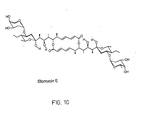
- Fraction III contains 1.6 g of efomycin E as evaporation residue, which can be recrystallized from methanol.
- the degrees of purity of the efomycin components A to E obtained in this way can be determined by means of HPLC - (column Nova Pak o, C-18, 18.4 ⁇ m, 3.9 x 150 mm; Fa. Waters; eluent: 5 mM citric acid with 45-65% Acetonitrile addition as a gradient in 18 minutes; flow rate 1.5 ml / min) can be approximately determined by absorbance measurements at 254 nm and / or 208 nm detector wavelength. Accordingly, they are at least 80-85% for each component.
- a corresponding chromatogram of a mixture of the efomycin components A to E is shown in Fig. 11.
- composition of the buffer solution which was saturated with carbon dioxide before the start of the experiment, was as follows:
- the ratio of acetic acid to propionic acid was determined in each experiment.
- the value obtained in the negative controls was set at 100 and the deviations in relation thereto were given.
- Twenty-four Holstein-Friesian cows were selected in order to determine the effects of the compounds according to the invention on milk yield.
- Six cows were given 1000 mg of the mixture of all efomycin components each day, six were given 1000 mg of efomycin A daily, six were given 1000 mg of efomycin E each day, and six cows were negative controls.
- the compounds according to the invention were added in the form of a premix to the finished feed of the 18 test cows. All cows received a ration that contained 45% corn, 20% alfalfa hay and 35% finished feed. Feed intake, milk production and milk composition (content of fat, protein and lactose) were measured daily for 12 weeks. The trial started 4 weeks ago after calving. Good results were achieved in this experiment, ie increased milk production without influencing the milk composition.
Landscapes
- Chemical & Material Sciences (AREA)
- Organic Chemistry (AREA)
- Life Sciences & Earth Sciences (AREA)
- Health & Medical Sciences (AREA)
- Engineering & Computer Science (AREA)
- General Health & Medical Sciences (AREA)
- Genetics & Genomics (AREA)
- Biotechnology (AREA)
- Biochemistry (AREA)
- Zoology (AREA)
- Wood Science & Technology (AREA)
- Molecular Biology (AREA)
- Bioinformatics & Cheminformatics (AREA)
- Medicinal Chemistry (AREA)
- Chemical Kinetics & Catalysis (AREA)
- General Chemical & Material Sciences (AREA)
- General Engineering & Computer Science (AREA)
- Microbiology (AREA)
- Polymers & Plastics (AREA)
- Public Health (AREA)
- Pharmacology & Pharmacy (AREA)
- Virology (AREA)
- Veterinary Medicine (AREA)
- Nuclear Medicine, Radiotherapy & Molecular Imaging (AREA)
- Animal Behavior & Ethology (AREA)
- Tropical Medicine & Parasitology (AREA)
- Mycology (AREA)
- Biomedical Technology (AREA)
- Communicable Diseases (AREA)
- Animal Husbandry (AREA)
- Oncology (AREA)
- Food Science & Technology (AREA)
- Reproductive Health (AREA)
- Endocrinology (AREA)
- Pharmaceuticals Containing Other Organic And Inorganic Compounds (AREA)
- Preparation Of Compounds By Using Micro-Organisms (AREA)
- Micro-Organisms Or Cultivation Processes Thereof (AREA)
- Medicines Containing Material From Animals Or Micro-Organisms (AREA)
- Fodder In General (AREA)
- Saccharide Compounds (AREA)
Abstract
Description
- Die vorliegende Erfindung betrifft die Verwendung mikrobiologisch hergestellter Verbindungen und ihrer Gemische, die Efomycine genannt werden, als Leistungsförderer bei Tieren sowie Verfahren zu ihrer Herstellung, ferner neue Efomycine sowie ihre Gemische als neue chemische Verbindungen. Die Erfindung betrifft ferner zur Herstellung der Efomycine und ihrer Gemische verwendbare Mikroorganismen.
- 1. Es wurde gefunden, daß man die Efomycine A-F sowie ihre Gemische als Leistungsförderer bei Tieren einsetzen kann.
Zusätzlich zeigen die Efomycine A-F und ihre Gemische starke antimikrobielle wie z.B. antibakterielle und antivirale Wirkungen. - 2. Es wurden ferner die neuen Efomycine A, B, C, D, F mit den im folgenden angegebenen chemischen und physikalischen Eigenschaften sowie Gemische dieser Verbindungen gefunden:
- 2.1 Die neue Verbindung Efomycin A wird durch die folgenden chemischen und physikalischen Eigenschaften charakterisiert:
- 1. Die Elementaranalyse C: 61,3-63,8
- H: 8,2-9,4
- O: 26,8-30,5
- Es muß hier darauf hingewiesen werden, daß bei höhermolekularen Naturstoffen die Fehlerbreite der Elementaranalyse größer sein kann als allgemein üblich - (R.B. Woodward, Angew. Chem. 69, 50-51 (1957)).
- 2. Die Summenformel: C55H92O18
- 3. Das Massenspektrum (Fast Atom Bombardment) Molmasse + Na+ : 1061
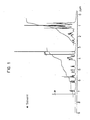
- 4. Das 'H-Kernresonanzspektrum, angegeben in Teilen pro Million, gemäß Abb. 1
- Es wurde in einem WP 200 der Fa. Bruker bei 200 MHz an einer Lösung von Efomycin A in deuteriertem Chloroform mit Tetramethylsilan als innerem Standard aufgenommen.
- 5. Das 13C-Kernresonanzspektrum, angegeben in Teilen pro Million, gemäß Abb. 2
- Es wurde in einem EP 200 der Fa. Bruker bei 50,32 MHz an einer Lösung von Efomycin A in deuteriertem Chloroform mit Tetramethylsilan als innerem Standard aufgenommen.
- 6. Das UV-Absorptionsmaximum bei 251-254 nm in methanolischer Lösung. 22 Die neue Verbindung Efomycin B wird durch die folgenden chemischen und physikalischen Eigenschaften charakterisiert:
- 1. Die Elementaranalyse C: 61,3-63,8
- H: 8,2-9,4
- 0: 26,8-30,5
- Es muß hier darauf hingewiesen werden, daß bei höhermolekularen Naturstoffen die Fehlerbreite der Elementaranalyse größer sein kann als allgemein üblich - (R.B. Woodward, Angew. Chem. 69, 50-51 (1957)).
- 2. Die Summenformel C56H94O187)).
- Das Massenspektrum (Fast Atom Bombardment)
- 3. Molmasse + Na+ : 1075
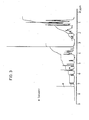
- 4. Das 'H-Kemresonanzspektrum, angegeben in Teilen pro Million, gemäß Abb. 3.
- Es wurde in einem EP 200 der Fa. Bruker bei 200 MHz an einer Lösung von Efomycin B in deuteriertem Chloroform mit Tetramethylsilan als innerem Standard aufgenommen.
- 5. Das "C-Kemresonanzspektrum, angegeben in Teilen pro Million, gemäß Abb. 4.
- Es wurde in einem EP 200 der Fa. Bruker bei 50,32 MHz an einer Lösung von Efomycin A in deuteriertem Chloroform mit Tetramethylasilan als innerem Standard aufgenommen.
- 6. Das UV-Absorptionsmaximum bei 251-254 nm in methanolischer Lösung. 2.3 Die neue Verbindung Efomycin C wird durch die folgenden chemischen und physikalischen Eigenschaften charakterisiert.
- 1. Die Summenformel C49H80O15
- 2. Das Massenspektrum (Fast Atom Bombardment) Molmasse + Na+ : 931
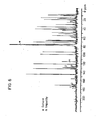
- 3. Das 'H-Kernresonanzspektrum, angegeben in Teilen pro Million, gemäß Abb. 5 Es wurde in einem WP 200 der Fa. Bruker bei 200 MHz an einer Lösung von Efomycin C in deuteriertem Chloroform mit Tetramethylsilan als innerem Standard aufgenommen.
- 4. Das "C-Kernresonanzspektrum, angegeben in Teilen pro Million, gemäß Abb. 6.
- Es wurde in einem WM 250 der Fa. Bruker bei 250 MHz an einer Lösung von Efomycin C in deuterisiertem Chloroform mit Tetramethylsilan als innerem Standard aufgenommen.
- 5. Das UV-Absorptionsmaximum bei 251-254 nm in methanolischer Lösung. 2.4 Die neue Verbindung Efomycin D wird durch die folgenden chemischen und physikalischen Eigenschaften charakterisiert
- 1. Die Summenformel C42H68O12
- 2. Das Massenspektrum (Fast Atom Bombardment) Molmasse + Na+ : 787
- 3. Die 'H-Kernresonanzspektren, angegeben in Teilen pro Million. Sie werden in einem WM 250 der Fa. Bruker bei 250 MHz an einer Lösung von Efomycin D in deuteriertem Chloroform mit Tetramethylsilan als innerem Standard aufgenommen (Abb. 7). Die identische Lösung wurde nach Schütteln mit deuteriertem Wasser unter entsprechenden Bedingungen aufgenommen (Abb. 8).
- 4. Das "C-Kernresonanzspektrum, angegeben in Teilen pro Million, gemäß Abb. 9.
- Es wurde in einem WM -250 der Fa Bruker bei 62,84 MHz an einer Lösung von Efomycin D in deuteriertem Chloroform mit Tetramethylsilan als innerem Standard aufgenommen.
- 5. Das UV-Absorptionsmaximum bei 251-254 nm in methanolischer Lösung. 2.5 Die neue Verbindung Efomycin F wird durch die folgenden chemischen und physikalischen Eigenschaften charakterisiert:
- 1. Die Summenformel: C48H78O15
- 2. Die Elementaranalyse: C: 63,0-65,6
- H: 8,5-8,9
- O: 26,5-28,5
- Es muß hier daraufhingewiesen werden, daß bei höhermolekularen Naturstoffen die Fehlerbreite der Elementaranalyse größer sein kann als allgemein üblich - (R.B. Woodward, Angew. Chem. 69, 50-51 (1957)).
- 3. Das Massenspektrum (Fast Atom Bombardment) Molmasse + Na+ : 917
- 4. Das UV-Absorptionsmaximum bei 251-254 nm in methanolischer Lösung.
- 5. Die folgenden Absorptionsbanden, angegeben in cm-', des IR-Spektrums, aufgenommen als KBr Preßling:
- 3444 1385 1150 745
- 2975 1304 1112
- 2937 1284 1088
- 1693 1259 1000
- 1642 1226 880
- 1462 1187 825
- Die Verbindung Efomycin E wird durch die in Abb. 10 wiedergegebene Strukturformel gekennzeichnet.
- Efomycin E ist mit Azalomycin B (vgl. US-P 3 076 746) bzw. Elaiophylin (W. Keller-Schierlein et.al. Hel.Chim.Acta 64, 407-424 (1981) ; K. Neupert-Laves, M. Dobler Helv. Chim. Acta 65, 262-267 - (1982)) in Konstitution, sowie relativer und absoluter Konfiguation sämtlicher, bei Raumtemperatur in Lösung konfigurativ stabiler, asymmetrischer Kohlenstoffatome identisch.
- 2.1 Die neue Verbindung Efomycin A wird durch die folgenden chemischen und physikalischen Eigenschaften charakterisiert:
- 3. Es wurde weiterhin gefunden, daß man die erfindungsgemäßen Efomycine A, B, C, D, F sowie ihre Gemische erhält, wenn man geeignete Mikroorganismen der Familie der Streptomycetaceae in einem Nährmedium welches assimilierbare Kohlenstoff-und Stickstoffquellen sowie Mineralsalze enthält unter aeroben Bedingungen kultiviert, das entstandene Gemisch der Efomycine nach üblichen Methoden isoliert und trennt.
- Bei Kenntnis der Eigenschaften der Efomycine A, B, C, D, F ist es mit Hilfe der üblichen chromatografischen, spektroskopischen und/oder biologischen Nachweisverfahren leicht und rasch möglich, geeignete Mikroorganismenstämme auszumachen die Efomycine A, B, C, D, F produzieren. 4. Zur Durchführung des Verfahrens kann insbesondere der Streptomyces Stamm BS 1261 -sowie seine Mutanten und Värianten -Verwendung finden.
- Dieser Stamm gehört zu der Familie Streptomycetaceae, der Gattung Streptomyces aus der grauen Serie der Streptomyceten - (Cinereus-Gruppe).
- Der Stamm BS 1261 wurde am 16.01.1985 bei der Deutschen Sammlung für Mikroorganismen (DSM) Griesbachstraße 8, 3400 Göttingen, Bundesrepublik Deutschland unter der Nummer DSM 3200 hinterlegt.
- Taxonomische Beschreibung des Stamms BS 1261 (DSM 3200)
- Die taxonomische Beschreibung des Stamms BS 1261 erfolgte nach Bergey's Manual of Determinative Bacterioloav 8th, (1974) sowie International Journal of Systematic Baceteriology 16. 313-340 (1966) und The Prokarvotes 2,, 2028-2020 (1981).
- Eine gute Sporulation war auf den ISP-Medien Nr. 2, 3, 4, 5, 7 bis 9 zu beobachten. Auf ISP-Medium Nr. 9 mit Ribose als C-Quelle sowie aus ISP-Medium Nr. 1 und 6 wurde überwiegend Substratmyzel gebildet.
- Luftmyzel (ISP-Medium Nr. 3, 28°C, 7 Tage:
- Farbe: grau (Cinereus-Typ)
- Sporenketten: Retinaculum-Apertum-Type
- Sporen: Quadratisch bis rechteckig,
- 1,4-1,8 µm lang und 1,3-1,6 u.m breit
- glatt (Elektronenmikroskopie).
- Das Temperaturoptimum liegt bei 28°C (auf ISP-Medium Nr. 2, 5 Tage). Der Stamm wächst nicht bei 4°und 45°C. Melanin wird nicht gebildet. Das Wachstum wird durch die Antibiotika Erythromycin (10 µg), Sulphafurazol (100 µg), Streptomycin (10 u.g) und Novobiocin (5 µg) gehemmt (ISP-Medium Nr. 2, 28°C, 2 Tage).
- Die Verwertung von C-Quellen wurde auf Basalagar (ISP-Medium Nr. 9) nach Int. Syst. Bact. 16, 313-340 (1966) überprüft. Für die Negativ-Kontrolle wurde das Wachstum auf Basalagar ohne C-Quelle verglichen. Dabei werden folgende Ergebnisse erhalten:
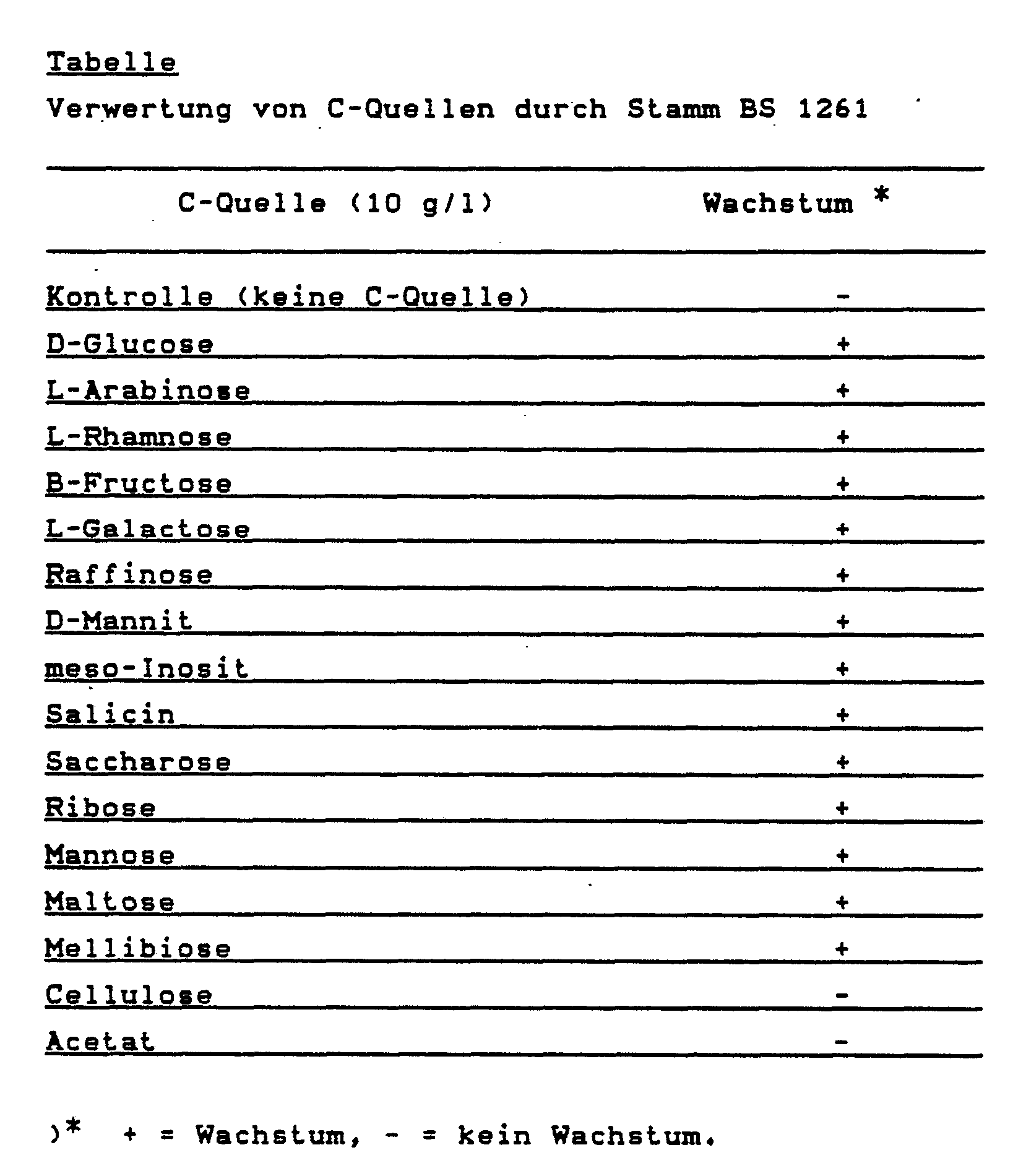
- 20 g Hafermehl werden in 1000 ml H20 deion. suspendiert und 20 Minuten gekocht. Anschließend wird filtriert, 1 ml Spurenelementlösung für ISP3 und 18 g Agar zugegeben, und der pH-Wert auf 7,2 eingestellt, und bei 121 °C 15-20 Minuten autoklaviert.
-

- Weitere Medien s. lnt. J. Syst. Bact. 16 , 313-340 (1966).
- Der Stamm BS 1261, isoliert aus einer Erdprobe aus Neuseeland, läßt sich aufgrund der morphologischen Daten in die graue Serie der Streptomyceten (Cinereus-Gruppe) einordnen.
- Die Efomycine A-F werden erfindungsgemäß durch die Fermentation geeigneter Mikroorganismen, wie dem Streptomycetenstamm BS 1261 oder dessen Mutanten oder Varianten erzeugt.
- Das erfindungsgemäße Fermentationsverfahren kann mit Hilfe fester, halbfester oder flüssiger Nährmedien durchgeführt werden. Bevorzugt werden wäßrig-flüssige Nährmedien verwendet.
- Die Beimpfung der Nährmedien erfolgt nach allgemein üblichen Methoden, z.B. über Schrägröhrchen oder Kolbenkulturen.
- Die Kultur erfolgt unter aeroben Bedingungen und kann gemäß den allgemein üblichen Methoden wie unter Verwendung von Schüttelkulturen oder von Submerskulturen durchgeführt werden. Bevorzugt erfolgt die Kultivierung im aeroben Submersverfahren in belüfteten Fermentern, z.B. in üblichen Submersfermentationstanks. Es ist möglich, die Fermentation kontinuierlich oder diskontinuierlich durchzuführen. Vorzugsweise wird diskontinuierlich gearbeitet.
- Die Kultur wird in Nährmedien durchgeführt, welche bekannterweise zur Kultivierung von Mikroorganismen der Ordnung Actinomycetales verwendet werden. Das Nährmedium muß eine oder mehrere assimilierbare Kohlenstoffquellen und Stickstoffquellen sowie Mineralsalze enthalten, wobei diese Produkte in Form von definierten Einzelbestandteilen, aber auch in Form von komplexen Gemischen, wie sie insbesondere biologische Produkte verschiedenen Ursprungs darstellen, vorliegen können. Als Kohlenstoffquellen kommen alle üblichen Kohlenstoffquellen infrage. Beispielsweise seien Kohlenhydrate, insbesondere Polysaccharide, wie Stärke oder Dextrine, Disaccharide, wie Maltose oder Lactose, Monosaccharide, wie Glucose oder Xylose, Alkohole, wie Mannit oder Glycerin sowie natürlich vorkommende Gemische, wie Malzextrakt, Melasse oder Molkepulver genannt. Als Stickstoffquellen kommen alle üblichen organischen und anorganischen Stickstoffquellen infrage. Beispielsweise seien Eiweißstoffe, Eiweißhydrolysate, Aminosäuren, Nucleosidbasen, wie Cytosin oder Uracil sowie Sojabohnenmehl, Baumwollsamenmehl, Linsenmehl, Erbsenmehl, lösliche und unlösliche pflanzliche Proteine, Maisquellwasser, Hefeextrakt, Peptone und Fleischextrakt, stickstoffhaltige Salze wie z.B. Ammoniumsalze und Nitrate, aufgeführt. Die Mineralsalze, welche im Nährmedium enthalten sein sollten, liefern z.B. folgende lonen:

- Bei der Durchführung des Verfahrens kann es günstig sein, zu Beginn der Kultivierung nur relativ geringe Konzentrationen der löslichen Nährlösungsbestandteile zu verwenden und dann im Laufe der ersten 3 Kultivierungstage durch häufigere Zusätze diese Bestandteile in Form steriler, relativ konzentrierter Lösungen dem Kulturansatz fraktioniert zuzufüttem.
- Der pH-Wert der wachsenden Kulturen sollte vorzugsweise zwischen etwa 5 und etwa 10, insbesondere zwischen 6,5 und 8,0 gehalten werden. Ein zu starker pH-Abfall in den sauren Bereichen kann durch Zusätze einer organischen oder anorganischen Base, vorzugsweise von CaCO3 vermieden werden. Wie in der Fermentationstechnologie üblich, kann auch eine automatische pH-Regulierung durchgeführt werden, bei der sterile organische oder anorganische Säuren, z.B. H2SO., oder sterile Laugen, z.B. NaOH in Abständen in die Kulturlösung eingespritzt werden.
- Es ist zweckmäßig sicherzustellen, daß die Mikroorganismen ausreichend mit Sauerstoff sowie den Nährstoffen in Kontakt gebracht werden. Dies kann nach den allgemein üblichen Methoden wie Schütteln und Rühren erfolgen.
- Die Züchtungstemperatur kann zwischen etwa 24°C und etwa 34°C, vorzugsweise zwischen 26°C und 32°C liegen, besonders bevorzugt liegt sie bei etwa 28°C. Die Dauer der Züchtung kann stark variiert werden, wobei z.B. die Zusammensetzung des Nährmediums und die Züchtungstemperatur eine Rolle spielen. Die jeweiligen optimalen Bedingungen können von jedem Fachmann auf dem mikrobiologischen Gebiet leicht festgelegt werden.
- Es hat sich herausgestellt, daß die Menge der sich in der Kulturbrühe anreichernden erfindungsgemäßen Verbindungen im allgemeinen ihr Maximum etwa 1 bis 10, vorzugsweise etwa 4 bis 7 Tage nach Züchtungsbeginn erreicht. Das gewünschte Endprodukt der Fermentation kann mit Hilfe von dünnschichtchromatographischen und hochdruckflüssigkeitschromatographischen Untersuchungen oder biologischen Testverfahren bestimmt werden.
- Wie allgemein bei mikrobiologischen Verfahren üblich sollten Fremdinfektionen der Kulturmedien vermieden werden. Hierzu werden die üblichen Vorkehrungen getroffen, wie Sterilisation der Nährmedien, Kulturgefäße sowie der für die Belüftung notwendigen Luft. Zur Sterilisation der Vorrichtungen können z.B. die Dampfals auch die Trockensterilisation verwendet werden, wobei die Temperaturen vorzugsweise bei 100 bis 140°C, insbesondere bei 120 bis 130°C liegen können.
- Falls bei der Kultivierung in unerwünschter Menge Schaum entsteht, können die üblichen chemischen Schaumdämpfungsmittel, z.B. flüssige Fette und Öle, wie ÖI-Wasser-Emulsionen, Paraffine, höhere Alkohole, wie Octadecanol, Siliconöle, Polyoxyethylen-bzw. Polyoxypropylenverbindungen (z.B. in Mengen bis etwa 1 %) zugesetzt werden. Schaum kann auch mit Hilfe der üblichen mechanischen Vorrichtungen (welche z.B. Zentrifugalkräfte benutzen) gedämpft oder beseitigt werden.
- Die erfindungsgemäßen Verbindungen können aus dem Kulturmedium nach allgemein üblichen physikalisch-chemischen Methoden isoliert werden. Die Isolierung kann z.B. gemäß den üblichen Extraktionsverfahren, Fällungsverfahren und/oder Chromatographieverfahren erfolgen. Die isolierten Stoffe können mit Hilfe der genannten Methoden auch feingereinigt werden. Für viele Fälle ist jedoch eine Feinreinigung nicht erforderlich, da gegebenenfalls vorhandene geringfügige Verunreinigungen die Wirksamkeit der Verbindungen nicht nachteilig beeinflußen. Bei allen Isolierungs-und Reinigungsoperationen ist darauf zu achten, daß die pH-Werte im neutralen Bereich liegen. Vorzugsweise werden pH-Werte zwischen 7 und 8 eingehalten. Zur Einstellung des pH-Wertes können anorganische und organische Basen verwendet werden, wie Alkalibasen z.B. NaOH, KOH oder organische Amine, wie Triethylamin; anorganische Säuren wie z.B. HCI und organische Säuren wie z.B. Essigsäure.
- Um bei den oben angegebenen Isolierungs-und Reinigungsmethoden die Fraktionen herauszufinden, in welchen die erfindungsgemäßen Verbindungen in höchster Konzentration bzw. Reinheit vorliegen, können die üblichen physikalisch chemischen Methoden z.B. Messen einer charakteristischen Bande im Spektrum oder der Rf-Werte, Bestimmung der antibakteriellen Aktivität usw. herangezogen werden. Diese Methoden können auch verwendet werden, um in Routineverfahren für die Produktion von Efomycinen geeignete Mikroorganismen aufzufinden.
- Die Isolierung und Reinigung der erfindungsgemäßen Verbindungen kann z.B. im Falle, daß ein flüssiges wäßriges Nährmedium verwendet wird, wie folgt vorgenommen werden:
- Da die Efomycine sowohl im Kulturüberstand als auch im Myzel zu finden sind, können sie mit Hilfe von üblichen Extraktionsverfahren, Fällungsverfahren und/oder Chromatographieverfahren aus dem Fermentationsansatz isoliert und gegebenenfalls gereinigt werden. Die Chromatographie kann in Form der Säulenchromatographie durchgeführt werden. Mit gutem Erfolg läßt sich auch die Hochdruckflüssigkeitschromatographie - (HPLC) einsetzen. Als Adsorptionsmittel können die üblichen anorganischen oder organischen Adsorptionsmittel eingesetzt werden, wie z.B. Kieselgel, Magnesiumsilikat, Aktivkohle, Cellulose, Cellulosederivate, Kunstharze wie Polyamide, z.B. acetylier- tes Polyamid, Dextrangele .oder modifizierte Dextrangele. Als Laufmittel können die verschiedensten Lösungsmittel oder Lösungsmittelgemisch verwendet werden, in welchen die erfindungsgemäßen Verbindungen löslich sind. Bevorzugt werden Essigsäureethylester, Chloroform und Methanol oder ihre Gemische (beispielsweise Gemische aus Chloroform und Methanol oder aus Essigsäureethylester und Chloroform) eingesetzt.
- Bevorzugt werden zur Isolierung der erfindungsgemäßen Verbindungen Chromatographie-Verfahren verwendet, z.B. unspezifische Adsorption an Sorbentien wie Kieselgel oder andererseits Geldiffusionschromatographie. Dies sind die von der Reinigung schlecht wasserlöslicher Naturstoffe her bekannten Methoden.
- Aus ihren Lösungen können die erfindungsgemäßen Verbindungen nach den üblichen Methoden, z.B. Verdampfen des Lösungsmittels, Gefriertrocknung usw. erhalten werden.
- In einer bevorzugten Ausführungsform wird das Mycelium aus der Kulturbrühe, vorzugsweise durch Zentrifugation abgetrennt und mit einem, mit Wasser mischbaren Lösungsmittel mehrfach, vorzugsweise zweimal extrahiert. Als Lösungsmittel können (C,-C4)-Aikyiaikohoie, C'.4-Ketone, besonders bevorzugt Aceton verwendet werden. Die wäß rigorganische Lösung wird im Vakuum, z.B. etwa auf 1/20 des Volumens der Kulturbrühe konzentriert und gefriergetrocknet.
- Dieses Rohpräparat wird in Wasser suspendiert und die Efomycine mit einem mit Wasser nicht mischbaren Lösungsmittel, wie z.B. Chlorkohlenwasserstoffe wie Chloroform, Ester der Essigsäure oder Ketone extrahiert. Aus diesem Extrakt können die Efomycine durch übliche chromatographische Methoden, vorzugsweise Chromatographie an Kieselgel, isoliert werden.
- Die Efomycine können auch aus dem Kulturfiltrat durch Extraktion mit einem mit Wasser nicht mischbaren Lösungsmittel wie z.B. Essigester, Methylenchlorid oder Chloroform extrahiert werden.
- Sie können außerdem an unspezifische Adsorberharze auf Polystyrolbasis (z.B. Amberlite XAD der Firma Roehm & Hass oder Lewatit OC 1031 der Firma Bayer) gebunden werden. Die Desorption wird fraktioniert, durch Mischungen aus Wasser und organischen Lösungsmitteln, insbesondere Wasser/Methanol vorgenommen. Die durch Test gegen Staphylococcus aureus 1756 ermittelten. aktiven Fraktionen werden unter reduziertem Druck bis zur vollständigen Entfernung des organischen Lösungsmittels bei 30 -35°C konzentriert und der Rückstand in ca. 1/100 des Volumens des Kulturfiltrates suspendiert und gefriergetrocknet.
- Das Lyophilisat wird erneut in Wasser suspendiert und vorzugsweise mit Essigsäureethylester oder anderen nicht mit Wasser mischbaren Lösungsmitteln extrahiert. Aus dem Extrakt werden die Efomycine durch übliche chromatographische Methoden, vorzugsweise Chromatographie an Kieselgel, gewonnen.
- Die erfindungsgemäßen Verbindungen zeigen eine gute antibakterielle Wirkung vor allem gegen grampositive Keime. Besonders erwähnt werden soll ihre Eignung zur Verhinderung und Heiling der Schweinedysenterie.
- Die Wirkstoffe werden als Leistungsförderer bei Tieren zur Förderung und Beschleunigung des Wachstums, der Milch-und Wollproduktion, sowie zur Verbesserung der Futterverwertung, der Fleischqualität und zur Verschiebung des Fleisch-Fett-Verhältnisses zugunsten von Fleisch eingesetzt. Die Wirkstoff werden bei Nutz-, Zucht-, Zier-und Hobbytieren verwendet.
- Zu den Nutz-und Zuchttieren zählten Säugetiere wie z.B. Rinder, Schweine, Pferde, Schafe, Ziegen, Kaninchen, Hasen, Damwild, Pelztiere wie Nerze, Chinchilla, Geflügel wie z.B. Hühner, Gänse, Enten, Puten, Tauben, Fische wie z.B. Karpfen, Forellen, Lachse, Aale, Schleien, Hechte, Reptilien wie z.B. Schlangen und Krokodile.
- Zu den Zier-und Hobbytieren zählen Säugetiere wie Hunde und Katzen, Vögel wie Papageien, Kanarienvögel, Fische wie Zier-und Aquarienfische z.B. Goldfische.
- Die Wirkstoffe werden unabhängig vom Geschlecht der Tiere während allen Wachstums-und Leistungsphasen der Tiere eingesetzt. Bevorzugt werden die Wirkstoffe während der intensiven Wachstums-und Leistungsphase eingesetzt. Die intensive Wachstums-und Leistungsphase dauert je nach Tierart von einem Monat bis zu 10 Jahren.
- Die Menge der Wirkstoffe, die den Tieren zur Erreichung des gewünschten Effektes verabreicht wird, kann wegen der günstigen Eigenschaften der .Wirkstoffe weitgehend variiert werden. Sie liegt vorzugsweise bei etwa 0,001 bis 500 mg/kg insbesondere 0,01 bis 5 mg/kg Körpergewicht pro Tag. Die passende Menge des Wirkstoffs sowie die passende Dauer der Verabreichung hängen insbesondere von der Art, dem Alter, dem Geschlecht, der Wachstums-und Leistungsphase, dem Gesundheitszustand und der Art der Haltung und Fütterung der Tiere ab und sind durch jeden Fachmann leicht zu ermitteln.
- Die Wirkstoffe werden den Tieren nach den üblichen Methoden verabreicht. Die Art der Verabreichung hängt insbesondere von der Art, dem Verhalten und dem Gesundheitszustand der Tiere ab.
- Die Wirkstoffe können einmalig verabreicht werden. Die Wirkstoffe können aber auch während der ganzen oder während eines Teils der Wachstums-und Leistungsphase temporär oder kontinuierlich verabreicht werden.
- Bei kontinuierlicher Verabreichung kann die Anwendung einoder mehrmals täglich in regelmäßigen oder unregelmäßigen Abständen erfolgen.
- Die Verabreichung erfolgt oral oder parenteral in dafür geeigneten Formulierungen oder in reiner Form.
- Die Wirkstoffe können in den Formulierungen allein oder in Mischung mit anderen leistungsfördemden Wirkstoffen, mineralischen Futtermittlen, Spurenelement-Verbindungen, Vrtaminen, Nicht-Protein-Verbindungen, Farbstoffen, Antioxidantien, Aromastoffen, Emulgatoren, Fließhilfsstoffen, Konservierungs-und Preßhilfsstoffen vorliegen.
- Andere leistungsfördemde Wirkstoffe sind:
- z.B. Antibiotika wie Tylosin, Virginiamycin und Monensin. Mineralische Futtermittel sind z.B. DicaJciumphosphat, Magnesiumoxid, Natriumchlorid.
- Spurenelement-Verbindungen sind z.B. Eisenfumarat, Natriumjodid, Kobaltchlorid, Kupfersulfat, Zinkoxid. Vitamine sind z.B. Vitamin A, Vitamin D3, Vitamin E, B-Vitamine, Vitamin C:
- Nicht-Protein-Verbindungen sind z.B. Biuret, Harnstoff. Farbstoffe sind z.B. Carotinoide wie Citranaxanthin, Zeaxanthin, Capsanthin.
- Antioxidantien sind z.B. Aethoxyquin, ButylhydroxyToluol.
- Aromastoffe sind z.B. Vanillin.
- Emulgatoren sind z.B. Ester der Milchsäure, Lecithin.
- Fließhilsstoffe sind z.B. Natriumstearat, Calciumstearat.
- Konservierungsstoffe sind z.B. Zitronensäure, Propionsäure.
- Preßhilfsstoffe sind z.B. Ligninsulfonate, Celluloseether.
- Die Verabreichung der Wirkstoffe kann auch zusammen mit dem Futter und/oder dem Trinkwasser erfolgen.
- Zum Futter zählen Einzelfuttermittel pflanzlicher Herkunft wie Heu, Rüben, Getreidenebenprodukte, Einzelfut termittel tierischer Herkunft wie Fleisch, Fette, Milchprodukte, Knochenmehl, Fischprodukte, die Einzelfuttermittel wie Vitamine, Proteine, Aminosäure z.B. DL-Methionin, Salze wie Kalk und Kochsalz. Zum Futter zählen auch Ergänzungs-, Fertig-und Mischfuttermittel. Diese enthalten Einzelfuttermittel in einer Zusammensetzung die eine ausgewogene Ernährung hinsichtlich der Energie-und Proteinversorgung sowie der Versorgung mit Vitaminen, Mineralsalzen und Spurenelementen sicherstellen.
- Die Konzentration der Wirkstoffe im Futter beträgt normalerweise etwa 0,01-500 ppm, bevorzugt 0,1-50 ppm.
- Die Wirkstoffe können als solche oder in Form von Prämixen oder Futterkonzentraten dem Futter zugesetzt werden.
- Beispiel für die Zusammensetzung eines Kükenaufzuchtfutters, das erfindungsgemäßen Wirkstoff enthält :
- 200 g Weizen, 340 g Mais, 361 g Sojaschrot, 60 g Rindertalg, 15 g Dicalciumphosphat, 10 g Calciumcarbonat, 4 g jodiertes Kochsalz, 7,5 g Vitamin-Mineral-Mischung und 2,5 g Wirkstoff-Prämix ergeben nach sorgfältigem Mischen 1 kg Futter.
- In einem kg Futtermischung sind enthalten:
- 600 I.E. Vitamin A, 100 I.E. Vitamin, D3, 10 mg Vitamin E, 1 mg Vitamin K3, 3 mg Riboflavin, 2 mg Pyridoxin, 20 mcg Vitamin B12, 5 mg Calciumpanto-. thenat, 30 mg Nikotinsäure, 200 mg Cholinchlörid, 200 mg Mn So2 x H2O, 140 mg Zn So4 x 7 H20, 100 mg Fe SO, x 7 H20 und 20 mg Cu So. x 5 H2O.
- 2,5 g Wirkstoff-Prämix enthalten z.B. 10 mg Wirkstoff, 1 g DL-Methionin, Rest Sojabohnenmehl.
- Beispiel für die Zusammensetzung eines Schweineaufzuchtfutters, das erfindungsgemäßen Wirkstoff enthält :
- 630 g Futtergetreideschrot (zusammengesetzt aus 200 g Mais, 150 g Gerste-, 150 g Hafer-und 130 g Weizenschrot), 80 g Fischmehl, 60 g Sojaschrot, 60 g Tapiokamehl, 38 g Bierhefe, 50 g Vitamin-Mineral-Mischung für Schweine, 30 g Leinkuchenmehl, 30 g Maiskleberfutter, 10 g Sojaöl, 10 g Zuckerrohrmelasse und 2 g Wirkstoff-Prämix - (Zusammensetzung z.B. wie beim Kükenfutter) ergeben nach sorgfältigem Mischen 1 kg Futter.
- Die angegebenen Futtergemische sind zur Aufzucht und Mast von vorzugsweise Küken bzw. Schweinen abgestimmt, sie können jedoch in gleicher oder ähnlicher Zusammensetzung auch zur Fütterung anderer Tiere verwendet werden.
- Es ist nicht unbedingt erforderlich, die gereinigten und isolierten Efomycine A-F zu verwenden. Es ist auch möglich, die bei ihrer Herstellung anfallenden Gemische oder sogar die anfallende Kulturbrühe oder das Mycelium ohne Reinigung, gegebenenfalls nach Trocknung, einzusetzen. Für viele Zwecke ist es auch ausreichend, Rohformen der erfindungsgemäßen Wirkstoffe und ihrer Gemische ohne vorherige Feinreinigung einzusetzen.
- Die Herstellung und biologische Wirkung der neuen erfindungsgemäßen Verbindungen kann durch die folgenden Beispiele erläutert werden:
- 150 ml steriler, in 1-Ltr.-Erlenmeyerkolben befindlicher Nährlösung (CASO@ der Firma Merck, Darmstadt) der Zusammensetzung

- 20 Liter Nährlösung der oben beschriebenen Zusammensetzung und 20 ml Entschäumer (SAG 5693, UnionCarbide) werden in einen Fermenter - (30 I) mit Rührwerk und Belüftungseinrichtung abgefüllt, und bei 120°C sterilisiert. Nach Abkühlen der Lösung wird der Fermenter mit dem Inhalt von 2 Kolben der wie oben beschrieben gewonnenen Schüttelkulturen des Streptomyceten-Stammes BS 1261 beimpft, mit 10 Liter steriler Luft pro Minute bei 250 Umdrehungen des Rührwerks pro Minute belüftet und bei einer Temperatur von 28°C und einem Überlagerungsdruck von 0,5 bar fermentiert. Nach 1-2 Tagen wird die Kultivierung beendet und der Inhalt als Inokulum für einen Ansatz in einem 300 1 Fermenter verwendet.
- 200 I der Nährlösung der folgenden Zusammensetzung

- Die gemäß Beispiel 2 erhaltene Kulturbrühe einer 200-Uter Fermentation wird bei pH7-7,5 mit 200-250 I/h in einem Westfalia-Separator separiert. Das Mycel wird mit dem doppelten Volumen Aceton 30. Minuten bei Raumtemperatur gerührt und zentrifugiert. Der Rückstand wird erneut mit dem doppelten Volumen Aceton gerührt und zentrifugiert. Die vereinigten Zentrifugate werden unter reduziertem Druck bei 40°C Badtemperatur konzentriert. Das Konzentrat wird mit 20 Liter Wasser versetzt und gefriergetrocknet, wobei 540 g des rohen erfindungsgemäßen Efomycin-Gemisches mit einem Gehalt von ca. 5 % an Efomycinen anfallen.
- 60 g des gemäß Beispiel 3 gewonnenen rohen Wirkstoffgemisches werden in 3 Liter Wasser suspendiert und dreimal mit je 400 ml Chloroform extrahiert. Die vereinigten organischen Phasen werden über wasserfreien Natriumsulfat getrocknet, filtriert und unter reduziertem Druck bei 35°C Badtemperatur bis auf ein Volumen von 30 ml eingesngt. Die konzentrierte Lösung läßt man unter Rühren in 2 Liter Heptan einfließen. Nach weiterem Rühren für 30 min wird abfiltriert, wobei 3,6 g Rückstand mit einem Gehalt des Efomycin-Gemisches von ca. 80 % gewonnen werden.
- 3,3 g des nach Beispiel 4 dargestellten Efomycin-Gemisches werden in 10 ml Chloroform gelöst, auf eine in Chlorofrom äquilibrierte Lobar® - Fertigsäule Lichroprep Si 60 (40-63 um, Merck Größe C) aufgetragen und mit einem Gemisch aus Chloroform und 7 % Methanol fraktioniert eluiert. Die dünnschichtchromatographische Analyse des Eluates (Merck 5715, Chloroform 7 % Methanol, Detektion durch Fluoreszenzlöschung bei 254 nm) ergibt nach fallenden RF-Werten geordnet drei Fraktionen I, II und III, die getrennt im Vakuum bei ca. 35 °C eingedampft werden.
- Fraktion I enthält 480 mg eines Produktgemisches, das dickschichtchromatographisch an Kieselgelplatten (Merck 13 895) mit Ethylacetat als Fließmittel in drei Komponenten aufgetrennt wird, die nach steigenden RF-Werten als Efomycin-B - (160 mg Ausbeute), Efomycin C (60 mg Ausbeute) bzw. Efomycin D (40 mg Ausbeute) bezeichnet werden.
- Fraktion II enthält 950 mg eines Produktgemisches, das dickschichtchromatographisch an Kieselgelplatten (Merck 13 895) mit Ethylacetat als Fließmittel in zwei Komponenten aufgetrennt wird, die nach steigenden RF-Werten als Efomycin A - (510 mg Ausbeute) bzw. Efomycin F (320 mg Ausbeute) bezeichnet werden.
- Fraktion III enthält als Verdampfungsrückstand 1,6 g Efomycin E, das sich aus Methanol umkristallisieren läßt.
- Die Reinheitsgrade der so gewonnenen Efomycin Komponenten A bis E können mittels HPLC - (Säule Nova Pak o, C-18, 18,4 um, 3,9 x 150 mm; Fa. Waters; Fließmittel: 5 mM Citronensäure mit 45-65 % Acetonitril Zusatz als Gradient in 18 Minuten; Durchflußrate 1,5 ml/min) durch Extinktionsmessungen bei 254 nm und/oder 208 nm Detektorwellenlänge annähernd bestimmt werden. Sie betragen demnach für jede Komponente mindestens 80-85 %. Ein entsprechendes Chromatogramm eines Gemisches der Efomycin-Komponenten A bis E ist in Abb. 11 wiedergegeben.
- Einem Hammel, der pro Tag 650 g grob gemahlenes Schaf-Fertigfutter und 250 g Trockengrün Cobs erhielt, wurde Pansenflüssigkeit durch eine Pansenfistel entnommen. Das Fertigfutter wurde über einen Futterautomaten in 12 gleichen Portionen in zweistündlichem Abstand und die Cobs in 2 gleichen Portionen um 8.30 und 16.15 Uhr verabreicht. Die Pansenflüssigkeit wurde unmittelbar nach der Gewinnung folgender Behandlung unterworfen: 2,5 ml des Panseninokulums wurden in einem mit Kohlendioxid begasten Reagenzröhrchen von 13 ml Volumen vorgelegt, das darüber hinaus folgende Zusätze enthielt:
- 100 mg fein gemahlenes Schaf-Fertigfutter
- 7,5 ml Pufferlösung
- 0,5 ml 'einer Lösung mit bzw. ohne erfindungsgemäße Verbindung.
- Die Zusammensetzung der Pufferlösung, welche vor Anfang des Versuches mit Kohlendioxid gesättigt wurde, war wie folgt:

- In diese Mischung wurde 0,5 ml einer Lösung, die die gewünschte Menge der erfindungsgemäßen Verbindungen in 5 prozentigem wäßrigem Ethanol enthielt, gegeben. Danach betrug das totale Volumen der Fermentationsmischung 10,5 ml. Jedes Reagenzröhrchen wurde mit einem Bunsen-Stopfen verschlossen und bei 39°C bebrütet. Nach 2, 4, 6 und 8 Stunden wurden die Ansätze von Hand geschüttelt. Nach 24-stündiger Bebrütung wurde-1,0 ml der Fermentationsflüssigkeit aus den Ansätzen entnommen und in ein Eppendorf-Gefäß pipettiert, das 0,2 ml 10 %ige Phosphorsäure (enthaltend 5,7 µmol 2-Methylvaleriansäure) enthielt. Die Proben wurden bei 11 000 g zentrifugiert und aus dem Überstand die flüchtigen Fettsäurekonzentrationen gaschromatographisch bestimmt.
- Es wurde bei jedem Versuch das Verhältnis Essigsäure zu Propionsäure bestimmt. Der bei den Negativkontrollen erhaltene Wert wurde mit 100 angesetzt und die Abweichungen im Verhältnis dazu angegeben. Je mehr Propionsäure gebildet wurde, um so niedriger liegt das Verhältnis Essigsäure zu Propionsäure und um so kleiner wird die Verhältniszahl im Vergleich zur Kontrolle - (niedrige Verhältniszahl = verringertes Essigsäure/Propionsäure-Verhäftnis = verbesserte Futterverwertung).
- Zusätzlich werden bei jedem Versuch die Konzentrationen der Gesamtfettsäuren im Vergleich zur Kontrolle (= 100) angegeben.
- Die Ergebnisse sind in den nachstehenden Tabellen zusammengestellt:


- Vierundzwanzig Holstein-Friesian Kühe wurden selektiert, um die Effekte der erfindungsgemäßen Verbindungen auf die Milchleistung zu bestimmen. Sechs Kühe bekamen täglich je 1000 mg des Gemisches aller Efomycin Komponenten, sechs bekamen täglich je 1000 mg Efomycin A, sechs bekamen täglich je 1000 mg Efomycin E und sechs Kühe bildeten die Negativkontrollen. Die erfindungsgemäßen Verbindungen wurden in Form eines Prämix dem Fertigfutter der 18 Testkühe zugesetzt. Sämtliche Kühe erhielten eine Ration, die 45 % Mais, 20 % Luzerneheu und 35 % Fertigfutter enthielt. Die Futteraufnahme, Milchproduktion und Milchzusammensetzung (Gehalt an Fett, Eiweiß und Laktose) wurden täglich über 12 Wochen gemessen. Der Versuch fing 4 Wochen nach dem Abkalben an. Bei diesem Versuch wurden gute Ergebnisse erzielt, d.h. eine erhöhte Milchproduktion ohne Beeinflussung der Milchzusammensetzung.
Claims (9)
Priority Applications (1)
| Application Number | Priority Date | Filing Date | Title |
|---|---|---|---|
| AT86103539T ATE88328T1 (de) | 1985-03-30 | 1986-03-15 | Verwendung von efomycinen als leistungsfoerderer bei tieren, efomycine und ihre herstellung. |
Applications Claiming Priority (2)
| Application Number | Priority Date | Filing Date | Title |
|---|---|---|---|
| DE3511753 | 1985-03-30 | ||
| DE19853511753 DE3511753A1 (de) | 1985-03-30 | 1985-03-30 | Verwendung von efomycinen als wachstumsfoerderer, efomycine und ihre herstellung |
Publications (2)
| Publication Number | Publication Date |
|---|---|
| EP0197360A1 true EP0197360A1 (de) | 1986-10-15 |
| EP0197360B1 EP0197360B1 (de) | 1993-04-21 |
Family
ID=6266903
Family Applications (1)
| Application Number | Title | Priority Date | Filing Date |
|---|---|---|---|
| EP86103539A Expired - Lifetime EP0197360B1 (de) | 1985-03-30 | 1986-03-15 | Verwendung von Efomycinen als Leistungsförderer bei Tieren, Efomycine und ihre Herstellung |
Country Status (15)
| Country | Link |
|---|---|
| US (1) | US5073369A (de) |
| EP (1) | EP0197360B1 (de) |
| JP (1) | JPS61233695A (de) |
| KR (1) | KR860009033A (de) |
| AR (1) | AR242484A1 (de) |
| AT (1) | ATE88328T1 (de) |
| AU (1) | AU599903B2 (de) |
| CA (1) | CA1306432C (de) |
| DE (2) | DE3511753A1 (de) |
| DK (1) | DK142586A (de) |
| ES (1) | ES8706202A1 (de) |
| FI (1) | FI861345L (de) |
| GR (1) | GR860827B (de) |
| NZ (1) | NZ215643A (de) |
| ZA (1) | ZA862321B (de) |
Cited By (2)
| Publication number | Priority date | Publication date | Assignee | Title |
|---|---|---|---|---|
| EP0236894A3 (en) * | 1986-03-12 | 1988-10-05 | Bayer Ag | Efomycine g, its preparation and its use as an animal growth promotor |
| EP0461499A3 (en) * | 1990-06-14 | 1992-09-16 | Bayer Ag | Use of efomycins a, e and g as antiinflammatory agents |
Families Citing this family (3)
| Publication number | Priority date | Publication date | Assignee | Title |
|---|---|---|---|---|
| US5420106A (en) * | 1994-03-22 | 1995-05-30 | Bristol-Myers Squibb Company | Method and composition having enhanced alpha-hydroxy acid skin permeation and retention |
| DE19654073A1 (de) | 1996-12-23 | 1998-06-25 | Bayer Ag | Verwendung von Efomycinen |
| CN102344468B (zh) * | 2011-07-13 | 2016-09-21 | 马丁 | 一类akt/pkb激酶激动剂的获得及其用途 |
Citations (1)
| Publication number | Priority date | Publication date | Assignee | Title |
|---|---|---|---|---|
| US3076746A (en) * | 1959-05-24 | 1963-02-05 | Sankyo Co | New antibiotics azalomycin b and f and a process for the production thereof |
Family Cites Families (4)
| Publication number | Priority date | Publication date | Assignee | Title |
|---|---|---|---|---|
| US4132778A (en) * | 1977-05-31 | 1979-01-02 | Eli Lilly And Company | Antibiotic A-32887 |
| RO86375B1 (ro) * | 1982-03-24 | 1985-04-01 | Eli Lilly And Company | Procedeu pentru prepararea antibioticului a 41030 |
| DE3443681A1 (de) * | 1984-11-30 | 1986-06-05 | Bayer Ag, 5090 Leverkusen | Organisch-chemische verbindung, mikrobiologische verfahren zu ihrer herstellung sowie ihre verwendung |
| NZ215917A (en) * | 1985-05-02 | 1989-10-27 | Merck & Co Inc | 22-oh milbemycin derivatives and parasiticidal compositions |
-
1985
- 1985-03-30 DE DE19853511753 patent/DE3511753A1/de not_active Withdrawn
-
1986
- 1986-03-15 AT AT86103539T patent/ATE88328T1/de not_active IP Right Cessation
- 1986-03-15 EP EP86103539A patent/EP0197360B1/de not_active Expired - Lifetime
- 1986-03-15 DE DE8686103539T patent/DE3688299D1/de not_active Expired - Fee Related
- 1986-03-17 US US06/840,638 patent/US5073369A/en not_active Expired - Fee Related
- 1986-03-19 AR AR86303429A patent/AR242484A1/es active
- 1986-03-24 AU AU55085/86A patent/AU599903B2/en not_active Ceased
- 1986-03-26 DK DK142586A patent/DK142586A/da not_active IP Right Cessation
- 1986-03-26 ES ES553444A patent/ES8706202A1/es not_active Expired
- 1986-03-27 NZ NZ215643A patent/NZ215643A/xx unknown
- 1986-03-27 ZA ZA862321A patent/ZA862321B/xx unknown
- 1986-03-27 FI FI861345A patent/FI861345L/fi not_active Application Discontinuation
- 1986-03-27 CA CA000505337A patent/CA1306432C/en not_active Expired - Lifetime
- 1986-03-27 JP JP61067398A patent/JPS61233695A/ja active Pending
- 1986-03-28 GR GR860827A patent/GR860827B/el unknown
- 1986-03-29 KR KR1019860002380A patent/KR860009033A/ko not_active Ceased
Patent Citations (1)
| Publication number | Priority date | Publication date | Assignee | Title |
|---|---|---|---|---|
| US3076746A (en) * | 1959-05-24 | 1963-02-05 | Sankyo Co | New antibiotics azalomycin b and f and a process for the production thereof |
Non-Patent Citations (1)
| Title |
|---|
| CHEMICAL ABSTRACTS, Band 104, Nr. 2, 13. Januar 1986, Seite 321, Spalte 1, Zusammenfassung Nr. 10615j, Columbus, Ohio, US; & JP A - 60 152 418 (TOKYO TANABE CO.) 10.08.85 (Kat. P,A) * |
Cited By (3)
| Publication number | Priority date | Publication date | Assignee | Title |
|---|---|---|---|---|
| EP0236894A3 (en) * | 1986-03-12 | 1988-10-05 | Bayer Ag | Efomycine g, its preparation and its use as an animal growth promotor |
| US4927810A (en) * | 1986-03-12 | 1990-05-22 | Bayer Aktiengesellschaft | Efomycin G and it's use as yield promoter in animals |
| EP0461499A3 (en) * | 1990-06-14 | 1992-09-16 | Bayer Ag | Use of efomycins a, e and g as antiinflammatory agents |
Also Published As
| Publication number | Publication date |
|---|---|
| EP0197360B1 (de) | 1993-04-21 |
| US5073369A (en) | 1991-12-17 |
| ATE88328T1 (de) | 1993-05-15 |
| FI861345A7 (fi) | 1986-10-01 |
| DK142586A (da) | 1986-10-01 |
| DK142586D0 (da) | 1986-03-26 |
| ZA862321B (en) | 1986-11-26 |
| CA1306432C (en) | 1992-08-18 |
| AR242484A1 (es) | 1993-04-30 |
| AU599903B2 (en) | 1990-08-02 |
| KR860009033A (ko) | 1986-12-19 |
| ES8706202A1 (es) | 1987-06-01 |
| DE3511753A1 (de) | 1986-10-02 |
| NZ215643A (en) | 1989-05-29 |
| JPS61233695A (ja) | 1986-10-17 |
| ES553444A0 (es) | 1987-06-01 |
| GR860827B (en) | 1986-07-25 |
| AU5508586A (en) | 1986-10-02 |
| DE3688299D1 (de) | 1993-05-27 |
| FI861345A0 (fi) | 1986-03-27 |
| FI861345L (fi) | 1986-10-01 |
Similar Documents
| Publication | Publication Date | Title |
|---|---|---|
| DE2717040C2 (de) | Als Anthelmintica C-076 bezeichnete α-L-Oleandrosyl-α-L-oleandroside, Verfahren zu ihrer Herstellung und diese Verbindungen enthaltende pharmazeutische Zubereitungen | |
| EP0035119B1 (de) | Polyätherverbindungen und ihre Herstellung, entsprechende Präparate und die Verwendung dieser Produkte als Heilmittel oder wachstumsfördernde Mittel bei Wiederkäuern | |
| EP0366060B1 (de) | Glykosidase-Inhibitor Salbostatin, Verfahren zu seiner Herstellung und seine Verwendung | |
| DE69005935T2 (de) | Antiparasitisches Mittel. | |
| DE3880845T2 (de) | Durch fermentation hergestellte antibiotika. | |
| US4229535A (en) | Method for preparing multhiomycin | |
| EP0197360B1 (de) | Verwendung von Efomycinen als Leistungsförderer bei Tieren, Efomycine und ihre Herstellung | |
| DE2931082C2 (de) | ||
| EP0236894B1 (de) | Efomycin G, seine Herstellung und seine Verwendung als Leistungsförderer bei Tieren | |
| DE68905838T2 (de) | Saures polycyclisches etherantibiotikum mit anticoccidiose- und wachstumsfoerderungsaktivitaet. | |
| DD234031A5 (de) | Verfahren zur herstellung von neuen antibiotika ll-d 42067alpha und ll-d 42067beta | |
| DE3882490T2 (de) | Saurer polyzyklischer Äther, verwendbar als Anticoccidiosemittel und als wachstumsförderndes Mittel. | |
| DD208990A5 (de) | Verfahren zur herstellung eines neuen, polycyclischen aetherantibiotikums | |
| EP0259751A2 (de) | Annomycin, ein Antibiotikum; mikrobiologisches Verfahren zu dessen Herstellung und seine Verwendung | |
| EP0183214A2 (de) | Organisch-chemische Verbindung, mikrobiologische Verfahren zu ihrer Herstellung sowie ihre Verwendung | |
| EP0011178B1 (de) | Antibiotikum, seine Herstellung sowie seine Verwendung als Arzneimittel | |
| DE2725163C2 (de) | ||
| DE2510161C2 (de) | Antibioticum, ein Verfahren zu seiner Herstellung sowie seine Verwendung als Mittel zur Förderung des Wachstums und der Steigerung der Futterverwertung bei Tieren | |
| DE3509949A1 (de) | Verfahren, verbindungen und mittel zur behandlung von protozoeninfektionen mit einem neuen antibiotikum | |
| DE69124390T2 (de) | Polycyclisches etherantibiotikum mit anticoccidose- und wachstumsförderungsaktivität | |
| DE2510160A1 (de) | Antibioticum, ein verfahren zu seiner herstellung sowie seine verwendung als arzneimittel | |
| DE69026742T2 (de) | Saures polycyclisches Etherantibiotikum | |
| DE3005696A1 (de) | Wirkstoffgemisch, ein verfahren zu seiner herstellung sowie seine verwendung als futterzusatzstoff | |
| DE2450813C2 (de) | Antibioticum FR-02A | |
| DE3728702A1 (de) | Organisch-chemische verbindung, mikrobiologische verfahren zu ihrer herstellung sowie ihre verwendung |
Legal Events
| Date | Code | Title | Description |
|---|---|---|---|
| PUAI | Public reference made under article 153(3) epc to a published international application that has entered the european phase |
Free format text: ORIGINAL CODE: 0009012 |
|
| 17P | Request for examination filed |
Effective date: 19860315 |
|
| AK | Designated contracting states |
Kind code of ref document: A1 Designated state(s): AT BE CH DE FR GB IT LI NL SE |
|
| 17Q | First examination report despatched |
Effective date: 19880616 |
|
| GRAA | (expected) grant |
Free format text: ORIGINAL CODE: 0009210 |
|
| AK | Designated contracting states |
Kind code of ref document: B1 Designated state(s): AT BE CH DE FR GB IT LI NL SE |
|
| REF | Corresponds to: |
Ref document number: 88328 Country of ref document: AT Date of ref document: 19930515 Kind code of ref document: T |
|
| ITF | It: translation for a ep patent filed | ||
| GBT | Gb: translation of ep patent filed (gb section 77(6)(a)/1977) |
Effective date: 19930427 |
|
| REF | Corresponds to: |
Ref document number: 3688299 Country of ref document: DE Date of ref document: 19930527 |
|
| ET | Fr: translation filed | ||
| PLBE | No opposition filed within time limit |
Free format text: ORIGINAL CODE: 0009261 |
|
| STAA | Information on the status of an ep patent application or granted ep patent |
Free format text: STATUS: NO OPPOSITION FILED WITHIN TIME LIMIT |
|
| PG25 | Lapsed in a contracting state [announced via postgrant information from national office to epo] |
Ref country code: GB Effective date: 19940315 Ref country code: AT Effective date: 19940315 |
|
| PG25 | Lapsed in a contracting state [announced via postgrant information from national office to epo] |
Ref country code: SE Free format text: LAPSE BECAUSE OF NON-PAYMENT OF DUE FEES Effective date: 19940316 |
|
| PG25 | Lapsed in a contracting state [announced via postgrant information from national office to epo] |
Ref country code: LI Effective date: 19940331 Ref country code: CH Effective date: 19940331 Ref country code: BE Effective date: 19940331 |
|
| 26N | No opposition filed | ||
| BERE | Be: lapsed |
Owner name: BAYER A.G. Effective date: 19940331 |
|
| PG25 | Lapsed in a contracting state [announced via postgrant information from national office to epo] |
Ref country code: NL Effective date: 19941001 |
|
| GBPC | Gb: european patent ceased through non-payment of renewal fee |
Effective date: 19940315 |
|
| NLV4 | Nl: lapsed or anulled due to non-payment of the annual fee | ||
| PG25 | Lapsed in a contracting state [announced via postgrant information from national office to epo] |
Ref country code: FR Effective date: 19941130 |
|
| REG | Reference to a national code |
Ref country code: CH Ref legal event code: PL |
|
| PG25 | Lapsed in a contracting state [announced via postgrant information from national office to epo] |
Ref country code: DE Effective date: 19941201 |
|
| REG | Reference to a national code |
Ref country code: FR Ref legal event code: ST |
|
| EUG | Se: european patent has lapsed |
Ref document number: 86103539.2 Effective date: 19941010 |
|
| PG25 | Lapsed in a contracting state [announced via postgrant information from national office to epo] |
Ref country code: IT Free format text: LAPSE BECAUSE OF NON-PAYMENT OF DUE FEES;WARNING: LAPSES OF ITALIAN PATENTS WITH EFFECTIVE DATE BEFORE 2007 MAY HAVE OCCURRED AT ANY TIME BEFORE 2007. THE CORRECT EFFECTIVE DATE MAY BE DIFFERENT FROM THE ONE RECORDED. Effective date: 20050315 |
|
| APAH | Appeal reference modified |
Free format text: ORIGINAL CODE: EPIDOSCREFNO |