EP0161318B1 - Jod-zelle - Google Patents
Jod-zelle Download PDFInfo
- Publication number
- EP0161318B1 EP0161318B1 EP84903289A EP84903289A EP0161318B1 EP 0161318 B1 EP0161318 B1 EP 0161318B1 EP 84903289 A EP84903289 A EP 84903289A EP 84903289 A EP84903289 A EP 84903289A EP 0161318 B1 EP0161318 B1 EP 0161318B1
- Authority
- EP
- European Patent Office
- Prior art keywords
- cell
- iodine
- positive electrode
- carbon
- discharging
- Prior art date
- Legal status (The legal status is an assumption and is not a legal conclusion. Google has not performed a legal analysis and makes no representation as to the accuracy of the status listed.)
- Expired - Lifetime
Links
Images
Classifications
-
- H—ELECTRICITY
- H01—ELECTRIC ELEMENTS
- H01M—PROCESSES OR MEANS, e.g. BATTERIES, FOR THE DIRECT CONVERSION OF CHEMICAL ENERGY INTO ELECTRICAL ENERGY
- H01M4/00—Electrodes
- H01M4/02—Electrodes composed of, or comprising, active material
- H01M4/62—Selection of inactive substances as ingredients for active masses, e.g. binders, fillers
- H01M4/624—Electric conductive fillers
- H01M4/625—Carbon or graphite
-
- H—ELECTRICITY
- H01—ELECTRIC ELEMENTS
- H01M—PROCESSES OR MEANS, e.g. BATTERIES, FOR THE DIRECT CONVERSION OF CHEMICAL ENERGY INTO ELECTRICAL ENERGY
- H01M10/00—Secondary cells; Manufacture thereof
- H01M10/36—Accumulators not provided for in groups H01M10/05-H01M10/34
-
- H—ELECTRICITY
- H01—ELECTRIC ELEMENTS
- H01M—PROCESSES OR MEANS, e.g. BATTERIES, FOR THE DIRECT CONVERSION OF CHEMICAL ENERGY INTO ELECTRICAL ENERGY
- H01M4/00—Electrodes
- H01M4/02—Electrodes composed of, or comprising, active material
- H01M4/06—Electrodes for primary cells
-
- H—ELECTRICITY
- H01—ELECTRIC ELEMENTS
- H01M—PROCESSES OR MEANS, e.g. BATTERIES, FOR THE DIRECT CONVERSION OF CHEMICAL ENERGY INTO ELECTRICAL ENERGY
- H01M6/00—Primary cells; Manufacture thereof
- H01M6/14—Cells with non-aqueous electrolyte
- H01M6/18—Cells with non-aqueous electrolyte with solid electrolyte
-
- Y—GENERAL TAGGING OF NEW TECHNOLOGICAL DEVELOPMENTS; GENERAL TAGGING OF CROSS-SECTIONAL TECHNOLOGIES SPANNING OVER SEVERAL SECTIONS OF THE IPC; TECHNICAL SUBJECTS COVERED BY FORMER USPC CROSS-REFERENCE ART COLLECTIONS [XRACs] AND DIGESTS
- Y02—TECHNOLOGIES OR APPLICATIONS FOR MITIGATION OR ADAPTATION AGAINST CLIMATE CHANGE
- Y02E—REDUCTION OF GREENHOUSE GAS [GHG] EMISSIONS, RELATED TO ENERGY GENERATION, TRANSMISSION OR DISTRIBUTION
- Y02E60/00—Enabling technologies; Technologies with a potential or indirect contribution to GHG emissions mitigation
- Y02E60/10—Energy storage using batteries
Definitions
- This invention relates to an iodine cell which uses iodine fixed by a polymer as a positive electrode active substance.
- Iodine is a substance which readily becomes an anion, and is one of suitable positive electrode active substances. Iodine is known to form charge transfer complexes with various organic compounds.
- the charge transfer complexes of iodine are composed of iodine (acceptor) and various electron donating organic compounds (organic donor component).
- Known electron-donating compounds include heterocyclic compounds such as phenothiazine and carbazole; polynuclear aromatic compounds such as pyrene and perylene; and organic polymers such as poly-2-vinylpyridine, polyacetylene, poly-p-phenylene, polythienylene, polypyrrole, polyethers, polyaniline, polyamides, polyvinyl alcohol, polyethylene, polypropylene and polystyrene.
- Some cells are known in which such an iodine charge transfer complex (to be referred to as the iodine complex or simply the complex adduct) is used as a main component of a positive electrode material. Furthermore, the present inventors found that such organic polymers as urea-formaldehyde resin, polyurethane, polyacrylonitrile, polyacrylamide, polymethacrylamide, polyethers and melamine resins are effective as the organic donor component.
- organic polymers as urea-formaldehyde resin, polyurethane, polyacrylonitrile, polyacrylamide, polymethacrylamide, polyethers and melamine resins are effective as the organic donor component.
- the cells which use such iodine complexes as positive electrode active substances have problems. They have a low output. As discharging proceeds, they lose iodine, and abruptly decrease in electrical conductivity. Consequently, the resistance of the positive electrode material increases very much, and the internal resistances of the cells increase remarkably.
- US-A-3,660,163 and US-A-3,660,164 disclose primary cells which include electrodes which comprise mixtures of organic transfer complexes of iodine and carbon.
- US-A-3,660,164 discloses a cell comprising: a negative electrode; a positive electrode comprising a positive electrode material whose main component is a complex adduct of iodine and a polymer having the ability to form a complex adduct with iodine and/or a composition comprising said polymer and iodine dispersed thereon, said positive electrode material having carbon dispersed therein; an electrolyte; and a membrane between said electrodes.
- the present invention provides a cell which has these features and is characterised in that it is a secondary cell whose cell characteristics are substantially unchanged after 300 charging/discharging cycles; said electrolyte is an aqueous electrolyte liquid solution; said membrane is a cation exchange membrane; and in that zinc, cadmium, magnesium or aluminium is used as said negative electrode. Desirably it is such that the E.M.F. is substantially undiminished after 300 days.
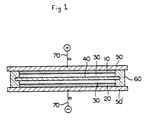
- 10 represents a positive electrode; 20, a negative electrode; 30, an electrolyte; 40, a separator; 50 and 50', a support; 60, a packing; and 70, a lead wire.
- polyacrylamide polymethacrylamide
- urea-formaldehyde resin polyvinyl alcohol
- polyvinyl acetate aliphatic polyamides such as nylon-6, nylon-6,6, nylon-12, nylon-6,9 and nylon-6,10
- wholly aromatic polyamides such as Kevlar (a trademark for a product of E.I.
- Two or more of these may be used as a blend, or a copolymer thereof may also be used.
- a carbon is included in a dispersed form in a positive electrode material composed of iodine and the polymer having the ability to form a complex adduct with iodine.
- a general method of preparing it is, for example, as follows:-
- a carbon is added to a predetermined amount of the polymer having the ability to form a complex adduct with iodine to include it in a dispersed form.
- the method of adding the carbon is to first prepare a polymer/carbon mixture. This may be accomplished, for example, by a method which comprises dissolving the polymer in a solvent, mixing the carbon with the solution and thereafter removing the solvent, or a method which comprises kneading the carbon directly with the polymer and dispersing it therein.
- Iodine is added to the resulting polymer/carbon mixture. Iodine may be ordinary solid or flaky iodine either as such or as required, in purified form.
- Iodine may be added, for example, by (i) a method comprising bringing a vapor of iodine into contact with the polymer/carbon mixture to effect addition and adsorption, (ii) a method comprising immersing the polymer/carbon mixture in a solution of iodine in benzene, acetone, etc. to effect addition and adsorption of iodine, or (iii) a method comprising kneading iodine into the polymer/carbon mixture.
- first preparing the polymer/carbon mixture there may also be used a method which comprises adding the carbon and iodine simultaneously to a predetermined amount of the polymer and kneading them in the molten state to disperse the carbon and to prepare the positive electrode material in one step.
- a method which comprises adding the carbon and iodine simultaneously to a predetermined amount of the polymer and kneading them in the molten state to disperse the carbon and to prepare the positive electrode material in one step.
- composition in which the carbon is dispersed substantially in the complex adduct of the polymer and iodine and/or a composition comprising the polymer and iodine dispersed therein, and there is no particular restriction on the method of its preparation.
- the methods of preparation include one in which a current collector is incorporated in the positive electrode composition in order to take out electric current rapidly from the positive electrode material.
- the current collector there can be used, for example, a mesh of a metal nobler than the metals used as a negative electrode such as platinum or stainless steel, a mat, cloth or porous block of carbon.
- Examples of the carbon to be added to the positive electrode material in the cell of this invention include carbon black, acetylene black, graphite, and Ketjen Black (a trademark of AKZO Chemie). Preferably, they are in an easily dispersible form such as a powder, scales and short fibers.
- the amount of the carbon differs, of course, with its type. Usually, it is 0.5 to 60% (% by weight; the same basis applies hereinafter) based on the total weight of polymer and carbon. It is 0.5 to 50% for Ketjen Black, and 0.5 to 40% for pulverized graphite.
- the amount of Ketjen Black is preferably 5 to 40%, especially preferably 10 to 30%.
- the cell of this invention may be formed by using as a positive electrode a composition containing the resulting complex adduct of iodine and the polymer having the ability to form the complex adduct with iodine and/or a composition comprising said polymer and iodine dispersed therein as a main ingredient and a metal selected from zinc, cadmium, magnesium and aluminum as a negative electrode, and contacting them with each other.
- iodine forms a complex adduct in the polymer.
- Iodine may partly be simply dispersed in free form in the polymer. In short, it is sufficient that iodine is substantially taken up in the polymer.
- the positive electrode and the negative electrode may be contacted with each other through an electrolyte solution of a metal iodide which is the discharge product corresponding to the metal of the negative electrode (for example, zinc iodide when the negative electrode is zinc).
- a metal iodide which is the discharge product corresponding to the metal of the negative electrode (for example, zinc iodide when the negative electrode is zinc).
- a solution of such an electrolyte as ammonium chloride, sodium chloride, zinc chloride, sodium bromide, potassium bromide, lithium iodide or zinc iodide may be used as an auxiliary electrolyte.
- a porous separator is inserted between the two active substances in the electrolyte solution.
- An electrode formed by integrating the resulting composition of the polymer, carbon and iodine and the current collector is used as a positive electrode, and the metal described above in regard to the formation of the cell is used as a negative electrode. They are assembled together with a metal iodide corresponding to the metal of the negative electrode (for example, zinc iodide when the negative electrode is zinc) as an electrolyte.
- a metal iodide corresponding to the metal of the negative electrode for example, zinc iodide when the negative electrode is zinc
- the auxiliary electrolyte may be used in place of the metal iodide, or the auxiliary electrolyte may be added to the metal iodide. Such an electrolyte is used as a solution in water.
- the solution of the metal iodide is impregnated in a porous support having the ability to hold a large amount of liquid such as a glass fiber mat (filter paper is also feasible).
- the porous material impregnated with the electrolyte has the advantage that a storge cell can be built by interposing it directly between the aforesaid positive and negative electrodes.
- a metal ion is formed at the negative electrode and an iodine ion, at the positive electrode. These ions are combined to form a metal iodide which is an electrolyte (discharge product).
- the metal iodide is decomposed into the metal and iodine.
- the metal precipitates at the negative electrode, and iodine is again taken up into the positive electrode containing the polymer as a main component. As a result, the cell again attains a charged condition.
- iodine deposited at the positive electrode readily forms a complex adduct with the polymer as a main component of the positive electrode and is taken into the polymer.
- the dc voltage is cut off and the terminals of the two electrodes are connected through a load whereby discharging occurs and power is obtained at the load.
- a complex adduct of iodine and a specific polymer and/or a composition comprising the polymer and iodine dispersed therein is used as a main component of the positive electrode material, and a carbon is included in the composition in a dispersed form.
- the technical significance of dispersing the carbon is as follows:
- the complex adduct of iodine and a certain type of polymer is a material having much better electric conductivity than the individual components.
- a complex of iodine with poly-2-vinylpyridine is used as a positive electrode material of a primary cell for cardiac pacemakers.
- a complex adduct has the defect that as discharging is carried out, it loses iodine and abruptly decreases in electrical conductivity and that the interior resistance of a cell using it increases remarkably.
- this complex adduct is used as a positive electrode material of a secondary cell, the amount of iodine in the positive electrode material becomes very small as a result of discharging. Attempts to charge this cell after the end of discharging fail because the electric conductivity of the electrode is completely lost as described above. In other words, such a complex adduct cannot at all be utilized in a secondary cell in particular.
- the electrical conductivity of the composition can be greatly increased.
- the invention can exhibit the marked advantage that even when discharging proceeds, a large electric current can be obtained without an appreciable increase in the internal resistance of the positive electrode.
- the addition of the carbon to the positive electrode material sometimes even increases the electrical conductivity of the positive electrode material by discharging.
- the addition of the carbon to the positive electrode material in accordance with this invention is essential to the complex cell of this invention.
- the cell is further characterised in that a cation exchange membrane is inserted in the electrolyte solution instead of the conventional porous separator.
- a cation exchange membrane is inserted in the electrolyte solution instead of the conventional porous separator.
- the cation exchange membrane used as the separator in the cell of this invention may be an inorganic membrane or an organic membrane. Ion exchange membranes of the hydrocarbon type and ion exchange membrane of the fluorocarbon type among the organic membranes are particularly preferred.
- cation exchange membranes permit selective permeation of cations alone.
- the cation exchange membrane used in the cell of this invention may contain any of sulfonic, carboxylic and phosphoric acid groups as an ion exchange group.
- the membrane is properly surface-treated in order to reduce its electrical resistance, and reinforced with a cloth or net in order to increase its mechanical strength.
- the cation exchange membrane that can be used in the cell of this invention may be any commercially available membrane which satisfies the above requirements.
- a Selemion cation exchange membrane CMV (a product of Asahi Glass Co., Ltd.) and a cation exchange membrane CM (a product of Toyo Kagaku Sangyo K. K.) which are of the hydrocarbon type
- a Nafion 324 cation exchange membrane (a product of E. I. du Pont de Nemours & Co.) which is of the fluorocarbon type.
- any cation exchange membranes which permit selective permeation of cations and selectively hamper permeation of anions may be used, and the above-exemplified membranes are not particularly limitative.
- preferred cation exchange membranes have low electrical resistance and high mechanical strength and exhibit strong corrosion resistance in oxidizing and reducing atmospheres.
- a cell having the structure shown in Figure 1 was built by the following procedure.
- Ketjen Black KB-EC (a trademark of AKZO Chemie) was added to, and well dispersed, in DMF containing 300 mg of polyacrylonitrile (average molecular weight 152,000).
- the dispersion was coated on a carbon fiber disc (E-715 made by Kureha Chemical Industry Co., Ltd.) having a diameter of 4.5 cm, and DMF was removed by spontaneous evaporation.
- the disc was immersed in an acetone solution of iodine to effect addition of 380 mg of iodine.
- the product was used as positive electrode 10.
- a 0.3 mm-thick zinc plate (a product of Mitsui Mining & Smelting Co., Ltd.) was used as negative electrode 20.
- a 1 mole/liter aqueous solution of NH4Cl was used as an electrolyte solution and 2 ml of it was impregnated into two glass fiber filters 30, and a Selemion CMV membrane made by Asahi Glass Co., Ltd. was interposed as a separator 40 between the glass fiber filters.
- the assembly was put between the two electrodes to build a cell.
- 50 and 50' represent a support; 60, a packing; and 70, a lead wire.
- the following experiment was conducted at 25°C in a stream of nitrogen.
- the initial short-circuit current (I sc ) of the cell during discharging was measured and found to be 80 mA/cm2.
- the open-circuit voltage at this time was 1.36 V.
- the cell was discharged to a final voltage of 0.9 V and then charged to a final voltage of 1.5 V.
- This charging-discharging test was repeated. Even after 600 cycles, the test proceeded without an appreciable change in energy efficiency and current efficiency.
- the electrical capacity after 600 cycles was 87% based on the initial capacity. This shows that the cell is substantially on a practical level as a secondary cell.
- a cell was built by the same procedure as above except that a positive electrode material not containing Ketjen Black KB-EC was used.
- the cell was evaluated under the same conditions as above.
- the initial short-circuit current (I sc ) of this cell was found to be 8 mA/cm2, and at this time, its open-circuit voltage was 1.34 V.
- the cell was subjected to the charging-discharging test. After discharging, an attempt was made to charge the cell. But the voltage rose remarkably and the cell could not be charged.
- the disc was immersed in an acetone solution of iodine to effect addition of 120 mg of iodine, and the product was used as a positive electrode.
- a 0.3 mm-thick zinc plate (made by Mitsui Mining & Smelting Co., Ltd.) was used as a negative electrode.
- a 1 mole/liter aqueous solution of NH4Cl was used as an electrolyte solution and 2 ml of it was impregnated into two glass fiber filters.
- a Selemion CMV membrane made by Asahi Glass Co., Ltd. was interposed as a separator between the two glass fiber filters.
- the assembly was put between the two electrodes to construct a cell.
- the structure of the cell was that shown in Figure 1 as in Example 1.
- the following experiment was conducted at 25°C in a stream of nitrogen.
- the initial short-circuit current (I sc ) of the cell during discharging was measured and found to be 42 mA/cm2.
- the open-circuit voltage at this time was 1.36 V.
- the cell was discharged to a final voltage of 0.9 V and then charged to a final voltage of 1.5 V.
- This charging-discharging test was repeated. Even after 600 cycles, the test proceeded without an appreciable change in energy efficiency and current efficiency.
- the electrical capacity after 600 cycles was 87% based on the initial capacity. This shows that the cell is substantially on a practical level as a secondary cell.
- a cell was built by the same procedure as above except that a positive electrode material not containing Ketjen Black KB-EC was used.
- the cell was evaluated under the same conditions as above.
- the initial short-circuit current (I sc ) of this cell was found to be 6 mA/cm2, and at this time, its open-circuit voltage was 1.34 V.
- the cell was subjected to the charging-discharging test. After discharging, an attempt was made to charge the cell. But the voltage rose remarkably and the cell could not be charged.
- Ketjen Black KB-EC (a trademark of AKZO Chemie) was added to, and well dispersed in, a formic acid solution containing 300 mg of nylon-6 (a product of Toray Inc.).
- the dispersion was coated on a carbon fiber disc (E-715, a product of Kureha Chemical Industry Co., Ltd.) having a diameter of 4.5 cm, and formic acid was removed by spontaneous evaporation.
- the disc was immersed in an acetone solution of iodine to effect addition of 360 mg of iodine, and the product was used as a positive electrode.
- a 0.3 mm-thick zinc plate (made by Mitsui Mining & Smelting Co., Ltd.) was used as a negative electrode.
- a 1 mole/liter aqueous solution of NH4Cl was used as an electrolyte solution and 2 ml of it was impregnated into two glass fiber filters.
- a Selemion CMV membrane made by Asahi Glass Co., Ltd. was interposed as a separator between the glass fiber filters. The assembly was put between the two electrodes to construct a cell.
- the structure of the cell was that shown in Figure 1 as in Example 1.
- the following experiment was conducted at 25°C in a stream of nitrogen.
- the initial short-circuit current (I sc ) of the cell during discharging was measured and found to be 71 mA/cm2.
- the open-circuit voltage at this time was 1.36 V.
- the cell was discharged to a final voltage of 0.9 V and then charged to a final voltage of 1.5 V.
- This charging-discharging test was repeated. Even after 600 cycles, the test proceeded without an appreciable change in energy efficiency and current efficiency.
- the electrical capacity after 600 cycles was 85% based on the initial capacity. This shows that the cell is substantially on a practical level as a secondary cell.
- a cell was built by the same procedure as above except that a positive electrode material not containing Ketjen Black KB-EC was used.
- the cell was evaluated under the same conditions as above.
- the initial short-circuit current (I sc ) of this cell was found to be 10 mA/cm2, and at this time, its open-circuit voltage was 1.34 V.
- the cell was subjected to the charging-discharging test. After discharging, an attempt was made to charge the cell. But the voltage rose remarkably and the cell could not be charged.
- a 0.3 mm-thick zinc plate (made by Mitsui Mining & Smelting Co., Ltd.) was used as a negative electrode.
- a 20% aqueous solution of lithium chloride was used as an electrolyte solution and 2 ml of it was impregnated into two glass fiber filter sheets.
- a Selemion CMV membrane made by Asahi Glass Co., Ltd. was interposed as a separator between two glass fiber filters. The assembly was put between the two electrodes to construct a cell.
- the structure of the cell was that shown in Figure 1 as in Example 1.
- the following experiment was conducted at 25°C in a stream of nitrogen.
- the initial short-circuit current (I sc ) of the cell during discharging was measured and found to be 35 mA/cm2.
- the open-circuit voltage at this time was 1.30 V.
- the cell was discharged to a final voltage of 0.9 V and then charged to a final voltage of 1.5 V.
- This charging-discharging test was repeated. Even after 600 cycles, the test proceeded without an appreciable change in energy efficiency and current efficiency.
- the electrical capacity after 600 cycles was 45% based on the initial capacity. This shows that the cell is substantially on a practical level as a secondary cell.
- a cell was built by the same procedure as above except that a positive electrode material not containing Ketjen Black KB-EC was used.
- the cell was evaluated under the same conditions as above.
- the initial short-circuit current (I sc ) of this cell was found to be 5 mA/cm2, and at this time, its open-circuit voltage was 1.3 V.
- the cell was subjected to the charging-discharging test. After discharging, an attempt was made to charge the cell. But the voltage rose remarkably and the cell could not be charged.
- acrylamide made by Mitsui Toatsu Chemicals, Inc.
- 1 mg of bismethylene acrylamide were dissolved in 1 ml of fully deoxygenated water, and 3 mg of ammonium persulfate and 1.5 mg of acidic sodium sulfite were added to the solution.
- the polymerization was carried out to some extent at 20°C in a stream of nitrogen, and then Ketjen Black KB-EC (a trademark of AKZO Chemie) was added and dispersed by kneading.
- the mixture was coated on a carbon fiber disc (E-715 made by Kureha Chemical Industry Co., Ltd.) and cured, and the product was used as a positive electrode.
- a 0.3 mm-thick zinc plate (made by Mitsui Mining & Smelting Co., Ltd.) was used as a negative electrode.
- a 20% aqueous solution of lithium chloride was used as an electrolyte and 2 ml of it was impregnated into two glass fiber filters.
- a Selemion CMV membrane made by Asahi Glass Co., Ltd. was interposed as a separator between the two glass fiber filters. The assembly was put between the two electrodes to construct a cell.
- the structure of the cell was that shown in Figure 1 as in Example 1.
- the following experiment was conducted at 25°C in a stream of nitrogen.
- the initial short-circuit current (I sc ) of the cell during discharging was measured and found to be 46 mA/cm2.
- the open-circuit voltage at this time was 1.3 V.
- the cell was discharged to a final voltage of 0.9 V and then charged to a final voltage of 1.5 V.
- This charging-discharging test was repeated. Even after 600 cycles, the test proceeded without an appreciable change in energy efficiency and current efficiency.
- the electrical capacity after 600 cycles was 72% based on the initial capacity. This shows that the cell is substantially on a practical level as a secondary cell.
- a cell was built by the same procedure as above except that a positive electrode material not containing Ketjen Black KB-EC was used.
- the cell was evaluated under the same conditions as above.
- the initial short-circuit current (I sc ) of this cell was found to be 6 mA/cm2, and at this time, its open-circuit voltage was 1.3 V.
- the cell was subjected to the charging-discharging test. After discharging, an attempt was made to charge the cell. But the voltage rose remarkably and the cell could not be charged.
- the disc was then immersed in an acetone solution of iodine to effect addition of 320 mg of iodine, and the product was used as a positive electrode.
- a 0.3 mm-thick zinc plate (made by Mitsui Mining & Smelting Co., Ltd.) was used as a negative electrode.
- a 1 mole/liter aqueous solution of NH4Cl was used as an electrolyte and 2 ml of it was impregnated into two glass fiber filters.
- a Selemion CMV membrane made by Asahi Glass Co., Ltd. was interposed as a separator between the two glass fiber filters.
- the assembly was put between the two electrodes to construct a cell.
- the structure of the cell was that shown in Figure 1 as in Example 1.
- the following experiment was conducted at 25°C in a stream of nitrogen.
- the initial short-circuit current (I sc ) of the cell during discharging was measured and found to be 92 mA/cm2.
- the open-circuit voltage at this time was 1.36 V.
- the cell was discharged to a final voltage of 0.9 V and then charged to a final voltage of 1.5 V.
- This charging-discharging test was repeated. Even after 600 cycles, the test proceeded without an appreciable change in energy efficiency and current efficiency.
- the electrical capacity after 600 cycles was 88% based on the initial capacity. This shows that the cell is substantially on a practical level as a secondary cell.
- a cell was built by the same procedure as above except that a positive electrode material not containing Ketjen Black KB-EC was used.
- the cell was evaluated under the same conditions as above.
- the initial short-circuit current (I sc ) of this cell was found to be 10 mA/cm2, and at this time, its open-circuit voltage was 1.34 V.
- the cell was subjected to the charging-discharging test. After discharging, an attempt was made to charge the cell. But the voltage rose remarkably and the cell could not be charged.
- Ketjen Black KB-EC (a trademark of AKZO Chemie) was added to, and dispersed well in, a formic acid solution containing 300 mg of Barex Resin (a trademark of The Standard Oil Co. (Ohio), U. S. A. for acrylonitrile, methyl acrylate and butadiene copolymerized graft polymer; sold by Mitsui Toatsu Chemicals, Inc.).
- Barex Resin a trademark of The Standard Oil Co. (Ohio), U. S. A. for acrylonitrile, methyl acrylate and butadiene copolymerized graft polymer; sold by Mitsui Toatsu Chemicals, Inc.
- the dispersion was coated on a carbon fiber disc (E-715, a product of Kureha Chemical Industry Co., Ltd.) having a diameter of 4.5 cm, and formic acid was removed by evaporation.
- the disc was immersed in an acetone solution of iodine to effect addition of 380 mg of iodine, and the product was used as a positive electrode.
- a 0.3 mm-thick zinc plate (made by Mitsui Mining & Smelting Co., Ltd.) was used as a negative electrode.
- a 1 mole/liter aqueous solution of NH4Cl was used as an electrolyte solution and 2 ml of it was impregnated into two glass fiber filters.
- a Selemion CMV membrane made by Asahi Glass Co., Ltd. was interposed as a separator between the two glass fiber filters.
- the assembly was put between the two electrodes to construct a cell.
- the structure of the cell was that shown in Figure 1 as in Example 1.
- the following experiment was conducted at 25°C in a stream of nitrogen.
- the initial short-circuit current (I sc ) of the cell during discharging was measured and found to be 70 mA/cm2.
- the open-circuit voltage at this time was 1.35 V.
- the cell was discharged to a final voltage of 0.9 V and then charged to a final voltage of 1.5 V.
- This charging-discharging test was repeated. Even after 600 cycles, the test proceeded without an appreciable change in energy efficiency and current efficiency.
- the electrical capacity after 600 cycles was 85% based on the initial capacity. This shows that the cell is substantially on a practical level as a secondary cell.
- a cell was built by the same procedure as above except that a positive electrode material not containing Ketjen Black KB-EC was used.
- the cell was evaluated under the same conditions as above.
- the initial short-circuit current (I sc ) of this cell was found to be 7 mA/cm2, and at this time, its open-circuit voltage was 1.34 V.
- the cell was subjected to the charging-discharging test. After discharging, an attempt was made to charge the cell. But the voltage rose remarkably and the cell could not be charged.
- Ketjen Black KB-EC (a trademark of AKZO Chemie) was added to, and dispersed well in, an ethyl acetate solution containing 300 mg of polymethyl methacrylate (average molecular weight 152000).
- the dispersion was coated on a carbon fiber disc (E-715, a product of Kureha Chemical Industry Co., Ltd.) having a diameter of 4.5 cm, and ethyl acetate was removed by spontaneous evaporation.
- the disc was immersed in an acetone solution of iodine to effect addition of 220 mg of iodine, and the product was used as a positive electrode.
- a 0.3 mm-thick zinc plate (made by Mitsui Mining & Smelting Co., Ltd.) was used as a negative electrode.
- a 1 mole/liter aqueous solution of NH4Cl was used as an electrolyte solution and 2 ml of it was impregnated into two glass fiber filters.
- a Selemion CMV membrane made by Asahi Glass Co., Ltd. was interposed as a separator between the two glass fiber filters. The assembly was put between the two electrodes to construct a cell.
- the structure of the cell was that shown in Figure 1 as in Example 1.
- the following experiment was conducted at 25°C in a stream of nitrogen.
- the initial short-circuit current (I sc ) of the cell during discharging was measured and found to be 68 mA/cm2.
- the open-circuit voltage at this time was 1.36 V.
- the cell was discharged to a final voltage of 0.9 V and then charged to a final voltage of 1.5 V.
- This charging-discharging test was repeated. Even after 600 cycles, the test proceeded without an appreciable change in energy efficiency and current efficiency.
- the electrical capacity after 600 cycles was 82% based on the initial capacity. This shows that the cell is substantially on a practical level as a secondary cell.
- a cell was built by the same procedure as above except that a positive electrode material not containing Ketjen Black KB-EC was used.
- the cell was evaluated under the same conditions as above.
- the initial short-circuit current (I sc ) of this cell was found to be 7 mA/cm2, and at this time, its open-circuit voltage was 1.34 V.
- the cell was subjected to the charging-discharging test. After discharging, an attempt was made to charge the cell. But the voltage rose remarkably and the cell could not be charged.
- Polyvinyl alcohol made by Kuraray Co., Ltd.; 270 mg
- 30 mg of polymelamine resin, Cymel 303 (a trademark of Mitsui Toatsu Chemicals, Inc.) were dissolved in water, and 60 mg of Ketjen Black KB-EC (a trademark of AKZO Chemie) was added to, and well dispersed in, the aqueous solution.
- the dispersion was coated on a carbon fiber disc (E-715, a product of Kureha Chemical Industry Co., Ltd.) having a diameter of 4.5 cm, and water was removed by spontaneous evaporation.
- the disc was heat-treated at 150°C for 40 minutes, and then immersed in an acetone solution of iodine to effect addition of 360 mg of iodine.
- the product was used as a positive electrode.
- a 0.3 mm-thick zinc plate (made by Mitsui Mining & Smelting Co., Ltd.) was used as a negative electrode.
- a 1 mole/liter aqueous solution of NH4Cl was used as an electrolyte solution and 2 ml of it was impregnated into two glass fiber filters.
- a Selemion CMV membrane made by Asahi Glass Co., Ltd. was interposed as a separator between the two glass fiber filters.
- the assembly was put between the two electrodes to construct a cell.
- the structure of the cell was that shown in Figure 1 as in Example 1.
- the following experiment was conducted at 25°C in a stream of nitrogen.
- the initial short-circuit current (I sc ) of the cell during discharging was measured and found to be 300 mA/cm2.
- the open-circuit voltage at this time was 1.36 V.
- the cell was discharged to a final voltage of 0.9 V and then charged to a final voltage of 1.5 V.
- This charging-discharging test was repeated. Even after 600 cycles, the test proceeded without an appreciable change in energy efficiency and current efficiency.
- the electrical capacity after 600 cycles was 90% based on the initial capacity. This shows that the cell is substantially on a practical level as a secondary cell.
- a cell was built by the same procedure as above except that a positive electrode material not containing Ketjen Black KB-EC was used.
- the cell was evaluated under the same conditions as above.
- the initial short-circuit current (I sc ) of this cell was found to be 16 mA/cm2, and at this time, its open-circuit voltage was 1.34 V.
- the cell was subjected to the charging-discharging test. After discharging, an attempt was made to charge the cell. But the voltage rose remarkably and the cell could not be charged.
- Ketjen Black KB-EC (a trademark of AKZO Chemie) was added to, and well dispersed in, a tetrahydrofuran solution containing 300 mg of polyvinyl pyrrolidone (average molecular weight 163000).
- the dispersion was coated on a carbon fiber disc (E-715 made by Kureha Chemical Industry Co., Ltd.) having a diameter of 4.5 cm, and tetrahydrofuran was removed by spontaneous evaporation.
- the carbon fiber was immersed in an acetone solution of iodine to effect addition of 420 mg of iodine, and the product was used as a positive electrode.
- a 0.3 mm-thick zinc plate (made by Mitsui Mining & Smelting Co., Ltd.) was used as a negative electrode.
- a 1 mole/liter aqueous solution of NH4Cl was used as an electrolyte solution and 2 ml of it was impregnated into two glass fiber filters.
- a Selemion CMV membrane made by Asahi Glass Co., Ltd. was interposed as a separator between the two glass fiber filters. The assembly was put between the two electrodes to construct a cell.
- the structure of the cell was that shown in Figure 1 as in Example 1.
- the following experiment was conducted at 25°C in a stream of nitrogen.
- the initial short-circuit current (I sc ) of the cell during discharging was measured and found to be 92 mA/cm2.
- the open-circuit voltage at this time was 1.36 V.
- the cell was discharged to a final voltage of 0.9 V and then charged to a final voltage of 1.5 V.
- This charging-discharging test was repeated. Even after 600 cycles, the test proceeded without an appreciable change in energy efficiency and current efficiency.
- the electrical capacity after 600 cycles was 86% based on the initial capacity. This shows that the cell is substantially on a practical level as a secondary cell.
- a cell was built by the same procedure as above except that a positive electrode material not containing Ketjen Black KB-EC was used.
- the cell was evaluated under the same conditions as above.
- the initial short-circuit current (I sc ) of this cell was found to be 9 mA/cm2, and at this time, its open-circuit voltage was 1.34 V.
- the cell was subjected to the charging-discharging test. After discharging, an attempt was made to charge the cell. But the voltage rose remarkably and the cell could not be charged.
- Ketjen Black KB-EC (a trademark of AKZO Chemie) was added to, and well dispersed in, a tetrahydrofuran solution containing 300 mg of poly-2-vinylpyridine (average molecular weight 80,000).
- the dispersion was coated on a carbon fiber disc (E-715 made by Kureha Chemical Industry Co., Ltd.) having a diameter of 4.5 cm, and tetrahydrofuran was removed by spontaneous evaporation.
- the disc was immersed in an acetone solution of iodine to effect addition of 430 mg of iodine, and the product was used as a positive electrode.
- a 0.3 mm-thick zinc plate (made by Mitsui Mining & Smelting Co., Ltd.) was used as a negative electrode.
- a 1 mole/liter aqueous solution of NH4Cl was used as an electrolyte solution and 2 ml of it was impregnated into two glass fiber filters.
- a Selemion CMV membrane made by Asahi Glass Co., Ltd. was interposed as a separator between the two glass fiber filters. The assembly was put between the two electrodes to construct a cell.
- the structure of the cell was that shown in Figure 1 as in Example 1.
- the following experiment was conducted at 25°C in a stream of nitrogen.
- the initial short-circuit current (I sc ) of the cell during discharging was measured and found to be 95 mA/cm2.
- the open-circuit voltage at this time was 1.36 V.
- the cell was discharged to a final voltage of 0.9 V and then charged to a final voltage of 1.5 V.
- This charging-discharging test was repeated. Even after 600 cycles, the test proceeded without an appreciable change in energy efficiency and current efficiency.
- the electrical capacity after 600 cycles was 88% based on the initial capacity. This shows that the cell is substantially on a practical level as a secondary cell.
- a cell was built by the same procedure as above except that a positive electrode material not containing Ketjen Black KB-EC was used.
- the cell was evaluated under the same conditions as above.
- the initial short-circuit current (I sc ) of this cell was found to be 10 mA/cm2, and at this time, its open-circuit voltage was 1.34 V.
- the cell was subjected to the charging-discharging test. After discharging, an attempt was made to charge the cell. But the voltage rose remarkably and the cell could not be charged.
- Ketjen Black was mixed with U-Loid #320, the inital-stage reaction product of a urea resin, (made by Mitsui Toatsu Chemicals, Inc.) so that the amount of the carbon became 15% by weight.
- One drop of 12N hydrochloric acid was added as a curing agent to 500 mg of the resulting mixture and they were fully kneaded.
- the mixture was coated on a carbon fiber disc (E-715 made by Kureha Chemical Industry Co., Ltd.) and cured. The disc was then immersed in an acetone solution of iodine to effect addition of 150 mg of iodine.
- a 0.3 mm-thick zinc plate (made by Mitsui Mining & Smelting Co., Ltd.) was used as a negative electrode.
- a 1 mole/liter aqueous solution of NH4Cl was used as an electrolyte solution and 2 ml of it was impregnated into two glass fiber filters.
- Various cation exchange membranes were each interposed between the two glass fiber filters. The assembly was put between the two electrodes to build a cell. The structure of the cell was shown in Figure 1 as in Example 1.
- the iodine/zinc cell (containing Selemion cation exchange membrane) obtained by the method of Example 12 was subjected to charging and discharging at a fixed current of 1 mA.
- One cycle of the charging-discharging test consisted of 5 hours of discharging and 5 hours of charging. Even in the 300th cycle, the characteristics of the cell were not lost and variations in its electromotive force were constant. This characteristic shows that the cell had superior properties as a chargeable and dischargeable secondary cell, i.e. storage cell.
- the cell of this invention has a high output and a low internal resistance. Even when discharging proceeds and most of iodine fixed to the positive electrode material was liberated, the electrical conductivity hardly decreased. Hence, the cell is characterized by the fact that the charging operation could be easily carried out.
- the cell characteristics are not lost even upon repeated charging and discharging through many cycles (for example, 300 cycles), and the electromotive force hardly decreases even after the lapse of a long period of time (for example, 300 days).
- the service life of the cell becomes strikingly long.
- the cell of this invention can be used as a primary cell, and preferably as a secondary cell. It can be used conveniently as a back-up power supply or emergency power supply for VTR, communication devices, portable electronic calculators, watches, computers and office automation devices (such as word processors) and also as solar cells and cells for solar systems.
Landscapes
- Chemical & Material Sciences (AREA)
- Chemical Kinetics & Catalysis (AREA)
- Electrochemistry (AREA)
- General Chemical & Material Sciences (AREA)
- Engineering & Computer Science (AREA)
- Manufacturing & Machinery (AREA)
- Secondary Cells (AREA)
- Battery Electrode And Active Subsutance (AREA)
- Hybrid Cells (AREA)
Claims (9)
- Zelle, umfassend:
eine negative Elektrode;
eine positive Elektrode, umfassend ein positives Elektrodenmaterial, dessen Hauptbestandteil ein Komplexaddukt aus Iod und einem Polymer mit der Fähigkeit zur Bildung eines Komplexadduktes mit Iod und/oder eine Zusammensetzung ist, die das genannte Polymer und Iod darin dispergiert enthält, wobei das genannte positive Elektrodenmaterial Kohlenstoff darin dispergiert aufweist;
einen Elektrolyten; und
eine Membran zwischen den genannten Elektroden;
dadurch gekennzeichnet, daß die genannte Zelle eine Sekundärzelle ist, deren Zelleigenschaften nach 300 Ladungs/Entladungszyklen im wesentlichen unverändert sind; der genannte Elektrolyt eine wässerige Elektrolytflüssigkeitslösung ist; die genannte Membran eine Kationenaustauschmembran ist; und dadurch, daß Zink, Kadmium, Magnesium oder Aluminium als die genannte negative Elektrode eingesetzt ist. - Zelle nach Anspruch 1, derart, daß die EMK nach 300 Tagen im wesentlichen unverringert ist.
- Zelle nach Anspruch 1 oder 2, worin das Polymer aus Polyamiden, Poly(meth)acrylamid, Polyurethan, Polyvinylalkohol und Polyäthern ausgewählt ist.
- Zelle nach einem der Ansprüche 1, 2 oder 3, worin der Kohlenstoff aus Ruß, Acetylenruß, Graphit und Ketjen Black ausgewählt ist.
- Zelle nach Anspruch 4, worin der Kohlenstoff in leicht dispergierbarer Form vorliegt.
- Zelle nach Anspruch 5, worin der Kohlenstoff in Form von Pulver, Schuppen oder kurzen Fasern vorliegt.
- Zelle nach einem der Ansprüche 4, 5 oder 6, worin der Kohlenstoff in einer Menge von 1 bis 60 Gew.-%, basierend auf dem Gewicht von Polymer und Kohlenstoff, vorliegt.
- Zelle nach einem der vorhergehenden Ansprüche, worin die Elektrolytlösung eine wässerige Flüssigkeitslösung aus einem Elektrolyten ist, der aus Ammoniumchlorid, Natriumchlorid, Zinkchlorid, Natriumbromid, Kaliumbromid, Zinkiodid oder Lithiumiodid ausgewählt ist.
- Zelle nach einem der vorhergehenden Ansprüche, worin mit der wässerigen Elektrolytflüssigkeitslösung ein poröser Träger getränkt ist.
Applications Claiming Priority (10)
| Application Number | Priority Date | Filing Date | Title |
|---|---|---|---|
| JP58157143A JPS6049564A (ja) | 1983-08-30 | 1983-08-30 | ポリアクリルアミド類電池 |
| JP157142/83 | 1983-08-30 | ||
| JP157143/83 | 1983-08-30 | ||
| JP58157142A JPS6049563A (ja) | 1983-08-30 | 1983-08-30 | 尿素−ホルムアルデヒド樹脂電池 |
| JP172250/83 | 1983-09-20 | ||
| JP58172250A JPS6065459A (ja) | 1983-09-20 | 1983-09-20 | ポリウレタン電池 |
| JP77/84 | 1984-01-05 | ||
| JP76/84 | 1984-01-05 | ||
| JP59000077A JPH069145B2 (ja) | 1984-01-05 | 1984-01-05 | ヨウ素電池 |
| JP59000076A JPS60146459A (ja) | 1984-01-05 | 1984-01-05 | 高出力ポリアミド電池 |
Publications (3)
| Publication Number | Publication Date |
|---|---|
| EP0161318A1 EP0161318A1 (de) | 1985-11-21 |
| EP0161318A4 EP0161318A4 (de) | 1988-02-23 |
| EP0161318B1 true EP0161318B1 (de) | 1992-11-04 |
Family
ID=27517915
Family Applications (1)
| Application Number | Title | Priority Date | Filing Date |
|---|---|---|---|
| EP84903289A Expired - Lifetime EP0161318B1 (de) | 1983-08-30 | 1984-08-30 | Jod-zelle |
Country Status (3)
| Country | Link |
|---|---|
| US (1) | US4656105A (de) |
| EP (1) | EP0161318B1 (de) |
| WO (1) | WO1985001155A1 (de) |
Families Citing this family (17)
| Publication number | Priority date | Publication date | Assignee | Title |
|---|---|---|---|---|
| EP0149421A3 (de) * | 1983-12-16 | 1986-05-14 | Eltech Systems Corporation | Metall-Halogen-Feststoffzelle |
| ATE79694T1 (de) * | 1987-01-15 | 1992-09-15 | Lonza Ag | Verwendung einer kathodenbeschichtungsdispersion fuer batterien. |
| CH674164A5 (de) * | 1987-09-29 | 1990-05-15 | Lonza Ag | |
| CH674096A5 (de) * | 1988-01-19 | 1990-04-30 | Lonza Ag | |
| CH674477A5 (de) * | 1988-03-30 | 1990-06-15 | Lonza Ag | |
| JPH0748739B2 (ja) * | 1988-12-09 | 1995-05-24 | 富士通株式会社 | 多重アクセス制御方法および該方法を実施する多重アクセス制御システム |
| US5217828A (en) * | 1989-05-01 | 1993-06-08 | Brother Kogyo Kabushiki Kaisha | Flexible thin film cell including packaging material |
| US5540742A (en) * | 1989-05-01 | 1996-07-30 | Brother Kogyo Kabushiki Kaisha | Method of fabricating thin film cells and printed circuit boards containing thin film cells using a screen printing process |
| US5099667A (en) * | 1989-06-16 | 1992-03-31 | Lonza Ltd. | System for suspending and applying solid lubricants to tools or work pieces |
| ATE111379T1 (de) * | 1990-03-26 | 1994-09-15 | Lonza Ag | Verfahren und einrichtung zum intervallweisen versprühen einer schmiermittel-suspension. |
| US5336273A (en) * | 1992-11-27 | 1994-08-09 | Gould Electronics Inc. | Laser sealed solid electrolyte cell housed within a ceramic frame and the method for producing it |
| CN1302570C (zh) * | 2004-11-25 | 2007-02-28 | 复旦大学 | 一种绿色储能薄膜电池及其制备方法 |
| US9156957B2 (en) * | 2012-02-24 | 2015-10-13 | The United States Of America As Represented By The Administrator Of The National Aeronautics And Space Administration | Puncture-healing thermoplastic resin carbon-fiber-reinforced composites |
| US11001684B2 (en) | 2014-12-02 | 2021-05-11 | United States Of America As Represented By The Administrator Of Nasa | Puncture healing engineered polymer blends |
| CN114725533A (zh) * | 2022-03-21 | 2022-07-08 | 孙雷 | 吸附剂正极材料的碘二次电池 |
| CN115693022B (zh) * | 2022-11-23 | 2023-08-18 | 浙江大学杭州国际科创中心 | 一种基于共价有机框架的锌碘电池隔膜及其制备方法和应用 |
| CN116779829B (zh) * | 2023-08-16 | 2023-11-24 | 中石油深圳新能源研究院有限公司 | 一种有机双功能复合正极材料及其制备方法和应用 |
Family Cites Families (10)
| Publication number | Priority date | Publication date | Assignee | Title |
|---|---|---|---|---|
| US3438813A (en) * | 1967-03-24 | 1969-04-15 | American Cyanamid Co | Battery cell depolarizers |
| US3531328A (en) * | 1968-11-13 | 1970-09-29 | Mallory & Co Inc P R | Light metal-copper chloride organic electrolyte cell |
| US4060673A (en) * | 1969-04-07 | 1977-11-29 | P. R. Mallory & Co. Inc. | Ion exchange membranes and organic electrolyte cells employing same |
| US3660164A (en) * | 1969-07-02 | 1972-05-02 | California Inst Res Found | Primary cell utilizing halogen-organic charge tranfer complex |
| US3660163A (en) * | 1970-06-01 | 1972-05-02 | Catalyst Research Corp | Solid state lithium-iodine primary battery |
| US3773557A (en) * | 1972-03-01 | 1973-11-20 | Wurlitzer Co | Solid state battery |
| JPS4934086A (de) * | 1972-07-30 | 1974-03-29 | ||
| JPS53120138A (en) * | 1977-03-29 | 1978-10-20 | Teijin Ltd | Electric cell using halogen salt of n*n**bis *ppcyanophenyl*4*4**bipyridinium as positive electrode active material |
| JPS5642961A (en) * | 1979-09-18 | 1981-04-21 | Matsushita Electric Ind Co Ltd | Solid electrolyte battery |
| US4550064A (en) * | 1983-12-08 | 1985-10-29 | California Institute Of Technology | High cycle life secondary lithium battery |
-
1984
- 1984-08-30 US US06/726,907 patent/US4656105A/en not_active Expired - Fee Related
- 1984-08-30 EP EP84903289A patent/EP0161318B1/de not_active Expired - Lifetime
- 1984-08-30 WO PCT/JP1984/000416 patent/WO1985001155A1/ja not_active Ceased
Also Published As
| Publication number | Publication date |
|---|---|
| EP0161318A1 (de) | 1985-11-21 |
| US4656105A (en) | 1987-04-07 |
| EP0161318A4 (de) | 1988-02-23 |
| WO1985001155A1 (fr) | 1985-03-14 |
Similar Documents
| Publication | Publication Date | Title |
|---|---|---|
| EP0161318B1 (de) | Jod-zelle | |
| US3639174A (en) | Voltaic cells with lithium-aluminum alloy anode and nonaqueous solvent electrolyte system | |
| CA1168701A (en) | Reversible electrochemical doping of conjugated polymers, and secondary batteries based thereon | |
| US5705259A (en) | Method of using a bipolar electrochemical storage device | |
| JPH09508487A (ja) | ソリッドステート電気化学バッテリ | |
| CA1226894A (en) | Battery having cathode of sheet loaded with graphite and carbon sheet anode | |
| US3625764A (en) | Electrode for electric storage batteries containing zinc halide in aqueous solution, of the type having a soluble cathode and a dissolved anode | |
| EP0350066B1 (de) | Lithiumsekundärzelle | |
| US4740434A (en) | Surface treated electrodes applicable to zinc-halogen secondary batteries | |
| KR100586823B1 (ko) | 전기화학 셀 용 전극 및 그것을 이용한 전기화학 셀 | |
| US4610811A (en) | Iodine-containing conductive resin composition | |
| US4128702A (en) | Cell with N,N-bis (substituted phenyl)-4,4- dipyridinium salt depolarizer | |
| JP2819201B2 (ja) | リチウム二次電池 | |
| JP4669980B2 (ja) | 薄形リチウム二次電池 | |
| DE3485975T2 (de) | Jod-zelle. | |
| KR890002308B1 (ko) | 옥소 전지 | |
| US3556850A (en) | Lead-acid,polyelectrolyte complex containing storage battery and method of storing and handling the same | |
| JPH0547947B2 (de) | ||
| JPH0642377B2 (ja) | 新型電池 | |
| JPS6119074A (ja) | ヨウ素電池 | |
| CA2060712C (en) | High voltage lithium rechargeable electrochemical cell | |
| JPS6243081A (ja) | 亜鉛ヨウ素二次電池 | |
| JPS6217963A (ja) | 蓄電池 | |
| JPS63205067A (ja) | 亜鉛/ヨウ素二次電池 | |
| JPH01134856A (ja) | 二次電池の製造方法 |
Legal Events
| Date | Code | Title | Description |
|---|---|---|---|
| PUAI | Public reference made under article 153(3) epc to a published international application that has entered the european phase |
Free format text: ORIGINAL CODE: 0009012 |
|
| 17P | Request for examination filed |
Effective date: 19850521 |
|
| AK | Designated contracting states |
Designated state(s): DE FR GB NL |
|
| A4 | Supplementary search report drawn up and despatched |
Effective date: 19880223 |
|
| 17Q | First examination report despatched |
Effective date: 19891208 |
|
| GRAA | (expected) grant |
Free format text: ORIGINAL CODE: 0009210 |
|
| RBV | Designated contracting states (corrected) |
Designated state(s): DE |
|
| AK | Designated contracting states |
Kind code of ref document: B1 Designated state(s): DE |
|
| REF | Corresponds to: |
Ref document number: 3485975 Country of ref document: DE Date of ref document: 19921210 |
|
| PLBE | No opposition filed within time limit |
Free format text: ORIGINAL CODE: 0009261 |
|
| STAA | Information on the status of an ep patent application or granted ep patent |
Free format text: STATUS: NO OPPOSITION FILED WITHIN TIME LIMIT |
|
| 26N | No opposition filed | ||
| PG25 | Lapsed in a contracting state [announced via postgrant information from national office to epo] |
Ref country code: DE Effective date: 19940503 |