EP0154766B1 - A method for processing gray scale picture elements to facilitate data compression - Google Patents
A method for processing gray scale picture elements to facilitate data compression Download PDFInfo
- Publication number
- EP0154766B1 EP0154766B1 EP85100005A EP85100005A EP0154766B1 EP 0154766 B1 EP0154766 B1 EP 0154766B1 EP 85100005 A EP85100005 A EP 85100005A EP 85100005 A EP85100005 A EP 85100005A EP 0154766 B1 EP0154766 B1 EP 0154766B1
- Authority
- EP
- European Patent Office
- Prior art keywords
- pel
- gray scale
- pels
- values
- current
- Prior art date
- Legal status (The legal status is an assumption and is not a legal conclusion. Google has not performed a legal analysis and makes no representation as to the accuracy of the status listed.)
- Expired
Links
Images

Classifications
-
- H—ELECTRICITY
- H04—ELECTRIC COMMUNICATION TECHNIQUE
- H04N—PICTORIAL COMMUNICATION, e.g. TELEVISION
- H04N1/00—Scanning, transmission or reproduction of documents or the like, e.g. facsimile transmission; Details thereof
- H04N1/40—Picture signal circuits
- H04N1/409—Edge or detail enhancement; Noise or error suppression
-
- G—PHYSICS
- G06—COMPUTING OR CALCULATING; COUNTING
- G06T—IMAGE DATA PROCESSING OR GENERATION, IN GENERAL
- G06T3/00—Geometric image transformations in the plane of the image
- G06T3/40—Scaling of whole images or parts thereof, e.g. expanding or contracting
- G06T3/403—Edge-driven scaling; Edge-based scaling
-
- H—ELECTRICITY
- H04—ELECTRIC COMMUNICATION TECHNIQUE
- H04N—PICTORIAL COMMUNICATION, e.g. TELEVISION
- H04N1/00—Scanning, transmission or reproduction of documents or the like, e.g. facsimile transmission; Details thereof
- H04N1/40—Picture signal circuits
- H04N1/403—Discrimination between the two tones in the picture signal of a two-tone original
Definitions
- the present invention relates to image processing and more particularly to a method for processing gray scale pel value to facilitate subsequent data compression.
- Each room normally includes a room camera for capturing a wide angle view of the people, a document camera which can be focused on letters, drawings or other documents, a room monitor for permitting people in one room to see those in the other, and a document monitor for viewing documents being presented in the other room.
- Communications between the two rooms are established over conventional teleprocessing links, such as leased or switched telephone lines or satellite communication channels.
- freeze-frame teleconferencing techniques may be employed.
- the video image captured by a room camera is updated only periodically, either at fixed intervals or on command of an operator. People at the receiver see the same "frozen" room image between updates. Audio signals are transmitted on a real time basis so that there is no perceptible delay in voice communications. Document images are updated only when the person presenting a document pushes a "send" button in the teleconferencing room.
- Delay time and communication costs can be reduced by compressing the amount of data which must be transmitted over a low bandwidth channel in order to reconstruct an acceptable video image of a presented document.
- documents which are nominally bilevel for example, black characters on white paper
- the binary data can then be compressed using known one-dimensional or two-dimensional run length encoding techniques.
- Another technique for achieving greater reductions in delay time and communication costs is to reduce the image sampling rate. Instead of sampling the image at 40 picture elements or pels per inch, the sampling rate may be reduced to 20 or even 10 pels per inch. The amount of data which must be encoded and transmitted is directly related to the sampling rate.
- JP-A-56,159,767 calls for a method for removing some distorsion and performing high quality picture reproduction free of unevenness in a simple shape, by performing differential filter processing only for the complicated parts of the picture.
- a three-by-three pels structure analysis is performed about a given pel X. Should said structure be equivalent to any one of a set of predefined three-by-three pels structures, differential filtering is performed according to a predefine figure. Otherwise, the filter processing is not performed.
- one type of distorsion that can occur is along a vertical edge of an image area; for example, along a vertical edge of the stem in a typed or printed "T". What may appear, at a distance, as a perfectly straight edge will turn out to have irregularities on closer inspection. Depending upon the relative orientation of the sampling pel position and the vertical edge, simply reducing the image pels to one bit binary values may cause the irregularities to be accentuated, thus degrading the recreated video image.
- vertical filtering may be performed to reduce pel-to-pel variations in a vertical direction.
- the digital value of substantially every pel in the image is modified as a function of the captured digital values for both of its vertical neighbors; that is, the pels above and below the pel being modified or filtered. If the vertical neighbor pels have higher digital values than the pel being filtered, the digital value of the pel is increased. Conversely, if the digital values for the vertical neighbor pels are lower, the digital value of the pel being filtered is reduced.
- capture gray scale value in a number of places. This term is not to be construed as meaning only those values resulting from direct digitization of a camera-generated analog signal.
- the term also contemplates any gray scale values which might be generated when preliminary image processing operations are performed.
- An example of such an operation is a deshading operation which eliminates subtle differences in background (usually white) pel values due to non-uniform lighting, document curl, etc.
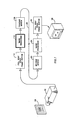
- the capture gray scale pel data is manipulated and compressed in an image processor 16 before being made available to a transmit modem 18.
- the modem 18 transmits the compressed data over a teleprocessing link 20, such as a dial-up telephone line, to a receive modem 22 at the receiving teleconferencing location.
- the compressed data is decompressed in an image processor 24 before being loaded into another gray scale frame buffer 26.
- the gray scale pel data stored in buffer 26 is used to drive the video display monitor 28.
- the present invention is a method which would be carried out in the image processor 16, which could be driven by any suitable general purpose microprocessor such as a type 68000 microprocessor available from Motorola Corporation.
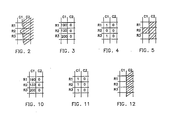
- the vertical edge of an image area is shown with an overlay of pel boundaries or sampling regions. Those pels in the shaded area to the right of the vertical edge are assumed to have an ideal 0 value. Those pels to the left of the edge are assumed to have an ideal value of 255. The pels on the vertical edge will have values falling between these extremes depending upon the relative amounts of black and white areas within the pel boundary.
- Figure 3 is a matrix or capture gray scale values for the area shown in Figure 2.
- pels are referenced by row and column coordinates R1, R2, R3 and C1, C2.
- the pels at R1, C1 and R3, C1 will have nearly the same capture gray scale value since both have the same relative amounts of black and white area.
- the pel at R2, C1 will, on the other hand, have a much lower capture gray scale value due to the excursion of the black area toward the left. Such an excursion might occur on a nominally straight edge due to ink migration or smudging.
- the capture gray scale value shown in Figure 3 could be thresholded immediately to binary levels simply by defining any pel having a gray scale value of 128 or higher as a 1 and any pel having a value lower than 128 as a 0.
- the result of this rudimentary thresholding approach is shown in Figure 4.
- a pel is vertically filtered by looking at the capture gray scale value of the pels immediately above and below; that is, its vertical neighbor pels. If the vertical neighbor pels both have capture gray scale values greater than pel being filtered, the gray scale value of that pel is increased. Conversely, if the vertical neighbor pels have lower gray scale values, the gray scale value of the pel being filtered is reduced. Binary thresholding, along with other image processing operations, can then be performed using the new or filtered gray scale value for the pel.
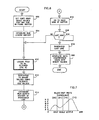
- FIG. 6 is a high level flow chart of the preceding and following operations.
- the capture gray scale values for all pels in line 1 of the image are retrieved from the frame buffer. These gray scale values are thresholded to binary levels using the simple fixed threshold mentioned above or other more complex thresholding arrangements. The thresholding technique employed is not part of this invention and is not described in detail.
- Line 1 is run length encoded (604) to establish a run length history. Run length encoding is well known. Rather than store a binary value for each pel on a line, all that is stored is the length of each run of pels.
- the run length history would be represented by the following string of numbers 26, 36, 66 where each number is the location of the first pel in a new run.
- a processor uses the run length history of the prior line to examine only those pels of the current line which are immediately below the beginning and end of each run in the prior line.
- the actual steps used to locate pels to be filtered are discussed with reference to Figure 8. For purposes of Figure 6, these steps are represented as a single block 610.
- these values are used to threshold each pel in the current line to binary values (612).
- the new gray scale values are used in creating a run length history (614) for the current line.
- the process continues (616) at the next line of the buffer. Unless the next line is the last line (618) of the frame buffer, the loop consisting of operations 610, 612, 614, 616 is repeated. If, however, the next line is the last line (618) of a frame buffer, it cannot be vertically filtered but instead is thresholded to a binary level (619) using the original gray scale values.
- Further data compression (620), such as conventional two-dimensional run length compression can be performed in parallel with the steps described above using the thresholded or final binary values so that all data compression is completed on one pass through the frame buffer.
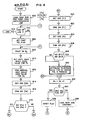
- the specific steps performed to identify pels for vertical filtering are described with reference to Figure 8.
- Several of these steps involve an intermediate thresholding operation in which certain pels are assigned one of four ranges of gray scale values as a function of their original capture gray scale values.
- the intermediate threshold steps require a histogram of the captured image.
- a histogram is basically a graph showing how many pels have each of the 256 possible capture gray scale values.
- the irregular line 11 in Figure 7 shows a typical histogram for a heavily printed document having black characters on a white background.
- the programming steps required to generate a histogram are simple and well known. Since construction of a histogram is not part of the present invention, those steps are not described here.
- a WHITE boundary is established preferably at the median gray scale level.
- a BLACK boundary is established at the gray scale level half way between the WHITE boundary and the lowest level in the histogram:
- a GRAY boundary is established at the level midway between the BLACK and WHITE boundaries.
- pels are temporarily assigned one of four possible two-bit values as a function of their capture gray scale value. Any pel having a capture gray scale value less than the value at the BLACK boundary is assigned a binary value of 00. Any pel with a gray scale value between the BLACK and GRAY boundaries is considered a dark gray pel and is assigned a value of 01. Each pel with a value between the GRAY and WHITE boundary is considered light gray pel and is assigned a binary value of 10. Each pel having a capture gray scale value greater than the value at the WHITE boundary is considered to be a white pel and is assigned a binary value of 11.
- the process of identifying those pels which require vertical filtering begins with the step (802) of locating the first pel below a run end point of the prior or history line. This pel, identified as the current pel, is at the first possible vertical edge in the current line. A check is then made (804) as to whether the current pel is at the end of the scan line. If it is, no vertical filtering is needed and control is returned to operation 614 in the process described with reference to Figure 6.
- a First Pel flag is set (806). Both the current pel and the next pel must be independently tested and, if need be, independently filtered.
- the First Pel flag is an indication that the first of these two pels is being processed.
- operation 834 When the next pel, now identified as the current pel, has been processed in the series of operations beginning with operation 808 and ending with operation 832, operation 834 will be repeated. This time the First Pel flag will be reset. Under these conditions, the next run end point in the history line is found (838) to restart the process of identifying any pel at this end point which may require vertical filtering.
- the first step (902) in the actual vertical filtering process is to establish the difference in gray scale values between the current pel Pc and the pel Pa through simple subtraction.
- a check is then made (904) to determine whether the difference exceeds the predetermined limit. If the difference is greater than the limit, it is set equal to the limit (906). If not, the original value of the difference is retained.
- the difference between the pel Pb and current pel Pc is then established (908) in the same way and a check (910) is made to determine whether this difference exceeds the limit. If it does, this difference is set equal to the limit (912). If it doesn't, the original difference is retained.
- Figures 10 through 12 show the results of vertical filtering as applied to the image shown in Figure 2 and digitized in Figure 3.
- the vertical neighbor pels at R1, C1 and R3, C1 have substantially the same gray scale value and would undoubtedly be assigned the same intermediate gray scale value in the steps performed in the process described with reference to Figure 8.
- the horizontal neighbor pels on the other hand, have completely different values so that all tests required by the steps in Figure 8 are satisfied.
- the pel at R2, C1, would definitely be a candidate for vertical filtering.
Landscapes
- Engineering & Computer Science (AREA)
- Multimedia (AREA)
- Signal Processing (AREA)
- Physics & Mathematics (AREA)
- General Physics & Mathematics (AREA)
- Theoretical Computer Science (AREA)
- Image Processing (AREA)
- Facsimile Image Signal Circuits (AREA)
- Compression Of Band Width Or Redundancy In Fax (AREA)
Applications Claiming Priority (2)
| Application Number | Priority Date | Filing Date | Title |
|---|---|---|---|
| US06/581,768 US4599656A (en) | 1984-02-21 | 1984-02-21 | Processing of gray scale image pels to facilitate data compression |
| US581768 | 1984-02-21 |
Publications (3)
| Publication Number | Publication Date |
|---|---|
| EP0154766A2 EP0154766A2 (en) | 1985-09-18 |
| EP0154766A3 EP0154766A3 (en) | 1988-09-21 |
| EP0154766B1 true EP0154766B1 (en) | 1990-10-31 |
Family
ID=24326481
Family Applications (1)
| Application Number | Title | Priority Date | Filing Date |
|---|---|---|---|
| EP85100005A Expired EP0154766B1 (en) | 1984-02-21 | 1985-01-02 | A method for processing gray scale picture elements to facilitate data compression |
Country Status (4)
| Country | Link |
|---|---|
| US (1) | US4599656A (enExample) |
| EP (1) | EP0154766B1 (enExample) |
| JP (1) | JPS60190090A (enExample) |
| DE (1) | DE3580292D1 (enExample) |
Families Citing this family (17)
| Publication number | Priority date | Publication date | Assignee | Title |
|---|---|---|---|---|
| GB8410860D0 (en) * | 1984-04-27 | 1984-06-06 | Crosfield Electronics Ltd | Image modification |
| US5067162A (en) * | 1986-06-30 | 1991-11-19 | Identix Incorporated | Method and apparatus for verifying identity using image correlation |
| US4679094A (en) * | 1986-10-14 | 1987-07-07 | The Associated Press | Method for compression and transmission of video information |
| USH996H (en) | 1987-01-20 | 1991-11-05 | Recognition Equipment Incorporated | High resolution page image display system |
| US4785356A (en) * | 1987-04-24 | 1988-11-15 | International Business Machines Corporation | Apparatus and method of attenuating distortion introduced by a predictive coding image compressor |
| US4868670A (en) * | 1987-07-24 | 1989-09-19 | Eastman Kodak Company | Apparatus and method for improving the compressibility of an enhanced image through use of a momentarily varying threshold level |
| US4924322A (en) * | 1988-03-18 | 1990-05-08 | Matsushita Electric Industrial Co., Ltd. | Bi-level image display signal processing apparatus |
| US5170261A (en) * | 1990-11-21 | 1992-12-08 | Polaroid Corporation | Printing method |
| DK0514504T3 (da) * | 1990-11-21 | 1997-06-23 | Polaroid Corp | Fremgangsmåde til printning |
| US5359432A (en) * | 1991-11-25 | 1994-10-25 | Lexmark International, Inc. | Printer page composition with color and text |
| JPH06276520A (ja) * | 1993-03-22 | 1994-09-30 | Sony Corp | 画像処理装置 |
| US5838838A (en) * | 1996-07-19 | 1998-11-17 | Hewlett-Packard Company | Down-scaling technique for bi-level images |
| US6091432A (en) * | 1998-03-31 | 2000-07-18 | Hewlett-Packard Company | Method and apparatus for improved block transfers in computer graphics frame buffers |
| JP4018310B2 (ja) * | 1999-04-21 | 2007-12-05 | 株式会社リコー | 画像二値化装置、画像撮像装置、画像二値化方法、画像撮像方法およびその方法の各工程としてコンピュータを機能させるためのプログラムを記録したコンピュータ読取可能な記録媒体 |
| US7715656B2 (en) * | 2004-09-28 | 2010-05-11 | Qualcomm Incorporated | Magnification and pinching of two-dimensional images |
| JP5742427B2 (ja) * | 2011-04-25 | 2015-07-01 | 富士ゼロックス株式会社 | 画像処理装置 |
| KR102533723B1 (ko) * | 2018-09-14 | 2023-05-18 | 삼성전자주식회사 | 전자 장치 및 그 제어 방법 |
Family Cites Families (6)
| Publication number | Priority date | Publication date | Assignee | Title |
|---|---|---|---|---|
| US4280144A (en) * | 1979-12-03 | 1981-07-21 | International Business Machines Corporation | Coarse scan/fine print algorithm |
| JPS56159767A (en) * | 1980-05-14 | 1981-12-09 | Ricoh Co Ltd | Picture processing method |
| DE3121599C2 (de) * | 1981-05-30 | 1986-11-27 | Robert Bosch Gmbh, 7000 Stuttgart | Verfahren und Schaltungsanordnung zum Verdecken von Fehlern in einem digitalen Videosignal |
| JPS58215869A (ja) * | 1982-06-07 | 1983-12-15 | インタ−ナショナル ビジネス マシ−ンズ コ−ポレ−ション | グレ−スケ−ル映像デ−タを縮少する方法 |
| US4532651A (en) * | 1982-09-30 | 1985-07-30 | International Business Machines Corporation | Data filter and compression apparatus and method |
| US4504864A (en) * | 1982-12-30 | 1985-03-12 | International Business Machines Corporation | Nonlinear filtering of gray scale images |
-
1984
- 1984-02-21 US US06/581,768 patent/US4599656A/en not_active Expired - Fee Related
- 1984-11-30 JP JP59252116A patent/JPS60190090A/ja active Granted
-
1985
- 1985-01-02 DE DE8585100005T patent/DE3580292D1/de not_active Expired - Lifetime
- 1985-01-02 EP EP85100005A patent/EP0154766B1/en not_active Expired
Also Published As
| Publication number | Publication date |
|---|---|
| EP0154766A3 (en) | 1988-09-21 |
| JPS60190090A (ja) | 1985-09-27 |
| EP0154766A2 (en) | 1985-09-18 |
| DE3580292D1 (de) | 1990-12-06 |
| JPH0431224B2 (enExample) | 1992-05-25 |
| US4599656A (en) | 1986-07-08 |
Similar Documents
| Publication | Publication Date | Title |
|---|---|---|
| US4599656A (en) | Processing of gray scale image pels to facilitate data compression | |
| EP0105116B1 (en) | Enhancement of video images by selective introduction of gray-scale pels | |
| EP0449516B1 (en) | Image processing using neural network | |
| US4517604A (en) | Method for reducing line width variations in bilevel video images | |
| EP0205944B1 (en) | Method of spatially thresholding a discrete color image | |
| US5271072A (en) | Image reduction of binary images using filtering processing | |
| EP0613290A1 (en) | Method and apparatus for binary image data compression | |
| EP0820195B1 (en) | Image coding using sub-sampling, classification of pixel blocks and association of mapping coefficients | |
| JPH0251310B2 (enExample) | ||
| RU97119861A (ru) | Улучшенный способ заключительной обработки и устройство для использования в системе декодирования сигнала изображения | |
| EP0649246B1 (en) | A method of reducing document size for optical display | |
| WO1994023531A1 (en) | Process and device for analyzing image data in a digital signal from a scanned document | |
| EP0096220A2 (en) | Gray scale image thresholding method | |
| JP3100383B2 (ja) | 文字領域分離方法および装置 | |
| JPH082083B2 (ja) | 多値画像のブロック符号化装置 | |
| JPS613568A (ja) | 中間調領域識別方式 | |
| JPH0767107A (ja) | 画像符号化装置 | |
| JP2845938B2 (ja) | 中間調画像処理方法 | |
| JP2778669B2 (ja) | 網点領域検出方法 | |
| JPS6180964A (ja) | 画信号処理方法 | |
| JPH0429109B2 (enExample) | ||
| JPH03219774A (ja) | 画像処理方法および装置 | |
| JP3080110B2 (ja) | 画像読取装置 | |
| JP2835736B2 (ja) | 画像2値化制御方式 | |
| JPH07104932B2 (ja) | 文字画像データの作成方法 |
Legal Events
| Date | Code | Title | Description |
|---|---|---|---|
| PUAI | Public reference made under article 153(3) epc to a published international application that has entered the european phase |
Free format text: ORIGINAL CODE: 0009012 |
|
| AK | Designated contracting states |
Designated state(s): DE FR GB |
|
| 17P | Request for examination filed |
Effective date: 19851213 |
|
| PUAL | Search report despatched |
Free format text: ORIGINAL CODE: 0009013 |
|
| AK | Designated contracting states |
Kind code of ref document: A3 Designated state(s): DE FR GB |
|
| 17Q | First examination report despatched |
Effective date: 19890808 |
|
| GRAA | (expected) grant |
Free format text: ORIGINAL CODE: 0009210 |
|
| AK | Designated contracting states |
Kind code of ref document: B1 Designated state(s): DE FR GB |
|
| REF | Corresponds to: |
Ref document number: 3580292 Country of ref document: DE Date of ref document: 19901206 |
|
| ET | Fr: translation filed | ||
| PLBE | No opposition filed within time limit |
Free format text: ORIGINAL CODE: 0009261 |
|
| STAA | Information on the status of an ep patent application or granted ep patent |
Free format text: STATUS: NO OPPOSITION FILED WITHIN TIME LIMIT |
|
| 26N | No opposition filed | ||
| PGFP | Annual fee paid to national office [announced via postgrant information from national office to epo] |
Ref country code: GB Payment date: 19911206 Year of fee payment: 8 |
|
| PGFP | Annual fee paid to national office [announced via postgrant information from national office to epo] |
Ref country code: FR Payment date: 19911218 Year of fee payment: 8 |
|
| PGFP | Annual fee paid to national office [announced via postgrant information from national office to epo] |
Ref country code: DE Payment date: 19920121 Year of fee payment: 8 |
|
| PG25 | Lapsed in a contracting state [announced via postgrant information from national office to epo] |
Ref country code: GB Effective date: 19930102 |
|
| GBPC | Gb: european patent ceased through non-payment of renewal fee |
Effective date: 19930102 |
|
| PG25 | Lapsed in a contracting state [announced via postgrant information from national office to epo] |
Ref country code: FR Effective date: 19930930 |
|
| PG25 | Lapsed in a contracting state [announced via postgrant information from national office to epo] |
Ref country code: DE Effective date: 19931001 |
|
| REG | Reference to a national code |
Ref country code: FR Ref legal event code: ST |