US4599656A - Processing of gray scale image pels to facilitate data compression - Google Patents
Processing of gray scale image pels to facilitate data compression Download PDFInfo
- Publication number
- US4599656A US4599656A US06/581,768 US58176884A US4599656A US 4599656 A US4599656 A US 4599656A US 58176884 A US58176884 A US 58176884A US 4599656 A US4599656 A US 4599656A
- Authority
- US
- United States
- Prior art keywords
- pel
- gray scale
- values
- pels
- current
- Prior art date
- Legal status (The legal status is an assumption and is not a legal conclusion. Google has not performed a legal analysis and makes no representation as to the accuracy of the status listed.)
- Expired - Fee Related
Links
Images



Classifications
-
- H—ELECTRICITY
- H04—ELECTRIC COMMUNICATION TECHNIQUE
- H04N—PICTORIAL COMMUNICATION, e.g. TELEVISION
- H04N1/00—Scanning, transmission or reproduction of documents or the like, e.g. facsimile transmission; Details thereof
- H04N1/40—Picture signal circuits
- H04N1/409—Edge or detail enhancement; Noise or error suppression
-
- G—PHYSICS
- G06—COMPUTING OR CALCULATING; COUNTING
- G06T—IMAGE DATA PROCESSING OR GENERATION, IN GENERAL
- G06T3/00—Geometric image transformations in the plane of the image
- G06T3/40—Scaling of whole images or parts thereof, e.g. expanding or contracting
- G06T3/403—Edge-driven scaling; Edge-based scaling
-
- H—ELECTRICITY
- H04—ELECTRIC COMMUNICATION TECHNIQUE
- H04N—PICTORIAL COMMUNICATION, e.g. TELEVISION
- H04N1/00—Scanning, transmission or reproduction of documents or the like, e.g. facsimile transmission; Details thereof
- H04N1/40—Picture signal circuits
- H04N1/403—Discrimination between the two tones in the picture signal of a two-tone original
Definitions
- the present invention relates to image processing and more particularly to a method for processing gray scale pel values to facilitate subsequent data compression.
- Each room normally includes a room camera for capturing a wide angle view of the people, a document camera which can be focused on letters, drawings or other documents, a room monitor for permitting people in one room to see those in the other, and a document monitor for viewing documents being presented in the other room.
- Communications between the two rooms are established over conventional teleprocessing links, such as leased or switched telephone lines or satellite communication channels.
- freeze-frame teleconferencing techniques may be employed.
- the video image captured by a room camera is updated only periodically, either at fixed intervals or on command of an operator. People at the receiver see the same "frozen" room image between updates. Audio signals are transmitted on a real time basis so that there is no perceptible delay in voice communications. Document images are updated only when the person presenting a document pushes a "send" button in the teleconferencing room.
- the image of the presented document does not appear immediately on the display or monitor in the receiving teleconferencing room.
- a finite period of time is required to scan, capture and process image data at the originating teleconferencing room, to transmit the processed data over teleprocessing links and to process data at the receiving teleconferencing room in order to reconstruct the image of the presented document.
- the length of the delay can be critical in a teleconferencing system. Delays exceeding a few seconds produce unnatural pauses in the smooth flow of a business meeting.
- the length of the delay is directly related to the amount of data which must be transmitted in order to construct an acceptable video image at the receiving teleconferencing room and is inversely related to the bandwidth of the teleprocessing link over which the data must be transmitted. Delay can be reduced by using a higher bandwidth channel. However, communication costs are a direct function of required bandwidth making it desirable to utilize low bandwidth links; e.g., conventional telephone lines.
- Delay time and communication costs can be reduced by compressing the amount of data which must be transmitted over a low bandwidth channel in order to reconstruct an acceptable video image of a presented document.
- documents which are nominally bilevel for example, black characters on white paper
- the binary data can then be compressed using known one-dimensional or two-dimensional run length encoding techniques.
- Another technique for achieving greater reductions in delay time and communication costs is to reduce the image sampling rate. Instead of sampling the image at 40 picture elements or pels per inch, the sampling rate may be reduced to 20 or even 10 pels per inch. The amount of data which must be encoded and transmitted is directly related to the sampling rate.
- video images captured at reduced sampling rates can become distorted.
- One type of distortion that can occur is along a vertical edge of an image area; for example, along a vertical edge of the stem in a typed or printed "T". What may appear, at a distance, as a perfectly straight edge will turn out to have irregularities on closer inspection.
- simply reducing the image pels to one bit binary values may cause the irregularities to be accentuated, thus degrading the recreated video image.
- vertical filtering may be performed to reduce pel-to-pel variations in a vertical direction.
- the digital value of substantially every pel in the image is modified as a function of the captured digital values for both of its vertical neighbors; that is, the pels above and below the pel being modified or filtered. If the vertical neighbor pels have higher digital values than the pel being filtered, the digital value of the pel is increased. Conversely, if the digital values for the vertical neighbor pels are lower, the digital value of the pel being filtered is reduced.
- the present invention is a method for vertically filtering only selected pels in a captured video image.
- the number of pels actually filtered is greatly reduced, making it possible to perform image processing without a special purpose parallel processor.
- the method identifies pels which may require vertical filtering to reduce distortion due to sampling along image vertical edges and comprises the steps of retrieving the captured gray scale pel values for a current pel and for both pels which are vertical neighbors of the current pel.
- Each vertical neighbor pel is assigned one of the limited number of gray scale range values as a function of its captured gray scale value; that is, each vertical neighbor pel is assigned an intermediate threshold level. The intermediate threshold levels of the vertical neighbor pels are compared. If both have the same value, the current pel is identified as a candidate for vertical filtering.
- FIG. 1 is a simplified block diagram of the essential components of a teleconferencing system in which the present invention may be utilized;
- FIG. 2 is an enlarged view of a vertical edge of an image area with a grid of sampling pels
- FIGS. 3 through 5 represent the various steps of compressing the image of FIG. 2 but without vertical filtering
- FIG. 6 is a flow chart of an overall image processing operation within which the present invention may be practiced.
- FIG. 7 is a histogram which shows the intermediate threshold boundaries which are used in a preferred embodiment of the present invention.
- FIG. 8 is a more detailed flow chart of the steps which are required to identify pels requiring vertical filtering
- FIG. 9 is a detailed flow chart of the actual vertical filtering process for identified pels.
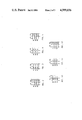
- FIGS. 10 through 12 represent various stages of compressing the image represented by FIG. 2 where selected pels are vertically filtered.
- each picture element or pel in the captured image is initially stored in a frame buffer 14 in the form of an N-bit word where N is dependent upon the gray scale resolution of the camera. If the camera 12 is capable of discriminating among 256 levels of gray, each pel stored in frame buffer 14 can be represented by an 8 bit binary word. The 8 bit word is referred to as the capture gray scale value of the pel.
- the capture gray scale value for any given pel can fall anywhere within the range of 0 to 255 with 0 being a pel in an ideal, pure black area and 255 being a pel in an ideal, pure white area.
- the capture gray scale pel data is manipulated and compressed in an image processor 16 before being made available to a transmit modem 18.
- the modem 18 transmits the compressed data over a teleprocessing link 20, such as a dial-up telephone line, to a receive modem 22 at the receiving teleconferencing location.
- the compressed data is decompressed in an image processor 24 before being loaded into another gray scale frame buffer 26.
- the gray scale pel data stored in buffer 26 is used to drive the video display monitor 28.
- the present invention is a method which would be carried out in the image processor 16, which could be driven by any suitable general purpose microprocessor such as a Type 68000 microprocessor available from Motorola Corporation.
- the vertical edge of an image area is shown with an overlay of pel boundaries or sampling regions. Those pels in the shaded area to the right of the vertical edge are assumed to have an ideal 0 value. Those pels to the left of the edge are assumed to have an ideal value of 255. The pels on the vertical edge will have values falling between these extremes depending upon the relative amounts of black and white areas within the pel boundary.
- FIG. 3 is a matrix of capture gray scale values for the area shown in FIG. 2.
- the pels at R1, C1 and R3, C1 will have nearly the same capture gray scale value since both have the same relative amounts of black and white area.
- the pel at R2, C1 will, on the other hand, have a much lower capture gray scale value due to the excursion of the black area toward the left. Such an excursion might occur on a nominally straight edge due to ink migration or smudging.
- the recreated image would follow the pattern shown in FIG. 5.
- the pel at R2, C1 would be recreated as a black pel since its capture gray scale value of 120 is slightly below the threshold level of 128.
- the distortion is accentuated by the fact that the pels at R1, C1 and R3, C1 will be recreated as white pels since their capture gray scale values are greater than the threshold value of 128.
- a pel is vertically filtered by looking at the capture gray scale value of the pels immediately above and below; that is, its vertical neighbor pels. If the vertical neighbor pels both have capture gray scale values greater than the pel being filtered, the gray scale value of that pel is increased. Conversely, if the vertical neighbor pels have lower gray scale values, the gray scale value of the pel being filtered is reduced. Binary thresholding, along with other image processing operations, can then be performed using the new or filtered gray scale value for the pel.
- FIG. 6 is a high level flow chart of the preceding and following operations.
- the capture gray scale values for all pels in line 1 of the image are retrieved from the frame buffer. These gray scale values are thresholded to binary levels using the simple fixed threshold mentioned above or other more complex thresholding arrangements. The thresholding technique employed is not part of this invention and is not described in detail.
- Line 1 is run length encoded (604) to establish a run length history. Run length encoding is well known. Rather than store a binary value for each pel on a line, all that is stored is the length of each run of pels.
- the run length history would be represented by the following string of numbers 26, 36, 66 where each number is the location of the first pel in a new run.
- a processor uses the run length history of the prior line to examine only those pels of the current line which are immediately below the beginning and end of each run in the prior line.
- the actual steps used to locate pels to be fi1tered are discussed with reference to FIG. 8. For purposes of FIG. 6, these steps are represented as a single block 610.
- these values are used to threshold each pel in the current line to binary values (612).
- the new gray scale values are used in creating a run length history (614) for the current line.
- the process continues (616) at the next line of the buffer. Unless the next line is the last line (618) of the frame buffer, the loop consisting of operations 610, 612, 614, 616 is repeated. If, however, the next line is the last line (618) of a frame buffer, it cannot be vertically filtered but instead is thresholded to a binary level (619) using the original gray scale values.
- Further data compression (620), such as conventional two-dimensional run length compression can be performed in parallel with the steps described above using the thresholded or final binary values so that all data compression is completed on one pass through the frame buffer.
- the specific steps performed to identify pels for vertical filtering are described with reference to FIG. 8.
- Several of these steps involve an intermediate thresholding operation in which certain pels are assigned one of four ranges of gray scale values as a function of their original capture gray scale values.
- the intermediate threshold steps require a histogram of the captured image.
- a histogram is basically a graph showing how many pels have each of the 256 possible capture gray scale values.
- the irregular line in FIG. 7 shows a typical histogram for a heavily printed document having black characters on a white background.
- the programming steps required to generate a histogram are simple and well known. Since construction of a histogram is not part of the present invention, those steps are not described here.
- a WHITE boundary is established preferably at the median gray scale level.
- a BLACK boundary is established at the gray scale level half way between the WHITE boundary and the lowest level in the histogram:
- a GRAY boundary is established at the level midway between the BLACK and WHITE boundaries.
- pels are temporarily assigned one of four possible two-bit values as a function of their capture gray scale value. Any pel having a capture gray scale value less than the value at the BLACK boundary is assigned a binary value of 00. Any pel with a gray scale value between the BLACK and GRAY boundaries is considered a dark gray pel and is assigned a value of 01. Each pel with a value between the GRAY and WHITE boundary is considered light gray pel and is assigned a binary value of 10. Each pel having a capture gray scale value greater than the value at the WHITE boundary is considered to be a white pel and is assigned a binary value of 11.
- the process of identifying those pels which require vertical filtering begins with the step (802) of locating the first pel below a run end point of the prior or history line. This pel, identified as the current pel, is at the first possible vertical edge in the current line. A check is then made (804) as to whether the current pel is at the end of the scan line. If it is, no vertical filtering is needed and control is returned to operation 614 in the process described with reference to FIG. 6.
- a First Pel flag is set (806). Both the current pel and the next pel must be independently tested and, if need be, independently filtered.
- the First Pel flag is an indication that the first of these two pels is being processed.
- the program increments the current pel location by 1 to point to the next pel.
- a check is then made as to whether the First Pel flag is set (834). If the flag is set, indicating that only the first of the two pels has been tested, the flag is reset (836) and the entire process is repeated for the next pel.
- operation 834 When the next pel, now identified as the current pel, has been processed in the series of operations beginning with operation 808 and ending with operation 832, operation 834 will be repeated. This time the First Pel flag will be reset. Under these conditions, the next run end point in the history line is found (838) to restart the process of identifying any pel at this end point which may require vertical filtering.
- the actual vertical filtering steps referred to only as block 830 in FIG. 8, are described in detail with reference to FIG. 9.
- the first step (902) in the actual vertical filtering process is to establish the difference in gray scale values between the current pel Pc and the pel Pa through simple subtraction.
- a check is then made (904) to determine whether the difference exceeds the predetermined limit. If the difference is greater than the limit, it is set equal to the limit (906). If not, the original value of the difference is retained.
- the difference between the pel Pb and current pel Pc is then established (908) in the same way and a check (910) is made to determine whether this difference exceeds the limit. If it does, this difference is set equal to the limit (912). If it doesn't, the original difference is retained.
- ⁇ P The sum of the two differences is determined (914) and a filter value ⁇ P is obtained by multiplying the total difference times a scale factor (916). A scale factor of 0.25 has empirically been found to be preferred.
- the gray scale value for the current pel is adjusted (918) by the value ⁇ P. It should be noted that value of ⁇ P may not directly reflect the actual gray scale values of the current pel and its vertical neighbor pels which can occur in steps 904, 906, 910 and 912. The reason for limiting is to preserve any sharp transitions which exist in the image.
- the maximum pel gray scale value must, of course, be limited to 255 (922). If the calculated value does not exceed 255, another check (924) is made to determine whether it is less than 0, which is also a physical impossibility. If the results of the calculation did yield a negative gray scale value, the value is limited to 0 (926).
- the new or filtered gray scale value for the current pel Pc is stored (928) before program control is returned to operation 832 in the process described with reference to FIG. 8.
- FIGS. 10 through 12 show the results of vertical filtering as applied to the image shown in FIG. 2 and digitized in FIG. 3.
- the vertical neighbor pels at R1, C1 and R3, C1 have substantially the same gray scale value and would undoubtedly be assigned the same intermediate gray scale value in the steps performed in the process described with reference to FIG. 8.
- the horizontal neighbor pels on the other hand, have completely different values so that all tests required by the steps in FIG. 8 are satisfied.
- the pel at R2, C1, would definitely be a candidate for vertical filtering.
- the difference between the pel above the current pel and the current pel would be 190 minus 120 or 70. Assume that the limit discussed with reference to FIG. 9 is arbitrarily set at 25 pels, this difference would be limited to a value of 25. Similarly, the difference between the lower horizontal neighbor and the current pel would be 200 minus 120 or 80 and would also be limited to 25. The total difference would thus be 25 plus 25 or 50 and ⁇ P would 50 times 0.25 or, with rounding, 13. When the raw or capture gray scale value for the current pel is adjusted by ⁇ P, the gray scale value increases from 120 to 133.
Landscapes
- Engineering & Computer Science (AREA)
- Multimedia (AREA)
- Signal Processing (AREA)
- Physics & Mathematics (AREA)
- General Physics & Mathematics (AREA)
- Theoretical Computer Science (AREA)
- Image Processing (AREA)
- Facsimile Image Signal Circuits (AREA)
- Compression Of Band Width Or Redundancy In Fax (AREA)
Priority Applications (4)
| Application Number | Priority Date | Filing Date | Title |
|---|---|---|---|
| US06/581,768 US4599656A (en) | 1984-02-21 | 1984-02-21 | Processing of gray scale image pels to facilitate data compression |
| JP59252116A JPS60190090A (ja) | 1984-02-21 | 1984-11-30 | グレ−スケ−ルイメ−ジ画素処理方法 |
| EP85100005A EP0154766B1 (en) | 1984-02-21 | 1985-01-02 | A method for processing gray scale picture elements to facilitate data compression |
| DE8585100005T DE3580292D1 (de) | 1984-02-21 | 1985-01-02 | Verfahren zur verarbeitung von bildelementen grauer toene zum erleichtern der datenkompression. |
Applications Claiming Priority (1)
| Application Number | Priority Date | Filing Date | Title |
|---|---|---|---|
| US06/581,768 US4599656A (en) | 1984-02-21 | 1984-02-21 | Processing of gray scale image pels to facilitate data compression |
Publications (1)
| Publication Number | Publication Date |
|---|---|
| US4599656A true US4599656A (en) | 1986-07-08 |
Family
ID=24326481
Family Applications (1)
| Application Number | Title | Priority Date | Filing Date |
|---|---|---|---|
| US06/581,768 Expired - Fee Related US4599656A (en) | 1984-02-21 | 1984-02-21 | Processing of gray scale image pels to facilitate data compression |
Country Status (4)
| Country | Link |
|---|---|
| US (1) | US4599656A (enExample) |
| EP (1) | EP0154766B1 (enExample) |
| JP (1) | JPS60190090A (enExample) |
| DE (1) | DE3580292D1 (enExample) |
Cited By (16)
| Publication number | Priority date | Publication date | Assignee | Title |
|---|---|---|---|---|
| US4679094A (en) * | 1986-10-14 | 1987-07-07 | The Associated Press | Method for compression and transmission of video information |
| US4725966A (en) * | 1984-04-27 | 1988-02-16 | Crosfield Electronics Limited | Image modification |
| US4785356A (en) * | 1987-04-24 | 1988-11-15 | International Business Machines Corporation | Apparatus and method of attenuating distortion introduced by a predictive coding image compressor |
| US4868670A (en) * | 1987-07-24 | 1989-09-19 | Eastman Kodak Company | Apparatus and method for improving the compressibility of an enhanced image through use of a momentarily varying threshold level |
| US4924322A (en) * | 1988-03-18 | 1990-05-08 | Matsushita Electric Industrial Co., Ltd. | Bi-level image display signal processing apparatus |
| USH996H (en) | 1987-01-20 | 1991-11-05 | Recognition Equipment Incorporated | High resolution page image display system |
| US5067162A (en) * | 1986-06-30 | 1991-11-19 | Identix Incorporated | Method and apparatus for verifying identity using image correlation |
| US5170261A (en) * | 1990-11-21 | 1992-12-08 | Polaroid Corporation | Printing method |
| US5359432A (en) * | 1991-11-25 | 1994-10-25 | Lexmark International, Inc. | Printer page composition with color and text |
| US5369497A (en) * | 1990-11-21 | 1994-11-29 | Allen; Janet A. | Apparatus and method for modulating the area of pixels for tone reproduction |
| US5838838A (en) * | 1996-07-19 | 1998-11-17 | Hewlett-Packard Company | Down-scaling technique for bi-level images |
| US6091432A (en) * | 1998-03-31 | 2000-07-18 | Hewlett-Packard Company | Method and apparatus for improved block transfers in computer graphics frame buffers |
| US6898329B1 (en) * | 1999-04-21 | 2005-05-24 | Ricoh Company, Ltd. | Image binarization apparatus, image binarization method, image pickup apparatus, image pickup method, and a computer product |
| US20060078226A1 (en) * | 2004-09-28 | 2006-04-13 | Mengyao Zhou | Magnification and pinching of two-dimensional images |
| US20120268629A1 (en) * | 2011-04-25 | 2012-10-25 | Fuji Xerox Co., Ltd. | Image processing apparatus and image processing method |
| CN112740319A (zh) * | 2018-09-14 | 2021-04-30 | 三星电子株式会社 | 电子设备及其控制方法 |
Families Citing this family (1)
| Publication number | Priority date | Publication date | Assignee | Title |
|---|---|---|---|---|
| JPH06276520A (ja) * | 1993-03-22 | 1994-09-30 | Sony Corp | 画像処理装置 |
Citations (4)
| Publication number | Priority date | Publication date | Assignee | Title |
|---|---|---|---|---|
| US4280144A (en) * | 1979-12-03 | 1981-07-21 | International Business Machines Corporation | Coarse scan/fine print algorithm |
| US4498104A (en) * | 1981-05-30 | 1985-02-05 | Robert Bosch Gmbh | Method and apparatus for concealing errors in a digital television signal |
| US4504864A (en) * | 1982-12-30 | 1985-03-12 | International Business Machines Corporation | Nonlinear filtering of gray scale images |
| US4532651A (en) * | 1982-09-30 | 1985-07-30 | International Business Machines Corporation | Data filter and compression apparatus and method |
Family Cites Families (2)
| Publication number | Priority date | Publication date | Assignee | Title |
|---|---|---|---|---|
| JPS56159767A (en) * | 1980-05-14 | 1981-12-09 | Ricoh Co Ltd | Picture processing method |
| JPS58215869A (ja) * | 1982-06-07 | 1983-12-15 | インタ−ナショナル ビジネス マシ−ンズ コ−ポレ−ション | グレ−スケ−ル映像デ−タを縮少する方法 |
-
1984
- 1984-02-21 US US06/581,768 patent/US4599656A/en not_active Expired - Fee Related
- 1984-11-30 JP JP59252116A patent/JPS60190090A/ja active Granted
-
1985
- 1985-01-02 DE DE8585100005T patent/DE3580292D1/de not_active Expired - Lifetime
- 1985-01-02 EP EP85100005A patent/EP0154766B1/en not_active Expired
Patent Citations (4)
| Publication number | Priority date | Publication date | Assignee | Title |
|---|---|---|---|---|
| US4280144A (en) * | 1979-12-03 | 1981-07-21 | International Business Machines Corporation | Coarse scan/fine print algorithm |
| US4498104A (en) * | 1981-05-30 | 1985-02-05 | Robert Bosch Gmbh | Method and apparatus for concealing errors in a digital television signal |
| US4532651A (en) * | 1982-09-30 | 1985-07-30 | International Business Machines Corporation | Data filter and compression apparatus and method |
| US4504864A (en) * | 1982-12-30 | 1985-03-12 | International Business Machines Corporation | Nonlinear filtering of gray scale images |
Cited By (21)
| Publication number | Priority date | Publication date | Assignee | Title |
|---|---|---|---|---|
| US4725966A (en) * | 1984-04-27 | 1988-02-16 | Crosfield Electronics Limited | Image modification |
| US5067162A (en) * | 1986-06-30 | 1991-11-19 | Identix Incorporated | Method and apparatus for verifying identity using image correlation |
| US4679094A (en) * | 1986-10-14 | 1987-07-07 | The Associated Press | Method for compression and transmission of video information |
| USH996H (en) | 1987-01-20 | 1991-11-05 | Recognition Equipment Incorporated | High resolution page image display system |
| US4785356A (en) * | 1987-04-24 | 1988-11-15 | International Business Machines Corporation | Apparatus and method of attenuating distortion introduced by a predictive coding image compressor |
| US4868670A (en) * | 1987-07-24 | 1989-09-19 | Eastman Kodak Company | Apparatus and method for improving the compressibility of an enhanced image through use of a momentarily varying threshold level |
| US4924322A (en) * | 1988-03-18 | 1990-05-08 | Matsushita Electric Industrial Co., Ltd. | Bi-level image display signal processing apparatus |
| US5170261A (en) * | 1990-11-21 | 1992-12-08 | Polaroid Corporation | Printing method |
| US5369497A (en) * | 1990-11-21 | 1994-11-29 | Allen; Janet A. | Apparatus and method for modulating the area of pixels for tone reproduction |
| US5359432A (en) * | 1991-11-25 | 1994-10-25 | Lexmark International, Inc. | Printer page composition with color and text |
| US5838838A (en) * | 1996-07-19 | 1998-11-17 | Hewlett-Packard Company | Down-scaling technique for bi-level images |
| US6091432A (en) * | 1998-03-31 | 2000-07-18 | Hewlett-Packard Company | Method and apparatus for improved block transfers in computer graphics frame buffers |
| US6898329B1 (en) * | 1999-04-21 | 2005-05-24 | Ricoh Company, Ltd. | Image binarization apparatus, image binarization method, image pickup apparatus, image pickup method, and a computer product |
| US20050271294A1 (en) * | 1999-04-21 | 2005-12-08 | Sadao Takahashi | Image binarization apparatus, image binarization method, image pickup apparatus, image pickup method, and a computer product |
| US7623727B2 (en) * | 1999-04-21 | 2009-11-24 | Ricoh Company, Ltd. | Image binarization apparatus, image binarization method, image pickup apparatus, image pickup method, and a computer product |
| US20060078226A1 (en) * | 2004-09-28 | 2006-04-13 | Mengyao Zhou | Magnification and pinching of two-dimensional images |
| US7715656B2 (en) * | 2004-09-28 | 2010-05-11 | Qualcomm Incorporated | Magnification and pinching of two-dimensional images |
| US20120268629A1 (en) * | 2011-04-25 | 2012-10-25 | Fuji Xerox Co., Ltd. | Image processing apparatus and image processing method |
| US8824804B2 (en) * | 2011-04-25 | 2014-09-02 | Fuji Xerox Co., Ltd. | Image processing apparatus and image processing method |
| CN112740319A (zh) * | 2018-09-14 | 2021-04-30 | 三星电子株式会社 | 电子设备及其控制方法 |
| CN112740319B (zh) * | 2018-09-14 | 2024-03-08 | 三星电子株式会社 | 电子设备及其控制方法 |
Also Published As
| Publication number | Publication date |
|---|---|
| EP0154766A3 (en) | 1988-09-21 |
| JPS60190090A (ja) | 1985-09-27 |
| EP0154766A2 (en) | 1985-09-18 |
| DE3580292D1 (de) | 1990-12-06 |
| JPH0431224B2 (enExample) | 1992-05-25 |
| EP0154766B1 (en) | 1990-10-31 |
Similar Documents
| Publication | Publication Date | Title |
|---|---|---|
| EP0154766B1 (en) | A method for processing gray scale picture elements to facilitate data compression | |
| EP0105116B1 (en) | Enhancement of video images by selective introduction of gray-scale pels | |
| EP0899959A2 (en) | Image data coding and restoring method and apparatus for coding and restoring the same | |
| US4517604A (en) | Method for reducing line width variations in bilevel video images | |
| EP0449516B1 (en) | Image processing using neural network | |
| WO1997022202A2 (en) | Method and apparatus for compressing and decompressing a video image | |
| EP0205944B1 (en) | Method of spatially thresholding a discrete color image | |
| US5271072A (en) | Image reduction of binary images using filtering processing | |
| EP0613290A1 (en) | Method and apparatus for binary image data compression | |
| US5905820A (en) | Enhancement of digital images for electronic displays | |
| EP0820195B1 (en) | Image coding using sub-sampling, classification of pixel blocks and association of mapping coefficients | |
| EP0096219A2 (en) | Image classification method based on histogram analysis | |
| EP0105085A2 (en) | A method and apparatus for filtering grey scale image data | |
| JP3308675B2 (ja) | 符号化装置 | |
| US4729034A (en) | Method and apparatus for selection of a coding reference line for two-dimensional coding of image data representing screened images | |
| US5091977A (en) | Image data compression method using a run prediction technique | |
| EP0649246B1 (en) | A method of reducing document size for optical display | |
| EP0096220A2 (en) | Gray scale image thresholding method | |
| EP0330684A1 (en) | Identification information storage and retrieval | |
| JPH0767107A (ja) | 画像符号化装置 | |
| KR930003482B1 (ko) | 영상 및 문자 혼재 문서의 간이 식별 방법 | |
| JPH0429109B2 (enExample) | ||
| JPH02159186A (ja) | 動画像の伝送装置 | |
| JPH07325883A (ja) | 画像処理装置及び方法 | |
| JP2001057637A (ja) | 画像送信方法及び画像送信装置 |
Legal Events
| Date | Code | Title | Description |
|---|---|---|---|
| AS | Assignment |
Owner name: INTERNATIONAL BUSINESS MACHINES CORPORATION, ARMON Free format text: ASSIGNMENT OF ASSIGNORS INTEREST.;ASSIGNOR:BELLINGHAUSEN, JOAN M.;REEL/FRAME:004232/0925 Effective date: 19840213 |
|
| FPAY | Fee payment |
Year of fee payment: 4 |
|
| FPAY | Fee payment |
Year of fee payment: 8 |
|
| REMI | Maintenance fee reminder mailed | ||
| LAPS | Lapse for failure to pay maintenance fees | ||
| FP | Lapsed due to failure to pay maintenance fee |
Effective date: 19980708 |
|
| STCH | Information on status: patent discontinuation |
Free format text: PATENT EXPIRED DUE TO NONPAYMENT OF MAINTENANCE FEES UNDER 37 CFR 1.362 |