EP0153237B1 - Orthopädische Stützvorrichtung des Rumpfes - Google Patents
Orthopädische Stützvorrichtung des Rumpfes Download PDFInfo
- Publication number
- EP0153237B1 EP0153237B1 EP85400235A EP85400235A EP0153237B1 EP 0153237 B1 EP0153237 B1 EP 0153237B1 EP 85400235 A EP85400235 A EP 85400235A EP 85400235 A EP85400235 A EP 85400235A EP 0153237 B1 EP0153237 B1 EP 0153237B1
- Authority
- EP
- European Patent Office
- Prior art keywords
- elements
- elastic
- corset
- thoracic
- sub
- Prior art date
- Legal status (The legal status is an assumption and is not a legal conclusion. Google has not performed a legal analysis and makes no representation as to the accuracy of the status listed.)
- Expired
Links
- 239000002131 composite material Substances 0.000 claims abstract description 15
- 210000004197 pelvis Anatomy 0.000 claims abstract description 7
- 210000001015 abdomen Anatomy 0.000 claims abstract description 4
- 210000000115 thoracic cavity Anatomy 0.000 claims description 46
- 230000001105 regulatory effect Effects 0.000 claims description 21
- 230000033001 locomotion Effects 0.000 claims description 18
- 230000009975 flexible effect Effects 0.000 claims description 13
- 210000001624 hip Anatomy 0.000 claims description 10
- 241001433070 Xiphoides Species 0.000 claims description 8
- 238000000429 assembly Methods 0.000 claims description 8
- 210000002417 xiphoid bone Anatomy 0.000 claims description 8
- 230000005484 gravity Effects 0.000 claims description 7
- 239000000463 material Substances 0.000 claims description 6
- 239000004033 plastic Substances 0.000 claims description 6
- 229920003023 plastic Polymers 0.000 claims description 6
- 206010023509 Kyphosis Diseases 0.000 claims description 5
- 208000007623 Lordosis Diseases 0.000 claims description 5
- 208000008765 Sciatica Diseases 0.000 claims description 5
- 210000000038 chest Anatomy 0.000 claims description 5
- 230000000295 complement effect Effects 0.000 claims description 4
- QTCANKDTWWSCMR-UHFFFAOYSA-N costic aldehyde Natural products C1CCC(=C)C2CC(C(=C)C=O)CCC21C QTCANKDTWWSCMR-UHFFFAOYSA-N 0.000 claims description 4
- ISTFUJWTQAMRGA-UHFFFAOYSA-N iso-beta-costal Natural products C1C(C(=C)C=O)CCC2(C)CCCC(C)=C21 ISTFUJWTQAMRGA-UHFFFAOYSA-N 0.000 claims description 4
- 210000000481 breast Anatomy 0.000 claims description 3
- 210000000845 cartilage Anatomy 0.000 claims description 3
- 210000001621 ilium bone Anatomy 0.000 claims description 3
- 230000000717 retained effect Effects 0.000 claims description 3
- 210000000954 sacrococcygeal region Anatomy 0.000 claims description 3
- 210000001991 scapula Anatomy 0.000 claims description 3
- 230000009189 diving Effects 0.000 claims description 2
- 210000002239 ischium bone Anatomy 0.000 claims description 2
- 230000007246 mechanism Effects 0.000 claims description 2
- 210000001113 umbilicus Anatomy 0.000 claims description 2
- 210000003109 clavicle Anatomy 0.000 claims 1
- 238000005259 measurement Methods 0.000 claims 1
- 238000007665 sagging Methods 0.000 claims 1
- 230000035945 sensitivity Effects 0.000 abstract description 4
- 210000003205 muscle Anatomy 0.000 abstract description 3
- 210000000056 organ Anatomy 0.000 description 8
- 208000037265 diseases, disorders, signs and symptoms Diseases 0.000 description 4
- 208000035475 disorder Diseases 0.000 description 4
- 210000003141 lower extremity Anatomy 0.000 description 3
- 210000002105 tongue Anatomy 0.000 description 3
- 210000001364 upper extremity Anatomy 0.000 description 3
- 230000021542 voluntary musculoskeletal movement Effects 0.000 description 3
- 238000005452 bending Methods 0.000 description 2
- 230000008901 benefit Effects 0.000 description 2
- 230000000694 effects Effects 0.000 description 2
- 239000004744 fabric Substances 0.000 description 2
- 229920001684 low density polyethylene Polymers 0.000 description 2
- 239000004702 low-density polyethylene Substances 0.000 description 2
- 239000002184 metal Substances 0.000 description 2
- 239000002991 molded plastic Substances 0.000 description 2
- 210000004061 pubic symphysis Anatomy 0.000 description 2
- 230000004044 response Effects 0.000 description 2
- 230000003068 static effect Effects 0.000 description 2
- 206010000077 Abdominal mass Diseases 0.000 description 1
- 229910000760 Hardened steel Inorganic materials 0.000 description 1
- 208000016285 Movement disease Diseases 0.000 description 1
- 206010033799 Paralysis Diseases 0.000 description 1
- 229910000831 Steel Inorganic materials 0.000 description 1
- 230000003321 amplification Effects 0.000 description 1
- 230000005540 biological transmission Effects 0.000 description 1
- 238000006243 chemical reaction Methods 0.000 description 1
- 230000002301 combined effect Effects 0.000 description 1
- 230000002950 deficient Effects 0.000 description 1
- 238000006073 displacement reaction Methods 0.000 description 1
- 239000010985 leather Substances 0.000 description 1
- 210000004705 lumbosacral region Anatomy 0.000 description 1
- 238000012423 maintenance Methods 0.000 description 1
- 238000012986 modification Methods 0.000 description 1
- 230000004048 modification Effects 0.000 description 1
- 210000002346 musculoskeletal system Anatomy 0.000 description 1
- 238000003199 nucleic acid amplification method Methods 0.000 description 1
- 230000007420 reactivation Effects 0.000 description 1
- 238000011084 recovery Methods 0.000 description 1
- 230000000241 respiratory effect Effects 0.000 description 1
- 230000029058 respiratory gaseous exchange Effects 0.000 description 1
- 238000000926 separation method Methods 0.000 description 1
- 239000010959 steel Substances 0.000 description 1
- 210000001562 sternum Anatomy 0.000 description 1
- 238000006467 substitution reaction Methods 0.000 description 1
Images

Classifications
-
- A—HUMAN NECESSITIES
- A61—MEDICAL OR VETERINARY SCIENCE; HYGIENE
- A61F—FILTERS IMPLANTABLE INTO BLOOD VESSELS; PROSTHESES; DEVICES PROVIDING PATENCY TO, OR PREVENTING COLLAPSING OF, TUBULAR STRUCTURES OF THE BODY, e.g. STENTS; ORTHOPAEDIC, NURSING OR CONTRACEPTIVE DEVICES; FOMENTATION; TREATMENT OR PROTECTION OF EYES OR EARS; BANDAGES, DRESSINGS OR ABSORBENT PADS; FIRST-AID KITS
- A61F5/00—Orthopaedic methods or devices for non-surgical treatment of bones or joints; Nursing devices ; Anti-rape devices
- A61F5/01—Orthopaedic devices, e.g. long-term immobilising or pressure directing devices for treating broken or deformed bones such as splints, casts or braces
- A61F5/02—Orthopaedic corsets
- A61F5/024—Orthopaedic corsets having pressure pads connected in a frame for reduction or correction of the curvature of the spine
Definitions
- the present invention relates to an external apparatus for the trunk.
- a first type (see FR-A-2 085 624) essentially comprises a rigid or semi-rigid structure enveloping the trunk, such as a shell made of material plastic or metal corset, leather or composite, fabric and steel;
- a second type (see US-A-3,282,264) comprises a posterior and / or lateral bracket cooperating with a corset to support the user, and is generally called "Lyon corset", while the third type (see US-A - 3 543 748) includes elastic corsets enclosing the trunk evenly.
- the aim of the present invention is to propose such an apparatus or orthosis, which makes it possible to more or less completely compensate for all the deficient disorders of tone and / or motor skills and / or sensitivity at the levels of the spine. and / or the trunk of a subject.
- the principle which is the basis of the invention, consists in producing an apparatus capable of absorbing differential variations in the diameters of the trunk, which result from respiratory movements or other voluntary movements of the trunk or parts thereof. , and capable of restoring them and transmitting them dynamically inside the practically conservative system, on the energy level, which the apparatus constitutes with the trunk of the user, by giving dynamic support to the muscles of the breathing, static and motor skills.
- the apparatus according to the invention can be advantageously combined with an external apparatus for the physically handicapped of at least one upper limb and / or with an external apparatus for the physically handicapped of at least one lower limb which forms the subject of patent application EP-A- 0 066 028.
- an external apparatus for the physically handicapped of at least one upper limb and / or with an external apparatus for the physically handicapped of at least one lower limb which forms the subject of patent application EP-A- 0 066 028.
- the apparatus according to the invention makes it possible to apply, at the level of the trunk, the biomechanical principles on the basis of which the apparatuses of the front axle and of the undercarriage were respectively described, described in the two patent applications previously mentioned.
- the corset comprises four semi-rigid elements, the first two elements being substantially equal and having approximately the shape of an equilateral triangle whose side is substantially equal to the half-perimeter of the waist, one said first elements being a posterior element, which is placed on the sacro-coccygeal region, so that its lower side is arranged according to the bi-trochanteric posterior half-perimeter and the other of said first elements being an anterior element, which is placed on the pubic symphysis, so that its upper side is disposed along the anterior half-perimeter of the waist, the two other semi-rigid elements of the corset being substantially equal elements, of substantially trapezoidal shape, each located in an intermediate position between the first anterior and posterior elements, the upper sides of these trapezoidal elements being arranged at the waist and being substantially equal to u half-perimeter of said size, these two intermediate elements being placed symmetrically on each side on the two iliac bones.
- each of the two sub-assemblies of the second composite structure consists of three semi-rigid elements connected by flexible and flexible members, said three semi-rigid elements being, for the scapular sub-assembly, a pectoral element, a trapezoidal element and a sub-spinous element, and, for the thoracic subset, a posterior thoracic element placing itself on the subscapular region, an anterior thoracic element placing itself on the submammary region, and a xiphoid element which is placed on the costal cartilages and belongs to the common sterno-xyphoid part, the two hemi-thoracic envelopes being connected to each other by the dorsal elastic articulation at the level of the sub-spiny elements of their scapular subsets.
- the lower end of the trunk that is to say the pelvic motor, which constitutes the dynamic foundation of the spine
- the upper ends of the trunk that is to say the two scapular motors supported by the dorso-lumbar spine
- the apparatus according to the invention thus allows all physiological movements of the spine.
- the overall anterior flexion of the dorso-lumbar vertebral beam can reach 30 °, and its lateral inclination can reach 15 °, while a lateral and upper costal extension can be obtained, as well as all possible combinations of movements of screw deformations (torsion-extension).
- the corset advantageously opens and closes from the front, and for this purpose the semi-rigid anterior element of the corset is subdivided along a vertical and median line, in two halves carrying means complementary to an opening and closing mechanism of the two halves relative to one another.
- the two vertices adjacent to said horizontal side of the anterior and posterior triangular elements of the corset are cut, delimiting free spaces allowing the movements of the pelvis.
- each of the four semi-rigid elements of the corset is connected to each of the two elements which are adjacent to it by an elastic joint strip which also occupies the spaces possibly freed by cutting the tops of the anterior and posterior elements.
- the parts of the corset on which the anterior spring levers, the latero-posterior tensioners and the elastic regulating means are located on the iliac spines are located on the elastic joint strips connecting the 'anterior element and the intermediate elements, as well as on the adjacent edges of these elements.
- the parts of the corset on which the elastic regulating means are implanted, at the level of the sacroiliac attachments and the ischia, are located on the bands of elastic joint between the posterior element and the intermediate elements as well as on the adjacent edges. of these elements.
- the four semi-rigid elements of the corset are molded plastic plates implanted on an elastic band
- the elastic regulating means of the corset are constituted by four elastic bands regulating the spacing of the intermediate elements of the corset, and of which the two lower bands, connecting the parts in line with the iliac spines to the parts in line with the ischia, form brakes limiting the anterior play of the posterior element of the corset and opposing the lordosis, while the two upper bands connecting the parts to the right of the iliac spines to the parts to the right of the sacroiliac attachments form brakes opposing the kyphosis.
- the two latero-posterior tensioners each consist of an elastic band; in addition, each of the two spring levers is advantageously constituted by a flexible metal blade, capable of absorbing and restoring the bending and torsional stresses.
- the pectoral, trapezoidal and sub-spiny elements are equilateral triangles whose side is approximately equal to the outer edge of the scapula and at the height of a semi-rigid sternal element, of substantially rectangular shape, of the common sterno-xyphoid part, the trapezoidal element having a vertex directed towards the shoulder and the opposite side facing the neck, being connected along its posterior side , at the upper side of the sub-spiny element by an elastic joint strip and at an angle of about 15 ° with it, the sub-spiny element being connected along its internal side to the dorsal elastic joint and, along its external side, and by an elastic joint strip, to the posterior thoracic element of the homo-lateral thoracic sub-assembly, by being fixed by its lower apex to the upper end of the homo-posterior posterior tensioner -l ateral, the trapezoidal element also being connected
- the posterior thoracic elements, anterior thoracic and xyphoid are equilateral triangles having a vertex directed downwards, the anterior thoracic element being connected on the one hand along its internal side to the external side of the xyphoid element by an elastic joint strip, and, d ' on the other hand, along its external side to the external side of the posterior thoracic element by a band of elastic joint, making between these respective sides angles of approximately 60 °.
- the common sterno-xyphoid part consists of a single piece having the sternal element and the two xyphoid elements. But, preferably, each of the two triangular xyphoid elements is connected by its upper internal vertex to the lower end of the sternal element.
- the three elements of the scapular sub-assembly and the three elements of the thoracic sub-assembly are, for each hemi-thoracic envelope, formed by a chain of six plates in equilateral triangle molded in plastic material and implanted on an elastic band.
- the two front spring levers are located by their upper ends each on the corresponding homolateral xyphoid element.
- the elastic regulating means connecting the three semi-rigid elements of the scapular subset on each of the two hemi-thoracic envelopes consist of an elastic tensioner anchored by one end to the lower vertex of the pectoral element, by the other end on the lower vertex of the sub-spinous element, and passing through the center of gravity of the trapezoidal element.
- the elastic regulating means connecting the three semi-rigid elements of the thoracic sub-assembly on each of the two hemi-thoracic envelopes consist of an elastic tensioner anchored by one end to the lower vertex of the xyphoid element, by l other end on the lower vertex of the posterior thoracic element, and passing through the center of gravity of the anterior thoracic element.
- the elastic dorsal articulation comprises two elastic members of elliptical shape, having a major axis substantially equal to the height of the dorsal column and a minor axis substantially equal to the side of the elements in equilateral triangle of the thoracic subsets, one of the organs having the shape of an elliptical ring with a large central recess, while the other organ has the form of an elliptical disc pierced with a small central recess and having an axial notch extending from each of the two ends of its major axis towards its center, and the depth of which is slightly greater than the width of the elliptical ring at the ends of the latter's major axis, the disc being engaged in the ring and mounted to pivot relative to the latter by overlapping by its notches the ends of the long axis of the elliptical ring, so that the internal edges of the sub-spiny elements are each retained in s a pair of
- the lower and upper structures, as well as the spring levers and the tensioners are submerged in a diving suit.
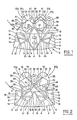
- the apparatus comprises a pelvic corset 1 essentially comprising an elastic band 2, on which are implanted four semi-rigid plates 3, 4, 5 and 6, 2 mm thick, molded in plastic material, by example in low density polyethylene, and which have a certain flexibility in deformation in all directions.
- the elastic band 2 may have a generally rectangular shape, but preferably it has the shape of a portion of circular crown of large radius, so that when the two short sides of the band 2 are placed at the end one of the 'other, the strip 2 takes the form of a frustoconical envelope having substantially the physiological shape of the lower part of the trunk, that is to say of the abdomino-pelvic girdle, that the pelvic corset 1 is intended to grip.
- the width of the strip 2 is such that it extends from the bi-trochanteric perimeter of the wearer, below, to the navel, above and forward, and at the height of the 3rd or 4th lumbar vertebra, at the top and back, that is to say at the waist.
- One of the plates 3, located in the middle of the strip 2 has the shape of an equilateral triangle whose side is equal to the posterior half-perimeter of the size of the wearer.
- This plate 3, which constitutes the posterior semi-rigid element of the corset 1 is arranged with a lower horizontal side along the posterior bi-trochanteric half-perimeter, and the opposite vertex in an upper point directed vertically upwards.
- Another plate 4 constituting the anterior semi-rigid element of the corset 1 also has an equilateral triangle shape with a side equal to that of the plate 3, but this plate 4 is implanted so as to present an upper horizontal side on the anterior half-perimeter of the waist and the opposite vertex in lower point directed vertically downwards , and this plate 4 is divided, along a vertical and median line, into two halves 4a and 4b each having the shape of a right triangle, and each located on an end portion of the strip 2, so that the two halves 4a and 4b can be joined together to reconstitute the anterior element 4 when the strip 2 is closed in an envelope around the lower part of the trunk of the wearer.
- the halves 4a and 4b carry the complementary members of a fast closing and opening device, which allows the two halves 4a and 4b to be joined together, in order to close the pelvic corset 1, or to separate from one another to open this corset.
- This device may for example comprise two pairs of tongues 9 complementary to the closure device available under the trade name "Velcro", one tongue of each pair, carrying the hooks, is fixed on the half 4a, and the other tongue of which of each pair, carrying the loops, is fixed on the half 4b, the two tabs of the upper pair being substantially one third of the width of the strip 2, from its upper edge, and the two tabs of the lower pair being substantially one third of the width of the strip 2 from its lower edge.
- This device has the advantage of allowing immediate adjustment, to the size of the wearer, of the pelvic corset 1 with opening and closing from the front which can accommodate overflows of the abdominal mass.
- the anterior element 4 is amputated at the levels of the two vertices adjacent to its upper horizontal side by two vertical cuts (one in each half 4a, 4b) while revealing triangular parts 10 and 11 of the band 2.
- the cutouts of the tops of elements 3 and 4 will allow the play of the wearer's pelvic motor in lordosis and kyphosis.
- the other two plates 5 and 6 are equal lateral and intermediate elements, in the shape of a trapezoid or substantially parallelogram, arranged symmetrically with respect to the rear elements 3 and anterior 4, and one of which 5 is interposed between the half 4a and l posterior element 3, while the other 6 is interposed between the half 4b and the posterior element 3.
- these intermediate elements 5 and 6 are practically equal to the posterior half-perimeter of the waist.
- the four elements 3, 4, 5 and 6 are not arranged directly adjacent to each other on the strip 2, but they are separated by a clearance of between 5 and 8 mm approximately, freeing strips elastic joint 12, 13, 14 and 15 which, with the triangular zones 7, 8, 10 and 11, constitute the only visible parts of the elastic band 2.
- These elastic joint bands 13 to 16 tighten against the trunk of the carrier the four elements 3 to 6, which respectively cover the sacro-coccygeal region, the pubic symphysis and the two iliac bones of the carrier, and which tend to move apart from one another under the effect of the movements of the pelvic motor of the carrier .
- the corset 1 also has clean brakes constituted by four adjustable elastic straps. Two of these straps 17 each connect one of the two parts 18 of the corset 1 to the right of the two antero-superior iliac spines, that is to say substantially at mid-height along the elastic joints 14 and 15, and to horse on these joints and on the adjacent edges of the rigid elements 4, 5 and 6 corresponding to the homo-lateral part of the two parts 19 of the corset 1 in line with the sacroiliac attachments, that is to say substantially one third height along the elastic joints 13 and 16 from the upper edge of the corset 1, and straddling these joints and on the adjacent edges of the corresponding elements 3, 5 and 6.
- the other two straps 20 each connect an attachment point 18, in line with an iliac spine, to the homo-lateral part of the two parts 21 of the corset 1 to the right of the ischia, that is to say one third of the height along the seams 13 and 16 from the lower edge, and straddling the adjacent edges of the corresponding elements 3, 5 and 6.
- the two upper straps 17 constitute brakes opposing the deformation of the pelvic corset 1 in kyphosis, by opposing the anterior play of the posterior element 3, while the two lower straps 20 constitute brakes opposing the deformation of the corset 1 in lordosis, the set of four straps 17 and 20 opposing the separation of the two intermediate lateral elements 5 and 6.
- the apparatus also comprises an upper structure constituted by two thoracic envelopes 22a and 22b, each surrounding a hemi-thorax, and symmetrical with respect to a sternal element 23, of form rectangular, arranged vertically, and also constituted by a semi-rigid plate of molded plastic.
- Each of these two envelopes 22a and 22b of generally frusto-conical shape, consists of a chain of six semi-rigid plates, also molded in plastic material, and implanted on an elastic band 24a, 24b.
- These six plates for example of low density polyethylene 2 mm thick, have the shape of equal equilateral triangles, the side of which is approximately equal to the outer edge of the scapula of the wearer, as well as to the height of the sternal element 23.
- Each chain is subdivided into two sub-assemblies each comprising three plates, which are, one, a scapular or shoulder sub-assembly having, from the inside towards the outside, a pectoral element 25, a trapezoidal element 26 and a sub-spinous element 27, and the other, an infero-lateral thoracic sub-assembly having, from the inside to the outside, a xyphoid element 28, covering the costal cartilages, an antero-thoracic element lateral 29 covering the submammary region, and a posterolateral thoracic element 30 covering the subscapular region (between the 6th and 10th rib), the regions of the axillary hollow and of the breast being free.
- the six semi-rigid elements 25 to 30 of each chain are not directly adjacent to the corresponding elastic band, but separated by pieces of band constituting elastic joints of triangular shape.
- the pectoral element 25 is connected to the upper end of the sternal element 23 by a lower and internal vertex, and is inclined by about 30 ° relative to the sternum, presenting an upper side along of the collarbone, and by being linked along its external side to the anterior side of the trapezoidal element 26 by an elastic joint 31 opening onto an angular sector of approximately 15 °.
- the trapezoidal element 26 has a vertex facing the shoulder and the opposite side facing the neck, and is connected along its posterior side to the inner and upper side of the subpinous element 27 by an elastic joint 32 , opening on an angular sector of approximately 15 °.
- the sub-spiny element 27 has a vertex directed towards the shoulder and delimited between its internal and upper side and its external and lower side, along which it is connected, by an elastic joint 33 in band, having a clearance tension of about 1 cm, on the upper and internal side of the posterior thoracic element of the inferolateral thoracic sub-assembly.
- the latter which is stretched between the sub-spiny element 27 and the pectoral element 23, is such that its three elements have one side facing the mammary region and the opposite vertex directed downwards.
- the external side of the posterolateral thoracic element 30 is connected to the external side of the anterolateral thoracic element 29 by a triangular elastic joint 34 extending over an angular sector of approximately 60 °.
- the antero-lateral thoracic element 29 is connected by its internal side to the external side of the xyphoid element 28 by a triangular elastic joint 35 extending substantially over an angular sector of 60 °.
- the xyphoid element 28 is fixed to the lower end of the sternal element 23 by its upper internal vertex and is joined by its internal side to the xyphoid element of the other hemithoracic envelope 22a or 22b.
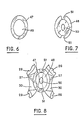
- sub-spinous elements 27 of the two hemi-thoracic envelopes 22a and 22b are connected to each other by their internal side by means of an elastic dorsal articulation 36, which will be described more precisely below in reference to Figures 6 to 8.
- the two frustoconical envelopes 22a and 22b thus connected to each other, at the front by the element common sternal 33 and at the rear by the elastic dorsal articulation 36, constitute in a way diaphragms whose opening and closing are regulated by two brakes 37 and 38 each constituted by an elastic tensioner (so as not to overload the figure 1, the tensioners 37 and 38 have only been shown on the hemi-thoracic envelope 22b, in the upper right-hand part of FIG. 1).
- One of the tensioners 37 is installed on the shoulder pad, being anchored by one of its ends 39 to the internal vertex of the pectoral element 25 and by its other end 40 to the internal and lower vertex of the element under -thorn 27, passing through a hoop 41 fixed on the center of gravity of the trapezoidal element 26.
- the other tensioner 38 is anchored by one of its ends 42 on the lower vertex of the xyphoid element 28, and by its other end 43 on the lower vertex of the posterolateral thoracic element 30, passing through an arch 44 fixed on the center of gravity of the anterolateral thoracic element 29.
- the lower structure, constituted by the pelvic corset 1, and the upper structure, constituted by the two hemi-thoracic envelopes 22a and 22b, are connected to each other by elastic organs for adjusting the dynamic balance of the 'equipment.
- These organs comprise, on the one hand, two front spring levers 45, each constituted by a hardened steel blade XC 75 40 mm wide and 0.5 mm thick, stretched between one of the two xyphoid elements 28, on which it is anchored by its upper end in the vicinity of the center of gravity of this element, and the corset 1, on which it is anchored by its lower end at the point of attachment 18 to the right of the homo-lateral iliac spine.
- These organs further comprise two latero-posterior tensioners 46, each constituted by an elastic strap anchored by its upper end to the lower vertex of a sub-spiny element 27 and by its lower end to the attachment point 18 located on corset 1 to the right of the controlateral iliac spine.
- the elastic dorsal joint 36 which is centered at the top of the dorsal column, has a generally elliptical external shape, the major axis of which extends vertically over the whole of the dorsal column, while its minor horizontal axis is approximately equal alongside the equal equilateral triangles that are the elements 25 to 30.
- This articulation comprises two elastic members of elliptical shape 47 and 48, mounted one inside the other.
- One, 47 is an elliptical ring having a large central recess 49, also of elliptical shape.
- the other, 48 is an elliptical disc having the same large and small axes as the ring 47, but having a small central orifice 50, also of elliptical shape, and two axial notches 51, each formed in one end of the major axis. towards the center, and whose depth is slightly greater than the width of the ring 47 in its parts located at the ends of its major axis, that is to say so that the ellipse passing at the bottom of the notches 51 and indicated in dotted lines (and which corresponds to the elliptical recess 49 of the ring 47) is not interrupted.
- the two notches 51 are slightly flared outward to facilitate the engagement of the disc 48 in the ring 47 and the introduction of the parts of the ring 47 located at the ends of its major axis in the notches 51 of the disc 48, and in order also to facilitate the pivoting of the disc 48 with respect to the ring 47 about their substantially common major axis.
- the posterior junction between the two frustoconical hemi-thoracic envelopes 22a and 22b is thus ensured by an elastic dorsal articulation 36, having the mechanical advantage of keeping each of the elements to be joined pinched inside two lips each formed by half of '' an elliptical elastic member, the shape of which accommodates differential deformations in all directions of the two hemi-thoracic envelopes, the central elliptical orifice 50 of the disc 48 also allowing the adjustment of the elastic clearance of the articulation 36, of which the thickness, at the junction, is limited.
- the apparatus thus described therefore comprises three composite and frustoconical envelopes, one of which, lower, encloses the pelvis as a whole, and each of the other two, upper, encloses a hemi-thorax, and these envelopes are equipped with elastic means and connected by elastic means, at least one of which is stressed and loaded by any voluntary movement of the carrier's trunk, and then tends by reaction to return the trunk to its natural position, in a vertical station.
- the spring levers 45 absorb the movements of bending the trunk forward as well as back as well as the torsional movements of the trunk from one side to the other, and are charged as accumulators of energy which tend to discharge, recalling the trunk in reverse motion.
- the tensioners 46 function in a similar manner as brakes loaded by a forward movement and opposing the forward fall of the thorax, and one of them is bandaged during torsion of the trunk and tends to return in torsion in the opposite direction.
- the tensioner 37 is loaded during a movement of the corresponding shoulder backwards, and it then tends to return the shoulder and make it descend, in particular in response to the movements of screws, which combine rotation of the trunk with an elevation of one shoulder and a lowering of the other.
- the tensioner 38 tends to tighten the rib cage and is loaded by a backward movement.
- the various components of the apparatus according to the invention which is preferably embedded in a spacesuit, between two layers of fabric for example, or integrated in a re-educational garment, can be governed according to static disorders or d '' an anteroposterior and / or lateral and / or torsional imbalance of the carrier.
- the apparatus ensures dynamic maintenance, in the event of high paralysis of the spinal column, and facilitates the transmission of tensions and movements on the pelvic motor.
- the apparatus according to the invention therefore makes it possible to provide a certain correction to positioning disorders, a certain amplification or substitution for movement disorders and displacement and / or positioning information in the event of sensitivity disorder.
Landscapes
- Health & Medical Sciences (AREA)
- Nursing (AREA)
- Orthopedic Medicine & Surgery (AREA)
- Engineering & Computer Science (AREA)
- Biomedical Technology (AREA)
- Heart & Thoracic Surgery (AREA)
- Vascular Medicine (AREA)
- Life Sciences & Earth Sciences (AREA)
- Animal Behavior & Ethology (AREA)
- General Health & Medical Sciences (AREA)
- Public Health (AREA)
- Veterinary Medicine (AREA)
- Orthopedics, Nursing, And Contraception (AREA)
- Finger-Pressure Massage (AREA)
- Buildings Adapted To Withstand Abnormal External Influences (AREA)
- Transplanting Machines (AREA)
- Measuring Pulse, Heart Rate, Blood Pressure Or Blood Flow (AREA)
- Vehicle Body Suspensions (AREA)
Claims (22)
dadurch gekennzeichnet, daß sie aus zwei Strukturen zusammengesetzt ist, nämlich
die zwei anderen halbstarren Elemente des Korsetts (1) annähernd gleiche und etwa trapezförmige Elemente sind, die jeweils eine Mittellage zwischen den ersten vorderen Elementen (4) und den hinteren Elementen (3) einnehmen,
und wobei die oberen Seiten dieser trapezförmigen Elemente in der Höhe der Taille angebracht sind und etwa den halben Umfang der Taille haben, wobei die beiden Zwischenelemente (5, 6) symmetrisch auf jeder Seite über den beiden Darmbeinstacheln liegen.
wobei eines (47) dieser Organe die Form eines elliptischen Rings mit einer großen zentralen Aussparung (49) besitzt, während das andere Organ (48) die Form einer elliptischen Scheibe mit einer kleinen zentralen Aussparung (50) besitzt und eine axiale Kerbe (51) aufweist, die sich von jedem der beiden Enden der großen Achse zum Zentrum erstrecken, wobei die Tiefe dieser axialen Kerbe geringfügig größer als die Breite des Ringes (47) in Höhe der Enden der großen Achse ist und wobei die Scheibe (48) im Eingriff mit dem Ring (47) ist und drehbar dazu befestigt ist, indem sie mit ihren Kerben (51) die Enden der großen Achse des Ringes (47) überlappen,
so daß die Innenseitender unter den Schulterblättern befindlichen Elemente (27) jeweils in einer Klemmvorrichtung gehalten sind, welche durch Zusammenwirken einer Hälfte der Scheibe (48) und einer Hälfte des Ringes (47) gebildet ist.
Priority Applications (1)
| Application Number | Priority Date | Filing Date | Title |
|---|---|---|---|
| AT85400235T ATE28788T1 (de) | 1984-02-14 | 1985-02-13 | Orthopaedische stuetzvorrichtung des rumpfes. |
Applications Claiming Priority (2)
| Application Number | Priority Date | Filing Date | Title |
|---|---|---|---|
| FR8402202 | 1984-02-14 | ||
| FR8402202A FR2559381B1 (fr) | 1984-02-14 | 1984-02-14 | Appareillage externe du tronc |
Publications (3)
| Publication Number | Publication Date |
|---|---|
| EP0153237A2 EP0153237A2 (de) | 1985-08-28 |
| EP0153237A3 EP0153237A3 (en) | 1985-09-25 |
| EP0153237B1 true EP0153237B1 (de) | 1987-08-12 |
Family
ID=9301018
Family Applications (1)
| Application Number | Title | Priority Date | Filing Date |
|---|---|---|---|
| EP85400235A Expired EP0153237B1 (de) | 1984-02-14 | 1985-02-13 | Orthopädische Stützvorrichtung des Rumpfes |
Country Status (7)
| Country | Link |
|---|---|
| US (1) | US4593697A (de) |
| EP (1) | EP0153237B1 (de) |
| JP (1) | JPS60193458A (de) |
| AT (1) | ATE28788T1 (de) |
| CA (1) | CA1250103A (de) |
| DE (1) | DE3560419D1 (de) |
| FR (1) | FR2559381B1 (de) |
Families Citing this family (11)
| Publication number | Priority date | Publication date | Assignee | Title |
|---|---|---|---|---|
| DE69229559D1 (de) * | 1991-12-24 | 1999-08-12 | Second Skin Pty Ltd | Dynamische schiene für eine stabile haltung |
| US6533739B1 (en) | 1995-11-21 | 2003-03-18 | The Penn State Research Foundation | Chest brace and method of using same |
| RU2131232C1 (ru) * | 1998-09-15 | 1999-06-10 | Аверьянов Андрей Игоревич | Комбинезон для лечения больных детским церебральным параличом и больных с последствиями черепно-мозговой травмы |
| RU2141807C1 (ru) * | 1998-09-15 | 1999-11-27 | Закрытое Акционерное Общество Научно-Производственный Центр "Огонек" | Устройство для лечения кифосколиозов |
| DE10129017C2 (de) * | 2001-06-08 | 2003-05-08 | Fraunhofer Ges Forschung | Pelottenkorsett für die Skoliosetherapie |
| RU2219812C1 (ru) * | 2002-12-19 | 2003-12-27 | Санкт-Петербургский государственный университет технологии и дизайна | Приспособление для маскировки дефектов плечевого пояса |
| US7775999B2 (en) * | 2004-10-01 | 2010-08-17 | Randall Brown | Apparatus and method for use of a hip brace |
| GB2467974B (en) * | 2009-02-24 | 2011-01-05 | Spinecorporation Ltd | Spinal Orthosis |
| BR102012032478B1 (pt) * | 2011-12-23 | 2020-10-20 | Renato Guimarães Loffi | veste baseada em tensegridade para otimização da postura e movimento humano |
| US12097139B2 (en) | 2012-09-13 | 2024-09-24 | Nancy Monden | Posture and lifting orthotic |
| US20140074003A1 (en) * | 2012-09-13 | 2014-03-13 | Nancy Monden | Posture and Lifting Orthotic |
Family Cites Families (5)
| Publication number | Priority date | Publication date | Assignee | Title |
|---|---|---|---|---|
| US2139305A (en) * | 1937-05-03 | 1938-12-06 | Friend Eusta | Corset |
| US2530132A (en) * | 1945-11-13 | 1950-11-14 | Silvain Andre | Orthopedic corset or girdle |
| US3282264A (en) * | 1964-02-03 | 1966-11-01 | S H Camp & Company | Back brace |
| US3543748A (en) * | 1967-10-20 | 1970-12-01 | John Dumergue Charters | Back support |
| FR2085624B1 (de) * | 1970-12-03 | 1973-02-02 | Lecante Pierre |
-
1984
- 1984-02-14 FR FR8402202A patent/FR2559381B1/fr not_active Expired
-
1985
- 1985-02-13 CA CA000474232A patent/CA1250103A/fr not_active Expired
- 1985-02-13 EP EP85400235A patent/EP0153237B1/de not_active Expired
- 1985-02-13 US US06/701,177 patent/US4593697A/en not_active Expired - Fee Related
- 1985-02-13 DE DE8585400235T patent/DE3560419D1/de not_active Expired
- 1985-02-13 AT AT85400235T patent/ATE28788T1/de active
- 1985-02-14 JP JP60025363A patent/JPS60193458A/ja active Granted
Also Published As
| Publication number | Publication date |
|---|---|
| JPH0450014B2 (de) | 1992-08-13 |
| FR2559381B1 (fr) | 1986-06-20 |
| JPS60193458A (ja) | 1985-10-01 |
| EP0153237A3 (en) | 1985-09-25 |
| FR2559381A1 (fr) | 1985-08-16 |
| ATE28788T1 (de) | 1987-08-15 |
| EP0153237A2 (de) | 1985-08-28 |
| CA1250103A (fr) | 1989-02-21 |
| US4593697A (en) | 1986-06-10 |
| DE3560419D1 (en) | 1987-09-17 |
Similar Documents
| Publication | Publication Date | Title |
|---|---|---|
| EP0099783B1 (de) | Aus halbfesten Teilen zusammengefügtes Hüftkorsett mit aufblasbarem Rückenkissen | |
| EP0389379B1 (de) | Orthese zur dreidimensionalen dynamischen Rückbildung einer Skoliose | |
| EP0153237B1 (de) | Orthopädische Stützvorrichtung des Rumpfes | |
| FR2552661A1 (fr) | Corset reglable pour tronc et vertebres cervicales | |
| FR2710838A1 (fr) | Corset orthopédique modulaire et réglable. | |
| EP0095396B1 (de) | Äussere Einrichtung zum aufrechten Stehen und Gehen von Personen mit motorischer Behinderung der unteren Gliedmassen | |
| EP0555154A1 (de) | Lendenstützgürtel | |
| FR2896133A1 (fr) | Doublure de casque | |
| FR2535604A1 (fr) | Appareillage externe pour handicapes moteurs d'au moins un membre superieur | |
| EP0066028A1 (de) | Äussere Einrichtung für aufrechtes Stehen und Gehen von Personen mit motorischer Behinderung der unteren Gliedmassen | |
| EP3975793B1 (de) | Mit formverstärkung versehener tragegurt | |
| FR2581859A1 (fr) | Orthese pour le maintien de l'articulation du genou | |
| FR2659547A1 (fr) | Corset orthopedique. | |
| FR2697143A1 (fr) | Sac à dos. | |
| FR2704424A1 (fr) | Orthèse cervical à appui cervico-occipital réglable. | |
| FR3020929A1 (fr) | Dispositif pour faciliter le transport dorsal d'un sac. | |
| EP3302375A1 (de) | Hilfe zur haltungsverbesserung | |
| FR2909861A1 (fr) | Dispositif orthopedique de correction de la posture par contention du tronc | |
| BE1028058B1 (fr) | Ceinture abdominale pour individu en surpoids avec poche extensible integree | |
| FR2585561A1 (fr) | Appareil d'abduction des membres superieurs | |
| WO2020128388A1 (fr) | Sac équipe d'un accessoire de répartition de charge | |
| EP3525991A1 (de) | Wearable-vorrichtung zur stützung einer last weg vom körper der person, die sie trägt | |
| FR2719764A1 (fr) | Corset pour le maintien et le redressement de la colonne vertébrale. | |
| FR3141615A1 (fr) | Dispositif de protection d’au moins une partie du corps humain | |
| WO2026002637A1 (fr) | Dispositif de soutien pour l'adaptation positionnelle d'au moins un segment d'un membre d'un utilisateur |
Legal Events
| Date | Code | Title | Description |
|---|---|---|---|
| PUAI | Public reference made under article 153(3) epc to a published international application that has entered the european phase |
Free format text: ORIGINAL CODE: 0009012 |
|
| PUAL | Search report despatched |
Free format text: ORIGINAL CODE: 0009013 |
|
| 17P | Request for examination filed |
Effective date: 19850214 |
|
| AK | Designated contracting states |
Designated state(s): AT BE CH DE GB IT LI LU NL SE |
|
| AK | Designated contracting states |
Designated state(s): AT BE CH DE GB IT LI LU NL SE |
|
| 17Q | First examination report despatched |
Effective date: 19861212 |
|
| GRAA | (expected) grant |
Free format text: ORIGINAL CODE: 0009210 |
|
| AK | Designated contracting states |
Kind code of ref document: B1 Designated state(s): AT BE CH DE GB IT LI LU NL SE |
|
| REF | Corresponds to: |
Ref document number: 28788 Country of ref document: AT Date of ref document: 19870815 Kind code of ref document: T |
|
| ITF | It: translation for a ep patent filed | ||
| REF | Corresponds to: |
Ref document number: 3560419 Country of ref document: DE Date of ref document: 19870917 |
|
| R20 | Corrections of a patent specification |
Effective date: 19871002 |
|
| PLBE | No opposition filed within time limit |
Free format text: ORIGINAL CODE: 0009261 |
|
| STAA | Information on the status of an ep patent application or granted ep patent |
Free format text: STATUS: NO OPPOSITION FILED WITHIN TIME LIMIT |
|
| 26N | No opposition filed | ||
| NLXE | Nl: other communications concerning ep-patents (part 3 heading xe) |
Free format text: ON 880706 NEW PAGES 10 AND 13 OF THE TRANSLATION OF THE PATENT SPECIFICATION HAVE BEEN RECEIVED IN CONNECTION WITH CORRECTIONS ISSUED BY THE EUROPEAN PATENT OFFICE |
|
| ITTA | It: last paid annual fee | ||
| EPTA | Lu: last paid annual fee | ||
| EAL | Se: european patent in force in sweden |
Ref document number: 85400235.9 |
|
| PGFP | Annual fee paid to national office [announced via postgrant information from national office to epo] |
Ref country code: AT Payment date: 19960125 Year of fee payment: 12 |
|
| PGFP | Annual fee paid to national office [announced via postgrant information from national office to epo] |
Ref country code: LU Payment date: 19960201 Year of fee payment: 12 |
|
| PGFP | Annual fee paid to national office [announced via postgrant information from national office to epo] |
Ref country code: GB Payment date: 19960206 Year of fee payment: 12 |
|
| PGFP | Annual fee paid to national office [announced via postgrant information from national office to epo] |
Ref country code: SE Payment date: 19960226 Year of fee payment: 12 |
|
| PGFP | Annual fee paid to national office [announced via postgrant information from national office to epo] |
Ref country code: CH Payment date: 19960227 Year of fee payment: 12 |
|
| PGFP | Annual fee paid to national office [announced via postgrant information from national office to epo] |
Ref country code: NL Payment date: 19960229 Year of fee payment: 12 |
|
| PGFP | Annual fee paid to national office [announced via postgrant information from national office to epo] |
Ref country code: BE Payment date: 19960312 Year of fee payment: 12 |
|
| PGFP | Annual fee paid to national office [announced via postgrant information from national office to epo] |
Ref country code: DE Payment date: 19960326 Year of fee payment: 12 |
|
| PG25 | Lapsed in a contracting state [announced via postgrant information from national office to epo] |
Ref country code: LU Free format text: LAPSE BECAUSE OF NON-PAYMENT OF DUE FEES Effective date: 19970213 Ref country code: GB Effective date: 19970213 Ref country code: AT Effective date: 19970213 |
|
| PG25 | Lapsed in a contracting state [announced via postgrant information from national office to epo] |
Ref country code: SE Effective date: 19970214 |
|
| PG25 | Lapsed in a contracting state [announced via postgrant information from national office to epo] |
Ref country code: LI Effective date: 19970228 Ref country code: CH Effective date: 19970228 Ref country code: BE Effective date: 19970228 |
|
| BERE | Be: lapsed |
Owner name: SALORT GUY Effective date: 19970228 |
|
| PG25 | Lapsed in a contracting state [announced via postgrant information from national office to epo] |
Ref country code: NL Effective date: 19970901 |
|
| GBPC | Gb: european patent ceased through non-payment of renewal fee |
Effective date: 19970213 |
|
| REG | Reference to a national code |
Ref country code: CH Ref legal event code: PL |
|
| PG25 | Lapsed in a contracting state [announced via postgrant information from national office to epo] |
Ref country code: DE Effective date: 19971101 |
|
| EUG | Se: european patent has lapsed |
Ref document number: 85400235.9 |
|
| NLV4 | Nl: lapsed or anulled due to non-payment of the annual fee |
Effective date: 19970901 |