EP0147554B1 - Epoxidharz-Diammoniumsalz-Emulsion und Verfahren zu ihrer Herstellung - Google Patents
Epoxidharz-Diammoniumsalz-Emulsion und Verfahren zu ihrer Herstellung Download PDFInfo
- Publication number
- EP0147554B1 EP0147554B1 EP84112493A EP84112493A EP0147554B1 EP 0147554 B1 EP0147554 B1 EP 0147554B1 EP 84112493 A EP84112493 A EP 84112493A EP 84112493 A EP84112493 A EP 84112493A EP 0147554 B1 EP0147554 B1 EP 0147554B1
- Authority
- EP
- European Patent Office
- Prior art keywords
- epoxy resin
- diammonium salt
- emulsion according
- salt emulsion
- emulsifier
- Prior art date
- Legal status (The legal status is an assumption and is not a legal conclusion. Google has not performed a legal analysis and makes no representation as to the accuracy of the status listed.)
- Expired
Links
Classifications
-
- C—CHEMISTRY; METALLURGY
- C08—ORGANIC MACROMOLECULAR COMPOUNDS; THEIR PREPARATION OR CHEMICAL WORKING-UP; COMPOSITIONS BASED THEREON
- C08J—WORKING-UP; GENERAL PROCESSES OF COMPOUNDING; AFTER-TREATMENT NOT COVERED BY SUBCLASSES C08B, C08C, C08F, C08G or C08H
- C08J3/00—Processes of treating or compounding macromolecular substances
- C08J3/02—Making solutions, dispersions, lattices or gels by other methods than by solution, emulsion or suspension polymerisation techniques
- C08J3/03—Making solutions, dispersions, lattices or gels by other methods than by solution, emulsion or suspension polymerisation techniques in aqueous media
-
- C—CHEMISTRY; METALLURGY
- C04—CEMENTS; CONCRETE; ARTIFICIAL STONE; CERAMICS; REFRACTORIES
- C04B—LIME, MAGNESIA; SLAG; CEMENTS; COMPOSITIONS THEREOF, e.g. MORTARS, CONCRETE OR LIKE BUILDING MATERIALS; ARTIFICIAL STONE; CERAMICS; REFRACTORIES; TREATMENT OF NATURAL STONE
- C04B24/00—Use of organic materials as active ingredients for mortars, concrete or artificial stone, e.g. plasticisers
- C04B24/24—Macromolecular compounds
- C04B24/28—Macromolecular compounds obtained otherwise than by reactions only involving carbon-to-carbon unsaturated bonds
- C04B24/281—Polyepoxides
-
- C—CHEMISTRY; METALLURGY
- C08—ORGANIC MACROMOLECULAR COMPOUNDS; THEIR PREPARATION OR CHEMICAL WORKING-UP; COMPOSITIONS BASED THEREON
- C08G—MACROMOLECULAR COMPOUNDS OBTAINED OTHERWISE THAN BY REACTIONS ONLY INVOLVING UNSATURATED CARBON-TO-CARBON BONDS
- C08G59/00—Polycondensates containing more than one epoxy group per molecule; Macromolecules obtained by polymerising compounds containing more than one epoxy group per molecule using curing agents or catalysts which react with the epoxy groups
- C08G59/18—Macromolecules obtained by polymerising compounds containing more than one epoxy group per molecule using curing agents or catalysts which react with the epoxy groups ; e.g. general methods of curing
- C08G59/40—Macromolecules obtained by polymerising compounds containing more than one epoxy group per molecule using curing agents or catalysts which react with the epoxy groups ; e.g. general methods of curing characterised by the curing agents used
- C08G59/50—Amines
- C08G59/5093—Complexes of amines
-
- C—CHEMISTRY; METALLURGY
- C08—ORGANIC MACROMOLECULAR COMPOUNDS; THEIR PREPARATION OR CHEMICAL WORKING-UP; COMPOSITIONS BASED THEREON
- C08J—WORKING-UP; GENERAL PROCESSES OF COMPOUNDING; AFTER-TREATMENT NOT COVERED BY SUBCLASSES C08B, C08C, C08F, C08G or C08H
- C08J2363/00—Characterised by the use of epoxy resins; Derivatives of epoxy resins
Definitions
- a plastic-containing binder is described for example in DE-B 1 198 267. It consists of a hydraulic cement, water, a resin hardenable at ordinary temperature, e.g. an epoxy resin, and a curing agent.
- the preparation of this binder is cumbersome, since two premixes have to be prepared separately from one another and may only be combined immediately before use.
- the relatively short processing time of about 1 to 2 hours is the fundamental shortcoming not only of this system, but of all so-called 2K systems (see for example DE-A 2 840 874). After each use, all tools that have come into contact with the binding agent must be thoroughly cleaned, if deposits, blockages, etc. that are difficult to remove should not occur.
- US-A 3,926,886 relates to a 1-component epoxy resin diammonium acetate or formate emulsion which consists of a liquid epoxy resin, water and a substituted diammonium salt. The hardening takes place in the presence of cement.
- the diammonium salt has a dual function in this process: on the one hand, after reaction with the alkaline cement, it should release the underlying diamine, which then hardens the epoxy resin, and on the other hand, it should perform the function of an emulsifier.
- the stability of the emulsion obtained in this way is not guaranteed, especially not when working under extreme weather conditions. It is therefore already proposed in US Pat. No. 3,926,886 to add up to 15% of a commercially available emulsifier to the mixture. However, the stability of the emulsion remains a critical parameter even after such additions.
- the amine component should therefore not, as described for example in EP-A 1-0 043 463, react with epoxy resins at elevated temperature to form adducts which are made water-soluble and dispersible by addition of acid, rather it is an emulsion to produce from a diammonium salt and an epoxy resin, in which the curing process is only initiated at temperatures above 0 ° C after the addition of an alkaline substance.
- DD-PS 135 915 describes two-component dispersions composed of a polysulfide, a polyepoxide and polyvinyl alcohol, which are used as coating agents or as a cement additive. Building materials that contain organically bound sulfur are avoided in practice due to their increased risk of corrosion with regard to steel.
- the subject of DE-A 3,222,531 are emulsions of an epoxy resin, a primary aliphatic C 12-14 alcohol and / or its adduct with ethylene oxide, water, and the salt composed of an alkylene diamine and oxalic acid.
- DE-A 3 222 528 uses the salt of a polyamine or a polyaminoamide with oxalic acid as the latent hardener.
- An object of the present invention was therefore to develop improved epoxy resin diammonium salt emulsions.
- Another object of this invention was to provide emulsions for the building sector which can be processed without problems. After all, the emulsions should not only be used in the field of renovation, but also in as many other areas of application as possible.
- Emulsions have now been found which meet these objectives. Their composition is the subject of claims 1 to 8, claim 9 relates to a manufacturing process and claims 10 to 17 different possible uses.
- emulsions in the context of this application should not only refer to the 2-phase systems which were formed by dispersing a liquid phase in another liquid phase, but also those systems in which a solid phase in is dispersed in a liquid phase and all transitions of these two systems.
- Alkylene and cyclohexylene radicals which are substituted by one to three methyl groups are particularly suitable.
- Preferred examples of formula I are 2,2,4- and / or 2,4,4-trimethylhexamethylene diamine, 2-methylpentamethylene diamine, isophorone diamine (3-aminomethyl-3, 5, 5-trimethylcyclohexylamine) and xylylenediamine.
- a preferred example of a diamine corresponding to formula II is 4,4'-diamino-3,3'-dimethyldicyclohexylmethane.
- diamond mixtures can also be used.
- the amount of diamine depends on the information provided by the epoxy resin manufacturer, e.g. the epoxy value of the epoxy resin used or the specified mixing ratio of resin and hardener.
- the suitable acids can have one or two bases, contain hydroxyl groups and have up to 12 carbon atoms. They can be saturated and also unsaturated, aliphatic, cycloaliphatic or aromatic. Formic acid, acetic acid, oxalic acid, adipic acid, tartaric acid and phthalic acid are preferred.
- the amount of water favorable for an emulsion essentially depends on the type of diamine. Diamines with a relatively small number of carbon atoms, e.g. 7, is less water than diamines with a larger number of carbon atoms, e.g. 12, required. By varying the amount of water between 30 and 250%, based on the amount of epoxy resin used, the optimal amount can easily be determined by comparative tests.
- N-vinylpyrrolidone copolymers are described in the following German patents: 2 218 935, 2 255 263, 2 456 807 and 2 514 127.
- COLLACRAL® VL a product from BASF, Ludwigshafen, is particularly suitable.
- the emulsifier is used in quantities of 0.5 to 40% based on the amount of epoxy resin.
- defoamer based on silicone or hydrocarbons, such as, for example, RD defoamer emulsion from Dow Corning, Düsseldorf, defoamer NOPCO @ from Münzing Chemie GmbH, Heilbronn, or the DEHYDRAN @ types from Henkel KGaA.
- auxiliaries such as concrete plasticizers and accelerators, can be added to the emulsions (see EP-A 0 090 434).
- plasticizers based on melamine resins e.g. MELMENTO (manufacturer: Süd Weg Kalkstickstoff-Werke AG, D-8223 Trostberg) serve to increase the flowability of mortar mixtures. Their proportion is 0.1 to 8%, based on the total weight of the emulsion.
- the function of the accelerators is to cause the epoxy resin to harden quickly and completely.
- N- and P-containing compounds are suitable, in particular tertiary amines with up to 20 C atoms and esters of phosphorous acids with up to 25 C atoms, such as e.g. N-benzyl dimethylamine and triphenyl phosphite. They are used in amounts of 2 to 5%, based on the epoxy.
- Deviations from this customary manufacturing process are possible and can be advantageous in individual cases.
- the order of adding acid and diamine can be reversed.
- the diammonium salt can also be prepared separately beforehand and then added to the mixture. It is crucial in all these cases that the pH of the mixture must be below 7, better below 6.5 when the epoxy is stirred in. On the other hand, the pH should not be below 6, as too much alkalinity will be removed from the hydraulic binder.
- stirring is continued for 0.5 to 1.0 hours. In this way, emulsions are obtained which are stable for months at room temperature. If a phase separation occurs, the mixtures can be run through. Homogenize again quickly,
- the emulsions have the property of hardening only in the presence of alkaline agents, such as inorganic bases, cement and other alkaline setting binders.
- alkaline agents such as inorganic bases, cement and other alkaline setting binders.
- hardening is usually carried out in the presence of cement
- hardening mixtures which contain alkali or alkaline earth metal hydroxides, cyclic oxide or other oxides which react in a basic manner are also suitable, for example.
- Mineral fillers such as sand, finely ground silicon dioxide and similar fillers do not impair hardening.
- the emulsions according to the present invention can be used in a wide variety of ways in the construction sector, the renovation of already existing buildings being a focal point of application.
- the emulsions are particularly suitable for use in the dry pointed concrete method (cf. DE-A 3 136 737). If, for example, vertical walls, ceilings, pipes or tunnels are to be treated with concrete, you need concrete mixtures that stick to the wall as much as possible after spraying. The present emulsions meet this requirement.
- a variable admixture of the emulsions described here to the mixing water required makes it possible to work with different plastic / cement ratios depending on the requirements of the substrate.
- the water / cement ratio is preferably 0.35 to 0.65 and the ratio of epoxy and diamine to cement is 0.035 to 0.15.
- Hardened ECC mortars are more resistant to water penetration than conventional mortars. This also applies to aqueous chemical solutions. For this reason, the emulsions are outstandingly suitable for the production of prefabricated concrete parts, e.g. Sewage pipes.
- Putties and adhesives based on hydraulically setting binders which are used, for example, in the tile sector, advantageously contain the described emulsions in amounts between 3 and 75%. Adhesion strength and processing time correspond to the values required in this area.
- An emulsion was prepared analogously to Example 1, but without the addition of defoamers.
- test specimens were manufactured, stored and subjected to a strength test.
- test specimen was made in accordance with the DIN 1164 standard manufactured and subjected to a strength test.
- An adhesive was prepared from 100 parts by weight of Portland cement 35 F and 58 parts by weight of the emulsion according to Example 18, which hardened into test specimens. After 3 days of wet storage and 4 days of storage, the following strengths were determined:
Landscapes
- Chemical & Material Sciences (AREA)
- Chemical Kinetics & Catalysis (AREA)
- Organic Chemistry (AREA)
- Health & Medical Sciences (AREA)
- Medicinal Chemistry (AREA)
- Polymers & Plastics (AREA)
- Engineering & Computer Science (AREA)
- Ceramic Engineering (AREA)
- Materials Engineering (AREA)
- Structural Engineering (AREA)
- Dispersion Chemistry (AREA)
- Epoxy Resins (AREA)
- Compositions Of Macromolecular Compounds (AREA)
- Curing Cements, Concrete, And Artificial Stone (AREA)
- Colloid Chemistry (AREA)
- Polysaccharides And Polysaccharide Derivatives (AREA)
- Adhesives Or Adhesive Processes (AREA)
Description
- Es bedurfte wahrscheinlich erst des spektakulären Zusammenbruchs eines so technisch anspruchsvollen Bauwerks wie das der Berliner Kongresshalle, dass die breite Öffentlichkeit Notiz von dem schlechten Bauzustand vieler nach dem 2. Weltkrieg errichteter Stahlbaukonstruktionen nimmt.
- Der Fachmann beobachtet schon sein einigen Jahren, dass sich der Zustand vieler erst in jüngerer Zeit fertiggestellter Bauwerke teilweise dramatisch verschlechtert. Für diesen Trend lassen sich eine Reihe von Ursachen anführen:
- 1. Während ältere Bauwerke vielfach in massiver Bauweise erstellt wurden, werden bei neueren Bauwerken aus örtlichen Gegebenheiten und wirtschaftlichen und ästhetischen Aspekten feingliedrige Konstruktionen bevorzugt.
- 2. Nicht nur die wechselnden Witterungsbedingungen (Temperaturen, Sonneneinstrahlung, Feuchtigkeit), sondern auch in zunehmendem Masse chemische Einflüsse (Streusalz, Kohlendioxid, Stickoxide, Schwefeldioxid) tragen dazu bei, dass sich die Qualität der Bausubstanz rapide verschlechtert.
- 3. Die Folgen der kombinierten physikalischen und chemischen Einwirkungen sind die Carbonatisierung des Betons, die Aufhebung der Passivierung, die Bildung von Rost und schliesslich das Abplatzen der Überdeckung.
- 4. Gleichzeitig nehmen die Belastungen zu. Brükkenkonstruktionen sind durch den Schwerlastverkehr und das zunehmende Verkehrsaufkommen einer zusätzlichen Beanspruchung ausgesetzt.
- Ein Abriss und Wiederaufbau beschädigter Bauwerke lässt sich nur in seltenen Fällen wirtschaftlich rechtfertigen. Es geht also darum, die beschädigten Bauwerke zu erhalten. Gesucht sind Verfahren, mit denen eine Sanierung durchgeführt werden kann; gesucht sind insbesondere Materialien, die für derartige Sanierungen geeignet sind. Aufgrund ihrer chemischen Verträglichkeit mit Stahl und Beton haben sich Epoxidharz-Zement-Mörtel (ECC) besonders bewährt.
- Ein kunststoffhaltiges Bindemittel wird beispielsweise in der DE-B 1 198 267 beschrieben. Es besteht aus einem hydraulischen Zement, Wasser, einem bei gewöhnlicher Temperatur härtbarten Harz, z.B. einem Epoxidharz, und einem Härtungsmittel. Die Herstellung dieses Bindemittels ist umständlich, da zwei Vormischungen getrennt voneinander hergestellt werden müssen und erst unmittelbar vor Gebrauch vereinigt werden dürfen. Die relativ kurze Verarbeitungszeit von etwa 1 bis 2 Stunden ist der grundsätzliche Mangel nicht nur dieses Systems, sondern aller sogenannter 2K-Systeme (siehe beispielsweise DE-A 2 840 874). Nach jedem Gebrauch müssen alle Arbeitsgeräte, die mit dem Bindemittel in Berührung gekommen sind, gründlich gereinigt werden, wenn es nicht zu schwer zu entfernenden Ablagerungen, Verstopfungen usw. kommen soll.
- Gegenstand der US-A 3 926 886 ist eine 1 K-Epoxidharz-Diammoniumacetat- oder -formiat-Emulsion, die aus einem flüssigen Epoxidharz, Wasser und einem substituierten Diammoniumsalz besteht. In Gegenwart von Zement findet die Härtung statt.
- Das Diammoniumsalz soll bei diesem Verfahren eine doppelte Funktion einnehmen: einmal soll es nach Reaktion mit dem alkalisch wirkenden Zement das zugrundeliegende Diamin freisetzen, das dann das Epoxidharz aushärtet, zum anderen soll es die Funktion eines Emulgators wahrnehmen. Die Stabilität der auf diese Weise erhaltenen Emulsion ist jedoch nicht gewährleistet, insbesondere dann nicht, wenn unter extremen Witterungsbedingungen gearbeitet werden muss. Daher wird bereits in der US-A 3 926 886 vorgeschlagen, der Mischung bis zu 15% eines handelsüblichen Emulgators zuzusetzen. Indessen bleibt auch nach solchen Zusätzen die Stabilität der Emulsion eine kritische Grösse.
- Die Aminkomponente soll also nicht, wie dies beispielsweise in der EP-A 1-0 043 463 beschrieben ist, mit Epoxidharzen bei erhöhter Temperatur zu Addukten reagieren, die durch Zusätze von Säure wasserlöslich und dispergierbar gemacht werden, vielmehr geht es hier darum, eine Emulsion aus einem Diammoniumsalz und einem Epoxidharz herzustellen, bei der erst nach Zusatz eines alkalisch reagierenden Stoffes der Aushärtungsprozess bei Temperaturen über 0°C eingeleitet wird.
- Der einschlägigen Patentliteratur sind zahlreiche Emulgatoren für wässriges Epoxidharz-Dispersionen zu entnehmen:
- US-A 3 879 324
- Oberflächenaktive Stoffe, wie anionische und kationische Verbindungen;
- CA-A 879 750
- Mischungen aus Nonyiphenoxypoiy-(ethoxy)i9--ethanol und Alkylpenolpolyglykolethern mit 4 bis 9 Mol angelagertem Alkylenoxid;
- DE-C 2 800 323
- Poly-(ethylenoxid)-ester von Fettsäuren;
- DE-B 1 669 772
- Anlagerungsprodukte von .25 bis 30 Molen Alkylenoxid an Abietinsäure;
- US-PS 3 020 250
- Synthetische Verbindungen, Proteine;
- DE-OS 1 925 941
- Amin-Epoxidharz-Kondensationsprodukte;
- DE-AS 2 332 165
- Mischungen aus Abietinsäurepolyglykolestern, Polyglykolethern von Fettsäuren und/oder Polyglykolethern von p-Alkylphenol und langkettiger aliphatischer Alkohole mit 8 bis 18 Kohlenstoffatomen.
- Schliesslich beschreibt die DD-PS 135 915 2K-Dispersionen aus einem Polysulfid, einem Polyepoxid und Polyvinylalkohol, die als Beschichtungsmittel oder als Zementzusatz Verwendung finden. Baumaterialien, die organisch gebundenen Schwefel enthalten, werden wegen ihrer erhöhten Korrosionsgefahr im Hinblick auf Stahl in der Praxis vermieden.
- In jüngster Zeit konnten 2 Formulierungen entwickelt werden, die denen der amerikanischen Patentschrift 3 926 886 hinsichtlich Verfügbarkeit der Aminokomponente, Stabilität der Emulsion und Anwendungsbreite eindeutig überlegen sind.
- Gegenstand der DE-A 3 222 531 sind Emulsionen, die aus einem Epoxidharz, einem primären aliphatischen C12-14-Alkohol und/oder dessen Addukt mit Ethylenoxidgruppen, Wasser und dem Salz eines Alkylendiamins und Oxalsäure bestehen.
- In der DE-A 3 222 528 wird als latenter Härter das Salz aus einem Polyamin oder einem Polyaminoamid mit Oxalsäure verwendet.
- Trotz der erzielten Verbesserungen bleibt die Stabilität der Emulsion eine kritische Grösse. Probleme treten insbesondere dann auf, wenn die Epoxidharze selbst nicht wasseremulgierbar sind. Darüber hinaus macht sich bei der Herstellung der ECC-Mörtel die Bildung von Luftporen negativ bemerkbar.
- Ein Ziel der vorliegenden Erfindung war es daher, verbesserte Epoxidharz-Diammoniumsalz-Emulsionen zu entwickeln. Ein weiteres Ziel dieser Erfindung war es, Emulsionen für den Baubereich zur Verfügung zu stellen, die problemlos verarbeitbar sind. Schliesslich sollten die Emulsionen nicht nur im Bereich der Sanierung, sondern auch in möglichst vielen anderen Anwendungsgebieten einsetzbar sein.
- Es wurden jetzt Emulsionen gefunden, die diesen Zielvorstellungen entsprechen. Ihre Zusammensetzung ist Gegenstand der Ansprüche 1 bis 8, Anspruch 9 betrifft ein Herstellverfahren und die Ansprüche 10 bis 17 verschiedene Anwendungsmöglichkeiten.
- Es war zwar bekannt, dass sich durch bestimmte Polymerzusätze, wie beispielsweise Polyvinylalkohole, die Flexibilität von Betonen bedeutend erhöhen lässt (EP-A1-0 055 035), aber es ist auch bekannt, dass Betone, die Polyvinylacetat enthalten, sich in der Praxis nicht bewährt haben. Dies liegt daran, dass es unter Einwirkung von Feuchtigkeit zu einer Verseifung des Polyvinylacetats und damit zu einer Bildung von Polyvinylalkohol kommt. Gleichzeitig verschlechtern sich die betontechnischen Eigenschaften (vgl. DE-A 3 136 737).
- Es sei ausdrücklich darauf hingewiesen, dass unter Emulsionen im Rahmen dieser Anmeldung nicht nur die 2-Phasen-Systeme gemeint sein sollen, die durch Dispersion einer flüssigen Phase in einer anderen flüssigen Phase entstanden sind, sondern auch jene Systeme, in denen eine feste Phase in einer flüssigen Phase dispergiert ist sowie alle Übergänge dieser beiden Systeme.
- Die Komponenten der Emulsionen gemäss der vorliegenden Erfindung können wie folgt näher charakterisiert werden:
- Bei den Epoxidharzen handelt es sich um flüssige Verbindungen auf Basis von 2,2-Bis-(4-hydroxyphenyl)-alkanen und Epichlorhydrin oder Glycidol. Die präzise chemische Struktur der im Handel erhältlichen Produkte, wie EUREPOXO der Fa. Schering, Berlin, ist unbekannt. Besonders geeignet sind in Wasser emulgierbare Epoxidharze, wie z.B. RÜTA-POX@ VE 2913 der Fa.. Bakelite GmbH, Duisburg.
- Der latende Härter stellt das Diammoniumsalz aus einem Diamin der Formel I oder 11 und einer organischen Säure dar. Erfindungsgemäss verwendet werden Diamine der Formeln I oder 11


- - ein gegebenenfalls substituierter Alkylenrest mit 4 bis 9 C-Atomen,
- - ein gegebenenfalls substituierter Cycloalkylenrest mit 6 bis 9 C-Atomen oder
- - ein gegebenenfalls substituierter Aralkylenrest mit 7 bis 9 C-Atomen ist.
- Insbesondere eignen sich Alkylen- und Cyclohexylenreste, die durch ein bis drei Methylgruppen substituiert sind. Bevorzugte Beispiele für Formel I sind 2,2,4- und/oder 2,4,4-Trimethylhexamethylendiamin, 2-Methylpentamethylendiamin, Isophorondiamin(3-Aminomethyl-3, 5, 5-trimethylcyclohexylamin) sowie Xylylendiamin. Bevorzugtes Beispiel für ein Diamin entsprechend Formel II ist 4,4'-Diamino--3,3'-dimethyldicyclohexylmethan. Selbstverständlich können auch Diamingemische verwendet werden. Die Menge des Diamins richtet sich nach den Angaben des Epoxidharzherstellers, z.B. dem Epoxidwert des eingesetzten Epoxidharzes oder dem angegebenen Mischungsverhältnis von Harz und Härter.
- Die geeigneten Säuren können ein- und zweibasig sein, Hydroxylgruppen enthalten und bis 12 C-Atome aufweisen. Sie können gesättigt und auch ungesättigt, aliphatisch, cycloaliphatisch oder aromatisch sein. Bevorzugt werden Ameisensäure, Essigsäure, Oxalsäure, Adipinsäure, Weinsäure und Phthalsäure.
- Die für eine Emulsion günstige Wassermenge ist im wesentlichen von der Art des Diamins abhängig. Bei Diaminen mit einer relativ kleinen Anzahl von Kohlenstoffatomen, z.B. 7, ist weniger Wasser als bei Diaminen mit einer grösseren Anzahl von Kohlenstoffatomen, z.B. 12, erforderlich. Durch Variation der Wassermenge zwischen 30 und 250%, bezogen auf die eingesetzte Menge Epoxidharz, kann die optimale Menge durch Vergleichsversuche leicht ermittelt werden.
- Als Emulgator wird verwendet:
- 1. ein durch Verseifung von Polyvinylacetat gewonnener Polyvinylalkohol mit einem Hydrolysegrad von mindestens 70% und einem Molekulargewicht von mindestens 5000, insbesondere von 10 000 bis 100 000 (siehe Römpps ChemieLexikon, 7. Auflage),
- 2. ein Polyoxazonlin mit einem Molekulargewicht von 10 000 bis 100 000, erhalten durch Polymerisation von 2-Alkyl-A2-oxazolinen, wobei die Alkylgruppe 1 bis 5 C-Atome aufweist (siehe DE-OS 3 036 119) und Angew. Chemie 78, 913 (1966),
- 3. ein Copolymerisat des N-Vinylpyrrolidons mit
- a) Vinylestern ein- oder zweibasiger Carbonsäuren mit bis zu 6 C-Atomen,
- b) (Meth)Acrylester von ein- und zweiwertigen Alkoholen mit bis zu 6 C-Atomen,
- c) Malein-, Fumar-, Crotonsäure und/oder
- d) Styrol.
- N-Vinylpyrrolidon-Copolymerisate sind in folgenden deutschen Patentschriften beschrieben: 2 218 935, 2 255 263, 2 456 807 und 2 514 127.
- Besonders geeignet ist COLLACRAL® VL, ein Produkt der Fa. BASF, Ludwigshafen.
- Der Emulgator Wird - bezogen auf die Epoxidharzmenge - in Mengen von 0,5 bis 40% eingesetzt.
- Beim Vermischen der Emulsion mit Frischbeton kann es zu unerwünschter Luftporenbildung kommen. Sie lässt sich auf einfache Weise durch Zusatz von 0,5 bis 5 Gewichtsprozent Entschäumer, bezogen auf das Gesamtgewicht der Emulsion, unterdrücken. Geeignet sind insbesondere Entschäumer auf Silicon- oder Kohlenwasserstoffbasis, wie z.B. RD Entschäumer-Emulsion der Fa. Dow Corning, Düsseldorf, Entschäumer NOPCO@ der Fa. Münzing Chemie GmbH, Heilbronn, oder die DEHYDRAN@-Typen der Fa. Henkel KGaA.
- Zusätzlich können weitere Hilfsstoffe, wie Betonverflüssigungsmittel und Beschleuniger, den Emulsionen zugesetzt werden (siehe EP-A 0 090 434).
- Betonverflüssigungsmittel auf Basis von Melaminharzen, wie z.B. MELMENTO (Hersteller: Süddeutsche Kalkstickstoff-Werke AG, D-8223 Trostberg), dienen dazu, die Fliessfähigkeit von Mörtelmischungen zu erhöhen. Ihr Anteil beträgt 0,1 bis 8%, bezogen auf das Gesamtgewicht der Emulsion.
- Die Funktion der Beschleuniger besteht darin, eine schnelle und vollständige Aushärtung des Epoxidharzes zu bewirken.
- Geeignet sind im Prinzip bekannte N-und P-haltige Verbindungen, insbesondere tertiäre Amine mit bis zu 20 C-Atomen und Ester phosphoriger Säuren mit bis zu 25 C-Atomen, wie z.B. N-Benzyl-dimethylamin und Triphenylphosphit. Sie werden in Mengen von 2 bis 5%, bezogen auf das Epoxid, eingesetzt.
- Die Herstellung der Emulsionen erfolgt zweckmässigerweise in der Weise, dass man
- - zunächst eine wässrige Lösung des Emulgators vorlegt,
- - gegebenenfalls einen Entschäumer zufügt,
- - die Säure zusetzt,
- - soviel Diamin zufügt, bis ein pH-Wert von 6 bis 6,5 erreicht ist,
- - gegebenenfalls weitere Hilfsstoffe, wie beispielsweise Betonverflüssigungsmittel und Beschleuniger, zufügt und
- - schliesslich in die erhaltene Mischung das flüssige Epoxidharz einrührt.
- Abweichungen von diesem üblichen Herstellverfahren sind möglich und können in Einzelfällen vorteilhaft sein. So kann beispielsweise die Reihenfolge der Zugabe von Säure und Diamin vetauscht werden. Man kann auch das Diammoniumsalz vorher separat herstellen und dann der Mischung zusetzen. Entscheidend ist in allen diesen Fällen, dass der pH-Wert der Mischung unter 7, besser unter 6,5 liegen muss, wenn das Epoxid eingerührt wird. Andererseits sollte der pH-Wert aber auch nicht unter 6 liegen, da sonst dem hydraulischen Bindemittel zuviel Alkalität entzogen wird. Nach beendeter Zugabe wird noch 0,5 bis 1,0 Stunden nachgerührt. Es werden so Emulsionen erhalten, die bei Raumtemperatur über Monate stabil sind. Beim Auftreten einer Phasentrennung lassen sich die Mischungen durch. erneutes Rühren schnell wieder homogenisieren,
- Die Emulsionen besitzen die Eigenschaft, erst in Gegenwart von alkalischen Agentien, wie anorganischen Basen, Zement und anderen alkalisch abbindenden Bindemitteln, auszuhärten. Zwar wird üblicherweise die Härtung in Gegenwart von Zement durchgeführt, geeignet sind jedoch beispielsweise auch Härtungsmischungen, die Alkali- oder Erdalkalihydroxide, Cylciumoxid oder andere basisch reagierende Oxide enthalten. Mineralische Füllstoffe, wie Sand, feingemahlenes Siliciumdioxid und ähnliche Füllstoffe, beeinträchtigen die Härtung nicht.
- Die Emulsionen gemäss der vorliegenden Erfindung sind in überaus vielfältiger Weise im Baubereich einsetzbar, wobei die Sanierung bereits bestehender Bauten ein Anwendungsschwerpunkt ist.
- Besonders geeignet sind die Emulsionen für den Einsatz im Trockenspitzbetonverfahren (vgl. DE-A 3 136 737). Wenn etwa senkrechte Mauern, Dekken, Rohre oder Tunnel mit Beton behandelt werden sollen, benötigt man Betonmischungen, die nach Aufspritzen möglichst quantitativ an der Mauer haften bleiben. Die vorliegenden Emulsionen erfüllen diese Forderung. Durch eine variable Zumischung der hier beschriebenen Emulsionen zu dem benötigten Anmachwasser ist es möglich, je nach Anforderung des Untergrunds mit unterschiedlichem Kunststoff/Zement-Verhältnis zu arbeiten. Vorzugsweise beträgt das Wasser/Zement-Verhältnis 0,35 bis 0,65 und das Verhältnis von Epoxid und Diamin zu Zement 0,035 bis 0,15.
- Ausgehärtete ECC-Mörtel weisen im Vergleich zu herkömmlichen Mörteln eine höhere Widerstandsfähigkeit gegenüber dem Eindringen von Wasser auf. Dies gilt auch für wässrige Chemikalienlösungen. Aus diesem Grunde eignen sich die Emulsionen in hervorragender Weise zur Herstellung von Fertigbaubetonteilen, wie z.B. Abwasserrohren.
- Spachtel- und Klebemassen auf Basis hydraulisch abbindender Bindemittel, die etwa im Fliesenbereich eingesetzt werden, enthalten vorteilsweise in Mengen zwischen 3 und 75% die beschriebenen Emulsionen. Haftfestigkeit und Verarbeitungszeit entsprechen den in diesem Bereich geforderten Werten.
- Das gleiche gilt auch für Injektionsmassen auf Basis hydraulisch abbindender Bindemittel, die zur Sanierung von Bauten aller Art verwendet werden. Auch hier kommt es auf die hohe Haftfestigkeit an.
- Schliesslich werden die Emulsionen zur Herstellung von Estrichen verwendet, insbesondere dann, wenn die Oberfläche besonderen Belastungen ausgesetzt ist.
- a) Herstellung der Emulsionen (Die Mengenangaben der Oxalsäure beziehen sich stets auf das Dihydrat.)
- In einem Standkolben mit mechanischem Rührer werden 104 Gewichtsteile Wasser, 44 Gewichtsteile einer wässrigen 10%igen Polyvinylalkohollösung (PVAL GH-20 der Fa. Nippon Synthetic Chemical Industry Co., Ltd.) und 4,5 Gewichtsteile eines siliconhaltigen Entschäumers (Entschäumer RD der Fa. Dow Corning, Düsseldorf) vorgelegt. In der erhaltenen Mischung werden 30,3 Gewichtsteile Oxalsäure gelöst und 40,6 Gewichtsteile Isophorondiamin portionsweise so langsam zugetropft, dass eine Temperaturvon 80°C nicht überschritten wird. Darauf werden bei einer Temperatur über 60°C 173 Gewichtsteile des Epoxidharzes RÜTAPOX® VE 2913 eingetragen. Man lässt das Gemisch auf Raumtemperatur abkühlen und rührt noch eine Stunde nach. Man erhält eine stabile mittelviskose Emulsion, die auch nach 3monatigem Stehenlassen bei Raumtemperatur keinerlei Veränderungen aufweist.
- Die Diamine werden in den Tabellen wie folgt abgekürzt:
- IPD = Isophorondiamin
- MPDA = 2-Methylpentamethylendiamin
- XDA = Xylylendiamin
- DDDM = 4,4-Diamino-3,3'-dimethyldicyclohexyl- methan
- TMD = Isomerengemisch aus 2,2,4- und 2,4,4-Trimethylhexamethylendiamin
- Analog zu Beispiel 1 wurde eine Emulsion hergestellt, jedoch ohne Zusatz von Entschäumer.
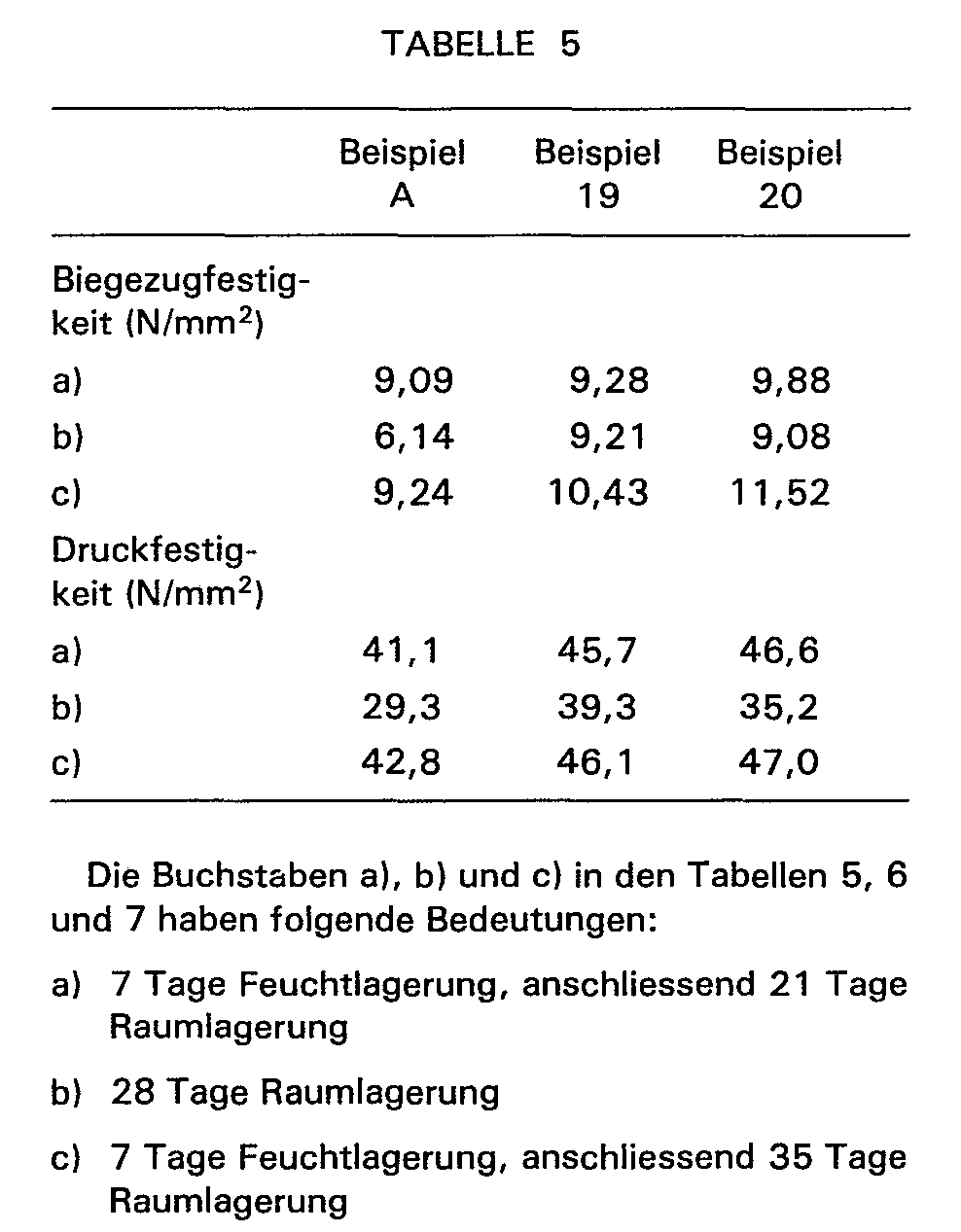
- Eine Mischung aus 100 Gewichtsteilen Portlandzement 35 F, 230 Gewichtsteilen Sand 0/1 mm und 130 Gewichtsteilen Sand 1/2 mm wurde mit 42,8 Gewichtsteiten Wasser und mit 29,6 Gewichtsteilen der Emulsion nach Beispiel 1 versetzt und gut durchgemischt. In Anlehnung an die DIN 1164 wurden Prüfkörper hergestellt, gelagert und einer Festigkeitsprüfung unterzogen.
- Analog zu Beispiel 19 wurde ein Epoxidharz-Zement-Mörtel aus
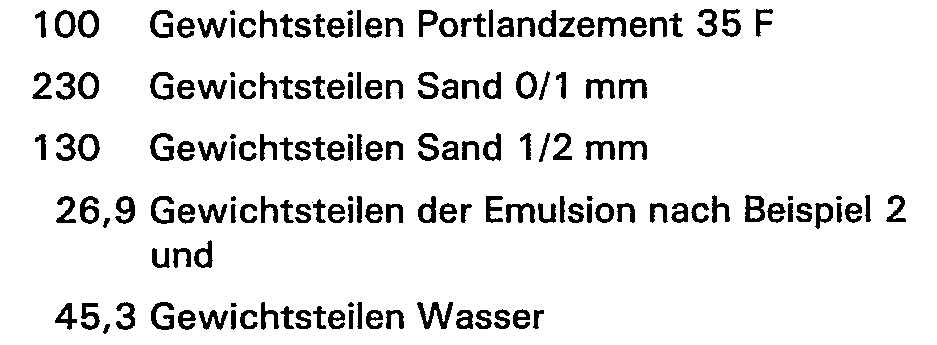
- Entsprechend der Norm DIN 1164 wurde ein Prüfkörper aus

- Analog zu Beispiel 19 wurde ein Epoxidharz-Zement-Mörtel aus

- Analog zu Beispiel 19 wurde ein Epoxidharz-Zement-Mörtel aus

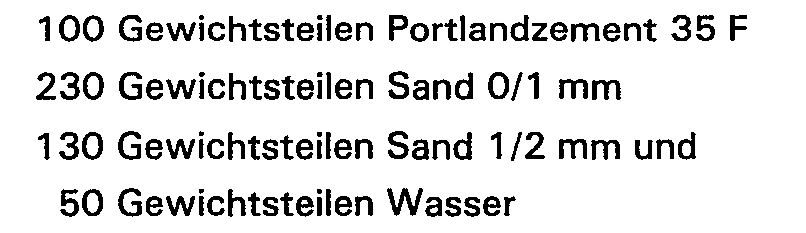
- Analog zu Vergleichsbeispiel A wurde ein Zement-mörtel aus

- Analog zu Beispiel 19 wurden folgende Epoxidharz-Zement-Mörtel-Mischungen hergestellt und geprüft:

- Aus 100 Gewichtsteilen Portlandzement 35 F und 58 Gewichtsteilen der Emulsion nach Beispiel 18 wurde eine Klebemasse hergestellt, die zu Prüfkörpern aushärteten. Nach 3 Tagen Feuchtlagerung und 4 Tagen Raumlagerung wurden folgende Festigkeiten ermittelt:


Claims (17)


ist.
Priority Applications (1)
| Application Number | Priority Date | Filing Date | Title |
|---|---|---|---|
| AT84112493T ATE29141T1 (de) | 1983-12-15 | 1984-10-17 | Epoxidharz-diammoniumsalz-emulsion und verfahren zu ihrer herstellung. |
Applications Claiming Priority (2)
| Application Number | Priority Date | Filing Date | Title |
|---|---|---|---|
| DE19833345399 DE3345399A1 (de) | 1983-12-15 | 1983-12-15 | Epoxidharz-diammoniumsalz-emulsion und verfahren zu ihrer herstellung |
| DE3345399 | 1983-12-15 |
Publications (3)
| Publication Number | Publication Date |
|---|---|
| EP0147554A2 EP0147554A2 (de) | 1985-07-10 |
| EP0147554A3 EP0147554A3 (en) | 1985-08-07 |
| EP0147554B1 true EP0147554B1 (de) | 1987-08-26 |
Family
ID=6217033
Family Applications (1)
| Application Number | Title | Priority Date | Filing Date |
|---|---|---|---|
| EP84112493A Expired EP0147554B1 (de) | 1983-12-15 | 1984-10-17 | Epoxidharz-Diammoniumsalz-Emulsion und Verfahren zu ihrer Herstellung |
Country Status (8)
| Country | Link |
|---|---|
| US (1) | US4622353A (de) |
| EP (1) | EP0147554B1 (de) |
| JP (1) | JPS60147428A (de) |
| AT (1) | ATE29141T1 (de) |
| CA (1) | CA1244565A (de) |
| DE (2) | DE3345399A1 (de) |
| FI (1) | FI78718C (de) |
| NO (1) | NO162294C (de) |
Families Citing this family (6)
| Publication number | Priority date | Publication date | Assignee | Title |
|---|---|---|---|---|
| JP2539920B2 (ja) * | 1989-08-30 | 1996-10-02 | 東洋インキ製造株式会社 | 熱硬化性水性樹脂組成物 |
| US4967839A (en) * | 1989-10-23 | 1990-11-06 | Atlantic Richfield Company | Method and composition for cementing in a wellbore |
| US5567748A (en) * | 1991-12-17 | 1996-10-22 | The Dow Chemical Company | Water compatible amine terminated resin useful for curing epoxy resins |
| KR100240737B1 (ko) * | 1992-12-21 | 2000-01-15 | 마에다나오미 | 복합재료 함유 시멘트, 시멘트 제품,성형재 콘크리트 부재 및 그의 제조방법 |
| US6975212B2 (en) * | 2001-10-02 | 2005-12-13 | Telkonet Communications, Inc. | Method and apparatus for attaching power line communications to customer premises |
| JP5642673B2 (ja) | 2008-07-10 | 2014-12-17 | セリナ・セラピユーテイツクス・インコーポレーテツド | 不活性末端基を有するポリオキサゾリン類、保護された開始基から調製されるポリオキサゾリン類及び関連化合物 |
Family Cites Families (11)
| Publication number | Priority date | Publication date | Assignee | Title |
|---|---|---|---|---|
| US3798191A (en) * | 1961-12-05 | 1974-03-19 | Epoxon Corp | Inorganic cement compositions containing epoxy resin and pozzolan |
| GB1113205A (en) * | 1965-08-02 | 1968-05-08 | James Howard Donnelly | Inorganic cement compositions |
| US3879324A (en) * | 1968-04-29 | 1975-04-22 | Robert D Timmons | Solvent-free, aqueous resin dispersion |
| US3640909A (en) * | 1969-02-17 | 1972-02-08 | Dow Chemical Co | Substituted acylated polyimine resins |
| GB1244424A (en) * | 1969-06-23 | 1971-09-02 | Albert Ag Chem Werke | Improvements in or relating to aqueous epoxy emulsions |
| US3926886A (en) * | 1974-03-27 | 1975-12-16 | Esb Inc | Epoxy resin-amine salt emulsion composition |
| US4281085A (en) * | 1978-05-12 | 1981-07-28 | Japan Synthetic Rubber Company, Ltd. | Rubber compound capable of giving a vulcanized rubber having a high modulus of elasticity |
| DE3025609A1 (de) * | 1980-07-05 | 1982-02-11 | Basf Ag, 6700 Ludwigshafen | Verfahren zur herstellung von waessrigen epoxidharzdispersionen |
| DE3222529A1 (de) * | 1982-06-16 | 1983-12-22 | Chemische Werke Hüls AG, 4370 Marl | Verfahren zur erzielung eines kraftschluessigen verbundes zwischen mit duroplasten beschichteten, lackierten gegenstaenden und beton |
| DE3222531A1 (de) * | 1982-06-16 | 1983-12-22 | Chemische Werke Hüls AG, 4370 Marl | Epoxidharz-diammoniumsalz-emulsion und verfahren zu ihrer herstellung |
| DE3222528A1 (de) * | 1982-06-16 | 1983-12-22 | Chemische Werke Hüls AG, 4370 Marl | Emulsion auf der basis epoxidharz/polyammoniumsalz und verfahren zu ihrer herstellung |
-
1983
- 1983-12-15 DE DE19833345399 patent/DE3345399A1/de not_active Withdrawn
-
1984
- 1984-10-17 EP EP84112493A patent/EP0147554B1/de not_active Expired
- 1984-10-17 AT AT84112493T patent/ATE29141T1/de not_active IP Right Cessation
- 1984-10-17 DE DE8484112493T patent/DE3465602D1/de not_active Expired
- 1984-12-10 NO NO844934A patent/NO162294C/no unknown
- 1984-12-12 FI FI844912A patent/FI78718C/fi not_active IP Right Cessation
- 1984-12-12 JP JP59261001A patent/JPS60147428A/ja active Pending
- 1984-12-14 CA CA000470130A patent/CA1244565A/en not_active Expired
- 1984-12-14 US US06/681,474 patent/US4622353A/en not_active Expired - Fee Related
Also Published As
| Publication number | Publication date |
|---|---|
| DE3345399A1 (de) | 1985-06-27 |
| NO162294B (no) | 1989-08-28 |
| FI844912L (fi) | 1985-06-16 |
| EP0147554A2 (de) | 1985-07-10 |
| NO162294C (no) | 1989-12-06 |
| ATE29141T1 (de) | 1987-09-15 |
| CA1244565A (en) | 1988-11-08 |
| FI78718C (fi) | 1989-09-11 |
| JPS60147428A (ja) | 1985-08-03 |
| DE3465602D1 (en) | 1987-10-01 |
| FI78718B (fi) | 1989-05-31 |
| NO844934L (no) | 1985-06-17 |
| EP0147554A3 (en) | 1985-08-07 |
| FI844912A0 (fi) | 1984-12-12 |
| US4622353A (en) | 1986-11-11 |
Similar Documents
| Publication | Publication Date | Title |
|---|---|---|
| DE19625853B4 (de) | Beschleunigermischung für eine spritzbare Zement enthaltende Zusammensetzung und Verfahren zum Spritzen einer Zement enthaltenden Zusammensetzung | |
| DE602004009537T2 (de) | Auf wasser basierendes epoxid-injektionsgut | |
| EP0222932A2 (de) | Verfahren zur Herstellung eines Bau- und/oder Konstruktionsmaterials; polymermodifizierte, wässrige Dispersion; und Verwendung derselben zur Herstellung eines Bau- und/oder Konstruktionsmaterials | |
| DE19513126A1 (de) | Copolymere auf Basis von Oxyalkylenglykol-Alkenylethern und ungesättigten Dicarbonsäure-Derivaten | |
| EP0147553B1 (de) | Epoxidharz-Polyammoniumsalz-Emulsion und Verfahren zu ihrer Herstellung | |
| DE2837898A1 (de) | Verfahren zur herstellung von mit synthetischen mineralfasern verstaerkten zementverbundstoffen | |
| EP0097784B1 (de) | Epoxidharz-Diammoniumsalz-Emulsion und Verfahren zu ihrer Herstellung | |
| US4655838A (en) | Cement additive composition | |
| EP0103908B1 (de) | Mit Wasser emulgierbare Epoxidharzsysteme und daraus hergestellte wässrige Emulsion sowie Verfahren zu ihrer Herstellung und Verwendung | |
| DE1594276B2 (de) | In Gegenwart von Wasser aushärtende Epoxidharz-Kleber und Ausfugmassen für Platten und Fliesen | |
| DE10150600A1 (de) | Zweikomponentiger, hydraulisch abbindender Klebemörtel | |
| EP0147554B1 (de) | Epoxidharz-Diammoniumsalz-Emulsion und Verfahren zu ihrer Herstellung | |
| DE10150601A1 (de) | Zweikomponentige Zusammensetzung zur Abdichtung von Bauwerken und Bauteilen | |
| EP0096737B1 (de) | Emulsion auf der Basis Epoxidharz/Polyammoniumsalz und Verfahren zu ihrer Herstellung | |
| EP3630697B1 (de) | Einkomponentiger epoxidharz-zement-mörtel | |
| DE2820389A1 (de) | Verfahren zur herstellung von waessrigen polyvinylalkohol-dispersionen und deren verwendung als zementzusaetze | |
| DE19757586C2 (de) | Hydraulisch härtende Zusammensetzung mit reduziertem Schwund, deren Verwendung und Verfahren zur Herstellung hydraulisch gehärteter Produkte | |
| DE1198267B (de) | Verfahren zur Herstellung eines insbesondere fuer die Bauindustrie geeigneten kunststoffhaltigen Bindemittels | |
| DE102011006286A1 (de) | Hybridbindemittel-Zusammensetzung und deren Verwendung | |
| DE2106320A1 (en) | Epoxy resin paints - consisting of aq dispersions of epoxy resins and hardeners with mixed emulsifiers | |
| EP0709350B1 (de) | Härtbare Baustoffgemische | |
| DE3345466A1 (de) | Epoxid-aminsalz-emulsion, insbesondere fuer die verwendung im bausektor und verfahren zu ihrer herstellung | |
| DE3031082A1 (de) | Verfahren zum herstellen fliessfaehiger baustoff-mischungen | |
| DE2330544A1 (de) | Verfahren zum verbinden einer masse aus hochhaltigem tonerdezement mit einer oberflaeche | |
| DE2414837A1 (de) | Beschichtungs-, spachtel- und klebemassen auf epoxidharzbasis |
Legal Events
| Date | Code | Title | Description |
|---|---|---|---|
| PUAI | Public reference made under article 153(3) epc to a published international application that has entered the european phase |
Free format text: ORIGINAL CODE: 0009012 |
|
| PUAL | Search report despatched |
Free format text: ORIGINAL CODE: 0009013 |
|
| AK | Designated contracting states |
Designated state(s): AT BE CH DE FR GB IT LI NL SE |
|
| AK | Designated contracting states |
Designated state(s): AT BE CH DE FR GB IT LI NL SE |
|
| 17P | Request for examination filed |
Effective date: 19850719 |
|
| RAP1 | Party data changed (applicant data changed or rights of an application transferred) |
Owner name: HUELS AKTIENGESELLSCHAFT |
|
| 17Q | First examination report despatched |
Effective date: 19860509 |
|
| GRAA | (expected) grant |
Free format text: ORIGINAL CODE: 0009210 |
|
| AK | Designated contracting states |
Kind code of ref document: B1 Designated state(s): AT BE CH DE FR GB IT LI NL SE |
|
| REF | Corresponds to: |
Ref document number: 29141 Country of ref document: AT Date of ref document: 19870915 Kind code of ref document: T |
|
| REF | Corresponds to: |
Ref document number: 3465602 Country of ref document: DE Date of ref document: 19871001 |
|
| ET | Fr: translation filed | ||
| ITF | It: translation for a ep patent filed | ||
| PLBE | No opposition filed within time limit |
Free format text: ORIGINAL CODE: 0009261 |
|
| STAA | Information on the status of an ep patent application or granted ep patent |
Free format text: STATUS: NO OPPOSITION FILED WITHIN TIME LIMIT |
|
| 26N | No opposition filed | ||
| PGFP | Annual fee paid to national office [announced via postgrant information from national office to epo] |
Ref country code: GB Payment date: 19901001 Year of fee payment: 7 |
|
| PGFP | Annual fee paid to national office [announced via postgrant information from national office to epo] |
Ref country code: FR Payment date: 19901010 Year of fee payment: 7 |
|
| PGFP | Annual fee paid to national office [announced via postgrant information from national office to epo] |
Ref country code: SE Payment date: 19901011 Year of fee payment: 7 |
|
| PGFP | Annual fee paid to national office [announced via postgrant information from national office to epo] |
Ref country code: CH Payment date: 19901022 Year of fee payment: 7 |
|
| ITTA | It: last paid annual fee | ||
| PGFP | Annual fee paid to national office [announced via postgrant information from national office to epo] |
Ref country code: NL Payment date: 19901031 Year of fee payment: 7 Ref country code: AT Payment date: 19901031 Year of fee payment: 7 |
|
| PGFP | Annual fee paid to national office [announced via postgrant information from national office to epo] |
Ref country code: DE Payment date: 19901102 Year of fee payment: 7 |
|
| PGFP | Annual fee paid to national office [announced via postgrant information from national office to epo] |
Ref country code: BE Payment date: 19901211 Year of fee payment: 7 |
|
| PG25 | Lapsed in a contracting state [announced via postgrant information from national office to epo] |
Ref country code: GB Effective date: 19911017 Ref country code: AT Effective date: 19911017 |
|
| PG25 | Lapsed in a contracting state [announced via postgrant information from national office to epo] |
Ref country code: SE Effective date: 19911018 |
|
| PG25 | Lapsed in a contracting state [announced via postgrant information from national office to epo] |
Ref country code: LI Effective date: 19911031 Ref country code: CH Effective date: 19911031 Ref country code: BE Effective date: 19911031 |
|
| BERE | Be: lapsed |
Owner name: HULS A.G. Effective date: 19911031 |
|
| PG25 | Lapsed in a contracting state [announced via postgrant information from national office to epo] |
Ref country code: NL Effective date: 19920501 |
|
| NLV4 | Nl: lapsed or anulled due to non-payment of the annual fee | ||
| GBPC | Gb: european patent ceased through non-payment of renewal fee | ||
| PG25 | Lapsed in a contracting state [announced via postgrant information from national office to epo] |
Ref country code: FR Effective date: 19920630 |
|
| REG | Reference to a national code |
Ref country code: CH Ref legal event code: PL |
|
| PG25 | Lapsed in a contracting state [announced via postgrant information from national office to epo] |
Ref country code: DE Effective date: 19920701 |
|
| REG | Reference to a national code |
Ref country code: FR Ref legal event code: ST |
|
| EUG | Se: european patent has lapsed |
Ref document number: 84112493.6 Effective date: 19920510 |