EP0145561B1 - Matériau fibreux pour diaphragme d'électrolyseur et diaphragme comportant un tel matériau - Google Patents
Matériau fibreux pour diaphragme d'électrolyseur et diaphragme comportant un tel matériau Download PDFInfo
- Publication number
- EP0145561B1 EP0145561B1 EP84402326A EP84402326A EP0145561B1 EP 0145561 B1 EP0145561 B1 EP 0145561B1 EP 84402326 A EP84402326 A EP 84402326A EP 84402326 A EP84402326 A EP 84402326A EP 0145561 B1 EP0145561 B1 EP 0145561B1
- Authority
- EP
- European Patent Office
- Prior art keywords
- metal
- chosen
- substitution
- potassium
- alcali
- Prior art date
- Legal status (The legal status is an assumption and is not a legal conclusion. Google has not performed a legal analysis and makes no representation as to the accuracy of the status listed.)
- Expired
Links
Classifications
-
- B—PERFORMING OPERATIONS; TRANSPORTING
- B82—NANOTECHNOLOGY
- B82Y—SPECIFIC USES OR APPLICATIONS OF NANOSTRUCTURES; MEASUREMENT OR ANALYSIS OF NANOSTRUCTURES; MANUFACTURE OR TREATMENT OF NANOSTRUCTURES
- B82Y30/00—Nanotechnology for materials or surface science, e.g. nanocomposites
-
- C—CHEMISTRY; METALLURGY
- C01—INORGANIC CHEMISTRY
- C01G—COMPOUNDS CONTAINING METALS NOT COVERED BY SUBCLASSES C01D OR C01F
- C01G23/00—Compounds of titanium
- C01G23/003—Titanates
- C01G23/005—Alkali titanates
-
- C—CHEMISTRY; METALLURGY
- C01—INORGANIC CHEMISTRY
- C01G—COMPOUNDS CONTAINING METALS NOT COVERED BY SUBCLASSES C01D OR C01F
- C01G37/00—Compounds of chromium
- C01G37/006—Compounds containing chromium, with or without oxygen or hydrogen, and containing two or more other elements
-
- C—CHEMISTRY; METALLURGY
- C01—INORGANIC CHEMISTRY
- C01G—COMPOUNDS CONTAINING METALS NOT COVERED BY SUBCLASSES C01D OR C01F
- C01G49/00—Compounds of iron
- C01G49/009—Compounds containing iron, with or without oxygen or hydrogen, and containing two or more other elements
-
- C—CHEMISTRY; METALLURGY
- C01—INORGANIC CHEMISTRY
- C01G—COMPOUNDS CONTAINING METALS NOT COVERED BY SUBCLASSES C01D OR C01F
- C01G53/00—Compounds of nickel
- C01G53/80—Compounds containing nickel, with or without oxygen or hydrogen, and containing one or more other elements
- C01G53/82—Compounds containing nickel, with or without oxygen or hydrogen, and containing two or more other elements
-
- C—CHEMISTRY; METALLURGY
- C25—ELECTROLYTIC OR ELECTROPHORETIC PROCESSES; APPARATUS THEREFOR
- C25B—ELECTROLYTIC OR ELECTROPHORETIC PROCESSES FOR THE PRODUCTION OF COMPOUNDS OR NON-METALS; APPARATUS THEREFOR
- C25B13/00—Diaphragms; Spacing elements
- C25B13/04—Diaphragms; Spacing elements characterised by the material
- C25B13/05—Diaphragms; Spacing elements characterised by the material based on inorganic materials
- C25B13/07—Diaphragms; Spacing elements characterised by the material based on inorganic materials based on ceramics
-
- C—CHEMISTRY; METALLURGY
- C01—INORGANIC CHEMISTRY
- C01P—INDEXING SCHEME RELATING TO STRUCTURAL AND PHYSICAL ASPECTS OF SOLID INORGANIC COMPOUNDS
- C01P2002/00—Crystal-structural characteristics
- C01P2002/50—Solid solutions
- C01P2002/52—Solid solutions containing elements as dopants
- C01P2002/54—Solid solutions containing elements as dopants one element only
-
- C—CHEMISTRY; METALLURGY
- C01—INORGANIC CHEMISTRY
- C01P—INDEXING SCHEME RELATING TO STRUCTURAL AND PHYSICAL ASPECTS OF SOLID INORGANIC COMPOUNDS
- C01P2002/00—Crystal-structural characteristics
- C01P2002/70—Crystal-structural characteristics defined by measured X-ray, neutron or electron diffraction data
- C01P2002/77—Crystal-structural characteristics defined by measured X-ray, neutron or electron diffraction data by unit-cell parameters, atom positions or structure diagrams
-
- C—CHEMISTRY; METALLURGY
- C01—INORGANIC CHEMISTRY
- C01P—INDEXING SCHEME RELATING TO STRUCTURAL AND PHYSICAL ASPECTS OF SOLID INORGANIC COMPOUNDS
- C01P2004/00—Particle morphology
- C01P2004/10—Particle morphology extending in one dimension, e.g. needle-like
-
- C—CHEMISTRY; METALLURGY
- C01—INORGANIC CHEMISTRY
- C01P—INDEXING SCHEME RELATING TO STRUCTURAL AND PHYSICAL ASPECTS OF SOLID INORGANIC COMPOUNDS
- C01P2004/00—Particle morphology
- C01P2004/54—Particles characterised by their aspect ratio, i.e. the ratio of sizes in the longest to the shortest dimension
-
- C—CHEMISTRY; METALLURGY
- C01—INORGANIC CHEMISTRY
- C01P—INDEXING SCHEME RELATING TO STRUCTURAL AND PHYSICAL ASPECTS OF SOLID INORGANIC COMPOUNDS
- C01P2004/00—Particle morphology
- C01P2004/60—Particles characterised by their size
- C01P2004/61—Micrometer sized, i.e. from 1-100 micrometer
-
- C—CHEMISTRY; METALLURGY
- C01—INORGANIC CHEMISTRY
- C01P—INDEXING SCHEME RELATING TO STRUCTURAL AND PHYSICAL ASPECTS OF SOLID INORGANIC COMPOUNDS
- C01P2004/00—Particle morphology
- C01P2004/60—Particles characterised by their size
- C01P2004/62—Submicrometer sized, i.e. from 0.1-1 micrometer
-
- C—CHEMISTRY; METALLURGY
- C01—INORGANIC CHEMISTRY
- C01P—INDEXING SCHEME RELATING TO STRUCTURAL AND PHYSICAL ASPECTS OF SOLID INORGANIC COMPOUNDS
- C01P2004/00—Particle morphology
- C01P2004/60—Particles characterised by their size
- C01P2004/64—Nanometer sized, i.e. from 1-100 nanometer
-
- C—CHEMISTRY; METALLURGY
- C01—INORGANIC CHEMISTRY
- C01P—INDEXING SCHEME RELATING TO STRUCTURAL AND PHYSICAL ASPECTS OF SOLID INORGANIC COMPOUNDS
- C01P2006/00—Physical properties of inorganic compounds
- C01P2006/40—Electric properties
-
- C—CHEMISTRY; METALLURGY
- C01—INORGANIC CHEMISTRY
- C01P—INDEXING SCHEME RELATING TO STRUCTURAL AND PHYSICAL ASPECTS OF SOLID INORGANIC COMPOUNDS
- C01P2006/00—Physical properties of inorganic compounds
- C01P2006/60—Optical properties, e.g. expressed in CIELAB-values
Definitions
- the invention relates to a fibrous material intended to constitute an electrolyzer diaphragm, as well as the diaphragm comprising such a material.
- each electrode being bipolar and constituting the anode of one cell and the cathode of the next cell.
- the electrolyte must be an aqueous solution with high conductivity. Saline solutions are not used because of the possible decomposition of the salt they contain, for example by anodic oxidation of the anion. Strong acid solutions raise corrosion problems.
- the ideal electrolyte is a potassium solution with a concentration between 25 and 50%, by mass.
- the electrodes must have a large surface area, be as close as possible to each other, and have a high resistance to corrosion, as well as a good activity limiting overvoltages.
- the cathode is usually made of mild steel
- the anode for which the risks of corrosion are greater, is usually made of nickel, or of steel covered with a non-porous electrolytic deposit of nickel.
- the two electrodes are made of nickel.
- the diaphragm must be very thin; however, it must have good mechanical strength.
- the pores must remain full of liquid, that is to say, not fill with gas, or become clogged; moreover the diaphragm must have a very long service life.
- fibrous potassium titanates possibly linked to polytetrafluoroethylene, for the manufacture of diaphragms.
- the subject of the present invention is a fibrous material for an electrolyzer diaphragm, using an aqueous potassium hydroxide solution as the electrolyte, characterized in that the said material corresponds to a formula derived from that of potassium octatitanate K 2 Ti 8 017, in which the titanium ions at degree of oxidation 4 are partially substituted by metal cations stable in octahedral site and of degree of oxidation less than four, the charge compensation, due to said substitution, being ensured by the introduction of alkaline ions chosen from sodium, potassium and lithium.
- M can be chosen from Mg and Ni.
- M III can be chosen from Fe, AI, Cr, Ti, Ga
- decomposable compounds or the oxides Ti0 2 , M II O and MIII 2 0 3 are in stoichiometric proportions relative to the formulas indicated above, an excess of the decomposable salt of alkali metal M i , of the order of 5%, may however be expected to compensate for losses due to volatility.
- the quantity of flux involved and the nature of it, as well as the heat treatment program make it possible to control the morphology of the fibers obtained.
- the molar ratio between the flux and the salt of the alkali metal M I can be between and 25.
- the temperature of the heat treatment also depends on the nature of the metal M II or M III .
- the decomposable salt of the alkali metal M I can be a carbonate, M 1 2 CO 3 .
- the flux can be chosen from K CI, a mixture of alkali halides and potassium molybdate.
- the temperature of the treatment is advantageously between 1000 and 1100 ° C.
- the temperature of the treatment is advantageously between 1000 and 1100 ° C.
- Cr and Mg it is advantageously between 700 and 900 ° C.
- Ti at the oxidation state 3, it will advantageously be greater than 1000 ° C.
- Ni it will advantageously be between 800 and 900 ° C.
- the pyrolysis of the mixture can be carried out in a sintered alumina crucible provided with a cover.
- the pyrolysis is preferably carried out under a controlled atmosphere.
- M III is chromium or titanium
- the atmosphere must be non-oxidizing.
- the products obtained after heat treatment are washed and dispersed in distilled water for approximately 24 hours, which makes it possible to completely eliminate the flow.
- the fibers are finally separated by filtration and dried.
- These fibers are characterized as to the nature of the phase which constitutes them by their X-ray diffraction diagram, highlighting their isomorphism with oxygenated bronze of titanium K 3 Ti 8 0 17 and with octatitanate K 2 Ti 8 O 17 .
- the monoclinic meshes of K 3 Ti 7.5 Mg 0.5 017 and K 3 Ti 7 Fe O 17 have respectively:
- K 3 Ti 8 O 17 and K 2 Ti 8 O 17 are respectively:
- These fibers are also characterized in terms of their texture by measuring their length L and their second largest dimension D.
- An intimate mixture of pulverulent products is constituted by grinding and homogenization of: the latter compound constituting the flow.
- the excess potassium carbonate K 2 C0 3 is approximately 5% compared to the stoichiometric proportions.
- the KCl / K 2 CO 3 molar ratio is 19.5.
- This mixture placed in a sintered alumina crucible, closed by a lid, is subjected to the following heat treatment: temperature rise to 800 ° C. at a speed of 200 ° C./h, maintenance at this temperature for 24 hours, cooling at the speed of 400 ° C / h.
- the product obtained weighing approximately 75 g, is dispersed and stirred in 900 to 1000 cm 3 of distilled water for 24 hours, which results in the total dissolution of the flow.
- the fibers, finally separated by filtration, are washed and dried.
- the fibers obtained are white.
- An intimate mixture of pulverulent products is constituted by grinding and homogenization of: the latter compound constituting the flow.
- the K 2 MoO 4 / K 2 CO 3 molar ratio is 3.4.
- This mixture placed in an alumina crucible, closed by a lid, is subjected to the following heat treatment: temperature rise to 500 ° C. at the speed of 300 ° C./h, maintenance of this temperature for 7.5 hours, rise to 1050 ° C ⁇ 50 ° C at the speed of 200 ° C / h, maintenance at this temperature for 15 hours, cooling at the speed of 400 ° C / h.
- the fairly pale ocher yellow fibers obtained are separated, washed and dried. They are isomorphic of K 3 Ti 8 O 17 , and of K 2 Ti 8 O 17 , their morphological characteristics have been specified above.
- the oxides Ti 0 2 , MgO and Fe 2 0 3 can be replaced by easily decomposable oxygenated compounds containing the same cations.
- oxides Ti 0 2 and M II O and Ti 0 2 and M III 2 0 3 may be replaced, at least in part, by mixed oxides of the metals thus considered, the quantities of these compounds which must comply with the formulas specified above.
- An intimate mixture of pulverulent products is constituted by grinding and homogenization of: the latter compound constituting the flux; the KCl / K 2 CO 3 molar ratio is 20.8.
- the reaction is carried out under a nitrogen sweep, in order to avoid the oxidation of the Cr 3+ ions to chromate.
- the product obtained is then washed with water, which results in the total dissolution of the flow.
- the fibers thus obtained are pale green in color and isomorphic with K 3 Ti 8 0 17 and K 2 Ti 8 017.
- An intimate mixture of pulverulent products is constituted, by grinding and homogenization of:
- the KCl / K 2 CO 3 molar ratio is 20.8.
- An intimate mixture of pulverulent products is constituted by grinding and homogenization of:
- KCI and NaCI form a solid solution whose melting point for this composition is close to 680 ° C. and play the role of flux.
- the KCI / K 2 0 molar ratio is 16.2.
- This mixture placed in an alumina nacelle, is subjected to the following heat treatment: temperature rise to 800 ° C. at the speed of 200 ° C./h, maintenance at this temperature for 48 hours, cooling at the speed of 400 ° C. / h.
- the yellow-ocher fibers obtained are then washed in order to remove the excess flux, and then dried with acetone.
- the substituted octatitanates obtained according to the invention in the form of fibers have hydrophilic properties.
- these fibers resist concentrated potash at temperatures up to 200 ° C.
- diaphragms are produced according to the usual techniques.
Landscapes
- Chemical & Material Sciences (AREA)
- Organic Chemistry (AREA)
- Engineering & Computer Science (AREA)
- Inorganic Chemistry (AREA)
- Nanotechnology (AREA)
- Materials Engineering (AREA)
- Condensed Matter Physics & Semiconductors (AREA)
- Ceramic Engineering (AREA)
- Geology (AREA)
- Composite Materials (AREA)
- Life Sciences & Earth Sciences (AREA)
- General Physics & Mathematics (AREA)
- General Life Sciences & Earth Sciences (AREA)
- Crystallography & Structural Chemistry (AREA)
- Environmental & Geological Engineering (AREA)
- Physics & Mathematics (AREA)
- Chemical Kinetics & Catalysis (AREA)
- Electrochemistry (AREA)
- Metallurgy (AREA)
- Inorganic Compounds Of Heavy Metals (AREA)
- Diaphragms For Electromechanical Transducers (AREA)
- Crystals, And After-Treatments Of Crystals (AREA)
- Artificial Filaments (AREA)
Description
- L'invention concerne un matériau fibreux destiné à constituer un diaphragme d'électrolyseur, ainsi que le diaphragme comportant un tel matériau.
- Parmi les différents procédés de stockage de l'énergie électrique actuellement utilisés, on peut citer le stockage chimique sous forme d'hydrogène, qui met en oeuvre l'électrolyse de l'eau.
- Celle-ci peut intervenir, par exemple, dans des cellules d'électrolyse montées en série, chaque électrode étant bipolaire et constituant l'anode d'une cellule et la cathode de la cellule suivante.
- L'électrolyte doit être une solution aqueuse de haute conductivité. Les solutions salines ne sont pas employées en raison de la decomposition possible du sel qu'elles contiennent, par exemple par oxydation anodique de l'anion. Les solutions d'acides forts soulèvent, elles, des problèmes de corrosion. L'électrolyte idéal est une solution de potasse de concentration comprise entre 25 et 50 %, en masse.
- Les électrodes doivent avoir une grande surface, être aussi proches que possible les unes des autres, et présenter une grande résistance à la corrosion, ainsi qu'une bonne activité limitant les surtensions. Pour des températures de fonctionnement inférieures à 100°C, la cathode est habituellement en acier doux, l'anode, pour laquelle les risques de corrosion sont plus grands, est habituellement en nickel, ou en acier recouvert d'un dépôt électrolytique non poreux de nickel. Au dessus de 100°C les deux électrodes sont en nickel.
- Le rôle du separateur, ou diaphragme, est:
- - d'empêcher les deux électrodes de se toucher
- - d'éviter qu'à l'intérieur de la cellule d'électrolyse, les bulles d'hydrogène ne viennent au contact des bulles d'oxygène.
- Il doit s'agir d'un diaphragme poreux à l'électrolyte, c'est-à-dire permettant la conduction ionique. Pour que celle-ci soit élevée, il faut que le diaphragme soit très mince; il doit avoir néanmoins une bonne résistance mécanique.
- Les pores doivent rester pleins de liquide, c'est-à-dire, ne pas se remplir de gaz, ni se boucher; de plus le diaphragme doit avoir une très longue durée de vie.
- Les électrolyseurs industriels, actuellement en fonctionnement, utilisent des séparateurs en toile d'amiante, ou en feutre de fibres d'amiante.
- L'augmentation de la densité de courant dans les électrolyseurs du type "filtre-presse" permettra d'en abaisser le coût. Dans l'objectif d'augmenter le rendement, on cherche à diminuer la chute ohmique interne, par le choix d'une température de service comprise entre 120 et 200°C. La température maximale d'utilisation normale des séparateurs à amiante classique est de 80 à 90°C, ce qui limite fortement la performance des électrolyseurs à électrodes non catalytiques: environ 1,8 volt sous une densité de courant de 0,2 A/cm2. Des essais de courtes durées ont montré qu'en opérant à 160°C, il est possible d'abaisser la tension à 1,5 V sous 0,5 A/cm2 en utilisant une technique non catalytique.
- A cette température, l'amiante ne résiste pas à la corrosion, de sorte que la stabilisation d'une telle performance nécessite la mise en oeuvre d'un matériau nouveau pour la fabrication des diaphragmes.
- A ce titre, il a été proposé d'utiliser pour la fabrication des diaphragmes des titanates de potassium fibreux, éventuellement liés à du polytétrafluoréthylène..
- Toutefois, si la résistance à la corrosion de ces matériaux dans des solutions de potasse concentrées à des températures comprises entre 120 et 160°C est nettement améliorée par rapport à l'amiante, elle n'en demeure pas moins insuffisante. Il en est de même de la stabilité thermique. C'est pourquoi la Demanderesse a effectué de nombreux essais en vue d'améliorer ces propriétés sur un matériau de ce type.
- La présente invention a pour objet un matériau fibreux pour diaphragme d'électrolyseur, utilisant comme électrolyte une solution aqueuse de potasse, caractérisé par le fait que ledit matériau répond à une formule dérivant de celle de l'octatitanate de potassium K2 Ti8 017, dans laquelle les ions titane au degré d'oxydation 4 sont substitués partiellement par des cations métalliques stables en site octaédrique et de degré d'oxydation inférieur à quatre, la compensation de charge, du fait de ladite substitution, étant assurée par l'introduction d'ions alcalins choisis parmi le sodium, le potassium et le lithium.
- Les cations de substitution, de valence 2, étant représentés par M", et MI désignant un ion alcalin choisi parmi le sodium, le potassium et le lithium, la formule du matériau conforme à l'invention est:

- avec 0 < x < 0,5
- A titre illustratif, M peut être choisi parmi Mg et Ni.
- On a pu constater que la facilité d'élaboration de ces matériaux, leur stabilité thermique et chimique et leur résistance à la corrosion s'améliorent d'autant plus que x est voisin de 0,5.
- Les cations de substitution, de valence 3, étant représentés par MIII et MI ayant la même signification que précédemment, la formule du matériau conforme à l'invention est dans ce cas:
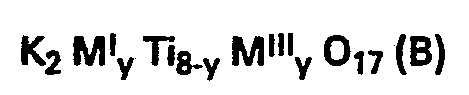
- avec0<y≤ 1
- A titre illustratif MIII peut être choisi parmi Fe, AI, Cr, Ti, Ga
- On a pu constater que la facilité d'élaboration de ces matériaux, leur stabilité thermique et chimique et leur résistance à la corrosion s'améliorent d'autant plus que y est voisin de 1.
- Les cations de substitution MII et MIII peuvent être simultanément présents dans le matériau. La formule de celui-ci est alors

- avec 0 < 2x+y ≤ 1
- Selon l'invention, ces matériaux peuvent être obtenus sous forme de fibres par pyrolyse d'un mélange intime comprenant:
- - un compose oxygène décomposable du titane, ou l'oxyde Ti02
- - un composé oxygéné décomposable du métal MII de valence 2, et/ou du métal MIII de valence 3 et/ou des oxydes correspondants MII Oet/ou MMIII 2 03
- - un sel décomposable du métal alcalin MI
- - un flux
- Les composés décomposables précités ou les oxydes Ti02, MIIO et MIII2 03 sont en proportions stoéchiométriques par rapport aux formules indiquées ci-dessus, un excès du sel décomposable de métal alcalin Mi, de l'ordre de 5 %, pouvant toutefois être prévu pour compenser les pertes par volatilité.
- La quantité de flux mise en jeu et la nature de celui-ci, ainsi que le programme de traitement thermique permettent de contrôler la morphologie des fibres obtenues.
- A titre illustratif et nullement limitatif le rapport molaire entre le flux et le sel du métal alcalin MI peut être compris entre et 25.
- La température du traitement thermique est également fonction de la nature du métal MII ou MIII.
- Le sel décomposable du métal alcalin MI peut être un carbonate, M1 2CO3.
- Le flux peut être choisi parmi K CI, un mélange d'halogénures alcalins et le molybdate de potassium.
- Si le cation de substitution est choisi parmi AI, Fe, Ga, la température du traitement est avantageusement comprise entre 1000 et 1100°C. Pour Cr et Mg, elle est avantageusement comprise entre 700 et 900°C. Pour Ti, au degré d'oxydation 3, elle sera avantageusement supérieure à 1000°C.
- Pour Ni elle sera avantageusement comprise entre 800 et 900°C.
- D'une manière, générale, plus x et y sont élevés, plus la température du traitement est élevée.
- La pyrolyse du mélange peut être effectuée dans un creuset en alumine frittée muni d'un couvercle.
- Dans certains cas, la pyrolyse est, de préférence, effectuée sous atmosphère contrôlee.
- Ainsi dans le cas où MIII est le chrome ou le titane, l'atmosphère doit être non oxydante.
- Les produits obtenus après traitement thermique sont lavés et dispersés dans de l'eau distillée pendant 24 heures environ, ce qui permet d'éliminer totalement le flux.
- Les fibres sont finalement séparées par filtration et séchées.
- Ces fibres sont caractérisées quant à la nature de la phase qui les constitue par leur diagramme de diffraction X, mettant en évidence leur isomorphie avec le bronze oxygéné de titane K3 Ti8 017 et avec l'octatitanate K2 Ti8 O17.
- A titre d'exemple, les mailles monocliniques de K3 Ti7,5 Mg0,5 017 et K3 Ti7 Fe O17 ont respectivement pour paramètres:


- Les paramètres de K3 Ti8 O17 et K2 Ti8 O17 sont respectivement:


- Ces fibres sont également caractérisées quant à leur texture par la mesure de leur longueur L et de leur seconde plus grande dimension D.
- A titre d'exemple, le tableau suivant rassemble les résultats concernant K3 Ti7,5 Mg0,5 O17 et K3 Ti7 Fe017

- D'autres caractéristiques et avantages de l'invention ressortiront de la description qui va suivre d'exemples de réalisation de matériaux utilisables conformément à l'invention pour la fabrication de diaphragmes d'électrolyseur.
- Obtention de K3 Ti7,5 Mg0,5 O17 sous forme fibreuse; ce composé correspond à la formule (A) précitée dans laquelle:

- Un mélange intime de produits pulvérulents est constitué par broyage et homogénéisation de:

- Ce mélange, placé dans un creuset d'alumine frittée, fermé par un couvercle, est soumis au traitement thermique suivant: montée en température à 800°C à la vitesse de 200°C/h, maintien à cette température pendant 24 heures, refroidissement à la vitesse de 400° C/h.
- Le produit obtenu, pesant 75 g environ, est dispersé et agité dans 900 à 1000 cm3 d'eau distillée pendant 24 heures, ce qui entraîne la dissolution totale du flux. Les fibres, finalement séparées par filtration, sont lavées et séchées. Les fibres obtenues sont blanches.
- Les caractéristiques morphologiques des fibres ainsi préparées ont été précisées ci-dessus.
- Obtention de K3 Til7 FeO17 sous forme fibreuse; ce composé correspond à la formule (B) précitée dans laquelle:

- Un mélange intime de produits pulvérulents est constitué par broyage et homogénéisation de:

- Ce mélange, placé dans un creuset d'alumine, fermé par un couvercle, est soumis au traitement thermique suivant: montée en température à 500°C à la vitesse de 300°C/h, maintien de cette température pendant 7,5 heures, montée à 1050°C ± 50° C à la vitesse de 200° C/h, maintien à cette température pendant 15 heures, refroidissement à la vitesse de 400° C/h.
- Les fibres obtenues de couleur jaune ocre assez pâle, sont séparées, lavées, séchées. Elles sont isomorphes de K3 Ti8 O17, et de K2 Ti8 O17, leurs caractéristiques morphologiques ont été précisées ci-dessus.
- Dans les exemples décrits ci-dessus les oxydes Ti 02, MgO et Fe2 03 peuvent être remplacés par des composés oxygénés facilement décomposables contenant les mêmes cations.
- Par ailleurs, d'une manière générale, les oxydes Ti 02 et MIIO et Ti 02 et MIII2 03 peuvent être remplacés, au moins en partie, par des oxydes mixtes des métaux ainsi considérés, les quantités de ces composés devant respecter les formules précisées ci-dessus.
- Obtention de K3 Til7 CrO17 sous forme fibreuse; ce composé correspond à la formule B précitée dans laquelle:

- Un mélange intime de produits pulvérulents est constitué par broyage et homogénéisation de:

- L'excès de K2CO3 est d'environ 5 % par rapport aux proportions stoechiométriques. Ce mélange, placé dans une nacelle d'alumine, est soumis au traitement thermique suivant: montée à la température de 700° C à la vitesse de 200° C/h, maintien à cette température pendant 70 heures, refroidissement à la vitesse de 400° C/h.
- La réaction se fait sous balayage d'azote, afin d'éviter l'oxydation des ions Cr3+ en chromate.
- Le produit obtenu est ensuite lavé à l'eau, ce qui entraîne la dissolution totale du flux.
- Les fibres ainsi obtenues sont de couleur vert-pâle et isomorphes de K3 Ti8 017 et de K2 Ti8 017.
- Obtention de K3 Ti7,5 Nio,5 017 sous forme fibreuse; ce composé correspond à la formule A, précitée dans laquelle:

- Un mélange intime de produits pulvérulents est constitué, par broyage et homogénéisation de:

- Le rapport molaire KCl/K2CO3 est de 20,8.
- L'excès de K2CO3 est environ 5 % par rapport aux proportions stoechiométriques.
- Ce mélange, placé dans un nacelle d'alumine, est soumis à un traitement thermique identique à celui de l'exemple n° 1.
- Obtention de K2NaTi7FeO17 sous forme fibreuse; ce composé correspond à la formule B précitée dans laquelle:

- Un mélange intime de produits pulvérulents est constitué par broyage et homogénéisation de:

- KCI et NaCI forment une solution solide dont le point de fusion pour cette composition est voisin de 680° C et jouent le rôle de flux.
- Le rapport molaire KCI/K20 est de 16,2.
- L'excès de carbonates de potassium et de sodium est d'environ 5 % par rapport aux proportions stoechiométriques.
- Ce mélange, placé dans une nacelle en alumine, est soumis au traitement thermique suivant: montée en température à 800°C à la vitesse de 200°C/h, maintien à cette températuré pendant 48 heures, refroidissement à la vitesse de 400° C/h.
- Les fibres obtenues de couleur jaune-ocre sont ensuite lavées afin d'éliminer l'excédent de flux, puis séchées avec de l'acétone.
- Les octatitanates substitués, obtenus selon l'invention sous forme de fibres, présentent des propriétés hydrophiles. Par ailleurs, ces fibres résistent à la potasse concentrée à des températures pouvant atteindre 200° C.
- A partir de ces fibres, on réalise des diaphragmes selon les techniques usuelles.
- On peut en particulier, en vue de cette réalisation, mélanger ces fibres à du polytétrafluoréthylène en présence d'un agent floculant, le mélange étant soumis ensuite à des opérations de malaxage, calandrage et pliage.
- Bien entendu l'invention n'est nullement limitée aux modes d'exécution décrits qui n'ont été donnés qu'à titre d'exemples.
puis l'élimination dudit flux.
Claims (21)


puis l'élimination dudit flux.
Priority Applications (1)
| Application Number | Priority Date | Filing Date | Title |
|---|---|---|---|
| AT84402326T ATE31944T1 (de) | 1983-11-18 | 1984-11-15 | Faseriger stoff fuer elektrolyseurdiaphragma und einen solchen stoff enthaltendes diaphragma. |
Applications Claiming Priority (2)
| Application Number | Priority Date | Filing Date | Title |
|---|---|---|---|
| FR8318380 | 1983-11-18 | ||
| FR8318380A FR2555207B1 (fr) | 1983-11-18 | 1983-11-18 | Materiau fibreux pour diaphragme d'electrolyseur et diaphragme comportant un tel materiau |
Publications (3)
| Publication Number | Publication Date |
|---|---|
| EP0145561A2 EP0145561A2 (fr) | 1985-06-19 |
| EP0145561A3 EP0145561A3 (en) | 1985-07-03 |
| EP0145561B1 true EP0145561B1 (fr) | 1988-01-13 |
Family
ID=9294277
Family Applications (1)
| Application Number | Title | Priority Date | Filing Date |
|---|---|---|---|
| EP84402326A Expired EP0145561B1 (fr) | 1983-11-18 | 1984-11-15 | Matériau fibreux pour diaphragme d'électrolyseur et diaphragme comportant un tel matériau |
Country Status (6)
| Country | Link |
|---|---|
| EP (1) | EP0145561B1 (fr) |
| JP (1) | JPS61500445A (fr) |
| AT (1) | ATE31944T1 (fr) |
| DE (1) | DE3468703D1 (fr) |
| FR (1) | FR2555207B1 (fr) |
| WO (1) | WO1985002208A1 (fr) |
Families Citing this family (2)
| Publication number | Priority date | Publication date | Assignee | Title |
|---|---|---|---|---|
| FR2650843B1 (fr) * | 1989-08-10 | 1992-01-17 | Rhone Poulenc Chimie | Diaphragme, association d'un tel diaphragme a un element cathodique et leur procede d'obtention |
| CN105056874B (zh) * | 2015-07-15 | 2018-02-27 | 江苏大学 | 一种八钛酸钾晶须的制备方法及其用途 |
Family Cites Families (6)
| Publication number | Priority date | Publication date | Assignee | Title |
|---|---|---|---|---|
| BE788293A (fr) * | 1971-09-17 | 1973-03-01 | Pall Corp | Produits microporeux permeables contenant du titanate de potassium et procede de fabrication |
| JPS52127479A (en) * | 1976-04-20 | 1977-10-26 | Agency Of Ind Science & Technol | Chemical resistant diaphragm and its preparation |
| JPS5419240A (en) * | 1977-07-13 | 1979-02-13 | Takasago Thermal Eng Co Lts | Heating method of heat source water in heat accumulating water tank |
| JPS5567527A (en) * | 1978-11-08 | 1980-05-21 | Kyushu Refract Co Ltd | Potassium titanate hydrate fiber and production thereof |
| JPS5638489A (en) * | 1979-09-07 | 1981-04-13 | Sutemi Negishi | Potassium titanate fiber diaphragm |
| DE2938123A1 (de) * | 1979-09-20 | 1981-04-09 | Siemens AG, 1000 Berlin und 8000 München | Diaphragmen fuer elektrochemische zellen und deren herstellung |
-
1983
- 1983-11-18 FR FR8318380A patent/FR2555207B1/fr not_active Expired
-
1984
- 1984-11-15 AT AT84402326T patent/ATE31944T1/de not_active IP Right Cessation
- 1984-11-15 JP JP59504194A patent/JPS61500445A/ja active Pending
- 1984-11-15 EP EP84402326A patent/EP0145561B1/fr not_active Expired
- 1984-11-15 DE DE8484402326T patent/DE3468703D1/de not_active Expired
- 1984-11-15 WO PCT/FR1984/000263 patent/WO1985002208A1/fr not_active Ceased
Also Published As
| Publication number | Publication date |
|---|---|
| DE3468703D1 (en) | 1988-02-18 |
| FR2555207A1 (fr) | 1985-05-24 |
| WO1985002208A1 (fr) | 1985-05-23 |
| EP0145561A2 (fr) | 1985-06-19 |
| ATE31944T1 (de) | 1988-01-15 |
| FR2555207B1 (fr) | 1986-02-21 |
| JPS61500445A (ja) | 1986-03-13 |
| EP0145561A3 (en) | 1985-07-03 |
Similar Documents
| Publication | Publication Date | Title |
|---|---|---|
| EP2555308B1 (fr) | Batterie au lithium à l'état entièrement solide | |
| FI93683B (fi) | Menetelmä liukenemisen vähentämiseksi ja siinä käytettävä elektrolyytti | |
| RU2519840C2 (ru) | Способ получения титаната лития | |
| US7820339B2 (en) | Gas diffusion electrode for electrochemical oxygen reduction | |
| Mohandas et al. | Electrochemical deoxidation of solid zirconium dioxide in molten calcium chloride | |
| EP2683478A1 (fr) | Nouveau matériau fluoré utilisable comme matière active d'électrode | |
| KR101162538B1 (ko) | 금속재질의 양극덮개를 포함하는 전해환원장치 및 이를 이용한 전해환원 방법 | |
| FR2666803A1 (fr) | Compositions solides vitreuses a base de li3po4 et lipo3, et piles electrochimiques utilisant ces compositions. | |
| CA2178420A1 (fr) | Cellule alcaline a base de dioxyde de manganese | |
| EP0448517B1 (fr) | Anodes pour piles contenant des cellules à combustible au carbonate | |
| EP0145561A2 (fr) | Matériau fibreux pour diaphragme d'électrolyseur et diaphragme comportant un tel matériau | |
| FR2494307A1 (fr) | Procede d'electrolyse d'une saumure d'un chlorure de metal alcalin dans une cuve a membrane permionique | |
| SK10552003A3 (sk) | Materiál vhodný na použitie ako aktívny anódový povrch v článku na elektrolytickú redukciu oxidu hlinitého na hliník | |
| FR2572590A1 (fr) | Pile secondaire au lithium | |
| RU2187578C2 (ru) | Биполярная пластина для электролизеров типа фильтр-пресс | |
| EP0027076A1 (fr) | Pile lithium - bioxyde de manganèse et procédé de réalisation d'une telle pile | |
| FR2518583A1 (fr) | Electrode recouverte d'un catalyseur presentant une faible surtension pour le degagement de l'oxygene utilisable notamment pour l'electrolyse de l'eau en milieu alcalin et procede pour sa preparation | |
| KR20240091549A (ko) | 물에 대한 안정성과 이온 전도성이 우수한 고체 전해질 조성물 및 이의 제조방법 | |
| JP2008153196A (ja) | アルカリ電池 | |
| FR2484712A1 (fr) | Piles au lithium secondaires et leur procede de fabrication | |
| KR102605098B1 (ko) | 복합 고체 전해질, 이를 포함하는 열전지 및 이의 제조방법 | |
| CH642777A5 (fr) | Composition de sels fondus utilisable comme electrolyte anodique dans les accumulateurs a alumine alcaline et electrode negative de metal alcalin. | |
| FR3110028A1 (fr) | Particule peu dense revêtue et son utilisation comme électrolyte dans des batteries | |
| FR2493879A1 (fr) | Composition de metal pour electrode inerte et son utilisation | |
| EP1568801A1 (fr) | Electrode à diffusion gazeuse, dispositif et procédé de production de peroxyde d'hydrogène |
Legal Events
| Date | Code | Title | Description |
|---|---|---|---|
| PUAI | Public reference made under article 153(3) epc to a published international application that has entered the european phase |
Free format text: ORIGINAL CODE: 0009012 |
|
| PUAL | Search report despatched |
Free format text: ORIGINAL CODE: 0009013 |
|
| AK | Designated contracting states |
Designated state(s): AT BE CH DE FR GB IT LI LU NL SE |
|
| AK | Designated contracting states |
Designated state(s): AT BE CH DE FR GB IT LI LU NL SE |
|
| RAP1 | Party data changed (applicant data changed or rights of an application transferred) |
Owner name: ETABLISSEMENT PUBLIC DIT: CENTRE NATIONAL DE LA Owner name: ALSTHOM |
|
| 17P | Request for examination filed |
Effective date: 19860102 |
|
| RAP1 | Party data changed (applicant data changed or rights of an application transferred) |
Owner name: ETABLISSEMENT PUBLIC DIT: CENTRE NATIONAL DE LA Owner name: ALSTHOM |
|
| 17Q | First examination report despatched |
Effective date: 19870127 |
|
| GRAA | (expected) grant |
Free format text: ORIGINAL CODE: 0009210 |
|
| AK | Designated contracting states |
Kind code of ref document: B1 Designated state(s): AT BE CH DE FR GB IT LI LU NL SE |
|
| REF | Corresponds to: |
Ref document number: 31944 Country of ref document: AT Date of ref document: 19880115 Kind code of ref document: T |
|
| REF | Corresponds to: |
Ref document number: 3468703 Country of ref document: DE Date of ref document: 19880218 |
|
| ITF | It: translation for a ep patent filed | ||
| GBT | Gb: translation of ep patent filed (gb section 77(6)(a)/1977) | ||
| PLBE | No opposition filed within time limit |
Free format text: ORIGINAL CODE: 0009261 |
|
| STAA | Information on the status of an ep patent application or granted ep patent |
Free format text: STATUS: NO OPPOSITION FILED WITHIN TIME LIMIT |
|
| PG25 | Lapsed in a contracting state [announced via postgrant information from national office to epo] |
Ref country code: LU Free format text: LAPSE BECAUSE OF NON-PAYMENT OF DUE FEES Effective date: 19881130 |
|
| 26N | No opposition filed | ||
| PGFP | Annual fee paid to national office [announced via postgrant information from national office to epo] |
Ref country code: CH Payment date: 19900921 Year of fee payment: 7 |
|
| PGFP | Annual fee paid to national office [announced via postgrant information from national office to epo] |
Ref country code: LU Payment date: 19901005 Year of fee payment: 7 |
|
| PGFP | Annual fee paid to national office [announced via postgrant information from national office to epo] |
Ref country code: AT Payment date: 19901115 Year of fee payment: 7 |
|
| PGFP | Annual fee paid to national office [announced via postgrant information from national office to epo] |
Ref country code: NL Payment date: 19901130 Year of fee payment: 7 |
|
| PG25 | Lapsed in a contracting state [announced via postgrant information from national office to epo] |
Ref country code: AT Effective date: 19911115 |
|
| PG25 | Lapsed in a contracting state [announced via postgrant information from national office to epo] |
Ref country code: LI Effective date: 19911130 Ref country code: CH Effective date: 19911130 |
|
| PG25 | Lapsed in a contracting state [announced via postgrant information from national office to epo] |
Ref country code: NL Effective date: 19920601 |
|
| NLV4 | Nl: lapsed or anulled due to non-payment of the annual fee | ||
| REG | Reference to a national code |
Ref country code: CH Ref legal event code: PL |
|
| PGFP | Annual fee paid to national office [announced via postgrant information from national office to epo] |
Ref country code: SE Payment date: 19920923 Year of fee payment: 9 |
|
| PGFP | Annual fee paid to national office [announced via postgrant information from national office to epo] |
Ref country code: BE Payment date: 19921001 Year of fee payment: 9 |
|
| ITTA | It: last paid annual fee | ||
| PGFP | Annual fee paid to national office [announced via postgrant information from national office to epo] |
Ref country code: DE Payment date: 19930922 Year of fee payment: 10 |
|
| PGFP | Annual fee paid to national office [announced via postgrant information from national office to epo] |
Ref country code: GB Payment date: 19931022 Year of fee payment: 10 |
|
| PG25 | Lapsed in a contracting state [announced via postgrant information from national office to epo] |
Ref country code: SE Effective date: 19931116 |
|
| PG25 | Lapsed in a contracting state [announced via postgrant information from national office to epo] |
Ref country code: BE Effective date: 19931130 |
|
| BERE | Be: lapsed |
Owner name: CENTRE NATIONAL DE LA RECHERCHE SCIENTIFIQUE CNRS Effective date: 19931130 Owner name: ALSTHOM Effective date: 19931130 |
|
| PGFP | Annual fee paid to national office [announced via postgrant information from national office to epo] |
Ref country code: FR Payment date: 19940929 Year of fee payment: 11 |
|
| PG25 | Lapsed in a contracting state [announced via postgrant information from national office to epo] |
Ref country code: GB Effective date: 19941115 |
|
| EUG | Se: european patent has lapsed |
Ref document number: 84402326.7 Effective date: 19940610 |
|
| GBPC | Gb: european patent ceased through non-payment of renewal fee |
Effective date: 19941115 |
|
| PG25 | Lapsed in a contracting state [announced via postgrant information from national office to epo] |
Ref country code: DE Effective date: 19950801 |
|
| PG25 | Lapsed in a contracting state [announced via postgrant information from national office to epo] |
Ref country code: FR Effective date: 19960731 |
|
| REG | Reference to a national code |
Ref country code: FR Ref legal event code: ST |