EP0144796A2 - Herbizide Mittel - Google Patents
Herbizide Mittel Download PDFInfo
- Publication number
- EP0144796A2 EP0144796A2 EP84113518A EP84113518A EP0144796A2 EP 0144796 A2 EP0144796 A2 EP 0144796A2 EP 84113518 A EP84113518 A EP 84113518A EP 84113518 A EP84113518 A EP 84113518A EP 0144796 A2 EP0144796 A2 EP 0144796A2
- Authority
- EP
- European Patent Office
- Prior art keywords
- formula
- compound
- component
- alkyl
- compositions according
- Prior art date
- Legal status (The legal status is an assumption and is not a legal conclusion. Google has not performed a legal analysis and makes no representation as to the accuracy of the status listed.)
- Granted
Links
- 239000004009 herbicide Substances 0.000 title claims description 6
- 150000001875 compounds Chemical class 0.000 claims abstract description 33
- 239000000203 mixture Substances 0.000 claims abstract description 25
- -1 alkali metal cation Chemical class 0.000 claims abstract description 16
- 230000002363 herbicidal effect Effects 0.000 claims abstract description 13
- WKBOTKDWSSQWDR-UHFFFAOYSA-N Bromine atom Chemical group [Br] WKBOTKDWSSQWDR-UHFFFAOYSA-N 0.000 claims abstract description 9
- 125000004209 (C1-C8) alkyl group Chemical group 0.000 claims abstract description 8
- 150000001768 cations Chemical class 0.000 claims abstract description 8
- GDTBXPJZTBHREO-UHFFFAOYSA-N bromine Chemical group BrBr GDTBXPJZTBHREO-UHFFFAOYSA-N 0.000 claims abstract description 7
- 229910052794 bromium Chemical group 0.000 claims abstract description 7
- 239000000460 chlorine Substances 0.000 claims abstract description 6
- 229910052801 chlorine Inorganic materials 0.000 claims abstract description 6
- ZAMOUSCENKQFHK-UHFFFAOYSA-N Chlorine atom Chemical compound [Cl] ZAMOUSCENKQFHK-UHFFFAOYSA-N 0.000 claims abstract description 5
- 229910052740 iodine Inorganic materials 0.000 claims abstract description 5
- ZCYVEMRRCGMTRW-UHFFFAOYSA-N 7553-56-2 Chemical compound [I] ZCYVEMRRCGMTRW-UHFFFAOYSA-N 0.000 claims abstract description 4
- 229910052783 alkali metal Inorganic materials 0.000 claims abstract description 4
- 239000011630 iodine Substances 0.000 claims abstract description 4
- 125000001309 chloro group Chemical group Cl* 0.000 claims abstract description 3
- 238000002156 mixing Methods 0.000 claims description 4
- 125000002347 octyl group Chemical group [H]C([*])([H])C([H])([H])C([H])([H])C([H])([H])C([H])([H])C([H])([H])C([H])([H])C([H])([H])[H] 0.000 claims description 4
- 125000004178 (C1-C4) alkyl group Chemical group 0.000 claims description 3
- 239000003795 chemical substances by application Substances 0.000 claims description 3
- 125000006650 (C2-C4) alkynyl group Chemical group 0.000 claims description 2
- 238000000034 method Methods 0.000 claims description 2
- BACHBFVBHLGWSL-UHFFFAOYSA-N methyl 2-[4-(2,4-dichlorophenoxy)phenoxy]propanoate Chemical compound C1=CC(OC(C)C(=O)OC)=CC=C1OC1=CC=C(Cl)C=C1Cl BACHBFVBHLGWSL-UHFFFAOYSA-N 0.000 claims description 2
- 230000008635 plant growth Effects 0.000 claims 1
- 244000045561 useful plants Species 0.000 claims 1
- 125000000217 alkyl group Chemical group 0.000 abstract description 3
- 125000000304 alkynyl group Chemical group 0.000 abstract 1
- 239000004480 active ingredient Substances 0.000 description 16
- 241000196324 Embryophyta Species 0.000 description 9
- 238000009472 formulation Methods 0.000 description 9
- 239000004495 emulsifiable concentrate Substances 0.000 description 6
- 239000003995 emulsifying agent Substances 0.000 description 5
- 239000008187 granular material Substances 0.000 description 5
- 239000000843 powder Substances 0.000 description 5
- DGAQECJNVWCQMB-PUAWFVPOSA-M Ilexoside XXIX Chemical compound C[C@@H]1CC[C@@]2(CC[C@@]3(C(=CC[C@H]4[C@]3(CC[C@@H]5[C@@]4(CC[C@@H](C5(C)C)OS(=O)(=O)[O-])C)C)[C@@H]2[C@]1(C)O)C)C(=O)O[C@H]6[C@@H]([C@H]([C@@H]([C@H](O6)CO)O)O)O.[Na+] DGAQECJNVWCQMB-PUAWFVPOSA-M 0.000 description 4
- 239000002253 acid Substances 0.000 description 4
- 230000000694 effects Effects 0.000 description 4
- 229910052708 sodium Inorganic materials 0.000 description 4
- 239000011734 sodium Substances 0.000 description 4
- 239000000243 solution Substances 0.000 description 4
- 239000000126 substance Substances 0.000 description 4
- 230000002195 synergetic effect Effects 0.000 description 4
- 241001621841 Alopecurus myosuroides Species 0.000 description 3
- 241000209764 Avena fatua Species 0.000 description 3
- 235000007320 Avena fatua Nutrition 0.000 description 3
- 240000006122 Chenopodium album Species 0.000 description 3
- 235000009344 Chenopodium album Nutrition 0.000 description 3
- ZMXDDKWLCZADIW-UHFFFAOYSA-N N,N-Dimethylformamide Chemical compound CN(C)C=O ZMXDDKWLCZADIW-UHFFFAOYSA-N 0.000 description 3
- 240000006694 Stellaria media Species 0.000 description 3
- 239000012141 concentrate Substances 0.000 description 3
- 239000002270 dispersing agent Substances 0.000 description 3
- 239000006185 dispersion Substances 0.000 description 3
- 238000002360 preparation method Methods 0.000 description 3
- XLYOFNOQVPJJNP-UHFFFAOYSA-N water Substances O XLYOFNOQVPJJNP-UHFFFAOYSA-N 0.000 description 3
- 239000000080 wetting agent Substances 0.000 description 3
- LRHPLDYGYMQRHN-UHFFFAOYSA-N N-Butanol Chemical compound CCCCO LRHPLDYGYMQRHN-UHFFFAOYSA-N 0.000 description 2
- VYPSYNLAJGMNEJ-UHFFFAOYSA-N Silicium dioxide Chemical compound O=[Si]=O VYPSYNLAJGMNEJ-UHFFFAOYSA-N 0.000 description 2
- 241000209140 Triticum Species 0.000 description 2
- 235000021307 Triticum Nutrition 0.000 description 2
- 239000000853 adhesive Substances 0.000 description 2
- 230000001070 adhesive effect Effects 0.000 description 2
- 239000000969 carrier Substances 0.000 description 2
- 235000013339 cereals Nutrition 0.000 description 2
- 239000007859 condensation product Substances 0.000 description 2
- JHIVVAPYMSGYDF-UHFFFAOYSA-N cyclohexanone Chemical compound O=C1CCCCC1 JHIVVAPYMSGYDF-UHFFFAOYSA-N 0.000 description 2
- 235000014113 dietary fatty acids Nutrition 0.000 description 2
- 150000002170 ethers Chemical class 0.000 description 2
- FKRCODPIKNYEAC-UHFFFAOYSA-N ethyl propionate Chemical compound CCOC(=O)CC FKRCODPIKNYEAC-UHFFFAOYSA-N 0.000 description 2
- 239000000194 fatty acid Substances 0.000 description 2
- 229930195729 fatty acid Natural products 0.000 description 2
- 239000003337 fertilizer Substances 0.000 description 2
- 238000000227 grinding Methods 0.000 description 2
- HJOVHMDZYOCNQW-UHFFFAOYSA-N isophorone Chemical compound CC1=CC(=O)CC(C)(C)C1 HJOVHMDZYOCNQW-UHFFFAOYSA-N 0.000 description 2
- NLYAJNPCOHFWQQ-UHFFFAOYSA-N kaolin Chemical compound O.O.O=[Al]O[Si](=O)O[Si](=O)O[Al]=O NLYAJNPCOHFWQQ-UHFFFAOYSA-N 0.000 description 2
- 239000000463 material Substances 0.000 description 2
- 125000001117 oleyl group Polymers [H]C([*])([H])C([H])([H])C([H])([H])C([H])([H])C([H])([H])C([H])([H])C([H])([H])C([H])([H])/C([H])=C([H])\C([H])([H])C([H])([H])C([H])([H])C([H])([H])C([H])([H])C([H])([H])C([H])([H])C([H])([H])[H] 0.000 description 2
- 229920000151 polyglycol Polymers 0.000 description 2
- 239000010695 polyglycol Substances 0.000 description 2
- 239000007787 solid Substances 0.000 description 2
- 239000002904 solvent Substances 0.000 description 2
- 125000006526 (C1-C2) alkyl group Chemical group 0.000 description 1
- 239000005995 Aluminium silicate Substances 0.000 description 1
- QGZKDVFQNNGYKY-UHFFFAOYSA-O Ammonium Chemical class [NH4+] QGZKDVFQNNGYKY-UHFFFAOYSA-O 0.000 description 1
- 239000005489 Bromoxynil Substances 0.000 description 1
- IAYPIBMASNFSPL-UHFFFAOYSA-N Ethylene oxide Chemical compound C1CO1 IAYPIBMASNFSPL-UHFFFAOYSA-N 0.000 description 1
- 240000005702 Galium aparine Species 0.000 description 1
- 235000014820 Galium aparine Nutrition 0.000 description 1
- 240000005979 Hordeum vulgare Species 0.000 description 1
- 235000007340 Hordeum vulgare Nutrition 0.000 description 1
- 229920001479 Hydroxyethyl methyl cellulose Polymers 0.000 description 1
- 239000005909 Kieselgur Substances 0.000 description 1
- 244000182930 Matricaria sp Species 0.000 description 1
- 235000008885 Matricaria sp Nutrition 0.000 description 1
- RJUFJBKOKNCXHH-UHFFFAOYSA-N Methyl propionate Chemical compound CCC(=O)OC RJUFJBKOKNCXHH-UHFFFAOYSA-N 0.000 description 1
- CTQNGGLPUBDAKN-UHFFFAOYSA-N O-Xylene Chemical compound CC1=CC=CC=C1C CTQNGGLPUBDAKN-UHFFFAOYSA-N 0.000 description 1
- 241000745991 Phalaris Species 0.000 description 1
- RVGRUAULSDPKGF-UHFFFAOYSA-N Poloxamer Chemical compound C1CO1.CC1CO1 RVGRUAULSDPKGF-UHFFFAOYSA-N 0.000 description 1
- 239000004372 Polyvinyl alcohol Substances 0.000 description 1
- 240000003461 Setaria viridis Species 0.000 description 1
- 235000002248 Setaria viridis Nutrition 0.000 description 1
- 241000220261 Sinapis Species 0.000 description 1
- 229920002125 Sokalan® Polymers 0.000 description 1
- 244000098338 Triticum aestivum Species 0.000 description 1
- 239000013543 active substance Substances 0.000 description 1
- 239000000654 additive Substances 0.000 description 1
- 230000000996 additive effect Effects 0.000 description 1
- 150000001340 alkali metals Chemical class 0.000 description 1
- 229910052784 alkaline earth metal Inorganic materials 0.000 description 1
- 125000002877 alkyl aryl group Chemical group 0.000 description 1
- 235000012211 aluminium silicate Nutrition 0.000 description 1
- 230000003042 antagnostic effect Effects 0.000 description 1
- 239000000440 bentonite Substances 0.000 description 1
- 229910000278 bentonite Inorganic materials 0.000 description 1
- SVPXDRXYRYOSEX-UHFFFAOYSA-N bentoquatam Chemical compound O.O=[Si]=O.O=[Al]O[Al]=O SVPXDRXYRYOSEX-UHFFFAOYSA-N 0.000 description 1
- 239000011230 binding agent Substances 0.000 description 1
- 238000009835 boiling Methods 0.000 description 1
- 159000000007 calcium salts Chemical class 0.000 description 1
- 238000011284 combination treatment Methods 0.000 description 1
- 239000003085 diluting agent Substances 0.000 description 1
- 150000004665 fatty acids Chemical class 0.000 description 1
- 150000002191 fatty alcohols Chemical class 0.000 description 1
- 239000000945 filler Substances 0.000 description 1
- PNDPGZBMCMUPRI-UHFFFAOYSA-N iodine Chemical compound II PNDPGZBMCMUPRI-UHFFFAOYSA-N 0.000 description 1
- 229910052622 kaolinite Inorganic materials 0.000 description 1
- 238000003475 lamination Methods 0.000 description 1
- 239000007788 liquid Substances 0.000 description 1
- 238000004519 manufacturing process Methods 0.000 description 1
- 239000000155 melt Substances 0.000 description 1
- 229910052751 metal Inorganic materials 0.000 description 1
- 239000002184 metal Substances 0.000 description 1
- 239000002480 mineral oil Substances 0.000 description 1
- 239000003960 organic solvent Substances 0.000 description 1
- 230000008520 organization Effects 0.000 description 1
- 239000004584 polyacrylic acid Substances 0.000 description 1
- 229920000570 polyether Polymers 0.000 description 1
- 229920001522 polyglycol ester Polymers 0.000 description 1
- 229920002451 polyvinyl alcohol Polymers 0.000 description 1
- 239000000047 product Substances 0.000 description 1
- BGRYSGVIVVUJHH-UHFFFAOYSA-N prop-2-ynyl propanoate Chemical compound CCC(=O)OCC#C BGRYSGVIVVUJHH-UHFFFAOYSA-N 0.000 description 1
- IUVKMZGDUIUOCP-BTNSXGMBSA-N quinbolone Chemical group O([C@H]1CC[C@H]2[C@H]3[C@@H]([C@]4(C=CC(=O)C=C4CC3)C)CC[C@@]21C)C1=CCCC1 IUVKMZGDUIUOCP-BTNSXGMBSA-N 0.000 description 1
- BACHBFVBHLGWSL-JTQLQIEISA-N rac-diclofop methyl Natural products C1=CC(O[C@@H](C)C(=O)OC)=CC=C1OC1=CC=C(Cl)C=C1Cl BACHBFVBHLGWSL-JTQLQIEISA-N 0.000 description 1
- 239000004576 sand Substances 0.000 description 1
- 229920005552 sodium lignosulfonate Polymers 0.000 description 1
- 239000011877 solvent mixture Substances 0.000 description 1
- 238000005507 spraying Methods 0.000 description 1
- 238000003756 stirring Methods 0.000 description 1
- 239000000454 talc Substances 0.000 description 1
- 229910052623 talc Inorganic materials 0.000 description 1
- 239000008096 xylene Substances 0.000 description 1
Classifications
-
- A—HUMAN NECESSITIES
- A01—AGRICULTURE; FORESTRY; ANIMAL HUSBANDRY; HUNTING; TRAPPING; FISHING
- A01N—PRESERVATION OF BODIES OF HUMANS OR ANIMALS OR PLANTS OR PARTS THEREOF; BIOCIDES, e.g. AS DISINFECTANTS, AS PESTICIDES OR AS HERBICIDES; PEST REPELLANTS OR ATTRACTANTS; PLANT GROWTH REGULATORS
- A01N43/00—Biocides, pest repellants or attractants, or plant growth regulators containing heterocyclic compounds
- A01N43/34—Biocides, pest repellants or attractants, or plant growth regulators containing heterocyclic compounds having rings with one nitrogen atom as the only ring hetero atom
- A01N43/40—Biocides, pest repellants or attractants, or plant growth regulators containing heterocyclic compounds having rings with one nitrogen atom as the only ring hetero atom six-membered rings
-
- A—HUMAN NECESSITIES
- A01—AGRICULTURE; FORESTRY; ANIMAL HUSBANDRY; HUNTING; TRAPPING; FISHING
- A01N—PRESERVATION OF BODIES OF HUMANS OR ANIMALS OR PLANTS OR PARTS THEREOF; BIOCIDES, e.g. AS DISINFECTANTS, AS PESTICIDES OR AS HERBICIDES; PEST REPELLANTS OR ATTRACTANTS; PLANT GROWTH REGULATORS
- A01N43/00—Biocides, pest repellants or attractants, or plant growth regulators containing heterocyclic compounds
- A01N43/72—Biocides, pest repellants or attractants, or plant growth regulators containing heterocyclic compounds having rings with nitrogen atoms and oxygen or sulfur atoms as ring hetero atoms
- A01N43/74—Biocides, pest repellants or attractants, or plant growth regulators containing heterocyclic compounds having rings with nitrogen atoms and oxygen or sulfur atoms as ring hetero atoms five-membered rings with one nitrogen atom and either one oxygen atom or one sulfur atom in positions 1,3
- A01N43/76—1,3-Oxazoles; Hydrogenated 1,3-oxazoles
Definitions
- a cation equivalent is understood to mean in each case an equivalent of a metal cation such as, for example, an alkali metal or alkaline earth metal cation or an optionally (C 1 -C 4 ) -alkyl-substituted ammonium ion.
- a metal cation such as, for example, an alkali metal or alkaline earth metal cation or an optionally (C 1 -C 4 ) -alkyl-substituted ammonium ion.
- the compounds of the formula (A) have an asymmetry center in the propionic acid part, they can be present as pure stereoisomers or as steroisomer mixtures.
- the compounds of the formula (A) are particularly active against monocotyledonous harmful plants such as, for example, Alopecurus myosuroides and Avena fatua (see DE-A 2 640 730 and DE-A 2 223 894).
- R 1 has in particular the meaning (C 1 -C 2 ) alkyl.
- R 1 has in particular the meaning (C 1 -C 2 ) alkyl.
- the compounds of the formulas (B) and (C) are notable for good activity against dicotyledonous harmful plants such as Stellaria media and Chenopodium album.
- the active compound combinations according to the invention can be used to control undesirable plant species, such as, for example, Alopecurus myosuroides, Avena fatua, Stellaria media, Chenopodium album, Setaria viridis, Phalaris sp., Galium aparine, Matricaria sp., Sinapis arvense, Miosotis arvense in. Crop crops, in particular in cereal crops such as wheat , Barley, preferably wheat.
- undesirable plant species such as, for example, Alopecurus myosuroides, Avena fatua, Stellaria media, Chenopodium album, Setaria viridis, Phalaris sp., Galium aparine, Matricaria sp., Sinapis arvense, Miosotis arvense in.
- Crop crops in particular in cereal crops such as wheat , Barley, preferably wheat.
- the mixing ratios of the components of the formulas (A) and (B) or (C) can vary within wide limits.
- the combinations according to the invention can either be used as tank mixtures, in which the individual active ingredient components are only mixed with one another immediately before application, or as ready-to-use formulations.
- ready mixes you can e.g. be formulated in the form of wettable powders, emulsifiable concentrates, solutions, dispersions, dusts or granules and then optionally contain the customary formulation auxiliaries, such as wetting agents, adhesives, emulsifiers, dispersants, solid or liquid inert substances, grinding aids and solvents.
- Wettable powders are preparations which are uniformly dispersible in water and which, in addition to the active substance, may contain wetting agents, e.g. diluents or inert substances, e.g. polyoxethylated alkylphenols, polyoxethylated oleyl or stearyl amines, alkyl or alkylphenyl sulfonates and dispersants, e.g. sodium lignosulfonate, 2,2'-dinaphthylmethane-6,6'-disulfonic acid sodium, dibutylnaphthalenesulfonic acid sodium or oleylmethyl tauric acid sodium.
- wetting agents e.g. diluents or inert substances, e.g. polyoxethylated alkylphenols, polyoxethylated oleyl or stearyl amines, alkyl or alkylphenyl sulfon
- Emulsifiable concentrates can be obtained, for example, by dissolving the active ingredient in an organic solvent, e.g. Butanol, cyclohexanone, dimethylformamide, xylene, isophorone or higher-boiling aromatics with the addition of one or more emulsifiers.
- organic solvent e.g. Butanol, cyclohexanone, dimethylformamide, xylene, isophorone or higher-boiling aromatics.
- emulsifiers which can be used are: alkylarylsulfonic acid calcium salts, fatty acid polyglycol esters, alkylaryl polyglycol ethers, fatty alcohol polyglycol ethers, polyoxethylated oleyl or stearyl amines, propylene oxide-ethylene oxide condensation products, alkyl polyethers, sorbitan fatty acid esters, alkylaryl-propylene products and ethylene oxide condensation products.
- Dusts are obtained by grinding the active ingredient with finely divided, solid substances, e.g. Talc, natural clays, such as kaolin, bentonite, pyrophillite or diatomaceous earth.
- finely divided, solid substances e.g. Talc, natural clays, such as kaolin, bentonite, pyrophillite or diatomaceous earth.
- Granules can either be prepared by spraying a solution of the active ingredient onto adsorbable, granulated inert material or by applying active ingredient concentrates using a binder, e.g. Polyvinyl alcohol, sodium polyacrylic acid, methylhydroxyethyl cellulose or mineral oils on the surface of carriers such as sand, kaolinite or granulated inert material.
- a binder e.g. Polyvinyl alcohol, sodium polyacrylic acid, methylhydroxyethyl cellulose or mineral oils
- Suitable active ingredient formulations can also be prepared in the manner customary for the production of fertilizer granules, if desired in a mixture with fertilizers.
- the synergistic active ingredient mixtures of compounds of the formulas A and B or C according to the invention can be formulated in the form of customary preparations, in particular as wettable powders, emulsifiable concentrates, solutions, dispersions, dusts or granules.
- the total active ingredient content of the marketable formulation The lamination is then about 2 to 95% by weight, preferably .10 to 70% by weight, the remainder being 100% by weight of conventional formulation auxiliaries, such as adhesives, wetting agents, emulsifiers, dispersants and fillers -, solvents and carriers.
- the total active ingredient concentration varies in the range from about 10 to 80% by weight.
- the total active ingredient concentration is in the range from approximately 10 to 70% by weight. In the case of granules, it is about 2 to 10% by weight. Dust-like formulations contain about 5 to 20 wt .-% of active ingredient mixture.
- the invention therefore also relates to herbicidal compositions with a content of 2 to 95% by weight, preferably 10 to 70% by weight, of an active ingredient combination of compounds of the formulas A and B or C, the remainder being 100% by weight. consists of conventional formulation aids.
- the concentrates mentioned are optionally diluted in a customary manner, e.g. wettable powders, emulsifiable concentrates and dispersions using water. Dusty and granulated preparations and sprayable solutions are generally no longer diluted with other inert substances before use.
- the required application rate of the agents according to the invention also varies. It can vary within wide limits and is generally between 0.2 and 10 kg / ha combination of active ingredients, preferably 0.3-2.0 kg / ha.
- One active ingredient was dissolved in the solvent mixture in question at 50-60 ° C. and then the second active ingredient, optionally in the form of a melt, was added.
- the individual emulsifier components were added with thorough stirring and the mixture was allowed to cool.
- the emulsifiable concentrates obtained are light to moderately brown in color.
- test plants were grown in pots in the greenhouse.
- the concentrates diluted in water were applied when the monocotyledonous plants - Alopecurus myosuroides, Avena fatua and Triticum aestivum - reached the 3-4 leaf stage and the dicotyledonous plants - Stellaria media and Chenopodium album - up to a height of 5 - 10 cm had grown.
- the expected efficiency was calculated using the formula from S.R. Colby, Caiculating synergistic and antagonistic response of herbicide combinations (Weeds 15, p. 20-22, 1967).
- the effect of the combination is more than additive, ie there is a synergistic effect.
- the effect calculated from the above formula is given in brackets.
Landscapes
- Life Sciences & Earth Sciences (AREA)
- Agronomy & Crop Science (AREA)
- Pest Control & Pesticides (AREA)
- Plant Pathology (AREA)
- Health & Medical Sciences (AREA)
- Engineering & Computer Science (AREA)
- Dentistry (AREA)
- General Health & Medical Sciences (AREA)
- Wood Science & Technology (AREA)
- Zoology (AREA)
- Environmental Sciences (AREA)
- Agricultural Chemicals And Associated Chemicals (AREA)
Abstract



Description
- Gegenstand der vorliegenden Erfindung sind herbizide Mittel, die gekennzeichnet sind, durch einen Gehalt an einer Verbindung der Formel (A),


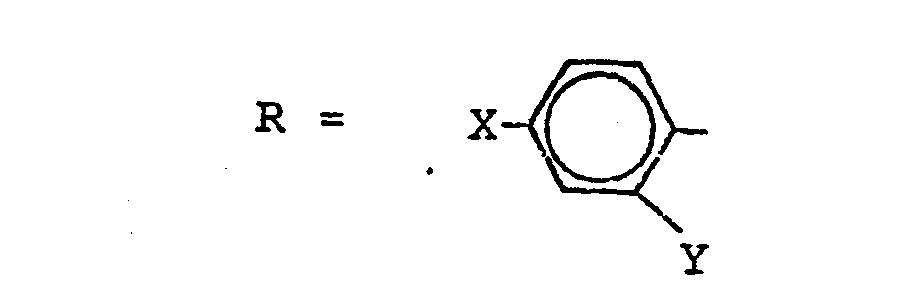
- wobei X = Chlor oder Brom und Y = H oder Chlor bedeuten, und
- R1= H, (C1-C4)-Alkyl, (C2-C4)-Alkinyl oder ein Kationäquivalent, in Kombination mit
- R2 = Brom oder Jod und
- R3 = H, NH4, ein Alkalimetallkation oder (C1-C8)-Alkyl bedeuten,
- R4 = H, (C1-C8)-Alkyl oder ein Kationäquivalent bedeutet, mit der Bedingung, daß, wenn in Formel(A)

- Kombinationen der Verbindungen der Formel(A)mit Verbindungen der Formel (B) ausgeschlossen sind.
- Unter einem Kationäquivalent ist jeweils ein Äquivalent eines Metallkations wie beispielsweise eines Alkalimetall-oder Erdalkalikations oder eines gegebenenfalls (C1-C4)-alkylsubstituierten Ammoniumions zu verstehen.
- Da die Verbindungen der Formel (A) im Propionsäureteil ein Asymmetriezentrum besitzen, können sie als reine Stereoisomeren oder als Steroisomerengemische vorliegen.
- Die Verbindungen der Formel (A) sind insbesondere wirksam gegen monokotyle Schadpflanzen wie beispielsweise Alopecurus myosuroides und Avena fatua (s. DE-A 2 640 730 und DE-A 2 223 894).
- R1 besitzt insbesondere die Bedeutung (C1-C2)Alkyl. Unter den Verbindungen der Formel (A) sind die Verbindungen
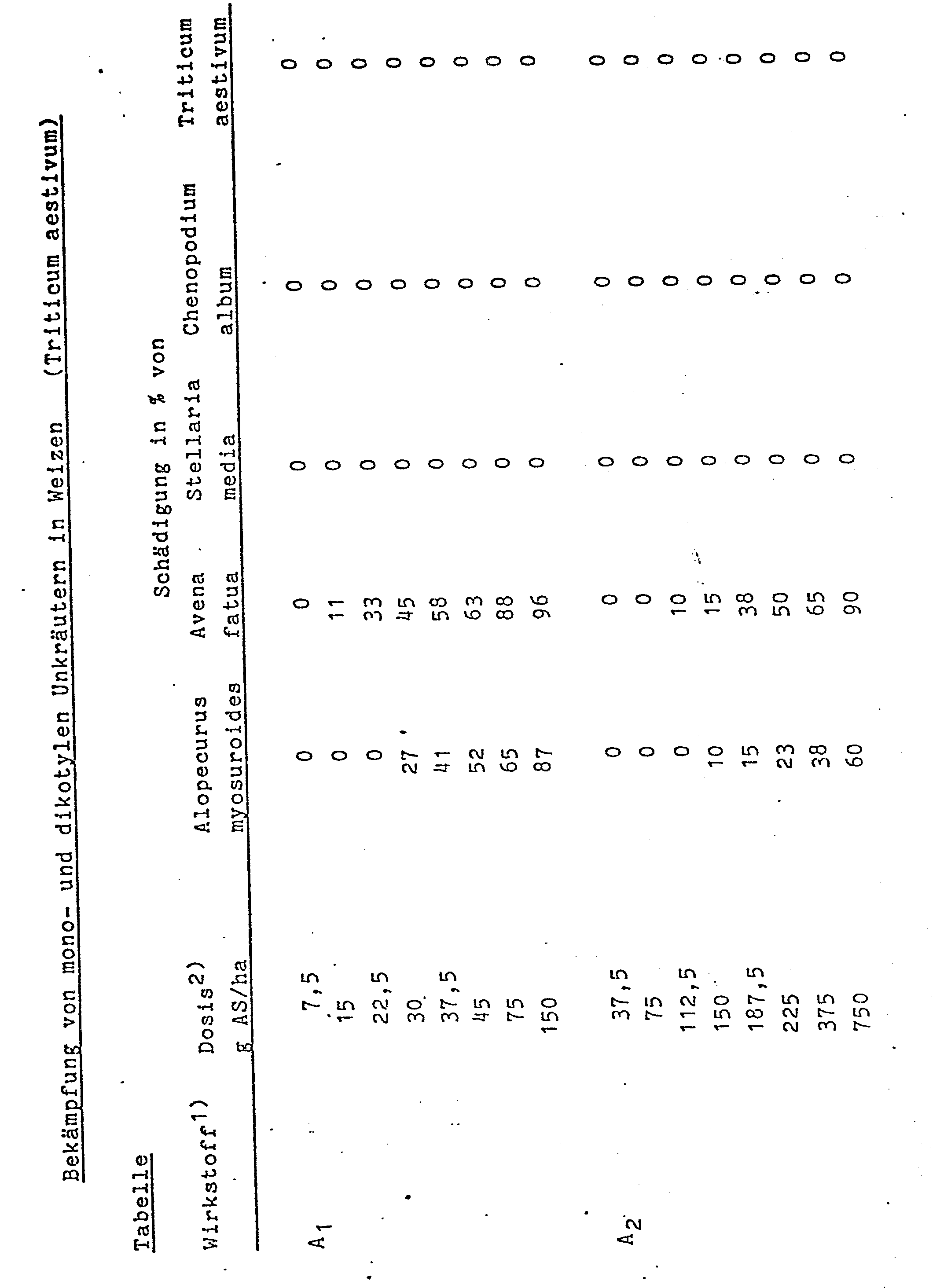
- α-/4-(6-Chlorbenzoxazolyloxy)-phenoxy/-propionsäure- ethylester (A1),
- α-/4-(2,4-Dichlorphenoxy)-phenoxy/-propionsäuremethyl- ester (A2) (common name: Diclofop-methyl) und α-/4-(3,5-Dichlor-pyrid-2-yloxy)-phenoxy/-propionsäure- prop-2-inylester von besonderem Interesse, besonders. bevorzugt die Komponenten (A1) und (A2).
- Unter den Verbindungen der Formel (B) sind bevorzugt die Verbindungen mit R3 = Octyl, common names: Bromoxyniloctylester für R2 = Brom (Verbindung B1) und Ioxyniloctylester für R2 = Jod (Verbindung B2). Beide Verbindungen sind aus NL-A 64 11 452 als Unkrautbekämpfungsmittel in Getreide bekannt.
- Bevorzugt unter den Verbindungen der Formel (C) ist die Verbindung mit R = Octyl (C1). Diese Verbindung ist beschrieben in Weed Research Organization, technical report No. 63.
- Die Verbindungen der Formel (B) und (C) zeichnen sich durch gute Wirksamkeit gegen dikotyle Schadpflanzen wie Stellaria media und Chenopodium album aus.
- Bei der Kombination der Verbindungen der Formel (A) mit Verbindungen der Formel (B) oder (C) zeigten sich überraschenderweise auffallende synergistische Effekte.
- Die erfindungsgemäßen Wirkstoffkombinationen können zur Bekämpfung unerwünschter Pflanzenarten wie z.B. Alopecurus myosuroides, Avena fatua, Stellaria media, Chenopodium album, Setaria viridis, Phalaris sp.,Galium aparine, Matricaria sp., Sinapis arvense, Miosotis arvense in. Nutzpflanzenkulturen, insbesondere in Getreidekulturen wie Weizen, Gerste, vorzugsweise Weizen, eingesetzt werden.
- Die Mischungsverhältnisse der Komponenten der Formeln (A) und (B) bzw. (C) können innerhalb weiter Grenzen variieren. So liegt das Verhältnis der Komponenten A zu B (oder C) im Bereich zwischen 1 : 10 und 15 : 1; bevorzugt ist der Bereich 1 : 5 bis 5 : 1, wenn R von Formel (A) = 6-Chlorbenzoxazolyl bedeutet, und der Bereich 1 : 1 bis 10 : 1, wenn R von Formel (A)

- Die erfindungsgemäßen Kombinationen können entweder als Tankmischungen, bei denen die einzelenen Wirkstoffkomponenten erst unmittelbar vor der Applikation miteinander vermischt werden, oder als Fertigformulierungen zur Anwendung gebracht werden. Als Fertigmischungen können sie z.B. in Form von benetzbaren Pulvern, emulgierbaren Konzentraten, Lösungen, Dispersionen, Stäubemitteln oder Granulaten formuliert sein und enthalten dann gegebenenfalls die üblichen Formulierungshilfsmittel, wie Netz-, Haft-,-Emulgier-, Dispergiermittel, feste oder flüssige Inertstoffe, Mahlhilfsmittel und Lösungsmittel.
- Benetzbare Pulver sind in Wasser gleichmäßig dispergierbare Präparate, die neben dem Wirkstoff außer gegebenenfalls Verdünnungs- bzw. Inertstoffen noch Netzmittel, z.B. polyoxethylierte Alkylphenole, polyoxethylierte Oleyl- oder Stearylamine, Alkyl- oder Alkylphenylsulfonate und Dispergiermittel, z.B. ligninsulfonsaures Natrium, 2,2'-dinaphthyl-methan-6,6'-disulfonsaures Natrium, dibutylnaphthalinsulfonsaures Natrium oder auch oleylmethyltaurinsaures Natrium enthalten können.
- Emulgierbare Konzentrate können beispielsweise durch .Auflösen des Wirkstoffes in einem organischen Lösungsmittel, z.B. Butanol, Cyclohexanon, Dimethylformamid, Xylol, Isophoron oder auch höhersiedenden Aromaten unter Zusatz von einem oder mehreren Emulgatoren hergestellt werden. Als Emulgatoren können beispielsweise verwendet werden: Alkylarylsulfonsaure Calciumsalze, Fettsäurepolyglykolester, Alkylarylpolyglykolether, Fettalkoholpolyglykolether, polyoxethylierte Oleyl- oder Stearylamine, Propylenoxid-Ethylenoxid-Kondensationsprodukte, Alkylpolyether, Sorbitan-Fettsäureester, Alkylaryl-Propylenoxid-Ethylenoxid-Kondensationsprodukte u.a.
- Stäubemittel erhält man durch Vermahlen des Wirkstoffes mit fein verteilten, festen Stoffen, z.B. Talkum, natürlichen Tonen, wie Kaolin, Bentonit, Pyrophillit oder Diatomeenerde.
- Granulate können entweder durch Verdüsen einer Lösung des Wirkstoffes auf adsorptionsfähiges, granuliertes Inertmaterial hergestellt werden oder durch Aufbringen von Wirkstoffkonzentraten mittels eines Bindemittels, z.B. Polyvinylalkohol, polyacrylsaurem Natrium, Methylhydroxyethylcellulose oder auch Mineralölen auf die Oberfläche von Trägerstoffen, wie Sand, Kaolinite oder von granuliertem Inertmaterial. Auch können geeignete Wirkstofformulierungen in der für die Herstellung von Düngemittelgranulaten üblichen Weise - gewünschtenfalls in Mischung mit Düngemitteln - hergestellt werden.
- Die erfindungsgemäßen synergistischen Wirkstoffmischungen aus Verbindungen der Formeln A und B bzw. C können in Form üblicher Zubereitungen, insbesondere als benetzbare Pulver, emulgierbare Konzentrate, Lösungen, Dispersionen, Stäubemittel oder Granulate formuliert werden. Der Gesamtwirkstoffgehalt der marktfähigen Formulierungen beträgt dann ca. 2 bis 95 Gew.-%, vorzugsweise .10 bis 70 Gew.-%, wobei der Rest zu 100 Gew.-% aus üblichen Formulierungshilfsmitteln, wie Haft-, Netz-, Emulgier-, Dispergier-, Füll-, Lösungsmitteln und Trägerstoffen besteht.
- In benetzbaren Pulvern variiert die Gesamt-Wirkstoffkonzentration im Bereich von etwa 10 bis 80 Gew.-%.
- Bei emulgierbaren Konzentraten liegt die Gesamtwirkstoffkonzentration im Bereich von etwa 10 bis 70 Gew.-%. Bei Granulaten beträgt sie etwa 2 bis 10 -Gew.-%. Staubförmige Formulierungen enthalten etwa 5 bis 20 Gew.-% an Wirkstoffgemisch.
- Gegenstand der Erfindung sind daher auch herbizide Mittel mit einem Gehalt von 2 bis 95 Gew.-%, vorzugsweise 10 bis 70 Gew.-% an einer Wirkstoffkombination aus Verbindungen der Formeln A und B oder C, wobei der Rest zu 100 Gew.-% aus üblichen Formulierungshilfsmitteln besteht.
- Zur Anwendung werden die genannten Konzentrate gegebenenfalls in üblicher Weise verdünnt, z.B. benetzbare Pulver, emulgierbare Konzentrate und Dispersionen mittels Wasser. Staubförmige und granulierte Zubereitungen sowie versprühbare Lösungen werden vor der Anwendung im allgemeinen nicht mehr mit weiteren inerten Stoffen verdünnt. Mit den äußeren Bedingungen, wie Temperatur, Feuchtigkeit u.a. variiert auch die erforderliche Aufwandmenge an den erfindungsgemäßen Mitteln. Sie kann sich innerhalb weiter Grenzen bewegen und beträgt im allgemeinen zwischen 0,2 und 10 kg/ha Wirkstoffkombination, vorzugsweise 0,3 - 2,0 kg/ha.
- Die Erfindung wird durch die nachfolgenden Beispiele erläutert.
- Ein Wirkstoff wurde in dem betreffenden Lösungsmittelgemisch bei 50 - 60°C gelöst und anschließend der zweite Wirkstoff, gegebenenfalls in Form einer Schmelze, zugegeben. Unter gutem Rühren setzte man die einzelnen Emulgatorkomponenten zu und ließ das Gemisch erkalten. Die erhaltenen emulgierbaren Konzentrate sind leicht bis mäßig braun gefärbt.
- Nach dieser Verfahrensweise werden die in den Beispielen 1 - 12 der folgenden Tabelle angegebenen Wirkstoffe und Formulierungshilfsmittel miteinander vermischt. Die Zahlenangaben in der Tabelle entsprechen Gewichtsteilen.


- In den folgenden Anwendungsbeispielen wurden die Testpflanzen im Gewächshaus in Töpfen angezogen. Die Applikation der in Wasser verdünnten Konzentrate erfolgte, als die monokotylen Pflanzen - Alopecurus myosuroides, Avena fatua und Triticum aestivum - das 3-4 Blattstadium erreicht hatten und die dikotylen Pflanzen - Stellaria media und Chenopodium album - bis zu einer Höhe von 5 - 10 cm gewachsen waren.
- Nach 4 Wochen wurde die Wirkung (Schädigung) bonitiert. In den Tabellen wird der gefundene Wirkungsgrad dem erwarteten Wirkungsgrad gegenübergestellt.
- Der erwartete Wirkungsgrad wurde nach der Formel von S.R. Colby, Caiculating synergistic and antagonistic response of herbicide combinations (Weeds 15, p. 20-22, 1967) berechnet.
- Die Formel von Colby lautet:

- X = % Schädigung durch Herbizid A bei x kg/ha Aufwandmenge
- Y = % Schädigung durch Herbizid B bei y kg/ha Aufwandmenge
- E = die erwartete Schädigung der Herbizide A + B bei x + y kg/ha Aufwandmenge
- Ist die tatsächliche Schädigung größer als die errechnete, so ist die Wirkung der Kombination mehr als additiv, d.h. es liegt ein synergistischer Effekt vor. Bei den Kombinationsbehandlungen ist die aus obiger Formel errechnete Wirkung in Klammern angegeben.


einer Verbindung der Formel (B),

oder mit einer Verbindung der Formel (C),

bedeuten.
Claims (9)


einer Verbindung der Formel (B)


Kombinationen der Verbindungen der Formel (A) mit Verbindungen der Formel (B) ausgeschlossen sind.

Priority Applications (1)
| Application Number | Priority Date | Filing Date | Title |
|---|---|---|---|
| AT84113518T ATE46422T1 (de) | 1983-11-19 | 1984-11-09 | Herbizide mittel. |
Applications Claiming Priority (4)
| Application Number | Priority Date | Filing Date | Title |
|---|---|---|---|
| DE3341884 | 1983-11-19 | ||
| DE3341884 | 1983-11-19 | ||
| DE3415069 | 1984-04-21 | ||
| DE19843415069 DE3415069A1 (de) | 1983-11-19 | 1984-04-21 | Herbizide mittel |
Related Child Applications (1)
| Application Number | Title | Priority Date | Filing Date |
|---|---|---|---|
| EP88105355.7 Division-Into | 1984-11-09 |
Publications (3)
| Publication Number | Publication Date |
|---|---|
| EP0144796A2 true EP0144796A2 (de) | 1985-06-19 |
| EP0144796A3 EP0144796A3 (en) | 1986-02-05 |
| EP0144796B1 EP0144796B1 (de) | 1989-09-20 |
Family
ID=25815741
Family Applications (2)
| Application Number | Title | Priority Date | Filing Date |
|---|---|---|---|
| EP84113518A Expired EP0144796B1 (de) | 1983-11-19 | 1984-11-09 | Herbizide Mittel |
| EP88105355A Expired - Lifetime EP0296319B1 (de) | 1983-11-19 | 1984-11-09 | Herbizide Mittel auf der Basis von Heteroaryloxyphenoxycarbonsäure-Derivaten |
Family Applications After (1)
| Application Number | Title | Priority Date | Filing Date |
|---|---|---|---|
| EP88105355A Expired - Lifetime EP0296319B1 (de) | 1983-11-19 | 1984-11-09 | Herbizide Mittel auf der Basis von Heteroaryloxyphenoxycarbonsäure-Derivaten |
Country Status (10)
| Country | Link |
|---|---|
| US (1) | US5080709A (de) |
| EP (2) | EP0144796B1 (de) |
| AU (1) | AU567595B2 (de) |
| BR (1) | BR8405848A (de) |
| CA (1) | CA1236315A (de) |
| DD (1) | DD228440A5 (de) |
| DE (3) | DE3415069A1 (de) |
| DK (2) | DK165934C (de) |
| IL (1) | IL73541A (de) |
| PL (2) | PL144354B1 (de) |
Cited By (4)
| Publication number | Priority date | Publication date | Assignee | Title |
|---|---|---|---|---|
| FR2589327A1 (fr) * | 1985-11-06 | 1987-05-07 | Rhone Poulenc Agrochimie | Melanges herbicides de derives d'acides pyridinoxyalcanoiques et de derives d'acides phenoxybenzoiques et leur utilisation pour le traitement des cultures |
| EP0400585A3 (de) * | 1989-06-02 | 1992-09-02 | Hoechst Schering AgrEvo GmbH | Flüssige herbizide Mittel |
| EP0614608A3 (de) * | 1993-02-18 | 1994-10-19 | Hoechst Schering Agrevo Gmbh | Synergistische Mischungen zur Bekämpfung von Ackerfuchsschwanz. |
| WO2007065618A1 (de) * | 2005-12-06 | 2007-06-14 | Bayer Cropscience Ag | Stabilisierte herbizidzusammensetzung |
Families Citing this family (3)
| Publication number | Priority date | Publication date | Assignee | Title |
|---|---|---|---|---|
| KR927002913A (ko) * | 1989-10-18 | 1992-12-17 | 짜우너, 라피체 | 제초 활성 물질 혼합물 |
| GB9108199D0 (en) * | 1991-04-17 | 1991-06-05 | Rhone Poulenc Agriculture | New compositions of matter |
| EP1104232B8 (de) | 1998-07-16 | 2010-10-27 | Bayer CropScience AG | Herbizide mittel |
Family Cites Families (5)
| Publication number | Priority date | Publication date | Assignee | Title |
|---|---|---|---|---|
| US3397054A (en) * | 1962-08-30 | 1968-08-13 | Schering Corp | Process for controlling plant growth |
| CS185694B2 (en) * | 1974-07-17 | 1978-10-31 | Ishihara Sangyo Kaisha | Herbicidal agent |
| DE2755617A1 (de) * | 1977-12-14 | 1979-06-21 | Hoechst Ag | Herbizide mischungen |
| CH650493A5 (en) * | 1977-12-24 | 1985-07-31 | Hoechst Ag | D-(+)-alpha-phenoxypropionic acid derivatives |
| MA19203A1 (fr) * | 1980-07-09 | 1982-04-01 | Ciba Geigy Ag | Agent synergique et procede de lutte selective contre les mauvaises herbes,en particulier dans les cereales . |
-
1984
- 1984-04-21 DE DE19843415069 patent/DE3415069A1/de not_active Withdrawn
- 1984-11-09 DE DE8888105355T patent/DE3485442D1/de not_active Expired - Lifetime
- 1984-11-09 EP EP84113518A patent/EP0144796B1/de not_active Expired
- 1984-11-09 DE DE8484113518T patent/DE3479781D1/de not_active Expired
- 1984-11-09 EP EP88105355A patent/EP0296319B1/de not_active Expired - Lifetime
- 1984-11-16 DK DK547784A patent/DK165934C/da not_active IP Right Cessation
- 1984-11-16 DD DD84269570A patent/DD228440A5/de unknown
- 1984-11-16 PL PL1984264463A patent/PL144354B1/pl unknown
- 1984-11-16 PL PL1984250465A patent/PL143899B1/pl unknown
- 1984-11-16 BR BR8405848A patent/BR8405848A/pt unknown
- 1984-11-16 CA CA000468010A patent/CA1236315A/en not_active Expired
- 1984-11-18 IL IL73541A patent/IL73541A/xx not_active IP Right Cessation
- 1984-11-19 AU AU35663/84A patent/AU567595B2/en not_active Expired
-
1990
- 1990-04-05 US US07/506,509 patent/US5080709A/en not_active Expired - Lifetime
-
1992
- 1992-07-24 DK DK095992A patent/DK165935C/da not_active IP Right Cessation
Cited By (6)
| Publication number | Priority date | Publication date | Assignee | Title |
|---|---|---|---|---|
| FR2589327A1 (fr) * | 1985-11-06 | 1987-05-07 | Rhone Poulenc Agrochimie | Melanges herbicides de derives d'acides pyridinoxyalcanoiques et de derives d'acides phenoxybenzoiques et leur utilisation pour le traitement des cultures |
| EP0400585A3 (de) * | 1989-06-02 | 1992-09-02 | Hoechst Schering AgrEvo GmbH | Flüssige herbizide Mittel |
| US5821198A (en) * | 1989-06-02 | 1998-10-13 | Hoechst Aktiengesellschaft | Liquid herbicidal agents |
| EP0614608A3 (de) * | 1993-02-18 | 1994-10-19 | Hoechst Schering Agrevo Gmbh | Synergistische Mischungen zur Bekämpfung von Ackerfuchsschwanz. |
| WO2007065618A1 (de) * | 2005-12-06 | 2007-06-14 | Bayer Cropscience Ag | Stabilisierte herbizidzusammensetzung |
| AU2006322281B2 (en) * | 2005-12-06 | 2012-09-13 | Bayer Cropscience Aktiengesellschaft | Stabilized herbicide composition |
Also Published As
| Publication number | Publication date |
|---|---|
| EP0144796B1 (de) | 1989-09-20 |
| EP0296319B1 (de) | 1992-01-08 |
| IL73541A0 (en) | 1985-02-28 |
| PL250465A1 (en) | 1985-12-17 |
| PL143899B1 (en) | 1988-03-31 |
| DK165935B (da) | 1993-02-15 |
| DK95992D0 (da) | 1992-07-24 |
| BR8405848A (pt) | 1985-09-17 |
| US5080709A (en) | 1992-01-14 |
| AU3566384A (en) | 1985-05-23 |
| DK95992A (da) | 1992-07-24 |
| DK165934B (da) | 1993-02-15 |
| CA1236315A (en) | 1988-05-10 |
| DD228440A5 (de) | 1985-10-16 |
| IL73541A (en) | 1989-12-15 |
| DE3479781D1 (en) | 1989-10-26 |
| DK547784A (da) | 1985-05-20 |
| EP0144796A3 (en) | 1986-02-05 |
| DK165935C (da) | 1993-07-05 |
| PL144354B1 (en) | 1988-05-31 |
| DE3485442D1 (de) | 1992-02-20 |
| DK547784D0 (da) | 1984-11-16 |
| AU567595B2 (en) | 1987-11-26 |
| DK165934C (da) | 1993-07-05 |
| EP0296319A1 (de) | 1988-12-28 |
| DE3415069A1 (de) | 1985-05-30 |
Similar Documents
| Publication | Publication Date | Title |
|---|---|---|
| DE2223894B2 (de) | Herbizide Mittel auf Basis von Phenoxy carbonsäurederivaten | |
| DE19911165A1 (de) | Entlaubungsmittel | |
| EP2096913A1 (de) | Synergetisch wirkende und kulturpflanzenverträgliche herbizide mittel enthaltend herbizide aus der gruppe der benzoylpyrazole | |
| DD142643A5 (de) | Herbizide mittel | |
| EP0144796B1 (de) | Herbizide Mittel | |
| DE19728568B4 (de) | Herbizide Mittel auf Basis von (5-Trifluormethyl-1,3,4-thiadiazol-2-yl-oxy)-essigsäure-N-isopropyl-N-(4fluorphenyl)-amid | |
| DE3101889A1 (de) | "neue phenoxycarbonsaeureamide, verfahren zu ihrer herstellung und ihre verwendung als herbizide" | |
| EP1985180A1 (de) | Defoliant | |
| EP0110168B1 (de) | Herbizide Mittel | |
| DE3018003C2 (de) | ||
| EP0157171B1 (de) | Herbizide Mittel | |
| EP0110236B1 (de) | Herbizide Mittel | |
| EP0227045B1 (de) | Heterocyclische Phenyläther, Verfahren zu deren Herstellung und diese enthaltende herbizide Mittel | |
| DE69109399T2 (de) | Herbizide Zusammensetzungen. | |
| EP0427072A1 (de) | Selektiv-herbizide Mittel, enthaltend Metribuzin in Kombination mit Bromoxynil | |
| DE3918287A1 (de) | Herbizide mittel | |
| DE2850902A1 (de) | Neue phenoxy-phenoxi-propionsaeureamide und ihre verwendung als herbizide | |
| DE19632424A1 (de) | Synergistische Wirkstoffkombinationen zur Bekämpfung von Schadpflanzen in Nutzpflanzenkulturen | |
| DE4428982C1 (de) | Neue synergistische Herbizide, insbesondere zur Bekämpfung von Ackerfuchsschwanz | |
| DE3006439A1 (de) | Herbizide mittel | |
| AT366549B (de) | Herbizide mittel | |
| DE3918288A1 (de) | Herbizide mittel | |
| EP0075249A1 (de) | Herbizide Mittel | |
| GB2100128A (en) | A herbicidal composition | |
| EP0158810A1 (de) | Herbizide Mittel |
Legal Events
| Date | Code | Title | Description |
|---|---|---|---|
| PUAI | Public reference made under article 153(3) epc to a published international application that has entered the european phase |
Free format text: ORIGINAL CODE: 0009012 |
|
| AK | Designated contracting states |
Designated state(s): AT BE CH DE FR GB IT LI NL SE |
|
| PUAL | Search report despatched |
Free format text: ORIGINAL CODE: 0009013 |
|
| AK | Designated contracting states |
Designated state(s): AT BE CH DE FR GB IT LI NL SE |
|
| 17P | Request for examination filed |
Effective date: 19860411 |
|
| 17Q | First examination report despatched |
Effective date: 19871126 |
|
| GRAA | (expected) grant |
Free format text: ORIGINAL CODE: 0009210 |
|
| AK | Designated contracting states |
Kind code of ref document: B1 Designated state(s): AT BE CH DE FR GB IT LI NL SE |
|
| REF | Corresponds to: |
Ref document number: 46422 Country of ref document: AT Date of ref document: 19891015 Kind code of ref document: T |
|
| XX | Miscellaneous (additional remarks) |
Free format text: TEILANMELDUNG 88105355 EINGEREICHT AM 02.04.88. |
|
| REF | Corresponds to: |
Ref document number: 3479781 Country of ref document: DE Date of ref document: 19891026 |
|
| ITF | It: translation for a ep patent filed | ||
| ET | Fr: translation filed | ||
| R20 | Corrections of a patent specification |
Effective date: 19891024 |
|
| GBT | Gb: translation of ep patent filed (gb section 77(6)(a)/1977) | ||
| PLBE | No opposition filed within time limit |
Free format text: ORIGINAL CODE: 0009261 |
|
| STAA | Information on the status of an ep patent application or granted ep patent |
Free format text: STATUS: NO OPPOSITION FILED WITHIN TIME LIMIT |
|
| 26N | No opposition filed | ||
| ITTA | It: last paid annual fee | ||
| EAL | Se: european patent in force in sweden |
Ref document number: 84113518.9 |
|
| REG | Reference to a national code |
Ref country code: GB Ref legal event code: IF02 |
|
| PGFP | Annual fee paid to national office [announced via postgrant information from national office to epo] |
Ref country code: DE Payment date: 20030905 Year of fee payment: 20 |
|
| PGFP | Annual fee paid to national office [announced via postgrant information from national office to epo] |
Ref country code: SE Payment date: 20031105 Year of fee payment: 20 Ref country code: NL Payment date: 20031105 Year of fee payment: 20 Ref country code: GB Payment date: 20031105 Year of fee payment: 20 |
|
| PGFP | Annual fee paid to national office [announced via postgrant information from national office to epo] |
Ref country code: FR Payment date: 20031110 Year of fee payment: 20 |
|
| PGFP | Annual fee paid to national office [announced via postgrant information from national office to epo] |
Ref country code: AT Payment date: 20031112 Year of fee payment: 20 |
|
| PGFP | Annual fee paid to national office [announced via postgrant information from national office to epo] |
Ref country code: CH Payment date: 20031118 Year of fee payment: 20 |
|
| PGFP | Annual fee paid to national office [announced via postgrant information from national office to epo] |
Ref country code: BE Payment date: 20040121 Year of fee payment: 20 |
|
| PG25 | Lapsed in a contracting state [announced via postgrant information from national office to epo] |
Ref country code: LI Free format text: LAPSE BECAUSE OF EXPIRATION OF PROTECTION Effective date: 20041108 Ref country code: GB Free format text: LAPSE BECAUSE OF EXPIRATION OF PROTECTION Effective date: 20041108 Ref country code: CH Free format text: LAPSE BECAUSE OF EXPIRATION OF PROTECTION Effective date: 20041108 |
|
| PG25 | Lapsed in a contracting state [announced via postgrant information from national office to epo] |
Ref country code: NL Free format text: LAPSE BECAUSE OF EXPIRATION OF PROTECTION Effective date: 20041109 Ref country code: AT Free format text: LAPSE BECAUSE OF EXPIRATION OF PROTECTION Effective date: 20041109 |
|
| BE20 | Be: patent expired |
Owner name: *HOECHST A.G. Effective date: 20041109 |
|
| REG | Reference to a national code |
Ref country code: CH Ref legal event code: PL |
|
| REG | Reference to a national code |
Ref country code: GB Ref legal event code: PE20 |
|
| EUG | Se: european patent has lapsed | ||
| NLV7 | Nl: ceased due to reaching the maximum lifetime of a patent |
Effective date: 20041109 |