EP0137527B1 - Verfahren zur Herstellung von als Gleitmittel wirkenden stabilisierenden Additivgemischen in Form von staubfreien Schuppen - Google Patents
Verfahren zur Herstellung von als Gleitmittel wirkenden stabilisierenden Additivgemischen in Form von staubfreien Schuppen Download PDFInfo
- Publication number
- EP0137527B1 EP0137527B1 EP84201051A EP84201051A EP0137527B1 EP 0137527 B1 EP0137527 B1 EP 0137527B1 EP 84201051 A EP84201051 A EP 84201051A EP 84201051 A EP84201051 A EP 84201051A EP 0137527 B1 EP0137527 B1 EP 0137527B1
- Authority
- EP
- European Patent Office
- Prior art keywords
- flakes
- powder
- mixture
- extruder
- products
- Prior art date
- Legal status (The legal status is an assumption and is not a legal conclusion. Google has not performed a legal analysis and makes no representation as to the accuracy of the status listed.)
- Expired
Links
Images
Classifications
-
- B—PERFORMING OPERATIONS; TRANSPORTING
- B29—WORKING OF PLASTICS; WORKING OF SUBSTANCES IN A PLASTIC STATE IN GENERAL
- B29B—PREPARATION OR PRETREATMENT OF THE MATERIAL TO BE SHAPED; MAKING GRANULES OR PREFORMS; RECOVERY OF PLASTICS OR OTHER CONSTITUENTS OF WASTE MATERIAL CONTAINING PLASTICS
- B29B9/00—Making granules
- B29B9/02—Making granules by dividing preformed material
- B29B9/06—Making granules by dividing preformed material in the form of filamentary material, e.g. combined with extrusion
-
- C—CHEMISTRY; METALLURGY
- C08—ORGANIC MACROMOLECULAR COMPOUNDS; THEIR PREPARATION OR CHEMICAL WORKING-UP; COMPOSITIONS BASED THEREON
- C08K—Use of inorganic or non-macromolecular organic substances as compounding ingredients
- C08K9/00—Use of pretreated ingredients
- C08K9/08—Ingredients agglomerated by treatment with a binding agent
-
- B—PERFORMING OPERATIONS; TRANSPORTING
- B29—WORKING OF PLASTICS; WORKING OF SUBSTANCES IN A PLASTIC STATE IN GENERAL
- B29K—INDEXING SCHEME ASSOCIATED WITH SUBCLASSES B29B, B29C OR B29D, RELATING TO MOULDING MATERIALS OR TO MATERIALS FOR MOULDS, REINFORCEMENTS, FILLERS OR PREFORMED PARTS, e.g. INSERTS
- B29K2027/00—Use of polyvinylhalogenides or derivatives thereof as moulding material
- B29K2027/06—PVC, i.e. polyvinylchloride
Definitions
- Halogenated vinyl polymers in general and polyvinyl chloride-PVC-in particular are known to be widely used for the production of end products, for example in the form of sheets, panels, window frames roll shutters and others, which are usually exposed to atmospheric agents and light during their use.
- mixtures are added to it which comprise stabilising products, antioxidant products, products for filtering the ultraviolet rays, lubricant products, and also pigments if necessary.
- the ratio of the quantity of meltable products to the quantity of non-meltable products must be at least 1:4 for products which are of low viscosity in the molten state, and up to at least 1:2 for products which are viscous in the molten state, otherwise if the values are lower the molten mass cannot be worked by known systems.
- stabilisers which are not meltable below the PVC softening point for example tribasic Pb sulphate, are dispersed in a molten mass of meltable components, for example neutral Pb stearate, with the possible addition of other low-melting products for making the molten mass fluid.
- the molten stabilising mixture mass obtained by this process must be fluid and flowable when - hot, and thus said system is suitable only for these formulations in which the ratio of meltable products to non-meltable products is greater than 1:4, as stated.
- pulverulent stabilising mixtures are mixed with low melting point organic products, such as waxes and esters, by means of rapid mixers.
- the result is a product in the form of granules of various sizes, of diameter between 0.1 and 10 mm, which have the tendency to agglomerate and are not free from powder.
- Italian patent 867,139 suggests the use of extruder devices in which the stabilising mixture is compressed under cold conditions in order to force it through a convenient die, for example a perferated plate or drum.
- said granules have relatively low flowability, and are therefore difficult to ensile and to meter automatically.
- a further known system is that described in Italian patent application 49,948 A/78 which relates to a process for obtaining small flakes of stabilising mixtures by keeping a fluid molten mass agitated with the aid of electrical resistance heaters, and then cooling the product on a belt.
- This process is also suitable only for certain formulations, and cannot be used in these cases in which the percentage of meltable products is low compared with that of the non-meltable products.
- meltable products used are not soluble in each other, it is difficult to keep them mixed in the form of a homogeneous molten mass, and there is thus a strong tendency to generate undesirable stratification.
- a further limitation of said known processes is the need to use large quantities of meltable components in the additive formulation, in order to always obtain at one stage of the process a mass which is fluid and flowable under hot conditions.
- the present patent provides and protects a process and plant by means of which it is possible to obtain flakes of additive mixtures of any formulation, in the presence of very small quantities of meltable components, the flakes being practically free from powder and possessing good flowability and dispersibility characteristics.
- the ratio of meltable products to non-meltable products is no longer important, because according to the invention the component mixtures do not have to be transferred into a mass which under normal conditions is naturally fluid and flowable when hot.
- the process according to the present invention therefore comprises the production of flakes from a mixture of lubricating, stabilising additives for PVC which contains a product having a melting point between 50° and 90°C, characterised by comprising the following operations:
- the powder mixture is treated in an extruder with screws of variable pitch and having sections temperature-controlled at temperatures which increase from upstream to downstream.
- the final product is collected absolutely free from powder by conveying it in a stream of air through successive cyclous separators, the small quantity of powder recovered being recycled.
- flakes of stabilising mixtures are obtained having a size of the order of a few millimeters, which are free from powder, very flowable, and thus easy to store, for example through a pneumatic conveying line.
- Said flakes have good dispersability in halogenated vinyl polymers in general.
- the stabilising mixtures can comprise a wide range of formulation, and according to the invention comprise the products of the classes listed hereinafter, obviously mixed to form compositions which depend on their application and on the characteristics required for the corresponding polymer in which they are to be added.
- the process is applicable to any stabilising mixture formulation or composition, the only condition being that it comprises at least a small quantity of one of the low-melting products stated under point C of the aforesaid list, in order to obtain said ductile mix.
- the quantity of low-melting product (C) is at least 3% of the total weight of the stabilising mixture.
- the sections of the screw extruder temperature-controlled at different temperatures, in which the stabilising mixtures are compressed and mixed have temperatures which increase from 50°C, to 90°C in proximity to the outlet.
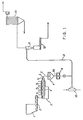
- Figure 1 is a diagrammatic representation of the plant.
- It comprises a hopper 1 for receiving the stabilising mixture in pulverulent form, and which can be prepared either at the place of manufacture of the components or immediately upstream of the plant.
- the hopper 1 comprises a lower discharge screw 2 which feeds the powdered mixture into the chamber of an extruder 3 provided with two side- by-side screws of variable pitch 4, one being right handed and the other left handed, and with a transformation head or die 5 comprising a series of uniformly distributed holes.
- the various longitudinal portions of the extruder 3 and die 5 are surlaked by respective jackets which contain electrical resistance heaters, indicated by T i , T 2 , T 3 and T 4 , of which the operating temperature, which can be adjusted according to the stabilising mixture being processed, increase from upstream to downstream.
- rigid sheets 66 are obtained having a thickness of between 0.1 and 2 mm, according to the composition of the mixture, and are then reduced to flakes by means of a toothed-roller crushing device 8.
- the flakes have a surface area of up to 15 mm 2 and are fed, together with the small powder residues originating from the crushing, to a pneumatic conveying line 9 which is served by a blower 10.
- the line 9 discharges into a powder-separating cyclone 11, in which the flakes fall freely into an underlying collection silo 12 for the finished product.
- the air stream which passes through the cyclone 11 in counter-current with the falling path of the flakes separates the fine powder from the flakes and feeds it to a collection vessel 13 under vacuum, and from which the powder ccan be withdrawn for recycling.
- the finished product is therefore free from powder, has good flowability and possesses good dispersibility in halogenated vinyl polymers in general, as will be apparent from the examples given hereinafter.
- the crusher was of the usual type.
- the extruder is fed with the following powder mixture (percentages by weight)
- the extruder is driven at 6 r.p.m. with an absorbed current of 10 A.
- T i 60°C
- T 2 69°C
- T 3 71°C
- T 4 71°C.
- the hourly production rate was 100 kg/hour.
- the final product characteristics are: good dispersibility, particle thickness 0.65 mm, apparent density 720 g/I.
- the mixture fed to the extruder is as follows (percentages by weight):
- the extruder is driven at 6 r.p.m. with an absorbed current of 10 A.
- T 1 40°C
- T Z 40°C
- T 3 40°C
- T 4 40°C.
- the hourly production rate was 105 kg/hour.
- the final product characteristics are: good dispersibility, particle thickness 0.85 mm, apparent density 700 g/I.
- the mixture fed to the extruder is as follows (percentages by weight):
- the extruder is driven at 40 r.p.m. with an absorbed current of 25 A.
- T 1 70°C
- T 2 70°C
- T 3 80°C
- T 4 80°C.
- the hourly production rate was 95 kg/hour.
- the final product characteristics are: good dispersibility, particle thickness 0.65 mm, apparent density 450 g/I.
- the extruder is driven at 40 r.p.m. with an absorbed current of 24 A.
- T 50°C
- T 2 53°C
- T 3 60°C
- T 4 60°C.
- the hourly production rate was 120 kg/hour.
- the final product characteristics are: good dispersibility, particle thickness 0.85 mm, apparent density 500 g/I.
- the extruder is driven at 40 r.p.m. with an absorbed current of 25 A.
- T 1 70°C
- T 2 70°C
- T 3 80°C
- T 4 80°C.
- the melting point, which for Cd laurate is about 100°C, is never reached.
- the hourly production rate is 110 kg/hour.
- the final product characteristics are: good dispersibility, particle thickness 0.6 mm, apparent density 520 g/I.
- the extruder is fed with the followina mixture:
- the extruder is driven at 40 r.p.m. with an absorbed current of 20 A.
- T 1 65°C
- T 2 70°C
- T 3 70°C
- T Q 75°C.
- the final product characteristics are: good dispersibility, particle thickness 0.8 mm, apparent density 950 g/I.
- the extruder is fed with the following mixture:
- the extruder is driven at 40 r.p.m. with an absorbed current of 18 A.
- T 1 50°C
- T 2 55°C
- T 3 55°C
- T 4 58°C.
- the final product characteristics are: good dispersibility, particle thickness 0.6 mm, apparent density 850 g/l.
- All the aforesaid obtained products have a dispersibility such that the prefabricated PVC component to which they are added has an "undispersed particle" defects noticeable at a signification of 10 times.
Landscapes
- Chemical & Material Sciences (AREA)
- Polymers & Plastics (AREA)
- Health & Medical Sciences (AREA)
- Mechanical Engineering (AREA)
- Chemical Kinetics & Catalysis (AREA)
- Medicinal Chemistry (AREA)
- Engineering & Computer Science (AREA)
- Organic Chemistry (AREA)
- Lubricants (AREA)
- Artificial Filaments (AREA)
- Processing And Handling Of Plastics And Other Materials For Molding In General (AREA)
- Agricultural Chemicals And Associated Chemicals (AREA)
- Fertilizers (AREA)
Claims (2)
Priority Applications (1)
| Application Number | Priority Date | Filing Date | Title |
|---|---|---|---|
| AT84201051T ATE43619T1 (de) | 1983-07-20 | 1984-07-13 | Verfahren zur herstellung von als gleitmittel wirkenden stabilisierenden additivgemischen in form von staubfreien schuppen. |
Applications Claiming Priority (2)
| Application Number | Priority Date | Filing Date | Title |
|---|---|---|---|
| IT46853/83A IT1174993B (it) | 1983-07-20 | 1983-07-20 | Procedimento ed impianto per la produzione di miscele di additivi stabilizzanti lubrificanti in forma di scaglie esenti da polvere e con buone caratteristiche di scorrimento e disperdibilita' |
| IT4685383 | 1983-07-20 |
Publications (3)
| Publication Number | Publication Date |
|---|---|
| EP0137527A2 EP0137527A2 (de) | 1985-04-17 |
| EP0137527A3 EP0137527A3 (en) | 1985-11-21 |
| EP0137527B1 true EP0137527B1 (de) | 1989-05-31 |
Family
ID=11259726
Family Applications (1)
| Application Number | Title | Priority Date | Filing Date |
|---|---|---|---|
| EP84201051A Expired EP0137527B1 (de) | 1983-07-20 | 1984-07-13 | Verfahren zur Herstellung von als Gleitmittel wirkenden stabilisierenden Additivgemischen in Form von staubfreien Schuppen |
Country Status (4)
| Country | Link |
|---|---|
| EP (1) | EP0137527B1 (de) |
| AT (1) | ATE43619T1 (de) |
| DE (1) | DE3478457D1 (de) |
| IT (1) | IT1174993B (de) |
Family Cites Families (2)
| Publication number | Priority date | Publication date | Assignee | Title |
|---|---|---|---|---|
| NL7900252A (nl) * | 1979-01-12 | 1980-07-15 | Haagen Chemie Bv | Toevoegsel voor polymeren en werkwijze voor de berei- ding van een dergelijk toevoegsel. |
| DE3224717A1 (de) * | 1982-07-02 | 1984-01-05 | Neynaber Chemie Gmbh, 2854 Loxstedt | Mehrkomponentige feste stabilisator- und/oder gleitmittelmitschungen fuer halogenhaltige polymere, insbesondere pvc, sowie verfahren zu ihrer herstellung |
-
1983
- 1983-07-20 IT IT46853/83A patent/IT1174993B/it active
-
1984
- 1984-07-13 AT AT84201051T patent/ATE43619T1/de not_active IP Right Cessation
- 1984-07-13 DE DE8484201051T patent/DE3478457D1/de not_active Expired
- 1984-07-13 EP EP84201051A patent/EP0137527B1/de not_active Expired
Also Published As
| Publication number | Publication date |
|---|---|
| ATE43619T1 (de) | 1989-06-15 |
| DE3478457D1 (en) | 1989-07-06 |
| IT1174993B (it) | 1987-07-01 |
| EP0137527A2 (de) | 1985-04-17 |
| IT8346853A0 (it) | 1983-07-20 |
| EP0137527A3 (en) | 1985-11-21 |
| IT8346853A1 (it) | 1985-01-20 |
Similar Documents
| Publication | Publication Date | Title |
|---|---|---|
| DE69728785T2 (de) | Verfahren zum bearbeiten von polymeren | |
| US4218350A (en) | Shaped synthetic polymers containing a biodegradable substance | |
| US4446086A (en) | Process and apparatus for extruding stabilizers | |
| DE68926439T2 (de) | Verfahren zur Entfernung flüchtiger Substanzen aus Polyphenylenether oder Polyphenylenether/Styrolharz-Zusammensetzungen | |
| EP0514784A1 (de) | Verfahren zur Granulierung von Additiven für organische Polymere | |
| CN103524950B (zh) | Pvc挤出级颗粒料、制备方法以及挤出制品的制备方法 | |
| DE69020822T2 (de) | Extrudierbare Polyvinylalcoholzusammensetzungen. | |
| EP0013872B1 (de) | Verfahren zum Herstellen kleinteiliger, mit Leitfähigkeitsruss versehener Polyolefin-Formmassen und deren Verwendung zur Herstellung von Formkörpern | |
| DE10045794A1 (de) | Verfahren zur Herstellung eines Zwischenproduktes für die Erzeugung von Kunststoff-Formkörpern | |
| DE2940041C2 (de) | Grundmischungen zur Verformung von aufgeschäumtem Polyamid | |
| EP0137527A2 (de) | Verfahren zur Herstellung von als Gleitmittel wirkenden stabilisierenden Additivgemischen in Form von staubfreien Schuppen | |
| US5294667A (en) | Preparation of thermoplastic molding materials based on pulverulent polyphenylene ethers and aromatic vinyl polymers | |
| CN117384447B (zh) | 一种聚丙烯拉丝母粒及其制备方法和应用 | |
| US4769200A (en) | Compounding crystalline organic materials | |
| DE2408488A1 (de) | Granulat aus rotem phosphor und einem bindemittel zur flammwidrigen ausruestung von kunststoffen | |
| EP0665095A1 (de) | Verfahren zur Entwässerung von wasserfeuchtem Pfropfkautschuk | |
| GB2029836A (en) | Plastics Based Composition | |
| DE3319093C2 (de) | ||
| DE2528563A1 (de) | Thermoplastische fuellmassen, verfahren zur herstellung derselben und kunststoffmassen mit einem gehalt an ihnen | |
| EP0988338A1 (de) | Verfahren zur herstellung von weich-pvc | |
| US5296563A (en) | Preparation of polyphenylene ether/polyamide molding materials | |
| DE2922378A1 (de) | Verfahren zur herstellung einer nichtstaubenden, schwermetallhaltigen stabilisator/gleitmittel-kombination fuer halogenhaltige vinylpolymerisate | |
| DE4328873A1 (de) | Polyarylenetheragglomerate | |
| DE2308698B2 (de) | Vorrichtung zur rueckfuehrung von kunststoffabfaellen | |
| DE69829695T2 (de) | Verfahren zur herstellung von elastomermaterial zur herstellung von kaugummi |
Legal Events
| Date | Code | Title | Description |
|---|---|---|---|
| PUAI | Public reference made under article 153(3) epc to a published international application that has entered the european phase |
Free format text: ORIGINAL CODE: 0009012 |
|
| AK | Designated contracting states |
Designated state(s): AT BE CH DE FR GB IT LI LU NL SE |
|
| PUAL | Search report despatched |
Free format text: ORIGINAL CODE: 0009013 |
|
| AK | Designated contracting states |
Designated state(s): AT BE CH DE FR GB IT LI LU NL SE |
|
| 17P | Request for examination filed |
Effective date: 19860325 |
|
| 17Q | First examination report despatched |
Effective date: 19870727 |
|
| GRAA | (expected) grant |
Free format text: ORIGINAL CODE: 0009210 |
|
| AK | Designated contracting states |
Kind code of ref document: B1 Designated state(s): AT BE CH DE FR GB IT LI LU NL SE |
|
| PG25 | Lapsed in a contracting state [announced via postgrant information from national office to epo] |
Ref country code: SE Effective date: 19890531 Ref country code: LI Effective date: 19890531 Ref country code: CH Effective date: 19890531 |
|
| REF | Corresponds to: |
Ref document number: 43619 Country of ref document: AT Date of ref document: 19890615 Kind code of ref document: T |
|
| ITF | It: translation for a ep patent filed | ||
| REF | Corresponds to: |
Ref document number: 3478457 Country of ref document: DE Date of ref document: 19890706 |
|
| ET | Fr: translation filed | ||
| PG25 | Lapsed in a contracting state [announced via postgrant information from national office to epo] |
Ref country code: LU Free format text: LAPSE BECAUSE OF NON-PAYMENT OF DUE FEES Effective date: 19890731 |
|
| REG | Reference to a national code |
Ref country code: CH Ref legal event code: PL |
|
| PLBE | No opposition filed within time limit |
Free format text: ORIGINAL CODE: 0009261 |
|
| STAA | Information on the status of an ep patent application or granted ep patent |
Free format text: STATUS: NO OPPOSITION FILED WITHIN TIME LIMIT |
|
| 26N | No opposition filed | ||
| ITTA | It: last paid annual fee | ||
| PGFP | Annual fee paid to national office [announced via postgrant information from national office to epo] |
Ref country code: FR Payment date: 19940707 Year of fee payment: 11 |
|
| PGFP | Annual fee paid to national office [announced via postgrant information from national office to epo] |
Ref country code: GB Payment date: 19940712 Year of fee payment: 11 |
|
| PGFP | Annual fee paid to national office [announced via postgrant information from national office to epo] |
Ref country code: AT Payment date: 19940719 Year of fee payment: 11 |
|
| PGFP | Annual fee paid to national office [announced via postgrant information from national office to epo] |
Ref country code: NL Payment date: 19940731 Year of fee payment: 11 |
|
| PGFP | Annual fee paid to national office [announced via postgrant information from national office to epo] |
Ref country code: DE Payment date: 19940802 Year of fee payment: 11 |
|
| PGFP | Annual fee paid to national office [announced via postgrant information from national office to epo] |
Ref country code: BE Payment date: 19940804 Year of fee payment: 11 |
|
| PG25 | Lapsed in a contracting state [announced via postgrant information from national office to epo] |
Ref country code: GB Effective date: 19950713 Ref country code: AT Effective date: 19950713 |
|
| PG25 | Lapsed in a contracting state [announced via postgrant information from national office to epo] |
Ref country code: BE Effective date: 19950731 |
|
| BERE | Be: lapsed |
Owner name: REAGENS S.P.A. INDUSTRIA CHIMICA Effective date: 19950731 |
|
| PG25 | Lapsed in a contracting state [announced via postgrant information from national office to epo] |
Ref country code: NL Effective date: 19960201 |
|
| GBPC | Gb: european patent ceased through non-payment of renewal fee |
Effective date: 19950713 |
|
| NLV4 | Nl: lapsed or anulled due to non-payment of the annual fee |
Effective date: 19960201 |
|
| PG25 | Lapsed in a contracting state [announced via postgrant information from national office to epo] |
Ref country code: DE Effective date: 19960402 |
|
| PG25 | Lapsed in a contracting state [announced via postgrant information from national office to epo] |
Ref country code: FR Effective date: 19960430 |
|
| REG | Reference to a national code |
Ref country code: FR Ref legal event code: ST |
|
| REG | Reference to a national code |
Ref country code: FR Ref legal event code: ST |
|
| REG | Reference to a national code |
Ref country code: FR Ref legal event code: ST |