EP0137372B1 - Verfahren zur Herstellung der optischen Antipoden von tert.-Leucin - Google Patents
Verfahren zur Herstellung der optischen Antipoden von tert.-Leucin Download PDFInfo
- Publication number
- EP0137372B1 EP0137372B1 EP84111207A EP84111207A EP0137372B1 EP 0137372 B1 EP0137372 B1 EP 0137372B1 EP 84111207 A EP84111207 A EP 84111207A EP 84111207 A EP84111207 A EP 84111207A EP 0137372 B1 EP0137372 B1 EP 0137372B1
- Authority
- EP
- European Patent Office
- Prior art keywords
- leucine
- tert
- acyl
- preparation
- reaction
- Prior art date
- Legal status (The legal status is an assumption and is not a legal conclusion. Google has not performed a legal analysis and makes no representation as to the accuracy of the status listed.)
- Expired
Links
Classifications
-
- C—CHEMISTRY; METALLURGY
- C12—BIOCHEMISTRY; BEER; SPIRITS; WINE; VINEGAR; MICROBIOLOGY; ENZYMOLOGY; MUTATION OR GENETIC ENGINEERING
- C12P—FERMENTATION OR ENZYME-USING PROCESSES TO SYNTHESISE A DESIRED CHEMICAL COMPOUND OR COMPOSITION OR TO SEPARATE OPTICAL ISOMERS FROM A RACEMIC MIXTURE
- C12P41/00—Processes using enzymes or microorganisms to separate optical isomers from a racemic mixture
- C12P41/006—Processes using enzymes or microorganisms to separate optical isomers from a racemic mixture by reactions involving C-N bonds, e.g. nitriles, amides, hydantoins, carbamates, lactames, transamination reactions, or keto group formation from racemic mixtures
- C12P41/007—Processes using enzymes or microorganisms to separate optical isomers from a racemic mixture by reactions involving C-N bonds, e.g. nitriles, amides, hydantoins, carbamates, lactames, transamination reactions, or keto group formation from racemic mixtures by reactions involving acyl derivatives of racemic amines
-
- C—CHEMISTRY; METALLURGY
- C12—BIOCHEMISTRY; BEER; SPIRITS; WINE; VINEGAR; MICROBIOLOGY; ENZYMOLOGY; MUTATION OR GENETIC ENGINEERING
- C12P—FERMENTATION OR ENZYME-USING PROCESSES TO SYNTHESISE A DESIRED CHEMICAL COMPOUND OR COMPOSITION OR TO SEPARATE OPTICAL ISOMERS FROM A RACEMIC MIXTURE
- C12P13/00—Preparation of nitrogen-containing organic compounds
- C12P13/04—Alpha- or beta- amino acids
Definitions
- Optically active tert-leucine which is not accessible from nature's chiral pool, is of outstanding interest as an auxiliary chiral reagent in asymmetric organic synthesis. It is difficult to access it in large quantities using classic methods of racemate resolution.
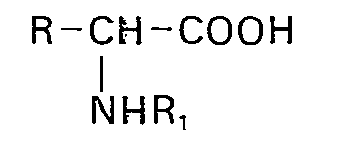
- a method is known from British Patent 1,369,462 in which a racemate of the formula in which R is an optionally substituted alkyl, aryl or aralkyl group and R 1 is an acyl group for which there is a specific deacylase, is treated in an aqueous medium with a deacylase which is known to form the N-acyl side chain of a penicillin to form 6- Aminopenicillanic acid removed, producing the free L-amino acid, which is separated from the N-acyl-D-amino acid.
- a deacylase which is known to form the N-acyl side chain of a penicillin to form 6- Aminopenicillanic acid removed, producing the free L-amino acid, which is separated from the N-acyl-D-amino acid.
- racemic N-acyl tert-leucine is easily cleaved enzymatically when the acylase is carrier-bound.
- the fact that the enzyme can be bound to an inert material is already mentioned in the British patent. However, it was not to be expected that such a fixation would suppress the steric hindrance of the reaction in this way, especially since the fixation of an enzyme is generally associated with a reduction in activity.
- the invention thus relates to a process for the preparation of L-tert-leucine by enzymatic cleavage of racemic N-acyl-tert-leucine in an aqueous medium with the aid of a carrier-bound acylase.
- the non-cleaved N-acyl-D-tert-leucine can be converted into the free D-tert-leucine in a manner known per se by chemical deacylation, for example by acid hydrolysis, or can be returned to the process after racemization.
- Suitable N-acyl radicals are all acyl groups which are known to be split off by acylases, such as, for example, alkanoyl groups having 1 to 5 carbon atoms, aralkanoyl groups, preferably phenylacetyl, and aroyl groups such as benzoyl, each of which is substituted by halogen, hydroxyl, lower alkyl or lower alkoxy can.
- acylases such as, for example, alkanoyl groups having 1 to 5 carbon atoms, aralkanoyl groups, preferably phenylacetyl, and aroyl groups such as benzoyl, each of which is substituted by halogen, hydroxyl, lower alkyl or lower alkoxy can.
- Suitable acyl radicals are known from the literature, for example from the British patent mentioned and German Offenlegungsschriften 2,352,579, 2,446,320, 2,939,269 and 3,048,612. The corresponding acylases are also mentioned
- the fixation of the enzyme to a carrier is, as stated above, already known from British Patent 1,369,462, cellulose, sand or aluminum oxide being mentioned as the inert material and a bifunctional reagent such as glutaraldehyde being mentioned as the crosslinking agent.
- a bifunctional reagent such as glutaraldehyde being mentioned as the crosslinking agent.
- German Offenlegungsschrift 2732301 which relates specifically to the fixation of penicillin acylase.
- Particularly advantageous carriers for the amidase are phenol-formaldehyde resins with free N-H groups, as are commercially available as weakly basic ion exchangers.
- the enzyme is bound to these supports with the aid of a bifunctional isocyanate such as hexamethylene-1,6-diisocyanate.
- Macroporous resins with an average pore diameter of 80 to 100 nm are particularly advantageous.
- a weakly basic ion exchanger of the pore size mentioned, marketed under the trade name "Duolite A7”, after binding with hexamethylene-1,6-diisocyanate, gives a penicillin G amidase preparation with a relative activity of over 30% (penicillin-G 100%).
- Such immobilized acylases, their preparation and use are the subject of EP-A-0 137371 on the same filing date (corresponding to German patent application P3334846.4).
- the disadvantage of the reduced activity compared to the free enzyme is more than eliminated in the immobilized enzymes by an increased service life. A lifespan of over a year and a half-life of more than 8 months could be observed.
- the substrate concentration can be 0.1 to 30, preferably 4 to 10,% by weight.
- the temperature and the pH value depend on the respective enzyme. In general, the reaction temperature is 10 to 60 ° C, preferably 20 to 40 ° C, and the pH in a range of 3 to 9, preferably 6 to 8.
- the reaction can take place in a buffered system or without the addition of a buffer.
- the duration of the reaction depends not only on the temperature and the enzyme immobilizate, but also on the enzyme-substrate ratio, which can vary within wide limits. For short reaction times of around 0.5 to 5 hours, one chooses expediently a weight ratio of enzyme to substrate of 1: 4 to 4: 1.
- the reaction can be carried out batchwise or continuously.
- the immobilized enzyme is placed in a fluidized bed or fixed bed reactor.
- the enzyme immobilizate can be packed in columns or used in a loop reactor.
- the course and end of the reaction can be followed using polarimetric or titrimetric methods.
- the resulting free amino acid can also be determined quantitatively using the ninhydrin reaction.
- the free L-tert-leucine can be separated from the non-attacked N-acyl-D compound and the acid released by the different solubility, for example by extraction, or due to the different pK a - Value can be separated by adsorption, for example on ion exchangers. Volatile carboxylic acids released can also be separated off by distillation.
- 300 g of the commercially available weakly basic ion exchanger Duolite A7 (phenol-formaldehyde resin with free NH groups from Diamond Shamrock, cf. EP-A2-37667, Example 1) are stirred in 500 ml of 2N sodium hydroxide solution for 10 minutes and then neutral washed converted to the free base form with deionized water. After drying at 40 ° C. and 50 mbar for 24 hours, 100 g of dry resin are taken up in 200 ml of anhydrous dichloromethane, 10 g of hexamethylene-1,6-diisocyanate are added and the mixture is stirred for 2 hours with the exclusion of air. The resin is filtered off and washed thoroughly with dichloromethane.
- the activated resin After drying in a desiccator, the activated resin is placed in 200 ml of an aqueous solution of 10 g penicillin-G acylase and stirred for 2 hours at room temperature. The product is filtered off and washed with saturated saline and then with deionized water.
- phenylacetic acid and N-phenacetyl-D-tert.-leucine crystallize out.
- a 10% substrate solution is prepared from 50 g (0.2 mol) of N-phenacetyl-D, L-tert.-leucine in accordance with Example 2 and pumped continuously at 37 ° C. through a column which contains 100 g of enzyme immobilizate as in Example 1 is filled.
- the pH in the storage vessel is kept at 7.8 by adding 0.05N sodium hydroxide solution.
- the hydrolysis is complete after about 2 hours.
- Working up is carried out according to Example 2.
- Example 3 The procedure according to Example 3 is followed, but the liberated amino acid is separated off as follows:
- the phenylacetic acid and the N-phenacetyl-D-tert.-leucine according to Example 2 are isolated from the eluate of the ion exchanger.
Landscapes
- Chemical & Material Sciences (AREA)
- Organic Chemistry (AREA)
- Zoology (AREA)
- Life Sciences & Earth Sciences (AREA)
- Engineering & Computer Science (AREA)
- Wood Science & Technology (AREA)
- Chemical Kinetics & Catalysis (AREA)
- Genetics & Genomics (AREA)
- General Chemical & Material Sciences (AREA)
- Biotechnology (AREA)
- Microbiology (AREA)
- Health & Medical Sciences (AREA)
- Biochemistry (AREA)
- Bioinformatics & Cheminformatics (AREA)
- General Engineering & Computer Science (AREA)
- General Health & Medical Sciences (AREA)
- Analytical Chemistry (AREA)
- Organic Low-Molecular-Weight Compounds And Preparation Thereof (AREA)
- Preparation Of Compounds By Using Micro-Organisms (AREA)
- Acyclic And Carbocyclic Compounds In Medicinal Compositions (AREA)
- Medicines That Contain Protein Lipid Enzymes And Other Medicines (AREA)
Description
- Optisch aktives tert.-Leucin, das aus dem chiralen Pool der Natur nicht zugänglich ist, besitzt als chirales Hilfsreagenz in der asymmetrischen organischen Synthese außerordentliches Interesse. Durch klassische Methoden der Racematspaltung ist es nur schwer in größeren Mengen zugänglich.
- Aus der britischen Patentschrift 1 369462 ist zwar ein Verfahren bekannt, bei dem ein Racemat der Formel
- Überraschenderweise wurde nun gefunden, daß racemisches N-Acyl-tert.-Leucin dann enzymatisch leicht gespalten wird, wenn die Acylase trägergebunden vorliegt. Die Tatsache, daß das Enzym an ein inertes Material gebunden sein kann, ist bereits in der britischen Patentschrift erwähnt. Es war jedoch nicht zu erwarten, daß eine solche Fixierung die sterische Hinderung der Reaktion derartig zurückdrängt, zumal mit der Fixierung eines Enzyms generell eine Verringerung der Aktivität verbunden ist.
- Die Erfindung betrifft somit ein Verfahren zur Herstellung von L-tert.-Leucin durch enzymatische Spaltung von racemischem N-Acyl-tert.-Leucin im wäßrigen Medium mit Hilfe einerträgergebundenen Acylase. Das nicht gespaltene N-Acyl-D-tert.-Leucin kann in an sich bekannter Weise durch chemische Deacylierung, beispielsweise durch saure Hydrolyse, in das freie D-tert.-Leucin übergeführt werden oder aber nach Racemisierung wieder in den Prozeß zurückgeführt werden.
- Als N-Acylrest kommen alle Acylgruppen in Betracht, die bekanntermaßen durch Acylasen abgespalten werden, wie beispielsweise Alkanoylgruppen mit 1 bis 5 Kohlenstoffatomen, Aralkanoylgruppen, vorzugsweise Phenylacetyl, und Aroylgruppen wie Benzoyl, die jeweils durch Halogen, Hydroxy, niederes Alkyl oder niederes Alkoxy substituiert sein können. Geeignete Acylreste sind literaturbekannt, beispielsweise aus der genannten britischen Patentschrift und den deutschen Offenlegungsschriften 2 352 579, 2 446 320, 2 939 269 und 3 048 612. Die entsprechenden Acylasen sind ebenfalls in diesen Druckschriften erwähnt.
- Wenn zur Acylierung eine schwerflüchtige Carbonsäure verwendet wird, kann das nach Abtrennung des L-tert.-Leucins und Entfernung des Wassers zurückbleibende Gemisch aus der N-Acyl-D-Verbindung und der schwerflüchtigen Carbonsäure unmittelbar durch Erhitzen wieder racemisiert werden (EP-A-0 137371 vom gleichen Anmeldetag, entsprechend der deutschen Patentanmeldung P 33 34 849.9).
- Die Fixierung des Enzyms an einen Träger istwie vorstehend angegeben - bereits aus der britischen Patentschrift 1 369462 bekannt, wobei als inertes Material Cellulose, Sand oder Aluminiumoxid und als Vernetzungsmittel ein bifunktionelles Reagenz wie Glutaraldehyd erwähnt sind. Verwiesen werden kann auch auf die deutsche Offenlegungsschrift 2732301, die speziell die Fixierung von Penicillinacylase betrifft. Ein so hergestelltes Penicillin-G-Amidase-Präparat zeigt gegenüber N-Phenacetyl-L-tert.-Leucin eine relative Aktivität von 10 bis 15% (Penicillin-G = 100%).
- Besonders vorteilhafte Träger für die Amidase sind Phenol-Formaldehyd-Harze mit freien N-H-Gruppen, wie sie als schwach basische lonenaustauscher handelsüblich sind. An diese Träger wird das Enzym mit Hilfe eines bifunktionellen lsocyanats wie Hexamethylen-1,6-diisocyanat gebunden. Besonders vorteilhaft sind macroporöse Harze mit einem mittleren Porendurchmesser von 80 bis 100 nm. Ein unter der Handelsbezeichnung "Duolite A7 vertriebener schwach basischer Ionenaustauscher der genannten Porengröße ergibt nach Bindung mit Hexamethylen-1,6-diisocyanat ein Penicillin-G-Amidase-Präparat mit einer relativen Aktivität von über 30% (Penicillin-G = 100%). Derart immobilisierte Acylasen, ihre Herstellung und Verwendung sind Gegenstand der EP-A-0 137371 von gleichen Anmeldetag (entsprechend der deutschen Patentanmeldung P3334846.4).
- Der Nachteil der gegenüber dem freien Enzym verringerten Aktivität wird bei den immobilisierten Enzymen durch eine erhöhte Standzeit mehr als aufgehoben. So konnte eine Lebensdauer von über einem Jahr und eine Halbwertszeit von mehr als 8 Monaten beobachtet werden.
- Je nach Löslichkeit des Ausgangsmaterials kann die Substratkonzentration bei 0,1 bis 30, vorzugsweise 4 bis 10, Gew.-% liegen. Die Temperatur und der pH-Wert richten sich nach dem jeweiligen Enzym. Im allgemeinen liegt die Umsetzungstemperatur bei 10 bis 60° C, vorzugsweise bei 20 bis 40° C, und der pH-Wert in einem Bereich von 3 bis 9, vorzugsweise 6 bis 8.
- Die Reaktion kann in einem gepufferten System oder ohne Pufferzusatz ablaufen.
- Die Umsetzungsdauer ist neben der Temperatur und dem Enzymimmobilisat abhängig vom Enzym-Substrat-Verhältnis, das grundsätzlich in weiten Grenzen schwanken kann. Für kurze Reaktionszeiten von etwa 0,5 bis 5 Stunden wählt man zweckmäßig ein Gewichtsverhältnis von Enzym zu Substrat von 1 :4 bis 4: 1.
- Die Reaktion kann absatzweise oder kontinuierlich durchgeführt werden. Im letzteren Fall wird das immobilisierte Enzym in einem Fließbett-oder Festbett-Reaktor angeordnet. So kann das Enzymimmobilisat beispielsweise in Säulen gepackt oder in einem Schlaufenreaktor eingesetzt werden.
- Verlauf und Ende der Reaktion können mit polarimetrischen oder titrimetrischen Methoden verfolgt werden. Die entstehende freie Aminosäure kann außerdem quantitativ mittels der Ninhydrin-Reaktion bestimmt werden.
- Die Aufarbeitung erfolgt in an sich bekannter Weise: Das freie L-tert.-Leucin kann von der nicht angegriffenen N-Acyl-D-Verbindung und der freigesetzten Säure durch die unterschiedliche Löslichkeit, beispielsweise durch Extraktion, oder auf Grund des unterschiedlichen pKa-Wertes durch Adsorption, beispielsweise an lonenaustauschern, aufgetrennt werden. Flüchtige freigesetzte Carbonsäuren können auch durch Destillation abgetrennt werden.
- Besonders bevorzugte Ausgestaltungen der Erfindung werden in den folgenden Beispielen näher erläutert. Prozentangaben beziehen sich hierbei auf das Gewicht, wenn nichts anderes angegeben ist.
- 300 g des handelsüblichen schwach basischen Ionenaustauschers Duolite A7 (Phenol-Formaldehyd-Harz mit freien N-H-Gruppen der Firma Diamond Shamrock, vgl. EP-A2-37667, Beispiel 1) werden durch 10-minütiges Rühren in 500 ml 2N Natronlauge und anschließendes Neutralwaschen mit entionisiertem Wasser in die freie Basenform überführt. Nach 24 Stunden Trocknen bei 40° C und 50 mbar werden 100 g trockenes Harz in 200 ml wasserfreiem Dichlormethan aufgenommen, mit 10 g Hexamethylen-1,6-diisocyanat versetzt und 2 Stunden unter Luftausschluß gerührt. Man filtriert das Harz ab und wäscht es mit Dichlormethan gründlich nach.
- Nach Trocknen im Exsikkator wird das aktivierte Harz in 200 ml einer wäßrigen Lösung von 10 g Penicillin-G-Acylase gegeben und 2 Stunden bei Raumtemperatur gerührt. Das Produkt wird abfiltriert und mit gesättigter Kochsalzlösung und anschließend mit entionisiertem Wasser gewaschen.
- 100 g (0,4 Mol) N-Phenacetyl-D,L-tert.-Leucin werden in 400 ml 1 N Natronlauge gelöst und auf einen pH-Wert von 7,8 und ein Gesamtvolumen von 1000 ml eingestellt. Diese Reaktionslösung wird auf 37° C thermostatisiert und unter Rühren mit 100 g nach Beispiel 1 immobilisierter Penicillin-G-Amidase versetzt. Durch Titrieren mit 0,05N Natronlauge wird der pH-Wert während der Hydrolysereaktion konstant gehalten und gleichzeitig der Umsetzungsverlauf registriert. Nach 3 bis 4 Stunden wird keine Natronlauge mehr verbraucht. Nach Abfiltrieren des Enzymmaterials und Ansäuern mit konzentrierter Schwefelsäure auf pH 3 kristalisieren Phenylessigsäure und N-Phenacetyl-D-tert.-Leucin aus. Die Phenylessigsäure kann durch Extraktion mit Essigsäureethylester-Hexan aus dem Kristallisat abgetrennt werden, worauf 45 g (0,18 Mol = 90% d. Th.) N-Phenacetyl-D-tert.-Leucin vom Schmelzpunkt 163 bis 164°C, [α]20 D 14,2° (c = 1, in Methanol) zurückbleiben.
- Aus der eingeengten Mutterlauge werden durch Extraktion mit Ethanol-Wasser 23 g (0,18 Mol = 90 d. Th.) L-tert.-Leucin vom Schmelzpunkt über 250° C, [α]

- Aus 50 g (0,2 Mol) N-Phenacetyl-D,L-tert.-Leucin wird entsprechend Beispiel 2 eine 10%ige Substralösung hergestellt und kontinuierlich bei 37° C durch eine Säule gepumpt, die mit 100 g Enzymimmobilisat entsprechend Beispiel 1 gefüllt ist. Im Vorratsgefäß wird der pH-Wert bei 7,8 durch Zugabe von 0,05N Natronlauge gehalten. Nach etwa 2 Stunden ist die Hydrolyse beendet. Die Aufarbeitung erfolgt nach Beispiel 2.
- Man verfährt gemäß Beispiel 3, trennt jedoch die Freigesetzte Aminosäure wie folgt ab: Man gibt die Reaktionslösung über einen stark sauren Kationenaustauscher in der H'-Form (H Dowex 50 Wx2) und desorbiert mit 5%iger wäßriger Ammoniaklösung. Aus dem Desorbat erhält man durch Vakuumtrocknung bei 80 bis 100° C 12,4 g (0,095 Mol = 95% d. Th.) L-tert.-Leucin, Schmelzpunkt über 250° C, [a] ö° -9,44° (c = 1, in Wasser).
- Aus dem Eluat des Ionenaustauschers isoliert man die Phenylessigsäure und das N-Phenacetyl-D-tert.-Leucin gemäß Beispiel 2.
- Aus dem gemäß Beispiel 2 bis 4 erhaltenen N-Phenacetyl-D-tert.-Leucin isoliert man das D-tert.-Leucin durch saure Hydrolyse mit Salzsäure: [α]20 D +9,0° (c = 1, in Wasser).
Claims (5)
Priority Applications (1)
| Application Number | Priority Date | Filing Date | Title |
|---|---|---|---|
| AT84111207T ATE21687T1 (de) | 1983-09-27 | 1984-09-20 | Verfahren zur herstellung der optischen antipoden von tert.-leucin. |
Applications Claiming Priority (2)
| Application Number | Priority Date | Filing Date | Title |
|---|---|---|---|
| DE19833334848 DE3334848A1 (de) | 1983-09-27 | 1983-09-27 | Verfahren zur herstellung der optischen antipoden von tert.-leucin |
| DE3334848 | 1983-09-27 |
Publications (2)
| Publication Number | Publication Date |
|---|---|
| EP0137372A1 EP0137372A1 (de) | 1985-04-17 |
| EP0137372B1 true EP0137372B1 (de) | 1986-08-27 |
Family
ID=6210137
Family Applications (1)
| Application Number | Title | Priority Date | Filing Date |
|---|---|---|---|
| EP84111207A Expired EP0137372B1 (de) | 1983-09-27 | 1984-09-20 | Verfahren zur Herstellung der optischen Antipoden von tert.-Leucin |
Country Status (9)
| Country | Link |
|---|---|
| EP (1) | EP0137372B1 (de) |
| JP (1) | JPS60105500A (de) |
| AT (1) | ATE21687T1 (de) |
| AU (1) | AU573261B2 (de) |
| CA (1) | CA1229810A (de) |
| DE (2) | DE3334848A1 (de) |
| DK (1) | DK460884A (de) |
| IL (1) | IL73061A (de) |
| ZA (1) | ZA847561B (de) |
Families Citing this family (3)
| Publication number | Priority date | Publication date | Assignee | Title |
|---|---|---|---|---|
| ES2144999T3 (es) * | 1986-06-04 | 2000-07-01 | Hoechst Schering Agrevo Gmbh | Procedimiento para la preparacion de l-leucina terciaria mediante transaminacion. |
| WO2010019469A2 (en) * | 2008-08-11 | 2010-02-18 | Dr. Reddy's Laboratories Ltd. | Preparation of (s)-2-aminobutyric acid |
| JPWO2011068206A1 (ja) * | 2009-12-04 | 2013-04-18 | 三菱瓦斯化学株式会社 | 光学活性アミノ酸または光学活性アミノ酸アミドの製造法 |
Family Cites Families (7)
| Publication number | Priority date | Publication date | Assignee | Title |
|---|---|---|---|---|
| AT169327B (de) * | 1948-07-07 | 1951-11-10 | Interchem Corp | Verfahren zur Trennung der beiden optischen Antipoden einer racemischen Aminosäure |
| GB1072876A (en) * | 1965-07-15 | 1967-06-21 | Tanabe Seiyaku Co | Resolution of racemic amino acids |
| FR2078103A5 (de) * | 1970-02-03 | 1971-11-05 | Tanabe Seiyaku Co | |
| GB1369462A (en) * | 1971-11-23 | 1974-10-09 | Beecham Group Ltd | Enzymic resolution of racemic n-acyl-dl-amino acids |
| JPS5233194B2 (de) * | 1973-04-24 | 1977-08-26 | ||
| DE2732301C3 (de) * | 1977-07-16 | 1980-12-11 | Roehm Gmbh, 6100 Darmstadt | Verfahren zur Herstellung von stabilisierten trägergebundenen Proteinen |
| DE3334846A1 (de) * | 1983-09-27 | 1985-04-04 | Hoechst Ag, 6230 Frankfurt | Immobilisierte acylase, verfahren zu ihrer herstellung und ihre verwendung |
-
1983
- 1983-09-27 DE DE19833334848 patent/DE3334848A1/de not_active Withdrawn
-
1984
- 1984-09-20 EP EP84111207A patent/EP0137372B1/de not_active Expired
- 1984-09-20 DE DE8484111207T patent/DE3460566D1/de not_active Expired
- 1984-09-20 AT AT84111207T patent/ATE21687T1/de active
- 1984-09-25 IL IL73061A patent/IL73061A/xx unknown
- 1984-09-26 CA CA000464045A patent/CA1229810A/en not_active Expired
- 1984-09-26 DK DK460884A patent/DK460884A/da not_active Application Discontinuation
- 1984-09-26 ZA ZA847561A patent/ZA847561B/xx unknown
- 1984-09-26 AU AU33556/84A patent/AU573261B2/en not_active Expired - Fee Related
- 1984-09-26 JP JP59199688A patent/JPS60105500A/ja active Pending
Also Published As
| Publication number | Publication date |
|---|---|
| DE3334848A1 (de) | 1985-04-04 |
| CA1229810A (en) | 1987-12-01 |
| IL73061A (en) | 1988-02-29 |
| EP0137372A1 (de) | 1985-04-17 |
| ATE21687T1 (de) | 1986-09-15 |
| AU3355684A (en) | 1985-04-04 |
| DK460884A (da) | 1985-03-28 |
| DK460884D0 (da) | 1984-09-26 |
| IL73061A0 (en) | 1984-12-31 |
| ZA847561B (en) | 1985-05-29 |
| JPS60105500A (ja) | 1985-06-10 |
| AU573261B2 (en) | 1988-06-02 |
| DE3460566D1 (en) | 1986-10-02 |
Similar Documents
| Publication | Publication Date | Title |
|---|---|---|
| EP0720655B1 (de) | Racematspaltung primärer und sekundärer amine durch enzym-katalysierte acylierung | |
| DE2526594C2 (de) | Verfahren zur Herstellung von L-Phenylglycin und zur Gewinnung von D-Phenylglycinamid | |
| DE3872924T2 (de) | Verfahren zur herstellung von optisch aktiven verbindungen. | |
| DE69914458T2 (de) | Verfahren zur enzymatischen auflösung von laktamen | |
| EP0326063A2 (de) | Enzymatisches Verfahren zur Herstellung von optisch aktiven Cyanhydrinen | |
| EP0054897A2 (de) | Verfahren zur enzymatischen Herstellung von L-2-Amino-4-methylphosphinobuttersäure | |
| DE2336829B2 (de) | Wasserunlösliches Enzympräparat, Verfahren zu seiner Herstellung und seine Verwendung | |
| EP0539767B1 (de) | Enzymatisches Verfahren zur enantioselektiven Herstellung optisch aktiver Cyanhydrine | |
| DE69007599T2 (de) | Verfahren zur Racemisierung optisch aktiver Carbonsäureester. | |
| EP0141223B1 (de) | Verfahren zur Herstellung einer immobilisierten Acylase und ihre Verwendung | |
| EP0137372A1 (de) | Verfahren zur Herstellung der optischen Antipoden von tert.-Leucin | |
| EP0214569A2 (de) | Verfahren zur Herstellung optisch aktiver alpha-Phenoxypropionsäure und deren Derivate | |
| EP0157170A2 (de) | Verfahren zur Immobilisierung von Zellen und Enzymen | |
| DE3400574A1 (de) | Verfahren zur isolierung von l-aminosaeuren | |
| DE3786511T2 (de) | Immobilisiertes Enzympräparat und seine Verwendung. | |
| AT398081B (de) | Verfahren zur enzymatischen hydrolyse eines carbonsäurederivates | |
| EP0301391B1 (de) | Verbessertes Verfahren zur enzymatischen Herstellung von L-2-Amino-4-methylphosphino-buttersäure | |
| DE69905218T2 (de) | Verfahren zur Herstellung von L-Allysin Acetal | |
| CH629534A5 (de) | Verfahren zur herstellung von penicillinen und cephalosporinen. | |
| DE2740348A1 (de) | Verfahren zur optischen trennung von dl-lysin-verbindungen | |
| DE60010013T2 (de) | Verfahren zur Herstellung von optisch aktivem 1,2,4-Butantriol und optisch aktivem 3-Hydroxy-gamma-butyrolacton mittels Mikroorganismen | |
| DE2019101A1 (de) | Verfahren zur Herstellung von Mononatriumglutamat | |
| EP0407909B1 (de) | Verfahren zur Herstellung von R-(+)-3-Oxocycloalkancarbonsäureniederalkylestern | |
| DE3727243A1 (de) | Verfahren zur enzymatischen herstellung optisch aktiver phosphorhaltiger funktioneller essigsaeurederivate | |
| DE19735198A1 (de) | Verfahren zur Racematspaltung von cis- und trans-Pyrrolopiperidin |
Legal Events
| Date | Code | Title | Description |
|---|---|---|---|
| PUAI | Public reference made under article 153(3) epc to a published international application that has entered the european phase |
Free format text: ORIGINAL CODE: 0009012 |
|
| AK | Designated contracting states |
Designated state(s): AT BE CH DE FR GB IT LI NL SE |
|
| RTI1 | Title (correction) | ||
| 17P | Request for examination filed |
Effective date: 19850705 |
|
| GRAA | (expected) grant |
Free format text: ORIGINAL CODE: 0009210 |
|
| PGFP | Annual fee paid to national office [announced via postgrant information from national office to epo] |
Ref country code: AT Payment date: 19860825 Year of fee payment: 3 |
|
| AK | Designated contracting states |
Kind code of ref document: B1 Designated state(s): AT BE CH DE FR GB IT LI NL SE |
|
| REF | Corresponds to: |
Ref document number: 21687 Country of ref document: AT Date of ref document: 19860915 Kind code of ref document: T |
|
| REF | Corresponds to: |
Ref document number: 3460566 Country of ref document: DE Date of ref document: 19861002 |
|
| ITF | It: translation for a ep patent filed | ||
| ET | Fr: translation filed | ||
| PLBE | No opposition filed within time limit |
Free format text: ORIGINAL CODE: 0009261 |
|
| STAA | Information on the status of an ep patent application or granted ep patent |
Free format text: STATUS: NO OPPOSITION FILED WITHIN TIME LIMIT |
|
| 26N | No opposition filed | ||
| PGFP | Annual fee paid to national office [announced via postgrant information from national office to epo] |
Ref country code: NL Payment date: 19870930 Year of fee payment: 4 |
|
| PG25 | Lapsed in a contracting state [announced via postgrant information from national office to epo] |
Ref country code: GB Effective date: 19880920 Ref country code: AT Effective date: 19880920 |
|
| PG25 | Lapsed in a contracting state [announced via postgrant information from national office to epo] |
Ref country code: SE Effective date: 19880921 |
|
| PG25 | Lapsed in a contracting state [announced via postgrant information from national office to epo] |
Ref country code: LI Effective date: 19880930 Ref country code: CH Effective date: 19880930 Ref country code: BE Effective date: 19880930 |
|
| BERE | Be: lapsed |
Owner name: HOECHST A.G. Effective date: 19880930 |
|
| PG25 | Lapsed in a contracting state [announced via postgrant information from national office to epo] |
Ref country code: NL Effective date: 19890401 |
|
| NLV4 | Nl: lapsed or anulled due to non-payment of the annual fee | ||
| PG25 | Lapsed in a contracting state [announced via postgrant information from national office to epo] |
Ref country code: FR Free format text: LAPSE BECAUSE OF NON-PAYMENT OF DUE FEES Effective date: 19890531 |
|
| REG | Reference to a national code |
Ref country code: CH Ref legal event code: PL |
|
| GBPC | Gb: european patent ceased through non-payment of renewal fee | ||
| REG | Reference to a national code |
Ref country code: FR Ref legal event code: ST |
|
| PG25 | Lapsed in a contracting state [announced via postgrant information from national office to epo] |
Ref country code: DE Effective date: 19900601 |
|
| EUG | Se: european patent has lapsed |
Ref document number: 84111207.1 Effective date: 19890712 |