EP0124014A2 - Verfahren zur Herstellung von Oxiranen - Google Patents
Verfahren zur Herstellung von Oxiranen Download PDFInfo
- Publication number
- EP0124014A2 EP0124014A2 EP84104333A EP84104333A EP0124014A2 EP 0124014 A2 EP0124014 A2 EP 0124014A2 EP 84104333 A EP84104333 A EP 84104333A EP 84104333 A EP84104333 A EP 84104333A EP 0124014 A2 EP0124014 A2 EP 0124014A2
- Authority
- EP
- European Patent Office
- Prior art keywords
- formula
- und
- steht
- organic diluent
- bromide
- Prior art date
- Legal status (The legal status is an assumption and is not a legal conclusion. Google has not performed a legal analysis and makes no representation as to the accuracy of the status listed.)
- Granted
Links
Classifications
-
- C—CHEMISTRY; METALLURGY
- C07—ORGANIC CHEMISTRY
- C07D—HETEROCYCLIC COMPOUNDS
- C07D303/00—Compounds containing three-membered rings having one oxygen atom as the only ring hetero atom
- C07D303/02—Compounds containing oxirane rings
- C07D303/12—Compounds containing oxirane rings with hydrocarbon radicals, substituted by singly or doubly bound oxygen atoms
- C07D303/18—Compounds containing oxirane rings with hydrocarbon radicals, substituted by singly or doubly bound oxygen atoms by etherified hydroxyl radicals
- C07D303/20—Ethers with hydroxy compounds containing no oxirane rings
- C07D303/22—Ethers with hydroxy compounds containing no oxirane rings with monohydroxy compounds
-
- C—CHEMISTRY; METALLURGY
- C07—ORGANIC CHEMISTRY
- C07D—HETEROCYCLIC COMPOUNDS
- C07D231/00—Heterocyclic compounds containing 1,2-diazole or hydrogenated 1,2-diazole rings
- C07D231/02—Heterocyclic compounds containing 1,2-diazole or hydrogenated 1,2-diazole rings not condensed with other rings
- C07D231/10—Heterocyclic compounds containing 1,2-diazole or hydrogenated 1,2-diazole rings not condensed with other rings having two or three double bonds between ring members or between ring members and non-ring members
- C07D231/12—Heterocyclic compounds containing 1,2-diazole or hydrogenated 1,2-diazole rings not condensed with other rings having two or three double bonds between ring members or between ring members and non-ring members with only hydrogen atoms, hydrocarbon or substituted hydrocarbon radicals, directly attached to ring carbon atoms
-
- C—CHEMISTRY; METALLURGY
- C07—ORGANIC CHEMISTRY
- C07D—HETEROCYCLIC COMPOUNDS
- C07D233/00—Heterocyclic compounds containing 1,3-diazole or hydrogenated 1,3-diazole rings, not condensed with other rings
- C07D233/54—Heterocyclic compounds containing 1,3-diazole or hydrogenated 1,3-diazole rings, not condensed with other rings having two double bonds between ring members or between ring members and non-ring members
- C07D233/56—Heterocyclic compounds containing 1,3-diazole or hydrogenated 1,3-diazole rings, not condensed with other rings having two double bonds between ring members or between ring members and non-ring members with only hydrogen atoms or radicals containing only hydrogen and carbon atoms, attached to ring carbon atoms
-
- C—CHEMISTRY; METALLURGY
- C07—ORGANIC CHEMISTRY
- C07D—HETEROCYCLIC COMPOUNDS
- C07D249/00—Heterocyclic compounds containing five-membered rings having three nitrogen atoms as the only ring hetero atoms
- C07D249/02—Heterocyclic compounds containing five-membered rings having three nitrogen atoms as the only ring hetero atoms not condensed with other rings
- C07D249/08—1,2,4-Triazoles; Hydrogenated 1,2,4-triazoles
-
- C—CHEMISTRY; METALLURGY
- C07—ORGANIC CHEMISTRY
- C07D—HETEROCYCLIC COMPOUNDS
- C07D303/00—Compounds containing three-membered rings having one oxygen atom as the only ring hetero atom
- C07D303/02—Compounds containing oxirane rings
- C07D303/04—Compounds containing oxirane rings containing only hydrogen and carbon atoms in addition to the ring oxygen atoms
-
- C—CHEMISTRY; METALLURGY
- C07—ORGANIC CHEMISTRY
- C07D—HETEROCYCLIC COMPOUNDS
- C07D303/00—Compounds containing three-membered rings having one oxygen atom as the only ring hetero atom
- C07D303/02—Compounds containing oxirane rings
- C07D303/08—Compounds containing oxirane rings with hydrocarbon radicals, substituted by halogen atoms, nitro radicals or nitroso radicals
Definitions
- the present invention relates to a new process for the preparation of known oxiranes which can be used as intermediates for the synthesis of compounds with plant growth-regulating and fungicidal activity.
- oxiranes can be prepared by reacting dimethyl sulfide with methyl bromide and then using trimyl sulfonium bromide with carbonyl compounds in the presence of an inert organic solvent and in the presence of a strong base such as sodium hydride, sodium amide or potassium. tert-butoxide, brings about the reaction (see Ber. 96, 1881-1890 (1963)).
- 2- (4-chlorophenylethyl) -2-tert-butyl-oxirane can be prepared by adding dimethyl sulfide and dimethyl sulfate mounted trimethylsulfonium methyl sulfate with 1- (4-chlorophenyl) -4,4-dimethyl-pentan-3-one in acetonitrile in the presence of sodium methylate (cf. EP-OS 40 345).
- the yields in this process are good, but are not always sufficient for practical purposes.
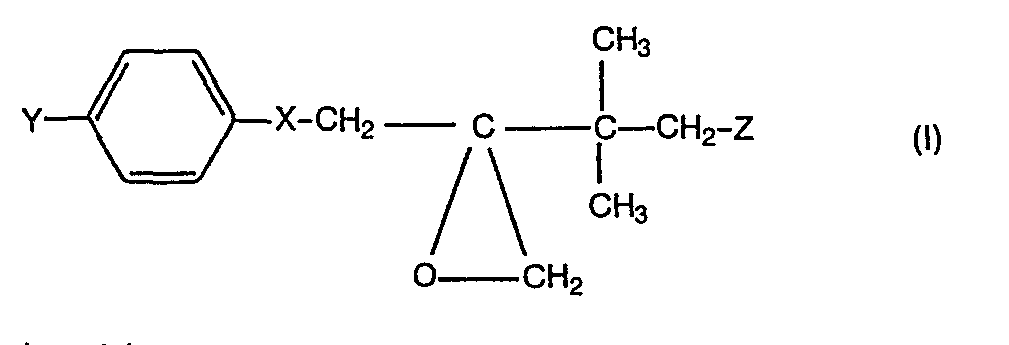
- oxiranes of formula (I) e.g. the 2- (4-chlorophenylethyl) -2-tert-butyl-oxirane
- oxiranes of formula (I) can be produced in higher yield by the process according to the invention than by the previously known process, in which dimethyl sulfide and dimethyl sulfate served as starting materials.
- the method according to the invention has a number of advantages. It enables the production of oxiranes of the formula (I) in very good yields. In addition, the raw materials are relatively inexpensive and also available on an industrial scale.
- oxiranes which can be prepared by the process according to the invention are defined by the formula (I).
- X represents oxygen or the CH 2 group and Y represents chlorine or phenyl.
- the radical Z is preferably hydrogen, fluorine or chlorine.
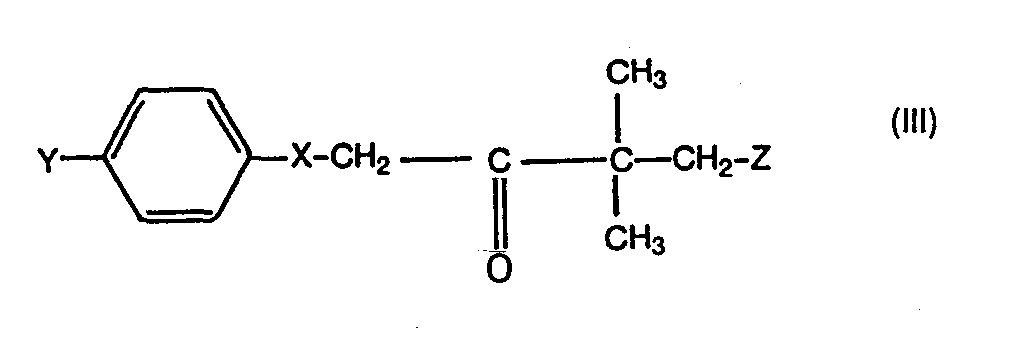
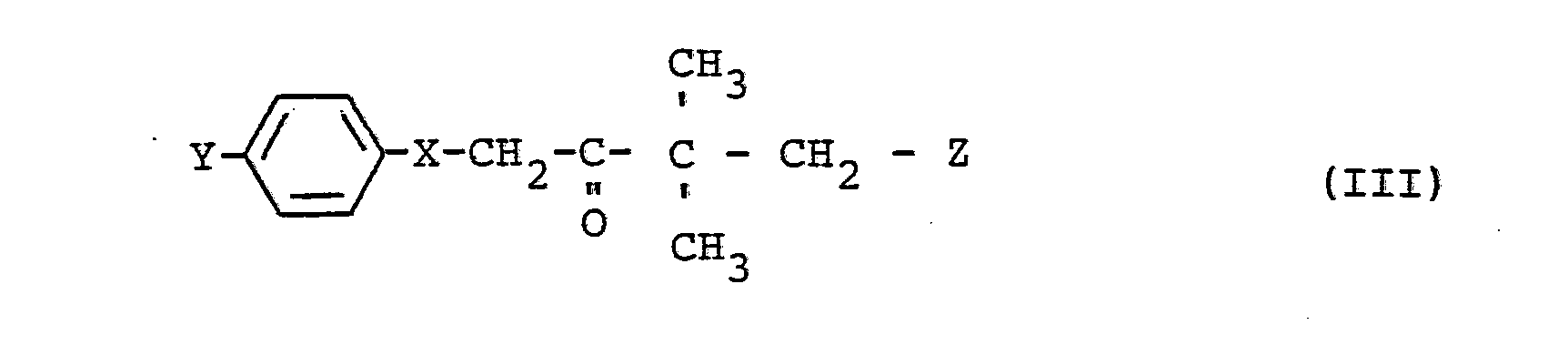
- ketones required as starting materials in the process according to the invention are defined by the formula (III).
- Y represents chlorine or phenyl
- X represents oxygen or the CH 2 group.
- the radical Z is preferably hydrogen, fluorine or chlorine.
- ketones of the formula (III) are known (cf. DE-PS 22 01 063, DE-OS 27 05 678 and DE-OS 27 37 489).
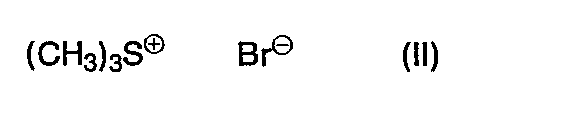
- the trimethylsulfonium bromide of the formula (II) which is also required as a starting material in the process according to the invention is also known (cf. Ber. 96, 1881-1890 (1963)). It is used in the above reaction in a freshly prepared state, optionally without prior isolation.
- Strong inorganic and organic bases can be used as bases in the process according to the invention will.
- inert organic solvents can be used as diluents in the process according to the invention both in the preparation of the trimethylsulfonium bromide and in the subsequent reaction of this substance with a ketone of the formula (III).
- Preferred solvents for the reaction of dimethyl sulfide and methyl bromide are nitriles, such as acetonitrile, or low-boiling ketones, such as acetone.
- nitriles such as acetonitrile
- polar solvents such as dimethyl sulfoxide
- aromatic or aliphatic hydrocarbons such as hexane, benzene, toluene and xylene
- alcohols such as Isopropanol and tert-butanol
- reaction temperatures can be varied within a certain range when carrying out the process according to the invention.
- Tem temperatures between 0 ° C and 60 ° C, preferably between 10 ° C and 40 ° C.
- the process according to the invention is generally carried out at normal pressure. But it is also possible to work at elevated or reduced pressure.
- dimethyl sulfide is reacted in the first stage with an equivalent amount or also with an excess of methyl bromide.
- the amounts of reaction components are generally chosen so that for 1 mole of ketone of the formula (III) 1.0 to 2.0 moles, preferably 1.1 to 1.5 moles of trimethylsulfonium bromide and 1, 0 to 2.0 mol, preferably 1.0 to 1.5 mol, of base are present.
- the procedure for carrying out the process according to the invention is such that methyl bromide is introduced into a solution of methyl sulfide in an organic solvent and then the salt formed either after prior isolation or directly into a mixture of ketone of the formula (III) and Base in an organic solvent.
- the processing takes place according to usual methods.
- the reaction mixture is mixed with an oxidizing agent, such as an aqueous hydrogen peroxide solution or a mixture of dilute aqueous sodium or potassium hypochlorite solution, and further with a water-immiscible solvent and water, the separates the organic phase, washes and, after drying, if appropriate, concentrates.
- the resulting product can be distilled under reduced pressure for further purification.
- oxiranes of the formula (I) which can be prepared by the process according to the invention are valuable starting materials for the synthesis of 1-hydroxyethyl-azole derivatives which have excellent plant growth-regulating and fungicidal properties (cf. EP-OS 40 345).
- 1- (4-chlorophenyl) -4,4-dimethyl-3- (1,2,4-triazol-1-yl-methyl) -pentan-3-ol of the formula can be used produce by reacting 2- (4-chlorophenyl-ethyl) -2-tert-butyl-oxirane with 1,2,4-triazole in the presence of potassium hydroxide.
- This synthesis can be illustrated as follows:
- reaction mixture was stirred for 4 hours and then left to stand overnight.
- the reaction mixture was then concentrated under reduced pressure and the remaining residue was dissolved in ethyl acetate.
- the resulting solution was washed with water and, after drying over sodium sulfate, concentrated by stripping off the solvent under reduced pressure.
Landscapes
- Chemical & Material Sciences (AREA)
- Organic Chemistry (AREA)
- Epoxy Compounds (AREA)
Abstract
- Y für Chlor oder Phenyl steht,
- X für Sauerstoff oder CH2 steht und
- Z für Wasserstoff oder Halogen steht,
dadurch herstellen, daß man Dimethylsulfid mit Methylbromid in Gegenwart eines inerten organischen Verdünnungsmittels behandelt und das dabei entstehende Trimethylsulfonium-bromid der Formel
- X, Y und Z die oben angegebene Bedeutung haben,
in Gegenwart einer Base sowie in Gegenwart eines inerten organischen Verdünnungsmittels bei Temperaturen zwischen 0°C und 60°C umsetzt.
Description
- Die vorliegende Erfindung betrifft ein neues Verfahren zur Herstellung von bekannten Oxiranen, die als Zwischenprodukte zur Synthese von Verbindungen mit pflanzenwuchsregulierender und fungizider Wirksamkeit verwendet werden können.
- Es ist bereits bekannt geworden, daß man Oxirane herstellen kann, indem man Dimethylsulfid mit Methylbromid umsetzt und das dabei entstehende Trimethylsulfonium-bromid anschließend mit Carbonyl-Verbindungen in Gegenwart eines inerten organischen Lösungsmittels und in Gegenwart einer starken Base, wie Natriumhydrid, Natriumamid oder Kalium-tert.-butylat, zur Reaktion bringt (vgl. Ber. 96, 1881-1890 (1963)).
- Weiterhin ist bekannt, daß sich 2-(4-Chlorphenyl- ethyl)-2-tert.-butyl-oxiran herstellen läßt, indem man aus Dimethylsulfid und Dimethylsulfat zubereitetes Trimethylsulfonium-methylsulfat mit 1-(4-Chlorphenyl)-4,4-dimethyl-pentan-3-on in Acetonitril in Gegenwart von Natriummethylat umsetzt (vgl. EP-OS 40 345). Die Ausbeuten bei diesem Verfahren sind gut, aber dennoch für praktische Zwecke nicht immer ausreichend.
- Es wurde nun gefunden, daß man die bekannten Oxirane der Formel

- Y für Chlor oder Phenyl steht,
- X für Sauerstoff oder CH2 steht und
- Z für Wasserstoff oder Halogen steht,
- X, Y und Z die oben angegebene Bedeutung haben,
- Es ist als äußerst überraschend zu bezeichnen, daß sich Oxirane der Formel (I), z.B. das 2-(4-Chlor-phenylethyl)-2-tert.-butyl-oxiran, nach dem erfindungsgemäßen Verfahren in höherer Ausbeute herstellen lassen als nach dem bisher bekannten Verfahren, bei dem Dimethylsulfid und Dimethylsulfat als Ausgangsstoffe dienten.
- Das erfindungsgemäße Verfahren besitzt eine Reihe von Vorteilen. So ermöglicht es die Herstellung von Oxiranen der Formel (I) in sehr guten Ausbeuten. Außerdem sind die Ausgangsstoffe relativ preisgünstig und auch in technischem Maßstab verfügbar.
- Die nach dem erfindungsgemäßen Verfahren herstellbaren Oxirane sind durch die Formel (I) definiert. In dieser Formel steht X für Sauerstoff oder die CH2-Gruppe und Y für Chlor oder Phenyl. Der Rest Z steht vorzugsweise für Wasserstoff, Fluor oder Chlor.
- Verwendet man bei dem erfindungsgemäßen Verfahren neben Dimethylsulfid und Methylbromid das 1-(4-Chlor-phenyl)-4,4-dimethyl-pentan-3-on als Ausgangsstoff und Kalium- tert.-butylat als Base, so kann der Reaktionsablauf durch das folgende Formelschema veranschaulicht werden:


- Die bei dem erfindungsgemäßen Verfahren als Ausgangsstoffe benötigten Ketone sind durch die Formel (III) definiert. In dieser Formel steht Y für Chlor oder Phenyl, und X steht für Sauerstoff oder die CH2-Gruppe. Der Rest Z steht vorzugsweise für Wasserstoff, Fluor oder Chlor.
- Die Ketone der Formel (III) sind bekannt (vgl. DE-PS 22 01 063, DE-OS 27 05 678 und DE-OS 27 37 489).
- Das bei dem erfindungsgemäßen Verfahren weiterhin als Ausgangsstoff benötigte Trimethylsulfonium-bromid der Formel (II) ist ebenfalls bekannt (vgl. Ber. 96, 1881-1890 (1963)). Es wird bei der obigen Umsetzung in frisch hergestelltem Zustand, gegebenenfalls ohne vorherige Isolierung, verwendet.
- Als Basen können bei dem erfindungsgemäßen Verfahren starke anorganische und organische Basen verwendet werden. Vorzugsweise in Betracht kommen Natriumhydrid, Natriumamid, außerdem Alkalialkoholate, wie Natriummethylat, Natriumethylat und Kalium-tert.-butylat, und ferner auch Alkalihydroxide, wie Kaliumhydroxid und Natriumhydroxid.
- Als Verdünnungsmittel können bei dem erfindungsgemäßen Verfahren sowohl bei der Herstellung des Trimethylsulfonium-bromids als auch bei der anschließenden Umsetzung dieses Stoffes mit einem Keton der Formel (III) alle inerten organischen Lösungsmittel verwendet werden. Vorzugsweise kommen bei der Umsetzung von Dimethylsulfid und Methylbromid als Solventien Nitrile, wie Acetonitril, oder niedrig siedende Ketone, wie Aceton, in Frage. Bei der anschließenden Umsetzung des Trimethylsulfonium-bromids mit einem Keton der Formel (III) kommen Nitrile, wie Acetonitril, ferner polare Solventien, wie Dimethylsulfoxid, weiterhin aromatische oder aliphatische Kohlenwasserstoffe, wie Hexan, Benzol, Toluol und Xylol, und außerdem auch Alkohole, wie Isopropanol und tert.-Butanol, als Lösungsmittel in Betracht. Es können auch Gemische dieser Lösungsmittel verwendet werden.
- Die Reaktionstemperaturen können bei der Durchführung des erfindungsgemäßen Verfahrens innerhalb eines bestimmten Bereiches variiert werden. Im allgemeinen arbeitet man sowohl bei der Herstellung des Trimethylsulfonium-bromids als auch bei dessen anschließender Umsetzung mit einem Keton der Formel (III) bei Temperaturen zwischen 0°C und 60°C, vorzugsweise zwischen 10°C und 40°C.
- Das erfindungsgemäße Verfahren wird im allgemeinen bei Normaldruck durchgeführt. Es ist aber auch möglich, bei erhöhtem oder vermindertem Druck zu arbeiten.
- Bei der Durchführung des erfindungsgemäßen Verfahrens setzt man in der ersten Stufe Dimethylsulfid mit einer äquivalenten Menge oder auch mit einem Überschuß an Methylbromid um. In der zweiten Stufe werden die Mengen an Reaktionskomponenten im allgemeinen so gewählt, daß auf 1 Mol an Keton der Formel (III) 1,0 bis 2,0 Mol, vorzugsweise 1,1 bis 1,5 Mol an Trimethylsulfonium-bromid und 1,0 bis 2,0 Mol, vorzugsweise 1,0 bis 1,5 Mol an Base vorhanden sind.
- Im einzelnen verfährt man bei der Durchführung des erfindungsgemäßen Verfahrens in der Weise, daß man in eine Lösung von Djmethylsulfid in einem organischen Solvens Methylbromid einleitet und dann das entstandene Salz entweder nach vorheriger Isolierung oder aber direkt in ein Gemisch aus Keton der Formel (III) und Base in einem organischen Solvens gibt. Die Aufarbeitung erfolgt nach üblichen Methoden. Im allgemeinen geht man so vor, daß man das Reaktionsgemisch mit einem Oxidationsmittel, wie z.B. einer wäßrigen Wasserstoffperoxid-Lösung oder einem Gemisch aus verdünnter, wäßriger Natrium- oder Kaliumhypochlorit-Lösung, und ferner mit einem mit Wasser wenig mischbaren Lösungsmittel und Wasser versetzt, die organische Phase abtrennt, wäscht und nach gegebenenfalls vorherigem Trocknen einengt. Das dabei anfallende Produkt kann zur weiteren Reinigung unter vermindertem Druck destilliert werden.
- Die nach dem erfindungsgemäßen Verfahren herstellbaren Oxirane der Formel (I) sind wertvolle Ausgangsstoffe zur Synthese von 1-Hydroxyethyl-azol-Derivaten welche hervorragende pflanzenwuchsregulierende und fungizide Eigenschaften besitzen (vgl. EP-OS 40 345).
- So läßt sich beispielsweise das 1-(4-Chlorphenyl)-4,4-dimethyl-3-(1,2,4-triazol-1-yl-methyl)-pentan-3-ol der Formel


- Das erfindungsgemäße Verfahren wird durch die nachfolgenden Beispiele veranschaulicht.
-

- In ein Gemisch von 22,4 g (0,2 Mol) Kalium-tert.-butylat in 100 ml tert.-Butanol wurden bei Raumtemperatur unter Rühren 22,4 g (0,1 Mol) 1-(4-Chlor-phenyl)-4,4-dimethyl- pentan-3-on gegeben. Danach wurden 23,5 g (0,15 Mol) Trimethylsulfonium-bromid zugesetzt, wobei die Temperatur des Reaktionsgemisches auf 30°C anstieg. Nach 22- stündigem Nachrühren bei Raumtemperatur wurde ein quantitativer Umsatz erzielt. Der Gehalt an dem gewünschten Endprodukt betrug gemäß gaschromatographischer Analyse 98,8 %. Zur Aufarbeitung wurde das Reaktionsgemisch nacheinander mit 200 ml Wasser und 20 ml wäßriger Natriumhypochlorit-Lösung versetzt. Danach wurde mit insgesamt 250 ml Ethylenchlorid extrahiert, die organische Phase mit Wasser neutral gewaschen und anschließend durch Abziehen des Lösungsmittels unter vermindertem Druck eingeengt. Es verblieb ein öliger Rückstand von 21,1 gi der gemäß Gaschromatogramm zu 95,9 % aus 2-(4-Chlor-phenylethyl)-2-tert.-butyl-oxiran bestand. Danach errechnet sich eine Ausbeute von 84,8 % der Theorie.
- Herstellung von 2-(4-Chlor-phenyl-ethyl)-2-tert.-butyloxiran der Formel

- Zu einer Lösung von 126 ml (1,33 Mol) Dimethylsulfat in 670 ml Acetonitril wurde unter Rühren eine Lösung von 108 ml (1,47 Mol) Dimethylsulfid in 130 ml Acetonitril getropft. Man ließ das Reaktionsgemisch über Nacht stehen und versetzte dann mit 79,2 g (1,47 Mol) festem gepulvertem Natriummethylat, wobei die Temperatur des Reaktionsgemisches auf etwa 20°C gahalten wurde. Danach wurde eine Lösung von 179 g (0,8 Mol) 1-(4-Chlor-phenyl)-4,4-dimethyl- pentan-3-on in 250 ml Acetonitril zugetropft. Das Reaktionsgemisch wurde 4 Stunden nachgerührt und dann über Nacht stehen gelassen. Anschließend wurde das Reaktionsgemisch unter vermindertem Druck eingeengt, und der verbleibende Rückstand wurde in Essigester gelöst. Die dabei entstehende Lösung wurde mit Wasser gewaschen und nach dem Trocknen über Natriumsulfat durch Abziehen des Lösungsmittels unter vermindertem Druck eingeengt.
- Der verbleibende Rückstand wurde einer Vakuumdestillation unterworfen. Man erhielt auf diese Weise 157 g eines Produktes, das einen Siedepunkt von 102 - 105°C bei 0,01 mbar aufwies und das gemäß Gaschromatogramm zu 53 % aus 2-(4-Chlor-phenyl-ethyl)-2-tert.-butyl-oxiran bestand. Danach errechnet sich eine Ausbeute von 43 % der Theorie.
- Beispiel für die Verwendung eines erfindungsgemäß herstellbaren Oxirans zur Synthese eines 1-Hydroxyethyl-azol-Derivates mit pflanzenwuchsregulierender und fungizider Wirksamkeit
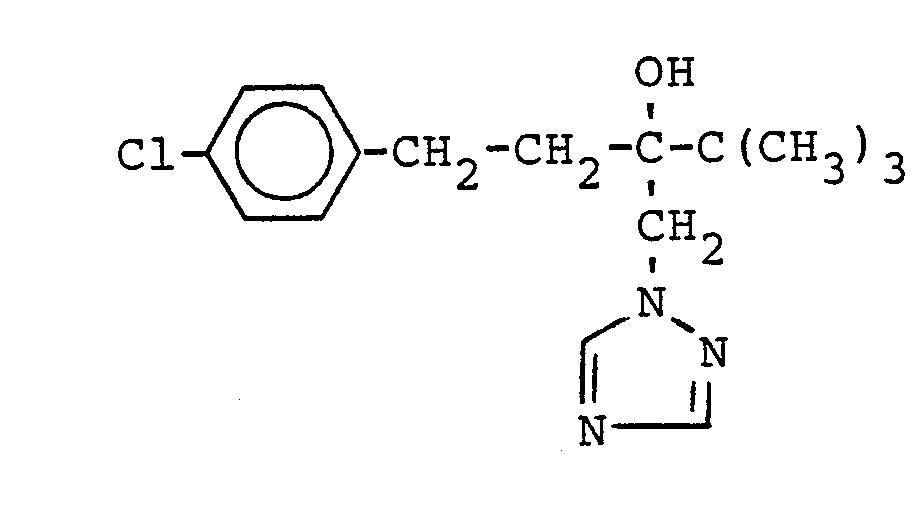
- Eine Lösung von 27,1 g (0,1 Mol) eines Produktes, das zu 88 % aus 2-(4-Chlor-phenyl-ethyl)-2-tert.-butyl-oxiran bestand, 8,3 g (0,12 Mol) 1,2,4-Triazol und 0,06 g (0,01 Mol) Kaliumhydroxid in 100 ml n-Propanol wurde 30 Stunden auf 95°C erhitzt. Danach ließ man abkühlen und engte das Reaktionsgemisch durch Abziehen des Lösungsmittels unter vermindertem Druck ein. Der verbliebene Rückstand wurde in Toluol aufgenommen, die dabei entstehende Suspension wurde filtriert, und das Filtrat wurde durch Abziehen des Lösungsmittels unter vermindertem Druck eingeengt. Der anfallende Rückstand wurde aus Ligroin umkristallisiert. Man erhielt auf diese Weise 30,6 g eines Produktes, das gemäß HPLC-Analyse zu 67,4 % aus 1-(4-Chlor-phenyl)-4,4-dimethyl-3-(1,2,4-triazol-1-yl-methyl)-pentan-3-ol bestand. Danach errechnet sich eine Ausbeute von 67 % der Theorie.
erhält, wenn man Dimethylsulfid mit Methylbromid in Gegenwart eines inerten organischen Verdünnungsmittels behandelt und das dabei entstehende Trimethylsulfonium-bromid der Formel


in Gegenwart einer Base sowie in Gegenwart eines inerten organischen Verdünnungsmittels bei Temperaturen zwischen 0°C und 60°C umsetzt.
Claims (4)
- Verfahren zur Herstellung von Oxiranen der Formel
 Y für Chlor oder Phenyl steht,X für Sauerstoff oder CH2 steht undZ für Wasserstoff oder Halogen steht,
dadurch gekennzeichnet, daß man Dimethylsulfid mit Methylbromid in Gegenwart eines inerten organischen Verdünnungsmittels behandelt und das dabei entstehende Trimethylsulfonium-bromid der Formel
 X, Y und Z die oben angegebene Bedeutung haben,
in Gegenwart einer Base sowie in Gegenwart eines inerten organischen Verdünnungsmittels bei Temperaturen zwischen 0°C und 60°C umsetzt. - 2. Verfahren gemäß Anspruch 1, dadurch gekennzeichnet, daß man die Umsetzung bei Temperaturen zwischen 10°C und 40°C durchführt.
- 3. Verfahren gemäß Anspruch 1, dadurch gekennzeichnet, daß man in der zweiten Stufe des Verfahrens als organische Verdünnungsmittel Acetonitril, Dimethylsulfoxid, Toluol, Isopropanol und/oder tert.-Butanol einsetzt.
- 4. Verfahren gemäß Anspruch 1, dadurch gekennzeichnet, daß man als Keton der Formel (III) 1-(4-Chlorphenyl)-4,4-dimethyl-pentan-3-on einsetzt.
Applications Claiming Priority (2)
| Application Number | Priority Date | Filing Date | Title |
|---|---|---|---|
| DE3315510 | 1983-04-29 | ||
| DE19833315510 DE3315510A1 (de) | 1983-04-29 | 1983-04-29 | Verfahren zur herstellung von oxiranen |
Publications (3)
| Publication Number | Publication Date |
|---|---|
| EP0124014A2 true EP0124014A2 (de) | 1984-11-07 |
| EP0124014A3 EP0124014A3 (en) | 1985-07-03 |
| EP0124014B1 EP0124014B1 (de) | 1988-10-05 |
Family
ID=6197651
Family Applications (1)
| Application Number | Title | Priority Date | Filing Date |
|---|---|---|---|
| EP84104333A Expired EP0124014B1 (de) | 1983-04-29 | 1984-04-17 | Verfahren zur Herstellung von Oxiranen |
Country Status (4)
| Country | Link |
|---|---|
| US (1) | US4992565A (de) |
| EP (1) | EP0124014B1 (de) |
| JP (1) | JPS59206374A (de) |
| DE (2) | DE3315510A1 (de) |
Cited By (2)
| Publication number | Priority date | Publication date | Assignee | Title |
|---|---|---|---|---|
| EP0290907A1 (de) * | 1987-05-14 | 1988-11-17 | Bayer Ag | Verfahren zur Herstellung von Acetylenepoxiden und deren Verwendung |
| US4988823A (en) * | 1988-07-08 | 1991-01-29 | Bayer Aktiengesellschaft | Optically active oxiranes |
Families Citing this family (8)
| Publication number | Priority date | Publication date | Assignee | Title |
|---|---|---|---|---|
| DE3824457C2 (de) * | 1988-07-19 | 1995-07-27 | Bayer Ag | Verfahren zur Herstellung von 2- (4-Chlorphenyl-ethyl) -2- tert.-butyl-oxiran |
| JPH0383973A (ja) * | 1989-08-28 | 1991-04-09 | Sumitomo Pharmaceut Co Ltd | エポキシ体のスレオ選択的製造法 |
| US5194636A (en) * | 1990-06-13 | 1993-03-16 | Bayer Aktiengesellschaft | Preparation of benzyl ketones and an oxirane |
| DE4030061A1 (de) * | 1990-06-13 | 1991-12-19 | Bayer Ag | Verfahren zur herstellung von benzylketonen sowie verfahren zur herstellung eines oxiranes |
| GB9103260D0 (en) * | 1991-02-15 | 1991-04-03 | Ici Plc | Chemical process |
| US5408033A (en) * | 1993-04-01 | 1995-04-18 | Miles Inc. | Process for the preparation of an epoxide from ketones using an alcohol or ether catalyst |
| CN107935900B (zh) * | 2017-12-13 | 2022-02-11 | 湖北大学 | 一种三甲基氯化锍的制备方法 |
| CN109336849A (zh) * | 2018-10-26 | 2019-02-15 | 江苏七洲绿色化工股份有限公司 | 一种2-[2-(4-氯苯基)乙基]-2-(1,1-二甲基乙基)环氧乙烷的制备方法 |
Family Cites Families (3)
| Publication number | Priority date | Publication date | Assignee | Title |
|---|---|---|---|---|
| CH614201A5 (en) * | 1975-04-11 | 1979-11-15 | Hoffmann La Roche | Process for the preparation of epoxides |
| AU542623B2 (en) * | 1980-05-16 | 1985-02-28 | Bayer Aktiengesellschaft | 1-hydroxyethyl-azole derivatives |
| DE3315524A1 (de) * | 1983-04-29 | 1984-10-31 | Bayer Ag, 5090 Leverkusen | Verfahren zur herstellung von oxiranen |
-
1983
- 1983-04-29 DE DE19833315510 patent/DE3315510A1/de not_active Withdrawn
-
1984
- 1984-04-17 DE DE8484104333T patent/DE3474450D1/de not_active Expired
- 1984-04-17 EP EP84104333A patent/EP0124014B1/de not_active Expired
- 1984-04-25 JP JP59082139A patent/JPS59206374A/ja active Granted
-
1990
- 1990-04-12 US US07/512,612 patent/US4992565A/en not_active Expired - Lifetime
Cited By (2)
| Publication number | Priority date | Publication date | Assignee | Title |
|---|---|---|---|---|
| EP0290907A1 (de) * | 1987-05-14 | 1988-11-17 | Bayer Ag | Verfahren zur Herstellung von Acetylenepoxiden und deren Verwendung |
| US4988823A (en) * | 1988-07-08 | 1991-01-29 | Bayer Aktiengesellschaft | Optically active oxiranes |
Also Published As
| Publication number | Publication date |
|---|---|
| EP0124014A3 (en) | 1985-07-03 |
| DE3474450D1 (en) | 1988-11-10 |
| JPH0458473B2 (de) | 1992-09-17 |
| DE3315510A1 (de) | 1984-10-31 |
| EP0124014B1 (de) | 1988-10-05 |
| JPS59206374A (ja) | 1984-11-22 |
| US4992565A (en) | 1991-02-12 |
Similar Documents
| Publication | Publication Date | Title |
|---|---|---|
| EP0124009B1 (de) | Verfahren zur Herstellung von Oxiranen | |
| EP0061051B1 (de) | Substituierte Triazolylmethyl-oxirane, Verfahren zu ihrer Herstellung sowie ihre Verwendung als Zwischenprodukte | |
| EP0143384B1 (de) | Verfahren zur Herstellung von Beta-Hydroxyethyl-(1,2,4-triazol)-Derivaten | |
| EP0124011B1 (de) | Verfahren zur Herstellung von Oxiranen | |
| EP0124014B1 (de) | Verfahren zur Herstellung von Oxiranen | |
| EP0124013B1 (de) | Verfahren zur Herstellung von Oxiranen | |
| EP0219799B1 (de) | Verfahren zur Herstellung von Oxiranen | |
| DE4030061A1 (de) | Verfahren zur herstellung von benzylketonen sowie verfahren zur herstellung eines oxiranes | |
| EP0017080A2 (de) | Verfahren zur Herstellung von Hydroxyethyl-azolen; Zwischenprodukte | |
| EP0035697B1 (de) | 3,3-Dimethyl-1-phenoxy-butan-2-ole, Verfahren zu ihrer Herstellung sowie ihre Verwendung als Zwischenprodukte | |
| CH632501A5 (de) | Verfahren zur herstellung von 1-azolyl-3,3-dimethyl-1-phenoxy-butan-2-onen. | |
| EP0169439B1 (de) | Verfahren und Zwischenprodukte zur Synthese von diastereomeren Triazolyl-O,N-acetalen | |
| EP0143379B1 (de) | Verfahren zur Herstellung von beta-Hydroxyethyl-(1,2,4-triazol)-Derivaten | |
| DE3824457C2 (de) | Verfahren zur Herstellung von 2- (4-Chlorphenyl-ethyl) -2- tert.-butyl-oxiran | |
| DE3021516C2 (de) | ||
| EP0222205B1 (de) | Verfahren zur Herstellung von Imidazolyl-methan-Derivaten | |
| EP0290907B1 (de) | Verfahren zur Herstellung von Acetylenepoxiden und deren Verwendung | |
| EP0250897B1 (de) | Verfahren zur Herstellung von Hydroxybenzaldoxim-O-ethern | |
| DE3603100C2 (de) | Verfahren zur Herstellung von Nitromethylen-Derivaten | |
| EP0277572A2 (de) | Verfahren zur Herstellung optisch aktiver 2-Hydroxyethyl-azol-Derivate | |
| EP0307791A1 (de) | Bisazolyl-hydroxyalkyl-Derivate | |
| EP0047941B1 (de) | Verfahren zur Herstellung und Reinigung von Phenoxy-azolyl-butanon-Derivaten | |
| DE3021516C1 (de) | ||
| EP0096801B1 (de) | Azolylmethyl-ketone, Verfahren zu ihrer Herstellung und ihre Verwendung als Zwischenprodukte | |
| EP0248253A2 (de) | Verfahren zur Herstellung eines Azol-Derivates |
Legal Events
| Date | Code | Title | Description |
|---|---|---|---|
| PUAI | Public reference made under article 153(3) epc to a published international application that has entered the european phase |
Free format text: ORIGINAL CODE: 0009012 |
|
| 17P | Request for examination filed |
Effective date: 19840417 |
|
| AK | Designated contracting states |
Designated state(s): BE CH DE FR GB LI |
|
| PUAL | Search report despatched |
Free format text: ORIGINAL CODE: 0009013 |
|
| AK | Designated contracting states |
Designated state(s): BE CH DE FR GB LI |
|
| 17Q | First examination report despatched |
Effective date: 19870108 |
|
| GRAA | (expected) grant |
Free format text: ORIGINAL CODE: 0009210 |
|
| AK | Designated contracting states |
Kind code of ref document: B1 Designated state(s): BE CH DE FR GB LI |
|
| ET | Fr: translation filed | ||
| REF | Corresponds to: |
Ref document number: 3474450 Country of ref document: DE Date of ref document: 19881110 |
|
| GBT | Gb: translation of ep patent filed (gb section 77(6)(a)/1977) | ||
| PLBE | No opposition filed within time limit |
Free format text: ORIGINAL CODE: 0009261 |
|
| STAA | Information on the status of an ep patent application or granted ep patent |
Free format text: STATUS: NO OPPOSITION FILED WITHIN TIME LIMIT |
|
| 26N | No opposition filed | ||
| REG | Reference to a national code |
Ref country code: GB Ref legal event code: IF02 |
|
| PGFP | Annual fee paid to national office [announced via postgrant information from national office to epo] |
Ref country code: DE Payment date: 20030314 Year of fee payment: 20 |
|
| PGFP | Annual fee paid to national office [announced via postgrant information from national office to epo] |
Ref country code: FR Payment date: 20030415 Year of fee payment: 20 |
|
| PGFP | Annual fee paid to national office [announced via postgrant information from national office to epo] |
Ref country code: GB Payment date: 20030416 Year of fee payment: 20 |
|
| PGFP | Annual fee paid to national office [announced via postgrant information from national office to epo] |
Ref country code: CH Payment date: 20030425 Year of fee payment: 20 |
|
| PGFP | Annual fee paid to national office [announced via postgrant information from national office to epo] |
Ref country code: BE Payment date: 20030430 Year of fee payment: 20 |
|
| PG25 | Lapsed in a contracting state [announced via postgrant information from national office to epo] |
Ref country code: LI Free format text: LAPSE BECAUSE OF EXPIRATION OF PROTECTION Effective date: 20040416 Ref country code: GB Free format text: LAPSE BECAUSE OF EXPIRATION OF PROTECTION Effective date: 20040416 Ref country code: CH Free format text: LAPSE BECAUSE OF EXPIRATION OF PROTECTION Effective date: 20040416 |
|
| BE20 | Be: patent expired |
Owner name: *BAYER A.G. Effective date: 20040417 |
|
| REG | Reference to a national code |
Ref country code: GB Ref legal event code: PE20 |
|
| REG | Reference to a national code |
Ref country code: CH Ref legal event code: PL |