EP0106552B1 - Procédé pour la production de zéolithes - Google Patents
Procédé pour la production de zéolithes Download PDFInfo
- Publication number
- EP0106552B1 EP0106552B1 EP83305527A EP83305527A EP0106552B1 EP 0106552 B1 EP0106552 B1 EP 0106552B1 EP 83305527 A EP83305527 A EP 83305527A EP 83305527 A EP83305527 A EP 83305527A EP 0106552 B1 EP0106552 B1 EP 0106552B1
- Authority
- EP
- European Patent Office
- Prior art keywords
- alkali metal
- weight
- metal hydroxide
- homogeneous phase
- phase compound
- Prior art date
- Legal status (The legal status is an assumption and is not a legal conclusion. Google has not performed a legal analysis and makes no representation as to the accuracy of the status listed.)
- Expired
Links
Images
Classifications
-
- C—CHEMISTRY; METALLURGY
- C01—INORGANIC CHEMISTRY
- C01B—NON-METALLIC ELEMENTS; COMPOUNDS THEREOF; METALLOIDS OR COMPOUNDS THEREOF NOT COVERED BY SUBCLASS C01C
- C01B33/00—Silicon; Compounds thereof
- C01B33/20—Silicates
- C01B33/26—Aluminium-containing silicates, i.e. silico-aluminates
- C01B33/28—Base exchange silicates, e.g. zeolites
- C01B33/2807—Zeolitic silicoaluminates with a tridimensional crystalline structure possessing molecular sieve properties; Isomorphous compounds wherein a part of the aluminium ore of the silicon present may be replaced by other elements such as gallium, germanium, phosphorus; Preparation of zeolitic molecular sieves from molecular sieves of another type or from preformed reacting mixtures
- C01B33/2861—Zeolitic silicoaluminates with a tridimensional crystalline structure possessing molecular sieve properties; Isomorphous compounds wherein a part of the aluminium ore of the silicon present may be replaced by other elements such as gallium, germanium, phosphorus; Preparation of zeolitic molecular sieves from molecular sieves of another type or from preformed reacting mixtures of mordenite type, e.g. ptilolite or dachiardite
-
- C—CHEMISTRY; METALLURGY
- C01—INORGANIC CHEMISTRY
- C01B—NON-METALLIC ELEMENTS; COMPOUNDS THEREOF; METALLOIDS OR COMPOUNDS THEREOF NOT COVERED BY SUBCLASS C01C
- C01B33/00—Silicon; Compounds thereof
- C01B33/20—Silicates
- C01B33/26—Aluminium-containing silicates, i.e. silico-aluminates
- C01B33/28—Base exchange silicates, e.g. zeolites
- C01B33/2807—Zeolitic silicoaluminates with a tridimensional crystalline structure possessing molecular sieve properties; Isomorphous compounds wherein a part of the aluminium ore of the silicon present may be replaced by other elements such as gallium, germanium, phosphorus; Preparation of zeolitic molecular sieves from molecular sieves of another type or from preformed reacting mixtures
- C01B33/2869—Zeolitic silicoaluminates with a tridimensional crystalline structure possessing molecular sieve properties; Isomorphous compounds wherein a part of the aluminium ore of the silicon present may be replaced by other elements such as gallium, germanium, phosphorus; Preparation of zeolitic molecular sieves from molecular sieves of another type or from preformed reacting mixtures of other types characterised by an X-ray spectrum and a definite composition
-
- Y—GENERAL TAGGING OF NEW TECHNOLOGICAL DEVELOPMENTS; GENERAL TAGGING OF CROSS-SECTIONAL TECHNOLOGIES SPANNING OVER SEVERAL SECTIONS OF THE IPC; TECHNICAL SUBJECTS COVERED BY FORMER USPC CROSS-REFERENCE ART COLLECTIONS [XRACs] AND DIGESTS
- Y10—TECHNICAL SUBJECTS COVERED BY FORMER USPC
- Y10S—TECHNICAL SUBJECTS COVERED BY FORMER USPC CROSS-REFERENCE ART COLLECTIONS [XRACs] AND DIGESTS
- Y10S423/00—Chemistry of inorganic compounds
- Y10S423/22—MFI, e.g. ZSM-5. silicalite, LZ-241
-
- Y—GENERAL TAGGING OF NEW TECHNOLOGICAL DEVELOPMENTS; GENERAL TAGGING OF CROSS-SECTIONAL TECHNOLOGIES SPANNING OVER SEVERAL SECTIONS OF THE IPC; TECHNICAL SUBJECTS COVERED BY FORMER USPC CROSS-REFERENCE ART COLLECTIONS [XRACs] AND DIGESTS
- Y10—TECHNICAL SUBJECTS COVERED BY FORMER USPC
- Y10S—TECHNICAL SUBJECTS COVERED BY FORMER USPC CROSS-REFERENCE ART COLLECTIONS [XRACs] AND DIGESTS
- Y10S423/00—Chemistry of inorganic compounds
- Y10S423/23—Ferrierite, e.g. SR-D ZSM-33
Definitions
- This invention relates to a process for the preparation of zeolites, for example zeolites having 5-membered rings of oxygen atoms and having a high purity and a high Si0 2 /AI 2 0 3 molar ratio.
- the zeolite is a crystalline aluminosilicate containing zeolitic water, which has an oxide molar composition represented by the following general formula: wherein M stands for a metal cation, n stands for the valency of the metal cation M, x is a number of at least 2, and y is a number larger than 0.
- the basic structure of the zeolite comprises Si0 4 tetrahedrons having four oxygen atoms at apexes with the silicon atom being as the center and A10 4 tetrahedrons having four oxygen atoms at apexes with the aluminum atom being as the center, where these Si0 4 tetrahedrons and A10 4 tetrahedrons are regularly and three-dimensionally connected to one another while owing oxygen atoms jointly.
- a three-dimensional network structure having pores differing in the size and shape according to the manner of connection of the tetrahedrons can be provided. Negative charges of the A10 4 tetrahedrons are electrically neutralized by coupling with cations of an alkali metal or alkaline earth metal.
- the thus-formed pores have a size of 2 to 10 angstroms or more, and the pore size can be changed by exchanging the metal cations connected to the A10 4 tetrahedrons with other metal cations having a different
- the zeolite is widely used as a dehydrating agent for a gas or liquid or as a molecular sieve for adsorbing and separating specific molecules by utilizing the above-mentioned pores. Furthermore, the zeolite is used on an industrial scale as a catalyst by utilizing properties as the solid acid.
- zeolites differing in the crystal structure and chemical composition are known, and the adsorbing properties, catalytic properties and ion-exchanging properties differ according to the differences of the crystal structure and chemical composition. Different names are given to these zeolites.
- mordenite, offretite, erionite, clinoptilolite and chabazite are naturally present, and they can also be obtained by the hydrothermal synthesis.
- Zeolites A, X and Y are not naturally present, but they are obtained only by the hydrothermal synthesis.
- the zeolites prepared by the process of the present invention are classified into two types, one of which is similar to a ZSM-5 type and the other of which is a ferrierite type.
- Japanese Unexamined Patent Publication No. 57-7,819 teaches a process in which the synthesis is carried out in the presence of a seed crystal synthesized in the presence of tetrapropyl ammonium bromide.
- Japanese Examined Patent Publication No. 56-49,851 discloses a process in which a zeolite similar to ZSM-5 is synthesized in the absence of an organic mineralizer by using a silica sol as the silica source.
- a zeolite similar to ZSM-5 was obtained only when an aqueous solution of sodium silicate was used as the silica source, fine ZSM was added as a seed crystal and crystallization was effected under heating with stirring. However, mordenite and kenyaite were present as impurities in the product. Even if various experiments were performed without addition of a seed crystal by using an aqueous solution of sodium silicate as the silica source, the intended object could not be attained.
- a ferrierite type zeolite naturally occurs, and its typical composition is represented as follows:
- the crystal structure of this zeolite comprises 5-membered oxygen ring units constituting the skeleton and is characterized in that it has fine pores of 10-membered rings of oxygen atoms having a size of 4.3x5.5 A and fine pores of 8-membered rings of oxygen atoms having a size of 3.4x4.8 A.
- EP 0 016 393 discloses the reaction of an aqueous sodium aluminate with aqueous sodium silicate in excess sodium hydroxide to give finely divided amorphous sodium aluminosilicate.
- the amorphous aluminosilicate is separated from the aqueous alkaline suspension, and the washed compounds is recrystallised from hot aqueous alkali solution.
- the product of this reaction has a composition suitable only for the preparation of an Na-A type zeolite.
- the primary object of the present invention is to provide a process in which a ferrierite type zeolite or a zeolite similar to ZSM-5, having a high purity and a high Si0 2 /AI 2 0 3 ratio is easily and efficiently prepared with good reproductability by using cheap starting materials without using organic and inorganic mineralizers.
- a ferrierite type zeolite or a zeolite similar to ZSM-5 having a high purity and a high Si0 2 /AI 2 0 3 ratio is easily and efficiently prepared with good reproductability by using cheap starting materials without using organic and inorganic mineralizers.
- the zeolite, similar to ZSM-5, characterized as having lattice spacings, shown in Table 1, of the X-ray powder diffraction pattern is prepared preferably by crystallizing a homogeneous phase compound of a granular amorphous alumino silicate containing aluminum in an amount of 0.5 to 10% by weight as calculated as anhydrous A1 2 0 3 in an aqueous solution of an alkali metal hydroxide.
- the ferrierite type zeolite is prepared preferably by:
- the manner whereby the specified homogeneous phase compound of a granular amorphous aluminosilicate is prepared is not particularly critical, but any of the processes capable of providing such a homogeneous compound can be adopted.
- this homogeneous compound can be prepared by reacting an aqueous alkali metal silicate solution simultaneously and continuously with an aqueous aluminum-containing solution.
- the process for the preparation of the homogeneous phase compound of a granular amorphous aluminosilicate will now be described with reference to this typical embodiment.
- the "simultaneous and continuous reaction” referred to in this embodiment is meant a reaction to be carried out in such a manner that the aqueous alkali metal silicate solution and the aqueous aluminum-containing solution are simultaneously supplied to a reaction zone while always maintaining substantially the same ratio.
- aqueous solution of the alkali metal silicate there can be used aqueous solutions of lithium silicate, sodium silicate and potassium silicate.
- aqueous aluminum-containing solution there can be used aqueous solutions of aluminum sulfate, aluminum nitrate, aluminum chloride, sodium aluminate and potassium aluminate. If necessary, a caustic alkali or mineral acid may be added to these aqueous solutions so as to adjust the amount of the alkali or acid.
- a commercially available aqueous alkali metal silicate solution and a commercially available aqueous solution of a mineral acid salt of aluminum or an alkali metal aluminate may be used as the starting aqueous solutions.
- an aqueous solution formed by dissolving a silica source such as siliceous sand or hydrous solid silicic acid by a caustic alkali and an aqueous solution formed by dissolving an aluminum source such as aluminum hydroxide or activated alumina by a mineral acid or caustic alkali may be used.
- concentrations of both the aqueous solutions are not particularly critical, but optional concentrations may be adopted.
- both the aqueous solutions are simultaneously and continuously supplied with stirring to an overflow type reaction vessel provided with a stirrer.
- the homogeneous compound obtained according to this embodiment takes a shape of substantially spherical particles or agglomerates of fine particles.
- the particle size or agglomerate size of the majority of the particles or agglomerates is distributed in the range of from 1 to 500 microns and the fraction of fine particles or agglomerates having a size smaller than 1 micron is very small, especially good results can be obtained.
- a homogeneous compound having a particle or agglomerate size of 10 to 100 microns be used.
- the feed rates of both the aqueous solutions can optionally be determined according to the Si0 2 /AI 2 0 3 molar ratio of the intended zeolite.
- a slurry containing the homogeneous compound suspended therein is formed by the above reaction.
- the pH value of this slurry is adjusted by controlling the amounts of the alkali and acid to be added to both the aqueous solutions. It is ordinarily preferred that the pH value of the reaction slurry be adjusted to 5 to 9, more preferably 6 to 8.
- the residence time of the slurry in the reaction vessel is preferably at least 3 minutes.
- reaction time a period ranging from the point of the simultaneous and continuous supply of both the aqueous solutions to the reaction vessel to the point of the discharge of the reaction slurry containing the homogeneous compound formed by the reaction from the reaction vessel.
- the residence time is shorter than 3 minutes, the ratio of fine particles is increased. As described hereinafter, as the ratio of fine particles having a size smaller than 1 micron is increased, a larger load is imposed at the step of filtering for separating the formed compound. If the residence time is at least 3 minutes, the majority of formed particles are spherical particles and the proportion of fine particles is reduced. If the residence time is further prolonged, the particle size is increased, and the bonding among the particles becomes strong, resulting in increase of the hardness of the spherical particles. Accordingly, the size and hardness of the formed spherical particles can be varied by controlling the residence time, and the reactivity of the homogeneous compound per se can therefore be adjusted by controlling the residence time.
- both the aqueous solutions are simultaneously and continuously supplied at a certain ratio with stirring to a reaction vessel without discharging a reaction slurry.
- both the aqueous solutions should not be added promptly but the starting materials for one batch should be supplied over a period of at least 5 minutes, preferably at least 30 minutes.
- the reaction temperature adopted for the production of the homogeneous compound is not particularly critical, and spherical particles are formed at either a lower temperature or a higher temperature and no substantial difference of the reactivity is caused by the difference of the reaction temperature.
- a zeolite of an especially high-purity can be obtained, while if a pasty amorphous aluminosilicate compound obtained by adding one aqueous solution to the other aqueous solution according to a so-called batchwise reaction method is used as the starting material, the intended high purity zeolite cannot be obtained even when the crystallization is carried out under the same conditions.
- the composition of the formed spherical homogeneous compound is microscopically completely uniform irrespectively of the size of the formed spherical particles, and therefore, formation of impurities as by-products due to the non-uniform composition can be avoided.
- the reaction is carried out by adding one aqueous solution to the other aqueous solution according to the so-called batchwise method, the viscosity of the reaction slurry is abnormally increased and even if strong stirring is effected, it is impossible to render the formed slurry homogeneous. Even if the slurry is sufficiently mixed to be rendered homogeneous in appearance, microscopic non-uniformity of the composition cannot be avoided.
- the amorphous aluminosilicate compound obtained according to the batchwise method is used as the starting material, it is impossible to obtain the intended zeolite, and this is due to the non-uniformity of the composition.
- the granular amorphous aluminosilicate compound is called "homogeneous phase compound" in the present invention.
- the concentration of the effective ingredient is inevitably limited to a very low level.
- the homogeneous compound of the present invention consists of spherical particles having a size of 1 to 500 microns, the viscosity of the reaction slurry is very low and strong stirring required in the batchwise method need not be effected, and the concentration of the reaction slurry can be greatly increased.
- the homogenoeus compound prepared according to one typical embodiment is obtained in the form of spherical particles having an appropriate size and solid-liquid separation and washing can be performed very easily.
- an ordinary centrifugal separator or vacuum filter can be adopted for solid-liquid separation.
- the amount of water can be set within a very broad range. It is preferred that the washed homogeneous compound be used in the form of a wet cake. Of course, however, the homogeneous compound may be used after drying.
- the mixing ratio of the ingredients of the starting material is important for preparing a pure zeolite free of impurities.
- the composition of the homogeneous compound is determined by the conditions for the reaction between the aqueous alkali metal silicate solution and the aluminum-containing aqueous solution and the washing, filtering and drying conditions.
- homogeneous compounds differing in the composition can be prepared according to the above-mentioned processes.
- the homogeneous compound used preferably contain aluminum in an amount of 0.5 to 10% by weight as calculated as anhydrous Al 2 O 3 .
- a homogeneous compound having a relatively low A1 2 0 3 content is preferred for obtaining a zeolite having a high Si0 2 /AI 2 0 3 ratio.
- a homogeneous compound having a relatively high A1 2 0 3 content is preferred for obtaining a zeolite having a low Si0 2 /AI 2 0 3 ratio.
- the A1 2 0 3 content (as calculated in the anhydrous state) of the homogeneous compound is lower than 0.5% by weight or higher than 10% by weight, the intended zeolite similar to ZSM-5 cannot be obtained.
- Homogeneous compounds having an A1 2 0 3 content in the range of from 0.5 to 10% by weight can be prepared by adjusting the flow rates of both the aqueous solutions while taking the concentrations of Si0 2 and A1 2 0 3 into consideration.
- a homogeneous compound having a relatively high A1 2 0 3 content is obtained by increasing the Al 2 O 3 concentration or flow rate of the aluminum-containing aqueous solution.
- the homogeneous compound used preferably contain aluminum in an amount of 3 to 15% by weight as calculated as anhydrous Al 2 O 3 and an alkali metal in an amount of 0.4 to 17% by weight as calculated as anhydrous A 2 0. It is more preferable that the aluminum content be 5 to 14% by weight, especially 6 to 10% by weight, as AI 2 0 3 , and the alkali metal content be 1 to 12% by weight, especially 1.5 to 10% by weight, as A 2 0. If a homogeneous compound having an anhydrous A1 2 0 3 content lower than 3% by weight is used, other zeolites are formed as impurities in large quantities. If the anhydrous AI 2 0 3 content exceeds 15% by weight, a ferrierite type zeolite is not formed. If the alkali metal content is outside the above-mentioned range, the obtained product contains large quantities of impurities.
- Solid-liquid separation of the reaction slurry having the homogeneous compound suspended therein can be accomplished very easily, and a homogeneous compound having a high dehydration ratio can ordinarily be obtained by a customary filtration operation. It is one of economical advantages of the present invention that aqueous dilute solutions can be used as the starting materials for the synthesis of zeolites.
- the homogeneous compound may be used either in the wet state or in the dry state.
- Crystallization is effected by heating the homogeneous compound in the aqueous alkali metal hydroxide solution. Stirring at the crystallizing step is not an indispensable condition, but in order to conduct heat uniformly in the crystallization system, stirring is preferred.
- Crystallization into the ferrierite type zeolite is carried out in an aquoeus alkali metal hydroxide solution.
- concentration and amount of the alkali metal hydroxide should be adjusted so that the homogeneous compound will be crystallized into a high-purity ferrierite type zeolite.
- aqueous solution of the alkali metal hydroxide to be used for crystallization of the homogeneous compound into the ferrierite type zeolite there can be mentioned aqueous solutions of sodium hydroxide, potassium hydroxide and lithium hydroxide. These alkali metal hydroxides may be used either alone or in combination. The concentration of the aqueous solution of the alkali metal hydroxide is adjusted according to the aluminum content in the homogeneous compound as indicated below.
- A stands for an alkali metal and AOH stands for an alkali metal hydroxide.
- Most preferred conditions for obtaining a ferrierite type zeolite having a high purity and a high crystallinity are such that the concentration of the aqueous solution of the alkali metal hydroxide is adjusted within the above-mentioned range, the molar ratio of the whole alkali metal hydroxide component as AOH in the starting slurry for crystallization to the aluminum component as A1 2 0 3 in the homogeneous compound is adjusted within a range of from 2 to 4 and the molar ratio of the alkali metal hydroxide component as AOH to the silicon component as Si0 2 in the homogeneous compound is adjusted to not more than 0.2. Furthermore, the amount of the aqueous alkali metal hydroxide solution is adjusted so that the weight ratio of the solid to the whole starting slurry for crystallization is within a range of from 0.04 to 0.4.
- the homogeneous compound obtained according to the typical preferred embodiment has a relatively large particle size and a high hardness. Accordingly, the homogeneous compound is not finely divided even under'stirring. Therefore, the amount of water in the starting slurry can be reduced without formation of impurities and without drastic increase of the viscosity of the slurry, and hence, the yield in the batchwise reaction can remarkably be increased.
- the crystallization into the ferrierite type zeolite is effected by charging a starting homogeneous compound-containing slurry for crystallization in an autoclave and heating the slurry at a temperature of 100 to 300°C, preferably 150 to 300°C.
- the crystallization be carried out with stirring.
- the formed crystal is separated from the mother liquor, washed with water and dried to obtain a crystal powder.
- the obtained crystal particles retain substantially the same particle size as that of the spherical particles of the starting homogeneous compound.
- the obtained product is an aggregate of crystal particles of a granular ferrierite type zeolite having a particle size of about 1 to about 500 microns.
- Crystallization into the zeolite similar to ZSM-5 is preferably carried out in an aqueous solution of an alkali metal hydroxide.
- aqueous solution there are preferably used aqueous solutions of sodium hydroxide, potassium hydroxide, lithium hydroxide, sodium silicate, potassium silicate and lithium silicate. These alkali metal compounds may be used either alone or in combination. Aqueous solutions of sodium hydroxide and sodium silicate and mixtures thereof are especially preferred.
- the AOH concentration in which A stands for an alkali metal
- the Si0 2 concentration be 0 to 10% by weight
- an AOH concentration of 1 to 5% by weight is especially preferred. If the AOH concentration exceeds 5% by weight, impurities, especially mordenite, are formed. If the AOH concentration is lower than 5% by weight, crystallization becomes difficult. Furthermore, if the Si0 2 concentration is higher than 10% by weight, crystallization is not caused to occur.
- the mother liquor obtained at the step of solid-liquid separation conducted after completion of the crystallization may be used as the aqueous alkali solution, and use of this mother liquor is preferred from the economical viewpoint.
- the ratio between the homogeneous compound and the aqueous alkali solution to be subjected to the crystallization is not particularly critical. However, it is preferred that the aqueous alkali solution be used in an amount of 20 to 2,000 parts by weight per 100 parts by weight (wet base) of the homogeneous compound.
- the crystallization temperature is preferably 120 to 220°C. At a temperature lower than 120°C, the crystallization is difficult, and at a temperature higher than 220°C, mordenite and quartz are formed.
- the crystallization time is ordinarily in the range of from 10 to 200 hours, though the suitable crystallization time varies depending upon the crystallization temperature.
- the slurry After completion of the crystallization, the slurry is subjected to solid-liquid separation, water washing and drying to obtain a high-purity zeolite similar to ZSM-5, which has d-values of the X-ray powder diffractometry shown in Table 1.
- d-Values of a typical product obtained according to the process of the present invention are shown in Table 2.
- Table 2 In the X-ray powder diffractometry, the d-values and relative intensities vary to some extent depending upon the zeolite preparation conditions and measurement conditions. Accordingly, the values shown in Table 2 are not critical.
- the zeolite similar to ZSM-5 obtained according to the process of the present invention, is characterized in that doublets appear at 10.0 A and 9.8 A, 3.85 A and 3.81 A, 3.75 A and 3.72 A, and 2.99 A and 2.98 A. This feature becomes more conspicuous the higher the Si0 2 /AI 2 0 3 ratio.
- the composition of this zeolite is represented by the following formula: wherein x is about 1 though the value differs to some extent according to the degree of water washing of the product, and y is 0 or a positive number though the value differs according to the degree of drying or dehydration.
- the zeolites obtained according to the process of the present invention have a high SiO 2 /Al 2 O 3 in the range of from 15 to 100. Furthermore, these zeolites exhibit a characteristic adsorption. Namely, these zeolites have a high adsorption for benzene but a relatively low adsorption for cyclohexane. This tendency becomes more conspicuous the higher the Si0 2 /AI 2 0 3 molar ratio. For example, in the case where the SiO 2 /Al 2 O 3 molar ratio is 45, the adsorption for benzene is 9.6% by weight and the adsorption for cyclohexane is 2.2% by weight (25°C, 46 mmHg).
- the adsorption for benzene is 13.8% by weight and the adsorption for cyclohexane is 7.5% by weight (25°C, 46 mmHg).
- the zeolites are ion-exchanged with an appropriate cation according to known procedures in the powdery state or after calcination and molding.
- the ion-exchanged zeolites can be utilized as a dehydrating agent, an adsorbing separator or a catalyst in the form of the crystal aggregate or after fine pulverization, or after molding together with a binder.
- the apparent residence time of the reaction slurry was 30 minutes, the reaction temperature was 30 to 32°C, and the pH value of the overflowing slurry was 6.3 to 6.6.
- the discharged slurry was subjected to solid-liquid separation by a centrifugal filter, and the recovered solid was sufficiently washed with water to obtain a wet cake A, B, C, D or E of a homogeneous compound having a composition shown in Table 3. S04 was not detected in the homogeneous compound. From the results of the X-ray powder diffractometry, it was confirmed that each homogeneous compound was amorphous.
- a heterogeneous compound F was prepared by adding 2 liters of the same aqueous solution of aluminum sulfate as used for the formation of the homogeneous compound C to 6 liters of the same aqueous solution of sodium silicate as used for the formation of the homogeneous compound C.
- a heterogeneous compound G was prepared by adding 6 liters of the same aqueous solution of sodium silicate as used for the formation of the homogeneous compound C to 2 liters of the same aqueous solution of aluminum sulfate as used for the formation of the homogeneous compound C.
- the homogeneous compound B and an aqueous solution of sodium hydroxide having an NaOH concentration of 3.60% by weight were charged in an autoclave having a capacity of 10 Itiers.
- the charge was heated at 165°C for 2 hours to obtain a zeolite similar to ZSM-5, which had a high purity and an Si0 2 /AI 2 0 3 ratio of 58.8.
- the crystallization conditions and obtained results are shown in Table 4.
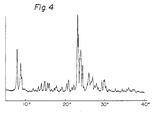
- the X-ray powder diffraction pattern of the zeolite is shown in Fig. 4.
- An overflow opening of the reaction vessel was arranged so that 0.5 liter of the reaction liquid (slurry) was always present in the reaction vessel and the excessive slurry overflowed from the reaction vessel.
- the residence time of the reaction slurry was thus adjusted to 30 minutes.
- the pH value of the slurry was 6.2 and the reaction temperature was 32°C.
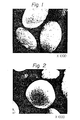
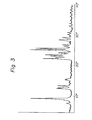
- the starting slurry was charged in an autoclave and maintained at 180°C under the autogeneous pressure for 72 hours to effect crystallization. After completion of the reaction, the formed solid was separated from the mother liquor by filtration, washed with water and then dried at 110°C. An electron microscope photograph (1000 magnifications) of the product and an X-ray powder diffraction diagram of the product are shown in Figs. 2 and 3, respectively. From the results of the chemical analysis, it was found that the obtained product had the following composition on the anhydrous base:
- the formed solid was separated from the mother liquor by filtration, washed with water and then dried at 110°C. From the results of the X-ray powder diffractometry, it was found that the product was mordenite containing a-quartz.
- the formed slurry product was subjected to solid-liquid separation by a centrifugal separator, and the recovered solid was washed with water until SO 2- 4 ion was not detected in the washing filtrate.
- the product was amorphous sodium aluminosilicate having a composition shown in Table 5.
- the slurry was charged in an autoclave and maintained at 180°C under the autogeneous pressure for 72 hours to effect crystallization. After completion of the reaction, the formed solid was separated from the mother liquor by filtration, washed with water and then dried at 110°C. From the results of the X-ray powder diffractometry, it was found that the product was an amorphous solid.
Landscapes
- Chemical & Material Sciences (AREA)
- Organic Chemistry (AREA)
- Life Sciences & Earth Sciences (AREA)
- General Life Sciences & Earth Sciences (AREA)
- Geology (AREA)
- Inorganic Chemistry (AREA)
- Silicates, Zeolites, And Molecular Sieves (AREA)
- Catalysts (AREA)
Claims (10)
Applications Claiming Priority (4)
| Application Number | Priority Date | Filing Date | Title |
|---|---|---|---|
| JP162123/82 | 1982-09-20 | ||
| JP16212382A JPS5954620A (ja) | 1982-09-20 | 1982-09-20 | ゼオライトを製造する方法 |
| JP176077/82 | 1982-10-08 | ||
| JP17607782A JPS5969419A (ja) | 1982-10-08 | 1982-10-08 | フエリエライト型ゼオライトの製造方法 |
Publications (2)
| Publication Number | Publication Date |
|---|---|
| EP0106552A1 EP0106552A1 (fr) | 1984-04-25 |
| EP0106552B1 true EP0106552B1 (fr) | 1988-12-07 |
Family
ID=26488022
Family Applications (1)
| Application Number | Title | Priority Date | Filing Date |
|---|---|---|---|
| EP83305527A Expired EP0106552B1 (fr) | 1982-09-20 | 1983-09-20 | Procédé pour la production de zéolithes |
Country Status (5)
| Country | Link |
|---|---|
| US (1) | US4562055A (fr) |
| EP (1) | EP0106552B1 (fr) |
| CA (1) | CA1213872A (fr) |
| DE (1) | DE3378627D1 (fr) |
| DK (1) | DK164097C (fr) |
Families Citing this family (23)
| Publication number | Priority date | Publication date | Assignee | Title |
|---|---|---|---|---|
| CA1215348A (fr) * | 1982-10-08 | 1986-12-16 | Junji Arika | Zeolithe et methode de preparation |
| JPS5973424A (ja) * | 1982-10-20 | 1984-04-25 | Toyo Soda Mfg Co Ltd | モルデナイト型ゼオライトの製造方法 |
| FR2552418B1 (fr) * | 1983-09-28 | 1985-10-25 | Rhone Poulenc Spec Chim | Procede de fabrication de zeolithe du type zsm-5 |
| JPS6121911A (ja) * | 1984-07-11 | 1986-01-30 | Toyo Soda Mfg Co Ltd | フオ−ジヤサイト型ゼオライトの製造方法 |
| NZ215987A (en) * | 1985-05-14 | 1989-07-27 | Mobil Oil Corp | Manufacture of zeolite |
| US4822941A (en) * | 1985-05-14 | 1989-04-18 | Mobil Oil Corporation | Conversion of aliphatics to aromatics over a zeolite catalyst |
| US4795623A (en) * | 1986-08-05 | 1989-01-03 | Shell Oil Company | Time effective method for preparing ferrierite |
| US4942027A (en) * | 1986-08-05 | 1990-07-17 | Shell Oil Company | Method for preparing ferrierite |
| US5240892A (en) * | 1987-09-02 | 1993-08-31 | Mobil Oil Corporation | Small crystal ZSM-5, as a catalyst |
| DE3922181A1 (de) * | 1989-07-06 | 1991-01-17 | Vaw Ver Aluminium Werke Ag | Synthetisches kristallines alumosilikat und verfahren zu seiner herstellung |
| UA27705C2 (uk) * | 1990-07-11 | 2000-10-16 | Еколіт-Цеоліте Гмбх | СПОСІБ КАТАЛІТИЧНОЇ ІЗОМЕРИЗАЦІЇ С<sub>8 </sub>- АРОМАТИЧНИХ ВУГЛЕВОДНІВ |
| US5110573A (en) * | 1990-08-16 | 1992-05-05 | Mobil Oil Corporation | Silica-alumina-organic amine product, its synthesis and use in zeolite production |
| US5254327A (en) * | 1992-04-03 | 1993-10-19 | Intevep, S.A. | Zeolitic catalyst of MFI type, its preparation and use |
| US5427765A (en) * | 1993-02-02 | 1995-06-27 | Tosoh Corporation | Method of producing zeolite β |
| DE19707994A1 (de) * | 1997-02-27 | 1998-09-03 | Sued Chemie Ag | Verfahren zur Herstellung von Zeolithen mit einem hohen Si/Al-Atomverhältnis |
| US6004527A (en) * | 1997-09-29 | 1999-12-21 | Abb Lummus Global Inc. | Method for making molecular sieves and novel molecular sieve compositions |
| JP3417309B2 (ja) * | 1997-10-28 | 2003-06-16 | トヨタ自動車株式会社 | 炭化水素吸着材 |
| US6180550B1 (en) | 1998-12-22 | 2001-01-30 | Mobile Oil Corporation | Small crystal ZSM-5, its synthesis and use |
| US6793911B2 (en) | 2002-02-05 | 2004-09-21 | Abb Lummus Global Inc. | Nanocrystalline inorganic based zeolite and method for making same |
| ITMI20042136A1 (it) * | 2004-11-08 | 2005-02-08 | Sasol Italy S P A | Procedimento perfezionato per la preparazione di zeoliti zsm-5 |
| WO2009103394A2 (fr) * | 2008-02-22 | 2009-08-27 | Exxonmobil Chemical Patents Inc. | Tamis moléculaires à cristaux de grande taille et leur fabrication |
| EP2130586A1 (fr) | 2008-06-06 | 2009-12-09 | Total Petrochemicals Research Feluy | Procédé de fabrication de métallosilicates cristallins |
| JP6423729B2 (ja) | 2015-02-09 | 2018-11-14 | 三井金属鉱業株式会社 | ベータ型ゼオライトの製造方法 |
Family Cites Families (11)
| Publication number | Priority date | Publication date | Assignee | Title |
|---|---|---|---|---|
| US3119659A (en) * | 1960-09-26 | 1964-01-28 | Union Carbide Corp | Process for producing molecular sieve bodies |
| FR1411753A (fr) * | 1964-07-21 | 1965-09-24 | Air Liquide | Procédé de fabrication de mordénite cristalline |
| NL6609779A (fr) * | 1964-07-21 | 1967-01-13 | ||
| US4017590A (en) * | 1974-05-14 | 1977-04-12 | Zeochem Corporation | Preparation of synthetic ferrierite |
| US3966883A (en) * | 1974-10-16 | 1976-06-29 | W. R. Grace & Co. | Synthetic ferrierite synthesis |
| US4046859A (en) * | 1974-11-29 | 1977-09-06 | Mobil Oil Corporation | Crystalline zeolite and method of preparing same |
| US3933974A (en) * | 1975-02-18 | 1976-01-20 | Shell Oil Company | Process for the preparation of ferrierite |
| US4257885A (en) * | 1976-02-04 | 1981-03-24 | Union Carbide Corporation | Novel zeolite compositions and processes for preparing and using same |
| US4173622A (en) * | 1978-01-03 | 1979-11-06 | Fmc Corporation | Zeolite A crystals of uniformly small particle size and the manufacture thereof |
| FR2444005A1 (fr) * | 1978-12-15 | 1980-07-11 | Ugine Kuhlmann | Procede industriel de fabrication en semi-continu de zeolithe a |
| DE2910147A1 (de) * | 1979-03-15 | 1980-10-30 | Degussa | Verfahren zur herstellung von amorphen natriumaluminiumsilikaten |
-
1983
- 1983-09-16 DK DK423883A patent/DK164097C/da not_active IP Right Cessation
- 1983-09-19 CA CA000436967A patent/CA1213872A/fr not_active Expired
- 1983-09-20 US US06/534,118 patent/US4562055A/en not_active Expired - Lifetime
- 1983-09-20 DE DE8383305527T patent/DE3378627D1/de not_active Expired
- 1983-09-20 EP EP83305527A patent/EP0106552B1/fr not_active Expired
Also Published As
| Publication number | Publication date |
|---|---|
| DK423883D0 (da) | 1983-09-16 |
| DK423883A (da) | 1984-03-21 |
| DK164097C (da) | 1992-10-05 |
| EP0106552A1 (fr) | 1984-04-25 |
| CA1213872A (fr) | 1986-11-12 |
| DE3378627D1 (en) | 1989-01-12 |
| US4562055A (en) | 1985-12-31 |
| DK164097B (da) | 1992-05-11 |
Similar Documents
| Publication | Publication Date | Title |
|---|---|---|
| US4562055A (en) | Process for preparation of zeolites | |
| US4530824A (en) | Process for preparation of L type zeolites | |
| US5371307A (en) | Silica/germanium oxide zeolites | |
| US4587115A (en) | Process for preparation of high-silica faujasite type zeolite | |
| US4650654A (en) | Process for preparation of ferrierite type zeolites | |
| US5427765A (en) | Method of producing zeolite β | |
| EP0109729B1 (fr) | Procédé pour la préparation d'une zéolithe du type mordenite | |
| CA1249989A (fr) | Procede de preparation de zeolite de type faujasite | |
| EP0106643A2 (fr) | Zéolite et procédé pour sa préparation | |
| JPH0239446B2 (fr) | ||
| EP0614853B1 (fr) | Méthode pour la production de bêta-zéloite | |
| HU181898B (en) | Semicontinuous industrial process for producing zeolite a | |
| EP0273403B1 (fr) | Procédé de préparation de mazzite synthétique | |
| JPH0244771B2 (fr) | ||
| JPH08183611A (ja) | Mfi型ゼオライトの製造方法 | |
| JPH0247403B2 (fr) | ||
| JPH06287015A (ja) | ゼオライトβの製造方法 | |
| JPH04305010A (ja) | 高耐熱水性ゼオライトの製造法 | |
| JPH0353251B2 (fr) | ||
| JPH0345009B2 (fr) | ||
| JPS60226412A (ja) | 結晶性ボロシリケ−トの製造法 | |
| JPH0479978B2 (fr) | ||
| JPH0525804B2 (fr) |
Legal Events
| Date | Code | Title | Description |
|---|---|---|---|
| PUAI | Public reference made under article 153(3) epc to a published international application that has entered the european phase |
Free format text: ORIGINAL CODE: 0009012 |
|
| 17P | Request for examination filed |
Effective date: 19831003 |
|
| AK | Designated contracting states |
Designated state(s): BE DE FR GB IT NL |
|
| RAP1 | Party data changed (applicant data changed or rights of an application transferred) |
Owner name: TOSOH CORPORATION |
|
| GRAA | (expected) grant |
Free format text: ORIGINAL CODE: 0009210 |
|
| AK | Designated contracting states |
Kind code of ref document: B1 Designated state(s): BE DE FR GB IT NL |
|
| ITF | It: translation for a ep patent filed | ||
| REF | Corresponds to: |
Ref document number: 3378627 Country of ref document: DE Date of ref document: 19890112 |
|
| ET | Fr: translation filed | ||
| PLBE | No opposition filed within time limit |
Free format text: ORIGINAL CODE: 0009261 |
|
| STAA | Information on the status of an ep patent application or granted ep patent |
Free format text: STATUS: NO OPPOSITION FILED WITHIN TIME LIMIT |
|
| 26N | No opposition filed | ||
| ITTA | It: last paid annual fee | ||
| PGFP | Annual fee paid to national office [announced via postgrant information from national office to epo] |
Ref country code: FR Payment date: 19970909 Year of fee payment: 15 |
|
| PGFP | Annual fee paid to national office [announced via postgrant information from national office to epo] |
Ref country code: GB Payment date: 19970911 Year of fee payment: 15 |
|
| PGFP | Annual fee paid to national office [announced via postgrant information from national office to epo] |
Ref country code: BE Payment date: 19971118 Year of fee payment: 15 |
|
| PG25 | Lapsed in a contracting state [announced via postgrant information from national office to epo] |
Ref country code: GB Free format text: LAPSE BECAUSE OF NON-PAYMENT OF DUE FEES Effective date: 19980920 |
|
| PGFP | Annual fee paid to national office [announced via postgrant information from national office to epo] |
Ref country code: DE Payment date: 19980925 Year of fee payment: 16 |
|
| PGFP | Annual fee paid to national office [announced via postgrant information from national office to epo] |
Ref country code: NL Payment date: 19980929 Year of fee payment: 16 |
|
| PG25 | Lapsed in a contracting state [announced via postgrant information from national office to epo] |
Ref country code: BE Free format text: LAPSE BECAUSE OF NON-PAYMENT OF DUE FEES Effective date: 19980930 |
|
| BERE | Be: lapsed |
Owner name: TOSOH CORP. Effective date: 19980930 |
|
| GBPC | Gb: european patent ceased through non-payment of renewal fee |
Effective date: 19980920 |
|
| PG25 | Lapsed in a contracting state [announced via postgrant information from national office to epo] |
Ref country code: FR Free format text: LAPSE BECAUSE OF NON-PAYMENT OF DUE FEES Effective date: 19990531 |
|
| REG | Reference to a national code |
Ref country code: FR Ref legal event code: ST |
|
| PG25 | Lapsed in a contracting state [announced via postgrant information from national office to epo] |
Ref country code: NL Free format text: LAPSE BECAUSE OF NON-PAYMENT OF DUE FEES Effective date: 20000401 |
|
| NLV4 | Nl: lapsed or anulled due to non-payment of the annual fee |
Effective date: 20000401 |
|
| PG25 | Lapsed in a contracting state [announced via postgrant information from national office to epo] |
Ref country code: DE Free format text: LAPSE BECAUSE OF NON-PAYMENT OF DUE FEES Effective date: 20000701 |