EP0101665A2 - Reaktivfarbstoffe der Dioxazinreihe, deren Herstellung und Verwendung - Google Patents
Reaktivfarbstoffe der Dioxazinreihe, deren Herstellung und Verwendung Download PDFInfo
- Publication number
- EP0101665A2 EP0101665A2 EP83810359A EP83810359A EP0101665A2 EP 0101665 A2 EP0101665 A2 EP 0101665A2 EP 83810359 A EP83810359 A EP 83810359A EP 83810359 A EP83810359 A EP 83810359A EP 0101665 A2 EP0101665 A2 EP 0101665A2
- Authority
- EP
- European Patent Office
- Prior art keywords
- formula
- propylene
- substituted
- methyl
- alkyl
- Prior art date
- Legal status (The legal status is an assumption and is not a legal conclusion. Google has not performed a legal analysis and makes no representation as to the accuracy of the status listed.)
- Withdrawn
Links
Classifications
-
- C—CHEMISTRY; METALLURGY
- C09—DYES; PAINTS; POLISHES; NATURAL RESINS; ADHESIVES; COMPOSITIONS NOT OTHERWISE PROVIDED FOR; APPLICATIONS OF MATERIALS NOT OTHERWISE PROVIDED FOR
- C09B—ORGANIC DYES OR CLOSELY-RELATED COMPOUNDS FOR PRODUCING DYES, e.g. PIGMENTS; MORDANTS; LAKES
- C09B62/00—Reactive dyes, i.e. dyes which form covalent bonds with the substrates or which polymerise with themselves
- C09B62/02—Reactive dyes, i.e. dyes which form covalent bonds with the substrates or which polymerise with themselves with the reactive group directly attached to a heterocyclic ring
- C09B62/04—Reactive dyes, i.e. dyes which form covalent bonds with the substrates or which polymerise with themselves with the reactive group directly attached to a heterocyclic ring to a triazine ring
- C09B62/046—Specific dyes not provided for in group C09B62/06 - C09B62/10
Definitions
- the present application relates to new improved reactive dioxazine dyes which are particularly suitable for dyeing cellulose-containing fiber materials by the exhaust dyeing process and which give wet and lightfast dyeings in pure, bright blue tones, and processes for the preparation of these dyes and their use for dyeing and printing on textile materials.
- Possible substituents R are e.g. Methyl, ethyl, propyl, isopropyl, butyl, isobutyl, sec-butyl, tert-butyl, methoxy, ethoxy, propyloxy, isopropyloxy, butyloxy, isobutyloxy, sec-butyloxy, tert-butyloxy, fluorine, chlorine or bromine.
- a straight-chain or branched alkyl radical which can also be substituted, for example by halogen, hydroxyl, cyano, sulfo or sulfato, is suitable as C 1-4 alkyl for R 1 and R in formula (2).
- R are: methyl, ethyl, propyl, isopropyl, butyl, isobutyl, sec. -Butyl, tert-butyl, ⁇ -chloroethyl, ⁇ -hydroxyethyl, ⁇ -hydroxybutyl, ⁇ -cyanoethyl, sulfomethyl, ⁇ -sulfoethyl and ⁇ -sulfatoethyl.
- Substituted amino groups Y are: alkylamino, N, N-dialkylamino, cycloalkylamino, N, N-dicycloalkylamino, aralkylamino, arylamino groups, mixed substituted amino groups such as N-alkyl-N-cyclohexylamino and N-alkyl -N-arylamino groups, furthermore amino groups which contain heterocyclic radicals, which may have further fused-on carbocyclic rings, and amino groups, in which the amino nitrogen atom is a member of an N-heterocyclic ring which optionally contains further heteroatoms.
- alkyl radicals mentioned above can be straight-chain or branched, low molecular weight or higher molecular weight; alkyl radicals having 1 to 6 carbon atoms are preferred; suitable cycloalkyl, aralkyl and aryl radicals are, in particular, cyclohexyl, benzyl, phenethyl, phenyl and naphthyl radicals; heterocyclic radicals are especially furan, thiophene, pyrazole, pyridine, pyrimidine, quinoline, benzimidazole, benzothiazole and benzoxazole; and as amino groups in which the amino nitrogen atom is a member of an N-heterocyclic ring, preference is given to residues of six-membered N-heterocyclic compounds which may contain nitrogen, oxygen and sulfur as further heteroatoms.
- alkyl, cycloalkyl, aralkyl and aryl radicals, the heterocyclic radicals and also the N-heterocyclic rings may be further substituted, for example by halogen, such as fluorine, chlorine and bromine, N itro, cyano, trifluoromethyl, sulfamoyl, carbamoyl, C 1-4 alkyl, C 1-4 alkoxy, acylamino groups such as acetylamino, ureido, hydroxy, carboxy, sulfomethyl and sulfo.
- halogen such as fluorine, chlorine and bromine, N itro, cyano, trifluoromethyl
- sulfamoyl carbamoyl, C 1-4 alkyl, C 1-4 alkoxy
- acylamino groups such as acetylamino, ureido, hydroxy, carboxy, sulfomethyl and sulfo.
- Examples of the amino radical Y in formula (2) are: -NH, methylamino, ethylamino, propylamino, isopropylamino, butylamino, hexylamino, ß-methoxyethylamino, y-methoxypropylamino, ß-ethoxyethylamino, N, N-dimethylamino, N.
- the dyes of the formula (1) are fiber-reactive since they contain at least one cleavable fluorine atom on the s-triazine ring.
- Fiber-reactive compounds are to be understood as those which are able to react with the hydroxyl groups of cellulose or with the amino groups of natural or synthetic polyamides to form covalent chemical bonds.
- the preparation of the reactive dyes of the formula (1) is characterized in that dioxazine compounds of the formula wherein R, n and m have the meanings given under formula (1), and X is a radical of the formula is, 2,4,6-trifluoro-s-triazine and optionally amines of the formula condensed.
- the individual method steps can be carried out in a different order, possibly partially at the same time. Different process variants are possible. In general, the implementation is carried out step by step.
- the preferred method of preparing the reactive dye according to m) is characterized in that a dioxazine compound of the formula wherein X is a radical of the formula is, with the compound of the formula obtained by monocondensation of 2,4,6-trifluoro-s-triazine and aniline-2,5-disulfonic acid. condensed.
- the condensation of 2,4,6-trifluoro-s-triazine with the dioxazine compounds of the formula (1) is preferably carried out in aqueous solution or suspensions, at low temperatures, preferably between 0 ° and 5 ° C. and in the case of weakly acidic, neutral to weak alkaline pH.
- the hydrogen fluoride liberated in the condensation is advantageously continuously neutralized by adding aqueous alkali metal hydroxides, carbonates or bicarbonates.
- the free amines or their salts are used, preferably in the form of the hydrochloride.
- the reaction is carried out at temperatures between about 0 and 40 ° C., preferably between 5 and 25 ° C., with the addition of acid-binding agents, preferably sodium carbonate, in a pH range from 2 to 8, preferably 5 to 6.5.
- the condensation of the fluorotriazine with an amine of the formula (7) can take place before or after the condensation of the fluorotriazine with a dioxazine of the formula (1).
- the condensation of the fluorotriazine with an amine of the formula (7) is preferably carried out in aqueous solution or suspension, at low temperature and at a weakly acidic to neutral pH.
- the hydrogen fluoride liberated during the condensation is advantageously neutralized by the continuous addition of aqueous alkali metal hydroxides, carbonates or bicarbonates.
- the reactive dyes of the formula (1) can be isolated and processed into usable, dry dyeing preparations.
- the isolation is preferably carried out at the lowest possible temperatures by salting out and filtering.
- the filtered dyes can optionally be added after the addition of couping agents and / or buffering agents, e.g. after adding a mixture of equal parts of mono- and disodium phosphate, dried; drying is preferably carried out at temperatures which are not too high and under reduced pressure.
- the drying preparations according to the invention can be directly dried, i.e. Manufacture without intermediate insulation of the dyes.
- the reactive dyes of formula (1) are new. They are characterized by high reactivity and they result in dyeings with good wet and light fastness. It is particularly noteworthy that the dyes have good solubility and high dye fixation.
- the reactive dyes of the formula (1) are suitable for dyeing and printing a wide variety of materials, such as silk, leather, wool, superpolyamide fibers and superpolyamide urethanes, but in particular cellulosic materials with a fibrous structure, such as linen, cellulose, regenerated cellulose and especially cotton. They are suitable both for the exhaust process and for dyeing according to the pad dyeing process, according to which the goods are impregnated with aqueous and, if appropriate, also salt-containing dye solutions, and the dyes are fixed after an alkali treatment or in the presence of alkali, if appropriate with the action of heat.
- They are particularly suitable for printing, especially on cotton, but also for printing nitrogen-containing fibers, e.g. of blended fabrics containing wool, silk or wool.
- the parts mean parts by weight, the percentages by weight and the temperatures are given in degrees Celsius.
- Example 1 Preparation of 4- (3'-aminopropylamino) aniline-3-sulfonic acid.
- the nitro compound obtained in this way is then reduced according to Bechamp by introducing the product in portions into a boiling mixture of 2000 parts of water, 250 parts of iron powder and 20 parts of glacial acetic acid. After the reduction has ended, the reaction mixture is made mimosa-alkaline with about 160 parts of 10N sodium hydroxide solution and filtered hot from the iron sludge. The filtrate is decolorized with a little hydrosulfite and adjusted to pH 7 with about 110 parts of 10N hydrochloric acid.
- 80 parts of the anil thus obtained are introduced into 1600 parts of 24% oleum in the course of about 40 minutes.
- the temperature rises to approx. 40 ° C and an olive-brown solution is created.
- the reaction mixture is heated to 65 ° C. within about 15 minutes and kept at this temperature for about 1 hour. This creates a deep blue solution.
- the mixture is cooled to room temperature and the oleum solution is poured onto 4000 parts of ice with stirring. With ice cooling, 2500 parts of 10N sodium hydroxide solution are then added dropwise within about 1 hour, whereupon the dioxazine is practically completely precipitated in a readily filterable form. It is filtered and washed with water.
- the dioxazine chromophore thus obtained is stirred overnight in 1000 parts of water and adjusted to pH 7 the next day with sodium hydroxide solution.
- aniline-2,5-disulfonic acid 60.72 parts are dissolved in 800 parts of water with about 20 parts of 10N sodium hydroxide solution and cooled to 0 ° C.
- 34 parts of cyanuric fluoride are added dropwise in the course of 20 minutes and the pH is kept between 4 and 5 by simultaneous addition of approx. 33 parts of 10N sodium hydroxide solution.
- the clear solution of the primary condensation product thus obtained is then poured into the prepared slurry of the dioxazine chromophore, slowly warmed to 30 to 35 ° C. and the pH of the reaction mixture is kept between 7 and 8 by the dropwise addition of sodium hydroxide solution, for which approximately 31 parts of 10N sodium hydroxide solution are required will.
- the dye thus obtained dyes cotton in pure blue tones.
- Example 2 parts of the dye obtained in Example 1 are dissolved in 20 parts of water at 20 to 50 ° C. with the addition of 5 to 20 parts of urea and 2 parts of calcined soda.
- a cotton fabric is impregnated with the solution obtained so that it increases by 60 to 80% of its weight, and then dried.
- the mixture is then heat-set at 140 to 210 ° for 1/2 to 5 minutes, then soaped in a 0.1% boiling solution of an ion-free detergent for a quarter of an hour, rinsed and dried.
- Example 2 2 parts of the dye obtained in Example 1 are dissolved in 100 parts of water with the addition of 0.5 part of sodium m-nitrobenzenesulfonate. A cotton fabric is impregnated with the solution obtained so that it increases by 75% in weight, and then dried.
- the fabric is impregnated with a 20 ° warm solution containing 5 grams of sodium hydroxide and 300 grams of sodium chloride per liter, squeezed to 75% weight gain, the dye is dampened for 30 seconds at 100 to 101 °, rinsed, soaped in for a quarter of an hour a 0.3% boiling solution of an ion-free detergent, rinses and dries.
- the solution is added to 1900 parts of cold water, 60 parts of sodium chloride are added and 100 parts of a cotton fabric are added to this dye bath.
- the temperature is raised to 60 °, 40 parts of calcined soda and another 60 parts of sodium chloride being added after 30 minutes.
- the temperature is kept at 60 ° for 30 minutes, rinsed and the soap is then soaped for 15 minutes in a 0.3% boiling solution of an ion-free detergent, rinsed and dried.
- Example 2 4 parts of the reactive dye prepared in Example 1 are dissolved in 50 parts of water. 50 parts of a solution are added, which contains 5 g of sodium hydroxide and 10 g of calcined soda per liter. A cotton fabric is padded with the solution obtained so that it increases by 70% of its weight, and then wound onto a drum. The cotton fabric is stored for 3 to 12 hours at room temperature. The dyed goods are then rinsed, soaped at the boil with a nonionic detergent for a quarter of an hour, rinsed again and dried. A blue color is obtained with good fastness properties.
Landscapes
- Chemical & Material Sciences (AREA)
- Organic Chemistry (AREA)
- Coloring (AREA)
- Nitrogen And Oxygen Or Sulfur-Condensed Heterocyclic Ring Systems (AREA)
Abstract
Reaktivfarbstoffe der Formel

worin (R)n für n Substituenten R steht, die unabhängig voneinander C1-4-Alkyl, C1-4-Alkoxy, Carboxy oder Halogen sein kön- ) nen, n = 0 bis 3, m = 1 bis 2, und X ein Rest der Formel
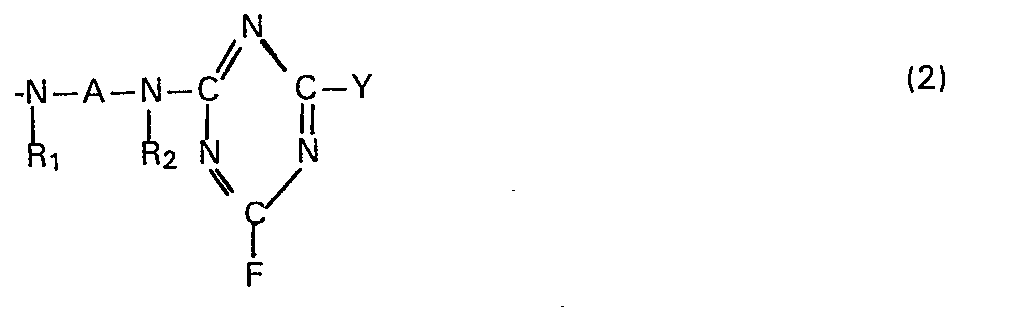
worin R1 und R2 unabhängig voneinander Wasserstoff oder gegebenenfalls substituiertes C1-4-Alkyl, A C3-7-Alkylen, das durch Halogen, Hydroxy, Carboxy, Sulfo, Phenyl, Sulfophenyl oder C1-4-Alkoxycarbonyl substituiert sein kann, oder Cyclohexylen, das durch C1-4-Alkyl substituiert sein kann, oder worin die Gruppe -N(R1)-A-N(R2)- 1,4-Piperazindiyl ist, und Y Fluor, -NH2 oder eine substituierte Aminogruppe ist, eignen sich zum Färben und Bedrucken von cellulosehaltigen Fasermaterialien und ergeben nass- und lichtechte Färbungen in leuchtend blauen Tönen.
Description
- Die vorliegende Anmeldung betrifft neue verbesserte reaktive Dioxazinfarbstoffe, die sich besonders für das Färben von cellulosehaltigen Fasermaterialien nach dem Ausziehfärbeverfahren eignen, und die nass- und lichtechte Färbungen in reinen, leuchtend blauen Tönen ergeben, sowie Verfahren zur Herstellung dieser Farbstoffe, und deren Verwendung zum Färben und Bedrucken von textilen Materialien.
- Gegenstand der Erfindung sind Reaktivfarbstoffe der Formel


- Mögliche Substituenten R sind z.B. Methyl, Aethyl, Propyl, Isopropyl, Butyl, Isobutyl, sec.-Butyl, tert.-Butyl, Methoxy, Aethoxy, Propyloxy, Isopropyloxy, Butyloxy, Isobutyloxy, sec.-Butyloxy, tert.-Butyloxy, Fluor, Chlor oder Brom.
- Als C1-4-Alkyl kommt für R1 und R in Formel (2) ein geradkettiger oder verzweigter Alkylrest in Betracht, der auch substituiert sein kann, z.B. durch Halogen, Hydroxy, Cyan, Sulfo oder Sulfato. Als Beispiele für R seien genannt: Methyl, Aethyl, Propyl, Isopropyl, Butyl, Isobutyl, sek. -Butyl, tert.-Butyl, β-Chloräthyl, ß-Hydroxyäthyl, β-Hydroxybutyl, β-Cyanäthyl, Sulfomethyl, β-Sulfoäthyl und β-Sulfato- äthyl.
- Das Brückenglied A kann geradkettig oder verzweigt sein, und, wie oben angegeben, weitersubstituiert sein. Als Beispiele für A seien genannt:
- 1,2- und 1,3-Propylen, 2-Hydroxy-1,3-propylen, 1- und 2-Phenyl-1,3-propylen, 2-(4'-Sulfophenyl)-l,3-propylen, 1,4-, 2,3- und 2,4-Butylen, 2-Methyl-l,3-propylen, 2-Methyl-2,4-pentylen, 2,2-Dimethyl-1,3-propylen, 1-Chloro-2,3-propylen, 1,6- und 2,5-Hexylen, 2,3-Diphenyl-1,4-butylen, 1-(Methoxycarbonyl)-1,5-pentylen, 1-Carboxy-1,5-pentylen, 2,7-Heptylen, 3-Methyl-1,6-hexylen, 1,3-Cyclohexylen, 1,4-Cyclohexylen, 4-Methyl-1,3-cyclohexylen, 2-Methyl-1,3-cyclohexylen, 5,5-Dimethyl-1,3-cyclohexylen, 2-Methyl-1,4-cyclohexylen, 4-6-Dimethyl-1,3-cyclohexylen und 4-Methyl-1,2-cyclohexylen.
- Als substituierte Aminogruppen Y kommen in Betracht: Alkylamino-, N,N-Dialkylamino-, Cycloalkylamino-, N,N-Dicycloalkylamino-, Aralkylamino-, Arylaminogruppen, gemischt substituierte Aminogruppen, wie N-Alkyl-N-cyclohexylamino- und N-Alkyl-N-arylaminogruppen, ferner Aminogruppen, die heterocyclische Reste enthalten, welche weitere ankondensierte carbocyclische Ringe aufweisen können, sowie Aminogruppen, worin das Aminostickstoffatom Glied eines N-heterocyclischen Ringes ist, der gegebenenfalls weitere Heteroatome enthält.
- Die oben genannten Alkylreste können geradkettig oder verzweigt, niedrigmolekular oder höhermolekular sein, bevorzugt sind Alkylreste mit 1 bis 6 Kohlenstoffatomen; als Cycloalkyl-, Aralkyl- und Arylreste kommen insbesondere Cyclohexyl-, Benzyl-, Phenäthyl-, Phenyl-und Naphthylreste in Frage; heterocyclische Reste sind vor allem Furan-, Thiophen-, Pyrazol-, Pyridin-, Pyrimidin-, Chinolin-, Benzimidazol-, Benzthiazol- und Benzoxazolreste; und als Aminogruppen, worin das Aminostickstoffatom Glied eines N-heterocyclischen Ringes ist, kommen vorzugsweise Reste von sechs-gliedrigen N-heterocyclischen Verbindungen in Betracht, die als weitere Heteroatome Stickstoff, Sauerstoff und Schwefel enthalten können.
- Die oben genannten Alkyl-, Cycloalkyl-, Aralkyl- und Arylreste, die heterocyclischen Reste sowie die N-heterocyclischen Ringe können weitersubstituiert sein, z.B. durch: Halogen, wie Fluor, Chlor und Brom, Nitro, Cyan, Trifluormethyl, Sulfamoyl, Carbamoyl, C1-4-Alkyl, C1-4-Alkoxy, Acylaminogruppen, wie Acetylamino, Ureido, Hydroxy, Carboxy, Sulfomethyl und Sulfo.
- Als Beispiele für den Aminorest Y in Formel (2) seien genannt: -NH , Methylamino, Aethylamino, Propylamino, Isopropylamino, Butylamino, Hexylamino, ß-Methoxyäthylamino, y-Methoxypropylamino, ß-Aethoxy- äthylamino, N,N-Dimethylamino, N,N-Diäthylamino, β-Chloräthylamino, ß-Cyanäthylamino, y-Cyanpropylamino, ß-Carboxyäthylamino, Sulfomethylamino, β-Sulfoäthylamino, β-Hydroxyäthylamino, N,N-Di-ß-hydroxy- äthylamino, y-Hydroxypropylamino, Benzylamino, Phenäthylamino, Cyclohexylamino, N-Methyl-N-phenylamino, N-Aethyl-N-phenylamino, N-Propyl-N-phenylamino, N-Butyl-N-phenylamino, N-ß-Cyanäthyl-N-phenylamino, N-Aethyl-2-methylphenylamino, N-Aethyl-4-methylphenylamino, N-Aethyl-3-sulfophenylamino, N-Aethyl-4-sulfophenylamino, Phenylamino, Toluidino, Xylidino, Chloranilino, Anisidino, Phenetidino, 2-, 3- und 4-Sulfoanilino, 2,5-Disulfoanilino, Sulfomethylanilino, N-Sulfomethylanilino, 3- und 4-Carboxyphenylamino, 2-Carboxy-5-sulfophenylamino, 2-Carboxy-4-sulfophenylamino, 4-Sulfonaphthyl-(1)-amino, 3,6-Disulfo- naphthyl-(l)-amino, 3,6,8 Trisulfonaphthyl-(1)-amino, 4,6,8-Trisulfo- naphthyl-(1)-amino, 6-Sulfonaphthyl-(2)-amino, Pyridyl-(2)-amino, Morpholino, Piperidino und Piperazino.
- Unter den Reaktivfarbstoffen der Formel (1) sind diejenigen bevorzugt,
- a) worin n = 0 ist;
- b) worin m = 1 ist;
- c) welche der Formel

- d) worin R1 und R2 Wasserstoff sind;
- e) worin A Propylen ist, das durch Chlor, Hydroxy, Methyl oder Phenyl substituiert sein kann;
- f) worin A 1,2-Propylen, 1,3-Propylen, 2-Hydroxy-1,3-propylen, 1-Phenyl-1,3-propylen, 2-Phenyl-1,3-propylen, 2-(4'-Sulfophenyl)-1,3-propylen, 2-Methyl-1,3-propylen oder 2,2-Dimethyl-1,3-propylen ist;
- g) worin A 1,2-Propylen, 1,3-Propylen, 2-Methyl-1,3-propylen oder 2,2-Dimethyl-1,3-propylen ist;
- h) worin A 1,3-Propylen ist;
- i) worin Y -NH2, C1-4-Alkylamino, das durch Hydroxy oder Sulfo substituiert sein kann, N,N-Di-C1-4-alkylamino, das durch Hydroxy substituiert sein kann, Phenylamino, das durch C1-4-Alkyl, C1-4-Alkoxy, Halogen, Hydroxy, Ureido, Acetylamino, Carboxy, Sulfo oder Sulfomethyl substituiert sein kann, N-C1-4-Alkyl-N-phenylamino, Sulfonaphthylamino oder Morpholino ist.
- j) worin Y ein Rest der Formel

- k) worin R3 Wasserstoff ist, und der Benzolring B durch Sulfo oder Methyl substituiert sein kann;
- 1) worin Y 2-Methyl-5-sulfophenylamino oder 2,5-Disulfophenylamino ist.
Durch Kombination obiger Merkmale, z.B. g) und 1) oder c), h) und k), ergeben sich weitere bevorzugte Untergruppen von Reaktivfarbstoffen der Formel (1).
Besonders bevorzugt ist - m) der Reaktivfarbstoff der Formel


- Die Farbstoffe der Formel (1) sind faserreaktiv, da sie mindestens ein abspaltbares Fluoratom am s-Triazinring enthalten.
- Unter faserreaktiven Verbindungen sind solche zu verstehen, die mit den Hydroxygruppen der Cellulose oder mit den Aminogruppen von natürlichen oder synthetischen Polyamiden unter Bildung kovalenter chemischer Bindungen zu reagieren vermögen.
- Die Herstellung der Reaktivfarbstoffe der Formel (1) ist dadurch gekennzeichnet, dass man in beliebiger Reihenfolge Dioxazinverbindungen der Formel


- Bei dem im vorangehenden beschriebenen Verfahren können die einzelnen Verfahrensschritte in unterschiedlicher Reihenfolge, gegebenenfalls teilweise auch gleichzeitig, ausgeführt werden. Dabei sind verschiedene Verfahrensvarianten möglich. Im allgemeinen führt man die Umsetzung schrittweise nacheinander aus.
- Dabei hängt es von der Struktur der Ausgangsstoffe ab, welche der möglichen Verfahrensvarianten die besten Resultate ergeben, oder unter welchen speziellen Bedingungen, z.B. bei welcher Kondensationstemperatur, die Reaktion am vorteilhaftesten auszuführen ist.
- Wichtige Verfahrensvarianten sind dadurch gekennzeichnet, dass man:
- 1. eine Dioxazinverbindung der Formel (1), worin X ein Rest der Formel (6) ist, mit 2,4,6-Trifluor-s-triazin kondensiert und das erhaltene di-primäre Kondensationsprodukt mit 2 Mol eines Amins der Formel (7) kondensiert.
- 2. 2,4,6-Trifluor-s-triazin mit einem Amin der Formel (7) monokondensiert, und die erhaltene Zwischenverbindung im molaren Verhältnis 2:1 mit einer Dioxazinverbindung der Formel (1), wor- " in X ein Rest der Formel (6) ist, kondensiert.
- Die bevorzugte Herstellungsweise des Reaktivfarbstoffes gemäss m) ist dadurch gekennzeichnet, dass man eine Dioxazinverbindung der Formel


- Die Kondensation des 2,4,6-Trifluor-s-triazins mit den Dioxazinverbindungen der Formel (1) erfolgen vorzugsweise in wässriger Lösung oder Suspensionen, bei niedrigen Temperaturen, vorzugsweise zwischen 0° und 5° C und bei schwach saurem, neutralem bis schwach alkalischem pH-Wert. Vorteilhaft wird der bei der Kondensation freiwerdende Fluorwasserstoff laufend durch Zugabe wässriger Alkalihydroxide, -carbonate oder -bicarbonate neutralisiert. Für die weitere Umsetzung der so erhaltenen Fluortriazinfarbstoffe bzw. für die Umsetzung des 2,4,6-Trifluor-s-triazins mit den Aminen der Formel (7) setzt man die freien Amine oder deren Salze, bevorzugt in Form des Hydrochlorids, ein. Die Umsetzung wird bei Temperaturen etwa zwischen 0 und 40° C, bevorzugt zwischen 5 und 25° C, unter Zusatz säurebindender Mittel, bevorzugt Natriumcarbonat, in einem pH-Bereich von 2 bis 8, bevorzugt 5 bis 6,5, durchgeführt.
- Die Kondensation des Fluortriazins mit einem Amin der Formel (7) kann vor oder nach der Kondensation des Fluortriazins mit einem Dioxazin der Formel (1) geschehen. Die Kondensation des Fluortriazins mit einem Amin der Formel (7) erfolgt vorzugsweise in wässriger Lösung oder Suspension, bei niedriger Temperatur und bei schwach saurem bis neutralem pH-Wert. Auch hier wird der bei der Kondensation freiwerdende Fluorwasserstoff vorteilhafterweise durch laufende Zugabe von wässrigen Alkalihydroxiden, -carbonaten oder -bicarbonaten neutralisiert.
- Als Ausgangsverbindungen zur Herstellung der Reaktivfarbstoffe der Formel (1) sind zu nennen:
- a) Dioxazinverbindungen der Formel (1), worin X ein Rest der Formel (6) ist:
- Die Amino-6,13-dichlorotriphendioxazine können nach bekannten Methoden durch Kondensation von 2,3,5,6-Tetrachloro-l,4-benzochinon mit aromatischen Aminkomponenten gewonnen werden.
- Im vorliegenden Falle geht man so vor, dass man 1 Mol 2,3,5,6-Tetrachloro-1,4-benzochinon mit 2 Mol eines Diamins der Formel

- Beispiele für Diamine der Formel (10) sind die folgenden: 4-(3'-Amino-2'-hydroxypropylamino)-anilin-3-sulfonsäure. 4-(2'-Aminopropylamino)-anilin-3-sulfoasäure, 4-(3'-Aminopropylamino)-anilin-3-sulfonsäure, 4-(2'-(4"-Sulfophenyl)-3'-aminopropylamino)-anilin-3-sulfonsäure, 4-(2'-(3"-Sulfophenyl)-3'-aminopropylamino)-anilin-3-sulfonsäure, 4-(2'-Phenyl-3'-aminopropylamino)-anilin-3-sulfonsäure, 4-(4'-Aminocyclohexylamino)-anilin-3-sulfonsäure, 4-(3'-Aminocyclohexylamino)-anilin-3-sulfonsäure, 4-Piperazino-anilin-3-sulfonsäure.
- b) 2,4,6-Trifluor-s-triazin (Cyanurfluorid).
- c) Amine der Formel (7):
- Ammoniak, Methylamin, Dimethylamin, Aethylamin, Diäthylamin, Propylamin, Isopropylamin, Butylamin, Dibutylamin, Isobutylamin, sek.-Butylamin, tert.-Butylamin, Hexylamin, Methoxyäthylamin, Aethoxyäthylamin, Methoxypropylamin, Chloräthylamin, Hydroxyäthylamin, Dihydroxyäthylamin, Hydroxypropylamin, Amino- äthansulfonsäure, β-Sulfatoäthylamin, Benzylamin, Phenäthylamin, Cyclohexylamin, N-Methylaminobenzol, N-Aethylaminobenzol, N-Propylaminobenzol, N-Butylaminobenzol, N-Hexylaminobenzol, N-ß-Hydroxyäthylaminobenzol, N-ß-Chloräthylaminobenzol, N-ß-Cyan- äthylaminobenzol, N-ß-Sulfoäthylaminobenzol, 1-(N-Aethylamino)-2-, -3- oder -4-methylbenzol, 1-(N-Aethylamino)-2-, -3- oder -4-äthylbenzol, 1-(N-Aethylamino)-2-, -3- oder -4-chlorbenzol, 1-N-Aethylaminobenzol-3- oder -4-sulfonsäure, l-(N-Aethylamino)-4-butylbenzol, 1-(N-Aethylamino)-4-hexylbenzol, 1-(N-Aethylamino)-4-octylbenzol, 1-(N-Aethylamino)-4-vinylbenzol, 1-N-n-Butylamino-3-methylbenzol, N-Isopropylaminobenzol, N-Isobutylaminobenzol, N-sek.-Butylaminobenzol, 1-(N-Aethylamino)-4-fluorbenzol, Benzylamin, Cyclohexylamin, Anilin, o-, m- und p- Toluidin, 2,3-, 2,4-, 2,5-, 2,6-, 3,4- und 3,5-Dimethylanilin, o-, m- und p-Chloranilin, N-Methylanilin, N-Aethylanilin, o-, mund p-Aminophenol, 2-Methyl-4-nitroanilin, 2-Methyl-5-nitro- anilin, 2,5-Dimethoxyanilin, 3-Methyl-4-nitroanilin, 2-Nitro-4-methylanilin, 3-Nitro-4-methylanilin, o-, m- und p- Anisidin, o-, m- und p-Phenetidin, 2-Methoxy-5-methylanilin, 2-Aethoxy-5-methoxyanilin, 4-Bromanilin, 3-Aminobenzamid, 4-Aminophenylsulfamid, 3-Trifluormethylanilin, 3- und 4-Aminophenylsulfamid, 3-Trifluormethylanilin, 3- und 4-Aminophenylharnstoff, 1-Naphthylamin, 2-Naphthylamin, Orthanilsäure, Metanilsäure, Sulfanilsäure, Anilin-2,4-disulfonsäure, Anilin-2,5-disulfonsäure, Anilin-3,5- disulfonsäure, Anthranilsäure, m- und p-Aminobenzoesäure, 4-Aminophenylmethansulfonsäure, Anilin-N-methansulfonsäure, 2-Aminotoluol-4-sulfonsäure, 2-Aminotoluol-5-sulfonsäure, p-Aminosalicylsäure, 1-Amino-4-carboxy-benzol-3-sulfonsäure, 1-Amino-2-carboxy-benzol-5-sulfonsäure, 1-Amino-5-carboxy-benzol-2-sulfonsäure, l-Naphthylamin-2-, -3-, -4-, -5-, -6-, -7- und -8-sulfonsäure, 2-Naphthylamino-l-, -3-, -4-, -5-, -6-, -7- und -8-sulfonsäure, 1-Naphthylamin-2,4-, -2,5-, -2,7-, -2,8-, -3,5-, -3,6-, -3,7-, -3,8-, -4,6-, -4,7-, -4,8- und -5,8-disulfonsäure, 2-Naphthylamin-l,5-, -1,6-, -1,7-, -3,6-, -3,7-, -4,7-, -4,8-, -5,7- und -6,8-disulfonsäure, 1-Naphthylamin-2,4,6-, -2,4,7-, -2,5,7-, -3,5,7-, -3,6,8- und -4,6,8-trisulfonsäure, 2-Naphthylamin-1,3,7-, -1,5,7-, -3,5,7-, -3,6,7-, -3,6,8- und -4,6,8-trisulfonsäure, 2-, 3- und 4-Aminopyridin, 2-Aminobenzthiazol, 5-, 6- und 8-Aminochinolin, 2-Aminopyrimidin, Morpholin, Piperidin und Piperazin.
- Die Reaktivfarbstoffe der Formel (1) können isoliert und zu brauchbaren, trockenen Färbepräparaten verarbeitet werden. Die Isolierung erfolgt vorzugsweise bei möglichst niedrigen Temperaturen durch Aussalzen und Filtrieren. Die filtrierten Farbstoffe können gegebenenfalls nach Zugabe von Coupagemitteln und/oder Puffermitteln, z.B. nach Zugabe eines Gemisches gleicher Teile Mono- und Dinatriumphosphat, getrocknet werden; vorzugsweise wird die Trocknung bei nicht zu hohen Temperaturen und unter vermindertem Druck vorgenommen. Durch Zerstäubungstrocknung des ganzen Herstellungsgemisches kann man in gewissen Fällen die erfindungsgemässen trockenen Präparate direkt, d.h. ohne Zwischenisolierung der Farbstoffe herstellen.
- Die Reaktivfarbstoffe der Formel (1) sind neu. Sie zeichnen sich durch hohe Reaktivität aus, und sie ergeben Färbungen mit guten Nass-und Lichtechtheiten. Besonders hervorzuheben ist es, dass die Farbstoffe eine gute Löslichkeit und hohe Farbstoff-Fixierung aufweisen.
- Die Reaktivfarbstoffe der Formel (1) eignen sich zum Färben und Bedrucken der verschiedensten Materialien, wie Seide, Leder, Wolle, Superpolyamidfasern und Superpolyamidurethanen, insbesondere aber cellulosehaltiger Materialien faseriger Struktur, wie Leinen, Zellstoff, regenerierte Cellulose und vor allem Baumwolle. Sie eignen sich sowohl für das Ausziehverfahren als auch zum Färben nach dem Foulardfärbeverfahren, wonach die Ware mit wässrigen und gegebenenfalls auch salzhaltigen Farbstofflösungen imprägniert wird, und die Farbstoffe nach einer Alkalibehandlung oder in Gegenwart von Alkali, gegebenenfalls unter Wärmeeinwirkung fixiert werden.
- Sie eignen sich vor allem zum Druck, insbesondere auf Baumwolle, ebenso aber auch zum Bedrucken von stickstoffhaltigen Fasern, z.B. von Wolle, Seide oder Wolle enthaltenden Mischgeweben.
- Es empfiehlt sich, die Färbungen und Drucke einem gründlichen Spülen mit kaltem und heissem Wasser, gegebenenfalls unter Zusatz eines dispergierend wirkenden und die Diffusion der nicht fixierten Anteile fördernden Mittels zu unterwerfen.
- In den nachfolgenden Beispielen bedeuten die Teile Gewichtsteile, die Prozente Gewichtsprozente und die Temperaturen sind in Celsiusgraden angegeben.
- Zu einer Aufschlämmung von 259,5 Teilen 2-Chlor-5-nitro-benzol-sul- fonsaurem Natrium in 400 Teilen Wasser werden 222 Teile 1,3-Diaminopropan zugetropft. Man erwärmt auf 90° C und kocht während 1 Stunde am Rückfluss. Hierauf verdünnt man das Reaktionsgemisch mit 1000 Teilen Wasser, stellt die klare Lösung mit ca. 400 Teilen 10-n Salzsäure auf pH 7, lässt erkalten und filtriert die ausgefallene N-(3'-Amino- propyl)-4-nitro-anilin-2-sulfonsäure.
- Die so erhaltene Nitroverbindung wird hierauf nach Bechamp reduziert, indem man das Produkt in Portionen in eine kochende Mischung von 2000 Teilen Wasser, 250 Teilen Eisenpulver und 20 Teilen Eisessig einträgt. Nach beendeter Reduktion wird das Reaktionsgemisch mit ca. 160 Teilen 10-n Natriumhydroxydlösung mimosaalkalisch gestellt und heiss vom Eisenschlamm abfiltriert. Das Filtrat wird mit etwas Hydrosulfit entfärbt und mit ca. 110 Teilen 10-n Salzsäure auf pH 7 gestellt.
- Zur Vervollständigung der Abscheidung werden noch ca. 10 Vol.% Kochsalz zugegeben. Man lässt erkalten und filtriert die gebildete 4-(3'-Aminopropylamino)-anilin-3-sulfonsäure.
- 245 Teile 4-(3'-Amino-propylamino)-anilin-3-sulfonsäure und 123 Teile Chloranil werden in 1500 Teilen Wasser aufgeschlämmt und auf 55° C erwärmt. Durch Zutropfen von ca. 500 Teilen 2-n Natriumhydroxydlösung wird das pH während der Kondensation bei 6 gehalten. Nach ca. 12 Stunden lässt man erkalten und filtriert das dunkelbraune Reaktionsprodukt. Nach dem Waschen mit Wasser wird das so erhaltene Anil im Vakuum bei 100° C getrocknet.
- 80 Teile des so erhaltenen Anils werden im Laufe von ca. 40 Minuten in 1600 Teile Oleum 24 % eingetragen. Die Temperatur steigt auf ca. 40° C und es entsteht eine olivebraune Lösung. Man erwärmt das Reaktionsgemisch innert ca. 15 Minuten auf 65° C und hält diese Temperatur während ca. 1 Stunde. Dabei entsteht eine tiefblaue Lösung. Man kühlt auf Zimmertemperatur und trägt die Oleumlösung unter Rühren auf 4000 Teile Eis aus. Unter Eiskühlung werden hierauf innert ca. 1 Stunde 2500 Teile 10-n Natriumhydroxydlösung zugetropft, worauf das Dioxazin in einer gut filtrierbaren Form praktisch vollständig ausfällt. Man filtriert und wäscht mit Wasser.
- Das so erhaltene Dioxazin-Chromophor wird über Nacht in 1000 Teilen Wasser angerührt und anderntags mit Natriumhydroxydlösung auf pH 7 gestellt.
- Gleichzeitig werden 60,72 Teile Anilin-2,5-disulfonsäure in 800 Teilen Wasser mit ca. 20 Teilen 10-n Natriumhydroxydlösung neutral gelöst und auf 0° C abgekühlt. Im Laufe von 20 Minuten werden 34 Teile Cyanurfluorid zugetropft und durch gleichzeitige Zugabe von ca. 33 Teilen 10-n Natriumhydroxydlösung wird das pH zwischen 4 und 5 gehalten.
- Die so erhaltene klare Lösung des primären Kondensationsproduktes giesst man hierauf zur vorbereiteten Aufschlämmung des Dioxazinchromophors, erwärmt langsam auf 30 bis 35° C und hält das pH des Reaktionsgemisches durch Zutropfen von Natronlauge zwischen 7 und 8, wozu ca. 31 Teile 10-n Natriumhydroxydlösung benötigt werden.
- Nach ca. 3 Stunden entsteht eine klare Lösung, aus welcher der fertige Farbstoff mit 300 Teilen Kochsalz (= 10 Vol./) isoliert wird. Nach der Filtration wird die Farbstoffpaste mit einer gesättigten Lösung von Dinatriumhydrogenphosphat gepuffert und im Vakuum bei 50° C getrocknet.
- Der so erhaltene Farbstoff färbt Baumwolle in reinen blauen Tönen.
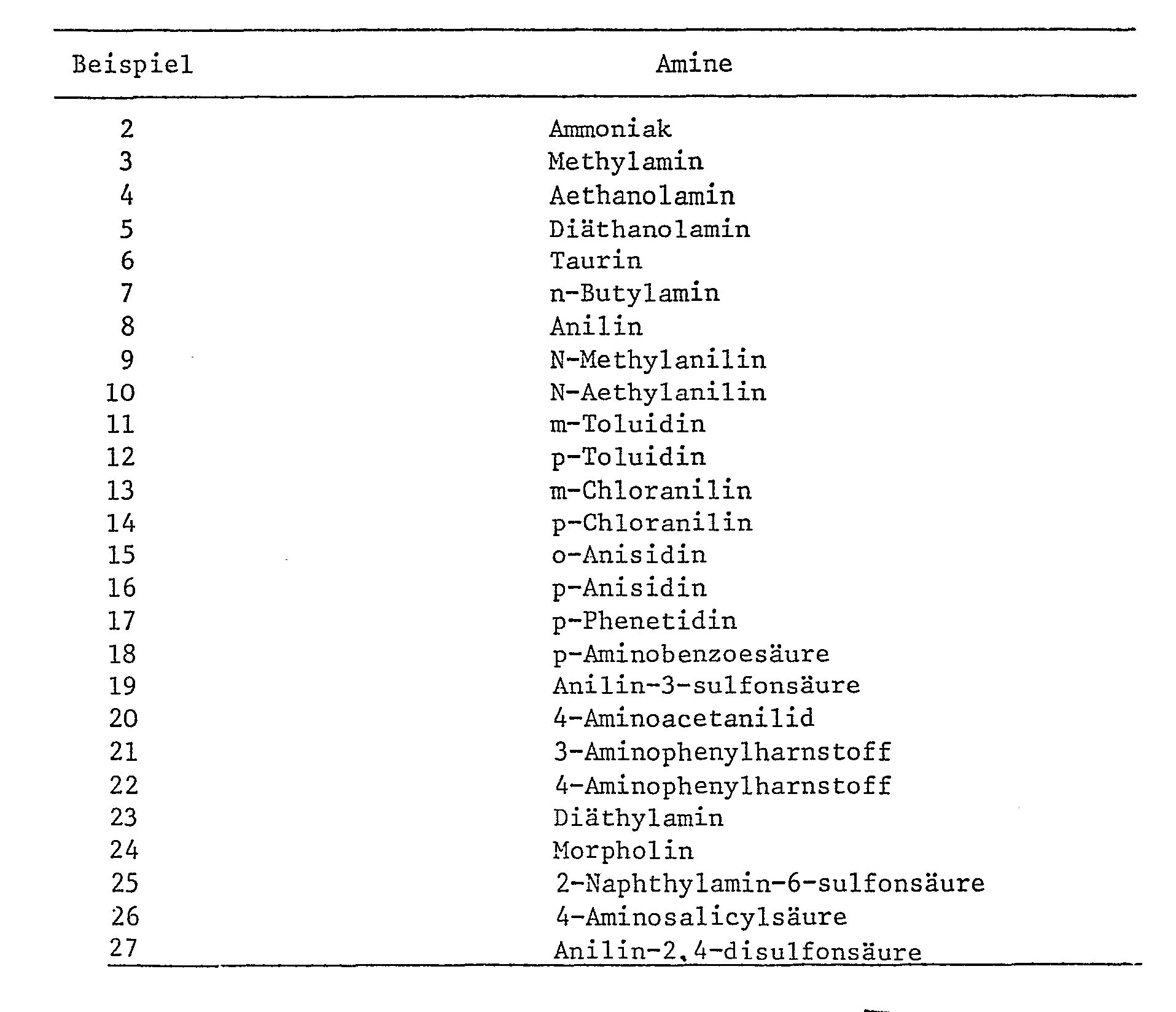
- Verwendet man anstelle von Anilin-2,5-disulfonsäure eine äquivalente Menge der 2-Methyl-anilin-5-sulfonsäure, so erhält man einen ähnlichen Farbstoff.
- Aehnliche Farbstoffe werden erhalten, wenn anstelle von Anilin-2,5- disulfonsäure äquivalente Mengen der unten aufgeführten Amine verwendet werden.


- 2 Teile des gemäss Beispiel 1 erhaltenen Farbstoffes werden unter Zusatz von 5 bis 20 Teilen Harnstoff und 2 Teilen kalzinierter Soda in 100 Teilen Wasser bei 20 bis 50° C gelöst. Mit der erhaltenen Lösung wird ein Baumwollgewebe imprägniert, sodass es um 60 bis 80 % seines Gewichtes zunimmt, und dann getrocknet. Danach wird während 1/2 bis 5 Minuten bei 140 bis 210° thermofixiert, dann während einer Viertelstunde in einer 0,1 %igen kochenden Lösung eines ionenfreien Waschmittels geseift, gespült und getrocknet.
- 2 Teile des gemäss Beispiel 1 erhaltenen Farbstoffes werden unter Zusatz von 0,5 Teilen m-nitrobenzolsulfonsaurem Natrium in 100 Teilen Wasser gelöst. Mit der erhaltenen Lösung wird ein Baumwollgewebe imprägniert, sodass es um 75 % seines Gewichtes zunimmt, und dann getrocknet.
- Danach imprägniert man das Gewebe mit einer 20° warmen Lösung, die pro Liter 5 Gramm Natriumhydroxyd und 300 Gramm Natriumchlorid enthält, quetscht auf 75 % Gewichtszunahme ab, dämpft die Färbung während 30 Sekunden bei 100 bis 101°, spült, seift während einer Viertelstunde in einer 0,3 %igen kochenden Lösung eines ionenfreien Waschmittels, spült und trocknet.
- 2 Teile des gemäss Beispiel 1 erhältlichen Farbstoffes werden in 100 Teilen Wasser gelöst.
- Die Lösung gibt man zu 1900 Teilen kaltem Wasser, fügt 60 Teile Natriumchlorid zu und geht mit 100 Teilen eines Baumwollgewebes in dieses Färbebad ein.
- Man steigert die Temperatur auf 60° , wobei nach 30 Minuten 40 Teile kalzinierte Soda und nochmals 60 Teile Natriumchlorid zugegeben werden. Man hält die Temperatur 30 Minuten auf 60°, spült und seift dann die Färbung während 15 Minuten in einer 0,3 %igen kochenden Lösung eines ionenfreien Waschmittels, spült und trocknet.
- 4 Teile des in Beispiel 1 hergestellten Reaktivfarbstoffes werden in 50 Teilen Wasser gelöst. Dazu gibt man 50 Teile einer Lösung, die pro Liter 5 g Natriumhydroxyd und 10 g kalziniertes Soda enthält. Mit der erhaltenen Lösung wird ein Baumwollgewebe foulardiert, so dass es um 70 % seines Gewichtes zunimmt, und dann auf eine Kaule aufgewickelt. Das Baumwollgewebe wird so während 3 bis 12 Stunden bei Raumtemperatur gelagert. Danach wird die gefärbte Ware gespült, während einer Viertelstunde mit einem nichtionogenen Waschmittel kochend geseift, nochmals gespült und getrocknet. Man erhält eine blaue Färbung mit guten Echtheitseigenschaften.
Falls im Endfarbstoff der Formel (1) Y ein Fluoratom ist, entfällt die Kondensation mit einem Amin der Formel (7),
Claims (18)
1. Reaktivfarbstoffe der Formel

worin (R) für n Substituenten R steht, die unabhängig voneinander n C1-4-Alkyl, C1-4-Alkoxy, Carboxy oder Halogen sein können, n = 0 bis 3, m = 1 bis 2, und X ein Rest der Formel

worin R1 und R2 unabhängig voneinander Wasserstoff oder gegebenenfalls substituiertes C1-4-Alkyl, A C3-7-Alkylen, das durch Halogen, Hydroxy, Carboxy, Sulfo, Phenyl, Sulfophenyl oder C1-4-Alkoxycarbonyl substituiert sein kann, oder Cyclohexylen, das durch C1-4-Alkyl substituiert sein kann, oder worin die Gruppe -N(R1)-A-N(R2)- 1,4-Piperazindiyl ist, und Y Fluor, -NH2 oder eine substituierte Aminogruppe ist.
2. Reaktivfarbstoffe gemäss Anspruch 1, worin n = 0 ist.
3. Reaktivfarbstoffe gemäss Anspruch 1 oder 2, worin m = 1 ist.
4. Reaktivfarbstoffe gemäss den Ansprüchen 1, 2 und 3, der Formel

worin X die im Anspruch 1 angegebene Bedeutung hat.
5. Reaktivfarbstoffe gemäss einem der Ansprüche 1 bis 4, worin R1 und R2 Wasserstoff sind.
6. Reaktivfarbstoffe gemäss einem der Ansprüche 1 bis 5, worin A Propylen ist, das durch Chlor, Hydroxy, Methyl oder Phenyl substituiert sein kann.
7. Reaktivfarbstoffe gemäss Anspruch 6, worin A 1,2-Propylen, 1,3-Propylen, 2-Hydroxy-1,3-propylen, 1-Phenyl-1,3-propylen, 2-Phenyl-1,3-propylen, 2-(4'-Sulfophenyl)-1,3-propylen, 2-Methyl-1,3-propylen oder 2,2-Dimethyl-1,3-propylen ist.
8. Reaktivfarbstoffe gemäss Anspruch 7, worin A 1,2-Propylen, 1,3-Propylen, 2-Methyl-1,3-propylen oder 2,2-Dimethyl-1,3-propylen ist.
9. Reaktivfarbstoffe gemäss Anspruch 8, worin A 1,3-Propylen ist.
10. Reaktivfarbstoffe gemäss einem der Ansprüche 1 bis 9, worin Y -NH2, Cl-4-Alkylamino, das durch Hydroxy oder Sulfo substituiert sein kann, N,N-Di-C1-4-alkylamino, das durch Hydroxy substituiert sein kann, Phenylamino, das durch CI-4-Alkyl, CI-4-Alkoxy, Halogen, Hydroxy, Ureido, Acetylamino, Carboxy, Sulfo oder Sulfomethyl substituiert sein kann, N-Cl-4-Alkyl-N-phenylamino, Sulfonaphthylamino oder Morpholino ist.
11. Reaktivfarbstoffe gemäss Anspruch 10, worin Y ein Rest der Formel

und R3 Wasserstoff oder C1-4-Alkyl, das durch Halogen, Cyan Hydroxy, Carboxy, Sulfo oder Sulfato substituiert sein kann, ist, und der Phenyl ring B durch Methyl, Methoxy, Aethoxy, Chlor, Hydroxy, Ureido, Acetylamino, Carboxy oder Sulfo substituiert sein kann.
12. Reaktivfarbstoffe gemäss Anspruch 11, worin R Wasserstoff ist, und der Benzolring B durch Sulfo oder Methyl substituiert sein kann.
13. Reaktivfarbstoffe gemäss Anspruch 12, worin Y 2-Methyl-5-sulfo- phenylamino oder 2,5-Disulfophenylamino ist.
14. Reaktivfarbstoff gemäss Anspruch 13, der Formel
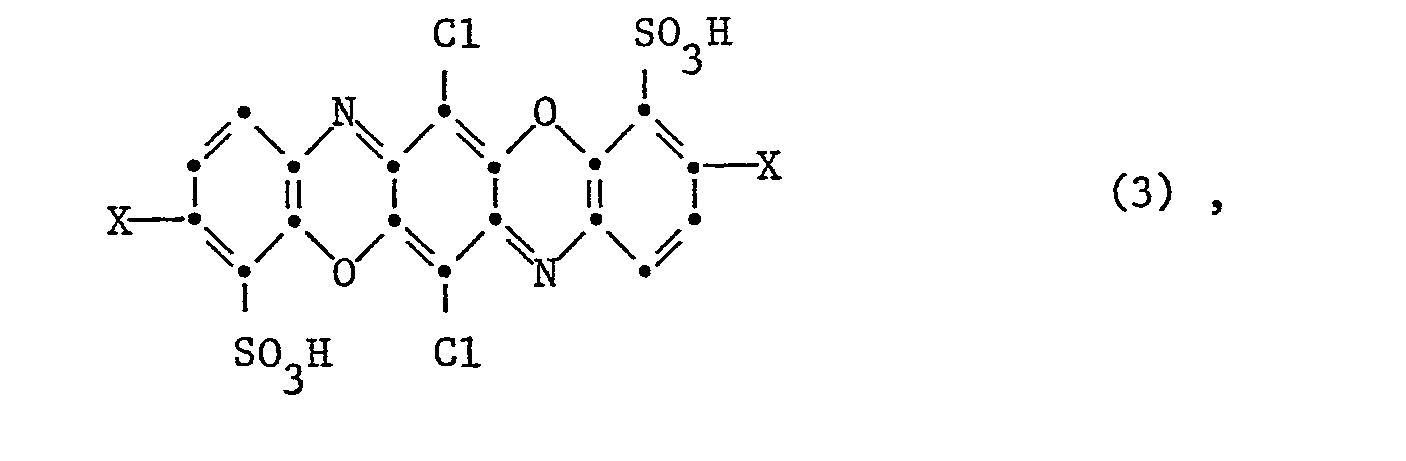
worin X ein Rest der Formel

ist.
15. Verfahren zur Herstellung von Reaktivfarbstoffen gemäss Anspruch 1, dadurch gekennzeichnet, dass man in beliebiger Reihenfolge Dioxazinverbindungen der Formel

worin R, n und m die in Anspruch 1 angegebenen Bedeutungen haben, und X ein Rest der Formel

ist, 2,4,6-Trifluor-s-triazin und gegebenenfalls Amine der Formel

kondensiert.
16. Verfahren gemäss Anspruch 15, zur Herstellung des Reaktivfarbstoffes gemäss Anspruch 14, dadurch gekennzeichnet, dass man eine Dioxazinverbindung der Formel

worin X ein Rest der Formel

ist, mit der durch Monokondensation von 2,4,6-Trifluor-s-triazin und Anilin-2,5-disulfonsäure erhaltenen Verbindung der Formel

kondensiert.
17. Verwendung der Reaktivfarbstoffe gemäss den Ansprüchen 1 bis 14, bzw. der gemäss den Ansprüchen 15 und 16 erhältlichen Reaktivfarbstoffen zum Färben und Bedrucken.
18. Verwendung gemäss Anspruch 17, zum Färben von Cellulosefasern.
Applications Claiming Priority (2)
| Application Number | Priority Date | Filing Date | Title |
|---|---|---|---|
| CH496082 | 1982-08-19 | ||
| CH4960/82 | 1982-08-19 |
Publications (2)
| Publication Number | Publication Date |
|---|---|
| EP0101665A2 true EP0101665A2 (de) | 1984-02-29 |
| EP0101665A3 EP0101665A3 (de) | 1984-10-10 |
Family
ID=4285521
Family Applications (1)
| Application Number | Title | Priority Date | Filing Date |
|---|---|---|---|
| EP83810359A Withdrawn EP0101665A3 (de) | 1982-08-19 | 1983-08-15 | Reaktivfarbstoffe der Dioxazinreihe, deren Herstellung und Verwendung |
Country Status (2)
| Country | Link |
|---|---|
| EP (1) | EP0101665A3 (de) |
| JP (1) | JPS5953552A (de) |
Cited By (15)
| Publication number | Priority date | Publication date | Assignee | Title |
|---|---|---|---|---|
| US4568742A (en) * | 1983-11-19 | 1986-02-04 | Bayer Aktiengesellschaft | Basic triphendioxazine dyestuffs |
| US4577015A (en) * | 1984-02-11 | 1986-03-18 | Bayer Aktiengesellschaft | Triphendioxazine vinyl sulphone dyestuffs |
| US4578461A (en) * | 1983-12-07 | 1986-03-25 | Bayer Aktiengesellschaft | Triphendioxazine dyestuffs |
| US4588810A (en) * | 1983-12-08 | 1986-05-13 | Bayer Aktiengesellschaft | Basic triphendioxazine dyestuffs |
| US4591643A (en) * | 1983-10-06 | 1986-05-27 | Bayer Aktiengesellschaft | Triphendioxazine reactive dyestuffs |
| US4604459A (en) * | 1984-06-27 | 1986-08-05 | Bayer Aktiengesellschaft | Triphendioxazine reactive dyestuffs |
| EP0199036A3 (en) * | 1985-03-23 | 1987-01-21 | Bayer Ag | Triphenedioxazine dyes |
| EP0260227A1 (de) * | 1986-09-12 | 1988-03-16 | Ciba-Geigy Ag | Reaktivfarbstoffe der Dioxazinreihe, deren Herstellung und Verwendung |
| US4785099A (en) * | 1985-12-19 | 1988-11-15 | Hoechst Aktiengesellschaft | Water-soluble triphendioxazine compounds |
| US4785098A (en) * | 1984-07-20 | 1988-11-15 | Hoechst Aktiengesellschaft | Water-soluble triphendioxazine compounds |
| EP0432879A1 (de) * | 1989-11-16 | 1991-06-19 | Zeneca Limited | Reaktivfarbstoffe |
| US5189162A (en) * | 1989-11-16 | 1993-02-23 | Imperial Chemical Industries Plc | Unsymmetrical triphenodixoazine reactive dyes |
| EP0739950A3 (de) * | 1995-04-25 | 1998-02-25 | Ciba SC Holding AG | Reaktivfarbstoffe der Dioxazinreihe, ihre Herstellung und Verwendung |
| EP0881268A1 (de) * | 1997-05-28 | 1998-12-02 | DyStar Textilfarben GmbH & Co. Deutschland KG | Faserreaktive Triphendioxazinfarbstoffe, Verfahren zu deren Herstellung und ihre Verwendung |
| CN1043894C (zh) * | 1993-05-18 | 1999-06-30 | 赫彻斯特股份公司 | 三苯二嗪化合物、其制法及其作为染料的应用 |
Families Citing this family (1)
| Publication number | Priority date | Publication date | Assignee | Title |
|---|---|---|---|---|
| JPH0750921B2 (ja) * | 1985-12-18 | 1995-05-31 | ソニー株式会社 | 編集制御装置 |
Family Cites Families (1)
| Publication number | Priority date | Publication date | Assignee | Title |
|---|---|---|---|---|
| GB1477071A (en) * | 1975-01-13 | 1977-06-22 | Ici Ltd | Reactive dioxazine dyestuffs |
-
1983
- 1983-08-15 EP EP83810359A patent/EP0101665A3/de not_active Withdrawn
- 1983-08-19 JP JP15040483A patent/JPS5953552A/ja active Pending
Cited By (20)
| Publication number | Priority date | Publication date | Assignee | Title |
|---|---|---|---|---|
| US4591643A (en) * | 1983-10-06 | 1986-05-27 | Bayer Aktiengesellschaft | Triphendioxazine reactive dyestuffs |
| US4568742A (en) * | 1983-11-19 | 1986-02-04 | Bayer Aktiengesellschaft | Basic triphendioxazine dyestuffs |
| US4578461A (en) * | 1983-12-07 | 1986-03-25 | Bayer Aktiengesellschaft | Triphendioxazine dyestuffs |
| US4588810A (en) * | 1983-12-08 | 1986-05-13 | Bayer Aktiengesellschaft | Basic triphendioxazine dyestuffs |
| US4577015A (en) * | 1984-02-11 | 1986-03-18 | Bayer Aktiengesellschaft | Triphendioxazine vinyl sulphone dyestuffs |
| US4604459A (en) * | 1984-06-27 | 1986-08-05 | Bayer Aktiengesellschaft | Triphendioxazine reactive dyestuffs |
| US4785098A (en) * | 1984-07-20 | 1988-11-15 | Hoechst Aktiengesellschaft | Water-soluble triphendioxazine compounds |
| US4665179A (en) * | 1985-03-23 | 1987-05-12 | Bayer Aktiengesellschaft | Triphendioxazine dyestuffs |
| EP0199036A3 (en) * | 1985-03-23 | 1987-01-21 | Bayer Ag | Triphenedioxazine dyes |
| US4785099A (en) * | 1985-12-19 | 1988-11-15 | Hoechst Aktiengesellschaft | Water-soluble triphendioxazine compounds |
| EP0260227A1 (de) * | 1986-09-12 | 1988-03-16 | Ciba-Geigy Ag | Reaktivfarbstoffe der Dioxazinreihe, deren Herstellung und Verwendung |
| US4841049A (en) * | 1986-09-12 | 1989-06-20 | Ciba-Geigy Corporation | Reactive dyes of the dioxazine series |
| US5189162A (en) * | 1989-11-16 | 1993-02-23 | Imperial Chemical Industries Plc | Unsymmetrical triphenodixoazine reactive dyes |
| EP0432879A1 (de) * | 1989-11-16 | 1991-06-19 | Zeneca Limited | Reaktivfarbstoffe |
| CN1043894C (zh) * | 1993-05-18 | 1999-06-30 | 赫彻斯特股份公司 | 三苯二嗪化合物、其制法及其作为染料的应用 |
| EP0739950A3 (de) * | 1995-04-25 | 1998-02-25 | Ciba SC Holding AG | Reaktivfarbstoffe der Dioxazinreihe, ihre Herstellung und Verwendung |
| US5772698A (en) * | 1995-04-25 | 1998-06-30 | Ciba Specialty Chemicals Corporation | Reactive dyes from the dioxazine series, their preparation and use |
| SG49926A1 (en) * | 1995-04-25 | 2001-07-24 | Ciba Sc Holding Ag | Reactive dyes from the dioxazine series, their preparation and use |
| EP0881268A1 (de) * | 1997-05-28 | 1998-12-02 | DyStar Textilfarben GmbH & Co. Deutschland KG | Faserreaktive Triphendioxazinfarbstoffe, Verfahren zu deren Herstellung und ihre Verwendung |
| US5972048A (en) * | 1997-05-28 | 1999-10-26 | Dystar Textilfarben Gmbh & Co. Deutschland Kg | Fiber-reactive triphendioxazine dyes, preparation thereof and use thereof |
Also Published As
| Publication number | Publication date |
|---|---|
| EP0101665A3 (de) | 1984-10-10 |
| JPS5953552A (ja) | 1984-03-28 |
Similar Documents
| Publication | Publication Date | Title |
|---|---|---|
| DE2560422C2 (de) | Reaktivfarbstoffe, deren Herstellung und Verwendung | |
| EP0735113B1 (de) | Faserreaktive Farbstoffmischungen und deren Verwendung | |
| EP0260227B1 (de) | Reaktivfarbstoffe der Dioxazinreihe, deren Herstellung und Verwendung | |
| EP0070807B1 (de) | Reaktivfarbstoffe, deren Herstellung und Verwendung | |
| EP0076782A2 (de) | Reaktivfarbstoffe, deren Herstellung und Verwendung | |
| US4092478A (en) | Triphendioxazine triazinyl dyes having phosphonic acid groups | |
| EP0084314B1 (de) | Disazoreaktivfarbstoffe | |
| DE69018674T2 (de) | Faserreaktive asymmetrische Dioxazinverbindungen und deren Verwendung als faserreaktive Farbstoffe. | |
| CH634341A5 (de) | Reaktivfarbstoffe und deren herstellung. | |
| EP0131542B1 (de) | Reaktivfarbstoffe, deren Herstellung und Verwendung | |
| CH629239A5 (en) | Process for the preparation of fibre-reactive disazo dyes | |
| EP0036838B1 (de) | Azofarbstoffe, deren Herstellung und Verwendung | |
| DE2924228A1 (de) | Reaktivfarbstoffe, deren herstellung und verwendung | |
| EP0132223A1 (de) | Reaktivfarbstoffe, deren Herstellung und Verwendung | |
| EP0305021B1 (de) | Reaktive Monoazofarbstoffe, deren Herstellung und Verwendung | |
| EP0120807B1 (de) | Reaktivfarbstoffe, deren Herstellung und Verwendung | |
| EP0073178A1 (de) | Reaktivfarbstoffe, deren Herstellung und Verwendung | |
| EP0474596B1 (de) | Reaktivfarbstoffe, Verfahren zu deren Herstellung und deren Verwendung | |
| DE2819787A1 (de) | Neue farbstoffe, deren herstellung und verwendung | |
| EP0485336B1 (de) | Reaktivfarbstoffmischungen, Verfahren zu deren Herstellung und deren Verwendung | |
| EP0083052B1 (de) | Bisazoreaktivfarbstoffe, Verfahren zu ihrer Herstellung und ihre Verwendung zum Färben und Bedrucken von hydroxylgruppen- oder stickstoffhaltigem Fasermaterial | |
| EP0356681B1 (de) | Disazoreaktivfarbstoffe | |
| EP0333656A1 (de) | Reaktivfarbstoffe, Verfahren zu deren Herstellung und deren Verwendung | |
| EP0069376B1 (de) | Kupferkomplex-Monoazoverbindungen, Verfahren zu ihrer Herstellung und ihre Verwendung als Farbstoffe | |
| DE2728354C2 (de) | Faserreaktive Azofarbstoffe, deren Herstellung und Verwendung |
Legal Events
| Date | Code | Title | Description |
|---|---|---|---|
| PUAI | Public reference made under article 153(3) epc to a published international application that has entered the european phase |
Free format text: ORIGINAL CODE: 0009012 |
|
| 17P | Request for examination filed |
Effective date: 19830817 |
|
| AK | Designated contracting states |
Designated state(s): CH DE FR GB IT LI |
|
| PUAL | Search report despatched |
Free format text: ORIGINAL CODE: 0009013 |
|
| AK | Designated contracting states |
Designated state(s): CH DE FR GB IT LI |
|
| STAA | Information on the status of an ep patent application or granted ep patent |
Free format text: STATUS: THE APPLICATION IS DEEMED TO BE WITHDRAWN |
|
| 18D | Application deemed to be withdrawn |
Effective date: 19860127 |
|
| RIN1 | Information on inventor provided before grant (corrected) |
Inventor name: SEITZ, KARL, DR. |