EP0098523A2 - Vakuummonitor für Vakuumschalter - Google Patents
Vakuummonitor für Vakuumschalter Download PDFInfo
- Publication number
- EP0098523A2 EP0098523A2 EP83106356A EP83106356A EP0098523A2 EP 0098523 A2 EP0098523 A2 EP 0098523A2 EP 83106356 A EP83106356 A EP 83106356A EP 83106356 A EP83106356 A EP 83106356A EP 0098523 A2 EP0098523 A2 EP 0098523A2
- Authority
- EP
- European Patent Office
- Prior art keywords
- vacuum
- electromagnetic wave
- monitor
- vacuum interrupter
- interrupter
- Prior art date
- Legal status (The legal status is an assumption and is not a legal conclusion. Google has not performed a legal analysis and makes no representation as to the accuracy of the status listed.)
- Granted
Links
Images


Classifications
-
- H—ELECTRICITY
- H01—ELECTRIC ELEMENTS
- H01H—ELECTRIC SWITCHES; RELAYS; SELECTORS; EMERGENCY PROTECTIVE DEVICES
- H01H33/00—High-tension or heavy-current switches with arc-extinguishing or arc-preventing means
- H01H33/60—Switches wherein the means for extinguishing or preventing the arc do not include separate means for obtaining or increasing flow of arc-extinguishing fluid
- H01H33/66—Vacuum switches
- H01H33/668—Means for obtaining or monitoring the vacuum
-
- H—ELECTRICITY
- H02—GENERATION; CONVERSION OR DISTRIBUTION OF ELECTRIC POWER
- H02H—EMERGENCY PROTECTIVE CIRCUIT ARRANGEMENTS
- H02H7/00—Emergency protective circuit arrangements specially adapted for specific types of electric machines or apparatus or for sectionalised protection of cable or line systems, and effecting automatic switching in the event of an undesired change from normal working conditions
- H02H7/22—Emergency protective circuit arrangements specially adapted for specific types of electric machines or apparatus or for sectionalised protection of cable or line systems, and effecting automatic switching in the event of an undesired change from normal working conditions for distribution gear, e.g. bus-bar systems; for switching devices
- H02H7/222—Emergency protective circuit arrangements specially adapted for specific types of electric machines or apparatus or for sectionalised protection of cable or line systems, and effecting automatic switching in the event of an undesired change from normal working conditions for distribution gear, e.g. bus-bar systems; for switching devices for switches
Definitions
- the present invention relates generally to a vacuum monitor for detecting poor vacuum pressure within a vacuum interrupter, and more specifically to a vacuum monitor which can produce an alarm or indicate a caution when vacuum pressure within a vacuum interrupter is abnormally increasing.
- a vacuum interrupter for use with an electric power circuit has a normal circuit interruption performance when pressure of vacuum within its evacuated envelope is kept below 10 -4 Torr (Torricelli).
- Torricelli 10 -4 Torr
- the pressure of vacuum sometimes increases and the circuit interruption performance deteriorates, because of, for instance, outgassing from materials used for the interrupter or slow leakage of air (air is leaked through cracks caused by undue mechanical stresses or through welded or insufficiently brazed junction portions).
- the small contact spacing will no longer be able to sustain a high voltage applied to the contacts; arcs and flashovers will occur; white hot arc will burn the contact surfaces and may melt the vacuum envelope and other parts of the vacuum interrupter.
- a vacuum monitor for a vacuum interrupter which can easily check poor vacuum pressure within a vacuum interrupter, without need of any additional electric discharge electrodes or high voltage power supply, provided that a high supply voltage is being applied to a power circuit via a vacuum interrupter, at relatively low manufacturing cost and through simple checking procedure.
- This vacuum monitor for a vacuum interrupter comprises an antenna disposed near a conductive material of the vacuum 'interrupter for receiving impulsive electromagnetic wave signals generated by electric discharge caused -in accordance with a prebreakdown voltage depending upon Paschen's law when vacuum pressure increases within the vacuum interrupter and a detector circuit connected to the antenna for electrically processing the impulsive electromagnetic wave signals received by the antenna in order to indicate poor vacuum pressure within a vacuum interrupter.
- the vacuum monitor as described above are disclosed in detail in our former Patent Application Document (U.S. Patent Application No. 437,678 filed on October 29, 1982, EPC Patent Application No. 82 305 761.7 filed on October 29, 1982, or Korean Patent Application No. 82-4846 filed on October 28, 1982).
- this vacuum monitor can check poor vacuum pressure within the vacuum interrupter in dependence upon impulsive electromagnetic wave signals emitted to the air from the vacuum interrupter or a conductive material connected to the interrupter, in the case where the vacuum interrupter is perfectly covered by an insulating solid material and the insulating solid material is additionally covered by a metal layer connected to the ground, no impulsive electromagnetic wave signals are emitted to the outside.
- the vacuum interrupter in the case where the vacuum interrupter is housed within a metal housing filled with an insulating medium such as an oil or gas and the metal housing is perfectly grounded and further where other conductive materials connected to the vacuum interrupter are all shielded perfectly, no impulsive electromagnetic wave signals are emitted to the outside.
- there exists shortcomings such that it is impossible to check poor vacuum pressure within a vacuum interrupter which is housed within a casing perfectly shielded and grounded.
- the vacuum monitor for a vacuum interrupter comprises a peculiar detector terminal indirectly, namely, inductively or capacitively coupled to a conductive material to which a high voltage is applied.
- the detector terminal is attached in position in any desired elements (not necessarily grounded or shielded) of the vacuum interrupter to be monitored.
- the detector terminals are of a capacitor coupler type (C-type), a current transformer type (CT-type) or a potential transformer type (PT-type).
- the vacuum monitor for a vacuum interrupter comprises a peculiar detector terminal indirectly, namely, inductively or capacitively coupled to a conductive material to which a high voltage is applied.
- the detector terminal is attached in position in the wall of the grounded casing for the vacuum interrupter.
- the detector terminals are of a capacitor coupler type (C-type), a current transformer type (CT-type) or a potential transformer type ( P T-type), similarly.
- the vacuum monitor according to the present invention comprises, in particular, means for discriminating the magnitude of the signal level of impulsive electromagnetic wave signals indicative of a poor vacuum pressure in order to apply the electromagnetic wave signals to the next stage through a voltage divider when the signal level exceeds a predetermined reference value. Therefore, it is possible to reliably detect the electromagnetic wave signals indicative of a poor vacuum pressure without being subject to the influence of external electrical noise signals;
- the vacuum monitor according to the present invention comprises means for outputting a diagnosis signal the frequency of which lies from 2 to 400 kHz exactly or from 2 to 20 kHz substantially in order to diagnose the functions, of the vacuum monitor itself. Therefore, it is possible to more reliably detect the electromagnetic wave signals indicative of a poor vacuum.
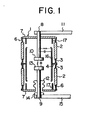
- the reference numeral 1 denotes a typical vacuum interrupter, the evacuated envelope of which comprises two tubular insulating housings 2 made of glass or ceramics and hermetically joined to each other by two metallic tubes 3 with a disk 4 sandwiched therebetween, and a pair of metallic end caps 7 also hermetically joined to the tubular insulating housing 2, respectively, with a metallic tube 6 joined hermetically on either opposite side (upper and lower sides) of the insulating housing 2.
- a metallic contact rods 8 and 9 At the center of the respective end caps 7, there are disposed two conductive contact rods 8 and 9.
- the fixed conductive contact rod 8 is hermetically joined at its upper end to the upper metallic end cap 7.
- a fixed contact 10 is fixedly brazed to the lower end of the fixed conductive contact rod 8 and an external connection conductor 11 is joined to the upper end of the fixed conductive contact rod 8.
- the movable conductive contact rod 9 is movably joined to the lower end cap 7 through a metal bellows 12 so as to be freely movable in the axial direction of the envelope without destroying a vacuum within the envelope.
- a movable contact 13 is fixedly brazed to the upper end of the movable conductive contact rod 9, and a slide contact 14 is slidably fitted to the lower end of the movable contact rod 9.
- the numeral 15 denotes another external connection conductor for mounting the slide contact 14.
- the numeral 16 denotes a tubular main shield disposed at the intermediate portion of the envelope for preventing metal vapor, generated from the fixed and movable contacts 10 and 13 when they are opened or closed, from depositing onto the inner surfaces of the tubular insulating housings 2.
- the numeral 17 denotes a pair of upper and lower auxiliary shields. Further, in Fig. 1, when a high supply voltage is connected to the external conductor 11, a power circuit is connected to the other external conductor 15.
- the vacuum interrupter 1 is operated by driving the movable contact 13 up and down to close and open an electric power circuit connected thereto. When the two contacts are closed, current flows from the upper external connection conductor 11 to the lower external connection conductor 15 or vice versa, through the path of the fixed contact rod 8, the fixed contact 10, the movable contact 13 and the movable contact rod 9.
- Power circuit interruption is effected by driving the movable contact 13 downward so as to be separated from the fixed contact 10 by an appropriate operating apparatus (not shown).
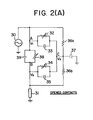
- Fig. 2 (A) is an equivalent circuit diagram of the vacuum interrupter shown in Fig. 1, in which the two contacts thereof are kept opened.
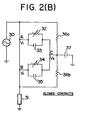
- Fig. 2(B) is the same circuit diagram, in which the two contacts thereof are kept closed.
- the reference numeral 30 denotes.a power supply for a power circuit to be interrupted by a vacuum interrupter;
- the reference numeral 31 denotes a load for the power circuit.
- the reference numeral 32 denotes an insulation resistance existing between the fixed contact 10 including the fixed contact rod 8 and the main shield 16;
- the numeral 33 denotes a stray capacitance existing between the fixed contact 10 including the fixed contact rod 8 and the main shield 16.
- the reference numeral 34 denotes an insulation resistance existing between the movable contact 13 including the movable contact rod 9 and the main shield 16; the numeral 35 denotes a stray capacitance existing between the movable contact 13 including the movable contact rod 9 and the main shield 16.
- the reference numerals 36a and 36b denote insulation resistances in the two tubular insulating housings 2, respectively; the numeral 37 denotes a stray capacitance existing between the main shield 16 and the ground.
- the reference numeral 38 denotes an insulation resistance existing between the fixed and movable contacts 10 and 13 and the numeral 39 denotes a stray capacitance existing between the two contacts 10 and 13, in the case where the two contacts are opened.
- the vacuum pressure within the interrupter when the vacuum pressure within the interrupter is normal lying less than 10- 4 Torr, the respective potential differences are constant; however, in case the vacuum pressure becomes poor or increases gradually due to air leakage or outgassing and therefore ions are produced within the envelope, the insulation resistances 32, 34 and 38 decrease, thus resulting in anxious electric dark current flowing mainly between the fixed and movable contacts 10 and 13 when the two contacts are kept opened, and between the fixed and movable contact rods 8 and 9 including the two contacts and the main shield 16 when the two contacts are kept closed.
- the insulation resistance 38, 32 or 34 drops gradually over a long time (e.g. 2 to 3 years) and therefor anxious electric dark current will flow therebetween, thus a kind of anxious electromagnetic wave being emitted. Since the electromagnetic wave generated by the above-mentioned potential difference (between A and B or between A and C or B and C) tends to be propagated in conductive material connected to the vacuum interrupter, it is possible to indirectly check poor vacuum pressure within a vacuum interrupter by providing a detector terminal inductively or capacitively coupled to a conductive material of the interrupter in order to detect the electromagnetic wave signals generated by anxious electric dark discharge when the vacuum pressure increases within the vacuum interrupter.
- the potential V l is equal to the potential V 2 when the two contacts are kept closed and the floating potential V 3 changes according to the stray capacitance 37 which is usually determined by the grounded condition.
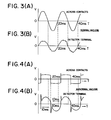
- Fig. 3 (A) shows the wave-form of the voltage signal developing across the two contacts when the vacuum pressure within the vacuum interrupter is normal (e.g. 10 -4 Torr or less).
- Fig. 3( B ) shows the wave-form of the signal received through a detector terminal when the vacuum pressure is normal.
- a commercial frequency e.g. 50 or 60 Hz
- the signal received through the detector terminal is roughly a sine wave upon which signals including higher harmonics of 2 kHz or less or 400 kHz or more (20 kHz or more substantially) are superimposed.
- These superimposed signals of 2 kHz or less frequencies may be generated for rotary machines, transformers, measuring devices, etc.
- these superimposed signals of 400 kHz or more frequencies (20 kHz or more frequencies substantially) are generated due to partial discharge.
- these signals with frequencies of 2 kHz or less or of 400 kHz or more (20 kHz or more substantially) can be eliminated.
- commercial frequency components of 50 or 60 Hz can easily be eliminated. That is to say, when the vacuum pressure within the vacuum interrupter is normal, the vacuum monitor outputs no signal.
- Fig. 4(A) shows the wave-form of the voltage signal developing across the two contacts when the vacuum pressure is abnormal (e.g. 10 -3 Torr or more).
- Fig. 4(B) shows the wave-form of the electro- - magnetic wave signals received through the detector terminal when the vacuum pressure is abnormal.
- the frequency components of the electromagnetic wave signals received through the antenna ranges from 10 to 14 kHz when the electrostatic capacitance between the load and the ground is 0.0042 uF, from 2 to 8 kHz when the capacitance is 0.05 ⁇ F, and from 2 to 20 kHz when the capacitance is 0.2 ⁇ F or more.
- the detection sensitivity can be improved by connecting a capacitance of about 0.2 ⁇ F on the load side of the vacuum interrupter, in order to stably detect the electromagnetic wave signals caused by abnormal poor vacuum pressure.
- the detected signal voltage outputted from the vacuum monitor is about 0.6V if the gain thereof is 10,000.
- the detected signal voltage outputted from the vacuum monitor is about 0.3V.
- the reason why the detected signal voltage is low when. the two contacts are closed, in comparison with that obtained when the two contacts are opened, may be due to the following fact: when the two contacts are closed, since electric discharge is generated only between the fixed and movable contact rods 8 and 9 including the fixed and movable contacts 10 and 13 and the main shield 16, the insulation resistance (parallel connection of 32 and 34) existing therebetween may be greater than the insulation resistance 38 existing between two contacts, and therefore the electric discharge energy obtained when the two contacts are closed may be smaller than that obtained when the two contacts are opened. Further, in the case when poor vacuum pressure is detected through the detector terminal according to the present invention, a fairly high-level voltage signal indicative of poor vacuum can be obtained, even if the gain of the monitor is relatively low.
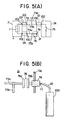
- Fig. 5(A) shows an exemplary miniature substation installation, in which the three-phase bus bars or conductors are illustrated by a single line.
- the reference numeral 71 denotes a first tank within which a vacuum interrupter is housed
- the numeral 72 denotes a second tank connected to the first tank 71 through ducts 101, within which conductors 73a connected to the power-supply cables 73b and conductors 73c connected to the load cable 73d are housed respectively
- the numeral 74 denotes a third tank connected to the second tank 72 through a duct 101, within which a disconnecting switch 75 is housed.
- the tanks 71, 72 and 74 and the ducts 101 are all made of a metal and are grounded. All the tanks and the ducts are filled with an insulating medium and the ducts 101 are airtightly sealed to the tanks through insulating spacers 102.
- a detector terminal 21 of capacitor coupler type is connected to the power supply conductor 73a, as more clearly depicted in the enlarged drawing of Fig. 5(B) shown below.
- the detector terminal 21 comprises a capacitor 76 one electrode 76a of which is connected to the power supply conductor 73a and the other electrode 76b of which is connected a detection conductor 77.
- the detection conductor 77 is guided to the outside of the second tank 72 through an insulator 78 fixed to the wall 72a of the second tank 72.
- a detecting cable 22 led out of the vacuum monitor 200- is brought into contact with one outer end portion of the detection conductor 77 for sensing the electromagnetic wave signals indicative of a poor vacuum.
- a pair of male and female plugs for connection between the insulator 78 and the detecting cable 22.
- a male plug is attached to one end of the detecting cable 22 and a female plug is implanted within the insulator 78, for instance.
- a coaxial cable as the detecting cable 22 with the outer shield wire net connected to the ground, instead of a single insulated cable.
- Fig. 6 shows a schematic block diagram of the vacuum monitor 200 according to the present invention.
- the vacuum monitor 200 is roughly made up of a detection terminal section, a signal level discriminating section 40, a diagnosis section 50 and a detection section 20.
- the detection terminal section includes a detector terminal 21 such as capacitor coupler type and a detecting cable 22.
- the signal level discriminating section 40 includes a comparator section 41 having an amplifier 41a and a first comparator 41b, a switching section 42 having a transistor 42a, a relay 42b and relay contacts 42c, and a voltage divider section 43, as shown in more detail in Fig. 7.
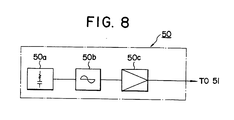
- the diagnosis section 50 includes a CR time constant circuit 50a, a CR oscillator 50b and an amplifier 50c, as shown in more detail in Fig. 8.
- the detection section 20 includes a buffer amplifier 23, a band-pass filter 24, an amplifier 25, a first comparator 26, an integrator or a counter 27 and a second comparator 28.
- the detection terminal section detects impulsive electromagnetic wave signals through the detector terminal 21 indirectly coupled to a conductive material of a vacuum interrupter when the vacuum pressure within the vacuum interrupter is abnormal.
- the detector terminal 21 is of a capacitor coupler type as shown in Figs. 5(A) and 5(B).
- the detecting cable 22 is a single or coaxial cable brought into contact with the detector terminal 21 directly.
- the signal level discriminating section 40 serves to discriminate the magnitude of the voltage level of the electromagnetic wave signals and to output the signals to the next stage directly, when the magnitude of the voltage level is relatively small; but indirectly, after having reduced the voltage level thereof into a smaller level through the voltage divider 43, when the magnitude of the voltage level is relatively great.
- the amplifier 41a is a high-input impedance operational amplifier, the input terminal of which is connected to the detector terminal 21 through the detecting cable 22 and the output terminal of which is connected the comparator 41a.
- the comparator 41b discriminates the magnitude of the voltage level of the electromagnetic wave signals sensed through the detector terminal 21 and outputs a voltage level reduction signal S to the base of the switching transistor 42a only when the magnitude of the signal voltage level exceeds a predetermined reference voltage level.
- the switching transistor 42a is turned on to energize a relay 42b connected to the collector terminal of the transistor 42a.
- the relay 42b is energized, the relay contact 42c is changed over.
- the relay contact 42c includes a first contact 42C-1 connected to the next stage through the voltage divider 43 and.a second contact 42C-2 connected directly to the next stage. In the usual state, the first contact 42C-1 is kept opened and the second contact 42C-2 is kept closed. Therefore, when the magnitude of the electromagnetic wave signal voltage level is small, the low-level electromagnetic wave signal S l is directly applied to the next stage without reduction of the voltage level. However, when the magnitude of the electromagnetic wave signal voltage level exceeds a predetermined reference voltage level, since the comparator 41b outputs the voltage level reduction signal S , the transistor 42a is turned on; the relay 42b is energized; the relay contact 42c is changed over, so that the first contact 42C-1 is closed.
- the high-level electromagnetic wave signals So are applied to the next stage through the voltage divider 43 by which the voltage level thereof is reduced. Accordingly, in case the magnitude of the voltage level of the sensed signals So is extraordinarily great and some external electrical noise signals are mixed with the sensed signals So, it is possible to reliably detect the sensed impulsive electromagnetic wave signals indicative of a poor vacuum at a relatively constant signal voltage level without being subject to the influence of external electrical noise signals.
- the detection section 20 serves to generate an alarm sound or to activate an alarm indicator when the magnitude of the voltage level of the electromagnetic wave signals exceeds an allowable reference voltage level beyond the predetermined reference number of times.
- the buffer amplifier 23 having a high input impedance amplifies the signal received through the signal level discriminating section 40 and outputs the signal S 1 '.
- the signal S 1 ' indicates that the . impulsive electromagnetic wave signals are superimposed as ripples upon a commercial frequency of, for instance, 50 or 60 Hz.
- the band-pass filter 24 passes only the frequency components of 2 to 400 kHz exactly (2 to 20 kHz substantially) from the signal S 1 ' (the commercial frequency components are, of course eliminated) and outputs signal 5 2 . That is to say, this band-pass filter 24 serves to eliminate frequency components of 2 kHz or less and 400 kHz or more exactly (20 kHz or more substantially) from the signal S 1 .
- the amplifier 25 amplifies the filtered signal S 2 to the corresponding signal S 3 .
- the first comparator 26 compares this amplified signal S 3 with a predetermined reference voltage level and outputs a signal S 4 whenever the amplified signal S 3 exceeds the reference level.
- the integrator (or a counter) 27 continually integrates or counts the number of the signal S4 and outputs the corresponding signal S 5 .
- the second, comparator 28 compares the integrated or counted signal S 5 with another predetermined reference value and outputs a signal S 6 when the signal S 5 exceeds the reference level. This signal S 6 outputted from the second comparator 28 is used for producing an alarm or for activating an indicator to show poor vacuum pressure or that vacuum pressure is abnormally increasing within the interrupter.
- the diagnosis section 50 serves to diagnose the functions of the vacuum monitor before and after checking a poor vacuum pressure within the vacuum interrupter. In other words, the diagnosis section 50 checks whether or,not the detecting section 20 operates normally. For the above-mentioned purpose, this diagnosis section 50,outputs any one of a first diagnosis signal the frequency of which is from about 2 kHz (the lower limit value of the filter 24) to about 400 kHz exactly or 20 kHz substantially (the upper limit value of the filter 24), a second diagnosis signal the frequency of which is less than 2 kHz and a third diagnosis signal the frequency of which is more than 400 kHz (20 kHz substantially).
- a first diagnosis signal the frequency of which is from about 2 kHz (the lower limit value of the filter 24) to about 400 kHz exactly or 20 kHz substantially (the upper limit value of the filter 24)
- a second diagnosis signal the frequency of which is less than 2 kHz
- a third diagnosis signal the frequency of which is more than 400 kHz (20 kHz substantially).
- the diagnosis switch 51 is turned on manually and then the first diagnosis signal of from 2 kHz to 400 kHz (2 kHz to 20 kHz substantially) is applied to the signal level discriminating section 40. In this case, if an alarm sound or an alarm indication is produced, the detection section 20 is determined to be normal. On the other hand, if no alarm sound or no alarm indication is produced, the detection section 20 is determined to be abnormal. In contrast with this, if an alarm sound or alarm indication is produced when the second diagnosis signal (2 kHz or less) or the third diagnosis signal (400 kHz or more or_ 20 kHz or more) is applied to the signal level discriminating section 40, the detection section 20 is determined to be abnormal.
- the detection section 20 is determined to be normal.
- diagnosis signals it is possible to check the normal operations of the amplifiers 23 and 25, the filters 24, the first and second comparators 26 and 28, the integrator or counter 27, and the alarm or indicator device together at the same time.
- the diagnosis section 50 is made up of a CR time constant circuit 50a, a CR oscillator 50b and an amplifier 50c.
- the CR time constant circuit 50a includes a Schmitt circuit, for instance, and a CR circuit having a variable resistor. Therefore, by adjusting the resistance of the CR time constant circuit, it is possible to selectively obtain a first CR time constant corresponding to the first diagnosis signal (between 2 and 400 kHz or 20 kHz), a second CR time constant corresponding to the second diagnosis signal (2 kHz or less) or a third CR time constant corresponding to the third diagnosis signal (400 kHz or more, or 20 kHz or more).
- the CR oscillator 50b can generate any one of the first, second and third diagnosis signals. These diagnosis signals are applied to the voltage level discriminating section 40 after amplified by an amplifier 50c, instead of the electromagnetic wave signals sensed through the detector terminal 21, in order to check the normal operation of the detecting section 20.
- the detector terminal of capacitor coupler type is additionally and separately provided in the wall of the tank.
- the elements already provided for the vacuum interrupter for the detector terminal.
- the vacuum interrupter is usually provided with various measuring instruments in order to measure the voltage applied to the interrupter and the current passing through the interrupter (e.g. a voltage detector or capacitor, current transformer, potential transformer, etc.), it is also possible to detect the impulsive electromagnetic wave signals more easily through the output terminals of these already-housed measuring instruments.
- the detector terminal is not necessarily disposed additionally for the vacuum interrupter.
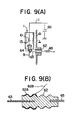
- Fig. 9 (A) shows a second embodiment of the detector terminal of capacitor coupler type used for the vacuum monitor according to the present invention.
- the vacuum interrupter 1 is molded by a resin casing 61 made of an insulating material such as epoxide resin.
- the metal layer formed on the outer surface of the casing 61 is perfectly grounded.
- the reference numeral 62 denotes an insulated operation rod;
- the reference numeral 63 denotes an operation conductor, one end of which is connected to the movable conductive contact rod 9 via an operation lever 64.
- the reference numeral 65 denotes an operation spring, one end of which is implanted within the insulated operation rod 62. Therefore, when the operation spring 65 is energized or deenergized by the aid of an operation device (not shown), the movable conductive contact rod 9 is moved in either direction via the operation lever 64 to open or close the movable contact 13 with respect to the fixed contact 10.
- the detector terminal of capacitor coupler type is made up of one end of the operation conductor 63 implanted at the center of the insulated operation rod 62 and a metal semicircular ring 62A formed on the outer surface of the operation rod 62. Therefore, the end of the operation conductor 63 serves as one electrode and the semicircular ring 62A serves as the other electrode of a capacitor.
- This semicircular ring 62A is connected to the switching section 42 of the voltage level discriminating section 40 through a capacitor cable 62B and the detecting cable 22.
- the reference numeral 66 denotes a capacitor connected to the external connection conductor 11 on the load side in order to increase the detection sensitivity of the vacuum monitor to the electromagnetic wave signals.
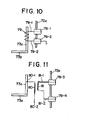
- Fig. 10 shows a detector terminal of current transformer type, which is provided for the miniature substation installation shown in Fig. 5(A).
- the current transformer is a kind of transformer used for insulating the secondary winding 79 from the primary winding (power supply conductor 73a) and for mainly transform the current passing through the conductor 73a.
- the reference numerals 78-1 and 78-2 denote insulators fixed to the wall 72a of the second tank 72 of the miniature substation installation. For safety, either one of these two secondary winding terminals 79-1 and 79-2 is grounded.
- the detecting cable 22 of the vacuum monitor 200 is brought into contact with the secondary winding terminal 79-1 for sensing the impulsive electromagnetic wave signals indicative of a poor vacuum.
- Fig. 11 shows a detector terminal of potential transformer type, which is provided for the miniature substation installation shown in Fig. 5(A).
- the potential transformer is a kind of transformer also used for insulating the secondary winding 81 from the primary winding 80, one end (80-1) of which is connected to one-phase power supply conductor 73a and the other end (80-2) of which is connected to the other-phase power supply conductor.
- the potential transformer serves to mainly transform the potential developed across the primary winding 80.
- the reference numerals 78-3 and 78-4 denote two insulators fixed in the wall 72a of the second tank 72, respectively.
- the reference numerals 81-1 and 81-2 denote secondary winding terminals, respectively.
- the detecting cable 22 of the vacuum monitor 200 is brought into contact with the secondary winding terminals 81-1 and 81-2 for sensing the impulsive electromagnetic wave signals indicative of a poor vacuum.
- the above-mentioned two detector terminals of current transformer type and potential transformer type are of inductor coupler type, in comparison with the detector terminals shown in Figs. 5(B) and 9(B).
- the vacuum monitor according to the present invention is applicable to almost all the ordinary vacuum interrupters now in use, and advantageously can check the vacuum pressure while a voltage is kept applied to the interrupter, that is, under hot-line condition.
- the vacuum monitor since the vacuum pressure within a vacuum interrupter can be checked, on the basis of the impulsive electromagnetic wave signals generated by electric discharge existing between the two contacts in the case when the two contacts are kept opened or between the two contact rods including the contacts and the main shield in the case when the two contacts are kept closed in accordance with a prebreakdown voltage depending upon Paschen's law, by the use of a detector terminal capacitively or inductively coupled to the conductive material of the interrupter and since the sensed signals including higher harmonics of 2 to 400 kHz exactly or of 2 to 20 kHz substantially are amplified and compared with a predetermined reference value to output an alarm signal, it is possible to realize a very convenient, low-priced, small-sized vacuum monitor for a vacuum interrupter housed within a tank or housing which is perfectly shielded and grounded.
- the signal level discriminating section is incorporated in the vacuum monitor according to the present invention for discriminating the magnitude of the voltage level of the electromagnetic wave signals indicative of a poor vacuum and for selectively supplying the signals to the detection section through the voltage divider when the voltage level of the electromagnetic wave signals exceeds a predetermined reference voltage level, it is possible to reliably process the sensed electromagnetic wave signals indicative of a poor vacuum at the relatively constant voltage level without being subject to the influence of external electrical noise signals.
- diagnosis section is additionally provided in the vacuum monitor according to the present invention for outputting any desired diagnosis signals with frequencies of 2 kHz to 400 kHz exactly or of 2 to 20 kHz substantially or with frequencies lower than 2 kHz and higher than 400 kHz exactly or 20 kHz substantially in order to diagnose, the functions of the vacuum monitor, before and after checking the poor vacuum pressure within the vacuum interrupter, it is possible to more reliably detect the electromagnetic wave signals indicative of a poor vacuum.
- diagnosis signals with frequencies of 2 kHz to 20 kHz or with frequencies lower than 2 kHz and higher than 20 kHz to the monitor. This is because the signal levels of frequency components from 2 to 20 kHz are fairly high as compared with those of frequency comonents higher than 20 kHz.
Landscapes
- Measuring Fluid Pressure (AREA)
Applications Claiming Priority (4)
| Application Number | Priority Date | Filing Date | Title |
|---|---|---|---|
| JP116505/82 | 1982-07-05 | ||
| JP57116505A JPS598225A (ja) | 1982-07-05 | 1982-07-05 | 真空しや断器の真空度監視装置 |
| JP14238882A JPS5933719A (ja) | 1982-08-17 | 1982-08-17 | 真空しや断器の真空度監視装置 |
| JP142388/82 | 1982-08-17 |
Publications (3)
| Publication Number | Publication Date |
|---|---|
| EP0098523A2 true EP0098523A2 (de) | 1984-01-18 |
| EP0098523A3 EP0098523A3 (en) | 1985-10-09 |
| EP0098523B1 EP0098523B1 (de) | 1988-03-30 |
Family
ID=26454823
Family Applications (1)
| Application Number | Title | Priority Date | Filing Date |
|---|---|---|---|
| EP83106356A Expired EP0098523B1 (de) | 1982-07-05 | 1983-06-29 | Vakuummonitor für Vakuumschalter |
Country Status (4)
| Country | Link |
|---|---|
| US (1) | US4553139A (de) |
| EP (1) | EP0098523B1 (de) |
| CA (1) | CA1208337A (de) |
| DE (1) | DE3376164D1 (de) |
Families Citing this family (9)
| Publication number | Priority date | Publication date | Assignee | Title |
|---|---|---|---|---|
| JPH0680411B2 (ja) * | 1985-06-17 | 1994-10-12 | 株式会社日立製作所 | 衝撃波検出装置 |
| WO2006012233A1 (en) * | 2004-06-24 | 2006-02-02 | Tari Taricco | Leak detectors and leak detection methods |
| US7148677B2 (en) * | 2005-02-15 | 2006-12-12 | Eaton Corporation | Vacuum circuit interrupter including circuit monitoring leakage or loss of vacuum and method of monitoring a vacuum interrupter for leakage or loss of vacuum |
| US7499255B2 (en) * | 2006-01-31 | 2009-03-03 | Thomas & Betts International, Inc. | Vacuum-type electrical switching apparatus |
| FR2968827B1 (fr) * | 2010-12-09 | 2012-12-21 | Schneider Electric Ind Sas | Dispositif de detection de la perte de vide dans un appareil de coupure a vide et appareil de coupure a vide comportant un tel dispositif |
| CN106463297B (zh) | 2014-05-12 | 2019-03-15 | 库珀技术公司 | 真空损失检测 |
| FR3023650B1 (fr) * | 2014-07-10 | 2016-08-19 | Alstom Technology Ltd | Interrupteur isole par du vide autorisant un test du vide, ensemble d'interrupteur et procede de test |
| US10605687B2 (en) * | 2016-02-29 | 2020-03-31 | General Electric Company | Spark gap device and method of measurement of X-ray tube vacuum pressure |
| WO2025067644A1 (de) * | 2023-09-27 | 2025-04-03 | Trench Germany Gmbh | Messchaltung für eine messung eines spannungsimpulses, eine formieranlage und ein verfahren zum messen eines elektrischen überschlags in einer vakuum-schaltröhre |
Family Cites Families (9)
| Publication number | Priority date | Publication date | Assignee | Title |
|---|---|---|---|---|
| DE1241526B (de) * | 1964-08-11 | 1967-06-01 | Siemens Ag | Stromwandlerschaltung fuer Selektivschutz |
| US3403297A (en) * | 1966-03-17 | 1968-09-24 | Gen Electric | Vacuum-type circuit interrupter with pressure-monitoring means |
| US3594754A (en) * | 1968-01-26 | 1971-07-20 | Westinghouse Electric Corp | Pressure measurement arrangements for a vacuum-type circuit interrupter |
| DE1944241A1 (de) * | 1969-08-28 | 1971-03-04 | Licentia Gmbh | Verfahren zur Funktionspruefung an elektronischen Schutzsystemen |
| US4021702A (en) * | 1974-04-02 | 1977-05-03 | Siemens Aktiengesellschaft | Arrangement for detecting deficient operational capability of vacuum switching vessels |
| US3983345A (en) * | 1975-01-30 | 1976-09-28 | General Electric Company | Method of detecting a leak in any one of the vacuum interrupters of a high voltage circuit breaker |
| US4103291A (en) * | 1976-09-30 | 1978-07-25 | Howe Francis M | Leak sensor and indicating system for vacuum circuit interrupters |
| DE3174794D1 (en) * | 1980-03-24 | 1986-07-17 | Meidensha Electric Mfg Co Ltd | Vacuum circuit interrupter system |
| DE3270153D1 (en) * | 1981-10-30 | 1986-04-30 | Meidensha Electric Mfg Co Ltd | Vacuum monitor for vacuum interrupter and use of the vacuum monitor |
-
1983
- 1983-06-22 US US06/506,662 patent/US4553139A/en not_active Expired - Lifetime
- 1983-06-29 DE DE8383106356T patent/DE3376164D1/de not_active Expired
- 1983-06-29 EP EP83106356A patent/EP0098523B1/de not_active Expired
- 1983-07-04 CA CA000431732A patent/CA1208337A/en not_active Expired
Also Published As
| Publication number | Publication date |
|---|---|
| EP0098523B1 (de) | 1988-03-30 |
| DE3376164D1 (en) | 1988-05-05 |
| CA1208337A (en) | 1986-07-22 |
| EP0098523A3 (en) | 1985-10-09 |
| US4553139A (en) | 1985-11-12 |
Similar Documents
| Publication | Publication Date | Title |
|---|---|---|
| EP0079181B1 (de) | Vakuum-Überwachungsgerät für Vakuum-Schalter und seine Verwendung | |
| US4163130A (en) | Vacuum interrupter with pressure monitoring means | |
| KR970007512B1 (ko) | 진공밸브의 진공누설 검지방법 및 장치 | |
| US20120145674A1 (en) | Device for detecting vacuum loss in a vacuum breaking apparatus and vacuum breaking apparatus comprising one such device | |
| KR102457645B1 (ko) | 진공 시험이 가능한 진공 절연 스위치, 스위치 조립체 및 시험 방법 | |
| EP0036760B1 (de) | Vakuum-Schalter-System | |
| US4553139A (en) | Vacuum monitor for vacuum interrupter | |
| KR920008836B1 (ko) | 진공차단기용 진공모니터 | |
| EP0056722A2 (de) | Vakuumschalter mit eingebauter Überwachungsvorrichtung | |
| KR101172750B1 (ko) | 진공차단기용 전류차단기구의 부분방전 측정장치 및 방법 | |
| JP2885233B2 (ja) | 真空バルブ形開閉装置の真空度低下検出装置 | |
| JP2705266B2 (ja) | 真空バルブ形開閉装置の真空度低下検出装置 | |
| KR860001784B1 (ko) | 진공차단기용 진공도 감시장치 | |
| JPH0432488B2 (de) | ||
| JP2670948B2 (ja) | 部分放電監視方法 | |
| KR102603638B1 (ko) | 진공차단기의 진공도 감시를 위한 부분 방전 측정 센서 및 이를 적용한 진공차단기 | |
| JPS59175524A (ja) | 真空しや断器の真空度監視装置 | |
| JPS63186512A (ja) | 縮小形開閉装置の異常検出装置 | |
| JP2001242197A (ja) | 電流検出器 | |
| JPS645648B2 (de) | ||
| JPH0470568A (ja) | サージ電圧センサ | |
| JPH0629751Y2 (ja) | 電気機器の異常検出装置 | |
| JPS61259421A (ja) | 真空インタラプタの真空度低下検出装置 | |
| JPH033328B2 (de) | ||
| JPS61294725A (ja) | 真空インタラプタの真空度低下検出装置 |
Legal Events
| Date | Code | Title | Description |
|---|---|---|---|
| PUAI | Public reference made under article 153(3) epc to a published international application that has entered the european phase |
Free format text: ORIGINAL CODE: 0009012 |
|
| AK | Designated contracting states |
Designated state(s): CH DE FR GB LI NL SE |
|
| PUAL | Search report despatched |
Free format text: ORIGINAL CODE: 0009013 |
|
| AK | Designated contracting states |
Designated state(s): CH DE FR GB LI NL SE |
|
| 17P | Request for examination filed |
Effective date: 19860116 |
|
| 17Q | First examination report despatched |
Effective date: 19870616 |
|
| GRAA | (expected) grant |
Free format text: ORIGINAL CODE: 0009210 |
|
| AK | Designated contracting states |
Kind code of ref document: B1 Designated state(s): CH DE FR GB LI NL SE |
|
| REF | Corresponds to: |
Ref document number: 3376164 Country of ref document: DE Date of ref document: 19880505 |
|
| ET | Fr: translation filed | ||
| PLBE | No opposition filed within time limit |
Free format text: ORIGINAL CODE: 0009261 |
|
| STAA | Information on the status of an ep patent application or granted ep patent |
Free format text: STATUS: NO OPPOSITION FILED WITHIN TIME LIMIT |
|
| 26N | No opposition filed | ||
| PGFP | Annual fee paid to national office [announced via postgrant information from national office to epo] |
Ref country code: CH Payment date: 19900611 Year of fee payment: 8 |
|
| PGFP | Annual fee paid to national office [announced via postgrant information from national office to epo] |
Ref country code: SE Payment date: 19900621 Year of fee payment: 8 |
|
| PGFP | Annual fee paid to national office [announced via postgrant information from national office to epo] |
Ref country code: NL Payment date: 19900630 Year of fee payment: 8 |
|
| PGFP | Annual fee paid to national office [announced via postgrant information from national office to epo] |
Ref country code: FR Payment date: 19910613 Year of fee payment: 9 |
|
| PGFP | Annual fee paid to national office [announced via postgrant information from national office to epo] |
Ref country code: GB Payment date: 19910625 Year of fee payment: 9 |
|
| PG25 | Lapsed in a contracting state [announced via postgrant information from national office to epo] |
Ref country code: SE Effective date: 19910630 Ref country code: LI Effective date: 19910630 Ref country code: CH Effective date: 19910630 |
|
| PGFP | Annual fee paid to national office [announced via postgrant information from national office to epo] |
Ref country code: DE Payment date: 19910808 Year of fee payment: 9 |
|
| PG25 | Lapsed in a contracting state [announced via postgrant information from national office to epo] |
Ref country code: NL Effective date: 19920101 |
|
| NLV4 | Nl: lapsed or anulled due to non-payment of the annual fee | ||
| REG | Reference to a national code |
Ref country code: CH Ref legal event code: PL |
|
| PG25 | Lapsed in a contracting state [announced via postgrant information from national office to epo] |
Ref country code: GB Effective date: 19920629 |
|
| GBPC | Gb: european patent ceased through non-payment of renewal fee |
Effective date: 19920629 |
|
| PG25 | Lapsed in a contracting state [announced via postgrant information from national office to epo] |
Ref country code: FR Effective date: 19930226 |
|
| PG25 | Lapsed in a contracting state [announced via postgrant information from national office to epo] |
Ref country code: DE Effective date: 19930302 |
|
| REG | Reference to a national code |
Ref country code: FR Ref legal event code: ST |
|
| EUG | Se: european patent has lapsed |
Ref document number: 83106356.5 Effective date: 19920109 |