EP0092089A2 - Abtauvorrichtung für einen Kühlschrank - Google Patents
Abtauvorrichtung für einen Kühlschrank Download PDFInfo
- Publication number
- EP0092089A2 EP0092089A2 EP83103255A EP83103255A EP0092089A2 EP 0092089 A2 EP0092089 A2 EP 0092089A2 EP 83103255 A EP83103255 A EP 83103255A EP 83103255 A EP83103255 A EP 83103255A EP 0092089 A2 EP0092089 A2 EP 0092089A2
- Authority
- EP
- European Patent Office
- Prior art keywords
- defrosting
- fact
- refrigerator according
- temperature
- defrosting device
- Prior art date
- Legal status (The legal status is an assumption and is not a legal conclusion. Google has not performed a legal analysis and makes no representation as to the accuracy of the status listed.)
- Granted
Links
Images

Classifications
-
- F—MECHANICAL ENGINEERING; LIGHTING; HEATING; WEAPONS; BLASTING
- F25—REFRIGERATION OR COOLING; COMBINED HEATING AND REFRIGERATION SYSTEMS; HEAT PUMP SYSTEMS; MANUFACTURE OR STORAGE OF ICE; LIQUEFACTION SOLIDIFICATION OF GASES
- F25D—REFRIGERATORS; COLD ROOMS; ICE-BOXES; COOLING OR FREEZING APPARATUS NOT OTHERWISE PROVIDED FOR
- F25D21/00—Defrosting; Preventing frosting; Removing condensed or defrost water
- F25D21/002—Defroster control
Definitions
- the present invention relates to a defrosting device for a refrigerator comprising a number of cooling compartments, of which at least one is used for storing fresh food and at least a second for storing frozen food, at least a first evaporator assigned to the fresh food compartment and at least a second evaporator assigned to the freezer, both with refrigerating fluid flowing, through them in a series circuit, a compressor for compressing the refrigerating fluid, a condenser for condensing the refrigerating fluid from the compressor, a system of capillary tubes for supplying the refrigerating fluid from the condenser to the evaporators and at least one return pipe connecting the evaporators to the inlet on the compressor.
- the fresh food compartment evaporator is defrost ed at each cooling cycle by an electric resistor which is kept running as long as the compressor is off.
- the complete cooling cycle on current refrigerators with more than one cooling compartment is as follows : when the fresh food compartment evaporator reaches a given maximum temperature, the compressor is started up. When the temperature of the said fresh food compartment evaporator falls to a given minimum,.however, the compressor is turned off and, at the same time, the defrosting resistor turned on to heat the said fresh food compartment evaporator backup to maximum temperature. When the latter is reached, the defrosting resistor is turned off and the compressor turned back on to commence another cooling cycle.
- the sole purpose of all this is to avoid too long a lapse of time between the fresh food compartment reaching minimum temperature and the compressor being started up again, which could happen if the system depended solely on natural defrosting. Should the compressor take too long to start up, the temperature in the freezer could exceed the allowed maximum with consequent damage to the foodstuffs stored inside.
- the aim of the present invention is therefore to overcome the above drawbacks by providing a defrosting device, for a refrigerator with a number of cooling compartments, which only starts the defrosting resistor when strictly necessary so as to ensure efficient operation of the refrigerator and, at the same time, save on energy consumption.
- a further aim of the present invention is to ensure the said device is reliable and reasonably cheap.
- the present invention relates to a defrosting device for a refrigerator comprising a number of cooling compartments, of which at least one is used for stor ing fresh food and at least a second for storing frozen food, at least a first evaporator assigned to the fresh food compartment and at least a second evaporator assigned to the freezer, both with refrigrating fluid flowing through them in a series circuit, a compressor for compressing the refrigerating fluid, a condenser for condensing the refrigerating fluid from the compressor, a-system of capillary tubes for supplying the refrigerating fluid from the condenser to the evaporators and at least one return pipe connecting the.
- curves "a” and “a”' (dot and dash line), “b” and “b ' “ (continuous line) and “c” and “c”' (dash line) show the quality of the temperature on the fresh food compartment evaporator and in the freezer of a refrigerator with more than one cooling compartment in the case of natural defrosting, i.e. with no assistance from a defrosting resistor, defrosting performed using the known technique and defrosting according to the present invention respectively.
- t 1 marks the point at which the cooling cycle commences when the compressor is started up
- t 2 the point at which the compressor is turned off.
- This difference in temperature is caused by the heat supplied, in the second case, to the refrigerator by the defros ting resistor.
- the best solution which is the one adopted by the present invention, is to make use of natural defrosting as long as this is sufficient and to use the defrosting resistor only as long as it is strictly necessary to ensure fast, complete defrosting of the fresh food compartment evaporator before the temperature in the freezer exceeds -18°C.
- the said curves also show how, in the interval t4-t 2 , both the compressor and defrosting resistor are off, with no consumption of energy, and how the cycle lasts from t5 to t 1 instead of from t3 to t 1 as in the case of defrosting according to the known technique.
- This solution therefore provides for several advantages among which a dual saving in energy, in that the defrosting resistor is only left on for the time strictly necessary to ensure complete defrosting, at the same time consuming less electricity than the known defrosting technique; the compres sor no longer has the extra job of extracting the superfluous heat supplied to the refrigerator and therefore also works for a shorter length of time as compared with the known defrosting technique; furthermore, the cooling cycles are longer (t5-t1) as compared with the known technique (t3-t 1 ) and therefore fewer in number, which provides not only for energy saving but also for extending the working life of the compressor and refrigerator.
- the power of the defrosting resistor and the instant in which the resistor is to be turned on should, of course, be calculated to provide for maximum natural defrosting and, consequently, maximum energy saving, though at the same time ensuring that the temperature in the freezer does not exceed -18°C.
- a number of possible solutions have been worked out as shown in the following Figures.
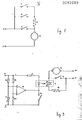
- Numbers 1 and 2 in Fig.2 indicate two supply terminals on the electricity mains.
- To terminal 2 is connected one end of compressor 3 on a refrigerator with more than one cooling compartment.
- the other end of compressor 3 is connected to one end of defrosting resistor 4, placed in contact with the fresh food evaporator on the same refrigerator, and with one terminal of a mechanical thermostat 5 also placed on the fresh food evaporator of the same refrigerator.
- the other terminal of mechanical thermostat 5 is connected to terminal 1 on the electricity mains to which is also connected one end of any temperature-controlled switch element .6 , or more specifically, a second mechanical thermostat, the other end of which is connected to the other end of defrosting resistor 4.
- a manual fast-freeze switch 7 is connected parallel to the contacts on the second mechanical thermostat 6.
- the second mechanical thermostat 6 is placed on the fresh food evaporator but, in an alternative arrangement, it may also be placed inside the freezer compartment.
- thermostat 5 can be set by the operator within a minimum and maximum temperature range.
- the said thermostat 5 closes, when the evaporator it is placed on reaches maximum temperature (5°C) and opens when the said temperature falls to minimum (ranging from -17 to - 25 °C depending on the setting made by the operator).
- the temperature-sensitive switch or second mechanical thermostat 6 is set to one specific temperature when the device is assembled at the plant, e.g. -2°C (or -18.5°C in the case of the alternative arrangement with the thermostat inside the freezer).
- the said temperature-sensitive switch 6 is closed, when the temperature in the compartment it is as- embled in is higher than the switch setting (-2°C; -18.5°C), and open when the said temperature is below the said setting.
- a refrigerator fitted with the present defrosting device operates as follows : when the temperature of the fresh food compartment evaporator rises to maximum (5°C), thermostat 5 closes and compressor 3 starts up to commence cooling. when the said temperature falls to minimum (-17 to -25 0 C), thermostat 5 opens to stop compressor 3. This is the point at which natural defrosting of the fresh food compartment evaporator commences, caused by the big difference in temperature between the evaporator itself, which is around - 25 °C, and the fresh food compartment, which is around 5° C.
- thermostat 5 closes its contacts to short-circuit defrosting resistor 4, stop defrosting and start compressor 3 up again for another cooling cycle. with this operating mode, manual switch 7 is always open.
- defrosting resistor 4 For fast-freeze operation of the refrigerator, however, manual switch 7 is closed so that, whenever compressor 3 stops, defrosting resistor 4 is supplied so as to provide for fast defrosting so that another cooling cycle can be started immediately.
- a starting temperature of - 2 °C for defrosting resistor 4 was chosen for two reasons : 1) because of the small temperature difference between the evaporator and the fresh food compartment and consequently the low heat exchange possibility ; 2 ) because, with - 2 °C on the fresh food compartment evaporator, the temperature inside the freezer is sure to be below - 1 8°C. In any case, defrosting resistor 4 is powerful enough to complete defrosting before the temperature in the freezer exceeds the said maximum.
- the alternative arrangement of the present device provides for placing the temperature-sensitive switch 6, inside the freezer and for setting it to a temperature of -18.5°C.
- the said switch 6 will only close to supply defrosting resistor 4 when the temperature in the freezer rises to -18.5°C, thus avoiding all possible waste by only commencing a new cooling cycle when the said compartment requires it.
- defrosting resistor 4 will be powerful enough to ensure defrosting is completed before the freezer temperature reaches -18°C.
- Number 1 0 in Fig.3 is a mains terminal to which is connected one end of compressor 1 1 on a refrigerator with more than one cooling compartment the other end of which is connected to one terminal of switch 12 and one anode (A ) of optotriac 13 .
- the other end of switch 12 is connected to the other mains terminal 14 and to one end of defrosting resistor 15 on the fresh food compartment evaporator of the said refrigerator, the other end of which is connected to the other anode (A ) of optotriac 13 .
- Switch 1 2 is controlled by a known type of electronic circuit, not shown in the diagram, which may be of the type described in Italian Patent Application N° 68 23 0-A/80 of July 3rd, 1980 filed by the present applicant.
- Number 1 6 is a resistor one end of which is connected to a positive d.c. supply (V) while the other end is connected to one end of a negative temperature coefficient (NTC) temperature sensor 17 . the other end of which is grounded.
- the junction of resistor 16 and NTC 17 is connected to the non-inverting input of threshold voltage comparator 18.
- To the inverting input of the same threshold voltage comparator 18 is connected the junction of resistor 19 , the other end of which goes to supply V, and resistor 2 0, the other end of which is grounded.
- the output of threshold voltage comparator 18 goes to the cathode of the emitting diode of optotriac 13 the anode of which is connected to one end of resis tor 21 the other end of which goes to supply V.
- the cathode of the emitting diode of optotriac 13 is also connected to one terminal of a manual fast-freeze switch 22 the other terminal of which is grounded.
- NTC 17 is placed on the fresh food compartment evaporator and resistors 16, 19 and 20 designed so that the output of threshold voltage comparator 18 is high when the temperature of the fresh food compartment evaporator is below - 2°C and low when the said temperature is over -2°C, that defrosting resistor 15 is not energized in the first case whereas it is in the second.
- NTC 17 is placed inside the freezer and resistors 16, 19 and 20 designed so that the output of threshold voltage comparator 18 is high when the temperature of the freezer is below -18.5°C and low when the said temperature is over--18.5°C.
- the defrosting device combining the present circuit and the one described in the abovementioned patent application has three temperature sensors, one on the fresh food compartment evaporator (9 in Fig.2 of the abovementioned patent application), one inside the fresh food compartment ( 13 in Fig. 2 of the abovementioned patent application) and one inside the freezer 17 .
- the defrosting device described operates as follows : as already stated, switch 12 is controlled by the circuit shown in Fig.2 of the aforementioned patent application to close when the temperature of the evaporator in the freezer exceeds maximum (5°C) and to open when the temperature of the said evaporator falls to minimum (ranging from -17 to -25°C according to the setting made by the operator).
- optotriac 13 modifies the cycle as follows : when the temperature of the fresh food compart ment evaporator falls to minimum (ranging from -17 to -25°C) switch 1 2 opens and compressor 11 stops. Under these conditions, however, the output of threshold voltage comparator 1 8 is high so that optotriac 13 is open and defrosting resistor 15 is not supplied. This therefore starts off a natural defrosting stage, the temperature of the fresh food compartment evaporator starts to rise and, when it reaches - 2 °C, the output of threshold voltage comparator 1 8 switches to low and optotriac 13 is energized so as to close and supply defrosting resistor 15.
- the said defrosting resistor 15 must, of course, be powerful enough to complete the defrosting operation before the temperature in the freezer exceeds -18°C.
- hand switch 22 is closed so that optotriac 13 is always energized and defrosting resistor 15 always supplied whenever switch 12 is opened.
- the said resistor is more powerful than the one normally used in the known technique (e.g- 25 - 30 w as compared with 18W) it completes defrosting faster, keeps compressor 11 running longer and freezes food faster than the known technique. If, during nor mal operation or fast freezing, the temperature of the fresh food compartment should fall below 0°C, switch 1 2 opens to commence natural defrosting, in the case of normal operation, or fast defrosting, in the case of fast freezing.
- a threshold of - 2 °C for commencing fast defrosting was selected because, from that point on, the difference in temperature between the fresh food compartment evaporator .and the environment is very small and also because, with such a threshold, we can be certain the temperature in the freezer does not exceed -18°C.
- a situation could arise, however, in which, on account of low-load operation of the freezer or the fact that the freezer is left unopened for a long period of time, even with a temperature of -2°C on the fresh food compartment evaporator, the freezer does not need cool ing in which case natural defrosting could be.continued longer.
- a variation of the present defrost ing device provides for placing NTC sensor 17 inside the freezer so that, after compressor 11 stops, natural defrosting continues until the temperature in the said freezer reach es -18.5°C. If this temperature is not reached before the temperature of the fresh food compartment evaporator reaches 5 °C, a complete natural defrosting cycle would be performed, that is, with no help from defrosting resistor 15 .
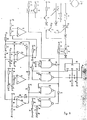
- the Fig.4 circuit is a variation of the one shown in Fig. 3 whereby fast defrosting only takes place every "n" cycles.
- the said Figure shows : a threshold voltage comparator 30 with hysteresis whose inverting input is connected to one end of condenser 31, the other end of which is grounded (M 1 ), to one end of condenser 3 2 , the other end of which goes to the non-inverting input of the same threshold voltage comparator 30, to one end of resistor 3 4 , the other end of which is connected to (positive d.c.) supply V1, and to one end of negative temperature coefficient temperature sensor (NTC) 35, the other end of which is grounded (M 1 ).
- NTC negative temperature coefficient temperature sensor
- threshold comparator 30 The non-inverting input of threshold comparator 30 is also connected to one end of condenser 36, the other end of which is grounded (M 1 ), and to the middle terminal of potentiometer 37.
- One side ter minal on potentiometer 37 is connected to one end of resistor 3 8, the other end of which goes to the cathode of diode 39 , the anode of which is connected to the output of threshold voltage comparator 30.
- the other side terminal on potentiometer 37 goes to the junction of resistor 40, the other end of which is grounded ( M ), and resistor 41, the other end of which goes to supply V 1 .
- the output of threshold voltage comparator 30 also goes to one end of condenser 4 2 , the other end of which is grounded (M 1 ), to one end of resistor 43, the other end of which goes to supply V 1 , and to the non-inverting input of operational amplifier 44, the inverting input of which is connected to the junction of resistor 45, the other end of which is ground ed ( M ), and resistor 46, the other end of which goes to sup- my V 1 .
- a hysteresis-free threshold voltage comparator 47 to whose inverting input are connected one end of condenser 48, the other end of which goes to the non-inverting input of the same threshold voltage comparator 47 , and the junction of resistor 49 , the other end of which goes to supply V , and negative temperature coefficient (NTC) temperature sensor 5 0, the other end of which is grounded (M 1 ).
- the non-inverting input of threshold voltage comparator 47 is also connected to the junction of resistor 51 , the other end of which goes to supply V 1 , and resistor 52, the other end of which is grounded (M 1 ). Via resistor 53, the output of threshold voltage comparator 47 goes to the junction of resistors 40 and 41.
- a hysteresis-free threshold voltage comparator 54 to whose inverting input is connected the junction of resistor 34 and temperature sensor 3 5 and to whose non-inverting input is connected the junction of resistor 55, the other end of which is grounded (M 1 ), and resistor 56, the other end of which goes to supply V 1 .
- the output of threshold voltage comparator 54 goes to supply V and input "a" of NA N D gate 58.
- the junction of resistor 3 4 and NTC sensor 3 5 is also connected to one end of resistor 59, the other end of which goes to the anode of diode 60, the cathode of which is connected to the output of NAND gate 58.
- the output of operational amplifier 44 goes to the cathode of an emitting diode on optotransistor 6 1 and to the clock (pin 114) of a decimal counter 6 2 .
- the anode of the emitting diode on optotransistor 6 1 goes to supply V 1 via resistor 63.
- the collector of optotransistor 6 1 goes to supply V 2 (positive d.c. but separate from the V 1 supply).
- the emitter of optotransistor 61 goes to the base of N P N transistor 65, the emitter of which is grounded (M 2 ) (electrically apart from ground M 1 ).
- the circuit elements connected to terminals V 1 - M 1 and V 2 - M 2 are electrically separate and form two independent circuits, that is, with no electrical connections in common, therefore insulated as per safety standards.
- Via resistor 66 the collector of transistor 65 goes to supply V 2 and the gate of triac 67.
- One of the two anodes on triac 67 is grounded (M 2 ) while the other goes to one end of the windings on compressor 68, the other end of which goes to a terminal on the a.c. voltage electricity mains.
- Resistor 69 and condenser 70 are connected between the said two anodes on triac 67.
- the end of the winding on compressor 68 connected to triac 67 is also connected to one end of 18W defrosting resistor 7 1 , the other end of which is connected to an anode on triac 72.
- the other anode on triac 72 is connected to ground M 2 to which is also connected the other terminal on the a.c. voltage electricity mains.
- the gate of triac 72 is connected to the collector of PNP transistor 74, the emitter of which is connected to supply V .
- the anode of the emitting diode on optotransistor 76 goes to supply V 1 , while the cathode goes to the anode of diode 78, to the anode of diode 79 and to the "b" input.of NAND gate 58.
- the cathode of diode 78 is connected to the output of NAND gate 80, while the cathode of diode 79 is connected to the output of NAND gate 8 1 .
- Input "b" of NAND gate 80 goes to one end of resistor 8 2 and to one end of condenser 83, the other end of which is grounded (M 1 ).
- resistor 82 goes to the output (pin 110) of decimal counter 6 2 which is also connected to input "b" of NAND gate 84. Inputs "a" of NAND gates 80, 8 1 and 84 are connected to supply V .
- the output of NAND gate 8 4 goes to one end of con denser 8 5 .
- the other end of condenser 8 5 goes to one end of resistor 86, the other end of which is grounded (M 1 ), to one end of condenser 87 and to the reset (pin 115 ) of counter 6 2 .
- condenser 87 goes to supply V , to the supply (pin 1 16) of counter 62 and to one end of condenser 88, the other end of which is grounded (M 1 ).
- Input "b" of NAND gate 8 1 is connected to the junction of one end of resistor 89, the other end of which goes to supply V 1 , and the anode of light emitting diode 90, the cathode of which goes to one end of resistor 9 1 , the other end of which is grounded (M1).
- the said input "b” of NAND gate 81 is also connected to one end of a manual switch 9 2 , the other end of which is grounded (M 1 ).
- Manual switch 92 forms part of potentiometer 37 . It is normally closed and is opened when the switch on the said potentiometer 37 is on the last setting.
- compressor 68 forms part of a refrigerating wircuit with more than one refrigerating compart ment
- NTC 35 is placed on the fresh food compartment evaporator and that NTC 50 is placed inside the fresh food compartment.
- defrost ing resistor 7 1 we shall commence from fast defrosting of the fresh food compartment evaporator by defrost ing resistor 7 1 .
- the output of threshold voltage comparator 30 switches to high.
- this voltage is transmitted to the cathode of the emitting diode on optotransistor 6 1 which stops conducting and so disables both optotransistor 61 and transistor 65.
- a positive signal is therefore sent to the gate of triac 67 which closes to start up compressor 68 and cool the refrigerator.
- threshold voltage comparator 54 When this threshold is exceeded upwards, the output of threshold voltage comparator 54 switches to high and a logic 1 is sent to input "a" on NAND gate 5 8. As input “b" of the said gate is also logic 1 -, the output of NAND gate 58 will be low.
- the branch formed by resistor 59 and diode 60 (parallel to NTC 35) starts conducting and the voltage at the inverting input of threshold voltage comparator 30 is lowered to simulate the fresh food compart ment evaporator reaching 5°C. A second pulse is thus sent to the clock on counter 6 2 , which moves forward a second step, and a second cooling cycle is commenced. This is repeated for 4 cycles.
- a fifth pulse is sent to the clock on counter 6 2 which moves a fifth step forward and raises the voltage at its output (pin 110) so that a logic 1 is sent to inputs "b" of NAND gates 80 and 84.
- input "a" of NAND gate 80 is also high, the output of the said NAND gate 80 switches to low, the emitting diode of optotransistor 76 starts conducting, optotransistor 76 and transistor 74 become saturated and a positive signal is sent to the gate of triac 7 2 which closes to enable the supply of defrosting resistor 7 1 .
- compressor 68 also receives the starting signal for commencing the fifth cooling cycle.
- the branch formed by counter 62, NAND gate 80, optotransistor 76, transistor 74 and triac 72 may be faster than the branch formed by optotransistor 6 1 , transistor 6 5 and triac 67 so that a fast defrosting cycle via defrosting resistor 71 may be started instead of the fifth cooling cycle.
- the signal sent to input "b" of NAND gate 80 is delayed by resistor 82 and condenser 83 so that the fifth cooling cycle is sure to be started.
- triac 67 opens at the end of the fifth cooling cycle, as triac 7 2 is closed, defrosting resistor 7 1 is supplied and a fast defrosting cycle started and continued until the temperature of the fresh food compartment evaporator reaches 5°C.
- input "b" of NAND gate 58 is low so that the input of the same NAND gate 58 will be high, and, as the branch formed by resistor 5 9 and diode 60 is not conducting, threshold voltage comparator 30 switches when NTC 35 detects a temperature of 5°C.
- a sixth clock is sent to counter 62, which moves a sixth step forward, its pin 1 1 0 switches back to low and the logic O is sent to input "b" of NAND gate 84 (which was high).
- a positive pulse will be formed and transmitted, via condenser 85, to the reset (pin 115) of counter 62 which will be zeroed and start counting again from the beginning.
- this sixth clock pulse becomes the first clock pulse of a new set of cycles.
- Condenser 8 5 has been provided between the output of NAND gate 84 and the reset of counter 62 to "form" the reset pulse and ensure the said pulse is detected at all times by counter 6 2 .
- the circuit described above provides for natural defrosting for four out of five cycles and fast defrosting, with the aid of defrosting resistor 71, for one out of five cycles.
- the natural defrosting cycles terminate when the tem perature of the fresh food compartment evaporator reaches -2°C to avoid any danger of the temperature in the freezer exceeding -18°C.
- threshold voltage comparator 47 switches to low, the references at the non-inverting input of threshold voltage comparator 30 are changed and compressor 68 is stopped.
- threshold voltage comparator 54 could be connected to a branch com prising a temperature sensor inside the freezer and resistors 34, 55 and 56 could be set so that the output of threshold voltage comparator 54 switches to high when the temperature in the said freezer exceeds -18. 5° C upwards. This arrangement would only start fast defrosting when the freezer actually needed it thus providing for further energy saving.
- triacs 1 3, 67 and 72 in the Fig.3 and 4 circuits could be replaced by relay.
Landscapes
- Engineering & Computer Science (AREA)
- Chemical & Material Sciences (AREA)
- Combustion & Propulsion (AREA)
- Physics & Mathematics (AREA)
- Mechanical Engineering (AREA)
- Thermal Sciences (AREA)
- General Engineering & Computer Science (AREA)
- Defrosting Systems (AREA)
Applications Claiming Priority (2)
| Application Number | Priority Date | Filing Date | Title |
|---|---|---|---|
| IT67519/82A IT1155313B (it) | 1982-04-20 | 1982-04-20 | Dispositivo di sbrinamento per un apparecchio frigorifero |
| IT6751982 | 1982-04-20 |
Publications (3)
| Publication Number | Publication Date |
|---|---|
| EP0092089A2 true EP0092089A2 (de) | 1983-10-26 |
| EP0092089A3 EP0092089A3 (en) | 1984-08-29 |
| EP0092089B1 EP0092089B1 (de) | 1988-12-14 |
Family
ID=11303109
Family Applications (1)
| Application Number | Title | Priority Date | Filing Date |
|---|---|---|---|
| EP83103255A Expired EP0092089B1 (de) | 1982-04-20 | 1983-04-01 | Abtauvorrichtung für einen Kühlschrank |
Country Status (5)
| Country | Link |
|---|---|
| US (1) | US4530217A (de) |
| EP (1) | EP0092089B1 (de) |
| DE (1) | DE3378694D1 (de) |
| ES (1) | ES521676A0 (de) |
| IT (1) | IT1155313B (de) |
Cited By (1)
| Publication number | Priority date | Publication date | Assignee | Title |
|---|---|---|---|---|
| WO2011041780A3 (en) * | 2009-10-02 | 2011-07-21 | The Controls Group, Inc. | Removal of an accumulated frozen substance from a cooling unit |
Families Citing this family (14)
| Publication number | Priority date | Publication date | Assignee | Title |
|---|---|---|---|---|
| JP2562639B2 (ja) * | 1988-01-20 | 1996-12-11 | 三洋電機株式会社 | 低温商品貯蔵ケースの温度制御方式 |
| US4974418A (en) * | 1988-10-12 | 1990-12-04 | Honeywell Inc. | Heat pump defrosting operation |
| US4951473A (en) * | 1988-10-12 | 1990-08-28 | Honeywell, Inc. | Heat pump defrosting operation |
| US4974417A (en) * | 1988-10-12 | 1990-12-04 | Honeywell Inc. | Heat pump defrosting operation |
| US5201888A (en) * | 1991-11-14 | 1993-04-13 | White Consolidated Industries, Inc. | Temperature control system for refrigerator/freezer combinations |
| DE4438917C2 (de) * | 1994-11-03 | 1998-01-29 | Danfoss As | Verfahren zum Abtauen eines Kältesystems und Steuergerät zur Durchführung dieses Verfahrens |
| US5842355A (en) * | 1995-03-22 | 1998-12-01 | Rowe International, Inc. | Defrost control system for a refrigerator |
| US5924297A (en) * | 1997-11-03 | 1999-07-20 | Hussmann Corporation | Refrigerated merchandiser with modular evaporator coils and "no defrost" product area |
| JP3888403B2 (ja) * | 1997-12-18 | 2007-03-07 | 株式会社富士通ゼネラル | 空気調和機の制御方法およびその装置 |
| NZ503106A (en) * | 2000-02-28 | 2002-07-26 | Fisher & Paykel Appliances Ltd | Refrigerator with at least a fresh food compartment and evaporator operating within 10 degrees centigrade below compartment temperature, so that air at above 0 degrees is blown over evaporator during off cycle |
| US6817195B2 (en) * | 2002-03-29 | 2004-11-16 | General Electric Company | Reduced energy refrigerator defrost method and apparatus |
| US8417386B2 (en) * | 2008-11-17 | 2013-04-09 | Trane International Inc. | System and method for defrost of an HVAC system |
| US8291718B2 (en) * | 2010-09-02 | 2012-10-23 | General Electric Company | DSM defrost during high demand |
| JP5897994B2 (ja) * | 2012-06-06 | 2016-04-06 | シャープ株式会社 | 空気調和機 |
Family Cites Families (13)
| Publication number | Priority date | Publication date | Assignee | Title |
|---|---|---|---|---|
| US2130036A (en) * | 1934-07-21 | 1938-09-13 | John A Shrader | Defroster |
| US2720086A (en) * | 1953-08-13 | 1955-10-11 | Gen Electric | Automatic defrosting systems for twotemperature refrigerators |
| US2867093A (en) * | 1955-12-20 | 1959-01-06 | Gen Motors Corp | Defrosting arrangement for refrigerating system |
| CH413880A (de) * | 1964-11-23 | 1966-05-31 | Forster Ag Hermann | Kühlschrank |
| US3553975A (en) * | 1967-08-07 | 1971-01-12 | Sanyo Electric Co | Refrigerator temperature and defrosting control |
| DE2010717A1 (de) * | 1970-03-06 | 1971-09-23 | Necchi Societä per Azioni, Pavia (Italien) | Schmiervorrichtung für gekapselte Motor-Verdichter-Aggregate |
| DE2262039B2 (de) * | 1971-12-23 | 1980-01-17 | N.V. Philips' Gloeilampenfabrieken, Eindhoven (Niederlande) | Vorrichtung zur automatischen Steuerung des Abtauens des Verdampfers eines Kühlgerätes |
| AT325644B (de) * | 1973-10-11 | 1975-10-27 | Bosch Hausgeraete Gmbh | Kühlmöbel, insbesondere zweitemperaturen-kühlschrank |
| DE2557794A1 (de) * | 1975-12-22 | 1977-06-23 | Licentia Gmbh | Verfahren und vorrichtung zum abtauen des verdampfers bei einem kuehlgeraet mit abtauvorrichtung |
| DE2629595A1 (de) * | 1976-07-01 | 1978-01-05 | Licentia Gmbh | Verfahren und vorrichtung zum abtauen des verdampfers bei einem kuehlgeraet mit abtauvorrichtung |
| DE2753744C3 (de) * | 1977-12-02 | 1981-11-19 | Bosch-Siemens Hausgeräte GmbH, 7000 Stuttgart | Gefriergerät, insbesondere Gefrierschrank, Gefriertruhe o.dgl. mit Abtauvorrichtung |
| US4299095A (en) * | 1979-08-13 | 1981-11-10 | Robertshaw Controls Company | Defrost system |
| US4305259A (en) * | 1980-04-03 | 1981-12-15 | Eaton Corporation | Frost sensor employing self-heating thermistor as sensor element |
-
1982
- 1982-04-20 IT IT67519/82A patent/IT1155313B/it active
-
1983
- 1983-04-01 DE DE8383103255T patent/DE3378694D1/de not_active Expired
- 1983-04-01 EP EP83103255A patent/EP0092089B1/de not_active Expired
- 1983-04-19 US US06/486,369 patent/US4530217A/en not_active Expired - Fee Related
- 1983-04-20 ES ES521676A patent/ES521676A0/es active Granted
Cited By (2)
| Publication number | Priority date | Publication date | Assignee | Title |
|---|---|---|---|---|
| WO2011041780A3 (en) * | 2009-10-02 | 2011-07-21 | The Controls Group, Inc. | Removal of an accumulated frozen substance from a cooling unit |
| US9562757B2 (en) | 2009-10-02 | 2017-02-07 | The Controls Group, Inc. | Removal of an accumulated frozen substance from a cooling unit |
Also Published As
| Publication number | Publication date |
|---|---|
| IT8267519A0 (it) | 1982-04-20 |
| ES8404043A1 (es) | 1984-04-01 |
| ES521676A0 (es) | 1984-04-01 |
| US4530217A (en) | 1985-07-23 |
| DE3378694D1 (en) | 1989-01-19 |
| IT8267519A1 (it) | 1983-10-20 |
| IT1155313B (it) | 1987-01-28 |
| EP0092089A3 (en) | 1984-08-29 |
| EP0092089B1 (de) | 1988-12-14 |
Similar Documents
| Publication | Publication Date | Title |
|---|---|---|
| EP0092089A2 (de) | Abtauvorrichtung für einen Kühlschrank | |
| US6138465A (en) | Method for controlling the temperature of a refrigeration unit and temperature control arrangement for a refrigeration unit | |
| US3977851A (en) | Automatic electronic ice-making control system for automatic ice-making machine | |
| US3174297A (en) | Refrigerating apparatus with defrost control means | |
| US3950961A (en) | Cooling system for a two-temperature refrigerator | |
| US4056948A (en) | Presettable defrost timer | |
| US2545054A (en) | Refrigerator control | |
| CN107084577A (zh) | 一种双系统冰箱的控制方法及控制装置和冰箱 | |
| EP0045728B1 (de) | Elektronischer Temperaturregler für ein Gefriergerät | |
| US3760600A (en) | Ice-making apparatus | |
| US3367128A (en) | Control system for ice-making apparatus | |
| US4086780A (en) | Refrigerating apparatus, in particular two-temperature refrigerator | |
| US4344295A (en) | Control for timed operation of ice maker | |
| US3105362A (en) | Refrigerating apparatus with indicating means | |
| US3277662A (en) | Refrigeration system defrost control | |
| EP0644386A1 (de) | Verfahren und Vorrichtung zur dynamischen Kontrolle der Eisbildung an einem Kühlschrankverdampfer | |
| US3859813A (en) | Ice maker control circuit | |
| US3164969A (en) | Heat pump defrost control | |
| JPH0137669B2 (de) | ||
| US3918267A (en) | Ice-maker control circuit with slab limiting control | |
| US3483919A (en) | Electric refrigerator with defrosting means | |
| GB2100031A (en) | Electrical control circuit for refrigerators and freezers | |
| EP0388726B1 (de) | Kühlgerät mit nur einer thermostatischen Temperaturregelvorrichtung | |
| KR930010499A (ko) | 냉장고 | |
| EP0387680A2 (de) | Kühlgerät mit thermostatischer Temperaturregelanordnung |
Legal Events
| Date | Code | Title | Description |
|---|---|---|---|
| PUAI | Public reference made under article 153(3) epc to a published international application that has entered the european phase |
Free format text: ORIGINAL CODE: 0009012 |
|
| AK | Designated contracting states |
Designated state(s): DE FR GB NL SE |
|
| PUAL | Search report despatched |
Free format text: ORIGINAL CODE: 0009013 |
|
| AK | Designated contracting states |
Designated state(s): DE FR GB NL SE |
|
| 17P | Request for examination filed |
Effective date: 19850219 |
|
| GRAA | (expected) grant |
Free format text: ORIGINAL CODE: 0009210 |
|
| AK | Designated contracting states |
Kind code of ref document: B1 Designated state(s): DE FR GB NL SE |
|
| RAP2 | Party data changed (patent owner data changed or rights of a patent transferred) |
Owner name: INDESIT - S.R.L. |
|
| REF | Corresponds to: |
Ref document number: 3378694 Country of ref document: DE Date of ref document: 19890119 |
|
| ET | Fr: translation filed | ||
| PLBE | No opposition filed within time limit |
Free format text: ORIGINAL CODE: 0009261 |
|
| STAA | Information on the status of an ep patent application or granted ep patent |
Free format text: STATUS: NO OPPOSITION FILED WITHIN TIME LIMIT |
|
| 26N | No opposition filed | ||
| EAL | Se: european patent in force in sweden |
Ref document number: 83103255.2 |
|
| PGFP | Annual fee paid to national office [announced via postgrant information from national office to epo] |
Ref country code: NL Payment date: 19950430 Year of fee payment: 13 |
|
| PGFP | Annual fee paid to national office [announced via postgrant information from national office to epo] |
Ref country code: FR Payment date: 19950503 Year of fee payment: 13 |
|
| PGFP | Annual fee paid to national office [announced via postgrant information from national office to epo] |
Ref country code: GB Payment date: 19950505 Year of fee payment: 13 |
|
| PGFP | Annual fee paid to national office [announced via postgrant information from national office to epo] |
Ref country code: SE Payment date: 19950510 Year of fee payment: 13 |
|
| PGFP | Annual fee paid to national office [announced via postgrant information from national office to epo] |
Ref country code: DE Payment date: 19950517 Year of fee payment: 13 |
|
| PG25 | Lapsed in a contracting state [announced via postgrant information from national office to epo] |
Ref country code: GB Effective date: 19960401 |
|
| PG25 | Lapsed in a contracting state [announced via postgrant information from national office to epo] |
Ref country code: SE Effective date: 19960402 |
|
| PG25 | Lapsed in a contracting state [announced via postgrant information from national office to epo] |
Ref country code: NL Effective date: 19961101 |
|
| GBPC | Gb: european patent ceased through non-payment of renewal fee |
Effective date: 19960401 |
|
| PG25 | Lapsed in a contracting state [announced via postgrant information from national office to epo] |
Ref country code: FR Effective date: 19961227 |
|
| PG25 | Lapsed in a contracting state [announced via postgrant information from national office to epo] |
Ref country code: DE Effective date: 19970101 |
|
| NLV4 | Nl: lapsed or anulled due to non-payment of the annual fee |
Effective date: 19961101 |
|
| EUG | Se: european patent has lapsed |
Ref document number: 83103255.2 |
|
| REG | Reference to a national code |
Ref country code: FR Ref legal event code: ST |