EP0086562A1 - Process and means for hydroponic cultivation - Google Patents
Process and means for hydroponic cultivation Download PDFInfo
- Publication number
- EP0086562A1 EP0086562A1 EP83300216A EP83300216A EP0086562A1 EP 0086562 A1 EP0086562 A1 EP 0086562A1 EP 83300216 A EP83300216 A EP 83300216A EP 83300216 A EP83300216 A EP 83300216A EP 0086562 A1 EP0086562 A1 EP 0086562A1
- Authority
- EP
- European Patent Office
- Prior art keywords
- plant
- portions
- root system
- root
- nutrient solutions
- Prior art date
- Legal status (The legal status is an assumption and is not a legal conclusion. Google has not performed a legal analysis and makes no representation as to the accuracy of the status listed.)
- Ceased
Links
- 238000000034 method Methods 0.000 title claims abstract description 26
- 230000008569 process Effects 0.000 title claims description 3
- 235000015097 nutrients Nutrition 0.000 claims abstract description 59
- 239000000463 material Substances 0.000 claims abstract description 37
- 230000002745 absorbent Effects 0.000 claims abstract description 9
- 239000002250 absorbent Substances 0.000 claims abstract description 9
- 230000002792 vascular Effects 0.000 claims abstract description 5
- XLYOFNOQVPJJNP-UHFFFAOYSA-N water Substances O XLYOFNOQVPJJNP-UHFFFAOYSA-N 0.000 claims description 14
- 230000001419 dependent effect Effects 0.000 claims description 5
- 239000004033 plastic Substances 0.000 claims description 5
- 229920003023 plastic Polymers 0.000 claims description 5
- 238000001704 evaporation Methods 0.000 claims description 4
- 239000000203 mixture Substances 0.000 claims description 4
- 238000003860 storage Methods 0.000 claims description 4
- 230000024245 cell differentiation Effects 0.000 claims description 3
- 230000008020 evaporation Effects 0.000 claims description 3
- 230000001850 reproductive effect Effects 0.000 claims description 3
- 239000007787 solid Substances 0.000 claims description 2
- 239000000126 substance Substances 0.000 claims description 2
- 230000002411 adverse Effects 0.000 claims 1
- 239000012882 rooting medium Substances 0.000 description 12
- 150000003839 salts Chemical class 0.000 description 8
- 230000006872 improvement Effects 0.000 description 5
- XEEYBQQBJWHFJM-UHFFFAOYSA-N Iron Chemical compound [Fe] XEEYBQQBJWHFJM-UHFFFAOYSA-N 0.000 description 4
- 238000011161 development Methods 0.000 description 4
- 230000018109 developmental process Effects 0.000 description 4
- 239000007788 liquid Substances 0.000 description 4
- 239000002609 medium Substances 0.000 description 4
- 230000005855 radiation Effects 0.000 description 4
- 230000000717 retained effect Effects 0.000 description 4
- 230000003068 static effect Effects 0.000 description 4
- 230000005945 translocation Effects 0.000 description 4
- 238000005273 aeration Methods 0.000 description 3
- 210000004027 cell Anatomy 0.000 description 3
- 238000001816 cooling Methods 0.000 description 3
- 238000010438 heat treatment Methods 0.000 description 3
- 238000012986 modification Methods 0.000 description 3
- 230000004048 modification Effects 0.000 description 3
- 235000016709 nutrition Nutrition 0.000 description 3
- 230000035764 nutrition Effects 0.000 description 3
- 239000002689 soil Substances 0.000 description 3
- 210000001519 tissue Anatomy 0.000 description 3
- 238000012546 transfer Methods 0.000 description 3
- IJGRMHOSHXDMSA-UHFFFAOYSA-N Atomic nitrogen Chemical compound N#N IJGRMHOSHXDMSA-UHFFFAOYSA-N 0.000 description 2
- CURLTUGMZLYLDI-UHFFFAOYSA-N Carbon dioxide Chemical compound O=C=O CURLTUGMZLYLDI-UHFFFAOYSA-N 0.000 description 2
- VGGSQFUCUMXWEO-UHFFFAOYSA-N Ethene Chemical compound C=C VGGSQFUCUMXWEO-UHFFFAOYSA-N 0.000 description 2
- 239000005977 Ethylene Substances 0.000 description 2
- OAICVXFJPJFONN-UHFFFAOYSA-N Phosphorus Chemical compound [P] OAICVXFJPJFONN-UHFFFAOYSA-N 0.000 description 2
- 239000004698 Polyethylene Substances 0.000 description 2
- 239000000853 adhesive Substances 0.000 description 2
- 230000001070 adhesive effect Effects 0.000 description 2
- 238000003287 bathing Methods 0.000 description 2
- 230000009286 beneficial effect Effects 0.000 description 2
- 239000001506 calcium phosphate Substances 0.000 description 2
- 229910000389 calcium phosphate Inorganic materials 0.000 description 2
- 235000011010 calcium phosphates Nutrition 0.000 description 2
- 230000000694 effects Effects 0.000 description 2
- 238000001125 extrusion Methods 0.000 description 2
- 239000010903 husk Substances 0.000 description 2
- 239000003501 hydroponics Substances 0.000 description 2
- 238000007654 immersion Methods 0.000 description 2
- 150000002500 ions Chemical class 0.000 description 2
- 229910052742 iron Inorganic materials 0.000 description 2
- 230000003050 macronutrient Effects 0.000 description 2
- 235000021073 macronutrients Nutrition 0.000 description 2
- 239000011785 micronutrient Substances 0.000 description 2
- 235000013369 micronutrients Nutrition 0.000 description 2
- 229910052760 oxygen Inorganic materials 0.000 description 2
- 239000001301 oxygen Substances 0.000 description 2
- 229910052698 phosphorus Inorganic materials 0.000 description 2
- 239000011574 phosphorus Substances 0.000 description 2
- -1 polyethylene Polymers 0.000 description 2
- 229920000573 polyethylene Polymers 0.000 description 2
- 238000011160 research Methods 0.000 description 2
- 238000000926 separation method Methods 0.000 description 2
- QORWJWZARLRLPR-UHFFFAOYSA-H tricalcium bis(phosphate) Chemical compound [Ca+2].[Ca+2].[Ca+2].[O-]P([O-])([O-])=O.[O-]P([O-])([O-])=O QORWJWZARLRLPR-UHFFFAOYSA-H 0.000 description 2
- 238000003466 welding Methods 0.000 description 2
- ZOXJGFHDIHLPTG-UHFFFAOYSA-N Boron Chemical compound [B] ZOXJGFHDIHLPTG-UHFFFAOYSA-N 0.000 description 1
- OYPRJOBELJOOCE-UHFFFAOYSA-N Calcium Chemical compound [Ca] OYPRJOBELJOOCE-UHFFFAOYSA-N 0.000 description 1
- PWHULOQIROXLJO-UHFFFAOYSA-N Manganese Chemical compound [Mn] PWHULOQIROXLJO-UHFFFAOYSA-N 0.000 description 1
- 206010061291 Mineral deficiency Diseases 0.000 description 1
- ZLMJMSJWJFRBEC-UHFFFAOYSA-N Potassium Chemical compound [K] ZLMJMSJWJFRBEC-UHFFFAOYSA-N 0.000 description 1
- 238000010521 absorption reaction Methods 0.000 description 1
- 239000004411 aluminium Substances 0.000 description 1
- XAGFODPZIPBFFR-UHFFFAOYSA-N aluminium Chemical compound [Al] XAGFODPZIPBFFR-UHFFFAOYSA-N 0.000 description 1
- 229910052782 aluminium Inorganic materials 0.000 description 1
- 150000001450 anions Chemical class 0.000 description 1
- 238000013459 approach Methods 0.000 description 1
- QVGXLLKOCUKJST-UHFFFAOYSA-N atomic oxygen Chemical compound [O] QVGXLLKOCUKJST-UHFFFAOYSA-N 0.000 description 1
- 229910052796 boron Inorganic materials 0.000 description 1
- 229910052791 calcium Inorganic materials 0.000 description 1
- 239000011575 calcium Substances 0.000 description 1
- 239000001569 carbon dioxide Substances 0.000 description 1
- 229910002092 carbon dioxide Inorganic materials 0.000 description 1
- 150000001768 cations Chemical class 0.000 description 1
- 210000000170 cell membrane Anatomy 0.000 description 1
- 238000004891 communication Methods 0.000 description 1
- 150000001875 compounds Chemical class 0.000 description 1
- 238000010276 construction Methods 0.000 description 1
- 238000004132 cross linking Methods 0.000 description 1
- 230000004069 differentiation Effects 0.000 description 1
- 238000009792 diffusion process Methods 0.000 description 1
- 238000007598 dipping method Methods 0.000 description 1
- 230000009977 dual effect Effects 0.000 description 1
- 229940117927 ethylene oxide Drugs 0.000 description 1
- 239000004744 fabric Substances 0.000 description 1
- 239000006261 foam material Substances 0.000 description 1
- 239000007789 gas Substances 0.000 description 1
- 239000012535 impurity Substances 0.000 description 1
- 230000002401 inhibitory effect Effects 0.000 description 1
- 229910052500 inorganic mineral Inorganic materials 0.000 description 1
- 238000009413 insulation Methods 0.000 description 1
- 230000002262 irrigation Effects 0.000 description 1
- 238000003973 irrigation Methods 0.000 description 1
- 229910052748 manganese Inorganic materials 0.000 description 1
- 239000011572 manganese Substances 0.000 description 1
- 230000002503 metabolic effect Effects 0.000 description 1
- 230000004060 metabolic process Effects 0.000 description 1
- 239000002207 metabolite Substances 0.000 description 1
- 230000003278 mimic effect Effects 0.000 description 1
- 239000011707 mineral Substances 0.000 description 1
- 210000003470 mitochondria Anatomy 0.000 description 1
- 229910052757 nitrogen Inorganic materials 0.000 description 1
- 239000004745 nonwoven fabric Substances 0.000 description 1
- 230000036961 partial effect Effects 0.000 description 1
- 229910052700 potassium Inorganic materials 0.000 description 1
- 239000011591 potassium Substances 0.000 description 1
- 238000001556 precipitation Methods 0.000 description 1
- 230000003134 recirculating effect Effects 0.000 description 1
- 230000002829 reductive effect Effects 0.000 description 1
- 239000013535 sea water Substances 0.000 description 1
- 239000002759 woven fabric Substances 0.000 description 1
Images

Classifications
-
- A—HUMAN NECESSITIES
- A01—AGRICULTURE; FORESTRY; ANIMAL HUSBANDRY; HUNTING; TRAPPING; FISHING
- A01G—HORTICULTURE; CULTIVATION OF VEGETABLES, FLOWERS, RICE, FRUIT, VINES, HOPS OR SEAWEED; FORESTRY; WATERING
- A01G31/00—Soilless cultivation, e.g. hydroponics
- A01G31/02—Special apparatus therefor
-
- A—HUMAN NECESSITIES
- A01—AGRICULTURE; FORESTRY; ANIMAL HUSBANDRY; HUNTING; TRAPPING; FISHING
- A01G—HORTICULTURE; CULTIVATION OF VEGETABLES, FLOWERS, RICE, FRUIT, VINES, HOPS OR SEAWEED; FORESTRY; WATERING
- A01G9/00—Cultivation in receptacles, forcing-frames or greenhouses; Edging for beds, lawn or the like
- A01G9/04—Flower-pot saucers
- A01G9/047—Channels or gutters, e.g. for hydroponics
-
- Y—GENERAL TAGGING OF NEW TECHNOLOGICAL DEVELOPMENTS; GENERAL TAGGING OF CROSS-SECTIONAL TECHNOLOGIES SPANNING OVER SEVERAL SECTIONS OF THE IPC; TECHNICAL SUBJECTS COVERED BY FORMER USPC CROSS-REFERENCE ART COLLECTIONS [XRACs] AND DIGESTS
- Y02—TECHNOLOGIES OR APPLICATIONS FOR MITIGATION OR ADAPTATION AGAINST CLIMATE CHANGE
- Y02P—CLIMATE CHANGE MITIGATION TECHNOLOGIES IN THE PRODUCTION OR PROCESSING OF GOODS
- Y02P60/00—Technologies relating to agriculture, livestock or agroalimentary industries
- Y02P60/20—Reduction of greenhouse gas [GHG] emissions in agriculture, e.g. CO2
- Y02P60/21—Dinitrogen oxide [N2O], e.g. using aquaponics, hydroponics or efficiency measures
Definitions
- the present invention relates to improvements in plant cultivation. More particularly it relates to an improved type of plant and to improved methods of growing plants hydroponically.
- a major problem is inadequate gaseous exchange by the root. This problem derives from the fact, which has emerged from our recent research, that the gaseous inputs and outputs of the root system and the liquid inputs and outputs, whilst both being absolutely essential for healthy growth, have modes of operation which conflict with each other.
- the rates of diffusion of the main gases concerned -oxygen in, ethylene and carbon dioxide out - are approximately 10,000 times faster in air than in water, so if the roots are bathed in an aqueous nutrient solution to facilitate the input of water and salts and the output of surplus liquid metabolites, the free flow of these gaseous compounds is greatly reduced.
- a second problem is that existing hydroponic systems fail to take into account that the uptake zone within the root system for certain ions is substantially confined to localised areas. For instance micro-nutrients are taken up almost exclusively near the root tips, whereas macro-nutrients can be absorbed in the more mature parts of the roots. It is well-known that some of the essential inputs affect the efficiency of uptake of other inputs, in particular high levels of macro-nutrients in the bathing solution can have an inhibiting effect on the uptake of the micro-nutrients when both are supplied, as is the common practice, in the same nutrient solution. Thus mineral deficiencies can occur even though the minerals are present in the bathing solution in adequate concentration.
- a third problem is that evolution has equipped plants to function effectively only when their root system is subject to a temperature cycle. Under natural conditions the upper root is relatively warmer during the day and early evening while the lower root is relatively warmer during the night and early morning. This temperature cycle plays an important part in the uptake of nutrients, and yet no existing hydroponic system makes any attempt to achieve it.
- a fourth problem is fundamental to all existing hydroponic methods. This is the limitation imposed upon the plant by its translocation system. When the solar inputs are high, the growth rate is quickly limited by the inability of the plant to transport photosynthates and nutrients to where they are needed. The differentiation of the cells forming the translocation system develops only slowly, and even then only to meet the current requirements of the plants. Nature does not equip the plant to anticipate future needs, and hence it cannot very effectively utilise variable radiation inputs. If plants grown under sub-optimal radiation conditions could be persuaded to develop translocation systems capable of handling the flow rates appropriate to high radiation conditions, they would be better placed to respond to increases in radiation as and when they occurred.
- a fifth problem with existing hydroponic systems is that the provision of all the essential salts in the same nutrient solution is inherently expensive: firstly, the iron has to be chelated to prevent precipitation and this adds significantly to its cost; and secondly, the calcium and phosphorus react to form insoluble calcium phosphate which builds up inside the supply pipework causing serious blockages.
- a sixth problem is that the acidity or alkalinity of nutrient solutions has a profound influence on the relative absorption of anions and cations.
- elements such as nitrogen, potassium and phosphorus need a pH of around 7 whilst elements such as iron, manganese and boron are readily absorbed only at a lower pH, e.g. 5 to 6.
- a single solution is used to present all the salts to the root system its pH has to be maintained at some compromise level at the expense of efficiency of uptake.
- the various xylem elements will develop mutliple cross-linkages and the specialised parenchyma cells of both the xylem and phloem, normally known as transfer cells, will develop extended plasma membranes with an abundance of mitochondria.
- transfer cells the specialised parenchyma cells of both the xylem and phloem, normally known as transfer cells.
- the division of the root system into portions can be vertical, horizontal or both.
- a vertical division we mean that the root system as a whole is divided into two or more branches, each containing upper and lower root portions.
- horizontal division we mean a division between the upper and lower root portions. Both methods of division can be applied simultaneously so that a root system which is already divided vertically can have each portion divided horizontally.
- each part of the root system is connected to a particular meristem and consequently supplies only a particular portion of the upper plant.
- the corresponding portion of the upper plant suffers while the rest of the plant grows normally.
- the plant is able to translocate nutrients and photosynthates more effectively than a conventional plant, and hence its potential maximum growth rate is higher.
- the improvements induced by differential nutrition will be retained even when the plant is removed from the specialised environment which caused it. Furthermore, these improvements are by no means confined to hydroponic cultivation.
- the plant can be established in soil and is particularly easy to establish under poor conditions, e.g. in arid or poor soil. Under these conditions, one portion of the root system may be planted normally and the other portion (or one of the other portions) may be confined in some way so that it can be supplied preferentially with extra nutrients.
- the extra nutrients so supplied can be utilised by the whole plant including the other portion of root system which accordingly will develop and remain nourished while providing anchorage. Eventually the extra nutrients can be withdrawn and the remaining root system can take over support of the plant.
- This technique would be impossible with a normal plant since the portion of root not being fed, and the corresponding portions of the upper plant, would die before becoming established.
- the technique is expected to be very useful for the establishment, for example, of trees in semi-desert areas, where irrigation and feeding of the entire root system is not practicable.
- the two or more root portions may be allowed to intermingle, but it will be understood that the portions still exist as structural entities in the plant. Such a plant still embodies our invention even though the root portions are no longer physically separate.
- differential nutrition can be applied in a number of ways.
- the separate nutrient solutions may have the same or different compositions. They may be supplied continuously or intermittently. They may have different pH levels,.different salt concentrations, or be at different temperatures. The level to which the root system is immersed may be varied to bring particular solutions into contact with different parts of the root system. By such means it is possible to ensure a highly efficient pattern of inputs and outputs.
- the primary requirement is to induce the root system to divide into two or more portions and to provide separate nutrient solutions for the said portions.
- two or more storage vessels for the nutrient solutions may be utilised, and the plant may be supported on a dividing wall between the vessels, with or without the presence of rooting medium.
- the conventional nutrient gully or channel is replaced by a number of channels each carrying a nutrient solution.
- Selected portions of the root system can be presented to one or more of the channels in such a way that the plant as a whole receives its complete requirement of root inputs, the individual inputs being presented to the parts of the root structure where they can be efficiently absorbed.
- the dual or multiple channels required can be conveniently constructed by providing one or more dividing walls projecting upwardly from the base of a conventional gully, to maintain the separation of the nutrient solutions.
- one or more dividing walls running parallel with the sides of the gully and thereby dividing the gully into two or more channels can support the stem of the plant, with portions of the root system in each of the channels.
- the dividing walls should be impervious to the nutrient solution and should have a height adequate to maintain the separation of the various solutions although they may allow roots to pass over them from one channel to another.
- a rooting medium is not essential, an inert rooting medium can if desired be provided on the dividing wall or walls to support the individual roots and to assist their development above the surface of the nutrient solution. Only a thin layer of rooting medium is required to assist early root establishment and this has no tendency to block the flow of solution down the channels. Moreover the rooting medium can be placed high enough to avoid an excessive uptake of nutrient solution by capillarity, leading to high concentrations of salts around the base of the stem and consequentially to "collar burn". Collar burn is a problem with conventional hydroponic systems. It is usually avoided by providing a sufficient depth of rooting medium so that the top surface is not wetted by capillarity. However the large block of rooting medium thereby required is uneconomic and tends to obstruct the flow of nutrient solution.
- absorbent sheet material such as capillary matting can be used to provide a particularly simple and efficient propagation pocket for supporting a plant on the dividing wall.
- means for growing and supporting a plant during hydroponic cultivation comprises a pocket of hydrophilic absorbent sheet material, said pocket being open at its upper edge and having two or more dependent portions of said material for conveying nutrient solutions to a seed or other plant reproductive material placed in said pocket.
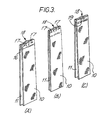
- the pocket is preferably formed by a pleat in a sheet of said material, as illustrated in Figure 3 described hereinafter.
- the pleat may be retained by stitching, staples, adhesive, heat-welding or other suitable attachment means.
- a sheet of folded material may be slit along a portion of the fold and the slit portion formed into a pocket by stitching, staples, adhesive, heat welding or other suitable means, or an equivalent device may be fashioned from two or more separate pieces of sheet material suitably attached together. It is sometimes practicable, particularly in the case of large seeds, to leave the bottom of the pocket open.
- the seed germinating in the pocket, develops a root system extending into each of the two or more dependent portions of sheet material, which portions depend into adjacent channels or static containers for the nutrient solutions.
- the sheet material thus supports the plant securely from the earliest stage of development. Moreover it provides sufficient resistance to the emerging shoot to ensure that the remnants of seed husk are separated from the cotyledons, thus overcoming a problem well-known to nurserymen whereby the tips of the cotyledons are trapped inside the desiccated husk.
- the sheet material is preferably the material known as capillary matting, as used for covering glasshouse benches and the like.
- This is a non-woven cellulosic fabric. Any other suitable type of woven or non-woven fabric, felt or open-celled foam material may be used, provided it permits the roots to develop freely and has adequate capillarity to maintain the nutrition of the seedling.
- gully which can be readily modified for use in accordance with our invention is that described and claimed in our British Patent Specification 2,074,OOlA.
- the gully is formed of flexible sheet material shaped to form a base and side members, the side members being longitudinally rolled, creased or folded into a tubular or part-tubular configuration.
- This gully can be modified by draping it over a longitudinally extending and centrally disposed dividing member, thus causing the sheet material to be formed into two channels. Obviously further channels could be produced in the same way if desired.
- the tubular or part-tubular portion may contain water, external to the channel, said water bring in contact with hydrophilic absorbent sheet material, such as capillary matting, which is draped over or adjacent to the gully, whereby the gully is cooled by evaporation of said water.
- hydrophilic absorbent sheet material such as capillary matting
- the central dividing wall will be stable without a permanent internal support. Indeed the central wall adds to the stiffness of the gully and enables it to span considerable distances without intermediate supports.
- the central wall may be hollow and may contain heating means, e.g a pipe carrying warmed water. Thus root metabolism may be maintained even when the air temperature is low.
- the gully may instead be formed, e.g. by extrusion, in an inert impermeable material such as a suitable plastics material and the nutrient solutions may then flow directly in the channels so formed.
- Plastics sheet material e.g. black polyethylene, rolled into a tubular or part-tubular configuration is preferably provided overlaying said channels on either side of the dividing wall to exclude light from the roots, provide heat insulation, and support the stems of the plants.
- Such sheet material may be attached to the outer edges of the gulley by clips or other suitable means.
- a plant having a multiple or divided root system is thought to be wholly novel and such a plant forms an important aspect of our invention.
- the plant may be defined as having a root system divided into two or more portions and characterised in that the pattern of cell differentiation of the vascular tissues connecting said portions to the upper plant has been so modified by cross-linkages within and between the tissues that when any one portion of the root system is at any time drained of nutrient solution the remaining portion or portions can supply adequate quantities of all essential root inputs to the whole plant.
- Such a plant is improved in several respects relative to a normal plant, for instance:-
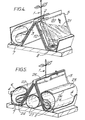
- Fig. 1 the plants 1 are shown growing in propagation pockets 2 which straddle the dividing wall 3 of a gully 4, which may be an extrusion in rigid PVC, aluminium or like material.
- Flexible sheet material 5 e.g. pigmented polyethylene, is folded and rolled to form part-tubular side members 6 and two channels 7 and 8 down which nutrient solutions are supplied.
- the free edges of the sheet material 5 give support to the plant stems and are attached at spaced intervals by clips 9.
- the propagation pocket 2 has two dependent portions 10,11 dipping respectively into channels 8,9. Each portion 10,11 supports and nourishes a separate portion of root system, of which portion 12 is visible.
- the portion 12 may be supplied with root inputs via channel 8 independently of the root portion supplied via channel 7.
- the levels of nutrient solution in the channels 7,8 may be varied from time to time, e.g. to the depths shown at 13,14 and 15. Level 13 will mainly supply nutrients to the root tips, while levels 14 and 15 will involve increasing proportions of.the mature root.
- the propagation pocket (A) comprises a single length of capillary matting having a central pleat 16 retained by staples 17.
- the pocket portion 18 is available to receive a seed (not shown).
- Fig. 3(B) the pocket is fashioned from two pieces of capillary matting attached by staples 17.
- Fig. 3(C) a single piece of capillary matting has been folded and the central portion of the fold cut to form the seed pocket 18. The fold is retained by stiching 19.
- Fig. 4 is a modification of Fig. 2 wherein the dividing wall 3 has been covered with a layer of capillary matting 20 prior to placing the propagation pocket 2 in position.
- the root system can develop lateral branches 21 on both sides of the dividing wall, as well as the main vertical root 12.
- the lateral branches can be selectively supplied with inputs by altering the level of the solutions in the channels 7,8.'
- Fig. 5 the apparatus of Fig. 2 has been modified by providing capillary matting 22,23 which dips into water channels 24 contained within the rolled side members 6.
- the matting is looped into the channels 24 and the free edges terminate respectively at 25, adjacent the free edges of the plastics sheet 5, and at 26, in the vicinity of upper edge of gully 4.
- the water in channels 24 is not in contact with the plants and can be of poor quality, or even seawater.
- a pipe 27 is located within the dividing wall and may be supplied with or warm or cold water as desired.
- the upper root portions may be selectively warmed by feeding warm water through pipe 27, and the lower root portions may be warmed by supplying heated nutrient solution to channels 7 and 8. It is thereby possible to mimic the natural diurnal temperature differentials-which plants have been equipped by evolution to utilise.
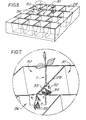
- Fig. 6 is a static hydroponic cultivation system comprising an array of sixteen separate vessels 28 in four rows, the rows being staggered such that the internal dividing walls terminate at the junction of three different vessels.
- the array may be conveniently made out of vacuum-formed plastics material, e.g. rigid PVC.
- two plants are shown in position, one being illustrated in enlarged inset view in Fig. 7.
- the plant 1 is supported on the dividing wall 29 between vessels 30 and 31.
- the plant is anchored in rooting medium 32.
- the tap root 33 divides into laterals 34, some of which are trained to hang down into vessel 30 and some into vessel 31. These vessels contain suitable nutrient solutions for nourishing the upper root.
- the lower root 35 hangs down into a third vesel 36 containing a solution adapted to be taken up by the root tip.
- the vessels 30 and 31 may contain the following solutions, either separately and alternately or in admixture (although mixtures of solutions (A) and (B) are liable to precipitate calcium phosphate unless well diluted);
- Vessel 36 contains solution (C):
Landscapes
- Life Sciences & Earth Sciences (AREA)
- Environmental Sciences (AREA)
- Hydroponics (AREA)
Applications Claiming Priority (2)
| Application Number | Priority Date | Filing Date | Title |
|---|---|---|---|
| GB8201408 | 1982-01-19 | ||
| GB8201408 | 1982-01-19 |
Publications (1)
| Publication Number | Publication Date |
|---|---|
| EP0086562A1 true EP0086562A1 (en) | 1983-08-24 |
Family
ID=10527707
Family Applications (1)
| Application Number | Title | Priority Date | Filing Date |
|---|---|---|---|
| EP83300216A Ceased EP0086562A1 (en) | 1982-01-19 | 1983-01-17 | Process and means for hydroponic cultivation |
Country Status (9)
| Country | Link |
|---|---|
| EP (1) | EP0086562A1 (ref) |
| JP (1) | JPS58138324A (ref) |
| AU (1) | AU553432B2 (ref) |
| CA (1) | CA1220029A (ref) |
| ES (1) | ES519106A0 (ref) |
| GB (1) | GB2113518B (ref) |
| GR (1) | GR77141B (ref) |
| NZ (1) | NZ203051A (ref) |
| PT (1) | PT76122B (ref) |
Cited By (11)
| Publication number | Priority date | Publication date | Assignee | Title |
|---|---|---|---|---|
| EP0235953A1 (en) * | 1986-02-04 | 1987-09-09 | Nutrient Film Technology Limited | Method and apparatus for hydroponic cultivation |
| EP0764400A1 (en) * | 1995-09-19 | 1997-03-26 | Mikado Chemical M.F.G. Co. | Plant-growing system and plant-growing method |
| EP2210478A1 (en) * | 2009-01-26 | 2010-07-28 | Kekkilä OY | Cultivation method for plants and system and substrate box for cultivating plants |
| CN102523977A (zh) * | 2011-12-09 | 2012-07-04 | 河南科技大学 | 一种水稻幼苗培养方法 |
| KR200462184Y1 (ko) | 2010-10-08 | 2012-09-03 | 김종훈 | 식물줄기 관찰용 교구 |
| US20120324787A1 (en) * | 2011-04-06 | 2012-12-27 | Horticoop B.V. | Apparatus and method for cultivating one or more plants |
| US20130118073A1 (en) * | 2011-11-15 | 2013-05-16 | Stratus Hydroponics International, Inc. | Soilless plant cultivation system |
| JP2017029166A (ja) * | 2013-04-03 | 2017-02-09 | 三井化学株式会社 | 植物栽培システムとそれを利用した栽培方法及びその製造方法 |
| IT201600104884A1 (it) * | 2016-10-19 | 2018-04-19 | Enrico Lapi | Apparato per la coltura fuori suolo di piante |
| US10058040B2 (en) | 2010-09-17 | 2018-08-28 | Kamal Daas | Apparatus and method for growing one or more plants |
| WO2023214133A1 (fr) * | 2022-05-05 | 2023-11-09 | Agro Innovation International | Pot et procédé de culture de plantes |
Families Citing this family (9)
| Publication number | Priority date | Publication date | Assignee | Title |
|---|---|---|---|---|
| NO153831C (no) * | 1984-03-08 | 1986-06-04 | Torbjoern Arnold Snekkenes | Vanningssystem for dyrkningsflater. |
| GB2199475B (en) * | 1986-11-27 | 1990-08-01 | Fisons Plc | Plant cultivation container |
| CN102326508B (zh) * | 2010-07-13 | 2013-06-19 | 西北农林科技大学 | 一种用于植物分根试验的组合式水培装置及用该装置进行水培的方法 |
| CN104320967B (zh) * | 2012-12-28 | 2020-04-07 | 三菱化学农业梦想株式会社 | 营养液栽培用部件和营养液栽培方法 |
| CN103601557A (zh) * | 2013-11-27 | 2014-02-26 | 申燕林 | 金边富贵竹水培营养液 |
| FI126323B (fi) | 2015-03-25 | 2016-09-30 | Green Automation Exp Oy | Hydroponinen kasvatusjärjestelmä |
| CN104756850B (zh) * | 2015-04-16 | 2017-03-08 | 中国林业科学研究院亚热带林业研究所 | 一种分根实验容器 |
| US20180132430A1 (en) * | 2016-11-15 | 2018-05-17 | Kristopher Ryan Kaminski | Planting system for optimization of plant growth |
| CN110275001B (zh) * | 2019-07-31 | 2023-01-03 | 四川省农业科学院生物技术核技术研究所 | 一种测定及评价药剂对根结线虫药效的装置与方法 |
Citations (4)
| Publication number | Priority date | Publication date | Assignee | Title |
|---|---|---|---|---|
| GB1245581A (en) * | 1967-09-04 | 1971-09-08 | Nat Res Dev | Cultivation of plants |
| US3744183A (en) * | 1970-12-11 | 1973-07-10 | N Kato | Method of hydroponic cultivation |
| GB2056833A (en) * | 1979-08-28 | 1981-03-25 | Hago Prod Ltd | Hydroponic cultivation |
| GB2074001A (en) * | 1980-04-21 | 1981-10-28 | Nutrient Film Tech Ltd | Gully for hydroponic cultivation |
Family Cites Families (6)
| Publication number | Priority date | Publication date | Assignee | Title |
|---|---|---|---|---|
| JPS5219136B2 (ref) * | 1972-04-26 | 1977-05-26 | ||
| JPS5130267U (ref) * | 1974-08-20 | 1976-03-04 | ||
| JPS548576A (en) * | 1977-06-22 | 1979-01-22 | Fuji Electric Co Ltd | Infrated ray gas analyzer |
| JPS5577834A (en) * | 1978-12-07 | 1980-06-12 | Kazuaki Inoike | Waterrculture using two tanks |
| JPS56106529A (en) * | 1980-01-31 | 1981-08-24 | Riijienshii Inbuesutomentsu Lt | Propagator for cultivating plant and method using same |
| ES268986Y (es) * | 1980-04-21 | 1983-12-16 | Un dispositivo de canal para cultivo hidroponico de plantas. |
-
1983
- 1983-01-17 EP EP83300216A patent/EP0086562A1/en not_active Ceased
- 1983-01-17 GB GB08301135A patent/GB2113518B/en not_active Expired
- 1983-01-19 ES ES519106A patent/ES519106A0/es active Granted
- 1983-01-19 CA CA000419787A patent/CA1220029A/en not_active Expired
- 1983-01-19 PT PT76122A patent/PT76122B/pt unknown
- 1983-01-19 JP JP58005976A patent/JPS58138324A/ja active Pending
- 1983-01-19 AU AU10614/83A patent/AU553432B2/en not_active Ceased
- 1983-01-19 NZ NZ203051A patent/NZ203051A/en unknown
- 1983-01-19 GR GR70293A patent/GR77141B/el unknown
Patent Citations (4)
| Publication number | Priority date | Publication date | Assignee | Title |
|---|---|---|---|---|
| GB1245581A (en) * | 1967-09-04 | 1971-09-08 | Nat Res Dev | Cultivation of plants |
| US3744183A (en) * | 1970-12-11 | 1973-07-10 | N Kato | Method of hydroponic cultivation |
| GB2056833A (en) * | 1979-08-28 | 1981-03-25 | Hago Prod Ltd | Hydroponic cultivation |
| GB2074001A (en) * | 1980-04-21 | 1981-10-28 | Nutrient Film Tech Ltd | Gully for hydroponic cultivation |
Non-Patent Citations (1)
| Title |
|---|
| Soviet Inventions Illustrated Week E30, 8 September 1982 Section P13 * |
Cited By (12)
| Publication number | Priority date | Publication date | Assignee | Title |
|---|---|---|---|---|
| EP0235953A1 (en) * | 1986-02-04 | 1987-09-09 | Nutrient Film Technology Limited | Method and apparatus for hydroponic cultivation |
| EP0764400A1 (en) * | 1995-09-19 | 1997-03-26 | Mikado Chemical M.F.G. Co. | Plant-growing system and plant-growing method |
| EP2210478A1 (en) * | 2009-01-26 | 2010-07-28 | Kekkilä OY | Cultivation method for plants and system and substrate box for cultivating plants |
| US10058040B2 (en) | 2010-09-17 | 2018-08-28 | Kamal Daas | Apparatus and method for growing one or more plants |
| KR200462184Y1 (ko) | 2010-10-08 | 2012-09-03 | 김종훈 | 식물줄기 관찰용 교구 |
| US20120324787A1 (en) * | 2011-04-06 | 2012-12-27 | Horticoop B.V. | Apparatus and method for cultivating one or more plants |
| US20130118073A1 (en) * | 2011-11-15 | 2013-05-16 | Stratus Hydroponics International, Inc. | Soilless plant cultivation system |
| CN102523977A (zh) * | 2011-12-09 | 2012-07-04 | 河南科技大学 | 一种水稻幼苗培养方法 |
| CN102523977B (zh) * | 2011-12-09 | 2013-06-26 | 河南科技大学 | 一种水稻幼苗培养方法 |
| JP2017029166A (ja) * | 2013-04-03 | 2017-02-09 | 三井化学株式会社 | 植物栽培システムとそれを利用した栽培方法及びその製造方法 |
| IT201600104884A1 (it) * | 2016-10-19 | 2018-04-19 | Enrico Lapi | Apparato per la coltura fuori suolo di piante |
| WO2023214133A1 (fr) * | 2022-05-05 | 2023-11-09 | Agro Innovation International | Pot et procédé de culture de plantes |
Also Published As
| Publication number | Publication date |
|---|---|
| PT76122A (en) | 1983-02-01 |
| GR77141B (ref) | 1984-09-07 |
| GB2113518B (en) | 1986-09-03 |
| ES8402693A1 (es) | 1984-02-16 |
| GB2113518A (en) | 1983-08-10 |
| JPS58138324A (ja) | 1983-08-17 |
| GB8301135D0 (en) | 1983-02-16 |
| CA1220029A (en) | 1987-04-07 |
| NZ203051A (en) | 1986-04-11 |
| AU553432B2 (en) | 1986-07-17 |
| AU1061483A (en) | 1983-07-28 |
| PT76122B (en) | 1985-11-12 |
| ES519106A0 (es) | 1984-02-16 |
Similar Documents
| Publication | Publication Date | Title |
|---|---|---|
| EP0086562A1 (en) | Process and means for hydroponic cultivation | |
| US5201141A (en) | Method of hydroponical growing of plants and an apparatus and a system for use by the method | |
| US4528774A (en) | Plant and seed growing system | |
| EP0040620B1 (en) | Arrangement for greenhouses or growth rooms for enhancing the growth of plants or the germination of seeds | |
| US6389751B1 (en) | Plant cultivating apparatus using subirrigation | |
| EP0268556B1 (en) | Plant culturing method and apparatus | |
| JP6566501B2 (ja) | 養液栽培システム | |
| EP0416008A1 (en) | Method and apparatus for hydroponic gardening. | |
| EP0076261B1 (en) | A method of growing plants, and a growing bag for use by the method | |
| EP0406803B1 (en) | A method for hydroponical growing of plants as well as a growing device and a system for the practicing of said method | |
| JPS63126440A (ja) | 水耕栽培装置 | |
| KR100332418B1 (ko) | 양액재배에서 근권부 냉각 및 가열에 의한 생육조절방법 및 장치 | |
| JPH10271926A (ja) | 養液栽培用の定植板 | |
| JP2684081B2 (ja) | 水耕栽培方法と水耕栽培パネル | |
| JP4315737B2 (ja) | 植物栽培装置及び植物栽培方法 | |
| JPH0614665A (ja) | 植物栽培ベッドおよび植物栽培装置 | |
| CN213662976U (zh) | 一种果蔬种植槽及果蔬种植园 | |
| JP7494574B2 (ja) | 養液栽培方法 | |
| KR200174607Y1 (ko) | 식물재배용 복합배지의 적층구조 | |
| JPH10117616A (ja) | 胡蝶蘭等の水耕栽培方法および水耕栽培用装置 | |
| JP3001784U (ja) | 養液栽培装置 | |
| JP6292693B1 (ja) | 縦型水耕栽培システム及び縦型水耕栽培方法 | |
| JP3199233U (ja) | 木質チップ発酵熱を利用した水耕栽培システム | |
| JPH04121125A (ja) | 植物の根域部を温度調節する水耕栽培装置 | |
| JPH0779651A (ja) | エアーバッグ利用による養液栽培方法及び装置 |
Legal Events
| Date | Code | Title | Description |
|---|---|---|---|
| PUAI | Public reference made under article 153(3) epc to a published international application that has entered the european phase |
Free format text: ORIGINAL CODE: 0009012 |
|
| AK | Designated contracting states |
Designated state(s): AT BE CH DE FR IT LI LU NL SE |
|
| 17P | Request for examination filed |
Effective date: 19840207 |
|
| STAA | Information on the status of an ep patent application or granted ep patent |
Free format text: STATUS: THE APPLICATION HAS BEEN REFUSED |
|
| 18R | Application refused |
Effective date: 19871221 |
|
| RIN1 | Information on inventor provided before grant (corrected) |
Inventor name: EDWARDS, CYRIL KENNETH |