EP0084350B1 - Vorrichtung und Verfahren zur Herstellung von Abbildungen - Google Patents
Vorrichtung und Verfahren zur Herstellung von Abbildungen Download PDFInfo
- Publication number
- EP0084350B1 EP0084350B1 EP83100247A EP83100247A EP0084350B1 EP 0084350 B1 EP0084350 B1 EP 0084350B1 EP 83100247 A EP83100247 A EP 83100247A EP 83100247 A EP83100247 A EP 83100247A EP 0084350 B1 EP0084350 B1 EP 0084350B1
- Authority
- EP
- European Patent Office
- Prior art keywords
- layer
- cutting
- film layer
- cut
- figures
- Prior art date
- Legal status (The legal status is an assumption and is not a legal conclusion. Google has not performed a legal analysis and makes no representation as to the accuracy of the status listed.)
- Expired
Links
Images

Classifications
-
- B—PERFORMING OPERATIONS; TRANSPORTING
- B05—SPRAYING OR ATOMISING IN GENERAL; APPLYING FLUENT MATERIALS TO SURFACES, IN GENERAL
- B05C—APPARATUS FOR APPLYING FLUENT MATERIALS TO SURFACES, IN GENERAL
- B05C17/00—Hand tools or apparatus using hand held tools, for applying liquids or other fluent materials to, for spreading applied liquids or other fluent materials on, or for partially removing applied liquids or other fluent materials from, surfaces
- B05C17/06—Stencils
-
- B—PERFORMING OPERATIONS; TRANSPORTING
- B32—LAYERED PRODUCTS
- B32B—LAYERED PRODUCTS, i.e. PRODUCTS BUILT-UP OF STRATA OF FLAT OR NON-FLAT, e.g. CELLULAR OR HONEYCOMB, FORM
- B32B27/00—Layered products comprising a layer of synthetic resin
- B32B27/40—Layered products comprising a layer of synthetic resin comprising polyurethanes
-
- B—PERFORMING OPERATIONS; TRANSPORTING
- B32—LAYERED PRODUCTS
- B32B—LAYERED PRODUCTS, i.e. PRODUCTS BUILT-UP OF STRATA OF FLAT OR NON-FLAT, e.g. CELLULAR OR HONEYCOMB, FORM
- B32B7/00—Layered products characterised by the relation between layers; Layered products characterised by the relative orientation of features between layers, or by the relative values of a measurable parameter between layers, i.e. products comprising layers having different physical, chemical or physicochemical properties; Layered products characterised by the interconnection of layers
- B32B7/02—Physical, chemical or physicochemical properties
- B32B7/022—Mechanical properties
-
- B—PERFORMING OPERATIONS; TRANSPORTING
- B32—LAYERED PRODUCTS
- B32B—LAYERED PRODUCTS, i.e. PRODUCTS BUILT-UP OF STRATA OF FLAT OR NON-FLAT, e.g. CELLULAR OR HONEYCOMB, FORM
- B32B7/00—Layered products characterised by the relation between layers; Layered products characterised by the relative orientation of features between layers, or by the relative values of a measurable parameter between layers, i.e. products comprising layers having different physical, chemical or physicochemical properties; Layered products characterised by the interconnection of layers
- B32B7/04—Interconnection of layers
- B32B7/12—Interconnection of layers using interposed adhesives or interposed materials with bonding properties
-
- C—CHEMISTRY; METALLURGY
- C09—DYES; PAINTS; POLISHES; NATURAL RESINS; ADHESIVES; COMPOSITIONS NOT OTHERWISE PROVIDED FOR; APPLICATIONS OF MATERIALS NOT OTHERWISE PROVIDED FOR
- C09J—ADHESIVES; NON-MECHANICAL ASPECTS OF ADHESIVE PROCESSES IN GENERAL; ADHESIVE PROCESSES NOT PROVIDED FOR ELSEWHERE; USE OF MATERIALS AS ADHESIVES
- C09J7/00—Adhesives in the form of films or foils
-
- B—PERFORMING OPERATIONS; TRANSPORTING
- B32—LAYERED PRODUCTS
- B32B—LAYERED PRODUCTS, i.e. PRODUCTS BUILT-UP OF STRATA OF FLAT OR NON-FLAT, e.g. CELLULAR OR HONEYCOMB, FORM
- B32B2307/00—Properties of the layers or laminate
- B32B2307/50—Properties of the layers or laminate having particular mechanical properties
- B32B2307/54—Yield strength; Tensile strength
-
- B—PERFORMING OPERATIONS; TRANSPORTING
- B32—LAYERED PRODUCTS
- B32B—LAYERED PRODUCTS, i.e. PRODUCTS BUILT-UP OF STRATA OF FLAT OR NON-FLAT, e.g. CELLULAR OR HONEYCOMB, FORM
- B32B2405/00—Adhesive articles, e.g. adhesive tapes
-
- Y—GENERAL TAGGING OF NEW TECHNOLOGICAL DEVELOPMENTS; GENERAL TAGGING OF CROSS-SECTIONAL TECHNOLOGIES SPANNING OVER SEVERAL SECTIONS OF THE IPC; TECHNICAL SUBJECTS COVERED BY FORMER USPC CROSS-REFERENCE ART COLLECTIONS [XRACs] AND DIGESTS
- Y10—TECHNICAL SUBJECTS COVERED BY FORMER USPC
- Y10S—TECHNICAL SUBJECTS COVERED BY FORMER USPC CROSS-REFERENCE ART COLLECTIONS [XRACs] AND DIGESTS
- Y10S428/00—Stock material or miscellaneous articles
- Y10S428/914—Transfer or decalcomania
-
- Y—GENERAL TAGGING OF NEW TECHNOLOGICAL DEVELOPMENTS; GENERAL TAGGING OF CROSS-SECTIONAL TECHNOLOGIES SPANNING OVER SEVERAL SECTIONS OF THE IPC; TECHNICAL SUBJECTS COVERED BY FORMER USPC CROSS-REFERENCE ART COLLECTIONS [XRACs] AND DIGESTS
- Y10—TECHNICAL SUBJECTS COVERED BY FORMER USPC
- Y10T—TECHNICAL SUBJECTS COVERED BY FORMER US CLASSIFICATION
- Y10T428/00—Stock material or miscellaneous articles
- Y10T428/14—Layer or component removable to expose adhesive
- Y10T428/149—Sectional layer removable
- Y10T428/1495—Adhesive is on removable layer
-
- Y—GENERAL TAGGING OF NEW TECHNOLOGICAL DEVELOPMENTS; GENERAL TAGGING OF CROSS-SECTIONAL TECHNOLOGIES SPANNING OVER SEVERAL SECTIONS OF THE IPC; TECHNICAL SUBJECTS COVERED BY FORMER USPC CROSS-REFERENCE ART COLLECTIONS [XRACs] AND DIGESTS
- Y10—TECHNICAL SUBJECTS COVERED BY FORMER USPC
- Y10T—TECHNICAL SUBJECTS COVERED BY FORMER US CLASSIFICATION
- Y10T428/00—Stock material or miscellaneous articles
- Y10T428/24—Structurally defined web or sheet [e.g., overall dimension, etc.]
- Y10T428/24628—Nonplanar uniform thickness material
- Y10T428/24736—Ornamental design or indicia
-
- Y—GENERAL TAGGING OF NEW TECHNOLOGICAL DEVELOPMENTS; GENERAL TAGGING OF CROSS-SECTIONAL TECHNOLOGIES SPANNING OVER SEVERAL SECTIONS OF THE IPC; TECHNICAL SUBJECTS COVERED BY FORMER USPC CROSS-REFERENCE ART COLLECTIONS [XRACs] AND DIGESTS
- Y10—TECHNICAL SUBJECTS COVERED BY FORMER USPC
- Y10T—TECHNICAL SUBJECTS COVERED BY FORMER US CLASSIFICATION
- Y10T428/00—Stock material or miscellaneous articles
- Y10T428/28—Web or sheet containing structurally defined element or component and having an adhesive outermost layer
- Y10T428/2839—Web or sheet containing structurally defined element or component and having an adhesive outermost layer with release or antistick coating
-
- Y—GENERAL TAGGING OF NEW TECHNOLOGICAL DEVELOPMENTS; GENERAL TAGGING OF CROSS-SECTIONAL TECHNOLOGIES SPANNING OVER SEVERAL SECTIONS OF THE IPC; TECHNICAL SUBJECTS COVERED BY FORMER USPC CROSS-REFERENCE ART COLLECTIONS [XRACs] AND DIGESTS
- Y10—TECHNICAL SUBJECTS COVERED BY FORMER USPC
- Y10T—TECHNICAL SUBJECTS COVERED BY FORMER US CLASSIFICATION
- Y10T428/00—Stock material or miscellaneous articles
- Y10T428/31504—Composite [nonstructural laminate]
- Y10T428/31551—Of polyamidoester [polyurethane, polyisocyanate, polycarbamate, etc.]
-
- Y—GENERAL TAGGING OF NEW TECHNOLOGICAL DEVELOPMENTS; GENERAL TAGGING OF CROSS-SECTIONAL TECHNOLOGIES SPANNING OVER SEVERAL SECTIONS OF THE IPC; TECHNICAL SUBJECTS COVERED BY FORMER USPC CROSS-REFERENCE ART COLLECTIONS [XRACs] AND DIGESTS
- Y10—TECHNICAL SUBJECTS COVERED BY FORMER USPC
- Y10T—TECHNICAL SUBJECTS COVERED BY FORMER US CLASSIFICATION
- Y10T428/00—Stock material or miscellaneous articles
- Y10T428/31504—Composite [nonstructural laminate]
- Y10T428/31551—Of polyamidoester [polyurethane, polyisocyanate, polycarbamate, etc.]
- Y10T428/31565—Next to polyester [polyethylene terephthalate, etc.]
-
- Y—GENERAL TAGGING OF NEW TECHNOLOGICAL DEVELOPMENTS; GENERAL TAGGING OF CROSS-SECTIONAL TECHNOLOGIES SPANNING OVER SEVERAL SECTIONS OF THE IPC; TECHNICAL SUBJECTS COVERED BY FORMER USPC CROSS-REFERENCE ART COLLECTIONS [XRACs] AND DIGESTS
- Y10—TECHNICAL SUBJECTS COVERED BY FORMER USPC
- Y10T—TECHNICAL SUBJECTS COVERED BY FORMER US CLASSIFICATION
- Y10T428/00—Stock material or miscellaneous articles
- Y10T428/31504—Composite [nonstructural laminate]
- Y10T428/31678—Of metal
- Y10T428/31717—Next to bituminous or tarry residue
Definitions
- the present invention relates to an apparatus for manufacturing figures of desired shape which includes (i) a cutting die having an elongated cutting ridge defining said figure of desired shape, a plastic or rubber cutting pad and means for exerting a cutting force against said pad or cutting die (29), and further comprising (ii) a laminated tape adapted to be disposed between said pad ("bottom" position) and said cutting die ("top” position) said tape being composed of an uppermost or first film layer having a top and a bottom face, a second film layer for supporting the first film layer, said second film layer having a top and bottom face, said top face of said second film layer being disposed in face-to-face relationship with respect to the bottom face of said first film layer, and of an adhesive coating provided on. the bottom surface of the first film layer and the first film layer being selectively removable from said second film layer.
- the present invention also relates to a method of using such apparatus in the manufacture of such figures and application of the same to the desired medium.
- a laminated tape includes a top layer adapted to transmit a cutting force from a cutting die to a cuttable intermediate layer and a bottom base layer.
- a laminated tape is described in the Massari Patent No. 3,558,425.
- the laminated tape described in this patent includes an upper, relatively thin and highly flexible carrier layer which stretches and serves to transmit the cutting force of a cutting die to an intermediate layer.
- This intermediate layer is positioned below the upper layer and is a highly inflexible and hard material such as cellulose acetate which is susceptible of being cut by the cutting forces transmitted through the upper layer.
- a bottom layer of this laminated tape consists of a relatively hard material.
- the laminated tape of the above-mentioned Massari patent is satisfactory in many respects, its usefulness is limited because of the relatively high cutting force needed to cut the intermediate layer. This high cutting force is a direct result of the highly inflexible and hard intermediate layer required in the Massari laminated tape structure. The high cutting forces in turn necessitate the use of generally hard cutting materials such as steel, thus dramatically increasing the cost of the cutting equipment and thereby limiting the potential use of the laminated tape. Accordingly, a need has existed, and continues to exist, for a laminated tape structure having a cuttable layer with the toughness and strength to resist tearing, etc.
- Such a laminated tape would eliminate the necessity for relatively hard cutting materials such as steel and thereby significantly reduce the cost of the cutting equipment and increase the use of the laminated tape.
- the present invention relates to an apparatus of the kind described at the beginning, characterized in that said first film layer has a thickness of at least 25 pm and is composed of a material having a tensile strength of no greater than about 70 bar and capable of being cut by said plastic cutting ridge against said plastic or rubber cutting pad with a cutting force of no more than 450 N per cm length of said cutting ridge, the top surface of said second film layer having a release coating permitting the selective removal of said first film layer and being free of any adhesive layer or properties.
- the structure of the laminated film used in the present invention is similar in some respects to the laminated tape structure described in the Massari patent mentioned above, the composition and physical characteristics of the first layer susceptible of being cut is dramatically different.
- the physical characteristics of the cuttable first layer of the present invention are virtually opposite that of the cuttable layer in the Massari structure.
- the Massari intermediate layer is defined as being hard, brittle and highly inflexible.
- the cuttable first layer of the present invention is a very soft, elastic and highly flexible material.
- a first film layer constructed of a polyurethane material provides the desired physical characteristics.
- the method for manufacturing figures of desired shape from a laminated tape and applying the same to the desired medium of the present invention is characterized by the steps of cutting at least one figure of desired shape from at least the uppermost layer of a segment of laminated tape, removing the uppermost layer from the segment of laminated tape except for that portion comprising the cut-out figures, placing a segment of adhesive backed transfer tape onto the cut-out figures, removing the cut-out figures from the laminated tape via the transfer tape, positioning the transfer tape with cut-out figures disposed thereon with respect to the desired medium and transferring the cut-out figures from the transfer tape to the desired medium.
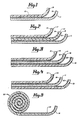
- Figures 1-4 showing various embodiments of the laminated tape of the present invention. Although these embodiments illustrate various combinations of laminated structures, they all include a first film layer 10 comprised of a relatively soft and highly flexible material capable of being cut by a cutting ridge of a cutting die. Each of these embodiments also includes a second film layer 11 functioning to support or carry the first layer 10. This second layer 11 is not cut during the cutting procedure. Each of the embodiments of Figures 1-4 also includes a third film layer functioning as a transfer tape to transfer the cut out figures from the first layer 10 to a desired medium. In the embodiment of Figure 2, this third layer is designated by the reference numeral 12, whereas in the embodiments of Figures 3 and 4, this third layer is designated by the reference numeral 13. With respect to the embodiment of Figure 1, the third layer is supplied separately from the roll of transfer tape 22 illustrated in Figure 5. The transfer tape itself is designated by the reference numeral 14.
- the first layer 10 of each of the embodiments illustrated in Figures 1-4 is capable of being cut by an elongated cutting ridge of a cutting die.
- the physical characteristics of this first layer 10 is that it is a relatively soft and flexible material.
- various types of synthetic polymers such as epoxys, acrylics, vinyls and polyesters may be formulated so that they exhibit the desired physical characteristics of the first layer 10
- the first layer 10 of the preferred embodiment is constructed of a low energy, cuttable polyurethane. It has been found, through testing and experimentation, that a first layer constructed of such a polyurethane provides the desired physical properties of softness and flexibility and provides a material which is capable of being cut at dramatically lower cutting forces than is needed in prior art devices.
- One of the primary advantages of the softness and flexibility of the first layer 10 is that it is cuttable with a relatively low force by a cutting ridge of a cutting die.
- the particular magnitude of this cutting force is one parameter which has been used by the inventor to define the desired characteristics of the first layer 10.
- a second parameter used is that of tensile strength, namely, the force needed to fracture a piece of the material by pulling two ends of the material in opposite directions.
- tensile strength namely, the force needed to fracture a piece of the material by pulling two ends of the material in opposite directions.
- This device was provided with a 2, 23 kN load cell and a compression fixture to enable a compression cutting force to be exerted.
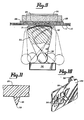
- a cutting die similar to the lettering chip 29 illustrated in Figure 10 was also utilized.
- Such cutting die included a continuous cutting ridge 35 of finite length.
- the generally wedge shaped continuous cutting ridge 35 includes a cutting point or edge 39 and a pair of side surfaces disposed at an included angle "A" with respect to each other of approximately fifty degrees (50°).
- the lettering chip 29 and cutting ridge 35 was constructed of a high impact molded plastic designated as Plexiglass DR 61KO and manufactured by Rohm & Haas Company of Philadelphia, Pennsylvania.
- a urethane pad of Hardness 61-64 Shore C was provided to resist the cutting force.
- the testing . device further included means for applying and recording a given force to the cutting die.
- the first film layer 10 had to be constructed of a material which could be cut by a cutting force of no greater than about 450 N per cm length of cutting ridge. It is also contemplated that the first layer 10 should be at least about 25 pm thick.
- the first film layer 10 is constructed of a material which can be cut by a cutting force of between about 220 and 310 N per cm length of cutting ridge.
- the inventor has also determined that the tensile strength of a particular material is generally linearly related to the cutting force determined in the test described above.
- Tensile strength of a material is conventionally determined by The American Society for Testing and Materials (ASTM) test D882. In this test, stress is applied to a material in a pulling fashion until it breaks. Tensile strength is calculated by dividing the maximum load (force) by the original cross-sectional area of the sample. The result is expressed in pounds per square inch.
- Tensile strength determinations were made on various materials and formulations which confirmed the generally linear relationship between tensile strength and cutting force. While this generally linear relationship is expected to vary somewhat for different kinds and formulations of material, it was determined that the tensile strength of the material from which the first layer is constructed should be no greater than about 70 bar and preferably no greater than about 35 bar. Tensile strength determinations conducted with respect to a sample of cellulose acetate 24 11 m thick resulted in a tensile strength of about 700 bar.
- the first layer 10 which is cuttable must be constructed of a material which is relatively soft and flexible and capable of being cut by an elongated cutting ridge of a cutting die. Further, the material of the first layer 10 should have a tensile strength of no greater than 70 bar. The material should also be such that a cutting force of no more than about 450 N per cm length of the cutting ridge will cut the first layer 10. The first layer 10 should also be at least 25 11 m thick.
- the first film layer 10 of the preferred embodiment is a urethane film formed by reacting an isocyanate monomer with one or more polyols.
- the isocyanate monomer is a hexamethylene diisocyanate having an isocyanate equivalent weight of about 190.
- the preferred polyols include a polymeric vinyl ester acrylic copolymer (40%, by weight, solids) with a hydroxyl equivalent weight of about 400; a hydroxyl functional acrylic copolymer with a hydroxyl equivalent weight of about 800; a saturated polyester resin with a hydroxyl equivalent weight of about 1135; DB castor oil having a hydroxyl value of about 164; and a polyoxypropylene polyether having a hydroxyl equivalent weight of about 125.
- a catalyst such as organo tin and pigments are also added in the preferred system.
- the index or ratio of isocyanate equivalence to hydroxyl equivalence is about 0.7 to 0.9 with the optimum being about 0.8.
- a second layer 11 is disposed adjacent to and in face-to-face relationship with one surface of the first layer 10.
- the physical properties of this second layer 11 are not as important as the properties of the first layer 10 since its primary function is to provide support for and carry the first layer 10 during the cutting procedure.
- the second layer 11 can be constructed of a variety of materials such as materials having a paper base or polymer films such as polyesters or polyethylenes.
- the second layer 11 should be relatively hard and inflexible compared to the first layer 10 and should also be relatively non-elastic, to preclude the laminated film from being stretched and deformed prior or subsequent to the cutting procedure.
- the second layer 11 In comparison to the first layer 10, the second layer 11 should have a tensile strength greater than 70 bar.
- the second layer 11 should not be capable of being cut by a cutting ridge at cutting forces less than 450 N per cm length.
- the lower surface of the first layer 10 which is adjacent to the second layer 11' is provided with an adhesive coating 15.
- the corresponding surface of the second layer 11 is provided with a release liner or coating 16 to permit portions of the first layer 10 to be removed or stripped from the second layer 11 when desired. Following removal, as will be described in greater detail below, these portions of the first layer 10 are positioned onto the desired medium and retained in such position by the adhesive coating 15. Accordingly, the adhesive coating 15 should be quite aggressive.
- the adhesive 15 is a generally available hot melt acrylic or water base adhesive. The specific tack or aggressiveness of the adhesive is measured by a peel test which involves placing a one-half inch wide strip of material backed with the particular adhesive in question on a substrate consisting of 1000 H Vellum drafting stock.
- the preferred tack of the adhesive 15 should be about 0.4 to 0.8 N per cm for a low tack application and about 1.6 to 2.0 N per cm high tack application.
- the low tack is used primarily when preparing stencils, whereas the high tack is used when the adherence is intended to be permanent.
- the release coating 16 can also consist of a variety of materials. In the preferred embodiment, however, the coating 16 is a silicone coating applied to the top surface of the second or support layer 11.
- Each of the embodiments illustrated in Figures 1-4 also includes an associated third or transfer film layer.
- the primary function of this third layer is to facilitate the transfer of the cut-out figures, or the stencil as the case may be, to the desired medium.
- this third or transfer layer is illustrated by the reference numeral 12 and is disposed adjacent to the side of the first layer 10 opposite that of the second layer 11.
- the third layer 12 must be constructed of a generally flexible, hard and elastic material which enables it to be stretched without being cut during application of the cutting force.
- the third layer 12 is utilized to transmit the cutting force of the cutting die to the first layer 10 to cut the first layer 10 into the desired characters or figures.
- the material from which the third layer 12 in Figure 2 is constructed is a material such as a polyester or polyethylene.
- this layer 12 of Figure 2 can be constructed of a variety of materials, it must have the necessary flexibility, elasticity and toughness to prevent it from being cut by a cutting force of less than 450 N per cm length in accordance with the cutting force test previously described.
- the surface of the third layer 12 adjacent to the first layer 10 is provided with a low tack adhesive layer 17 to facilitate removal of portions of the first layer 10 from the second layer 11.
- the first layer 10 is provided with a release coating or surface 18 to allow removal of the third layer.12 after the cut-out figures have been secured to the desired medium.
- the adhesive coating 17 can be any common low tack adhesive such as, for example only, those having a vinyl, acrylic or urethane base.
- the release coating 18 can be any common release coating such as silicone, teflon orfluorocarbons, or can in some cases be nothing more than the top surface of the first layer 10.
- the adhesive 17 has a tack of less than about 0.4 N per cm as measured by the test described above.
- the third layer or transfer tape is designated by the reference numeral 13.
- the third layer 13 is disposed adjacent to the surface of the second layer 11 opposite that of the first layer 10 and remains in this position during the cutting procedure.
- the third layer transfer tape 13 is removed and placed adjacent the first layer 10 to transfer the cut-out figures from the first layer 10 to the desired medium.
- the third layer or transfer tape 13 illustrated in Figures 3 and 4 can be constructed of a variety of materials since its only function, in these particular embodiments, is to facilitate the transfer of the cut-out characters from the first layer 10 to the desired medium.
- the third layer 13 in the embodiments of Figures 3 and 4 is constructed of a polyester, polypropylene, acetate, polyethylene or paper base material.
- the third layer 13 of Figures 3 and 4 is provided with a low tack adhesive coating 20.
- This coating 20 has generally the same characteristics and tack as the coating 17 of Figure 2 and performs the same function of facilitating removal of cut-out portions of the first layer 10 from the second layer 11.
- a release liner or coating 19 is provided on the surface of the second layer 11 adjacent to the third layer 13, while in the embodiment of Figure 4, the release characteristics are inherent in the second layer 11 itself.
- the third layer or transfer tape is provided from a separate spool 22 as shown in Figure 5 and designated by the reference numeral 14.
- the transfer tape 14 is utilized in the same manner as the transfer tape 13 in Figures 3 and 4 after the cutting procedure has been completed.
- the sole purpose of the transfer tape 14 is to assist in transferring the cut-out figures from the first layer 10 to the desired medium. Accordingly, it can be constructed of the same material as the third layer 13 of Figures 3 and 4.
- the transfer tape 14 in Figure 5 is also provided with a low tack adhesive 21. This adhesive has generally the same characteristics and tack as the adhesive coating 17 of Figure 2 and the adhesive coating 20 of Figures 3 and 4 and performs the same function of facilitating removal of cut-out portions of the first layer 10 from the second layer 11.
- the first layer 10 of Figures 1-4 is cut by a cutting die in the form of the lettering chip 29 illustrated in Figure 10.
- the cutting die includes a generally wedge-shaped, continuous cutting ridge 35 having a continuous cutting point or edge 39 ( Figure 11).
- this lettering chip 29 is constructed of a high impact molded plastic material such as Plexiglass DR 61 K O manufactured by Rohm & Haas Company of Philadelphia, Pennsylvania. It is contemplated, however, that different types of materials can also be used.
- the lettering chip 29 includes a tab 38 to facilitate handling the chip 29 and a plurality of alignment indicia 36 to facilitate proper alignment of the character or figure 35 to be cut.
- Figure 9 illustrates one embodiment of a means for applying a cutting force to the lettering chip 29.
- a structure of this type is known in the art. In general, however, it includes a pair of support rails 34 (only one of which is illustrated in Figure 9) and a generally wedge shaped force generating segment rotatably mounted near its pointed end to a roller member 32 adapted for rolling movement along the support rails 34.
- the upper, curved surface of the wedge-shaped segment 30 includes a pad 31.
- This pad may be constructed of a rubber or plastic material with some resiliency. In the preferred embodiment, the pad is a urethane pad having a hardness of approximately 61-64 Shore C.
- the device illustrated in Figure 9 also includes a pair of chip alignment members 28, 28 and a cutting force resisting means 26.
- the cutting die or lettering chip 29 is positioned within the alignment and retaining tabs 28, 28 and the segment 30 is caused to roll against the bottom surface of the lettering chip 29 containing the cutting ridge 35 by moving the roller 32 from one end of the support rails 34 to the other.
- the laminated tape comprising at least the first layer 10 and the second layer 11 is disposed between the urethane pad 31 and the bottom surface of the lettering chip 29.
- the cutting force is applied between the urethane pad 31 and the lettering chip 29. This cutting force is sufficient to cut only the first layer 10, while leaving the second layer 11 uncut.
- the laminated tape is then removed from the cutting apparatus and the cut-out figures or characters from the- first layer 10 are transferred to the desired medium.
- This transfer procedure is illustrated best in Figures 6, 6a, 7 and 8.
- Figure 6 shows a section of the laminated tape of Figure 1 with the letters or characters having been cut-out.
- the portion of the layer 10, except for the cut-out letters is first removed from the base or second layer 11. This is accomplished by separating the layers 10 and 11 at a corner and then pulling the layer 10 off.
- the figures 24 remain on the layer 11 as illustrated in the lower half of Figure 6a.
- a strip of the third layer of transfer tape 14 ( Figure 5) is then cut and placed onto the top surface of the remaining cut-out figures 24 as illustrated in Figure 6a with the low tack adhesive 21 in engagement with the top layer 10 of the cut-out figures 24.
- the transfer tape 14 is peeled back to remove the figures 24 from the second layer 11.
- the adhesive 21 on the transfer layer 14 is a relatively low tack adhesive, it is sufficient to remove the cut-out figures 24 because of the release layer 16 on the layer 11.
- the third layer 12 is simply peeled back in the same manner so as to remove the cut-out figures 24 from the layer 11.
- the transfer tape 13 must first be removed from the lower surface of the layer 11 and then used to remove the cut-out figures 24 in the manner described above.
- the resulting transfer tape 14 includes only the cut-out letters 24 as shown in Figure 7. As illustrated, the cut-out figures 24 are aligned on the tape 14 with their adhesive side facing outwardly. To apply these cut-out characters 24 to the desired medium, the transfer tape 14 is simply aligned in the desired position as illustrated in Figure 8 and placed down in that position so that the bottom surface of the cut-out letters 24 which contain the aggressive adhesive 15 secures to the desired medium 25. The transfer tape 14 which contains the relatively low tack adhesive is then removed, thereby leaving the cut-out letters 24 properly positioned on the desired medium 25.
Landscapes
- Engineering & Computer Science (AREA)
- Mechanical Engineering (AREA)
- Chemical & Material Sciences (AREA)
- Organic Chemistry (AREA)
- Laminated Bodies (AREA)
- Adhesive Tapes (AREA)
- Eyeglasses (AREA)
- Manufacture Or Reproduction Of Printing Formes (AREA)
- Decoration By Transfer Pictures (AREA)
- Organic Insulating Materials (AREA)
Claims (5)
Priority Applications (1)
| Application Number | Priority Date | Filing Date | Title |
|---|---|---|---|
| AT83100247T ATE35110T1 (de) | 1982-01-15 | 1983-01-13 | Vorrichtung und verfahren zur herstellung von abbildungen. |
Applications Claiming Priority (2)
| Application Number | Priority Date | Filing Date | Title |
|---|---|---|---|
| US06/339,481 US4584220A (en) | 1982-01-15 | 1982-01-15 | Laminated tape |
| US339481 | 1982-01-15 |
Publications (3)
| Publication Number | Publication Date |
|---|---|
| EP0084350A2 EP0084350A2 (de) | 1983-07-27 |
| EP0084350A3 EP0084350A3 (en) | 1984-05-16 |
| EP0084350B1 true EP0084350B1 (de) | 1988-06-15 |
Family
ID=23329193
Family Applications (1)
| Application Number | Title | Priority Date | Filing Date |
|---|---|---|---|
| EP83100247A Expired EP0084350B1 (de) | 1982-01-15 | 1983-01-13 | Vorrichtung und Verfahren zur Herstellung von Abbildungen |
Country Status (6)
| Country | Link |
|---|---|
| US (1) | US4584220A (de) |
| EP (1) | EP0084350B1 (de) |
| JP (1) | JPS58164670A (de) |
| AT (1) | ATE35110T1 (de) |
| CA (1) | CA1204998A (de) |
| DE (1) | DE3377052D1 (de) |
Families Citing this family (13)
| Publication number | Priority date | Publication date | Assignee | Title |
|---|---|---|---|---|
| SE448153B (sv) * | 1984-05-03 | 1987-01-26 | Frans Gunnar Waldemar Fjelkner | Klyv- eller kapklinga |
| NZ247984A (en) * | 1992-07-01 | 1994-09-27 | Lintec Corp | Plastics film for labels; produced from resin composition containing 20-80% by weight polypropylene resin and 20-80% by weight polyethylene resin |
| ATE315476T1 (de) * | 1997-06-09 | 2006-02-15 | Tesa Tape Inc | Coextrudierte filme und diese enthaltende bandrollen und hergestellte gegenstände |
| US8247057B2 (en) * | 2005-09-16 | 2012-08-21 | 3M Innovative Properties Company | Cover tape and method for manufacture |
| US20070062844A1 (en) * | 2005-09-16 | 2007-03-22 | Velasquez Urey Ruben E | Cover tape and method for manufacture |
| JP5238699B2 (ja) * | 2006-08-09 | 2013-07-17 | スリーエム イノベイティブ プロパティズ カンパニー | 引裂開始型カバーテープを有するキャリアテープ、及びその製造方法 |
| JP2012046723A (ja) * | 2010-07-30 | 2012-03-08 | Nitto Denko Corp | アプリケーションテープ |
| US10016909B2 (en) | 2011-05-06 | 2018-07-10 | Iconex Llc | Roll of pre-printed stamp label stock and method of manufacturing a roll of pre-printed stamp label stock |
| US9524517B2 (en) * | 2011-05-06 | 2016-12-20 | Iconex Llc | Method of operating a self-service terminal to provide on-demand postage stamp labels to a postage stamp buyer and a self-service terminal therefor |
| US8833037B2 (en) * | 2012-04-05 | 2014-09-16 | Carlisle Intangible Company | Single ply roofing membranes with multifunctional biodegradable release liner |
| MX2019014145A (es) | 2013-03-15 | 2020-02-07 | Building Mat Investment Corp | Membrana para techo coloreada con reflectancia solar mejorada. |
| US10422138B1 (en) * | 2018-05-08 | 2019-09-24 | Carlisle Intangible, LLC | Roof membranes with removable protective sheets |
| CN114683352B (zh) * | 2020-12-27 | 2023-12-01 | 上海昊佰智造精密电子股份有限公司 | 一种组合刀模及其使用方法 |
Family Cites Families (8)
| Publication number | Priority date | Publication date | Assignee | Title |
|---|---|---|---|---|
| GB842983A (en) * | 1955-08-30 | 1960-08-04 | Milton Alfred Bergstedt | Adhesive sheets or tapes and a method of producing them |
| US3166186A (en) * | 1962-06-25 | 1965-01-19 | Andrew B Karn | Pressure sensitive labels, label stocks, and methods for manufacturing the same |
| DE1263474B (de) * | 1962-07-25 | 1968-03-14 | Jackstaedt & Co Wilhelm | Verfahren zum Herstellen eines mit Selbstklebeetiketten versehenen Vorratstraegers |
| US3930092A (en) * | 1969-09-24 | 1975-12-30 | Adhesive Materials Ltd | Printing characters for use in transfer printing processes |
| GB1438947A (en) * | 1972-08-08 | 1976-06-09 | Letraset International Ltd | Lettering products |
| FR2332581A1 (fr) * | 1975-11-19 | 1977-06-17 | Kalbacher Bernard | Procede de transfert de caracteres en film auto-adherent par vacuum ou electricite statique |
| JPS576767A (en) * | 1980-06-16 | 1982-01-13 | Teijin Ltd | Easily adhesive polyester film |
| US4374883A (en) * | 1981-10-15 | 1983-02-22 | Minnesota Mining And Manufacturing Company | Pressure-sensitive adhesive tape |
-
1982
- 1982-01-15 US US06/339,481 patent/US4584220A/en not_active Expired - Fee Related
-
1983
- 1983-01-13 EP EP83100247A patent/EP0084350B1/de not_active Expired
- 1983-01-13 DE DE8383100247T patent/DE3377052D1/de not_active Expired
- 1983-01-13 AT AT83100247T patent/ATE35110T1/de not_active IP Right Cessation
- 1983-01-14 CA CA000419525A patent/CA1204998A/en not_active Expired
- 1983-01-17 JP JP58005787A patent/JPS58164670A/ja active Pending
Also Published As
| Publication number | Publication date |
|---|---|
| ATE35110T1 (de) | 1988-07-15 |
| EP0084350A2 (de) | 1983-07-27 |
| US4584220A (en) | 1986-04-22 |
| CA1204998A (en) | 1986-05-27 |
| JPS58164670A (ja) | 1983-09-29 |
| EP0084350A3 (en) | 1984-05-16 |
| DE3377052D1 (en) | 1988-07-21 |
Similar Documents
| Publication | Publication Date | Title |
|---|---|---|
| US4604153A (en) | Method of manufacturing figures from a laminated tape and applying the same to a desired medium | |
| EP0084350B1 (de) | Vorrichtung und Verfahren zur Herstellung von Abbildungen | |
| EP1685206B1 (de) | Strukturiertes papier als trennschicht, rückseitig mit klebstoffaufschlaggegenstandverbund und herstellungsverfahren dafür | |
| US6440880B2 (en) | Pressure-sensitive adhesives having microstructured surfaces | |
| US5196266A (en) | Reclosable mechanical fastener based on a composite article | |
| EP0315072B1 (de) | Schicht von Haftklebstoff | |
| US6315851B1 (en) | Pressure-sensitive adhesives having microstructured surface | |
| KR100560341B1 (ko) | 미소복제된 지형을 가진 접착제 및 그 접착제의 제조 방법및 사용 방법 | |
| KR100422221B1 (ko) | 재부착가능한접착물품 | |
| US4223067A (en) | Foam-like pressure-sensitive adhesive tape | |
| EP2193769B1 (de) | Pflastermaterial | |
| JP3029047B2 (ja) | ループファスナー材料保存/小出しアセンブリー | |
| DE4431914C2 (de) | Streifen einer Klebfolie für eine rückstandsfrei wiederlösbare Verklebung und dessen Verwendung | |
| CA1124428A (en) | Foam-like pressure-sensitive adhesive tape | |
| EP0385647A2 (de) | Stapel von Folien mit druckempfindlicher Klebstoffbeschichtung | |
| KR880002964A (ko) | 압감 접착제 | |
| DE68916975T2 (de) | Mit gemusterter silikon-trennschicht beschichtete artikel. | |
| US5316849A (en) | Reclosable mechanical fastener based on a composite article | |
| JPH06346032A (ja) | 両面粘着テープ | |
| EP0747027A2 (de) | Klebeband | |
| EP0426359B1 (de) | Wiederverschliessbarer mechanischer Befestiger auf Basis eines zusammengesetzten Artikels | |
| JP4181930B2 (ja) | 研磨パッド積層体 | |
| US6699565B2 (en) | Pressure-sensitive transfer adhesive tape | |
| EP1233046A1 (de) | Trägermaterialbahn, auf der beidseitig selbstklebend ausgerüstete Klebebandschnitte angeordnet sind, sowie die Verwendung dieser in einem Handetikettiergerät | |
| DE1245523B (de) | UEbertragungsklebefolie |
Legal Events
| Date | Code | Title | Description |
|---|---|---|---|
| PUAI | Public reference made under article 153(3) epc to a published international application that has entered the european phase |
Free format text: ORIGINAL CODE: 0009012 |
|
| AK | Designated contracting states |
Designated state(s): AT BE CH DE FR GB IT LI LU NL SE |
|
| PUAL | Search report despatched |
Free format text: ORIGINAL CODE: 0009013 |
|
| AK | Designated contracting states |
Designated state(s): AT BE CH DE FR GB IT LI LU NL SE |
|
| 17P | Request for examination filed |
Effective date: 19841026 |
|
| RAP1 | Party data changed (applicant data changed or rights of an application transferred) |
Owner name: KROY INC. |
|
| GRAA | (expected) grant |
Free format text: ORIGINAL CODE: 0009210 |
|
| AK | Designated contracting states |
Kind code of ref document: B1 Designated state(s): AT BE CH DE FR GB IT LI LU NL SE |
|
| REF | Corresponds to: |
Ref document number: 35110 Country of ref document: AT Date of ref document: 19880715 Kind code of ref document: T |
|
| REF | Corresponds to: |
Ref document number: 3377052 Country of ref document: DE Date of ref document: 19880721 |
|
| ITF | It: translation for a ep patent filed | ||
| ET | Fr: translation filed | ||
| PG25 | Lapsed in a contracting state [announced via postgrant information from national office to epo] |
Ref country code: GB Effective date: 19890113 Ref country code: AT Effective date: 19890113 |
|
| PG25 | Lapsed in a contracting state [announced via postgrant information from national office to epo] |
Ref country code: SE Effective date: 19890114 |
|
| PG25 | Lapsed in a contracting state [announced via postgrant information from national office to epo] |
Ref country code: LU Free format text: LAPSE BECAUSE OF NON-PAYMENT OF DUE FEES Effective date: 19890131 Ref country code: LI Effective date: 19890131 Ref country code: CH Effective date: 19890131 Ref country code: BE Effective date: 19890131 |
|
| PLBE | No opposition filed within time limit |
Free format text: ORIGINAL CODE: 0009261 |
|
| STAA | Information on the status of an ep patent application or granted ep patent |
Free format text: STATUS: NO OPPOSITION FILED WITHIN TIME LIMIT |
|
| 26N | No opposition filed | ||
| BERE | Be: lapsed |
Owner name: KROY INC. Effective date: 19890131 |
|
| PG25 | Lapsed in a contracting state [announced via postgrant information from national office to epo] |
Ref country code: NL Effective date: 19890801 |
|
| NLV4 | Nl: lapsed or anulled due to non-payment of the annual fee | ||
| GBPC | Gb: european patent ceased through non-payment of renewal fee | ||
| PG25 | Lapsed in a contracting state [announced via postgrant information from national office to epo] |
Ref country code: FR Free format text: LAPSE BECAUSE OF NON-PAYMENT OF DUE FEES Effective date: 19890929 |
|
| REG | Reference to a national code |
Ref country code: CH Ref legal event code: PL |
|
| PG25 | Lapsed in a contracting state [announced via postgrant information from national office to epo] |
Ref country code: DE Effective date: 19891003 |
|
| REG | Reference to a national code |
Ref country code: FR Ref legal event code: ST |
|
| EUG | Se: european patent has lapsed |
Ref document number: 83100247.2 Effective date: 19891204 |