EP0082455B1 - Verfahren zur Herstellung blockfester, weicher Polymerperlen - Google Patents
Verfahren zur Herstellung blockfester, weicher Polymerperlen Download PDFInfo
- Publication number
- EP0082455B1 EP0082455B1 EP82111551A EP82111551A EP0082455B1 EP 0082455 B1 EP0082455 B1 EP 0082455B1 EP 82111551 A EP82111551 A EP 82111551A EP 82111551 A EP82111551 A EP 82111551A EP 0082455 B1 EP0082455 B1 EP 0082455B1
- Authority
- EP
- European Patent Office
- Prior art keywords
- polymer
- dispersion
- bead
- beads
- monomers
- Prior art date
- Legal status (The legal status is an assumption and is not a legal conclusion. Google has not performed a legal analysis and makes no representation as to the accuracy of the status listed.)
- Expired
Links
- 229920000642 polymer Polymers 0.000 title claims description 85
- 238000004519 manufacturing process Methods 0.000 title claims description 5
- 239000011049 pearl Substances 0.000 title description 23
- 239000011324 bead Substances 0.000 claims description 77
- 239000006185 dispersion Substances 0.000 claims description 75
- 238000000034 method Methods 0.000 claims description 29
- NIXOWILDQLNWCW-UHFFFAOYSA-M Acrylate Chemical compound [O-]C(=O)C=C NIXOWILDQLNWCW-UHFFFAOYSA-M 0.000 claims description 13
- 230000009477 glass transition Effects 0.000 claims description 12
- 239000003995 emulsifying agent Substances 0.000 claims description 8
- 239000004815 dispersion polymer Substances 0.000 claims description 6
- 229920000058 polyacrylate Polymers 0.000 claims description 6
- 239000007787 solid Substances 0.000 claims description 4
- 239000000178 monomer Substances 0.000 description 55
- XLYOFNOQVPJJNP-UHFFFAOYSA-N water Substances O XLYOFNOQVPJJNP-UHFFFAOYSA-N 0.000 description 39
- 239000000203 mixture Substances 0.000 description 22
- 239000012153 distilled water Substances 0.000 description 19
- 238000006116 polymerization reaction Methods 0.000 description 17
- QAOWNCQODCNURD-UHFFFAOYSA-N Sulfuric acid Chemical compound OS(O)(=O)=O QAOWNCQODCNURD-UHFFFAOYSA-N 0.000 description 16
- VVQNEPGJFQJSBK-UHFFFAOYSA-N Methyl methacrylate Chemical compound COC(=O)C(C)=C VVQNEPGJFQJSBK-UHFFFAOYSA-N 0.000 description 11
- -1 alkali metal salts Chemical class 0.000 description 9
- SOGAXMICEFXMKE-UHFFFAOYSA-N Butylmethacrylate Chemical compound CCCCOC(=O)C(C)=C SOGAXMICEFXMKE-UHFFFAOYSA-N 0.000 description 8
- CERQOIWHTDAKMF-UHFFFAOYSA-N Methacrylic acid Chemical compound CC(=C)C(O)=O CERQOIWHTDAKMF-UHFFFAOYSA-N 0.000 description 8
- PPBRXRYQALVLMV-UHFFFAOYSA-N Styrene Chemical compound C=CC1=CC=CC=C1 PPBRXRYQALVLMV-UHFFFAOYSA-N 0.000 description 8
- NIXOWILDQLNWCW-UHFFFAOYSA-N acrylic acid group Chemical class C(C=C)(=O)O NIXOWILDQLNWCW-UHFFFAOYSA-N 0.000 description 8
- ROOXNKNUYICQNP-UHFFFAOYSA-N ammonium persulfate Chemical compound [NH4+].[NH4+].[O-]S(=O)(=O)OOS([O-])(=O)=O ROOXNKNUYICQNP-UHFFFAOYSA-N 0.000 description 8
- 230000000903 blocking effect Effects 0.000 description 8
- 239000011521 glass Substances 0.000 description 8
- 229920001519 homopolymer Polymers 0.000 description 8
- 238000003860 storage Methods 0.000 description 8
- SMZOUWXMTYCWNB-UHFFFAOYSA-N 2-(2-methoxy-5-methylphenyl)ethanamine Chemical compound COC1=CC=C(C)C=C1CCN SMZOUWXMTYCWNB-UHFFFAOYSA-N 0.000 description 7
- 238000001035 drying Methods 0.000 description 7
- 238000001816 cooling Methods 0.000 description 6
- 229920001577 copolymer Chemical class 0.000 description 6
- 150000002148 esters Chemical class 0.000 description 6
- RUMACXVDVNRZJZ-UHFFFAOYSA-N 2-methylpropyl 2-methylprop-2-enoate Chemical compound CC(C)COC(=O)C(C)=C RUMACXVDVNRZJZ-UHFFFAOYSA-N 0.000 description 5
- 239000000839 emulsion Substances 0.000 description 5
- 159000000000 sodium salts Chemical class 0.000 description 5
- 238000010557 suspension polymerization reaction Methods 0.000 description 5
- VFXXTYGQYWRHJP-UHFFFAOYSA-N 4,4'-azobis(4-cyanopentanoic acid) Chemical compound OC(=O)CCC(C)(C#N)N=NC(C)(CCC(O)=O)C#N VFXXTYGQYWRHJP-UHFFFAOYSA-N 0.000 description 4
- JIGUQPWFLRLWPJ-UHFFFAOYSA-N Ethyl acrylate Chemical compound CCOC(=O)C=C JIGUQPWFLRLWPJ-UHFFFAOYSA-N 0.000 description 4
- 239000002253 acid Substances 0.000 description 4
- 229910001870 ammonium persulfate Inorganic materials 0.000 description 4
- 235000019395 ammonium persulphate Nutrition 0.000 description 4
- 125000004432 carbon atom Chemical group C* 0.000 description 4
- 239000003999 initiator Substances 0.000 description 4
- 239000000047 product Substances 0.000 description 4
- 238000010992 reflux Methods 0.000 description 4
- 238000003756 stirring Methods 0.000 description 4
- GOXQRTZXKQZDDN-UHFFFAOYSA-N 2-Ethylhexyl acrylate Chemical compound CCCCC(CC)COC(=O)C=C GOXQRTZXKQZDDN-UHFFFAOYSA-N 0.000 description 3
- RWRDLPDLKQPQOW-UHFFFAOYSA-N Pyrrolidine Chemical compound C1CCNC1 RWRDLPDLKQPQOW-UHFFFAOYSA-N 0.000 description 3
- XTXRWKRVRITETP-UHFFFAOYSA-N Vinyl acetate Chemical compound CC(=O)OC=C XTXRWKRVRITETP-UHFFFAOYSA-N 0.000 description 3
- 239000000853 adhesive Substances 0.000 description 3
- 230000001070 adhesive effect Effects 0.000 description 3
- CQEYYJKEWSMYFG-UHFFFAOYSA-N butyl acrylate Chemical compound CCCCOC(=O)C=C CQEYYJKEWSMYFG-UHFFFAOYSA-N 0.000 description 3
- 238000006243 chemical reaction Methods 0.000 description 3
- 230000000052 comparative effect Effects 0.000 description 3
- 150000001875 compounds Chemical class 0.000 description 3
- 238000007720 emulsion polymerization reaction Methods 0.000 description 3
- 239000008187 granular material Substances 0.000 description 3
- RAXXELZNTBOGNW-UHFFFAOYSA-N imidazole Natural products C1=CNC=N1 RAXXELZNTBOGNW-UHFFFAOYSA-N 0.000 description 3
- FQPSGWSUVKBHSU-UHFFFAOYSA-N methacrylamide Chemical compound CC(=C)C(N)=O FQPSGWSUVKBHSU-UHFFFAOYSA-N 0.000 description 3
- 125000004108 n-butyl group Chemical group [H]C([H])([H])C([H])([H])C([H])([H])C([H])([H])* 0.000 description 3
- 239000002245 particle Substances 0.000 description 3
- PNJWIWWMYCMZRO-UHFFFAOYSA-N pent‐4‐en‐2‐one Natural products CC(=O)CC=C PNJWIWWMYCMZRO-UHFFFAOYSA-N 0.000 description 3
- 238000002360 preparation method Methods 0.000 description 3
- 239000007858 starting material Substances 0.000 description 3
- UJOBWOGCFQCDNV-UHFFFAOYSA-N 9H-carbazole Chemical compound C1=CC=C2C3=CC=CC=C3NC2=C1 UJOBWOGCFQCDNV-UHFFFAOYSA-N 0.000 description 2
- HRPVXLWXLXDGHG-UHFFFAOYSA-N Acrylamide Chemical compound NC(=O)C=C HRPVXLWXLXDGHG-UHFFFAOYSA-N 0.000 description 2
- NLHHRLWOUZZQLW-UHFFFAOYSA-N Acrylonitrile Chemical compound C=CC#N NLHHRLWOUZZQLW-UHFFFAOYSA-N 0.000 description 2
- RTZKZFJDLAIYFH-UHFFFAOYSA-N Diethyl ether Chemical compound CCOCC RTZKZFJDLAIYFH-UHFFFAOYSA-N 0.000 description 2
- LYCAIKOWRPUZTN-UHFFFAOYSA-N Ethylene glycol Chemical compound OCCO LYCAIKOWRPUZTN-UHFFFAOYSA-N 0.000 description 2
- UFHFLCQGNIYNRP-UHFFFAOYSA-N Hydrogen Chemical compound [H][H] UFHFLCQGNIYNRP-UHFFFAOYSA-N 0.000 description 2
- MHAJPDPJQMAIIY-UHFFFAOYSA-N Hydrogen peroxide Chemical compound OO MHAJPDPJQMAIIY-UHFFFAOYSA-N 0.000 description 2
- XEEYBQQBJWHFJM-UHFFFAOYSA-N Iron Chemical compound [Fe] XEEYBQQBJWHFJM-UHFFFAOYSA-N 0.000 description 2
- BAPJBEWLBFYGME-UHFFFAOYSA-N Methyl acrylate Chemical compound COC(=O)C=C BAPJBEWLBFYGME-UHFFFAOYSA-N 0.000 description 2
- 229920003171 Poly (ethylene oxide) Polymers 0.000 description 2
- 229920002319 Poly(methyl acrylate) Polymers 0.000 description 2
- JUJWROOIHBZHMG-UHFFFAOYSA-N Pyridine Chemical compound C1=CC=NC=C1 JUJWROOIHBZHMG-UHFFFAOYSA-N 0.000 description 2
- VYPSYNLAJGMNEJ-UHFFFAOYSA-N Silicium dioxide Chemical compound O=[Si]=O VYPSYNLAJGMNEJ-UHFFFAOYSA-N 0.000 description 2
- CDBYLPFSWZWCQE-UHFFFAOYSA-L Sodium Carbonate Chemical compound [Na+].[Na+].[O-]C([O-])=O CDBYLPFSWZWCQE-UHFFFAOYSA-L 0.000 description 2
- 229910052783 alkali metal Inorganic materials 0.000 description 2
- DIZPMCHEQGEION-UHFFFAOYSA-H aluminium sulfate (anhydrous) Chemical compound [Al+3].[Al+3].[O-]S([O-])(=O)=O.[O-]S([O-])(=O)=O.[O-]S([O-])(=O)=O DIZPMCHEQGEION-UHFFFAOYSA-H 0.000 description 2
- 150000001408 amides Chemical class 0.000 description 2
- AYJRCSIUFZENHW-UHFFFAOYSA-L barium carbonate Chemical compound [Ba+2].[O-]C([O-])=O AYJRCSIUFZENHW-UHFFFAOYSA-L 0.000 description 2
- TZCXTZWJZNENPQ-UHFFFAOYSA-L barium sulfate Chemical compound [Ba+2].[O-]S([O-])(=O)=O TZCXTZWJZNENPQ-UHFFFAOYSA-L 0.000 description 2
- WERYXYBDKMZEQL-UHFFFAOYSA-N butane-1,4-diol Chemical compound OCCCCO WERYXYBDKMZEQL-UHFFFAOYSA-N 0.000 description 2
- 150000001735 carboxylic acids Chemical class 0.000 description 2
- 239000011248 coating agent Substances 0.000 description 2
- 238000000576 coating method Methods 0.000 description 2
- 239000000084 colloidal system Substances 0.000 description 2
- 238000004132 cross linking Methods 0.000 description 2
- 238000002474 experimental method Methods 0.000 description 2
- 239000000706 filtrate Substances 0.000 description 2
- 238000007710 freezing Methods 0.000 description 2
- 230000008014 freezing Effects 0.000 description 2
- 229910052739 hydrogen Inorganic materials 0.000 description 2
- 239000001257 hydrogen Substances 0.000 description 2
- 125000005397 methacrylic acid ester group Chemical group 0.000 description 2
- 125000005395 methacrylic acid group Chemical group 0.000 description 2
- 125000002496 methyl group Chemical group [H]C([H])([H])* 0.000 description 2
- QUWPKSVNVOPLKX-UHFFFAOYSA-N octan-3-yl 2-sulfanylacetate Chemical compound CCCCCC(CC)OC(=O)CS QUWPKSVNVOPLKX-UHFFFAOYSA-N 0.000 description 2
- 239000000843 powder Substances 0.000 description 2
- 230000001681 protective effect Effects 0.000 description 2
- 239000011541 reaction mixture Substances 0.000 description 2
- 238000003303 reheating Methods 0.000 description 2
- 150000003839 salts Chemical class 0.000 description 2
- BTURAGWYSMTVOW-UHFFFAOYSA-M sodium dodecanoate Chemical compound [Na+].CCCCCCCCCCCC([O-])=O BTURAGWYSMTVOW-UHFFFAOYSA-M 0.000 description 2
- 229940082004 sodium laurate Drugs 0.000 description 2
- 239000000126 substance Substances 0.000 description 2
- 239000001117 sulphuric acid Substances 0.000 description 2
- 125000000391 vinyl group Chemical group [H]C([*])=C([H])[H] 0.000 description 2
- BJELTSYBAHKXRW-UHFFFAOYSA-N 2,4,6-triallyloxy-1,3,5-triazine Chemical compound C=CCOC1=NC(OCC=C)=NC(OCC=C)=N1 BJELTSYBAHKXRW-UHFFFAOYSA-N 0.000 description 1
- IEJPPSMHUUQABK-UHFFFAOYSA-N 2,4-diphenyl-4h-1,3-oxazol-5-one Chemical compound O=C1OC(C=2C=CC=CC=2)=NC1C1=CC=CC=C1 IEJPPSMHUUQABK-UHFFFAOYSA-N 0.000 description 1
- OEPOKWHJYJXUGD-UHFFFAOYSA-N 2-(3-phenylmethoxyphenyl)-1,3-thiazole-4-carbaldehyde Chemical compound O=CC1=CSC(C=2C=C(OCC=3C=CC=CC=3)C=CC=2)=N1 OEPOKWHJYJXUGD-UHFFFAOYSA-N 0.000 description 1
- 125000003903 2-propenyl group Chemical group [H]C([*])([H])C([H])=C([H])[H] 0.000 description 1
- NDWUBGAGUCISDV-UHFFFAOYSA-N 4-hydroxybutyl prop-2-enoate Chemical compound OCCCCOC(=O)C=C NDWUBGAGUCISDV-UHFFFAOYSA-N 0.000 description 1
- 229920000178 Acrylic resin Polymers 0.000 description 1
- 239000004925 Acrylic resin Substances 0.000 description 1
- LSNNMFCWUKXFEE-UHFFFAOYSA-M Bisulfite Chemical compound OS([O-])=O LSNNMFCWUKXFEE-UHFFFAOYSA-M 0.000 description 1
- 101100453960 Drosophila melanogaster klar gene Proteins 0.000 description 1
- VGGSQFUCUMXWEO-UHFFFAOYSA-N Ethene Chemical compound C=C VGGSQFUCUMXWEO-UHFFFAOYSA-N 0.000 description 1
- 239000005977 Ethylene Substances 0.000 description 1
- 108010010803 Gelatin Proteins 0.000 description 1
- WOBHKFSMXKNTIM-UHFFFAOYSA-N Hydroxyethyl methacrylate Chemical compound CC(=C)C(=O)OCCO WOBHKFSMXKNTIM-UHFFFAOYSA-N 0.000 description 1
- WRYCSMQKUKOKBP-UHFFFAOYSA-N Imidazolidine Chemical compound C1CNCN1 WRYCSMQKUKOKBP-UHFFFAOYSA-N 0.000 description 1
- CERQOIWHTDAKMF-UHFFFAOYSA-M Methacrylate Chemical compound CC(=C)C([O-])=O CERQOIWHTDAKMF-UHFFFAOYSA-M 0.000 description 1
- GYCMBHHDWRMZGG-UHFFFAOYSA-N Methylacrylonitrile Chemical compound CC(=C)C#N GYCMBHHDWRMZGG-UHFFFAOYSA-N 0.000 description 1
- 239000004698 Polyethylene Substances 0.000 description 1
- 239000004372 Polyvinyl alcohol Substances 0.000 description 1
- DBMJMQXJHONAFJ-UHFFFAOYSA-M Sodium laurylsulphate Chemical compound [Na+].CCCCCCCCCCCCOS([O-])(=O)=O DBMJMQXJHONAFJ-UHFFFAOYSA-M 0.000 description 1
- 229920002125 Sokalan® Polymers 0.000 description 1
- 229920002472 Starch Polymers 0.000 description 1
- ZJCCRDAZUWHFQH-UHFFFAOYSA-N Trimethylolpropane Chemical compound CCC(CO)(CO)CO ZJCCRDAZUWHFQH-UHFFFAOYSA-N 0.000 description 1
- BZHJMEDXRYGGRV-UHFFFAOYSA-N Vinyl chloride Chemical compound ClC=C BZHJMEDXRYGGRV-UHFFFAOYSA-N 0.000 description 1
- 125000002777 acetyl group Chemical group [H]C([H])([H])C(*)=O 0.000 description 1
- 150000008065 acid anhydrides Chemical class 0.000 description 1
- 150000007513 acids Chemical class 0.000 description 1
- 150000003926 acrylamides Chemical class 0.000 description 1
- 125000005396 acrylic acid ester group Chemical group 0.000 description 1
- 150000001298 alcohols Chemical class 0.000 description 1
- 125000000217 alkyl group Chemical group 0.000 description 1
- XYLMUPLGERFSHI-UHFFFAOYSA-N alpha-Methylstyrene Chemical compound CC(=C)C1=CC=CC=C1 XYLMUPLGERFSHI-UHFFFAOYSA-N 0.000 description 1
- WNROFYMDJYEPJX-UHFFFAOYSA-K aluminium hydroxide Chemical compound [OH-].[OH-].[OH-].[Al+3] WNROFYMDJYEPJX-UHFFFAOYSA-K 0.000 description 1
- 125000003277 amino group Chemical class 0.000 description 1
- QGZKDVFQNNGYKY-UHFFFAOYSA-O ammonium group Chemical group [NH4+] QGZKDVFQNNGYKY-UHFFFAOYSA-O 0.000 description 1
- 125000000129 anionic group Chemical group 0.000 description 1
- 239000003945 anionic surfactant Substances 0.000 description 1
- 238000013459 approach Methods 0.000 description 1
- 239000003125 aqueous solvent Substances 0.000 description 1
- QVGXLLKOCUKJST-UHFFFAOYSA-N atomic oxygen Chemical group [O] QVGXLLKOCUKJST-UHFFFAOYSA-N 0.000 description 1
- DQXBYHZEEUGOBF-UHFFFAOYSA-N but-3-enoic acid;ethene Chemical compound C=C.OC(=O)CC=C DQXBYHZEEUGOBF-UHFFFAOYSA-N 0.000 description 1
- CJZGTCYPCWQAJB-UHFFFAOYSA-L calcium stearate Chemical compound [Ca+2].CCCCCCCCCCCCCCCCCC([O-])=O.CCCCCCCCCCCCCCCCCC([O-])=O CJZGTCYPCWQAJB-UHFFFAOYSA-L 0.000 description 1
- 235000013539 calcium stearate Nutrition 0.000 description 1
- 239000008116 calcium stearate Substances 0.000 description 1
- 239000003093 cationic surfactant Substances 0.000 description 1
- 238000007334 copolymerization reaction Methods 0.000 description 1
- 230000006378 damage Effects 0.000 description 1
- 239000002270 dispersing agent Substances 0.000 description 1
- 230000000694 effects Effects 0.000 description 1
- 239000003792 electrolyte Substances 0.000 description 1
- 230000001804 emulsifying effect Effects 0.000 description 1
- 125000003700 epoxy group Chemical group 0.000 description 1
- 125000002573 ethenylidene group Chemical group [*]=C=C([H])[H] 0.000 description 1
- SUPCQIBBMFXVTL-UHFFFAOYSA-N ethyl 2-methylprop-2-enoate Chemical compound CCOC(=O)C(C)=C SUPCQIBBMFXVTL-UHFFFAOYSA-N 0.000 description 1
- 239000005038 ethylene vinyl acetate Substances 0.000 description 1
- 238000011156 evaluation Methods 0.000 description 1
- 238000001914 filtration Methods 0.000 description 1
- 239000010419 fine particle Substances 0.000 description 1
- 239000008273 gelatin Substances 0.000 description 1
- 229920000159 gelatin Polymers 0.000 description 1
- 235000019322 gelatine Nutrition 0.000 description 1
- 235000011852 gelatine desserts Nutrition 0.000 description 1
- 125000003055 glycidyl group Chemical group C(C1CO1)* 0.000 description 1
- 125000002887 hydroxy group Chemical group [H]O* 0.000 description 1
- WGCNASOHLSPBMP-UHFFFAOYSA-N hydroxyacetaldehyde Natural products OCC=O WGCNASOHLSPBMP-UHFFFAOYSA-N 0.000 description 1
- 125000002768 hydroxyalkyl group Chemical group 0.000 description 1
- TUJKJAMUKRIRHC-UHFFFAOYSA-N hydroxyl Chemical compound [OH] TUJKJAMUKRIRHC-UHFFFAOYSA-N 0.000 description 1
- 229910052742 iron Inorganic materials 0.000 description 1
- 229920002521 macromolecule Polymers 0.000 description 1
- 239000000463 material Substances 0.000 description 1
- 229920000609 methyl cellulose Polymers 0.000 description 1
- 239000001923 methylcellulose Substances 0.000 description 1
- 235000010981 methylcellulose Nutrition 0.000 description 1
- 150000007522 mineralic acids Chemical class 0.000 description 1
- ZIUHHBKFKCYYJD-UHFFFAOYSA-N n,n'-methylenebisacrylamide Chemical compound C=CC(=O)NCNC(=O)C=C ZIUHHBKFKCYYJD-UHFFFAOYSA-N 0.000 description 1
- KKFHAJHLJHVUDM-UHFFFAOYSA-N n-vinylcarbazole Chemical compound C1=CC=C2N(C=C)C3=CC=CC=C3C2=C1 KKFHAJHLJHVUDM-UHFFFAOYSA-N 0.000 description 1
- 229930014626 natural product Natural products 0.000 description 1
- 150000002825 nitriles Chemical class 0.000 description 1
- 239000002736 nonionic surfactant Substances 0.000 description 1
- 238000005457 optimization Methods 0.000 description 1
- 229910052760 oxygen Inorganic materials 0.000 description 1
- 239000001301 oxygen Substances 0.000 description 1
- 230000020477 pH reduction Effects 0.000 description 1
- QIWKUEJZZCOPFV-UHFFFAOYSA-N phenyl 2-methylprop-2-enoate Chemical compound CC(=C)C(=O)OC1=CC=CC=C1 QIWKUEJZZCOPFV-UHFFFAOYSA-N 0.000 description 1
- 125000001997 phenyl group Chemical group [H]C1=C([H])C([H])=C(*)C([H])=C1[H] 0.000 description 1
- 230000000704 physical effect Effects 0.000 description 1
- 229920001485 poly(butyl acrylate) polymer Polymers 0.000 description 1
- 229920001490 poly(butyl methacrylate) polymer Polymers 0.000 description 1
- 229920001200 poly(ethylene-vinyl acetate) Polymers 0.000 description 1
- 229920003229 poly(methyl methacrylate) Polymers 0.000 description 1
- 239000004584 polyacrylic acid Substances 0.000 description 1
- 229920000573 polyethylene Polymers 0.000 description 1
- 229920001223 polyethylene glycol Polymers 0.000 description 1
- 229920000193 polymethacrylate Polymers 0.000 description 1
- 239000004926 polymethyl methacrylate Substances 0.000 description 1
- 239000011118 polyvinyl acetate Substances 0.000 description 1
- 229920002689 polyvinyl acetate Polymers 0.000 description 1
- 229920002451 polyvinyl alcohol Polymers 0.000 description 1
- 238000001556 precipitation Methods 0.000 description 1
- BOQSSGDQNWEFSX-UHFFFAOYSA-N propan-2-yl 2-methylprop-2-enoate Chemical compound CC(C)OC(=O)C(C)=C BOQSSGDQNWEFSX-UHFFFAOYSA-N 0.000 description 1
- UMJSCPRVCHMLSP-UHFFFAOYSA-N pyridine Natural products COC1=CC=CN=C1 UMJSCPRVCHMLSP-UHFFFAOYSA-N 0.000 description 1
- 239000012966 redox initiator Substances 0.000 description 1
- 239000000377 silicon dioxide Substances 0.000 description 1
- 235000012239 silicon dioxide Nutrition 0.000 description 1
- 238000005245 sintering Methods 0.000 description 1
- KYKFCSHPTAVNJD-UHFFFAOYSA-L sodium adipate Chemical compound [Na+].[Na+].[O-]C(=O)CCCCC([O-])=O KYKFCSHPTAVNJD-UHFFFAOYSA-L 0.000 description 1
- 235000011049 sodium adipate Nutrition 0.000 description 1
- 235000019333 sodium laurylsulphate Nutrition 0.000 description 1
- 239000002904 solvent Substances 0.000 description 1
- 239000008107 starch Substances 0.000 description 1
- 235000019698 starch Nutrition 0.000 description 1
- 150000003440 styrenes Chemical class 0.000 description 1
- 150000005846 sugar alcohols Polymers 0.000 description 1
- 239000000725 suspension Substances 0.000 description 1
- 229920001059 synthetic polymer Polymers 0.000 description 1
- 238000012360 testing method Methods 0.000 description 1
- UWHCKJMYHZGTIT-UHFFFAOYSA-N tetraethylene glycol Chemical compound OCCOCCOCCOCCO UWHCKJMYHZGTIT-UHFFFAOYSA-N 0.000 description 1
- 229920001567 vinyl ester resin Polymers 0.000 description 1
- 229920002554 vinyl polymer Polymers 0.000 description 1
- 238000005406 washing Methods 0.000 description 1
Images

Classifications
-
- C—CHEMISTRY; METALLURGY
- C08—ORGANIC MACROMOLECULAR COMPOUNDS; THEIR PREPARATION OR CHEMICAL WORKING-UP; COMPOSITIONS BASED THEREON
- C08J—WORKING-UP; GENERAL PROCESSES OF COMPOUNDING; AFTER-TREATMENT NOT COVERED BY SUBCLASSES C08B, C08C, C08F, C08G or C08H
- C08J3/00—Processes of treating or compounding macromolecular substances
- C08J3/12—Powdering or granulating
- C08J3/124—Treatment for improving the free-flowing characteristics
-
- Y—GENERAL TAGGING OF NEW TECHNOLOGICAL DEVELOPMENTS; GENERAL TAGGING OF CROSS-SECTIONAL TECHNOLOGIES SPANNING OVER SEVERAL SECTIONS OF THE IPC; TECHNICAL SUBJECTS COVERED BY FORMER USPC CROSS-REFERENCE ART COLLECTIONS [XRACs] AND DIGESTS
- Y10—TECHNICAL SUBJECTS COVERED BY FORMER USPC
- Y10T—TECHNICAL SUBJECTS COVERED BY FORMER US CLASSIFICATION
- Y10T428/00—Stock material or miscellaneous articles
- Y10T428/29—Coated or structually defined flake, particle, cell, strand, strand portion, rod, filament, macroscopic fiber or mass thereof
- Y10T428/2982—Particulate matter [e.g., sphere, flake, etc.]
- Y10T428/2991—Coated
- Y10T428/2998—Coated including synthetic resin or polymer
Definitions
- the invention relates to a process for the production of non-blocking, soft polymer beads and the bead polymers prepared by this process.
- Beaded polymers are prepared in a known manner by the bead polymerization processes.
- the monomers (disperse phase) are distributed in a non-solvent (continuous phase) by the action of mechanical forces (stirring) and polymerized in this form.
- the polymer formed is predominantly soluble in the monomer. Under the influence of the interfacial tension, the monomer forms spherical drops.
- so-called dispersants or distributors protecting colloids
- the “distributor” has the effect that the monomer droplets once formed are stabilized to such an extent that drops do not combine.
- Suitable monomers for polymerization are therefore primarily poorly soluble to water-insoluble, free-radically polymerizable monomers. (See Houben-Weyl, 4th edition, Vol. XIV / 1 "Macromolecular Substances " , pp. 406-433, G. Thieme-Verlag 1961).
- vinyl esters of carboxylic acids such as vinyl acetate, esters of acrylic and methacrylic acid, in addition to vinyl chloride, vinylidene chloride, N-vinyl carbazole.
- Possible distributors are (water-insoluble) salts of inorganic acids, such as barium sulfate or barium carbonate or high-molecular natural products or synthetic polymers.
- the group of high molecular weight distributors includes water-soluble colloids such as polyvinyl alcohol, partially saponified polyvinyl acetate, methyl cellulose, starch, gelatin, the alkali metal salts of polyacrylic acid or the alkali metal salts of styrene or vinyl acetate-maleic anhydride copolymers and the like. a. (See Houben-Weyl, loc. Cit., Pages 411-430).
- the ratio of the aqueous to the monomer phase is usually from 2: 1 to 4: 1.
- starters are used in the bead polymerization, which in the first approximation are soluble in the monomer but insoluble in water.
- the amount of starter used is usually 0.1 to 1% by weight, preferably around 0.5% by weight, based on the monomers.
- the pearl size can be set between 0.01 and a few millimeters depending on the requirements.
- DE-A-21 48 224 describes a method for preventing sticking of granules of ethylene-vinyl acetate which contain ethylene and vinyl acetate in a molar ratio of 10: 1 to 1 2 and in which the acetyl groups can be saponified up to 50%.
- the granules which tend to stick together after the mechanical comminution process, are treated with an aqueous polyalkyl methacrylate dispersion.
- aqueous polyalkyl methacrylate dispersion As a rule, thin layers of the coating material, which have a powdery nature, form on the granules after the dispersion has dried on.
- the most important monomer for acrylic resin beads is the methacrylic acid methyl ester. If other methacrylic acid esters (cf. US Pat. No. 2,440,808) or acrylic acid esters (cf. US Pat. No. 2,171,765) are polymerized, depending on the softening point, soft to sticky results are obtained Pearls, which is why they are often only used as comonomers alongside other derivatives of acrylic and / or methacrylic acid, such as acids, amides, nitriles or divalent monomers, such as acid anhydrides. (See H. Rauch-Puntigam, Th. Völker in "Acryl- und Methacrylitatien", Springer-Verlag, Berlin 1967, p. 210).
- the hardness of the homopolymers from the various monomers used industrially can be considered known.
- z. B. the (dilatometrically determined) glass or freezing temperature tur (Tg) apply, which also depends to a certain extent on the molecular weight of the acrylic polymers, or the dynamic freezing temperature T ⁇ max according to DIN 53 445 (see Esser-Vieweg, Kunststoff-Handbuch, Vol. IX, Polymethacrylate, Hanser 1975, page 333-339 ff) and Brandrup-Immergut, polymer handbook), which is usually 30 ⁇ 5 degrees higher than the glass temperature.
- a monomer is said to be “hard” if the Tg of a homopolymer prepared therefrom is above 30 ° C.
- the resulting Tg can be derived from the individual contributions of the monomers [cf. T. G. Fox, Bull. Am. Phys. Soc. 1, 123 (1956)].
- the task was therefore to provide non-blocking, “soft” acrylate polymer beads.
- Polymers and copolymers whose Tg is below 70 ° C. are considered to be “soft” bead polymers in the sense of the present application.
- the application relates to those acrylate polymer beads which have a glass transition temperature of ⁇ 50 degrees C.
- Comonomers which are frequently used industrially are, for example, ethyl acrylate, 2-ethylhexyl acrylate, iso- and n-butyl methacrylate.
- homopolymers made of soft monomers such as polymethyl acrylate, polybutyl methacrylate, and copolymers of these soft monomers with one another.
- the polymers can also contain functional or water-soluble monomers of acrylic or methacrylic acid, phenyl esters and (optionally substituted) amides of acrylic and / or methacrylic acid, methacrylic and / or acrylonitrile, furthermore styrene and its derivatives, and also vinyl carboxylates, such as vinyl acetate u. a. contain.
- As water-soluble or hydrophilic components such.
- B. monomers containing hydroxy groups in question cf. Rauch-Puntigam, acrylic and methacrylic compounds, Springer-Verlag 1967, pp. 102-129). May be mentioned for.
- the bead polymer can also contain crosslinking monomers.
- the proportion of “hard” monomers including methyl methacrylate should not exceed 80% by weight, based on the total polymer; the proportion of the hydrophilic or water-soluble monomers will generally be less than 20% by weight, in particular less than 5% by weight (based on the total polymer).
- the resulting hardness is a function of the overall system, so that an approximate range can be given for the “hard” monomers, but within which the relative proportions can vary considerably depending on the type and proportion of the comonomers.
- the bead polymer can also crosslinking monomers, i. H. Contain compounds with at least two reactive groups in the molecule, the reactive groups being in particular the vinyl, vinylidene, (blocked) amidmethylol, carbamidomethylol, carbamidomethylol ether, azlactone and epoxy groups.
- the acrylic and methacrylic acid esters of polyhydric alcohols such as glycol di (meth) acrylate, 1,3- and 1,4-butanediol (meth) acrylate, trimethylolpropane tri (meth) acrylate, tetraethylene glycol di (meth) acrylate etc., N-methylol ( meth) acrylamide, methylenebisacrylamide and methacrylamide, glycidyl (meth) acrylate, furthermore alkyl compounds such as allyl (meth) acrylamide, triallyl cyanurate, and the like. ⁇ ., Usually in small amounts, for example in 0.05 to 2 wt .-%, based on the total of the monomers.
- a deposit of 0.2-20% by weight, preferably 0.5-5% by weight, of solids, based on the beads as solids, is sufficient to make the beads blockproof.
- acrylic dispersions are, by definition, those which form a deposit on the beads which has the required hardness.
- the acrylate dispersions used according to the invention are known per se. In principle - apart from the hardness - similar criteria apply as for pearl polymerization.
- the dispersions are usually made up of a “hard” monomer component (A) consisting of methyl methacrylate and / or tert.
- the proportion of component (A) will in any case be so large that, if necessary in combination with component (C), the necessary hardness of the resulting dispersion polymers is achieved.
- the dispersion should have a glass transition temperature of> 50 degrees C.
- this upper limit of 70% by weight of monomers B in the polymer of the dispersion can only apply if the monomers within the group include the soft monomers among the harder ones, ie if homopolymers made from these monomers have a glass transition temperature of about room temperature.
- very soft monomers e.g. butyl acrylate, glass transition temperature of the homopolymer: -45 degree C
- the maximum proportion should be set significantly lower. So z. B. of a monomer such as butyl acrylate at most 40 wt .-% in the dispersion polymer.
- the group C monomers should generally make up at most 40% by weight, preferably ⁇ 20% by weight, of the total polymer. Depending on the hardness of their homopolymers, these monomers will either replace group A monomers, e.g. B. hard, hydrophilic monomers such as methacrylamide, 2-hydroxyethyl methacrylate or if these monomers C themselves give soft homopolymers, for. B. hydroxybutyl acrylate, they are to be exchanged accordingly for proportions of the monomers B.
- group A monomers e.g. B. hard, hydrophilic monomers such as methacrylamide, 2-hydroxyethyl methacrylate or if these monomers C themselves give soft homopolymers, for. B. hydroxybutyl acrylate, they are to be exchanged accordingly for proportions of the monomers B.
- composition of the polymer dispersions is therefore matched to that of the bead polymer and, when selecting the auxiliaries used in the preparation of the dispersions, attention is paid to compatibility with the further use of the bead polymer.
- solubility of the deposited polymers and the auxiliaries used in non-aqueous solvents corresponds approximately to the solubility of the bead polymers.
- dispersions whose monomer composition qualitatively corresponds to or does not differ significantly from that of the polymer beads, but which differs in quantitative terms in that they have a higher content of one or more "hard” monomers than the bead polymer has a good adhesive Form the coating on the residual polymer.
- the dispersion has a glass temperature at least 10 degrees higher than that of the pearl treated with it.
- the glass transition temperature of the dispersion will exceed that of the bead polymer by more than 20 degrees Celsius. (See the examples given in Tab. 1).
- a lower difference in the glass transition temperature between the bead polymer and the dispersion generally allows the use of very well compatible polymers, while a very good difference in the glass transition temperature provides excellent protection against clumping of the particles.
- the dispersion composition will therefore be selected in accordance with the application requirements.
- the acrylate dispersions can be prepared in a manner known per se.
- the emulsion or monomer feed process can advantageously be used, with part of the water and the total amount or parts of the initiator and the emulsifier being introduced.
- the particle size can advantageously be controlled by the amount of the emulsifier introduced.
- anionic and nonionic surfactants can be used as emulsifiers, but also cationic surfactants.
- the amount of emulsifier used, based on the polymer will not exceed 3% by weight, preferably 1% by weight.
- the initiator in addition to the usual compound in emulsion polymerization, such as. B. per compounds such as hydrogen peroxide, ammonium peroxydisulfate (APS) and redox systems such as bisulfite APS iron and azo starters can be used.
- the amount of initiator is generally from 0.005 to 0.5% by weight, based on the polymer.
- the polymerization temperature depends on the initiators within certain limits. For example, when using APS, you work advantageously in the range of 60-90 ° C. When using redox systems, polymerisation can also be carried out at lower temperatures, for example at 30 ° C. In addition to the feed polymerization, the batch polymerization process can also be used. The total amount or a proportion of the monomers with all auxiliaries is initially introduced and the polymerization is started with the aid of redox initiators. The monomer-water ratio must be adapted to the heat of reaction released.
- acid-labile emulsifiers for example sodium salts of long-chain carboxylic acids
- dispersions which are equipped with large amounts of nonionic emulsifiers for example 5%
- nonionic emulsifiers for example 5%
- Dispersions that meet the requirements are z. B. listed in Examples 3 to 7.
- the dispersion can be applied in a variety of ways. So there is z. B. a form of application in that the - if necessary only at elevated temperature - film-forming dispersion is applied in a fluidized bed dryer to beads already washed.
- Another method is to apply the dispersion to the beads with the wash water. Another method is that the dispersion by precipitation, for. B. with salts or by adding acid to the beads.
- Fig. 1 clearly shows how the flowability of a bead polymer according to the invention is improved compared to a conventional polymer.
- a solution of 7 g of aluminum sulfate is placed in a 2 l polymerization vessel equipped with a stirrer, reflux condenser and thermometer. 14 H 2 0 in 1,000 g of distilled water and heated to 75 degrees C. By adding 3 g of soda, dissolved in 30 g of water, aluminum hydroxide is produced, which acts as a distributor. Subsequently, 0.12 of the sodium salt of a C 14 -C 16 -alkylisulfonic acid and 0.12 g of polyethylene oxide (molecular weight: 5,000-6,000) are added in the form of a 20% solution in water.
- a monomer mixture, prepared, is added to this water phase with vigorous stirring
- Example 1 Under the precautionary measures mentioned in Example 1, a bead polymer is obtained which is free-flowing only at temperatures ⁇ 25 ° C. For the assessment of free-flowing properties at elevated storage temperatures, see Tab. 1.
- An emulsion, prepared from, is dripped into this template within 4 hours at 80 ° C. After the end of the feed, the mixture is stirred at 80 ° C. for a further 2 hours. After cooling to room temperature, a coagulate-free, readily filterable dispersion is obtained.
- a monomer mixture consisting of: is also added dropwise at 80 ° C. within 210 minutes.
- the mixture is stirred at 80 ° C. for a further 2 hours. After cooling to ambient temperature, the mixture is filtered.
- Emulsion feed
- the bead polymer is then dried in a fluidized bed dryer.
- the filtrate which contains most of the dispersion unchanged, can be used to assemble further batches of bead polymer. At certain intervals, however, it is advisable to replace the dispersion losses carried out with the beads by adding dispersion according to Example 6.
- a free-flowing powder is obtained which does not clump together even at a storage temperature> room temperature. (See Tab. 1).
- Example 10 The procedure is as in Example 10, but the relatively coarse, low-emulsifier dispersion according to Example 4 is used for the assembly.
- the dispersion is diluted with 3 times the amount of distilled water and added at 65 ° C. It is then acidified with 30 g of a 12% strength sulfuric acid and stirred at 65 ° C. for a further 10 minutes. After cooling, suction filtering, washing and drying as described in Example 10, a free-flowing bead polymer is obtained which does not clump together even at a storage temperature of 40 ° C.
- the mixture is polymerized at 75 ° C. for 3 hours and then stirred at 85 ° C. for 1 hour. Then it is cooled to 30 ° C. and 20 g of dispersion according to Example 7 are added.
- the dispersion is diluted with 40 g of distilled water before the addition. After acidification with 50 g of 12% sulfuric acid, the mixture is stirred for a further 15 minutes at 30 ° C., then it is cooled to 20 ° C., suction filtered, washed twice with 500 ml of distilled water each time and dried in a fluidized bed dryer. Well-flowing pearls are obtained which do not clump together even at elevated storage temperatures (45 ° C.). (See Tab. 1).
- Example 12 The assembly is carried out as in Example 12 by adding 20 g of dispersion according to Example 7.
- a solution of 7 g of aluminum sulfate is placed in a 2 l polymerization vessel equipped with a stirrer, reflux condenser and thermometer. 14 H 2 0 in 1,000 g of distilled water and heated to 75 ° C. A pH of 5.8 is set by adding about 3.3 g of soda (dissolved in 30 g of water). Then 0.12 of the sodium salt of a C 14 -C 16 alkylsulfonic acid and 0.12 of a polyethylene oxide (molecular weight 5,000-6,000) are added.
- a monomer mixture made from:
- Polymerization is carried out for 2 hours at a bath temperature of 72 ° C, then cooling to 25 ° C. After addition of 16 of the dispersion according to Example 7 (diluted with 50 g of water) and then 30 g of 10% sulfuric acid, the mixture is stirred at 25 ° C. for a further 10 minutes. After cooling to 20 ° C., the beads are allowed to settle, slurried in 2 l of distilled water, decanted, slurried again with 2 distilled water and the product is suctioned off. Then it is washed again with 500 ml of distilled water.
- the water phase - as described in Example 1 - is prepared in a 2 l polymerization vessel.
- a monomer phase is prepared with vigorous stirring:
- Polymerization takes place at approx. 70 ° C. After only 10 minutes the internal temperature rises to over 80 ° C due to the violent reaction. Then keep the internal temperature at 80 ° C for 90 minutes. It is then cooled to 25 ° C.
- Example 7 After adding 20 g of dispersion according to Example 7 (1: 1 diluted with water), the mixture is acidified with 30 g of 10% strength sulfuric acid and then stirred at 25 ° C. for 15 minutes. Then it is diluted with 500 g of distilled water, cooled to 20 ° C., the bead polymer is suctioned off and washed twice with 500 ml of distilled water.
- Example 15 The batch according to Example 15 is repeated, 30 g of the dispersion according to Example 5 are used for the confectioning. After drying at room temperature, a free-flowing bead polymer is obtained.
- Fig. 1 shows the behavior of the bead polymer according to the invention according to Example 8 under a stack pressure load in comparison with the corresponding untreated bead polymer according to Example 1.
Landscapes
- Chemical & Material Sciences (AREA)
- Health & Medical Sciences (AREA)
- Chemical Kinetics & Catalysis (AREA)
- Medicinal Chemistry (AREA)
- Polymers & Plastics (AREA)
- Organic Chemistry (AREA)
- Addition Polymer Or Copolymer, Post-Treatments, Or Chemical Modifications (AREA)
- Polymerisation Methods In General (AREA)
- Graft Or Block Polymers (AREA)
- Processes Of Treating Macromolecular Substances (AREA)
- Paints Or Removers (AREA)
Description
- Die Erfindung betrifft ein Verfahren zur Herstellung blockfester, weicher Polymerperlen und die nach diesem Verfahren hergestellten Perlpolymerisate.
- Perlförmige Polymerisate werden in bekannter Weise nach den Verfahren der Perlpolymerisation hergestellt. Bei diesem Verfahren werden die Monomeren (disperse Phase) durch Einwirkung mechanischer Kräfte (Rührung) in einem Nichtlösungsmittel (kontinuierliche Phase) verteilt und in dieser Form polymerisiert. Das gebildete Polymerisat ist überwiegend im Monomeren löslich. Unter dem Einfluß der Grenzflächenspannung bildet das Monomere kugelförmige Tropfen. Um die Tropfenform während der Polymerisation zu erhalten und das Zusammenlaufen von Tropfen zu verhindern, setzt man dem Polymerisationsansatz sogenannte « Dispergatoren oder Verteiler (Schutzkolloide) zu, vorzugsweise Substanzen, die sich nach beendeter Polymerisation vollständig vom dem perlförmig anfallenden Polymerisat abtrennen lassen.
- Der «Verteiler» bewirkt, daß die einmal gebildeten Monomertröpfchen soweit stabilisiert werden, daß eine Vereinigung von Tropfen praktisch unterbleibt.
- Als kontinuierliche Phase verwendet man in der Regel Wasser. Als zur Polymerisation geeignete, Monomere kommen daher primär schwerlösliche bis wasserunlösliche, radikalisch polymerisierbare Monomere in Frage. (Vgl. Houben-Weyl, 4. Auflage, Bd. XIV/1 « Makromolekulare Stoffe ", S. 406-433, G. Thieme-Verlag 1961).
- Dies trifft z. B. für Styrol und substituierte Derivate, Vinylester von Carboxylsäuren, wie Vinylacetat, Ester der Acryl- und der Methacrylsäure, daneben Vinylchlorid, Vinylidenchlorid, N-Vinylcarbazol zu.
- Als Verteiler kommen (wasserunlösliche) Salze anorganischer Säuren, wie Bariumsulfat oder Bariumcarbonat oder hochmolekulare Naturstoffe oder synthetische Polymere in Frage. Zu der Gruppe der hochmolekularen Verteiler gehören wasserlösliche Kolloide, wie Polyvinylalkohol, teilweise verseiftes Polyvinylacetat, Methylcellulose, Stärke, Gelatine, die Alkalisalze der Polyacrylsäure oder die Alkalisalze von Styrol- oder Vinylacetat-Maleinsäureanhydrid-Copolymeren u. a. (Vgl. Houben-Weyl, loc. cit., Seite 411-430). Das Verhältnis der wäßrigen zur Monomerenphase liegt meist bei 2 : 1 bis 4 : 1. Im Unterschied zu der Emulsionspolymerisation werden bei der Perlpolymerisation Starter eingesetzt, die in erster Näherung im Monomeren löslich, aber in Wasser unlöslich sind. Meistens liegt die angewandte Startermenge bei 0,1 bis 1 Gew.-%, bevorzugt um 0,5 Gew.-%, bezogen auf die Monomeren. Die Perlgröße läßt sich je nach den Erfordernissen zwischen 0,01 und einigen Millimetern einstellen.
- Während die Verfahrenstechnik der Perlpolymerisation vielfach abgewandelt und im Zuschnitt auf die gewünschten Perlpolymeren optimiert wurde, lassen die Verfahrensprodukte teilweise noch zu wünschen übrig.
- In der DE-A-21 48 224 ist ein Verfahren zur Verhinderung von Verklebungen von Granulaten aus Ethylen-Vinylacetat angegeben, die Ethylen und Vinylacetat im Molverhältnis 10 : 1 bis 1 2 enthalten und in welchen die Acetylgruppen bis zu 50 % verseift sein können.
- Nach der Lehre der DE-A werden die nach dem mechanischen Zerkleinerungsprozeß besonders zum Verkleben neigenden Granulate mit einer wäßrigen Polyalkylmethacrylatdispersion behandelt. In der Regel bilden sich auf den Granulaten nach dem Antrocknen der Dispersion dünne Schichten des Umhüllungsmaterials, die eine pulvrige Beschaffenheit aufweisen.
- In der US-A-4 097 533 wird des gleiche Prinzip wie in der DE-A-2 148 224 auf durch Emulsionspolymerisation erhaltenen Teilchen angewandt.
- Bei der Perlpolymerisation ging die Tendenz dagegen eindeutig dahin, Fremdbestandteile möglichst auszuschließen oder doch deren Gehalt so niedrig wie möglich zu halten.
- Das wichtigste Monomere für Acrylharzperlen stellt der Methacrylsäuremethylester dar. Werden andere Methacrylsäureester (vgl. US-A-2 440 808) oder Acrylsäureester (vgl. US-A-2 171 765) polymerisiert, so erhält man - je nach Erweichungspunkt - weiche bis klebrige Perlen, weshalb man sie oft nur als Comonomere neben anderen Derivaten der Acryl- und/oder Methacrylsäure, wie Säuren, Amiden, Nitrilen oder bivalenten Monomeren, wie Säureanhydriden, verwendet. (Vgl. H. Rauch-Puntigam, Th. Völker in «Acryl- und Methacrylverbindungen », Springer-Verlag, Berlin 1967, S. 210). Die « Härte bzw. « Weichheit eines Polymerisats ist jedoch nur ein sprachlicher Ausdruck für eine aus einer Reihe von physikalischen Eigenschaften, die für die technische Eignung von Polymerisaten eine Rolle spielen können ; andere, wichtige Eigenschaften sind z. B. das Molekulargewicht und die Heißsiegelbarkeit. Daraus resultiert in der Praxis häufig das bereits oben angedeutete Problem, daß Perlpolymerisate hinsichtlich ihrer physikalischen und chemischen Eigenschaften die Anforderungen der Technik gut bis optimal erfüllen, bis auf die « Weichheit der Perlen, die sich in negativer Weise als Tendenz zum Blocken äußert. Zunächst muß mit Schwierigkeiten beim Trocknen gerechnet werden.
- So müssen in der Praxis beispielsweise öfter Ablufttemperaturen eingehalten werden, welche eine rationelle Trocknung in Frage stellen. In gewissen Fällen verbietet sich z. B. die Produktion bzw. der Transport derartiger « weicher » Perlpolymerisate in der heißen Jahreszeit oder in Ländern mit hoher Durchschnittstemperatur.
- Die « Härte der Homopolymerisate aus den verschiedenen, technisch verwendeten Monomeren, kann als bekannt gelten. Als Maßzahl kann z. B. die (dilatometrisch ermittelte) Glas- oder Einfriertemperatur (Tg) gelten, die in gewissem Umfang auch vom Molekulargewicht der Acrylpolymerisate abhängig ist, bzw. die dynamische Einfriertemperatur Tλmax nach DIN 53 445 (vgl. Esser-Vieweg, Kunststoff-Handbuch, Bd. IX, Polymethacrylate, Hanser 1975, Seite 333-339 ff) und Brandrup-Immergut, Polymer-Handbook), die in der Regel um 30 ± 5 Grad höher liegt als die Glastemperatur. Als « hart wird ein Monomeres im Rahmen der üblichen Definitionen dann bezeichnet, wenn die Tg eines daraus hergestellten Homopolymerisates oberhalb 30 Grad C liegt.
- Bei Copolymerisation kann die resultierende Tg aus den Einzelbeiträgen der Monomeren abgeleitet werden [vgl. T. G. Fox, Bull. Am. Phys. Soc. 1, 123 (1956)].
- Es bestand demnach die Aufgabe, blockfeste, «weiche » Acrylatperlpolymerisate zur Verfügung zu stellen. Als « weiche » Perlpolymerisate im Sinne der hier vorliegenden Anmeldung sollen solche Polymeren und Copolymeren gelten, deren Tg unterhalb 70 Grad C liegt. Insbesondere betrifft die Anmeldung solche Acrylatperlpolymerisate, die eine Glastemperatur von < 50 Grad C aufweisen. Dazu gehören insbesondere Copolymerisate des an sich « harten » Methylmethacrylats (Tg des PMMA = 105 Grad C) mit weicheren Copolymeren, beispielsweise mit den Estern der Methacrylsäure mit C2-C24-Alkoholen bzw. den Estern der Acrylsäure mit C1-C24-Alkoholen. Technisch häufig verwendete Comonomere sind beispielsweise Äthylacrylat, 2-Äthylhexylacrylat, iso- und n-Butylmethacrylat.
- Genannt seien insbesondere Copolymerisate des Methyl-methacrylates mit Butylmethacrylat (Tg Poly-n-butyl MA = 20 °C), Äthylacrylat (Tg Polyäthyl-A = - 24 °C), Methylacrylat (Tg Polymethylacrylat : + 10°), Butylacrylat (Tg Polybutylacrylat: -45°C), 2-Äthylhexylacrylat (Tg Poly-2-Äthylhexylacrylat: -55 °C) oder Polymerisate, die kein Methylmethacrylat enhalten, z. B. solche, die auf Isobutylmethacrylat (Tg Polyisobutyl-MA = 53 °C) oder Butylmethacrylat (Tg Poly-n-butyl MA = 20 °C) aufgebaut sind, und die beispielsweise noch andere Ester der Acryl- und/oder der Methacrylsäure enthalten können. Daneben auch Homopolymerisate aus an sich weichen Monomeren wie Polymethylacrylat, Polybutylmethacrylat, desweiteren Copolymeren aus diesen weichen Monomeren miteinander. Weiter können die Polymerisate noch funktionelle bzw. wasserlösliche Monomere der Acryl- oder Methacrylsäure, Phenylester und (gegebenenfalls substituierte) Amide der Acryl- und/oder der Methacrylsäure, Methacryl- und/oder Acrylnitril, ferner Styrol und dessen Derivate, sowie Vinylcarboxylate, wie Vinylacetat u. a. enthalten. Als wasserlösliche bzw. hydrophile Komponenten kommen z. B. hydroxygruppenhaltige Monomeren infrage (vgl. Rauch-Puntigam, Acryl- und Methacrylverbindungen, Springer-Verlag 1967, S. 102-129). Genannt seien z. B. Hydroxyalkylester der Acryl- bzw. der Methacrylsäure. Daneben kann das Perlpolymerisat auch vernetzende Monomere enthalten.
- Die Limitierung liegt dabei auf der Hand : Diese Komponenten werden die Härte des Gesamtpolymerisats nicht soweit bestimmen, daß a priori kein Blocken stattfindet bzw. die Wasserlöslichkeit nicht soweit beeinflussen, daß keine Perlpolymerisate mehr gewonnen werden können. In der Regel dürfte der Anteil der « harten » Monomeren inklusive Methylmethacrylat 80 Gew.-%, bezogen auf das Gesamtpolymerisat, nicht überschreiten ; der Anteil der hydrophilen bzw. wasserlöslichen Monomeren wird im allgemeinen unter 20 Gew.-%, insbesondere unter 5 Gew.-%, (bezogen auf das Gesamtpolymerisat) liegen. Die resultierende Härte ist - wie bereits ausgeführt - eine Funktion des Gesamtsystems, so daß zwar für die « harten » Monomeren ein ungefährer Bereich angegeben werden kann, innerhalb dessen jedoch die relativen Anteile je nach Art und Anteil der Comonomeren erheblich schwanken können.
- Daneben kann das Perlpolymerisat noch vemetzende Monomere, d. h. Verbindungen mit mindestens zwei reaktiven Gruppen im Molekül enthalten, wobei als reaktive Gruppen insbesondere die Vinyl-, Vinyliden-, die (verkappte) Amidmethylol-, Carbamidmethylol-, Carbamidmethyloläther-, Azlacton und Epoxygruppen infrage kommen. Genannt seien die Acryl- und Methacrylsäureester von mehrwertigen Alkoholen wie Glykoldi(meth)acrylat, 1,3- und 1,4-Butandiol(meth)acrylat, Trimethylolpropantri(meth)acrylat, Tetraäthylenglykoldi(meth)acrylat usw., N-Methylol(meth)acrylamid, Methylenbisacrylamid und -methacrylamid, Glycidyl(meth)acrylat, ferner Alkylverbindungen wie Allyl(meth)acrylamid, Triallylcyanurat, u. ä., in der Regel in geringen Mengen, beispielsweise in 0,05 bis 2 Gew.-%, bezogen auf die Gesamtheit der Monomeren.
- Es wurde nun ein Verfahren zur Herstellung blockfester, weicher Acrylat-Polymerisatperlen, die in an sich bekannter Weise durch Perlpolymerisation hergestellt werden, gefunden, wobei man nach abgeschlossener Perlpolymerisation auf die Polymerisatperlen, die eine Glastemperatur (TgPerle) von unter 70 Grad C besitzen, ein haftendes Deposit aus aus einer Acrylatdispersion aufbringt, wobei die Glastemperatur des Deposits (TgDeposit) über 40 Grad C liegt und um wenigstens 10 Grad C höher gewählt wird als die Glastemperatur der Perlen (TgPerle). Vorzugsweise wird das haftende Deposit aus einer wäßrigen Acrylat-Dispersion aufgebracht und anschließend getrocknet.
- Es ist leicht einzusehen, daß man zur Verbesserung der Blockfestigkeit einer weniger weichen Perle, z. B. eines Perlpolymerisats mit einer Glastemperatur von 60 Grad C, ein Deposit mit einer recht hohen Glastemperatur, z. B. Tg = 80 Grad C verwenden muß. Man wählt daher die Glastemperatur des Deposites wenigstens 10 Grad C höher als die des Perlpolymerisats. Die Lösung der vorliegenden Aufgabe kann dabei sowohl mit filmbildenden Acrylatdispersionen als mit nicht-filmbildenden Acrylatdispersionen erreicht werden (sofern die Deposite die notwendige Härte besitzen). Die filmbildenden « hart eingestellten Dispersionen hinterlassen als Deposit einen harten Schutzfilm auf den individuellen Polymerisatperlen. Bei harten, nichtfilmbildenden Acrylatdispersionen erhält man Perlen, die (bei Betrachtung unter dem Mikroskop) wie mit « Dispersionspuder » überzogen erscheinen.
- Im allgemeinen genügt ein Deposit von 0,2-20 Gew.-%, vorzugsweise 0,5-5 Gew.-% an Feststoff, bezogen auf die Perlen als Feststoffe, um die Perlen blockfest auszurüsten. Grundsätzlich kommen als Acrylatdispersionen definitionsgemäß diejenigen in Frage, die ein Deposit auf den Perlen bilden, das die erforderliche Härte aufweist.
- Bei der Auswahl der Acrylatdispersionen, die für eine Blockfest-Ausrüstung der Polymerisatperlen geeignet sind, können gewisse Auswahlkriterien nützlich sein. So soll z. B. das aus der Polymerisatdispersion deponierte Polymerisat die endgültige Verwendung der Perlpolymerisate möglichst wenig beeinflussen.
- Hier zeigt sich der besondere Vorzug des erfindungsgemäßen Verfahrens zur Blockfestausrüstung von Acrylatperlpolymeriaten. Bei den bisherigen Verfahren zur Blockfestausrüstung von Perlpolymerisaten werden z. B. Calciumstearat (Jap-OS 79 65, 791) oder Dinatriumadipat in Kombination mit Natriumlaurylsulfat (US-A-2 448 524) verwendet. Ein anderes, weit verbreitetes Verfahren zum Klebfreimachen von Oberflächen besteht in der Zugabe von sehr feinteiligem Siliciumdioxid. In all diesen Fällen werden jedoch die anwendungstechnischen Eigenschaften, z. B. die Löslichkeit derart behandelten Perlen, deutlich verändert. Dieser Nachteil läßt sich bei Verwendung von Polymerdispersionen zur Blockfestausrüstung vermeiden.
- Die erfindungsgemäß verwendete Acrylatdispersionen sind an sich bekannt. Prinzipiell gelten - abgesehen von der Härte - ähnliche Kriterien wie bei der Perlpolymerisation. Die Dispersionen sind in der Regel aufgebaut aus einer « harten » Monomerkomponente (A), bestehend aus Methylmethacrylat und/oder tert. Butylmethacrylat, Äthylmethacrylat, Isopropylmethacrylat, Isobutylmethacrylat, Phenylmethacrylat, wobei als Comonomere Styrol oder Derivaten des Styrols, wie a-Methylstyrol und/oder Acrylsäure bzw. Methacrylsäure und/oder ein gegebenenfalls alkylsubstituiertes Acrylamid bzw. Methacrylamid und/oder Acrylnitril bzw. Methacrylnitril eingesetzt werden können, wobei die Komponente (A) vorzugsweise bzw. ausschließlich Methylmethacrylat enthält, sowie gegebenenfalls aus einer « weicheren » Monomerenkomponente (B), bestehend aus einem oder mehreren Estern der Formel 1



- Der Anteil der Komponente (A) wird auf jeden Fall so groß sein, daß gegebenenfalls in Kombination mit der Komponente (C) die notwendige « Härte der resultierenden Dispersionspolymerisate erreicht wird.
- Die Dispersion sollte in der bevorzugten Durchführungsform eine Glastemperatur von > 50 Grad C haben.
- Demnach sollten von den als weich anzusehenden Monomeren B (Tg der Homopolymerisate ≤ 30 Grad C) 0-70 Gew.-% im Dispersionspolymerisat enthalten sein.
- Es ist leicht einzusehen, daß diese Obergrenze von 70 Gew.-% an Monomeren B im Polymerisat der Dispersion nur dann gelten kann, wenn die Monomeren innerhalb der Gruppe die weichen Monomeren zu den härteren zu rechnen sind, d. h. wenn Homopolymeren aus diesen Monomeren eine Glastemperatur von etwa Raumtemperatur aufweisen. Bei Verwendung von sehr weichen Monomeren (z. B. Butylacrylat, Glastemperatur des Homopolymerisats : -45Grad C) ist der maximale Anteil deutlich niedriger anzusetzen. So sollten z. B. von einem Monomeren wie Butylacrylat höchstens 40 Gew.-% im Dispersionspolymerisat enthalten sein.
- Die Monomeren der Gruppe C sollten in der Regel höchstens 40 Gew.-%, vorzugsweise < 20 Gew.-% des Gesamtpolymerisats ausmachen. Entsprechend der Härte ihrer Homopolymerisate werden diese Monomeren entweder Monomeren der Gruppe A ersetzen, so z. B. harte, hydrophile Monomeren wie Methacrylamid, 2-Hydroxyäthylmethacrylat oder aber wenn diese Monomeren C selbst weiche Homopolymerisate ergeben, z. B. Hydroxybutylacrylat, sind sie entsprechend gegen Anteile der Monomeren B auszutauschen.
- Es ist vorteilhaft, das Dispersionspolymerisat in seinen Eigenschaften - abgesehen von der Härte - dem Perlpolymerisat anzugleichen. Daher stimmt man die Zusammensetzung der Polymerdispersionen auf die der Perlpolymerisate ab und achtet bei der Auswahl der bei der Herstellung der Dispersionen verwendeten Hilfsstoffe auf Kompatibilität mit der weiteren Verwendung der Perlpolymerisate.
- So kann es z. B. wichtig sein, daß die Löslichkeit der deponierten Polymerisate und der verwendeten Hilfsstoffe in nicht-wäßrigen Lösungsmitteln in etwa der Löslichkeit der Perlpolymerisate entspricht.
- Es kann z. B. erwartet werden, daß Dispersionen, deren Monomerenzusammenstzung qualitativ der der Polymerisatperlen entspricht oder nicht entscheidend davon abweicht, die sich aber in quantitativer Hinsicht unterscheidet, indem sie einen höheren Gehalt an einem oder mehreren « harten » Monomeren aufweisen, als das Perlpolymerisat einen gut haftenden Überzug auf dem Restpolymerisat bilden.
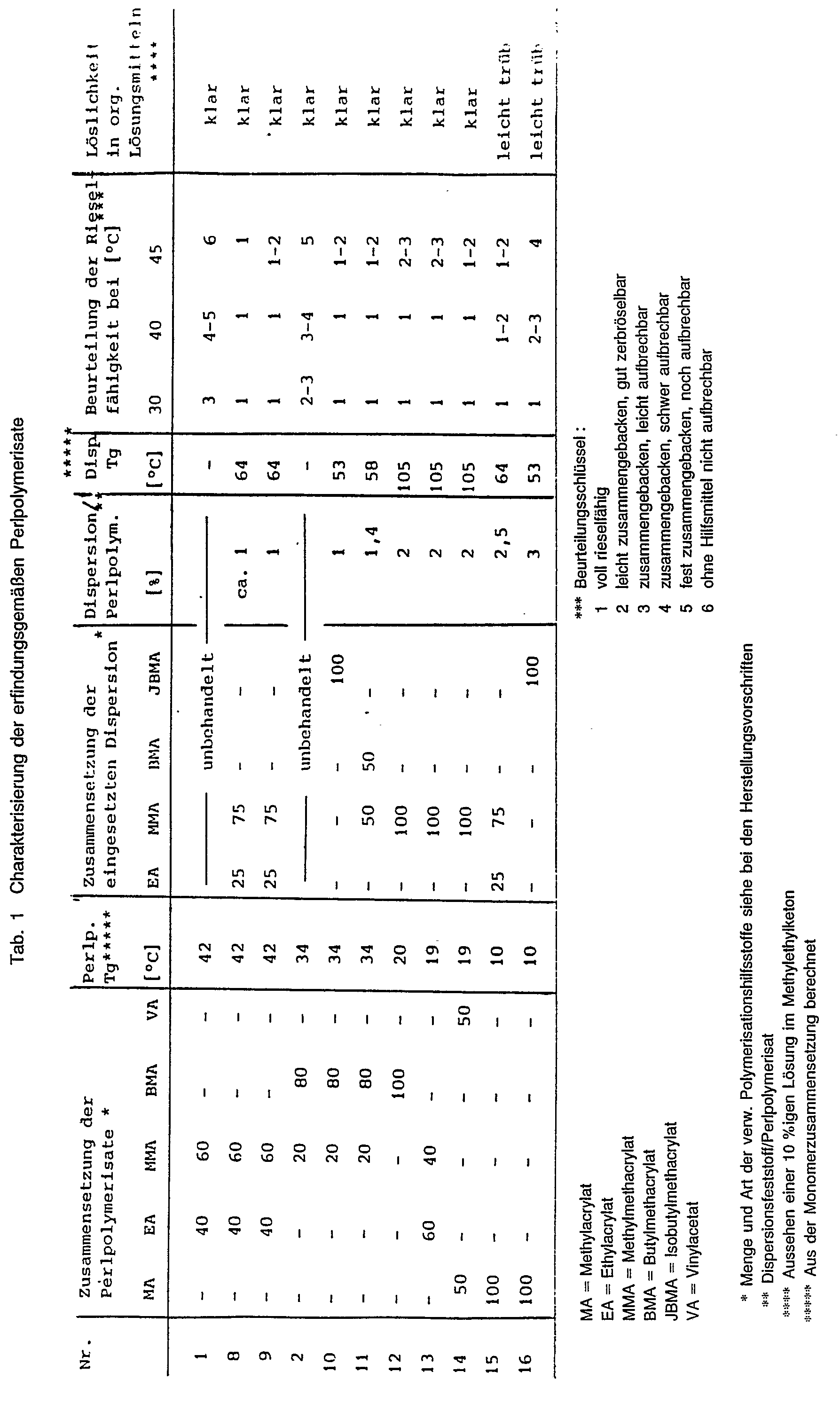
- Als Ansatzpunkt für die Optimierung der einzusetzenden Dispersionen wird erfindungsgemäß davon ausgegangen, daß die Dispersion wenigstens eine um 10 Grad C höhere Glastemperatur aufweise als die damit behandelte Perle. In der Regel wird die Glastemperatur der Dispersion die des Perlpolymerisats jedoch um mehr als 20 Grad C übertreffen. (Vgl. hierzu die in Tab. 1 genannten Beispiele).
- Eine niedrigere Differenz in der Glastemperatur zwischen Perlpolymerisat und Dispersion gestattet im allgemeinen den Einsatz von sehr gut miteinander verträglichen Polymeren, eine sehr gute Differenz in der Glastemperatur bewirkt andererseits einen ausgezeichneten Schutz gegen ein Verklumpen der Teilchen. Man wird daher die Dispersionszusammensetzung entsprechend den anwendungstechnischen Erfordernissen auswählen.
- Die Herstellung der Acrylatdispersionen kann in an sich bekannter Weise erfolgen. Dabei kann vorteilhaft nach dem Emulsions- oder Monomerzulaufverfahren gearbeitet werden, wobei ein Teil des Wassers sowie die Gesamtmenge oder Anteile des Initiators und des Emulgators vorgelegt werden. Die Teilchengröße läßt sich bei diesen Verfahren mit Vorteil durch die Menge des vorgelegten Emulgators steuern. Als Emulgatoren sind vor allem anionische und nichtionische Tenside, daneben aber auch kationische Tenside verwendbar. Im allgemeinen wird die verwendete Emulgatormenge - bezogen auf das Polymerisat - 3 Gew.-%, vorzugsweise 1 Gew.-%, nicht überschreiten.
- Als Initiator können neben den in der Emulsionspolymerisation üblichen Verbindung, wie z. B. Perverbindungen wie Wasserstoffperoxid, Ammoniumperoxidisulfat (APS) auch Redoxsysteme wie Bisulfit-APS-Eisen sowie Azo-Starter verwendet werden. Die Initiatormenge liegt im allgemeinen bei 0,005 bis 0,5 Gew.-%, bezogen auf das Polymerisat.
- Die Polymerisationstemperatur richtet sich innerhalb gewisser Grenzen nach den Initiatoren. So arbeitet man bei Anwendung von APS vorteilhaft im Bereich von 60-90 °C. Bei Einsatz von Redoxsystemen kann auch bei tieferen Temperaturen, beispielsweise bei 30 °C polymerisiert werden. Neben der Zulaufpolymerisation kann auch nach dem Verfahren der Batch-Polymerisation gearbeitet werden. Dabei wird die Gesamtmenge bzw. ein Anteil der Monomeren mit allen Hilfsstoffen vorgelegt und die Polymerisation mit Hilfe von Redox-Initiatoren gestartet. Das Monomer-Wasser-Verhältnis muß dabei der freiwerdenden Reaktionswärme angepaßt werden. In der Regel treten keine Schwierigkeiten auf, wenn man eine 50 %ige Emulsion so erzeugt, daß man zunächst die Hälfte der Monomeren und der Hilfsstoffe in der Gesamtmenge des Wassers emulgiert und dann bei Raumtemperatur die Polymerisation auslöst und nach erfolgter Reaktion den Ansatz abkühlt und die verbleibende Hälfte der Monomeren zusammen mit den Hilfsstoffen zusetzt.
- Besonders vorteilhaft gestaltet sich die Verwendung von säurelabilen Emulgatoren (z. B. Natriumsalze langkettiger Carbonsäuren), da die so hergestellte Dispersion einfach auf die Perloberfläche ausgefällt werden kann. Weniger vorteilhaft erscheint dagegen die Verwendung von Dispersionen, die mit großen Mengen an nichtionischen Emulgatoren (z. B. 5 %), elektrolytbeständig ausgerüstet sind.
- Dispersionen, die den genannten Anforderungen genügen, sind z. B. in den Beispielen 3 bis 7 aufgeführt.
- Das Aufbringen der Dispersion kann prinzipiell auf den unterschiedlichsten Wegen erfolgen. So besteht z. B. eine Form der Aufbringung darin, daß man die - gegebenenfalls erst bei erhöhter Temperatur - filmbildende Dispersion in einem Wirbelschichttrockner auf bereits gewaschenen Perlen aufbringt.
- Ein anderes Verfahren ist darin zu sehen, daß man die Dispersion mit dem Waschwasser auf die Perlen aufbringt. Ein weiteres Verfahren besteht darin, daß man die Dispersion durch Fällung, z. B. mit Salzen oder durch Zusatz von Säure auf die Perlen aufbringt.
- Ein besonders vorteilhaftes Verfahren ist darin zu sehen, daß die Dispersionen direkt nach Beendigung der Perlpolymerisation der Perlsuspension zugesetzt werden. In diesem Falle läßt sich z. B. bei Verwendung eines anorganischen Verteilers die Zerstörung des Verteilersystems mit dem Ausfällen der Dispersion auf der Perloberfläche verbinden. Außerdem gewährt die Dispersion auf diesem Wege schon in einem sehr frühen Stadium Schutz gegen ein Verklumpen der Perlen.
- Die nachfolgenden Beispiele dienen der Erläuterung der Erfindung. Während in den Beispielen 1 und 2 nicht blockfest ausgerüstete Vergleichsversuche aufgezeigt werden, wird in den Beispielen 3-7 die Herstellung von Polymerdispersionen beschrieben, in den Versuchen 8-16 schließlich wird die Herstellung der erfindungsgemäßen Perlen beschrieben. Abb. 1 zeigt anschaulich, wie gerade die Rieselfähigkeit eines erfindungsgemäßen Perlpolymerisats gegenüber einem herkömmlichen Polymerisat verbessert wird.
- In einem 2 I-Polymerisationsgefäß, ausgestattet mit Rührer, Rückflußkühler und Thermometer, wird eine Lösung aus 7 g Aluminiumsulfat. 14 H20 in 1 000 g destilliertem Wasser vorgelegt und auf 75 Grad C erwärmt. Durch Zugabe von 3 g Soda, gelöst in 30 g Wasser, wird Aluminiumhydroxid erzeugt, das als Verteiler wirkt. Im Anschluß daran werden noch 0,12 des Natriumsalzes einer C14-C16-Alkyisulfonsäure sowie 0,12 g Polyethylenoxid (Molekulargewicht: 5 000-6 000) in Form einer 20 %igen Lösung in Wasser zugesetzt.
- Zu dieser Wasserphase gibt man unter kräftigem Rühren eine Monomermischung, hergestellt aus
-

- Man verfährt wie in Beispiel 1, ändert jedoch die Zusammensetzung der Monomerphase :

- Unter den in Beispiel 1 genannten Vorsichtsmaßnahmen erhält man ein Perlpolymerisat, das nur bei Temperaturen < 25 °C rieselfähig ist. Zur Beurteilung der Rieselfähigkeit bei erhöhter Lagertemperatur siehe Tab. 1.
- In einem Witt'schen Topf mit Rückflußkühler, Thermometer, Rührer und Zulaufgefäß wird eine Lösung von
-


- In einem Witt'schen Topf mit Rückflußkühler, Thermometer und Zulaufgefäß wird eine Lösung von
-

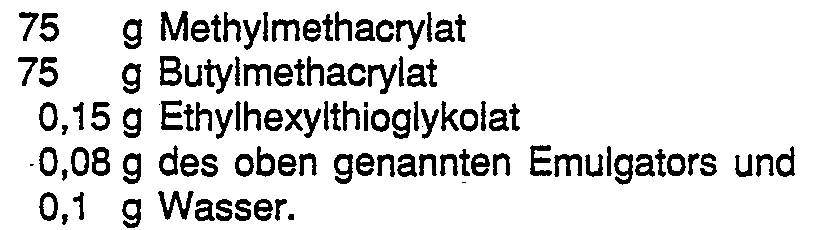
- Im Anschluß daran tropft man ebenfalls bei 80 °C innerhalb von 210 Minuten eine Monomerulgatormischung zu, bestehend aus :

- Nach Beendigung des Zulaufs wird noch 2 Stunden bei 80 °C gerührt. Nach Abkühlen auf imtemperatur wird filtriert.
- Es resultiert eine grobteilige Dispersion :

- Man verfährt wie in Beispiel 3, ändert jedoch die Menge und Art der Hilfsstoffe :
- Vorlage :
- 1,8 g Natriumsalz der 4,4'-Azobis-(4-cyanovaleriansäure)
- 3,6 g Natriumlaurat
- 400 g destilliertes Wasser
- Emulsionszulauf :
- 2 400 g Isobutylmethacrylat
- 5 g Ethylhexylthioglykolat
- 5 g Natriumsalz der 4,4'-Azobis-(4-cyanovaleriansäure)
- 32 g Natriumlaurat
- 3 260 g destilliertes Wasser
- Es resultiert eine gut filtrierbare Dispersion :

- Man verfährt wie in Beispiel 3, ändert jedoch die Menge und die Art der Monomeren und der Hilfsstoffe.
- Vorlage :

- Emulsionszulauf :

- Es resultiert eine gut filtrierbare Dispersion :

- Man verfährt wie in Beispiel 6, ändert jedoch die Monomerzusammensetzung und die Menge des Reglers :
- 4 000 g Methylmethacrylat (anstelle der Mischung aus Ethylacrylat und Methylmethacrylat) 3 g Ethylhexylthioglykolat (statt 6 g in Beispiel 6)
- Man erhält eine gut filtrierbare Dispersion :

- 100 g der gemäß Beispiel 1 hergestellten, bereits zweimal mit destilliertem Wasser gewaschenen, jedoch noch nicht getrockneten Perlen werden in ca. 100 ml einer 10% igen Dispersion (hergestellt aus 20 g Dispersion gemäß Beispiel 6 und 80 g destilliertes Wasser) aufgeschlämmt und etwa 5 Minuten gerührt. Anschließend wird die Dispersion abgenutscht oder abgeschleudert.
- Danach wird das Perlpolymerisat im Wirbelschichttrockner getrocknet.
- Man erhält ein im Vergleich zum unbehandelten Perlpolymerisat in der Blockfestigkeit deutlich verbessertes Produkt. (Siehe Abb. 1 und Tab. 1).
- Das Filtrat, das den größten Teil der Dispersion unverändert enthält, kann zur Konfektionierung weiterer Chargen Perlpolymerisat verwendet werden. Dabei empfiehlt es sich jedoch in gewissen Abständen die mit den Perlen ausgetragenen Dispersionsverluste durch Zugabe von Dispersion gemäß Beispiel 6 zu ersetzen.
- Man wiederholt den Ansatz gemäß Beispiel 1 :
- 3 Stunden Polymerisation bei 75 °C, anschließend
- 1 Stunde Nacherhitzen bei 85 °C.
- Danach wird jedoch durch folgende Maßnahmen konfektioniert :
- Der Reaktionsansatz wird auf ca. 40 °C gekühlt, bei dieser Temperatur werden 10 g Dispersion gemäß Beispiel 6 verdünnt mit 30 g destilliertem Wasser zugesetzt. Nach etwa 5 Minuten Rühren bei 40 °C setzt man zur Zerstörung des anorganischen Verteilers und zum Ausfällen der Dispersion 30 g 10 %ige Schwefelsäure zu. Man rührt noch ca. 15 Minuten bei 40 °C, kühlt anschließend auf Raumtemperatur und saugt ab.
- (Filtrat : völlig klar.)
- Die Perlen werden noch zweimal mit 500 ml destilliertem Wasser gewaschen und anschließend bei Raumtemperatur getrocknet.
- Man erhält ein gut rieselfähiges Produkt, das auch bei erhöhter Lagertemperatur nicht verklumpt. (Siehe Tab. 1).
- Man wiederholt den Polymerisationsansatz gemäß Beispiel 2 :
- 3 Stunden Polymerisation bei 75 °C, anschließend Nacherhitzen bei 85 °C. Danach wird jedoch durch Zugabe von Dispersion konfektioniert:
- Man kühlt den Reaktionsansatz auf 65 °C ab, gibt 12,5 g Dispersion gemäß Beispiel 3 (verdünnt mit der 3-fachen Menge an destilliertem Wasser) hinzu, säuert mit 2,5 g 50 %iger Schwefelsäure an und rührt darauf 10 Minuten bei 65 °C. Anschließend wird auf 30 °C abgekühlt, zweimal mit je 500 ml destilliertem Wasser gewaschen und danach im Wirbelschichttrockner bei 50 °C getrocknet.
- Man erhält ein gut rieselfähiges Pulver, das auch bei einer Lagertemperatur > Raumtemoeratur nicht verklumpt. (Siehe Tab. 1).
- Man verfährt wie in Beispiel 10, verwendet jedoch zur Konfektionierung die relativ grobteilige, emulgatorarme Dispersion gemäß Beispiel 4..
- Menge der zugesetzten Dispersion : 12 g (= 7,2 g Dispersionsfeststoff).
- Die Dispersion wird mit der 3-fachen Menge an destilliertem Wasser verdünnt und bei 65 °C zugegeben. Anschließend wird mit 30 g einer 12 %igen Schwefelsäure angesäuert und noch 10 Minuten bei 65 °C gerührt. Nach Abkühlen, Abnutschen, Waschen und Trocknen wie in Beispiel 10 beschrieben, erhält man ein gut rieselfähiges Perlpolymerisat, das auch bei einer Lagertemperatur von 40 °C nicht verklumpt.
- Man verfährt wie in Beispiel 1, wählt jedoch eine andere Zusammensetzung der Monomerphase :

- Man polymerisiert 3 Stunden bei 75 °C und rührt anschließend noch 1 Stunde bei 85 °C. Danach kühlt man auf 30 °C und setzt 20 g Dispersion gemäß Beispiel 7 zu.
- Die Dispersion wird vor der Zugabe mit 40 g destilliertem Wasser verdünnt. Nach Ansäuern mit 50 g 12 %iger Schwefelsäure wird noch 15 Minuten bei 30 °C gerührt, anschließend wird auf 20 °C abgekühlt, abgesaugt, zweimal mit jeweils 500 ml destilliertem Wasser gewaschen und im Wirbelschichttrockner getrocknet. Man erhält gut rieselfähige Perlen, die auch bei erhöhter Lagertemperatur (45 °C) nicht verklumpen. (Siehe Tab. 1).
- Man verfährt wie in Beispiel 12, wählt jedoch eine andere Zusammensetzung der Monomerphase :

- Die Konfektionierung wird wie in Beispiel 12 durch Zugabe von 20 g Dispersion gemäß Beispiel 7 durchgeführt.
- Man erhält gut rieselfähige Perlen, die auch bei erhöhter Lagertemperatur (40 °C) nicht verklumpen. (Siehe Tab. 1).
- In einem 2 I-Polymerisationsgefäß, ausgestattet mit Rührer, Rückflußkühler und Thermometer, wird eine Lösung aus 7 g Aluminiumsulfat. 14 H20 in 1 000 g destilliertem Wasser vorgelegt und auf 75 °C erwärmt. Durch Zugabe von ca. 3,3 g Soda (gelöst in 30 g Wasser) wird ein pH-Wert von 5,8 eingestellt. Danach werden 0,12 des Natriumsalzes einer C14-C16-Alkylsulfonsäure sowie 0,12 eines Polyethylenoxids (Molekylargewicht 5 000-6 000) zugesetzt.
- Zu dieser Wasserphase gibt man unter kräftigem Rühren eine Monomermischung, hergestellt aus :

- Man polymerisiert 2 Stunden bei einer Badtemperatur von 72 °C, anschließend wird auf 25 °C gekühlt. Nach Zugabe von 16 der Dispersion gemäß Beispiel 7 (verdünnt mit 50 g Wasser) und anschließend 30 g 10 %ige Schwefelsäure wird noch 10 Minuten bei 25 °C gerührt. Nach Abkühlen auf 20 °C läßt man die Perlen absitzen, schlämmt in 2 I destilliertem Wasser auf, dekantiert, schlämmt nochmals mit 2 destilliertem Wasser auf und saugt das Produkt ab. Anschließend wird noch einmal mit 500 ml destilliertem Wasser gewaschen.
- Nach Trocknung bei Raumtemperatur resultiert ein gut rieselfähiges Perlpolymerisat. (Siehe Tab. 1).
- In einem 2 I-Polymerisationsgefäß wird die Wasserphase - wie in Beispiel 1 beschrieben - hergestellt. Dazu gibt man unter kräftigem Rühren eine Monomerphase hergestellt aus :

- Man polymerisiert bei ca. 70 °C. Bereits nach 10 Minuten steigt die Innentemperatur aufgrund der heftigen Reaktion auf über 80 °C. Anschließend hält man die Innentemperatur noch 90 Minuten bei 80 °C. Danach wird auf 25 °C abgekühlt.
- Nach Zugabe von 20 g Dispersion gemäß Beispiel 7 (1 : 1 verdünnt mit Wasser) wird mit 30 g 10 %iger Schwefelsäure angesäuert und anschließend 15 Minuten bei 25 °C gerührt. Danach verdünnt man mit 500 g destilliertem Wasser, kühlt auf 20 °C, saugt das Perlpolymerisat ab und wäscht zweimal mit 500 ml destilliertem Wasser.
- Nach Trocknung bei Raumtemperatur erhält man ein gut rieselfähiges Perlpolymerisat.
- Man wiederholt den Ansatz gemäß Beispiel 15, verwendet zur Konfektionierung 30 g der Dispersion gemäß Beispiel 5. Nach Trocknung bei Raumtemperatur erhält man ein gut rieselfähiges Perlpolymerisat.
- Die Ergebnisse der Versuche sind in der folgenden Tabelle 1 wiedergegeben. Abb. 1 stellt das Verhalten des erfindungsgemäßen Perlpolymerisats gemäß Beispiel 8 unter Stapeldruckbelastung im Vergleich mit dem entsprechenden unbehandelten Perlpolymerisat gemäß Beispiel 1 dar.
- Dabei wird der Bewertungsschlüssel (« Note ») gemäß Tabelle 1 angewendet, d. h. 1 = voll rieselfähig usw. bis 6 = ohne Hilfsmittel nicht aufbrechbar.
Claims (6)
Applications Claiming Priority (2)
| Application Number | Priority Date | Filing Date | Title |
|---|---|---|---|
| DE3150730 | 1981-12-22 | ||
| DE19813150730 DE3150730A1 (de) | 1981-12-22 | 1981-12-22 | Verfahren zur herstellung blockfester, weicher polymerperlen |
Publications (2)
| Publication Number | Publication Date |
|---|---|
| EP0082455A1 EP0082455A1 (de) | 1983-06-29 |
| EP0082455B1 true EP0082455B1 (de) | 1989-11-02 |
Family
ID=6149383
Family Applications (1)
| Application Number | Title | Priority Date | Filing Date |
|---|---|---|---|
| EP82111551A Expired EP0082455B1 (de) | 1981-12-22 | 1982-12-13 | Verfahren zur Herstellung blockfester, weicher Polymerperlen |
Country Status (5)
| Country | Link |
|---|---|
| US (1) | US4463032A (de) |
| EP (1) | EP0082455B1 (de) |
| JP (1) | JPS58109503A (de) |
| CA (1) | CA1192092A (de) |
| DE (2) | DE3150730A1 (de) |
Families Citing this family (16)
| Publication number | Priority date | Publication date | Assignee | Title |
|---|---|---|---|---|
| JPS6067543A (ja) * | 1983-09-21 | 1985-04-17 | Sumitomo Chem Co Ltd | 発泡成形用粒状ポリオレフィン材料 |
| DE3418524A1 (de) * | 1984-05-18 | 1985-11-21 | Basf Ag, 6700 Ludwigshafen | Verfahren zur herstellung von lackbindemitteln und deren verwendung |
| JP2728910B2 (ja) * | 1988-12-27 | 1998-03-18 | 三井東圧化学株式会社 | 小孔を有する合成樹脂粒子の製造法 |
| GB9108219D0 (en) * | 1991-04-18 | 1991-06-05 | Ici America Inc | Anti-blocking suspension of polymers |
| AU2002342647A1 (en) | 2001-09-28 | 2003-04-14 | Basf Corporation | Anti-lumping compounds for use with expandable polystyrenes |
| US7208121B2 (en) * | 2001-12-06 | 2007-04-24 | Auburn University | Plasticizer-free-ion-detective sensors |
| US7201876B2 (en) * | 2002-03-11 | 2007-04-10 | Auburn University | Ion-detecting sensors comprising plasticizer-free copolymers |
| US7247489B2 (en) * | 2002-03-11 | 2007-07-24 | Auburn University | Ion-detecting microspheres and methods of use thereof |
| TWI339210B (en) * | 2003-02-25 | 2011-03-21 | Kaneka Corp | Polymer particle composition and process for producing the same |
| US6995122B2 (en) | 2003-05-20 | 2006-02-07 | International Flavors & Fragrances Inc. | Method for imparting substantive fragrance and, optionally, anti-static properties to fabrics during washing and/or drying procedure and compositions useful for effecting such processes |
| JP4567000B2 (ja) * | 2003-05-28 | 2010-10-20 | オーバーン ユニバーシティ | 可塑剤フリーのコポリマーを含むイオン検出センサー |
| US7381753B2 (en) * | 2004-06-29 | 2008-06-03 | Lexmark International, Inc. | Inkjet ink composition |
| EP2655443A1 (de) | 2010-12-20 | 2013-10-30 | DSM IP Assets B.V. | Biologisch erneuerbare vinylkügelchen |
| US20150005442A1 (en) | 2012-02-03 | 2015-01-01 | Dsm Ip Assets B.V. | Polymer, process and composition |
| AU2013214126A1 (en) | 2012-02-03 | 2014-08-07 | Dsm Ip Assets B.V. | Use of a polymer composition |
| CN102888004B (zh) * | 2012-10-25 | 2014-07-02 | 博立尔化工(扬州)有限公司 | 一种改善软树脂耐热性的方法 |
Family Cites Families (9)
| Publication number | Priority date | Publication date | Assignee | Title |
|---|---|---|---|---|
| US2448524A (en) * | 1947-11-07 | 1948-09-07 | Du Pont | Coated granular resin and process of making same |
| US3102050A (en) * | 1960-04-21 | 1963-08-27 | Phillips Petroleum Co | Method of coating particulated resinous material by polymerization technique |
| BE789274A (fr) * | 1971-09-28 | 1973-03-26 | Bayer Ag | Enrobage de granules de polymeres ethylene-acetate de vinyle |
| US3911193A (en) * | 1971-09-28 | 1975-10-07 | Bayer Ag | Coated granulates of ethylene/vinyl acetate copolymers |
| US4097553A (en) * | 1977-06-20 | 1978-06-27 | E. I. Du Pont De Nemours And Company | Acrylic graft copolymers blended with acrylic resins |
| JPS5941450B2 (ja) * | 1977-11-04 | 1984-10-06 | エヌオーケー株式会社 | 粒状アクリルエラストマ−の製造方法 |
| JPS597729B2 (ja) * | 1979-03-19 | 1984-02-20 | 鐘淵化学工業株式会社 | 発泡性熱可塑性樹脂粒子の製造法 |
| US4307134A (en) * | 1980-12-22 | 1981-12-22 | Atlantic Richfield Company | Process for producing plasticized elastomer-styrene coated beads |
| US4333970A (en) * | 1980-12-23 | 1982-06-08 | Atlantic Richfield Company | Process for producing coated beads with macromonomer-styrene polymerizate coating |
-
1981
- 1981-12-22 DE DE19813150730 patent/DE3150730A1/de active Granted
-
1982
- 1982-12-09 US US06/448,406 patent/US4463032A/en not_active Expired - Lifetime
- 1982-12-13 EP EP82111551A patent/EP0082455B1/de not_active Expired
- 1982-12-13 DE DE8282111551T patent/DE3280006D1/de not_active Expired
- 1982-12-16 CA CA000417891A patent/CA1192092A/en not_active Expired
- 1982-12-21 JP JP57223134A patent/JPS58109503A/ja active Granted
Non-Patent Citations (2)
| Title |
|---|
| B. Vollmert:"Grundriss der makromolekularen Chemie",Teil 1, E. Vollmert-Verlag, Karlsruhe, 1980, Seiten 180, 181 * |
| G. Gnauck, P. Fründt:"Leichtverständliche Einführung in die Kunststoffchemie",Carl Hanser Verlag, München, Wien, 1979, Seite 23 * |
Also Published As
| Publication number | Publication date |
|---|---|
| DE3150730A1 (de) | 1983-06-30 |
| DE3280006D1 (en) | 1989-12-07 |
| JPH0463890B2 (de) | 1992-10-13 |
| EP0082455A1 (de) | 1983-06-29 |
| CA1192092A (en) | 1985-08-20 |
| US4463032A (en) | 1984-07-31 |
| DE3150730C2 (de) | 1990-08-02 |
| JPS58109503A (ja) | 1983-06-29 |
Similar Documents
| Publication | Publication Date | Title |
|---|---|---|
| DE68907521T2 (de) | Mehrstufige opazifierende Polymerpartikel mit absorbierter nichtpolymerisierbarer Säure. | |
| EP0376096B1 (de) | Mehrphasige, wässrige Kunststoffdispersion und ihre Verwendung in Überzugsmitteln | |
| DE3785995T2 (de) | Dispersionen von Kern-Schale-Teilchen. | |
| DE69403436T2 (de) | Verfahren zur herstellung von emulsionspolymeren mit hohler struktur | |
| EP0203487B1 (de) | Verträgliche Polymermischungen | |
| DE69504650T3 (de) | Verfahren zur herstellung von wässrigen polymer-zusammensetzungen | |
| EP0379892B1 (de) | Bindemittel für wässrige Glanzfarben | |
| DE3150730C2 (de) | ||
| EP0381029B1 (de) | Wässrige Polyacrylat-Systeme für Lackierung von Kunststoffoberflächen | |
| AT397251B (de) | Sequenz-erzeugte polymerteilchen, wässrige dispersionen von sequenz-erzeugten polymerteilchen, verfahren zur herstellung von sequenz-erzeugten polymerteilchen und verwendung von sequenz-erzeugten polymerteilchen | |
| DE1932395B2 (de) | Verwendung eines wäßrigen Latex eines Additionspolymerisats zum Überziehen eines Substrats | |
| DE69512070T2 (de) | Verfahren zur Herstellung von wärmehärtenden Harzteilchen | |
| DE3329765C2 (de) | Verfahren zur Herstellung schlagzäher Formmassen auf Acrylatbasis durch zweistufige Polymerisation | |
| DE2059078A1 (de) | Verfahren zur Herstellung eines Blaeschen aufweisenden Polymeren | |
| DE69421087T2 (de) | Waessrige polymerdispersion, verfahren zu seiner herstellung und seine verwendung zur lackformulierung | |
| EP0381030B1 (de) | Wässriges Polyacrylat-System für die Schlusslackierung von Polyvinylchlorid-Oberflächen | |
| EP0590468B1 (de) | Verfahren zur Verringerung des Restmonomerengehaltes bei der Herstellung von Perlpolymerisaten | |
| DE3308925A1 (de) | Verfahren zur herstellung lagerstabiler plastisole und organosole | |
| DE3333503A1 (de) | In benzin gelbildende verdickungs- und bindemittel | |
| DE3783723T2 (de) | Ueberzugszusammensetzungen mit hohem feststoffgehalt. | |
| EP1049737B1 (de) | Verfahren zum fällen von mikrosuspensionspolymerisaten | |
| EP0661306B1 (de) | Polymerdispersionen | |
| DE4405208A1 (de) | Polymerdispersion | |
| DE69505845T2 (de) | Wässrige polymerisatemulsionen | |
| EP0059262A1 (de) | Verfahren zur Herstellung eines vollständig löslichen Emulsionspolymerisats |
Legal Events
| Date | Code | Title | Description |
|---|---|---|---|
| PUAI | Public reference made under article 153(3) epc to a published international application that has entered the european phase |
Free format text: ORIGINAL CODE: 0009012 |
|
| AK | Designated contracting states |
Designated state(s): DE FR GB IT NL |
|
| 17P | Request for examination filed |
Effective date: 19831224 |
|
| GRAA | (expected) grant |
Free format text: ORIGINAL CODE: 0009210 |
|
| AK | Designated contracting states |
Kind code of ref document: B1 Designated state(s): DE FR GB IT NL |
|
| ITF | It: translation for a ep patent filed | ||
| REF | Corresponds to: |
Ref document number: 3280006 Country of ref document: DE Date of ref document: 19891207 |
|
| ET | Fr: translation filed | ||
| GBT | Gb: translation of ep patent filed (gb section 77(6)(a)/1977) | ||
| PLBE | No opposition filed within time limit |
Free format text: ORIGINAL CODE: 0009261 |
|
| STAA | Information on the status of an ep patent application or granted ep patent |
Free format text: STATUS: NO OPPOSITION FILED WITHIN TIME LIMIT |
|
| 26N | No opposition filed | ||
| PGFP | Annual fee paid to national office [announced via postgrant information from national office to epo] |
Ref country code: DE Payment date: 19901203 Year of fee payment: 9 |
|
| PG25 | Lapsed in a contracting state [announced via postgrant information from national office to epo] |
Ref country code: DE Effective date: 19920901 |
|
| ITTA | It: last paid annual fee | ||
| NLT1 | Nl: modifications of names registered in virtue of documents presented to the patent office pursuant to art. 16 a, paragraph 1 |
Owner name: ROEHM GMBH & CO. KG |
|
| REG | Reference to a national code |
Ref country code: FR Ref legal event code: CJ |
|
| PGFP | Annual fee paid to national office [announced via postgrant information from national office to epo] |
Ref country code: GB Payment date: 20011206 Year of fee payment: 20 |
|
| PGFP | Annual fee paid to national office [announced via postgrant information from national office to epo] |
Ref country code: FR Payment date: 20011218 Year of fee payment: 20 |
|
| PGFP | Annual fee paid to national office [announced via postgrant information from national office to epo] |
Ref country code: NL Payment date: 20011221 Year of fee payment: 20 |
|
| REG | Reference to a national code |
Ref country code: GB Ref legal event code: IF02 |
|
| PG25 | Lapsed in a contracting state [announced via postgrant information from national office to epo] |
Ref country code: GB Free format text: LAPSE BECAUSE OF EXPIRATION OF PROTECTION Effective date: 20021212 |
|
| PG25 | Lapsed in a contracting state [announced via postgrant information from national office to epo] |
Ref country code: NL Free format text: LAPSE BECAUSE OF EXPIRATION OF PROTECTION Effective date: 20021213 |
|
| REG | Reference to a national code |
Ref country code: GB Ref legal event code: PE20 Effective date: 20021212 |
|
| NLV7 | Nl: ceased due to reaching the maximum lifetime of a patent |
Effective date: 20021213 |