EP0082401A1 - Verfahren zur Herstellung von überwiegend das Z-Isomere enthaltendem Rosenoxid - Google Patents
Verfahren zur Herstellung von überwiegend das Z-Isomere enthaltendem Rosenoxid Download PDFInfo
- Publication number
- EP0082401A1 EP0082401A1 EP82111294A EP82111294A EP0082401A1 EP 0082401 A1 EP0082401 A1 EP 0082401A1 EP 82111294 A EP82111294 A EP 82111294A EP 82111294 A EP82111294 A EP 82111294A EP 0082401 A1 EP0082401 A1 EP 0082401A1
- Authority
- EP
- European Patent Office
- Prior art keywords
- methyl
- isomer
- rose oxide
- tetrahydropyran
- prop
- Prior art date
- Legal status (The legal status is an assumption and is not a legal conclusion. Google has not performed a legal analysis and makes no representation as to the accuracy of the status listed.)
- Granted
Links
- 238000000034 method Methods 0.000 title claims abstract description 17
- 238000002360 preparation method Methods 0.000 title claims abstract description 4
- 239000003054 catalyst Substances 0.000 claims abstract description 18
- 230000002378 acidificating effect Effects 0.000 claims abstract description 9
- JRIATCFPZFOVNP-UHFFFAOYSA-N 4-methylidene-2-(2-methylprop-1-enyl)oxane Chemical compound CC(C)=CC1CC(=C)CCO1 JRIATCFPZFOVNP-UHFFFAOYSA-N 0.000 claims abstract description 7
- 150000001768 cations Chemical class 0.000 claims abstract description 7
- 239000000203 mixture Substances 0.000 claims abstract description 7
- YKIOKAURTKXMSB-UHFFFAOYSA-N adams's catalyst Chemical compound O=[Pt]=O YKIOKAURTKXMSB-UHFFFAOYSA-N 0.000 claims abstract description 3
- SYSQUGFVNFXIIT-UHFFFAOYSA-N n-[4-(1,3-benzoxazol-2-yl)phenyl]-4-nitrobenzenesulfonamide Chemical class C1=CC([N+](=O)[O-])=CC=C1S(=O)(=O)NC1=CC=C(C=2OC3=CC=CC=C3N=2)C=C1 SYSQUGFVNFXIIT-UHFFFAOYSA-N 0.000 claims abstract 2
- BASFCYQUMIYNBI-UHFFFAOYSA-N platinum Chemical compound [Pt] BASFCYQUMIYNBI-UHFFFAOYSA-N 0.000 claims description 7
- CZCBTSFUTPZVKJ-UHFFFAOYSA-N rose oxide Chemical compound CC1CCOC(C=C(C)C)C1 CZCBTSFUTPZVKJ-UHFFFAOYSA-N 0.000 abstract description 23
- 229930007790 rose oxide Natural products 0.000 abstract description 12
- 239000003205 fragrance Substances 0.000 abstract description 3
- DSVGQVZAZSZEEX-UHFFFAOYSA-N [C].[Pt] Chemical compound [C].[Pt] DSVGQVZAZSZEEX-UHFFFAOYSA-N 0.000 abstract 1
- 229910052739 hydrogen Inorganic materials 0.000 description 13
- 239000001257 hydrogen Substances 0.000 description 13
- UFHFLCQGNIYNRP-UHFFFAOYSA-N Hydrogen Chemical compound [H][H] UFHFLCQGNIYNRP-UHFFFAOYSA-N 0.000 description 12
- 238000005984 hydrogenation reaction Methods 0.000 description 12
- 239000000047 product Substances 0.000 description 10
- 150000002500 ions Chemical class 0.000 description 9
- RTZKZFJDLAIYFH-UHFFFAOYSA-N Diethyl ether Chemical compound CCOCC RTZKZFJDLAIYFH-UHFFFAOYSA-N 0.000 description 6
- 238000002474 experimental method Methods 0.000 description 6
- BZLVMXJERCGZMT-UHFFFAOYSA-N Methyl tert-butyl ether Chemical compound COC(C)(C)C BZLVMXJERCGZMT-UHFFFAOYSA-N 0.000 description 4
- 238000006243 chemical reaction Methods 0.000 description 4
- 238000004821 distillation Methods 0.000 description 4
- 238000004817 gas chromatography Methods 0.000 description 4
- 239000002904 solvent Substances 0.000 description 4
- JOXIMZWYDAKGHI-UHFFFAOYSA-N toluene-4-sulfonic acid Chemical compound CC1=CC=C(S(O)(=O)=O)C=C1 JOXIMZWYDAKGHI-UHFFFAOYSA-N 0.000 description 4
- 229920002125 Sokalan® Polymers 0.000 description 3
- 229920001429 chelating resin Polymers 0.000 description 3
- 238000006317 isomerization reaction Methods 0.000 description 3
- 238000003756 stirring Methods 0.000 description 3
- SEPQTYODOKLVSB-UHFFFAOYSA-N 3-methylbut-2-enal Chemical compound CC(C)=CC=O SEPQTYODOKLVSB-UHFFFAOYSA-N 0.000 description 2
- KZMGYPLQYOPHEL-UHFFFAOYSA-N Boron trifluoride etherate Chemical compound FB(F)F.CCOCC KZMGYPLQYOPHEL-UHFFFAOYSA-N 0.000 description 2
- 101100522123 Caenorhabditis elegans ptc-1 gene Proteins 0.000 description 2
- 238000005481 NMR spectroscopy Methods 0.000 description 2
- NBIIXXVUZAFLBC-UHFFFAOYSA-N Phosphoric acid Chemical compound OP(O)(O)=O NBIIXXVUZAFLBC-UHFFFAOYSA-N 0.000 description 2
- QAOWNCQODCNURD-UHFFFAOYSA-N Sulfuric acid Chemical compound OS(O)(=O)=O QAOWNCQODCNURD-UHFFFAOYSA-N 0.000 description 2
- WYURNTSHIVDZCO-UHFFFAOYSA-N Tetrahydrofuran Chemical compound C1CCOC1 WYURNTSHIVDZCO-UHFFFAOYSA-N 0.000 description 2
- 230000000052 comparative effect Effects 0.000 description 2
- 238000004519 manufacturing process Methods 0.000 description 2
- 229920005989 resin Polymers 0.000 description 2
- 239000011347 resin Substances 0.000 description 2
- 239000007858 starting material Substances 0.000 description 2
- WHOZNOZYMBRCBL-OUKQBFOZSA-N (2E)-2-Tetradecenal Chemical compound CCCCCCCCCCC\C=C\C=O WHOZNOZYMBRCBL-OUKQBFOZSA-N 0.000 description 1
- YZUPZGFPHUVJKC-UHFFFAOYSA-N 1-bromo-2-methoxyethane Chemical compound COCCBr YZUPZGFPHUVJKC-UHFFFAOYSA-N 0.000 description 1
- OKTJSMMVPCPJKN-UHFFFAOYSA-N Carbon Chemical group [C] OKTJSMMVPCPJKN-UHFFFAOYSA-N 0.000 description 1
- XDTMQSROBMDMFD-UHFFFAOYSA-N Cyclohexane Chemical compound C1CCCCC1 XDTMQSROBMDMFD-UHFFFAOYSA-N 0.000 description 1
- 239000002841 Lewis acid Substances 0.000 description 1
- 239000007868 Raney catalyst Substances 0.000 description 1
- NPXOKRUENSOPAO-UHFFFAOYSA-N Raney nickel Chemical compound [Al].[Ni] NPXOKRUENSOPAO-UHFFFAOYSA-N 0.000 description 1
- 229910000564 Raney nickel Inorganic materials 0.000 description 1
- 229910021626 Tin(II) chloride Inorganic materials 0.000 description 1
- 239000002253 acid Substances 0.000 description 1
- 150000007513 acids Chemical class 0.000 description 1
- 125000002015 acyclic group Chemical group 0.000 description 1
- PNEYBMLMFCGWSK-UHFFFAOYSA-N aluminium oxide Inorganic materials [O-2].[O-2].[O-2].[Al+3].[Al+3] PNEYBMLMFCGWSK-UHFFFAOYSA-N 0.000 description 1
- 229910000147 aluminium phosphate Inorganic materials 0.000 description 1
- 238000009835 boiling Methods 0.000 description 1
- 239000007795 chemical reaction product Substances 0.000 description 1
- 239000003795 chemical substances by application Substances 0.000 description 1
- 230000018044 dehydration Effects 0.000 description 1
- 238000006297 dehydration reaction Methods 0.000 description 1
- 238000001914 filtration Methods 0.000 description 1
- 238000004508 fractional distillation Methods 0.000 description 1
- 239000007789 gas Substances 0.000 description 1
- 239000011521 glass Substances 0.000 description 1
- 238000009905 homogeneous catalytic hydrogenation reaction Methods 0.000 description 1
- 150000002431 hydrogen Chemical class 0.000 description 1
- 239000013067 intermediate product Substances 0.000 description 1
- CPJRRXSHAYUTGL-UHFFFAOYSA-N isopentenyl alcohol Chemical compound CC(=C)CCO CPJRRXSHAYUTGL-UHFFFAOYSA-N 0.000 description 1
- 150000007517 lewis acids Chemical class 0.000 description 1
- 239000011159 matrix material Substances 0.000 description 1
- 230000007935 neutral effect Effects 0.000 description 1
- 239000003960 organic solvent Substances 0.000 description 1
- 229940044654 phenolsulfonic acid Drugs 0.000 description 1
- 229920001467 poly(styrenesulfonates) Polymers 0.000 description 1
- 229920000172 poly(styrenesulfonic acid) Polymers 0.000 description 1
- 229920000642 polymer Polymers 0.000 description 1
- 229940005642 polystyrene sulfonic acid Drugs 0.000 description 1
- 125000004309 pyranyl group Chemical group O1C(C=CC=C1)* 0.000 description 1
- 239000011541 reaction mixture Substances 0.000 description 1
- 235000011150 stannous chloride Nutrition 0.000 description 1
- 229920003002 synthetic resin Polymers 0.000 description 1
- 239000000057 synthetic resin Substances 0.000 description 1
- YLQBMQCUIZJEEH-UHFFFAOYSA-N tetrahydrofuran Natural products C=1C=COC=1 YLQBMQCUIZJEEH-UHFFFAOYSA-N 0.000 description 1
- AXZWODMDQAVCJE-UHFFFAOYSA-L tin(II) chloride (anhydrous) Chemical compound [Cl-].[Cl-].[Sn+2] AXZWODMDQAVCJE-UHFFFAOYSA-L 0.000 description 1
Classifications
-
- C—CHEMISTRY; METALLURGY
- C07—ORGANIC CHEMISTRY
- C07D—HETEROCYCLIC COMPOUNDS
- C07D309/00—Heterocyclic compounds containing six-membered rings having one oxygen atom as the only ring hetero atom, not condensed with other rings
- C07D309/02—Heterocyclic compounds containing six-membered rings having one oxygen atom as the only ring hetero atom, not condensed with other rings having no double bonds between ring members or between ring members and non-ring members
- C07D309/04—Heterocyclic compounds containing six-membered rings having one oxygen atom as the only ring hetero atom, not condensed with other rings having no double bonds between ring members or between ring members and non-ring members with only hydrogen atoms, hydrocarbon or substituted hydrocarbon radicals, directly attached to ring carbon atoms
Definitions
- the invention relates to an improved process for the preparation of an isomer mixture of Z- and E-2- [2-methyl-prop-1-en-1-yl] -4-methyl-tetrahydropyran, better known as Z- or E- Rose oxide known that contains at least 85% of the natural Z-isomer, which is more valuable for perfumery.
- II can be reduced in one step to a rose oxide containing at least 85% of the Z isomer if the reduction is carried out in the presence of a PtO 2 or a Pt / C catalyst in the presence of a strongly acidic cation exchanger.
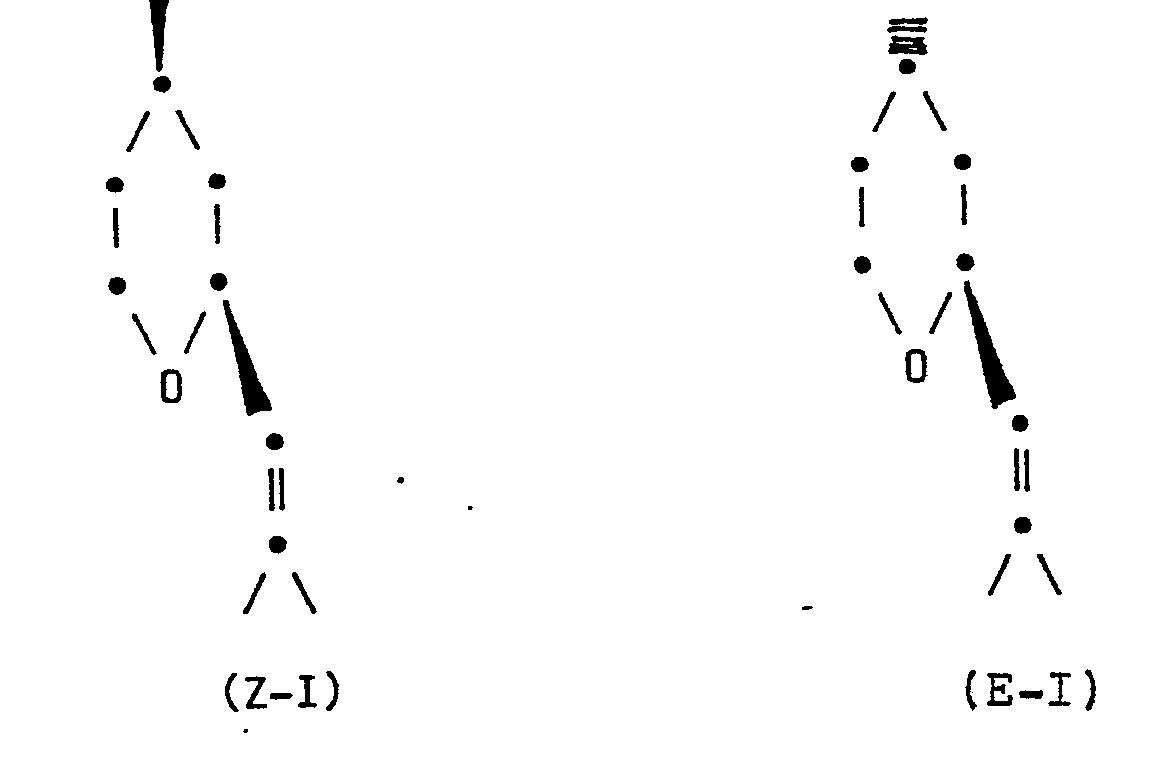
- the application accordingly relates to a process for preparing an isomer mixture of Z- and E-2 - [2-methyl-prop-1-en-1-yl] -4-methyl-tetrahydropyran of the formulas ZI and EI containing at least 85% ZI and at most 15% EI, which is characterized in that 2- [2-methyl-prop-1-ene-1-1-yl] -4-methylene-tetrahydropyran of the formula II hydrogenated on a platinum dioxide or a platinum / carbon catalyst in the presence of a strongly acidic cation exchanger.
- resin ion exchanger that is, high-polymer three-dimensional networks of carbon chains (matrix), which as charged groups (fixed ions) -SO ⁇ 3 groups or -S03- and contain -0 groups.
- Strongly acidic ion exchangers which are also macroporous, such as Lewatit SPC 118 / H or Amberlite 200, are particularly suitable.
- the exchangers were used in dry H ⁇ form.
- the reaction can be carried out either without a solvent or in an inert organic solvent, such as methyl tert-butyl ether, diethyl ether, tetrahydrofuran or cyclohexane.
- an inert organic solvent such as methyl tert-butyl ether, diethyl ether, tetrahydrofuran or cyclohexane.
- the reaction temperatures are generally 20 to 50 ° C, preferably room temperature.
- the hydrogen pressure during the hydrogenation is generally between 0 and 1 bar.
- the dehydrorose oxide II required as a starting compound for the process according to the invention can easily be prepared according to the process described in Tetrahedron Letters 51 (1970), page 4507.
- the starting materials to be used for this, the 3-methyl-2-buten-l-al and the 2-methyl-l-buten-4- 0 1 are commercially available products.
- the process product can be isolated in a simple manner by filtering off the catalyst system and subsequent distillation.
- Both the solvents and the catalyst system can be reused.
- the process product is a particularly valuable fragrance that also occurs in nature.
Landscapes
- Chemical & Material Sciences (AREA)
- Organic Chemistry (AREA)
- Low-Molecular Organic Synthesis Reactions Using Catalysts (AREA)
- Organic Low-Molecular-Weight Compounds And Preparation Thereof (AREA)
- Catalysts (AREA)
- Pyrane Compounds (AREA)
Abstract
Description
- Die Erfindung betrifft ein verbessertes Verfahren zur Herstellung eines Isomerengemisches von Z- und E-2-[2-Methyl--prop-1-en-1-yl]-4-methyl-tetrahydropyran, besser unter dem Namen Z- oder E-Rosenoxid bekannt, das mindestens 85 % des für die Parfümerie wertvolleren natürlichen Z-Isomeren enthält.
- Seit seiner Entdeckung im Jahre 1960 (vgl. CH 395.406) hat Rosenoxid steigendes Interesse in der Duftstoffindustrie gefunden. Das Z-Isomere hat sich als das wertvollere und daher begehrtere Isomere erwiesen. Es hat daher nicht an Versuchen gefehlt, Rosenoxid, insbesondere ein überwiegend das Z-Isomere enthaltendes Rosenoxid herzustellen. Die meisten bekannten Verfahren sehen die Verwendung von acyclischen Zwischenprokdukten oder die Einführung des 2-Isobutylenrestes in den zunächst gebildeten Pyranring vor. So ist es beispielsweise aus Tetrahedron Letters No. 51 (1970) Seiten 4507-08 bekannt durch Umsetzen von 3-Methyl-2-buten-l-al und 2-Methyl-1-buten-4-ol und anschließendes Dehydrieren das 2-[2-Methyl-prop-1-en-1-yl]-4--methylen-tetrahydropyran (II) herzustellen und dieses durch homogene Hydrierung in Gegenwart von SnCl2/ H2PtC16 in ein hauptsächlich das Z-Isomere enthaltendes Rosenoxid zu überführen. Das genannte Verfahren ist für eine technische Anwendung jedoch noch nicht zufriedenstellend, da der für die Hydrierung verwendete Katalysator relativ teuer und außerdem nur äußerst schwierig zurückzugewinnen ist, da das H2PtC16 im Reaktionsprodukt löslich ist.
- Eine Verbesserung dieses Verfahrens wird gemäß der PCT-Anmeldung mit der internationalen Publikationsnummer WO 79/00509 darin gesehen, II zu Rosenoxid zu reduzieren Rr/P und anschließend das noch große Anteile an dem E-Isomeren enthaltende Isomerengemisch durch Behandlung mit sauren Mitteln zu isomerisieren. Die Reduktion von II zu Rosenoxid erfolgt hierbei in Gegenwart von einem Pd-Katalysator oder von Raney-Nickel; die Isomerisierung in Gegenwart einer Protonensäure wie Schwefelsäure oder Phosphorsäure, einer sauren Tonerde oder einer sogenannten Lewis--Säure, insbesondere von BF3 in Form seines Etherats. Nachteilig an diesem Verfahren ist, daß es sich bei der Hydrierung von II zu einem im wesentlichen Z-Rosenoxid enthaltendem Isomerengemisch praktisch um ein Zweistufenverfahren handelt, bei dem das zunächst erhaltene Isomerengemisch vor seiner Isomerisierung destillativ isoliert werden muß.
- Es war daher die Aufgabe der Erfindung ein Verfahren zu entwickeln, gemäß dem es gelingt das -2-[2-Methyl-prop-1--en-yl]-4-methylen-tetrahydropyran II in Gegenwart von einem relativ leicht zugänglichen und außerdem leicht aus dem_Reaktionsgemisch abtrennbaren und somit leicht zurückgewinnbaren Katalysatorsystem in nur 1 Stufe zu einem im wesentlichen das Z-Isomere enthaltenden Rosenoxid zu gelangen.
- Es wurde nun überraschenderweise gefunden, daß man II auf einfache Weise in einer Stufe zu einem mindestens 85 % des Z-Isomeren enthaltenden Rosenoxids reduzieren kann, wenn man die Reduktion in Gegenwart von einem Pt02- oder einem Pt/C-Katalysator in Gegenwart eines stark sauren Kationenaustauschers vornimmt.
- Gegenstand der Anmeldung ist dementsprechend ein Verfahren zur Herstellung eines Isomerengemisches von Z- und E-2--[2-Methyl-prop-1-en-1-yl]-4-methyl-tetrahydropyran der Formeln Z-I und E-I


- Als Katalysatoren werden hierbei käufliche Pt02-Katalysatoren bzw. Pt/C-Katalysatoren (0,5 bis 5 %ig) eingesetzt.
- Es war überraschend, daß das Verfahren mit so guten Ausbeuten gelingt, da bei entsprechender Hydrierung von II an PtO2- oder Pt/C-Katalysatoren in Gegenwart anderer saurer Verbindungen entweder gar keine Hydrierung erfolgte oder aber zwar eine Hydrierung aber keine Isomerisierung stattfand (siehe Vergleichsbeispiele a bis f).
- Als stark saure Kationenaustauscher verstehen wir erfindungsgemäß Kunstharz-Ionenaustauscher, d.h. hochpolymere räumliche Netzwerke aus Kohlenstoffketten (Matrix), die als ladungstragende Gruppen (Festionen) -SOθ 3-Gruppen oder -S03- und -0 -Gruppen enthalten. Es handelt sich hierbei im wesentlichen um handelsübliche Kationenaustauscher auf der Basis von Polystyrolsulfonsäureharzen oder Phenolsulfonsäureharzen, die z.B. unter folgenden Handelsnamen bekannt sind: Lewatit S 100, Lewatit S 115, Lewatit SP 1080, Lewatit SC 102, Lewatit SPC 118, Amberlite IR 120, Amberlite IR 200, Amberlyst 15, Dowex 50, Permutit RS, Wofatit KPS 200, Duolite C-3, Duolite C-10, Duolite C-25, Wofatit F, Wofatit D, Wofatit P, Zeoxex (Zeokarb H), Nalcite HCR, Nalcite HGR, Nalcite HDR, Permutit Q und Permutit RS.
- Bezüglich näherer Einzelheiten über Herstellung, Eigenschaften und Verwendung der sauren Kationenaustauscher verweisen wir auf Ullmanns Encyclopädie der technischen Chemie, 3. Auflage, Band 8, 1957, Seite 787 ff, insbesondere Seite 806 bis 811 und 814 bis 822.
- Besonders geeignet sind stark saure Ionenaustauscher, die darüber hinaus makroporös sind wie z.B. Lewatit SPC 118/H oder Amberlite 200. Die Austauscher wurden in trockener H⊕-Form eingesetzt.
- Bei diskontinuierlicher Arbeitsweise werden im allgemeinen zwischen 0,5 und 1 g des Hydrierkatalysators sowie zwischen 10 und 100 ml des Ionenaustauschers pro Mol II eingesetzt. Eine besondere Ausführungsform des Verfahrens ist jedoch die Anordnung von Hydrierkatalysator und Ionenaustauscher im Festbett, wobei wesentlich geringere Mengen benötigt werden.
- Die Umsetzung kann sowohl lösungsmittelfrei als auch in einem inerten organischen Lösungsmittel, wie Methyl-tert.--butylether, Diethylether, Tetrahydrofuran oder Cyclohexan durchgeführt werden.
- Die Reaktionstemperaturen betragen im allgemeinen 20 bis 50°C, vorzugsweise Raumtemperatur.
- Der Wasserstoffüberdruck während der Hydrierung liegt im allgemeinen zwischen 0 und 1 bar.
- Das als Ausgangsverbindung für das erfindungsgemäße Verfahren benötigte Dehydrorosenoxid II kann leicht gemäß dem in Tetrahedron Letters 51 (1970), Seite 4507 beschriebenen Verfahren hergestellt werden. Die hierfür einzusetzenden Ausgangsstoffe, das 3-Methyl-2-buten-l-al sowie das 2-Methyl-l-buten-4-01 sind handelsübliche Produkte.
- Das Verfahrensprodukt kann in einfacher Weise durch Abfiltrieren des Katalysatorsystems und anschließende Destillation isoliert werden.
- Sowohl die Lösungsmittel als auch das Katalysatorsystem können erneut verwendet werden.
- Das Verfahrensprodukt ist ein besonders wertvoller, auch in der Natur vorkommender Duftstoff.
- 1216 g (~8 Mol) eines etwa 97 %igen Dehydrorosenoxids wurden in 1 1 Methyl-tert.-butylether aufgenommen mit 1 g PtO2 und 250 ml Lewatit SPC 118 (Lewatit-Ionenaustauscher) in trockener H⊕-Form versetzt und bei 25 C und 0,3 bar Wasserstoffdruck hydriert. Die Hydrierung wurde nach Aufnahme von 192 1 Wasserstoff abgebrochen, wozu etwa 11 Stunden notwendig waren. Der Reaktionsverlauf wurde durch stündlich durchgeführte gaschromatographische Analysen (GC) verfolgt. Anschließend wurde vom Ionenaustauscher und Katalysator abfiltriert,.das Lösungsmittel bei 20°C und 20 mbar abdestilliert und das verbleibende Hydrierungsprodukt einer fraktionierten Destillation unterworfen. Man erhielt 1015 g eines Produkts vom Siedepunkt Kp = 89 bis 90°C (26 mbar), das nach GC 92 % Z-Rosenoxid und 6,5 % E-Rosenoxid enthielt. Das entspricht einer Ausbeute von 82 % der Theorie. nD 25= 1,4536.
- 152 g (1 Mol) eines etwa 97 %igen Dehydrorosenoxids wurden mit 0,5 g Platin/Kohle (5 %ig) und 50 ml Ionenaustauscher Lewatit SPC 118 (H⊕-Form, trocken) versetzt und bei 25 bis 30°C und 0,3 bar Wasserstoffdruck hydriert. Die Hydrierung wurde nach 26 Stunden, in denen 23,5 1 Wasserstoff aufgenommen wurde abgebrochen. Der Reaktionsverlauf wurde durch GC verfolgt. Man filtrierte dann vom Katalysator und Ionenaustauscher ab, wusch anhaftendes Produkt mit Diethylether aus, destillierte das Lösungsmittel bei 50°C und 20 mbar ab und fraktionierte das zurückbleibende Produkt über eine 1 m Kolonne, die mit 5 mm Glasringen gefüllt war. Man erhielt 129 g eines Produkts, das nach GC 90,5 % Z-Rosenoxid und 7 % E-Rosenoxid enthielt. Das entspricht einer Ausbeute von 87 % der Theorie.
-
- a) 152 g (1 Mol) eines 97 %igen Dehydrorosenoxids wurden mit 0,5 g Platin/Kohle (5 %ig) und 1 g Zinn(II)-chlorid versetzt und unter kräftigem Rühren bei 25°C einer Wasserstoffatmosphäre (Normaldruck bis 0,3 bar) ausgesetzt. In 24 Stunden erfolgte keine Wasserstoffaufnahme.
- b) Der unter a) beschriebene Versuch wurde unter Verwendung von 1 ml Borfluoridetherat anstelle von 1 g SnCl2 wiederholt. In 24 Stunden erfolgte-ebenfalls keine Wasserstoffaufnahme.
- c) Der unter a) beschriebene Versuch wurde unter Verwendung von 1 g p-Toluolsulfonsäure anstelle von 1 g SnC12 wiederholt. Nach 51 Stunden waren etwa 24 1 H2 aufgenommen. Dann wurde die Hydrierung unterbrochen, vom Katalysator abfiltriert, mit NaHCO3-Lösung neutral gewaschen und destilliert. Es wurden 143 g Destillat erhalten, das nach GC- und NMR-Analyse 30 % Z-Rosenoxid und 52 % E-Rosenoxid enthält.
- d) 152 g (1 Mol) eines etwa 97 %igen Dehydrorosenoxids wurden mit 0,5 g Pt02 und 2 g SnCl2 versetzt und unter kräftigem Rühren bei 25 bis 30°C und 0,3 bar Wasserstoffdruck versucht zu hydrieren. In 24 Stunden erfolgte keine Wasserstoffaufnahme.
- e) Der unter d) beschriebene Versuch wurde unter Verwendung von 2 ml Borfluoridetherat anstelle von 2 g SnC12 wiederholt. In 4 Stunden wurden bei 25 bis 30°C 24 1 Wasserstoff aufgenommen. Die Aufarbeitung erfolgte analog Versuch c). Bei der Destillation wurden 144 g Produkt erhalten, das nach GC- und NMR-Analyse 25 % Z-Rosenoxid und 58 % E-Rosenoxid enthielt.
- f) Der unter d) beschriebene Versuch wurde unter Verwendung von 2 g p-Toluolsulfonsäure anstelle von 2 g SnC12 wiederholt. Bei 25 bis 30°C war die Wasserstoffaufnahme von 24 1 inerhalb von 3 Stunden beendet. Da das Isomerenverhältnis zu diesem Zeitpunkt nach GC-Analyse bei 31 % Z- und 55 % E-Rosenoxid lag wurde weitere 24 Stunden bei 25 bis 30°C nachgerührt. Anschließend wurde gemäß Versuch 3 aufgearbeitet. Bei der Destillation fielen 144 g Produkt an das nach GC-Analyse 32 % Z- und 54 % E-Rosenoxid enthielt. Eine Isomerisierung in Richtung Z-Rosenoxid fand praktisch nicht statt.
Claims (1)
- Verfahren zur Herstellung eines Isomerengemisches von Z-und E-2-[2-Methyl-prop-l-en-l-yl]-4-methyl-tetrahydropyran der Formeln Z-I und E-I

Applications Claiming Priority (2)
| Application Number | Priority Date | Filing Date | Title |
|---|---|---|---|
| DE19813150234 DE3150234A1 (de) | 1981-12-18 | 1981-12-18 | Verfahren zur herstellung von ueberwiegend das z-isomere enthaltendem rosenoxid |
| DE3150234 | 1981-12-18 |
Publications (2)
| Publication Number | Publication Date |
|---|---|
| EP0082401A1 true EP0082401A1 (de) | 1983-06-29 |
| EP0082401B1 EP0082401B1 (de) | 1985-07-03 |
Family
ID=6149115
Family Applications (1)
| Application Number | Title | Priority Date | Filing Date |
|---|---|---|---|
| EP82111294A Expired EP0082401B1 (de) | 1981-12-18 | 1982-12-06 | Verfahren zur Herstellung von überwiegend das Z-Isomere enthaltendem Rosenoxid |
Country Status (3)
| Country | Link |
|---|---|
| US (1) | US4429144A (de) |
| EP (1) | EP0082401B1 (de) |
| DE (2) | DE3150234A1 (de) |
Cited By (7)
| Publication number | Priority date | Publication date | Assignee | Title |
|---|---|---|---|---|
| CN101903366B (zh) * | 2007-12-19 | 2012-09-05 | 巴斯夫欧洲公司 | 制备顺式-玫瑰醚的方法 |
| EP2586775A1 (de) | 2011-10-28 | 2013-05-01 | Basf Se | Verfahren zur Herstellung von cis-Rosenoxid |
| US8846956B2 (en) | 2011-10-28 | 2014-09-30 | Basf Se | Process for the preparation of cis-rose oxide |
| WO2014184311A1 (en) | 2013-05-16 | 2014-11-20 | Basf Se | Method for producing dehydro rose oxide |
| CN106008431A (zh) * | 2015-03-27 | 2016-10-12 | 国际香料和香精公司 | 新型感官化合物 |
| WO2019020691A1 (en) * | 2017-07-26 | 2019-01-31 | Givaudan Sa | Organic compounds |
| EP3666763A1 (de) * | 2018-12-13 | 2020-06-17 | Givaudan SA | (2s,4r)-4-methyl-2-(2-methylbut-1-en-1-yl)tetrahydro-2h-pyranen als parfümstoff |
Families Citing this family (7)
| Publication number | Priority date | Publication date | Assignee | Title |
|---|---|---|---|---|
| DE19645922A1 (de) * | 1996-11-08 | 1998-05-14 | Dragoco Gerberding Co Ag | Verfahren zur Herstellung von Rosenoxid |
| SE9904753L (sv) * | 1999-12-23 | 2001-06-24 | Abb Ab | Användning av HVDC-isolerad ledare i magnetiska flödesbärare |
| CN104230863A (zh) * | 2013-06-18 | 2014-12-24 | 怀化市芬芳香料有限公司 | 光学活性氧化玫瑰的制备方法 |
| EP2993221B1 (de) * | 2014-09-08 | 2019-01-09 | Symrise AG | Verkapselte Duftstoffmischungen |
| EP3781551A1 (de) * | 2018-04-18 | 2021-02-24 | Basf Se | D-glucaro-6,3-lacton-monoester und verfahren zur herstellung davon |
| EP3873888B1 (de) * | 2018-10-29 | 2026-03-18 | Basf Se | Herstellung von 2-substituierten 4-methyl-tetrahydropyranen aus 2-substituierten 4-hydroxy-4-methyl-tetrahydropyranen als ausgangsstoffen |
| JP7305601B2 (ja) * | 2020-07-30 | 2023-07-10 | 長谷川香料株式会社 | デヒドロローズオキシドからなる飲みごたえ感増強剤 |
Citations (1)
| Publication number | Priority date | Publication date | Assignee | Title |
|---|---|---|---|---|
| WO1979000509A1 (fr) * | 1978-01-16 | 1979-08-09 | Firmenich & Cie | Procede pour la preparation d'un ether terpenique |
Family Cites Families (8)
| Publication number | Priority date | Publication date | Assignee | Title |
|---|---|---|---|---|
| CH395406A (fr) | 1960-11-05 | 1965-07-15 | Firmenich & Cie | Composition odoriférante |
| US3166575A (en) | 1961-03-15 | 1965-01-19 | Givaudan Corp | 2(2-methyl-1-propene)-yl-4-methyl-tetrahydro-pyrans and 2(2-methyl-2-propene)-yl-4-methyl-tetrahydro-pyrans |
| DE1443338C3 (de) | 1961-05-18 | 1974-02-28 | Studiengesellschaft Kohle Mbh, 4330 Muelheim | Verfahren zur Herstellung von cyclischen 6-Ring-Äthern |
| US3163658A (en) | 1962-12-27 | 1964-12-29 | Givaudan Corp | Process for preparing rosenoxyd and isomers thereof |
| GB1054420A (de) | 1963-06-11 | 1900-01-01 | ||
| CH437345A (de) | 1964-03-26 | 1967-06-15 | Firmenich & Cie | Verfahren zur Herstellung von cyclischen Äthern |
| US3657278A (en) | 1970-06-29 | 1972-04-18 | Givaudan Corp | Process for the preparation of rose oxide |
| US4312717A (en) | 1979-06-19 | 1982-01-26 | Sumitomo Chemical Company, Limited | Process for producing 2-(2'-methyl-1'-propenyl)-4-methyltetrahydropyran |
-
1981
- 1981-12-18 DE DE19813150234 patent/DE3150234A1/de not_active Withdrawn
-
1982
- 1982-12-06 EP EP82111294A patent/EP0082401B1/de not_active Expired
- 1982-12-06 DE DE8282111294T patent/DE3264588D1/de not_active Expired
- 1982-12-09 US US06/448,345 patent/US4429144A/en not_active Expired - Lifetime
Patent Citations (1)
| Publication number | Priority date | Publication date | Assignee | Title |
|---|---|---|---|---|
| WO1979000509A1 (fr) * | 1978-01-16 | 1979-08-09 | Firmenich & Cie | Procede pour la preparation d'un ether terpenique |
Non-Patent Citations (1)
| Title |
|---|
| TETRAHEDRON LETTERS, Nr. 51, 1970, Seiten 4507-4508, Pergamon Press, London, G.B. * |
Cited By (13)
| Publication number | Priority date | Publication date | Assignee | Title |
|---|---|---|---|---|
| CN101903366B (zh) * | 2007-12-19 | 2012-09-05 | 巴斯夫欧洲公司 | 制备顺式-玫瑰醚的方法 |
| US8546591B2 (en) | 2007-12-19 | 2013-10-01 | Basf Se | Method for producing cis-rose oxide |
| EP2586775A1 (de) | 2011-10-28 | 2013-05-01 | Basf Se | Verfahren zur Herstellung von cis-Rosenoxid |
| WO2013060805A1 (de) | 2011-10-28 | 2013-05-02 | Basf Se | Verfahren zur herstellung von cis-rosenoxid |
| US8846956B2 (en) | 2011-10-28 | 2014-09-30 | Basf Se | Process for the preparation of cis-rose oxide |
| US9346779B2 (en) | 2013-05-16 | 2016-05-24 | Basf Se | Method for producing dehydro rose oxide |
| WO2014184311A1 (en) | 2013-05-16 | 2014-11-20 | Basf Se | Method for producing dehydro rose oxide |
| CN106008431A (zh) * | 2015-03-27 | 2016-10-12 | 国际香料和香精公司 | 新型感官化合物 |
| CN106008431B (zh) * | 2015-03-27 | 2021-03-16 | 国际香料和香精公司 | 新型感官化合物 |
| WO2019020691A1 (en) * | 2017-07-26 | 2019-01-31 | Givaudan Sa | Organic compounds |
| US10899996B2 (en) | 2017-07-26 | 2021-01-26 | Givaudan Sa | Organic compounds |
| EP3666763A1 (de) * | 2018-12-13 | 2020-06-17 | Givaudan SA | (2s,4r)-4-methyl-2-(2-methylbut-1-en-1-yl)tetrahydro-2h-pyranen als parfümstoff |
| WO2020120643A1 (en) * | 2018-12-13 | 2020-06-18 | Givaudan Sa | Improvement in or relating to organic compounds |
Also Published As
| Publication number | Publication date |
|---|---|
| DE3264588D1 (en) | 1985-08-08 |
| DE3150234A1 (de) | 1983-06-30 |
| US4429144A (en) | 1984-01-31 |
| EP0082401B1 (de) | 1985-07-03 |
Similar Documents
| Publication | Publication Date | Title |
|---|---|---|
| EP0082401B1 (de) | Verfahren zur Herstellung von überwiegend das Z-Isomere enthaltendem Rosenoxid | |
| EP0071787A2 (de) | Neue Ruthenium/Kohle-Hydrierkatalysatoren, deren Herstellung und Verwendung zur selektiven Hydrierung von ungesättigten Carbonylverbindungen | |
| DE2431242C3 (de) | 2,7,10,15,18,23-Hexamethyltetracosan und Verfahren zu seiner Herstellung | |
| DE1174769B (de) | Verfahren zur Herstellung von Polyenalkoholen | |
| EP0007520B1 (de) | Verfahren zur Herstellung von cis-2,6-dimethylmorpholin | |
| DE2642519A1 (de) | Verfahren zur herstellung von tricyclo-eckige klammer auf 5.2.1.0 hoch 2.6 eckige klammer zu-dec-3-en- 9(8)-yl-alkyl- oder -alkenylaethern | |
| EP0107806B1 (de) | Verfahren zur Herstellung von optisch aktiven Hydrochinonderivaten sowie von d-alpha-Tocopherol | |
| DE1222916B (de) | Verfahren zur Herstellung von Jodpropargylaralkylaethern | |
| EP0066212B1 (de) | Verfahren zur katalytischen Hydrierung von Di-(4-aminophenyl)methan | |
| DE2151492A1 (de) | Verfahren zur Herstellung von rho-Menthenolen | |
| EP0026367B1 (de) | Verfahren zur Herstellung von cis-2,6-Dimethylmorpholin | |
| DE2447978C2 (de) | Verfahren zur Herstellung einer Tropan-Verbindung | |
| DE2606830C3 (de) | Verfahren zur Herstellung von Tocopherol | |
| EP0842926A1 (de) | Verfahren zur Herstellung von Rosenoxid | |
| EP0095611A1 (de) | 2-Methoxyethyl-cyclododecenylether, Verfahren zu seiner Herstellung sowie seine Verwendung zur Herstellung von 2-Methoxyethyl-cyclododecylether | |
| DE19853858A1 (de) | Verfahren zur Herstellung von Hydroxyethylcyclohexanen und Hydroxyethylpiperidinen | |
| DE69001626T2 (de) | Optisch aktive verbindung. | |
| DE2413170C3 (de) | Diacetylendiol-Derivate, Verfahren zu ihrer Herstellung und ihre Verwendung | |
| DE2612749A1 (de) | Cyanmethylsubstituierte tetrahydropyrane bzw. -furane und verfahren zu deren herstellung | |
| DE1468779C3 (de) | ||
| DE69202169T2 (de) | Verfahren zur Herstellung von Irone. | |
| EP0002498A1 (de) | Verfahren zur Herstellung von Hydroxycitronellol | |
| DE2203807C3 (de) | Verfahren zur Herstellung von D,L-Menthol | |
| AT235827B (de) | Verfahren zur Herstellung von 2, 3-Dimethoxy-5-methyl-benzochinon-Derivaten | |
| DE1282018B (de) | Verfahren zur Herstellung eines Isomerengemisches von Bis-(4-aminocyclohxyl)-methan mit Gleichgewichtsverteilung der Isomeren |
Legal Events
| Date | Code | Title | Description |
|---|---|---|---|
| PUAI | Public reference made under article 153(3) epc to a published international application that has entered the european phase |
Free format text: ORIGINAL CODE: 0009012 |
|
| 17P | Request for examination filed |
Effective date: 19821206 |
|
| AK | Designated contracting states |
Designated state(s): CH DE FR GB LI NL |
|
| GRAA | (expected) grant |
Free format text: ORIGINAL CODE: 0009210 |
|
| AK | Designated contracting states |
Designated state(s): CH DE FR GB LI NL |
|
| REF | Corresponds to: |
Ref document number: 3264588 Country of ref document: DE Date of ref document: 19850808 |
|
| ET | Fr: translation filed | ||
| PLBE | No opposition filed within time limit |
Free format text: ORIGINAL CODE: 0009261 |
|
| STAA | Information on the status of an ep patent application or granted ep patent |
Free format text: STATUS: NO OPPOSITION FILED WITHIN TIME LIMIT |
|
| 26N | No opposition filed | ||
| PGFP | Annual fee paid to national office [announced via postgrant information from national office to epo] |
Ref country code: FR Payment date: 19971127 Year of fee payment: 16 |
|
| PGFP | Annual fee paid to national office [announced via postgrant information from national office to epo] |
Ref country code: GB Payment date: 19971202 Year of fee payment: 16 |
|
| PGFP | Annual fee paid to national office [announced via postgrant information from national office to epo] |
Ref country code: CH Payment date: 19971205 Year of fee payment: 16 |
|
| PGFP | Annual fee paid to national office [announced via postgrant information from national office to epo] |
Ref country code: NL Payment date: 19971210 Year of fee payment: 16 |
|
| PGFP | Annual fee paid to national office [announced via postgrant information from national office to epo] |
Ref country code: DE Payment date: 19971212 Year of fee payment: 16 |
|
| PG25 | Lapsed in a contracting state [announced via postgrant information from national office to epo] |
Ref country code: GB Free format text: LAPSE BECAUSE OF NON-PAYMENT OF DUE FEES Effective date: 19981206 |
|
| PG25 | Lapsed in a contracting state [announced via postgrant information from national office to epo] |
Ref country code: DE Free format text: LAPSE BECAUSE OF THE APPLICANT RENOUNCES Effective date: 19981224 |
|
| PG25 | Lapsed in a contracting state [announced via postgrant information from national office to epo] |
Ref country code: LI Free format text: LAPSE BECAUSE OF NON-PAYMENT OF DUE FEES Effective date: 19981231 Ref country code: CH Free format text: LAPSE BECAUSE OF NON-PAYMENT OF DUE FEES Effective date: 19981231 |
|
| PG25 | Lapsed in a contracting state [announced via postgrant information from national office to epo] |
Ref country code: NL Free format text: LAPSE BECAUSE OF NON-PAYMENT OF DUE FEES Effective date: 19990701 |
|
| GBPC | Gb: european patent ceased through non-payment of renewal fee |
Effective date: 19981206 |
|
| REG | Reference to a national code |
Ref country code: CH Ref legal event code: PL |
|
| PG25 | Lapsed in a contracting state [announced via postgrant information from national office to epo] |
Ref country code: FR Free format text: LAPSE BECAUSE OF NON-PAYMENT OF DUE FEES Effective date: 19990831 |
|
| NLV4 | Nl: lapsed or anulled due to non-payment of the annual fee |
Effective date: 19990701 |
|
| REG | Reference to a national code |
Ref country code: FR Ref legal event code: ST |