EP0080072B1 - Verbessertes Verfahren zur Herstellung schlagzäher Formmassen - Google Patents
Verbessertes Verfahren zur Herstellung schlagzäher Formmassen Download PDFInfo
- Publication number
- EP0080072B1 EP0080072B1 EP82109973A EP82109973A EP0080072B1 EP 0080072 B1 EP0080072 B1 EP 0080072B1 EP 82109973 A EP82109973 A EP 82109973A EP 82109973 A EP82109973 A EP 82109973A EP 0080072 B1 EP0080072 B1 EP 0080072B1
- Authority
- EP
- European Patent Office
- Prior art keywords
- stage
- monomers
- polymerisation
- conversion
- polybutadiene
- Prior art date
- Legal status (The legal status is an assumption and is not a legal conclusion. Google has not performed a legal analysis and makes no representation as to the accuracy of the status listed.)
- Expired
Links
- 238000000465 moulding Methods 0.000 title claims description 12
- 238000002360 preparation method Methods 0.000 title 1
- 239000000178 monomer Substances 0.000 claims description 30
- PPBRXRYQALVLMV-UHFFFAOYSA-N Styrene Chemical compound C=CC1=CC=CC=C1 PPBRXRYQALVLMV-UHFFFAOYSA-N 0.000 claims description 28
- 238000006243 chemical reaction Methods 0.000 claims description 22
- 229920002857 polybutadiene Polymers 0.000 claims description 22
- 238000000034 method Methods 0.000 claims description 21
- 239000005062 Polybutadiene Substances 0.000 claims description 20
- 239000000203 mixture Substances 0.000 claims description 16
- 239000007787 solid Substances 0.000 claims description 15
- 229920001971 elastomer Polymers 0.000 claims description 13
- 239000005060 rubber Substances 0.000 claims description 13
- VVQNEPGJFQJSBK-UHFFFAOYSA-N Methyl methacrylate Chemical compound COC(=O)C(C)=C VVQNEPGJFQJSBK-UHFFFAOYSA-N 0.000 claims description 12
- XYLMUPLGERFSHI-UHFFFAOYSA-N alpha-Methylstyrene Chemical compound CC(=C)C1=CC=CC=C1 XYLMUPLGERFSHI-UHFFFAOYSA-N 0.000 claims description 9
- 239000003999 initiator Substances 0.000 claims description 8
- 238000004519 manufacturing process Methods 0.000 claims description 8
- 208000037516 chromosome inversion disease Diseases 0.000 claims description 6
- 229920001577 copolymer Polymers 0.000 claims description 6
- 239000002245 particle Substances 0.000 claims description 6
- 125000005907 alkyl ester group Chemical group 0.000 claims description 5
- SMZOUWXMTYCWNB-UHFFFAOYSA-N 2-(2-methoxy-5-methylphenyl)ethanamine Chemical compound COC1=CC=C(C)C=C1CCN SMZOUWXMTYCWNB-UHFFFAOYSA-N 0.000 claims description 4
- NIXOWILDQLNWCW-UHFFFAOYSA-N 2-Propenoic acid Natural products OC(=O)C=C NIXOWILDQLNWCW-UHFFFAOYSA-N 0.000 claims description 4
- CERQOIWHTDAKMF-UHFFFAOYSA-N Methacrylic acid Chemical compound CC(=C)C(O)=O CERQOIWHTDAKMF-UHFFFAOYSA-N 0.000 claims description 4
- 125000005250 alkyl acrylate group Chemical group 0.000 claims description 4
- 125000004106 butoxy group Chemical group [*]OC([H])([H])C([H])([H])C(C([H])([H])[H])([H])[H] 0.000 claims description 4
- 238000003756 stirring Methods 0.000 claims description 2
- 238000006116 polymerization reaction Methods 0.000 description 19
- 229920000642 polymer Polymers 0.000 description 5
- YIVJZNGAASQVEM-UHFFFAOYSA-N Lauroyl peroxide Chemical compound CCCCCCCCCCCC(=O)OOC(=O)CCCCCCCCCCC YIVJZNGAASQVEM-UHFFFAOYSA-N 0.000 description 3
- YXFVVABEGXRONW-UHFFFAOYSA-N Toluene Chemical compound CC1=CC=CC=C1 YXFVVABEGXRONW-UHFFFAOYSA-N 0.000 description 3
- KQYLUTYUZIVHND-UHFFFAOYSA-N tert-butyl 2,2-dimethyloctaneperoxoate Chemical compound CCCCCCC(C)(C)C(=O)OOC(C)(C)C KQYLUTYUZIVHND-UHFFFAOYSA-N 0.000 description 3
- JIGUQPWFLRLWPJ-UHFFFAOYSA-N Ethyl acrylate Chemical compound CCOC(=O)C=C JIGUQPWFLRLWPJ-UHFFFAOYSA-N 0.000 description 2
- QROGIFZRVHSFLM-QHHAFSJGSA-N [(e)-prop-1-enyl]benzene Chemical compound C\C=C\C1=CC=CC=C1 QROGIFZRVHSFLM-QHHAFSJGSA-N 0.000 description 2
- 238000012662 bulk polymerization Methods 0.000 description 2
- 125000004432 carbon atom Chemical group C* 0.000 description 2
- 238000007872 degassing Methods 0.000 description 2
- WNAHIZMDSQCWRP-UHFFFAOYSA-N dodecane-1-thiol Chemical class CCCCCCCCCCCCS WNAHIZMDSQCWRP-UHFFFAOYSA-N 0.000 description 2
- 230000003287 optical effect Effects 0.000 description 2
- PNJWIWWMYCMZRO-UHFFFAOYSA-N pent‐4‐en‐2‐one Natural products CC(=O)CC=C PNJWIWWMYCMZRO-UHFFFAOYSA-N 0.000 description 2
- 230000003068 static effect Effects 0.000 description 2
- 239000006188 syrup Substances 0.000 description 2
- 235000020357 syrup Nutrition 0.000 description 2
- NINIDFKCEFEMDL-UHFFFAOYSA-N Sulfur Chemical compound [S] NINIDFKCEFEMDL-UHFFFAOYSA-N 0.000 description 1
- CIUQDSCDWFSTQR-UHFFFAOYSA-N [C]1=CC=CC=C1 Chemical compound [C]1=CC=CC=C1 CIUQDSCDWFSTQR-UHFFFAOYSA-N 0.000 description 1
- BAPJBEWLBFYGME-UHFFFAOYSA-N acrylic acid methyl ester Natural products COC(=O)C=C BAPJBEWLBFYGME-UHFFFAOYSA-N 0.000 description 1
- 125000004423 acyloxy group Chemical group 0.000 description 1
- 125000000217 alkyl group Chemical group 0.000 description 1
- -1 alkyl methacrylate Chemical compound 0.000 description 1
- 230000006735 deficit Effects 0.000 description 1
- 238000010586 diagram Methods 0.000 description 1
- 239000000463 material Substances 0.000 description 1
- 239000000155 melt Substances 0.000 description 1
- ADFPJHOAARPYLP-UHFFFAOYSA-N methyl 2-methylprop-2-enoate;styrene Chemical compound COC(=O)C(C)=C.C=CC1=CC=CC=C1 ADFPJHOAARPYLP-UHFFFAOYSA-N 0.000 description 1
- 125000002496 methyl group Chemical group [H]C([H])([H])* 0.000 description 1
- 239000002904 solvent Substances 0.000 description 1
- 239000007858 starting material Substances 0.000 description 1
- 229910052717 sulfur Inorganic materials 0.000 description 1
- 239000011593 sulfur Substances 0.000 description 1
- BWSZXUOMATYHHI-UHFFFAOYSA-N tert-butyl octaneperoxoate Chemical compound CCCCCCCC(=O)OOC(C)(C)C BWSZXUOMATYHHI-UHFFFAOYSA-N 0.000 description 1
- XLYOFNOQVPJJNP-UHFFFAOYSA-N water Substances O XLYOFNOQVPJJNP-UHFFFAOYSA-N 0.000 description 1
Images
Classifications
-
- C—CHEMISTRY; METALLURGY
- C08—ORGANIC MACROMOLECULAR COMPOUNDS; THEIR PREPARATION OR CHEMICAL WORKING-UP; COMPOSITIONS BASED THEREON
- C08F—MACROMOLECULAR COMPOUNDS OBTAINED BY REACTIONS ONLY INVOLVING CARBON-TO-CARBON UNSATURATED BONDS
- C08F279/00—Macromolecular compounds obtained by polymerising monomers on to polymers of monomers having two or more carbon-to-carbon double bonds as defined in group C08F36/00
- C08F279/02—Macromolecular compounds obtained by polymerising monomers on to polymers of monomers having two or more carbon-to-carbon double bonds as defined in group C08F36/00 on to polymers of conjugated dienes
- C08F279/06—Vinyl aromatic monomers and methacrylates as the only monomers
Definitions
- the invention relates to an improved process for the production of transparent, impact-resistant molding compositions based on a) a tough phase consisting of grafted polybutadiene solid rubber and b) a copolymer hard phase composed of the monomers methyl methacrylate and styrene or of the monomers methyl methacrylate, styrene and at least one further alkyl ester the methacrylic and / or acrylic acid by means of polymerization in several process steps.
- No. 0 033 363 describes a process for the production of transparent impact-resistant molding compositions based on a) a tough phase consisting of grafted solid polybutadiene rubber and b) a hard copolymer phase consisting of the monomers methyl methacrylate, alkyl acrylate and styrene by means of polymerization in several process steps in the first stage a prepolymerization of the monomers in the presence of the polybutadiene solid rubber dissolved in the monomers and a final polymerization up to a conversion of over 80% of the monomers, in the first stage the polybutadiene solid rubber in proportions of 3-10% by weight in the mixture of the monomers methyl methacrylate-styrene-methyl and / or ethyl acrylate in a weight ratio (73 ⁇ 5): (22 ⁇ 2): (5 ⁇ 3) is dissolved by adjusting the refractive index and with the addition of such graft-active initi
- the method of the prior art leads to high-quality products, but still has points for improvement.
- the high viscosities in the third polymerization stage are particularly noticeable for the process.
- alkyl radicals having 1 to 8 carbon atoms are preferably used.
- the method according to the invention can also be carried out largely based on the method of the European application mentioned above. With regard to the starting materials and the polymerization aids and their use, the teaching of the European application can be adopted directly. The method according to the invention can thus be carried out in the following manner:
- the polybutadiene is crushed and dissolved in the monomer mixture consisting of methyl methacrylate, styrene and / or a-methylstyrene and at least one other alkyl ester of acrylic and / or methacrylic acid, with the aim of increasing the refractive index of the resulting hard phase to match the transparency of polybutadiene must be respected.
- This solution is, in particular tert, with the addition of graft-active initiators of the type which, when decomposed, releases a butoxy, acyloxy or a phenyl radical.
- Dodecyl mercaptans polymerized.
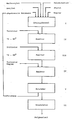
- the procedure is expediently such that the solution is pumped (from a solution kettle (I) into the reactor (11), (see flow diagram according to FIG. 1).
- this reactor can The grafting of the polybutadiene is generally carried out at temperatures in the first polymerization vessel of 75-85 ° C.
- the polymer syrup is transferred from the reactor (11) to the reactor (111) and is then preferably polymerized with a renewed addition of initiator, especially dilauroyl peroxide, to a higher conversion, with residence times of generally between 60 and 120 minutes and at appropriately selected temperatures (depending on the initiator selected), for example from 75-85 ° C. when using dilauroyl peroxide, the polymerization is carried out up to a conversion of 15 to 50%, preferably 20 to 35%, continued.
- initiator especially dilauroyl peroxide
- the product of the reaction in the reactor (11) is fed to a reactor (IV), for example a tubular reactor, preferably with the addition of further initiators and optionally further regulators, advantageously using a pump and a static mixer.
- the subsequent polymerization step is advantageously carried out at temperatures from 100 to 200 ° C. and residence times from 10 to 60 minutes, the conversion being said to be in the range from 40 to 75%.
- the method according to the invention must be regarded as a very advantageous solution even at conversions of approximately 50%, which leads to a product with very good material properties.
- the maximum pressures are approx. 30 bar.
- the polymer syrup is fed to a degassing extruder (V) after the reactor (IV).
- the separated monomers can be returned to the solution kettle (I).
- the polymer melt can advantageously be fed to a granulator (VI) via a water bath.
- the molding compositions produced by the process according to the invention are notable for high impact strength combined with very good optical properties. Compared to the process of the prior art (discontinuous final polymerization), the present process can be classified as considerably more efficient.
- a solution of 4.9 parts by weight of polybutadiene in 76 parts by weight of methyl methacrylate, 19 parts by weight of styrene and 5 parts of ethyl acrylate is tert with 0.1 parts by weight.
- polymerization is continued at 77 ° C. and after addition of dilauroyl peroxide with a residence time of 90 minutes beyond the inversion point to a conversion of 22%.
- This polymer solution is fed to a two-stage reactor with a pump.
- Impact-resistant molding compositions with the desired properties can be obtained if the combinations of methyl methacrylate / styrene and / or ⁇ -methyl styrene or methyl methacrylate / alkyl acrylate / styrene and / or ⁇ -methyl styrene as well as methyl methacrylate / alkyl methacrylate / styrene and / or uses a-methylstyrene.
Landscapes
- Chemical & Material Sciences (AREA)
- Health & Medical Sciences (AREA)
- Chemical Kinetics & Catalysis (AREA)
- Medicinal Chemistry (AREA)
- Polymers & Plastics (AREA)
- Organic Chemistry (AREA)
- Graft Or Block Polymers (AREA)
Description
- Die Erfindung betrifft ein verbessertes Verfahren zur Herstellung transparenter, schlagzäher Formmassen auf Basis a) einer Zähphase, bestehend aus gepfropftem Polybutadien-Festkautschuk und b) einer Copolymerisat-Hartphase aus den Monomeren Methylmethacrylat und Styrol oder aus den Monomeren Methylmethacrylat, Styrol und wenigstens einem weiteren Alkylester der Methacryl- und/oder der Acrylsäure mittels Polymerisation in mehreren Verfahrensschritten.
- In der Europäischen Patentanmeldung Veröffentl. Nr. 0 033 363 wird ein Verfahren zur Herstellung von transparenten schlagzähen Formmassen beschrieben auf Basis a) einer Zähphase, bestehend aus gepfropftem Polybutadien-Festkautschuk und b) einer Copolymerisat-Hartphase aus den Monomeren Methylmethacrylat, Alkylacrylat und Styrol mittels Polymerisation in mehreren Verfahrensschritten, umfassend in erster Stufe eine Vorpolymerisation der Monomeren in Gegenwart des in den Monomeren gelösten Polybutadien-Festkautschuks und eine Endpolymerisation bis zu einem Umsatz von über 80% der Monomeren, wobei in erster Stufe der Polybutadien-Festkautschuk in Anteilen von 3-10 Gew.-% in dem Gemisch der Monomeren Methylmethacrylat-Styrol-Methyl- und/oder Äthylacrylat im Gewichtsverhältnis (73 ± 5) : (22 ± 2) : (5 ± 3) unter Angleichung des Brechungsindex gelöst wird und unter Zusatz solcher pfropfaktiver Initiatoren, bei deren Zerfall Butoxy- bzw. Phenylradikale entstehen und in Anwesenheit von Reglern von Anfang an bis zu einem Umsatz der Monomeren, der dem 1-2 fachen Gewicht des eingesetzten Polybutadiens entspricht, polymerisiert und in einer zweiten Stufe (Inversionsstufe) die Polymerisation bis zu einem Umsatz zwischen 25 und 40% geführt wird, wobei sich Zähphasen-Teilchen bilden, deren Teilchendurchmesser durch Rühren unter Ausnutzung der Scherkräfte zwischen 0,2 und 1,5 g gehalten wird und der Ansatz in an sich bekannter Weise der Endpolymerisation unterworfen wird.
- Das Verfahren des Standes der Technik führt zwar zu hochwertigen Produkten, weist aber noch verbesserungsfähige Punkte auf. Bei der praktischen Durchführung machen sich vor allem die hohen Viskositäten in der dritten Polymerisationsstufe belastend für das Verfahren bemerkbar.
- Um den erforderlichen hohen Endumsatz zu garantieren, bietet sich z. B. die Substanzpolymerisation an. Führt man die Substanzpolymerisation diskontinuierlich durch, so resultiert ein vergleichsweise hoher Arbeitsaufwand; betreibt man sie kontinuierlich, sieht man sich zu einem hohen apparativen Aufwand genötigt. Bei gewissen Verfahren des Standes der Technik wurden Lösungsmittel, wie z. B. Toluol zugesetzt, um die Viskosität der Polymerisatansätze zu erniedrigen. Die Erfahrung zeigt jedoch, dass man dabei eine Beeinträchtigung der mechanischen Eigenschaften in Kauf nehmen muss.
- Es bestand daher die Aufgabe, Reaktionsbedingungen zu finden, welche die Herstellung qualitativ gleichwertiger, schlagzäher transparenter Formmassen gestatten, unter Vermeidung des nach dem Vorgehen gemäss dem Stand der Technik unvermeidbaren Aufwandes bzw. der Nachteile in Bezug auf die Produktqualität. Es wurde nun gefunden, dass das Verfahren zur Herstellung schlagzäher, weitgehend transparenter Formmassen erheblich verbessert werden kann.
- Die Erfindung besteht aus einem Verfahren zur Herstellung von transparenten, schlagzähen Formmassen auf Basis
- a) einer Zähphase, bestehend aus gepfropftem Polybutadien-Festkautschuk und
- b) einer Copolymerisat-Hartphase aus den Monomeren Methylmethacrylat und Styrol und/oder a-Methylstyrol und gegebenenfalls wenigstens einem weiteren Alkylester der Methacryl- und/oder Acrylsäure mittels Polymerisation in mehreren Verfahrensschritten, umfassend in erster Stufe eine Vorpolymerisation der Monomeren in Gegenwart des in den Monomeren gelösten Polybutadien-Festkautschuks, wobei in erster Stufe der Polybutadien-Festkautschuk in Anteilen von 3-10 Gew.-% in dem Gemisch der Monomeren Methylmethacrylat-Styrol- und/oder a-Methylstyrol-Alkylmethacrylat und/oder Alkylacrylat gelöst wird, wobei deren Gewichtsverhältnisse so zu wählen sind, dass die gebildete Copolymerisat-Hartphase im Brechungsindex dem vorgelegten Polybutadien-Festkautschuk entspricht und ein Anteil von 15-25 Gew.-%, bezogen auf die Monomeren an Styrol und/oder a-Methylstyrol, vorhanden sein soll und unter Zusatz solcher pfropfaktiver Initiatoren, bei deren Zerfall Butoxy- bzw. Phenylradikale entstehen und in Anwesenheit von Reglern von Anfang an bis zu einem Umsatz der Monomeren, der dem 1-2 fachen Gewicht des eingesetzten Polybutadiens entspricht, polymerisiert wird, und in einer zweiten Stufe (Inversionsstufe) die Polymerisation so geführt wird, dass sich Zähphasen-Teilchen bilden, deren Teilchendurchmesser durch Rühren unter Ausnutzung der Scherkräfte zwischen 0,2 und 2,5 J.1m gehalten wird und in dritter Stufe der Ansatz der Endpolymerisation unterworfen wird, wobei man in erster Stufe eine Polymerisation der Monomeren in Gegenwart des in den Monomeren gelösten Polybutadien-Festkautschuks im Umsatzbereich 3-20% durchführt und in der zweiten Stufe (Inversionsstufe) die Polymerisation im Umsatzbereich zwischen 15 und 50% und in der dritten und letzten Stufe die Polymerisation bis zu einem Umsatz zwischen 40 und 75% fortsetzt.
- Soweit im Rahmen der Definition der vorliegenden Erfindung die Bezeichnung Alkyl verwendet wird, kommen vorzugsweise Alkylreste mit 1 bis 8 Kohlenstoffatomen, insbesondere solche mit 1 bis 4 Kohlenstoffatomen, in Betracht.
- Es muss als ausserordentlich überraschend betrachtet werden, dass man - beispielsweise bei kontinuierlicher Durchführung der Polymerisation in allen drei Stufen - unter den erfindungsgemäss einzuhaltenden Randbedingungen ein Produkt erhält, das sehr gute Schlagzähigkeit bei guten optischen Eigenschaften aufweist.
- Die Durchführung des erfindungsgemässen Verfahrens kann im übrigen weitestgehend in Anlehnung an das Verfahren der oben genannten europäischen Anmeldung erfolgen. Hinsichtlich der Ausgangsmaterialien und der Polymerisationshilfsmittel und ihres Einsatzes kann die Lehre der europäischen Anmeldung unmittelbar übernommen werden. Die Durchführung des erfindungsgemässen Verfahrens kann somit in folgender Weise vorgenommen werden:
- Das Polybutadien wird zerkleinert und in der Monomerenmischung, bestehend aus Methylmethacrylat, Styrol und/oder a-Methylstyrol und mindestens einem weiteren Alkylester der Acryl-und/oder der Methacrylsäure gelöst, wobei im Interesse der Transparenz auf die Angleichung des Brechungsindex der resultierenden Hartphase an den des Polybutadiens geachtet werden muss. Diese Lösung wird unter Zusatz von pfropfaktiven Initiatoren des Typs, bei dessen Zerfall ein Butoxy-, Acyloxy- oder ein Phenylradikal freigesetzt wird, insbesondere tert. Butylperneodecanoat und vorzugsweise eines Reglers, insbesondere eines Schwefelreglers, beispielsweise des tert. Dodecylmercaptans, polymerisiert. Bei der praktischen Durchführung geht man zweckmässig so vor, dass man die Lösung (von einem Lösungskessel (I) in den Reaktor (11), (s. Fliessschema lt. Fig. 1) pumpt. Dieser Reaktor kann wie der zweite Reaktor (111) als Rührkesselreaktor betrieben werden. Bei Temperaturen im ersten Polymerisationskessel von 75-85 °C und Verweilzeiten zwischen 40 und 80 Minuten wird in der Regel die Pfropfung des Polybutadiens vorgenommen, wobei der Umsatz zwischen 3 und 20%, vorzugsweise 5-10%, speziell 7-9%, gehalten wird. Der Polymersirup wird aus dem Reaktor (11) in den Reaktor (111) überführt. Anschliessend wird vorzugsweise unter erneutem Zusatz von Initiator, speziell von Dilauroylperoxid, bis zu einem höheren Umsatz polymerisiert. Bei Verweilzeiten von in der Regel zwischen 60 und 120 Minuten und bei zweckmässig gewählten Temperaturen (in gewisser Abhängigkeit vom gewählten Initiator), z. B. von 75-85 °C bei Verwendung von Dilauroylperoxid, wird die Polymerisation bis zu einem Umsatz von 15 bis 50%, vorzugsweise 20 bis 35%, fortgeführt.
- Das Produkt der Umsetzung im Reaktor (11) wird - vorzugsweise unter Zusatz weiteren Initiators und gegebenenfalls weiteren Reglers-einem Reaktor (IV), beispielsweise einem Rohrreaktor zugeführt, vorteilhafterweise unter Verwendung einer Pumpe und eines statischen Mischers. Der anschliessende Polymerisationsschritt wird vorteilhaft bei Temperaturen von 100 bis 200°C und Verweilzeiten von 10 bis 60 Minuten durchgeführt, wobei der Umsatz im Bereich von 40 bis 75% liegen soll.
- Besonders hervorzuheben ist, dass das erfindungsgemässe Verfahren bereits bei Umsätzen von etwa 50% als eine sehr vorteilhafte Lösung betrachtet werden muss, die zu einem Produkt mit sehr guten Materialeigenschaften führt. Bei Anwendung des Rohrreaktors (IV) betragen die maximalen Drucke ca. 30 bar. Vorteilhafterweise führt man den Polymersirup nach dem Reaktor (IV) einem Entgasungsextruder (V) zu. Die abgetrennten Monomeren können in den Lösungskessel (I) zurückgeführt werden. Die Polymerschmelze kann zweckmässig über ein Wasserbad einem Granulator (VI) zugeführt werden. Die nach dem erfindungsgemässen Verfahren hergestellten Formmassen zeichnen sich durch hohe Schlagzähigkeit, verbunden mit sehr guten optischen Eigenschaften aus. Gegenüber dem Verfahren des Standes der Technik (diskontinuierliche Endpolymerisation) ist das vorliegende Verfahren als wesentlich rationeller einzustufen.
- Die Durchführung des Verfahrens im einzelnen geht aus dem folgenden Beispiel hervor.
- Eine Lösung von 4,9 Gew.-Teilen Polybutadien in 76 Gew.-Teilen Methylmethacrylat, 19 Gew.-Teilen Styrol und 5 Teilen Äthylacrylat wird mit 0,1 Gew.-Teilen tert. Dodecylmercaptan als Regler in einem Rührkessel bei 81 °C mit tert. Butyl-perneodecanoat als Initiator in einer Stunde bis zu einem Umsatz von 7% kontinuierlich gepfropft.
- In einem zweiten Rührkessel wird bei 77 °C und nach Zusatz von Dilauroylperoxid bei einer Verweilzeit von 90 Minuten über den Inversionspunkt hinaus zu einem Umsatz von 22% weiterpolymerisiert. Mit einer Pumpe wird diese Polymerlösung einem zweistufigen Reaktor zugeführt.
- Vor der ersten Stufe dieses Reaktors wird nochmals tert. Butylperneodecanoat und zusätzlich tert.-Butylperoctoat in die Lösung gepumpt und in einem statischen Mischer gut darin verteilt. Die erste Stufe dieses Reaktors wird bei 115°C gehalten, die zweite Stufe bei 175°C. Nach einer Verweilzeit von je 20 Minuten in jeder der beiden Stufen beträgt der Umsatz 50% (bezogen auf die Monomeren). Von der zweiten Stufe des Reaktors wird die monomerhaltige Schmelze in einen Entgasungsextruder gedrückt, die nicht polymerisierten Anteile dort abgezogen und wieder kondensiert und die Schmelze wie üblich extrudiert und granuliert. Schlagzähe Formmassen mit den gewünschten Eigenschaften können erhalten werden, wenn man in technisch gleicher Weise als Hartphasenmonomeren die Kombinationen Methylmethacrylat/Styrol und/oder a-Methylstyrol oder Methylmethacrylat/Alkylacrylat/Styrol und/ oder a-Methylstyrol wie auch Methylmethacrylat/ Alkylmethacrylat/Styrol und/oder a-Methylstyrol einsetzt.
Claims (4)
Applications Claiming Priority (2)
| Application Number | Priority Date | Filing Date | Title |
|---|---|---|---|
| DE3145675 | 1981-11-19 | ||
| DE19813145675 DE3145675A1 (de) | 1981-11-19 | 1981-11-19 | Verbessertes verfahren zur herstellung schlagzaeher formmassen |
Publications (2)
| Publication Number | Publication Date |
|---|---|
| EP0080072A1 EP0080072A1 (de) | 1983-06-01 |
| EP0080072B1 true EP0080072B1 (de) | 1988-06-01 |
Family
ID=6146622
Family Applications (1)
| Application Number | Title | Priority Date | Filing Date |
|---|---|---|---|
| EP82109973A Expired EP0080072B1 (de) | 1981-11-19 | 1982-10-28 | Verbessertes Verfahren zur Herstellung schlagzäher Formmassen |
Country Status (2)
| Country | Link |
|---|---|
| EP (1) | EP0080072B1 (de) |
| DE (2) | DE3145675A1 (de) |
Families Citing this family (4)
| Publication number | Priority date | Publication date | Assignee | Title |
|---|---|---|---|---|
| AU586971B2 (en) * | 1984-05-25 | 1989-08-03 | Mobil Oil Corporation | Non-staining, non-sticking styrenic polymers and method of preparation |
| DE4141319A1 (de) * | 1991-12-14 | 1993-10-14 | Roehm Gmbh | Hochschlagzähe Polymermischungen |
| US5891962A (en) * | 1994-09-20 | 1999-04-06 | Mitsui Chemicals, Inc. | Transparent, rubber-modified styrene resin and production process thereof |
| CN114230740B (zh) * | 2021-12-27 | 2023-09-08 | 广东众和高新科技股份公司 | 一种透明抗冲丁苯树脂及其制备方法和应用 |
Family Cites Families (3)
| Publication number | Priority date | Publication date | Assignee | Title |
|---|---|---|---|---|
| US3178489A (en) * | 1961-07-18 | 1965-04-13 | Shell Oil Co | Multi-stage polymerization process for preparing transparent compositions |
| US3359345A (en) * | 1964-11-25 | 1967-12-19 | Rexall Drug Chemical | Butadiene-styrene block copolymers reacted with monomeric mixtures |
| DE3002394A1 (de) * | 1980-01-24 | 1981-07-30 | Röhm GmbH, 6100 Darmstadt | Verfahren zur herstellung schlagzaeher formmassen |
-
1981
- 1981-11-19 DE DE19813145675 patent/DE3145675A1/de not_active Withdrawn
-
1982
- 1982-10-28 DE DE8282109973T patent/DE3278565D1/de not_active Expired
- 1982-10-28 EP EP82109973A patent/EP0080072B1/de not_active Expired
Also Published As
| Publication number | Publication date |
|---|---|
| DE3145675A1 (de) | 1983-05-26 |
| EP0080072A1 (de) | 1983-06-01 |
| DE3278565D1 (en) | 1988-07-07 |
Similar Documents
| Publication | Publication Date | Title |
|---|---|---|
| DE1965283C2 (de) | Verfahren zur Herstellung von Pfropf-Mischpolymerisaten mittels eines Zweistufenprozesses | |
| DE69221222T2 (de) | Propfkopolymere | |
| EP0113924B1 (de) | Schlagzähmodifizierungsmittel | |
| DE3750561T2 (de) | Verfahren zur Herstellung von schlagfesten Polystyrenharzen durch kontinuierliche Massepolymerisation. | |
| EP0033365B1 (de) | Verfahren zur Herstellung schlagzäher Formmassen | |
| AT397251B (de) | Sequenz-erzeugte polymerteilchen, wässrige dispersionen von sequenz-erzeugten polymerteilchen, verfahren zur herstellung von sequenz-erzeugten polymerteilchen und verwendung von sequenz-erzeugten polymerteilchen | |
| EP0030999A2 (de) | Schlagzähe Harze und ihre Herstellung | |
| CH487943A (de) | Verfahren zur Herstellung von Homo- oder Copolymeren des Methylmethacrylats | |
| DE1299421B (de) | Verfahren zur kontinuierlichen Loesungspolymerisation von Methacrylsaeureestern | |
| DE3687509T2 (de) | Klarer stoff zur erhoehung der schlagzaehigkeit von pvc. | |
| DE2461083A1 (de) | Verfahren zur mikrosuspensionspolymerisation von vinylhalogeniden | |
| DE2716207B2 (de) | Schlagfeste Styrolpolymere | |
| EP0477671A2 (de) | Verfahren zur Herstellung von ABS-Formmassen | |
| DE2039022B2 (de) | Thermoplastische formmasse | |
| DE69115159T2 (de) | Verfahren zur Herstellung von Stossresistenten Thermoplastischen Harzen mit Hochglänzender Oberfläche. | |
| DE2252619C3 (de) | T herrnoplastische Formmasse | |
| EP0080072A1 (de) | Verbessertes Verfahren zur Herstellung schlagzäher Formmassen | |
| EP0505798B1 (de) | Verfahren zur Herstellung von ABS-Formmassen | |
| DE69127745T2 (de) | Schlagfestes Pfropfcopolymer und thermoplastisches Harz, welches dieses Polymer enthält | |
| DE1038757B (de) | Verfahren zur Herstellung von Polystyrol | |
| DE3885546T2 (de) | Verfahren zur Herstellung eines schlagfesten thermoplastischen Harzes. | |
| EP0074051A1 (de) | Thermoplastische Formmasse | |
| DE3603375A1 (de) | Thermoplastische formmasse auf basis von abs | |
| EP1049737A1 (de) | Verfahren zum fällen von mikrosuspensionspolymerisaten | |
| EP0505799A1 (de) | ABS-Formmassen mit bimodaler Kautschukpartikelgrössenverteilung |
Legal Events
| Date | Code | Title | Description |
|---|---|---|---|
| PUAI | Public reference made under article 153(3) epc to a published international application that has entered the european phase |
Free format text: ORIGINAL CODE: 0009012 |
|
| AK | Designated contracting states |
Designated state(s): DE FR GB IT |
|
| 17P | Request for examination filed |
Effective date: 19831018 |
|
| GRAA | (expected) grant |
Free format text: ORIGINAL CODE: 0009210 |
|
| AK | Designated contracting states |
Kind code of ref document: B1 Designated state(s): DE FR GB IT |
|
| ITF | It: translation for a ep patent filed | ||
| REF | Corresponds to: |
Ref document number: 3278565 Country of ref document: DE Date of ref document: 19880707 |
|
| ET | Fr: translation filed | ||
| GBT | Gb: translation of ep patent filed (gb section 77(6)(a)/1977) | ||
| PLBI | Opposition filed |
Free format text: ORIGINAL CODE: 0009260 |
|
| 26 | Opposition filed |
Opponent name: BASF AKTIENGESELLSCHAFT, LUDWIGSHAFEN Effective date: 19890228 |
|
| ITTA | It: last paid annual fee | ||
| PGFP | Annual fee paid to national office [announced via postgrant information from national office to epo] |
Ref country code: DE Payment date: 19930929 Year of fee payment: 12 |
|
| PGFP | Annual fee paid to national office [announced via postgrant information from national office to epo] |
Ref country code: GB Payment date: 19931015 Year of fee payment: 12 |
|
| PGFP | Annual fee paid to national office [announced via postgrant information from national office to epo] |
Ref country code: FR Payment date: 19931018 Year of fee payment: 12 |
|
| RDAG | Patent revoked |
Free format text: ORIGINAL CODE: 0009271 |
|
| STAA | Information on the status of an ep patent application or granted ep patent |
Free format text: STATUS: PATENT REVOKED |
|
| 27W | Patent revoked |
Effective date: 19950113 |
|
| GBPR | Gb: patent revoked under art. 102 of the ep convention designating the uk as contracting state |
Free format text: 950113 |