EP0075031B1 - Method of forming curved surface - Google Patents
Method of forming curved surface Download PDFInfo
- Publication number
- EP0075031B1 EP0075031B1 EP82901010A EP82901010A EP0075031B1 EP 0075031 B1 EP0075031 B1 EP 0075031B1 EP 82901010 A EP82901010 A EP 82901010A EP 82901010 A EP82901010 A EP 82901010A EP 0075031 B1 EP0075031 B1 EP 0075031B1
- Authority
- EP
- European Patent Office
- Prior art keywords
- partitioning
- curve
- curves
- curved surface
- external shape
- Prior art date
- Legal status (The legal status is an assumption and is not a legal conclusion. Google has not performed a legal analysis and makes no representation as to the accuracy of the status listed.)
- Expired - Lifetime
Links
Images



Classifications
-
- G—PHYSICS
- G05—CONTROLLING; REGULATING
- G05B—CONTROL OR REGULATING SYSTEMS IN GENERAL; FUNCTIONAL ELEMENTS OF SUCH SYSTEMS; MONITORING OR TESTING ARRANGEMENTS FOR SUCH SYSTEMS OR ELEMENTS
- G05B19/00—Program-control systems
- G05B19/02—Program-control systems electric
- G05B19/18—Numerical control [NC], i.e. automatically operating machines, in particular machine tools, e.g. in a manufacturing environment, so as to execute positioning, movement or co-ordinated operations by means of program data in numerical form
- G05B19/41—Numerical control [NC], i.e. automatically operating machines, in particular machine tools, e.g. in a manufacturing environment, so as to execute positioning, movement or co-ordinated operations by means of program data in numerical form characterised by interpolation, e.g. the computation of intermediate points between programmed end points to define the path to be followed and the rate of travel along that path
- G05B19/4103—Digital interpolation
-
- G—PHYSICS
- G05—CONTROLLING; REGULATING
- G05B—CONTROL OR REGULATING SYSTEMS IN GENERAL; FUNCTIONAL ELEMENTS OF SUCH SYSTEMS; MONITORING OR TESTING ARRANGEMENTS FOR SUCH SYSTEMS OR ELEMENTS
- G05B19/00—Program-control systems
- G05B19/02—Program-control systems electric
- G05B19/18—Numerical control [NC], i.e. automatically operating machines, in particular machine tools, e.g. in a manufacturing environment, so as to execute positioning, movement or co-ordinated operations by means of program data in numerical form
- G05B19/41—Numerical control [NC], i.e. automatically operating machines, in particular machine tools, e.g. in a manufacturing environment, so as to execute positioning, movement or co-ordinated operations by means of program data in numerical form characterised by interpolation, e.g. the computation of intermediate points between programmed end points to define the path to be followed and the rate of travel along that path
-
- G—PHYSICS
- G05—CONTROLLING; REGULATING
- G05B—CONTROL OR REGULATING SYSTEMS IN GENERAL; FUNCTIONAL ELEMENTS OF SUCH SYSTEMS; MONITORING OR TESTING ARRANGEMENTS FOR SUCH SYSTEMS OR ELEMENTS
- G05B2219/00—Program-control systems
- G05B2219/30—Nc systems
- G05B2219/35—Nc in input of data, input till input file format
- G05B2219/35151—Modeling geometric, generation or forming of curved surface
Definitions
- This invention relates to a method of machining the curved surface of a three-dimensional body and, more particularly but not exclusively, to a method of creating curved surfaces that is ideal for the preparation of a numerical control tape required for the numerically controlled machining of a three-dimensional metal mold or the like.
- a curved surface of a three-dimensional metal mold or the like when drawn out on the plane of a blueprint, is generally represented by a plurality of given section curves, but no data is shown forthe shape of the area lying between a certain section curve and the next adjacent section curve.
- machining must be performed by generating the curved surface between the two section curves from such data as that indicative of the section curves, punching an NC tape so as to incorporate the data concerning the generated curved surface, and then machining the workpiece in accordance with the instructions on the NC tape.
- the numerical control tape ordinarily is prepared by using a computer, and either of two methods can be adopted to create the curved surface, namely (1) a patch system in which processing is executed by partitioning a curved surface into minute portions, and (2) a system in which a two- dimensional curve made of straight line segments and arcs is modified for each pick-feed applied to a third axis.
- the patch system (1) entails the processing of large quantities of data as well as highly complicated mathematical processing, and requires a large-scale computer system.
- the system (2) makes processing with a small-scale computer possible, but there is no three-dimensional tool offset capability and an excessive limitation upon tool movement direction and machining shape, making it impossible to create sophisticated three-dimensional bodies.
- the inventors have already proposed a method of creating curved surfaces, comprising generating a plurality of intermediate sections and finding a section curve (intermediate section curve) on a curved body, based on the intermediate sections, in accordance with predetermined rules, from section data specifying given sections of a three-dimensional curved body and from data specifying section curves in said sections, and generating the curved surface of the three-dimensional body based on the plurality of generated intermediate section curves.
- processing can be carried out with a small-scale computer and a sophisticated three-dimensional body can be created in a simple manner.
- a three-dimensional curved body has been generated by partitioning the X, Y or Z axis in accordance with a partitioning quantity provided for the X, Y or Z axis irrespective of the position, shape, etc., of the curved surface, generating intermediate sections so as to contain partitioning points obtained from the partitioning operation, finding a section curve (intermediate section curve) in each of the intermediate sections, and generating the three-dimensional curved body on the basis of a plurality of the intermediate section curves.
- Machining has been performed by transporting a tool along the X, Y or Z axis through a cutting pitch decided in accordance with the partitioning quantity (which operation is referred to as a pick-feed operation), then transporting the tool along an intermediate section curve, followed by repeating the pick-feed operation and the tool movement along an intermediate section curve, whereby the desired three-dimensional curved body is created.
- partitioning quantity which operation is referred to as a pick-feed operation
- the partitioning pitch quantity can be given without being hampered by the position or shape of the curved surface.
- the conventional method does have the following defects:
- an object of the present invention is to provide a curved surface machining method which enables a curved surface to be created and machining accuracy improved without changing the partitioning axis, even in a case where the curvature of the curved surfaces changes.
- EP-A-0 041 854 by FANUC is relevant under EPC Article 54(3) and proposes that the aforesaid partitioning takes place not along X, Y or Z axes, but at equally spaced locations along the length of the curved surface itself.
- a method of machining a curved surface in which external shape curves of a three-dimensional curved body are generated successively at a predetemined pitch and a plurality of said external shape curves are machined successively to create the curved surface of the three-dimensional curved body comprising entering into calculating circuitry at least one reference external shape curve and partitioning information, including said predetermined pitch, for partitioning said reference external shape curve, partitioning said reference external shape curve at equally spaced partitioning points on the basis of said partitioning information, and successively generating said plurality of external shape curves to be machined, in such fashion that each such curve contains a respective one of the partitioning points on the reference external shape curve.
- the present invention relates to a method of machining the curved surface of a three-dimensional curved body by successively generating the external shape curves of the three-dimensional body at a predetermined pitch, and machining the curved surface on the basis of a collection of a plurality of the external shape curves.
- the invention includes the steps of entering an external shape curve and partitioning information such as the number of partitions and partitioning pitch or amount of allowable error, partitioning the external shape curve on the basis of the partitioning information, successively generating a plurality of intermediate external shape curves so as to contain each of the partitioning points, creating a curved surface on the basis of a plurality of the intermediate section curves and, in a machining operation, transporting a tool along each intermediate external shape curve.
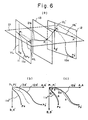
- Fig. 6 is an explanatory view for describing examples of surface creation method according to the present invention.
- Reference numerals 11, 12 denote two sections (given sections) of a three-dimensional curved body, and 11a, 12a denote section curves (given section curves) for a case where the three-dimensional curved surface is cut by the given sections 11, 12.
- Numeral 21 denotes a reference plane containing points P1, P1' on the respective section curves 11a, 12a.
- Numeral 21a denotes a reference curve lying in the reference plane 21 and specifying the external form of the three-dimensional curved body.
- Numeral 13 denotes an intermediate section. The intermediate section 13 is generated so as to contain a partitioning point P1" which divides the length of the reference curve 21a a into a ratio of m:n, and so as to lie perpendicular to the reference plane 21 and reference curve 21 a.
- a case was described where two given section curves 11a, 12a and one reference curve 21 are given.
- Other possibilities are (a) a case where one given section curve and two reference curves are given, and (b) a case where two given section curves and two reference curves are given.
- a three-dimensional curved body can be created by partitioning a reference curve, namely a curve representing the external form of the body, in accordance with partitioning information, successively obtaining a plurality of intermediate section curves (curves representing the external form of the body) so as to contain each of the partitioning points, and assembling the intermediate section curves.
- Fig. 7 is a block diagram for realizing the given surface creation method according to the present invention.
- numeral 101 denotes a partitioning point arithmetic unit for computing the partitioning point P1" upon receiving as inputs the data specifying the reference curve, the number of partitions and the partitioning ratio m:n.
- Numeral 103 denotes an intermediate section generating unit for computing data indicative of an intermediate section which contains the partitioning point P1" and which is perpendicular to the reference plane and reference curve.
- Numeral 104 designates a given section curve transformation processor for developing two given section curves into the same predetermined plane and for effecting a transformation into the given section curve data.
- Numeral 105 denotes an intermediate section curve arithmetic unit, and 106 an intermediate section curve transformation processor.
- the intermediate section curve arithmetic unit 105 executes the processing for the above-described step (4) for generating the intermediate section curve 13a' [Fig.
- the intermediate section curve transformation processor 106 through a matrix transformation, develops the intermediate section curve 13a' into the intermediate section 13 generated by the intermediate section generating unit 103.
- the output of the intermediate section curve transformation processor 106 is intermediate section curve data that is stored successively in a memory device, not shown.
- a three-dimensional curved body is created by collecting a plurality of the intermediate section curves together.
- a reference curve which is one of the curves defining the outward shape of a three-dimensional curved body, is partitioned based on partitioning information. Therefore, processing can be executed uniformly and machining accuracy improved without requiring that the partitioning axis be changed, even when the curvature of the curved surface varies. Owing to uniform processing, intermediate section curves (curves defining the outward shape of the body) are generated successively and assembled to create the curved body. Processing is simplified as a result.
- processing can be executed uniformly and machining accuracy of a three-dimensional curved body improved without requiring that the partitioning axis be changed, even when the curvature of the three-dimensional curved body varies.
Landscapes
- Engineering & Computer Science (AREA)
- Computing Systems (AREA)
- Theoretical Computer Science (AREA)
- Human Computer Interaction (AREA)
- Manufacturing & Machinery (AREA)
- Physics & Mathematics (AREA)
- General Physics & Mathematics (AREA)
- Automation & Control Theory (AREA)
- Numerical Control (AREA)
- Document Processing Apparatus (AREA)
- Image Generation (AREA)
Applications Claiming Priority (2)
| Application Number | Priority Date | Filing Date | Title |
|---|---|---|---|
| JP50968/81 | 1981-04-04 | ||
| JP56050968A JPS57166607A (en) | 1981-04-04 | 1981-04-04 | Curved surface generating method |
Publications (3)
| Publication Number | Publication Date |
|---|---|
| EP0075031A1 EP0075031A1 (en) | 1983-03-30 |
| EP0075031A4 EP0075031A4 (en) | 1985-09-16 |
| EP0075031B1 true EP0075031B1 (en) | 1990-08-29 |
Family
ID=12873609
Family Applications (1)
| Application Number | Title | Priority Date | Filing Date |
|---|---|---|---|
| EP82901010A Expired - Lifetime EP0075031B1 (en) | 1981-04-04 | 1982-04-05 | Method of forming curved surface |
Country Status (6)
| Country | Link |
|---|---|
| US (1) | US4546427A (enExample) |
| EP (1) | EP0075031B1 (enExample) |
| JP (1) | JPS57166607A (enExample) |
| KR (1) | KR890000027B1 (enExample) |
| DE (1) | DE3280235D1 (enExample) |
| WO (1) | WO1982003475A1 (enExample) |
Families Citing this family (25)
| Publication number | Priority date | Publication date | Assignee | Title |
|---|---|---|---|---|
| JPS57194855A (en) * | 1981-05-27 | 1982-11-30 | Fanuc Ltd | Numerical control system |
| JPS6015711A (ja) * | 1983-07-07 | 1985-01-26 | Fanuc Ltd | 曲面生成方法 |
| JPS60107106A (ja) * | 1983-11-15 | 1985-06-12 | Mitsubishi Electric Corp | 曲線補間装置 |
| JPS60213426A (ja) * | 1984-04-07 | 1985-10-25 | Fanuc Ltd | ワイヤ放電加工機における加工形状表示方法 |
| JPH067362B2 (ja) * | 1984-06-26 | 1994-01-26 | フアナツク株式会社 | 複合曲面生成方法 |
| JPH067363B2 (ja) * | 1985-02-28 | 1994-01-26 | フアナツク株式会社 | 複合曲面生成方法 |
| US4697240A (en) * | 1985-05-28 | 1987-09-29 | Modern Engineering Service Company | Method for making models using simultaneous construction and CAD/CAM techniques |
| JPS61292705A (ja) * | 1985-06-20 | 1986-12-23 | Fanuc Ltd | 丸味付け方法 |
| JPS6219910A (ja) * | 1985-07-18 | 1987-01-28 | Fanuc Ltd | 丸味付け方法 |
| JPH061404B2 (ja) * | 1985-09-13 | 1994-01-05 | フアナツク株式会社 | 複合曲面加工方法 |
| JPS6265105A (ja) * | 1985-09-17 | 1987-03-24 | Fanuc Ltd | 複合曲面生成方法 |
| JPH069007B2 (ja) * | 1986-04-04 | 1994-02-02 | フアナツク株式会社 | 複合曲面のncデ−タ作成方法 |
| JPS6318405A (ja) * | 1986-07-09 | 1988-01-26 | Fanuc Ltd | 複合曲面の切削通路生成方法 |
| JPS6391705A (ja) * | 1986-10-06 | 1988-04-22 | Fanuc Ltd | フイレツト面加工用ncデ−タ作成方法 |
| CA1282142C (en) * | 1986-10-21 | 1991-03-26 | Sony Corporation | Method for generating offset surface data |
| JPH0679251B2 (ja) * | 1987-03-27 | 1994-10-05 | オークマ株式会社 | Nc装置における3次元自由曲線補間方法 |
| JPS63263501A (ja) * | 1987-04-21 | 1988-10-31 | Fanuc Ltd | 曲面加工用のncデ−タ作成方法 |
| CA1339155C (en) * | 1987-07-28 | 1997-07-29 | David M. Dundorf | Computer produced carved signs and method and apparatus for making same |
| CA1293812C (en) * | 1987-10-26 | 1991-12-31 | Tetsuzo Kuragano | Method and system for generating free curved surface |
| EP0523270A1 (de) * | 1991-07-18 | 1993-01-20 | International Business Machines Corporation | Verfahren zur Steuerung einer Positioniereinrichtung |
| JP2800861B2 (ja) * | 1991-11-19 | 1998-09-21 | 株式会社 エフ・エーラボ | 三次元加工方法 |
| US5363309A (en) * | 1993-02-25 | 1994-11-08 | International Business Machines Corp. | Normal distance construction for machining edges of solid models |
| DE69834639T2 (de) * | 1998-10-05 | 2006-12-14 | Sony Deutschland Gmbh | Automatische Bestimmung des Punkts für Direktzugriffs-Kanalaufteilungsverfahren |
| US6449529B1 (en) | 1999-01-05 | 2002-09-10 | Henryk Oleksy | Process for contour machining of metal blocks |
| ATE472763T1 (de) * | 2000-01-18 | 2010-07-15 | Henryk Oleksy | Verfahren zur gesteuerten bearbeitung von konturen von metallblöcken |
Citations (1)
| Publication number | Priority date | Publication date | Assignee | Title |
|---|---|---|---|---|
| EP0041854A1 (en) * | 1980-06-10 | 1981-12-16 | Fanuc Ltd. | A method of mechining a three-dimensional curved surface |
Family Cites Families (2)
| Publication number | Priority date | Publication date | Assignee | Title |
|---|---|---|---|---|
| US3882304A (en) * | 1973-05-04 | 1975-05-06 | Allen Bradley Co | Parametric interpolation of three-dimensional surfaces |
| US3932923A (en) * | 1974-10-21 | 1976-01-20 | Dynell Electronics Corporation | Method of generating and constructing three-dimensional bodies |
-
1981
- 1981-04-04 JP JP56050968A patent/JPS57166607A/ja active Granted
-
1982
- 1982-04-03 KR KR8201488A patent/KR890000027B1/ko not_active Expired
- 1982-04-05 WO PCT/JP1982/000105 patent/WO1982003475A1/ja not_active Ceased
- 1982-04-05 DE DE8282901010T patent/DE3280235D1/de not_active Expired - Lifetime
- 1982-04-05 US US06/451,146 patent/US4546427A/en not_active Expired - Fee Related
- 1982-04-05 EP EP82901010A patent/EP0075031B1/en not_active Expired - Lifetime
Patent Citations (1)
| Publication number | Priority date | Publication date | Assignee | Title |
|---|---|---|---|---|
| EP0041854A1 (en) * | 1980-06-10 | 1981-12-16 | Fanuc Ltd. | A method of mechining a three-dimensional curved surface |
Also Published As
| Publication number | Publication date |
|---|---|
| EP0075031A4 (en) | 1985-09-16 |
| EP0075031A1 (en) | 1983-03-30 |
| JPS57166607A (en) | 1982-10-14 |
| JPH0373882B2 (enExample) | 1991-11-25 |
| DE3280235D1 (de) | 1990-10-04 |
| KR830009898A (ko) | 1983-12-24 |
| KR890000027B1 (ko) | 1989-03-06 |
| US4546427A (en) | 1985-10-08 |
| WO1982003475A1 (fr) | 1982-10-14 |
Similar Documents
| Publication | Publication Date | Title |
|---|---|---|
| EP0075031B1 (en) | Method of forming curved surface | |
| EP0076327B1 (en) | Method of forming curved surface | |
| EP0041854B1 (en) | A method of mechining a three-dimensional curved surface | |
| EP0841606B1 (en) | Three-dimensional machining method and recording medium stored with a three-dimensional machining control program | |
| EP0148279B1 (en) | Method of producing curved surface | |
| EP0160097B1 (en) | Area machining method | |
| EP0068031B1 (en) | Curved surface forming method | |
| EP0168501B1 (en) | Area machining method | |
| EP0215955B1 (en) | Method of generating compound curved planes | |
| EP0276312B1 (en) | Method for computing normal vector | |
| EP0240569B1 (en) | Method of forming compposite curved surface | |
| Yeo et al. | A cost-tolerance model for process sequence optimisation | |
| US4755926A (en) | Method and apparatus for producing a three-dimensional curved surface from two-dimensional curves in perpendicular planes | |
| EP0068765B1 (en) | Numerical control method | |
| EP0237578B1 (en) | Method of forming composite curved surface | |
| EP0707252B1 (en) | Three-dimensional machining method | |
| JPH067362B2 (ja) | 複合曲面生成方法 | |
| US4893251A (en) | Method of generating cutting path of complex curved surface | |
| US5151864A (en) | Method of generating cutting passes of complex curved surface | |
| Yong-hoon | A unified rough and finish cut algorithm for NC machining of free form pockets using a grid based approach | |
| JPH04143806A (ja) | フィレット曲面取り出し方法 |
Legal Events
| Date | Code | Title | Description |
|---|---|---|---|
| PUAI | Public reference made under article 153(3) epc to a published international application that has entered the european phase |
Free format text: ORIGINAL CODE: 0009012 |
|
| 17P | Request for examination filed |
Effective date: 19821216 |
|
| AK | Designated contracting states |
Designated state(s): CH DE FR GB LI |
|
| 17Q | First examination report despatched |
Effective date: 19870811 |
|
| GRAA | (expected) grant |
Free format text: ORIGINAL CODE: 0009210 |
|
| AK | Designated contracting states |
Kind code of ref document: B1 Designated state(s): CH DE FR GB LI |
|
| REF | Corresponds to: |
Ref document number: 3280235 Country of ref document: DE Date of ref document: 19901004 |
|
| ET | Fr: translation filed | ||
| PGFP | Annual fee paid to national office [announced via postgrant information from national office to epo] |
Ref country code: FR Payment date: 19910322 Year of fee payment: 10 |
|
| PLBE | No opposition filed within time limit |
Free format text: ORIGINAL CODE: 0009261 |
|
| STAA | Information on the status of an ep patent application or granted ep patent |
Free format text: STATUS: NO OPPOSITION FILED WITHIN TIME LIMIT |
|
| 26N | No opposition filed | ||
| PG25 | Lapsed in a contracting state [announced via postgrant information from national office to epo] |
Ref country code: FR Effective date: 19921230 |
|
| REG | Reference to a national code |
Ref country code: FR Ref legal event code: ST |
|
| PGFP | Annual fee paid to national office [announced via postgrant information from national office to epo] |
Ref country code: GB Payment date: 19960327 Year of fee payment: 15 |
|
| PGFP | Annual fee paid to national office [announced via postgrant information from national office to epo] |
Ref country code: DE Payment date: 19960418 Year of fee payment: 15 |
|
| PGFP | Annual fee paid to national office [announced via postgrant information from national office to epo] |
Ref country code: CH Payment date: 19960425 Year of fee payment: 15 |
|
| PG25 | Lapsed in a contracting state [announced via postgrant information from national office to epo] |
Ref country code: GB Effective date: 19970405 |
|
| PG25 | Lapsed in a contracting state [announced via postgrant information from national office to epo] |
Ref country code: LI Free format text: LAPSE BECAUSE OF NON-PAYMENT OF DUE FEES Effective date: 19970430 Ref country code: CH Free format text: LAPSE BECAUSE OF NON-PAYMENT OF DUE FEES Effective date: 19970430 |
|
| GBPC | Gb: european patent ceased through non-payment of renewal fee |
Effective date: 19970405 |
|
| REG | Reference to a national code |
Ref country code: CH Ref legal event code: PL |
|
| PG25 | Lapsed in a contracting state [announced via postgrant information from national office to epo] |
Ref country code: DE Free format text: LAPSE BECAUSE OF NON-PAYMENT OF DUE FEES Effective date: 19980101 |