EP0073847B1 - Blutbeutel mit einem Verbindungssystem - Google Patents
Blutbeutel mit einem Verbindungssystem Download PDFInfo
- Publication number
- EP0073847B1 EP0073847B1 EP81106885A EP81106885A EP0073847B1 EP 0073847 B1 EP0073847 B1 EP 0073847B1 EP 81106885 A EP81106885 A EP 81106885A EP 81106885 A EP81106885 A EP 81106885A EP 0073847 B1 EP0073847 B1 EP 0073847B1
- Authority
- EP
- European Patent Office
- Prior art keywords
- bag
- blood
- break
- blood bag
- coupling
- Prior art date
- Legal status (The legal status is an assumption and is not a legal conclusion. Google has not performed a legal analysis and makes no representation as to the accuracy of the status listed.)
- Expired
Links
- 239000008280 blood Substances 0.000 title claims abstract description 57
- 210000004369 blood Anatomy 0.000 title claims abstract description 57
- 239000000463 material Substances 0.000 claims abstract description 6
- 230000008878 coupling Effects 0.000 claims abstract 5
- 238000010168 coupling process Methods 0.000 claims abstract 5
- 238000005859 coupling reaction Methods 0.000 claims abstract 5
- 238000002360 preparation method Methods 0.000 claims description 14
- 230000000717 retained effect Effects 0.000 claims description 2
- 239000012503 blood component Substances 0.000 description 3
- 238000005119 centrifugation Methods 0.000 description 3
- 239000004033 plastic Substances 0.000 description 3
- 229920003023 plastic Polymers 0.000 description 3
- 238000000926 separation method Methods 0.000 description 3
- 238000003466 welding Methods 0.000 description 3
- 238000011109 contamination Methods 0.000 description 2
- 238000004519 manufacturing process Methods 0.000 description 2
- 102000001690 Factor VIII Human genes 0.000 description 1
- 108010054218 Factor VIII Proteins 0.000 description 1
- 239000004425 Makrolon Substances 0.000 description 1
- 238000004026 adhesive bonding Methods 0.000 description 1
- 230000000903 blocking effect Effects 0.000 description 1
- 230000017531 blood circulation Effects 0.000 description 1
- 230000036765 blood level Effects 0.000 description 1
- 239000012141 concentrate Substances 0.000 description 1
- 229960000301 factor viii Drugs 0.000 description 1
- 239000011521 glass Substances 0.000 description 1
- 238000005304 joining Methods 0.000 description 1
- 239000007788 liquid Substances 0.000 description 1
- 239000012528 membrane Substances 0.000 description 1
- 238000000034 method Methods 0.000 description 1
- 229920000515 polycarbonate Polymers 0.000 description 1
- 229920000915 polyvinyl chloride Polymers 0.000 description 1
- 239000004800 polyvinyl chloride Substances 0.000 description 1
- 238000007789 sealing Methods 0.000 description 1
- 239000003381 stabilizer Substances 0.000 description 1
- 230000001954 sterilising effect Effects 0.000 description 1
- 238000004659 sterilization and disinfection Methods 0.000 description 1
- 238000003860 storage Methods 0.000 description 1
- 239000003634 thrombocyte concentrate Substances 0.000 description 1
- 238000002604 ultrasonography Methods 0.000 description 1
Images


Classifications
-
- A—HUMAN NECESSITIES
- A61—MEDICAL OR VETERINARY SCIENCE; HYGIENE
- A61J—CONTAINERS SPECIALLY ADAPTED FOR MEDICAL OR PHARMACEUTICAL PURPOSES; DEVICES OR METHODS SPECIALLY ADAPTED FOR BRINGING PHARMACEUTICAL PRODUCTS INTO PARTICULAR PHYSICAL OR ADMINISTERING FORMS; DEVICES FOR ADMINISTERING FOOD OR MEDICINES ORALLY; BABY COMFORTERS; DEVICES FOR RECEIVING SPITTLE
- A61J1/00—Containers specially adapted for medical or pharmaceutical purposes
- A61J1/14—Details; Accessories therefor
- A61J1/20—Arrangements for transferring or mixing fluids, e.g. from vial to syringe
- A61J1/2089—Containers or vials which are to be joined to each other in order to mix their contents
-
- A—HUMAN NECESSITIES
- A61—MEDICAL OR VETERINARY SCIENCE; HYGIENE
- A61J—CONTAINERS SPECIALLY ADAPTED FOR MEDICAL OR PHARMACEUTICAL PURPOSES; DEVICES OR METHODS SPECIALLY ADAPTED FOR BRINGING PHARMACEUTICAL PRODUCTS INTO PARTICULAR PHYSICAL OR ADMINISTERING FORMS; DEVICES FOR ADMINISTERING FOOD OR MEDICINES ORALLY; BABY COMFORTERS; DEVICES FOR RECEIVING SPITTLE
- A61J1/00—Containers specially adapted for medical or pharmaceutical purposes
- A61J1/05—Containers specially adapted for medical or pharmaceutical purposes for collecting, storing or administering blood, plasma or medical fluids ; Infusion or perfusion containers
- A61J1/10—Bag-type containers
-
- A—HUMAN NECESSITIES
- A61—MEDICAL OR VETERINARY SCIENCE; HYGIENE
- A61J—CONTAINERS SPECIALLY ADAPTED FOR MEDICAL OR PHARMACEUTICAL PURPOSES; DEVICES OR METHODS SPECIALLY ADAPTED FOR BRINGING PHARMACEUTICAL PRODUCTS INTO PARTICULAR PHYSICAL OR ADMINISTERING FORMS; DEVICES FOR ADMINISTERING FOOD OR MEDICINES ORALLY; BABY COMFORTERS; DEVICES FOR RECEIVING SPITTLE
- A61J1/00—Containers specially adapted for medical or pharmaceutical purposes
- A61J1/14—Details; Accessories therefor
- A61J1/20—Arrangements for transferring or mixing fluids, e.g. from vial to syringe
- A61J1/2003—Accessories used in combination with means for transfer or mixing of fluids, e.g. for activating fluid flow, separating fluids, filtering fluid or venting
- A61J1/2048—Connecting means
Definitions
- the invention relates to blood bags with a connection system that contains a connection piece (5) consisting of connection part (7), break-off part (8), predetermined breaking point (9) and possibly collar (6), the connection piece (5) directly with the blood bag (1) is connected, such that it is located directly on the upper bag edge and substantially flush therewith, said break-off part (8) projects into the bag, so that the break-off part (8) is present after canceling in -r -Beutelinneren.
- Blood bags are used for the collection, storage, preparation and transfusion of blood and blood components.
- One of the advantages of blood bags over blood bottles made of glass is that with multiple blood bag systems, blood preparations in a closed, i.e. sterile system are possible.
- the production of blood preparations is becoming increasingly important as part of "hemotherapy made to measure”.
- Multi-bag systems as they are currently on the market consist of 2 or more bag systems, in which a primary bag generally contains the blood stabilizer solution and serves to absorb the blood.
- the secondary or satellite bag or the satellite bag system which is connected to the primary bag with a tube system, is used to prepare the blood components, such as plasma, factor VIII concentrate, platelet concentrate, etc.
- the primary bag carries a connection system which, after opening, allows the preparation to pass from the primary bag into the secondary bag.
- connection system There are various design options for this connection system.
- connection system which consists of a ball which is pressed into a flexible hose. A free passage is possible after pushing the ball out of the hose.
- This system has the disadvantage that under extreme conditions such as overpressure, centrifugation, mechanical change in the tube diameter etc. there is no hermetic seal.
- US-PS 3110 308 describes a connection system consisting of a membrane which is perforated with a cannula-like mandrel. This system often complains about the complicated and time-consuming manipulation.
- break-off systems are known in which a free passage is possible by breaking off a plastic part in a hose system.
- Such systems are located outside a blood bag in the connecting tube between the primary and secondary bags (e.g. WO A-1-81 / 01105).
- This has the disadvantage that a clean and optimal separation of the blood preparations according to e.g. Centrifugation is not possible and the preparation is contaminated.
- the manufacture and assembly of such systems is complex and costly.
- the invention has for its object to provide a blood bag with a connection system; which has the advantages of the generic blood bag with a connection system, but in which blocking of the free passage through the break-off part is largely avoided.
- break-off part consists of a material that has a lower density than blood.
- a break-off part which is made of a material that has a lower density than blood, will float on the blood or blood preparation after the separation and will not sink, whereby a blockage of the passage that is possible due to the sinking is largely avoided.
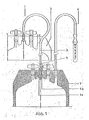
- Fig. 1 shows the blood bag (1) (primary bag) with the blood collection tube (4), which is connected to the blood bag (2) (secondary bag) by a connecting tube (3).
- the Blood bag (1) is sealed liquid-tight by the connecting piece (5).
- the connecting piece (5) When the connecting piece (5) is opened, the preparation can overflow into the secondary bag (2) via the connecting tube (3).
- part of the connecting piece (5) lies in a recess (1 c).
- a tube (1 b) is also shown, which according to one embodiment is located between the blood bag (1) and the connecting piece (5).
- Fig. 2 shows a detailed enlargement of the connector (5) used as a connection system. It consists of a collar (6), connecting part (7), break-off part (8) made of a material with a lower density than blood and predetermined breaking point (9).
- the collar (6) is connected to the connecting tube (3), the connecting part (7) is hermetically connected to the blood bag (1), and the breaking part (8) is connected to the connecting part (7) via the breaking or predetermined breaking point (9 ) connected.
- the predetermined breaking point (9) is designed so that when the connection part (7) is broken off it receives a free flow which corresponds to or approximately corresponds to the lumen of the connection part (7). If the transfer hose (3) is glued inside the collar (6), then after breaking off the demolition part (8) there is a free flow through the complete system, which has approximately the lumen of the connecting hose (3).
- the break-off part (8) After opening the connection system, the break-off part (8) remains in the primary bag (11). If, when the blood flows out of the blood bag, the blood level has dropped so far that it is at the level of the flow, a floating break-off part could also block the flow. In order to prevent the break-off part in the embodiment in which it falls freely into the bag, in the case of transfusion or preparation, when the preparation runs through the tube (3) or any other outlet connection, this prevents the flow from being blocked, the break-off part (8) has a structured surface which allows the liquid to flow past.
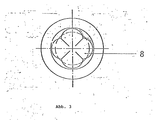
- Fig. 3 shows a cross section of a preferred surface structure of the break-off part (8), which is composed of 4 semicircles in a rosette shape.
- Fig. 4 shows an embodiment in which the connecting piece (5), consisting of connecting part (7) and break-off part (8), is welded directly into the bag.
- the connecting hose (3) is glued directly into the open part of the system after the part has been welded in.
- the connecting piece (5) is connected to the blood bag via connecting part (7) (Fig. 2), the connecting piece (5) being connected to the bag (1) via a tube (1b) (as in Fig. 1) or directly to the bag (as shown in Fig. 4).
- Hose (3) and connecting part (7) of the connecting system (5) can also be designed such that hose (3) is inserted into the connecting part (7).
- the hose (3) with the connecting piece (5) and the bag (1) can be connected by gluing or welding or by other known joining techniques, such as ultrasound welding or rotary welding.
- Connection piece (5) is made of a transparent or colored plastic, which shows optimal properties both in steam sterilization and when breaking off.
- a slight through pressure on the break-off part (8) results in a free passage, wherein the predetermined breaking point (9) can be structured in such a way that part (8) still adheres to part (7), but preferably breaks off completely.
- Plastics such as hard polyvinyl chloride or Makrolon (registered trademark) are suitable for this application. It is essential that the materials have a lower density than 1 and thus the break-off part floats on the blood or blood preparation after separation.
- the connecting piece (5) is that it is almost flush with the upper edge of the blood bag (1) and therefore no contamination of the preparation can take place.
- the upper edge of the blood bag can also be designed such that the connecting piece (5) is located in a recess (1c) of the bag. This facilitates manipulation of the breaking off, because blood components of the bag (1) are not stirred up.
- Recess (1c) can also be designed as a bag, so that the break-off part (8) does not fall freely into the bag (1), but is retained in the bag.
Landscapes
- Health & Medical Sciences (AREA)
- Pharmacology & Pharmacy (AREA)
- Life Sciences & Earth Sciences (AREA)
- Animal Behavior & Ethology (AREA)
- General Health & Medical Sciences (AREA)
- Public Health (AREA)
- Veterinary Medicine (AREA)
- Hematology (AREA)
- Medical Preparation Storing Or Oral Administration Devices (AREA)
Description
- Die Erfindung betrifft Blutbeutel mit einem Verbindungssystem das ein Verbindungsstück (5) enthält aus Verbindungsteil (7), Abbrechteil (8), Sollbruchstelle (9) und ggf. Kragen (6), wobei das Verbindungsstück (5) unmittelbar mit dem Blutbeutel (1) verbunden ist, derart, daß es sich direkt an der oberen Beutelkante befindet und mit dieser im wesentlichen bündig abschließt, wobei Abbrechteil (8) in den Beutel hineinragt, so daß das Abbrechteil (8) nach dem Abbrechen im-r-Beutelinneren vorliegt.
- Blutbeutel dienen zur Abnahme, Lagerung, Präparation und Transfusion von Blut und Blutbestandteilen. Einer der Vorteile der Blutbeutel gegenüber Blutflaschen aus Glas besteht darin, daß mit Mehrfachblutbeutel-Systemen Blutpräparationen in einem geschlossenen, d.h. sterilen System möglich sind. Die Herstellung von Blutpräparationen gewinnt im Rahmen von "Hämotherapie nach Maß" immer mehr Bedeutung.
- Mehrfachbeutelsysteme wie sie sich derzeit im Handel befinden, bestehen aus 2 oder mehr Beutelsystemen, bei denen im allgemeinen ein Primärbeutel die Blutstabilisatorlösung enthält und zur Aufnahme des Blutes dient. Zur Präparation der Blutbestandteile, wie Plasma, Faktor VIII-Konzentrat, Thrombozytenkonzentrat etc. dient der Sekundär- oder Satellitenbeutel oder das Satellitenbeutelsystem, das mit dem Primärbeutel mit einem Schlauchsystem verbunden ist.
- Damit die im Primärbeutel befindliche Lösung bzw. das abgenommene Blut vor der Präparation nicht in das Schlauchsystem des Sekundärbeutelsystems übertritt, trägt der Primärbeutel ein Verbindungssystem, das nach Öffnung einen Übertritt des Präparates vom Primär-, in den Sekundärbeutel erlaubt.
- Für dieses Verbindungssystem existieren verschiedene Ausführungsmöglichkeiten.
- So ist z.B. ein Verbindungssystem bekannt, das aus einer Kugel besteht, die in einen flexiblen Schlauch eingedrückt wird. Ein freier Durchlauf ist nach dem Herausdrücken der Kugel aus dem Schlauch möglich. Dieses System hat den Nachteil, daß unter extremen Bedingungen wie Überdruck, Zentrifugation, mechanische Veränderung des Schlauchdurchmessers etc. kein hermetischer Verschluß vorliegt.
- Es sind ferner Systeme bekannt, die Abklemmvorrichtungen aufweisen, die jedoch meist den Nachteil haben, daß sie voluminös sind und daß sich der eingesetzte Schlauch vor dem Einsatz der Beutel dauerhaft verengt oder verklebt hat, so daß nach Öffnung der Klemme kein freier Durchfluß gewährleistet ist.
- US-PS 3110 308 beschreibt ein Verbindungssystem, bestehend aus einer Membran, die mit einem kanülenartigen Dorn perforiert wird. Bei diesem System wird oft die umständliche und aufwendige Manipulation beanstandet.
- Ferner sind Abbrechsysteme bekannt, bei denen durch Abbrechen eines Kunststoffteils in einem Schlauchsystem ein freier Durchlauf möglich ist. Solche Systeme befinden sich außerhalb eines Blutbeutels in dem verbindungsschlauch zwischen Primär- und Sekundärbeutel (z.B. WO A-1-81/01105). Dies hat den Nachteil, daß häufig eine saubere und optimale Trennung der Blutpräparate nach z.B. Zentrifugation nicht möglich ist und eine Kontamination des Präparates erfolgt. Außerdem ist die Herstellung und Montage solcher Systeme aufwendig und kostspielig.
- Aus der FR-A-2 098 973 ist ein Blutbeutel mit einem Verbindungssystem gemäß dem Oberbegriff des Anspruchs 1 bekannt.
- Hier handelt es sich ebenfalls um ein Abbrechsystem, das jedoch gegenüber den vorstehend beschriebenen Abbruchsystemen den weiteren Vorteil aufweist, daß aufgrund seines bündigen Abschließens mit der oberen Blutbeutelkante eine Kontamination des Sekundärbeutels z.B. nach der Zentrifugation praktisch nicht möglich ist.
- Es kann jedoch den Nachteil besitzen, daß das nach dem Abbrechen im Beutelinneren vorliegende freie Abbrechteil den freien Durchlauf des Blutes durch die durch das Abbrechen entstandene Öffnung blockiert.
- Der Erfindung liegt die Aufgabe zugrunde, einen Blutbeutel mit einem Verbindungssystem bereitzustellen; der die Vorteile des gattungsgemäßen Blutbeutels mit einem Verbindungssystem aufweist, bei dem jedoch ein Blockieren des freien Durchlaufs durch das Abbrechteil weitestgehend vermieden wird.
- Diese Aufgabe wird erfindungsgemäß dadurch gelöst, daß das Abbrechteil aus einem Material besteht, das eine geringere Dichte hat als Blut.
- Ein Abbrechteil, das aus einem Material besteht, das eine geringere Dichte hat als Blut, wird nach der Abtrennung auf dem Blut oder Blutpräparat schwimmen und nicht absinken, wobei ein durch das Absinken mögliches Blockieren des Durchlaufs weitestgehend vermieden wird.
- Anhand der Abbildungen sollen Ausführungsarten der Erfindung weiter erläutert werden:
- Abb. 1 zeigt einen erfindungsgemäßen Blutbeutel mit Verbindungssystem, welcher Blutbeutel mit einem zweiten Blutbeutel verbunden ist.
- Abb. 2 zeigt das Verbindungssystem als solches.
- Abb. 3 zeigt einen Querschnitt durch eine besondere Ausführungsform des Abbrechteils und
- Abb. 4 zeigt eine Ausführungsform,bei der das Verbindungssystem direkt ohne Schlauch in den Blutbeutel eingearbeitet ist.
- Abb. 1 zeigt den Blutbeutel (1) (Primärbeutel) mit dem Blutentnahmeschlauch (4), der mit dem Blutbeutel (2) (Sekundärbeutel) durch einen Verbindungsschlauch (3) verbunden ist. Der Blutbeutel (1) wird durch das Verbindungsstück (5) flüssigkeitsdicht abgeschlossen. Bei Öffnung des Verbindungsstücks (5) kann das Präparat über den Verbindungsschlauch (3) in den Sekundärbeutel (2) überfließen. In der in Abb. 1 gezeigten Ausführungsform liegt ein Teil des Verbindungsstückes (5) in einer Aussparung (1 c). Es wird ferner ein Schlauch (1 b) gezeigt, der nach einer Ausführungsform sich zwischen Blutbeutel (1) und Verbindungsstück (5) befindet.
- Abb. 2 zeigt eine detaillierte Vergrößerung des als Verbindungssystem verwendeten Verbindungsstücks (5). Es besteht aus einem Kragen (6), Verbindungsteil (7), Abbrechteil (8) aus einem Material mit einer geringeren Dichte als Blut und Sollbruchstelle (9). Beim Einbau in den Blutbeutel wird Kragen (6) mit dem Verbindungsschlauch (3) verbunden, Verbindungsteil (7) ist mit dem Blutbeutel (1) hermetisch verbunden und Abbrechteil (8) ist mit Verbindungsteil (7) über die Abbrech- oder Sollbruchstelle (9) verbunden. Sollbruchstelle (9) ist so konstruiert, daß beim Abbrechen Verbindungsteil (7) einen freien Durchfluß erhält, der dem Lumen des Verbindungsteils (7) entspricht oder annähernd entspricht. Wenn Überleitungsschlauch (3) innerhalb des Kragens (6) eingeklebt wird, so entsteht nach Abbrechen des Abbruchteils (8) durch das komplette System ein freier Durchfluß, der annähernd das Lumen des Verbindungsschlauches (3) hat.
- Nach Öffnen des verbindungssystems verbleibt das Abbrechteil (8) im Primärbeutel (11). Wenn beim Auslaufen des Blutes aus dem Blutbeutel der Blutspiegel soweit abgesunken ist, daß er sich in der Höhe des Durchflusses befindet, könnte auch ein schwimmendes Abbrechteil den Durchfluß blockieren. Um auch in diesem Falle zu verhindern, daß das Abbrechteil bei der Ausführungsform, bei der es frei in den Beutel fällt, bei der Transfusion oder Präparation beim Lauf des Präparates durch den Schlauch (3) oder eventueller anderer Auslaufstutzen zu einem Verschluß des Durchflusses führt, trägt Abbrechteil (8) eine strukturierte Oberfläche, die ein Vorbeiströmen der Flüssigkeit zuläßt.
- Abb. 3 zeigt einen Querschnitt einer bevorzugten Oberflächenstruktur des Abbrechteils (8), die sich rosettenförmig aus 4 Halbkreisen zusammensetzt.
- Abb. 4 zeigt eine Ausführungsform, bei der das Verbindungsstück (5), bestehend aus Verbindungsteil (7) und Abbrechteil (8), direkt in den Beutel eingeschweißt wird. Der Verbindungsschlauch (3) wird in diesem Fall nach dem Einschweißen des Teils direkt in das offene Teil des Systems eingeklebt.
- Das Verbindungsstück (5) wird über Verbindungsteil (7) (Abb. 2) mit dem Blutbeutel verbunden, wobei das Verbindungsstück (5) über einen Schlauch (1b) des Beutels (1) (wie in Abb.1) oder direkt mit dem Beutel (wie in Abb. 4) verbunden wird. Schlauch (3) und Verbindungsteil (7) des Verbindungssystems (5) können auch derart ausgeführt werden, daß Schlauch (3) bis in Verbindungsteil (7) eingeführt wird.
- Die Verbindung vom Schlauch (3) mit Verbindungsstück (5) und Beutel (1) kann durch Kleben oder Schweißen oder durch sonstige bekannte Fügetechniken, wie Ultraschallschweißung oder Rotationsschweißen erfolgen.
- Verbindungsstück (5) wird aus einem transparenten oder gefärbten Kunststoff hergestellt, der sowohl bei der Dampfsterilisation als auch beim Abbrechen optimale Eigenschaften zeigt.
- Durch einen leichten Schrägdruck auf Abbrechteil (8) wird ein freier Durchlauf erreicht, wobei Sollbruchstelle (9) so strukturiert sein kann, daß Teil (8) noch an Teil (7) haftet, vorzugsweise jedoch komplett abbricht. Kunststoffe, wie Hart-Polyvinylchlorid oder Makrolon (eingetr. Marke), sind für diesen Einsatz geeignet. Wesentlich ist dabei, daß die Materialien eine geringere Dichte als 1 haben und dadurch das Abbrechteil nach Abtrennung auf dem Blut oder Blutpräparat schwimmt.
- Der Vorteil von Verbindungsstück (5) besteht darin, daß es nahezu bündig mit der Oberkante des Blutbeutels (1) abschließt und dadurch keine Kontamination des Präparates erfolgen kann. Wie in Abb. 1 oder 4 gezeigt wird, kann die Blutbeuteloberkante auch derart ausgeführt werden, daß sich Verbindungsstück (5) in einer Aussparung (1c) des Beutels befindet. Dies erleichtert die Manipulation des Abbrechens, weil hierbei Blutbestandteile des Beutels (1) nicht aufgerührt werden. Aussparung (1c) kann auch als Tasche ausgeführt sein, so daß Abbrechteil (8) nicht frei in den Beutel (1) fällt, sondern in der Tasche zurückgehalten wird.
Claims (6)
Priority Applications (2)
| Application Number | Priority Date | Filing Date | Title |
|---|---|---|---|
| EP81106885A EP0073847B1 (de) | 1981-09-03 | 1981-09-03 | Blutbeutel mit einem Verbindungssystem |
| AT81106885T ATE23271T1 (de) | 1981-09-03 | 1981-09-03 | Blutbeutel mit einem verbindungssystem. |
Applications Claiming Priority (1)
| Application Number | Priority Date | Filing Date | Title |
|---|---|---|---|
| EP81106885A EP0073847B1 (de) | 1981-09-03 | 1981-09-03 | Blutbeutel mit einem Verbindungssystem |
Publications (2)
| Publication Number | Publication Date |
|---|---|
| EP0073847A1 EP0073847A1 (de) | 1983-03-16 |
| EP0073847B1 true EP0073847B1 (de) | 1986-11-05 |
Family
ID=8187893
Family Applications (1)
| Application Number | Title | Priority Date | Filing Date |
|---|---|---|---|
| EP81106885A Expired EP0073847B1 (de) | 1981-09-03 | 1981-09-03 | Blutbeutel mit einem Verbindungssystem |
Country Status (2)
| Country | Link |
|---|---|
| EP (1) | EP0073847B1 (de) |
| AT (1) | ATE23271T1 (de) |
Families Citing this family (6)
| Publication number | Priority date | Publication date | Assignee | Title |
|---|---|---|---|---|
| JPS607833U (ja) * | 1983-06-27 | 1985-01-19 | テルモ株式会社 | 血液バツグ装置 |
| JPS6171064A (ja) * | 1984-09-13 | 1986-04-11 | 日本赤十字社 | 血液成分の分離用器具 |
| AU578554B2 (en) * | 1986-01-24 | 1988-10-27 | Japanese Red Cross Society | Centrifugal method of separating blood components |
| US6491679B1 (en) * | 1997-10-20 | 2002-12-10 | Rodney Okamoto | System for infusing intravenous nutrition solutions |
| FR2820029B1 (fr) * | 2001-01-26 | 2003-04-25 | Pascal Lecointe | Sachet et bande de sachets de conditionnement de substance, a canule et embout integres |
| DE10244154A1 (de) * | 2002-09-23 | 2004-04-08 | Prisma Diagnostika Gmbh | Trägerelement für diagnostische Tests |
Citations (1)
| Publication number | Priority date | Publication date | Assignee | Title |
|---|---|---|---|---|
| FR2098873A5 (de) * | 1970-07-30 | 1972-03-10 | Labaz Laboratoires |
Family Cites Families (8)
| Publication number | Priority date | Publication date | Assignee | Title |
|---|---|---|---|---|
| US2819805A (en) * | 1953-10-05 | 1958-01-14 | Price Battery Corp | Battery component assembling machines |
| AT203145B (de) * | 1956-10-30 | 1959-04-25 | Vifor Sa | Vorrichtung zur Infusion von Flüssigkeiten |
| US3158165A (en) * | 1961-06-20 | 1964-11-24 | Torrington Co | Valve assembly and method of making it |
| CH401363A (fr) * | 1964-05-13 | 1965-10-31 | Vifor Sa | Appareil pour l'infusion de liquides dans un corps |
| US3470893A (en) * | 1968-03-04 | 1969-10-07 | Illinois Tool Works | Fluid distribution unit |
| DE7719528U1 (de) * | 1977-06-22 | 1978-03-16 | Knoll Ag, 6700 Ludwigshafen | Infusionsbeutel |
| US4181140A (en) * | 1978-02-10 | 1980-01-01 | Baxter Travenol Laboratories, Inc. | Frangible resealable closure for a flexible tube having hold open means |
| US4340049A (en) * | 1979-10-18 | 1982-07-20 | Baxter Travenol Laboratories, Inc. | Breakaway valve |
-
1981
- 1981-09-03 EP EP81106885A patent/EP0073847B1/de not_active Expired
- 1981-09-03 AT AT81106885T patent/ATE23271T1/de not_active IP Right Cessation
Patent Citations (1)
| Publication number | Priority date | Publication date | Assignee | Title |
|---|---|---|---|---|
| FR2098873A5 (de) * | 1970-07-30 | 1972-03-10 | Labaz Laboratoires |
Also Published As
| Publication number | Publication date |
|---|---|
| EP0073847A1 (de) | 1983-03-16 |
| ATE23271T1 (de) | 1986-11-15 |
Similar Documents
| Publication | Publication Date | Title |
|---|---|---|
| DE68904332T2 (de) | Koerperfluessigkeitssammler. | |
| DE69424402T2 (de) | Medizinische behälteröffnung | |
| DE69302933T2 (de) | Arzneimittelabgabesystem | |
| EP0808148B1 (de) | Überleitungsgerät | |
| DE60207683T2 (de) | Verbindungsstück, Behälter mit solchem Verbindungsstück und Flüssigkeitaufbereitungsvorrichtung mit passendem Verbindungsstück für einen solchen Behälter | |
| DE2917767C2 (de) | Flüssigkeitssammelgerät | |
| DE69302146T2 (de) | Durchfluss-stück mit brechbarem Propfen | |
| DE69822495T2 (de) | Nadellose injektionsstelle | |
| DE69114086T2 (de) | Ventileinheit mit nach beiden Richtungen öffnendem Schlitz. | |
| DE3852638T2 (de) | Beutellose, kontinuierliche, ambulante peritonealdialyse. | |
| DE3784064T2 (de) | Einheitlicher, steriler fluessigkeitsverabreichungszusammenbau und herstellungsverfahren. | |
| DE2819507A1 (de) | Beutel zum sammeln, speichern, verabreichen und filtern von blut, blutkomponenten, intravenoesen und aehnlichen fluessigkeiten | |
| DE2835101A1 (de) | Blutentnahmeeinrichtung | |
| DE3413692C2 (de) | Blutbeutelanordnung | |
| DE7933323U1 (de) | Schlauchkupplung | |
| DE2647624A1 (de) | Verschluss mit halterung fuer einen behaelter | |
| DE2439392A1 (de) | Vorrichtung und verfahren zum aseptischen sammeln von fluiden durch unterdruck | |
| DE2628719A1 (de) | Verbindungsstueck zur entnahme von fluessigkeitsproben aus einer geschlossenen anordnung zur ableitung einer fluessigkeit | |
| EP0073847B1 (de) | Blutbeutel mit einem Verbindungssystem | |
| DE2909859A1 (de) | Verschlusskappe zur anbringung an einem behaelterhals und verfahren zu ihrer herstellung | |
| US4435179A (en) | Blood bags with interconnecting system | |
| DE2215486B2 (de) | MeBgefäßanordnung für ein Teilchenmeßgerät | |
| DE2853635C2 (de) | Kupplung für medizinische Schlauchverbindungen | |
| DE20200689U1 (de) | Einschweiß-Schiffchen für einen Beutel | |
| WO2010085990A1 (de) | Blutplasma-behälter |
Legal Events
| Date | Code | Title | Description |
|---|---|---|---|
| PUAI | Public reference made under article 153(3) epc to a published international application that has entered the european phase |
Free format text: ORIGINAL CODE: 0009012 |
|
| AK | Designated contracting states |
Designated state(s): AT BE FR GB NL |
|
| 17P | Request for examination filed |
Effective date: 19830721 |
|
| GRAA | (expected) grant |
Free format text: ORIGINAL CODE: 0009210 |
|
| AK | Designated contracting states |
Kind code of ref document: B1 Designated state(s): AT BE FR GB NL |
|
| PG25 | Lapsed in a contracting state [announced via postgrant information from national office to epo] |
Ref country code: BE Effective date: 19861105 |
|
| REF | Corresponds to: |
Ref document number: 23271 Country of ref document: AT Date of ref document: 19861115 Kind code of ref document: T |
|
| ET | Fr: translation filed | ||
| PLBE | No opposition filed within time limit |
Free format text: ORIGINAL CODE: 0009261 |
|
| STAA | Information on the status of an ep patent application or granted ep patent |
Free format text: STATUS: NO OPPOSITION FILED WITHIN TIME LIMIT |
|
| PG25 | Lapsed in a contracting state [announced via postgrant information from national office to epo] |
Ref country code: AT Effective date: 19870903 |
|
| 26N | No opposition filed | ||
| REG | Reference to a national code |
Ref country code: FR Ref legal event code: CN |
|
| NLS | Nl: assignments of ep-patents |
Owner name: BIOTEST AKTIENGESELLSCHAFT TE FRANKFORT A.D. MAIN, |
|
| PGFP | Annual fee paid to national office [announced via postgrant information from national office to epo] |
Ref country code: FR Payment date: 19900928 Year of fee payment: 10 Ref country code: GB Payment date: 19900928 Year of fee payment: 10 |
|
| PGFP | Annual fee paid to national office [announced via postgrant information from national office to epo] |
Ref country code: NL Payment date: 19900930 Year of fee payment: 10 |
|
| PG25 | Lapsed in a contracting state [announced via postgrant information from national office to epo] |
Ref country code: GB Effective date: 19910903 |
|
| PG25 | Lapsed in a contracting state [announced via postgrant information from national office to epo] |
Ref country code: NL Effective date: 19920401 |
|
| GBPC | Gb: european patent ceased through non-payment of renewal fee | ||
| NLV4 | Nl: lapsed or anulled due to non-payment of the annual fee | ||
| PG25 | Lapsed in a contracting state [announced via postgrant information from national office to epo] |
Ref country code: FR Effective date: 19920529 |
|
| REG | Reference to a national code |
Ref country code: FR Ref legal event code: ST |