EP0070789B1 - Procédé de destruction de produits à base de matières organiques contenant du soufre et/ou des halogènes et/ou des métaux toxiques et applications de celui-ci - Google Patents
Procédé de destruction de produits à base de matières organiques contenant du soufre et/ou des halogènes et/ou des métaux toxiques et applications de celui-ci Download PDFInfo
- Publication number
- EP0070789B1 EP0070789B1 EP19820420098 EP82420098A EP0070789B1 EP 0070789 B1 EP0070789 B1 EP 0070789B1 EP 19820420098 EP19820420098 EP 19820420098 EP 82420098 A EP82420098 A EP 82420098A EP 0070789 B1 EP0070789 B1 EP 0070789B1
- Authority
- EP
- European Patent Office
- Prior art keywords
- bath
- process according
- halogens
- alkali metal
- alkaline earth
- Prior art date
- Legal status (The legal status is an assumption and is not a legal conclusion. Google has not performed a legal analysis and makes no representation as to the accuracy of the status listed.)
- Expired
Links
Classifications
-
- C—CHEMISTRY; METALLURGY
- C10—PETROLEUM, GAS OR COKE INDUSTRIES; TECHNICAL GASES CONTAINING CARBON MONOXIDE; FUELS; LUBRICANTS; PEAT
- C10B—DESTRUCTIVE DISTILLATION OF CARBONACEOUS MATERIALS FOR PRODUCTION OF GAS, COKE, TAR, OR SIMILAR MATERIALS
- C10B53/00—Destructive distillation, specially adapted for particular solid raw materials or solid raw materials in special form
- C10B53/07—Destructive distillation, specially adapted for particular solid raw materials or solid raw materials in special form of solid raw materials consisting of synthetic polymeric materials, e.g. tyres
-
- B—PERFORMING OPERATIONS; TRANSPORTING
- B29—WORKING OF PLASTICS; WORKING OF SUBSTANCES IN A PLASTIC STATE IN GENERAL
- B29B—PREPARATION OR PRETREATMENT OF THE MATERIAL TO BE SHAPED; MAKING GRANULES OR PREFORMS; RECOVERY OF PLASTICS OR OTHER CONSTITUENTS OF WASTE MATERIAL CONTAINING PLASTICS
- B29B17/00—Recovery of plastics or other constituents of waste material containing plastics
- B29B17/04—Disintegrating plastics, e.g. by milling
-
- C—CHEMISTRY; METALLURGY
- C10—PETROLEUM, GAS OR COKE INDUSTRIES; TECHNICAL GASES CONTAINING CARBON MONOXIDE; FUELS; LUBRICANTS; PEAT
- C10B—DESTRUCTIVE DISTILLATION OF CARBONACEOUS MATERIALS FOR PRODUCTION OF GAS, COKE, TAR, OR SIMILAR MATERIALS
- C10B49/00—Destructive distillation of solid carbonaceous materials by direct heating with heat-carrying agents including the partial combustion of the solid material to be treated
- C10B49/14—Destructive distillation of solid carbonaceous materials by direct heating with heat-carrying agents including the partial combustion of the solid material to be treated with hot liquids, e.g. molten metals
-
- C—CHEMISTRY; METALLURGY
- C10—PETROLEUM, GAS OR COKE INDUSTRIES; TECHNICAL GASES CONTAINING CARBON MONOXIDE; FUELS; LUBRICANTS; PEAT
- C10B—DESTRUCTIVE DISTILLATION OF CARBONACEOUS MATERIALS FOR PRODUCTION OF GAS, COKE, TAR, OR SIMILAR MATERIALS
- C10B53/00—Destructive distillation, specially adapted for particular solid raw materials or solid raw materials in special form
-
- C—CHEMISTRY; METALLURGY
- C10—PETROLEUM, GAS OR COKE INDUSTRIES; TECHNICAL GASES CONTAINING CARBON MONOXIDE; FUELS; LUBRICANTS; PEAT
- C10J—PRODUCTION OF PRODUCER GAS, WATER-GAS, SYNTHESIS GAS FROM SOLID CARBONACEOUS MATERIAL, OR MIXTURES CONTAINING THESE GASES; CARBURETTING AIR OR OTHER GASES
- C10J3/00—Production of combustible gases containing carbon monoxide from solid carbonaceous fuels
- C10J3/57—Gasification using molten salts or metals
-
- H—ELECTRICITY
- H01—ELECTRIC ELEMENTS
- H01B—CABLES; CONDUCTORS; INSULATORS; SELECTION OF MATERIALS FOR THEIR CONDUCTIVE, INSULATING OR DIELECTRIC PROPERTIES
- H01B15/00—Apparatus or processes for salvaging material from cables
-
- A—HUMAN NECESSITIES
- A62—LIFE-SAVING; FIRE-FIGHTING
- A62D—CHEMICAL MEANS FOR EXTINGUISHING FIRES OR FOR COMBATING OR PROTECTING AGAINST HARMFUL CHEMICAL AGENTS; CHEMICAL MATERIALS FOR USE IN BREATHING APPARATUS
- A62D2101/00—Harmful chemical substances made harmless, or less harmful, by effecting chemical change
- A62D2101/20—Organic substances
- A62D2101/22—Organic substances containing halogen
-
- A—HUMAN NECESSITIES
- A62—LIFE-SAVING; FIRE-FIGHTING
- A62D—CHEMICAL MEANS FOR EXTINGUISHING FIRES OR FOR COMBATING OR PROTECTING AGAINST HARMFUL CHEMICAL AGENTS; CHEMICAL MATERIALS FOR USE IN BREATHING APPARATUS
- A62D2101/00—Harmful chemical substances made harmless, or less harmful, by effecting chemical change
- A62D2101/20—Organic substances
- A62D2101/24—Organic substances containing heavy metals
-
- A—HUMAN NECESSITIES
- A62—LIFE-SAVING; FIRE-FIGHTING
- A62D—CHEMICAL MEANS FOR EXTINGUISHING FIRES OR FOR COMBATING OR PROTECTING AGAINST HARMFUL CHEMICAL AGENTS; CHEMICAL MATERIALS FOR USE IN BREATHING APPARATUS
- A62D2101/00—Harmful chemical substances made harmless, or less harmful, by effecting chemical change
- A62D2101/20—Organic substances
- A62D2101/28—Organic substances containing oxygen, sulfur, selenium or tellurium, i.e. chalcogen
-
- A—HUMAN NECESSITIES
- A62—LIFE-SAVING; FIRE-FIGHTING
- A62D—CHEMICAL MEANS FOR EXTINGUISHING FIRES OR FOR COMBATING OR PROTECTING AGAINST HARMFUL CHEMICAL AGENTS; CHEMICAL MATERIALS FOR USE IN BREATHING APPARATUS
- A62D2101/00—Harmful chemical substances made harmless, or less harmful, by effecting chemical change
- A62D2101/40—Inorganic substances
- A62D2101/43—Inorganic substances containing heavy metals, in the bonded or free state
-
- B—PERFORMING OPERATIONS; TRANSPORTING
- B29—WORKING OF PLASTICS; WORKING OF SUBSTANCES IN A PLASTIC STATE IN GENERAL
- B29B—PREPARATION OR PRETREATMENT OF THE MATERIAL TO BE SHAPED; MAKING GRANULES OR PREFORMS; RECOVERY OF PLASTICS OR OTHER CONSTITUENTS OF WASTE MATERIAL CONTAINING PLASTICS
- B29B17/00—Recovery of plastics or other constituents of waste material containing plastics
- B29B17/04—Disintegrating plastics, e.g. by milling
- B29B2017/0424—Specific disintegrating techniques; devices therefor
- B29B2017/0496—Pyrolysing the materials
-
- B—PERFORMING OPERATIONS; TRANSPORTING
- B29—WORKING OF PLASTICS; WORKING OF SUBSTANCES IN A PLASTIC STATE IN GENERAL
- B29L—INDEXING SCHEME ASSOCIATED WITH SUBCLASS B29C, RELATING TO PARTICULAR ARTICLES
- B29L2030/00—Pneumatic or solid tyres or parts thereof
-
- C—CHEMISTRY; METALLURGY
- C10—PETROLEUM, GAS OR COKE INDUSTRIES; TECHNICAL GASES CONTAINING CARBON MONOXIDE; FUELS; LUBRICANTS; PEAT
- C10J—PRODUCTION OF PRODUCER GAS, WATER-GAS, SYNTHESIS GAS FROM SOLID CARBONACEOUS MATERIAL, OR MIXTURES CONTAINING THESE GASES; CARBURETTING AIR OR OTHER GASES
- C10J2300/00—Details of gasification processes
- C10J2300/09—Details of the feed, e.g. feeding of spent catalyst, inert gas or halogens
- C10J2300/0913—Carbonaceous raw material
- C10J2300/0946—Waste, e.g. MSW, tires, glass, tar sand, peat, paper, lignite, oil shale
-
- C—CHEMISTRY; METALLURGY
- C10—PETROLEUM, GAS OR COKE INDUSTRIES; TECHNICAL GASES CONTAINING CARBON MONOXIDE; FUELS; LUBRICANTS; PEAT
- C10J—PRODUCTION OF PRODUCER GAS, WATER-GAS, SYNTHESIS GAS FROM SOLID CARBONACEOUS MATERIAL, OR MIXTURES CONTAINING THESE GASES; CARBURETTING AIR OR OTHER GASES
- C10J2300/00—Details of gasification processes
- C10J2300/09—Details of the feed, e.g. feeding of spent catalyst, inert gas or halogens
- C10J2300/0953—Gasifying agents
- C10J2300/0956—Air or oxygen enriched air
-
- C—CHEMISTRY; METALLURGY
- C10—PETROLEUM, GAS OR COKE INDUSTRIES; TECHNICAL GASES CONTAINING CARBON MONOXIDE; FUELS; LUBRICANTS; PEAT
- C10J—PRODUCTION OF PRODUCER GAS, WATER-GAS, SYNTHESIS GAS FROM SOLID CARBONACEOUS MATERIAL, OR MIXTURES CONTAINING THESE GASES; CARBURETTING AIR OR OTHER GASES
- C10J2300/00—Details of gasification processes
- C10J2300/09—Details of the feed, e.g. feeding of spent catalyst, inert gas or halogens
- C10J2300/0953—Gasifying agents
- C10J2300/0973—Water
- C10J2300/0976—Water as steam
-
- C—CHEMISTRY; METALLURGY
- C10—PETROLEUM, GAS OR COKE INDUSTRIES; TECHNICAL GASES CONTAINING CARBON MONOXIDE; FUELS; LUBRICANTS; PEAT
- C10J—PRODUCTION OF PRODUCER GAS, WATER-GAS, SYNTHESIS GAS FROM SOLID CARBONACEOUS MATERIAL, OR MIXTURES CONTAINING THESE GASES; CARBURETTING AIR OR OTHER GASES
- C10J2300/00—Details of gasification processes
- C10J2300/09—Details of the feed, e.g. feeding of spent catalyst, inert gas or halogens
- C10J2300/0983—Additives
- C10J2300/0996—Calcium-containing inorganic materials, e.g. lime
-
- Y—GENERAL TAGGING OF NEW TECHNOLOGICAL DEVELOPMENTS; GENERAL TAGGING OF CROSS-SECTIONAL TECHNOLOGIES SPANNING OVER SEVERAL SECTIONS OF THE IPC; TECHNICAL SUBJECTS COVERED BY FORMER USPC CROSS-REFERENCE ART COLLECTIONS [XRACs] AND DIGESTS
- Y02—TECHNOLOGIES OR APPLICATIONS FOR MITIGATION OR ADAPTATION AGAINST CLIMATE CHANGE
- Y02P—CLIMATE CHANGE MITIGATION TECHNOLOGIES IN THE PRODUCTION OR PROCESSING OF GOODS
- Y02P20/00—Technologies relating to chemical industry
- Y02P20/141—Feedstock
- Y02P20/143—Feedstock the feedstock being recycled material, e.g. plastics
-
- Y—GENERAL TAGGING OF NEW TECHNOLOGICAL DEVELOPMENTS; GENERAL TAGGING OF CROSS-SECTIONAL TECHNOLOGIES SPANNING OVER SEVERAL SECTIONS OF THE IPC; TECHNICAL SUBJECTS COVERED BY FORMER USPC CROSS-REFERENCE ART COLLECTIONS [XRACs] AND DIGESTS
- Y02—TECHNOLOGIES OR APPLICATIONS FOR MITIGATION OR ADAPTATION AGAINST CLIMATE CHANGE
- Y02W—CLIMATE CHANGE MITIGATION TECHNOLOGIES RELATED TO WASTEWATER TREATMENT OR WASTE MANAGEMENT
- Y02W30/00—Technologies for solid waste management
- Y02W30/50—Reuse, recycling or recovery technologies
- Y02W30/62—Plastics recycling; Rubber recycling
-
- Y—GENERAL TAGGING OF NEW TECHNOLOGICAL DEVELOPMENTS; GENERAL TAGGING OF CROSS-SECTIONAL TECHNOLOGIES SPANNING OVER SEVERAL SECTIONS OF THE IPC; TECHNICAL SUBJECTS COVERED BY FORMER USPC CROSS-REFERENCE ART COLLECTIONS [XRACs] AND DIGESTS
- Y02—TECHNOLOGIES OR APPLICATIONS FOR MITIGATION OR ADAPTATION AGAINST CLIMATE CHANGE
- Y02W—CLIMATE CHANGE MITIGATION TECHNOLOGIES RELATED TO WASTEWATER TREATMENT OR WASTE MANAGEMENT
- Y02W30/00—Technologies for solid waste management
- Y02W30/50—Reuse, recycling or recovery technologies
- Y02W30/82—Recycling of waste of electrical or electronic equipment [WEEE]
Definitions
- the invention relates to the treatment by pyrolysis of liquid products of petroleum origin containing sulfur and / or halogens with a view to eliminating them.
- the elimination of toxic metals is also concerned.
- the salts are generally chlorides, of the type for example LiCL, KCL or ZnCI 2 and mixtures of alkaline carbonates (K 2 CO 3 , Na 2 CO 3 ) containing various proportions of sulfates, sulfides and sulfites.
- This technique has the advantage of allowing excellent heat transfer and of fixing halogens and sulfur, whether the aim of the operation is the production of a gaseous or liquid fuel offered (FR 2109927, FR 2 274 675, FR 2,452,965) or the destruction of highly toxic but thermally very stable waste such as chlorobiphenyls (WO 80.100230).
- the object of the invention is to remedy certain drawbacks of pyrolysis techniques based on the use of known molten salts, while retaining the main advantage, namely a very rapid heat transfer, to which is added a complexing capacity of the atoms. undesirable.
- the pyrolysis takes place essentially in the absence of water, according to the invention which therefore relates to a process for the treatment of liquid products of petroleum origin containing sulfur and / or halogens to obtain products essentially liquids free of sulfur and / or halogens; pyrolysis is carried out in a bath of molten salts essentially free of water and consisting of one or more compounds chosen from alkali and alkaline earth hydroxides and oxides, at a temperature between 170 ° C and 550 ° C.
- sulfur and / or halogen is intended to denote these elements whatever their degree of oxidation, sulfur or elementary halogens (degree of oxidation 0) as well as sulfur and radical or ionic halogens (sulphides, mineral polysulphides or organic, mineral or organic halides, hypohalides, etc.).
- Halogens are conventionally fluorine, chlorine, bromine and iodine.
- toxic or corrosive metals By toxic or corrosive metals is meant the technically toxic or simply corrosive metals belonging in particular to columns III, IV, V, VI, VIII of the Mendeleev periodic classification regardless of their degree of oxidation, that is to say say that they are present in the form of free metals, oxides, metal salts, organic acid salts (heavy metal soaps) or organometallic complexes (acetylacetonates, benzoylacetonates, ethylenesalicylamidines, ethytenenaphtaidimines, phthalocyanines, porphyrins , etc.)
- the metals particularly concerned capable of reacting with oxides, hydroxides and where appropriate the carbonates of alkali and alkaline-earth metals to give simple or complex salts soluble in salt baths in the molten state are for example vanadium , tin, lead, bismuth, antimony.
- the bath therefore consists of one or more compounds chosen from hydroxides and oxides of alkali and alkaline earth metals. Let us cite in particular NaOH, KOH, LiOH, CaO. In the case of mixtures, it is advantageous to use eutectic mixtures.
- the bath can also contain alkali and alkaline earth carbonates or bicarbonates such as Na 2 C0 3 , K 2 CO 3 , alone or as a mixture, and advantageously as eutectic mixtures with the hydroxides and / or oxides.
- alkali and alkaline earth carbonates or bicarbonates such as Na 2 C0 3 , K 2 CO 3 , alone or as a mixture, and advantageously as eutectic mixtures with the hydroxides and / or oxides.
- the bath may contain, in quantities which may even be preponderant, still other compounds, the sole presence of which is to promote the homogeneity of the bath or to lower its melting point by eutectic phenomenon.
- These are, for example, halides and sulfates.
- the temperature of the bath necessary for pyrolysis is generally between 170 ° and 550 ° C., the minimum temperature corresponding to the KOH / NaOH eutectic.
- the amount of active compound is of the order of 1 to 5 liters per kilogram of feed, with an amount sufficient to dissolve all the sulfur and / or the halogens and / or the metals of the feed. . It can also be added to the pyrolysis bath continuously, as it is consumed by reaction with sulfur and / or halogens.
- the chemical reactivity of pure alkaline and alkaline earth oxides and hydroxides or in mixture with carbonates makes it possible to fix sulfur, halogens and certain metals from 200 ° C.
- the pyrolysates essentially consist of an oil devoid of halogens and sulfur, and the metal content of which has been significantly lowered.
- a gaseous fraction can be obtained in the order of 10%.
- the oil is recovered by distillation at atmospheric pressure or under reduced pressure, by overflow due to its density less than that from the salt bath or by entrainment by means of a gas stream.
- the bath advantageously consists of one or more hydroxides (NaOH, KOH, LiOH for example) with optionally one or more carbonates.
- hydroxides NaOH, KOH, LiOH for example
- one of these compounds is used in admixture with alkali and / or alkaline earth halides.
- the proportion of active compound relative to the halides is preferably between 1 and 60% by weight, for example from 10 to 30%.
- halides are used such as NaCl, NaF, KCI, CaCl 2 , CaF 2 , alone or as mixtures within the limits of miscibility.
- the pyrolysis reaction can be schematized, in the case of calcium oxide, with the same conventions as above:
- CaX 2 is generated from CaO, which therefore goes in the direction of better dissolution of the latter.
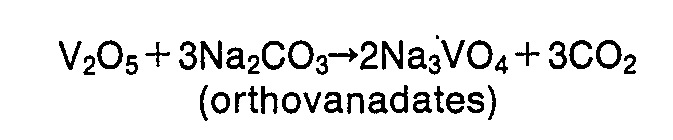
- vanadium the exact nature of vanadate depends on the reaction conditions and leads to three salts, namely orthovanadate, pyrovanadate and metavanadate, the latter being the most stable under the operating conditions envisaged; we can write these reactions schematically as follows: When the vanadium is in the form of a complex such as a vanadiated porphyrin, thermally stable almost at 400 ° C.
- vanadium in the form of a vanadyl anion V0 2 -
- vanadic oxide V 2 0 5 vanadic oxide V 2 0 5
- An oil fraction is recovered (approximately 85% by weight of the petroleum residue introduced) having the following characteristics:
- the vanadium present in the distillation residue is dosed in the form of vanadate in the mixture of carbonate and hydroxides.
- the nickel is distributed between the coked carbonaceous layer which floats above the salt bath (approximately 70% by weight of the petroleum residue introduced) and the salt bath proper.
Landscapes
- Chemical & Material Sciences (AREA)
- Engineering & Computer Science (AREA)
- Oil, Petroleum & Natural Gas (AREA)
- Organic Chemistry (AREA)
- Materials Engineering (AREA)
- Combustion & Propulsion (AREA)
- Mechanical Engineering (AREA)
- Environmental & Geological Engineering (AREA)
- Separation, Recovery Or Treatment Of Waste Materials Containing Plastics (AREA)
- Processing Of Solid Wastes (AREA)
- Fire-Extinguishing Compositions (AREA)
- Production Of Liquid Hydrocarbon Mixture For Refining Petroleum (AREA)
- Organic Low-Molecular-Weight Compounds And Preparation Thereof (AREA)
- Polymers With Sulfur, Phosphorus Or Metals In The Main Chain (AREA)
- Lubricants (AREA)
Description
- L'invention concerne le traitement par pyrolyse de produits liquides d'origine pétrolière contenant du soufre et/ou des halogènes en vue de les éliminer. L'élimination des métaux toxiques est également concernée.
- Dans les procédés de pyrolyse classique, les produits sont soumis à un chauffage en l'absence d'air, dans un four tournant, entre 600 et 800°C. Des améliorations leur ont été apportées, par exemple en introduisant dans le tambour des billes de céramique préchauffées. Mais ils présentent toujours des difficultés au niveau de la séparation des produits de la pyrolyse (noir de carbone, huile).
- Certains procédés de pyrolyse en bains de sels fondus ont été étudiés et proposés. Les sels sont généralement des chlorures, du type par exemple LiCL, KCL ou ZnCI2 et des mélanges de carbonates alcalins (K2CO3, Na2CO3) contenant diverses proportions de sulfates, sulfures et sulfites. Cette technique a l'avantage de permettre un excellent transfert de chaleur et de fixer les halogènes et le soufre, que le but de l'opération soit la production d'un combustible gazeux ou liquide proposé (FR 2109927, FR 2 274 675, FR 2 452 965) ou la destruction de déchets hautement toxiques mais thermiquement très stables comme les chlorobiphé- nyles (WO 80.100230).
- Dans US-A-3 440 164, plus spécifiquement consacré aux hydrocarbures liquides, la pyrolyse intervient dans un bain de sels alcalins fondus en présence d'un gaz contenant de l'oxygène et d'une quantité d'eau comprise entre 5 et 30% en poids du total.
- US-A-3 164 545 décrit un procédé de même nature que celui indiqué ci-dessus, en donnant plus de détails quant à l'importance de la présence d'eau.
- L'invention a pour objet de remédier à certains inconvénients des techniques de pyrolyse reposant sur l'emploi des sels fondus connus, tout en conservant le principal avantage, à savoir un transfert thermique très rapide, auquel s'ajoute une capacité de complexation des atomes indésirables.
- Au contraire de ce qui est indiqué précédemment, la pyrolyse se fait essentiellement en absence d'eau, selon l'invention qui concerne donc un procédé de traitement de produits liquides d'origine pétrolière contenant du soufre et/ou des halogènes pour obtenir des produits essentiellement liquides exempts de soufre et/ou d'halogènes; on procède à une pyrolyse dans un bain de sels fondus essentiellement exempt d'eau et constitué d'un ou plusieurs composés choisis parmi les hydroxydes et oxydes alcalins et alcalino-terreux, à une température comprise entre 170°C et 550°C.
- Par «soufre» et/ou «halogène», on entend désigner ces éléments quel que soit leur degré d'oxydation, soufre ou halogènes élémentaires (degré d'oxydation 0) aussi bien que soufre et halogènes radicalaires ou ioniques (sulfures, polysulfures minéraux ou organiques, halogènures minéraux ou organiques, hypohalogénures, etc.).
- Les halogènes sont classiquement le fluor, le chlore, le brome et l'iode.
- Par métaux toxiques ou corrosifs, on entend désigner les métaux franchement toxiques ou simplement corrosifs appartenant notamment aux colonnes III, IV, V, VI, VIII de la classification périodique de Mendeleev quel que soit leur degré d'oxydation, c'est-à-dire qu'ils soient présents sous forme de métaux libres, d'oxydes, de sels métalliques, de sels d'acides organiques (savons de métaux lourds) ou de complexes organométalliques (acétylacétonates, benzoylacétonates, éthylènesalicylamidines, éthytènenaphtaidimi- nes, phtalocyanines, porphyrines, etc.)
- Les métaux particulièrement concernés, susceptibles de réagir avec des oxydes, des hydroxydes et le cas échéant les carbonates de métaux alcalins et alcalino-terreux pour donner des sels simples ou complexes solubles dans les bains de sel à l'état fondu sont par exemple le vanadium, l'étain, le plomb, le bismuth, l'antimoine.
- Le bain est donc constitué d'un ou plusieurs composés choisis parmi les hydroxydes et les oxydes de métaux alcalins et alcalino-terreux. Citons en particulier NaOH, KOH, LiOH, CaO. Dans le cas des mélanges, il est avantageux d'employer des mélanges eutectiques.
- Le bain peut contenir aussi des carbonates ou bicarbonates alcalins et alcalino-terreux tels que Na2C03, K2CO3, seuls ou en mélange, et avantageusement en mélanges eutectiques avec les hydroxydes et/ou oxydes.
- Le bain peut contenir, en quantités pouvant même être prépondérantes, d'autres composés encore, dont la seule présence est de favoriser l'homogénéité du bain ou d'abaisser son point de fusion par phénomène eutectique. Il s'agit par exemple d'halogènures et de sulfates.
- La température du bain nécessaire à la pyrolyse est généralement comprise entre 170° et 550°C, la température minimale correspondant à l'eutectique KOH/NaOH.
- A chaque traitement on s'assure que la quantité de composé actif est de l'ordre de 1 à 5 litres par kilogramme de charge, avec une quantité suffisante pour solubiliser tout le soufre et/ou les halogènes et/ou les métaux de la charge. Il peut d'ailleurs être ajouté dans le bain de pyrolyse en continu, au fur et à mesure de sa consommation par réaction avec le soufre et/ou les halogènes.
- La réactivité chimique des oxydes et des hydroxydes alcalins et alcalino-terreux purs ou en mélange avec des carbonates permet de fixer le soufre, les halogènes et certains métaux dès 200 °C. Dans les conditions opératoires comprises entre 200 et 550 °C, les pyrolysats sont essentiellement constitués d'une huile dépourvue d'halogènes et de soufre, et dont la teneur en métaux a été abaissée de façon significative. Une fraction gazeuse peut être obtenue de l'ordre de 10%. L'huile est récupérée par distillation à pression atmosphérique ou sous pression réduite, par débordement en raison de sa densité inférieure à celle du bain de sel ou par entraînement au moyen d'un courant gazeux.
- Le bain ayant une excellente conductibilité thermique et les échanges de chaleur étant immédiats, la cinétique de décomposition est de 10 à 20 fois plus rapide que dans des fours conventionnels, tout en étant de plus homogène.
- Le bain est avantageusement constitué d'un ou plusieurs hydroxydes (NaOH, KOH, LiOH par exemple) avec éventuellement un ou plusieurs carbonates. En variante, on utilise un de ces composés en mélange avec des halogènures alcalins et/ou alcalino-terreux. La proportion de composé actif par rapport aux halogènures est de préférence comprise entre 1 et 60% en poids, par exemple de 10 à 30%. En pratique, on utilise des halogènures tels que NaCl, NaF, KCI, CaC12, CaF2, seuls ou en mélanges dans les limites de miscibilité.
- Il est avantageux de régénérer périodiquement le bain par insufflation d'air et de fumée de combustion, ce qui donne lieu à la réaction

- En représentant l'halogène par X, la réaction de pyrolyse peut se schématiser, dans le cas de l'oxyde de calcium, avec les mêmes conventions que précédemment:

- Remarquons que CaX2 est généré à partir de CaO, ce qui va donc dans le sens d'une meilleure dissolution de celui-ci. En pratique, on travaille avec une teneur de l'ordre de 10% en poids qu'on maintient sensiblement constante par addition de CaO au fur et à mesure de sa consommation et de sa transformation en CaX2.
- Dans le cas des hydroxydes alcalins (NaOH, KOH, LiOH), les réactions sont plus complexes et dépendent de la température et de la nature des produits halogènes formés lors de la pyrolyse.
- Quand la matière organique contient à la fois du soufre et des halogènes, on travaille selon le système hydroxyde ou selon le système oxyde, avec ou sans carbonate.
- En représentant. le métal par Me (plus particulièrement vanadium, plomb, étain, antimoine) la pyrolyse ou le craquage conduit à la formation d'une série de sels complexes de formule générale:

- Par exemple dans le cas du vanadium, la nature exacte du vanadate dépend des conditions de réaction et conduit à trois sels, à savoir orthova- nadate, pyrovanadate et métavanadate, ce dernier étant le plus stable dans les conditions d'opération envisagées; on peut écrire schématiquement ces réactions de la façon suivante:


- L'exemple suivant illustre l'invention.
- Pour le traitement de démétallisation des résidus de distillation sous vide de pétrole ou de bruts lourds à haute teneur en métaux (nickel, vanadium) on procède de la façon suivante:
- 1) Fusion du bain de sels fondus constitué de NaOH/KOH/Na2C03/K2C03, maintenu à 450°C.
- 2) Introduction du résidu de distillation sous vide d'arabe léger préalablement préchauffé vers 100°C et ayant les caractéristiques suivantes:l'introduction du résidu pétrolier est réalisé au moyen d'un gaz vecteur inerte tel que l'azote, ce qui permet de maintenir un bon contact entre le produit pétrolier et le bain de sels fondus, et de faciliter la récupération du produit craqué et démétallisé.

- On récupère une fraction pétrolière (environ 85% en poids du résidu pétrolier introduit) ayant les caractéristiques suivantes:

- Le vanadium présent dans le résidu de distillation est dosé sous forme de vanadate dans le mélange de carbonate et d'hydroxydes. Le nickel se répartit entre la couche carbonée cokéfiée qui surnage au-dessus du bain de sel (environ 70% en poids du résidu pétrolier introduit) et le bain de sel proprement dit.
Claims (10)
Priority Applications (1)
| Application Number | Priority Date | Filing Date | Title |
|---|---|---|---|
| AT82420098T ATE32519T1 (de) | 1981-07-20 | 1982-07-13 | Verfahren zur vernichtung von auf organischen stoffen basierenden produkten, die schwefelund/oder halogene und/oder toxische metalle enthalten und anwendungen dieses verfahrens. |
Applications Claiming Priority (2)
| Application Number | Priority Date | Filing Date | Title |
|---|---|---|---|
| FR8114222 | 1981-07-20 | ||
| FR8114222A FR2509634B1 (fr) | 1981-07-20 | 1981-07-20 | Procede de destruction de produits a base de matieres organiques contenant du soufre et/ou des halogenes et applications de celui-ci |
Publications (3)
| Publication Number | Publication Date |
|---|---|
| EP0070789A2 EP0070789A2 (fr) | 1983-01-26 |
| EP0070789A3 EP0070789A3 (en) | 1984-07-18 |
| EP0070789B1 true EP0070789B1 (fr) | 1988-02-17 |
Family
ID=9260744
Family Applications (1)
| Application Number | Title | Priority Date | Filing Date |
|---|---|---|---|
| EP19820420098 Expired EP0070789B1 (fr) | 1981-07-20 | 1982-07-13 | Procédé de destruction de produits à base de matières organiques contenant du soufre et/ou des halogènes et/ou des métaux toxiques et applications de celui-ci |
Country Status (4)
| Country | Link |
|---|---|
| EP (1) | EP0070789B1 (fr) |
| AT (1) | ATE32519T1 (fr) |
| DE (1) | DE3278117D1 (fr) |
| FR (1) | FR2509634B1 (fr) |
Cited By (8)
| Publication number | Priority date | Publication date | Assignee | Title |
|---|---|---|---|---|
| EP0150208A4 (fr) * | 1983-07-27 | 1985-10-24 | Kenneth W Hladun | Appareil pour la pyrolyse de materiaux contenant des hydrocarbures. |
| EP0125383A3 (fr) * | 1983-05-16 | 1986-07-16 | Rockwell International Corporation | Destruction de matériaux contenant des halogènes |
| WO1992017245A1 (fr) * | 1991-03-27 | 1992-10-15 | Metallwarenfabrik Stockach Gmbh | Procede de reduction de la teneur en substances polluantes de gaz de fumee degages pendant des processus thermiques |
| EP0515727A1 (fr) * | 1991-05-20 | 1992-12-02 | Rockwell International Corporation | Système pour le traitement de déchets |
| EP0572954A1 (fr) * | 1992-06-01 | 1993-12-08 | Rockwell International Corporation | Destruction de déchets contenant de l'alumine, silica, calcium et azote par oxydation dans un sel fondu |
| US5449438A (en) * | 1992-10-06 | 1995-09-12 | Formex Trading Gmbh | Apparatus and method for the pyrolysis of crushed organic waste matter |
| US5663250A (en) * | 1996-05-16 | 1997-09-02 | Shell Oil Company | Deprotection with molten salt |
| DE102005063160B4 (de) * | 2005-12-30 | 2010-11-25 | Spiegelberg, Volker, Dipl.-Ing. | Verfahren und Einrichtung zur Entsorgung und sowohl energetischen als auch stofflichen Nutzung von Abfällen mit Komponenten von vulkanisiertem Kautschuk und Polymer |
Families Citing this family (20)
| Publication number | Priority date | Publication date | Assignee | Title |
|---|---|---|---|---|
| DE4026188A1 (de) * | 1990-08-18 | 1992-02-20 | Reimbold & Strick | Wertstoffgewinnung von nichtfluechtigen, anorganischen kunststoffadditiven |
| DE19509626A1 (de) * | 1995-03-21 | 1996-09-26 | Metallgesellschaft Ag | Verfahren zum Behandeln flüssiger Schlacke, die beim Verbrennen oder Vergasen von Abfallstoffen entfällt |
| FR2743009A1 (fr) * | 1995-12-28 | 1997-07-04 | Fortin Claude Antoine Gabriel | Materiels et procedes de chloruration et de reduction en vase clos |
| DE19629544C2 (de) * | 1996-07-22 | 1998-10-22 | Linde Kca Dresden Gmbh | Verfahren zur Aufbereitung von Polyvinylchlorid (PVC) sowie Verwendung des Verfahrens |
| WO1999001182A1 (fr) * | 1997-07-03 | 1999-01-14 | Claude Fortin | Materiels et procedes de chloruration et de reduction en vase clos |
| BE1011558A7 (fr) * | 1997-11-20 | 1999-10-05 | Debailleul Gerard | Separation des matieres constituantes des pneumatiques, par procede thermo-chimique. |
| EP1077747B1 (fr) * | 1998-07-17 | 2001-12-12 | Frank Detlef | Procede pour la decomposition materielle de materiaux composites renfermant une resine synthetique |
| RU2160300C2 (ru) * | 1998-09-15 | 2000-12-10 | Новосибирский государственный проектно-изыскательский институт "ВНИПИЭТ" | Способ переработки твердых органических отходов, установка и деструктор для его осуществления |
| US7241377B2 (en) * | 2003-09-04 | 2007-07-10 | Dtx Technologies, Llc | Salt bath refining |
| CZ200532A3 (cs) * | 2005-01-17 | 2006-11-15 | Lysytchuk@Oleg | Zpusob zpracování uhlovodíkových surovin, zejménasurové ropy, a zarízení k provádení tohoto zpusobu |
| UA88577C2 (ru) * | 2008-06-12 | 2009-10-26 | Украинский Государственный Научно-Технический Центр По Технологии И Оборудованию, Обработке Металлов, Защите Окружающей Среды И Использованию Вторичных Ресурсов Для Металлургии И Машиностроения "Энергосталь" | Плавильная печь для термического уничтожения ядохимикатов |
| RU2398998C1 (ru) * | 2009-06-09 | 2010-09-10 | Общество с ограниченной ответственностью "Эко-Прогтех" | Установка для утилизации органических отходов и нефтешламов |
| RU2403499C1 (ru) * | 2009-07-03 | 2010-11-10 | Владимир Васильевич Масленников | Установка для утилизации органических отходов и нефтешламов |
| RU2406031C1 (ru) * | 2009-08-11 | 2010-12-10 | Владимир Васильевич Масленников | Реактор для переработки органических отходов и нефтешламов |
| MD4188C1 (ro) * | 2011-11-07 | 2013-06-30 | Валерий ДИНТОВ | Instalaţie pentru prelucrarea materiei prime ce conţine carbon |
| PL238649B1 (pl) * | 2017-10-31 | 2021-09-20 | Akademia Gorniczo Hutnicza Im Stanislawa Staszica W Krakowie | Sposób przetwarzania karbonizatów otrzymanych w wyniku pirolizy odpadów gumowych |
| CN112063403A (zh) * | 2019-06-10 | 2020-12-11 | 上海广谋能源技术开发有限公司 | 一种实现废塑料高效资源化利用的处理方法 |
| CN112063393A (zh) * | 2019-06-10 | 2020-12-11 | 上海广谋能源技术开发有限公司 | 一种实现生活垃圾高效资源化利用的处理方法 |
| CN112063404A (zh) * | 2019-06-10 | 2020-12-11 | 上海广谋能源技术开发有限公司 | 一种实现废旧轮胎高效资源化利用的处理方法 |
| FR3121847B1 (fr) * | 2021-04-16 | 2023-03-24 | Crymirotech | Procédé de gazéification d’une matière carbonée par catalyse en sels fondus |
Citations (1)
| Publication number | Priority date | Publication date | Assignee | Title |
|---|---|---|---|---|
| US3164545A (en) * | 1962-12-26 | 1965-01-05 | Exxon Research Engineering Co | Desulfurization process |
Family Cites Families (12)
| Publication number | Priority date | Publication date | Assignee | Title |
|---|---|---|---|---|
| US3252774A (en) * | 1962-06-11 | 1966-05-24 | Pullman Inc | Production of hydrogen-containing gases |
| US3440164A (en) * | 1965-09-03 | 1969-04-22 | Exxon Research Engineering Co | Process for desulfurizing vacuum distilled fractions |
| US3553279A (en) * | 1968-03-29 | 1971-01-05 | Texas Instruments Inc | Method of producing ethylene |
| GB1351448A (en) * | 1970-08-28 | 1974-05-01 | Imi Refinery Holdings Ltd | Copper recovery |
| JPS526703B1 (fr) * | 1970-10-01 | 1977-02-24 | ||
| FR2156050A1 (en) * | 1971-10-05 | 1973-05-25 | Exxon Research Engineering Co | Thermal cracking of heavy feedstocks - in molten medium contg alkaline component and glass-forming oxide |
| US3778320A (en) * | 1972-06-20 | 1973-12-11 | Rockwell International Corp | Non-polluting disposal of explosives and propellants |
| US3916617A (en) * | 1974-03-29 | 1975-11-04 | Rockwell International Corp | Process for production of low BTU gas |
| JPS55102684A (en) * | 1979-01-06 | 1980-08-06 | Mitsui Eng & Shipbuild Co Ltd | Thermal cracking of hydrocarbon and its device |
| IT1130572B (it) * | 1979-04-02 | 1986-06-18 | Cosden Technology | Procedimento ed apparecchiatura per la conversione di materiali carboniosi |
| US4246255A (en) * | 1979-04-02 | 1981-01-20 | Rockwell International Corporation | Disposal of PCB |
| LU81606A1 (de) * | 1979-08-14 | 1981-03-24 | Arbed | Verfahren und einrichtung zur wiederverwertung von kohlenstoffreichen abfallprodukten |
-
1981
- 1981-07-20 FR FR8114222A patent/FR2509634B1/fr not_active Expired
-
1982
- 1982-07-13 DE DE8282420098T patent/DE3278117D1/de not_active Expired
- 1982-07-13 EP EP19820420098 patent/EP0070789B1/fr not_active Expired
- 1982-07-13 AT AT82420098T patent/ATE32519T1/de not_active IP Right Cessation
Patent Citations (1)
| Publication number | Priority date | Publication date | Assignee | Title |
|---|---|---|---|---|
| US3164545A (en) * | 1962-12-26 | 1965-01-05 | Exxon Research Engineering Co | Desulfurization process |
Cited By (8)
| Publication number | Priority date | Publication date | Assignee | Title |
|---|---|---|---|---|
| EP0125383A3 (fr) * | 1983-05-16 | 1986-07-16 | Rockwell International Corporation | Destruction de matériaux contenant des halogènes |
| EP0150208A4 (fr) * | 1983-07-27 | 1985-10-24 | Kenneth W Hladun | Appareil pour la pyrolyse de materiaux contenant des hydrocarbures. |
| WO1992017245A1 (fr) * | 1991-03-27 | 1992-10-15 | Metallwarenfabrik Stockach Gmbh | Procede de reduction de la teneur en substances polluantes de gaz de fumee degages pendant des processus thermiques |
| EP0515727A1 (fr) * | 1991-05-20 | 1992-12-02 | Rockwell International Corporation | Système pour le traitement de déchets |
| EP0572954A1 (fr) * | 1992-06-01 | 1993-12-08 | Rockwell International Corporation | Destruction de déchets contenant de l'alumine, silica, calcium et azote par oxydation dans un sel fondu |
| US5449438A (en) * | 1992-10-06 | 1995-09-12 | Formex Trading Gmbh | Apparatus and method for the pyrolysis of crushed organic waste matter |
| US5663250A (en) * | 1996-05-16 | 1997-09-02 | Shell Oil Company | Deprotection with molten salt |
| DE102005063160B4 (de) * | 2005-12-30 | 2010-11-25 | Spiegelberg, Volker, Dipl.-Ing. | Verfahren und Einrichtung zur Entsorgung und sowohl energetischen als auch stofflichen Nutzung von Abfällen mit Komponenten von vulkanisiertem Kautschuk und Polymer |
Also Published As
| Publication number | Publication date |
|---|---|
| FR2509634A1 (fr) | 1983-01-21 |
| EP0070789A2 (fr) | 1983-01-26 |
| ATE32519T1 (de) | 1988-03-15 |
| EP0070789A3 (en) | 1984-07-18 |
| FR2509634B1 (fr) | 1986-10-10 |
| DE3278117D1 (en) | 1988-03-24 |
Similar Documents
| Publication | Publication Date | Title |
|---|---|---|
| EP0070789A2 (fr) | Procédé de destruction de produits à base de matières organiques contenant du soufre et/ou des halogènes et/ou des métaux toxiques et applications de celui-ci | |
| EP0158555B1 (fr) | Procédé pour récupérer le plutonium contenu dans des déchets solides | |
| EP0125383A2 (fr) | Destruction de matériaux contenant des halogènes | |
| FR2488806A1 (fr) | Procede pour la destruction des biphenyles polyhalogenes | |
| EP0252835B1 (fr) | Procédé pour l'élimination rapide de l'hydrogène sulfuré contenu dans le soufre liquide et système catalytique utilisable pour sa mise en oeuvre | |
| FR2554361A1 (fr) | Procede et composition d'elimination d'hydrogene sulfure de melanges de gaz | |
| EP0252836B1 (fr) | Procédé pour l'élimination rapide de l'hydrogène sulfuré contenu dans le soufre liquide et système catalytique utilisable pour sa mise en oeuvre | |
| US4058396A (en) | Recovery of lead from batteries | |
| EP0594470A1 (fr) | Procédé de récupération de plomb, provenant notamment de la matière active de batteries usagées et four électrique destiné notamment à mettre en oeuvre le procédé | |
| FR2498584A1 (fr) | Procede pour integrer la recuperation des indices de chlore a partir d'un compose organique chlore par combustion avec une reaction d'oxychloruration | |
| FR2794456A1 (fr) | Procede de fabrication de l'iodure de trifluoromethyle, de l'iodure de pentafluoromethyle ou d'un melange des deux | |
| EP0017285A1 (fr) | Procédé de récupération de métaux à partir de catalyseurs d'hydrodésulfuration d'hydrocarbures | |
| FR2608586A1 (fr) | Procede de distillation extractive pour la separation du hafnium du zirconium | |
| FR2498583A1 (fr) | Procede pour integrer une reaction d'oxychloruration avec une combustion d'hydrocarbures chlores | |
| US3940344A (en) | Method of producing activated carbons from petroleum heavy materials in a reaction solvent with a sulfonating agent | |
| EP0975816B1 (fr) | Procede de recyclage de dechets de fonderies de laitons | |
| EP1130010B1 (fr) | Procédé de préparation du 1,1,1- trifluoro-2,2-dichloroéthane | |
| EP0247924B1 (fr) | Procédé de préparation de tétrafluorure de soufre par réduction d'un fluorure d'uranium | |
| RU2117652C1 (ru) | Способ получения тетрафторметана | |
| US5552549A (en) | Process for the dechlorination of chlorinated aromatic compounds | |
| EP0244266B1 (fr) | Combustion réductive et compositions à cet effet | |
| EP0001145B1 (fr) | Procédé de récupération sélective de chlore et d'anhydride carbonique d'un mélange gazeux | |
| Carleton-Williams | XIX.—On some compounds of antimony pentachloride with alcohols and with ether | |
| EP0519808B1 (fr) | Synthèse d'un bromure de perfluoroalkyle par photobromation de l'iodure correspondant | |
| LU84329A1 (fr) | Procede de traitement de minerais contenant des sulfures |
Legal Events
| Date | Code | Title | Description |
|---|---|---|---|
| PUAI | Public reference made under article 153(3) epc to a published international application that has entered the european phase |
Free format text: ORIGINAL CODE: 0009012 |
|
| AK | Designated contracting states |
Designated state(s): AT BE CH DE FR GB IT LI LU NL SE |
|
| PUAL | Search report despatched |
Free format text: ORIGINAL CODE: 0009013 |
|
| AK | Designated contracting states |
Designated state(s): AT BE CH DE FR GB IT LI LU NL SE |
|
| 17P | Request for examination filed |
Effective date: 19841112 |
|
| RAP1 | Party data changed (applicant data changed or rights of an application transferred) |
Owner name: LITWIN S.A. Owner name: CIRTA CENTRE INTERNATIONAL DE RECHERCHES ET DE TEC |
|
| ITF | It: translation for a ep patent filed | ||
| GRAA | (expected) grant |
Free format text: ORIGINAL CODE: 0009210 |
|
| RAP1 | Party data changed (applicant data changed or rights of an application transferred) |
Owner name: CIRTA CENTRE INTERNATIONAL DE RECHERCHES ET DE TEC |
|
| AK | Designated contracting states |
Kind code of ref document: B1 Designated state(s): AT BE CH DE FR GB IT LI LU NL SE |
|
| REF | Corresponds to: |
Ref document number: 32519 Country of ref document: AT Date of ref document: 19880315 Kind code of ref document: T |
|
| REF | Corresponds to: |
Ref document number: 3278117 Country of ref document: DE Date of ref document: 19880324 |
|
| GBT | Gb: translation of ep patent filed (gb section 77(6)(a)/1977) | ||
| PG25 | Lapsed in a contracting state [announced via postgrant information from national office to epo] |
Ref country code: LU Free format text: LAPSE BECAUSE OF NON-PAYMENT OF DUE FEES Effective date: 19880731 |
|
| PLBE | No opposition filed within time limit |
Free format text: ORIGINAL CODE: 0009261 |
|
| STAA | Information on the status of an ep patent application or granted ep patent |
Free format text: STATUS: NO OPPOSITION FILED WITHIN TIME LIMIT |
|
| 26N | No opposition filed | ||
| PGFP | Annual fee paid to national office [announced via postgrant information from national office to epo] |
Ref country code: GB Payment date: 19890731 Year of fee payment: 8 |
|
| PGFP | Annual fee paid to national office [announced via postgrant information from national office to epo] |
Ref country code: SE Payment date: 19900109 Year of fee payment: 8 Ref country code: DE Payment date: 19900109 Year of fee payment: 8 |
|
| PGFP | Annual fee paid to national office [announced via postgrant information from national office to epo] |
Ref country code: AT Payment date: 19900115 Year of fee payment: 8 |
|
| PGFP | Annual fee paid to national office [announced via postgrant information from national office to epo] |
Ref country code: CH Payment date: 19900117 Year of fee payment: 8 |
|
| PGFP | Annual fee paid to national office [announced via postgrant information from national office to epo] |
Ref country code: LU Payment date: 19900118 Year of fee payment: 8 |
|
| PGFP | Annual fee paid to national office [announced via postgrant information from national office to epo] |
Ref country code: FR Payment date: 19900119 Year of fee payment: 8 |
|
| PGFP | Annual fee paid to national office [announced via postgrant information from national office to epo] |
Ref country code: BE Payment date: 19900131 Year of fee payment: 8 |
|
| PG25 | Lapsed in a contracting state [announced via postgrant information from national office to epo] |
Ref country code: GB Effective date: 19900713 Ref country code: AT Effective date: 19900713 |
|
| PG25 | Lapsed in a contracting state [announced via postgrant information from national office to epo] |
Ref country code: SE Effective date: 19900714 |
|
| ITTA | It: last paid annual fee | ||
| PG25 | Lapsed in a contracting state [announced via postgrant information from national office to epo] |
Ref country code: LI Effective date: 19900731 Ref country code: CH Effective date: 19900731 Ref country code: BE Effective date: 19900731 |
|
| PGFP | Annual fee paid to national office [announced via postgrant information from national office to epo] |
Ref country code: NL Payment date: 19900731 Year of fee payment: 9 |
|
| BERE | Be: lapsed |
Owner name: CIRTA CENTRE INTERNATIONAL DE RECHERCHES ET DE TE Effective date: 19900731 |
|
| GBPC | Gb: european patent ceased through non-payment of renewal fee | ||
| REG | Reference to a national code |
Ref country code: CH Ref legal event code: PL |
|
| PG25 | Lapsed in a contracting state [announced via postgrant information from national office to epo] |
Ref country code: FR Effective date: 19910329 |
|
| PG25 | Lapsed in a contracting state [announced via postgrant information from national office to epo] |
Ref country code: DE Effective date: 19910403 |
|
| REG | Reference to a national code |
Ref country code: FR Ref legal event code: ST |
|
| PG25 | Lapsed in a contracting state [announced via postgrant information from national office to epo] |
Ref country code: NL Effective date: 19920201 |
|
| NLV4 | Nl: lapsed or anulled due to non-payment of the annual fee | ||
| EUG | Se: european patent has lapsed |
Ref document number: 82420098.4 Effective date: 19910402 |