EP0069643B1 - Natrium-Tripolyphosphat und dessen Herstellungsverfahren und Möglichkeiten der Verwendung - Google Patents
Natrium-Tripolyphosphat und dessen Herstellungsverfahren und Möglichkeiten der Verwendung Download PDFInfo
- Publication number
- EP0069643B1 EP0069643B1 EP82401184A EP82401184A EP0069643B1 EP 0069643 B1 EP0069643 B1 EP 0069643B1 EP 82401184 A EP82401184 A EP 82401184A EP 82401184 A EP82401184 A EP 82401184A EP 0069643 B1 EP0069643 B1 EP 0069643B1
- Authority
- EP
- European Patent Office
- Prior art keywords
- zone
- ratio
- phase
- solution
- flow
- Prior art date
- Legal status (The legal status is an assumption and is not a legal conclusion. Google has not performed a legal analysis and makes no representation as to the accuracy of the status listed.)
- Expired
Links
- 235000019832 sodium triphosphate Nutrition 0.000 title claims abstract description 9
- 238000000034 method Methods 0.000 title claims description 10
- 238000004519 manufacturing process Methods 0.000 title 1
- 239000011734 sodium Substances 0.000 claims abstract description 20
- 238000007711 solidification Methods 0.000 claims abstract description 8
- 230000008023 solidification Effects 0.000 claims abstract description 8
- 239000012071 phase Substances 0.000 claims description 26
- XLYOFNOQVPJJNP-UHFFFAOYSA-N water Substances O XLYOFNOQVPJJNP-UHFFFAOYSA-N 0.000 claims description 11
- 239000000047 product Substances 0.000 claims description 10
- 229910019142 PO4 Inorganic materials 0.000 claims description 4
- 238000006243 chemical reaction Methods 0.000 claims description 4
- 239000006185 dispersion Substances 0.000 claims description 4
- 239000007791 liquid phase Substances 0.000 claims description 4
- 235000021317 phosphate Nutrition 0.000 claims description 4
- UNXRWKVEANCORM-UHFFFAOYSA-I triphosphate(5-) Chemical compound [O-]P([O-])(=O)OP([O-])(=O)OP([O-])([O-])=O UNXRWKVEANCORM-UHFFFAOYSA-I 0.000 claims description 3
- 239000012153 distilled water Substances 0.000 claims description 2
- 239000012467 final product Substances 0.000 claims description 2
- 150000003013 phosphoric acid derivatives Chemical class 0.000 claims description 2
- 239000007792 gaseous phase Substances 0.000 claims 4
- AYEKOFBPNLCAJY-UHFFFAOYSA-O thiamine pyrophosphate Chemical compound CC1=C(CCOP(O)(=O)OP(O)(O)=O)SC=[N+]1CC1=CN=C(C)N=C1N AYEKOFBPNLCAJY-UHFFFAOYSA-O 0.000 claims 1
- 239000000203 mixture Substances 0.000 abstract description 4
- 239000003599 detergent Substances 0.000 abstract description 2
- 239000000654 additive Substances 0.000 abstract 1
- 230000000996 additive effect Effects 0.000 abstract 1
- 239000002904 solvent Substances 0.000 abstract 1
- HEMHJVSKTPXQMS-UHFFFAOYSA-M Sodium hydroxide Chemical compound [OH-].[Na+] HEMHJVSKTPXQMS-UHFFFAOYSA-M 0.000 description 6
- 239000007789 gas Substances 0.000 description 6
- NBIIXXVUZAFLBC-UHFFFAOYSA-K phosphate Chemical compound [O-]P([O-])([O-])=O NBIIXXVUZAFLBC-UHFFFAOYSA-K 0.000 description 3
- 238000004090 dissolution Methods 0.000 description 2
- 239000012535 impurity Substances 0.000 description 2
- 230000003472 neutralizing effect Effects 0.000 description 2
- 239000010452 phosphate Substances 0.000 description 2
- 229910052708 sodium Inorganic materials 0.000 description 2
- 230000007928 solubilization Effects 0.000 description 2
- 238000005063 solubilization Methods 0.000 description 2
- 229920000388 Polyphosphate Polymers 0.000 description 1
- KEAYESYHFKHZAL-UHFFFAOYSA-N Sodium Chemical compound [Na] KEAYESYHFKHZAL-UHFFFAOYSA-N 0.000 description 1
- 238000000889 atomisation Methods 0.000 description 1
- 238000012550 audit Methods 0.000 description 1
- 230000015572 biosynthetic process Effects 0.000 description 1
- 238000001354 calcination Methods 0.000 description 1
- 238000001816 cooling Methods 0.000 description 1
- 238000010586 diagram Methods 0.000 description 1
- BNIILDVGGAEEIG-UHFFFAOYSA-L disodium hydrogen phosphate Chemical class [Na+].[Na+].OP([O-])([O-])=O BNIILDVGGAEEIG-UHFFFAOYSA-L 0.000 description 1
- 230000000694 effects Effects 0.000 description 1
- 238000004049 embossing Methods 0.000 description 1
- 239000012530 fluid Substances 0.000 description 1
- 239000008187 granular material Substances 0.000 description 1
- 230000036571 hydration Effects 0.000 description 1
- 238000006703 hydration reaction Methods 0.000 description 1
- 238000009434 installation Methods 0.000 description 1
- 238000002156 mixing Methods 0.000 description 1
- 238000006386 neutralization reaction Methods 0.000 description 1
- 239000002245 particle Substances 0.000 description 1
- 239000001205 polyphosphate Substances 0.000 description 1
- 235000011176 polyphosphates Nutrition 0.000 description 1
- 239000002244 precipitate Substances 0.000 description 1
- 238000002360 preparation method Methods 0.000 description 1
- 238000000926 separation method Methods 0.000 description 1
- FQENQNTWSFEDLI-UHFFFAOYSA-J sodium diphosphate Chemical class [Na+].[Na+].[Na+].[Na+].[O-]P([O-])(=O)OP([O-])([O-])=O FQENQNTWSFEDLI-UHFFFAOYSA-J 0.000 description 1
- 238000005507 spraying Methods 0.000 description 1
- 239000000126 substance Substances 0.000 description 1
- 238000003786 synthesis reaction Methods 0.000 description 1
- 235000019818 tetrasodium diphosphate Nutrition 0.000 description 1
- 230000009466 transformation Effects 0.000 description 1
- 238000011144 upstream manufacturing Methods 0.000 description 1
Images
Classifications
-
- C—CHEMISTRY; METALLURGY
- C01—INORGANIC CHEMISTRY
- C01B—NON-METALLIC ELEMENTS; COMPOUNDS THEREOF; METALLOIDS OR COMPOUNDS THEREOF NOT COVERED BY SUBCLASS C01C
- C01B25/00—Phosphorus; Compounds thereof
- C01B25/16—Oxyacids of phosphorus; Salts thereof
- C01B25/26—Phosphates
- C01B25/38—Condensed phosphates
- C01B25/40—Polyphosphates
- C01B25/41—Polyphosphates of alkali metals
-
- C—CHEMISTRY; METALLURGY
- C01—INORGANIC CHEMISTRY
- C01B—NON-METALLIC ELEMENTS; COMPOUNDS THEREOF; METALLOIDS OR COMPOUNDS THEREOF NOT COVERED BY SUBCLASS C01C
- C01B25/00—Phosphorus; Compounds thereof
- C01B25/16—Oxyacids of phosphorus; Salts thereof
- C01B25/26—Phosphates
- C01B25/38—Condensed phosphates
- C01B25/40—Polyphosphates
- C01B25/41—Polyphosphates of alkali metals
- C01B25/412—Preparation from alkali metal orthophosphates
- C01B25/414—Apparatus
Definitions
- the present invention relates to a new sodium tripolyphosphate, a process for obtaining it and its applications, in particular in the field of the food industry and detergents.
- tripolyphosphate is theoretically obtained from a solution of mono and disodium orthophosphates by adjusting the Na / P ratio to the appropriate value of 1.667 according to a diagram which can be represented as follows: but in reality, we are faced with a large number of possible reactions according to several equilibria which we summarize below without claiming that all these reactions even taking place in part, or that this statement is exhaustive.
- the starting solution can be produced by neutralizing H 3 P0 4 with NaOH or by mixing orthophosphates NaH 2 PO 4 + 2Na 2 HPO 3 .
- This solution is then generally heat treated by known methods: atomization, rotary kiln, fluid bed or flame in one step (or two steps if the intermediate orthophosphate is separated).
- TPP 100% phase I, 100% phase II or a mixture of phases 1 and II is obtained.
- FR-A-2 193 778 discloses TPP granules with an Na / P ratio equal to 1.667, practically anhydrous, which does not solidify on hydration.
- the hydrated phase II leads to a total and instantaneous setting, while the hydrated phase 1 causes no setting.
- a TPP with good solubilization is therefore a TPP containing at least 40% of phase 1 and prehydrated (according to the test described below).
- Prehydration can be created by spraying water after synthesis or by natural fixation of atmospheric water.
- the prehydration rate required for dissolution without solidification in an unstirred medium is at least 0.6% measured by a loss at 150 ° C.
- TPP 7g of TPP are added quickly (2 s) in 20 ml of distilled water.
- the appearance and the hardness of the undissolved TPP deposit are noted 2, 5, 10 and 20 minutes after the addition.
- the catch can be zero, partial or total and trigger more or less quickly.
- TPP has in or tic an apparent density of 0.5 to 1.1, a size of the agglomerates less than 100 pm and preferably between 90 and 60 pm and a rate of phase 1 between 15 and 60% and has no insolubles.
- the ratio of the momentum between the embossing and liquid phases being between 1000 and 10,000, the values for introducing the starting solution being less than 10 m / sec and said solution comprising between 15 and 50% of dry extract , the pressure on the gas phase being between 0.4 and 0.6 10 5 Pa and the temperature in the isothermal zone being in the range 380-450 ° C.
- the starting solution is obtained by neutralization of H 3 P0 4 with Na OH.
- the method according to the invention can be implemented in a device according to French patents 2 257 326, 2 419 754 and 2 431 321.
- the product according to the invention can find applications in particular in the food sector and in the field of detergency.
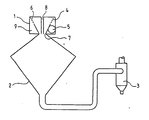
- It includes a dispersion head 1, a reception bicone 2 and a cyclone 3.
- the head has a perforated basket 4 defining an annular space 9 into which opens a tangential entry 5. This space makes it possible to produce the symmetrical well-vortex flow thanks to orifices such as 6 and at the neck 7.
- the phase to be treated is introduced through an axial conduit 8 so as to conduct it as far as the depression zone of the vortex well, that is to say in the upstream part of the bicone 2.
- the treatment gases are brought hot into the annular space.
- the purpose of this example is to demonstrate the advantage of the process according to the invention for the preparation of TPP without insoluble matter.
- a solution containing 20.5% P 2 0 5 and 14.9% Na 2 0 (Na / P 1.664) is sprayed into a stream of air heated to 880 ° C having a flow rate of 50 Nm3 / h.
- the flow rate of the solution is adjusted so as to obtain an outlet temperature of the gases and of the product of 405-420 ° C.
- the rate of transformation into TPP is 97% and the rate of insolubles is less than 0.01%.
- the rate of insolubles is measured by the following method: 20 g of product are dissolved in 400 cm 3 of water and brought to the boil for 10 min. The solution is filtered after cooling on a No. 4 frit, dried beforehand for two hours at 110 ° C. The frit containing any washed precipitate is dried for two hours at 110 ° C. The difference in weight of the frit before and after separation makes it possible to calculate the rate of insolubles.
- Example 2 Influence of various factors on the TPP.
- the conditions for preparing TPP are as follows: the solution is obtained by neutralizing H 3 P0 4 with NaOH so that there is an Na 2 0 / P 2 0 s ratio of between 1.64 and 1.70 and a dry extract of between 15 and 50%.
- the hot gases are introduced at a temperature between 880 and 950 ° C.
- TPP is obtained without any phosphate impurity if the ratio is properly adjusted to 5/3.
- the result is a TPP + pyroacid or TPP + pyroneutre mixture only if the Na / P ratio is poorly adjusted.
- the TPPs obtained according to tests 1 to 8 do not exhibit insolubles.
- a TPP with a phase rate half of the previous one according to test 7 does not lead to any solidification over time, while an anhydrous TPP (that is to say the same loss of water at 150 ° C.) the same rate of phase 1 according to the prior art, solidifies.
Landscapes
- Chemical & Material Sciences (AREA)
- Organic Chemistry (AREA)
- Inorganic Chemistry (AREA)
- Detergent Compositions (AREA)
- Polyurethanes Or Polyureas (AREA)
- General Preparation And Processing Of Foods (AREA)
- Saccharide Compounds (AREA)
- Food Preservation Except Freezing, Refrigeration, And Drying (AREA)
- Catalysts (AREA)
Claims (2)
Priority Applications (1)
| Application Number | Priority Date | Filing Date | Title |
|---|---|---|---|
| AT82401184T ATE22432T1 (de) | 1981-07-06 | 1982-06-28 | Natrium-tripolyphosphat und dessen herstellungsverfahren und moeglichkeiten der verwendung. |
Applications Claiming Priority (2)
| Application Number | Priority Date | Filing Date | Title |
|---|---|---|---|
| FR8113221A FR2508887A1 (fr) | 1981-07-06 | 1981-07-06 | Nouveau tripolyphosphate de sodium, procede pour l'obtenir et applications |
| FR8113221 | 1981-07-06 |
Publications (3)
| Publication Number | Publication Date |
|---|---|
| EP0069643A2 EP0069643A2 (de) | 1983-01-12 |
| EP0069643A3 EP0069643A3 (en) | 1983-07-06 |
| EP0069643B1 true EP0069643B1 (de) | 1986-09-24 |
Family
ID=9260237
Family Applications (1)
| Application Number | Title | Priority Date | Filing Date |
|---|---|---|---|
| EP82401184A Expired EP0069643B1 (de) | 1981-07-06 | 1982-06-28 | Natrium-Tripolyphosphat und dessen Herstellungsverfahren und Möglichkeiten der Verwendung |
Country Status (9)
| Country | Link |
|---|---|
| US (1) | US4671949A (de) |
| EP (1) | EP0069643B1 (de) |
| JP (1) | JPS5869707A (de) |
| AT (1) | ATE22432T1 (de) |
| CA (1) | CA1189679A (de) |
| DE (1) | DE3273439D1 (de) |
| FR (1) | FR2508887A1 (de) |
| TR (1) | TR21629A (de) |
| ZA (1) | ZA824766B (de) |
Families Citing this family (5)
| Publication number | Priority date | Publication date | Assignee | Title |
|---|---|---|---|---|
| FR2257326B1 (de) * | 1973-06-19 | 1976-05-28 | Rhone Progil | |
| EP0101347B1 (de) * | 1982-07-27 | 1986-09-24 | Rhone-Poulenc Chimie De Base | Natriumtripolyphosphat mit hoher Hydratationsgeschwindigkeit und dieses enthaltende Reinigungszusammensetzungen |
| US5660808A (en) * | 1995-06-14 | 1997-08-26 | Monsanto Company | Salt compatible sodium tripolyphosphate |
| US7357849B2 (en) * | 2005-09-01 | 2008-04-15 | Watervap, Llc | Method and system for separating solids from liquids |
| US20070045099A1 (en) * | 2005-09-01 | 2007-03-01 | Watervap, Llc | Method and system for seaparating solids from liquids |
Family Cites Families (8)
| Publication number | Priority date | Publication date | Assignee | Title |
|---|---|---|---|---|
| DE1258849B (de) * | 1965-06-18 | 1968-01-18 | Knapsack Ag | Verfahren zur Herstellung von Natriumtripolyphosphat mit hohem Gehalt der Hochtemperaturform |
| DE1604790A1 (de) * | 1965-11-22 | 1971-01-14 | Albright & Wilson Australia | Verfahren und Vorrichtung zur Beseitigung von Wasser aus waessrigen Loesungen von Feststoffen |
| US3629269A (en) * | 1968-09-26 | 1971-12-21 | Ortho Pharma Corp | Derivatives of the 2-(lower alkyl)-3-(lower alkyl)-4-phenyl-3- or 4-cyclohexenecarboxylic acids |
| FR2193778A1 (en) * | 1972-07-31 | 1974-02-22 | Rhone Progil | Sodium polyphosphate prepn - by granulating sodium orthophosphate with water or aqs orthophosphate soln drying and heat treating granules |
| FR2257326B1 (de) * | 1973-06-19 | 1976-05-28 | Rhone Progil | |
| FR2396250A1 (fr) * | 1977-07-01 | 1979-01-26 | Rhone Poulenc Ind | Nouveau procede pour le traitement de matieres thermosensibles |
| FR2431321A1 (fr) * | 1978-07-21 | 1980-02-15 | Rhone Poulenc Ind | Procede de traitement de substances se presentant sous des phases differentes, tel que traitement de substances sous forme liquide, semi-liquide, ou pateuse, par une autre phase notamment gazeuse |
| JPS57116691A (en) * | 1981-01-12 | 1982-07-20 | Ricoh Co Ltd | Multicolor thermal recording sheet |
-
1981
- 1981-07-06 FR FR8113221A patent/FR2508887A1/fr active Granted
-
1982
- 1982-06-28 AT AT82401184T patent/ATE22432T1/de not_active IP Right Cessation
- 1982-06-28 DE DE8282401184T patent/DE3273439D1/de not_active Expired
- 1982-06-28 EP EP82401184A patent/EP0069643B1/de not_active Expired
- 1982-07-05 ZA ZA824766A patent/ZA824766B/xx unknown
- 1982-07-05 JP JP57116690A patent/JPS5869707A/ja active Pending
- 1982-07-05 CA CA000406632A patent/CA1189679A/en not_active Expired
- 1982-07-06 TR TR21629A patent/TR21629A/xx unknown
-
1985
- 1985-12-27 US US06/813,786 patent/US4671949A/en not_active Expired - Fee Related
Also Published As
| Publication number | Publication date |
|---|---|
| CA1189679A (en) | 1985-07-02 |
| TR21629A (tr) | 1985-01-16 |
| FR2508887B1 (de) | 1985-01-11 |
| FR2508887A1 (fr) | 1983-01-07 |
| US4671949A (en) | 1987-06-09 |
| EP0069643A3 (en) | 1983-07-06 |
| EP0069643A2 (de) | 1983-01-12 |
| DE3273439D1 (en) | 1986-10-30 |
| ZA824766B (en) | 1983-04-27 |
| ATE22432T1 (de) | 1986-10-15 |
| JPS5869707A (ja) | 1983-04-26 |
Similar Documents
| Publication | Publication Date | Title |
|---|---|---|
| JP2013526575A (ja) | 改善された純度および流動能特性を有するアミノカルボキシレート粉末 | |
| US3956467A (en) | Process for producing alkali metal polysilicates | |
| EP0069643B1 (de) | Natrium-Tripolyphosphat und dessen Herstellungsverfahren und Möglichkeiten der Verwendung | |
| CA1179163A (fr) | Procede de fabrication de produits sous forme de particules solides notamment d'engrais granules np/npk contenant du phosphate d'ammonium | |
| US3988140A (en) | Process for making stable sludge-free ammonium polyphosphate fertilizer solutions | |
| EP0775167A1 (de) | Verfahren zur herstellung von polyasparaginsäure | |
| JPS61191503A (ja) | 16重量%より上の活性酸素含量を有する過硼酸ナトリウムおよびその製法 | |
| JPH0629127B2 (ja) | すぐに溶け、固化しない食品等級のトリポリリン酸ナトリウム | |
| EP0070216B1 (de) | Verfahren zur thermischen und/oder chemischen, homogenen Behandlung eines Fluidums und Verwendung bei synthetischen anorganischen Phosphaten | |
| FR2470091A1 (fr) | Procede pour la preparation de monofluorophosphate alcalin | |
| EP0001368B1 (de) | Verfahren zur Granulierung von Natriummetasilikat und die so erhaltenen Produkte | |
| EP0101347B1 (de) | Natriumtripolyphosphat mit hoher Hydratationsgeschwindigkeit und dieses enthaltende Reinigungszusammensetzungen | |
| NO180714B (no) | Fremgangsmåte til fremstilling av oksamid | |
| CA1083777A (en) | Continuous production of pure phosphine | |
| EP1704115A1 (de) | Verfahren zur herstellung von phosphaten starker basen | |
| EP0069644A2 (de) | Natrium-Orthophosphat und Verfahren zu dessen Herstellung | |
| JPS61134342A (ja) | 固体有機酸無水物から有機酸を製造する方法 | |
| SU910760A1 (ru) | Способ получени гранулированного синтетического моющего средства | |
| FR2621031A1 (fr) | Procede pour la preparation du phosphate monocalcique | |
| BE818945A (fr) | Engrais a base de phosphate de potassium. | |
| BE534527A (de) | ||
| JP2673853B2 (ja) | オキサミドの製造方法 | |
| SU339551A1 (ru) | Способ получения порошкообразного 2-этилгексилфенилфосфата натрия | |
| FR2583748A1 (fr) | Procede de preparation de sels du sel disodique de l'acide ethylenediamine-tetra-acetique, et de leurs hydrates | |
| SU1662993A1 (ru) | Способ получени гранулированных фосфорных удобрений |
Legal Events
| Date | Code | Title | Description |
|---|---|---|---|
| PUAI | Public reference made under article 153(3) epc to a published international application that has entered the european phase |
Free format text: ORIGINAL CODE: 0009012 |
|
| AK | Designated contracting states |
Designated state(s): AT BE CH DE FR GB IT LI LU NL SE |
|
| PUAL | Search report despatched |
Free format text: ORIGINAL CODE: 0009013 |
|
| AK | Designated contracting states |
Designated state(s): AT BE CH DE FR GB IT LI LU NL SE |
|
| 17P | Request for examination filed |
Effective date: 19830521 |
|
| ITF | It: translation for a ep patent filed | ||
| GRAA | (expected) grant |
Free format text: ORIGINAL CODE: 0009210 |
|
| AK | Designated contracting states |
Kind code of ref document: B1 Designated state(s): AT BE CH DE FR GB IT LI LU NL SE |
|
| REF | Corresponds to: |
Ref document number: 22432 Country of ref document: AT Date of ref document: 19861015 Kind code of ref document: T |
|
| REF | Corresponds to: |
Ref document number: 3273439 Country of ref document: DE Date of ref document: 19861030 |
|
| PLBE | No opposition filed within time limit |
Free format text: ORIGINAL CODE: 0009261 |
|
| STAA | Information on the status of an ep patent application or granted ep patent |
Free format text: STATUS: NO OPPOSITION FILED WITHIN TIME LIMIT |
|
| 26N | No opposition filed | ||
| PGFP | Annual fee paid to national office [announced via postgrant information from national office to epo] |
Ref country code: SE Payment date: 19910614 Year of fee payment: 10 |
|
| PGFP | Annual fee paid to national office [announced via postgrant information from national office to epo] |
Ref country code: LU Payment date: 19910620 Year of fee payment: 10 |
|
| PGFP | Annual fee paid to national office [announced via postgrant information from national office to epo] |
Ref country code: FR Payment date: 19910625 Year of fee payment: 10 |
|
| PGFP | Annual fee paid to national office [announced via postgrant information from national office to epo] |
Ref country code: GB Payment date: 19910627 Year of fee payment: 10 Ref country code: AT Payment date: 19910627 Year of fee payment: 10 |
|
| PGFP | Annual fee paid to national office [announced via postgrant information from national office to epo] |
Ref country code: BE Payment date: 19910628 Year of fee payment: 10 |
|
| ITTA | It: last paid annual fee | ||
| PGFP | Annual fee paid to national office [announced via postgrant information from national office to epo] |
Ref country code: NL Payment date: 19910630 Year of fee payment: 10 |
|
| PGFP | Annual fee paid to national office [announced via postgrant information from national office to epo] |
Ref country code: CH Payment date: 19910701 Year of fee payment: 10 |
|
| PGFP | Annual fee paid to national office [announced via postgrant information from national office to epo] |
Ref country code: DE Payment date: 19910723 Year of fee payment: 10 |
|
| EPTA | Lu: last paid annual fee | ||
| PG25 | Lapsed in a contracting state [announced via postgrant information from national office to epo] |
Ref country code: LU Free format text: LAPSE BECAUSE OF NON-PAYMENT OF DUE FEES Effective date: 19920628 Ref country code: GB Effective date: 19920628 Ref country code: AT Effective date: 19920628 |
|
| PG25 | Lapsed in a contracting state [announced via postgrant information from national office to epo] |
Ref country code: SE Effective date: 19920629 |
|
| PG25 | Lapsed in a contracting state [announced via postgrant information from national office to epo] |
Ref country code: LI Effective date: 19920630 Ref country code: CH Effective date: 19920630 Ref country code: BE Effective date: 19920630 |
|
| BERE | Be: lapsed |
Owner name: RHONE-POULENC CHIMIE DE BASE Effective date: 19920630 |
|
| PG25 | Lapsed in a contracting state [announced via postgrant information from national office to epo] |
Ref country code: NL Effective date: 19930101 |
|
| NLV4 | Nl: lapsed or anulled due to non-payment of the annual fee | ||
| GBPC | Gb: european patent ceased through non-payment of renewal fee |
Effective date: 19920628 |
|
| PG25 | Lapsed in a contracting state [announced via postgrant information from national office to epo] |
Ref country code: FR Effective date: 19930226 |
|
| REG | Reference to a national code |
Ref country code: CH Ref legal event code: PL |
|
| PG25 | Lapsed in a contracting state [announced via postgrant information from national office to epo] |
Ref country code: DE Effective date: 19930302 |
|
| REG | Reference to a national code |
Ref country code: FR Ref legal event code: ST |
|
| EUG | Se: european patent has lapsed |
Ref document number: 82401184.5 Effective date: 19930109 |