EP0061669B1 - Verbessertes Verfahren zur Herstellung von Cyclohexan-1,3-dionen sowie einige neue bicyclische Cyclohexan-1,3-dione - Google Patents
Verbessertes Verfahren zur Herstellung von Cyclohexan-1,3-dionen sowie einige neue bicyclische Cyclohexan-1,3-dione Download PDFInfo
- Publication number
- EP0061669B1 EP0061669B1 EP82102269A EP82102269A EP0061669B1 EP 0061669 B1 EP0061669 B1 EP 0061669B1 EP 82102269 A EP82102269 A EP 82102269A EP 82102269 A EP82102269 A EP 82102269A EP 0061669 B1 EP0061669 B1 EP 0061669B1
- Authority
- EP
- European Patent Office
- Prior art keywords
- reaction mixture
- mol
- cyclohexane
- dione
- carbon atoms
- Prior art date
- Legal status (The legal status is an assumption and is not a legal conclusion. Google has not performed a legal analysis and makes no representation as to the accuracy of the status listed.)
- Expired
Links
- 238000000034 method Methods 0.000 title claims description 25
- HJSLFCCWAKVHIW-UHFFFAOYSA-N cyclohexane-1,3-dione Chemical class O=C1CCCC(=O)C1 HJSLFCCWAKVHIW-UHFFFAOYSA-N 0.000 title claims description 14
- -1 bicyclic cyclohexane-1,3-diones Chemical class 0.000 title description 14
- 238000002360 preparation method Methods 0.000 title description 4
- 239000011541 reaction mixture Substances 0.000 claims description 44
- 238000006243 chemical reaction Methods 0.000 claims description 24
- 125000004432 carbon atom Chemical group C* 0.000 claims description 20
- 125000005396 acrylic acid ester group Chemical group 0.000 claims description 19
- 150000002576 ketones Chemical class 0.000 claims description 18
- 125000000217 alkyl group Chemical group 0.000 claims description 12
- 238000004519 manufacturing process Methods 0.000 claims description 6
- 125000003118 aryl group Chemical group 0.000 claims description 5
- 229910052739 hydrogen Inorganic materials 0.000 claims description 5
- 239000012454 non-polar solvent Substances 0.000 claims description 5
- 239000003795 chemical substances by application Substances 0.000 claims description 4
- 239000001257 hydrogen Substances 0.000 claims description 4
- 239000007791 liquid phase Substances 0.000 claims description 4
- 239000000376 reactant Substances 0.000 claims description 4
- 125000004435 hydrogen atom Chemical class [H]* 0.000 claims description 3
- 125000002947 alkylene group Chemical group 0.000 claims 2
- OKKJLVBELUTLKV-UHFFFAOYSA-N Methanol Chemical compound OC OKKJLVBELUTLKV-UHFFFAOYSA-N 0.000 description 60
- YXFVVABEGXRONW-UHFFFAOYSA-N Toluene Chemical compound CC1=CC=CC=C1 YXFVVABEGXRONW-UHFFFAOYSA-N 0.000 description 30
- 239000000203 mixture Substances 0.000 description 18
- CTQNGGLPUBDAKN-UHFFFAOYSA-N O-Xylene Chemical compound CC1=CC=CC=C1C CTQNGGLPUBDAKN-UHFFFAOYSA-N 0.000 description 17
- 239000008096 xylene Substances 0.000 description 17
- SXVPOSFURRDKBO-UHFFFAOYSA-N Cyclododecanone Chemical compound O=C1CCCCCCCCCCC1 SXVPOSFURRDKBO-UHFFFAOYSA-N 0.000 description 16
- XEKOWRVHYACXOJ-UHFFFAOYSA-N Ethyl acetate Chemical compound CCOC(C)=O XEKOWRVHYACXOJ-UHFFFAOYSA-N 0.000 description 15
- FDPIMTJIUBPUKL-UHFFFAOYSA-N pentan-3-one Chemical compound CCC(=O)CC FDPIMTJIUBPUKL-UHFFFAOYSA-N 0.000 description 14
- 239000002904 solvent Substances 0.000 description 13
- 239000000047 product Substances 0.000 description 12
- 238000002844 melting Methods 0.000 description 11
- 230000008018 melting Effects 0.000 description 11
- 239000000725 suspension Substances 0.000 description 11
- ZMXDDKWLCZADIW-UHFFFAOYSA-N N,N-Dimethylformamide Chemical compound CN(C)C=O ZMXDDKWLCZADIW-UHFFFAOYSA-N 0.000 description 9
- ZPVFWPFBNIEHGJ-UHFFFAOYSA-N 2-octanone Chemical compound CCCCCCC(C)=O ZPVFWPFBNIEHGJ-UHFFFAOYSA-N 0.000 description 8
- SYBYTAAJFKOIEJ-UHFFFAOYSA-N 3-Methylbutan-2-one Chemical compound CC(C)C(C)=O SYBYTAAJFKOIEJ-UHFFFAOYSA-N 0.000 description 8
- BAPJBEWLBFYGME-UHFFFAOYSA-N Methyl acrylate Chemical compound COC(=O)C=C BAPJBEWLBFYGME-UHFFFAOYSA-N 0.000 description 8
- NIXOWILDQLNWCW-UHFFFAOYSA-N acrylic acid group Chemical group C(C=C)(=O)O NIXOWILDQLNWCW-UHFFFAOYSA-N 0.000 description 8
- BDJSOPWXYLFTNW-UHFFFAOYSA-N methyl 3-methoxypropanoate Chemical compound COCCC(=O)OC BDJSOPWXYLFTNW-UHFFFAOYSA-N 0.000 description 8
- 238000000655 nuclear magnetic resonance spectrum Methods 0.000 description 7
- 239000007787 solid Substances 0.000 description 7
- XLYOFNOQVPJJNP-UHFFFAOYSA-N water Substances O XLYOFNOQVPJJNP-UHFFFAOYSA-N 0.000 description 7
- CSCPPACGZOOCGX-UHFFFAOYSA-N Acetone Chemical compound CC(C)=O CSCPPACGZOOCGX-UHFFFAOYSA-N 0.000 description 6
- 239000008346 aqueous phase Substances 0.000 description 6
- MVPPADPHJFYWMZ-UHFFFAOYSA-N chlorobenzene Chemical compound ClC1=CC=CC=C1 MVPPADPHJFYWMZ-UHFFFAOYSA-N 0.000 description 6
- 230000000052 comparative effect Effects 0.000 description 6
- OILAIQUEIWYQPH-UHFFFAOYSA-N cyclohexane-1,2-dione Chemical class O=C1CCCCC1=O OILAIQUEIWYQPH-UHFFFAOYSA-N 0.000 description 6
- 150000002085 enols Chemical class 0.000 description 6
- 125000002496 methyl group Chemical group [H]C([H])([H])* 0.000 description 6
- RTZKZFJDLAIYFH-UHFFFAOYSA-N Diethyl ether Chemical compound CCOCC RTZKZFJDLAIYFH-UHFFFAOYSA-N 0.000 description 5
- 239000002585 base Substances 0.000 description 5
- 238000009835 boiling Methods 0.000 description 5
- 238000002329 infrared spectrum Methods 0.000 description 5
- 238000001819 mass spectrum Methods 0.000 description 5
- VTJKYDIKNUBBNW-UHFFFAOYSA-N 2,4-dimethylcyclohexane-1,3-dione Chemical group CC1CCC(=O)C(C)C1=O VTJKYDIKNUBBNW-UHFFFAOYSA-N 0.000 description 4
- LFQSCWFLJHTTHZ-UHFFFAOYSA-N Ethanol Chemical compound CCO LFQSCWFLJHTTHZ-UHFFFAOYSA-N 0.000 description 4
- HYTRYEXINDDXJK-UHFFFAOYSA-N Ethyl isopropyl ketone Chemical compound CCC(=O)C(C)C HYTRYEXINDDXJK-UHFFFAOYSA-N 0.000 description 4
- NBIIXXVUZAFLBC-UHFFFAOYSA-N Phosphoric acid Chemical compound OP(O)(O)=O NBIIXXVUZAFLBC-UHFFFAOYSA-N 0.000 description 4
- QAOWNCQODCNURD-UHFFFAOYSA-N Sulfuric acid Chemical compound OS(O)(=O)=O QAOWNCQODCNURD-UHFFFAOYSA-N 0.000 description 4
- WYURNTSHIVDZCO-UHFFFAOYSA-N Tetrahydrofuran Chemical compound C1CCOC1 WYURNTSHIVDZCO-UHFFFAOYSA-N 0.000 description 4
- JHIVVAPYMSGYDF-UHFFFAOYSA-N cyclohexanone Chemical compound O=C1CCCCC1 JHIVVAPYMSGYDF-UHFFFAOYSA-N 0.000 description 4
- 125000001495 ethyl group Chemical group [H]C([H])([H])C([H])([H])* 0.000 description 4
- 238000010992 reflux Methods 0.000 description 4
- 239000007858 starting material Substances 0.000 description 4
- ZWEHNKRNPOVVGH-UHFFFAOYSA-N 2-Butanone Chemical compound CCC(C)=O ZWEHNKRNPOVVGH-UHFFFAOYSA-N 0.000 description 3
- WMFBEKBUSVGTGL-UHFFFAOYSA-N 4-pentylcyclohexane-1,3-dione Chemical compound CCCCCC1CCC(=O)CC1=O WMFBEKBUSVGTGL-UHFFFAOYSA-N 0.000 description 3
- YMWUJEATGCHHMB-UHFFFAOYSA-N Dichloromethane Chemical compound ClCCl YMWUJEATGCHHMB-UHFFFAOYSA-N 0.000 description 3
- JIGUQPWFLRLWPJ-UHFFFAOYSA-N Ethyl acrylate Chemical compound CCOC(=O)C=C JIGUQPWFLRLWPJ-UHFFFAOYSA-N 0.000 description 3
- 239000007789 gas Substances 0.000 description 3
- 239000000543 intermediate Substances 0.000 description 3
- PNJWIWWMYCMZRO-UHFFFAOYSA-N pent‐4‐en‐2‐one Natural products CC(=O)CC=C PNJWIWWMYCMZRO-UHFFFAOYSA-N 0.000 description 3
- 125000001997 phenyl group Chemical group [H]C1=C([H])C([H])=C(*)C([H])=C1[H] 0.000 description 3
- 230000001681 protective effect Effects 0.000 description 3
- 150000003254 radicals Chemical class 0.000 description 3
- 238000003756 stirring Methods 0.000 description 3
- 239000000126 substance Substances 0.000 description 3
- SMZOUWXMTYCWNB-UHFFFAOYSA-N 2-(2-methoxy-5-methylphenyl)ethanamine Chemical compound COC1=CC=C(C)C=C1CCN SMZOUWXMTYCWNB-UHFFFAOYSA-N 0.000 description 2
- UUWFJDWDSOYOGF-UHFFFAOYSA-N 4,4,5-trimethylcyclohexane-1,3-dione Chemical compound CC1CC(=O)CC(=O)C1(C)C UUWFJDWDSOYOGF-UHFFFAOYSA-N 0.000 description 2
- CREUBVKWQGIVDV-UHFFFAOYSA-N 4-methyl-2,6-diphenylcyclohexane-1,3-dione Chemical compound O=C1C(C)CC(C=2C=CC=CC=2)C(=O)C1C1=CC=CC=C1 CREUBVKWQGIVDV-UHFFFAOYSA-N 0.000 description 2
- VGVHNLRUAMRIEW-UHFFFAOYSA-N 4-methylcyclohexan-1-one Chemical compound CC1CCC(=O)CC1 VGVHNLRUAMRIEW-UHFFFAOYSA-N 0.000 description 2
- 0 C*C(C(C(C1C2(*)NC1)Cl)=[U])C2=O Chemical compound C*C(C(C(C1C2(*)NC1)Cl)=[U])C2=O 0.000 description 2
- VEXZGXHMUGYJMC-UHFFFAOYSA-N Hydrochloric acid Chemical compound Cl VEXZGXHMUGYJMC-UHFFFAOYSA-N 0.000 description 2
- CERQOIWHTDAKMF-UHFFFAOYSA-N Methacrylic acid Chemical compound CC(=C)C(O)=O CERQOIWHTDAKMF-UHFFFAOYSA-N 0.000 description 2
- BZLVMXJERCGZMT-UHFFFAOYSA-N Methyl tert-butyl ether Chemical compound COC(C)(C)C BZLVMXJERCGZMT-UHFFFAOYSA-N 0.000 description 2
- WQDUMFSSJAZKTM-UHFFFAOYSA-N Sodium methoxide Chemical compound [Na+].[O-]C WQDUMFSSJAZKTM-UHFFFAOYSA-N 0.000 description 2
- 239000003513 alkali Substances 0.000 description 2
- 229910000147 aluminium phosphate Inorganic materials 0.000 description 2
- 239000007795 chemical reaction product Substances 0.000 description 2
- 230000008878 coupling Effects 0.000 description 2
- 238000010168 coupling process Methods 0.000 description 2
- 238000005859 coupling reaction Methods 0.000 description 2
- 239000012043 crude product Substances 0.000 description 2
- BGTOWKSIORTVQH-UHFFFAOYSA-N cyclopentanone Chemical compound O=C1CCCC1 BGTOWKSIORTVQH-UHFFFAOYSA-N 0.000 description 2
- 239000000975 dye Substances 0.000 description 2
- 150000002170 ethers Chemical class 0.000 description 2
- 239000003292 glue Substances 0.000 description 2
- CATSNJVOTSVZJV-UHFFFAOYSA-N heptan-2-one Chemical compound CCCCCC(C)=O CATSNJVOTSVZJV-UHFFFAOYSA-N 0.000 description 2
- 239000012535 impurity Substances 0.000 description 2
- HIGGFWFRAWSMBR-UHFFFAOYSA-N iso-propyl n-propyl ketone Natural products CCCC(=O)C(C)C HIGGFWFRAWSMBR-UHFFFAOYSA-N 0.000 description 2
- LYLUAHKXJUQFDG-UHFFFAOYSA-N methyl 3-methoxy-2-methylpropanoate Chemical compound COCC(C)C(=O)OC LYLUAHKXJUQFDG-UHFFFAOYSA-N 0.000 description 2
- 239000012074 organic phase Substances 0.000 description 2
- XNLICIUVMPYHGG-UHFFFAOYSA-N pentan-2-one Chemical compound CCCC(C)=O XNLICIUVMPYHGG-UHFFFAOYSA-N 0.000 description 2
- 239000012071 phase Substances 0.000 description 2
- 239000002244 precipitate Substances 0.000 description 2
- 150000003839 salts Chemical class 0.000 description 2
- QDRKDTQENPPHOJ-UHFFFAOYSA-N sodium ethoxide Chemical compound [Na+].CC[O-] QDRKDTQENPPHOJ-UHFFFAOYSA-N 0.000 description 2
- 125000001424 substituent group Chemical group 0.000 description 2
- 229920003002 synthetic resin Polymers 0.000 description 2
- 239000000057 synthetic resin Substances 0.000 description 2
- 239000002023 wood Substances 0.000 description 2
- WBYWAXJHAXSJNI-VOTSOKGWSA-M .beta-Phenylacrylic acid Natural products [O-]C(=O)\C=C\C1=CC=CC=C1 WBYWAXJHAXSJNI-VOTSOKGWSA-M 0.000 description 1
- YFKBXYGUSOXJGS-UHFFFAOYSA-N 1,3-Diphenyl-2-propanone Chemical compound C=1C=CC=CC=1CC(=O)CC1=CC=CC=C1 YFKBXYGUSOXJGS-UHFFFAOYSA-N 0.000 description 1
- OCJBOOLMMGQPQU-UHFFFAOYSA-N 1,4-dichlorobenzene Chemical compound ClC1=CC=C(Cl)C=C1 OCJBOOLMMGQPQU-UHFFFAOYSA-N 0.000 description 1
- HNRVKBUIEQBLML-UHFFFAOYSA-N 2,4,4-trimethylcyclohexane-1,3-dione Chemical group CC1C(=O)CCC(C)(C)C1=O HNRVKBUIEQBLML-UHFFFAOYSA-N 0.000 description 1
- QZHKWRBDQSULCW-UHFFFAOYSA-N 2,4,5-trimethylcyclohexane-1,3-dione Chemical compound CC1CC(=O)C(C)C(=O)C1C QZHKWRBDQSULCW-UHFFFAOYSA-N 0.000 description 1
- GPPLAFRULGSVQL-UHFFFAOYSA-N 2,4,6-trimethylcyclohex-4-ene-1,3-dione Chemical compound CC1C=C(C)C(=O)C(C)C1=O GPPLAFRULGSVQL-UHFFFAOYSA-N 0.000 description 1
- QQZOPKMRPOGIEB-UHFFFAOYSA-N 2-Oxohexane Chemical compound CCCCC(C)=O QQZOPKMRPOGIEB-UHFFFAOYSA-N 0.000 description 1
- UPYMCUHGZQZAIS-UHFFFAOYSA-N 2-ethyl-4,4-dimethylcyclohexane-1,3-dione Chemical compound CCC1C(=O)CCC(C)(C)C1=O UPYMCUHGZQZAIS-UHFFFAOYSA-N 0.000 description 1
- LFSAPCRASZRSKS-UHFFFAOYSA-N 2-methylcyclohexan-1-one Chemical compound CC1CCCCC1=O LFSAPCRASZRSKS-UHFFFAOYSA-N 0.000 description 1
- YYPNJNDODFVZLE-UHFFFAOYSA-N 3-methylbut-2-enoic acid Chemical compound CC(C)=CC(O)=O YYPNJNDODFVZLE-UHFFFAOYSA-N 0.000 description 1
- FDTRWJLJJZIELS-UHFFFAOYSA-N 4,4-dimethyl-5-phenylcyclohexane-1,3-dione Chemical group C1C(=O)CC(=O)C(C)(C)C1C1=CC=CC=C1 FDTRWJLJJZIELS-UHFFFAOYSA-N 0.000 description 1
- PLGPBTCNKJQJHQ-UHFFFAOYSA-N 4,4-dimethylcyclohexane-1,3-dione Chemical compound CC1(C)CCC(=O)CC1=O PLGPBTCNKJQJHQ-UHFFFAOYSA-N 0.000 description 1
- RMNXDIURPRSSPG-UHFFFAOYSA-N 4,4-diphenylcyclohexane-1,3-dione Chemical compound O=C1CC(=O)CCC1(C=1C=CC=CC=1)C1=CC=CC=C1 RMNXDIURPRSSPG-UHFFFAOYSA-N 0.000 description 1
- IJGRMHOSHXDMSA-UHFFFAOYSA-N Atomic nitrogen Chemical compound N#N IJGRMHOSHXDMSA-UHFFFAOYSA-N 0.000 description 1
- QBSXMCGLROGNQF-UHFFFAOYSA-N CC(CC(C1)N)C=C1O Chemical compound CC(CC(C1)N)C=C1O QBSXMCGLROGNQF-UHFFFAOYSA-N 0.000 description 1
- AZNLCCQIQXGODC-UHFFFAOYSA-N CC(CC(c1ccccc1)C1=O)C([O]=O)=C1c1cc(C2C(CC(Cc3ccccc3)=O)=CC=CC2C)ccc1 Chemical compound CC(CC(c1ccccc1)C1=O)C([O]=O)=C1c1cc(C2C(CC(Cc3ccccc3)=O)=CC=CC2C)ccc1 AZNLCCQIQXGODC-UHFFFAOYSA-N 0.000 description 1
- WBYWAXJHAXSJNI-SREVYHEPSA-N Cinnamic acid Chemical compound OC(=O)\C=C/C1=CC=CC=C1 WBYWAXJHAXSJNI-SREVYHEPSA-N 0.000 description 1
- UFHFLCQGNIYNRP-UHFFFAOYSA-N Hydrogen Chemical compound [H][H] UFHFLCQGNIYNRP-UHFFFAOYSA-N 0.000 description 1
- DGAQECJNVWCQMB-PUAWFVPOSA-M Ilexoside XXIX Chemical compound C[C@@H]1CC[C@@]2(CC[C@@]3(C(=CC[C@H]4[C@]3(CC[C@@H]5[C@@]4(CC[C@@H](C5(C)C)OS(=O)(=O)[O-])C)C)[C@@H]2[C@]1(C)O)C)C(=O)O[C@H]6[C@@H]([C@H]([C@@H]([C@H](O6)CO)O)O)O.[Na+] DGAQECJNVWCQMB-PUAWFVPOSA-M 0.000 description 1
- NTIZESTWPVYFNL-UHFFFAOYSA-N Methyl isobutyl ketone Chemical compound CC(C)CC(C)=O NTIZESTWPVYFNL-UHFFFAOYSA-N 0.000 description 1
- UIHCLUNTQKBZGK-UHFFFAOYSA-N Methyl isobutyl ketone Natural products CCC(C)C(C)=O UIHCLUNTQKBZGK-UHFFFAOYSA-N 0.000 description 1
- VVQNEPGJFQJSBK-UHFFFAOYSA-N Methyl methacrylate Chemical compound COC(=O)C(C)=C VVQNEPGJFQJSBK-UHFFFAOYSA-N 0.000 description 1
- CIUQDSCDWFSTQR-UHFFFAOYSA-N [C]1=CC=CC=C1 Chemical compound [C]1=CC=CC=C1 CIUQDSCDWFSTQR-UHFFFAOYSA-N 0.000 description 1
- 239000002253 acid Substances 0.000 description 1
- 230000002378 acidificating effect Effects 0.000 description 1
- 229910052783 alkali metal Inorganic materials 0.000 description 1
- 125000005907 alkyl ester group Chemical group 0.000 description 1
- 230000002421 anti-septic effect Effects 0.000 description 1
- 229940064004 antiseptic throat preparations Drugs 0.000 description 1
- 239000012298 atmosphere Substances 0.000 description 1
- 125000002619 bicyclic group Chemical group 0.000 description 1
- HHJBRQQDFSXZIX-UHFFFAOYSA-N bicyclo[3.3.1]nonane-4,9-dione Chemical compound C1CCC2C(=O)CCC1C2=O HHJBRQQDFSXZIX-UHFFFAOYSA-N 0.000 description 1
- 230000015572 biosynthetic process Effects 0.000 description 1
- 125000000484 butyl group Chemical group [H]C([*])([H])C([H])([H])C([H])([H])C([H])([H])[H] 0.000 description 1
- 239000006227 byproduct Substances 0.000 description 1
- 150000001732 carboxylic acid derivatives Chemical class 0.000 description 1
- 235000021466 carotenoid Nutrition 0.000 description 1
- 150000001747 carotenoids Chemical class 0.000 description 1
- 230000003197 catalytic effect Effects 0.000 description 1
- 150000008280 chlorinated hydrocarbons Chemical class 0.000 description 1
- 229930016911 cinnamic acid Natural products 0.000 description 1
- 235000013985 cinnamic acid Nutrition 0.000 description 1
- CCRCUPLGCSFEDV-UHFFFAOYSA-N cinnamic acid methyl ester Natural products COC(=O)C=CC1=CC=CC=C1 CCRCUPLGCSFEDV-UHFFFAOYSA-N 0.000 description 1
- 238000004140 cleaning Methods 0.000 description 1
- 150000001875 compounds Chemical class 0.000 description 1
- 238000006482 condensation reaction Methods 0.000 description 1
- 238000001816 cooling Methods 0.000 description 1
- LDHQCZJRKDOVOX-NSCUHMNNSA-N crotonic acid Chemical compound C\C=C\C(O)=O LDHQCZJRKDOVOX-NSCUHMNNSA-N 0.000 description 1
- 238000002425 crystallisation Methods 0.000 description 1
- 230000008025 crystallization Effects 0.000 description 1
- 125000004122 cyclic group Chemical group 0.000 description 1
- 230000018044 dehydration Effects 0.000 description 1
- 238000006297 dehydration reaction Methods 0.000 description 1
- 229940117389 dichlorobenzene Drugs 0.000 description 1
- 229910001873 dinitrogen Inorganic materials 0.000 description 1
- 238000004821 distillation Methods 0.000 description 1
- 238000002474 experimental method Methods 0.000 description 1
- 238000001914 filtration Methods 0.000 description 1
- 239000003205 fragrance Substances 0.000 description 1
- 238000010438 heat treatment Methods 0.000 description 1
- 229930195733 hydrocarbon Natural products 0.000 description 1
- 150000002430 hydrocarbons Chemical class 0.000 description 1
- 125000000959 isobutyl group Chemical group [H]C([H])([H])C([H])(C([H])([H])[H])C([H])([H])* 0.000 description 1
- 238000002955 isolation Methods 0.000 description 1
- 125000001449 isopropyl group Chemical group [H]C([H])([H])C([H])(*)C([H])([H])[H] 0.000 description 1
- 229910052751 metal Inorganic materials 0.000 description 1
- 239000002184 metal Substances 0.000 description 1
- 150000002739 metals Chemical class 0.000 description 1
- MQWCXKGKQLNYQG-UHFFFAOYSA-N methyl cyclohexan-4-ol Natural products CC1CCC(O)CC1 MQWCXKGKQLNYQG-UHFFFAOYSA-N 0.000 description 1
- WBYWAXJHAXSJNI-UHFFFAOYSA-N methyl p-hydroxycinnamate Natural products OC(=O)C=CC1=CC=CC=C1 WBYWAXJHAXSJNI-UHFFFAOYSA-N 0.000 description 1
- CCRCUPLGCSFEDV-BQYQJAHWSA-N methyl trans-cinnamate Chemical compound COC(=O)\C=C\C1=CC=CC=C1 CCRCUPLGCSFEDV-BQYQJAHWSA-N 0.000 description 1
- 239000012299 nitrogen atmosphere Substances 0.000 description 1
- 230000020477 pH reduction Effects 0.000 description 1
- 239000003208 petroleum Substances 0.000 description 1
- 150000003012 phosphoric acid amides Chemical class 0.000 description 1
- 238000006116 polymerization reaction Methods 0.000 description 1
- LPNYRYFBWFDTMA-UHFFFAOYSA-N potassium tert-butoxide Chemical compound [K+].CC(C)(C)[O-] LPNYRYFBWFDTMA-UHFFFAOYSA-N 0.000 description 1
- 238000001556 precipitation Methods 0.000 description 1
- LYBIZMNPXTXVMV-UHFFFAOYSA-N propan-2-yl prop-2-enoate Chemical compound CC(C)OC(=O)C=C LYBIZMNPXTXVMV-UHFFFAOYSA-N 0.000 description 1
- 238000000746 purification Methods 0.000 description 1
- 239000012264 purified product Substances 0.000 description 1
- 238000001953 recrystallisation Methods 0.000 description 1
- 229910052708 sodium Inorganic materials 0.000 description 1
- 239000011734 sodium Substances 0.000 description 1
- RPACBEVZENYWOL-XFULWGLBSA-M sodium;(2r)-2-[6-(4-chlorophenoxy)hexyl]oxirane-2-carboxylate Chemical compound [Na+].C=1C=C(Cl)C=CC=1OCCCCCC[C@]1(C(=O)[O-])CO1 RPACBEVZENYWOL-XFULWGLBSA-M 0.000 description 1
- 150000005846 sugar alcohols Polymers 0.000 description 1
- 150000003457 sulfones Chemical class 0.000 description 1
- 150000003462 sulfoxides Chemical class 0.000 description 1
- 238000003786 synthesis reaction Methods 0.000 description 1
- YLQBMQCUIZJEEH-UHFFFAOYSA-N tetrahydrofuran Natural products C=1C=COC=1 YLQBMQCUIZJEEH-UHFFFAOYSA-N 0.000 description 1
- LDHQCZJRKDOVOX-UHFFFAOYSA-N trans-crotonic acid Natural products CC=CC(O)=O LDHQCZJRKDOVOX-UHFFFAOYSA-N 0.000 description 1
- 150000007934 α,β-unsaturated carboxylic acids Chemical class 0.000 description 1
Classifications
-
- C—CHEMISTRY; METALLURGY
- C07—ORGANIC CHEMISTRY
- C07C—ACYCLIC OR CARBOCYCLIC COMPOUNDS
- C07C49/00—Ketones; Ketenes; Dimeric ketenes; Ketonic chelates
- C07C49/587—Unsaturated compounds containing a keto groups being part of a ring
- C07C49/657—Unsaturated compounds containing a keto groups being part of a ring containing six-membered aromatic rings
-
- C—CHEMISTRY; METALLURGY
- C07—ORGANIC CHEMISTRY
- C07C—ACYCLIC OR CARBOCYCLIC COMPOUNDS
- C07C45/00—Preparation of compounds having >C = O groups bound only to carbon or hydrogen atoms; Preparation of chelates of such compounds
- C07C45/45—Preparation of compounds having >C = O groups bound only to carbon or hydrogen atoms; Preparation of chelates of such compounds by condensation
- C07C45/455—Preparation of compounds having >C = O groups bound only to carbon or hydrogen atoms; Preparation of chelates of such compounds by condensation with carboxylic acids or their derivatives
-
- C—CHEMISTRY; METALLURGY
- C07—ORGANIC CHEMISTRY
- C07C—ACYCLIC OR CARBOCYCLIC COMPOUNDS
- C07C49/00—Ketones; Ketenes; Dimeric ketenes; Ketonic chelates
- C07C49/385—Saturated compounds containing a keto group being part of a ring
- C07C49/403—Saturated compounds containing a keto group being part of a ring of a six-membered ring
-
- C—CHEMISTRY; METALLURGY
- C07—ORGANIC CHEMISTRY
- C07C—ACYCLIC OR CARBOCYCLIC COMPOUNDS
- C07C49/00—Ketones; Ketenes; Dimeric ketenes; Ketonic chelates
- C07C49/385—Saturated compounds containing a keto group being part of a ring
- C07C49/417—Saturated compounds containing a keto group being part of a ring polycyclic
- C07C49/423—Saturated compounds containing a keto group being part of a ring polycyclic a keto group being part of a condensed ring system
- C07C49/427—Saturated compounds containing a keto group being part of a ring polycyclic a keto group being part of a condensed ring system having two rings
-
- C—CHEMISTRY; METALLURGY
- C07—ORGANIC CHEMISTRY
- C07C—ACYCLIC OR CARBOCYCLIC COMPOUNDS
- C07C49/00—Ketones; Ketenes; Dimeric ketenes; Ketonic chelates
- C07C49/385—Saturated compounds containing a keto group being part of a ring
- C07C49/417—Saturated compounds containing a keto group being part of a ring polycyclic
- C07C49/423—Saturated compounds containing a keto group being part of a ring polycyclic a keto group being part of a condensed ring system
- C07C49/427—Saturated compounds containing a keto group being part of a ring polycyclic a keto group being part of a condensed ring system having two rings
- C07C49/443—Saturated compounds containing a keto group being part of a ring polycyclic a keto group being part of a condensed ring system having two rings the condensed ring system containing eight or nine carbon atoms
Definitions
- the invention relates to an improved process for the preparation of cyclohexane-1,3-diones and some new bicyclic cyclohexane-1,3-diones.
- the cyclohexane-1,3-diones can be converted into resorcins, which are used as synthetic resin components in the rubber and wood glue industry, as coupling components for dyes or as antiseptics.
- 5-Ketonitrile can also be cyclized to cyclohexane-1,3-diones in the presence of sulfuric acid or phosphoric acid (cf. DE-OS 21 44170).
- sulfuric acid or phosphoric acid cf. DE-OS 21 44170
- the use of large amounts of sulfuric acid or phosphoric acid and the need for two separate, complex reaction steps are technically disadvantageous.
- the invention relates to an improved process for the preparation of cyclohexane-1,3-diones of the general formula 1 in which the radicals R 1 , R 3 and R 4 are hydrogen, alkyl groups having 1 to 10 carbon atoms, preferably a methyl or ethyl group or an aryl group, preferably a phenyl group, the radical R 2 is hydrogen or an alkyl group having 1 to 10 C atoms, preferably a methyl group, the radical R 5 is an alkyl group having 1 to 10 C atoms, preferably a methyl or ethyl group or an aryl group, preferably a phenyl group, or R 4 and R 5 together represent an alkylene radical with 2 to 10 carbon atoms, or R 4 or R 5 and R 3 together represent an alkylene radical with 2 to 12 carbon atoms, by reacting acrylic acid esters of the general formula II in which R 6 represents an alkyl group having 1 to 4 carbon atoms, preferably a methyl
- the process according to the invention proceeds particularly advantageously if, in the reaction of acrylic acid esters of the formula II with the ketones of the formula III, the reaction mixture is heated after the addition of the reactants while distilling off the alkanol present in the reaction mixture, or if the reaction of acrylic acid ester addition products of formula IV with ketones of formula III the reaction mixture is heated while distilling off the alkanol present in the reaction mixture.
- the invention also relates to the new bicyclic cyciohexane-1,3-diones: bicyclo [9.3.1] pentadecan-14.15-dione and 13-methyl-bicyclo [9.3.1] pentadecane-14.15-dione and 12- Methyl bicyclo [9.3.1] pentadecane-14,15-dione.
- the acrylic acid esters and ketones required as starting compounds for the process according to the invention are known compounds, some of which are commercially available and some of which can be obtained in a known manner.
- the substituents defined as alkyl groups in the acrylic esters and ketones used as starting compounds can be straight-chain, branched or else cyclic.
- the substituents defined as aryl groups generally have up to 14 carbon atoms and can also be substituted by lower alkyl groups.
- the phenyl and the naphthyl radical, in particular the phenyl radical, are preferred.
- Particularly suitable starting products are acetone, methyl ethyl ketone, methyl propyl ketone, methyl isopropyl ketone, methyl isobutyl ketone, diethyl ketone, methyl butyl ketone, methyl pentyl ketone, methyl hexyl ketone, cyclopentanone, cyclohexanone, 2-methylcyclohexanone, 4-methylcyclohexanone, n-propyl-isyl, 1-propyl-isyl, 1-propyl-isyl, 1-propyl-isyl, 1-propyl-isyl, 1-propyl-isyl, 1-propyl-isyl, 1-propyl-isyl, 1-propyl-isyl, 1-propyl-1-propyl-isopropyl-isopropyl-isopropyl-isopropyl-isopropyl-isopropyl-iso
- ⁇ , ⁇ -unsaturated carboxylic acid esters are the methyl, ethyl, butyl, isopropyl and isobutyl esters of acrylic acid, methacrylic acid, crotonic acid and cinnamic acid.
- the starting compounds of the formulas II and 111 are advantageously used in approximately equimolecular amounts. An excess of ketone is possible, but is generally not necessary; a larger excess of acrylic ester is not recommended, since excess acrylic ester can polymerize.
- the alkali and alkaline earth alcoholates, the oxides and the metals themselves can be used as strong bases.
- the alkali and alkaline earth alcoholates are preferably used, which is available cheaply industrially as a solid substance or as a 30% by weight methanolic solution.
- the base is generally used in molar amounts up to an approximately 10% molar excess.
- non-polar solvents we understand in the context of the present invention in particular hydrocarbons or chlorinated hydrocarbons with a boiling point between about 40 and 200 ° C, such as xylene, toluene, methylene chloride, chlorobenzene and dichlorobenzene and some practically non-polar ethers, such as. B. tetrahydrofuran and methyl tert-butyl ether.
- the solvents with a boiling point between 90 and 160 ° C., such as xylene, toluene and chlorobenzene are preferred.
- the solvents used according to the invention are generally cheaper, easier to handle and much easier to recover than the solvents used according to the known processes.
- the alkanols which are added to the solvent are generally alkanols having 1 to 4 carbon atoms, preferably methanol or ethanol, in particular methanol, which is technically particularly cheaply available.
- the alkanols are generally used in amounts of 0.01 to 5, preferably 0.1 to 4, moles per mole of the acrylic acid ester present in the reaction mixture.
- the process according to the invention is equally advantageous if, at the same time, approximately the same molar amounts of the acrylic acid-alkanol addition product of the formula IV and the ketone 111 are introduced into a mixture of the basic condensing agent and the solvent and the reaction mixture during and / or after the addition to the claimed Temperatures heated.
- the acrylic ester-alkanol addition product is presumably first formed under the reaction conditions. From this base-catalyzed free acrylic ester is then re-formed in a low concentration, which can then react with the ketone present in a relatively higher concentration without self-condensation and / or polymerization reactions taking place, which usually reduce the yield of cyclohexanedione.
- the alkali metal salt of the enol which initially precipitates from the reaction mixture during the reaction can be isolated from the cyclohexanedione obtained simply by filtering off and used further in this form.
- reaction mixture obtained is mixed with water.
- the unreacted starting compounds and non-acidic by-products or impurities are then in the organic phase, which can be easily separated off and worked up by distillation.
- the desired reaction products are in the form of salts in the aqueous phase and can be obtained therefrom by acidification.
- the products obtained are generally so clean that no further purification is necessary, but some of them still contain small amounts of water.
- the cyclohexane-1,3-diones of the formula can be produced in a very advantageous manner.
- the cyclohexane-1,3-diones are valuable intermediates, for example for the production of synthetic resin components in the rubber and wood glue industry, as coupling components for dyes or as intermediates for carotenoids.
- the 3 new bicyclic cyclohexane-1,3-diones bicyclo [9.3.1] pentadecane-14.15-dione and 12- and 13-methylbicyclo [9.3.1] pentadecane-14.15-dione are valuable intermediates for the production of fragrances.
- 1,800 ml of xylene are mixed with 600 g of a 30% methanolic NaOCH 3 solution (corresponding to 13.1 mol of methanol and 3.3 mol of NaOCH 3 ).
- a mixture of 300 g (3 mol) of ethyl isopropyl ketone and 258 g (3 mol) of methyl acrylate is added dropwise to this solution with thorough stirring and under a protective nitrogen gas over the course of 1 hour.
- reaction mixture rises to about 40 ° C.
- reaction mixture is then heated and methanol is distilled off up to an internal temperature of 130.degree. About 250 g of distillate are obtained.
- a suspension of the Na salt in xylene is then present in the reaction vessel.
- a solution of 21 g of 1,1'-diphenylacetone and 11.8 g of methyl ⁇ -methoxypropionate in 100 ml of toluene is added to a suspension of 5.5 g (0.1 mol) of solid NaOCH 3 in 50 ml of toluene under an N 2 atmosphere added dropwise at 90 ° C within 2 hours.
- a voluminous precipitation occurs.
- the reaction mixture is mixed with 100 ml of water and the aqueous phase obtained is acidified with 50% H 2 S0 4 to a pH of 2-3.
- the precipitate obtained is filtered off and dried. This gives 21 g of a substance with a melting point of 185-187 ° C. Yield 79%.
- a mixture of 11 is added to a mixture of 20 g of a 30% strength solution of NaOCH 3 in methanol (corresponding to 0.11 mol of NaOCH 3 and 0.44 mol of CH 3 OH) and 70 ml of xylene with stirring and under a protective N 2 gas , 4 g (0.1 mol) of n-propyl-isopropyl ketone and 8.6 g (0.1 mol) of methyl acrylate were added dropwise, and the reaction mixture was then heated while distilling off methanol until the internal temperature of the reaction vessel was 130 ° C.
Landscapes
- Chemical & Material Sciences (AREA)
- Organic Chemistry (AREA)
- Organic Low-Molecular-Weight Compounds And Preparation Thereof (AREA)
Description
- Die Erfindung betrifft ein verbessertes Verfahren zur Herstellung von Cyclohexan-1,3-dionen sowie einige neue bicyclische Cyclohexan-1,3-dione. Durch Dehydrierung lassen sich die Cyclohexan-1,3-dione in Resorcine überführen, die als Kunstharzkomponenten in der Gummi- und Holzleimindustrie, als Kupplungskomponenten für Farbstoffe oder als Antiseptika Verwendung finden.
- Es hat daher nicht an Versuchen gefehlt, die Cyclohexan-1,3-dione auf möglichst vorteilhafte Weise herzustellen. So sind verschiedene Methoden zur Herstellung derselben aus Ketonen und Acrylestern bekannt.
- Beispielsweise ist es bekannt, Ketone aminkatalysiert an Acrylester zu addieren und die dabei erhaltenen 4-Oxocarbonsäurealkylester in der Flüssigphase (vgl. DE-OS 22 45 270 bzw. DE-OS 25 33 920) oder in der Gasphase (vgl. DE-OS 24 12 313) zu den Cyclohexandionen zu cyclisieren. Nachteilig an diesem Verfahren ist, daß zwei technisch aufwendige Reaktionsstufen erforderlich sind.
- Auch 5-Ketonitrile lassen sich in Gegenwart von Schwefelsäure oder Phosphorsäure zu Cyclohexan-1,3-dionen cyclisieren (vgl. DE-OS 21 44170). Jedoch ist hierbei die Verwendung großer Mengen Schwefelsäure bzw. Phosphorsäure sowie die Notwendigkeit von zwei getrennten aufwendigen Reaktionsschritten technisch nachteilig.
- Weiterhin ist es aus J. Org. Chem. 1957, Seite 1268 bekannt 4-Pentyl-cyclohexan-1,3-dion in einer einstufigen Synthese durch Umsetzen von Methylhexylketon und Acrylsäureethylester in Gegenwart von Natriumethylat in Xylol herzustellen. Gemäß diesem Verfahren wird zu einer Suspension von Natriumethoxid in Xylol, welche durch Zugabe von Ethanol zu einer Suspension von Natrium in Xylol hergestellt wurde, Acrylsäureethylester zugefügt, das Reaktionsgemisch in einem Eisbad gekühlt, tropfenweise mit Methylhexylketon versetzt, dann noch 0,5 h bei 0°C und 17 h bei Raumtemperatur gerührt. Ein wesentlicher Nachteil dieses Verfahrens ist die geringe Selektivität von 27%, die keine wirtschaftliche Produktion zuläßt.
- Es wurde daher vorgeschlagen (vgl. DE-OS 25 33 919), die CycIohexan-1,3-dione durch Umsetzen von Acrylsäureestern mit Ketonen in flüssiger Phase, in Gegenwart einer starken Base und in Gegenwart ganz bestimmter Lösungsmittel herzustellen. Als Lösungsmittel wurden Carbonsäureamide, Phosphorsäureamide, Sulfoxide, Sulfone sowie zahlreiche Ether mehrwertiger Alkohole genannt. Gemäß diesem Verfahren werden die Cyclohexandione in Ausbeuten von 33 bis 85 %, bezogen auf umgesetzten Acrylester, und von 52 bis 87,5 %, bezogen auf umgesetztes Keton erhalten. Nachteilig an diesem Verfahren ist vor allem, daß die notwendigen Lösungsmittel relativ teuer, teilweise schwierig zu handhaben und nach der Reaktion schwierig zurückzugewinnen sind. Weiterhin ist die Aufarbeitung des Reaktionsgemisches ziemlich aufwendig.
- Zum Vergleich wurde in der genannten DE-OS die Umsetzung von Acrylsäureestern mit Ketonen in einem üblichen unpolaren Lösungsmittel durchgeführt. Hierbei wurde bei der entsprechenden Umsetzung von Aceton mit Isopropylacrylat in Xylol gar kein Cyclohexandion erhalten (s. Vergleichsbeispiel 2) und bei der Umsetzung von 2-Octanen mit Ethylacrylat in Xylol das 4-Pentyl-1,3-cyclohexandion in Selektivitäten von etwa 35 % gebildet.
- Es war die Aufgabe der Erfindung, das Verfahren zur Herstellung von Cyclohexan-1,3-dionen durch Umsetzen von Acrylestern mit Ketonen so zu verbessern, daß man trotz Verwendung von billigeren und leichter rückgewinnbaren Lösungsmitteln gleich gute, oder bessere Ausbeuten erzielen kann und die Isolierung und Reinigung der Reaktionsprodukte erleichtert wird.
- Gegenstand der Erfindung ist ein verbessertes Verfahren zur Herstellung von Cyclohexan-1,3-dionen der allgemeinen Formel 1


- Die Additionsprodukte der Acrylsäureester mit einem Alkanol bilden sich sofort und quanitativ bei der Umsetzung der Acrylsäureester mit dem Alkanol in Gegenwart katalytischer Mengen einer Base und dementsprechend auch unter den Reaktionsbedingungen der erstgenannten Variante des erfindungsgemäßen Verfahrens.
- Besonders vorteilhaft verläuft das erfindungsgemäße Verfahren, wenn man bei der Umsetzung von Acrylsäureestern der Formel II mit den Ketonen der Formel III das Reaktionsgemisch nach der Zugabe der Reaktionspartner unter Abdestillieren des im Reaktionsgemisch vorhandenen Alkanols erhitzt, bzw. wenn man bei der Umsetzung von Acrylsäureester-Additionsprodukten der Formel IV mit Ketonen der Formel III das Reaktionsgemisch unter Abdestillieren des im Reaktionsgemisch vorhandenen Alkanols erhitzt.
- Es war überraschend, daß man die Cyclohexan-1,3-dione auf die einfache erfindungsgemäße Weise in sehr guten Ausbeuten erhalten kann, während die entsprechende Umsetzung sowohl in einem unpolaren Lösungsmittel als auch in einem Alkanol als alleinigem Lösungsmittel nur mit äußerst unbefriedigenden Ausbeuten verläuft (s. Vergleichsbeispiel).
- Gegenstand der Erfindung sind außerdem die neuen bicyclischen Cyciohexan-1,3-dione: Bicyclo [9.3.1] pentadecan-14,15-dion und 13-Methyl-bicyclo [9.3.1] pentadecan-14,15-dion und 12-Methyl-bicyclo [9.3.1] pentadecan-14,15-dion.
- Die als Ausgangsverbindungen für das erfindungsgemäße Verfahren benötigten Acrylsäureester und Ketone sind bekannte Verbindungen, die teils handelsüblich sind und teils auf bekannte Weise erhalten werden können.
- Die als Alkylgruppen definierten Substituenten in den als Ausgangsverbindungen benutzten Acrylestern und Ketonen können geradkettig, verzweigt oder auch cyclisch sein.
- Die als Arylgruppen definierten Substituenten haben im allgemeinen bis zu 14 C-Atome und können auch durch niedere Alkylgruppen substituiert sein. Bevorzugt sind der Phenyl und der Naphthylrest, insbesondere der Phenylrest.
- Als Ausgangsprodukte besonders geeignete Ketone sind Aceton, Methylethylketon, Methylpropylketon, Methylisopropylketon, Methylisobutylketon, Diethylketon, Methylbutylketon, Methylpentylketon, Methylhexylketon, Cyclopentanon, Cyclohexanon, 2-Methylcyclohexanon, 4-Methylcyclohexanon, n-Propyl-isopropylketon, 1,3-Diphenylaceton, 1,1-Diphenyl-aceton, Cyclododecanon und Ethylisopropylketon.
- Als a,ß-ungesättigte Carbonsäureester sind besonders geeignet der Methyl-, Ethyl-, Butyl-, Isopropyl-und Isobutylester von Acrylsäure, Methacrylsäure, Crotonsäure und Zimtsäure.
- Die Ausgangsverbindungen der Formeln II und 111 verwendet man mit Vorteil in etwa äquimolekularen Mengen. Ein Überschuß an Keton ist möglich, jedoch im allgemeinen nicht nötig ; ein größerer Überschuß an Acrylester ist nicht empfehlenswert, da überschüssiger Acrylester polymerisieren kann.
- Als starke Basen kann man die Alkali- und Erdalkali-Alkoholate, die -Oxide, sowie die Metalle selbst verwenden.
- Vorzugsweise werden die Alkali- und Erdalkali-Alkoholate, insbesondere Natriummethylat verwendet, das technisch als Festsubstanz oder als 30 gew.%ige methanolische Lösung billig verfügbar ist.
- Die Base verwendet man im allgemeinen in molaren Mengen bis zu einem etwa 10 %igen molaren Überschuß.
- Als übliche unpolare Lösungsmittel verstehen wir im Rahmen der vorliegenden Erfindung insbesondere Kohlenwasserstoffe oder chlorierte Kohlenwasserstoffe mit einem Siedepunkt zwischen etwa 40 und 200 °C, wie beispielsweise Xylol, Toluol, Methylenchlorid, Chlorbenzol und Dichlorbenzol sowie einige praktisch unpolare Ether, wie z. B. Tetrahydrofuran und Methyl-tert.-butylether. Bevorzugt werden die Lösungsmittel mit einem Siedepunkt zwischen 90 und 160 °C, wie Xylol, Toluol und Chlorbenzol.
- Die erfindungsgemäß verwendeten Lösungsmittel sind im allgemeinen billiger, leichter zu handhaben und wesentlich leichter zurückgewinnbar als die gemäß den bekannten Verfahren verwendeten Lösungsmittel.
- Als Alkanole, die dem Lösungsmittel zugesetzt werden, verwendet man im allgemeinen Alkanole mit 1 bis 4 C-Atomen, vorzugsweise Methanol oder Ethanol, insbesondere Methanol, das technisch besonders billig verfügbar ist.
- Die Alkanole verwendet man im allgemeinen in Mengen von 0,01 bis 5, vorzugsweise 0,1 bis 4 Mol pro Mol des jeweils im Reaktionsgemisch vorhandenen Acrylsäureesters.
- Mit besonderem Vorteil führt man das erfindungsgemäße Verfahren so aus, daß man zu einer Mischung aus dem basischen Kondensationsmittel, dem Lösungsmittel und dem Alkanol gleichzeitig etwa gleiche molare Mengen an dem Acrylsäureester und dem Keton lll einträgt und das Reaktionsgemisch während und/oder nach der Zugabe auf die beanspruchten Temperaturen erhitzt. Auf diese Weise kommt man mit minimalen Methanolmengen zu sehr guten Erfolgen. Verwendet man größere Mengen Alkanol, empfiehlt es sich, dieses sowie das bei der Umsetzung sich bildende Alkanol im Laufe der Umsetzung abzudestillieren, denn die Umsetzung verläuft in Methanol als Lösungsmittel nur sehr schlecht (s. Vergleichsbeispiel 3).
- Ebenso vorteilhaft verläuft das erfindungsgemäße Verfahren, wenn man zu einer Mischung aus dem basischen Kondensationsmittel und dem Lösungsmittel gleichzeitig etwa gleiche molare Mengen an dem Acrylsäureester-Alkanoladditionsprodukt der Formel IV und dem Keton 111 einträgt und das Reaktionsgemisch während und/oder nach der Zugabe auf die beanspruchten Temperaturen erhitzt.
- Die Äquivalenz beider Verfahrensvarianten erscheint plausibel, wenn man bedenkt, daß aus Acrylsäureestern und Alkanolen in Gegenwart von Basen, wie sie unter den Reaktionsbedingungen der Erfindung vorliegen, Acrylsäureester-Alkanoladditionsprodukte gebildet werden.
- Eine mögliche Erklärung für den unerwartet vorteilhaften Verlauf des erfindungsgemäßen Verfahrens liegt in Folgendem. Vermutlich wird unter den Reaktionsbedingungen zunächst das Acrylester-Alkanoladditionsprodukt gebildet. Aus diesem wird dann basenkatalysiert freier Acrylester in geringer Konzentration zurückgebildet, der dann mit dem in relativ höherer Konzentration vorliegenden Keton abreagieren kann, ohne daß Eigenkondensationsreaktionen und/oder Polymerisationsreaktionen stattfinden können, die üblicherweise die Ausbeute an Cyclohexandionen vermindern.
- Auch die Aufarbeitung des Reaktionsgemisches gestaltet sich bei dem erfindungsgemäßen Verfahren besonders einfach. Gewünschtenfalls kann das bei der Umsetzung zunächst aus dem Reaktionsgemisch ausfallende Alkalisalz des Enols von dem erhaltenen Cyclohexandion einfach durch Abfiltrieren isoliert und in dieser Form weiterverwendet werden.
- Zur Isolierung der Cyclohexandione selbst wird das erhaltene Reaktionsgemisch mit Wasser vermischt. Die unumgesetzten Ausgangsverbindungen sowie nicht saure Nebenprodukte oder Verunreinigungen befinden sich dann in der organischen Phase, die leicht abgetrennt und durch Destillation aufgearbeitet werden kann. Die gewünschten Reaktionsprodukte befinden sich in Form von Salzen in der wäßrigen Phase und können durch Ansäuern daraus gewonnen werden. Die erhaltenen Produkte sind im allgemeinen so sauber, daß keine weitere Reinigung erforderlich ist, sie enthalten teilweise jedoch noch geringe Mengen Wasser.
- Gemäß dem Verfahren der Erfindung können die Cyclohexan-1,3-dione der Formel auf sehr vorteilhafte Weise hergestellt werden. Die Cyclohexan-1,3-dione sind wertvolle Zwischenprodukte, beispielsweise für die Herstellung von Kunstharzkomponenten in der Gummi- und Holzleimindustrie, als Kupplungskomponenten für Farbstoffe oder als Zwischenprodukte für Carotenoide.
- Die 3 neuen bicyclischen Cyclohexan-1,3-dione Bicyclo [9.3.1] pentadecan-14,15-dion und 12- bzw. 13-Methylbicyclo [9.3.1] pentadecan-14,15-dion sind wertvolle Zwischenprodukte für die Herstellung von Riechstoffen.
-

- Die Temperatur des Reaktionsgemisches steigt dabei auf ca. 40 °C an. Anschließend wird das Reaktionsgemisch erhitzt und bis zu einer Innentemperatur von 130 °C Methanol abdestilliert. Man erhält ca. 250 g Destillat. Im Reaktionsgefäß liegt dann eine Suspension des Na-Salzes in Xylol vor.
- Dieses kann entweder abfiltriert und als solches weiter umgesetzt werden oder folgendermaßen aufgearbeitet werden.
- Bei Zugabe von 800 ml H20 löst sich das Salz auf. Die organische Phase wird abgetrennt. Die wäßrige Phase wird mit halbkonzentrierter Salzsäure bis zu einem pH Wert von 2-3 angesäuert. Das hierbei ausfallende Produkt wird mit Essigester extrahiert, die Lösung getrocknet und eingeengt. Es hinterbleibt ein Rückstand von 430 g. Das zähe Öl erstarrt zu einer wachsartigen Masse.
- IR, NMR und Massenspektrum bestätigen, daß es sich um 2,4,4-Trimethyl-cyclohexan-1,3-dion im Gleichgewicht mit seinem Enol handelt. Die Analyse zeigt, daß noch 1/4 Mol Kristallwasser enthalten ist. Ausbeute 92 % der Theorie.
-

- Nach dem Abkühlen wird das Reaktionsgemisch mit 70 ml H2O versetzt und wie in Beispiel 1 aufgearbeitet. Man erhält 9 g eines kristallinen Produkts vom Schmp. 105-111 °C.
- Gemäß IR-, NMR- und Massenspektren handelt es sich um 2,4-Dimethyl-cyclohexan-1,3-dion im Gleichgewicht mit seinem Enol. Ausbeute 64 %.
-

- Zu einer Mischung aus 20 einer 30%igen NaOCH3-Lösung in Methanol (entsprechend 0,11 Mol NaOCHa und 0,44 Mol CH3OH) und 50 ml Xylol wird unter N2 die Lösung von 21 g (0,1 Mol) 1,3-Diphenylaceton und 10 g (0,1 Mol) Methacrylsäuremethylester in 70 ml Xylol im Verlauf von 30 Min. zugetropft. Anschließend wird das Reaktionsgemisch analog Beispiel 1 unter Abdestillieren von Methanol erhitzt und wie in Beispiel 1 näher erläutert aufgearbeitet.
- Man erhält 26,5 g eines zähen Öls, das beim Anreiben auskristallisiert. F = 115-118 °C. Ausbeute 95,3 % der Theorie.
- Gemäß IR-, NMR- und Massenspektrum handelt es sich um 2,4-Diphenyl-6-methyl-cyclohexan-1,3-dion im Gleichgewicht mit seinem Enol.
-

- Zu einer Mischung von 20 g einer 30 %igen NaOCHa-Lösung in Methanol (entsprechend 0,11 Mol NaOCH3 und 0,44 Mol CH3OH) in 50 ml Xylol werden unter N2 innerhalb von 30 Min. zunächst 16,2 g (0,1 Mol) Zimtsäuremethylester getropft und anschließend in 40 Min. 9 g (0,1 Mol) Isopropylmethylketon. Anschließend wird das Reaktionsgemisch zum Sieden erhitzt und bis zu einer Innentemperatur von 120°C Methanol abdestilliert.
- Die Aufarbeitung erfolgt wie in Beispiel 1 näher beschrieben. Man erhält 17,1 g einer Festsubstanz vom Schmelzpunkt F = 182-183 °C. Ausbeute 89 % der Theorie.
- Gemäß IR-, NMR- und Massenspektum handelt es sich um 4,4-Dimethyl-5-phenyl-cyclohexan-1,3-dion im Gleichgewicht mit seinem Enol.
-
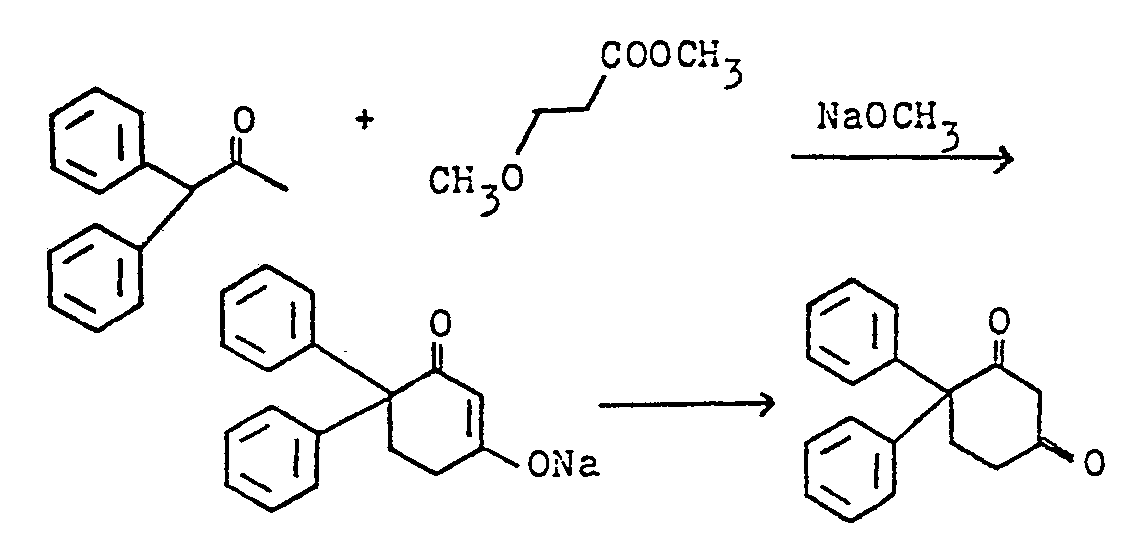
- Zu einer Suspension von 5,5 g (0,1 Mol) festem NaOCH3 in 50 ml Toluol wird unter N2-Atmosphäre eine Lösung von 21 g 1,1'-Diphenylaceton und 11,8 g β-Methoxypropionsäuremethylester in 100 ml Toluol innerhalb von 2 Stunden bei 90 °C zugetropft. Es fällt ein voluminöser Niederschlag aus. Das Reaktionsgemisch wird mit 100 ml Wasser versetzt und die erhaltene wäßrige Phase mit 50 %iger H2S04 auf einen pH-Wert von 2-3 angesäuert. Der erhaltene Niederschlag wird abfiltriert und getrocknet. Man erhält so 21 g einer Substanz mit einem Schmelzpunkt von 185-187 °C. Ausbeute 79 %.
- Gemäß IR-, NMR- und Massenspektrum handelt es sich um 4,4-Diphenyl-cyclohexan-1,3-dion im Gleichgewicht mit seinem Enol.
-
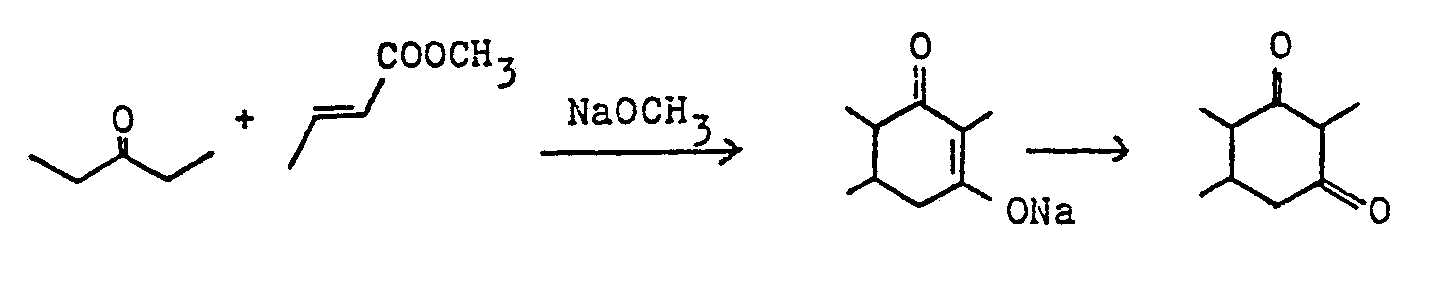
- Zu einer Mischung aus 20 g einer 30 %igen NaOCH3-Lösung in Methanol (entsprechend 0,11 Mol NaOCH3 und 0,44 Mol CH3OH) und 70 ml Xylol wird unter gutem Rühren und unter N2-Schutzgasatmosphäre ein Gemisch aus 8,6 (0,1 Mol) Diethylketon und 10g (0,1 Mol) Crotonsäuremethylester zugetropft und das Reaktionsgemisch unter Abdestillieren von Methanol erhitzt bis die Innentemperatur des Reaktionsgefäßes 130 °C beträgt. Anschließend wird das Reaktionsgemisch wie in Beispiel 1 näher beschrieben aufgearbeitet. Man erhält das 2,4,5-Trimethyl-cyclohexan-1,3-dion vom Schmelzpunkt F = 121-125 °C in einer Ausbeute von 70 % der Theorie.
-

- Zu einer Mischung von 20 g einer 30 %igen Lösung von NaOCH3 in Methanol (entsprechend 0,11 Mol NaOCH3 und 0,44 Mol CH3OH) und 70 ml Xylol wird unter Rühren und unter N2-Schutzgas ein Gemisch aus 11,4 g (0,1 Mol) n-Propyl-isopropylketon und 8,6 g (0,1 Mol) Acrylsäuremethylester zugetropft und anschließend das Reaktionsgemisch unter Abdestillieren von Methanol erhitzt, bis die Innentemperatur des Reaktionsgefäßes 130 °C beträgt.
- Bei einer Aufarbeitung analog Beispiel 1 erhält man 13 g 2-Ethyl-4,4-dimethyl-cyclohexan-1,3-dion in einer Ausbeute von 77 % der Theorie.
-

-

-

- Eine Aufarbeitung analog Beispiel 1 liefert aus der Toluolphase 10 g Cyclododecanon zurück und aus der wäßrigen Phase 100 g des neuen 13-Methyl-bicyclo [9.3.1 ] pentadecan-14,15-dion vom Schmelzpunkt F = 150-155 °C. Die Ausbeute beträgt 94,8 %, bezogen auf umgesetztes Cyclododecanon.
-

- Bei der Umsetzung von 0,5 Mol Cyclododecanon und 0,5 Mol β-Methoxy-propionsäuremethylester in Gegenwart von 0,5 Mol NaOCH3 analog Beispiel 10 erhält man das neue Bicyclo [9.3.1] pentadecan-14,15-dion vom Schmelzpunkt F = 157-159 °C. Ausbeute 60 %, bezogen auf umgesetztes Cyclododecanon.
-

- Bei der Umsetzung von 0,5 Mol Cyclododecanon und 0,5 Mol β-Methoxy-buttersäuremethylester in Gegenwart von 0,5 Mol NaOCH3 analog Beispiel 10 wird das neue 12-Methyl-bicyclo [9.3.1]-pentadecan-14,15-dion vom Schmelzpunkt F = 185-191 °C erhalten. Ausbeute 26 %, bezogen auf umgesetztes Cyclododecanon.
-

- Bei der Umsetzung von 0,1 Mol Cyclohexanon und 0,1 Mol β-Methoxy-propionsäuremethylester in Gegenwart von 0,1 Mol NaOCH3 analog Beispiel 10 wird 13 g Bicyclo [3.3.1] nonan-2,9-dion in Form eines zähen Öls erhalten. Ausbeute 85,5 %.
- Das NMR-Spektrum bestätigt die erwartete Struktur.
-

- 90 g einer 30 %igen NaOCH-Lösung in Methanol (entsprechend 0,5 Mol NaOCH3 und 2 Mol CH3OH) werden mit 200 ml Xylol versetzt und in diese Mischung innerhalb von 1 Stunde ein Gemisch aus 64 g (0,5 Mol) Octan-2-on und 43 g (0,5 Mol) Acrylsäuremethylester eingetropft. Anschließend wird das Reaktionsgemisch unter Abdestillieren von Methanol erhitzt bis die Innentemperatur im Reaktionsgefäß 130 °C beträgt. Aufarbeitung analog Beispiel 1 ergibt 80 g Rückstand entsprechend einer Rohausbeute an 4-Pentyl-cyclohexan-1,3-dion von 90 % der Theorie. Umkristallisation des Rohprodukts aus Essigsäureethylester ergibt 40 g eines Produktes vom Schmelzpunkt F = 68-70 °C, entsprechend einer Ausbeute von 45 %.
- In den im folgenden beschriebenen 4 Versuchen wird jeweils 0,5 Mol NaOCH3 in fester Form in 200 ml Xylol suspendiert und zu dieser Suspension die aus der folgenden Tabelle ersichtliche Menge Methanol zugefügt. Zu der erhaltenen Mischung wird bei 90 °C innerhalb von 30 Min. ein Gemisch aus 0,5 Mol Acrylsäureester und 0,5 Mol Diethylketon zugetropft und das Reaktionsgemisch noch 45 Min. bei 90 °C, bzw. in den Beispielen 17. und 18 unter Abdestillieren von Methanol zum Sieden erhitzt. Anschließend wird das Reaktionsgemisch mit ca. 200 ml Wasser versetzt, die wäßrige Phase auf einen pH-Wert = 3 gebracht, mit Essigsäureethylester extrahiert, getrocknet und eingeengt. Das erhaltene Rohprodukt wird zur Entfernung von nicht kristallinen Verunreinigungen mit Petrolether (Kp = 60-70 °C) und Diethylether bis zum Erhalt eines schmelzpunktkonstanten Produkts ausgerührt. Die Ausbeute an gereinigtem Produkt ist in der Tabelle angegeben.

- 6 g festes NaOCH3 wird in 50 ml Toluol suspendiert, zu dieser Suspension innerhalb von 2 Stunden unter Rückflußbedingungen ein Gemisch aus 0,1 Mol Diethylketon und 0,1 Mol β-Methoxy-propionsäuremethylester zugetropft und das Reaktionsgemisch noch 6 Stunden unter Rückfluß zum Sieden erhitzt. Aufarbeitung des Reaktionsansatzes analog Beispiel 1 ergibt das 2,4-Dimethyl-cyclohexan-1,3-dion in Ausbeuten von ca. 75 % der Theorie.
- Arbeitet man wie in Beispiel 19 beschrieben, verwendet jedoch anstelle von 0,1 Mol β-Methoxypropionsäuremethylester 0,1 Mol Acrylsäuremethylester, so erhält man das 2,4-Dimethyl-cyclohexan-1,3-dion nur in Ausbeuten von 11,5 % der Theorie.
- Arbeitet man wie in Beispiel 19 beschrieben, jedoch verwendet man anstelle von 50 ml Toluol 50 ml Methanol als Lösungsmittel, so erhält man das 2,4-Dimethyl-cyclohexan-1,3-dion nur in Ausbeuten von 7 % der Theorie.
- 6 g festes NaOCHa wird in 50 ml Dimethylformamid (DMF) suspendiert. Zu dieser Suspension wird innerhalb von 2 Stunden unter Rückflußbedingungen ein Gemisch aus 0,1 Mol Diethylketon und 0,1 Mol β-Methoxy-propionsäuremethylester zugetropft, das Reaktionsgemisch noch 90 Min. nachgerührt, anschließend mit 500 ml Wasser versetzt, auf einen pH-Wert von 2-3 gebracht, mit Essigsäureethylester extrahiert und eingeengt. Man erhält 10 g Rückstand, der nach NMR-Spektrum noch 2 g DMF enthält. Ausbeute ca. 57 % der Theorie.
Claims (6)


Applications Claiming Priority (2)
| Application Number | Priority Date | Filing Date | Title |
|---|---|---|---|
| DE19813112056 DE3112056A1 (de) | 1981-03-27 | 1981-03-27 | Verbessertes verfahren zur herstellung von cyclohexan-1,3-dionen sowie einige neue bicyclische cyclohexan-1,3-dione |
| DE3112056 | 1981-03-27 |
Publications (2)
| Publication Number | Publication Date |
|---|---|
| EP0061669A1 EP0061669A1 (de) | 1982-10-06 |
| EP0061669B1 true EP0061669B1 (de) | 1984-07-25 |
Family
ID=6128419
Family Applications (1)
| Application Number | Title | Priority Date | Filing Date |
|---|---|---|---|
| EP82102269A Expired EP0061669B1 (de) | 1981-03-27 | 1982-03-19 | Verbessertes Verfahren zur Herstellung von Cyclohexan-1,3-dionen sowie einige neue bicyclische Cyclohexan-1,3-dione |
Country Status (2)
| Country | Link |
|---|---|
| EP (1) | EP0061669B1 (de) |
| DE (2) | DE3112056A1 (de) |
Families Citing this family (4)
| Publication number | Priority date | Publication date | Assignee | Title |
|---|---|---|---|---|
| FR2543947B1 (fr) * | 1983-04-08 | 1985-07-26 | Centre Nat Rech Scient | Nouveaux tetra-alkyl-2,2,5,5 cyclohexanone-4 01-1 et leurs derives sulfonyles, leur preparation et leur application a la synthese de lactones cyclopropaniques |
| US5233095A (en) * | 1986-03-18 | 1993-08-03 | Catalytica, Inc. | Process for manufacture of resorcinol |
| JP4128223B2 (ja) * | 1996-09-27 | 2008-07-30 | フイルメニツヒ ソシエテ アノニム | 香料における環式ケトンの使用 |
| CN106146281A (zh) * | 2015-03-30 | 2016-11-23 | 王志训 | 一种大马酮的工业制造方法 |
Family Cites Families (1)
| Publication number | Priority date | Publication date | Assignee | Title |
|---|---|---|---|---|
| DE2533919C3 (de) * | 1975-07-30 | 1980-09-18 | Hoechst Ag, 6000 Frankfurt | Verfahren zur Herstellung von CyclohexandioneM 1.3) |
-
1981
- 1981-03-27 DE DE19813112056 patent/DE3112056A1/de not_active Withdrawn
-
1982
- 1982-03-19 DE DE8282102269T patent/DE3260432D1/de not_active Expired
- 1982-03-19 EP EP82102269A patent/EP0061669B1/de not_active Expired
Also Published As
| Publication number | Publication date |
|---|---|
| DE3112056A1 (de) | 1982-10-07 |
| DE3260432D1 (en) | 1984-08-30 |
| EP0061669A1 (de) | 1982-10-06 |
Similar Documents
| Publication | Publication Date | Title |
|---|---|---|
| DE2337813C3 (de) | Verfahren zur Herstellung von Monoacetalen aromatischer 1,2-Diketone | |
| DE2753454A1 (de) | Quadratsaeureester | |
| EP0165521B1 (de) | Verfahren zur Herstellung eines Gemisches aus einem gegebenenfalls substituierten Zimtsäureester und einem gegebenenfalls substituierten Beta-Alkoxy-Beta-phenyl-propionsäureester sowie Verfahren zur Herstellung von gegebenenfalls substituierter Zimtsäure | |
| EP0064605B1 (de) | Verfahren zur Herstellung von Resorcinderivaten sowie Verwendung bestimmter Resorcinderivate als Riechstoffe | |
| EP1241157B1 (de) | Verfahren zur Herstellung von 2,7-Dimethyl-2,4,6-octatrienal-monoacetalen | |
| EP0061669A1 (de) | Verbessertes Verfahren zur Herstellung von Cyclohexan-1,3-dionen sowie einige neue bicyclische Cyclohexan-1,3-dione | |
| DE2151493A1 (de) | Verfahren zur Herstellung eines Butyrolaktons | |
| EP0095047A1 (de) | Verfahren zur Herstellung von 3-vinylsubstituierten 2,2-Dimethylcyclopropan-1-carbonsäuren bzw. ihren Estern und neue Zwischenprodukte dafür | |
| DE2731543C3 (de) | Verfahren zur Herstellung von Cyclopentadecanolid | |
| CH646679A5 (de) | Verfahren zur herstellung von 1,5-dimethyl-bicyclo(3,2,1)octanol-8. | |
| EP0075237B1 (de) | Verfahren zur Herstellung von Derivaten des 1-Formyl-2,6,6-trimethyl-cyclohex-1-ens | |
| EP0119546B1 (de) | Neues Verfahren zur Herstellung von Verbindungen der 4-Oxodamascon-Reihe sowie neue Riechstoffe aus dieser Verbindungsklasse | |
| DE4408083C1 (de) | Verfahren zur Herstellung von 4-Fluoralkoxyzimtsäurenitrilen | |
| DE2912052C2 (de) | Verfahren zur Herstellung von 2-[4-(2- Thienylcarbonyl)-phenyl]-propionsäure | |
| DE3640591A1 (de) | Neue 2-substituierte 4-isopropyl-cyclohex-2-en-1-one | |
| DE2702088A1 (de) | Verfahren zur autoxidation eines cycloalkanons zu dem entsprechenden cycloalkan-1,2-dion | |
| DE1924844A1 (de) | Verfahren zur Herstellung von Trimethyl-2-cyclohexen-1-onen | |
| DE3031385A1 (de) | 1-hydroxypyrazol und verfahren zu seiner herstellung | |
| EP0087712B1 (de) | Verfahren zur Herstellung von 3-Cyan-2-alkylalkanalen und die Verwendung von 3-Cyan-2-ethylhexanal zur Herstellung von 2-Propylpentansäure | |
| DE3441369A1 (de) | Verfahren zur herstellung von hydroxymethylen-alkoxyessigsaeureestern | |
| DE1593302C (de) | Verfahren zur Herstellung von Cycloalkanonen mit 8 bis 15 Kohlenstoffatomen | |
| DE2611043C2 (de) | Verfahren zur Herstellung von 6,6-Alkylendioxyalkan-2-onen | |
| DE3048031A1 (de) | Verfahren zur herstellung substituierter pyrazine | |
| DE2547223B2 (de) | Verfahren zur Herstellung von 2,6,6-Trimethyl-cyclohex-2-en-l-on | |
| DE1668770B2 (de) | Verfahren zur herstellung von funktionell substituierten 1,4-dienen |
Legal Events
| Date | Code | Title | Description |
|---|---|---|---|
| PUAI | Public reference made under article 153(3) epc to a published international application that has entered the european phase |
Free format text: ORIGINAL CODE: 0009012 |
|
| AK | Designated contracting states |
Designated state(s): CH DE FR GB NL |
|
| 17P | Request for examination filed |
Effective date: 19820907 |
|
| GRAA | (expected) grant |
Free format text: ORIGINAL CODE: 0009210 |
|
| AK | Designated contracting states |
Designated state(s): CH DE FR GB LI NL |
|
| REF | Corresponds to: |
Ref document number: 3260432 Country of ref document: DE Date of ref document: 19840830 |
|
| ET | Fr: translation filed | ||
| PLBE | No opposition filed within time limit |
Free format text: ORIGINAL CODE: 0009261 |
|
| STAA | Information on the status of an ep patent application or granted ep patent |
Free format text: STATUS: NO OPPOSITION FILED WITHIN TIME LIMIT |
|
| 26N | No opposition filed | ||
| PGFP | Annual fee paid to national office [announced via postgrant information from national office to epo] |
Ref country code: FR Payment date: 19950224 Year of fee payment: 14 |
|
| PGFP | Annual fee paid to national office [announced via postgrant information from national office to epo] |
Ref country code: CH Payment date: 19950227 Year of fee payment: 14 |
|
| PGFP | Annual fee paid to national office [announced via postgrant information from national office to epo] |
Ref country code: GB Payment date: 19950315 Year of fee payment: 14 |
|
| PGFP | Annual fee paid to national office [announced via postgrant information from national office to epo] |
Ref country code: NL Payment date: 19950331 Year of fee payment: 14 Ref country code: DE Payment date: 19950331 Year of fee payment: 14 |
|
| PG25 | Lapsed in a contracting state [announced via postgrant information from national office to epo] |
Ref country code: GB Effective date: 19960319 |
|
| PG25 | Lapsed in a contracting state [announced via postgrant information from national office to epo] |
Ref country code: DE Effective date: 19960325 |
|
| PG25 | Lapsed in a contracting state [announced via postgrant information from national office to epo] |
Ref country code: LI Effective date: 19960331 Ref country code: CH Effective date: 19960331 |
|
| PG25 | Lapsed in a contracting state [announced via postgrant information from national office to epo] |
Ref country code: NL Effective date: 19961001 |
|
| GBPC | Gb: european patent ceased through non-payment of renewal fee |
Effective date: 19960319 |
|
| REG | Reference to a national code |
Ref country code: CH Ref legal event code: PL |
|
| PG25 | Lapsed in a contracting state [announced via postgrant information from national office to epo] |
Ref country code: FR Effective date: 19961129 |
|
| NLV4 | Nl: lapsed or anulled due to non-payment of the annual fee |
Effective date: 19961001 |
|
| REG | Reference to a national code |
Ref country code: FR Ref legal event code: ST |